New Thought is a movement devoted to the power of thought and the ability of individuals to deliberately influence health, character, habits, happiness, achievement, and the direction of their lives through the conscious use of the mind. It developed during the nineteenth century from American mental healing and initially consisted of numerous teachers, healers, writers, and small schools advancing related ideas without a common organization or completely unified explanation.

By the closing years of the nineteenth century and the opening years of the twentieth, the movement was being brought together through an increasingly interconnected group of writers, publishers, periodicals, schools, and national organizations. At the center of much of this development was Herbert A. Parkyn and the network that grew around his Chicago School of Psychology, where the Law of Suggestion supplied a systematic explanation capable of connecting many of the practices that had previously been taught under different names.
This development is fundamental to understanding what New Thought meant by the beginning of the twentieth century. Mental healing, affirmation, auto-suggestion, constructive thought, habit formation, concentration, personal influence, health, happiness, character, and success could increasingly be understood as applications of the same underlying principle. An idea accepted by the mind could influence feeling, bodily condition, habit, and action. Repeated thoughts could become established tendencies. Existing tendencies could be challenged by deliberately introducing opposing ideas. What had begun as a loose mental-healing movement was becoming an organized system of mental development, supported by a powerful network capable of carrying these teachings through magazines, books, schools, correspondence courses, lecturers, and organizations across the United States and abroad.
What Is New Thought?
New Thought begins with the proposition that thought is active. Human beings do not merely experience thoughts as passing events without consequence. What a person repeatedly thinks, expects, fears, believes, imagines, and accepts can become part of an established mental condition, and that condition can influence emotion, bodily experience, habit, behavior, character, and action.
The movement developed methods for deliberately intervening in this process. Instead of allowing fear, worry, anger, indecision, hopelessness, or expectations of failure to repeat themselves until they became habitual, individuals were taught to recognize those patterns and cultivate opposing ones. Courage could be placed against fear, confidence against self-doubt, calmness against anxiety, determination against indecision, and constructive expectation against anticipated failure. The repeated idea was intended to become increasingly established until it influenced the person’s habitual response.
New Thought extended this principle into nearly every area of life. Mental discipline was applied to health, relationships, work, business, personal influence, spiritual development, happiness, and prosperity. Different teachers supplied different explanations for the process, especially during the movement’s early period, but the repeated attempt to understand and direct the relationship between thought and experience remained at its center.
Where Did New Thought Begin?

New Thought grew from the nineteenth-century American mental-healing movement, with Phineas Parkhurst Quimby occupying an important place in its early development. Quimby began through an interest in mesmerism but gradually rejected the idea that an invisible magnetic fluid passing between operator and subject adequately explained the effects he observed. He became increasingly interested in belief, expectation, interpretation, and the possibility that mistaken ideas could contribute to illness and suffering.
This represented an important change. The source of the effect was moving away from the supposed magnetic power of the operator and toward processes occurring within the mind of the patient. If a belief could contribute to suffering, changing the belief could contribute to a different condition. The implications extended far beyond the original mesmeric setting.
After Quimby’s death in 1866, these ideas developed through a number of different teachers. Warren Felt Evans combined mental healing with the religious philosophy of Emanuel Swedenborg. Julius and Annetta Dresser carried forward another line of mental-healing teaching. Emma Curtis Hopkins became an influential teacher of metaphysical religion and trained people who would later establish important New Thought organizations. Other writers approached the subject through Christianity, idealist philosophy, mental science, psychology, or personal development.
How Did Mental Healing Become New Thought?
Mental healing initially concentrated upon illness and the relationship between belief and bodily condition. Once thought was accepted as an important factor in health, the same reasoning could be extended to other parts of life. Fear affected more than illness. It affected action. Confidence influenced more than emotional condition. It influenced behavior. Habitual expectations could shape decisions, relationships, work, and character.
The subject therefore expanded. Writers began discussing mental control, character building, concentration, self-confidence, personal influence, habit, happiness, achievement, and prosperity. The question was no longer simply whether mind could affect the body. It became whether the individual could consciously direct the mind and thereby change the course of his or her life.
This transition created the New Thought movement in the fuller sense of the term. Mental healing remained important, but it became one application within a much larger philosophy of mental development. Health, happiness, and success could all be approached through the same fundamental question of how thought becomes established and how established thought influences experience.
What Did New Thought Mean by the Power of Thought?
The power of thought in New Thought begins with repetition and mental tendency. A thought repeatedly entertained becomes easier to reproduce. An expectation repeatedly rehearsed becomes increasingly habitual. Habitual expectations influence attention and interpretation, while established mental attitudes affect emotion and action.
This gave ordinary thinking enormous importance. Fear continually rehearsed could become a habitual expectation of danger or failure. Persistent resentment could establish a recurring emotional response. Repeated self-doubt could inhibit action before an opportunity had even been tested. The same process could operate in the opposite direction. Confidence, courage, determination, calmness, and constructive expectation could also be deliberately cultivated.
Many New Thought writers extended this principle beyond the individual mind and taught that thought itself exercised influence through universal mental laws. Thoughts could be described as forces, vibrations, or forms of mental energy capable of affecting other minds and external circumstances. These teachings became associated with mental attraction, personal magnetism, telepathy, and the idea that corresponding mental states attract one another.
New Thought therefore developed both an internal and an external conception of mental power. Thought shaped the individual through habit, expectation, emotion, and action, while many writers also maintained that thought participated in a larger field of mental causation.
What Was Mental Science?
Mental Science was an attempt to identify laws governing the operation of thought and then apply those laws deliberately. The word “science” was important to its advocates because they believed the mind did not operate randomly. Mental phenomena were governed by principles that could be discovered, taught, and repeatedly applied.
This search for mental law became one of the major forces pushing New Thought toward greater unity. Different teachers might speak about healing, affirmation, thought power, concentration, habit, personal influence, or success, but each was attempting to explain how ideas produced effects. Once the process itself became the subject of investigation, similarities between apparently different methods became much easier to recognize.
The Law of Suggestion eventually became especially important within this development. Suggestion offered an explanation for how an idea could be introduced into the mind, accepted, repeated, and converted into a mental tendency capable of affecting bodily condition, feeling, habit, and action. It supplied a mechanism that could be applied to many teachings that had previously existed under separate names.
What Is the Law of Suggestion?
Suggestion is the process through which an idea is introduced or activated in the mind and becomes capable of influencing a subsequent response. The idea may come from another person, from circumstances and expectations, or from the individual through auto-suggestion. Once accepted and sufficiently established, it can influence thought, feeling, perception, habit, bodily response, and behavior.
This principle provided New Thought with something more precise than the general statement that thoughts are powerful. It offered a way of explaining how a thought became powerful. An idea had to enter mental activity, acquire acceptance, receive attention, and become established strongly enough to influence what followed. Repetition could strengthen it, while competing ideas could weaken or oppose it.
The Law of Suggestion also helped explain why so many New Thought methods resembled one another. Affirmation, constructive thinking, mental treatment, concentration upon a desired quality, and deliberate replacement of a negative thought all involved introducing and strengthening selected ideas. Their theological or metaphysical explanations might differ, while the mental operation could be understood through suggestion.
What Is Auto-Suggestion?

Auto-suggestion occurs when an individual deliberately directs suggestion toward his or her own mind. Instead of depending upon another person to introduce the idea, the individual chooses the thought to be established and repeatedly directs attention toward it.
This gave New Thought a method of self-directed mental change. A person who recognized a recurring tendency toward fear could deliberately cultivate courage. Indecision could be opposed with a suggestion of immediate action. Expectations of failure could be met with confidence and determination. Repetition allowed the new idea to compete with an established mental habit until the desired response became increasingly familiar.
Auto-suggestion also helped transform mental development from something done by a healer or teacher into something the individual could practice independently. Once the principles were understood, the student could become the operator of his or her own mental training.
What Are Affirmations?
Affirmations are deliberately selected statements expressing a desired mental, physical, spiritual, or personal condition. They became one of the characteristic methods of New Thought because they provided a direct means of repeatedly placing a chosen idea before the mind.
An affirmation of courage attempts to establish courage as the dominant idea when fear appears. An affirmation of health directs attention toward health instead of continually rehearsing illness. An affirmation of confidence attempts to replace habitual expectations of failure with an expectation of successful action. The effectiveness attributed to the affirmation came from the continued establishment of the selected idea.
Some New Thought teachers understood affirmation religiously. The statement was not merely an attempt to persuade oneself of something desirable. It was an affirmation of what the teacher regarded as a deeper spiritual truth concerning God, Divine Mind, health, abundance, or the nature of the individual. Others explained essentially the same practice through mental science, habit, or suggestion.
This difference in explanation did not prevent the methods from converging. Affirmation and auto-suggestion could become nearly identical in operation even when the philosophical explanation behind them differed.
What Is Denial?
Denial was frequently used alongside affirmation. The purpose was to withdraw mental acceptance from an undesirable condition before directing the mind toward its opposite. Fear could be denied authority and courage affirmed. Limitation could be denied as an inevitable condition and possibility affirmed in its place.
The process should not simply be understood as pretending that an existing circumstance was absent. Within developed New Thought teaching, denial was directed toward the mental authority granted to the condition. The individual attempted to stop continually affirming the unwanted state through attention, expectation, and repetition.
How Did New Thought Understand Habit?
Habit provided one of the clearest explanations for why repeated thought mattered. A thought or action repeated many times becomes increasingly easy to reproduce. Eventually it can occur with little deliberate effort. New Thought applied this observation to mental states as well as physical actions.
A person who continually responds to difficulty with fear is rehearsing fear. Someone who continually postpones action is rehearsing hesitation. Repetition strengthens the existing pathway. Changing the habit requires more than intellectually recognizing that it is undesirable. Another response must be deliberately practiced until it begins to compete with and eventually replace the old one.
This made mental discipline a daily activity. The individual watched for the return of the old thought and introduced its opposite. Repetition continued until the new response became increasingly habitual. Thought was being trained in much the same way that repeated action trains behavior.
What Did New Thought Teach About Character?
New Thought treated character as capable of deliberate development. Courage, confidence, self-control, persistence, patience, concentration, and determination were not simply qualities a person either possessed or lacked. They could be cultivated through repeated thought and action.
This was a significant expansion from mental healing. The same principles once applied primarily to illness could now be used to reshape personality. Mental development became character development.
The idea also placed responsibility upon action. Constructive thinking was not complete if it remained an internal exercise. A new mental attitude had to find expression through behavior. Confidence had to produce confident action. Determination had to produce persistence. The desired thought became meaningful when it was translated into conduct and eventually into character.
What Did New Thought Teach About Health?
Health remained one of the central subjects of New Thought because the movement had developed from mental healing. Fear, worry, grief, anger, expectation, and other mental states were understood to influence bodily experience, while calmness, confidence, hope, and constructive expectation were cultivated as beneficial conditions.
The extent of the claims varied. Some teachers attributed disease primarily to erroneous mental conditions and treated mental or spiritual correction as the principal remedy. Others accepted physical causes while maintaining that mental condition played an important role in health, symptoms, recovery, and behavior.
What became increasingly important was the relationship between the idea held in mind and the bodily response associated with it. Suggestion supplied one way of explaining that relationship. A suggested sensation could sometimes produce a bodily response. Expectations could affect experience. Repeated mental states could influence habits involving sleep, appetite, tension, and other bodily functions. Mental healing and suggestive therapeutics could thus approach similar phenomena from different directions.
What Did New Thought Teach About Fear?
Fear became one of the most frequently attacked mental states in New Thought because its effects could be observed throughout the person. Fear changes attention, expectation, bodily condition, decision making, and action. Repeated fear can become habitual, causing the individual to anticipate failure or danger before circumstances warrant the response.
The standard New Thought response was not simply to command fear to disappear. An opposing mental condition had to be cultivated. Courage, confidence, faith, calmness, and determination were repeatedly placed against fear until the desired response became more established.
What Did New Thought Teach About Success?
Success became a major New Thought subject when mental principles were extended from healing and character into work, business, and achievement. Writers examined fear of failure, indecision, lack of confidence, procrastination, concentration, initiative, persistence, and the ability to act upon an intention.
The underlying principle remained consistent. The person dominated by an expectation of failure approaches action differently from someone expecting the possibility of success. Repeated thoughts create attitudes, attitudes influence conduct, and conduct produces consequences. Mental training was intended to alter the chain at its beginning.
This is why health, happiness, and success became so closely associated within the movement. They were not necessarily treated as three unrelated objectives. Each could be approached through the deliberate direction and training of thought.
What Did New Thought Teach About Prosperity?
Prosperity developed into an extension of the same system. Thoughts concerning scarcity, failure, inability, and hopelessness were treated as limiting mental conditions, while confidence, initiative, expectation, and openness to opportunity were cultivated in their place.
Some writers explained prosperity primarily through changes in the individual. A person expecting opportunity might recognize possibilities that fear or hopelessness had previously caused him to ignore. Greater confidence could affect negotiation, persistence, social relationships, and willingness to act.
Other New Thought writers went further and treated prosperity as a direct expression of mental or spiritual law. Thoughts were believed to attract corresponding conditions, and abundance could be described as a universal spiritual reality with which the individual needed to bring consciousness into harmony. This became one of the sources of the later Law of Attraction tradition.
What Did New Thought Mean by the Law of Attraction?
The historical Law of Attraction developed from the proposition that corresponding mental states tend to draw one another together. Thoughts, people, opportunities, and circumstances were described as responding according to similarity or affinity.
The concept could be understood at different levels. Attention influences what a person notices. Expectation influences action. Character affects relationships. Confidence and persistence can alter the opportunities a person pursues. These processes can create results that appear to correspond with the original mental state.
More metaphysical writers treated attraction as an actual mental law operating beyond these psychological and social processes. Thoughts themselves were described as forces capable of attracting corresponding thoughts and circumstances. This version became closely connected with the language of vibration and mental magnetism.
Why Did New Thought Speak About Vibration and Mental Magnetism?
The language of vibration and magnetism supplied New Thought with a model for describing invisible mental influence. Nineteenth-century discoveries involving electricity, magnetism, sound, light, and other unseen physical processes had demonstrated that invisible forces could produce observable effects. Metaphysical writers adapted this language to thought.
Thoughts were described as producing vibrations or waves. Individuals could possess personal magnetism. Similar mental states could attract one another. Mental influence might operate at a distance and could be connected with telepathy.
These claims should be distinguished from the physical sciences whose terminology they borrowed. The scientific existence of electromagnetic phenomena did not demonstrate the existence of mental vibrations of the kind proposed by New Thought writers. Historically, however, this vocabulary became one of the principal ways in which the movement attempted to explain the transmission and attraction of thought.
How Did New Thought Understand Divine Mind?
Religious New Thought placed the individual mind within a greater spiritual reality usually described as Divine Mind, Infinite Mind, Universal Mind, Infinite Intelligence, or Spirit. God was understood not simply as a distant personal being but as an intelligent and spiritual presence underlying life.
Under this interpretation, mental development involved bringing individual consciousness into harmony with the greater mind. Health, wisdom, love, harmony, and abundance could be understood as qualities of divine reality. Affirmation became a means of recognizing and establishing those qualities in consciousness.
This allowed religious and mental-science interpretations to coexist within New Thought. One teacher could describe a process as aligning thought with Divine Mind while another explained a similar exercise through suggestion, habit, or mental law. The methods could converge even when their explanations differed.
How Did New Thought Differ from Christian Science?
New Thought and Christian Science developed from the same nineteenth-century American interest in mental and spiritual healing, but they became different movements. Christian Science under Mary Baker Eddy developed a defined theology, authoritative literature, and centralized religious organization. New Thought followed a different path.
New Thought absorbed a much wider range of mental, psychological, religious, and metaphysical ideas. It could accommodate Christian teaching, mental science, suggestion, personal development, theories of vibration, prosperity, and other systems without requiring adherence to one authoritative theology.
This openness became increasingly important as New Thought began to organize. Unity did not require every teacher to adopt identical religious beliefs. Common mental principles could connect people whose theological explanations remained different.
Who Was Henry Wood?
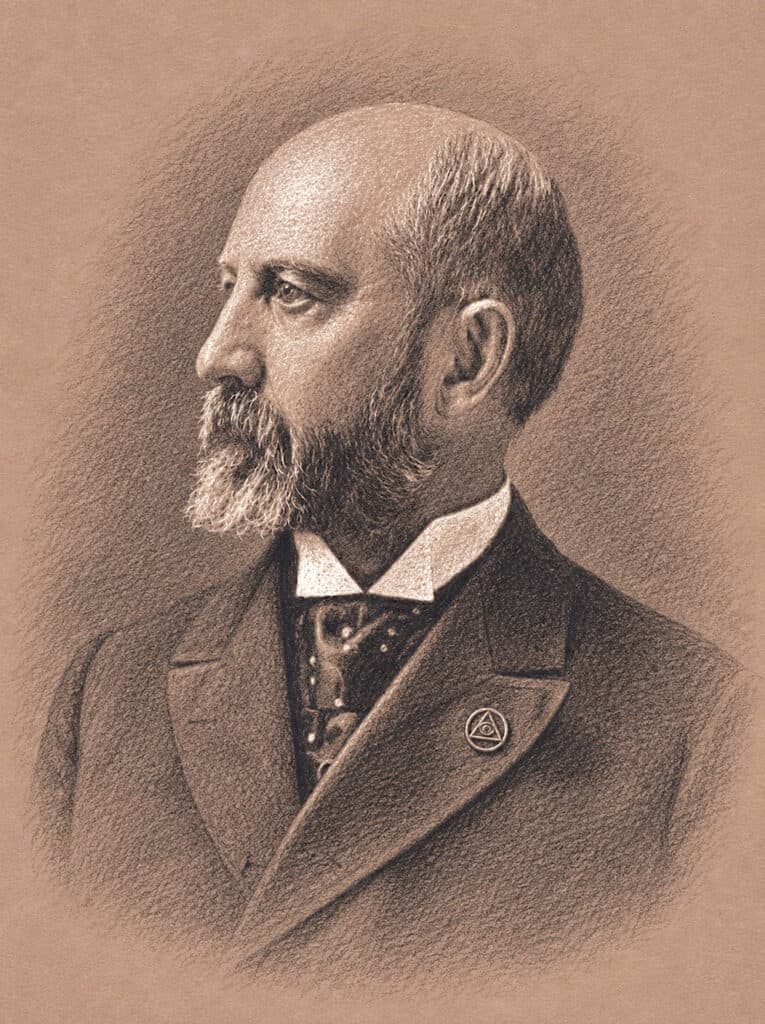
Henry Wood was one of the important early writers who helped move New Thought beyond isolated mental healing and toward a developed philosophy of mental and spiritual life. His books explored the relationship between thought, health, character, spiritual development, and the laws governing mental life. He became one of the movement’s respected literary voices during the period in which New Thought was developing a more coherent identity.
Wood is also important to this history because he was not merely a distant author who happened to write on similar subjects. He belonged to the close personal world surrounding Parkyn and his family. That relationship places his work within the human network through which New Thought ideas were being discussed, developed, published, and connected.
His writings show the movement extending beyond the treatment of disease into a philosophy of mental development. Health remained important, while thought, character, spiritual law, and the deliberate cultivation of mental states became part of a much larger system. This was the direction in which New Thought itself was moving.
How Did Herbert A. Parkyn Change New Thought?
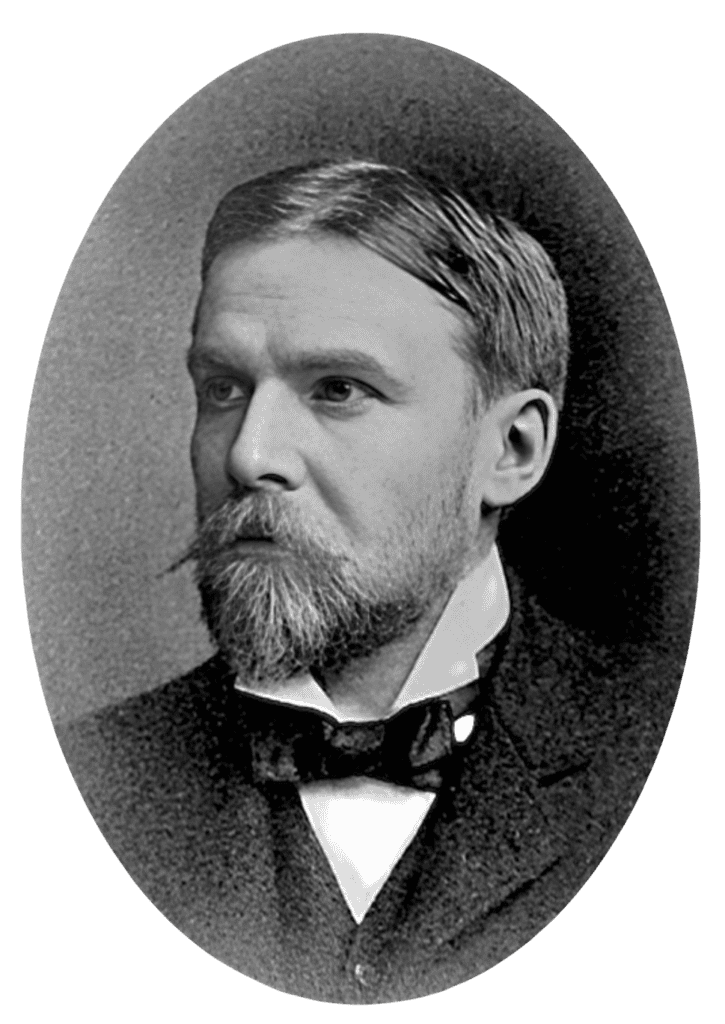
Herbert A. Parkyn entered this developing field with something that New Thought badly needed. He had spent years investigating the mechanism through which ideas could produce mental and bodily effects. His clinical work in Toronto between 1892 and 1894 and more than one thousand subsequent demonstrations with W. X. Sudduth in Minneapolis during 1894 and 1895 led him to the conclusion that suggestion itself, not hypnotic sleep, was the active agent.
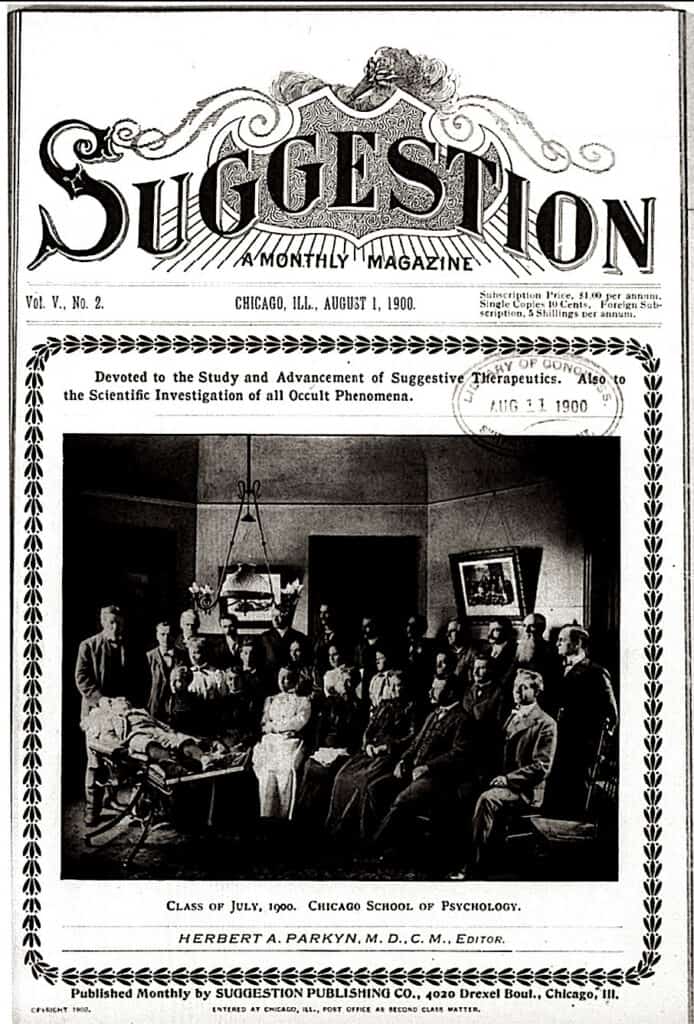
Parkyn began teaching in 1895 and founded the Chicago School of Psychology in 1896. His system expanded far beyond the induction of hypnosis. Suggestion, waking suggestion, auto-suggestion, mental habits, health, character, personal influence, confidence, will, and success became interconnected parts of a teachable system.
The importance of this development to New Thought is difficult to overstate. Many practices already circulating within mental healing could now be explained through the Law of Suggestion. Affirmation was a form of deliberately introduced thought. Repeated constructive thinking could be understood as auto-suggestion. Mental habits could be created or opposed through repeated suggestion. Fear could be met by establishing its opposite. Confidence could be cultivated. Thought could be translated into action and action into habit.
Parkyn was not simply adding another theory to an already crowded movement. His system supplied an organizing law through which much of its existing practice could be understood.
What Was the Suggestion Family?
Around Parkyn developed an interconnected network of physicians, psychologists, writers, lecturers, editors, publishers, students, graduates, investors, and organizers. The group became sufficiently interconnected that it can be understood as the Suggestion Family, a network whose activities reached across psychology, mental healing, New Thought, publishing, correspondence education, psychic science, and metaphysical teaching.
Its strength came from the fact that it did not depend upon a single book, teacher, or organization. The network controlled or influenced multiple channels through which ideas circulated. It had schools and affiliated schools. It had correspondence courses capable of reaching students far beyond Chicago. It had magazines and publishing operations. It had writers capable of translating the same underlying principles into different forms for different audiences. It also possessed the organizational connections necessary to bring previously separate New Thought teachers and groups into communication with one another.
This is where the history of New Thought changes. The earlier movement had consisted largely of related teachers and systems developing along parallel lines. The Suggestion Family possessed the machinery to connect those lines.
How Did the Suggestion Family Bring New Thought Together?
The consolidation of New Thought occurred through people as much as through doctrines. Parkyn’s network was connected personally and professionally with important writers and teachers across the movement, including close family friends such as Henry Wood. These relationships existed alongside an expanding system of periodicals, publishers, schools, lecturers, and organizations capable of circulating ideas on a national scale.
Elmer Ellsworth Carey became especially important through the Union New Thought movement. The purpose was no longer simply to promote another local school of mental healing. The work sought to bring New Thought teachers, organizations, writers, and publications together into a connected movement.
The significance of this development becomes apparent when combined with the publishing power of the Suggestion Family. Organization supplied connections between groups. Periodicals supplied regular communication. Books supplied lasting statements of doctrine. Correspondence courses supplied structured instruction. Writers supplied public voices capable of carrying the teachings to a large readership. The network increasingly possessed all of these at once.
New Thought was no longer simply a collection of people independently discovering that thought mattered. It was becoming an organized movement with national communication, recognizable literature, influential teachers, and increasingly shared principles.
Why Did the Law of Suggestion Become So Important?
The Law of Suggestion could unite New Thought without requiring complete agreement on theology. A Christian metaphysical healer, a mental scientist, a psychologist, a teacher of personal magnetism, and a writer on success might disagree about God, spirit, vibration, or the nature of reality. They could nevertheless employ essentially the same process of mental change.
An idea is presented. Attention is directed toward it. Repetition strengthens it. Expectation assists its acceptance. The accepted idea becomes a mental tendency. That tendency influences emotion, bodily response, habit, and action. An undesirable tendency can be opposed through the deliberate introduction of another idea.
This gave New Thought an operational center. The movement could retain different religious and metaphysical interpretations while increasingly organizing its methods around the deliberate use of thought. The Law of Suggestion helped turn a collection of related teachings into a system.
Parkyn’s own formulations make the direction unmistakable. “Health, Happiness, and Success” joined the principal objectives of the movement into a single formula. “I Can and I Will” united expectation with volition. “Do it Now” carried thought immediately toward action. “Thought takes form in action” stated the process directly. These were expressions of a system in which thought was cultivated for the purpose of producing an established mental tendency and translating it into life.
How Did New Thought Become Connected with the Yogi Publication Society?
By the time the Yogi Publication Society began in 1903, the transformation described above was already well underway. Parkyn had been teaching since 1895. The Chicago School of Psychology had existed since 1896. His Special Mail Course in Hypnotism and Suggestive Therapeutics had been issued in 1898. His educational and publishing network had expanded, and the Suggestion Family had become deeply involved in the organization and literature of New Thought.
YPS began within this existing structure. Its later books cannot be understood as though an entirely separate group suddenly discovered concentration, mental control, thought power, habit, personal influence, health, will, character, and self-development. Those subjects had already been developed and organized within the network from which the Society arose. The YPS literature expanded the range enormously. Under Yogi Ramacharaka and later pseudonymous identities, mental training could be joined with Yogi philosophy, psychic development, Hermeticism, and other systems. The terminology and cultural presentation could change while familiar methods of mental direction continued beneath them.
New Thought is thus one of the central subjects for understanding the Yogi Publication Society because it reveals what existed before YPS. The Society grew from a network that had already helped transform New Thought from a scattered mental-healing movement into a connected system increasingly organized around the Law of Suggestion. The books that followed were produced after that consolidation, not before it.