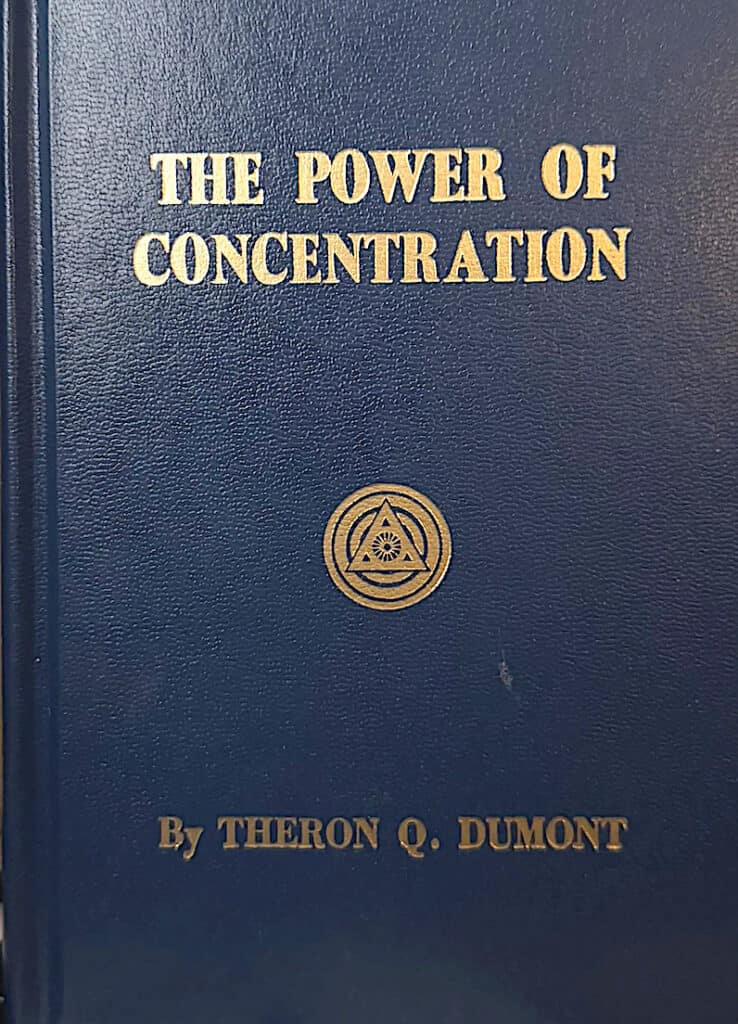
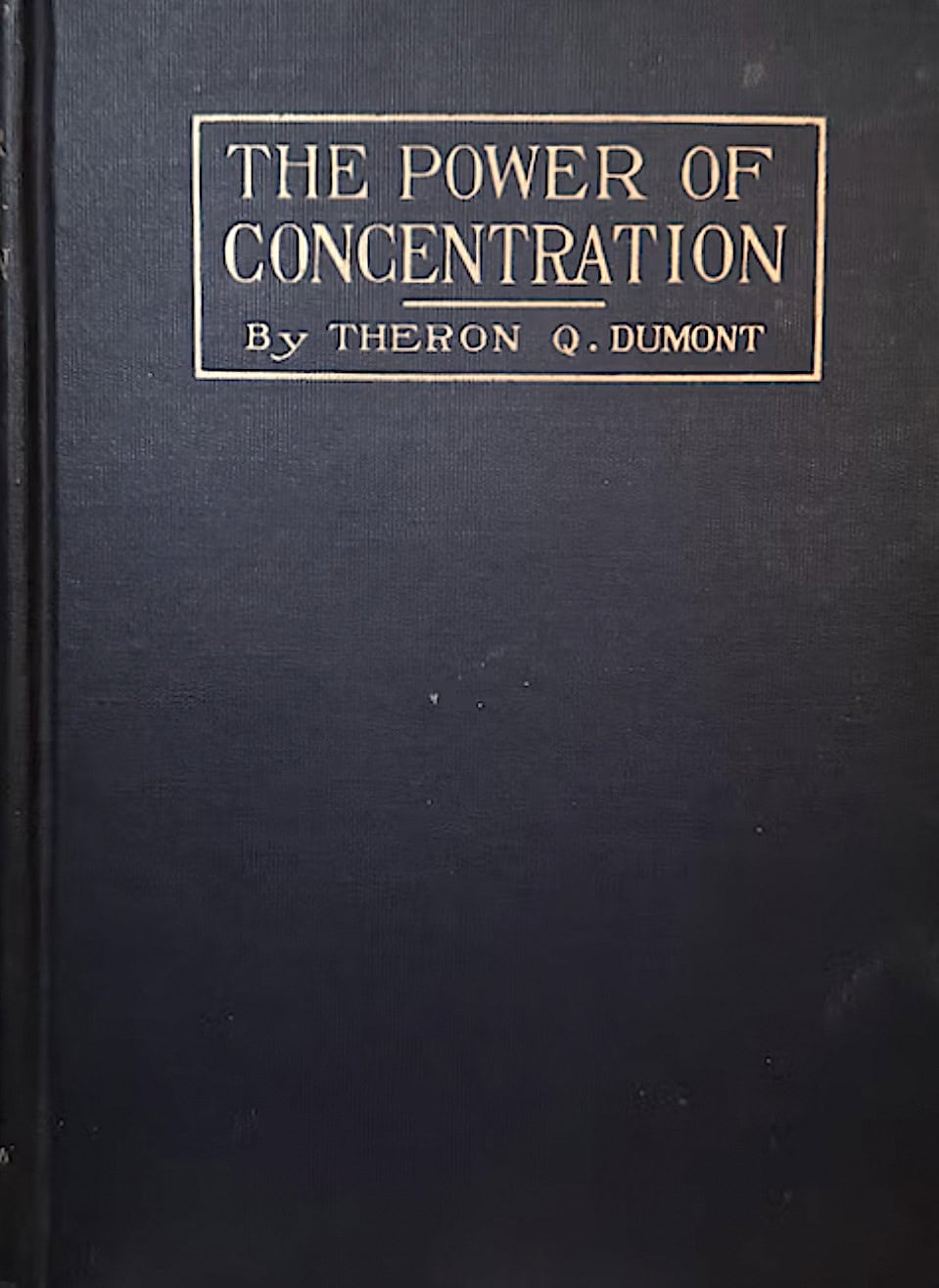
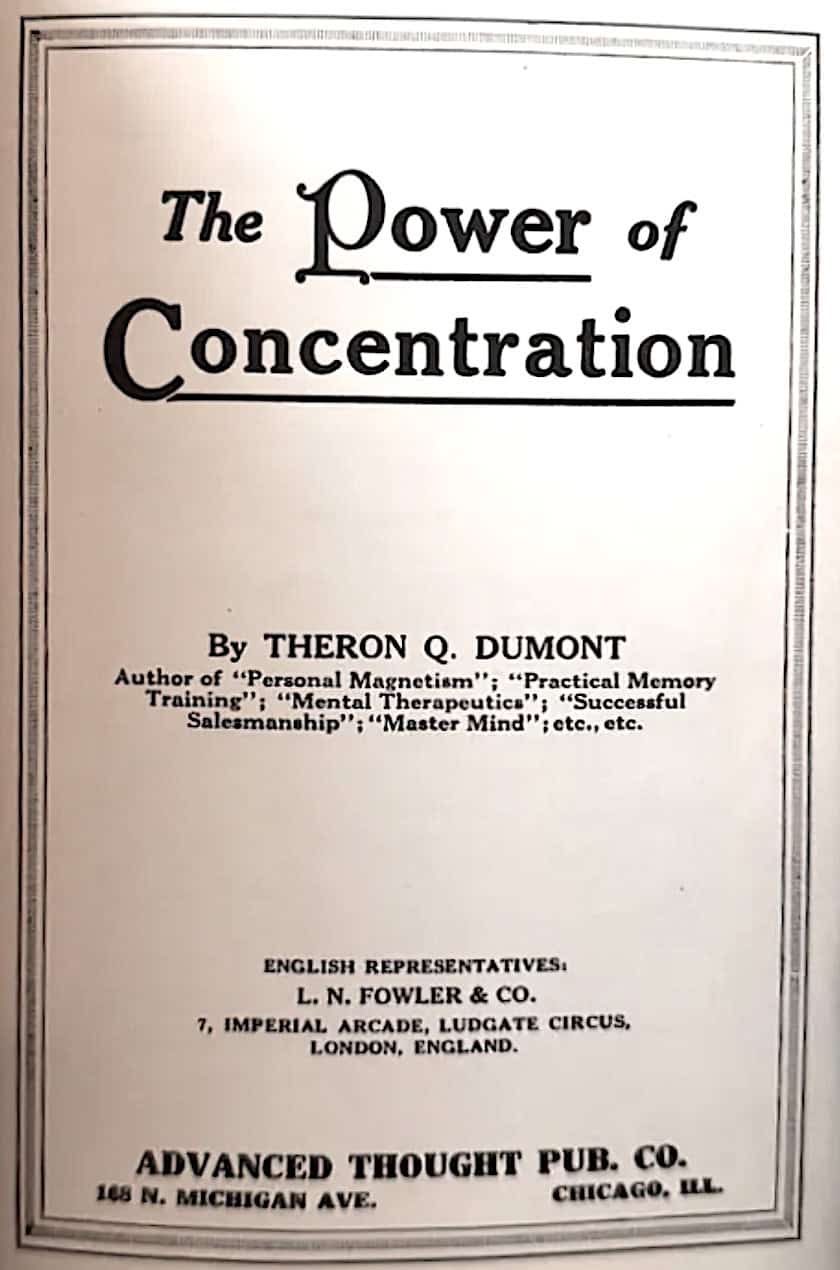
The Power of Concentration by Theron Q. Dumont was published by the Yogi Publication Society in 1918 as a twenty-lesson course in the development and use of concentrated thought. Dumont presents concentration as a trainable power through which a person learns to direct the will, regulate thought and emotion, overcome habits, strengthen memory, pursue definite aims, improve business performance, develop courage, and exert greater control over the conditions of everyday life.
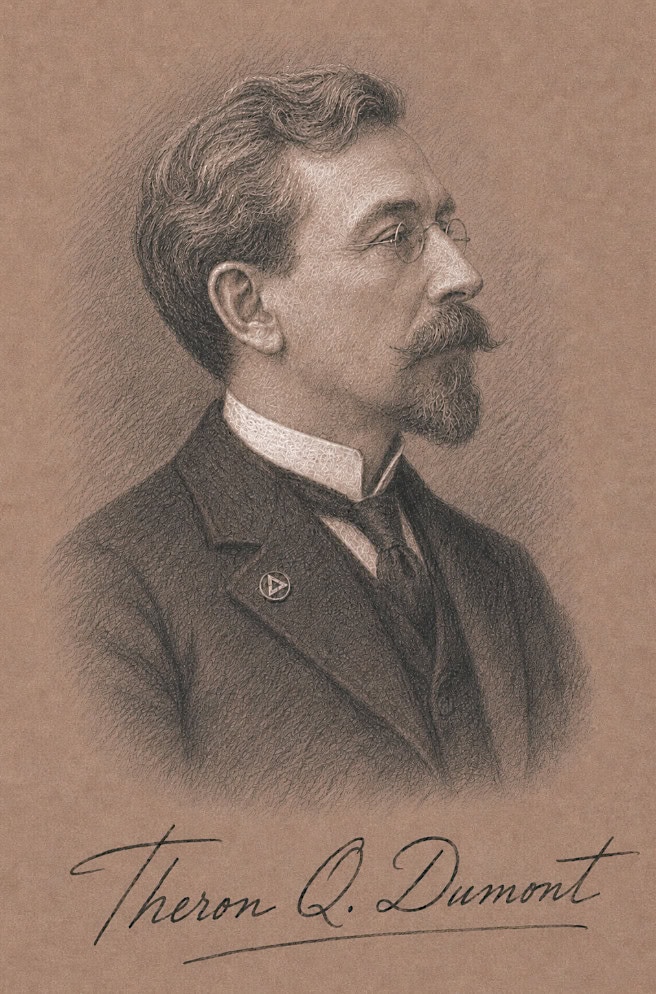
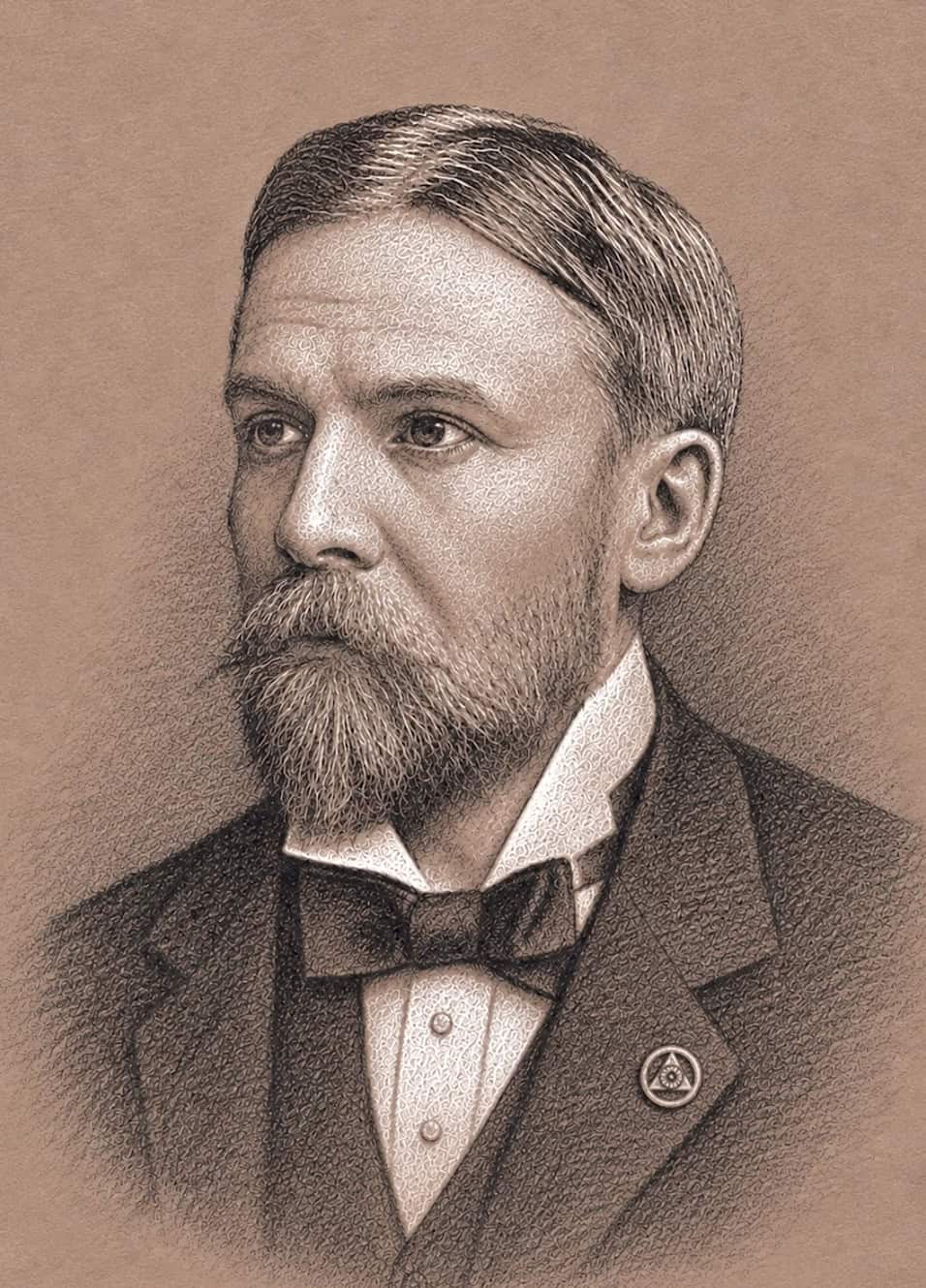
Theron Q. Dumont, “The Great French Authority and Foremost Psychologist of Paris, France. (artist depiction)
The book also has a strong relationship to the earlier psychological system developed by Herbert A. Parkyn and taught through his Chicago School of Psychology. Concentration, voluntary control, will, attention, habit formation, mental imagery, repetition, self-direction, the regulation of involuntary responses, and the movement of thought into action were already central parts of Parkyn’s teaching, and they form the working foundation of Dumont’s course. The detailed comparison at the end of this summary shows how closely The Power of Concentration follows these established principles while applying them to self-mastery, business, memory, courage, desire, personal influence, and achievement.
The 1918 title page identifies Dumont as the author of Personal Magnetism, Practical Memory Training, Mental Therapeutics, Successful Salesmanship, and Master Mind, showing how The Power of Concentration was presented alongside a connected group of books devoted to mental development, influence, memory, healing, and achievement. Across its twenty lessons, the book moves from basic control of attention and will into business success, mental demand, habit, courage, wealth, memory, desire, ideals, thought projection, influence over others, and advanced exercises for strengthening the will. The result is one of the clearest examples of how the Yogi Publication Society applied the principles of suggestion, self-direction, and mental control to a systematic course for everyday use.
What Is The Power of Concentration About?
The Power of Concentration teaches that concentrated thought gives direction to the forces already operating within the individual. Dumont does not define concentration simply as paying attention for a long period of time. He treats it as the ability to select an object, purpose, thought, or desired condition and hold the mental faculties steadily upon it while excluding competing impulses and distractions. The introduction makes this point directly: success requires the ability to concentrate one’s “entire thought upon the idea” being worked out, while conscious concentration allows constructive thoughts to be retained and destructive ones to be excluded. He assures readers that difficulty concentrating at first is normal and that the faculty can be strengthened through daily exercise.
The book is equally concerned with action. Concentration that never produces conduct has little value in Dumont’s system. The concentrated mind is supposed to direct behavior, organize effort, overcome procrastination, establish habits, improve work, and persist until an objective is reached. Dumont repeatedly returns to the will because the will supplies direction to concentration. His first lesson opens with the struggle between two tendencies within the individual, one moving toward advancement and another pulling backward, with the will deciding which gains control. The person becomes the director of his own life by learning to choose which thoughts and tendencies receive sustained attention.
The complete course can be reduced to several closely connected principles:
concentration can be trained through repeated exercise;
the will determines where mental energy is directed;
thoughts repeatedly entertained influence habits, conduct, character, and circumstances;
attention should be withdrawn from fear, worry, discouragement, and other unwanted mental states;
definite desires and ideals give concentration a target;
visualization strengthens the mental conception of the desired result;
control of bodily actions, impulses, emotions, and habits strengthens mental control;
concentration improves memory, judgment, persistence, confidence, business effectiveness, and personal influence;
mental force can be directed toward other people as well as toward one’s own development;
knowledge of these principles is of little use unless the reader repeatedly puts them into action.
These ideas provide the framework for all twenty lessons. The table of contents itself shows the deliberate progression from “Concentration Finds the Way” and “The Self-Mastery, Self-Direction Power of Concentration” through will, habit, business, courage, wealth, memory, desire, ideals, mental control, and finally concentrated will development and a review of the entire system.
Concentration Begins With Self-Mastery
Dumont’s second lesson gives one of the book’s clearest definitions of the subject by joining concentration directly to self-mastery and self-direction. He argues that the normal mind possesses faculties capable of directing and concentrating mental and physical operations, yet most people have never trained them adequately. When these controlling faculties remain undeveloped, impulses, passions, emotions, thoughts, actions, and habits operate without sufficient regulation. The problem is not necessarily lack of mental capacity. It is lack of training.
This is why physical self-control receives surprising attention. Dumont tells the reader to regulate bodily movements, impulses, breathing, emotional reactions, and unnecessary expenditure of energy. Mental concentration and physical control reinforce one another because bodily action is understood as the expression of mental direction. He describes the muscles, nerves, hands, feet, and other physical structures as instruments carrying out the “mandates of the mind.” By placing voluntary control over movements, impulses, thoughts, and emotions, the individual develops the faculty of self-mastery and strengthens concentration.
Dumont also distinguishes concentration from passive reverie. A negative or abstracted mental condition is not concentration. The strong mind can place itself upon a chosen subject and can also remove itself from that subject when desired. The ability to begin and end attention voluntarily is part of the power. “Concentration, first, last and all the time,” he writes, “means strength of mind.”
This conception has a close relationship to the mental training taught by Herbert A. Parkyn through the Chicago School of Psychology and his Special Mail Course in Hypnotism and Suggestive Therapeutics. Control is developed through repeated voluntary direction until the desired response becomes easier and increasingly habitual. In The Power of Concentration, that principle is applied across nearly every area of life.
How Does Concentration Help a Person Get What He Wants?
Lesson Three turns concentration toward definite attainment. Dumont rejects idle wishing and repeatedly insists upon directed effort. The person must know what he wants, hold it clearly before the mind, concentrate upon the means of attaining it, and act when opportunities appear. The table of contents describes this as learning the “secret of getting what you concentrate on,” while warning that the reader is not living in a “fairy age” in which dreaming alone produces results.
This distinction is important because some of Dumont’s language can resemble later versions of attraction teaching. His actual method continually brings the reader back to will, preparation, decision, persistence, observation, and action. Concentration helps the individual notice possibilities, maintain a purpose when obstacles appear, organize effort around a definite aim, and avoid scattering energy among conflicting desires. The desired result becomes the organizing center around which thought and conduct are arranged.
The first lesson already establishes this principle through Dumont’s discussion of opportunity. He argues that opportunity does not simply arrive at the door. It must be sought and used. Two people may encounter similar circumstances, yet the one who acts while the other procrastinates obtains the advantage. Habit can also be changed once the individual learns to master the “I will.” Concentration becomes a method for turning intention into sustained conduct.
Concentration as a Force in Business and Success
Business occupies a major place in The Power of Concentration. Lesson Four is titled “Concentration, the Silent Force That Produces Results in All Business,” while Lesson Ten returns to “Business Results Gained Through Concentration.” Dumont views successful business activity as an expression of organized thought. A person who scatters attention, doubts his judgment, changes direction constantly, or allows fear and emotional disturbance to dominate his decisions wastes the mental resources required for sustained achievement.
The concentrated businessperson directs thought into useful channels, studies conditions, improves efficiency, develops confidence, acts decisively, and learns to make his services valuable. Dumont is interested in the mental qualities behind advancement more than formal credentials or extraordinary intellectual ability. The manager who rises above others may possess no greater natural talent. His advantage lies in preparation, concentrated effort, reliability, initiative, and the ability to direct himself toward a purpose without continually abandoning it.
This part of the book also connects concentration with personal influence. Confidence is communicated. Mental attitude appears in expression, posture, speech, conduct, and the manner in which a person approaches others. Dumont treats personal magnetism as the outward result of organized internal forces, an idea developed at greater length elsewhere in the writings of Theron Q. Dumont. Concentration, self-control, confidence, controlled emotion, and directed will combine to produce the person who appears forceful because his mental and physical energies are working together.
How Does Concentrated Thought Connect People?
Lesson Five expands the theory beyond individual self-control with “How Concentrated Thought Links All Humanity Together.” Dumont presents thought as an active force connecting individuals with corresponding mental influences. He tells readers that uncontrolled worry, anxiety, discouragement, and despondency expose them to destructive mental conditions, while constructive thinking connects them with influences of a similar character. “Your thoughts make you what you are,” he states, adding that changes in thought are followed by changes in environment and associations.
The language belongs to the mental-force theories found throughout the Yogi Publication Society catalog. Thought is treated as something capable of transmission and reception, and concentration increases its force by gathering otherwise scattered mental energy around a definite idea. Later lessons extend the theory into deliberate influence over other people.
These subjects also connect with ideas developed throughout Yogi philosophy and the mental-training literature issued under Yogi Ramacharaka. Attention, directed thought, will, concentration, mental influence, and mastery over wandering mental activity appear repeatedly across that literature.
The Training of the Will to Do
Lesson Six places the will at the center of accomplishment. Dumont regards will as an internal directing force available to everyone, though its effective use varies enormously. Concentration develops determination and perseverance because it trains the individual to continue directing mental energy toward the chosen purpose. The table of contents describes the lesson as dealing with “the inner energy that controls all conscious acts,” the “spirit that wins,” and the importance of learning how to use the will.
The phrase “will to do” captures an important feature of the book. Dumont is interested in a will that produces action. A resolution repeatedly postponed has little force. Will becomes stronger through use, much as concentration does. Each completed act of self-direction provides further training. The reader is encouraged to choose definite tasks, perform them despite resistance, and gradually increase the difficulty of what is attempted.
The principle continues directly into Lesson Seven, “The Concentrated Mental Demand.” Desire becomes effective when competing thoughts are excluded and the mind is held upon a definite demand. Dumont describes this concentrated demand as a powerful internal force supplying energy for achievement. A person who wants several contradictory things at once disperses this force; a person who settles upon a definite aim gives the will something specific to execute.
What Is Mental Poise?
Lesson Eight describes concentration as a source of “mental poise.” Poise means that the person is not continually thrown from one mental condition to another by circumstances, emotional reactions, other people, or passing thoughts. The concentrated individual retains control of attention and action and is less easily directed by whatever happens to be strongest in the immediate environment.
Dumont also warns that concentration can be dangerous when directed toward destructive or uncontrolled mental states. Intensity by itself is not the goal. A person may concentrate strongly upon resentment, fear, jealousy, or another harmful idea and strengthen precisely the condition he wishes to escape. The object of concentration matters because continued attention feeds the mental state receiving it.
This gives the book a consistent psychological mechanism. Attention supplies mental material with energy; repetition strengthens it; action gives it expression; repeated action forms habit; and habit influences future action. Control of attention stands near the beginning of that sequence, which is why Dumont assigns concentration such importance.
How Can Concentration Overcome Bad Habits?
Lesson Nine applies the method directly to habit. Dumont calls habit both a powerful enemy and a valuable ally. Most people repeat established patterns because repetition has made those patterns easier to follow. The person becomes an imitator of his own past unless the will interrupts the sequence and establishes another course. The table of contents calls habit “the deepest law of human nature” and devotes the lesson to methods for replacing undesirable habits.
Dumont had already introduced this argument in Lesson One, where he insists that habit is acquired and can be changed once the individual masters the “I will.” The process requires attention to the desired response, inhibition of the unwanted response, repetition of the new action, and persistence until the new pattern becomes easier. Concentration gives the will enough continuity to prevent the older habit from automatically reclaiming control.
Here the relationship to Parkyn’s suggestion system becomes especially clear. Parkyn’s teaching had long emphasized repetition, habit, expectation, voluntary direction, and the use of suggestion and auto-suggestion to establish desired mental and physical responses. Dumont applies these mechanics to character development and personal achievement: what is repeatedly impressed and enacted becomes increasingly available as an automatic response.
Courage as Concentrated Mental Force
Lesson Eleven asks the reader to “Concentrate on Courage.” Dumont considers fear and cowardice forms of mental dissipation. Courage gathers mental force around the task that must be performed, while fear divides attention among imagined failures, dangers, objections, and consequences. A courageous person does not necessarily possess more ability; he makes more effective use of the ability already present because less energy is consumed by hesitation and conflicting thought.
Dumont encourages the reader to act despite doubt and discover ability through use. “No one knows what he can do until he tries,” the contents explain. Difficulties lose some of their apparent size when approached as definite problems demanding concentrated effort. Courage is trained in the same manner as concentration and will: through repeated exercise.
This is another example of Dumont turning an abstract virtue into a mental habit. Courage is something to cultivate deliberately through thought and conduct until courageous action becomes the normal response.
What Does Dumont Teach About Wealth?
Lesson Twelve, “Concentrate on Wealth,” reflects the success-oriented language common to early twentieth-century mental science and New Thought. Dumont argues that wealth gives individuals increased freedom and capacity to improve their conditions and assist others. He also rejects the idea that industry alone explains financial success. Judgment, opportunity, relationships, initiative, exchange, mental attitude, and the ability to organize effort all enter his account.
His emphasis on fair exchange is important. The reader is told that receiving value requires giving value and that social usefulness matters. Wealth is tied to the ability to make one’s services desirable, recognize opportunities, and direct sustained effort toward economically productive aims.
Lesson Thirteen follows naturally with the question “You Can Concentrate, But Will You?” Dumont’s answer is that ability is often present but unused. Failure may come from hesitation, fear of rejection, poor preparation, unfavorable habits, or failure to persist. Obstacles should become definite subjects for concentrated problem-solving. The determined person studies the obstruction, adjusts conditions, and continues.
The Art of Concentration and Its Exercises
Lesson Fourteen is one of the central instructional sections of the book because Dumont moves into explicit concentration exercises. The contents describe daily practice, visualization of oneself as one wishes to become, conserving energy, controlling irritation and nervousness, concentrating upon internal powers, an “Eastern way of concentrating,” and exercises for controlling desire.
The exercises are designed to make voluntary attention stronger by giving it increasingly difficult objects to control. Dumont treats bodily stillness, regulated breathing, control of muscular action, deliberate observation, and resistance to impulses as concentration training. The purpose is to establish the experience of directing an action because the will has chosen it, not because an immediate impulse demands it.
Visualization adds another dimension. The reader forms a clear mental picture of a desired state and repeatedly holds attention upon it. Dumont later advises a person seeking some desired result to “clearly picture what is wanted” and concentrate upon obtaining it, while avoiding mental pictures of failure. The image supplies concentration with a definite pattern.
The appearance of an “Eastern” concentration method is notable in a book published by the Yogi Publication Society, whose catalog included extensive material on Hindu philosophy, concentration, breath, psychic development, and mental control. The works of Yogi Ramacharaka repeatedly approached the training of attention and will as part of mental discipline. The Power of Concentration directs those exercises toward success and self-mastery while retaining the emphasis on control of attention, body, breath, desire, and mental imagery.
How Does Concentration Improve Memory?
Lesson Fifteen, “Concentrate So You Will Not Forget,” explains memory through the strength of the original impression. Forgetting often begins with inadequate attention. If the mind only partially attends to an experience, name, fact, or passage, the resulting mental impression is weak and later recall becomes difficult. Concentration strengthens the initial registration and makes retrieval easier.
Dumont’s introductory reading exercise demonstrates the same principle. He tells readers to read a page, close the book, and thoughtfully recall its ideas. Repeating this procedure develops a “concentrated mental habit” and improves the ability to remember what has been read.
The memory lesson is thus not detached from the rest of the course. Memory becomes another result of controlled attention. The more completely the mind attends when an impression is formed, the stronger the material available for later recall.
Desire, Visualization, and Fulfillment
Lesson Sixteen, “How Concentration Can Fulfill Your Desire,” returns to the relationship between desire and ability. Dumont argues that strong desire awakens capacities that may otherwise remain unused. Once a person clearly defines what is wanted, concentrated effort begins organizing thought and conduct around its attainment.
He repeatedly asks the reader to picture the desired condition as accomplished. The purpose is to eliminate the internal contradiction produced by continually imagining failure while consciously pursuing success. Self-distrust wastes “thought-force,” while fear of an approaching event consumes energy that could instead be devoted to deciding how to handle it successfully.
This is one of the clearest places where The Power of Concentration intersects with auto-suggestion and suggestion more generally. A desired mental picture is selected, sustained, emotionally accepted, and repeatedly returned to while contrary impressions are rejected. Concentration supplies continuity to the suggestion.
Why Are Ideals Important?
Lesson Seventeen, “Ideals Develop by Concentration,” gives concentration a longer-range purpose. An ideal is a mental conception of what a person wishes to become or create. Because conduct follows repeatedly accepted mental patterns, the quality of the ideal influences the direction of development. Dumont states that happiness and success depend upon ideals and that concentration allows those ideals to be worked out in physical life.
Changing the ideal changes the thoughts organized around it. Those changed thoughts influence decisions, habits, relationships, and actions. Dumont sees life as a continuing process of development in which the person can participate consciously by choosing what receives sustained attention. This section moves beyond isolated goals. Concentration can be applied to money, business, memory, or a single problem, but it can also be directed toward the kind of person one intends to become.
Mental Control, Thought Projection, and Influence Over Others
Lesson Eighteen, “Mental Control Through Creation,” carries Dumont’s theory into direct mental influence. The lesson discusses projecting thoughts to another person, drawing helpful forces toward oneself, generating enthusiasm, helping a friend or relative succeed, and instilling thoughts and ideas into other minds.
The underlying principle is that a strongly concentrated mental state influences weaker or less organized states. Earlier, Dumont claims that a person who can concentrate acquires increased ability to control others and that concentration can generate powerful personal influence. He does not limit this influence to spoken persuasion. Thought itself is treated as transmissible, while facial expression, bodily manner, confidence, emotional tone, and conduct provide additional channels through which the internal state affects other people.
These subjects connect The Power of Concentration with the mental-influence and psychic literature issued through the Yogi Publication Society, including works under Swami Panchadasi and Swami Bhakta Vishita. They also connect directly with Parkyn’s earlier investigation and instruction in mind reading, telepathy, mental influence, rapport, and the directed action of thought.
Developing a Concentrated Will
Lesson Nineteen returns to the will with a series of exercises designed specifically to strengthen it. Dumont distinguishes ability from the power to organize and use ability. Talent may remain inactive when initiative and driving force are weak. The concentrated will supplies the push that carries a decision through resistance.
The exercise principle is cumulative. Choose something definite, command yourself to perform it, complete it, and gradually strengthen confidence in your capacity for self-direction. Every successful exercise supplies evidence that an impulse does not have to be obeyed and that resistance does not determine conduct.
The final lesson, “Concentration Reviewed,” gathers the course around mastery. Dumont reminds the reader that an instructor can only provide methods; development depends upon use. This echoes the introduction, where he states that advancement must come through individual effort and that the lessons are intended to awaken and train powers already within the student.
How Should The Power of Concentration Be Read?
Dumont actually supplies his own reading method. The book is intended to be worked through as a course. Read a page, close it, recall the principal ideas, and force the attention to reconstruct what has just been learned. Reading the book in this manner makes the act of studying it one of its concentration exercises.
This also explains the repetition throughout the twenty lessons. Dumont continually returns to will, attention, self-control, habit, desire, visualization, confidence, persistence, and action because repetition is itself part of the training. The reader encounters the same mental mechanism applied to different problems until the method becomes familiar enough to use without constant reference to the text.
The Power of Concentration is best understood as an instructional course. Its value to Dumont lies in application: directing attention when it wanders, restraining an impulse, completing a chosen task, replacing an unwanted habit, recalling what has been read, maintaining courage under difficulty, visualizing a definite result, and repeatedly returning the mind to the purpose selected by the will.
How Closely Does The Power of Concentration Follow Herbert A. Parkyn’s Teaching?
Dr. Herbert A. Parkyn
The connection between The Power of Concentration and the system taught by Herbert A. Parkyn is substantial. Years before the appearance of Dumont’s book, Parkyn had developed an applied psychology centered upon voluntary and involuntary mental action, suggestion, auto-suggestion, attention, repetition, habit, expectation, concentration, will, mental influence, and the relationship between thought and action. These subjects were taught through the Chicago School of Psychology and Parkyn’s Special Mail Course in Hypnotism and Suggestive Therapeutics. Dumont’s twenty lessons repeatedly operate through these same principles.
Concentration Is an Exercise of the Voluntary Mind
Parkyn divided mental activity into voluntary and involuntary modes. The voluntary mind chooses, directs, reasons, and concentrates. The involuntary mind governs established habits, automatic reactions, bodily responses, and mental tendencies that operate without continuous conscious supervision.
Dumont begins The Power of Concentration with the same central problem of self-direction. Impulses, passions, emotions, thoughts, actions, and habits can operate automatically when the directing faculties are weak. Concentration strengthens the individual’s capacity to place voluntary control over them.
His entire course can be understood through this relationship. The reader chooses where attention will go, which thought will be entertained, which desire will be encouraged, which action will be performed, and which habit will be established. Repeated voluntary direction gradually changes what occurs automatically.
“I Will” and Parkyn’s “I Can and I Will”
One of the clearest connections appears in Dumont’s repeated emphasis upon the “I will.” Parkyn had made “I Can and I Will” one of the characteristic formulas associated with his system of mental training. Dumont begins his course by telling the reader that habits can be changed once he masters the “I will,” and the will remains central through the final lesson.
The connection goes beyond the wording. Parkyn’s formula joined confidence in ability with deliberate will and action. Dumont does the same throughout The Power of Concentration. Desire without will remains desire. Will without action remains incomplete. Concentration gathers the mental forces around the decision so that the chosen purpose can be carried into conduct.
Thought Must Become Action
Parkyn’s principle “Thought takes form in action” provides another direct key to Dumont’s course. Concentration has value because concentrated thought is intended to produce action. Dumont continually moves from thought to desire, from desire to will, from will to conduct, and from repeated conduct to habit.
This sequence appears in business, courage, wealth, memory, personal influence, and character development. The reader is not simply asked to contemplate a desired condition. He must act in accordance with it. Repeated action then strengthens the mental pattern that produced it. The same principle explains Dumont’s criticism of idle wishing. A mental image becomes useful when it organizes effort and helps direct behavior toward the result being pictured.
Repetition Creates Habit
Habit is one of the strongest points of correspondence. Parkyn’s teaching treated repetition as a primary means by which an idea becomes established in the involuntary mind. Repeated suggestions and repeated responses form increasingly stable tendencies.
Dumont describes habit as one of the deepest laws of human nature and devotes an entire lesson to its control. An established habit repeatedly carries behavior along the same path until voluntary direction interrupts it. The reader then concentrates upon another response and repeats that response until it becomes established. This is the working principle of auto-suggestion applied through conduct. A deliberately selected mental direction is repeated until the desired response begins operating with less conscious effort.
Concentration Strengthens Suggestion
The connection between concentration and suggestion is present throughout Dumont’s course. A suggestion gains strength when attention remains fixed upon it. An unwanted suggestion loses an important source of reinforcement when attention is withdrawn. Repetition deepens the impression, visualization gives it definite form, and action reinforces it. Dumont’s advice to picture what is wanted and avoid continually picturing failure follows this mechanism directly. The individual selects the mental impression he wishes to strengthen and repeatedly supplies attention to it.
Parkyn’s system had already made this deliberate control of suggestion central to self-training. Auto-suggestion allowed the individual to use voluntarily the same psychological law that operated through outside suggestion.
Control of the Body Trains Control of the Mind
Dumont’s exercises in bodily control provide another close connection with Parkyn’s teaching. He asks the reader to control unnecessary movements, impulses, muscular actions, breathing, nervous reactions, and physical expressions. The body becomes an instrument through which voluntary control is practiced.
Parkyn’s psychology likewise emphasized correspondence between mental and physical states. Mental conditions produce bodily responses, and bodily actions can reinforce mental states. Training the voluntary side therefore involves both thought and conduct.
Dumont makes this relationship central to concentration exercises. Stillness, controlled movement, regulated breathing, and resistance to impulses all provide opportunities for the will to establish command.
Attention Determines Which Mental State Receives Power
Attention plays the same central role here that it does throughout Parkyn’s psychology. Whatever repeatedly receives attention becomes stronger as a mental tendency. Dumont instructs readers to remove attention from worry, fear, discouragement, resentment, and failure while concentrating upon courage, confidence, purpose, and desired results.
This is also why Dumont warns that concentration itself can strengthen harmful states. Concentration upon resentment strengthens resentment. Concentration upon fear strengthens fear. The faculty becomes useful when voluntary intelligence chooses the proper object.
Parkyn’s teaching on suggestion follows the same law. The involuntary mind responds to the impressions repeatedly presented to it. Voluntary control determines which impressions will continue receiving reinforcement.
Visualization Supplies the Desired Mental Pattern
Visualization appears repeatedly in Dumont’s practical exercises. The reader is told to form a definite image of the desired condition, see himself possessing the quality or achieving the result, and hold that image steadily while refusing to rehearse the opposite outcome.
The technique fits directly with Parkyn’s use of mental impressions and auto-suggestion. A vague wish supplies the involuntary mind with little definite direction. A clearly formed mental picture gives the desired response a recognizable pattern.
Repetition then strengthens that pattern, while corresponding action carries it into conduct.
Courage Is Cultivated Through the Opposite Mental State
Dumont’s lesson on courage also reflects the use of opposing mental states found in Parkyn’s teaching. Fear is weakened by directing thought and action toward courage. The individual does not simply analyze fear indefinitely. He begins cultivating and expressing its opposite.
The same method appears in Dumont’s treatment of confidence, decisiveness, persistence, and constructive expectation. Desired qualities are strengthened through attention, imagery, action, and repetition until they become established tendencies.
This connects with Parkyn’s use of polarity in mental training, where movement toward the desired pole provides a method of changing an unwanted mental condition.
Mental Influence Extends Beyond Spoken Suggestion
Dumont eventually carries concentration into the influence of other people. Lesson Eighteen discusses thought projection, helping another person through directed thought, generating enthusiasm, and instilling ideas into other minds. This belongs directly beside Parkyn’s work in suggestion, mind reading, telepathy, rapport, and mental influence.
Parkyn’s investigations had already extended well beyond spoken therapeutic suggestion. His Course on Mind Reading dealt with telepathic communication and mental impressions between individuals, while his school and related psychical research explored the wider field of mental influence.
Dumont’s concentrated thought becomes one method through which this influence is intensified. The scattered mind produces weak direction; the concentrated mind gathers thought around a definite impression and directs it toward the intended person.
Concentration, Habit, Suggestion, and Will Form One System
The strongest Parkyn comparison appears when these principles are considered together. Dumont’s method repeatedly follows the same sequence:
The individual chooses a definite mental or physical result.
Voluntary attention is directed toward that result.
A clear mental image supplies a definite pattern.
Contrary thoughts and suggestions are denied continued attention.
The desired impression is strengthened through repetition.
Will carries the selected idea into action.
Repeated action establishes habit.
Habit makes the desired response increasingly automatic.
The newly established response becomes part of character and future conduct.
This sequence runs throughout The Power of Concentration. Dumont applies it to self-control, business, courage, wealth, memory, desire, ideals, personal influence, and will development. It is also the sequence that makes the relationship with Parkyn’s earlier system so important. Parkyn’s applied psychology had already joined voluntary and involuntary mentality, suggestion, auto-suggestion, repetition, habit, concentration, mental imagery, will, and action into a method of deliberate self-direction.
From the Chicago School of Psychology to The Power of Concentration
Parkyn’s Chicago School of Psychology was teaching students how mental impressions influence involuntary responses and how those responses could be redirected through suggestion, attention, repetition, expectation, and voluntary control years before the publication of Dumont’s course. The Special Mail Course in Hypnotism and Suggestive Therapeutics extended that instruction through a structured correspondence curriculum.
The Power of Concentration presents concentration as the directing faculty through which many of these same laws are put into operation. Attention selects the impression. Will sustains the direction. Visualization gives the idea form. Repetition establishes it. Action expresses it. Habit preserves it.
The connection becomes especially visible through Dumont’s “I will,” his insistence that habits can be deliberately replaced, his training of voluntary control over automatic mental and physical responses, his use of visualization, his emphasis on repeated action, and his extension of concentrated thought into mental influence over other people. These are central parts of the course, not isolated observations.
For the history of the Yogi Publication Society, The Power of Concentration provides another important example of the psychological principles that run through its publications. Related subjects appear in its works on New Thought, Yogi philosophy, personal magnetism, psychic development, mental healing, and suggestion. In Dumont’s twenty lessons, concentration becomes the organizing power through which the individual deliberately applies these principles to his own mind, habits, conduct, relationships, and aims.
What Is the Central Message of The Power of Concentration?
The central message of The Power of Concentration is that control of life begins with control of attention. Dumont asks the reader to stop allowing thought, emotion, impulse, habit, fear, and circumstance to determine automatically where mental energy goes. A purpose should be selected consciously, attention directed toward it, competing impressions controlled, and action continued until the chosen idea has been translated into conduct.
That principle explains the progression of all twenty lessons. Concentration helps the reader find a direction, develop self-mastery, pursue a desire, improve business performance, strengthen will, create a mental demand, gain poise, overcome habits, cultivate courage, pursue wealth, improve memory, develop ideals, influence others, and strengthen the will still further. The individual applications change while the method remains consistent.
Dumont closes where he began: instruction can point toward the method, but the reader has to use it. The introductory pages state that “all your real advancement must come from your individual effort,” and the final lesson again emphasizes that instruction helps only to the extent that it is put into practice. The Power of Concentration is built around that demand for use. Concentration becomes powerful through concentration, will becomes stronger through willing, self-control develops through acts of self-control, and a new habit is created by repeatedly performing the action that the individual has deliberately chosen.
Originally released by Advanced Thought Publishing