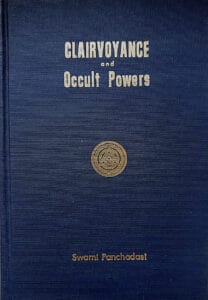
Swami Panchadasi is the pseudonym under which a series of influential books on clairvoyance, telepathy, the human aura, astral phenomena, and psychic development was published during the early twentieth century. The name has frequently been attributed to American New Thought author William Walker Atkinson, and many modern publishers and researchers continue to identify Atkinson as the writer behind the pseudonym. However, the authorship has not been established with sufficient certainty to treat that identification as historical fact, particularly given the collaborative publishing environment in which many similar pseudonymous works were produced.
Whatever the identity of the author, the Panchadasi books belong to the same intellectual world that combined New Thought, Suggestion, psychical research, Eastern philosophy, and Western esotericism. Rather than presenting psychic phenomena simply as supernatural events, the books attempted to explain them as manifestations of natural but little-understood powers of the human mind.
Philosophy
The writings attributed to Swami Panchadasi teach that ordinary physical perception represents only a small portion of humanity’s potential consciousness. Beyond the familiar senses of sight, hearing, touch, taste, and smell, the individual was said to possess subtler astral senses capable of perceiving thoughts, distant events, auras, and other levels of existence.
These abilities were presented not as miraculous gifts reserved for a select few but as latent faculties existing within human beings generally. Through concentration, mental discipline, observation, and carefully structured exercises, the student could gradually become more sensitive to these subtler forms of perception.
The Panchadasi writings therefore approached psychic development as a form of mental training rather than supernatural intervention.
Clairvoyance and Psychic Development
One of the principal subjects of the Panchadasi system is clairvoyance, broadly defined as perception beyond the ordinary physical senses. The writings explore telepathy, thought-transference, psychometry, crystal gazing, distant perception, and various forms of astral vision.
Particular attention is given to the idea that the human mind can receive impressions without ordinary physical communication. Telepathy and mind-reading are consequently interpreted as natural extensions of mental activity governed by laws that science had not yet fully discovered.
This approach closely reflected the wider psychical-research movement of the period, which attempted to determine whether phenomena traditionally associated with occultism might instead represent legitimate psychological processes.
The Astral World
Another major element of the Panchadasi writings is the concept of an astral world existing beyond ordinary physical perception. This realm is described as containing different levels or planes inhabited by various forms of consciousness and shaped in part by thought and mental activity.
The astral world was not presented simply as an imaginary realm but as another dimension of nature operating according to its own laws. Human beings were believed capable of experiencing these levels of existence through dreams, altered states of consciousness, psychic perception, and deliberate astral projection.
The Human Aura and Thought-Forms
The Panchadasi books also devote considerable attention to the human aura, described as a field of subtle energy surrounding the body and reflecting an individual’s physical, emotional, and mental condition.
Different colors within the aura were interpreted as expressions of particular emotions, character traits, and states of consciousness. Strong thoughts and emotions were also believed to produce thought-forms capable of extending beyond the individual and influencing the surrounding mental environment.
These ideas connected the Panchadasi writings with broader Theosophical, New Thought, and Western esoteric theories concerning vibration, mental influence, and the relationship between consciousness and matter.
Principal Works
Among the best-known books published under the name Swami Panchadasi are:
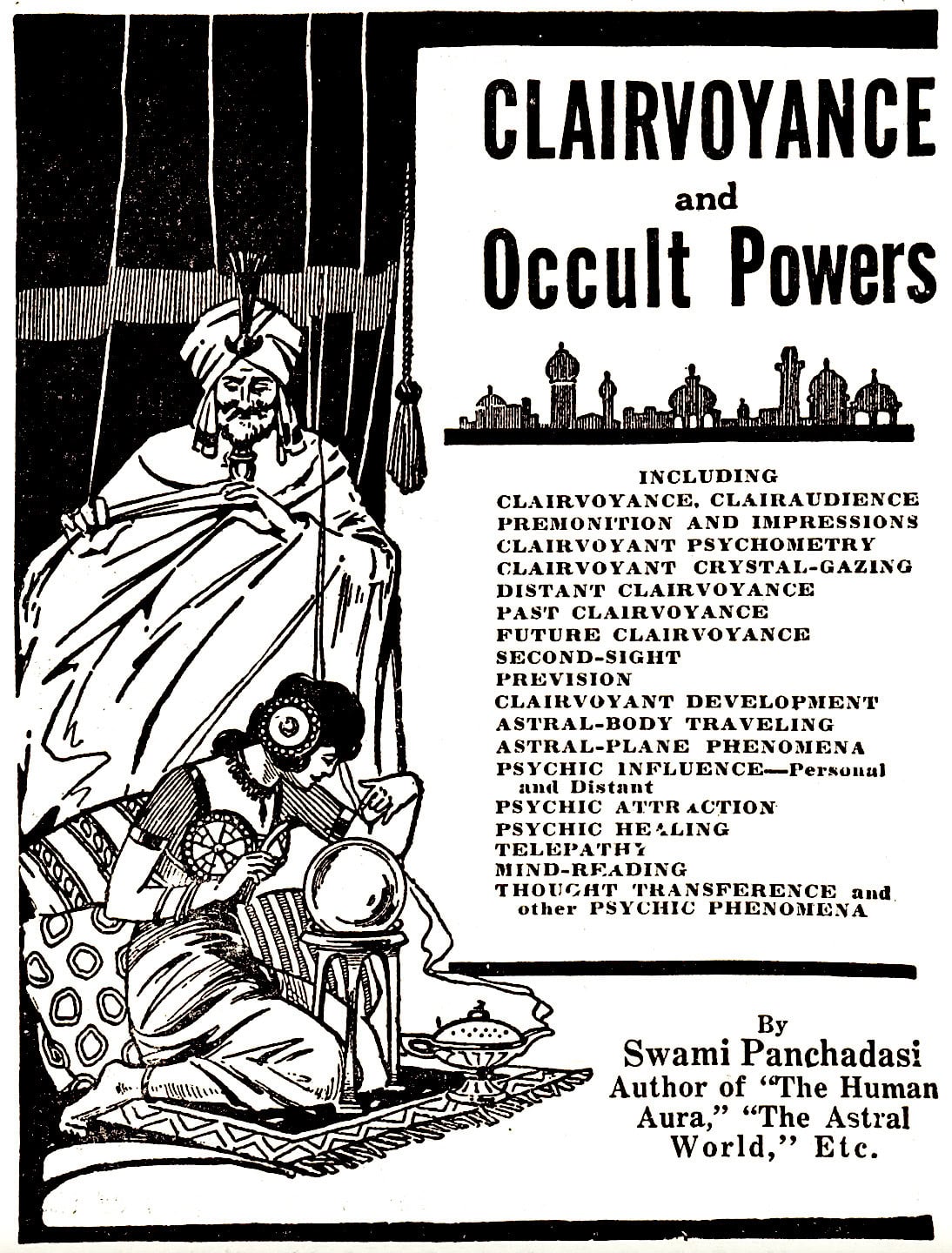
Clairvoyance and Occult Powers (1916), a twenty-lesson course examining telepathy, mind-reading, psychometry, crystal gazing, clairvoyance, astral perception, and the systematic development of psychic abilities.
The Astral World: Its Scenes, Dwellers, and Phenomena, describing the structure and inhabitants of the astral planes and the laws believed to govern consciousness beyond the physical world.
The Human Aura: Astral Colors and Thought Forms, examining the human aura, the symbolic meaning attributed to its colors, and the formation and projection of thoughts within the surrounding mental atmosphere.
Together these books formed a practical introduction to psychic development and the occult interpretation of human consciousness.
The Atkinson Attribution
Swami Panchadasi has long been identified by publishers, bibliographers, and later occult writers as another pseudonym of William Walker Atkinson. The attribution is understandable. The Panchadasi books appeared within the same Chicago metaphysical publishing environment in which Atkinson worked, and their terminology, organization, and treatment of subjects such as thought-force, vibration, mental influence, and psychic development closely resemble ideas appearing in works associated with him.
The books also contain many of the same underlying principles developed by Dr. Herbert A. Parkyn and repeatedly incorporated into works produced throughout this publishing network. These included the Law of Suggestion, the division of the mind into conscious and subconscious modes, thought-transference, concentration, auto-suggestion, mental influence, and the idea that apparently mysterious psychic phenomena should be investigated as expressions of natural laws rather than accepted as supernatural powers. Atkinson had repeatedly used these concepts in his writings after studying with Parkyn, and the same teachings appeared repeatedly across the journals, courses, and books produced by their circle.
Influence
The Swami Panchadasi books became enduring works within twentieth-century occult and metaphysical literature. Their significance lies particularly in their attempt to transform subjects traditionally associated with supernaturalism into an organized system of mental and psychic development.
By presenting clairvoyance, telepathy, the aura, thought-forms, and astral perception as natural faculties governed by discoverable laws, the Panchadasi writings helped bridge the worlds of psychical research, New Thought, Eastern philosophy, and Western occultism. Their continued publication more than a century later reflects the lasting influence of this distinctive period in the development of modern metaphysical literature.