Clairvoyance and Occult Powers is a 1916 work put out under the pseudonym Swami Panchadasi. It was originally published by the Advanced Thought Publishing Company and later by the Yogi Publication Society. The book is one of the most extensive works on psychic development published within the YPS collection. Panchadasi begins with the astral senses and then builds a complete system covering telepathy, thought transference, mind reading, psychometry, crystal gazing, clairvoyant reverie, distant vision, perception of past and future events, second sight, astral travel, thought forms, psychic influence, psychic attraction, magnetic and mental healing, and suggestive therapeutics. Although clairvoyance provides the title and starting point, the larger subject of the book is the development of the hidden powers of the mind and the laws through which thought can be received, projected, concentrated, and directed.
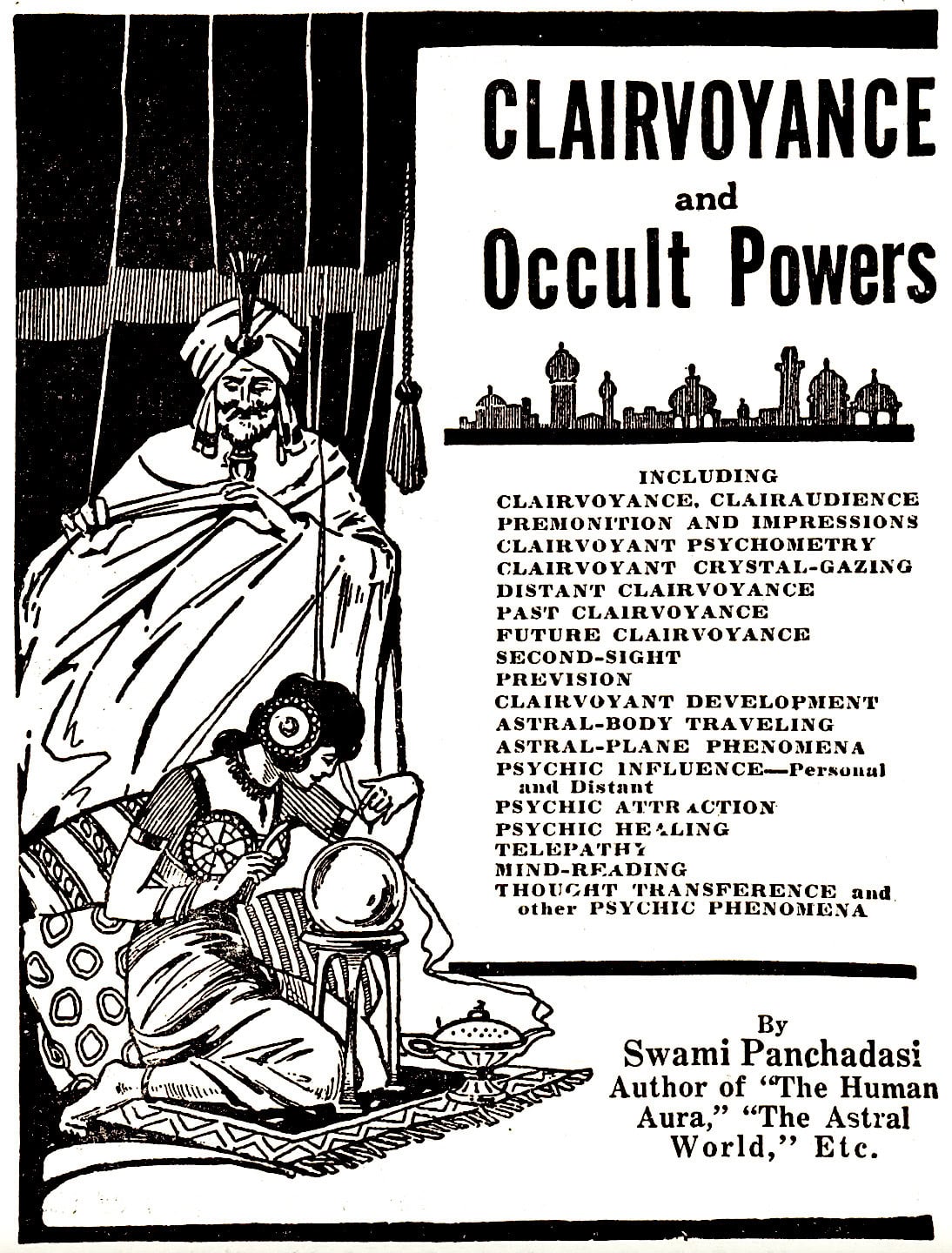
Original ad for the book Clairvoyance and Occult Powers by Swami Panchadasi
A major part of Panchadasi’s method is his attempt to connect the occult teachings of Yogi philosophy with the evidence being collected by Western investigators of psychic phenomena. He draws repeatedly upon experiments and case histories from the Society for Psychical Research and other Western authorities, then interprets these accounts through teachings concerning astral perception, thought vibration, mental influence, and the latent psychic faculties of man. Panchadasi explains that he has deliberately chosen Western evidence for his Western readers while maintaining that the principles behind these phenomena had long been known within Hindu occult teaching. This gives the book an unusual structure in which reports of telepathy, apparitions, prevision, and distant perception become the evidence through which a much larger occult system is introduced.
As the lessons progress, the emphasis also changes from receiving psychic impressions to deliberately using mental power. Telepathy and mind reading lead into clairvoyance, psychometry, and astral perception, which in turn lead into thought forms, personal influence, distant mental influence, psychic attraction, and healing. Concentration and visualization hold these subjects together. Panchadasi treats them as different applications of the same underlying powers of consciousness, making Clairvoyance and Occult Powers an important companion to the earlier YPS literature on thought force, psychic development, personal magnetism, and suggestion. The book is therefore both a detailed manual of occult development and an important example of the way the YPS publishing network brought Yoga, psychical research, mental science, and psychic influence together within a single system.
What Is Clairvoyance and Occult Powers About?
The central argument of Clairvoyance and Occult Powers is that ordinary sensory consciousness represents only a limited portion of man’s possible awareness. Human beings normally perceive through the physical senses, yet Panchadasi argues that corresponding astral senses exist behind them and can function independently of ordinary sight, hearing, touch, taste, and smell. From this starting point he builds a graded system. Telepathy is presented as the reception of thought vibrations. Clairvoyance reaches beyond telepathy because the percipient gains information without simply reading another person’s mind. Psychometry and crystal gazing provide means of establishing contact with the object or scene sought. Clairvoyant reverie suppresses ordinary sensory distractions so the astral senses can become active. Astral-body travel represents a still more complete transfer of perception. Psychic influence reverses the direction of the process, since the student now projects mental states instead of merely receiving impressions. Psychic healing applies similar principles to bodily and mental conditions.
This arrangement gives the course a deliberate progression from perception to projection. The student first learns how information might reach the mind through channels outside ordinary sensation. He is then taught how attention, concentration, and visualization can organize those faculties. The later lessons turn outward and ask how thought may affect another person, operate across distance, attract corresponding conditions, or influence health. That progression also places the book close to several branches of the earlier Chicago mental-science tradition represented by Herbert A. Parkyn, the Chicago School of Psychology, and the subsequent YPS literature, where suggestion, concentration, thought influence, psychic perception, personal magnetism, and mental healing repeatedly intersect.
Why Does Panchadasi Begin With the Astral Senses?
The first lesson establishes the foundation required for everything that follows. Panchadasi challenges the assumption that the five familiar senses exhaust the possible means by which consciousness receives information. Even physical sensation, he argues, is less simple and infallible than people commonly suppose. The physical organs do not themselves know anything. They transmit impressions to the mind, while the real act of knowing occurs behind the sensory mechanism. He treats the senses as products of evolution and proposes that additional modes of perception can likewise unfold.
From there he introduces the astral senses. Each physical sense is said to possess an astral counterpart capable of functioning on the astral plane. Astral sight makes clairvoyance possible. Astral hearing produces clairaudience. Other forms of psychic perception arise through the same extension of consciousness beyond its normal physical range. Psychometry and crystal gazing are consequently treated as special applications of astral perception. Clairvoyance itself is described as astral seeing without requiring either the physical connecting object used in psychometry or the visual focal point supplied by a crystal.
Panchadasi repeatedly argues that these abilities should be understood as natural faculties governed by laws. He rejects the idea that anything lying outside familiar sensory experience must automatically be supernatural. The limits of normal human perception, in his argument, cannot be treated as the limits of Nature itself. This natural-law language is important throughout the book. Even when the phenomena become increasingly occult, Panchadasi continues to describe them as orderly extensions of forces already operating within human beings.
How Does the Book Distinguish Telepathy From Clairvoyance?
Lessons II through V form a substantial preliminary course in telepathy and mind reading before Panchadasi reaches clairvoyance itself. This is intentional because he wants the student to understand that receiving another person’s thoughts is different from directly perceiving an event through astral sensation.
Telepathy is presented as the transmission of thought and feeling between minds. Panchadasi describes thoughts as producing vibrations capable of passing between people, with the brain, nervous system, solar plexus, and pineal gland all assigned roles within his explanation. He uses the idea of mental atmospheres to explain why a room, audience, house, town, or gathering may seem to acquire a recognizable emotional quality. Individuals continuously send and receive mental impressions, although differences of affinity, attention, emotional intensity, and receptivity determine which impressions are noticed.
Clairvoyance belongs to another level. Panchadasi compares ordinary telepathy to waves traveling between minds, while clairvoyance is described more like an extension of consciousness toward the object being perceived. In his own illustration, the astral self seems to reach outward until it comes into contact with the astral condition of another person. The distinction allows him to separate thought transmission from the direct psychic perception around which the rest of the book is built.
Why Does Panchadasi Appeal to Scientific Telepathy?
Lesson IV turns extensively to the Society for Psychical Research and experimental investigations of thought transference. Panchadasi knows that the Western reader he is addressing may reject his later occult claims unless he first establishes a phenomenon that seems easier to document. Telepathy serves that purpose.
He describes controlled guessing experiments, including the Creery experiments, and emphasizes attempts to exclude signaling, collusion, fraud, chance, and ordinary sensory communication. He also discusses experiments in which recipients reproduced drawings or geometrical figures selected by another person. In one series described in the book, a recipient reproduced nearly all the selected figures, sometimes reversing their orientation while retaining their form. Panchadasi treats such results as evidence that thought transmission deserves recognition as a genuine phenomenon.
He also cites Camille Flammarion and refers repeatedly to the reports of the Society for Psychical Research. This illustrates the method announced in the introduction. Panchadasi intentionally minimizes Indian examples during the early evidentiary portions of the course and uses Western investigators to establish the possibility of supernormal communication. Once that foundation has been laid, he begins interpreting the reported phenomena through Hindu occult philosophy.
How Does the Book Teach Mind Reading?
Lesson V moves from evidence to experiment. Panchadasi divides mind reading into contact and non-contact forms. Contact mind reading involves physical connection between the person concentrating upon the hidden object or intended action and the person attempting to discover it. He regards this as an elementary but useful stage because it allows the student to become sensitive to subtle impressions while reducing the difficulty of the experiment.
The lesson functions almost as a small instructional manual. The student is encouraged to work through actual experiments instead of remaining satisfied with intellectual belief. Attention must become quiet enough to distinguish the desired impression from one’s own expectations. The recipient should avoid consciously guessing and learn to recognize the subtle impulse that accompanies the transmitted thought. Repetition develops familiarity with the mental condition in which successful reception occurs.
This emphasis on learning through repeated experiment is characteristic of the book. Panchadasi does not present psychic power merely as something possessed by rare mediums. He repeatedly argues that latent faculties exist in ordinary people and can be strengthened through disciplined use. This instructional approach also places the book within the self-development format used throughout the Chicago correspondence-course tradition and in many works issued under YPS-associated pseudonyms.
What Is Clairvoyant Psychometry?
Lesson VI marks the formal beginning of the clairvoyance portion of the course. Panchadasi defines clairvoyance as the acquisition of information about distant, hidden, past, or future facts independently of ordinary sensory perception and independently of simply receiving those facts from another person’s mind. He then divides clairvoyance into three major forms.
Simple clairvoyance involves perception of auras, thought vibrations, astral colors, and similar conditions immediately surrounding the observer.
Clairvoyance in space involves perception of distant scenes, persons, objects, or events.
Clairvoyance in time involves perception of events belonging to the past or future.
Psychometry is presented as one of three principal methods of entering the clairvoyant condition, along with crystal gazing and clairvoyant reverie. In psychometry, a physical object acts as a connecting link. A piece of clothing, hair, stone, letter, or other object associated with a person or place establishes what Panchadasi calls an en rapport condition. The object does not contain the information in the ordinary physical sense. It provides the psychic connection through which the clairvoyant consciousness reaches the person, place, event, or astral record associated with it.
The method reflects a recurring principle throughout the book. Psychic operation depends upon relationship. A material object, mental image, concentrated thought, crystal, personal association, or emotional bond can establish a line along which perception or influence operates.
What Is the Purpose of Crystal Gazing?
Lesson VII gives crystal gazing the same theoretical foundation. Panchadasi does not claim that the images literally exist inside the crystal. The polished surface acts as a focal instrument for attention. By occupying the physical sight with a neutral object, the student reduces ordinary sensory distraction and allows astral impressions to enter consciousness.
The book compares the crystal to a psychic microscope or telescope. It concentrates perception and helps establish the condition required for clairvoyant vision. Panchadasi discusses traditional crystal balls, magic mirrors, shining surfaces, pools of water, and other reflective objects used in different cultures. He also advises that a crystal used regularly by one person should be kept for that person’s own use because it becomes associated or polarized with the owner’s psychic vibrations.
Development is described as gradual. The beginner may first perceive clouds, mist, vague light, or changing forms. These can become more definite until coherent scenes appear. Panchadasi warns the student against forcing the process or allowing imagination to manufacture desired results. The crystal is a focusing device. The real faculty lies in the person.
What Is Clairvoyant Reverie?
Lesson VIII introduces what Panchadasi regards as a higher method because it removes dependence on external objects. Clairvoyant reverie is a controlled inward state in which attention is withdrawn from physical sights, sounds, and ordinary mental activity. The student remains conscious. Panchadasi specifically rejects the idea that genuine clairvoyance requires unconscious trance.
Concentration becomes the central mechanism. The student develops the ability to hold the mind steadily upon a single point while allowing ordinary sensory impressions to recede. Panchadasi compares the condition to an intense daydream or “brown study,” though it is deliberately induced and consciously maintained. The mind becomes “one-pointed,” a phrase that connects the lesson with older Yogic concentration teachings.
The book strongly warns against drugs and artificial methods of inducing abnormal psychic states. Panchadasi argues that psychic development should come through control of attention and consciousness. The highest form of the faculty should increase command of the mind, not weaken it. This makes concentration one of the central teachings of the entire course, connecting psychic perception with the mental discipline found throughout the Yogi Ramacharaka series and later books issued as Theron Q. Dumont.
What Does Simple Clairvoyance Reveal?
Lesson IX describes what the student supposedly perceives once astral sight begins functioning without dependence on a distant target. The first field is the human aura. Panchadasi discusses pranic emanations, mental and emotional colors, currents of thought, and changing auric conditions surrounding individuals.
The aura is treated as dynamic. Thoughts and emotions alter its appearance. Mental states produce corresponding vibrations and forms. This provides a bridge between clairvoyance and thought influence because the clairvoyant is now said to see the very mental forces that later lessons teach the student to project.
Panchadasi expands simple clairvoyance into perception of thought forms and other astral phenomena. He also discusses accounts of seeing through opaque objects, reading sealed material, and magnifying extremely small objects through astral vision. Within the book’s system, these are variations in the range and focus of the astral senses, not separate supernatural gifts.
How Does Distant Clairvoyance Work?
Lesson X moves from the immediate astral environment to scenes removed in space. Panchadasi again draws heavily upon Western psychical research. He cites reported cases in which individuals claimed to perceive distant events without ordinary communication, including accounts connected with Emanuel Swedenborg, W. T. Stead, and cases collected by the Society for Psychical Research.
The book also examines apparitional experiences involving living persons. In one case reproduced from psychical research records, a man deliberately concentrated upon appearing at the home of acquaintances at a specified time. The women later reported seeing him despite his physical presence elsewhere. Panchadasi interprets such cases through astral projection and psychic perception.
Dreams and states near sleep receive considerable attention because ordinary sensory activity is then weakened. Panchadasi argues that psychic impressions may become noticeable when physical consciousness no longer dominates attention. He extends the same reasoning to illness and the approach of death, when the connection between ordinary physical awareness and the astral senses is said to loosen.
How Can Clairvoyance See the Past?
Lesson XI introduces one of the book’s most ambitious ideas. Panchadasi argues that past events do not disappear completely. They remain impressed upon what occult traditions call the Akashic Records or Astral Light. Clairvoyance of the past becomes possible because the clairvoyant consciousness gains access to these preserved impressions.
The analogy is one of recording. Physical events leave enduring records upon the astral plane, forming what amounts to a universal archive. The trained clairvoyant can supposedly move through those records in much the same way a reader searches a book. The time separating the observer from the event makes no fundamental difference. An event five minutes old and an event thousands of years old differ in distance along the record, not in the principle by which they are perceived.
This doctrine links the book with the Western esoteric and Theosophical literature of the period, where the Astral Light and Akashic Records were frequently invoked to explain psychometry, clairvoyant history, and visions of ancient civilizations.
How Does the Book Explain Future Clairvoyance?
Lessons XII and XIII address prophecy, prevision, second sight, and future clairvoyance. Panchadasi recognizes the philosophical problem immediately. If an event has not happened, what can the clairvoyant possibly perceive?
His first answer involves subconscious inference. The subconscious mind may perceive causes already in motion and calculate their probable consequences long before the conscious mind recognizes them. A future event can thus “cast its shadow” backward because its causes already exist.
The book then moves into a more metaphysical explanation. Panchadasi questions whether past, present, and future possess the absolute separation ordinarily assigned to them. Human consciousness experiences events sequentially, but a higher form of consciousness may perceive a much larger portion of the temporal order at once. He compares time to a moving-picture reel. The viewer sees one frame as the present, although later scenes already exist elsewhere on the reel. He also invokes dream experience, where an apparently lengthy sequence of events may be compressed into a very short interval of physical time.
Panchadasi does not completely eliminate free will. Future visions may represent tendencies, probable events, or conditions produced by causes already operating. The future is thus treated as possessing degrees of determination instead of being a simple fixed script.
What Examples of Second Sight Does Panchadasi Give?
Lesson XIII gathers historical and psychical-research accounts of prevision. Panchadasi discusses second sight in Scotland and Ireland, George Fox, Biblical prophecy, the death of Julius Caesar, and several reported premonitions of death or disaster.
One of the most dramatic examples is the famous story associated with Jacques Cazotte, who was said to have foretold the fate of several members of French society before the Revolution. Panchadasi also discusses the reported prevision of the assassination of British Prime Minister Spencer Perceval. These accounts are used to support the proposition that future perception has appeared across cultures and historical periods.
His purpose is cumulative. No single case carries the entire argument. By collecting reports from religion, history, folklore, psychical research, dreams, and individual testimony, Panchadasi tries to establish prevision as a recurring human phenomenon requiring explanation.
What Is Astral-Body Traveling?
Lesson XIV makes a careful distinction between seeing astrally and traveling in the astral body. In ordinary clairvoyance, consciousness remains centered in the physical person while perception reaches beyond the normal sensory field. In astral-body travel, the center of perception itself is said to move away from the physical body.
The astral traveler experiences the distant environment from within it and can look in different directions, change position, and observe from varying points of view. Panchadasi says many people undergo limited astral travel during sleep without consciously remembering the experience.
Yet this is one area where he becomes strongly cautionary. He warns inexperienced students against deliberately attempting astral-body projection. Dream-state experiences are one thing. Conscious projection without training is another. The lesson insists that curiosity alone is not sufficient reason to experiment with advanced astral phenomena.
What Are Thought Forms?
Lesson XV creates the transition from clairvoyant perception to psychic influence. A thought form is described as an organized psychic structure produced through concentrated thought and visualization. Under sufficiently strong concentration, the thinker can project a thought form outward and maintain a degree of consciousness through it.
Panchadasi describes this as something between ordinary clairvoyance and full astral-body projection. The observer remains physically conscious while using the projected thought form almost as a remote observation post. The scene may appear life-sized and nearby, and the observer can sometimes change the apparent point of view.
Visualization is the key. A vague thought produces a weak form. A clear image sustained by concentrated attention produces a stronger one. Panchadasi uses this doctrine to explain some stories of Hindu magic in which spectators reportedly see objects, plants, animals, or scenes that are not physically present. The magician, in his explanation, produces a sufficiently powerful thought form to impress the spectators’ psychic perception.
This section has strong connections with Hermeticism and the mental imagery found throughout YPS literature. The idea that thought acquires form, direction, and power also anticipates the later lessons in which mental pictures become instruments of personal influence and attraction.
What Are the Laws of Psychic Influence?
Lessons XVI through XVIII turn the course from psychic perception toward the deliberate influence of other minds. Panchadasi begins with vibration. Everything is said to possess a vibratory state, and mental states produce vibrations capable of inducing corresponding conditions in receptive minds.
A strong emotion can spread through a crowd. Confidence in one person can affect another. Fear can become contagious. A forceful personality can establish an atmosphere that alters the behavior of those around it. Panchadasi interprets these familiar social experiences as lower or more visible expressions of psychic induction.
Three factors become central to deliberate psychic influence.
Strong desire gives the projected thought force and direction.
Visualization creates a definite mental image of the desired result.
Concentration holds the mental force steadily upon that image.
These three principles are repeated in increasingly advanced forms. Desire supplies energy. Visualization supplies form. Concentration prevents dissipation.
This portion of the book has obvious connections with the literature of personal magnetism and the Law of Suggestion. It is also one of the places where the relationship to Parkyn’s earlier work becomes important for the history of this publishing network. Long before the 1916 Panchadasi course, Parkyn’s Mail Course had taught the operation of suggestion, concentration, mental control, and the direction of thought within a structured correspondence program. Clairvoyance and Occult Powers carries these themes into an explicitly occult model built around psychic vibration and the astral plane.
How Does Personal Psychic Influence Work?
Lesson XVII concentrates on influence exerted when people are physically present with one another. Panchadasi points to commanding political and military personalities such as Alexander, Caesar, and Napoleon as examples of individuals possessing unusually powerful personal influence.
The positive psychic personality is described as one whose thought, desire, imagination, and will operate together. Such a person creates what Panchadasi calls a positive psychic atmosphere. Others entering that atmosphere may find themselves responding to the dominant mental state.
The book also introduces psychic self-defense. A student should not become passively receptive to every personality encountered. Panchadasi teaches mental resistance, denial, and the creation of an “occult shield” against unwanted influence. This is a significant qualification because the same principles are presented as operating in both directions. A person capable of influencing others must also understand how influence from others reaches him.
Can Psychic Influence Operate at a Distance?
Lesson XVIII extends the same theory across space. Physical separation, Panchadasi argues, does not prevent psychic influence once an en rapport relationship has been established.
Several methods previously introduced now return. A personal object may provide a psychometric link. A clear mental image may establish the target in consciousness. Concentration maintains the connection. Panchadasi also employs the occult concept of an astral tube, a focused channel through which psychic perception or influence is directed.
The lesson discusses traditional stories of sorcery and witchcraft through this framework. Panchadasi gives fear and belief a major role. A person who believes himself psychically attacked may increase his own susceptibility by continually imagining the feared influence. Denial and mental refusal weaken that condition. He warns strongly against using these teachings to dominate or injure others and spends substantial space on methods of self-protection.
What Is the Law of Psychic Attraction?
Lesson XIX brings the book close to the thought-attraction teachings circulating through New Thought literature. Panchadasi argues that mental vibrations attract people and conditions corresponding to their character. The process works in both directions. A person attracts compatible influences while also being drawn toward people and circumstances corresponding to his dominant mental state.
He calls these principles the Law of Psychic Attraction and the Law of Psychic Repulsion. Harmony draws together. Inharmony separates. Repeated thought establishes a psychic tendency that changes what the individual notices, responds to, approaches, and influences.
Panchadasi applies the theory to business and public persuasion. He discusses powerful business figures and promoters who create mental atmospheres around themselves, their enterprises, or their products. Groups can likewise be affected by persistent projected ideas. The book treats these operations as extensions of the same laws already used to explain telepathy and personal influence.
This is one of the clearest examples of the course joining occult philosophy to everyday self-culture. The astral senses and clairvoyant visions of the first three-quarters of the book now lead directly into success, personality, business influence, environment, and the power of thought to shape experience.
How Does Panchadasi Explain Psychic and Magnetic Healing?
The twentieth and final lesson brings the system into healing. Panchadasi argues that the many schools of mental, magnetic, psychic, and spiritual healing use different explanations for processes resting upon a smaller number of common principles.
The lesson combines physiology, suggestion, mental imagery, human magnetism, Prana, the aura, laying on of hands, absent treatment, and self-healing. Magnetic healing is described partly through the transfer or direction of vital force. Mental healing operates through thought and suggestion. Psychic healing joins these principles with the astral body and the directed influence of the healer.
Panchadasi specifically discusses the role of affirmations used by healing movements and connects their effects with suggestion. This brings the final lesson into direct contact with the field of suggestive therapeutics that Parkyn had taught clinically and through the Chicago School years earlier. The difference lies mainly in the expanded occult framework surrounding the process. Panchadasi combines suggestion with Prana, the aura, astral forces, mental vibration, and distant psychic influence.
Absent healing follows the principles introduced in distant psychic influence. The healer forms a clear mental conception of the recipient, establishes the psychic connection, holds the desired condition firmly in mind, and projects the healing influence toward the person. Self-healing applies the same directed mental process inward.
How Is the Book Connected With the Earlier Yogi Publication Society System?
Clairvoyance and Occult Powers was copyrighted in 1916 by the Advanced Thought Publishing Company, not by the Yogi Publication Society. Yet its place within the publishing history is important because its subjects continue a program that YPS had already been developing for more than a decade.
The early Yogi courses had explicitly promised instruction in clairvoyance, clairaudience, psychometry, telepathy, thought dynamics, the aura, human magnetism, psychic influence, the astral world, healing, and the development of occult powers. An early YPS outline for the Yogi Class Course lists these subjects almost as a map of the territory later covered at much greater length in Panchadasi’s twenty lessons. The sixth Yogi lesson alone was devoted to clairvoyance, clairaudience, psychometry, telepathy, and psychic development, while later lessons covered human magnetism, occult therapeutics, psychic influence, the astral world, and methods of attainment.
The difference is one of specialization and expansion. The earlier Yogi material introduced psychic phenomena as one division of a complete philosophy of human development. Panchadasi takes that psychic division and turns it into a full course. Telepathy receives several lessons. Clairvoyance is separated into psychometry, crystal gazing, reverie, simple clairvoyance, distant clairvoyance, past clairvoyance, and future clairvoyance. Psychic influence receives its own theoretical and instructional lessons. Healing becomes the culminating application.
This also helps explain why the book repeatedly feels connected to several apparently different branches of the Chicago literature. It combines the psychic research tradition, the mental-force teachings of New Thought, the concentration exercises associated with Yogi instruction, the personal magnetism literature, and the Law of Suggestion. These subjects are presented as parts of one system because the book’s central premise makes mind the connecting mechanism.
What Is the Central Teaching of Clairvoyance and Occult Powers?
The central teaching of Clairvoyance and Occult Powers is that human consciousness possesses a much larger field of perception and action than ordinary waking sensory experience reveals. Panchadasi begins with the proposition that physical sensation is only one channel through which the mind obtains information. He then proposes astral counterparts to the senses and uses them to explain clairvoyance. Telepathy establishes that thoughts can pass between minds. Psychometry shows how an object can establish psychic contact. Crystal gazing teaches concentration through an external focal point. Clairvoyant reverie removes that external support and trains the student to shift attention inward. Simple clairvoyance reveals the aura and thought forms. Distant clairvoyance extends perception through space. Past clairvoyance opens the Akashic record. Future clairvoyance raises the possibility that consciousness can sometimes move beyond the ordinary succession of time. Astral travel transfers the center of perception. Thought forms turn concentrated imagination into an instrument of projection. Psychic influence directs mental force toward another person. Psychic attraction applies mental vibration to circumstances and relationships. Psychic healing directs the same principles toward health.
The book’s twenty lessons can thus be read as stages in a single theory of consciousness. Reception and projection are the two great movements running through it. The human mind receives impressions through physical senses, telepathic sensitivity, or astral perception. It projects influence through thought, emotion, visualization, concentration, suggestion, and what Panchadasi calls psychic force. Development consists of learning to control both movements.
That is also why concentration becomes more important as the course proceeds. The student who cannot control ordinary attention cannot reliably distinguish an impression from imagination, sustain clairvoyant reverie, construct a thought form, direct psychic influence, or perform the healing methods described in the final lesson. The spectacular subject advertised on the cover is clairvoyance, yet the working discipline beneath the entire book is control of consciousness.
For the history of the Yogi Publication Society and its related Chicago publishing network, Clairvoyance and Occult Powers is valuable because it gathers an extraordinary number of themes that had circulated through the network since its earliest years and organizes them into one advanced course. Telepathy and psychical research stand beside Yogi concentration. Astral perception stands beside thought force. Personal magnetism leads into psychic influence. Suggestion leads into mental healing. The occult vocabulary changes the outward presentation, but the book itself continually connects these subjects through the laws governing thought, attention, imagination, vibration, and mental influence. In 1916, the Advanced Thought Publishing Company presented that accumulated material through the persona of Swami Panchadasi as a comprehensive Western course in the development and use of occult powers.
.
Original version by Advanced Thought Publishing Co.