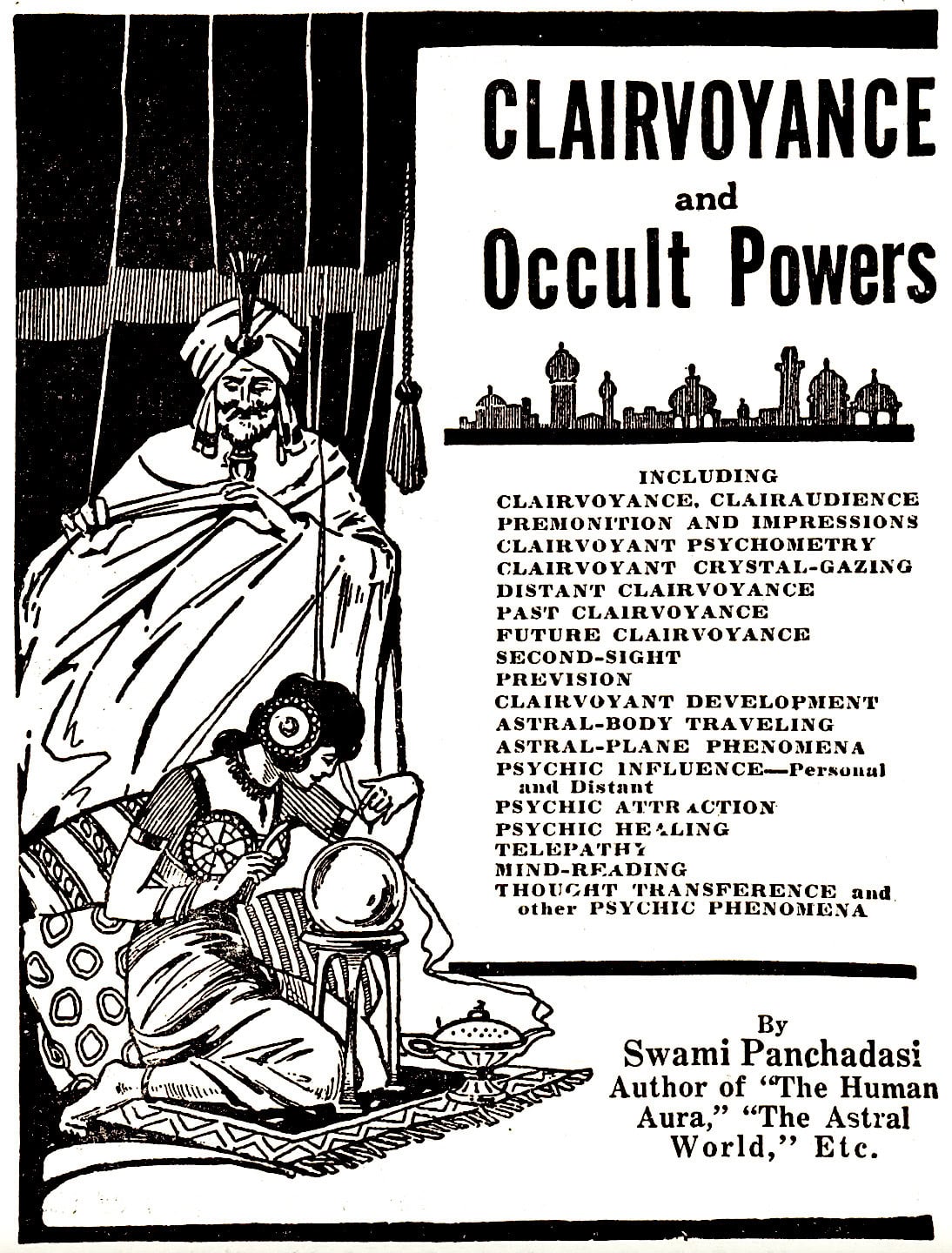
Clairvoyance occupied an important place in the literature of the Yogi Publication Society because it stood at the meeting point of psychical research, occult training, Yogi philosophy, Theosophy, and Western esotericism. The word was used for forms of perception in which a person was believed to obtain information without depending upon ordinary physical sight. This could include seeing distant places, perceiving events beyond the normal range of the senses, receiving impressions from objects, observing conditions on subtler planes, becoming conscious of scenes associated with the past, or experiencing images connected with events that had not yet occurred. Within the YPS catalog, clairvoyance was not treated simply as fortune telling. It formed part of a much larger theory of mind and consciousness in which ordinary physical perception represented only one level of human awareness.
What does clairvoyance mean?
The term clairvoyance comes from French words meaning clear seeing. In occult and psychical literature it came to describe perception of persons, objects, places, events, or conditions that could not be seen through the ordinary physical eyes.
The word “seeing” can be misleading if taken too literally. Clairvoyant perception was often described in visual terms because the resulting impression might appear as an image, scene, symbol, color, form, or complete picture within consciousness. Yet the doctrine did not require the physical eyes to participate. The perception was attributed to the mind or to subtler faculties of consciousness.
This distinction was central. Ordinary sight depends upon light reaching the physical eye and producing nervous activity transmitted to the brain. Clairvoyance was proposed as perception occurring without that ordinary sensory chain.
The YPS literature treated this possibility within a worldview in which consciousness was not confined completely to the five physical senses. The ordinary sensory apparatus was regarded as one set of instruments through which the mind receives information. Clairvoyant states were said to occur when consciousness received impressions through another channel.
Is clairvoyance the same as psychic ability?
Clairvoyance is one form of what the YPS literature commonly grouped under psychic or psychical phenomena, but the terms are not identical.
Psychic ability can include telepathy, psychometry, clairaudience, clairvoyance, dreams, intuition, trance phenomena, mediumistic perception, and other experiences in which information appears to reach consciousness outside the normal operation of the physical senses.
Clairvoyance refers more specifically to the perception of images, scenes, persons, objects, or conditions that are not available to normal sight.
A person could therefore be considered psychically sensitive without being primarily clairvoyant. One individual might receive impressions as thoughts. Another might hear words internally. Another might experience symbolic dreams. A clairvoyant would tend to experience the information in a visual or scene-like form.
The YPS catalog repeatedly treated these abilities as different expressions of a larger capacity of consciousness.
How was clairvoyance supposed to work?
The explanations varied according to the system being presented, but many of them rested upon the idea that the human mind possesses levels or faculties that extend beyond ordinary sensory consciousness.
Physical sight gathers information through the eyes. Clairvoyant perception was said to occur when the mind became aware of information without depending upon this physical route.
In some explanations, consciousness itself could reach beyond the normal limits of the body. In others, impressions were transmitted through an astral medium or subtle plane. Some theories treated the clairvoyant mind as becoming sensitive to vibrations that ordinary consciousness could not detect. Others described consciousness as entering a receptive state in which impressions already present within a wider mental or psychic field could become perceptible.
These different explanations were not always identical, but they shared one assumption. Ordinary waking consciousness represents only a portion of the possible activity of the mind.
What are the main types of clairvoyance?
The YPS treatment of clairvoyance divided the subject according to what was being perceived and the apparent distance between the perceiver and the information.
Clairvoyance of distant places
One of the most common forms involved the claimed perception of a place or event occurring beyond the physical range of sight. A person might describe a distant room, building, landscape, person, or event while remaining physically somewhere else.
This form was often connected with experiments in psychical research because the information could sometimes be compared afterward with the actual distant scene.
The central question was whether consciousness could obtain information without the physical senses having direct access to the object.
Clairvoyance of hidden objects
Another form involved perceiving something physically nearby but concealed from ordinary sight. An object might be enclosed in a box, placed behind a barrier, or otherwise hidden.
This type of experiment was attractive to investigators because the conditions could be controlled more easily than reports involving distant countries, spirits, or visionary states.
The distinction between clairvoyance and ordinary inference was important. If information could be obtained through sound, touch, previous knowledge, subtle cues, or suggestion from another person, the result would not demonstrate clairvoyant perception.
Clairvoyance through psychometry
Psychometry was closely associated with clairvoyance. In psychometric experiments, a person held or touched an object and attempted to receive impressions concerning its owner, history, location, or associated events.
The object was believed to provide a point of contact between the sensitive person and information connected with it.
A letter, piece of jewelry, fragment of clothing, photograph, stone, or personal possession could become the focus. The psychic impression might then appear as images, emotions, names, scenes, physical sensations, or knowledge whose source was not consciously understood.
Within occult theory, psychometry suggested that objects could retain or transmit impressions associated with people and events.
Astral clairvoyance
Astral clairvoyance moved beyond the perception of ordinary physical objects and into the idea of subtler planes of existence. The clairvoyant was said to perceive forms, beings, colors, thought forms, or environments belonging to an astral plane that normally remained invisible to physical sight.
This form appears naturally within Theosophy, Yogi philosophy, and other occult systems represented in the YPS catalog because those systems already described the human being and the universe as extending beyond the dense physical level.
Astral clairvoyance therefore depended upon a larger cosmology. If subtler planes existed, clairvoyance supplied one possible means through which consciousness could perceive them.
Clairvoyance of the past
Some clairvoyant experiences were said to involve scenes associated with earlier events.
This was sometimes described as retrospective clairvoyance or psychometric vision. The person appeared to witness a scene that had already occurred, even though no ordinary witness had described it to them.
Different systems explained this through psychic impressions left upon objects, places, or a subtler medium. The idea closely resembles the occult concept of a record in nature in which events leave traces capable of later perception.
The clairvoyant was not necessarily believed to travel physically backward in time. The claim was that consciousness could become aware of an enduring impression connected with a past event.
Clairvoyance of future events
The claimed perception of future events was one of the most difficult forms to explain because it raised questions about time, causation, and free will.
Some occult systems allowed for the possibility that future conditions could be perceived when their causes were already strongly established. A future event might not exist as an absolutely fixed occurrence, but the direction of existing causes could be sufficiently strong for a sensitive mind to perceive their probable result.
This interpretation allowed clairvoyant prediction to coexist with free will. A perceived future could represent a tendency or probable outcome instead of an unchangeable destiny.
The distinction is important because the YPS worldview also gave substantial importance to Karma, causation, personal action, and the ability of individuals to create new causes.
Is clairvoyance the same as telepathy?
Clairvoyance and telepathy were often discussed together, but they describe different proposed processes.
Telepathy involves the transmission or reception of thoughts, feelings, images, or mental impressions between minds. Clairvoyance involves direct perception of an object, place, event, or condition without ordinary sensory contact.
Imagine that a person correctly describes a card being viewed by someone in another room. If the information came from the other person’s mind, the phenomenon would be telepathic. If the person directly perceived the hidden card without receiving the information from another mind, it would be clairvoyant.
In practice, distinguishing between the two could be extremely difficult. This difficulty became an important problem in psychical experiments because a successful result did not automatically reveal the mechanism responsible for it.
The same event could be interpreted as telepathy, clairvoyance, unconscious cueing, coincidence, or ordinary inference depending upon the conditions.
Is clairvoyance the same as mind reading?
The terms sometimes overlapped in popular literature, but clairvoyance and mind reading were not necessarily the same.
Mind reading concerns information present within another person’s consciousness. Clairvoyance concerns perception of something independent of that person’s thoughts.
The distinction becomes important in experiments. If a subject locates an object hidden by another person, the subject might be responding to involuntary physical cues, receiving a telepathic impression from the person who knows the location, or perceiving the object clairvoyantly.
The early work surrounding Herbert A. Parkyn, the Chicago School of Psychology, suggestion, hypnotic phenomena, and mind reading belongs to the same late nineteenth-century environment in which investigators were trying to determine how apparently extraordinary perceptions occurred.
This environment is important to the history of the YPS because clairvoyance did not enter the catalog in isolation. It followed years of interest in hypnotism, suggestion, telepathy, trance, mind reading, psychical research, and unusual mental states.
What is the relationship between clairvoyance and suggestion?
Suggestion creates one of the greatest difficulties in interpreting clairvoyant experiences.
A person in a highly receptive state may unconsciously incorporate suggestions from an experimenter, sitter, hypnotist, or observer. A question can itself suggest an answer. Tone of voice, facial expression, expectation, previous conversation, or accidental information can influence what the subject reports.
This makes the study of clairvoyance inseparable from the study of suggestion.
A subject who sincerely believes he has received a clairvoyant image may actually be responding to an idea introduced unconsciously by another person. The experience can feel completely spontaneous even when its psychological origin lies in suggestion.
The distinction was especially important in hypnotic and trance experiments. Suggestion could produce vivid internal images, altered sensory experiences, false memories, and conviction that an imagined scene was objectively real.
The history of Herbert A. Parkyn, his Special Mail Course in Hypnotism and Suggestive Therapeutics, and the Chicago School of Psychology provides an important background for understanding why suggestion had to be considered whenever extraordinary mental phenomena were investigated.
What is the relationship between clairvoyance and hypnosis?
Hypnosis played a major role in nineteenth-century investigations of clairvoyance because some subjects appeared to display unusual perceptual abilities while hypnotized.
The hypnotic state could produce intense concentration, reduced attention to ordinary surroundings, increased responsiveness to suggestion, vivid imagery, altered sensation, and unusual access to memory. Some investigators believed it could also awaken latent psychic faculties.
This led to reports of hypnotized subjects describing distant events, diagnosing physical conditions, locating hidden objects, seeing through obstacles, or apparently perceiving information unavailable to their ordinary senses.
Yet hypnosis created the same methodological problem described above. The hypnotized subject could be extremely responsive to suggestion.
Any serious interpretation therefore had to distinguish between information genuinely unknown to everyone present and information that might have been communicated consciously or unconsciously.
Clairvoyance under hypnosis consequently stood at the boundary between experimental psychology, psychical research, mesmerism, and occultism.
Can clairvoyance occur during dreams?
Dreams were one of the most common settings for alleged clairvoyant experiences.
A person might dream of a distant event and later discover that something similar occurred at the same time. Another might dream of an event shortly before it happened. Some dreams appeared to contain information that the dreamer had no ordinary means of obtaining.
Within occult theory, sleep was believed to loosen the dominance of the physical senses. The surface mind became less occupied with external sensory impressions, allowing deeper levels of consciousness to become active.
This made dreams a possible channel for telepathic, clairvoyant, symbolic, or spiritual impressions.
At the same time, ordinary dreams contain enormous amounts of imagination, memory, emotional processing, symbolic material, and coincidence. The mere fact that a dream resembles a later event does not establish clairvoyance.
The YPS interest in dreams belonged to the larger question of whether human consciousness could function beyond the ordinary waking state.
What is spontaneous clairvoyance?
Not all clairvoyance was described as deliberately produced.
Spontaneous clairvoyance refers to experiences arising unexpectedly without an intentional attempt to enter a psychic state. A person might suddenly see an image of a distant relative, experience a vivid scene connected with an unknown event, or become aware of a place never physically visited.
Reports connected with illness, danger, death, emotional crisis, and strong relationships were common in the psychical literature of the period.
These cases attracted attention because the subject often claimed no previous intention to perform a psychic experiment.
The spontaneous nature of the experience could also make investigation difficult. Researchers generally learned about the event after it had happened, leaving them dependent upon memory, testimony, correspondence, and later verification.
What is induced clairvoyance?
Induced clairvoyance refers to attempts to produce the state deliberately.
Methods could include concentration, relaxation, hypnotism, crystal gazing, fixing the attention upon an object, psychometric contact, meditation, altered breathing, visualization, or the deliberate withdrawal of attention from ordinary sensory impressions.
The principle behind many of these exercises was similar. Normal consciousness is constantly occupied with physical sensations, thoughts, memories, and external distractions. By quieting or concentrating the ordinary mind, subtler impressions were believed to become easier to perceive.
The difficulty is that these same techniques can also strengthen imagination.
For this reason, occult training repeatedly warned students to distinguish between an impression received spontaneously and an image deliberately or unconsciously created by the mind.
What is crystal gazing?
Crystal gazing was one of the best-known methods associated with the deliberate cultivation of clairvoyant imagery.
The practitioner gazed into a crystal, glass, polished surface, dark mirror, or similar object while allowing ordinary attention to become quiet. Images might then appear within consciousness and seem to be projected into the gazing surface.
The crystal itself was not always regarded as the source of the information. It could function as a focus that reduced distraction and encouraged a receptive state.
The resulting images might be ordinary imagination, memory, symbolic material, subconscious association, telepathic impressions, or clairvoyant perception. The occult practitioner was therefore expected to learn discrimination through repeated observation.
The significance of crystal gazing within the YPS catalog lies in its treatment as a technique for altering the ordinary direction of attention, not merely as a theatrical method of fortune telling.
What is clairvoyance through the astral senses?
Many occult systems proposed that the human being possesses subtler counterparts of the physical senses.
Ordinary physical sight operates through the eye. Astral sight was said to operate through a corresponding faculty associated with the subtler body or astral consciousness.
When consciousness shifted sufficiently away from the physical sensory system, the person might perceive objects and conditions existing beyond the normal range of physical sight.
This idea appears naturally within Yogi philosophy, Theosophy, and other forms of Western esotericism.
The doctrine also explains why clairvoyance was often connected with sleep, trance, meditation, near-death states, and deliberate psychic development. All were understood as conditions in which the dominance of ordinary physical consciousness might be reduced.
Could clairvoyants see spirits or the dead?
Within spiritualist and occult literature, clairvoyance was frequently associated with the perception of deceased persons.
A clairvoyant medium might report seeing a figure invisible to everyone else, describe its appearance, receive symbolic impressions, or identify characteristics believed to belong to a deceased individual.
Several possible explanations existed within the literature. The figure might be interpreted as the surviving personality of the dead person, an astral form, a telepathically transmitted image, a subconscious construction, or an impression retained in the psychic environment.
This illustrates why the subject of clairvoyance overlapped with mediumship without being identical to it.
A medium was generally understood as serving as an intermediary for communication with discarnate intelligence. A clairvoyant might simply perceive an image or condition without acting as a communication channel.
The distinction mattered because a person could claim clairvoyant perception without claiming mediumship.
Can clairvoyance reveal previous lives?
Within systems that accepted reincarnation, clairvoyance could be proposed as one means of accessing information connected with previous incarnations.
Ordinary waking memory was regarded as belonging largely to the current personality and physical brain. Deeper consciousness, however, was believed to preserve the results and perhaps certain records of previous experience.
Under unusual conditions, a clairvoyant or deeply altered state might appear to penetrate beyond the normal boundary of present-life memory.
Such experiences could include unfamiliar scenes, identities, relationships, landscapes, or historical settings.
The difficulty of verification remained substantial. Imagination, forgotten reading, suggestion, symbolic imagery, and unconscious reconstruction could all produce experiences that felt like memories.
Within the YPS worldview, however, clairvoyance and reincarnation belonged naturally together because both rested upon the idea that human consciousness extends beyond the ordinary limits of the present physical personality.
Is clairvoyance connected with Karma?
Clairvoyance and Karma were connected most strongly through the concept of spiritual development.
Psychic ability was not necessarily regarded as proof of high spiritual attainment. A person might display unusual sensitivity while remaining morally undeveloped, emotionally unstable, selfish, or poorly disciplined.
This distinction was repeatedly important in occult teaching.
A psychic faculty could be a natural capacity carried from previous development, a temporary sensitivity, or a result of deliberate training. How that faculty was used created new karmic consequences.
Using unusual perception for deception, manipulation, vanity, intrusion, or exploitation would have a different karmic effect from using it responsibly or for the assistance of others.
The possession of an ability did not determine its spiritual value. Character and use did.
Does clairvoyance prove spiritual development?
No. Within the occult framework represented across the YPS catalog, psychic development and spiritual development were not necessarily the same thing.
A person could possess clairvoyant sensitivity without possessing wisdom.
This distinction protected the larger philosophy from the assumption that anyone who reported visions must be spiritually advanced.
Mental and psychic faculties could develop unevenly. A person might possess remarkable visual impressions while lacking judgment. Another could have strong telepathic sensitivity but little self-control. A third might display no unusual psychic phenomena while possessing considerable moral and spiritual development.
The higher goal was mastery of consciousness, not the accumulation of extraordinary experiences.
Clairvoyance could become useful when controlled and correctly interpreted. Without discipline, it could also become a source of confusion.
What were the dangers of clairvoyance?
The YPS literature did not always present psychic development as harmless entertainment.
One danger was imagination. A person strongly desiring psychic experiences could begin interpreting internally generated images as external perceptions.
Another danger was suggestion. Expectations supplied by teachers, books, sitters, or experimenters could shape the content of the experience.
Fear could also distort perception. A vague impression might be transformed into a threatening figure because the subject expected danger.
Vanity presented another problem. Once a person became convinced of possessing a special faculty, the desire to appear gifted could overpower careful judgment.
There was also the danger of becoming dependent upon impressions instead of ordinary reasoning. A student might begin consulting psychic impressions for trivial decisions and lose confidence in normal judgment.
For these reasons, serious occult instruction frequently placed self-control, discrimination, mental stability, and disciplined observation above the mere production of visions.
How can clairvoyance be distinguished from imagination?
This was one of the central problems of psychic development.
Both imagination and clairvoyance can produce vivid internal pictures. The fact that an image appears clearly does not reveal its source.
One proposed distinction concerned intentionality. Imagination often follows the direction given to it. A person thinks about a house and then pictures the house. A supposed clairvoyant impression might arise unexpectedly and contain details the person was not trying to imagine.
Yet this distinction is not sufficient because subconscious imagination can also appear spontaneously.
Verification becomes more important. If a vision contains specific information unknown to the subject and later independently confirmed, the case becomes more interesting than an impression that cannot be checked.
Repeated accuracy under controlled conditions would carry greater significance than a single striking coincidence.
The disciplined clairvoyant was therefore expected to record impressions before verification, avoid altering them afterward, separate interpretation from observation, and remain willing to accept error.
Why was concentration important to clairvoyance?
Concentration was one of the recurring methods for developing unusual forms of perception because ordinary consciousness is highly distracted.
Physical sensations, external sights and sounds, memories, worries, desires, and internal dialogue continually compete for attention.
Clairvoyant perception was believed to require enough mental quiet for subtler impressions to become noticeable.
Concentration therefore served two purposes. It reduced distraction and strengthened the ability to hold consciousness steadily upon a chosen object or condition.
This links clairvoyance with the extensive YPS literature devoted to mental control. Yogi Ramacharaka placed concentration within the training of mind and consciousness. Theron Q. Dumont made concentration and will central subjects of mental development. Swami Panchadasi and Swami Bhakta Vishita carried similar questions into explicitly psychic and occult fields.
The desired result was not uncontrolled receptivity. It was controlled perception.
What role did Yogi philosophy play in the YPS treatment of clairvoyance?
Yogi philosophy supplied one of the major frameworks through which YPS readers encountered psychic perception.
The teachings presented under Yogi Ramacharaka described the human being as possessing levels of mind and consciousness extending beyond ordinary sensory awareness. Concentration, meditation, control of thought, development of intuition, and knowledge of subtler planes all formed part of this larger view.
Clairvoyance therefore did not have to stand as an isolated miracle.
It could be interpreted as one faculty appearing when consciousness operated outside its usual physical limitations.
This framework also placed psychic ability below the highest goals of Yoga. Extraordinary perception could occur during development, but spiritual realization, mastery of mind, and knowledge of the deeper Self remained more important.
Psychic phenomena were possible signs of expanded consciousness, not the final purpose of that expansion.
What role did Theosophy play in ideas about clairvoyance?
Theosophy gave late nineteenth- and early twentieth-century occult readers an elaborate vocabulary for understanding clairvoyance.
Its descriptions of physical, astral, mental, and higher planes supplied a structured universe in which different kinds of clairvoyant perception could be classified.
Astral clairvoyance could reveal astral forms and environments. Mental perception could reach a different level. Thought forms, auras, subtle bodies, and postmortem states could all be interpreted within this layered cosmology.
Theosophical writers also distinguished between accidental psychic sensitivity and trained occult perception.
These ideas influenced the larger occult environment in which the YPS catalog appeared, even where individual YPS authors used different terminology.
How did clairvoyance fit within Western esotericism?
Clairvoyance had a long place within Western esotericism, though earlier traditions did not always use the modern word.
Visionary perception appears in Hermetic, magical, mystical, Rosicrucian, Qabalistic, alchemical, Christian visionary, and ceremonial traditions.
In Hermeticism, spiritual knowledge could involve perceiving realities concealed behind physical appearances. The tradition associated with Hermes Trismegistus presented the visible world as only one level of a larger ordered cosmos.
Qabalah and Rosicrucian systems likewise described hidden levels of nature, correspondences, spiritual hierarchies, and modes of knowledge unavailable to ordinary perception.
Christian mysticism contained its own traditions of visions, spiritual sight, prophetic dreams, apparitions, and states of illumination.
The YPS catalog brought these currents into proximity with Yoga, Theosophy, psychical research, mental science, and modern discussions of psychic faculties.
How does clairvoyance relate to Hermetic mentalism?
The Three Initiates presented The Kybalion as an exposition of principles belonging to the Hermetic tradition. Its Principle of Mentalism describes the universe in fundamentally mental terms.
That teaching does not amount to a manual of clairvoyance, yet it supplies a philosophical setting in which mind is not merely a passive observer of a purely material universe.
If reality possesses mental dimensions and if consciousness can function on levels beyond ordinary physical sensation, unusual forms of perception become easier to place within the larger system.
The Principles of Vibration and Correspondence also provided language that occult writers could use to describe psychic perception. A sensitive consciousness might be said to become responsive to subtler vibrations or to perceive correspondences between levels of existence.
This did not make every clairvoyant claim Hermetic. It helped place psychic perception inside the law-governed mental universe presented by the Hermetic side of the YPS catalog.
How was clairvoyance presented across the YPS catalog?
The importance of clairvoyance becomes clearer when the Yogi Publication Society catalog is viewed as a connected field of investigation into mind and consciousness.
Yogi Ramacharaka supplied a broad philosophical framework involving mind, concentration, psychic faculties, subtle planes, spiritual evolution, and the development of consciousness. Swami Panchadasi and Swami Bhakta Vishita brought clairvoyance, psychometry, telepathy, crystal gazing, astral perception, and other psychic phenomena into more concentrated treatments.
The material associated with William Walker Atkinson stood within the same American environment of New Thought, mental science, occultism, and psychical inquiry.
Theron Q. Dumont approached the development of the individual from the direction of concentration, will, mental control, personal magnetism, and mastery of attention. These subjects mattered to clairvoyant theory because controlled attention and disciplined consciousness were repeatedly presented as safeguards against uncontrolled psychic sensitivity.
The older psychical work of J. C. F. Grumbine belongs naturally in this history as well. Grumbine’s work on clairvoyance, psychometry, telepathy, mediumship, and psychic development formed part of the American occult and psychical environment closely surrounding the early YPS network.
The catalog therefore approached clairvoyance through several doors. One reader encountered it through Yoga. Another through psychical research. Another through crystal gazing or psychometry. Another through Theosophy, Hermeticism, Rosicrucianism, or the astral plane. Another reached it through the study of concentration and unusual states of mind.
What joined these approaches was the question of whether consciousness could know more than the physical senses normally reveal.
Why was psychical research important to clairvoyance?
Clairvoyance presented an unusual problem because its claims were capable, at least in some cases, of being tested.
If someone claimed to see an unverifiable spirit world, the report remained largely subjective. If someone claimed to describe a sealed object or distant location, the description could be compared with external facts.
This possibility attracted investigators who hoped to move the subject from anecdote toward experiment.
Controls became critical. Could the subject have seen the object earlier? Did the experimenter know the answer and unconsciously signal it? Was the description general enough to fit many possible targets? Were failures recorded along with successes? Was the account written before or after verification?
These questions separated experimental inquiry from simple belief.
The strongest claims were those in which specific information appeared under conditions designed to exclude ordinary sensory knowledge, chance, suggestion, and unconscious cueing.
Whether those experiments established clairvoyance remained disputed, but the effort to test the claims shaped the way the subject developed.
Why did clairvoyance matter to the larger YPS worldview?
Clairvoyance mattered because it challenged the assumption that human knowledge is confined completely to ordinary physical sensation. If genuine clairvoyant perception were possible, the implications would extend far beyond the ability to see a distant object.
It would suggest that consciousness can receive information independently of the ordinary sensory system. That possibility would support a larger conception of mind, strengthen the case for subtler planes of existence, and provide one possible mechanism for experiences associated with telepathy, psychometry, astral perception, dreams, apparitions, and knowledge of events beyond the immediate physical environment.
This is why clairvoyance repeatedly intersects with so many other YPS subjects.
Yogi philosophy supplied a model of expanded consciousness. Theosophy supplied a layered universe of subtler planes. Hermeticism and other currents of Western esotericism supplied concepts of hidden laws and invisible levels of nature. Suggestion supplied a warning that vivid mental experiences could be created without external psychic perception. Psychical research supplied methods for trying to separate genuine information from coincidence, imagination, and cueing.
Clairvoyance stood where all of these subjects met.
What was the larger meaning of clairvoyance within the Yogi Publication Society?
Within the world presented by the Yogi Publication Society, clairvoyance represented one possible extension of human consciousness beyond the ordinary limits of sight.
It included far more than the popular image of someone predicting the future. Clairvoyance could mean perceiving a distant place, receiving an image from an unseen object, becoming aware of an event associated with the past, experiencing a scene connected with a future possibility, seeing conditions on an astral plane, receiving information through psychometry, or perceiving forms associated with the dead.
Its significance did not rest only upon spectacular phenomena.
The deeper question concerned the nature of mind itself.
If consciousness can sometimes perceive independently of the physical senses, then ordinary waking perception cannot represent the whole range of human awareness. Dreams, trance, meditation, concentration, psychic sensitivity, and altered states become possible windows into other levels of mental activity.
At the same time, the YPS treatment of clairvoyance repeatedly intersected with the need for discrimination. Imagination can imitate psychic vision. Suggestion can create conviction. Expectation can alter perception. Symbolic images can be misunderstood. Personal desire can distort interpretation.
The development of clairvoyance therefore required more than learning how to produce visions. It required control of attention, knowledge of the mind, careful observation, emotional stability, and the ability to distinguish an impression from the interpretation later placed upon it.
This was the larger place of clairvoyance within the Yogi Publication Society catalog. It was part of an investigation into how far consciousness might extend beyond the physical senses, how such perception could be developed and controlled, how genuine impressions could be separated from imagination and suggestion, and what unusual perception might reveal about the nature of the human mind and the unseen dimensions of existence.