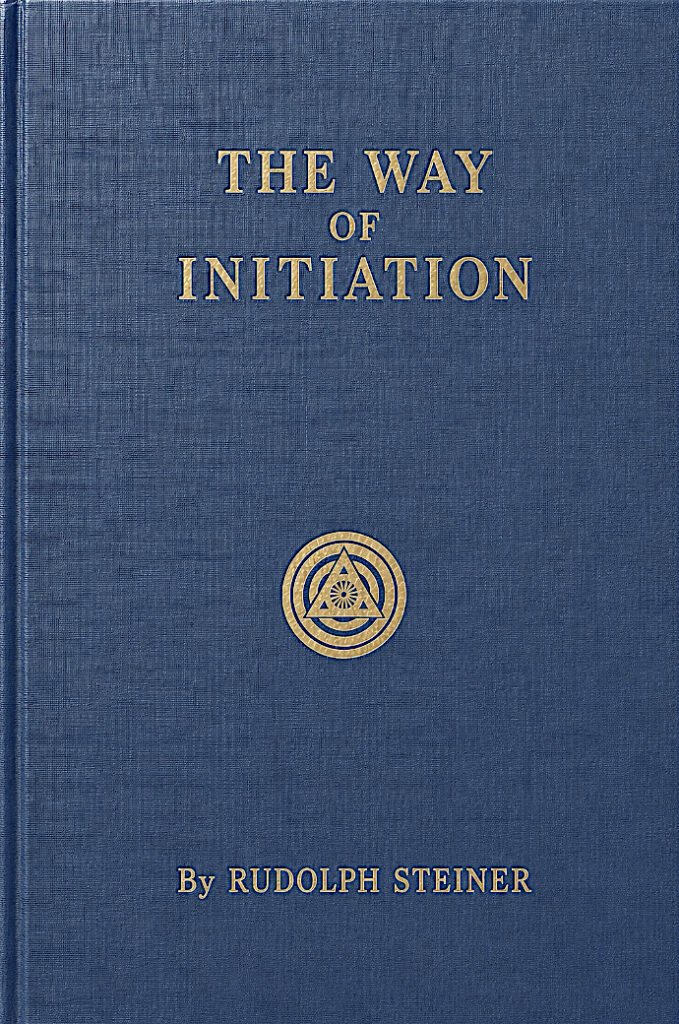
The Way of Initiation, or How to Attain Knowledge of the Higher Worlds by Rudolf Steiner is a systematic course in occult development that teaches the student how, through disciplined changes in thought, feeling, attention, conduct, and character, the faculties required for conscious perception can be developed. Steiner calls these faculties the superphysical worlds. Much of Steiner’s text had originally appeared in Lucifer-Gnosis in 1904 before the English translation was serialized in Annie Besant’s The Theosophist from 1907 to 1908. The first American version was published by the Yogi Publication Society in 1912.
Annie Besant contributes the foreword and describes Steiner’s teaching as a form of mystical Christian Theosophy, while Édouard Schuré supplies an extensive introductory biography presenting Steiner as both mystic and occultist and, more specifically, as an initiate of Western Rosicrucian esotericism. The book is built around the claim that the capacities required for clairvoyance and spiritual perception are latent within every human being and can be awakened by definite training. Its eight principal sections move from the existence of the superphysical world into the Path of Discipleship, Probation, Enlightenment, Initiation, the Higher Education of the Soul, and the conditions under which such training can safely proceed.
The book is important to the intellectual world surrounding the Yogi Publication Society because it belongs to the same early twentieth-century attempt to make occult development teachable through a graduated course. Steiner’s language is Western, Christian, Theosophical, and Rosicrucian, while the YPS books approached related questions through Yogi philosophy, mental science, Hermetic teaching, psychic development, and other schools of Western esotericism. Schuré makes this East-West relationship explicit in his introductory account of Steiner. He says that Steiner entered the Theosophical Society from the Western school of Rosicrucian initiation while recognizing the depth of Hindu wisdom and wishing to form a “magnetic link” between the two traditions. Hindu occult teaching was described as possessing great knowledge of cosmogony and the early history of humanity, while Christian and Western esotericism was directed toward the spiritual future. That is remarkably close to the kind of synthesis found throughout the YPS catalog, where Yogi Ramacharaka, the Three Initiates, Swami Panchadasi, and other identities presented Eastern and Western occult teachings to the same readership.
Who Was Rudolf Steiner According to This Edition?
Before Steiner’s own teaching begins, Édouard Schuré gives the reader a long account of his personality and spiritual development. Schuré begins by distinguishing the mystic from the occultist. The true mystic turns inward through concentration and disciplined meditation until latent faculties awaken and reveal the nature of the soul and its relation to divine reality. The occultist directs intuition, observation, reason, and synthesis toward the hidden laws operating behind nature. Schuré says that the higher initiate combines both. The mystic seeks the divine center within, while the occultist studies its manifestations throughout nature and humanity. Steiner is presented as possessing both capacities in unusual balance.
The biographical account describes Steiner as possessing unusual inward perceptions from childhood. Schuré says that he experienced a spontaneous form of clairvoyance and could perceive elements of the inner life that remained hidden from ordinary sight. At fifteen, Steiner encountered an herbalist who spoke of the etheric life of plants and the elemental beings connected with the vegetable kingdom. Schuré presents this man as a messenger from the spiritual teacher who would later guide Steiner more directly. By eighteen Steiner is said to have become conscious of what Schuré calls the twofold current of universal life. One current is evolution, through which visible beings move forward in manifestation. The other is involution, through which spiritual powers descend into matter and direct its development from the invisible side. Spirit enters matter while matter evolves through the activity of spirit.
At the same time, Steiner’s intellectual education was firmly grounded in philosophy and science. He studied Kant, Fichte, Schelling, Hegel, mathematics, chemistry, mineralogy, botany, zoology, Goethe, and the natural sciences. Schuré uses this to explain Steiner’s later effort to reconcile spiritual experience with scientific thinking. The mission attributed to him is stated with unusual clarity. He was to reunite science and religion, restore God to science and nature to religion, and through that reconciliation renew art and life. His method of occultism was intended to be neither blind faith nor an abandonment of rational thought. The ordinary faculties of observation were to be extended by cultivating additional faculties of perception.
Why Is the Rosicrucian Background Important?
Schuré is explicit that Steiner did not enter the Theosophical Society as a disciple of Eastern occultism. He describes him as belonging to the esoteric Christianity of the West and “most especially” to Rosicrucian initiation. Steiner joined the Theosophical Society in 1902 while maintaining this Western orientation. He respected Hindu wisdom and sought cooperation between the two traditions, yet Schuré presents his path as fundamentally connected with Christian and Rosicrucian esotericism.
This makes The Way of Initiation an important example of the Western initiatory side of Theosophy. Its language of Masters, hidden schools, spiritual organs, probation, initiation, discipleship, clairvoyance, and inner transformation overlaps with Theosophical terminology, while the moral and mystical framework remains closely connected with Christian mysticism and Rosicrucianism. Schuré even describes Steiner’s approach as forming a bridge between Rosicrucian esotericism and Hindu philosophy.
That East-West bridge is important when comparing Steiner with the YPS program. Swami Vivekananda had already introduced Western audiences to systematic Yoga training, and YPS developed its own extensive courses through Ramacharaka. Steiner presents another route toward disciplined spiritual perception. The vocabulary differs, but both assume that human consciousness contains dormant capacities that can be developed through sustained training.
What Does Steiner Mean by the Superphysical World?
Steiner opens his own text by addressing the obvious question raised by any claim concerning invisible worlds. How can a person know whether these things are true? He rejects the idea that the student should accept occult teaching solely because some spiritual authority declares it. Higher knowledge must eventually become experience.
His answer is that the ordinary human being possesses only the faculties currently developed. If another faculty remains dormant, realities perceptible through that faculty cannot be judged adequately by the faculties already in use. He compares the situation with mathematics. A mathematical theorem can be verified by anyone who first acquires the knowledge necessary to understand its demonstration. Someone unwilling to learn mathematics cannot reasonably demand that an advanced problem be proven entirely through the limited knowledge he already possesses. Steiner applies the same reasoning to occult perception.
This principle controls the whole book. The superphysical world is not supposed to be a supernatural realm arbitrarily revealed to a chosen few. Steiner describes it as a realm of reality for which most people have not yet developed appropriate organs of perception. The objective of initiation is to create those organs.
Can Anyone Develop Higher Knowledge?
Steiner answers this emphatically in the affirmative. He says that latent faculties exist in every human being through which knowledge of soul and spirit worlds can be acquired. The occultist differs from the ordinary person because these capacities have been cultivated.
He compares esoteric knowledge with ordinary education. Reading is secret to someone who has never learned to read, but there is no deliberate conspiracy withholding written language from that person. In the same manner, occult knowledge appears hidden because the student lacks the ability to perceive it. Correct training changes this.
There is one important qualification. Steiner insists that the aspirant must become worthy of receiving knowledge. He says that the initiates operate according to two laws. No person should be denied the knowledge that is due to him, yet no person should receive knowledge for which he is unprepared. The secrecy of initiation is therefore presented as a matter of spiritual capacity and responsibility. The teacher’s silence protects both the knowledge and the student.
What Is the Path of Devotion?
The first foundation of occult development is what Steiner calls the Path of Devotion or Veneration. This may initially appear surprising because the book promises the development of spiritual perception and then begins with respect, humility, and reverence. Steiner argues that these emotional qualities are themselves forces that modify the soul.
The student is instructed to cultivate admiration for what is worthy of admiration and to reduce habitual criticism, disparagement, and judgment. Steiner does not ask the student to surrender intellectual discrimination. He distinguishes the critical faculties needed for ordinary civilization from the interior attitude required for spiritual development. Modern science, industry, and social freedom have been aided by criticism and independent judgment. Spiritual perception requires the complementary capacity to receive.
Every act of genuine reverence is said to awaken latent powers. Contempt, constant criticism, and habitual antipathy weaken the same capacities. Steiner even describes changes in the aura associated with these emotional states and teaches that the spiritual organs of perception begin opening as the student’s emotional life changes.
Why Does Steiner Place So Much Importance on Thought?
The student is required to recognize thought and feeling as actual forces. During Probation, Steiner says one must become conscious that thoughts and emotions are realities in the astral and mental worlds just as physical objects possess reality on the physical plane. An evil thought may produce effects upon the world of thought in the same way that a destructive physical act produces effects in material existence.
This changes the meaning of morality. The disciple can no longer consider himself innocent merely because an angry, hateful, or destructive impulse remained unspoken. Thought itself becomes an act upon another level. Control of thought is thus required before the student can safely obtain heightened powers of perception.
This doctrine creates an interesting comparison with the mental training literature surrounding Herbert A. Parkyn, his Chicago School of Psychology, and the later YPS network. Parkyn’s Special Mail Course in Hypnotism and Suggestive Therapeutics trained students to observe and deliberately direct the mental processes associated with suggestion, habit, attention, and self-control. Steiner builds his discipline from a different metaphysical foundation, yet both systems insist that mastery begins with internal mental activity and that repeated control of thought and response changes the individual. The similarity is methodological while their explanations of the process remain distinct.
Why Must the Student Develop an Inner Life?
Steiner instructs the disciple to establish periods of quiet withdrawal from ordinary activity. These need not be long. He says that even five minutes can be sufficient if used correctly. During this period, ordinary experiences, joys, sorrows, actions, worries, and reactions are reviewed from a detached point of view.
The important exercise is to observe one’s own life almost as if it belonged to another person. A person normally judges another individual’s difficulties more calmly than his own because he is emotionally entangled in his personal experience. Steiner asks the student to create this same distance from his own biography. The personality becomes something observed by a higher center of consciousness.
This is one of the central psychological exercises in the book. The ordinary self is no longer identical with every feeling passing through it. A higher spectator begins to form. Steiner describes this as the development of an inward life capable of functioning independently of external stimulation.
The goal is not withdrawal from ordinary duties. The disciple continues working and fulfilling responsibilities. Steiner says that the transformation should initially be almost invisible to others. The work occurs within thought and feeling.
What Is the Rule Concerning Knowledge and Service?
Steiner gives one of the strongest ethical laws of the entire course before the formal stages of Probation and Enlightenment begin. Knowledge sought simply to increase one’s personal store of knowledge leads away from the Path. Knowledge sought for the service of humanity and the elevation of the world carries the student forward.
He condenses this into another rule. An idea that remains merely an idea destroys a power in the soul, while an idea transformed into an ideal creates living power.
This explains why curiosity is not enough. Occult knowledge is not being offered as entertainment. Clairvoyance, knowledge of the aura, spiritual beings, hidden forces, or higher worlds must serve development and service. Seeking supernatural experience simply because it is unusual strengthens the personality that initiation is intended to discipline.
Why Is Human Freedom Sacred in Steiner’s Occultism?
At the beginning of “The Path of Discipleship,” Steiner gives another fundamental rule. The occult teacher must watch every action and word so that the free will of another human being is never hindered. He says genuine occult teaching does not seek personal domination. The teacher gives methods by which the student develops himself.
This is an important distinction when the book is compared with the extensive early twentieth-century literature on hypnosis, psychic influence, personal magnetism, and suggestion. Steiner’s initiatory method is explicitly built around preservation of individual freedom. Spiritual development should increase self-command while making the student more careful about interfering with another person’s will.
This also helps explain why Steiner insists upon self-development before the acquisition of occult power. A person who has not learned moral restraint would gain new means of imposing an undeveloped personality upon others.
What Is Probation?
Steiner divides the formal occult path into three main stages. They are Probation, Enlightenment, and Initiation. These stages overlap. A student can already experience aspects of Enlightenment while still undergoing Probation, yet sufficient preparation must occur before the later stages can safely develop.
Probation begins with a strict cultivation of thought and emotion. Steiner says that this process creates organs in what he calls the spiritual body just as physical nature formed specialized organs in the biological body. The comparison is fundamental. Eyes did not arise merely because a human being wished to see. They had to be formed. Spiritual perception likewise requires organs.
One initial exercise consists of concentrating upon processes of germination, expansion, flowering, decline, fading, and death in the natural world. The student does not merely classify these processes intellectually. He observes the feelings awakened within himself while contemplating them. Through sustained attention, these feelings become increasingly definite. Steiner says that from them spiritual forms and perceptions begin to arise.
The point is to train consciousness to notice what ordinarily passes unnoticed. Nature becomes a field of spiritual instruction.
How Does Probation Develop Spiritual Perception?
The student must learn to distinguish the impressions connected with life from those connected with decay. Plants germinating and flowering awaken one kind of inward response. Withering and dying awaken another. By concentrating on these responses without adding arbitrary fantasy, the student gradually becomes aware of realities associated with the processes themselves.
Steiner repeatedly warns against imagining what one expects to see. The discipline depends upon careful observation. The student waits until perception develops from the exercise.
This is why patience is inseparable from occult training. Trying to force visions corrupts the process. The aspirant must create the required conditions and then allow perception to arise in its own time.
Probation also extends to sound. The student becomes attentive to sounds produced by living beings and learns to experience inwardly what is expressed through them. The objective is to move from a purely sensory reaction toward an inner participation in the life expressed through sound.
What Is Enlightenment?
Enlightenment begins when the spiritual organs cultivated during Probation start yielding more definite perceptions. Steiner uses an exercise involving a stone, a plant, and an animal. The student concentrates upon each and carefully observes the distinct feeling awakened.
The stone presents one quality. The animal, with its desires and active inner life, presents another. The plant occupies a position between them. By repeatedly attending to these differences, the student develops what Steiner calls spiritual eyes. Through these faculties he says the student begins perceiving astral and mental colors associated with different forms of existence.
The terms “light,” “darkness,” and “color” are approximations. Steiner acknowledges that language developed for physical experience cannot accurately describe nonphysical perception. Spiritual colors are not simply physical colors floating around objects. Ordinary vocabulary is being used to indicate experiences for which common language has no exact terms.
Is Steiner Teaching Clairvoyance?
Yes. The development of conscious and controlled clairvoyance is one of the explicit aims of the course. Schuré says Steiner’s own initiatory training led toward “conscious and intelligent clairvoyance,” and Steiner’s exercises are designed to develop organs capable of perceiving astral and spiritual realities.
This makes the book an important comparison with later YPS works attributed to Swami Panchadasi and Swami Bhakta Vishita. Panchadasi’s Clairvoyance and Occult Powers approaches clairvoyance through astral senses, telepathy, distant perception, past and future perception, and psychic development. Steiner is more concerned with the moral and initiatory preparation required before perception develops. Both systems regard clairvoyance as the operation of faculties ordinarily dormant in human consciousness, yet Steiner gives much more attention to transforming the student’s complete emotional and moral nature before advanced perception is considered safe.
The distinction also helps separate clairvoyance from telepathy and psychometry. Steiner is not primarily presenting collections of psychic phenomena. He wants the student to acquire a stable faculty of superphysical cognition.
What Are Spiritual Organs?
Steiner repeatedly describes occult development as the formation of organs. Just as physical eyes perceive physical light, spiritual organs perceive spiritual realities. Before training, these organs are undeveloped or disorganized. Disciplined thought and emotion gradually shape them.
This idea becomes much more detailed in “The Higher Education of the Soul.” Steiner describes the soul before training as an undifferentiated structure. Continued exercises produce organization. Certain centers traditionally described through lotus imagery become active, and their movement corresponds with new capacities of perception.
The comparison with physical biology is intentional. Steiner does not portray spiritual perception as random inspiration. He wants it understood as a lawful development of human organization. The student trains, organs develop, and a new range of experience becomes perceptible.
What Role Do the Lotus Flowers Play?
The lotus flowers are centers of spiritual perception. They belong to the subtle constitution described by occult teaching and become organized through specific changes in thought, emotion, speech, action, and character.
This creates another clear meeting point with Yogi philosophy. Indian Yoga traditions use lotus symbolism for subtle centers of consciousness, and Steiner’s Western occult system employs related imagery while adapting the training to his own Rosicrucian-Christian framework. The book does not simply reproduce a Hindu system. Its exercises emphasize moral equilibrium, thought control, devotional perception, objectivity, and disciplined observation.
The larger similarity is still important. Both Western and Eastern occult traditions treat the ordinary physical organism as one level of a more complex human constitution and connect spiritual development with latent centers that can be awakened.
What Is Initiation?
Initiation is the stage at which the student becomes capable of functioning more consciously within the higher worlds and of bearing responsibilities associated with that knowledge. Steiner describes the initiatory process through symbolic trials and experiences whose real meaning lies in qualities developed within the candidate.
Initiation does not erase the moral disciplines of the earlier stages. It tests whether they have become part of the person’s character. Courage, presence of mind, self-command, discrimination, trust, and freedom from personal fear must have become sufficiently strong to operate under conditions that would disturb ordinary consciousness.
The symbolic language of initiation points back toward the ancient mystery schools. Steiner says that many occult teachings were historically presented through symbols because symbols could communicate relationships not easily expressed through ordinary intellectual language.
What Are the Trials of Initiation?
The initiate encounters tests traditionally represented through elemental imagery. These are not meant simply as theatrical ceremonies. Steiner treats them as representations of inner capacities that must be established.
The student must be able to maintain spiritual judgment when familiar physical supports are absent. Ordinary life trains people to respond according to sensory evidence, habit, fear, memory, and social conditioning. Initiation tests whether the higher center of consciousness can remain stable when these ordinary reference points no longer supply direction.
The ordeal is thus a test of spiritual independence. The student must neither collapse into fear nor become intoxicated by unusual experiences. The same calm cultivated during the simplest exercises becomes necessary at a much higher level.
What Is the Draught of Forgetfulness?
One of Steiner’s most interesting symbols of initiation is the “draught of forgetfulness.” This does not mean literal amnesia. It represents the ability to confront every new situation without allowing accumulated memories and past judgments to determine in advance what the new experience must mean.
Past experience remains valuable because it develops discernment. The problem begins when the past becomes a filter through which everything unfamiliar is forced. The initiate must be able to meet a being, event, or spiritual perception freshly enough for it to reveal itself.
Steiner argues that memory continually forms a veil around human consciousness. The initiatory faculty allows a person to use memory without being imprisoned by it.
This is closely connected with the detached self-observation practiced earlier. The student has been learning throughout the course to see without immediately projecting personal reaction onto the object of perception.
What Is the Draught of Remembrance?
The second symbolic drink is the “draught of remembrance.” Here the movement is reversed. The initiate must be able to retain spiritual truth so completely that it ceases to remain abstract knowledge and becomes part of his entire being.
Steiner says the higher truths must become practice, inclination, habit, and living action. The initiate should no longer need to stop and intellectually remember a spiritual law before acting according to it. The law has been incorporated into character.
The two draughts express complementary powers. Forgetfulness frees perception from the tyranny of the past. Remembrance makes spiritual truth permanent within the transformed personality. One produces openness. The other produces continuity.
What Is the Higher Education of the Soul?
Once thought, emotion, and will have undergone the preceding training, Steiner says that the soul itself becomes increasingly differentiated and organized. Nature performed a similar work upon the physical organism by producing separate organs with distinct functions. The student now cooperates consciously in the organization of the spiritual constitution.
This education is extremely subtle. Steiner warns that spectacular external methods are not what transform the student. Small alterations in habitual thought and emotion matter more. How quickly anger arises, how patiently one waits, whether one deceives oneself about personal weaknesses, whether curiosity governs the search, and whether desire for spiritual advancement itself becomes selfish all affect development.
One of the central virtues is patience. Steiner states that impatience repels higher knowledge while patience attracts it. The student works faithfully but does not demand results. He recommends the attitude that one should do everything possible for the cultivation of soul and spirit and then wait quietly until higher powers judge the student ready for illumination.
Why Must the Student Be Completely Honest with Himself?
Self-knowledge is one of the strictest requirements of Steiner’s system. The disciple must face faults, weaknesses, and limitations without excuses. The moment a weakness is rationalized or disguised, it becomes an obstacle.
Steiner believes every capacity needed for development exists latently in the soul. A weakness can be changed once it is perceived clearly. The difficulty is that people are exceptionally skilled at deceiving themselves.
The path is therefore not a search for flattering evidence of spiritual superiority. A genuine occult exercise may reveal qualities the student would prefer not to discover. Spiritual development requires the willingness to see those qualities without self-condemnation and without evasion.
This emphasis sharply distinguishes initiation from fascination with psychic phenomena. A person might desire visions, auras, astral perception, or hidden knowledge while remaining unwilling to investigate his own motives. Steiner considers that reversal dangerous. Self-knowledge comes first.
Why Is Curiosity a Problem?
Steiner demands that ordinary curiosity disappear from occult study. Curiosity wants knowledge for personal satisfaction. The disciple is being trained to receive knowledge when it can serve a lawful purpose.
This returns to the earlier rule that knowledge sought for personal accumulation leads away from the path. The higher worlds are not a spectacle. A person seeking unusual experiences simply to possess stories unavailable to others is strengthening self-importance.
The paradox of Steiner’s system is that the student becomes capable of seeing more by becoming less concerned with seeing for its own sake.
What Are the Conditions of Discipleship?
The last section gathers the major requirements into a coherent standard of life. Steiner emphasizes health of body and soul, responsibility toward ordinary duties, cultivation of the inner life, self-knowledge, patience, receptivity, and willingness to learn. Occult development should not make someone less capable of ordinary life.
The disciple cannot use spiritual aspiration as an excuse to neglect family responsibilities, employment, ethical obligations, or necessary work. Higher development must be integrated into life.
Steiner also rejects dogmatic submission to the occult teacher. The teacher does not impose truth. He points toward a path. The student must eventually perceive the truth himself.
Near the end of the book Steiner returns to the importance of listening. A person who is constantly judging according to existing beliefs cannot learn what exceeds those beliefs. He recommends calm attention and temporary suspension of judgment when something cannot yet be understood. Waiting is preferable to prematurely condemning what later development may make intelligible.
Does Steiner Ask for Blind Faith?
No. This is one of the most important distinctions in the book. Steiner asks for trust in the process and respect for genuine teachers, but the object is direct knowledge.
The opening chapter is built around the modern demand for personal verification. Steiner agrees that people should eventually know for themselves. His disagreement concerns the assumption that present-day sensory and intellectual faculties are sufficient to judge every possible level of reality.
The student is asked to develop additional capacities and then investigate. In Steiner’s conception, occult training is a form of expanded empiricism. The instruments of investigation are first developed within the investigator.
What Is Steiner’s Relationship to Theosophy?
The 1912 edition is unmistakably Theosophical. It was published by the Theosophical Publishing Society. Annie Besant writes the foreword. The chapters had appeared in The Theosophist. The vocabulary includes occult schools, Masters, astral realities, higher worlds, clairvoyance, spiritual evolution, and hidden faculties. Besant calls Steiner’s approach a mystical Christian Theosophy.
Yet the Schuré biography stresses that Steiner entered the movement from a Western Christian and Rosicrucian background. This distinction matters because the book combines ideas associated with Theosophy with an initiatory system Schuré explicitly identifies as Western.
Steiner’s relationship with Eastern wisdom is presented as cooperative. The Hindu and Christian-Western streams are supposed to complement one another. This makes The Way of Initiation useful for understanding the cross-pollination that characterized occult publishing during the same period in which YPS was issuing its Ramacharaka courses and later books on Hermeticism, psychic development, Qabalistic traditions, and comparative religion.
How Does The Way of Initiation Compare with Yogi Philosophy?
The similarities with Yogi training are substantial. Steiner asks the student to control attention, cultivate inner stillness, separate the observing consciousness from ordinary emotional reactions, develop concentration, discipline thoughts, refine motives, overcome impulsive desire, and awaken latent perceptive faculties.
The Ramacharaka works published by YPS present comparable goals through the language of Yoga. Raja Yoga develops mastery over mental activity. Gnani Yoga directs consciousness toward knowledge of the higher Self. Other YPS works teach concentration, psychic development, self-control, mental influence, and the awakening of subtler faculties.
Steiner’s path remains distinct. His structure of Probation, Enlightenment, and Initiation belongs to a Western initiatory model, and his moral framework is deeply connected with Christian and Rosicrucian esotericism. Yet Schuré himself supplies the justification for comparing the systems when he says Steiner regarded Western and Hindu traditions as independent spiritual streams capable of working together.
How Does Steiner’s Teaching Compare with Yogi Ramacharaka?
Yogi Ramacharaka repeatedly presents human beings as possessing latent powers that can be awakened through systematic training. Steiner begins “How to Attain Knowledge of the Higher Worlds” with nearly the same fundamental proposition. Every human being contains latent faculties through which higher worlds can become knowable.
Both systems are developmental. The student does not simply believe a doctrine. He changes himself until another range of consciousness becomes possible.
Both also warn against an uncontrolled pursuit of psychic phenomena. Powers must remain subordinate to spiritual development. Concentration without character is insufficient. Knowledge without service can become dangerous.
The most important difference lies in framework. Ramacharaka writes through an explicitly Yogi presentation. Steiner’s path develops out of Christian Theosophy and Rosicrucian initiation. Yet both describe the human being as unfinished and capable of consciously accelerating an interior development ordinarily accomplished much more slowly.
How Does the Book Relate to Clairvoyance, Psychometry, and Telepathy?
Steiner’s immediate concern is clairvoyance because initiation develops spiritual organs of perception. Psychometry and telepathy are not developed as independent subjects in the same manner found in later psychic manuals. His concern is the underlying faculty through which superphysical reality becomes perceptible.
This makes the book a useful companion to the later YPS psychic literature. Swami Panchadasi and Swami Bhakta Vishita classify phenomena such as astral perception, thought transmission, distant vision, psychic influence, and subtle sensing. Steiner works from the opposite direction. He concentrates on creating a disciplined perceiver whose inner organs can encounter higher worlds consciously.
The difference is valuable. One system catalogs and explains phenomena. Steiner’s course asks what kind of human being can perceive such phenomena safely and accurately.
How Does The Way of Initiation Relate to New Thought and Mental Science?
Steiner is not writing a New Thought success manual. He is not primarily concerned with prosperity, personal achievement, health affirmations, or the deliberate attraction of circumstances. Yet several parts of his method intersect with the mental-discipline literature of the period.
Thought must be consciously governed. Habitual emotional reactions can be transformed. Concentrated attention strengthens particular capacities. Repeated inward exercises reorganize the personality. Self-observation allows the individual to cease reacting automatically. Higher control develops when thought becomes deliberate.
These same mechanisms appear in different language throughout the mental-science literature associated with William Walker Atkinson, Theron Q. Dumont, Parkyn, and the Chicago mental-training movement. Steiner directs them toward initiation and clairvoyant perception while the mental-science writers frequently direct them toward self-mastery, health, influence, habit, personality, and achievement.
What Is the Connection with Herbert A. Parkyn and the Chicago School of Psychology?
The relationship is one of comparative method, not a claim of direct borrowing. Herbert A. Parkyn had been teaching systematic mental training through the Chicago School of Psychology years before Steiner’s English book appeared. Parkyn’s system dealt with voluntary and involuntary mental processes, habit, suggestion, auto-suggestion, concentration, self-control, and the deliberate direction of mental activity. Steiner’s course is an occult initiatory discipline directed toward the development of spiritual organs and higher perception.
The striking meeting point is the conviction that internal processes can be trained systematically. Both reject passive dependence upon an outside operator. Parkyn’s movement away from hypnosis toward conscious suggestion and auto-suggestion emphasized increasing self-direction. Steiner likewise insists that no genuine occult teacher should interfere with another person’s free will. The student must become more independent as training proceeds, not more dependent upon the teacher.
This distinction also helps explain the range of subjects that converged in Chicago’s occult and mental-science publishing environment. Sydney B. Flower, Parkyn, Atkinson, and later YPS publications operated in a world where psychology, suggestion, mental science, Yoga, clairvoyance, occultism, and spiritual development were continually placed beside one another. Steiner belongs to this larger history even though his own institutional path came through European Theosophy and Western esotericism.
How Does Steiner’s Teaching Compare with The Kybalion?
Steiner’s The Way of Initiation and The Kybalion share a belief that mastery begins through mastery of internal states, but their structures are very different. The Kybalion, attributed to the Three Initiates, organizes its teaching around Hermetic principles and mental transmutation. Steiner organizes his around an initiatory path through devotion, self-observation, Probation, Enlightenment, spiritual organs, and direct perception of higher worlds.
The closest connection is transformation. Both teach that the student need not remain passively governed by ordinary mental and emotional conditions. Conscious work can change the level from which the individual functions.
Steiner’s Western esoteric background also places him within the same large field of Hermeticism, Rosicrucianism, Christian esotericism, and occult initiation in which the authority of Hermes Trismegistus continued to play a foundational role. The Way of Initiation is not a Hermetic manual in the narrow sense, but it belongs to the Western initiatory tradition that repeatedly drew upon Hermetic ideas of spiritual transformation.
How Does the Book Relate to Qabalah and Alchemy?
Steiner does not build this particular volume around Qabalah or Qabalism, yet his Rosicrucian background places the book within the same Western esoteric culture in which Qabalistic and alchemy symbolism circulated widely.
The comparison with Elias Gewurz’s The Hidden Treasures of the Ancient Qabalah is especially useful. Gewurz describes human beings as the vessels in which spiritual transmutation occurs. Steiner likewise makes the human soul the field of the Great Work. The material being transformed is thought, emotion, desire, perception, and character.
Steiner usually avoids Gewurz’s explicit alchemical symbolism in this volume. Yet the underlying initiatory structure is comparable. The student does not acquire higher truth as an external possession. The student must become a different instrument before the truth can be perceived.
What Role Does Christian Mysticism Play?
Christian mysticism is central. Annie Besant identifies Steiner’s teaching as mystical Christian Theosophy. Schuré presents his path as Western and Rosicrucian. Steiner himself draws upon Christ, the Gospels, Meister Eckhart, Angelus Silesius, and the inward birth of Christ when explaining spiritual knowledge.
His discussion of Gospel criticism makes this clear. Steiner does not deny historical investigation. He argues that scholarship alone cannot exhaust the spiritual content of Christian texts. The mystical meaning of Christ must also be experienced inwardly.
This is classic Christian mysticism interpreted through occult development. Christ is not solely an object of historical belief. Christian truth becomes something to be reexperienced within transformed consciousness.
Does Karma or Reincarnation Appear in Steiner’s Initiatory System?
The book’s final section makes clear that Steiner assumes a long developmental history extending beyond a single lifetime. He says that a person might discover the occult path independently but perhaps only after many incarnations, while systematic training can shorten the process.
This places initiation inside the Theosophical framework of reincarnation and Karma. Human faculties are at different stages because spiritual development is understood as a long evolutionary process.
Training does not eliminate this law. It allows the individual to cooperate consciously with development. The disciple takes part in a process that otherwise unfolds across much longer periods.
Why Is Patience One of the Most Important Qualities?
Steiner repeatedly returns to patience because spiritual desire can itself become an obstacle. A person may begin training precisely because he desperately wants visions, powers, confirmation, recognition, or secret knowledge. That intense demand keeps the personal self at the center.
The student must work without continually checking whether results have appeared. Steiner says higher knowledge recedes before impatience and desire. The aspirant prepares himself and waits.
This is a subtle form of self-mastery. A person may have conquered obvious distractions while remaining ruled by spiritual ambition. Steiner treats that ambition as another desire requiring discipline.
What Does Steiner Mean by Becoming a Master of Oneself?
Schuré’s introduction closes with an observer describing Steiner as a master of himself and of life. The phrase summarizes the book unusually well. Initiation begins long before clairvoyant colors or higher beings are perceived. It begins when the student becomes capable of governing his own inner life.
Anger need not automatically produce anger. Criticism need not automatically become judgment. Pleasure need not end in self-indulgence. Knowledge need not become possession. Memory need not predetermine perception. Curiosity need not dictate inquiry. Fear need not govern action.
When these processes cease operating automatically, another center of consciousness becomes possible. Steiner calls this spiritual development.
Why Does The Way of Initiation Matter to the Yogi Publication Society History?
The book provides an unusually clear Western counterpart to the initiatory and self-development systems that circulated through the Yogi Publication Society and its intellectual environment. It demonstrates that the early twentieth-century occult revival was not divided neatly into separate Eastern, Western, psychological, and mystical schools. Steiner himself was presented as a Rosicrucian initiate working through Theosophy while deliberately joining Western Christian esotericism with respect for Hindu occult wisdom.
The resemblance to the YPS program is strongest at the structural level. Human beings possess dormant capacities. Those capacities can be awakened. Training must proceed systematically. Thought and feeling have effects beyond their obvious physical expression. Attention can be strengthened. An inward observing consciousness can be cultivated. Psychic perception requires disciplined development. Higher knowledge carries moral obligations. Personal power must remain subordinate to service. The student’s freedom must be protected. Spiritual truth must eventually be experienced instead of merely believed.
YPS approached these subjects through multiple voices and fields. Ramacharaka supplied Yoga and Hindu philosophy. Atkinson and Dumont explored mental power, concentration, self-mastery, and suggestion. Panchadasi and Bhakta Vishita dealt with clairvoyance and psychic faculties. The Three Initiates presented Hermetic mental transmutation. Other YPS works entered Theosophy, Qabalah, Rosicrucianism, Christian mysticism, reincarnation, and occult initiation. Steiner’s book sits naturally beside this literature because it presents a Western initiatory answer to the same fundamental question. How can an ordinary human being consciously develop capacities that occult philosophy says are already latent within him?
What Is the Central Teaching of The Way of Initiation?
The central teaching is that initiation is the deliberate education of the whole human being for a new form of perception. Higher knowledge cannot be separated from the person who knows. The student cannot simply collect occult information and remain inwardly unchanged. He must create within himself the faculties capable of receiving that knowledge.
Steiner begins with devotion because perception depends upon the quality of the soul. He proceeds to inner quiet because the student must learn to observe independently of immediate reaction. Thought and feeling are disciplined because they become forces in the higher worlds. Probation trains attention. Enlightenment opens spiritual sight. Initiation tests whether the new consciousness can remain stable and responsible. The higher education of the soul organizes spiritual faculties into functioning organs. The final conditions ensure that knowledge remains compatible with freedom, ordinary duty, humility, patience, truthfulness, and service.
This is why the book’s title is precise. The Way of Initiation is not primarily a description of what initiates supposedly know. It is an account of the way by which Steiner believed a person could become capable of knowing. The higher worlds are reached through a transformation of the knower. The path begins in ordinary life, in the control of a thought, the restraint of a reaction, the cultivation of reverence, a few minutes of quiet observation, and the willingness to see oneself clearly. From these apparently small acts Steiner builds his entire system of discipleship, clairvoyance, enlightenment, and initiation.
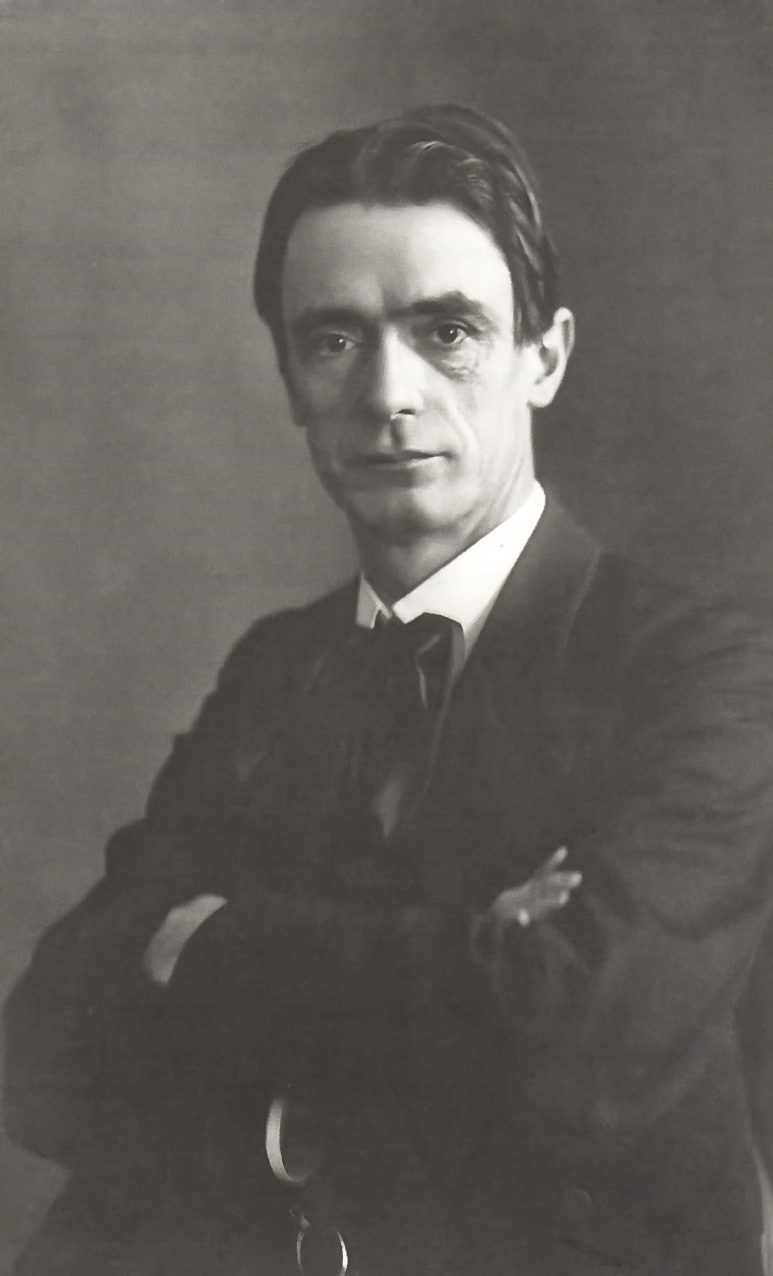
Rudolf Steiner Biography
Rudolf Steiner (1861–1925) was an Austrian philosopher, educator, architect, social reformer, and esoteric teacher. He is best known for founding Anthroposophy, a spiritual philosophy that sought to unite scientific study and spiritual insight. As an important figure in the Western esoteric revival of the twentieth century, Steiner created a wide range of work across areas such assuch as education, agriculture, medicine, architecture, economics, religion, and the arts. His ideas led to the Waldorf school movement, biodynamic agriculture, anthroposophical medicine, and many cultural institutions that still exist today.
Steiner was born in what is now Croatia and studied in Vienna. He began his career as a philosopher and literary scholar and, early on, edited the scientific works of Johann Wolfgang von Goethe, whose holistic view of nature strongly influenced Steiner’s thinking. Steiner rejected both materialism and uncritical mysticism. Instead, he believed that methodical, disciplined thinking could be used to explore spiritual realities with the same seriousness as physical science. This idea became the basis of Anthroposophy, which he called a “spiritual science” focused on understanding humanity’s role in the universe’s spiritual evolution.
Steiner first worked as General Secretary of the German Section of the Theosophical Society, where he proved to be a respected lecturer and writer. During this time, he wrote many of his most important books, including The Way of Initiation (Knowledge of the Higher Worlds and Its Attainment), which introduced Western readers to structured methods of meditation and spiritual growth. As philosophical disagreements grew, especially about Christianity and the figure of Jesus Christ, Steiner left the Theosophical Society in 1912. He then founded the Anthroposophical Society, which became the center of his independent movement.
Steiner wanted to put his spiritual ideas into practice. In 1919, he started the first Waldorf School in Stuttgart for the children of workers at the Waldorf-Astoria cigarette factory. As a result, the school focused on developing students’ intellectual, artistic, emotional, and practical skills. Five years later, he introduced biodynamic agriculture, an early form of organic farming that treats the farm as a living whole connected to nature and the cosmos. He also helped develop anthroposophical medicine, inspired the creation of the natural health company Weleda, designed the Goetheanum in Dornach, Switzerland, as the center of Anthroposophy, and proposed the Threefold Social Order, which called for greater independence among society’s cultural, political, and economic spheres.
Steiner wrote many books and gave around 6,000 lectures during his life, covering topics like philosophy, religion, education, history, science, agriculture, medicine, art, and esotericism. Among his most important works are The Philosophy of Freedom (1894), The Way of Initiation (1904), and An Outline of Esoteric Science (1909). Together, these books explain his ideas about human freedom, spiritual growth, and the evolution of the universe.
One unique part of Steiner’s worldview was his detailed story of humanity’s spiritual evolution through earlier civilizations. He claimed to have studied the Akashic Records and taught that Atlantis and Lemuria were real stages in human history, not just myths. In Steiner’s account, the people of Atlantis had a dreamlike, clairvoyant awareness and were more connected to the spiritual world than people today. He said their civilization went through seven stages before it declined due to the misuse of spiritual powers and moral failings, culminating in great floods that destroyed Atlantis. Steiner linked the biblical Flood to this event, teaching that a spiritual leader, known as Manu and later as Noah, led survivors who became the founders of later civilizations. In this way, these ideas became a key part of Anthroposophical cosmology, underscoring Steiner’s belief that history is a process of spiritual evolution guided by higher beings.
Steiner’s impact goes well beyond spiritual circles. Waldorf education is now one of the largest independent school movements in the world, biodynamic farming has influenced modern organic agriculture, and Anthroposophical medicine is still practiced in many countries. At the same time, many of his spiritual and metaphysical ideas—such as clairvoyant research, reincarnation, Atlantis, and the Akashic Records—are still debated and are usually seen by mainstream historians and scientists as part of esoteric philosophy rather than science. Even so, Rudolf Steiner is known as a highly original and influential spiritual thinker whose ideas continue to shape education, farming, medicine, and Western esotericism more than a hundred years later.