
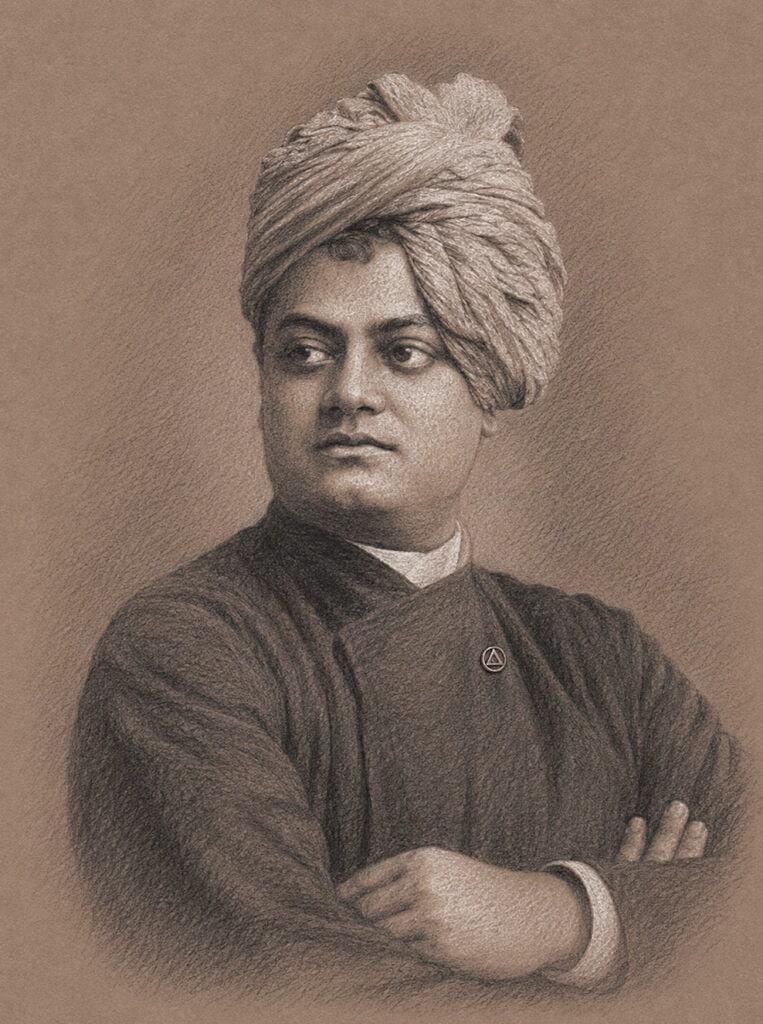
Person Research Collection
Swami Vivekananda
1863–1902
Vivekananda inspired the Yogi Publication Society by introducing Vedanta and Yoga, which it presented as expressing the same universal principles as Suggestion.
Swami Vivekananda was one of the most influential Hindu monks and religious teachers of the modern era. A disciple of the mystic Ramakrishna Paramahamsa, he introduced Vedanta and Yoga to the Western world while inspiring a renewed sense of spiritual and cultural confidence in India. His address at the 1893 World’s Parliament of Religions in Chicago transformed him into an international figure, and his lectures and writings became foundational texts for the global spread of Hindu philosophy. Through the Ramakrishna Mission and the Ramakrishna Order, he united spiritual practice with social service, leaving a legacy that continues to shape religious thought around the world.
Early Life and Education (1863–1881)

Vivekananda was born Narendranath Datta on January 12, 1863, in Calcutta (now Kolkata), British India. He was born into an educated and prosperous Bengali Kayastha family. His father, Vishwanath Datta, was a successful attorney at the Calcutta High Court whose liberal outlook exposed Narendranath to Western philosophy, law, and literature. His mother, Bhuvaneshwari Devi, was deeply religious and possessed an extensive knowledge of the Hindu epics and devotional traditions. From her he inherited both a vivid imagination and a lifelong interest in spirituality.
Narendranath received an excellent education. After attending the Metropolitan Institution, he enrolled at the General Assembly’s Institution, now known as Scottish Church College. There he studied Western philosophy, logic, psychology, European history, literature, and science. He developed an exceptional memory and became widely known for his intellectual abilities and debating skills.
Outside the classroom, he excelled in athletics, gymnastics, rowing, horseback riding, wrestling, and music. He was also trained in Indian classical vocal music and possessed a commanding speaking voice that later became one of his greatest strengths as a public lecturer.
During his college years he became increasingly interested in philosophy and comparative religion. He read the works of philosophers including David Hume, Immanuel Kant, Herbert Spencer, Arthur Schopenhauer, and John Stuart Mill, while simultaneously studying the Upanishads, Bhagavad Gita, and other Hindu scriptures. Although drawn to religion, he insisted that spiritual truth must be verified through direct experience rather than accepted through blind faith. His search led him to join the Brahmo Samaj, a reform movement that rejected idol worship and emphasized monotheism. Yet even there he remained dissatisfied. His constant question to religious leaders became, “Have you seen God?”
Meeting Ramakrishna (1881–1886)

The defining event of Narendranath’s life occurred in November 1881 when he met Ramakrishna Paramahamsa at the Dakshineswar Kali Temple near Calcutta. Upon meeting the revered mystic, Narendranath posed the question that had frustrated every religious teacher he had encountered:
“Sir, have you seen God?”
Ramakrishna answered without hesitation:
“Yes, I have seen Him just as I see you here, only in a much more intense sense.”
The certainty of the response deeply impressed the young skeptic, although he remained cautious. Over the next five years he repeatedly tested Ramakrishna’s teachings, questioned his experiences, and challenged many of his conclusions. Rather than rejecting these doubts, Ramakrishna encouraged them, insisting that genuine spirituality must withstand honest inquiry.
Gradually Narendranath came to recognize in Ramakrishna a profound realization that transcended intellectual philosophy. He accepted him as his guru and became one of his closest disciples.
When Ramakrishna died in 1886, he entrusted Narendranath with the leadership of his young monastic disciples. This responsibility marked the beginning of Vivekananda’s public mission.
The Birth of Swami Vivekananda (1886–1888)
Following Ramakrishna’s death, the disciples established a monastery at Baranagar near Calcutta. In 1887 they formally embraced the vows of sannyasa, or monastic renunciation. Narendranath adopted the name Swami Vivekananda, commonly interpreted as “the bliss of discerning wisdom.” The young monks lived in extreme poverty, dedicating themselves to meditation, scriptural study, and spiritual discipline. Yet Vivekananda increasingly felt compelled to understand India beyond the monastery walls.
The Wandering Monk (1888–1893)

Between 1888 and 1893, Vivekananda traveled throughout India as a wandering monk (parivrajaka). Possessing little more than a water pot, staff, ochre robes, and copies of the Bhagavad Gita and The Imitation of Christ, he journeyed on foot across the subcontinent.
His travels brought him into contact with every level of Indian society. He stayed in royal palaces as the guest of princes while also living among laborers, farmers, monks, and members of the lowest social castes. The contrast between India’s profound spiritual heritage and the crushing poverty experienced by millions left a lasting impression. These experiences convinced him that religion could not remain detached from human suffering. He frequently observed that a starving person required food before philosophy, leading him to emphasize that genuine spirituality must be accompanied by education, economic development, and practical service.
One of the rulers who became particularly devoted to him was Maharaja Ajit Singh of Khetri, who provided financial assistance for Vivekananda’s future journey to America and is traditionally credited with encouraging the use of the name “Vivekananda.”
Near the end of his travels, Vivekananda meditated on a rock just off India’s southern coast at Kanyakumari. There he reflected upon India’s past and contemplated how its spiritual heritage might contribute to the modern world. The experience strengthened his resolve to carry Vedanta beyond India.
The Parliament of the Religions (1893)

In 1893 Vivekananda sailed to the United States to attend the World’s Parliament of Religions held in Chicago during the World’s Columbian Exposition. His arrival was not easy. He faced financial hardship and initially lacked the credentials required to participate. Assistance from supporters in both Boston and Chicago enabled him to obtain official recognition as a delegate representing Hinduism. On September 11, 1893, Vivekananda opened his first address with the now-famous words:
“Sisters and brothers of America.”
The greeting immediately captivated the audience of approximately seven thousand people, who responded with prolonged applause and a standing ovation.

Throughout his speeches, Vivekananda advocated religious tolerance, universal acceptance, and harmony among faiths. Rather than arguing for the superiority of Hinduism, he maintained that every religion represented a genuine path toward the same divine reality. He condemned religious fanaticism, persecution, and sectarian violence while presenting Vedanta as a universal philosophy compatible with reason and science. His eloquence made him one of the Parliament’s most celebrated speakers and instantly established his international reputation.
Teaching in America and Europe (1893–1897)
Following the Parliament, Vivekananda spent nearly four years lecturing throughout the United States and Great Britain. His lectures introduced Western audiences to Vedanta philosophy, Raja Yoga, meditation, and the traditions of Hindu thought. Unlike many previous presentations of Eastern religion, his approach emphasized rational inquiry and practical spiritual development rather than exotic mysticism. In 1894, he established the first Vedanta Society in New York, creating a permanent institutional foundation for the study of Vedanta in America. Similar societies later emerged in other American cities and in England. Among his most influential Western students were Margaret Noble, later known as Sister Nivedita, Captain and Mrs. Sevier, Josephine MacLeod, Sara Bull, and E. T. Sturdy, many of whom became lifelong supporters of his work in both India and the West.
During this period he also produced many of the lectures that were later published as Raja Yoga, Karma Yoga, Bhakti Yoga, and Jnana Yoga, works that remain among the most widely read introductions to Hindu philosophy in the English language.
Return to India and the Ramakrishna Mission (1897–1899)

When Vivekananda returned to India in 1897, he received an enthusiastic public welcome. Thousands gathered to hear him speak as he traveled across the country encouraging educational reform, national confidence, religious harmony, and social responsibility.
On May 1, 1897, he founded the Ramakrishna Mission, an organization dedicated to combining spiritual practice with humanitarian service. The Mission established schools, hospitals, libraries, orphanages, famine relief efforts, disaster relief programs, and educational institutions across India.
His guiding principle became:
“For one’s own salvation and for the welfare of the world.”
In 1899, the Ramakrishna Order established its permanent headquarters at Belur Math, near Calcutta. The monastery became both the administrative center of the movement and a living expression of Vivekananda’s vision of combining contemplation with service.
Second Journey to the West (1899–1900)
Vivekananda returned to the West in 1899, spending time in the United States and Europe. During this second visit he established additional Vedanta centers, particularly in California, where he delivered influential lecture series in San Francisco and other cities. Although his health had begun to deteriorate, he continued to write, lecture, and mentor students while expanding the international reach of Vedanta.
Philosophy and Teachings
Vivekananda interpreted Hinduism as a universal spiritual philosophy rather than a sectarian religion. Central to his teaching was Advaita Vedanta, which held that the divine exists within every individual and that all beings ultimately share the same spiritual reality.
He emphasized four complementary paths to spiritual realization:
- Karma Yoga — selfless action performed without attachment to personal reward.
- Bhakti Yoga — devotion and love directed toward God.
- Jnana Yoga — the pursuit of spiritual knowledge through inquiry and discrimination.
- Raja Yoga — meditation and mastery of the mind through disciplined practice.
He rejected the notion that spirituality required withdrawal from society. Instead, he argued that serving humanity was itself a form of worship because every person embodied the divine. His teaching also encouraged harmony between science and religion, insisting that both sought truth through different methods. He maintained that religion should be based upon direct experience rather than mere belief, a perspective that resonated strongly with educated audiences in both India and the West.
Final Years and Death
Vivekananda’s demanding schedule gradually undermined his health. He suffered from diabetes, asthma, insomnia, and chronic fatigue, yet continued teaching almost without interruption. On July 4, 1902, after a day devoted to meditation, teaching, and discussions with fellow monks, he retired to his room at Belur Math. That evening he died while meditating, at only thirty-nine years of age, fulfilling a statement he had made years earlier that he would not live to see forty. He was cremated on the grounds of Belur Math, where a memorial temple now stands.
Legacy
Swami Vivekananda is widely regarded as one of the principal figures responsible for introducing Hindu philosophy to the modern Western world. His speeches at the Parliament of Religions marked a turning point in global awareness of Vedanta and Yoga, while his writings became foundational texts for generations of spiritual seekers. In India, his message helped foster renewed confidence in the country’s philosophical traditions during the colonial period and inspired numerous leaders of the Indian independence movement. His emphasis on education, character, self-discipline, and service continues to influence religious, educational, and humanitarian organizations around the world.
The Ramakrishna Mission and the worldwide network of Vedanta Societies remain active today, carrying forward his vision that spiritual realization and compassionate service are inseparable aspects of religious life.
Books
- Sangeet Kalpataru (1887, with Vaishnav Charan Basak)
- Karma Yoga (1896)
- Raja Yoga (1896
- Vedanta Philosophy: An address before the Graduate Philosophical Society (1896)
- Lectures from Colombo to Almora (1897)
- Bartaman Bharat (in Bengali) (March 1899), Udbodhan
- My Master (1901), The Baker and Taylor Company, New York
- Inspired Talks (1909)


References
- Vivekananda 2001, Conversations and Dialogues, Chapter “VI – X Shri Priya Nath Sinha”, Vol 5.
- Vivekananda 1996, pp. 1–2.
- “Swami Vivekananda life and teaching”. Belur Math. Archived from the original on 30 March 2012. Retrieved 23 March 2012.
- Towards the end”. Vivekananda A Biography. www.ramakrishnavivekananda.info. Retrieved 11 March 2012.
- “Charles Bonney and the Idea for a World Parliament of Religions”. The Interfaith Observer. 15 June 2012. Retrieved 28 December 2019.
- “World Parliament of Religions, 1893 (Boston Collaborative Encyclopedia of Western Theology)”. people.bu.edu. Retrieved 28 December 2019.
- Swami Vivekananda’s 114th death anniversary: Lesser known facts about the spiritual leader. India Today. 4 July 2016.
- Steven Kemper (2015). Rescued from the Nation: Anagarika Dharmapala and the Buddhist World. University of Chicago Press. p. 236. ISBN 978-0-226-19910-8.
- “Devdutt Pattanaik: Dayanand & Vivekanand”. 15 January 2017.
- World fair 1893 circulated photo”. vivekananda.net. Archived from the original on 24 December 2023. Retrieved 6 October 2024.
- “Bhajanānanda (2010), Four Basic Principles of Advaita Vedanta, p.3″ (PDF). Retrieved 28 December 2019.
- De Michelis 2005.
- “Swami Vivekananda: A short biography”. OneIndia. Retrieved 3 May 2017.
- “Life History & Teachings of Swami Vivekanand”. Archived from the original on 9 May 2017. Retrieved 3 May 2017.
- “International Yoga Day: How Swami Vivekananda helped popularise the ancient Indian regimen in the West”. The Indian Express. 21 June 2017.
- Feuerstein 2002, p. 600.
- Syman, Stefanie (2010). The Subtle Body: The Story of Yoga in America. New York: Farrar, Straus, and Giroux. p. 59. ISBN 978-0-374-23676-2.
- Clarke 2006, p. 209.
- Barrows, John Henry (1893). The World’s Parliament of Religions. The Parliament of Religions Publishing Company. p. 101.
- Dutt 2005, p. 121.
- “Sisters and brothers of America — full text of Swami Vivekananda’s iconic Chicago speech”. ThePrint. 4 July 2019.
- Jackson 1994, p. 115.
- Von Dense 1999, p. 191.
- “Know About Swami Vivekananda on National Youth Day 2022”. SA News Channel. 11 January 2022. Retrieved 12 January 2022.
- “National Youth Day 2022: Images, Wishes, and Quotes by Swami Vivekananda That Continue to Inspire us Even Today!”. News18. 12 January 2022. Retrieved 12 January 2022.
- Swami Saradananda. Sri Ramakrisha The Great Master. Vol. 1. Translated by Swami Jagadananda (5th ed.). Madras.: Sri Ramakrishna Math. pp. 558–561. ISBN 978-81-7823-483-0. Archived from the original on 4 March 2016
- National implementation committee approves funds for Swami Vivekananda values’ education project”. 6 September 2010. Archived from the original on 10 May 2013. Retrieved 14 April 2012.
- “Swami Vivekananda State Police Academy”. Swami Vivekananda State Police Academy. Archived from the original on 4 August 2013. Retrieved 9 January 2013.
- “Chhattisgarh Swami Vivekananda Technical University”. Csvtu.ac.in. 19 November 2012. Archived from the original on 15 January 2013. Retrieved 7 February 2013.
- “Pranab hopes Raipur airport’s new terminal will support Chhattisgarh’s growth”. The Hindu. Archived from the original on 17 January 2013. Retrieved 7 February 2013.
- “National Youth Day” (PDF). National Portal of India. Government of India. 10 January 2009. Retrieved 5 October 2011.
- “Remembering Swami Vivekananda”. Zee News.India. 11 January 2011. Retrieved 9 September 2013.
- “2013–14 Declared the Year for Skill Development of the Youth Parliamentary Consultative Committee Attached to Ministry of Youth Affairs & Sports Meets”. PTI. Retrieved 3 March 2013.
- “Year-long events to mark Vivekananda’s 150th birthday”. The Times of India. Archived from the original on 11 May 2013. Retrieved 3 March 2013.
- Rajadhyaksha, Ashish; Willemen, Paul (1999). Encyclopaedia of Indian cinema. British Film Institute.
- Vivekananda, Swami. “Complete Works – Index – Volumes”. www.ramakrishnavivekananda.info. Ramakrishna Mission. Retrieved 22 May 2022.