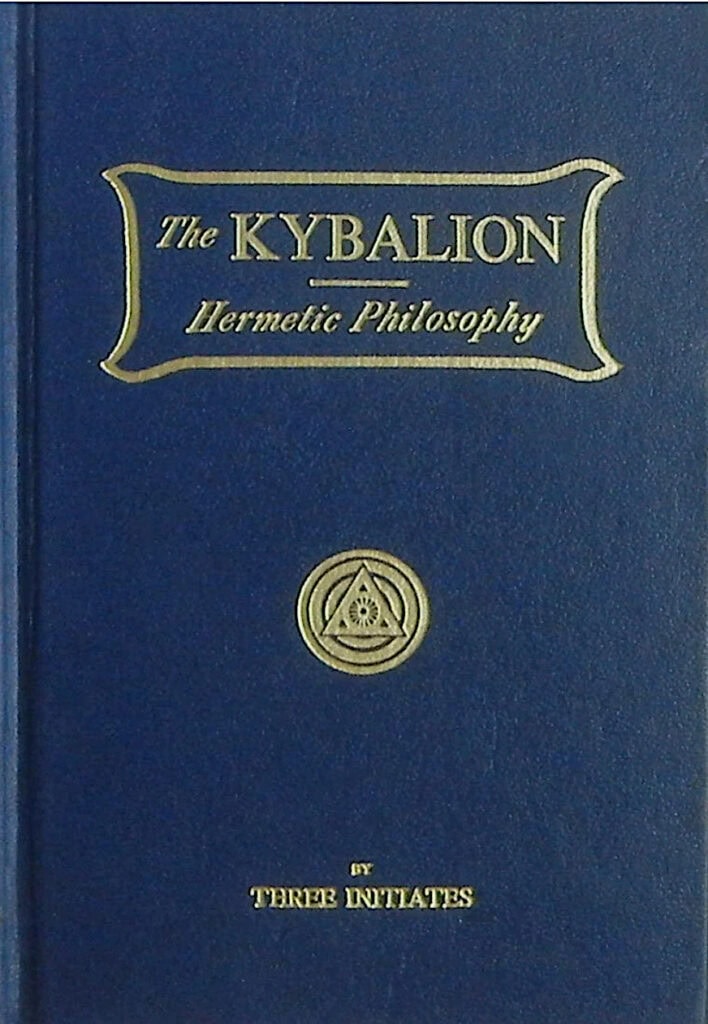
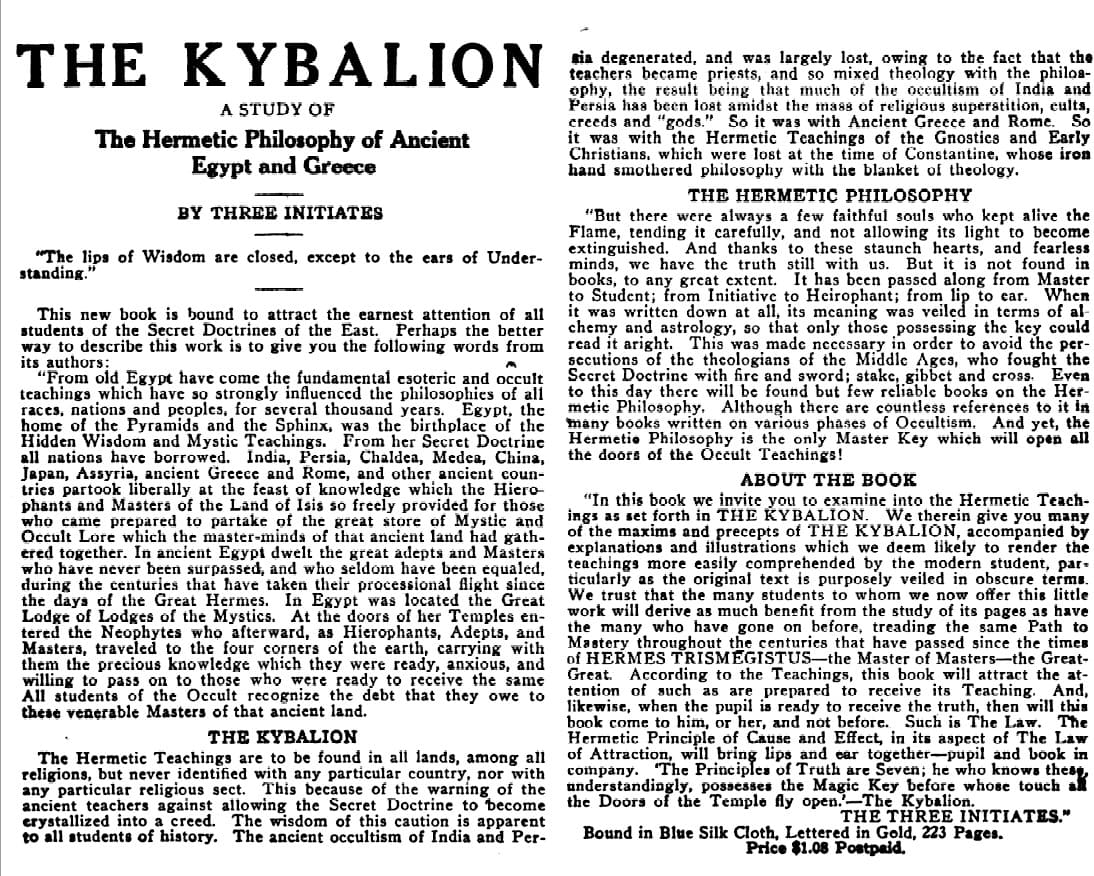
The Kybalion: A Study of the Hermetic Philosophy of Ancient Egypt and Greece is a 1908 work of occult philosophy published in Chicago by the Yogi Publication Society under the anonymous authorship of the “Three Initiates.” The book says that it is an introduction to the teachings attributed to Hermes Trismegistus, the legendary figure formed from the combination of the Greek Hermes with the Egyptian god Thoth, and organizes its philosophy around seven universal laws known as the Seven Hermetic Principles: Mentalism, Correspondence, Vibration, Polarity, Rhythm, Cause and Effect, and Gender.
At the center of The Kybalion is the idea that the universe is governed by universal laws operating across every level of existence. The first principle, Mentalism, declares that “The All is Mind” and “The Universe is Mental,” providing the foundation for everything that follows. Correspondence connects the different planes of existence through the maxim “As above, so below; as below, so above,” allowing the same laws to be understood through their expression on different levels. Vibration teaches that nothing rests and everything moves; Polarity places apparent opposites at opposing poles of the same scale; Rhythm describes the recurring movement between those poles; Cause and Effect holds that every event arises from causes operating according to law; and Gender describes the complementary Masculine and Feminine principles involved in generation throughout nature and mind.
These principles provide the foundation for Mental Transmutation, the deliberate transformation of mental states through an understanding and application of the laws governing thought. The Kybalion teaches that Will and Attention can be used to change mental vibration, direct thought toward a desired pole, neutralize unwanted rhythmic swings, introduce new causes into an existing chain of effects, and consciously govern the active and receptive faculties of the mind. The Seven Hermetic Principles form only the framework of this system. The book also develops its teachings on THE ALL, the Mental Universe, the Divine Paradox, the Physical, Mental, and Spiritual planes, suggestion, mental influence, Will, Attention, habit, and the mastery of mental states, connecting each of these subjects through the laws established by the Seven Principles.
The Seven Hermetic Principles at a Glance
Mentalism — “The All is Mind; the Universe is Mental.” Mind is presented as the underlying reality of existence, making Mentalism the foundation of the entire Hermetic system.
Correspondence — “As above, so below; as below, so above.” The same fundamental principles operate across different planes of existence, allowing what is known on one level to provide insight into another.
Vibration — “Nothing rests; everything moves; everything vibrates.” Differences between matter, energy, thought, emotion, and states of consciousness are explained through differing rates and modes of vibration.
Polarity — “Everything is Dual; everything has poles.” Apparent opposites are understood as opposing poles of the same underlying scale, making it possible to move from one mental pole toward another through Mental Transmutation.
Rhythm — “Everything flows, out and in.” Mental and natural conditions move through recurring swings, tides, rises, and falls. Through the Art of Polarization, the Hermetic student attempts to neutralize the effect of undesirable rhythmic movement.
Cause and Effect — “Every Cause has its Effect; every Effect has its Cause.” Nothing occurs outside law, and what is commonly called chance represents causes that are unknown or unrecognized. Mental mastery involves becoming increasingly a cause rather than merely an effect of circumstances, habits, suggestions, and outside influences.
Gender — “Gender is in everything.” Masculine and Feminine principles are presented as complementary forces of generation operating on the Physical, Mental, and Spiritual planes. In the human mind, The Kybalion connects these principles with contemporary theories of the active and passive, voluntary and involuntary, and conscious and subconscious faculties.
What Does The Kybalion Actually Teach?
The Kybalion presents the Seven Hermetic Principles as parts of a single system governing the universe and the mind. Mentalism establishes the Mental Universe, while Correspondence explains how the same laws find expression across different planes of existence. Vibration describes the movement underlying all forms and states; Polarity places opposites at different poles of the same scale; Rhythm governs the recurring movement between those poles; Cause and Effect explains the lawful sequence through which one condition produces another; and Gender describes the complementary Masculine and Feminine principles through which generation takes place on the Physical, Mental, and Spiritual planes.
The application of this system centers on the mastery and transformation of thought. If fear and courage occupy opposing poles, the student directs Attention toward courage and strengthens that pole through continued concentration. When moods follow rhythmic swings, the student uses the Art of Polarization to maintain the chosen state and neutralize the unwanted movement of the mental pendulum. Habits, environment, heredity, suggestion, and stronger personalities may all act as causes upon the individual, while Will and conscious mental direction allow the student to introduce new causes and alter the effects that follow. Each principle works with the others, giving the student a system for understanding universal law and applying those laws to the direction of thought.
The Kybalion also moves freely between ancient Hermeticism and the psychological language of its own period. Mental Transmutation is connected with mental science, while Mental Gender is compared with contemporary theories of the conscious and subconscious, voluntary and involuntary, and active and passive faculties of mind. From there, the book applies these ideas to suggestion, hypnotism, mental influence, telepathy, thought transference, treatments, and affirmations. These practices are presented as applications of universal laws that the authors trace back to the Hermetic tradition.
The Kybalion and the Roots of the Seven Hermetic Principles
The historical setting of The Kybalion is essential to understanding the book. Published in Chicago in 1908 by the Yogi Publication Society, it was a modern work presented as a transmission of ancient Hermetic knowledge. Its anonymous attribution to “The Three Initiates” placed the authors within the tradition of initiates described in the book as preserving and transmitting the teachings of Hermes Trismegistus. At the same time, its pages repeatedly connect those teachings with psychology, mental science, New Thought, suggestion, hypnotism, and mental influence.
The Seven Hermetic Principles reveal clear parallels with the system of Suggestive Therapeutics that Dr. Herbert A. Parkyn had already been teaching for years within the same network from which The Kybalion came. Parkyn’s Special Mail Course in Hypnotism and Suggestive Therapeutics taught the operation and direction of thought through mind, the correspondence between mental and physical states, vibration, opposing poles of thought, repetition and rhythm, cause and effect, and the complementary functions of the active voluntary and passive involuntary mind. Parkyn did not organize these teachings under the names of the Seven Hermetic Principles. The parallels lie in the laws themselves and in the way those laws are applied to thought, Suggestion, habit, Will, and the control of mental states.
Mental Gender provides one of the clearest examples. The Kybalion identifies its Masculine and Feminine principles with contemporary theories of the active and passive, voluntary and involuntary aspects of mind, then moves directly into suggestion, hypnotism, mental influence, telepathy, and thought transference. Parkyn had already placed the active voluntary and passive involuntary faculties at the center of Suggestive Therapeutics. The active faculty wills, directs, and impresses; the passive faculty receives, accepts, develops, and carries the accepted idea into expression.
The comparison at the end of this article places each of the Seven Hermetic Principles beside Parkyn’s earlier teachings and examines the system of thought they share. The Law of Correspondence provides a key to how those ideas could be carried from psychology into Hermeticism. Through “As above, so below,” laws demonstrated through the individual mind and body could be presented as corresponding laws operating throughout nature and across the Physical, Mental, and Spiritual planes.
About This Complete Kybalion Summary
The detailed analysis below follows The Kybalion through the complete philosophical system developed around the Seven Hermetic Principles. It examines Mental Transmutation, THE ALL, the Mental Universe, the Divine Paradox, the planes of correspondence, Vibration, Polarity, Rhythm, Neutralization, Cause and Effect, Mental Gender, suggestion, mental influence, and the Hermetic Axioms. Each subject is examined in relation to the others so that the Seven Principles can be understood as an interconnected system of universal and mental law. The article also examines the historical roots of these ideas and their parallels with Parkyn’s earlier Suggestive Therapeutics.
The Purpose of The Kybalion
The Three Initiates state their purpose immediately in the introduction. They seek to provide the fundamental principles through which students can understand and reconcile the many occult teachings already circulating around them. Their intended reader may have encountered occultism, mysticism, mental science, metaphysics, religion, psychic phenomena, Western esotericism, or related systems whose teachings often seem to conflict. The Kybalion offers Hermetic philosophy as a key for identifying the laws shared across these different traditions.
The authors explain their objective through one of the book’s central metaphors. They have no intention of constructing another “Temple of Knowledge.” Their purpose is to place a “Master-Key” in the student’s hands, capable of opening the inner doors of the existing “Temple of Mystery.” The Master-Key represents the Hermetic principles themselves. Once understood, these principles are meant to help the student recognize common laws beneath teachings that may use very different terminology, symbols, and philosophical frameworks.
This purpose explains the book’s constant movement between philosophy and application. The Seven Principles are introduced as laws to be recognized in operation and consciously used. Mentalism leads into Mental Transmutation; Polarity becomes a method for changing mental states; Rhythm leads to Neutralization; Cause and Effect becomes a means of gaining greater control over the causes acting upon the individual; and Mental Gender leads directly into the operation of suggestion and mental influence. Knowledge of the principles is expected to become practical knowledge through use.
Hermes Trismegistus and the Claimed Origin of the Teachings
The historical narrative presented by The Kybalion begins in ancient Egypt, which the Three Initiates describe as the great center from which the fundamental esoteric and occult teachings of the ancient world spread outward. At the center of this tradition they place Hermes Trismegistus, whom they describe as the “scribe of the gods” and the great founder of Hermetic teaching. The book makes expansive claims for his influence, presenting Hermes as a contemporary of Abraham and repeating the tradition that he may even have instructed Abraham. Above all, the Three Initiates present him as the common source from which later streams of occult knowledge descended, calling him the “Great Central Sun of Occultism.”
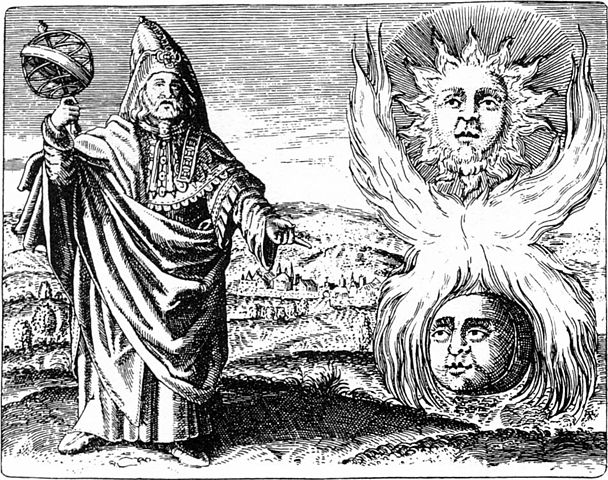
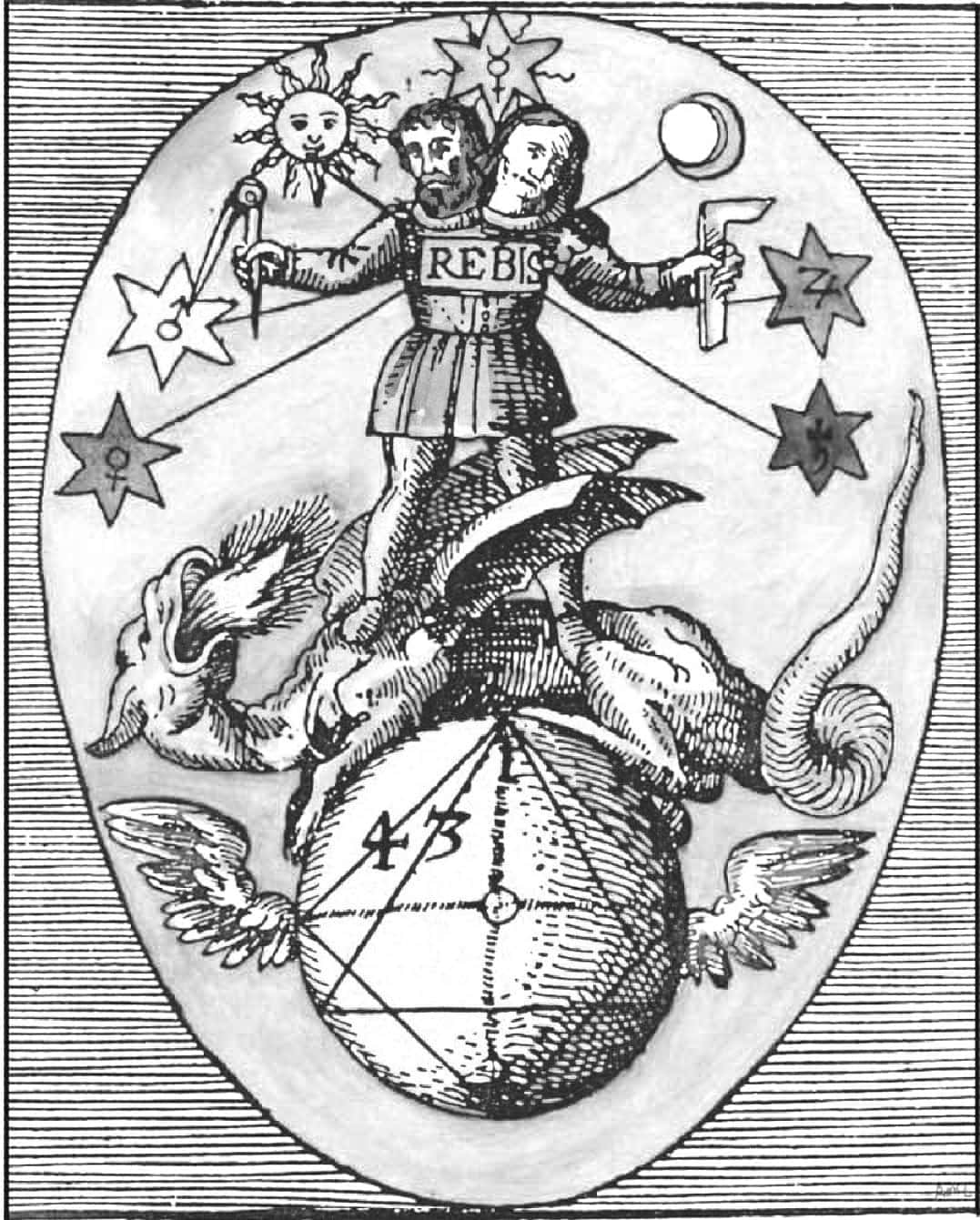
Hermes Trismegistus, the legendary founder of Western alchemy
In the book’s account, the esoteric systems found throughout the world share a common foundation beneath their different terminology, doctrines, symbols, and religious forms. The Three Initiates extend this claim to India, stating that ancient Hindu philosophy possessed roots in the original Hermetic teachings. They describe advanced Indian occultists traveling from the region of the Ganges to Egypt, where they studied with Hermes Trismegistus and received a “Master-Key” that allowed them to reconcile their differing philosophical ideas. This establishes Hermeticism as the universal explanatory system of The Kybalion. Similarities among religious, occult, philosophical, and metaphysical traditions are presented as surviving expressions of a common body of principles, giving Hermetic philosophy its role as what the authors call the “Great Reconciler.”
One Truth Expressed Through Many Systems
The idea of reconciliation appears before the Seven Hermetic Principles are introduced and establishes how the reader is expected to understand them. The Three Initiates argue that religions and occult philosophies can appear contradictory on the surface while sharing fundamental correspondences underneath. Different cultures developed their own symbols, terminology, doctrines, and explanations, yet the same truths could be expressed through each of them in different forms. According to the book, Hermes did not seek to establish a single religion or philosophical institution. He planted what the authors call a great “Seed-Truth,” from which many different systems developed. The Kybalion uses this idea to explain why similar principles can appear across traditions separated by culture, language, religion, and time.
The world’s different systems are described as branches extending from a common metaphysical root. Across centuries, teachers and traditions altered the original teachings, added their own doctrines, and developed new forms of expression, while enough of the original principles survived to produce recognizable correspondences between systems that may otherwise appear unrelated. The Seven Hermetic Principles are presented as a means of identifying those correspondences and tracing the different forms back to the universal laws beneath them.
The Secret Transmission of Hermetic Knowledge
According to the Three Initiates, the original Hermetic teachings were deliberately preserved by a small number of initiates and passed from generation to generation “from lip to ear.” Secrecy formed part of the method by which the tradition was maintained. Hermetic teachers avoided mass followings, popular approval, and large institutions, reserving advanced teachings for students considered capable of understanding and using them. When conditions allowed greater portions of the knowledge to be shared, the initiates released them; at other times, they preserved the teachings privately and waited for students prepared to receive them.
The introduction expresses this philosophy through several sayings attributed to The Kybalion. One states that when the Master appears, those prepared for the teaching will be able to hear it; another declares that when the student’s ears are ready, the teacher’s words will come. The principle is captured most clearly in the saying that appears on the title page and recurs throughout the book:
“The lips of Wisdom are closed, except to the ears of Understanding.”
Yogi Publication Society logo with winged globe
The saying establishes one of the book’s central ideas about knowledge: truth can be presented to the student, but understanding depends upon the student’s ability to receive it. The authors use this principle to defend the traditional secrecy of the Hermetists, arguing that advanced teachings given indiscriminately have often led to misunderstanding, ridicule, persecution, and distortion. The Hermetic teacher waits for students who have developed the capacity to understand the teaching and directs the knowledge toward those prepared to receive it.
What Exactly Is The Kybalion?
One of the most easily overlooked details in the book is the distinction the Three Initiates make between their 1908 volume and the teachings they call The Kybalion. Throughout the book, short maxims, axioms, and precepts appear in quotation marks and are attributed specifically to “The Kybalion,” while the surrounding explanations are supplied by the Three Initiates. The authors explain this arrangement directly, stating that the original maxims and axioms are quoted and credited while their explanations and illustrations form the main body of the work. They describe these explanations as necessary because the older teachings had been expressed in obscure and veiled language.
The name The Kybalion can thus refer to two related things within the 1908 work. It is the name given to the supposedly older body of Hermetic maxims and principles quoted by the authors, and it is also the title of The Kybalion: A Study of the Hermetic Philosophy of Ancient Egypt and Greece, the 1908 book published to explain those teachings to a modern audience. The Three Initiates position themselves as interpreters and transmitters of this material. They claim to be explaining an older body of Hermetic teaching whose principles had been transmitted through the centuries in aphoristic and often deliberately obscure forms. This distinction is important when examining the historical origins of the 1908 book separately from the system of Hermeticism it presents.
A Book Intended to Be Used, Not Merely Read
The introduction closes by telling readers that knowledge of the Hermetic principles must lead to their application. The Three Initiates do not attempt to provide every possible use of the system. They give readers what they describe as the working principles and leave many of the applications for the student to discover and develop. Knowing the names of the principles, memorizing their axioms, or understanding them intellectually does not constitute mastery. The student must learn to recognize the laws in operation and consciously apply them to mental states and conditions.
This distinction between knowledge and mastery becomes increasingly important as the book proceeds. The student begins by learning the laws, then learns to recognize their effects, and finally seeks to use them consciously. The Kybalion repeatedly contrasts those who are carried along by mental and universal forces with those who understand the laws well enough to exercise greater control over their own mental states and responses. Mastery, in the book’s sense, comes through the use of knowledge.
The Hermetic Philosophy
Before introducing the Seven Hermetic Principles, the Three Initiates explain what they mean by “Hermetic Philosophy,” why they trace it to ancient Egypt and Hermes Trismegistus, how they believe it survived across thousands of years, and why its teachings were concealed beneath the language of alchemy, astrology, religion, and occult symbolism. Their account presents Hermeticism as a body of knowledge whose outward forms changed while its central principles continued to be transmitted among initiates.
Hermetic Alchemy provides one of the first examples of how the authors interpret that tradition. The transmutation of base metals into gold is presented as a symbol for the transmutation of mental states, with the true Hermetic art concerned with changing one kind of mental vibration into another. Alchemy becomes a model for Mental Transmutation: the deliberate use of mental law to change the quality, degree, or condition of thought. This establishes the direction that runs through the rest of The Kybalion. Its cosmology explains the laws of the universe, while its system of Mental Transmutation teaches the student how those same laws operate within the mind and can be consciously applied.
By Athanasius Kircher
Ancient Egypt as the Source of the Hermetic Tradition
The Kybalion presents ancient Egypt as the birthplace of the esoteric and occult knowledge that later spread throughout the ancient world. According to the Three Initiates, Egypt was the home of the pyramids and Sphinx as well as the “Hidden Wisdom” and “Mystic Teachings.” Students and teachers from distant lands are said to have traveled there for instruction from Egyptian masters, carrying portions of that knowledge back into their own cultures. Egypt serves as the original center of the universal wisdom tradition described throughout the book, with the later philosophies, religions, and occult systems of other nations preserving portions of teachings that had once been concentrated there. At the center of this tradition stands Hermes Trismegistus.
Hermes Trismegistus: The Master of Masters
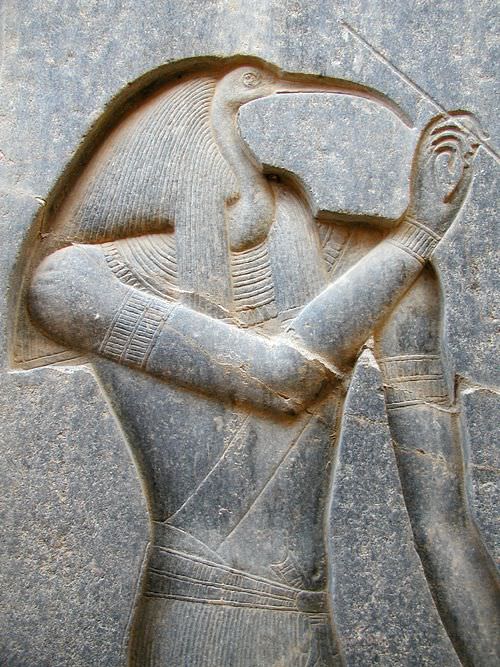
Thoth, the ancient Egyptian god of wisdom, writing, magic, and the moon.
The Three Initiates describe Hermes Trismegistus as the foundational teacher of the Western occult tradition, calling him the “father of the Occult Wisdom,” the founder of astrology, and the discoverer of alchemy. His historical identity is said to have disappeared into the immense distance of antiquity, with ancient nations themselves disputing the honor of his birthplace. According to the account given in The Kybalion, Hermes lived in Egypt during the earliest dynastic period, long before Moses. The authors repeat traditions placing him in the time of Abraham and even suggesting that Abraham received part of his mystical knowledge from Hermes. They also repeat the legend that Hermes lived for three hundred years before passing from physical existence.
After his death, the Egyptians are said to have elevated Hermes to divine status under the name Thoth, while the Greeks later identified him with their own Hermes. His title “Trismegistus” is given as “thrice-great,” “great-great,” or “greatest-great.” Across these traditions, Hermes Trismegistus became what the Three Initiates call the “Fount of Wisdom.” By tracing astrology, alchemy, occult philosophy, and the esoteric teachings of different cultures back to this common source, The Kybalion establishes the foundation for presenting its Seven Hermetic Principles as universal laws underlying many different systems.
Why the Teachings Were “Hermetic”
The book connects the name Hermes with the meaning of the word “hermetic.” A hermetically sealed container is closed so completely that nothing can escape, and the Three Initiates associate this meaning with the secrecy practiced by the followers of Hermes. Hermetic teachers are said to have reserved different levels of instruction for different levels of understanding, giving beginners teachings suited to their development while preserving deeper knowledge for students prepared to receive it. The authors connect this practice with the familiar expressions “milk for babes” and “meat for strong men,” which they claim had been used by the Egyptians centuries before their appearance in Christian scripture.
Secrecy protected both the student and the teaching. Knowledge placed in the hands of someone unable to understand it could be misused or misunderstood, while teachings openly exposed to hostile or unprepared audiences could be distorted, ridiculed, or destroyed. The Hermetic tradition described in The Kybalion preserved its teachings by controlling how, when, and to whom they were transmitted.
Why Hermeticism Must Never Become a Creed
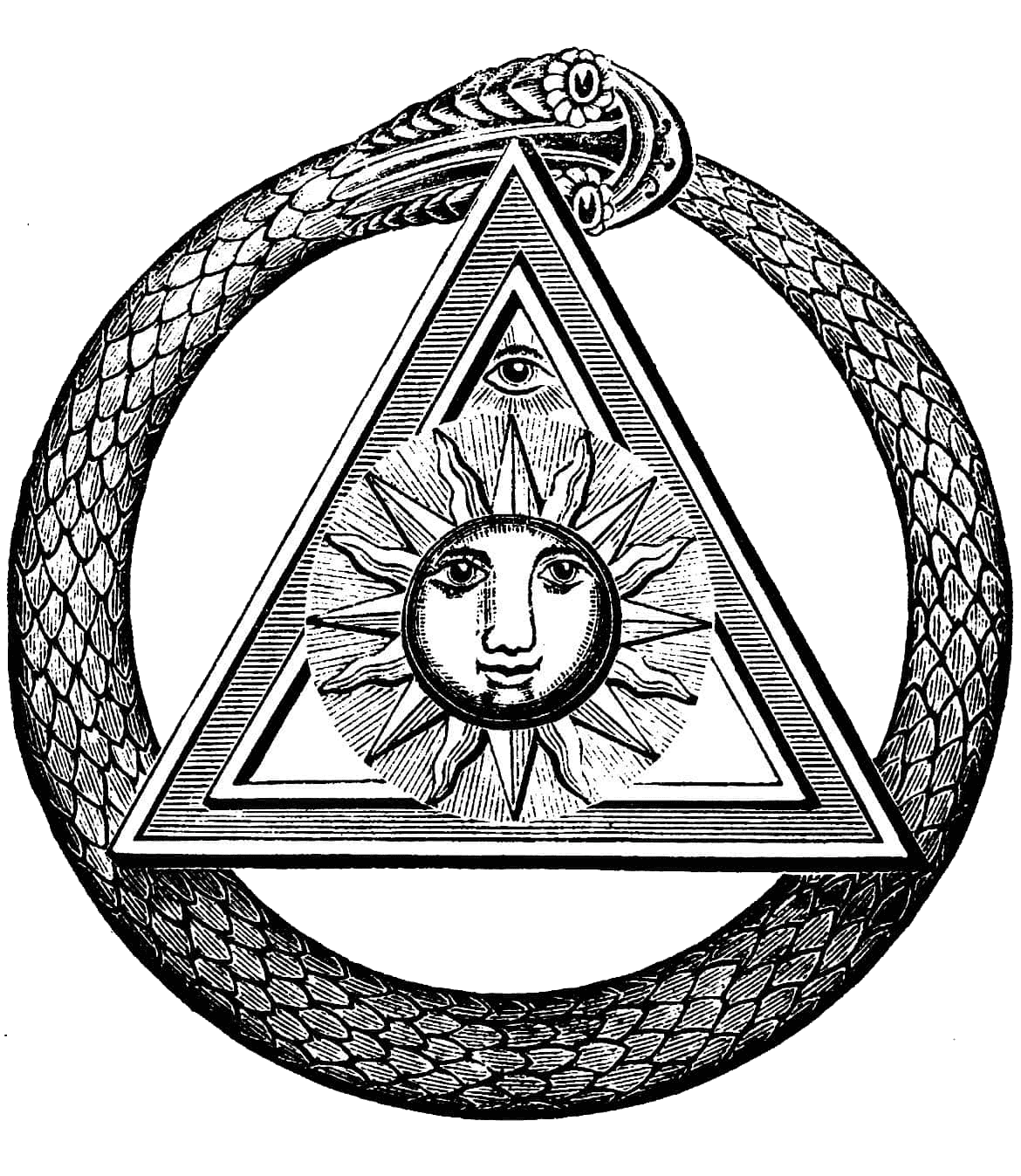
The Ouroboros, the universal symbol for eternity, cyclic renewal, and the unity of all things.
According to The Kybalion, genuine Hermeticism has never belonged exclusively to a nation, church, religion, or sect. Its teachings are said to survive within many religions and philosophical systems, and the absence of a formal Hermetic religion is presented as deliberate. The ancient teachers warned against allowing the Secret Doctrine to become “crystallized into a creed.”
The authors believed that once a philosophy became institutionalized as religion, its principles could become entangled with theology, priesthood, dogma, superstition, and ritual. India and Persia are offered as examples of ancient occult teachings becoming increasingly mixed with religious theology as teachers assumed the role of priests. Greece and Rome are said to have followed a similar course. The Hermetic teachers sought to preserve the underlying philosophy independently, allowing its principles to appear within different religious and philosophical systems without binding them permanently to any single creed.
Hermeticism and Early Christianity
The Three Initiates extend this history into Christianity, claiming that Hermetic teachings were present among the Gnostics and Early Christians and were gradually lost as institutional theology gained greater control. Emperor Constantine is specifically blamed for helping to suppress philosophy beneath what the authors call the “blanket of theology,” separating Christianity from much of its earlier mystical “essence and spirit.” In the authors’ account, teachings once associated with the spiritual foundations of Christianity survived outside the dominant institutions even as the Church moved away from them.
Writing in 1908, the Three Initiates believed Christianity was beginning to rediscover this mystical dimension. They saw renewed interest in the older teachings as part of a return to the spiritual principles that had been obscured over the centuries. The history they describe follows a recurring pattern: universal principles enter a religious or philosophical system, become obscured as doctrines and institutions develop around them, and later reappear among students searching for the laws beneath those outward forms.
The Hidden Chain of Transmission
The Kybalion describes a small number of “faithful souls” who preserved the Hermetic flame through the centuries. Knowledge passed from Master to Student, from Initiate to Hierophant, and “from lip to ear,” with very little of the true teaching committed openly to writing. The secrecy surrounding Western esotericism is presented as part of a deliberate method of preservation through periods when open teaching could invite persecution or destruction.
When Hermetic knowledge did appear in written form, the authors say that its meaning was concealed beneath symbolic terminology. Alchemy and astrology became two of the principal languages through which the teachings could be preserved, allowing the initiated reader to recognize meanings hidden from outsiders. Metals, planets, chemical operations, and mysterious substances could serve as symbols for processes taking place on other levels. The obscurity of old occult literature is treated as intentional, with its deeper meaning accessible to those possessing the interpretive “key.”
The “Master-Key” of Occult Philosophy
The Three Initiates describe Hermetic Philosophy as the “Master-Key” capable of opening the doors of the occult teachings. This claim defines the role assigned to Hermeticism throughout The Kybalion. Alchemy, astrology, mental phenomena, metaphysics, religion, mystical philosophy, and other occult systems may use very different languages, yet the authors believe the same fundamental laws can be discovered within them. The Hermetic student searches beneath their terminology and symbolism for the principles they share. The Seven Hermetic Principles are presented as that key, giving the student a framework for recognizing the same laws wherever they appear.
The Original “Kybalion” as an Oral Teaching
According to the Three Initiates, an ancient compilation of the fundamental Hermetic doctrines was known as “THE KYBALION.” They acknowledge that the original meaning of the word Kybalion had already been lost centuries before their own time and state that, so far as they knew, this original teaching had never been written down or printed. It consisted of maxims, axioms, and precepts transmitted orally from teacher to student, whose meanings were explained and demonstrated by Initiates to their Neophytes.
The authors present their 1908 Kybalion as an explanation of these teachings for contemporary students. The maxims attributed to the older Kybalion are quoted throughout the book, while the Three Initiates supply the explanations needed to interpret teachings they say had been deliberately “veiled in obscure terms.” Their account places the written book at the end of a claimed chain of oral transmission stretching back to the ancient Hermetic tradition.
Hermetic Alchemy as Mental Alchemy
The teachings contained in the original Kybalion, according to the authors, formed the fundamental principles of the “Art of Hermetic Alchemy.” They describe true Hermetic Alchemy as an art concerned primarily with the mastery and transformation of Mental Forces. Its central transmutation involves changing one form of Mental Vibration into another, giving the familiar image of turning base metal into gold a corresponding meaning within the mind.
The Philosopher’s Stone becomes a symbol for the knowledge that makes Mental Transmutation possible. Fear can be moved toward courage, hatred toward love, and other unwanted mental states toward their opposing poles. Mental vibrations can be raised, the swings of Rhythm can be neutralized through Polarization, and the individual can learn to direct forces that previously acted upon the mind without conscious control. Transmutation, Vibration, Polarity, Rhythm, Cause and Effect, and mastery all meet at this point: the laws described throughout The Kybalion become methods for changing and directing the condition of the mind.
The Philosopher’s Stone Becomes a Symbol of Mental Mastery
The Kybalion uses the language and symbolism of ancient occultism to develop a philosophy centered on the nature and direction of mind. The traditional image of alchemy is the transformation of something base into something precious, and the book carries that same process into consciousness. The “base metal” can represent a lower mental state and the “gold” its transmutation into a higher one. The mind becomes the laboratory, and the Hermetic principles provide the laws through which the transformation takes place. The Three Initiates acknowledge the physical experiments associated with historical alchemy while maintaining that the deeper Hermetic art concerns the mastery and transmutation of mental forces. This gives the philosophy that follows a definite purpose: knowledge of universal law provides the student with the means to understand and direct mental life.
The Three Initiates as Students of Hermes
Although they identify themselves as the “Three Initiates”, the authors describe themselves as “humble students” sitting at the feet of Hermes Trismegistus, whom they recognize as the Master. Their role is to transmit and explain the teachings. They reproduce maxims, axioms, and precepts attributed to the original Kybalion and surround them with explanations and illustrations intended to make their meaning accessible to contemporary readers. The sayings attributed directly to the older Kybalion appear in quotation marks, while the explanatory prose belongs to the Three Initiates. Two distinct voices run through the book: the brief, authoritative sayings attributed to the ancient teaching and the extensive commentary through which the authors explain their meaning and application.
The Square, Triangle, and Circle.
The Seven Hermetic Principles
At the foundation of the entire Hermetic system are seven principles: Mentalism, Correspondence, Vibration, Polarity, RSeven principles form the foundation of the Hermetic system presented in The Kybalion: Mentalism, Correspondence, Vibration, Polarity, Rhythm, Cause and Effect, and Gender. Each describes a different aspect of the laws governing matter, energy, mind, and spiritual existence, and their interaction provides the framework for the system developed throughout the book. Mental Transmutation depends upon these principles working together, since the ability to change a mental state requires an understanding of Mentalism, Vibration, Polarity, Rhythm, Cause and Effect, and the operation of the active and receptive faculties described through Mental Gender. Their importance is expressed in one of the book’s central maxims:
“The Principles of Truth are Seven; he who knows these, understandingly, possesses the Magic Key before whose touch all the Doors of the Temple fly open.”
The key word is “understandingly.” Knowledge of the names and definitions alone does not give the student the “Magic Key.” The principles are meant to provide a framework for recognizing the laws operating through different forms of experience and learning how those laws can be consciously applied.
“The Alchemical Tree of Life” with 7 ancient levels for self mastery by Wolfgang Killian
I. The Principle of Mentalism
The first principle establishes the metaphysical foundation for everything that follows:
“THE ALL is MIND; The Universe is Mental.”
Mentalism holds that the ultimate reality underlying the visible universe is Mind. Matter, energy, life, and the physical universe are not treated as independent realities existing outside this greater foundation. Behind them is what The Kybalion calls THE ALL, an infinite, universal, living Mind that cannot itself be completely defined or comprehended. The universe exists within this Infinite Mind as a mental creation. This does not mean that the individual human mind imagines the physical universe into existence, nor does it mean that ordinary thought and THE ALL are identical. Human consciousness exists within a vastly greater Mental Reality. Matter, energy, life, and individual minds are manifestations within that reality and remain subject to its laws.
Mentalism is more than a statement about the importance of thought. It establishes the book’s explanation of why mental laws can have such far-reaching importance. If the universe itself is fundamentally mental, then mind is not merely a secondary product operating inside an otherwise material universe. Mental phenomena belong to the fundamental structure of existence. This principle provides the philosophical basis for Mental Transmutation. If reality is mental in its underlying nature, then understanding the laws governing mental states provides a means of consciously changing conditions within the mental realm. The remaining principles explain how those changes occur.
II. The Principle of Correspondence
The second principle is expressed through the best-known saying associated with Hermetic philosophy:
“As above, so below; as below, so above.”
Correspondence teaches that the same fundamental principles operate throughout different levels of existence. The material, mental, and spiritual worlds may manifest in radically different forms, but their underlying laws correspond with one another. Knowledge acquired on one plane can provide a means of understanding phenomena operating on another.
The principle becomes a method of reasoning from the known toward the unknown. The Kybalion compares its use to geometry, through which a person can calculate the movements and distances of objects that cannot be physically reached. In the same way, the Hermetic student studies laws that can be observed on one level and uses their correspondence to gain insight into other levels of existence.
This does not mean that everything on one plane is an exact duplicate of everything on another. The correspondence lies in the principles governing them. The manifestations change according to the plane, while the underlying law remains recognizable.
This becomes important when the book later attempts to explain THE ALL and the creation of the universe. Because the workings of Infinite Mind cannot be observed directly, the authors examine the creative activity of the human mind and apply Correspondence upward. Human beings can create mental images without removing material from themselves or acquiring material from outside themselves. From this analogy, The Kybalion develops its conception of the universe as a mental creation within THE ALL.
Correspondence functions as one of the book’s primary tools for connecting the physical, mental, and spiritual aspects of its philosophy.
III. The Principle of Vibration
The Principle of Vibration states: “Nothing rests; everything moves; everything vibrates.”
Everything in existence is understood to be in motion. The apparent differences between matter, energy, mind, and spirit are explained in terms of different rates and modes of vibration. At one extreme lies Spirit, described as vibrating at a rate so infinitely high that it appears almost motionless. At the other lie the densest forms of matter, whose vibrations are so low that they likewise appear to be at rest. Between these extremes exists an enormous range of vibratory conditions.
The same principle is extended beyond physical matter. Energy and force are vibratory, but mental states also possess their own degrees of vibration. Thoughts, emotions, and conditions of consciousness can be understood as occupying different vibratory states.
This becomes one of the foundations of the practical Hermetic system. If a mental state corresponds to a particular vibration, changing that vibration changes the mental state. Mental Transmutation becomes possible because consciousness is not treated as permanently fixed in one condition. Its state can be altered by changing its degree of vibration.
The principle also provides The Kybalion with a means of connecting matter and mind. Instead of treating them as completely separate categories, the book places them within a vast continuum of manifestation. Differences that appear absolute from the human perspective become differences of degree when viewed through the Principle of Vibration.
The objective is eventually to learn to control one’s own mental vibrations rather than simply respond to whatever mental state happens to arise. The book goes further by maintaining that sufficiently advanced practitioners can influence the vibrations of others and that the highest Hermetic Masters can operate upon forces beyond the ordinary mental plane. For the ordinary student, however, the immediate importance lies in the transformation of his or her own mental condition.
IV. The Principle of Polarity
The first principle establishes the foundation for everything that follows:
“THE ALL is MIND; The Universe is Mental.”
Mentalism holds that Mind is the fundamental reality underlying the visible universe. Matter, energy, life, and the physical universe exist within what The Kybalion calls THE ALL, the infinite, universal, living Mind whose complete nature lies beyond human comprehension. The universe exists within THE ALL as a mental creation, while individual minds exist within this far greater Mental Reality and remain subject to its laws. The principle does not give the individual human mind the power to imagine the physical universe into existence or equate ordinary human consciousness with THE ALL. It places human consciousness, matter, energy, and life within a universe whose underlying nature is Mental.
Mentalism also explains why the laws of mind occupy such a central place in The Kybalion. If the universe is Mental in its underlying nature, mental phenomena belong to the same fundamental order as the rest of existence. Thought and consciousness are placed within the structure of universal law, giving Mental Transmutation its philosophical foundation. Knowledge of the laws governing mental states allows the student to work consciously with those states, while the remaining Hermetic Principles explain the processes through which change, movement, opposition, rhythm, causation, and generation occur.
V. The Principle of Rhythm
The Principle of Rhythm adds movement to Polarity:
“Everything flows, out and in; everything has its tides; all things rise and fall.”
Where Polarity establishes two extremes, Rhythm describes the recurring movement between them. Throughout existence there is action and reaction, advance and retreat, rise and fall, inflow and outflow. The book compares this movement to a pendulum swinging between two poles.
Rhythm is presented as universal. It operates in the creation and destruction of worlds, the rise and fall of nations, physical life, energy, matter, and the mental states of individuals. Human emotions and states of consciousness are subject to the same recurring movement. Enthusiasm may be followed by discouragement, confidence by uncertainty, and emotional elevation by a corresponding decline.
The Hermetic practitioner cannot abolish Rhythm. Instead, The Kybalion teaches that its effects can be partly overcome through what it calls the Law of Neutralization. The individual learns to establish consciousness at a chosen mental position and resist being carried unconsciously toward the opposite pole when the rhythmic swing occurs.
This introduces an important distinction between changing universal law and learning how to operate within it. The Hermetist does not claim to stop the pendulum. The objective is to avoid being carried by it.
Self-mastery requires more than reaching a desired mental condition. Polarity may allow a person to move from one state toward another, but Rhythm explains why maintaining that new position is difficult. The student must learn both how to change mental polarity and how to resist the recurring swing back toward the former condition.
VI. The Principle of Cause and Effect
The sixth principle states:
“Every Cause has its Effect; every Effect has its Cause; everything happens according to Law.”
Nothing simply happens. What people call chance is described as a name given to causes they have not recognized or understood. Events occur within chains of causation extending across different planes, with higher causes capable of influencing lower ones.
This principle becomes important when applied to human behavior. The Kybalion portrays ordinary individuals as being continually moved by causes they barely recognize. Environment, heredity, suggestion, desires, moods, emotions, habits, and the wills of other people can all act upon the individual. A person who does not understand these influences may believe that he is acting freely while actually responding to forces operating upon him.
Hermetic mastery does not mean escaping Cause and Effect, because nothing can escape universal law. Instead, the practitioner attempts to rise to a higher level within the chain of causation. By gaining control over mental states, habits, reactions, and choices, the individual becomes increasingly capable of producing causes instead of merely experiencing their effects.
The book expresses this distinction through the image of a chessboard. Ordinary people are moved like pawns by environment, suggestion, stronger wills, and circumstances. Those who understand mental law attempt to become movers within the game rather than pieces unconsciously moved by others.
Even the Master remains subject to causes operating on higher planes. The distinction is relative instead of absolute. Greater mastery means greater ability to become a determining cause within one’s own sphere while remaining part of the larger universal order.
This principle ties the philosophical system directly to the book’s concept of self-mastery. Knowledge is valuable because it increases conscious participation in causation. The individual learns to identify forces that previously acted unconsciously and begins to direct mental processes deliberately.
VII. The Principle of Gender
The seventh principle states:
“Gender is in everything; everything has its Masculine and Feminine Principles; Gender manifests on all planes.”
The Kybalion makes an important distinction between Gender and physical sex. Sex is treated as one physical manifestation of a much larger principle. Gender itself refers to generation, regeneration, and creation and is said to operate on the physical, mental, and spiritual planes.
Every process of creation requires the interaction of two complementary principles, which the book identifies as Masculine and Feminine. Both are present throughout existence and, in different forms, within every individual. The authors specifically warn against interpreting the teaching as a justification for sexual or phallic doctrines, which they regard as distortions of the principle.
The importance of Gender becomes much clearer when the book later applies it to the structure of the mind. The Masculine principle is associated with the projecting and directing function of Will, while the Feminine principle is associated with receiving impressions and generating mental forms. Their interaction becomes the basis of what The Kybalion calls Mental Gender.
Gender completes the Seven Principles by introducing the generative mechanism through which creation occurs. Mentalism establishes the mental foundation of reality; Correspondence connects its different planes; Vibration describes their states of motion; Polarity establishes degrees and opposites; Rhythm governs movement between those poles; Cause and Effect establishes lawful sequence; and Gender governs generation and creation.
Mental Transmutation
The heart of The Kybalion is Mental Transmutation, the art of changing one mental state, condition, or degree into another. The authors take the old alchemical idea of transmutation and move it into the realm of consciousness. Just as traditional alchemy sought to transform one material substance into another, Hermetic Mental Alchemy seeks to transform fear into courage, hatred into love, weakness into strength, passivity into control, and one vibratory state into another.
The Alchemy of Mental Transmutation
The book defines the process directly. “Transmutation” means changing one nature, form, or substance into another, while Mental Transmutation refers to the transformation of mental states, forms, and conditions. The Three Initiates describe it as a form of “Mental Chemistry” and connect it to the Principle of Mentalism. If “THE ALL is Mind” and the universe is Mental, then changes in mental conditions belong to the same system of laws that governs the larger Mental Universe. Mental Transmutation gives the student a way to apply those laws consciously.
The Seven Hermetic Principles begin working together through this process. Mentalism establishes Mind as the foundation of the universe. Vibration explains changes in the rate and degree of mental states. Polarity shows how opposing states occupy different positions along the same scale, allowing movement from one pole toward another. Rhythm explains the recurring movement of mental states and the tendency of old conditions to return. Cause and Effect places each mental condition within a chain of causes and consequences. Mental Transmutation brings these principles into conscious use by applying them to the transformation and direction of thought.
Alchemy as a Science of the Mind
The Three Initiates describe the ancient Hermetists as possessing both an outer and inner knowledge of the sciences. Astronomy studied the heavens outwardly, while astrology represented its transcendental counterpart. Chemistry dealt with physical substances, while alchemy concerned transformation on another level. Ordinary psychology studied the brain and recognizable mental processes, while what the authors call “mystic psychology” dealt with mental forces they believed contemporary psychology had yet to fully understand.
Mental Transmutation belonged to this inner science. The Hermetic alchemist sought knowledge of the laws governing mental states and the means of controlling and transforming them. The Philosopher’s Stone, traditionally associated with the transmutation of base metals into gold, becomes a symbol for the knowledge through which consciousness itself can be transformed. Since The Kybalion describes the universe as Mental, the authors extend Mental Transmutation beyond changes in mood or individual psychology and place it within their conception of a universe existing within Infinite Mind. At its highest levels, they associate mastery of these laws with the “Magic” described in ancient mystical writings.
The Limits of Mental Transmutation
The book draws a sharp distinction between the abilities available to ordinary students and those attributed to highly developed Mental Alchemists. The greatest Masters are credited with extraordinary control over physical conditions and natural forces, including phenomena as extreme as storms and earthquakes. The Three Initiates present these Masters as secretive figures who avoid public demonstrations and conduct their work away from public attention.
For the ordinary student, Mental Transmutation operates chiefly through the control of mental states. Students can learn to alter conditions within themselves and, according to the authors, influence the mental states of others through the same laws. This places Mental Transmutation directly alongside the contemporary study of suggestion and mental influence, subjects that become increasingly important as the book explains how individuals act upon one another mentally.
Mental Science and New Thought as Hermetic Practice
One of the clearest links between The Kybalion and the mental movements of its own period appears when the Three Initiates discuss “psychic phenomena,” “mental influence,” “mental science,” and “new-thought phenomena.” They state that these seemingly different practices operate according to the same general principle, regardless of the terminology used by their practitioners. Contemporary systems of mental healing and influence are placed within the Hermetic framework as applications of laws the authors claim had been known for centuries.
The connection becomes even more direct when the book discusses “treatments,” “affirmations,” and “denials” used by mental-science schools. The Three Initiates describe these methods as formulas of the Hermetic Art, while arguing that many contemporary practitioners possess only an incomplete understanding of the laws behind them. Treatment, affirmation, suggestion, mental influence, and New Thought are presented as different methods for changing mental conditions through principles that The Kybalion identifies with the older Hermetic system.
Changing One’s Own Mental State
The most immediate use of Mental Transmutation is the transformation of one’s own mental states. Fear, anger, discouragement, hatred, weakness, and other unwanted conditions can be changed by understanding the laws through which they operate. Polarity identifies the opposite pole toward which thought can be directed, while Vibration explains the change in degree that accompanies this movement. Rhythm accounts for the tendency of an established state to return, and Cause and Effect explains how a change introduced at the mental level can set different consequences in motion.
The method requires conscious direction of thought. Fear, for example, is transmuted by directing and maintaining thought toward its opposing pole. Continued attention strengthens the desired state and establishes a different mental pattern. The student learns to recognize the forces moving the mind and then uses knowledge of the Hermetic principles to influence the direction in which those forces operate.
Influencing the Mental States of Others
The Three Initiates extend Mental Transmutation to the influence people exert upon one another. Mental states are continually communicated, received, reinforced, and changed through human interaction, often without either person recognizing what is occurring. Those who understand the laws of mental influence can use them deliberately, while people unaware of these processes may remain susceptible to outside suggestion, emotional pressure, environmental influences, and stronger personalities.
This teaching later connects Mental Transmutation with Cause and Effect and Mental Gender. The individual who remains unaware of the causes acting upon the mind may repeatedly respond to ideas introduced from outside. The trained student seeks to identify those influences, resist unwanted suggestions, and establish the mental state he intends to maintain. The ability to govern what the mind accepts becomes one of the central requirements of Hermetic mastery.
Mental Conditions and Material Conditions
The Kybalion also connects changes in mental states with changes in outward circumstances. Human decisions, actions, relationships, habits, and responses are influenced by mental conditions, so changing those conditions can alter the sequence of actions and effects that follows. A different mental state can lead to different decisions, behavior, relationships, and circumstances, carrying Mental Transmutation from an inward change into observable results.
The Three Initiates place this process within Mentalism, Correspondence, and Cause and Effect. Mental and material conditions participate in the same chain of law, allowing changes introduced through thought to continue through behavior and into the circumstances produced by that behavior. The Mental Universe described by the book provides the larger philosophical foundation for these connections.
From Effect to Cause
Mental Transmutation also changes the individual’s position within the chain of Cause and Effect. The untrained person is described as being continually acted upon by moods, habits, circumstances, suggestions, other people, and environmental influences. Hermetic training seeks to give the student greater control over the mental causes that determine responses to those forces.
No one escapes Cause and Effect in The Kybalion. Mastery comes from understanding the law well enough to introduce causes consciously and reduce the control exerted by lower influences. A person unable to govern moods, impulses, emotional reactions, or susceptibility to suggestion remains subject to forces capable of moving the mind from one condition to another. Mental Transmutation allows the student to establish different causes within the mind and gain greater control over the character, actions, and circumstances that follow.
The Meaning of Mental Alchemy
Mental Alchemy brings the philosophical system of The Kybalion into direct application. Mentalism establishes the Mental Universe; Vibration makes changes in mental degree possible; Polarity provides the direction of change; Rhythm explains recurring movement; Cause and Effect governs the sequence through which one condition produces another; and Gender explains the active and receptive principles involved in mental creation and influence. Mental Transmutation is the art of consciously using these laws to change the condition of the mind.
The “gold” of Hermetic Alchemy is the transformed mental state. The student learns to alter mental vibration, move thought toward a chosen pole, neutralize unwanted rhythmic swings through Polarization, identify causes acting upon the mind, and establish new causes through Will and Attention. Mastery remains subject to universal law; it depends upon understanding those laws well enough to work with them consciously. The Kybalion later compares this ability to skilled swimmers using their knowledge of currents to determine their movement through the water while others are carried wherever the current takes them.
Mental Transmutation connects the Seven Hermetic Principles to the central purpose of the book. The principles describe the laws governing mental and universal phenomena, while Mental Transmutation explains how knowledge of those laws can be used to transform thought. From here, The Kybalion turns to the metaphysical foundation of the system: the nature of THE ALL and the claim that the universe exists within an Infinite Living Mind.
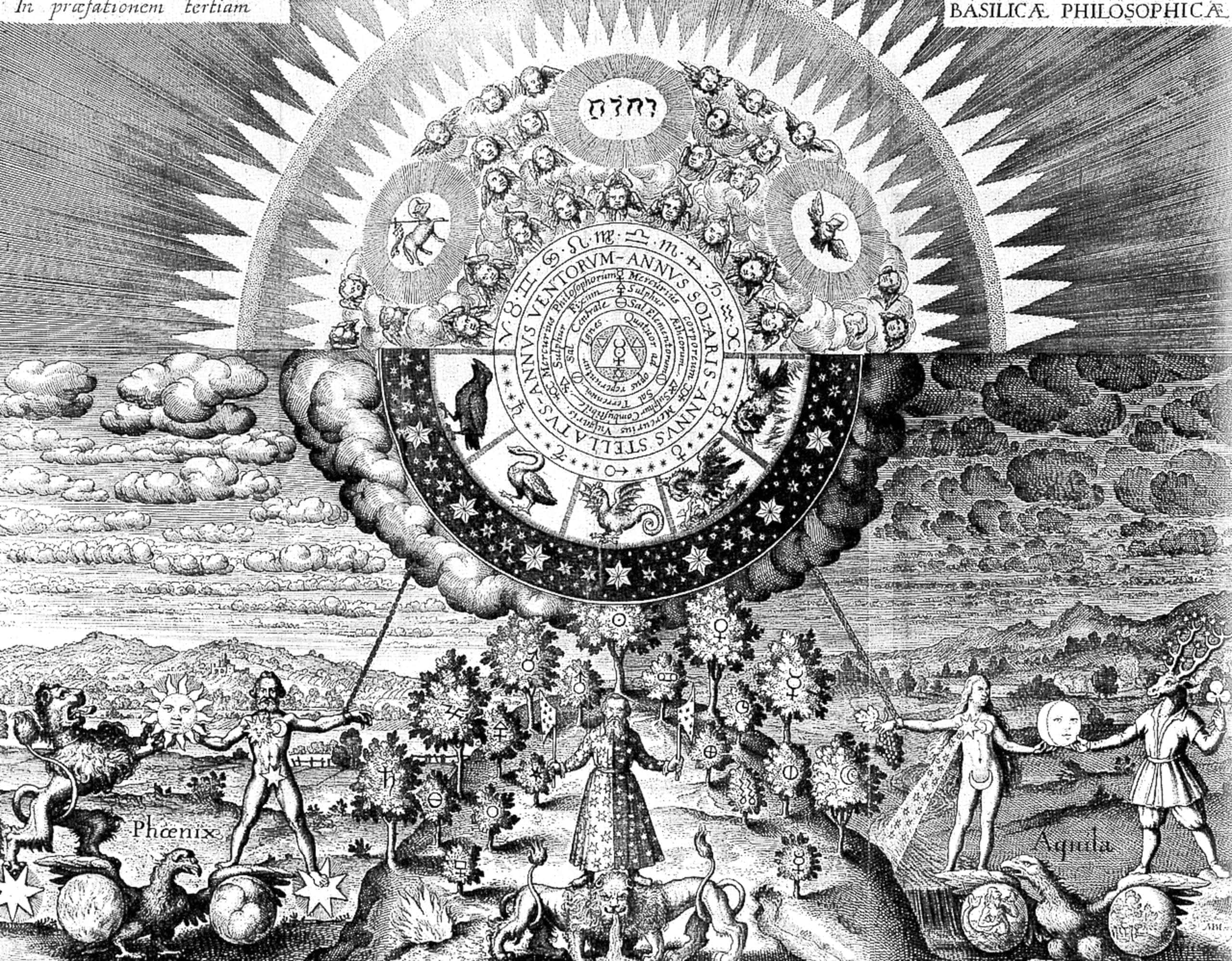
Alchemical Mental Transmutation illustration in the “Basilica Philosophica” section of Opus Medico-Chymicum
THE ALL: The Reality Behind the Universe
At the foundation of The Kybalion’s explanation of existence is a reality it calls “THE ALL.” Everything that appears within the universe, matter, energy, life, mind, consciousness, worlds, and living beings, exists within this greater reality. Yet THE ALL itself is said to stand beyond every ordinary category by which human beings attempt to understand existence. The Three Initiates begin from the observation that everything experienced through the senses is continually changing. Matter changes form, energy passes from one state into another, living things arise and disappear, and mental states continually shift. Nothing within the observable universe possesses permanent and independent existence. Behind these changing appearances, the Hermetic philosophy proposes an underlying reality that does not change and from which all manifestations arise.
This distinction between outward appearance and underlying reality becomes one of the foundations of the book. The changing universe is described as the world of form and manifestation, while THE ALL is the substantial reality behind it.
“Under, and back of, the Universe of Time, Space and Change, is ever to be found The Substantial Reality—the Fundamental Truth.”
The word “substance” is used here in its philosophical rather than material sense. It refers to that which exists beneath outward appearances and gives them their reality. The universe presents innumerable changing forms, but the authors reason that there must be something permanent beneath those forms or there would ultimately be nothing from which they could arise.
THE ALL Cannot Be Defined
The first difficulty is that THE ALL cannot actually be defined. A definition places something within a larger category or distinguishes it from other things, but nothing is supposed to exist outside THE ALL against which it could be compared. The finite human mind is itself contained within THE ALL and cannot stand outside it to examine its complete nature. The Three Initiates consequently distinguish between knowing that THE ALL exists and knowing what THE ALL is in itself. Its existence can be reasoned toward, but its inner nature remains unknowable.
“THE ALL is Infinite Living Mind—the Illumined call it SPIRIT!”
Even the word “Spirit” is acknowledged to be inadequate. It serves as the highest term available for pointing toward a reality that cannot be completely expressed in human language. The authors repeatedly caution against imagining THE ALL simply as an enormously enlarged human personality. Whatever attributes are assigned to it must not reduce an infinite reality to the limitations of an individual mind. This distinction allows The Kybalion to build an elaborate metaphysical system while preserving an ultimate mystery at its center. The principles may describe how THE ALL manifests and how its universe operates, but they do not reveal the absolute inner nature of THE ALL itself.
The Three Attributes of THE ALL
Although its essential nature cannot be known, the book argues that reason allows three fundamental conclusions about THE ALL.
First, THE ALL must be infinite. Nothing can exist outside it to limit, restrict, or define its boundaries. If another independent reality existed beyond THE ALL, then THE ALL would no longer truly be all.
Second, THE ALL must be eternal. It cannot have arisen from nothing, because the book rejects the idea that something can come from absolute nothingness. Nor could another power have created it, because such a creator would necessarily exist outside THE ALL. It has always existed and cannot cease to exist.
Third, THE ALL must be immutable in its essential nature. It cannot fundamentally change into something else because there is nothing outside itself into which it could change, nothing from which it could acquire something new, and nothing it could lose without ceasing to be THE ALL.
THE ALL is consequently described as Infinite, Eternal, and Immutable. Everything else exists within change; THE ALL is the underlying reality within which change occurs.
THE ALL Cannot Be Matter
Having established these attributes, the Three Initiates consider what THE ALL could actually be. Their first conclusion is that it cannot simply be matter. Matter is continually changing. It exists in different forms, can be divided and rearranged, and is subject to forces and laws. If THE ALL were merely matter, the authors argue, it could not account for the existence of life and mind unless those qualities were somehow already inherent within it. They express this reasoning through the maxim that nothing can rise higher than its own source. If consciousness, intelligence, and life exist within the universe, then the ultimate reality behind the universe cannot be fundamentally less than consciousness and life.
The authors also appeal to the changing scientific conception of matter in their own period. Matter was increasingly being understood not as an absolutely solid and permanent substance but in terms of atoms, energy, motion, and vibration. The Kybalion uses this development to argue that materialism cannot provide the final explanation of reality. Matter becomes a manifestation instead of the ultimate substance of existence.
THE ALL Cannot Be Mere Energy
The same argument is then applied to energy or force. If matter is ultimately reducible to forms of energy and vibration, perhaps energy itself could be the fundamental reality. The Three Initiates reject this as well. Energy, considered merely as blind mechanical force, does not explain life and mind. The book again argues that a source cannot give rise to something fundamentally greater than itself. Since living consciousness and intelligence exist, the ultimate reality must contain the potential for these qualities rather than being an unconscious force incapable of producing them. The authors move beyond both materialism and a purely mechanical conception of energy. Matter and energy are real as manifestations, but neither is sufficient to explain the ultimate source from which the universe arises.
THE ALL as Infinite Living Mind
The First Hermetic Principle—“THE ALL is Mind; The Universe is Mental”—now receives its deeper explanation. THE ALL is described as Infinite Living Mind, while the word Spirit is used as another name for this ultimate mental reality. This does not mean that THE ALL thinks in the same manner as an individual human being. Human thought is finite, conditioned, and limited. Infinite Mind is presented as something immeasurably beyond ordinary consciousness. The human mind provides only the nearest available analogy. The significance of this conception is enormous for the rest of the system. If THE ALL is Infinite Living Mind, then matter, energy, life, and individual consciousness exist within Mind instead of Mind arising secondarily from matter. Mentalism is not merely a doctrine concerning human psychology. It becomes the metaphysical explanation of the universe itself. The universe is mental because its ultimate source and containing reality is Mind.
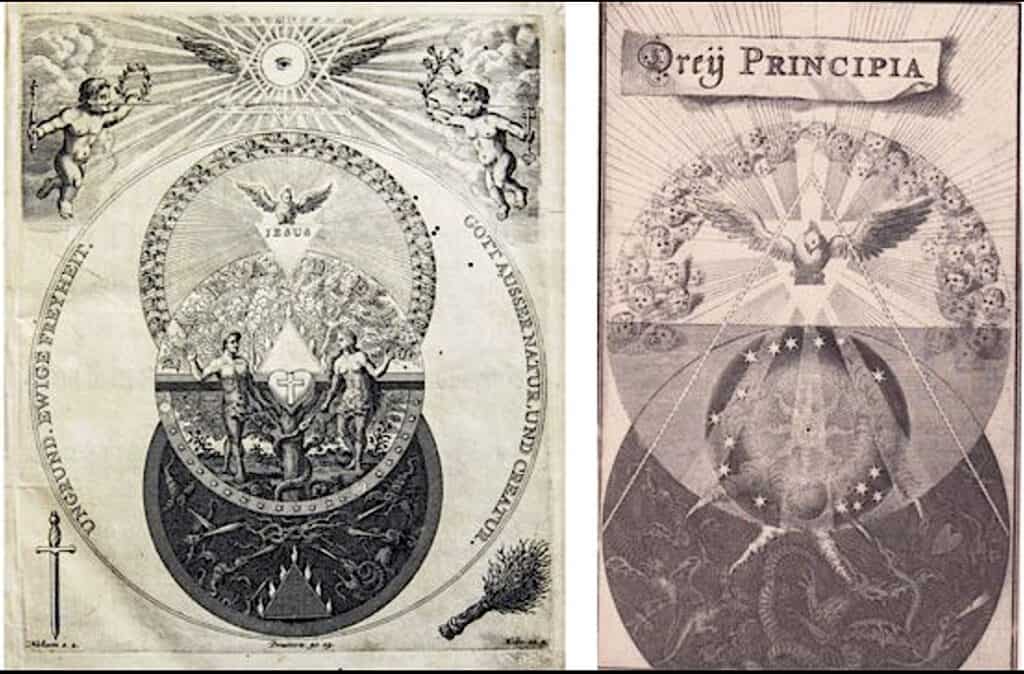
Illustration by John Yarker in The Kneph journal 1890
Nothing Exists Outside THE ALL
The statement that THE ALL is truly “All” leads to one of the central questions in The Kybalion. If nothing exists outside THE ALL, there can be no independent substance from which the universe was created. The universe also cannot exist as a separate reality outside its source, since the existence of anything beyond THE ALL would contradict the very idea of infinity. Everything that exists must exist within THE ALL.
This raises a difficult question. THE ALL is described as infinite, eternal, and immutable, while the universe is filled with movement, change, birth, death, formation, dissolution, and countless individual forms. If THE ALL transformed itself directly into the material universe, it would cease to be immutable. The Kybalion resolves this problem through Mentalism: creation occurs within Infinite Mind. THE ALL remains unchanged while the universe exists as its mental creation.
Creation Cannot Occur Through External Materials
The Three Initiates consider the possible ways THE ALL could create a universe. It cannot construct one from material obtained elsewhere because nothing exists beyond it. It also cannot divide portions from itself and transform those pieces into separate beings without violating the qualities of indivisibility and immutability already assigned to it. The book illustrates the problem with a deliberately provocative example: if THE ALL physically separated portions of itself to create individual beings, each person would literally be a detached piece of God. The authors reject this explanation and turn instead to mental creation.
The human mind provides the analogy. A person can create an image, character, place, or entire world mentally without obtaining physical material from outside the mind or removing a portion of his own physical substance. An author can populate an imagined world with characters and events while remaining unchanged by the physical act of their creation. Through the Principle of Correspondence, “As above, so below; as below, so above,” The Kybalion applies this relationship to THE ALL and the universe.
The Universe as a Mental Creation
The universe exists as a mental creation within the Mind of THE ALL. Matter, energy, life, worlds, and individual minds exist within this cosmic creation, while THE ALL remains infinite, eternal, and unchanged in its own nature. Creation becomes an activity of Infinite Mind, allowing a universe of continual movement and transformation to exist within a source that remains immutable.
Calling the universe Mental does not make physical existence meaningless or allow the individual to dismiss it as imaginary. The Kybalion later develops this distinction through the Divine Paradox, which explains how the universe can possess reality on its own plane while remaining a mental creation when viewed from the standpoint of THE ALL. Here, Mentalism establishes the foundation: everything experienced on the Physical, Mental, and Spiritual planes exists within Infinite Mind.
This gives Mental Transmutation its metaphysical basis. Mind occupies a foundational place in the structure of existence, so the laws governing mental states belong to the same universal order described by the Seven Hermetic Principles. Mental Transmutation applies those laws within the individual mind, while Mentalism traces their foundation back to the nature of the universe itself.
THE ALL Is Within Everything, and Everything Is Within THE ALL
The relationship between THE ALL and creation is expressed in one of the book’s most important statements:
“While All is in THE ALL, it is equally true that THE ALL is in All.”
Everything exists within THE ALL because nothing can exist outside Infinite Mind. At the same time, THE ALL is present within everything because every manifestation derives its existence from that same Infinite Reality. The Kybalion again uses mental creation to illustrate the idea. A character created by an author exists within the author’s mind, while the author’s mind is also present throughout the character and the imagined world in which that character exists. Every quality assigned to the character has its source in the mind that created it.
Individual beings exist within THE ALL and derive their existence from it while remaining finite manifestations within an infinite reality. This relationship becomes increasingly important as The Kybalion develops its account of spiritual evolution. Life advances through higher forms and degrees of consciousness within THE ALL, while THE ALL remains infinite and complete. The individual’s development takes place within this universal Mental Reality and follows the same laws operating throughout the rest of creation.
The concept of THE ALL brings the central teachingThe ideas developed so far come together in a single metaphysical framework. Behind everything that appears is an Infinite, Eternal, and Immutable Reality. The Three Initiates argue that this reality cannot be adequately described as matter or blind energy because life and mind exist within the universe. Their highest conception of THE ALL is Infinite Living Mind or Spirit. Since nothing can exist outside this Infinite Reality, the universe must exist within it. THE ALL also cannot divide itself or change its fundamental nature without contradicting the qualities assigned to it. Creation is explained through Mentalism: the universe exists as a mental creation within Infinite Mind.
The statement “THE ALL is Mind; The Universe is Mental” defines the nature of reality within the philosophy of The Kybalion. From this foundation, the book develops its cosmology of creation, existence, and evolution. The universe is conceived, generated, and sustained within THE ALL; worlds and living beings arise within this Mental Universe; and creation passes through vast cycles of involution and evolution while THE ALL remains infinite and unchanged.
The Mental Universe
With THE ALL established as Infinite Living Mind, The Kybalion turns to the nature of the universe existing within it. The universe is created mentally within the Infinite Mind of THE ALL, following the same principle by which thoughts, images, characters, and imagined worlds can exist within an individual mind. The Principle of Correspondence allows the authors to use human mental creation as an analogy for universal creation, while the difference in scale remains immeasurable: the human mind is finite, while the Mind of THE ALL is infinite.
“The Universe is Mental, held in the Mind of THE ALL.”
This statement defines the relationship between THE ALL and the universe. Matter, energy, life, space, time, and individual consciousness all exist within the Mental Universe and depend upon the Infinite Mind in which they arise. They possess reality on their own planes of existence, yet their existence remains dependent upon THE ALL. The Three Initiates maintain a clear distinction between the two: THE ALL is infinite, eternal, and immutable, while the universe contains finite forms that continually change, develop, dissolve, and give way to new forms.
Creation Through Mind
The process of creation is explained through the Principle of Correspondence. Human beings can create mentally without dividing themselves or obtaining materials from outside the mind. A person, landscape, event, or entire imagined world can arise within consciousness while the thinker remains distinct from the mental creation. The Three Initiates apply this principle to THE ALL. Universes are created within Infinite Mind in correspondence with the way mental creations arise within finite human minds, though the scale and nature of the two are immeasurably different.
“THE ALL creates in its Infinite Mind countless Universes.”
The reference to countless universes expands the scale of the cosmology presented in The Kybalion. Earth occupies no central position, and the visible universe represents only a portion of creation. The book describes countless worlds, universes, planes, and forms of life existing within Infinite Mind. Their cycles of creation, development, decline, and dissolution may span periods almost inconceivable from a human perspective, yet remain momentary when measured against the eternity of THE ALL. Human experience occupies one small region within an immense field of manifestation.
The Infinite Mind as the Womb of Universes
The language of creation introduces the Principle of Gender. The Infinite Mind is described as the “womb of Universes,” giving cosmic creation a generative structure. THE ALL itself stands above Gender, Time, Space, and the other laws governing manifested existence. Gender enters with creation and operates through the complementary Masculine and Feminine principles.
The Masculine principle is associated with Will and the projection of the creative impulse, while the Feminine principle receives that impulse and develops the forms of creation. The Kybalion expresses this relationship through the symbolism of God the Father and Nature the Mother. The Father principle projects the creative Will, and the Mother principle carries the universe into manifestation through the operation of natural law. The same Principle of Gender that will later be applied to the individual mind is first established here on the cosmic scale.
Father Mind and Mother Mind
THE ALL remains one Infinite Mind, while its creative activity is described through complementary Masculine and Feminine functions. The Masculine principle projects the creative Will toward the Feminine principle, identified with Nature, and Nature develops the universe according to established laws. Creation begins with simple forms or “centres of activity” and proceeds through increasingly complex expressions of matter, energy, life, intelligence, and consciousness.
The symbolism of Father Mind and Mother Mind gives each aspect a distinct role within a single creative process. The religious impulse directed toward the source of existence is associated with Father Mind, while reverence for Nature and the generative forces of life is associated with Mother Mind. Both belong to the one Infinite Reality of THE ALL and describe complementary aspects of its creative activity.
The Cosmic Parallel of the “I” and the “Me”
The Kybalion uses the human mind to illustrate this cosmic process through the Principle of Correspondence. Within personal consciousness, the authors distinguish between the “I” and the “Me.” The “I” is the observing and directing faculty that exercises Will and Attention. The “Me” is the receptive mental field in which thoughts, ideas, images, feelings, and mental forms arise and develop.
The relationship provides an analogy for cosmic creation. The “I” can direct Will and thought into the receptive field of the “Me,” just as the Masculine principle of THE ALL projects the creative impulse toward the Feminine principle in which forms are generated. This analogy later becomes central to Mental Gender, where the same relationship is used to explain the active and receptive faculties of the individual mind. On the cosmic level, it allows creation to occur within a single Infinite Mind through complementary functions of the same underlying Reality.
The Evolution of Life and Consciousness
The Mental Universe continually develops after creation begins. Simple forms give rise to increasingly complex forms of matter, life, intelligence, and consciousness. Humanity occupies one stage within this immense process and is never presented as its highest possible expression. The Kybalion describes beings on planes far above ordinary human consciousness whose powers and attributes might appear godlike from the human level. These beings remain finite participants in the same process and are themselves described as having passed through lower stages of development.
Humanity is likewise moving toward higher levels of existence. The path extends beyond physical life through stages and planes that lie outside ordinary experience, with consciousness developing toward greater knowledge, power, and realization. The universe becomes an immense field for the development of life, and human existence represents one stage within a journey extending far beyond the present condition.
Earth Is Only One Small Part of Creation
The Three Initiates repeatedly enlarge the scale through which the reader is asked to view existence. Earth is compared with a grain of dust against the immensity of creation. Countless worlds and universes exist within the Infinite Mind of THE ALL, along with planes and forms of life inaccessible to ordinary human perception. Even within the solar system, the authors propose levels and forms of life higher than those presently recognized by humanity.
The visible physical world is one region within a much larger hierarchy of existence. Above and below ordinary human consciousness lie numerous planes of manifestation, all governed by the same universal principles while expressing those laws through different forms and degrees. Correspondence connects these planes and allows knowledge gained on one level to provide insight into the laws operating on another.
Death as Transition
Within this evolutionary system, death marks a transition from one condition of existence to another. The physical form disappears, while the developing being continues through other planes and experiences. The Kybalion describes death as “Birth to a new life,” placing it within the continuing transformation that characterizes the Mental Universe.
What appears as an ending from the physical plane becomes the beginning of experience under another set of conditions. The individual continues through immense periods of development and increasingly higher states of existence. Physical death loses its position as the final boundary of life and becomes one transition within the continuing evolution of consciousness.
The Destiny of the Individual
The destiny described in The Kybalion is the continuing expansion of consciousness through increasingly advanced forms of existence. Human beings are expected to rise toward levels presently occupied by beings far beyond humanity and eventually pass beyond those levels as well. The process extends through “aeons upon aeons of time,” with the vast regions and planes of the universe serving as fields for the development of consciousness.
The direction of this development is toward greater realization of unity with THE ALL. Individuality remains meaningful throughout the evolutionary journey as consciousness expands and the deeper unity beneath separate existence becomes increasingly apparent. At the completion of the immense cosmic cycle, THE ALL draws creation back into itself, bringing the process of manifestation toward its return.
Involution and Evolution
The cosmic cycle moves in two complementary directions. Involution carries creation outward into differentiation, multiplicity, matter, and separate forms. Evolution carries consciousness through those forms toward higher levels of awareness and increasing realization of its source. Together they describe the great movement of manifestation and return.
Several of the Seven Hermetic Principles operate within this cycle at once. Rhythm appears in the outward and inward movement; Polarity appears in the opposing directions of involution and evolution; Cause and Effect governs the sequence of development; Gender governs generation; and Correspondence allows the same pattern to appear across different planes and scales of existence. The Seven Principles work together within a single process extending from the creation of universes to the development of individual consciousness.
Humanity Within the Father-Mother Mind
Despite the enormous scale of its cosmology, The Kybalion repeatedly returns to the individual’s relationship with THE ALL. Every being exists within Infinite Mind, and no world, plane, life form, or individual can exist beyond it. The section closes with a parental image:
“Within the Father-Mother Mind, mortal children are at home.”
The Father-Mother Mind contains both the originating Will and the generative field in which creation develops. Countless worlds, vast hierarchies of beings, death, evolution, and immense periods of cosmic time all remain within THE ALL. The individual is never outside the Infinite Mind from which the universe arises.
The Mental Universe is built upon this relationship. THE ALL creates mentally; Gender describes the complementary functions involved in creation; life develops through higher forms of consciousness; death carries the individual into another condition of existence; and creation moves through immense cycles of manifestation and return. This leads to another question within the philosophy: if the universe is a mental creation within THE ALL, what kind of reality does it possess? The Kybalion answers through the Divine Paradox and its distinction between Absolute and Relative Reality.
The Divine Paradox: Absolute and Relative Reality
The Mental Universe creates an apparent contradiction within the philosophy of The Kybalion. THE ALL alone possesses absolute and permanent reality, while the universe consists of changing forms within Infinite Mind. From the standpoint of THE ALL, the universe can be described as a mental creation without independent or permanent existence. Human beings, however, experience that universe as real. Matter produces physical effects, natural laws operate consistently, thoughts and actions have consequences, and individuals remain subject to the conditions of the planes they inhabit. The Divine Paradox allows both perspectives to exist within the same system: the universe is unreal when measured against Absolute Reality and real to the finite beings living within it.
“The half-wise, recognizing the comparative unreality of the Universe, imagine that they may defy its Laws—such are vain and presumptuous fools.”
This warning prevents Mentalism from becoming a doctrine in which physical existence and its consequences can simply be dismissed. The Hermetic student is expected to understand the Absolute and Relative perspectives at the same time. The universe does not possess the eternal, self-existing reality of THE ALL, yet it remains the field in which finite beings live, think, act, and experience the operation of universal law.
Absolute Reality and Relative Reality
From the Absolute perspective, THE ALL alone possesses complete reality because it is infinite, eternal, immutable, and independent. Everything within the universe is subject to change. Worlds form and disappear, living forms develop and dissolve, civilizations rise and fall, bodies are born and die, and even universes complete their cycles of manifestation. Measured against the permanence of THE ALL, these forms possess temporary and dependent existence.
The Kybalion still assigns them reality on their own planes. The universe exists as a mental creation within THE ALL and possesses the reality appropriate to that condition. From the standpoint of Infinite Mind, it is a mental creation; from the standpoint of beings living within it, it constitutes the world of experience. The distinction depends upon the level from which reality is being considered.
The book again uses human mental creation as an analogy. A character conceived within an author’s mind does not possess the same degree of reality as the author, yet the character’s world can contain its own events, relationships, surroundings, and internal conditions. Humanity occupies a comparable position within the Mental Universe of THE ALL. Knowing that the universe depends upon Infinite Mind does not remove human beings from the laws governing existence within it.
The Danger of Half-Wisdom
The Kybalion uses the term “half-wise” for the student who understands the mental nature of the universe and then draws the wrong conclusion from it. Such a person dismisses matter as illusion, treats natural laws as unreal, and imagines that philosophical knowledge has placed him beyond the conditions governing physical existence. The Three Initiates regard this as a serious misunderstanding of Hermeticism.
Their examples are deliberately simple. A person may call matter unreal, yet a stone can still injure the body. Fire can still burn, and the physical body still requires the conditions necessary to sustain life. These things possess Relative Reality because the individual currently exists on the plane where their laws operate. Their dependence upon Infinite Mind does not eliminate their effects within that plane.
The same principle applies to mental and social existence. Emotions, suggestion, relationships, human laws, and surrounding circumstances continue to exert influence according to the conditions under which they operate. Hermetic knowledge gives the student a way to understand these forces and work consciously within their laws. The Absolute perspective explains their place within Infinite Mind, while the Relative perspective governs the conditions under which the individual presently lives and acts.
Law Cannot Be Escaped
This leads to one of the central teachings of The Kybalion: knowledge of universal law does not place anyone outside universal law. The Hermetist never becomes supernatural in the sense of escaping Nature. Everything within the universe remains part of Nature and subject to the principles governing it. Mastery comes from understanding how different laws and forces interact and learning to use that knowledge consciously.
The Masters described in the book do not break natural laws. Their abilities are attributed to knowledge of laws unknown to ordinary people and the use of higher laws to counteract the effects of lower ones. The Three Initiates illustrate this through familiar physical examples. Gravity continues to pull an object toward Earth, yet another force can be applied to lift it. The second force does not abolish gravity; it changes the result produced under those conditions. Hermetic mastery follows the same principle.
“The wise ones serve on the higher, but rule on the lower.”
The maxim describes a hierarchy that applies at every level of development. The individual remains subject to laws operating above his level while gaining greater command over forces operating below it. Every degree of mastery remains relative because even the highest beings described in the book remain subject to THE LAW.
Using Law Against Law
The ability to use one law against another provides the Hermetic response to the Divine Paradox. The student recognizes the forces acting upon him and seeks the law through which their effects can be changed. This principle appears throughout the methods taught in The Kybalion. Rhythm continues to operate, while its effect upon consciousness can be neutralized through Polarization. Polarity remains in force, while the individual can move thought toward the desired pole. Cause and Effect cannot be escaped, while a person can introduce causes instead of remaining controlled by those already acting upon him. Vibration remains universal, while its degree can be changed. Mental influences continue to operate, while the student can establish a mental state capable of resisting or counteracting them.
Hermetic mastery depends upon understanding these relationships among laws. A higher principle is applied to change the effect of a lower force while both remain part of the universal order. The Three Initiates place this ability at the center of the Hermetic Art of Transmutation:
“The Hermetists understand the art of changing the character of mental vibrations of objects, or forms of energy, and thus perform what are commonly called ‘miracles.’”
Within this system, the apparent miracle is an event whose governing laws remain unknown to the observer.
Matter Is Neither Everything nor Nothing
The Divine Paradox also defines the book’s position on the reality of matter. Materialism treats physical matter as the fundamental substance of existence. At the opposite extreme, a student who has learned that the universe is Mental may conclude that matter has no reality and can simply be disregarded. The Kybalion places matter within Relative Reality. It is not the permanent and independent reality of THE ALL, yet it remains real on the Physical Plane and operates according to laws that must be respected.
The same distinction applies to individual thought. Mental states are also relative manifestations within the Mental Universe. They can change in degree, polarity, vibration, strength, and duration. The Principle of Mentalism does not give every human thought unlimited creative power, because the individual mind is not THE ALL. Human beings are finite centers of consciousness within Infinite Mind and remain subject to the universal laws governing the planes on which they exist.
Living on the Relative Plane While Knowing the Absolute
The Hermetic student is expected to maintain an awareness of Absolute Reality while living fully within Relative Reality. Work, health, relationships, responsibilities, physical conditions, and mental states remain part of the plane on which human development is taking place. The Three Initiates criticize teachings that use the unreality of matter as a reason to withdraw from ordinary life or ignore the conditions of physical existence.
Knowledge of the Absolute changes the student’s understanding of those conditions without removing their effects. Difficulties can be recognized as temporary within the immense scale of the Mental Universe while still requiring action on the plane where they occur. The Hermetist works within existing conditions, studies the laws governing them, and seeks the higher principles through which their effects can be changed.
The Universe as a Divine Mental Creation
The Mental Universe retains meaning and purpose within the philosophy because it is the creation of THE ALL. Its laws express the order of Infinite Mind, and its countless worlds, beings, planes, and stages of development provide the field through which consciousness evolves. Physical existence forms one stage of that process, mental development another, with higher spiritual planes continuing the progression.
Human beings participate in this creation through experience, development, and increasing mastery. Knowledge of Mentalism changes the way the universe is understood, while life within it continues. The forms encountered throughout existence are temporary, but they belong to the immense process through which consciousness develops within a permanent Infinite Reality.
The Paradox at the Heart of Hermetic Mastery
The Divine Paradox establishes two perspectives that the Hermetic student must hold together. THE ALL is Absolute Reality, while the Mental Universe possesses Relative Reality. Matter remains real on the Physical Plane, mental conditions remain real on the Mental Plane, and the laws governing those planes continue to operate. Human beings exist within THE ALL without individually possessing the infinite attributes of THE ALL.
Hermetic mastery develops through an understanding of these levels of law. The student learns which forces are acting upon a condition and how another principle can be applied to change their effects. Higher laws provide greater control over lower conditions, while every level remains within the universal order. This hierarchy of laws becomes important as The Kybalion turns from the distinction between Absolute and Relative Reality to the different planes on which those laws operate.
The Planes of Correspondence
The Kybalion describes manifested existence as an immense range of matter, energy, life, mind, and consciousness divided for study into different planes. These planes exist within the Infinite Mind of THE ALL and remain connected by the same fundamental laws. The Principle of Correspondence provides the key to understanding how laws observed on one level can reveal their operation on another:
“As above, so below; as below, so above.”
The Three Initiates divide this range into three Great Planes: the Great Physical Plane, the Great Mental Plane, and the Great Spiritual Plane. Each contains seven Minor Planes, with each Minor Plane divided again into seven sub-planes. These classifications create a hierarchy extending from dense physical matter through increasingly subtle forms of energy and consciousness to spiritual beings far beyond ordinary human experience.
A plane describes a degree or condition of existence. The boundaries between planes are gradual, like the colors of a spectrum passing into one another. To occupy a higher or lower plane concerns vibration, consciousness, organization, and development, giving the language of “higher” and “lower” a meaning based upon degree instead of physical position.
The Great Physical Plane
The Great Physical Plane includes familiar matter and energy along with subtler forms that the authors believed lay beyond ordinary sensory perception. It contains seven Minor Physical Planes: Matter (A), Matter (B), Matter (C), Ethereal Substance, Energy (A), Energy (B), and Energy (C). Together they form a scale extending from familiar physical substances toward increasingly subtle forms of matter and force.
Matter (A) includes the solids, liquids, and gases recognized by the science of the period. Matter (B) contains what the authors call “Radiant Matter,” associated with discoveries involving radium and states of matter that challenged older ideas of solid substance. Matter (C) represents still finer forms that they believed science had yet to discover. Ethereal Substance occupies an intermediate position between matter and energy and is described as the medium through which light, heat, electricity, and other forms of radiant energy travel.
The three Energy planes continue the progression. Energy (A) includes familiar forces such as heat, light, magnetism, electricity, gravitation, attraction, and chemical affinity. Energy (B) contains subtler forces associated with finer processes of Nature, while Energy (C) represents forms said to lie beyond ordinary scientific knowledge. The sequence allows the Physical Plane itself to extend from dense matter toward forces approaching the Mental Plane. Vibration supplies the connecting principle, with changes in vibratory degree producing different forms of manifestation.
The Great Mental Plane
The Great Mental Plane extends far beyond ordinary human thought. It contains the entire range of mental manifestation from the simplest forms of response in Nature through plant, animal, and human consciousness. The Seven Minor Mental Planes are Mineral Mind, Elemental Mind (A), Plant Mind, Elemental Mind (B), Animal Mind, Elemental Mind (C), and Human Mind.
Mineral Mind places the beginnings of mental activity at the lowest levels of Nature. The authors interpret attraction, affinity, and other responses found among minerals, chemical elements, atoms, and particles as primitive degrees of the same mental principle that appears in more developed forms higher on the scale. Plant Mind introduces more advanced forms of life, sensitivity, and response. Animal Mind develops this progression through instinct, emotion, perception, and intelligence, while Human Mind continues it into the forms of consciousness associated with humanity.
Mind, within this system, develops by degree throughout Nature. Mineral, plant, animal, and human consciousness occupy different stages along a continuous scale of mental manifestation. This follows directly from Mentalism: all existence occurs within Infinite Mind, and mentality appears throughout creation in different degrees and forms.
The Elemental Planes
Between Mineral, Plant, Animal, and Human Mind, The Kybalion places three intermediate regions called the Planes of Elemental Mind. Elemental Mind (A) lies between Mineral and Plant Mind, Elemental Mind (B) between Plant and Animal Mind, and Elemental Mind (C) between Animal and Human Mind. The Three Initiates provide few details about these planes, describing them mainly as connecting stages that fill the apparent gaps between the better-known forms of mental development.
The Elemental Planes support the book’s conception of Nature as a continuous progression. Each level shades into the next through intermediate degrees. They also leave room within the Hermetic cosmology for forms of life and consciousness outside ordinary human perception, including classes of beings associated with older occult ideas concerning elementals and invisible intelligences.
The Seven Sub-Planes of Human Mind
The Plane of Human Mind is itself divided into seven subdivisions, placing humanity within an ongoing process of mental development. The Three Initiates describe most people as occupying approximately the fourth subdivision, more advanced individuals as reaching the fifth, and exceptional individuals as entering the sixth. The seventh approaches the transition toward still higher forms of consciousness.
Humanity is presented as having risen gradually through the lower subdivisions over immense periods of development. Individuals advance at different rates, producing the wide range of intellectual, mental, moral, and spiritual development that the authors believed could be observed among people. Geniuses, advanced thinkers, Adepts, and Masters are placed toward the higher reaches of this scale and represent levels of development that humanity may eventually reach more widely.
The Great Spiritual Plane
Beyond the Mental Plane lies the Great Spiritual Plane. The Three Initiates give fewer details here because they regard ordinary human language and experience as inadequate for describing forms of consciousness so far above humanity. The Spiritual Plane follows the same sevenfold organization, with its Minor Planes containing beings of progressively greater consciousness, power, and development.
At its lower reaches are beings comparable to the angels, archangels, demigods, and celestial intelligences described in religious traditions. Higher levels contain beings whose powers would lead human beings to regard them as gods. The Kybalion maintains a firm distinction between all such beings and THE ALL. Every spiritual intelligence remains finite, exists within the Mental Universe, and remains subject to universal law.
These beings are described as participating in the administration and development of worlds, races, and cosmic processes. The hierarchy rises through levels increasingly difficult for human consciousness to comprehend, yet no point within it reaches THE ALL. THE ALL is the Infinite Reality containing the hierarchy, not another being positioned at its summit.
Masters, Adepts, and Higher Beings
The hierarchy of planes also provides the setting for the Masters and Adepts described throughout the book. Advanced human beings can rise into higher mental and spiritual conditions and gain knowledge of laws and forces inaccessible to ordinary consciousness. Their abilities arise from greater command of law and degree.
Their development continues after mastery of lower conditions has been attained. A Master may direct forces on one plane while remaining subject to laws and intelligences above it. “The wise ones serve on the higher, but rule on the lower” applies throughout the hierarchy. Each advance brings greater command over lower forces while revealing higher levels of law. Humanity looks toward the Masters, the Masters look toward beings above them, and the progression continues through levels of consciousness contained within THE ALL.
The Planes Are Degrees, Not Separate Worlds
The planes interpenetrate and can exist together because their differences arise from degree and vibration. Physical, mental, and spiritual manifestations need not occupy completely separate regions of space. A higher plane can coexist with a lower one while remaining imperceptible to consciousness attuned to another vibratory range.
The Three Initiates use physical vibration to illustrate the idea. Sound, light, heat, magnetism, electricity, and other forms of energy can occupy the same region while remaining distinguishable through their different vibratory characteristics. The same principle is applied to the planes of existence. Their coexistence does not require them to be visible or perceptible to one another.
Movement between planes describes a change in condition, vibration, consciousness, or development. To “rise” means to reach a higher degree. This idea links the structure of the planes directly with Mental Transmutation, where changes in mental vibration allow movement from one mental condition toward another.
Correspondence Across the Planes
The Principle of Correspondence makes the hierarchy intelligible by holding that the same fundamental laws operate throughout its different levels. Their forms of expression change from plane to plane, while the principles remain consistent.
Mentalism applies because every plane exists within Infinite Mind. Vibration establishes degrees of manifestation. Polarity creates opposing poles and intermediate states. Rhythm governs movement and recurring cycles. Cause and Effect establishes lawful sequences. Gender governs generation and creation. Correspondence allows knowledge of these principles on one plane to provide insight into their operation elsewhere.
“As above, so below” functions in The Kybalion as a method for reasoning across different levels of existence. Physical processes can provide analogies for mental processes, and human consciousness can provide insight into principles operating on levels beyond direct experience. Correspondence gives the student a way to approach the unknown through laws already recognized in the known.
A Continuous Scale of Existence
The Planes of Correspondence present reality as a continuous scale extending from dense matter through subtle forms of energy, primitive mentality, plant and animal consciousness, humanity, higher mental beings, and vast spiritual hierarchies. The divisions provide names and categories for study, while the underlying progression remains continuous.
Matter, energy, life, mind, psychic phenomena, and spiritual existence all belong to the same Mental Universe. Correspondence connects their laws, and Vibration differentiates their degrees. Humanity occupies one region within this immense spectrum and continues to move through the stages of mental and spiritual evolution. Rising to a higher plane means reaching a degree from which lower forces can be understood and directed with greater knowledge.
Vibration: From Matter to Mind
The Principle of Vibration explains how the enormous range described by the Planes of Correspondence can exist within one continuous universe. Matter, energy, mind, and spirit appear radically different at the human level, while The Kybalion attributes these differences to degrees and modes of vibration. Everything exists in motion, and changes in vibration correspond with changes in the form through which existence appears.
At the highest extreme stands pure Spirit, whose vibration is described as infinitely rapid while appearing motionless, much like a rapidly rotating wheel can appear still. At the lowest extreme lie the densest forms of matter, whose vibration is so slow that they also appear at rest. Between these extremes stretches the immense vibratory scale containing matter, energy, life, mind, and consciousness. Vibration provides the common principle connecting these different forms of manifestation.
Matter as Vibration
The Three Initiates begin with the physical world because vibration can be most easily illustrated there. Objects that appear motionless participate in constant movement. A stone resting on the ground moves with the rotation of Earth, Earth’s orbit around the Sun, and the movement of the solar system through space. At smaller scales, the particles composing matter are likewise described as being in continual motion.
The book draws upon the scientific discoveries and theories of its period to support this picture. Molecules, atoms, electrons, radioactivity, electricity, and other physical phenomena are used to show matter as a system of movement and activity. Heat is associated with increased molecular motion, while solids, liquids, and gases represent different conditions of matter produced through changes in movement, vibration, and cohesion. The authors use these examples to connect contemporary science with the Hermetic claim that apparent solidity and rest conceal continuous motion.
From Matter to Energy
As vibration rises, The Kybalion describes matter passing through subtler conditions until the boundary between matter and energy becomes increasingly difficult to distinguish. Heat, light, magnetism, electricity, and other forces are placed along the same vibratory scale, with their differences attributed to different rates and forms of motion.
The Three Initiates illustrate the idea with a hypothetical object whose vibration is continually increased. Its movement first enters the range perceived as sound. Once the vibration rises beyond human hearing, the sound disappears while the movement continues. At higher rates come conditions associated with heat and then visible light, passing through the colors of the spectrum from red toward violet. Beyond visible light lie forms of radiation that the eye cannot detect, followed in the authors’ model by still subtler electrical and magnetic conditions.
The example emphasizes the limited range of human perception. A vibration can pass beyond sight or hearing without ceasing to exist. The senses reveal only a small portion of the scale described by the Principle of Vibration, leaving open the possibility of forms of matter, energy, life, and consciousness operating beyond ordinary perception. This same principle supports the book’s account of the planes: different levels of existence can occupy the same apparent space while remaining inaccessible to senses attuned to another vibratory range.
The Ether and Finer Forms of Vibration
Between familiar matter and the higher forms of energy, The Kybalion places the Ether, or Ethereal Substance. Like many scientific and occult works of its period, the book describes the ether as an extremely subtle medium filling space and carrying vibrations associated with light, heat, electricity, and other forms of energy. Within the book’s system, the ether provides another stage in the progression from dense matter toward subtler manifestations. Matter passes into ethereal substance, ethereal substance into energy, and energy continues toward conditions approaching mind. The same gradation operates in the opposite direction, with countless intermediate degrees existing between recognizable states. Nature is presented as a continuous vibratory scale.
Mental States as Vibration
The Principle of Vibration takes on greater importance when it is extended from physical phenomena into consciousness. Thoughts, emotions, desires, moods, and mental states are described as having characteristic vibrations. Fear and courage, despair and confidence, hatred and love, weakness and strength occupy different vibratory degrees. A mental condition can change because its vibration can change, making Vibration one of the foundations of Mental Transmutation.
The individual can use this principle to work upon unwanted mental states. Fear, anger, melancholy, weakness, and similar conditions are not presented as fixed qualities of the mind. Another vibration can be deliberately established and strengthened until the mental condition changes. The Three Initiates summarize the principle in a direct instruction:
“To change your mood or mental state—change your vibration.”
Mental control depends upon establishing the vibration associated with the desired state. This connects Vibration directly with Polarity, since the change often involves directing the mind toward another degree or pole of the same mental scale. Fear can be moved toward courage by strengthening the mental vibration associated with courage until it becomes dominant.
Will, Attention, and Mental Vibration
Will and Attention provide the means for directing mental vibration. Attention strengthens the mental condition upon which it is concentrated. Sustained attention to an idea, emotion, or quality tends to bring the mind into correspondence with it, while withdrawing attention from an unwanted state removes one of the forces sustaining it.
“To destroy an undesirable rate of mental vibration, put into operation the Principle of Polarity and concentrate upon the opposite pole to that which you desire to suppress.”
The student directs attention toward the desired pole. Fear is countered by concentrating upon courage, weakness by strength, and discouragement by confidence. Will directs the process by selecting the mental state to be developed and holding Attention upon it. Through repeated concentration, the desired vibration is strengthened until it gains greater influence over consciousness. Mental self-government depends heavily upon this ability to choose where Attention will be placed instead of allowing moods, circumstances, or outside suggestion to continually determine it.
Induction and the Transmission of Mental States
The Kybalion also teaches that mental vibration can pass from one person to another through a process compared with physical induction. Just as one vibrating object can induce sympathetic vibration in another, a strongly established mental state can produce a corresponding response in another mind. Fear, enthusiasm, anger, confidence, depression, excitement, and other conditions can spread between individuals and groups, often without conscious recognition of the process.
This provides the book with an explanation for mental influence, suggestion, personal magnetism, hypnotism, and related phenomena. A strongly established mental condition in one person can act upon a receptive mind and encourage a corresponding vibration. The Hermetic student is expected to learn both sides of this process: how to establish and transmit a chosen mental condition and how to resist unwanted influences coming from other people, crowds, surroundings, and repeated suggestions.
The Principle Behind Mental Influence
The Three Initiates connect Vibration with the mental science of their own period. Suggestion, hypnotism, personal magnetism, mental influence, and similar methods are interpreted as different applications of laws that The Kybalion places within its Hermetic system.
A suggestion introduces or strengthens a mental condition. Repetition, concentration, expectation, emotional intensity, and receptivity can increase its influence until the receiving mind begins to respond to the suggested state. From this perspective, different schools of mental science may use different terminology while working with the same underlying process of changing mental vibration.
This also explains the book’s emphasis on maintaining a strong mental state. A mind capable of establishing and holding its own vibration is less easily shifted by outside influences. Without that control, moods and ideas can be absorbed from companions, crowds, persuasive personalities, prevailing opinions, or repeated suggestions. Control of personal vibration becomes both a method of Mental Transmutation and a defense against unwanted mental influence.
Raising the Vibration
The student is repeatedly instructed to raise the mental vibration. Higher vibration is associated with greater consciousness, self-control, strength, understanding, and spiritual development, while lower vibration corresponds with denser and less developed states.
“He who understands the Principle of Vibration, has grasped the sceptre of power.”
Raising vibration extends beyond changing a temporary mood. It forms part of the book’s account of mental and spiritual development. Established habits tend to reproduce familiar states, so the desired vibration must be reinforced through repeated Will and Attention until it becomes increasingly stable. This connects Vibration with Rhythm. Changing a mental state is one task; maintaining the chosen state against the return of established mental patterns is another.
Vibration as the Bridge Between the Seven Principles
Vibration connects several parts of the Hermetic system. Mentalism establishes the Mental Universe, Correspondence allows the same laws to operate across its different planes, and Vibration provides the range of degrees through which its manifestations differ. Polarity identifies opposing directions within a vibratory scale, Rhythm governs movement between those poles, Cause and Effect explains the sequence through which changes produce further changes, and Gender supplies the complementary relationship through which new forms and mental conditions are generated.
Mental Transmutation draws directly upon these relationships. The student recognizes an unwanted mental state as a condition capable of change, identifies the desired pole, and uses Will and Attention to strengthen the corresponding vibration. The transformation takes place through changes of degree, polarity, and vibration. Matter, energy, thought, emotion, and higher states of consciousness can then be placed within one continuous system governed by the principle that nothing rests and every condition exists in motion.
Polarity, Rhythm, and the Law of Neutralization
Polarity and Rhythm work closely together in The Kybalion’s system of Mental Transmutation. Polarity teaches that apparent opposites are different degrees of the same underlying quality. Rhythm describes the recurring movement between those poles. Together they explain both how a mental state can be changed and why the old state may return after the change has begun.
Heat and cold are degrees of temperature. Light and darkness occupy positions along a continuum. The same principle is applied to mental states. Fear and courage can be understood as opposing poles of confidence, while love and hate occupy opposing poles of affection. The existence of intermediate degrees makes movement possible. A person can move from one position toward another without having to create an entirely unrelated mental state.
The Art of Polarization
The deliberate movement toward a chosen pole is called the Art of Polarization. The student identifies the present mental condition, determines the desired pole, and uses Will, Attention, and repeated concentration to move thought in that direction. Fear can be polarized toward courage, hatred toward love, despair toward hope, and weakness toward strength.
“Mind (as well as metals and elements) may be transmuted from state to state; degree to degree; condition to condition; pole to pole; vibration to vibration.”
Mental Alchemy operates through this change of degree. Established habits may repeatedly pull consciousness toward the old pole, making continued concentration necessary. Each repetition strengthens the chosen mental direction until the new condition becomes more stable.
Polarity and Character
Repeated Polarization can extend beyond temporary moods into disposition and character. A person who repeatedly directs fear toward courage strengthens courage as a habitual mental condition. The same process can be applied to confidence, determination, self-control, optimism, and other qualities.
“By changing your polarity you may master your moods, change your mental states, remake your disposition, and build up character.”
Character is presented as capable of development through repeated mental action. A temporary act of Polarization changes the immediate state; continued Polarization strengthens the tendency to return to that state. Mental Transmutation can then become a method of reshaping the habitual direction of thought.
Mental Induction and the Polarity of Others
Polarity also enters the book’s theory of mental influence. A strongly polarized mind can induce a corresponding state in another person. The Three Initiates use the example of a fearful or melancholy individual being influenced by someone who first establishes courage and a stronger mental vibration within himself. Through Mental Induction, the second person’s mental condition is said to move toward the polarity established by the practitioner.
The book connects this process with the “mental treatments” of its period. The practitioner establishes the desired mental condition and attempts to stimulate a corresponding state in the recipient. Similar influence occurs constantly without deliberate intent. Fear can spread through a group, enthusiasm can stimulate enthusiasm, and confidence can encourage confidence. Control of personal polarity gives the student greater ability to influence mental conditions while resisting the influence of unwanted ones.
Rhythm: The Swing Between the Poles
Polarity explains the scale; Rhythm explains movement along it.
“Everything flows out and in; everything has its tides; all things rise and fall; the pendulum-swing manifests in everything.”
The pendulum is the book’s central image for Rhythm. Movement in one direction is followed by movement toward the other. The principle appears throughout Nature, history, civilizations, individual lives, moods, and emotions. Activity gives way to rest, expansion to contraction, enthusiasm to discouragement, confidence to uncertainty.
Mental Rhythm can make an achieved state difficult to maintain. A person may successfully move toward courage or confidence only to experience a later swing toward fear or discouragement. The Hermetic student learns to recognize this return as rhythmic movement and seeks to prevent it from controlling consciousness.
The Mental Pendulum
Most people, according to The Kybalion, are carried back and forth by the mental pendulum. Enthusiasm rises and falls. Confidence gives way to doubt. Energy is followed by discouragement. Each temporary condition can dominate thought and behavior while it lasts.
Recognizing Rhythm changes the student’s relationship to these recurring states. The return of an unwanted condition can be understood as part of an established mental pattern. The challenge is no longer limited to reaching the desired pole. The student must learn how to remain polarized there when the pendulum begins its return.
The Law of Neutralization
Rhythm itself cannot be destroyed because it is a universal principle. Its effect upon consciousness, however, can be neutralized. The Kybalion describes this through the Law of Neutralization, in which the student establishes consciousness on a higher level and allows the rhythmic swing to continue below without following it.
“Rhythm may be neutralized by an application of the Art of Polarization.”
Polarization provides the means of neutralizing Rhythm. By repeatedly concentrating upon the desired pole, the student creates a controlled rhythmic pattern of attention and reinforcement that works against the rhythm of outside influences and established mental habits. The old pendulum may continue its movement, but the student repeatedly returns thought to the chosen pole. Through continued repetition, the chosen state acquires its own rhythm and becomes increasingly capable of resisting the patterns that previously controlled consciousness.
Polarizing on the Higher Self
The Law of Neutralization also depends upon the distinction The Kybalion makes between the changing personality and the higher “I Am” of consciousness. Moods, emotions, thoughts, and circumstances continually change. The student seeks to establish the directing center of consciousness above those changes and maintain the chosen polarity from that position.
The lower mental movement may continue to produce fear, anger, discouragement, or other familiar reactions, while the student refuses to allow those reactions to determine the direction of thought and action. Mental poise develops through maintaining the chosen state during these recurring swings.
Poise and Mental Firmness
The Three Initiates describe Mental Firmness as the ability to remain consciously directed while moods and emotional tides rise and fall. Rhythm continues, but Will becomes capable of determining whether the individual follows its movement.
“The pendulum ever swings, although we may escape being carried along with it.”
Poise does not require the elimination of emotion or mental movement. It describes a stronger directing center that can maintain its chosen polarity while those movements occur. The student becomes increasingly capable of deciding which mental states will be strengthened and expressed.
The Law of Compensation
Rhythm also contains what The Kybalion calls the Law of Compensation:
“The measure of the swing to the right is the measure of the swing to the left; rhythm compensates.”
Compensation describes the balance between opposing movements. The swing of a pendulum in one direction corresponds with its movement in the other. The Three Initiates extend the principle into emotional experience, where a wide capacity for pleasure can correspond with a wide capacity for pain, and a narrower emotional range may limit both extremes.
Compensation belongs to the structure of Rhythm. Polarity supplies the opposing directions, Rhythm produces movement between them, and Compensation describes the balance in the extent of that movement.
Compensation Across Experience
The authors extend Compensation beyond moods to the circumstances of life. Gains and losses, pleasures and pains, advantages and difficulties are described as participating in patterns of balance across experience. An advantage in one area may carry a corresponding cost, while difficult experiences can develop capacities that later affect other conditions.
Within the Hermetic system, these patterns remain expressions of Rhythm and Polarity. The student cannot abolish the balancing movement of Nature, but greater control over mental polarity can reduce the degree to which consciousness is carried by it.
Using Polarity and Rhythm Together
Polarity and Rhythm form a continuous method of mental control. The student first recognizes the unwanted mental condition and identifies the desired pole. Will and Attention are then directed toward that pole through repeated concentration. When the established rhythmic swing begins pulling consciousness back toward the former condition, the student continues returning attention to the chosen state.
Repetition becomes crucial here. Each deliberate return to the desired pole establishes another cycle of directed thought. Over time, this repeated concentration creates a controlled rhythm capable of competing with the rhythms established by habit, environment, outside suggestion, and emotional reaction. “Rhythm may be neutralized by an application of the Art of Polarization” describes this relationship between the two principles: Polarization establishes the direction, while repeated attention helps maintain that direction against the returning swing.
From Servant to Master of Mental States
The goal is to change the individual’s relationship with mental states. Without an understanding of Polarity and Rhythm, moods can appear to arrive independently and determine behavior while they last. Fear produces one set of reactions, enthusiasm another, and discouragement another.
The Hermetic student learns to recognize these states as movements governed by law. Polarity provides a direction for changing them, Rhythm explains their tendency to return, and Neutralization provides a method for maintaining the chosen state. Mental Poise develops as consciousness becomes less dependent upon each passing swing and more capable of directing its own mental condition.
Cause and Effect: Becoming a Cause Instead of an Effect
The Principle of Cause and Effect carries the system of mental mastery into the question of human freedom. Every effect has a cause, every cause produces effects, and the chains connecting them extend throughout physical and mental life.
“Every Cause has its Effect; every Effect has its Cause; everything happens according to Law.”
Chance has no independent place within this system. An event may appear accidental because its causes are unknown or too numerous to trace, yet the inability to identify them does not remove them. A falling die provides a simple example. Its final position depends upon the force and angle of the throw, its starting position, the movement of the hand, the surface it strikes, and many other interacting conditions.
Mental life follows the same law. Thoughts and actions arise within chains formed by habits, environment, previous experiences, emotional states, desires, outside suggestion, and the influence of other people. Each mental condition is both an effect of preceding causes and a potential cause of what follows. Recognizing those chains allows the student to begin changing them.
Chance Is a Name for Unrecognized Causes
The Kybalion describes chance as “merely an expression relating to obscure causes; causes that we cannot perceive; causes that we cannot understand.” An event can stand at the intersection of many causal chains extending far beyond the individual’s ability to trace them, then become a cause producing further events.
The existence of causation does not leave the individual helpless. A new cause can change the effects that follow. The student seeks to recognize existing causes and introduce new ones capable of redirecting the sequence.
The Many Causes Acting Upon the Individual
The Three Initiates describe human beings as continually influenced by heredity, environment, habit, custom, prevailing opinions, emotions, desires, suggestions, and stronger personalities. Many of these causes operate without conscious recognition and can shape thought and behavior while the individual experiences the resulting action as a personal choice.
Suggestion provides a clear example. An accepted idea can become a cause. Repetition strengthens it, the strengthened idea can develop into habit, habit can shape character and decisions, and those decisions produce actions with further consequences. A mental impression introduced from outside can gradually become part of the individual’s own causal structure.
Collective influences operate in the same way. Family expectations, social customs, public opinion, group enthusiasm, fear, and the mental atmosphere of surrounding people can all supply causes. Recognizing them gives the student a greater opportunity to determine whether they will be accepted, resisted, or counteracted.
The Pawns on the Chessboard of Life
One of the book’s strongest images compares people who remain unaware of these influences with pieces being moved across a chessboard:
“The masses of people are carried along, obedient to environment; the wills and desires of others stronger than themselves; heredity; suggestion; and other outward causes moving them about like pawns on the Chessboard of Life.”
Hermetic training seeks to change the individual’s position within this system. The student learns to recognize the forces producing movement and to introduce causes deliberately. The chessboard metaphor remains important because greater control never removes the rules. The Hermetist gains greater ability to act within Cause and Effect.
Becoming a Cause
The objective is to become increasingly a Cause within one’s own mental life. Will, Attention, Polarization, Mental Transmutation, and Neutralization give the student ways to influence reactions that previously occurred automatically.
A person swept into fear by the fear of others is functioning as an effect of that influence. Recognizing the incoming state and deliberately establishing courage introduces a new cause. A recurring emotional swing can also act as a cause, while Neutralization changes the response produced by it.
Cause and Effect gives the other principles a place within the same chain. Vibration, Polarity, and Rhythm can produce mental changes. Will and Attention can introduce deliberate causes. Suggestion and Mental Induction can supply causes from other minds. The student seeks greater control over which causes are accepted and allowed to develop into effects.
Free Will and Determinism
Freedom in The Kybalion develops by degree. Every person exists within conditions produced by previous causes and remains subject to universal law. At the same time, greater control over thought, emotion, habit, and reaction increases the ability to introduce deliberate causes.
A person governed heavily by habit, outside suggestion, emotional reaction, and environment possesses less effective control over the resulting behavior. Mental training increases the ability to choose which tendencies will be reinforced and which will be counteracted. Freedom expands with self-mastery while remaining inside the structure of Cause and Effect.
Higher Causes and Lower Effects
The book also describes causes operating across different planes. A cause introduced from a higher plane can alter effects occurring on a lower one. This gives the Hermetist another way of understanding the use of higher laws against lower conditions.
The same principle appeared in Neutralization. Rhythm continues on the lower level, while consciousness is polarized on a higher one. The original force remains active, but another cause changes the effect it produces upon the individual.
“The wise ones serve on the higher, but rule on the lower.”
The hierarchy continues at every level. A Master may exercise great causal power on one plane while remaining subject to laws operating above it. No degree of mastery produces complete independence from universal law.
The Master and the Ordinary Person
The Master and the ordinary person both live within Cause and Effect. Their difference lies in the degree of control they possess within the causal chain. One is moved heavily by forces that remain unrecognized; the other understands more of those forces and can introduce causes capable of changing their effects.
Knowledge of law creates this difference. Mental mastery allows Will, Attention, vibration, and directed thought to become conscious causes. The individual becomes less like the pawn being moved and increasingly like the player capable of directing movement.
Suggestion as Cause
The Principle of Cause and Effect gives suggestion an important place within the system. Once accepted, a suggestion can become a mental cause. A suggestion of fear may alter vibration and move thought toward the fearful pole. Repetition can strengthen the condition until it becomes habitual, and the resulting habit can influence future thought, behavior, and perception.
The same process can be deliberately redirected. Constructive suggestion, affirmation, concentration, and Mental Transmutation introduce new causes. Repeated reinforcement strengthens them until they begin producing different habits and responses. The individual who consciously supplies these mental causes gains greater control over the ideas that become established within the mind.
Habit and the Chain of Causation
Habit demonstrates how effects become causes. A repeated thought or action strengthens a tendency. That tendency increases the likelihood of repetition, and continued repetition develops a stable mental pattern. A response originally produced by outside circumstances can eventually become an internal cause shaping future behavior.
The methods already introduced by The Kybalion are designed to alter this sequence. Polarity establishes a new direction, Vibration changes the mental state, Attention strengthens it, Will continues directing consciousness toward it, and Neutralization helps prevent the established rhythmic pattern from regaining control. Repetition gives the new condition increasing causal strength.
Mental Transmutation can be understood through this process as the deliberate reorganization of mental causation. New mental causes are introduced so that previous causes no longer reproduce the same effects indefinitely.
Mastery Within Law
Cause and Effect places a boundary around Hermetic power. Adepts, Masters, and higher spiritual beings all remain subject to THE LAW. Their power comes from greater knowledge of causes and greater ability to produce desired effects through them.
The same pattern runs across the Seven Principles. Vibration is changed in degree, Polarity is used to change mental direction, Rhythm is neutralized through Polarization, and Cause and Effect is used by introducing new causes. Hermetic freedom develops through increasing mental self-government. As automatic reactions give way to conscious direction, the individual gains greater influence over the forces shaping thought, action, and experience.
Gender and Mental Gender
The seventh Hermetic Principle, Gender, extends generation across the Physical, Mental, and Spiritual planes. The Kybalion uses Gender in the sense of generating, producing, and creating. Generation requires the interaction of two complementary principles, which the Three Initiates call Masculine and Feminine.
“Gender is in everything; everything has its Masculine and Feminine Principles; Gender manifests on all planes.”
Physical sex is presented as one expression of this universal principle. The authors also apply Gender to forces within matter, energy, mind, and spiritual existence. Masculine and Feminine describe complementary functions involved wherever something new is generated. Within the language of the book, the Masculine principle initiates and projects, while the Feminine principle receives, develops, and brings forth.
The Three Initiates extend this interpretation into the physics of their period, describing interactions among corpuscles, electrons, atoms, molecules, chemical forces, electricity, and gravitation through the same generative relationship. These examples reflect the scientific ideas available to the authors in 1908 and serve their larger philosophical purpose of presenting Gender as a universal creative law.
Gender as the Principle of Creation
Gender supplies the generative relationship within the system established by the other principles. Mentalism provides the Mental Universe, Vibration its changing degrees, Polarity its opposing directions, Rhythm its movement, and Cause and Effect its lawful sequence. Gender describes the complementary action through which new forms and conditions are produced.
The same pattern appears in the book’s account of cosmic creation. THE ALL stands above Gender, yet creation is symbolically described through Father Mind and Mother Mind. The Masculine aspect projects the creative Will, and the Feminine aspect receives and develops that impulse through Nature. Through Correspondence, the same relationship is then applied to the individual mind.
The Duality of Mind
Mental Gender becomes one of the book’s most important applications of the seventh principle. The Three Initiates compare their Masculine and Feminine faculties with contemporary psychological theories that divided mind into objective and subjective, conscious and subconscious, voluntary and involuntary, or active and passive aspects. Thomson Jay Hudson is specifically cited as one example of this dual-mind psychology.
The Kybalion interprets these two faculties through Gender. The Masculine corresponds with the active, conscious, and voluntary aspect of mind. It wills, initiates, directs, affirms, and projects. The Feminine corresponds with the passive, receptive, subconscious, and involuntary aspect. It receives impressions, accepts them, develops them, forms associations and mental images, and carries accepted ideas toward expression.
Mental Gender presents these faculties as complementary parts of one creative process. The Masculine faculty supplies direction and initiating force; the Feminine faculty receives that impulse and develops what has been impressed upon it. Their interaction provides the mental counterpart of the generative relationship that The Kybalion claims operates throughout Nature. Through the Principle of Correspondence, the dual structure of the individual mind becomes another expression of the same Masculine and Feminine law that the authors place throughout the Mental Universe.
The “Me” as the Mental Womb
The Three Initiates develop Mental Gender through the distinction between the “I” and the “Me.” At first, people tend to identify the self with the physical body. As consciousness develops, the body can be recognized as something possessed by the self. The same distinction can then be applied to thoughts, emotions, habits, feelings, and mental states. A mood can change, a habit can be weakened, and an emotion can be replaced while the underlying sense of identity remains. Through this process, The Kybalion identifies two functions within consciousness: the directing “I” and the receptive and generative “Me.”
The “Me” is the mental field in which thoughts, emotions, ideas, images, and other mental forms arise and develop. The Kybalion describes it as a “mental womb,” emphasizing its ability to receive impressions and generate mental forms from them. Its creative capacity is extensive, but the direction of that activity depends upon the impulses it receives. Without conscious direction from the “I,” the “Me” can continue developing impressions supplied by previous experience, surroundings, habits, or other minds.
This is the Feminine Principle of Mental Gender. “Feminine” describes its receptive and generative function and applies to every individual regardless of biological sex. The Feminine Mental Principle receives, accepts, develops, and carries mental forms toward expression.
The “I” and the Power of Will
The “I” is the directing aspect of consciousness. It can observe the thoughts, feelings, and mental conditions arising within the “Me” and exercise Will in determining their direction. The Kybalion identifies this function with the Masculine Principle. The Masculine “I” wills, initiates, directs, affirms, and projects, while the Feminine “Me” receives the initiating impulse and develops the corresponding mental condition.
This relationship explains the importance given to Will and Attention throughout the book. Changing vibration, shifting polarity, neutralizing Rhythm, and establishing new mental causes all require a directing faculty capable of selecting a desired condition and repeatedly concentrating upon it. The “I” supplies that direction, and the “Me” receives and develops what has been impressed upon it. Mental Transmutation depends upon their coordinated action: Will determines the direction, while the receptive and generative faculty develops the thoughts, images, emotions, and associations connected with it.
Imagination belongs largely to this generative side of mind. It produces mental forms, combinations, possibilities, and images. When directed by Will, imagination can be concentrated upon a chosen purpose. Without that direction, the same faculty can continually reproduce impressions supplied by habit, environment, or other people.
Will and Imagination Working Together
The Feminine Principle performs the generative work of producing thoughts, concepts, ideas, and imaginative forms, while the Masculine Principle supplies Will and direction. Sustained mental creation requires both. The receptive faculty develops the material of thought, while Will keeps it directed toward the chosen subject.
The Three Initiates contrast this with a person whose Masculine Principle remains weakly developed. The receptive “Me” can then become filled with ideas and impressions supplied by other people. Those ideas are developed internally until they may eventually be experienced as the person’s own thoughts. This becomes part of the book’s explanation for conformity, susceptibility to suggestion, and the influence of stronger personalities.
The receptive faculty itself is indispensable. Its ability to receive and generate gives it its creative power. Mental mastery requires the active and receptive faculties to work together, with the individual’s own Will supplying the direction of mental activity.
Mental Gender and Suggestion
Mental Gender becomes especially important when The Kybalion moves into suggestion, hypnotism, telepathy, thought transference, and mental influence. These phenomena are explained through the interaction of the Masculine and Feminine principles between different minds. The Masculine Principle of one mind projects an initiating impulse or Will-Power toward the receptive Feminine Principle of another. If the idea is accepted, the receiving faculty begins developing it internally.
Suggestion is described through the language of generation. The suggestion supplies the initiating seed, and the receptive mind accepts and develops it. Once established, the resulting idea, desire, belief, or impulse may eventually be experienced as though it originated within the recipient. The Three Initiates illustrate this with the cuckoo placing its egg in another bird’s nest: an idea introduced from outside is received, developed, and eventually treated by the mind as its own mental offspring.
Mental Gender connects here with Cause and Effect. An outside idea becomes an internal cause once it has been accepted. It can generate emotions, thoughts, actions, and habits long after its original source has been forgotten.
The Passive Mind and the Stronger Will
The Three Initiates describe susceptibility to outside influence as a problem of mental direction. The Feminine Principle receives and develops impressions, while the Masculine Principle supplies the individual’s own Will. When that directing faculty remains inactive, other people, circumstances, repeated ideas, public opinion, and surrounding mental influences can supply much of the material that the receptive mind develops.
This influence does not always involve deliberate attempts at control. Conversation, example, emotional contagion, repetition, persuasion, and ordinary suggestion can all introduce ideas into the receptive mind. The development of Will gives the individual greater control over which impressions will be accepted and strengthened.
Mental independence depends upon this relationship. The receptive faculty continues to receive, imagine, and generate, while the active faculty becomes increasingly capable of determining what will be admitted and developed.
Mental Influence as a Creative Process
Mental Gender also connects with Vibration and Mental Induction. The projected Will is described as vibratory energy capable of acting upon a receptive mind. When the corresponding idea is accepted, the Feminine faculty develops it internally. Mental influence requires both an initiating force and a receptive field.
The same process can carry very different mental contents. Courage, confidence, encouragement, and therapeutic suggestion can be transmitted through the same general relationship as fear, discouragement, manipulation, or harmful suggestion. The principle itself describes the process of mental generation; the character of the result depends upon the idea being introduced and accepted.
This helps explain why The Kybalion repeatedly emphasizes Will, personal vibration, and Polarity. A person who deliberately maintains a chosen mental condition gives the active faculty greater control over what the receptive mind will develop.
Mental Gender and Mental Transmutation
Mental Gender provides the mechanism through which many of the earlier principles are consciously applied. When the student seeks to move from fear toward courage, the Masculine Principle uses Will to establish the direction. Attention remains fixed upon courage, while the Feminine Principle receives and develops the corresponding thoughts, images, emotions, and associations. Repetition strengthens the new mental condition and its vibration.
When Rhythm begins pulling consciousness toward the former pole, Will repeatedly directs thought back toward the chosen condition. The active faculty continues supplying the desired direction, while the receptive faculty becomes increasingly conditioned to develop the mental state repeatedly impressed upon it.
Mental Transmutation can then be understood as a generative process. The “I” directs and the “Me” develops. Will supplies the initiating force, while the receptive and imaginative faculty gives the idea mental form and carries it toward expression. Through Correspondence, The Kybalion presents the same relationship on different scales: Father Mind and Mother Mind in cosmic creation, and the Masculine “I” and Feminine “Me” within individual consciousness.
Mental Self-Government
Mental Gender brings the book’s emphasis on Will into a single model of mental self-government. The individual possesses a receptive and generative faculty capable of developing the impressions it receives. The question is what will supply those impressions and determine their direction.
The Hermetic student learns to recognize thoughts and emotions as conditions within consciousness, establish the directing “I,” choose the state to be cultivated, and repeatedly impress that direction upon the receptive “Me.” Suggestion becomes another expression of the same law when the initiating idea comes from another mind.
Gender completes the Seven Principles by explaining the generative relationship through which ideas and mental conditions are produced. The Masculine principle wills, initiates, affirms, and directs; the Feminine principle receives, accepts, develops, and carries the accepted idea toward expression. Together they provide The Kybalion’s model for conscious mental creation.
The Hermetic Axioms: Turning Knowledge into Action
The final portion of The Kybalion brings the Seven Principles back to their application. After explaining THE ALL, the Mental Universe, the planes of existence, Mental Transmutation, Vibration, Polarity, Rhythm, Cause and Effect, and Mental Gender, the Three Initiates return to an idea introduced near the beginning of the book: knowledge gains value through use.
“The possession of Knowledge, unless accompanied by a manifestation and expression in Action, is like the hoarding of precious metals—a vain and foolish thing.”
The book calls this the Law of Use. Knowing the names of the Seven Principles or memorizing their axioms does not constitute mastery. The student is expected to recognize the principles in operation and use them in the direction of thought, emotion, habit, and conduct. The final axioms condense the methods developed throughout the book and show how the principles work together.
Will, Attention, and the Control of Mental States
The first axiom returns to Vibration:
“To change your mood or mental state—change your vibration.”
Will directs Attention, and Attention influences the mental vibration being strengthened. The student concentrates upon the state to be developed and withdraws attention from the condition that is to be weakened. Continued concentration gives the desired state increasing influence within consciousness.
This instruction connects several of the book’s teachings. Mental states possess vibration, Attention strengthens the condition upon which it rests, and Will determines the direction of Attention. Fear, habit, outside suggestion, and changing moods can all capture attention and reinforce their own mental patterns. Mental control begins with deliberately choosing what will receive continued attention.
Changing an Undesirable State Through Polarity
The next axiom gives the method for changing mental polarity:
“To destroy an undesirable rate of mental vibration, put into operation the Principle of Polarity and concentrate upon the opposite pole to that which you desire to suppress.”
The student concentrates upon the desired pole. Fear is met by cultivating courage. Weakness is met with strength, hatred with love, and discouragement with confidence. Since the two conditions occupy opposing degrees of the same mental scale, strengthening one moves consciousness away from the other.
The book illustrates this through darkness and light. Light is introduced and darkness disappears. Applied mentally, the student strengthens the desired condition through Will, Attention, and repetition until the new polarity becomes increasingly established. The method requires continued use because long-established mental habits tend to reproduce their familiar states.
Changing Character Through Polarity
Polarity can also be applied to disposition and character. Repeatedly occupying a chosen mental pole strengthens its associated patterns. Continued concentration upon courage makes courage increasingly habitual, while repeated concentration upon fear strengthens the fearful pole.
“Mind (as well as metals and elements) may be transmuted from state to state; degree to degree; condition to condition; pole to pole; vibration to vibration.”
Character is treated as capable of deliberate development. Heredity, environment, experience, habit, and suggestion may have helped establish existing tendencies, but those tendencies can be acted upon through the same mental laws that produced them. The mental alchemist identifies the present condition and repeatedly directs thought toward the pole that is to become dominant.
Neutralizing the Mental Pendulum
The next axiom returns to Rhythm:
“Rhythm may be neutralized by an application of the Art of Polarization.”
Rhythm cannot be abolished, but its control over consciousness can be reduced. The student establishes the desired polarity and repeatedly returns Attention to it when the mental pendulum begins moving toward the former state. The rhythmic swing continues, while conscious direction creates another repeated pattern working against it.
Each act of returning to the desired pole reinforces the chosen state. Repetition creates a controlled rhythm of concentration that can overcome the rhythms established by habit, emotional reaction, surroundings, and outside influence. Mental poise develops as the chosen polarity becomes increasingly stable and the old pendulum loses its ability to determine thought and action.
Higher Laws Overcoming Lower Laws
Cause and Effect supplies another axiom:
“Nothing escapes the Principle of Cause and Effect, but there are many Planes of Causation, and one may use the laws of the higher to overcome the laws of the lower.”
Hermetic mastery remains within universal law. Existing habits, inherited tendencies, emotional reactions, environmental pressures, and accepted suggestions act as causes. The student introduces other causes through Will, Attention, changed vibration, Polarization, and conscious mental direction. The new cause can change the effect that would otherwise have followed from the old one.
This is the meaning of using “Law against laws.” Greater knowledge allows the student to recognize the forces already acting upon the mind and introduce another force capable of changing their effects.
From Pawn to Player
The chessboard image returns near the end of the book. People who remain governed by environment, habit, surrounding suggestion, emotional impulse, and stronger personalities are compared with pawns moved by forces they do not understand.
Hermetic training seeks to give the individual a more active position within those causal relationships. Control of mood, Attention, Polarity, Rhythm, and habit allows the student to introduce mental causes consciously. The person becomes increasingly capable of determining responses instead of continually reacting to causes supplied from outside.
The distinction remains one of degree. Even the Master remains subject to higher laws. Greater freedom means greater control over the causes operating within the individual’s own sphere.
Serving the Higher and Ruling the Lower
The book expresses this hierarchy through another maxim:
“The wise ones serve on the higher, but rule on the lower.”
The wise person remains subject to laws operating from higher planes while gaining greater command over forces on lower ones. The Three Initiates illustrate the principle through a swimmer moving through a current. Both the swimmer and a floating log remain subject to the water, but the swimmer can use knowledge and effort to choose a direction while the log simply follows the current.
Hermetic mastery follows the same pattern. Knowledge does not remove universal law. It gives the student greater ability to work consciously within it.
The Seven Principles as a System of Mental Transmutation
The Hermetic Axioms show how the Seven Principles operate together. Mentalism establishes the Mental Universe. Correspondence allows the same laws to appear across different planes. Vibration explains the changing degrees of mental conditions. Polarity provides the direction in which thought can move. Rhythm explains recurring movement between the poles. Cause and Effect places every mental condition within a chain of influences and consequences. Gender explains the active and receptive relationship through which ideas and mental states are generated.
Mental Transmutation draws these principles into a single process. The student recognizes the existing condition, identifies the desired pole, directs Attention toward it, strengthens its vibration through repetition, and maintains that polarity when Rhythm begins pulling consciousness back toward the former state. The active Masculine faculty continues willing and directing the desired condition, while the receptive Feminine faculty accepts and develops what is repeatedly impressed upon it. As the new condition becomes established, it becomes a cause capable of influencing habit, character, conduct, and future mental states.
Knowledge Must Become Action
The closing emphasis of The Kybalion returns to the Law of Use. Intellectual knowledge of Mentalism, Correspondence, Vibration, Polarity, Rhythm, Cause and Effect, and Gender has limited value if those principles never influence the way the student thinks and acts.
Knowledge becomes effective through application. Repeated application creates habit, habit affects character, and character becomes a cause shaping future thought and action. The philosophy of The Kybalion and its system of mental training meet at this point. The Seven Hermetic Principles explain the laws, while Mental Transmutation teaches the student to consciously work with them. The measure of understanding is found in the degree to which those principles become expressed through thought, conduct, and action.
Herbert A. Parkyn and the Roots of the Seven Hermetic Principles
The Seven Hermetic Principles of The Kybalion reveal clear parallels with the system of Suggestive Therapeutics that Dr. Herbert A. Parkyn had already been teaching for years within the same network from which the book emerged.
Dr. Herbert A. Parkyn, founder of the Chicago School of Psychology
Parkyn’s 1898 Special Mail Course in Suggestive Therapeutics and Hypnotism was presented as a system of mental therapeutics, using Suggestion for the practical control of mind and body. Yet beneath the difference in presentation is the exact same structure as the Seven Hermetic Principles laid out in The Kybalion. The same fundamental ideas of Mentalism, Correspondence, Vibration, Polarity, Rhythm, Cause and Effect, and Gender were central to Parkyn’s explanation of how the mind operated and how its laws could be consciously used.
This relationship is important because The Kybalion does not isolate its teachings from the mental-science movements of the early twentieth century. It repeatedly connects Hermetic Mental Transmutation with Suggestion, New Thought, and the psychological distinction between the conscious and subconscious or voluntary and involuntary mind. Its argument is that these seemingly modern practices are the same ideas as ancient universal laws. Parkyn’s system is not merely a collection of teachings that happens to resemble The Kybalion, but is precisely the Laws of Suggestion that it reinterprets through the tradition of Hermetic philosophy.
Parkyn’s Seven Key Principles of Suggestive Therapeutics
Parkyn’s theory of suggestion rested on seven key principles that reflected his goal of demonstrating, through the Laws of Suggestion, the reality behind the metaphysical systems of ancient teachings.
That the mind is the originating power behind all physical states and that the universe of human experience is fundamentally mental.
That there is a direct correspondence between the state of the body and the state of the mind; what exists within will express itself without. No ailment appeared that had not first been accepted, whether knowingly or through passive conditioning. “As within, so without”
That everything moves according to vibration. Thought itself is vibratory, and Suggestions, tones, and even colors can be used to restore the body’s vital force and vibratory harmony. “Thought takes form in action.”
That every thought has its polar opposite, with fear and courage representing opposite poles of confidence. To produce the desired result, thought must be deliberately directed toward the desired pole. “I Can and I Will”
That mental healing is cyclical in nature. Suggestion had to be repeated because the mind responds to rhythms. Habits are formed and reformed not in single moments, but through a steady rhythm of reinforcement. Nothing in nature occurs without rhythm, and the mind is no exception.
That the cause of disease, failure, or fear is the direct effect produced by the mind and can be identified and reversed. If a person suffers, it is not because of chance, fatalism, or hereditary determinism, but because some aspect of their inner life has set that condition in motion.
That the mind has a dual nature consisting of two faculties: the active voluntary mind and the passive involuntary mind. The masculine gender of the active mind wills, initiates, affirms, and commands, while the feminine gender of the passive mind receives, accepts, holds, and carries the suggestion into action.