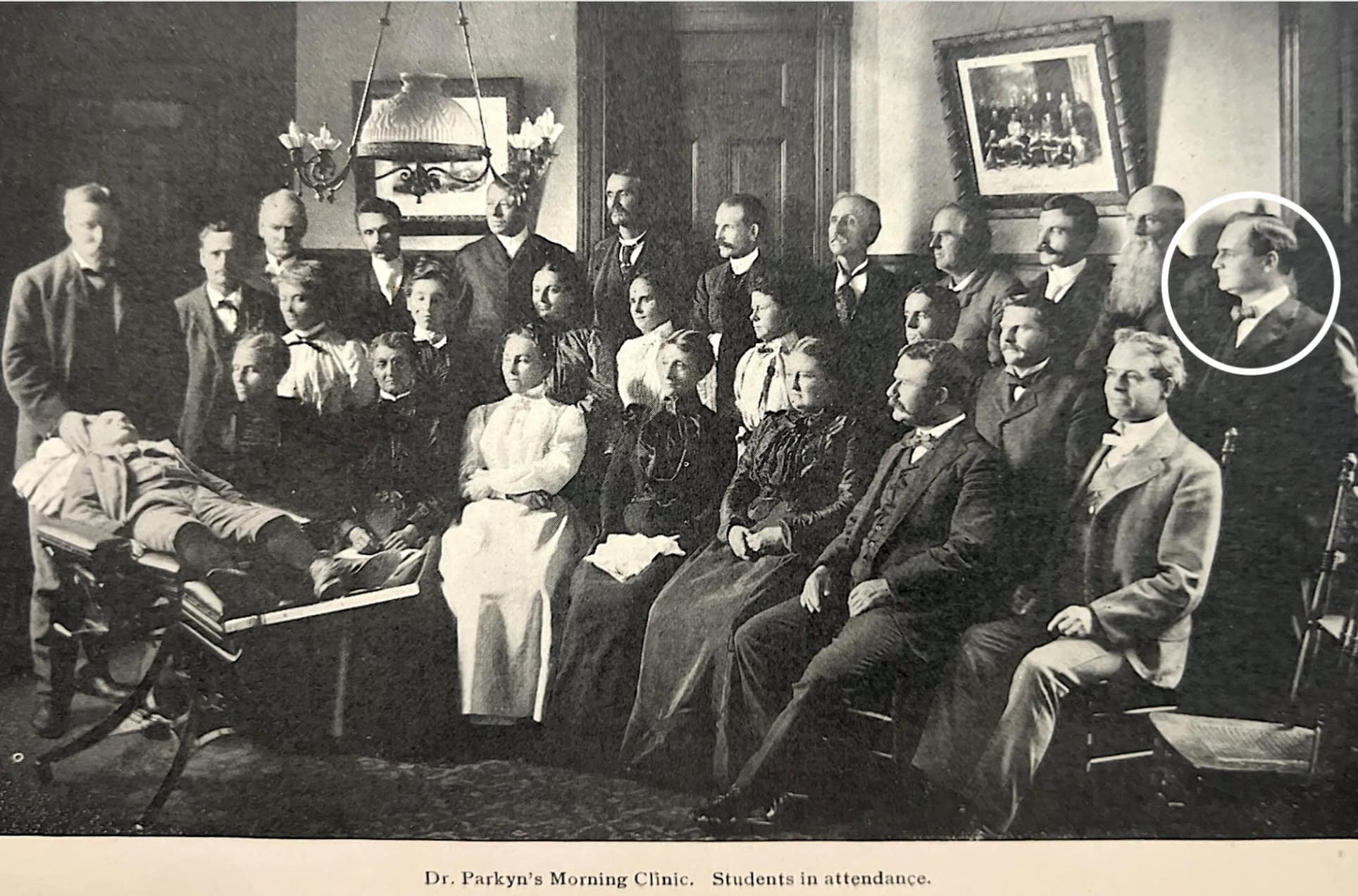
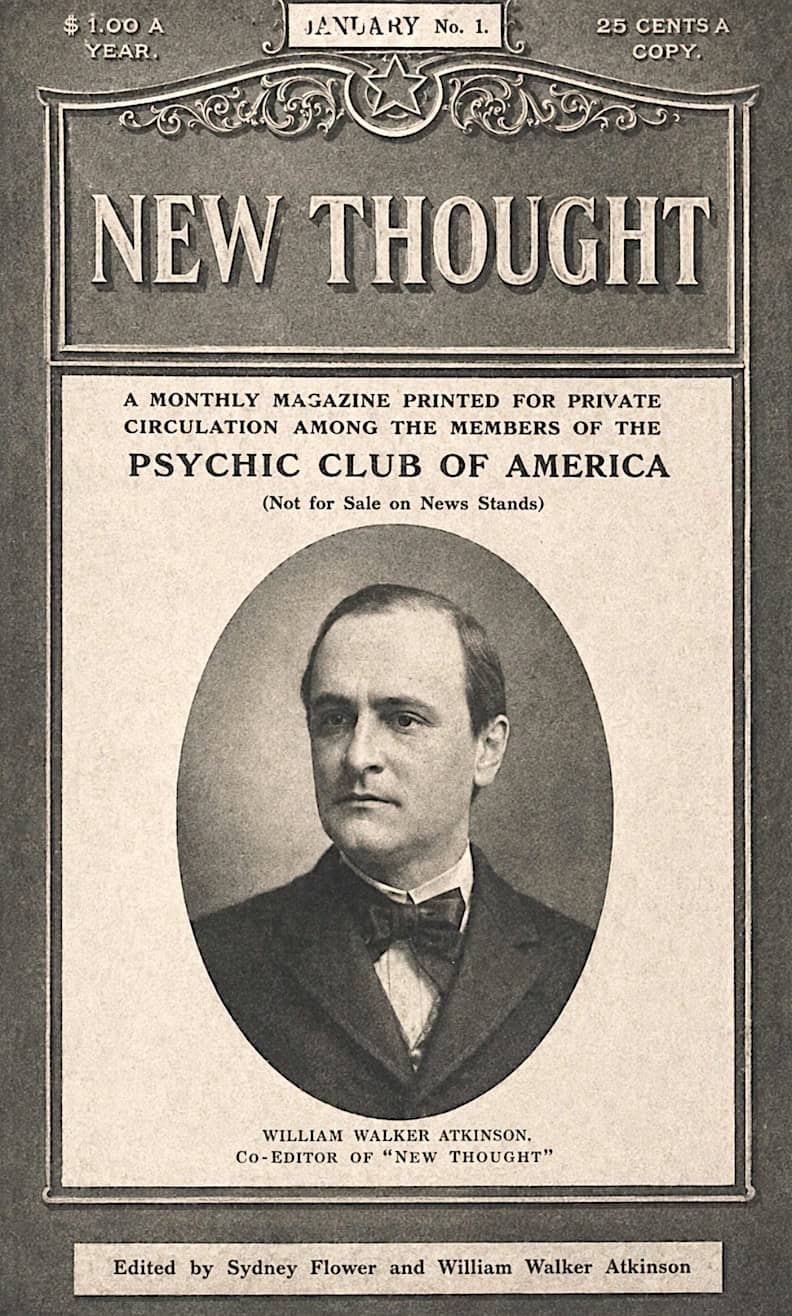
Atkinson was Parkyn's protégé, helping edit Suggestion and New Thought magazines before becoming one of the most influential New Thought authors of his generation.
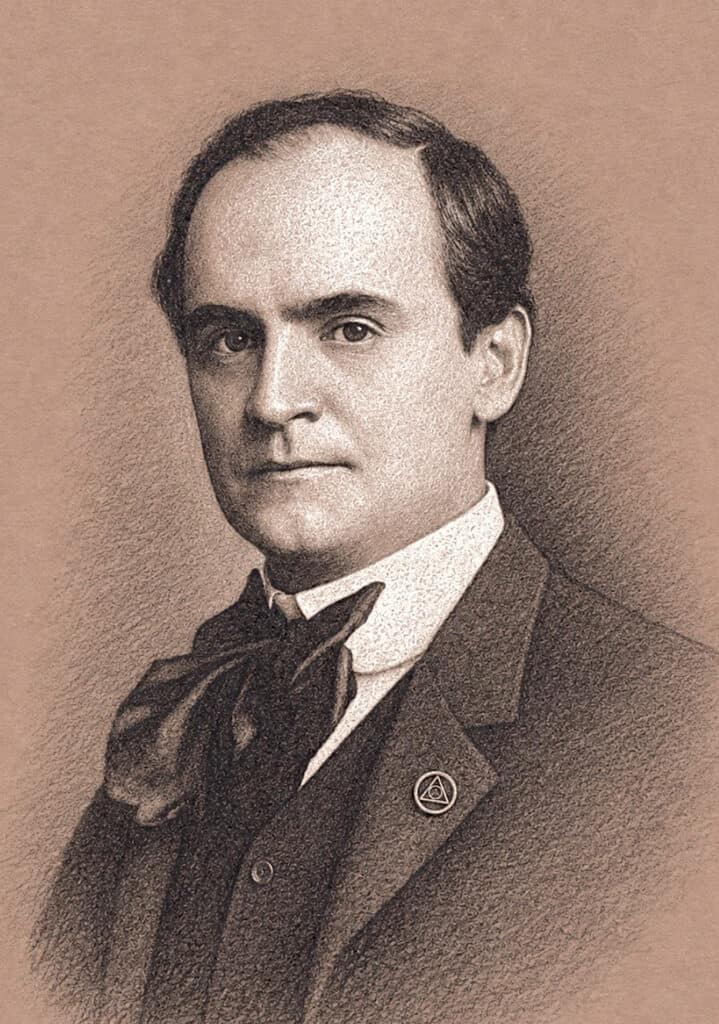
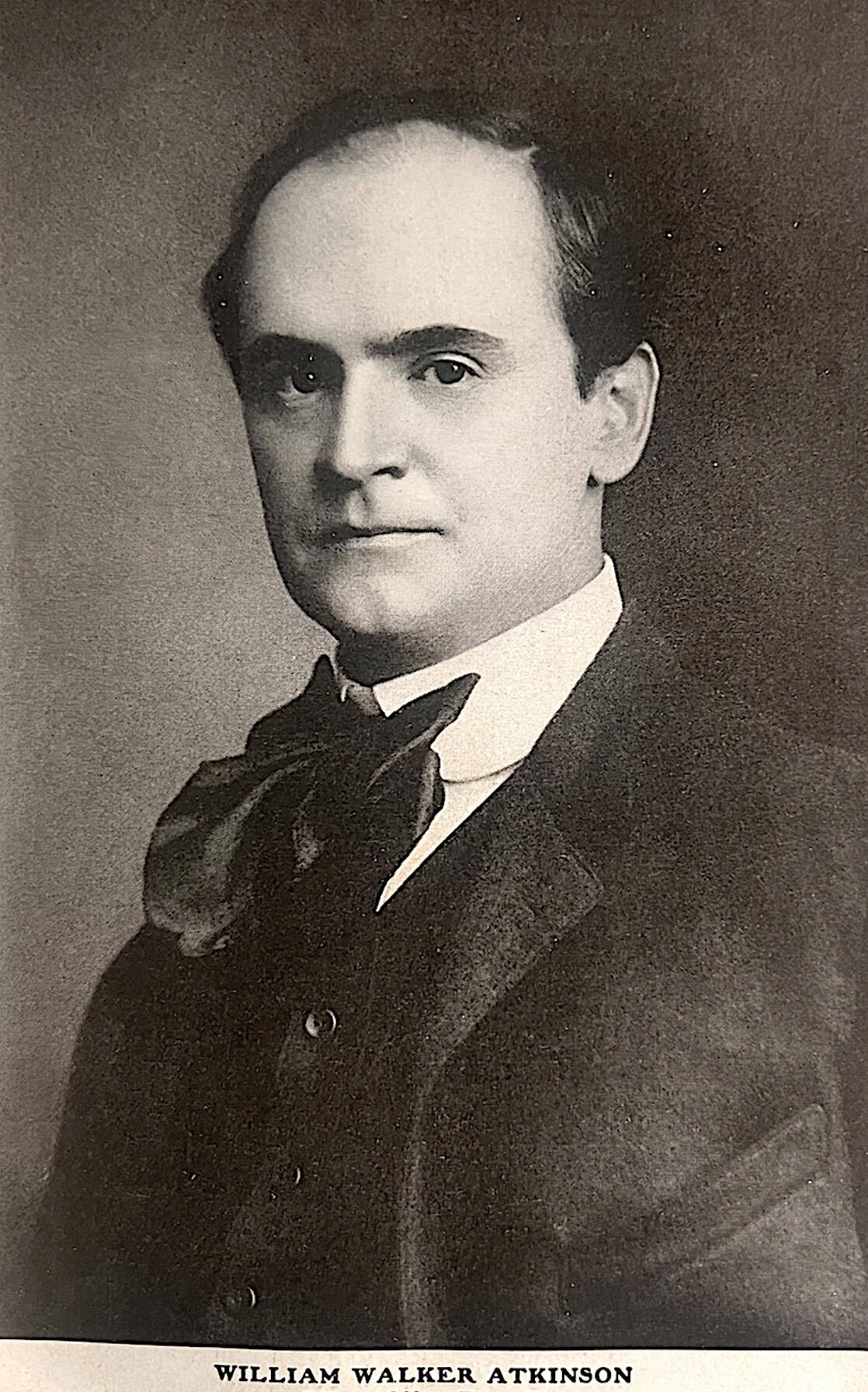
William Walker Atkinson was an American attorney, editor, psychic researcher, and arguably the most prolific and influential author of the New Thought movement. Best known for his writings on mental science, practical psychology, personal development, and Eastern philosophy, he authored dozens of books under his own name and contributed to numerous pseudonyms, including Yogi Ramacharaka, Theron Q. Dumont, Swami Bhakta Vishita, and others.
William Walker Atkinson
Atkinson was also hugely influential in the editorship of several magazines that shaped the New Thought movement. Those included Suggestion, The Journal of Magnetism, New Thought, The Segnogram, The Mystic, The Progress Magazine, and Advanced Thought.
**This biography provides a general overview of Atkinson’s life and career. Many aspects of his involvement with Dr. Herbert A. Parkyn, the Chicago School of Psychology, Suggestion & New Thought magazines, the Yogi Publication Society, and the development of the New Thought movement are explored in much greater detail in the related research articles.**
Atkinson was born on December 5, 1862, in Baltimore, Maryland, to William C. Atkinson and Emma L. Mittnacht. He was educated in the Baltimore public schools and entered the workforce at an early age. Rather than pursuing a university education, Atkinson began a career in his family’s grocery and merchandising business. On October 31, 1889, he married Margaret Foster Black in Delanco, New Jersey. The couple had two children, with one dying very young.
Career as an Attorney
Atkinson’s interests gradually shifted toward the legal profession. He studied law while continuing to work and was admitted to the Pennsylvania Bar in 1894. His practice focused primarily on commercial law, including debt collection, creditor litigation, foreclosures, and property execution cases. By all outward appearances, his career was progressing well. Yet a series of professional setbacks would dramatically affect his life and mental health.
Mental Breakdown
In 1899, Atkinson relocated to a neighboring county in hopes of expanding his legal opportunities. The move proved disastrous. When he later attempted to resume practice with his former partner, the local bar association ruled that he would first have to satisfy a six-month residency requirement and submit to a new examination. Atkinson strongly objected, maintaining that he had never legally surrendered his standing. After his appeal was denied, he dissolved his practice and partnership altogether.
The loss of his law practice left him discouraged and without a clear direction. Seeking financial stability, he moved his wife and child into his brother-in-law’s Philadelphia home and accepted a position as regional manager for the North American Mercantile Agency. Despite the new employment, Atkinson later claimed that his mental condition continued to deteriorate until he suffered a complete nervous breakdown and a severe case of what physicians of the period called “nervous prostration.”
Atkinson Disappears for Six Weeks with No Word to His Family
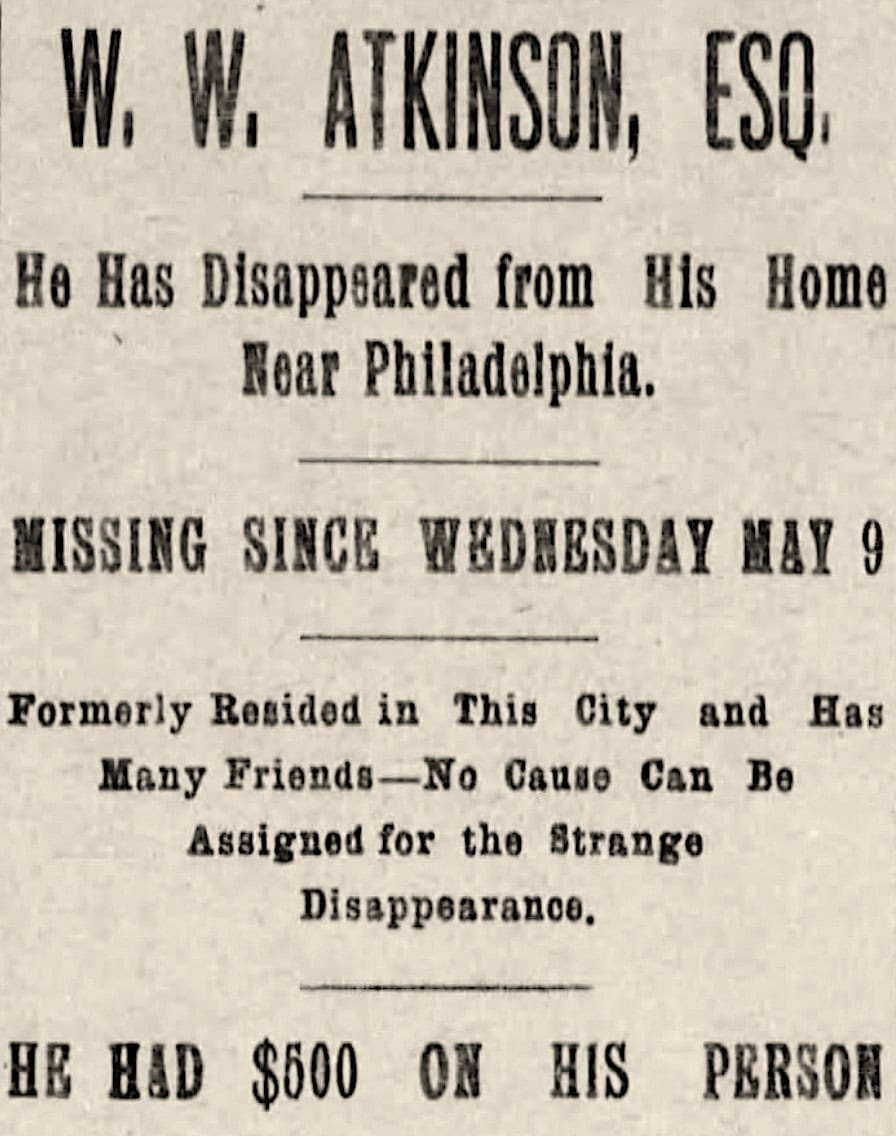
On May 9, 1900, Atkinson suddenly disappeared without explanation, leaving his office carrying several law books and about $500 in cash. When he failed to return home, his wife reported him missing, prompting a widespread police search and newspaper coverage throughout the Northeast. Friends, family, and business associates searched for weeks, but no credible leads emerged.
Atkinson Turns Up in New York
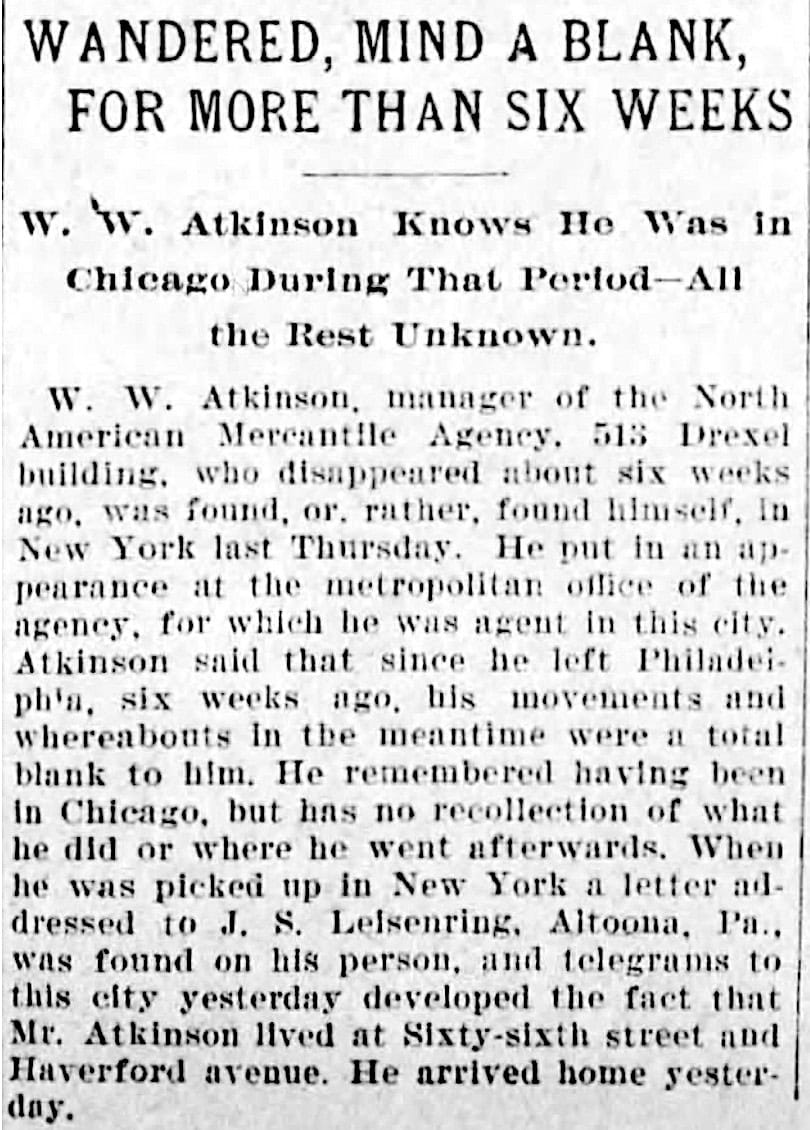
After six weeks with no word, Atkinson suddenly reappeared. On June 21, 1900, he walked into the New York office of the North American Mercantile Agency, claiming that he was lost but knew that he worked for the company. A letter addressed to his former law partner, J. S. Leisenring, was found in his possession, which helped establish his identity. When later questioned about his whereabouts, Atkinson claimed to have little memory of the preceding month and a half, except for a vague impression that he had been in Chicago, but offered no explanation of how he had traveled there or what he had done during his absence. Making the story even stranger, he soon moved his wife and child to Chicago and established himself there permanently, despite supposedly remembering almost nothing about his time in the city.
William Walker Atkinson disappears, Altoona Tribune 1900William Walker Atkinson located, The Philadelphia Times
Atkinson is Cured by Dr. Herbert A. Parkyn
It is now known that Atkinson traveled to Chicago during his disappearance to seek treatment from Dr. Parkyn, who was nationally recognized as the leading physician in the treatment of nervous prostration through Suggestive Therapeutics. Atkinson was not only cured but was so profoundly transformed by the experience that he decided to devote his life to studying the Law of Suggestion and sharing it with the world. This was also Dr. Parkyn’s mission, and upon returning to his family, Atkinson quickly gathered them and moved to Chicago to enroll in the July class at Parkyn’s Chicago School of Psychology.
After relocating to Chicago with his family in the summer of 1900, Atkinson devoted himself to the study of Dr. Parkyn’s system of Suggestive Therapeutics. While Atkinson had no previous knowledge of the New Thought movement, it has been claimed that he had been interested in the occult as a layperson. During the months that followed, he became closely aligned with Parkyn’s mission to establish Suggestion as a legitimate therapeutic science that could transform society.
Atkinson Becomes the Main Lecturer at Parkyn’s University of Psychic Science
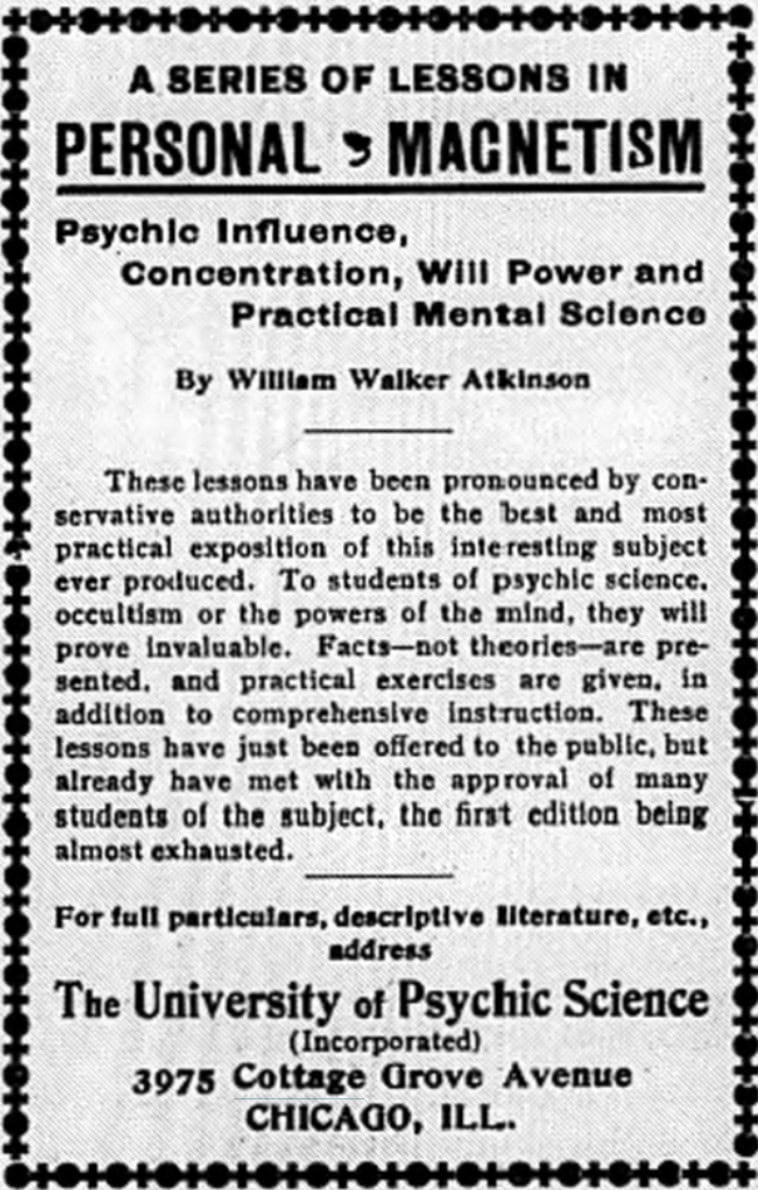
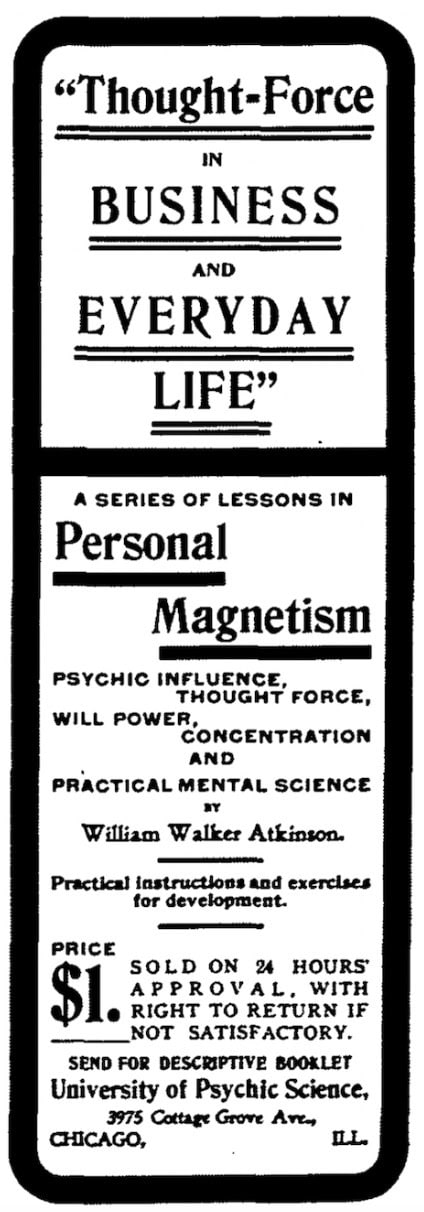
In the fall of 1900, Atkinson was appointed to lecture at the University of Psychic Science on Parkyn’s system, presenting its principles through subjects such as self-culture, thought-force, concentration, will-power, and psychic phenomena. These lectures gave Parkyn an opportunity to develop Atkinson as both a lecturer and writer while adapting the Law of Suggestion for audiences increasingly interested in New Thought. The material that Parkyn and Atkinson developed for these lectures would later be combined into one of Atkinson’s most successful books, A Series of Lessons in Personal Magnetism, Psychic Influence, Thought-Force, Concentration, Will-Power and Practical Mental Science. The ideas in this series and the following book created the foundation for the teachings and methods that would define Atkinson’s writing career and were the key to his rise to prominence within the New Thought movement. It was published by Parkyn, who would shortly later change the name to Thought=Force in Business and Everyday Life.
Drawing heavily upon Parkyn’s Mail Course: in Suggestive Therapeutics and Hypnosis, and the educational resources of his Mail Course Exchange Company, Atkinson combined the scientific principles of suggestion with concentration, affirmation, visualization, self-culture, and personal magnetism. He proved ideally suited to translate Parkyn’s clinical teachings into the practical style that appealed to New Thought readers, laying the foundation for much of his later work.
Atkinson writes for Suggestion and becomes associate editor
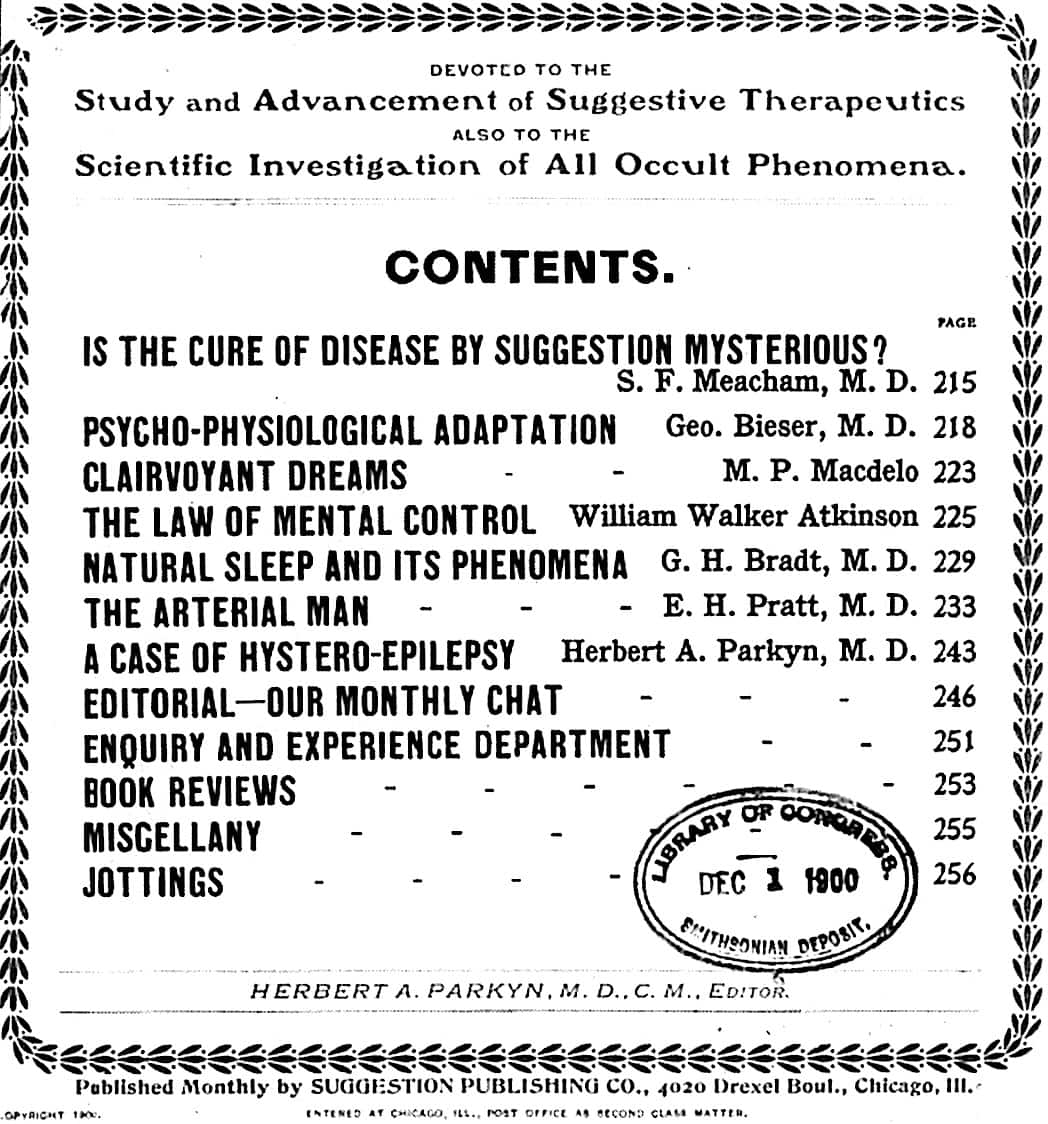
By the end of 1900, Parkyn and Atkinson had refined the lectures developed at the University of Psychic Science into a practical system that blended the Law of Suggestion with self-development and selected New Thought concepts. With the lecture series completed and prepared for publication, Parkyn introduced Atkinson as a writer in Suggestion magazine and appointed him associate editor.
In December 1900, Atkinson published his first credited New Thought article, “The Law of Mental Control,” the first of a four-part series that also included “The Functions of the Mind,” “The Real Self,” “Character Building by Mental Control,” and “I Can and I Will.” These articles introduced readers to the practical application of the Law of Suggestion and marked the beginning of Atkinson’s career as one of the New Thought movement’s most influential authors.
New Thought Magazine
In late 1901, Atkinson joined Sydney B. Flower in publishing New Thought magazine, serving as editor and its principal writer. Succeeding The Journal of Magnetism, it quickly became one of the leading publications of the New Thought movement. Atkinson became the magazine’s primary voice, continuing to develop the principles of the Law of Suggestion through articles on thought-force, concentration, personal magnetism, practical psychology, and success. Many of his earlier articles from Suggestion magazine were republished, while new material translated Parkyn’s teachings into the distinctive style of New Thought philosophy that they had cultivated. Much of Atkinson’s writing also emphasized New Thought as a practical way of life centered on Parkyn’s guiding principle that “thought takes form in action.” During this period, Thought = Force in Business and Everyday Life became the magazine’s principal promotional publication and was widely distributed to attract new readers.
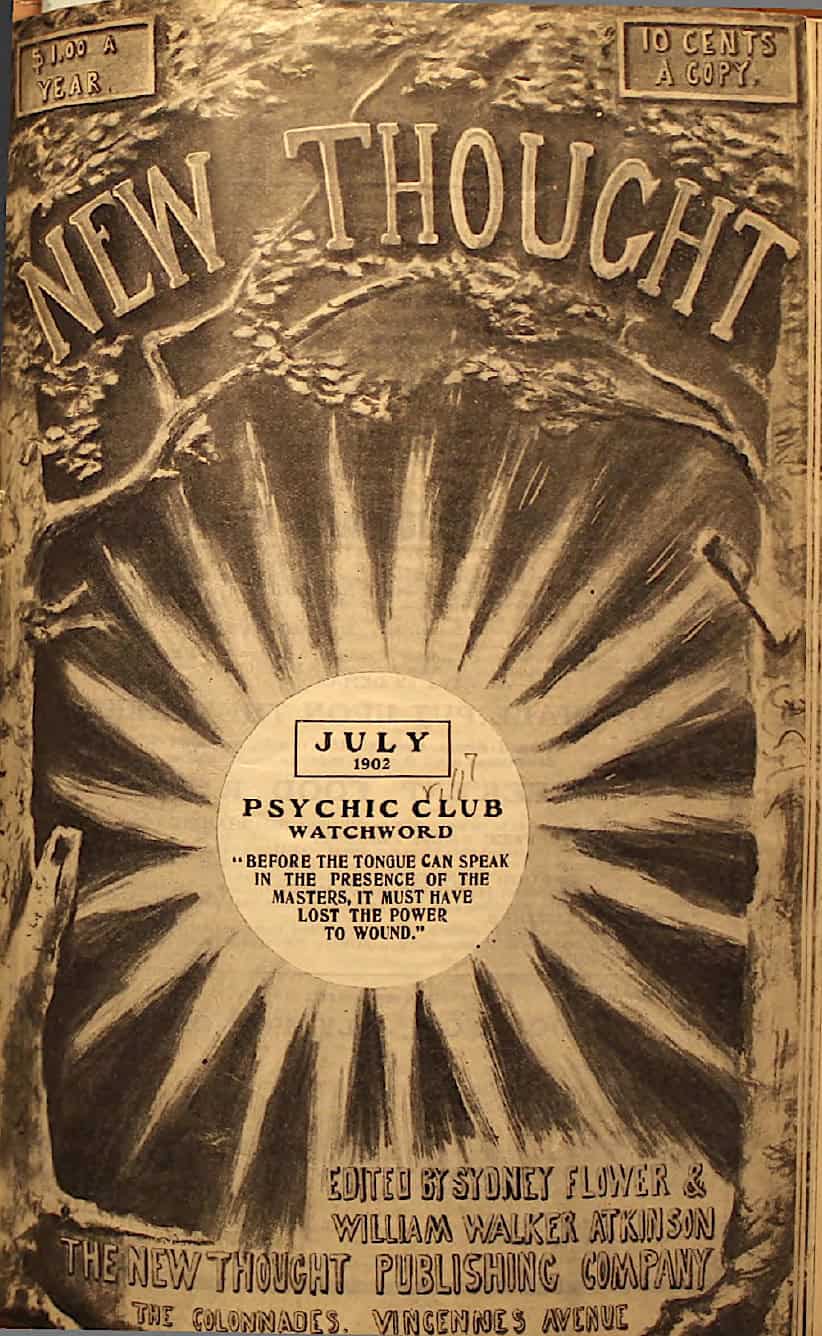
The first issue of New Thought, January 1902 and the redesigned cover July 1902
In late 1902, Ella Wheeler Wilcox joined New Thought magazine as co-editor alongside Atkinson, while Sydney B. Flower devoted increasing attention to the magazine’s growing business ventures, which ended up leading to a postal investigation of New Thought in 1904. In 1905, Atkinson stepped down as editor of the magazine, but remained a contributor for many years.
Yogi Publication Society
In 1903, Atkinson was part of Dr. Herbert A. Parkyn‘s network that collaborated in establishing the Yogi Publication Society, a publishing house devoted to books and correspondence courses on yogic philosophy and Eastern thought. Operating from Parkyn’s offices at 4000 Cottage Grove Avenue, the Society introduced New Thought readers to the teachings of Hinduism, particularly Vedanta and Yoga, interpreting them through the principles of the Law of Suggestion and mental science. While Atkinson served as the principal for the Yogi Publication Society and later conducted lecture tours billed as Yogi Ramacharaka, Parkyn and several others contributed to the works under the pseudonym.
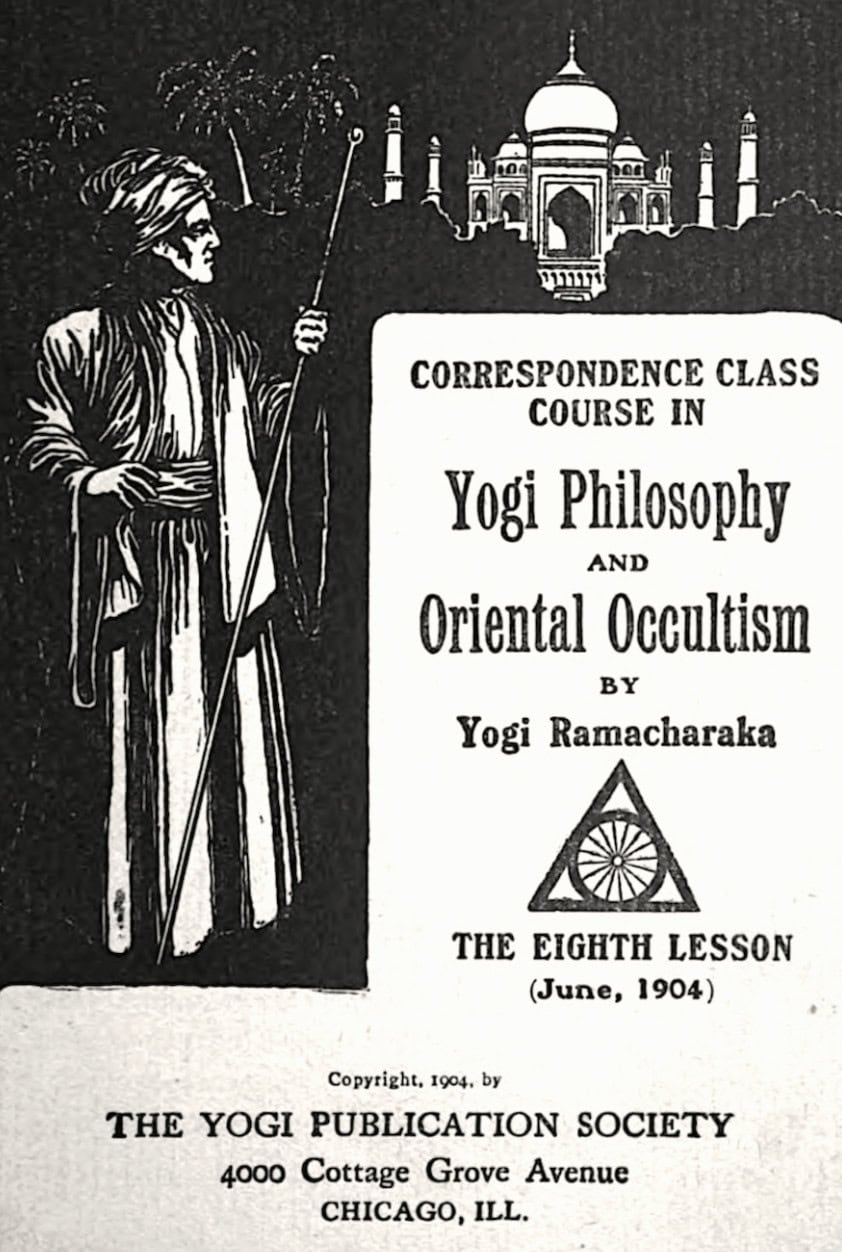
Yogi Philosophy course by the Yogi Publication Society, 1904
The Yogi Publication Society changes directions
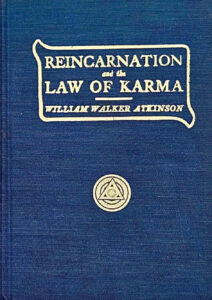
In 1908, the Yogi Publication Society released the final Yogi Ramacharaka book, The Religions and Philosophies of India. That same year, they also published Reincarnation and the Law of Karma, the first Yogi Publication book credited directly to William Walker Atkinson, and also The Kybalion, a work on Hermetic philosophy attributed to the anonymous authorship of the “Three Initiates.” This marked a deliberate shift toward Rosicrucian-style Hermetic philosophy, presenting it, like Eastern philosophy, as another tradition founded upon the Law of Suggestion. To support this new direction, new publishing imprints were established, including The Arcane Book Concern and the Advanced Thought Publishing Company.
In 1909, management of the Yogi Publication Society was handed to Olive Bedwell, a longtime secretary who had worked with them since 1900. Bedwell maintained the imprint’s operations and expanded its offerings while keeping the core Ramacharaka catalog in steady circulation. Thanks to Bedwell’s consistent oversight, the Yogi Publication Society remained in business and eventually became the primary publisher for much of Atkinson’s back catalog as well as other New Thought titles, continuing into the present day.
Pseudonyms and Anonymous Authorship
One of the defining features of William Walker Atkinson’s career was his association with a remarkable number of pseudonymous and anonymous publications. As Dr. Herbert A. Parkyn’s chief literary representative, Atkinson became the central public figure connected with many of the publishing network’s best-known series, including those issued under names such as Yogi Ramacharaka, Swami Bhakta Vishita, Swami Panchadasi, Magus Incognito, and Theron Q. Dumont.
The use of pseudonyms was an established practice within esoteric publishing, but it also reflected Dr. Parkyn’s teaching on “masked suggestion.” Rather than presenting ideas through ordinary authors, the books were attributed to symbolic figures such as an Indian yogi, a French psychologist, or anonymous initiates of an ancient Hermetic tradition. These literary identities allowed the same underlying principles to be presented to different audiences while encouraging readers to approach the material with fewer preconceived objections.
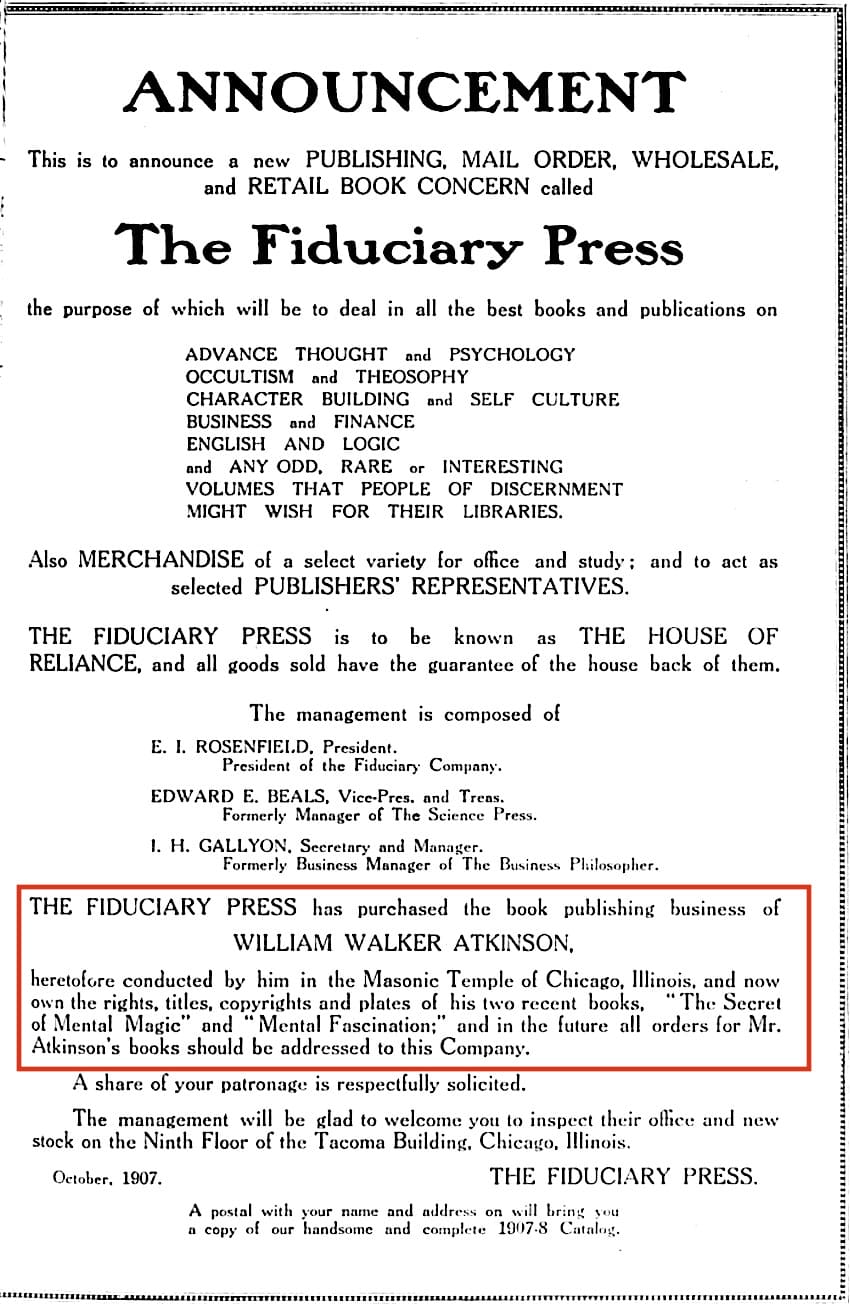
Unlike many of his collaborators, Atkinson never sought prominence as a lecturer, businessman, or promoter. Throughout his life he struggled with recurring attacks of nervous prostration and found the pressures of business management difficult to sustain. Reserved by nature, he preferred working quietly from private offices, devoting his time to research and writing rather than public appearances. When periods of intense stress arose, he frequently withdrew from public life altogether. This pattern can be seen in 1907, when he sold his William Walker Atkinson publishing imprint to Edward E. Beals’ Fiduciary Press and returned to Palmyra, New Jersey. During this period, he appears to have also transferred the rights to The Law of Financial Success, which was published under Beals’ name despite later being listed by Atkinson in his Who’s Who profile among his own works. It was probably co-written by Atkinson as he and Beals would collaborate on the twelve-volume PersonalPower Book series in 1922.
Edward E. Beals was a former student of Parkyn’s at the Chicago School and was also part of the Science Press that published Parkyn’s book Auto-Suggestion in 1905. Beals would work closely with Atkinson and help manage the brand. In 1909, they joined with fellow students of Parkyn’s system of Suggestion, Christian D. Larson and Dr. William C. Van Valen, in the formation of The Progress Company.
Who’s Who in Americaand in Occultism
Although Atkinson attempted to manage a school and publishing ventures, including Advanced Thought magazine and the Advanced Thought Publishing Company, he ultimately was not up to it and others such as Arthur Gould had to run the operations. His greatest strength was never the administration of publishing companies but the continuous production of books and magazine articles. For this reason, maintaining his reputation as a prolific author became central to his career. His self-profile entries in Who’s Who in America evolved alongside that strategy. Works published under his own name were listed almost immediately, while many pseudonymous and anonymous series were left unattributed until years later, after the fictional identities had become famous. The Yogi Ramacharaka books, for example, were not claimed until 1909, six years after the series began, while The Kybalion and the Arcane Teaching series did not appear until 1913, five years after they were published.
Although Atkinson claimed these books as his own in his Who’s Who self-profiles, the publishing network was far more collaborative than those listings suggest, but by attaching his own name to these anonymous and pseudonymous works, Atkinson protected future claims of authorship and attempts by others to publish under the now-famous names.
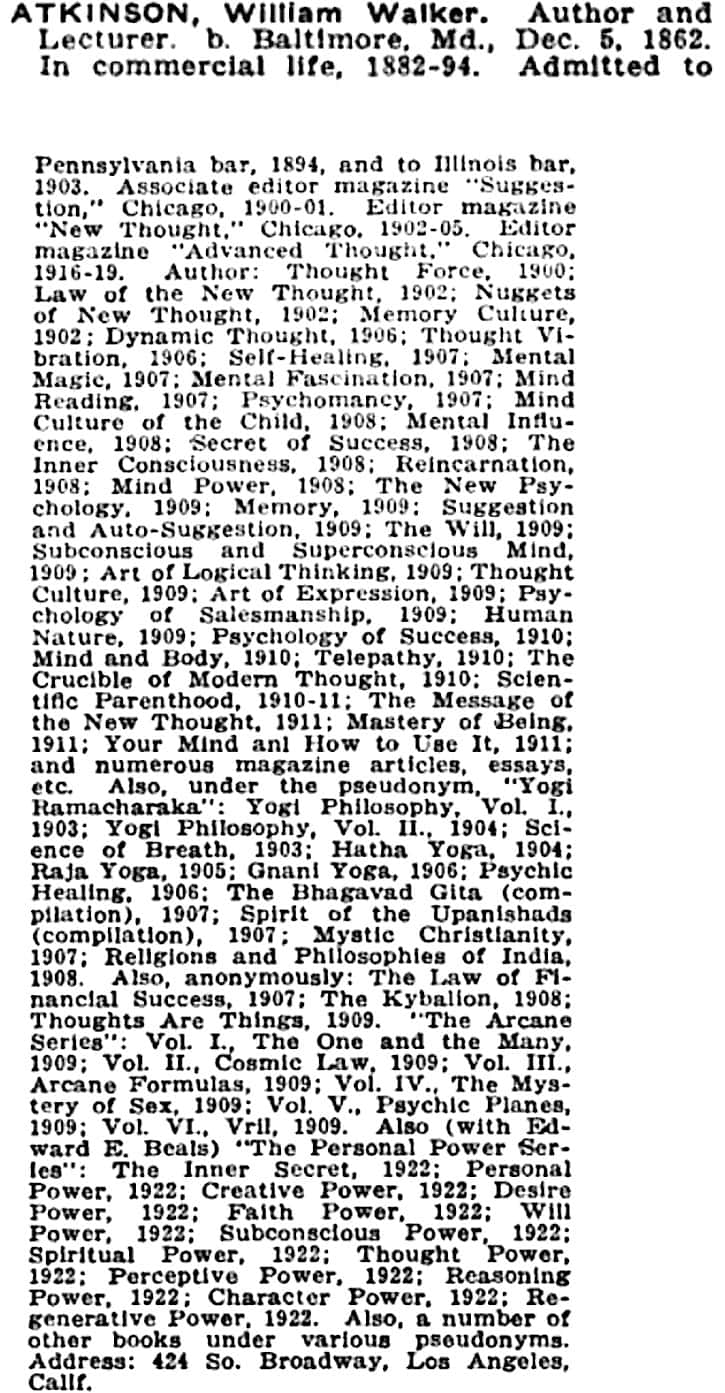
Below is Atkinson’s final Who’s Who self-profile from 1927. (These profiles were created from information submitted by the authors themselves)
Who’s Whoin Occultism profile of William Walker Atkinson 1927
The strategy to flood the New Thought market with successive book series on the Law of Suggestion
Since 1900, Parkyn’s network pursued a deliberate plan to saturate the emerging New Thought book market with a steady succession of publications covering a wide range of related subjects, all unified under the central principles and doctrines of the Law of Suggestion. The authors behind these series were closely connected, often using the same recurring phrases such as Parkyn’s “Thought takes form in action,” “New Psychology,” “Happiness, Health, and Success,” and “Poise and Power.” Their works covered similar subjects and centered on the core principles of right living and right thinking. Many of the books across the different series were able to be produced quickly by repurposing decades old material on topics such as memory training, fascination, concentration, etiquette, personal magnetism, mesmerism, or astrology, and then integrating the teachings of the Law of Suggestion into them. Atkinson, serving as Dr. Parkyn’s chief representative, provided the central link among the authors in the publishing networks and collaborated with many of them.
TheWilliam Walker Atkinson series – 1901 – 19011
Atkinson became involved shortly after the Psychic Research Company series of 1900. This was the first effort to flood the market with volumes on many topics such as Hypnotism, Clairvoyance, Mind Reading, Palmistry, Astrology, Suggestive Therapeutics, and Phrenology. Many of the titles were published anonymously or under pseudonyms and were distributed for free through marketing campaigns or sold at low cost. While the topics spanned a wide range of occult, divination, and mental science subjects, the central theme ultimately drew readers to the Law of Suggestion.
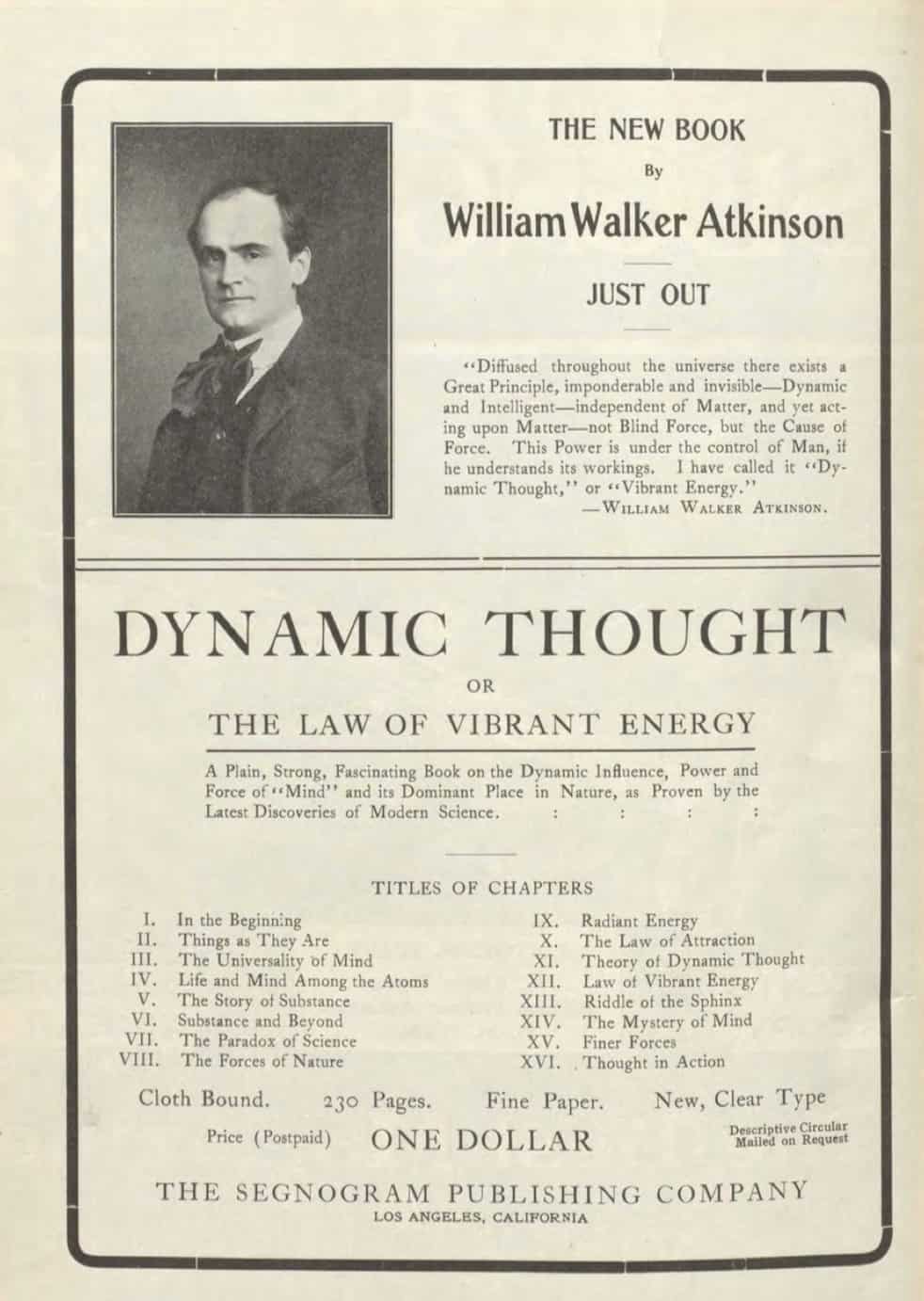
After the creation of Atkinsonia through Parkyn’s Suggestion magazine, a new wave of works, under the authorship of Atkinson, began in 1901 with Thought=Force in Business and Everyday Life. This was followed by titles that directly addressed New Thought philosophy, such as The Law of the New Thought (1902) and Nuggets of New Thought (1902) and continued over the next two decades with numerous titles, including Memory Culture (1902), Dynamic Thought (1906), Thought-Vibration (1906), Self Healing by Thought Force (1906), Mental Magic (1907), Mental Fascination (1907), Mind Culture of the Child (1908), Secret of Success (1908), The Inner Consciousness (1908), Reincarnationand the Law of Karma (1908), Mind Power (1908), Telepathy(1910), Scientific Parenthood (1910–11), The Message of the New Thought (1911), Mastery of Being (1911), Your Mind and How to Use It (1911), and many related articles in Suggestion, New Thought, and The Nautilus.
The Yogi Ramacharaka series – 1903 – 1908
The Yogi Publication Society was established in 1903 to issue a series of lessons and books on Yogic philosophy under the pseudonym Yogi Ramacharaka. These works presented Hindu teachings through the interpretive framework of the Law of Suggestion, illustrating Suggestion as the underlying principle within the Yogic system. The series included Yogi Philosophy, Vol. I (1903), Science of Breath (1903), Yogi Philosophy, Vol. II (1904), Hatha Yoga (1904), Raja Yoga (1905), Gnani Yoga (1906), Psychic Healing (1906), The Bhagavad Gita (compilation, 1907), The Upanishads (compilation, 1907), Mystic Christianity (1907), and Religions and Philosophies of India (1908). In later years, the Yogi Publication Society expanded its catalog to include volumes on Hermetic philosophy and New Psychology.
Yogi Publication Society logo with winged globe. Learn about the sacred geometry of the logo HERE.
The Nut-Shell series– 1907
This series was published by both Edward E. Beals’ The Fiduciary Company and The Lyal Book Concern. The first editions appeared anonymously through The Lyal Book Concern, which operated from the Drexel Building in Philadelphia, where Atkinson worked before his 1900 mental breakdown. They were then released by The Fiduciary Company, which had bought the books and rights to the name “William Walker Atkinson.” The titles included Practical Mind-Reading (1907), Practical Mental Influence (1907), and Practical Psychomancy and Crystal Gazing (1907).
Beals’ Fiduciary Press purchases the book publishing business of William Walker Atkinson, 1907
The Arcane Teaching series – 1909
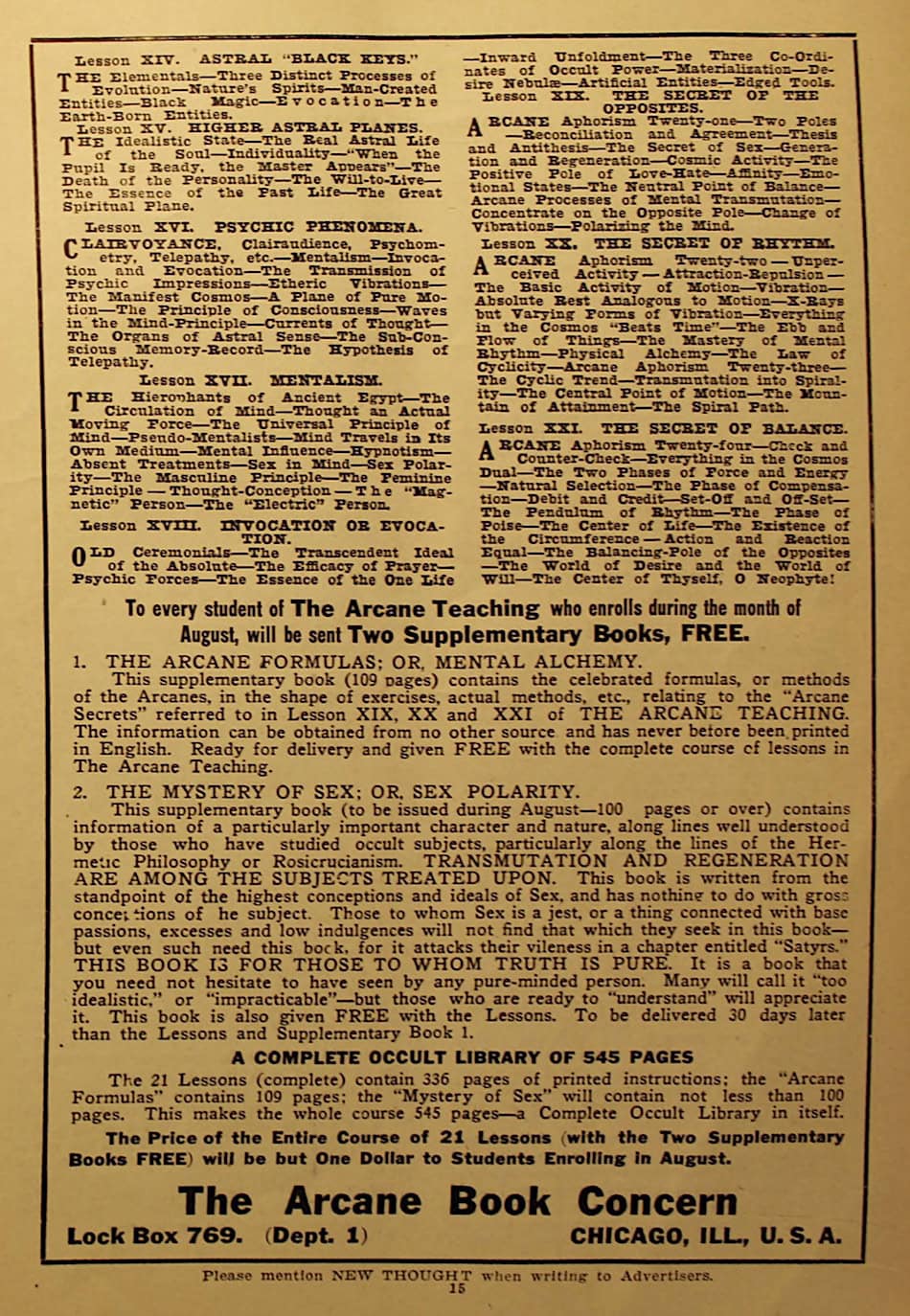
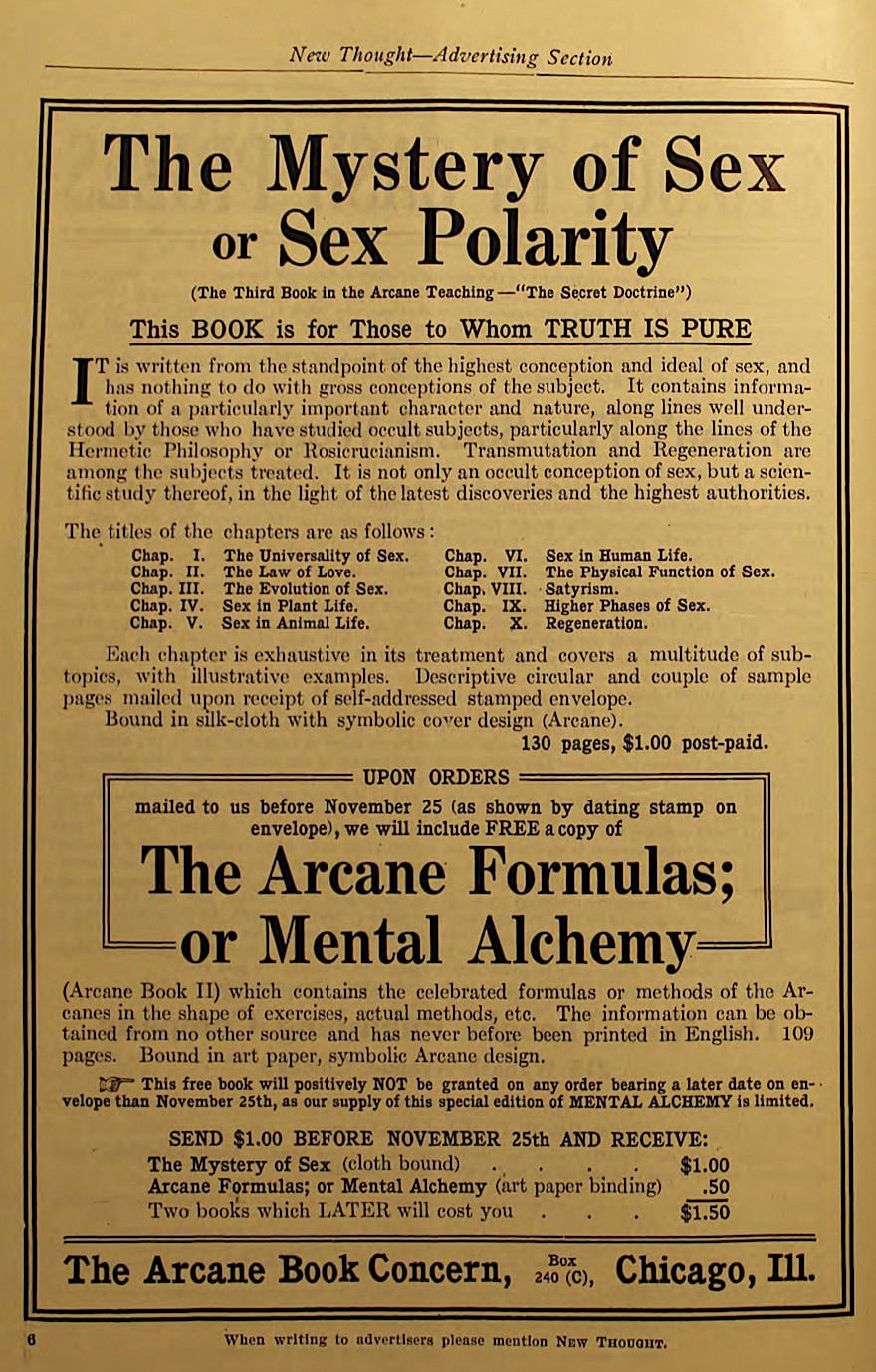
The Arcane Series marked a shift into Hermetic philosophy, emphasizing the foundational role of suggestion within the oldest spiritual and esoteric teachings. This move aligned with an effort to bring Hermetic principles, especially those associated with secret societies like the Rosicrucians, into public view. Intended as a continuation of The Kybalion, which had been released in 1908 by the Yogi Publication Society, the Arcane Series was structured as a multi-part course. It included: Vol. I: The One and the Many (1909), Vol. II: Cosmic Law (1909), Vol. III: The Arcane Formulas (1909), Vol. IV: The Mystery of Sex (1909), Vol. V: The Psychic Planes (1909), and Vol. VI: Vril or Vital Force (1909). The series was published anonymously by the Arcane Book Concern.
Ads for the Arcane Teachings Series in New Thought magazine, 1909
Arcane Teaching logo “Om Volos Lex, Ex Uno Disce Omnes”
The Arcane Book Concern adopted this emblem in 1909 as the official symbol of The Arcane Teaching series. Every element of the design represents a central principle of its philosophy.
Ouroboros – The serpent swallowing its own tail symbolizes eternity, unity, and the infinite cycle of existence.
Om – The Absolute; the infinite source from which all existence proceeds.
Volos – The Cosmic Will; the creative power through which the Absolute manifests the universe.
Lex – The Universal Law; the immutable spiritual principle governing all mind, matter, and evolution.
Ex Uno Disce Omnes – “From one, learn all.” The Hermetic principle that by understanding one part of creation, one may discover the laws governing the whole universe. “As Above, So Below”
The emblem expresses the central teaching of the Arcane School: the Absolute (Om) manifests through the Cosmic Will (Volos) according to the Universal Law (Lex), and by understanding this Law within oneself, one may understand the order governing all existence.
The New Psychology series – 1909 – 1910
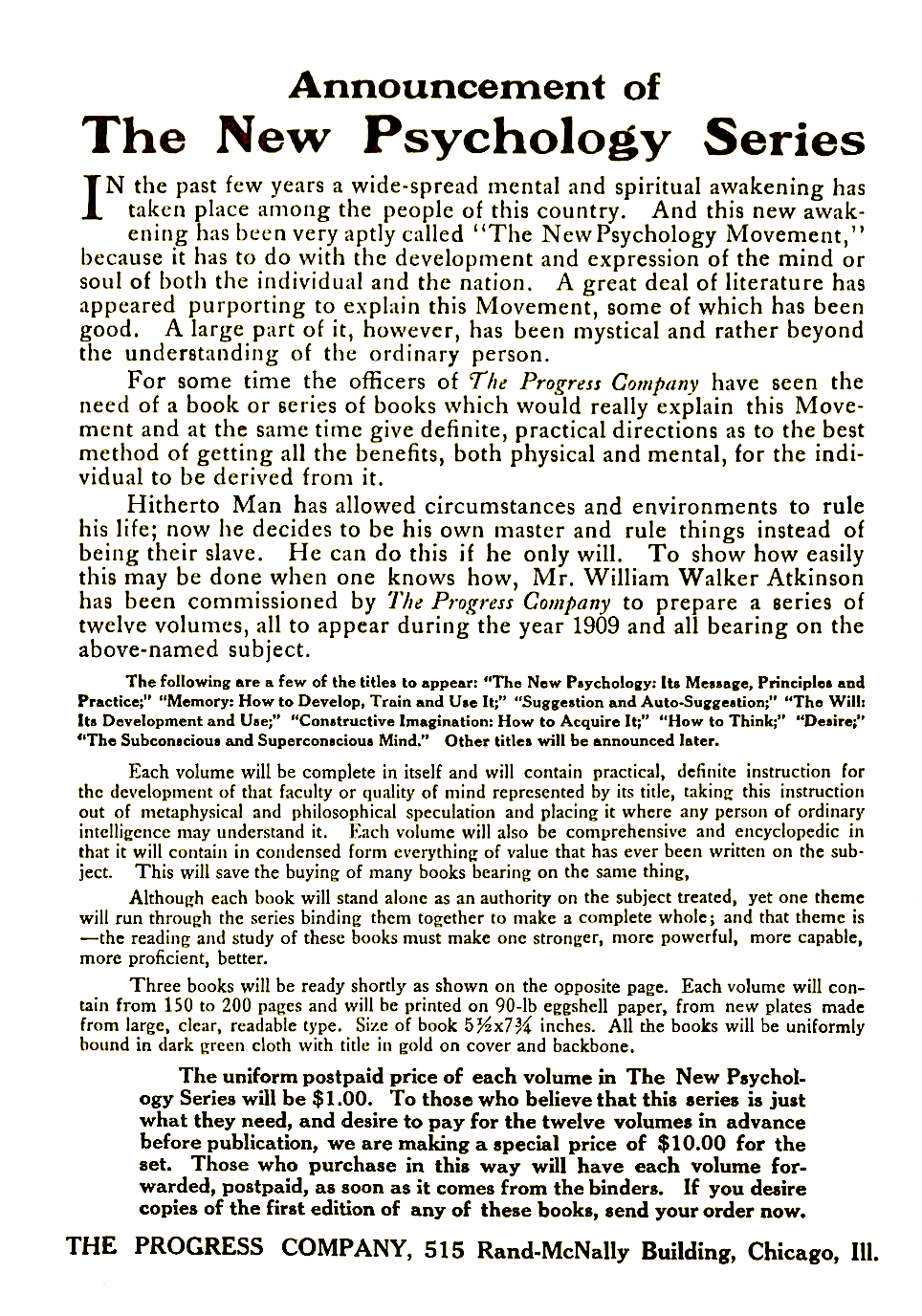
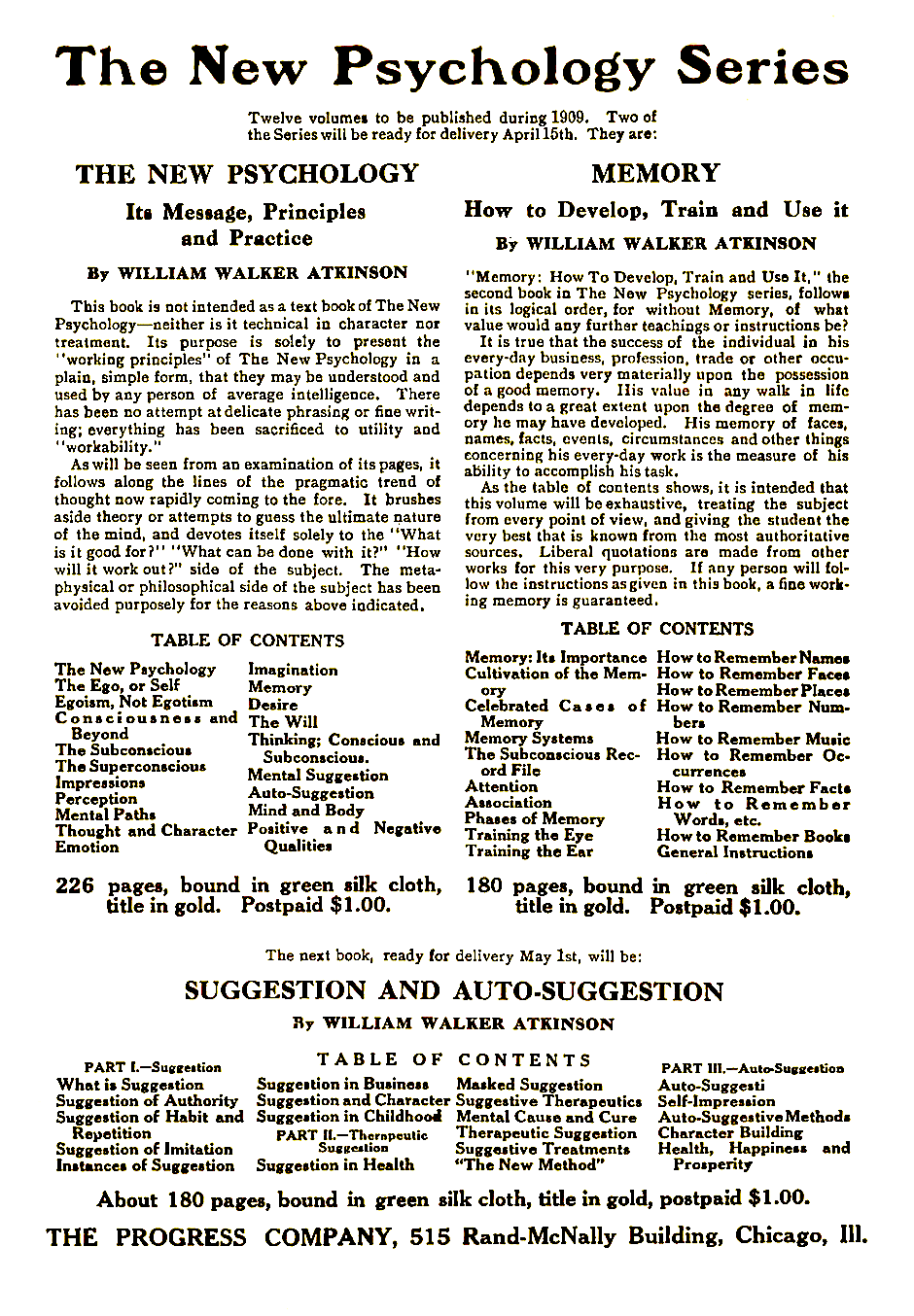
In 1908, Christian D. Larson (President), Edward E. Beals (Manager and Treasurer), and William Walker Atkinson (Vice-President) launched The Cosmic World magazine. In 1909, it merged with Larson’s earlier publication, Eternal Progress, to become The Progress Magazine. That same year, they established The Progress Company, along with Dr. W. C. Van Valen, a student of Dr. Parkyn. The company became one of the largest New Thought publishing houses, with a major headquarters and sanitarium in Chicago. In 1909, it issued The New Psychology Series by Atkinson, including The New Psychology (1909), Memory, How to Develop, Train and Use It (1909), Suggestion and Auto-Suggestion (1909), The Will (1909), Subconscious and Superconscious (1909), Art of Logical Thinking (1909), Thought Culture (1909), Art of Expression (1909), Psychology of Salesmanship (1909), How to Read Human Nature (1909), The Crucible of Modern Thought (1910), and Mindand Body (1910).
Nobody was more responsible for branding the term the “New Psychology” than Parkyn in his Suggestion magazine.
Theron Q Dumont series – 1913 -1920
This series was published by the Atkinson affiliated Advanced Thought Publishing Company between 1913 and 1920. Theron Q. Dumont was not a real person but a pseudonym, presented as a renowned “Instructor on the Art and Science of Personal Magnetism, Paris, France.” The series included: The Master Mind (1913), Culture of Personality: The Art and Science of Personal Magnetism (1913), Advanced Course in Personal Magnetism (1914), Mental Therapeutics (1916), Practical Memory Training (1916), Successful Salesmanship (1917), Character Reading (1918), Power of Concentration (1918), and The Solar Plexus (1920).
The Personal Power Book series – 1922
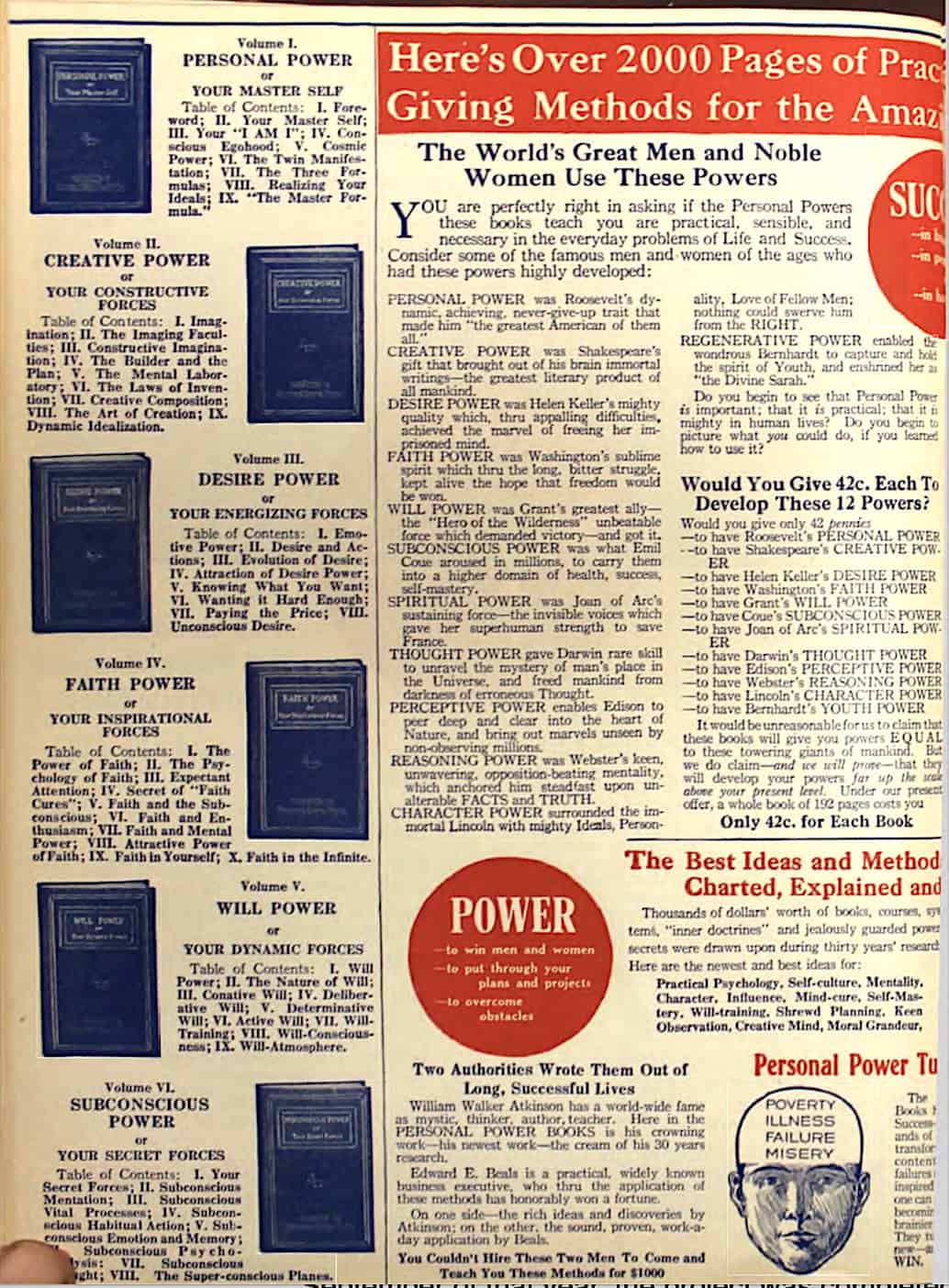
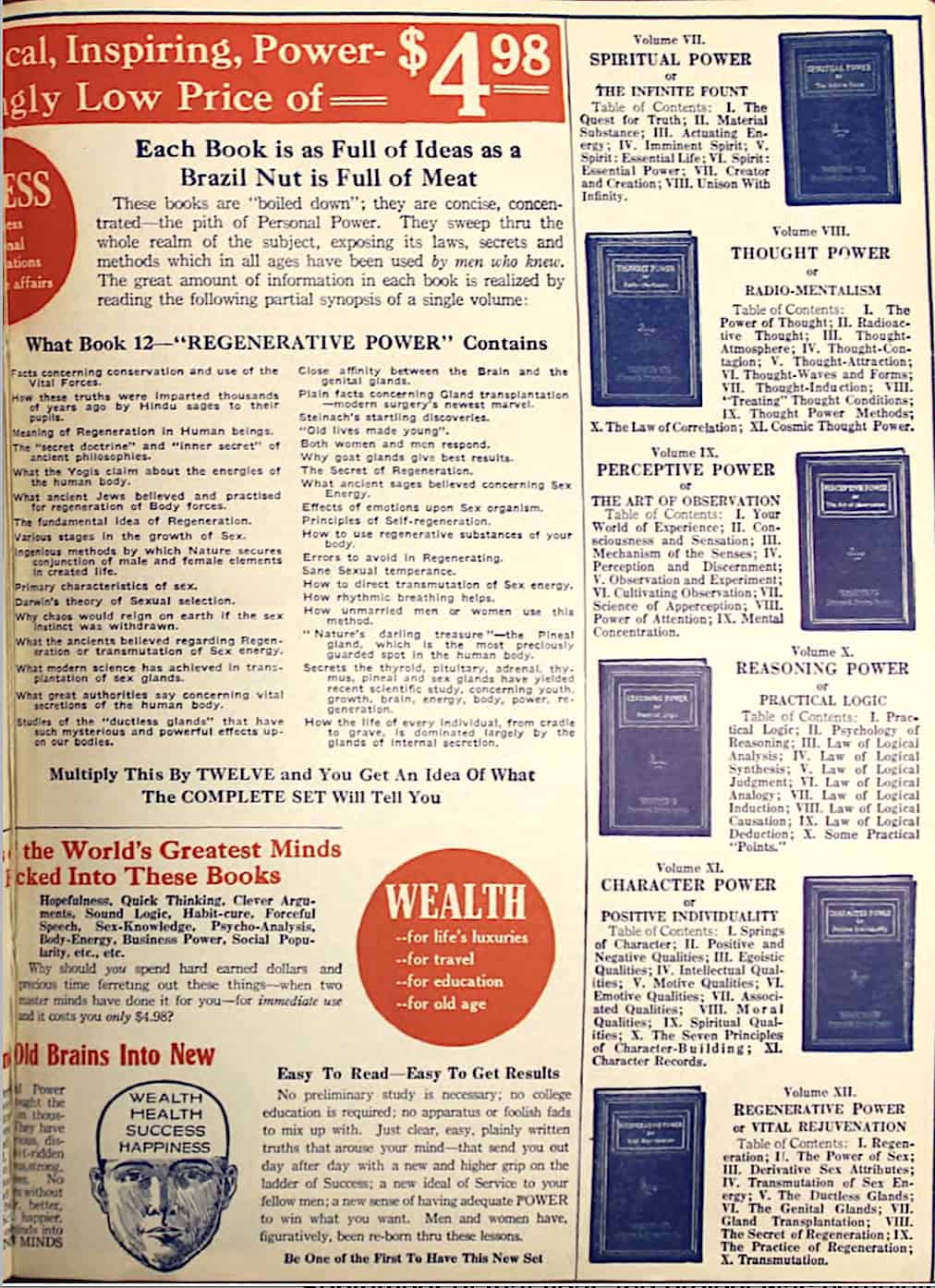
In this series, Atkinson and Edward Beals collaborated once again. This time on a twelve-volume set of self-help books focused on developing personal power for physical, mental, and spiritual goals. The titles in the series were: Personal Power (1922), Creative Power (1922), Desire Power (1922), Subconscious Power (1922), Health Power (1922), Will Power (1922), Spiritual Power (1922), Thought Power (1922), Perceptive Power (1922), Reasoning Power (1922), Character Power (1922), and Regenerative Power (1922)
Part of the large four-page ad for the Personal Power Series
Atkinson goes to Los Angeles to set up Alexander J. McIvor-Tyndall
Atkinson lectures with McIvor-Tyndall in Los Angeles
In late April 1905, Atkinson traveled to Los Angeles to spend several months with Alexander J. McIvor-Tyndall and evaluate his teaching and lectures at the Institute of Psychic Science which Parkyn had funded. Atkinson had served the same role at the University of Psychic Science in Chicago that McIvor-Tyndall was now fulfilling in Los Angeles, which made him well suited to mentor and guide the work of the Institute. McIvor-Tyndall was a world-famous stage mentalists that Parkyn had cured several years before from his severe struggle with cataleptic fits.
Around the same time W. J. Colville also visited the Institute to contribute his teachings to the curriculum. Colville had earlier served as a professor with Dr. Parkyn at Grumbine’s College of Psychical Sciences and Unfoldment, and also ran the Brooklyn School of Suggestive Therapeutics, which was affiliated with Parkyn’s Chicago School.
While in Los Angeles, Atkinson delivered a few lectures alongside McIvor-Tyndall to lend his name and recognition to the Institute and was the guest of honor at the Metaphysical May Festival, where W. J. Colville also appeared. Outside of these events, he kept largely out of the public eye, concentrating on his collaboration with McIvor-Tyndall and his ongoing writing projects. Parkyn was eager to introduce the group to his new star writer for Suggestion, Prof. Edgar L. Larkin, so he arranged for Atkinson and McIvor-Tyndall to visit Larkin’s Mount Lowe Observatory.
The McIvor-Tyndall Institute of Psychic Science featured Parkyn’s most used slogan “Health, Happiness, and Success.”
Atkinson returned to Los Angeles in 1906
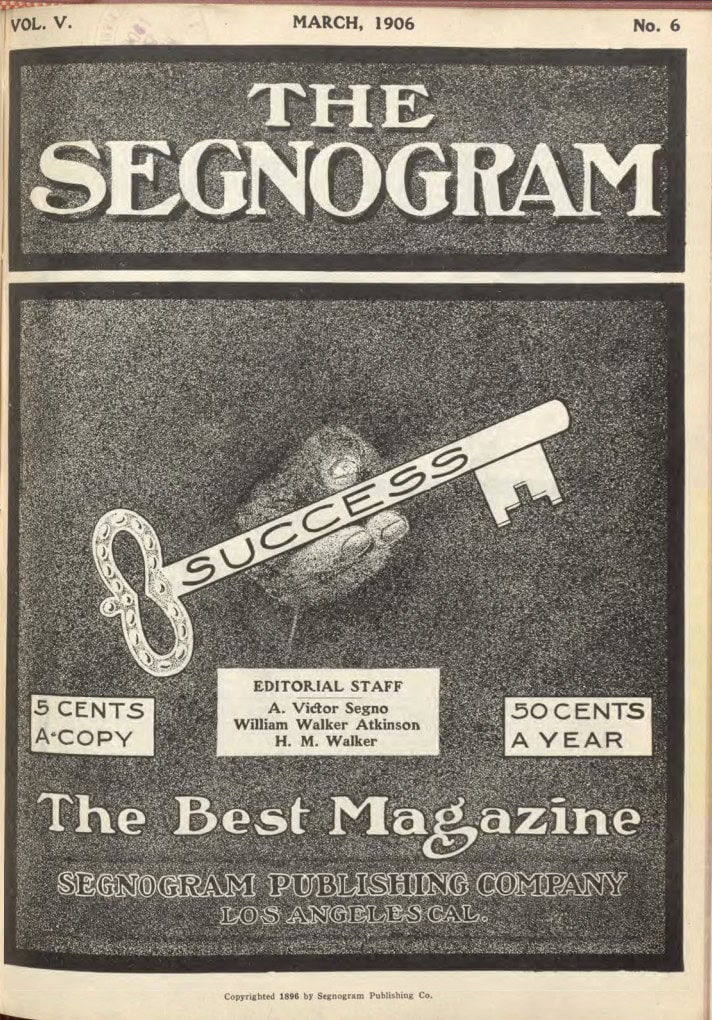
By 1906, Los Angeles was becoming crowded with every sort of new idea arising from the New Thought movement. Parkyn traveled there regularly to help set up his network in the city as the West Coast was becoming the center of the movement. Parkyn decided to send Atkinson back there in March of that year. Atkinson was to work with A. Victor Segno and take charge of editing The Segnogram, a magazine that had been launched in October 1904. Together they concentrated their efforts on building the most influential magazine and publishing house in Los Angeles. Atkinson’s arrival coincided with a major infusion of capital that led to the construction of a massive, Masonic-style headquarters for the enterprise.
A. Victor Segno was also a graduate of the Chicago School of Psychology and Parkyn was the first to publish Segno’s writings in Suggestion magazine.
Atkinson becomes an editor of The Segnogram in March 1906. His book Dynamic Thought is published by it.