Copyright © 2026 D. Parkyn Jackson. Published by the Yogi Publication Society History Project. All rights reserved.
Five years before the founding of the Yogi Publication Society in 1903, Dr. Herbert A. Parkyn had already created a pseudonymous identity through which he could explore Yogi philosophy, telepathy, psychic phenomena, and the occult. In 1898, with the launch of his Suggestion magazine, Parkyn introduced a special department called “The Occult World” and wrote its articles under the pseudonym “Astra.”
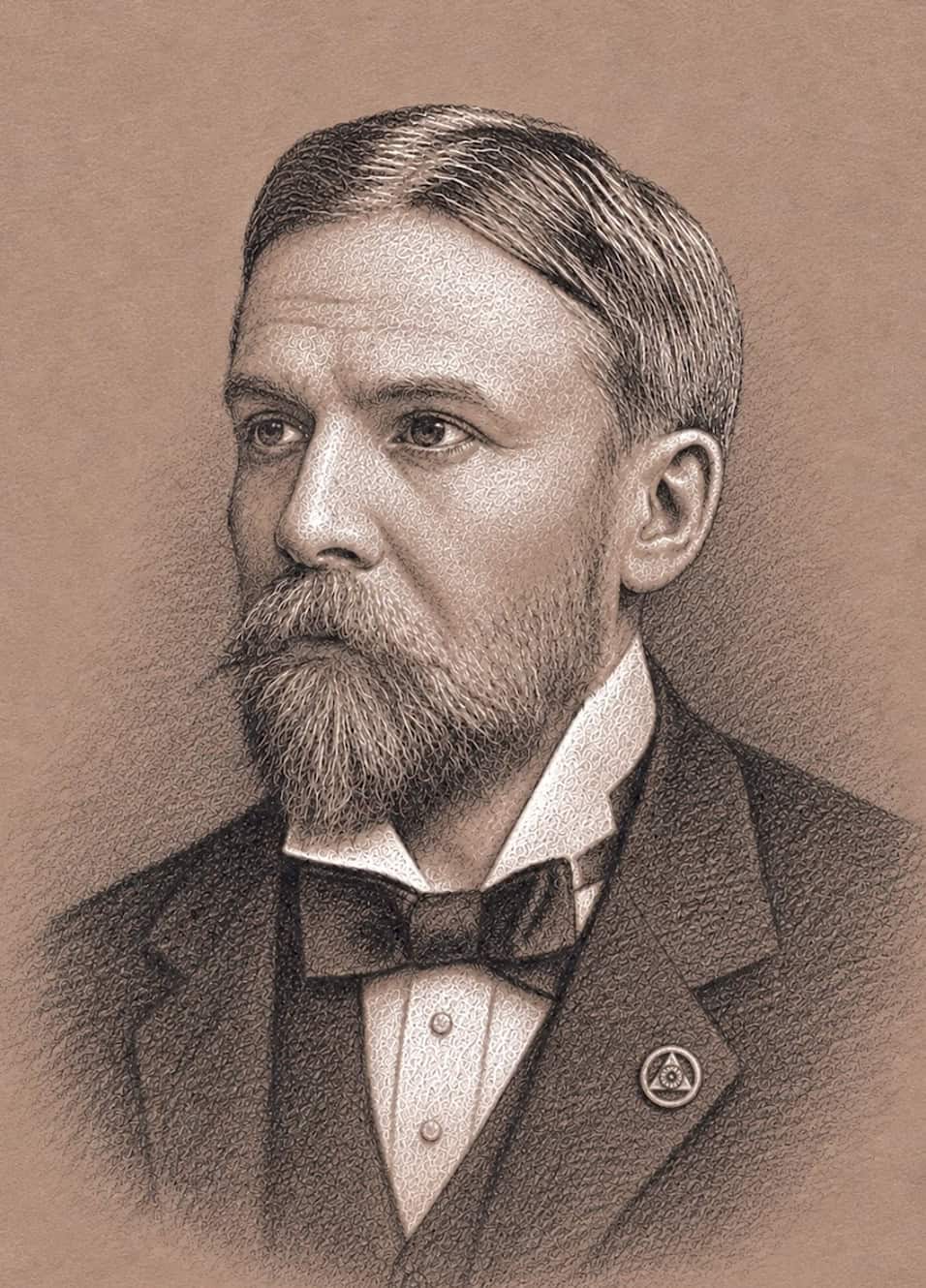
The choice marked an early division within Parkyn’s publishing work. His Chicago School of Psychology, medical clinics, and publications were at the forefront of the American effort to establish Suggestion as a legitimate science within medical education and clinical practice. However, subjects such as clairvoyance, telepathy, and the Yogi psychic traditions of India were a dangerous territory for a physician seeking recognition from the mainstream medical community. Astra gave Parkyn a secret voice through which he could enter that territory and investigate whether the same laws of mind he was studying through Suggestion could also be found within ancient traditions and phenomena that Western science had long rejected.
In the opening Astra article, Parkyn began with a powerful invocation in which the West looks toward the mysteries of the East for hidden knowledge, only for the East to point the Western seeker back toward the universal laws written in “Nature’s book.” That invocation provides the clearest mission statement for the philosophy that would guide the later Yogi Publication Society. The ancient mysteries of the East were expressions of universal natural laws, and the key to understanding them could be found in the same laws of mind that Parkyn was already uncovering through Suggestion.
This makes Astra extremely important to the history of the Yogi Publication Society. The pattern that would become so visible at YPS in 1903 was already present in Parkyn’s publishing work in 1898. It included the “masked suggestion” of a separate authorial identity, an Eastern framework, the study of Yogis and ancient knowledge, and the interpretation of occult and psychic phenomena as manifestations of the Law of Suggestion. From the Astra series, these same fields of investigation can be followed into the Psychic Research Company and from there into the Yogi Publication Society. Astra reveals that the intellectual path leading to YPS was already being developed within Parkyn’s organization five years before its founding.
Parkyn’s Invocation to the East Reveals the Future Mission of the Yogi Publication Society
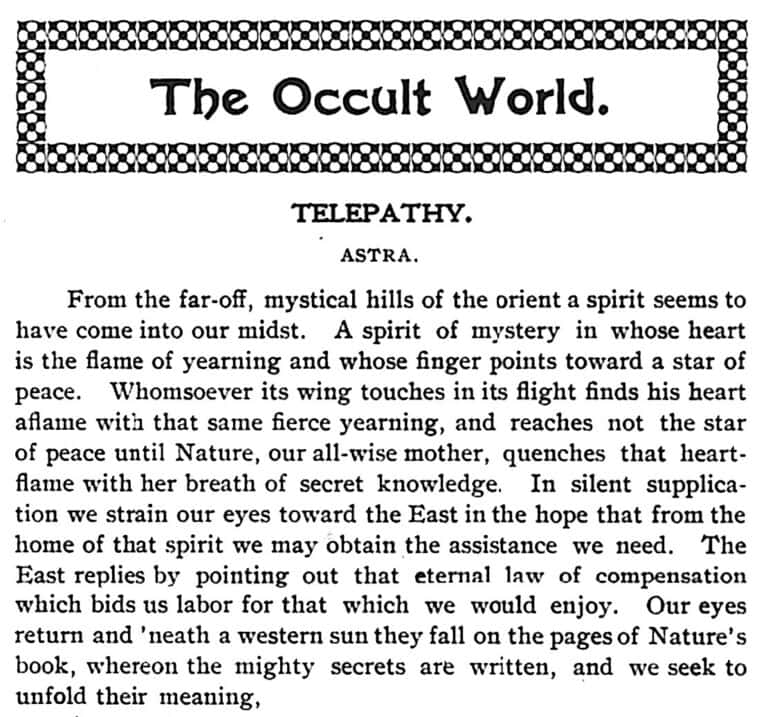
The opening of the first Astra article is one of the most important pieces of evidence for understanding the intellectual origins of the Yogi Publication Society. Parkyn begins by looking toward “the far-off, mystical hills of the orient,” describing a spirit of mystery coming from the East and awakening a yearning for knowledge in the West. He writes:
“From the far-off, mystical hills of the Orient, a spirit seems to have come into our midst. A spirit of mystery in whose heart is the flame of yearning and whose finger points toward a star of peace.”
Parkyn then describes Western seekers turning their eyes toward the East in the hope of receiving the secret knowledge associated with that ancient source. The crucial part comes with the answer. The East does not ask the West simply to accept its mysteries. It points the seeker toward an “eternal law,” and Parkyn writes:
“In silent supplication we strain our eyes toward the East in the hope that from the home of that spirit we may obtain the assistance we need. The East replies by pointing out that eternal law of compensation which bids us labor for that which we would enjoy. Our eyes return and ’neath a western sun they fall on the pages of Nature’s book, whereon the mighty secrets are written, and we seek to unfold their meaning.”
The return to “Nature’s book” is the key to the passage and to the program Parkyn was establishing through Astra. The West turns toward the mysteries of the East and discovers that their source lies in universal natural law. The knowledge associated with the Yogi belongs to the same Nature available to the Western psychologist. India may have preserved ancient teachings and practices surrounding these powers, but Western researchers were beginning to investigate the same forces through psychology, psychical research, and the science of Suggestion. The apparent distance between the two traditions disappears once both are traced back to the same laws governing mind and Nature.

This is the smoking gun in the Astra material because Parkyn had already stated, in 1898, the intellectual mission that the Yogi Publication Society would later pursue throughout its entire publishing catalog. YPS would repeatedly turn to Yoga, Vedanta, mental influence, breathing, concentration, mysticism, and ancient religious traditions, translating their principles into a language of universal law that modern Western readers could understand and apply. The central idea remained consistent. The ancient traditions contained genuine knowledge of principles that Parkyn saw were rooted in the Law of Suggestion.
The invocation makes the connection even stronger. He begins by looking toward the East and then has the East point the Western seeker back toward Nature and its universal laws. From there, he immediately examines the reported mental powers of Indian Yogis before turning to contemporary Western research into telepathy. The Yogi and the psychical researcher were investigating the same underlying forces, where ancient experience provided one body of evidence, modern investigation provided another, and natural law connected the two.
Why Did Parkyn Choose the Name Astra?

Parkyn’s choice of the name Astra was itself part of the message he intended to convey. The term carries a long history of meaning in Sanskrit and in esoteric tradition. Formed from the Sanskrit root “As”, meaning “to throw” or “to project,” and the suffix “-tra,” meaning “instrument,” the word translates to a “projection instrument.” Just as mantra is the “thought instrument” and yantra the “control instrument”, in Hindu epics astra is the instrument of projection, and it was reserved only for weapons that fly, such as arrows, spears, or divine missiles
In the Hindu epic traditions the astra is not simply a physical weapon but is empowered by the will, activated by mantra, and directed by intention. To release an astra is to harness word and thought and project it outward as energy. Its esoteric meaning is the principle that mind and will can extend beyond the body. Thought, word, and intention become forces that move outward like rays, and so an astra is a psychic or telepathic projection, a current of subtle energy launched from within the practitioner out into the world. This made Astra an exceptionally fitting name for Parkyn’s investigation into telepathy, where the central question was whether a thought or mental impression could be projected from one mind and received by another without passing through the ordinary physical senses.
The term was equally meaningful in Western esoteric traditions, where “Astra” came to be understood as the projection of thought and was seen as a force that could be directed outward from the mind. The medium of this projection was called the astral plane, the subtle realm that lies between spirit and matter. In Hermetic traditions, the astra is the ray of mental intention sent forth, and the astral plane is the field through which it travels, carrying the influence of mind beyond the limits of the body.

This combination of Sanskrit and Hermetic meaning is important because it anticipates the method that would later become one of the most recognizable features of the Yogi Publication Society. Parkyn selected a name from an ancient tradition whose meaning embodied the teaching being presented through it. The pseudonym itself became part of the instruction. Five years later, YPS followed the same pattern with Yogi Ramacharaka. The name and identity placed the reader immediately within a Yogic framework before the teaching even began, while the books translated those teachings into a system of universal laws that could be understood and applied by Western readers.
This was the “masked suggestion” at work in its earliest form within Parkyn’s publishing network. Astra did more than conceal Parkyn’s name. It supplied the reader with an identity, vocabulary, and cultural framework suited to the material being taught. The assumed identity prepared the reader for the teaching and embodied something about the teaching itself.
The Hermetic dimension of Astra also becomes significant when the later YPS publications are considered. Parkyn’s 1898 Astra pseudonym already occupied the meeting place of Yogi philosophy, Western esotericism, Hermeticism, and the science of mind. YPS would later move through these same traditions and present them as different expressions of universal principles. These ancient systems could each supply their own symbolic framework while pointing back toward the same laws of mind and Nature.
Parkyn Begins His Investigation with the Yogis of India
Parkyn’s investigation, through the Astra series, begins by identifying among the “many secrets held by the oriental mystics” the reported ability to communicate a vivid impression from one mind to another without the recognized organs of sensation. He discusses accounts related to the Indian Sepoy Rebellion of 1857, in which learned Yogis and other adepts were said to have transmitted information and helped spread news over considerable distances. Parkyn then asked what grounds the West actually possessed for dismissing them when modern investigators were beginning to produce evidence for thought-transference themselves.
The material Parkyn was presenting had been shared with him by his close friend Dr. Mark Henry Lackersteen, who had just passed away a few months earlier. Lackersteen had served as a Surgeon-Major in the British Army during the Sepoy Rebellion and had investigated claims surrounding unusual mental phenomena in India. He later spent years investigating these phenomena with the Society for Psychical Research in London before moving to Chicago.
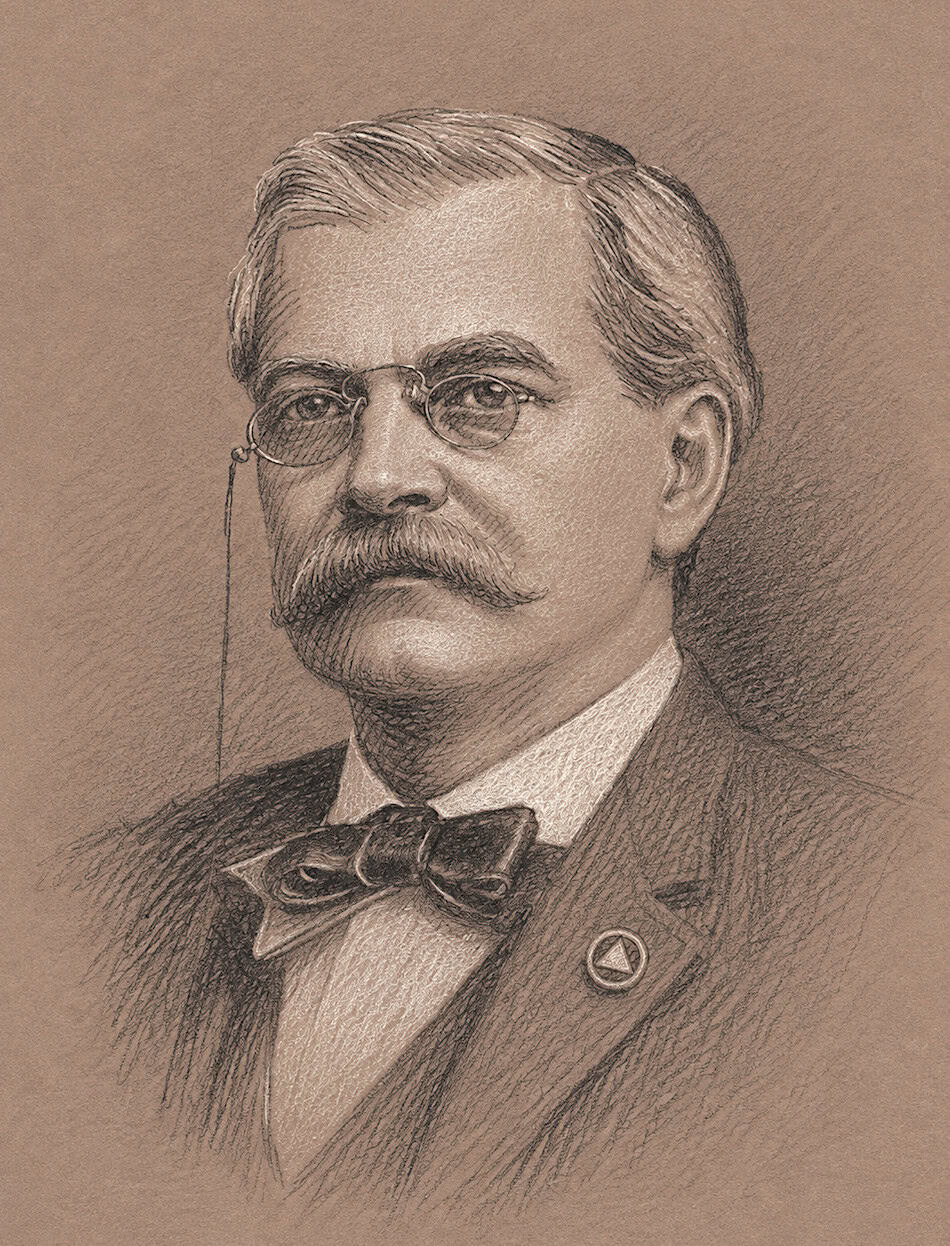
Through the Astra series, Parkyn asked whether the psychic abilities traditionally attributed to Eastern mystics could represent a genuine faculty. If a Yogi could project a mental image or influence across distance, then telepathy offered Western science a means of beginning to investigate the process. The question shifted from whether the stories sounded mysterious to what law of mind could make such experiences possible. This movement from ancient Eastern claim to natural law to Western investigation became a defining feature of the path leading from Astra toward YPS.
From the Yogi to Western Psychical Research
Parkyn next traced the history of Western resistance to telepathy. He described a culture in which early investigators of thought-transference were dismissed as harmless lunatics and the subject itself had been “relegated to the limbo of exploded fallacies.” Repeated experiments, though, gradually made that position harder to maintain. Parkyn gave substantial attention to the Society for Psychical Research, founded in London in 1882, and to investigators including W. F. Barrett, Edmund Gurney, and Frederic W. H. Myers, whose work attempted to collect, classify, and test evidence for thought-transference and related phenomena. Parkyn credited the Society with accumulating evidence that mental impressions could sometimes be communicated through channels that could not be reduced to ordinary sensory contact.
Parkyn Expands the Investigation into Psychic Phenomena
After beginning with the reported telepathic abilities of Indian Yogis, Parkyn expanded the Astra series into hypnosis, clairvoyance, subconscious reception, rapport, dreams, distant mental impressions, and other psychic phenomena. His treatment of hypnotic clairvoyance is especially revealing. Parkyn observed that subjects often described scenes already known to the hypnotist, while attempts to perceive places unknown to the operator failed. He explained that the hypnotized subject depended upon the operator for “impressions or suggestions,” making telepathic reception from the operator a possible explanation for what appeared to be clairvoyance.
This became important to the later YPS program because many of the same subjects would reappear within its Yogi framework. Concentration, mental influence, thought transmission, subconscious receptivity, psychic perception, healing, and the development of latent faculties became recurring areas of instruction.
From Telepathy to a Larger Psychic Science
The Astra series soon moved beyond telepathy. Parkyn examined dreams, trance states, automatic writing, apparitions, subconscious action, and other experiences that appeared to reveal capacities of mind outside ordinary conscious awareness. Their importance to the history of YPS lies in the method Parkyn applied to them. He searched for the underlying mental process and sought to determine how much could be explained by Suggestion, subconscious activity, or other natural faculties of the mind.
His 1898 treatment of automatic writing provides a good example. Parkyn announced that he would approach the subject “from a scientific point” and emphasized observation, interpretation, exactness, repetition, and control. He began with ordinary unconscious action before moving through subconscious activity, telepathy, clairvoyance, and other possible explanations. This method would become familiar within the later YPS program, where psychic and ancient teachings were presented as knowledge of laws and faculties that could be studied, understood, and developed.
The Psychic Research Company Becomes the Bridge to YPS
The subjects Parkyn explored through Astra did not remain confined to “The Occult World” in Suggestion. They continued through the psychical-research side of his network and found a more specialized publishing and educational vehicle in the Psychic Research Company. Mind reading, telepathy, mental influence, and psychic development could now be treated as a distinct field alongside Parkyn’s work in Suggestive Therapeutics. This makes the Psychic Research Company an important intermediate step between Astra in 1898 and the Yogi Publication Society in 1903.
The progression also shows how Parkyn’s publishing structure was developing. Suggestion had established his psychological and therapeutic work, Astra opened a separate pseudonymous channel for Yogi and occult subjects, and the Psychic Research Company gave psychic investigation a more specialized identity. YPS would carry this process into Eastern philosophy by creating a dedicated publishing vehicle for Yoga, Vedanta, psychic development, mental science, healing, and related ancient teachings.
The Yogi Publication Society Expands the Program
When YPS appeared in 1903, several of the subjects that Parkyn had first explored through Astra could be developed within a much larger Yogi framework. A Course in Yogi Philosophy presented mind, psychic faculties, thought force, and spiritual development as parts of an ordered system. Raja Yoga developed concentration, mental control, consciousness, and the powers of mind, while The Science of Psychic Healing carried the program into healing and mental influence. Other YPS works extended the field into breathing, physical development, Vedanta, reincarnation, and the religious philosophies of India.
The connection is strongest at the level of method. Parkyn had begun with the reported powers of Indian Yogis and asked what laws of mind could account for them. YPS could now move much deeper into the philosophies from which those claims came, presenting their teachings as knowledge of mind and Nature. The window Parkyn had opened through “The Occult World” had become a publishing program.
Astra and the “Masked Suggestion” of Yogi Ramacharaka
The appearance of Yogi Ramacharaka also extended the pseudonymous method Parkyn had already demonstrated with Astra. As discussed earlier, Astra was a carefully chosen identity whose Sanskrit and Hermetic associations with projection thought reflected the material Parkyn presented through it. Yogi Ramacharaka did the same by placing the reader immediately within an Indian and Yogic framework through which the teachings could be received.
This is where the idea of “masked suggestion” becomes important. The pseudonym helped establish the reader’s expectations before the teaching began. Astra prepared the reader for Eastern wisdom, occult investigation, and the projection of thought. Yogi Ramacharaka presented the voice of an Indian Yogi teaching an ancient philosophy to Western readers.
Astra Anticipated the Hermetic Direction of the Yogi Publication Society
The Hermetic meaning carried by Astra is also significant in light of the direction YPS would later take. Parkyn’s first occult pseudonym already stood at an intersection of Sanskrit terminology, Yogi philosophy, psychic projection, and Western esoteric ideas concerning thought and manifestation. YPS would eventually range across these same worlds, moving from Indian philosophy into Hermetic and other esoteric traditions.
This gives Astra an importance beyond its connection with the later Ramacharaka books. The pseudonym foreshadowed the range of a publishing program that would search across different ancient traditions for common principles of mind and Nature.
The Union of East and West in the Yogi Publication Society Logo
Parkyn’s message within the Astra series that the same underlying forces were at the center of ancient Eastern and Western traditions, and that natural law connected the two, would later be fully expressed within the sacred geometry of the Yogi Publication Society logo. The logo combines the inner circle of the Hindu teaching of the sixteen Kalas, representing the inner teachings of the East, with the triangle and outer circle of Western Hermetic sacred geometry, bringing both together into a unified teaching.
Read the article: The Sacred Geometry of the Yogi Publication Society Logo

From Astra to the Yogi Publication Society
The historical progression is much clearer once Astra is included in the story. Parkyn began exploring Yogi and occult philosophy under a pseudonym in 1898. The Astra series expanded from the psychic abilities attributed to Indian Yogis into a larger investigation of the hidden faculties of mind. Those subjects continued through the Psychic Research Company, while YPS eventually gave the Eastern and philosophical side of the program a publishing vehicle of its own.
This brings the article back to Parkyn’s opening invocation. Five years before YPS, he had the West look toward the mysteries of the East and then had the East point the seeker back toward the laws written in “Nature’s book.” The publications that followed can be traced along that path. Astra began the investigation, the Psychic Research Company carried its psychic subjects forward, and YPS expanded the search across Yogi, mystical, and esoteric philosophy.
Read the full series: Parkyn’s “Astra” series in Suggestion magazine
.