Copyright © 2026 D. Parkyn Jackson. Published by the Yogi Publication Society History Project. All rights reserved.
The meaning of the name The Kybalion has remained one of the enduring mysteries surrounding the 1908 book published by the Yogi Publication Society. For more than a century, readers have questioned where the unusual word came from and what it was intended to mean. “Kybalion” has frequently been described as an invented word because no word has been identified in Greek, Egyptian, Sanskrit, Arabic, or any other ancient or modern language that corresponds to it. Some have proposed a connection with Kabbalah, largely because “Kybalion” and “Kabbalah” look and sound somewhat alike and both appear within Hermetic traditions concerned with hidden and esoteric knowledge. The result is an unusual situation in which the title of one of the best-known works of modern Hermeticism has circulated for more than a century without its name being understood.
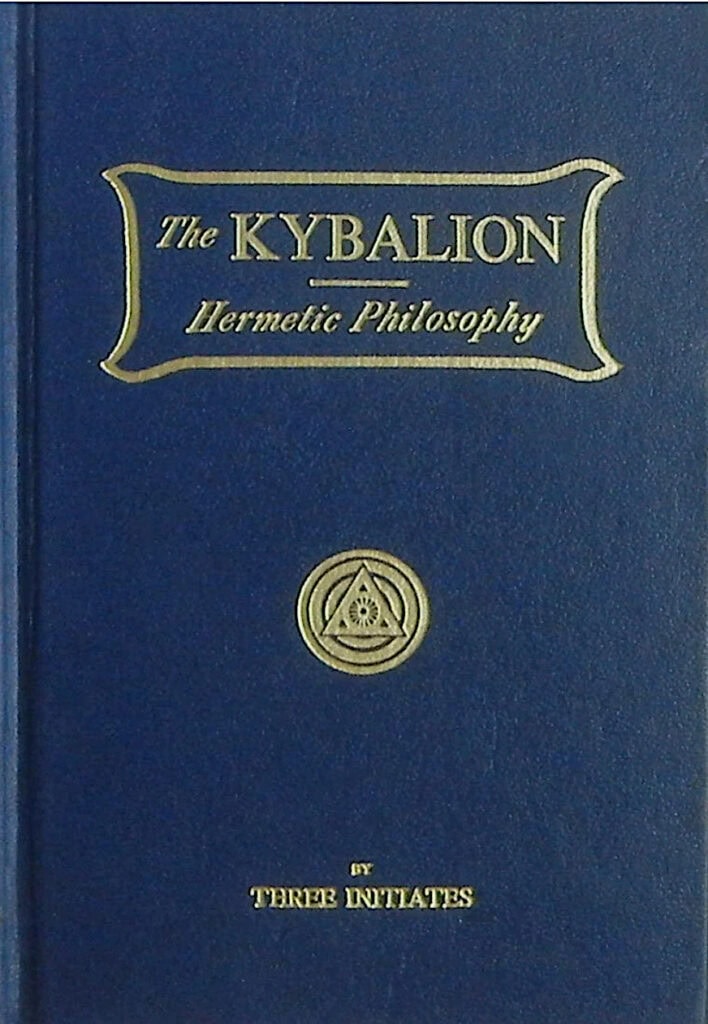
The Three Initiates make the mystery part of the book itself. They connect the teachings of The Kybalion with Hermes Trismegistus, whom they call the “Master of Masters,” and describe the Hermetic teachings associated with him as having been transmitted from teacher to student through the centuries. According to their account, the fundamental Hermetic teachings were at one time compiled into a collection of basic doctrines called “The Kybalion.” The book does not provide the reader with an ancient manuscript bearing that title or explain when such a collection was produced. Instead, the Three Initiates state that “the exact significance and meaning of the term has been lost for several centuries.“
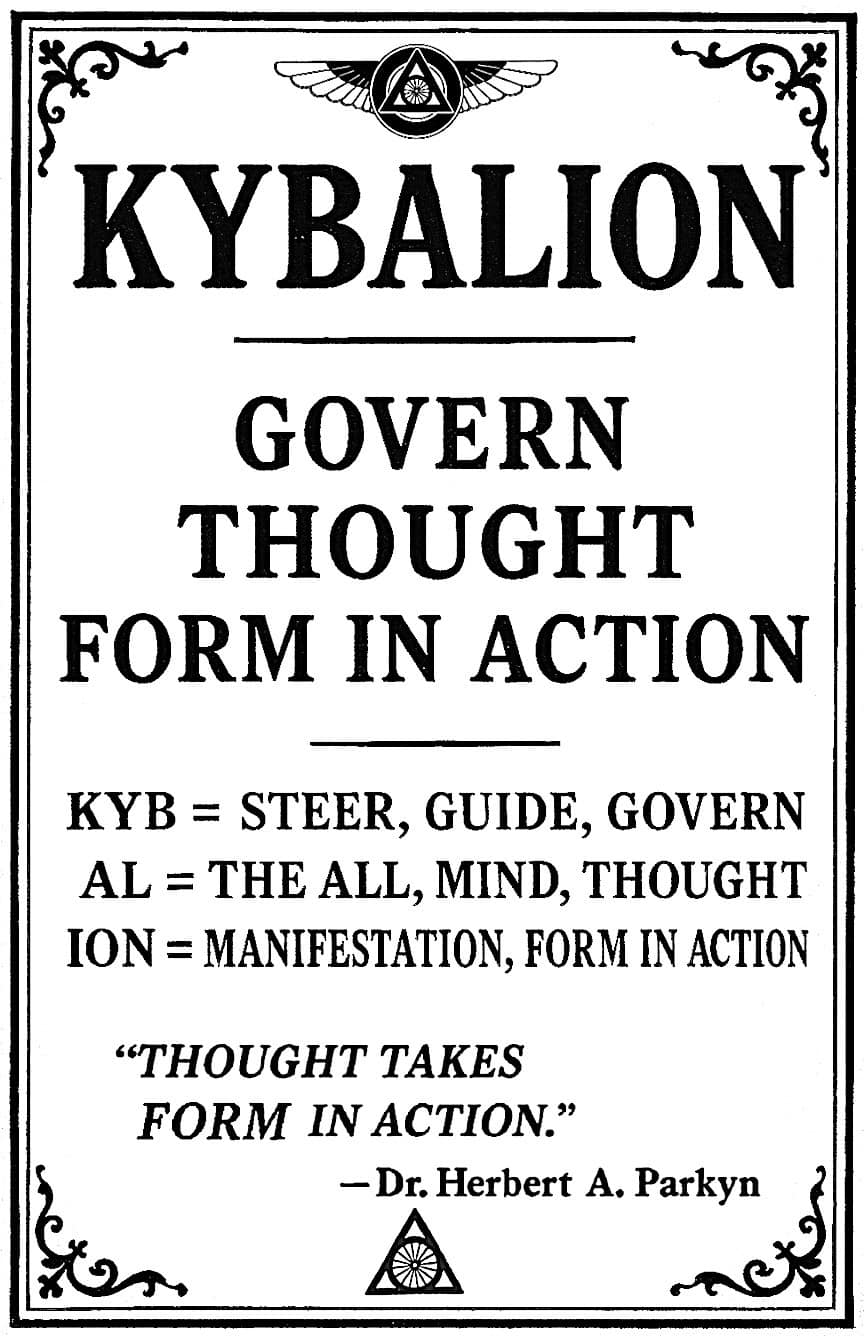
Research by the YPS History Project has uncovered the true meaning contained within the name itself. Far from being a meaningless invented word, “Kybalion” can be separated into elements whose meanings reveal what the complete name expresses. Those meanings correspond directly with the central teaching of The Kybalion, including its declaration that “THE ALL IS MIND,” while the completed construction leads to an even more significant connection. It expresses the same relationship between the direction of thought and its movement into manifested form found in the teachings of Herbert A. Parkyn, including his famous axiom, “Thought Takes Form in Action,” through which Parkyn summarized his system. The mystery of the name can be understood by looking not for another word that happens to resemble “Kybalion,” but at what the name itself says.
How Was the Name “Kybalion” Constructed?
The creation of names by joining words, roots, sounds, and symbols from different languages has a long history within occult and Hermetic traditions. A constructed name can bring several related ideas together within a single term, allowing each part of the name to contribute something to its complete meaning.
This method was also familiar within the circle surrounding Dr. Parkyn. Henry Clay Hodges, Parkyn’s relative who took over the publication of Suggestion magazine, employed this form of interpretation in his 1904 Science and Key of Life book series. Hodges used “Saturn” as one example, dividing the name into “Sat” and “urn.”

This gave the Sanskrit word “Sat,” meaning divine being and reality, with the Latin “urn,” meaning vessel. From this breakdown of the name, the true underlying meaning can be found, where, in astrology, Saturn represents the vessel through which divine reality manifests. The separate elements combine to express the complete spiritual meaning contained within the name.
Kybalion is constructed in the same Hermetic manner
Its meaning does not depend upon finding a single Greek, Egyptian, Sanskrit, or ancient word spelled “Kybalion.” Following the same Hermetic and esoteric tradition of the name being a combination, we can separate KYBALION into three distinct parts:
KYB — AL — ION
What Does “Kyb” Mean?
The first element, Kyb, is a root word from a Greek family of words that share the same meaning and include kybernaō, kybernētēs, and kybernēsis.
The Greek κυβερνάω (kybernaō) means to steer, pilot, direct, or govern. Κυβερνήτης (kybernētēs) is a steersman, helmsman, pilot, or governor. Κυβέρνησις (kybernēsis) is steering, direction, administration, or government. These meanings all originate from the same physical image of a helmsman governing a vessel by steering it, guiding its movement, regulating its course, and determining the direction in which its power will carry it.
The Kyb root becomes easier to recognize when it is followed into words that remain familiar today. One of the clearest is cybernetics. The word was formed from κυβερνήτης (kybernētēs), the steersman, helmsman, pilot, or governor. CYB-ERN-ETICS thus names the study or science of steering, governing, regulation, and control. When Norbert Wiener established the modern use of cybernetics in the twentieth century, the choice of the ancient steering word was deliberate. Cybernetics concerns how machines, organisms, and systems communicate, regulate themselves, respond to information, and control their operation. The ancient helmsman provides the image.
The familiar word cyber developed from cybernetics. Its current association with computers, networks, and digital technology can obscure what the word originally meant, since cyber did not originally mean those things. It is just the abbreviated form of the Greek steering and governing root used in cybernetics. The Kyb of Kybalion and the Cyb of cyber preserve the recognizable KYB/CYB construction. The change between K and C reflects different ways of carrying the Greek form into English spelling, while the underlying root and its meaning remain the same.
This same Greek family of words that produced KYB also passed through Latin to become very familiar words we use today. kybernaō became the Latin gubernare, also meaning to steer, direct, or govern. From this developed the English words govern, governor, governance, and government. The spelling has changed enough that the relationship between Kyb and govern is no longer immediately visible, yet both preserve the original meaning of directing and controlling a course. A governor directs. A government administers and directs. A mechanical governor regulates and controls the operation of a machine.
The progression can be followed from the original root into these different forms:
- KYB / CYB → steering and directing
- KYBERNĒTĒS → steersman, helmsman, pilot, governor
- CYBERNETICS → control, direction, communication, and regulation of systems
- CYBER → shortened modern form derived from cybernetics
- GUBERNARE → steer, direct, govern
- GOVERN → direct, control, administer
The common idea running through all of them is directed control.
kybos

There is also another Greek word that gives Kyb a deeper meaning. Greek κύβος (kybos) means “cube” or “die.” Here the idea moves from governing direction to giving definite form. A cube is bounded, measurable, structured, and ordered. Its dimensions establish definite relationships and proportion. What has been cubed has been brought into a defined structure that can be measured and understood.
Within the meaning of the word Kybalion, these two forms of Kyb work together. To govern is to direct and control. To cube is to give defined structure and form. Kyb can thus carry the power that directs something while also bringing it into order, proportion, and defined existence. The helmsman supplies the image of direction. The cube supplies the image of form. Both concern bringing something under order.
This becomes important once Kyb is joined to the remaining elements of the name. At this stage, Kyb can be defined as the power that governs by directing, controlling, and giving definite form to that which it governs:
KYB = STEER, GUIDE, GOVERN
What Does “Al” Mean?
The second part of the name, Al, begins with the Arabic ال (al-), meaning “the.” In ordinary language a definite article can appear insignificant, but “The” takes on a much deeper function in religious, mystical, and metaphysical language. It can distinguish the unique from the many, the universal from the individual, and the absolute from the relative. In this use, “The” identifies the supreme or absolute reality expressed by the word that follows it. This use of Al appears repeatedly in religious and esoteric terminology and provides the key to understanding why Al stands at the center of Kyb-Al-Ion.
Allah = Al-ilāh
The clearest example is Allah. The name is understood from al-ilāh, “The God.” The distinction created by Al is fundamental. It is not “a god,” one divine being among other divine beings. It is “The God,” the unique and supreme divine reality. The same function appears throughout Sufi mystical language. Al-Ḥaqq is “The Truth” or “The Reality,” Al-Bāṭin is “The Hidden” or “The Inner,” Al-Zāhir, is “The Manifest” or “The Outer,” Al-Rūḥ is “The Spirit” or “The Breath,” and Al-Malakūt is “The Realm of Dominion,” the celestial and invisible world of spiritual forms and powers.
In each case, Al retains its literal meaning of “The,” but the definite article is being applied to a reality, principle, state, or being understood in its divine, universal, and absolute sense.
Al-Chemy

One of the most important examples for understanding Al within a work claiming descent from Hermeticism is Alchemy. The word came through Arabic al-kīmiyāʾ. Chemy or kīmiyāʾ carries the idea of the elixir, medium, or transformative power through which one thing is changed into another, an idea that survives in chemistry and its study of what things are composed of and how they become other things. Al-Chemy is “The Chemy,” the ultimate elixir, medium, or power of transmutation through which the lower is changed into the higher.
In Hermetic philosophy, this does not apply only to metal transmutation. It becomes Mental Transmutation, the raising of Mind from a lower state into a higher state. This is the same language of Mental Transmutation used throughout The Kybalion.
The Good
The absolute power of “The” is not limited to Arabic. Plato’s “The Good” provides a familiar philosophical example. The Good is not simply one good thing or even a collection of everything considered good. “The Good” designates the supreme Good itself. In the same way, there is a difference between a truth and The Truth, a reality and The Reality, or an individual being and absolute Being. At this level, “The” is no longer doing the ordinary work of distinguishing one object from another. It is pointing toward that which is primary, unique, supreme, and absolute.
The All
This is exactly where Al meets the teaching of The Kybalion. The Three Initiates repeatedly acknowledge that the absolute Reality behind existence cannot actually be defined or explained. They write that “under and back of the Universe of Time, Space and Change, is ever to be found The Substantial Reality – the Fundamental Truth.” Yet when they attempt to describe the nature of that Reality, they immediately encounter the limits of language. They state that its “inner nature” is unknowable and that no human mind can fully comprehend it. Any complete definition would impose limits upon that which, by definition, can have no limitation.
The Three Initiates nevertheless say that humanity must have some name by which to designate this infinite Reality. They write, “We shall call this ‘THE ALL,’ a term which we consider the most comprehensive of the many terms applied by Man to THAT which transcends names and terms.” The name is not presented as a complete definition of what this Reality is. It is the nearest language can come to designating something that transcends the ability of language to describe it.
This makes the construction of THE ALL itself important. ALL already attempts to include everything without exception. THE makes that ALL absolute and definite. It is not an all, one totality among other possible totalities. It is THE ALL. Language has been pushed almost as far as a definite article can take it. In its most reduced form, the designation could almost stop at THE itself. THE ALL functions as the ultimate definite designation of that which cannot be placed into any lesser category. In that sense, it might just be expressed as “THE THE,” the definite article applied to the absolute Reality beyond every ordinary definition.
And then The Kybalion makes the connection that unlocks Al within the title.
“THE ALL IS MIND; The Universe is Mental.”
This point must be read exactly as the book gives it. THE ALL does not possess Mind as one of its attributes. Mind is not something created by THE ALL or something that proceeds from it. THE ALL IS MIND. Elsewhere the Three Initiates describe it as “Infinite Living Mind,” while still maintaining that its inner nature remains beyond finite human comprehension. Mind is the nearest expression the book gives for the nature of the indescribable Reality it has designated THE ALL.
So we see that Al means “The,” a definite article in its most absolute, unknowable, and ultimate state. And it is the Al (The) that passes and gives this ultimate state to anything. It is what changes “a god” to “The God.” It is what changes “All” to “The All.” When we follow this through The Kybalion‘s teaching that “THE ALL IS MIND” we see that if we shorten it to “All is Mind” we have pulled away the definite article part that gives it its connection to the absolute, unknowable, and ultimate state. This shows us that since “All is Mind,” the Al (The) has to be Thought in its most absolute, concentrated, and focused form, directing its ultimate power of will towards attention to ALLness.
Al = THE, ALL, MIND, THOUGHT
What Does “Ion” Mean?
The final element, Ion, carries meanings centered upon action, process, movement, progression, and manifestation. There are two different linguistic paths through which these meanings can be reached. One comes through the familiar suffix -ion, which turns an act into the state or result of that action. The other comes from the Greek ἰόν (ión), meaning “going” or “that which goes.” Their meanings converge in an unusual way. One expresses action and process. The other expresses going and movement. Together they provide the foundation for understanding Ion as movement into action, expression, and manifestation.
The suffix -ion
The suffix -ion is a noun-forming suffix inherited from the Latin -io and -ionem, with many such words passing into English through French. More specifically, it is frequently a deverbal suffix, meaning that it takes the action contained in a verb and turns it into a noun representing the action, process, state, or result.
This can be seen in many ordinary English words. To elect is an action. An election is the act or process of electing. To construct is to build. Construction is the act or process of constructing and can also identify the result produced by that action. To connect is an action. Connection can describe the act of connecting, the resulting relationship, or the state of being connected. In each case, -ion allows an action to be expressed as an act, process, state, condition, or result.
The Scientific Ion
The scientific word ion means an atom or molecule with a net electrical charge. The name comes from the Greek ἰόν (ión), meaning “going” or “that which goes.” The term was introduced by Michael Faraday in 1834 while developing the terminology of electrolysis.

The scientific meaning adds another important layer. An ion carries a positive or negative electrical charge, and this polarity governs its movement and interaction. The scientific Ion brings together movement, positive and negative polarity, direction, attraction, and repulsion. These are important because they are also part of the theory through which The Kybalion explains the operation of Matter and Mind.
The book actually introduces ions while explaining the Principle of Vibration:
“The atoms are composed of Corpuscles, sometimes called ‘electrons,’ ‘ions,’ etc., which also are in a state of rapid motion, revolving around each other, and which manifest a very rapid state and mode of vibration. And, so we see that all forms of Matter manifest Vibration, in accordance with the Hermetic Principle of Vibration.”
This passage gives us a remarkable combination of the ideas contained in Ion. The book names “ions,” describes them as being in “rapid motion,” and then says that they “manifest” a rapid state and mode of vibration. It then extends this from the individual particles to Matter itself, stating that “all forms of Matter manifest Vibration.”
This becomes much more important when The Kybalion carries the same theory from Matter into Mind. The Three Initiates explain:
“But the Hermetic Teachings go much further than do those of modern science. They teach that all manifestation of thought, emotion, reason, will or desire, or any mental state or condition, are accompanied by vibrations, a portion of which are thrown off and which tend to affect the minds of other persons by ‘induction.’”
The relationship is easy to see. The book first uses ions in rapid motion to explain how Matter manifests Vibration. It then describes the “manifestation of thought” through vibration. The physical and mental examples are explained through the same underlying principle. Matter manifests through vibration, and Thought manifests through vibration.
The book continues:
“Every thought, emotion or mental state has its corresponding rate and mode of vibration. And by an effort of the will of the person, or of other persons, these mental states may be reproduced, just as a musical tone may be reproduced by causing an instrument to vibrate at a certain rate—just as color may be reproduced in the same way.”
Here another part of the theory becomes visible. Thought does not merely possess vibration. The rate and mode of that vibration correspond to the mental state, and Will can act upon the process. The Three Initiates then connect this directly with Polarity:
“By a knowledge of the Principle of Vibration, as applied to Mental Phenomena, one may polarize his mind at any degree he wishes.”
This is what makes the scientific Ion so important to understanding the theory. The Ion provides a physical example in which movement is connected with positive and negative polarity, direction, attraction, and repulsion. The Kybalion then applies these same principles to Mind. Thoughts and mental states have different rates and modes of vibration. Mental conditions can occupy different poles and degrees. Will can direct the process, and the polarization of the mind can be changed.
The relationship can be expressed simply:
THOUGHT → DIRECTION THROUGH WILL → POLARITY →VIBRATION → MANIFESTATION
The scientific Ion is not being used here because a thought is literally an electrically charged ion. Its importance is that the physical behavior of the Ion expresses the same system of movement, direction, polarity, vibration, attraction, and repulsion through which the Hermetic teaching explains mental manifestation. The physical principle becomes a model for understanding the mental principle.
This also explains why the appearance of the word “ions” in The Kybalion matters so much. The Three Initiates could have discussed atoms and electrons without using the word at all. Instead, Ion appears precisely where the book joins motion with vibration and manifestation. The discussion then passes from the vibration manifested by Matter to the vibration manifested through Thought, and from there to the ability of Will to change the polarization of the mind.
How the Two Meanings of Ion Come Together
While the two Ions have separate origins, their meanings converge to give a remarkable understanding of the teaching of mental transmutation in The Kybalion. The suffix -ion takes an action and expresses its act, process, state, or result. The scientific Ion is a charged particle defined by movement, polarity, and direction. One gives us the action, and the other gives us the movement through which that action takes form.
This convergence can even be seen in the word manifestation. To manifest is to make something apparent, expressed, or present in form. Manifestation is the action, process, state, or result of manifesting, while the scientific Ion supplies the idea of movement through which something passes from one condition into another. In The Kybalion, that movement is governed through Thought and expressed through Polarity and Vibration.
Together, they express the movement of something into action, expression, and manifestation. What was first present as potential is put into motion and becomes expressed through action. This gives the final element of the name the meaning:
ION = MANIFESTATION, FORM IN ACTION
The Complete Meaning Hidden Within Kybalion
Each of the three elements of the name can now be brought together. Separately, they have led through different linguistic, philosophical, and scientific paths, yet each contributes a specific part of the teaching expressed by the complete word:
- KYB = STEER, GUIDE, GOVERN
- AL = THE, ALL, MIND, THOUGHT
- ION = MANIFESTATION, FORM IN ACTION
When the elements are joined, their relationship becomes clear. KYB supplies the act of steering, guiding, or governing. AL supplies that which is being governed. ION describes the manifestation of that Thought, the process through which Thought becomes expressed and takes form in action.
STEER, GUIDE, GOVERN — MIND, THOUGHT — MANIFESTATION, FORM IN ACTION
KYBALION = “GOVERN THOUGHT FORM IN ACTION“
“Thought Form” is important to understanding what the complete construction expresses. In The Kybalion, Thought is not presented as something that remains confined within the mind. Thought has a vibration, it is directed through Will, its polarization can be changed, and it becomes expressed through manifestation. Thought takes form, and that thought-form expresses itself in action. The teaching is concerned with governing that process by directing the Thought whose form will become active and manifest.
Dr. Herbert A. Parkyn’s Axiom
This is where the completed construction leads directly to one of the most distinctive teachings of Herbert A. Parkyn. Long before The Kybalion appeared, Parkyn summarized the relationship between Thought and its outward expression in a concise axiom:
“Thought takes form in action.”
Parkyn’s axiom describes precisely what occurs between AL and ION. AL gives us Mind and Thought. ION gives us manifestation and form in action. Thought takes form in action. KYB then supplies the governing instruction placed before that process.
How Kybalion Works on More Than One Level
There is also a simpler way of reading the completed name that shows how Kybalion can operate on more than one level. If AL is retained in its most direct meaning as “THE,” KYB supplies govern, and ION supplies the manifestation. The construction can then be read as:
GOVERN — THE — MANIFESTATION
Yes. This should follow very naturally from the meaning we have just established. The important point is that the sentence about the meaning being “lost” is not an isolated piece of invented history. It reflects the same historical narrative running through Parkyn’s teaching and the YPS books. I would write it like this:
Why Was the Meaning of Kybalion Said to Have Been Lost for Several Centuries?
Once the meaning contained within the name Kybalion is understood, the statement made by the Three Initiates near the beginning of the book makes sense. They tell the reader that “the exact significance and meaning of the term has been lost for several centuries.” This closely follows a much larger idea that runs through the teachings surrounding the Yogi Publication Society. What had been lost was the understanding of what the ancient teachings were actually describing.
This was central to Parkyn’s explanation of the Law of Suggestion. Parkyn maintained that suggestion was not a newly discovered force. It was a natural law that had been operating throughout human history and stood behind many of the phenomena associated with ancient religions, healing systems, mysteries, and occult teachings. Earlier peoples had observed its effects and learned ways of employing it, but the actual law operating beneath those effects had gradually been forgotten. What remained became surrounded by ritual, ceremony, mysterious language, religious interpretation, and supernatural explanations.
That same historical pattern appears repeatedly in the books associated with the Yogi Publication Society. Ancient teachers are presented as having possessed knowledge of real laws governing Mind, Thought, Will, vibration, polarity, mental influence, and human consciousness. Over the centuries, the original understanding became obscured. Fragments survived in religions, mystery traditions, occult schools, philosophical systems, ceremonies, symbols, and teachings passed from one generation to another, but their underlying meaning was no longer clearly understood. The work of the modern teacher was to recover the law beneath the surviving forms.
This makes the wording of The Kybalion especially significant. When the Three Initiates say that the meaning of the term had been “lost for several centuries,” they are describing the history of Kybalion in the same way this surrounding body of literature describes the ancient knowledge itself. The teaching survives, but its meaning becomes obscured. The outward forms remain, while knowledge of the law beneath them disappears.
The meaning uncovered in the name fits directly into that pattern. If Kybalion expresses the governing of Thought as it moves into action, then what had been lost was the knowledge of how Thoughts are directed and how they manifest reality. Parkyn’s teachings on the Law of Suggestion supplied the mechanism through which Thought could be directed, impressed, accepted, and carried into expression. What had been lost was the understanding of the law itself. The Kybalion presents itself as the recovery of that lost Hermetic knowledge, while the meaning contained within its name points directly to the mental law the book sets out to teach.