
Person Research Collection
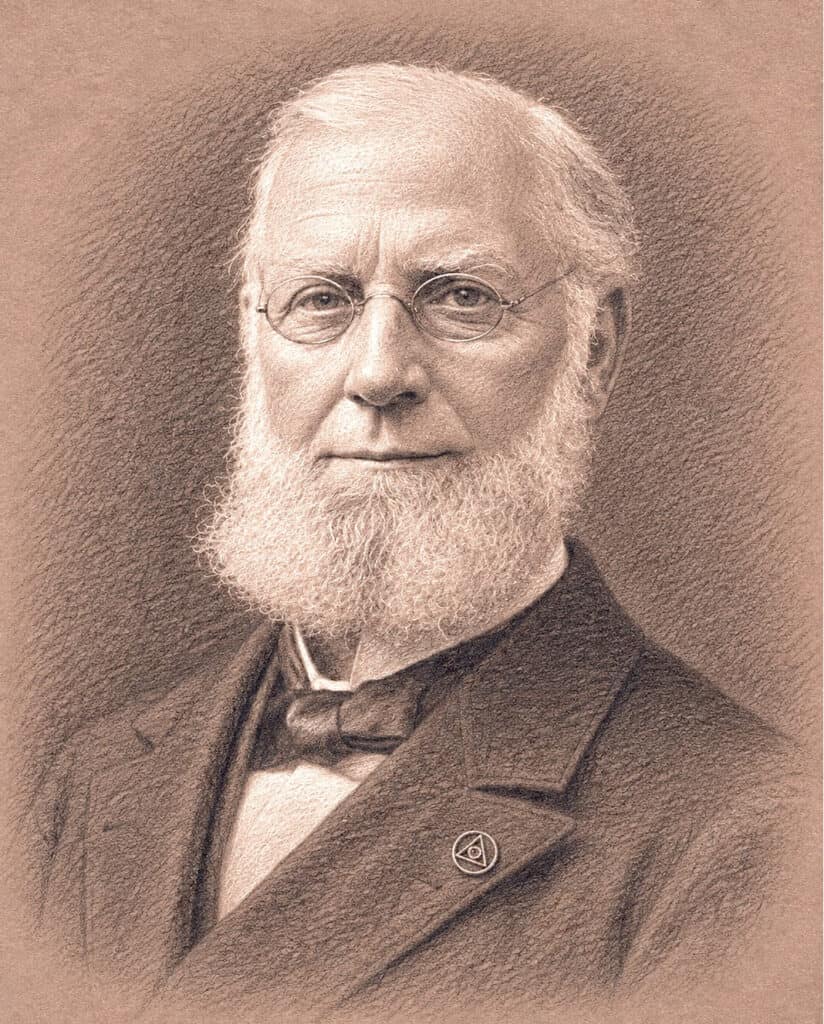
Henry Clay Hodges
1828–1919
Hodges was a wealthy Detroit industrialist, New Thought patron, astrologer, and relative of Parkyn, who purchased Suggestion in 1906 and continued it as The Stellar Ray.
Copyright © 2026 D. Parkyn Jackson. Published by the Yogi Publication Society History Project. All rights reserved.
Henry Clay Hodges (March 2, 1828–August 31, 1919) was an American businessman, industrialist, real estate developer, publisher, astrologer, psychical researcher, and major financial supporter of the New Thought movement. One of Detroit’s wealthiest and most prominent businessmen during the second half of the nineteenth century, Hodges made his fortune through insurance, real estate, manufacturing, mining, and some of the industrial enterprises that helped transform Detroit into a major American city.
During the later decades of his life, he increasingly directed his wealth and attention toward astrology, psychical research, mental science, ancient philosophy, and New Thought. He published the six-volume Science and Key of Life, financed the Church of the New Thought in Detroit, became closely associated with Herbert A. Parkyn, a relative of his, and the circle surrounding Parkyn’s Suggestion magazine, which he purchased from Parkyn in November 1906, continuing it under the new title The Stellar Ray.
Under Hodges, the magazine brought together writers and teachers from New Thought, psychical research, astrology, Yogi philosophy, and Western esotericism, including J. C. F. Grumbine, Charles Brodie Patterson, Edgar L. Larkin, and Yogi Ramacharaka. His close relationship with Parkyn and his later support of R. Swinburne Clymer’s Rosicrucian magazine The Initiates place Hodges directly within the network surrounding the Yogi Publication Society during the years in which New Thought, astrology, psychic science, Rosicrucianism, Hermetic philosophy, and Eastern teachings were being brought together in new forms.
Who Was Henry Clay Hodges?

Henry Clay Hodges was born on March 2, 1828, in South Hero, Vermont. His father came from Washington County, New York, while his mother belonged to the Phelps family of Connecticut. His formal education came through local common schools, but much of his education was self-directed. He began working on a farm at the age of twelve and entered the carriage-making trade at sixteen, remaining there for approximately six years while spending much of his available time reading and studying. This pattern of independent study continued throughout his life and eventually carried him far beyond business into philosophy, religion, astrology, psychic phenomena, ancient civilizations, symbolism, language, and the hidden laws he believed governed both the universe and the human mind.
At twenty-two, Hodges left Vermont and traveled west in November 1850. After passing through Detroit, he settled in Marshall, Michigan, where he taught in country schools and worked for a time as steward and clerk of the Railroad Hotel. He began studying law in 1852 while continuing to support himself through teaching. A prolonged illness interrupted those plans and sent him to Wisconsin in search of a different climate. In 1853 he returned to Michigan and settled in Niles, where he entered the employ of J. C. Frost & Company, a firm engaged in the Vermont marble trade. He became the company’s western agent and later moved to Fond du Lac, Wisconsin, when the company established a branch there. These early positions gave Hodges experience in sales, management, transportation, and the rapidly expanding commercial economy of the Midwest.
How Did Hodges Become One of Detroit’s Wealthiest Businessmen?
Hodges returned permanently to Detroit in 1862 and became the Michigan State Agent for the Connecticut Mutual Life Insurance Company. The following year he joined his brother Charles C. Hodges and Edward Barker in Barker, Hodges & Brothers, which represented Connecticut Mutual throughout Michigan, Wisconsin, Iowa, and Minnesota. After Barker retired in 1864, the company became Hodges Brothers & Company. Its territory eventually extended into Ontario, and the firm handled nearly ten million dollars in premium receipts during its years of operation. Insurance supplied Hodges with the capital and business relationships that allowed him to enter real estate and manufacturing on a much larger scale.
Beginning in 1865, Hodges and his brother acquired substantial Detroit real estate. Their largest development began in 1871 with the purchase of a major portion of the former Woodbridge estate north of Grand River Avenue. Much of the property was undeveloped when the Hodges interests acquired it. Streets were opened and improved, lots were subdivided, landscaping and construction followed, and the district developed into an important residential section of Detroit. Hodges was involved in the development of Lincoln and Trumbull avenues and later participated in the creation of Detroit’s Grand Boulevard.


His commercial buildings became prominent features of downtown Detroit. Hodges built the Brunswick Hotel at State and Griswold streets in 1878 and later erected the Hodges Building at the same intersection. He also built the Henry Clay Hotel on Center Street. By the end of the nineteenth century, his name had become attached not only to companies but to buildings and sections of the city he had helped develop.
Manufacturing expanded his fortune even further. In 1879 Henry and Charles Hodges purchased the lubricating-device business of John L. Cook, from which the Detroit Lubricator Company developed. Its products were eventually used in industrial machinery, railroads, marine engines, and other mechanical systems throughout the world. In 1882 the brothers incorporated the Detroit Steam Radiator Company, which developed into the Detroit Radiator Company as the demand for steam-heating systems expanded. Hodges became its president and chief executive, and the company grew into one of the major manufacturers in its field before becoming part of the American Radiator Company.
Hodges also served as vice president, managing director, and later president of the Wyandotte Rolling Mills Company, an important Michigan iron and steel enterprise associated with materials and vessels used throughout the Great Lakes and St. Lawrence transportation systems. He entered western mining as an organizer and president of the Detroit-Arizona Copper Mining Company. By the beginning of the twentieth century, the young Vermonter who had begun working on a farm at twelve had become a multimillionaire industrialist and one of the men credited with helping build modern Detroit. As his sons assumed increasing responsibility for the family businesses, Hodges had the financial independence to devote the final decades of his life to subjects that had increasingly captured his attention.

From Detroit Industrialist to Student of Astrology and Ancient Wisdom
Hodges’s interest in astrology developed into an ambitious attempt to find a single system capable of explaining the relationship between the universe, the human mind, physical health, character, and human destiny. In 1901 he began publishing Science and Key of Life through his Astro Publishing Company in Detroit. The project eventually expanded into six volumes and moved far beyond ordinary predictive astrology. Hodges treated astrology as part of a universal science whose principles could be found in ancient philosophy, religion, symbolism, mathematics, psychology, and the physical sciences.
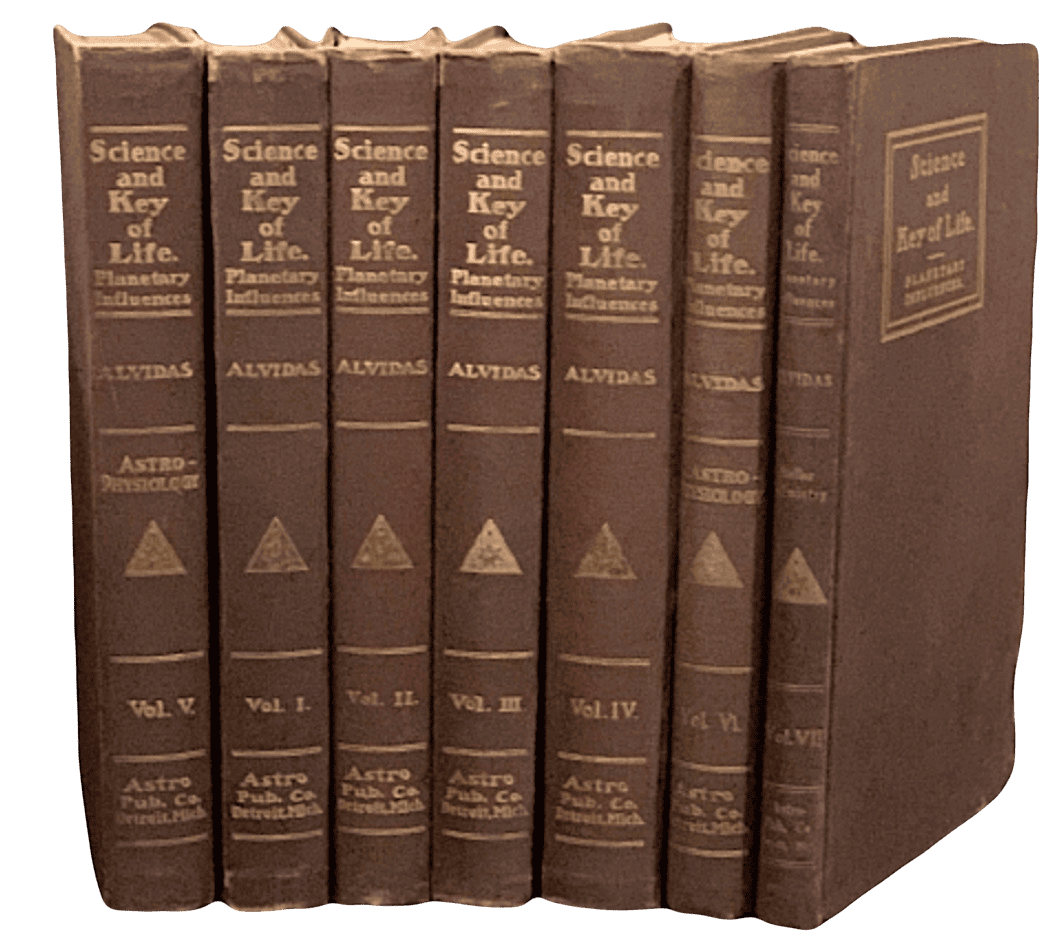
The books explored planetary influences upon the mind and body, numbers, color, sound, heat, vibration, palmistry, the pyramids, ancient mythology, symbolic language, and the hidden meanings of words and names. Hermeticism, Masonic symbolism, and Hindu and Sanskrit concepts appeared throughout the system. Hodges believed that many ancient teachings had encoded genuine knowledge of natural laws and that modern science was beginning to rediscover principles that the ancient world had understood symbolically.
Language itself became part of this search. Hodges repeatedly broke words into supposed ancient components and looked for concealed meanings in Sanskrit and other languages. His discussion of Saturn, for example, divided the name into “Sat” and “urn,” connecting the Sanskrit Sat, or divine being and reality, with the image of the urn as a vessel through which the divine essence becomes manifest. This reveals how Hodges approached occult philosophy. A word, myth, number, planetary symbol, physical vibration, or ancient emblem could all serve as different expressions of the same universal laws.
His astrology also extended into medicine through what he called astro-physiology. Planetary positions were used to interpret physical tendencies, periods of illness, critical times during disease, and possible approaches to treatment. Hodges imagined astrology eventually becoming part of ordinary social organization. He proposed its use in education and government and even argued that prospective marriages should be examined astrologically before licenses were granted, believing that incompatible unions could be identified before they ended in divorce. For Hodges, astrology was intended to become a working science of human life.

Alvidas and Clytina

Hodges’ series opened with a 1901 preface volume titled Two Thousand Years in Celestial Life, presented as the autobiography of a woman named Clytina, who was said to have been a student of Plato born in Athens in 147 B.C. and entered celestial life in 131 B.C. The book contained not only her life story but also an account of the previous four years of transmissions said to have been received through her and others. The book stated that “Within the past four years, Hodges has received through psychic force, a series of remarkable communications… from Alvidas and Clytina and others, former inhabitants of ancient classic Greece.” The celestial spirits stated that their purpose was to form a chain connecting the conditions existing over 2,000 years ago with those up to the present time, for the seed that was sown by Plato, Socrates, Confucius and others is now bearing fruit.”
Hodges had adopted a technique long established in Masonic and esoteric traditions, in which teachings were framed as transmissions from antiquity in order to cloak them with the authority of timeless wisdom. Within the structure of his book series, he presented the material not as his own but as revelations shared from a spiritual source. The metaphysical doctrines were said to have been delivered through a process of “psychic telegraphy,” as a form of mediumistic communication, and attributed to voices from the classical past. These transmissions were received by him in the presence of six other witnesses that gathered several times a week as “The Mystic Seven.”
Transmission of the messages by “psychic telegraphy”
Hodges claimed that he received messages from unseen spirits through a specially arranged telegraph machine. The setup involved a small slate covered box with a telegraph key inside, where Hodges would place his written questions. Wires from the box were connected to a small battery and then to a ticker machine placed in full view of everyone present. During the session a medium rested a hand on the closed box but never touched the telegraph key. The ticker would then begin producing messages in short hand telegraph code, which the medium quickly wrote down. Afterwards the messages were quickly taken to Hodges’ office and typed up by his stenographer.

In 1897 the wireless telegraph had only just been invented by Marconi and was so new that most people had never seen, or even heard of it yet. Hodges exploited that ignorance by staging his “psychic telegraphy” sittings in which the telegraph ticker was visibly unconnected to any wires other than those to the box and battery as it rattled out messages that he claimed were from the spirit world. To confer credibility, he assembled the “Mystical Seven” panel, a mix of professionals, everyday witnesses, and Spiritualists as validators. After witnessing the performances, they fully believed what they saw and swore that the communications were genuine, signing statements to that effect. Hodges reinforced the illusion with straightforward slate-writing tricks of the kind then being used to create a seamless impression of transmitting messages from the celestial realm
The Illustrated Slate
In August 1897 Hodges, together with members of his “Mystic Seven,” visited the psychic Campbell of the then famous Campbell Brothers in New York. Allen Campbell’s forte was the manifestation of spirit art through slate séances. The group arranged themselves around a small table where Hodges carefully examined a blank slate, confirming it was free of marks, and placed it on the table. A second blank slate was placed directly on top of it, upon which Campbell set his gold watch chain. Each of the participants then placed a hand on the upper slate and held it there for several minutes. When the chain, the top slate, and the participants’ hands were removed, the lower slate was found to contain writing and drawings in gold that had not been there before.

The slate presented a combination of Masonic cipher text on the left side, plain English text on the right side, and esoteric imagery in the center. On the right the words are given in cursive English. They read, “In the present as in the past do I come unto thee, and by the tokens of the past speak. And in the present do I speak likewise. By the emblem we send know that the star shall still shine on. Clytina.” The wording refers to “tokens” and an “emblem.” In Masonic and esoteric usage tokens are signs or proofs of recognition that connect to earlier teachings, and an emblem is a symbolic image that conveys a truth. On the left side the words are written in the Masonic or Pigpen cipher using the Grid X Grid X variant that was widely employed in Knights Templar Freemason circles.

Decoded this portion reads, “Beyond the stars that man can see are stars unnumbered for thee and me. Thy loving guide C.” (C. for Clytina) At the center is a seven-pointed star that contains the all-seeing eye and radiates outward, a design long associated with mystical completeness and the planetary cycle. Above it is a six-pointed star, also containing an eye, a symbol traditionally understood as the union of opposites and the harmony of spirit and matter. At the lower left is the Rod of Asclepius, a staff entwined by a single serpent which is an ancient emblem of healing and knowledge. The classic combination of cipher, text, and symbols reflected the established language of Masonic and Rosicrucian traditions in which hidden writings, guiding figures, and emblematic imagery served as vehicles for the transmission of wisdom
The meanings behind the names Clytina and Alvidas
The names of the spirit guides in Hodges’ Science and Key of Life series were chosen with deliberate meaning. Each was constructed to embody the essence of the teachings and to provide the reader with clues to Hodges’ deeper intentions.

Clytina is derived from the Ancient Greek word klutós (κλυτός), which translates to “glorious” or “renowned” and is a deliberate variation of the Greek mythic Clytia. In Greek mythology, the nymph daughters of Oceanus, called the Oceanids, were said to number in the thousands and were often understood allegorically as the stars scattered across the sea of night. Among them were Clytia and Leucothoe, whose fate reveals an allegory of Venus and Mercury, the two planets closest to the Sun. Clytia loved Helios, the Sun god, but he directed his affection to her sister Leucothoe. Out of jealousy, Clytia revealed the affair to their father, who punished Leucothoe by burying her alive, a symbolic entombment that corresponds to Mercury’s frequent disappearance into the brilliance of the Sun. Helios could not save her, but he transformed her into the frankincense tree. This tree, long associated with purity, divine worship, and sacred fire, represents Mercury’s role as a hidden but consecrated star, veiled within the Sun’s radiance. Clytia, abandoned and consumed by grief, sat staring at the Sun until she was transformed into the heliotrope flower, turning perpetually to follow his light. In astronomical terms Clytia is Venus, the Morning and Evening Star, known as the light-bearer. Her punishment and eventual exalted transformation into a heliotrope reflects Venus’s observable behavior of never straying far from the solar path and appearing as the herald of dawn or dusk.

This myth is expressed visually in the emblem on the illustrated slate, where two stars are set before the rays of the Sun. The smaller six-pointed star, the hexagram and Star of David, corresponds to Mercury. As the hidden light, it is close to the Sun but easily lost in its glare, echoing Leucothoe’s burial and her transformation into the tree of divine connection. The larger seven-pointed star, the heptagram, corresponds to Venus. Rather than the five-pointed pentagram, this “Blazing Star” symbolizes the higher light of divine guidance and illumination. Venus in this form is the light-bearer, the bright one who guides and reveals, and whose devotion to the Sun mirrors Clytia’s transformation into the heliotrope. Clytina’s messages on the slate tie directly to the planetary allegory. The “tokens of the past” recall the ancient myths, while “the emblem we send” points to the image of the Blazing Star and the Star of David. Her assurance that “the star shall still shine on” affirms the eternal role of the light-bearer’s guidance. Most important is the statement, “Beyond the stars that man can see are stars unnumbered for thee and me. Thy loving guide.” Here she declares that beyond her visible brilliance of divine guidance there lies an infinite realm of unseeable light.
Alvidas was presented as the voice through which Hodges’ Science and Key of Life was revealed, and the name itself is built from symbolic elements. The prefix “Al” comes from Arabic, where it is the definite article “the.” In esoteric use it signifies “The Absolute” or “The All,” as in Al-chemy, “The Art,” or Al-lah,”The God,” where the article conveys divine exclusivity. For instance, “The Absolute Art” or “The Absolute and Only God.” The root “vid” is from Sanskrit, meaning “to know,” appearing in words such as vidyā for wisdom or learning and Veda for the sacred texts of knowledge. The ending “as” is common in Sanskrit nouns, seen in man-as for mind and oj-as for vital energy, and when attached to vid produces vidas, knowledge in complete form. The combined name, Al-vidas, thus reads as “The Knowledge,” and in esoteric interpretation,”The Absolute Divine Knowledge.”
In Science and Key of Life Hodges repeatedly demonstrates his interest in the etymology of words, especially those connected to Sanskrit roots. One example is his treatment of the word Saturn, which he divides into Sat-urn. Sat, he explains, is a Sanskrit term signifying “Be-ness” or the divine essence that simply is, while urn is the sacred vessel of existence. He concludes that Sat does not exist for it can only be made to manifest through the urn.
Henry Clay Hodges and Herbert A. Parkyn
Hodges involvement within the New Thought movement brought him into close associated with Dr. Herbert A. Parkyn and the growing network of writers, lecturers, publishers, and educators connected with Parkyn’s Suggestion magazine and the Chicago School of Psychology. Hodges had followed Parkyn’s work for years and was well known to readers of Suggestion through his advertisements and articles on astrology and mental influence.

Family and historical connections
The relationship between Hodges and Dr. Parkyn extended beyond their shared philosophical interests. Hodges’ paternal great-grandmother was a Jackson, linking him to the same Jackson family from which Parkyn’s uncle, Rev. Samuel Nelson Jackson, descended. The two families had longstanding connections in Petersham, Massachusetts, before later settling in Vermont, with the Hodges family in South Hero, Vermont, and the Jackson family becoming established in the nearby Burlington and Barre area. Hodges maintained ties to Petersham throughout his life and later constructed a substantial summer residence there.
The historical connections between the two families were also in their professional activities. Parkyn’s grandfather owned the Mount Royal Mills in Montreal and also constructed and inspected steamboats on the St. Lawrence waterway, while at the same time Hodges was managing the Wyandotte Rolling Mills Company and also constructing steamers operating throughout the St. Lawrence transportation systems
Hodges Funds the Church of the New Thought

One of the most significant expressions of Hodges’ commitment to New Thought came in 1904 when he financed the establishment of the Church of the New Thought in Detroit and became president of its board of trustees. Hodges envisioned the church not merely as a local congregation but as the foundation of a larger movement that would eventually include additional churches, educational institutions, and centers devoted to the study of mental science and spiritual development. The Detroit church served as the first attempt to transform those ideas into a permanent institution.
To house the organization, Hodges financed the construction of a Greek temple-style building at 43 Winder Street in Detroit. The structure stood apart from conventional church architecture and symbolized the movement’s attempt to combine religion, philosophy, psychology, and self-development within a single framework.
Like many of the cover designs used on Parkyn’s Suggestion magazine, the building incorporated the symbolic motif of twin columns. Within Masonic and occult traditions these columns were associated with the pillars which were at the gateways to wisdom and spiritual understanding.
Working within Parkyn’s “Suggestion family”, Hodges financed some of the most prominent figures in the New Thought movement to participate in the work of the new church. Margaret LaGrange became its first pastor and was later followed by Charles Brodie Patterson, one of the movement’s most influential lecturers and authors. The organization later extended westward, first into Denver and eventually to Los Angeles, where Harry Gaze assumed the leadership role.
The Seven Principles of the Church of the New Thought

The Seven Principles:
- Firstly, we believe in an infinite source of intelligence from which all life has emanated, is now sustained, and which, through its dissemination, brings order out of chaos under immutable laws.
- Secondly, man, being an embodiment of this divine energy in the process of individualization, by recognizing his divine origin and awakening the faculties of his inner nature, ceases to be a mere material machine acted upon by external forces and becomes instead a spiritual operator, governing all things by the power of his awakened spirituality.
- Thirdly, since clean thoughts are necessary to a clean body, and both are essential to the formation of a strong mind, it is incumbent upon man not only to govern his outward life so that it remains above reproach, but also to so order his inner life that only clean, strong, and wise thoughts abide within him.
- Fourthly, all life being an expression of intelligence in various stages of manifestation, and reason being the faculty that gives to man his divine heritage, with divine will as the basic principle upon which the universe rests, and man as the vessel through which these divine qualities demonstrate, it is within his province to make his life spiritually, mentally, and physically that which he wills it to be. Thus we are no longer fated, but are free through Truth to fulfill our destiny, that is, to be like gods.
- Fifthly, Truth is a principle inseparable from life, and through all life’s manifestationsTruth is disseminated. Where there is life, there is Truth. Man needs only to seekand he will find. With an unbiased mind, an open heart, and the true desire of the spirit, Truth enters and dwells even in the humblest cottage, making of it a palace.
- Sixthly, that life has ever been and ever will be is a recognized law of nature. Yet we are most concerned with that part of eternity represented by the precious “Now.” To build each day so that there shall be no regret, to make each day a page upon which we may write with the ink of love our holiest thoughts and noblest desires, this is the laudable ambition of all.
- Seventhly, religion is the principle of government man sets up by which he may live in closest touch with goodness. Knowing nothing higher than Truth gleaned from the book of life, we declare that to do good and to be good, according to the light ofTruth, is our religion.
Hodges Purchases Parkyn’s Suggestion
In November 1906, Hodges purchased Suggestion magazine from Dr. Parkyn. By that time, Suggestion had become one of the leading publications devoted to mental science and New Thought. Parkyn was increasingly directing his attention toward expanding his interests in the rapidly growing New Thought centers of Denver and Los Angeles. Transferring ownership of the magazine to Hodges provided him with the time and financial flexibility to pursue those ventures while ensuring that the publication would remain in the hands of someone who shared its underlying philosophy.
Hodges was uniquely positioned to assume control. He had become one of the movement’s most important financial supporters and possessed the capital necessary to substantially expand the magazine’s influence. The only changes Hodges made when he assumed control of Suggestion magazine were the addition of a department devoted to astrology and the renaming of the publication as The Stellar Ray.

Hodges used his considerable resources to expand its size and to bring together many of the biggest names in the movement at the time. The magazine now featured a Department of Psychic Research headed by Prof. Edgar L. Larkin, a Department of Psychical Sciences and Unfoldment led by J. C. F. Grumbine, a Department of New Thought directed by Charles Brodie Patterson, as well as contributions from well-known writers such as Ella Wheeler Wilcox and Eleanor Kirk, while Yogi Ramacharaka brought the teachings associated with the Yogi Publication Society directly into its pages.
Hodges, Yogi Ramacharaka and the Yogi Publication Society Network
Hodges’s importance to YPS history comes from his position inside Parkyn’s network during the years when the Yogi Publication Society was becoming a major occult publishing house. He had advertised in and contributed to Suggestion while YPS was developing in Chicago, financed major New Thought activities beginning in 1904, and then assumed ownership of Parkyn’s principal magazine in 1906. Under Hodges, The Stellar Ray continued to carry material by Yogi Ramacharaka, whose books were among the publications that established YPS.
The intellectual range of Hodges’s own books also placed him close to the subjects being developed through YPS. Science and Key of Life moved among astrology, mental influence, Hindu philosophy, ancient wisdom, Hermetic ideas, symbolic numbers, vibration, psychic phenomena, and the relationship between thought and physical life. YPS was simultaneously publishing books on Yoga, mental science, psychic development, healing, Hermeticism, Christianity, and ancient philosophy under Yogi Ramacharaka and other identities. Hodges supplied money, publishing infrastructure, and a major periodical through which many of the people and ideas within this network could continue to reach a national audience.
His role is especially important because he was not a professional writer trying to support himself through New Thought publishing. Hodges had already accumulated a large fortune before devoting himself to the movement. He could finance buildings, publications, writers, lecturers, and organizations on a scale unavailable to most New Thought figures. By the time he purchased Suggestion, his contribution to the network was as much institutional and financial as literary.
Hodges and R. Swinburne Clymer’s The Initiates
Another important connection appeared in 1908 when R. Swinburne Clymer established The Initiates: A Rosicrucian Magazine. Clymer had been a graduate of Parkyn’s Chicago School of Psychology, had worked with other Chicago School graduates in the medical-freedom movement, and had contributed to Suggestion in 1904 before becoming one of America’s leading Rosicrucian organizers and publishers. When he launched The Initiates, Hodges became one of the magazine’s prominent supporters.
Advertisements for Science and Key of Life and The Stellar Ray appeared repeatedly in The Initiates. Hodges’s work also entered the editorial content of the magazine through Two Thousand Years in Celestial Life. A lengthy treatment reproduced Annie Bright’s discussion of Clytina, Hodges, and the psychic communications behind the book, introducing the Rosicrucian readership of The Initiates to the same celestial system Hodges had been developing since the 1890s.
The timing makes this period important. In 1908 Clymer launched a magazine called The Initiates while consolidating his Rosicrucian organizations and preparing to make previously private teachings available to a larger public. Hodges was supporting that magazine while publishing The Stellar Ray, the successor to Parkyn’s Suggestion. The Yogi Publication Society simultaneously published The Kybalion under the name Three Initiates. Hodges occupied a position directly between these publishing circles, with established relationships extending back through Parkyn and forward into Clymer’s Rosicrucian work.
How Did Hodges’s Ideas Fit the Esoteric World of the Early Twentieth Century?
Hodges approached ancient philosophy through the mind of an industrialist. He had spent his adult life working with machines, steam, metals, lubrication, heating systems, transportation, buildings, capital, and large organizations. When he turned toward astrology and metaphysics, he continued looking for systems governed by laws. Planets exerted influence, colors and sounds produced vibration, thought affected the body, symbols encoded principles, and the human being functioned within a universe whose apparent complexity could be reduced to an underlying order.
This helps explain why New Thought appealed so strongly to him. Parkyn’s work had likewise emphasized laws governing mental action, especially the Law of Suggestion, while New Thought taught that thought, will, consciousness, and the recognition of an underlying divine intelligence could transform human life. Hodges could incorporate these ideas into the cosmic system he was already developing without abandoning his belief in order, causation, and universal law.
His use of ancient sources followed the same pattern. Greek philosophy, Hindu thought, Hermetic teachings, Masonic symbolism, astrology, myth, and psychic communications were different routes toward the same hidden structure. The ancient past did not represent a primitive world that science had rendered obsolete. Hodges believed it contained knowledge expressed through symbolism that modern humanity was only beginning to understand in scientific terms.
That conviction also explains the structure of Two Thousand Years in Celestial Life. Clytina and Alvidas joined antiquity to modernity. The telegraph joined technology to spirit communication. The Blazing Star joined astrology with illumination. The Rod of Asclepius joined ancient symbolism with healing. Masonic cipher joined secrecy with transmitted knowledge. Hodges’s entire esoteric system was constructed around connections between fields that appeared separate on the surface.
Personal Life and the Later Years of Henry Clay Hodges
Hodges married Julia A. Bidwell of Hastings, Michigan, on October 10, 1854. Julia was the daughter of Horace Bidwell, one of Michigan’s early pioneers, and their marriage lasted fifty-eight years. They had three sons and two daughters. As Hodges grew older, his sons assumed major responsibilities within the family’s industrial enterprises. Clarence B. Hodges became president of the Detroit Lubricator Company, Charles H. Hodges succeeded his father as president of the Detroit Radiator Company in 1908, and Frederick W. Hodges served as secretary and treasurer of the Detroit Lubricator Company.
The transfer of business responsibilities gave Hodges increasing freedom to pursue the philosophical work that occupied his final decades. The fortune he had accumulated through insurance, Detroit real estate, manufacturing, steel, and mining became a means of supporting publications and institutions devoted to New Thought and esoteric study. His Astro Publishing Company, Science and Key of Life, Church of the New Thought, and The Stellar Ray represented different parts of the same late-life project.
Henry Clay Hodges died on August 31, 1919, at the age of ninety-one. His lifetime had stretched from the early age of American canals, horse-drawn transportation, and small-scale manufacturing through the development of the railroad, telegraph, modern industrial city, electrical age, automobile, and the First World War. He had personally participated in much of that transformation as a businessman and industrialist before devoting his later years to the possibility that another transformation was taking place in humanity’s understanding of mind, consciousness, and the universe.
Books by Henry Clay Hodges
- Two Thousand Years in Celestial Life
- Science and Key of Life: Planetary Influences – Volume 1
- Science and key of life: Planetary Influences – Volume 2
- Science and Key of Life: Planetary Influences – Volume 3
- Science and Key of Life: Planetary Influences- Volume 4
- Science and key of life: Planetary Influences – Volume 5
- Science and key of life: Planetary Influences – Volume 6
- Science and key of life: Planetary Influences – Volume 7
Sources & Citations
- PDF / Digital Archive. Burton , Clarence Monroe (1922). The City of Detroit, Michigan, 1701-1922;. S.J. Clarke Publishing Company.
- PDF / Digital Archive. Burton , Clarence Monroe (1908). Compendium of History and Biography of the City of Detroit and Wayne County, Michigan. H. Taylor & Company. ISBN 978-3-8496-7837-1.
- PDF / Digital Archive. Whitehouse , Robert Treat (1915). Michigan Judicature Act of 1915 and New Jersey Chancery Act of 1915: With Notes. Callaghan.
- PDF / Digital Archive. Ross, Robert Budd; Catlin, George Byron (1898). Landmarks of Wayne County and Detroit. Brookhaven Press. ISBN 978-1-58103-166-9.
- Website. "The Ashley (The Henry Clay Hotel, Milner Hotel, Ashley Apartments) | Historic Detroit" . historicdetroit.org. Retrieved 2026-06-03.
- Website. "The Ashley - Old Photos gallery | Historic Detroit" . historicdetroit.org. Retrieved 2026-06-03.
- Website. "Detroit Lubricator Company" . www.virtualsteamcarmuseum.org. Retrieved 2026-06-03.
- PDF / Digital Archive. Ross, Robert Budd; Catlin, George Byron (1898). Landmarks of Wayne County and Detroit. Brookhaven Press. ISBN 978-1-58103-166-9.
- PDF / Digital Archive. Domestic Engineering . Domestic Engineering Company. 1919.
- PDF / Digital Archive. Iron Age . Chilton Company. 1919.
- Website. "The American Radiator Company – Caso Station" . Retrieved 2026-06-03.
- PDF / Digital Archive. Mill Supplies . Crawford Publishing Company. 1911.
- PDF / Digital Archive. Stowe, Lyman E. (1909). Astrological Periodicity: A Book of Instructions, Showing Man, Beast and Plant are Subject to the Influences of the Planets ... [which Gives Good and Evil Periods, which Can be Taken Advantage of and be a Benefit, Not Only to the Individual, But to All Classes of People ... Astrological Publishing Company.
- PDF / Digital Archive. Burton , Clarence Monroe (1922). City of Detroit: Deluxe Supplement. S. J. Clarke publishing Company.
- PDF / Digital Archive. Leake, Paul (1912). History of Detroit: A Chronicle of Its Progress, Its Industries, Its Institutions, and the People of the Fair City of the Straits. Lewis Publishing Company.
- Newspaper. "Hodges a grand old man of Detroit" . Detroit Free Press. 1909-12-26. p. 31. Retrieved 2026-06-03.
- Newspaper. "Henry Clay Hodges is listed as one of the great " Makers of Detroit."". Detroit Free Press. 1907-09-01. p. 49. Retrieved 2026-06-03.
- PDF / Digital Archive. The book of Detroiters ; a biographical dictionary of leading men of Detroit. 1914
- PDF / Digital Archive. Men of Michigan : A Collection of the Portraits of Men Prominent in Business and Professional Life in Michigan. Michigan Art Company. 1904.
- PDF / Digital Archive. Hodges , Henry Clay (1902–1910). Science and key of life: planetary influences. Detroit: Astro Pub. Co.
- Newspaper. "Henry Clay Hodges on astrology" . Detroit Free Press. 1902-08-17. p. 34. Retrieved 2025-08-23.
- Newspaper. "Henry Clay Hodges on astrology" . Detroit Free Press. 1902-08-17. p. 34. Retrieved 2026-06-03.
- Newspaper. "Henry Clay Hodges says in the future astrology will be used for everything" . The Inter Ocean. 1905-09-17. p. 32. Retrieved 2026-06-03.
- PDF / Digital Archive. Two Thousand Years in Celestial Life by Hodges 1901 , Astro Publishing
- PDF / Digital Archive. Hodges , Henry Clay (1901). Two Thousand Years in Celestial Life: Introduction to Science and Key of Life, Manifestations of Divine Law (received Through Psychic Telegraphy) : Autobiography of Clytina, Born in Athens, 147 B.C., Passed to Celestial Life, 131 B.C. Astro Publishing Company.
- Website. "Wireless Telegraphy" . ETHW. 2020-02-19. Retrieved 2026-06-03.
- Newspaper. Sanders , Travis (2022-01-24). "The Campbell Brothers- and Precipitation". www.psychictravissanders.com. Retrieved 2026-06-02.
- Website. "Masonic Encyclopedia Entry On Token" . masonicshop.com. Retrieved 2026-06-03.
- Website. "Pigpen Cipher" . Crypto Corner. Retrieved 2026-06-03.
- Magazine. "Legends and Symbols in Masonic Instruction – The Square Magazine" . Retrieved 2026-06-03.
- Website. "Bibliothèque municipale de Lyon" . www.bm-lyon.fr (in French). Retrieved 2026-06-03.
- Website. "Clytie" . www.greekmythology.com. Retrieved 2026-06-03.
- Website. Michel (2023-08-08) . "The Mythical Tale of the Sunflower". devanakis. Retrieved 2026-06-03.
- PDF / Digital Archive. Moore, William Usborne (1911). Glimpses of the Next State: (the Education of an Agnostic). Watts & Company.
- Website. bshaffer@gmail .com (2025-07-22). "Clytie". Gods and Goddesses. Retrieved 2026-06-03.
- PDF / Digital Archive. Alvidas (1903) . Science and Key of Life: Planetary Influences. Astro Publishing Company.
- PDF / Digital Archive. The Humanitarian Review . 1909.
- Website. Read, 2 Min. "The "Al" in Arabic Language". www.lingualinx.com. Retrieved 2026-06-03.
- Website. "Sanskrit: Vidya (Knowledge)" . Asivana Yoga. Retrieved 2026-06-03.
- PDF / Digital Archive. Hodges , Henry Clay (1910). Science and key of life. Planetary influences, by Alvidas et al.
- PDF / Digital Archive. Suggestion magazine V15 N6 December 1905
- Newspaper. "HERBERT A PARKYN PUBLISHES " SUGGESTIONS" magazine". The Kingston Whig-Standard. 1898-09-10. p. 2. Retrieved 2025-05-07.
- Newspaper. "Dr Parkyn starts Suggestions magazine" . The Inter Ocean. 1898-07-24. p. 8. Retrieved 2025-05-07.
- Newspaper. "Herbert A Parkyn releases his magazine " Suggestions"". The Kingston Whig-Standard. 1898-07-27. p. 2. Retrieved 2025-05-07.
- PDF / Digital Archive. Jackson , Samuel N. (Samuel Nelson) (1911). A branch of the Jacksons and correlated families, 1730-1911. Boston Public Library. [New York : Bartlett-Orr Press].
- Newspaper. "Hodges wife dies at summer home in Petersham, Mass" . Detroit Evening Times. 1914-09-19. p. 11. Retrieved 2026-06-03.
- Government / Archival Record. Parks Canada Agency , Government of Canada (2024-03-18). "A supplier of hydraulic power". parks.canada.ca. Retrieved 2025-04-03.
- PDF / Digital Archive. The Jackson Chronicles , by Fred Kinney Jackson, Burlington Vt 1949
- PDF / Digital Archive. Montreal , its history, to which is added biographical sketches, with photographs, of many of its principal citizens by Borthwick, J. Douglas (John Douglas), 1831–1912 page 245
- Newspaper. "Henry Clay Hodges outrages that Michigan proposed a bill to ban astrology, clairvoyance etc" . Detroit Free Press. 1909-02-27. p. 5. Retrieved 2026-06-03.
- PDF / Digital Archive. Hartmann's Who's who in Occult , Psychic and Spiritual Realms...in the United States and Foreign Countries. Occult Press. 1927.
- PDF / Digital Archive. The Nautilus magazine V10 N8 June 1908
- Newspaper. "Henry Clay Hodges is the president of the Church of the New Thought" . Detroit Free Press. 1905-11-12. p. 37. Retrieved 2026-06-03.
- PDF / Digital Archive. Gazzo, Bruno. "PS Review of Freemasonry". PS Review of Freemasonry. Archived from the original on 2026-05-27. Retrieved 2026-06-03.
- Newspaper. "The church of the New Thought in Los Angeles and run by Harry Gaze" . Los Angeles Evening Express. 1915-03-27. p. 4. Retrieved 2026-06-03.
- Newspaper. "La Grange is called a medium as part of the Church of New Thought" . Detroit Free Press. 1906-04-14. p. 7. Retrieved 2026-06-03.
- Newspaper. "Henry Clay Hodges lists the declaration of principles of the church of the New Thought" . Detroit Free Press. 1904-01-17. p. 4. Retrieved 2026-06-03.
- PDF / Digital Archive. The Stellar Ray magazine
- PDF / Digital Archive. "The Stellar Ray (IAPSOP)" . iapsop.com. Retrieved 2025-08-24.
- PDF / Digital Archive. Suggestion magazine issue V17 N5 , November 1906
- PDF / Digital Archive. Suggestion magazine issue V17 N4 , October 1906
- PDF / Digital Archive. "Historical Architecture of Grosse Pointe – Welcome to 354 Washington Rd" . www.higbiemaxon.com. Archived from the original on 2026-01-20. Retrieved 2026-06-03.
- PDF / Digital Archive. Delta Kappa Epsilon Quarterly . 1937.