
Person Research Collection
Reuben Swinburne Clymer
1878–1966
Clymer was a physician and Rosicrucian leader who studied under Parkyn and later became Supreme Grand Master of the Fraternitas Rosae Crucis. The following information is based on original research conducted by the Yogi Publication Society History Project and was first published here in Aug. 2026.
Copyright © 2026 D. Parkyn Jackson. Published by the Yogi Publication Society History Project. All rights reserved.
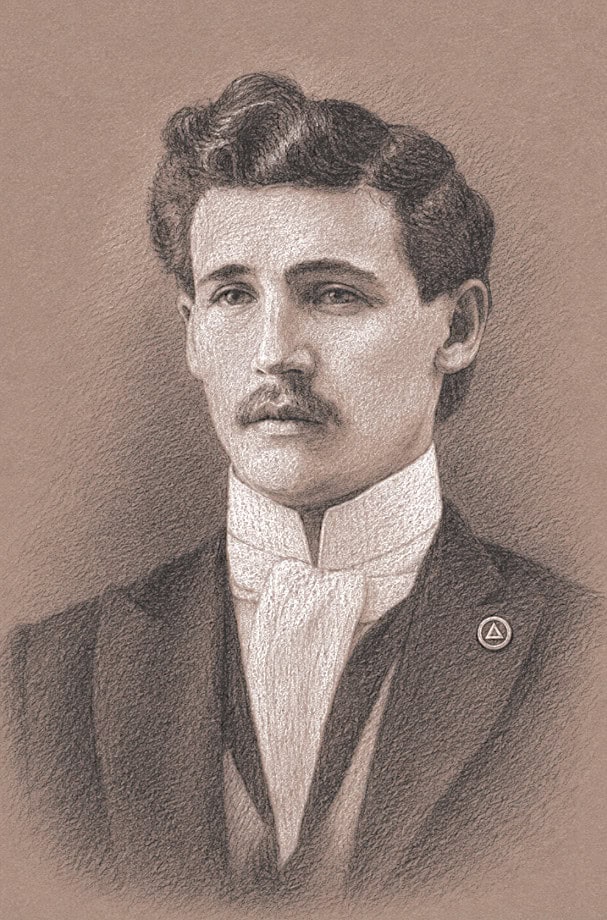
Reuben Swinburne Clymer (November 25, 1878–June 3, 1966) was an American physician, natural healer, occultist, author, publisher, and one of the leading American Rosicrucian figures of the twentieth century. In his early twenties, Clymer entered medical school in Chicago and also became a student of Herbert A. Parkyn at the Chicago School of Psychology. During his time studying medicine and Suggestion, he was also deeply involved in occult studies.
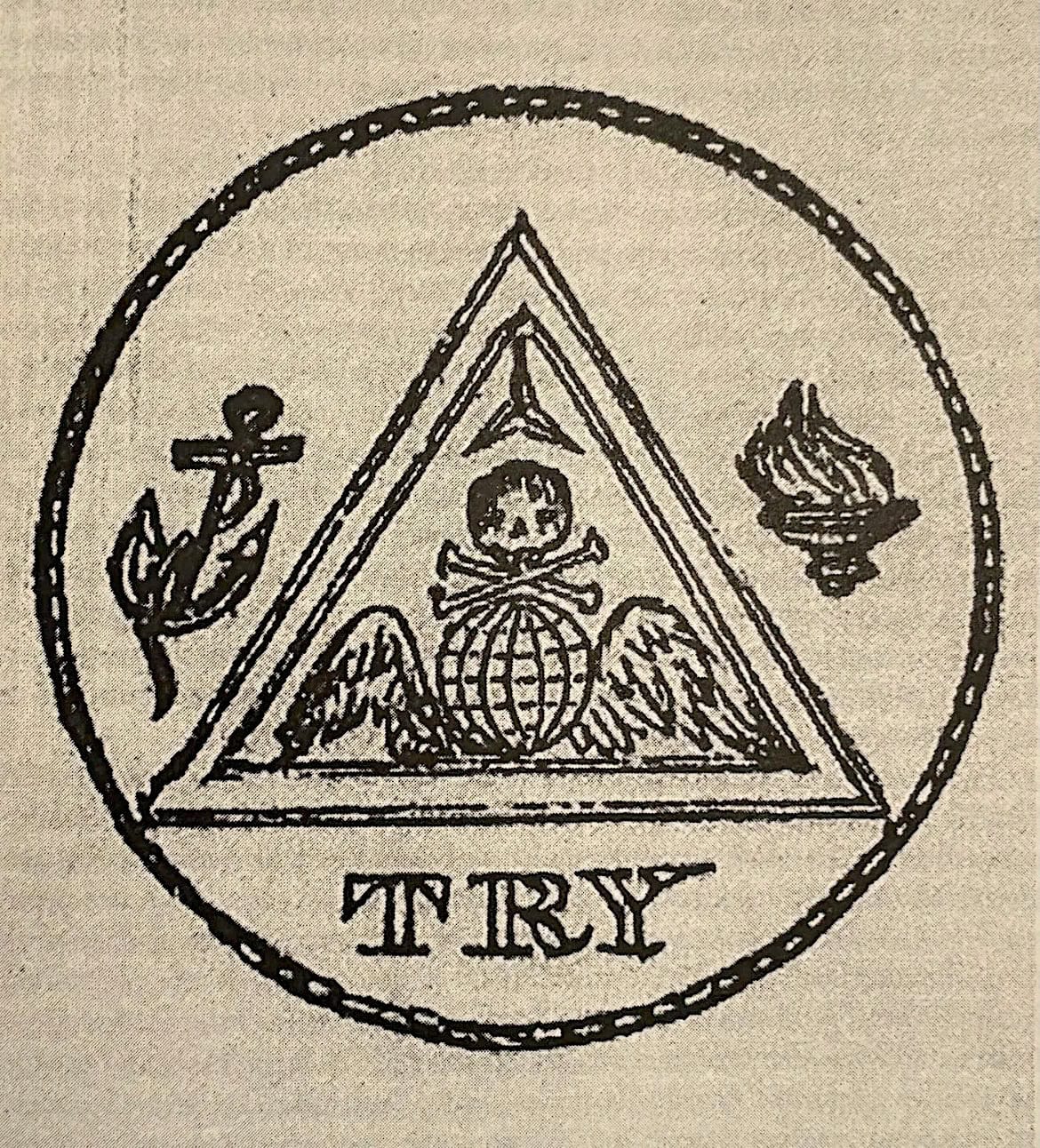
In the opening years of the twentieth century he worked with other graduates of Parkyn’s school, became active in the national medical-freedom movement, campaigned against compulsory vaccination, practiced natural and electro-therapeutic medicine, and contributed to Parkyn’s Suggestion magazine. During these same years he advanced rapidly through the Fraternitas Rosae Crucis, became Grand Master in 1905, established The Initiates: A Rosicrucian Magazine in 1908, and developed the Quakertown headquarters that became Beverly Hall. His Philosophical Publishing Company issued and preserved a vast body of literature dealing with natural healing, suggestion, alchemy, Hermeticism, Christian mysticism, occult initiation, sexuality, ancient religion, and especially the teachings of Paschal Beverly Randolph.
His connections with Parkyn, Henry Clay Hodges, The Stellar Ray, Randolph’s Hermetic writings, and the 1913 YPS book The Maid, the Man and the Mystic also place Clymer within the network surrounding the Yogi Publication Society during one of the most active periods in American occult publishing.
Who Was R. Swinburne Clymer?

Clymer was born in Quakertown on November 25, 1878, and entered adulthood during a period when medicine, psychology, psychical research, mental healing, spiritualism, and occult philosophy were rapidly intersecting in the United States. His interests crossed all of these fields. He pursued medical studies in Chicago while also studying psychological and occult systems of healing, and from the beginning he treated physical health, mental activity, and spiritual development as closely connected subjects. This combination remained characteristic of his career long after he became best known as a Rosicrucian leader.
An important part of Clymer’s Chicago education came through Herbert A. Parkyn’s Chicago School of Psychology. Parkyn had developed a system of suggestive therapeutics in which the therapeutic power traditionally attributed to hypnotic sleep was traced instead to the action of suggestion upon the involuntary mind. His school taught the laws of suggestion and their application to health, habit, mental control, concentration, auto-suggestion, personal development, and the relationship between mental and physiological action. Clymer graduated from the Chicago School and became part of the circle of students who carried Parkyn’s methods into their own schools, healing practices, publications, and organizations.
Clymer was already working within this network by 1900, when he joined fellow Chicago School graduate Rev. H. Warner Newby at the Twentieth Century Physio-Medical College. By this point, he was also working as a practicing physician, teaching in medical organizations, and contributing to publications.
Clymer, Parkyn and the Fight for Medical Freedom
Clymer’s early medical career developed during a major fight over the legal rights of non-drug practitioners. Osteopaths, magnetic healers, mental healers, suggestive therapists, Christian Scientists, and other practitioners faced increasingly restrictive state medical laws, leading Parkyn to organize the Natural Healers Protective League in April 1900 from his Chicago offices. The League sought to unite natural healers, provide legal protection for practitioners facing prosecution, and oppose legislation that would place healing exclusively under the control of orthodox medical organizations. Parkyn also wanted standards within the movement and repeatedly warned that untrained operators and fraudulent healers threatened the legitimacy of those doing serious work.
Parkyn launched The Natural Healer in July 1900 as the official publication of the League. The movement expanded in January 1901 with the creation of the United States Confederation of Medical Rights Leagues, and its new publication, Our Home Rights, began that May under Dr. Immanuel Pfeiffer. The Natural Healer was discontinued and its subscription list passed into Our Home Rights, allowing the campaign Parkyn had helped organize in Chicago to continue on a national scale.

Clymer became editor of the “Medical Freedom Department” of Our Home Rights in December 1901. Working in the same publication was E. Hood Corson, another graduate of Parkyn’s Chicago School, who edited the “Therapeutic Suggestion” department. Clymer was therefore working with at least two fellow Chicago School graduates during this early period, Newby in the Twentieth Century Medical School and Corson in Our Home Rights. His involvement with Parkyn was part of an identifiable professional network extending from psychological training into medicine, publishing, and organized campaigns for the legal protection of alternative healers.
Vaccination became one of Clymer’s most forcefully argued medical causes. In November 1901 he published an attack on compulsory vaccination under the headline “Vaccination Is a Curse to Humanity.” He continued campaigning on the subject and in October 1904 contributed an article opposing vaccination policies to Parkyn’s Suggestion. The appearance of Clymer in Suggestion is important because it demonstrates that his connection with Parkyn continued after his Chicago School training and his work in the medical-rights movement. It also places him directly in Parkyn’s publishing circle in 1904, only a year after the Yogi Publication Society had begun its work.
The Clymer Medical Institute and Natural Healing
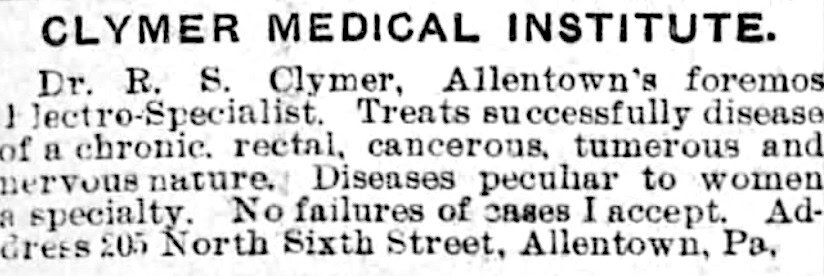
By 1906 Clymer was operating the Clymer Medical Institute at 205 North Sixth Street in Allentown, Pennsylvania. He promoted himself as an “Electro-Specialist” and treated chronic, nervous, rectal, cancerous, and tumorous conditions, with diseases affecting women among his specialties. He later registered as an osteopath in New York in 1910 and continued developing systems of natural healing, diet, mental control, and physical regeneration throughout his life.
Food and diet became an important part of this program. Clymer opposed red meat and connected diet with physical health, mental condition, and moral development. His system permitted fish, seafood, dairy products, and eggs and sought to remove foods he believed interfered with the body’s natural processes. Clara Witt’s The Rose Cross Aid Cook Book, issued with Clymer’s authorization in 1917, presented dietary instruction within this larger system, and Clymer followed it with Diet: The Way to Health in 1919. Later books such as Making Health Certain and Nature’s Healing Agents continued the work. Healing remained an important part of his teachings even after the Fraternitas Rosae Crucis became the dominant public identity of his career.
How Did Clymer Become a Rosicrucian Leader?
Clymer’s Rosicrucian development began while his medical career was taking shape. In 1899, at the age of twenty, he entered the Fraternitas Rosae Crucis as a neophyte under Freeman B. Dowd and continued his advancement under Dr. James R. Phelps. He progressed rapidly through the organization and became Grand Master of the Fraternitas Rosae Crucis in 1905 at the age of twenty-seven. Two years later, in 1907, he became Supreme Grand Master of the Aeth Priesthood.
The Rosicrucian world in which Clymer worked contained a collection of associated orders and initiatory bodies, including the Order of the Illuminati, Order of Melchizedek, Priesthood of Aeth, Ancient Order of the Magi, Sons of Isis and Osiris, Rosicrucian Brotherhood, Rosicrucian Order, Secret Schools, Hermetic Brotherhood of Luxor, Elphantes, and Atlantis. Clymer began bringing these affiliated bodies into a more organized structure during the opening years of the century, and in 1908–1909 they were consolidated under the Royal Fraternity Association.
The year 1908 also brought Clymer back to his native Quakertown. He obtained property there for the future headquarters of the Fraternity and began developing the location that would become Beverly Hall. A chapel was completed in 1911, the first convocation on the property was held that June, and Beverly Hall itself was completed in 1912. Quakertown thereafter became the center of Clymer’s publishing, educational, religious, and Rosicrucian activities.
Paschal Beverly Randolph and Clymer’s Rosicrucian Program
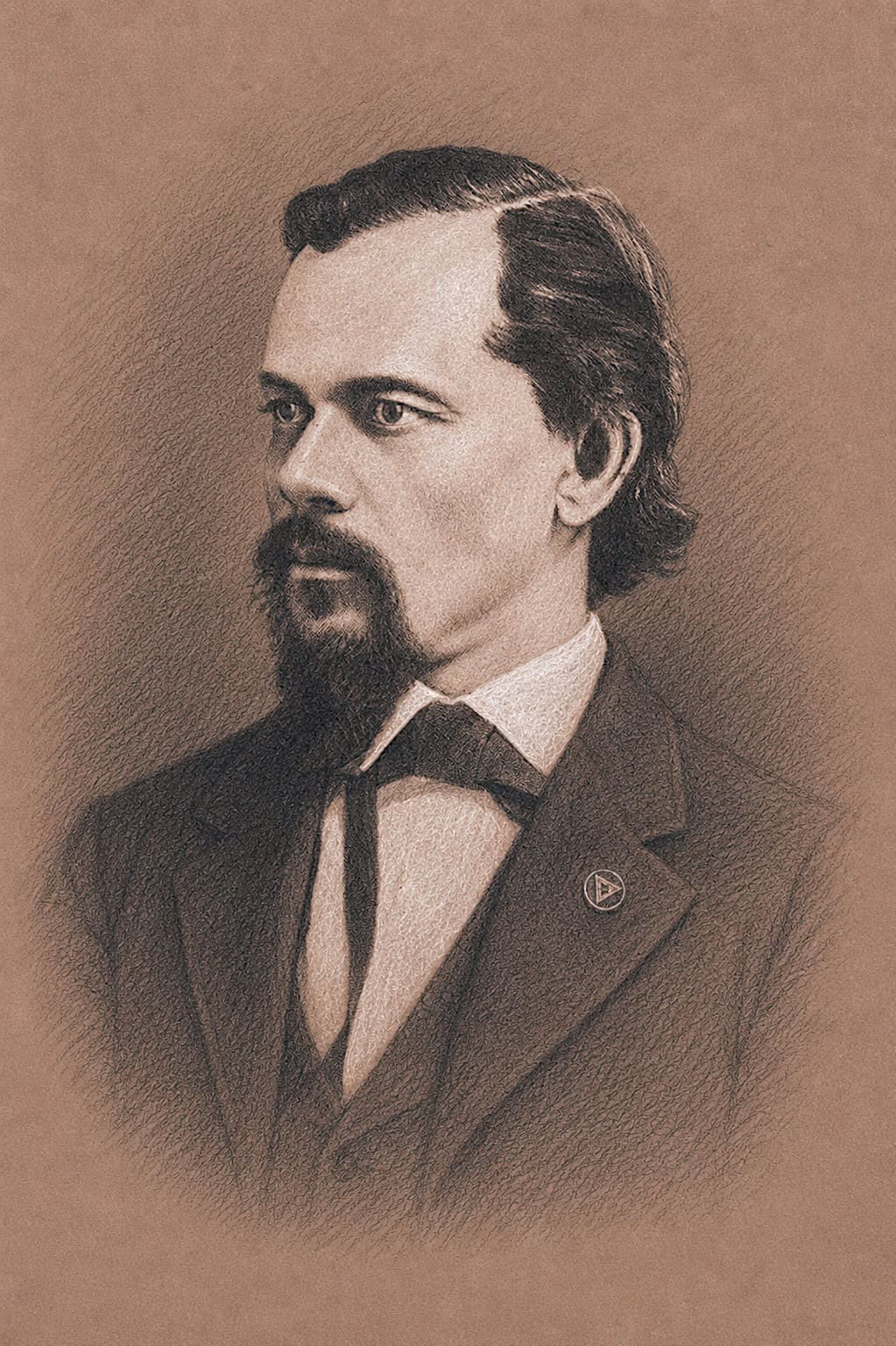
Paschal Beverly Randolph became the most important historical figure in Clymer’s understanding of American Rosicrucianism. Randolph had spent the nineteenth century moving through spiritualism, trance mediumship, medicine, occult philosophy, sexuality, magic, travel, religious study, and Rosicrucian teaching. His writings developed an unusual synthesis of spiritual development, occult initiation, Hermetic philosophy, the powers of the mind, human sexuality, and the possibility of consciously transforming the individual.
Clymer devoted a large part of his publishing career to preserving Randolph’s books and establishing him as the central American transmitter of the Rosicrucian tradition. Through the Philosophical Publishing Company, Randolph’s writings remained available to twentieth-century readers and became foundational texts within Clymer’s Fraternitas Rosae Crucis. Clymer also organized Randolph’s teachings into a more systematic initiatory program and developed an extensive historical lineage around them, tracing the Fraternity through earlier European occult and Rosicrucian bodies. Some portions of this historical reconstruction have remained disputed, but Randolph’s position within Clymer’s own system was unmistakable. Clymer regarded his work as a continuation of the tradition Randolph had established in America.
Randolph’s importance also brings Clymer into a much older meeting of Eastern and Western esoteric ideas. Randolph had already incorporated concepts from Asian religion and philosophy into a system that included Rosicrucianism, Hermeticism, Christianity, spiritualism, and occult initiation. Clymer preserved this material during the same period that American occult publishers were increasingly combining Hindu philosophy, Yoga, mental science, Western esotericism, and Hermetic philosophy.
Randolph’s Pymander and the Hermetic Tradition
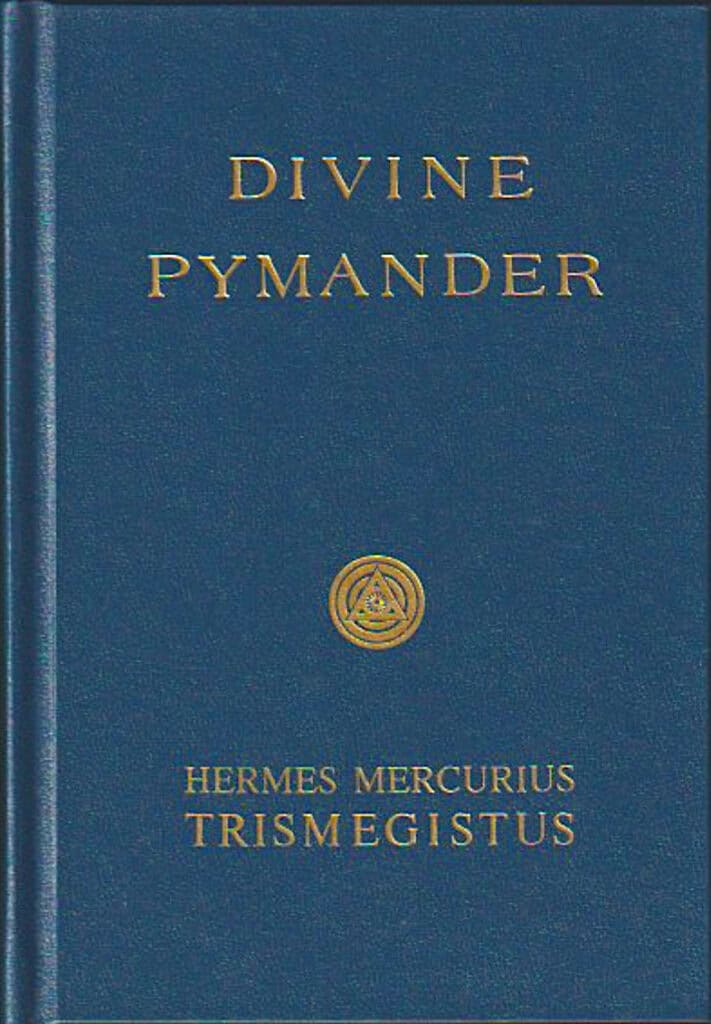
One of the most important examples was Randolph’s edition of Hermes Mercurius Trismegistus: His Divine Pymander, published by the Randolph Publishing Company in Toledo in 1889 from John Everard’s English translation. The Pymander belongs to the ancient Hermetic literature attributed to Hermes Trismegistus and teaches the nature of Divine Mind, creation, humanity, spiritual regeneration, knowledge of God, and the soul’s return toward its divine source.
Randolph placed this material directly into his Rosicrucian program. The preface presents the Pymander as foundational instruction for those seeking the ancient wisdom preserved through the Rosicrucian Brotherhood, giving the work a specific initiatory purpose beyond its value as an old Hermetic text. The edition also includes the section “Brahm,” which introduces Vedic religious and philosophical ideas into a volume centered upon Hermes and the Hermetic tradition. Rosicrucianism, Hermetic philosophy, and Indian religious ideas were thus being deliberately brought together within a single American esoteric program decades before similar combinations became familiar through New Thought and Yogi publishing.
This material remained part of the Randolph inheritance that Clymer carried into the twentieth century. Its importance increased during a period when Hermetic philosophy was again being presented to a large American readership. In 1908 the Yogi Publication Society issued The Kybalion under the name Three Initiates, presenting seven Hermetic principles as an expression of the ancient teachings associated with Hermes Trismegistus. Clymer was simultaneously preparing a major expansion of his own public Rosicrucian work.
1908 and the Beginning of The Initiates
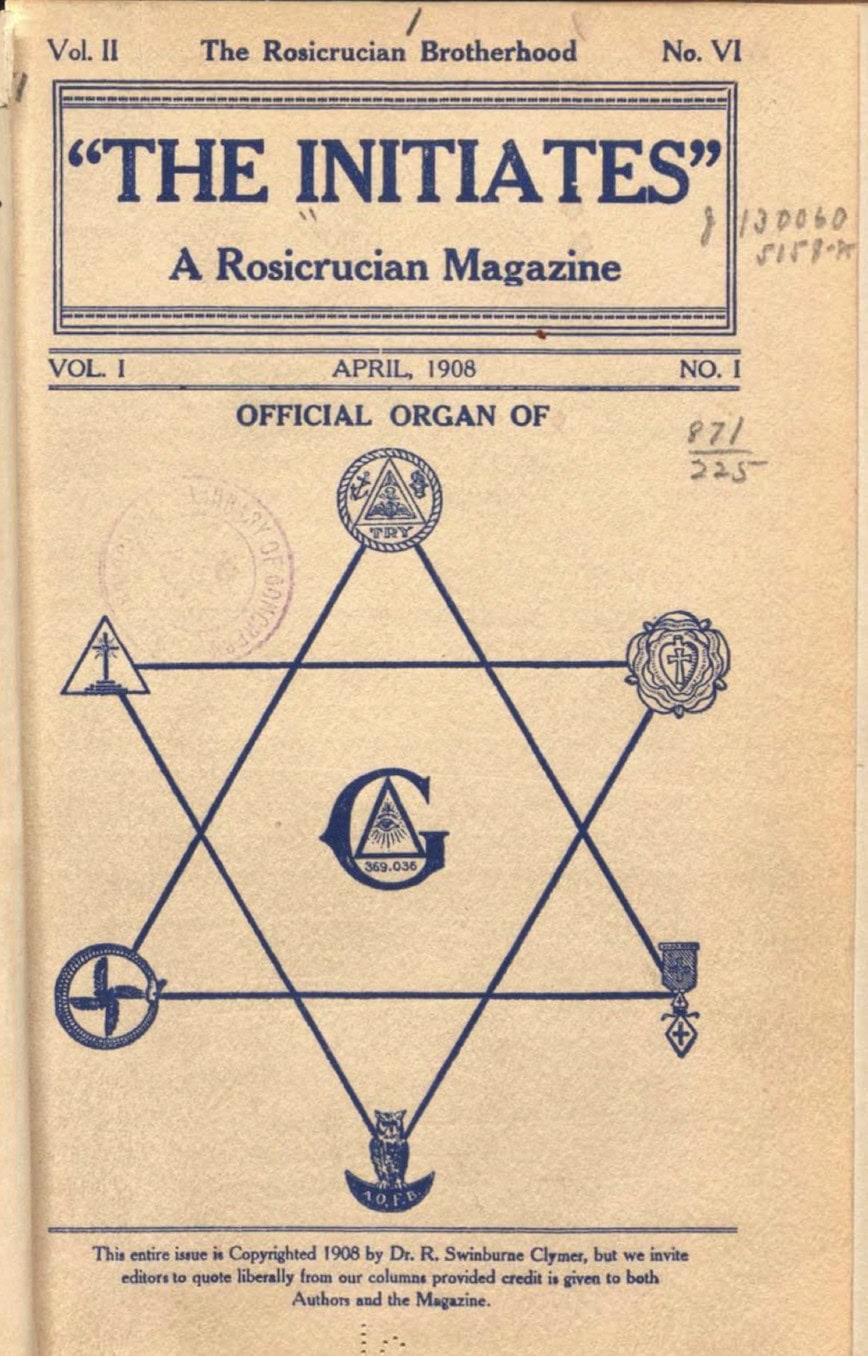
In April 1908 Clymer launched The Initiates: A Rosicrucian Magazine through the Philosophical Publishing Company. The magazine identified itself directly with the Rosicrucian Brotherhood and became a vehicle for Rosicrucian philosophy, alchemy, psychic phenomena, occult literature, ancient religions, initiatory organizations, and the work of other figures in the American esoteric world. It appeared during the same year Clymer was consolidating associated Rosicrucian bodies and establishing the Quakertown property that became the permanent home of his movement.
The title creates an unusual historical parallel with The Kybalion, which appeared that same year under the authorship of the Three Initiates. The similarity of the names does not establish an authorship connection, but the surrounding relationships make the coincidence worth recording. Clymer was already a former student of Parkyn and a contributor to Suggestion, and one of the most visible supporters of his new Rosicrucian magazine was Henry Clay Hodges, the wealthy Detroit businessman and Parkyn relative who had acquired Suggestion at the end of 1906.
Hodges had continued the publication as The Stellar Ray and used The Initiates to promote both the magazine and his own occult books. Advertisements for The Stellar Ray appeared alongside his multi-volume The Science and Key of Life, which combined astrology and modern scientific language with teachings attributed to ancient Chaldean and Egyptian sources. Hodges’s work also entered the editorial pages of The Initiates. His Two Thousand Years in Celestial Life, published through the Astro Publishing Company in Detroit, received extensive coverage through Annie Bright’s discussion of his communications with the psychic personality “Clytina,” including séances in which messages were said to have been transmitted through a telegraph instrument.
Clymer’s relationship with Hodges is important because it continued an earlier line of association without requiring a new one to be created. Clymer had already studied under Parkyn and written for Suggestion. When Hodges took control of that publication and continued it as The Stellar Ray, his work then appeared prominently inside Clymer’s new Rosicrucian magazine. The connection survived a change of publications and moved directly into the period when Clymer was making his Rosicrucian teachings increasingly public.
The Rosicrucian Brotherhood Opens Its Teachings
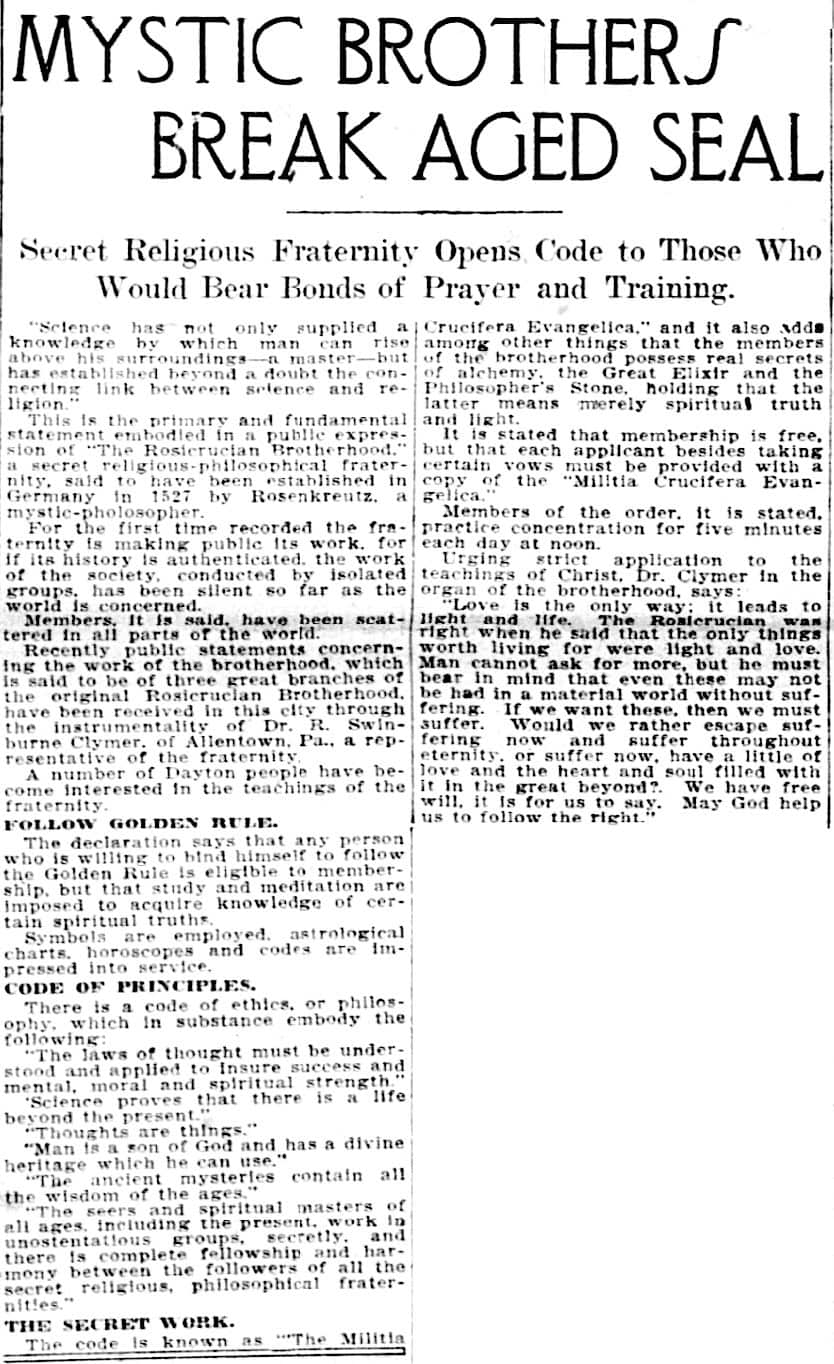
That public movement became unmistakable in February 1909. On February 17, Clymer announced the opening of previously private Rosicrucian work under the dramatic newspaper headline “Mystic Brothers Break Aged Seal.” The Rosicrucian Brotherhood was inviting outside students to enter a structured course of prayer, study, vows, and spiritual training that had previously remained within more restricted initiatory circles.
The instruction dealt with ancient mysteries, the development of thought, mental and spiritual strength, symbolism, alchemy, astrology, spiritual discipline, and the attainment of greater self-knowledge and knowledge of the divine. The Militia Crucifera Evangelica formed part of the program, while the Philosopher’s Stone and the Great Elixir were interpreted within a spiritual and initiatory system concerned with inner transformation.
Clymer had moved quickly. Within a few years he had risen to the leadership of his Rosicrucian organization, established The Initiates, consolidated affiliated bodies, obtained a permanent home for the Fraternity, and begun opening parts of its teachings to a larger public. The private fraternity was becoming a publishing and educational institution capable of reaching students far beyond its physical lodges.
Clymer as an Author, Publisher and “Pythagoras 38”
The Philosophical Publishing Company became one of Clymer’s principal means of carrying this program forward. His early books already show the range of subjects he intended to unite. The Thomsonian System of Medicine appeared in 1905, True Spiritualism in 1906, and The Philosophy of Fire in 1907. These were followed by works dealing with Rosicrucianism, initiation, Christianity, spiritual development, ancient mysteries, alchemy, healing, sexuality, and immortality, including Christhood and Adeptship, The Rosicrucians, Their Teachings and Mysteries, International Esoteric and Illuminated Bible Lessons, The Illuminated Faith, The Way to Life and Immortality, The Way to Godhood, The Divine Spark and the Great Pyramid, and The Æth Mystery.
Clymer also used a pseudonym in his occult publishing. In 1910 The Grand Grimore appeared under the name “Pythagoras 38.” The book was designed as an occult training manual and included material dealing with magical evocation, imagination, breathing exercises, planchette work, talismans, and older grimoire traditions. The use of “Pythagoras 38” allowed Clymer to place a distinct esoteric identity over this branch of his instruction, adding him to the many occult authors and publishers of the period who used assumed names to present specialized bodies of teaching.
His publishing work eventually became enormous. The Book of Rosicruciae, developed into three volumes totaling more than eight hundred pages, brought together Rosicrucian history, philosophy, symbolism, biographies of alchemists and Hermeticists, and the traditions Clymer associated with the Fraternity. The Fraternitas Rosae Crucis explored its origins and its relationship with older Hermetic and alchemical traditions, while his other books treated Egyptian mysteries, the Gospel of John, sex and regeneration, mental development, health, diet, and spiritual immortality. The Philosophical Publishing Company also gave Clymer the means to preserve older works that might otherwise have disappeared from circulation.
Clymer and The Maid, the Man and the Mystic

A direct connection between Clymer’s work and the Yogi Publication Society appeared in 1913 with Marguerite Louise Verdier’s The Maid, the Man and the Mystic, published in Chicago by the Yogi Publication House. Verdier constructed the book as a novel, using a romantic narrative and a Yellowstone setting to carry extensive teachings concerning Vedanta, Yoga, psychic development, spiritual initiation, and the common spiritual foundation of the world’s religions. Clymer was acknowledged among the influences behind the book.
More than forty years later, Clymer returned to Verdier’s work and made its relationship with his Rosicrucian system explicit. In 1956 the Philosophical Publishing Company at Beverly Hall issued a substantially revised posthumous version as The Master Initiate and the Maid. Clymer supplied a new prologue explaining that the original novel concealed Verdier’s initiatory training and experiences. He identified ideas within the story with Prana, the Lesser Light, the Great Work, the Aryan Society, and an “August Fraternity,” and revised portions of the terminology so that the initiatory meaning he found in the original book would be more clearly expressed.
The publishing history of Verdier’s work forms an unusual bridge between the two organizations. A book combining Indian philosophy and Western occult initiation appeared through the Yogi Publication House in 1913 with Clymer acknowledged as an influence. Decades later, Clymer’s own Philosophical Publishing Company preserved the book and brought it directly into the Rosicrucian instructional tradition centered at Beverly Hall.
Beverly Hall and the Fraternitas Rosae Crucis
Clymer’s position became permanent after the death of Edward Brown on May 11, 1922, when he succeeded him as Supreme Grand Master of the Fraternitas Rosae Crucis. He remained in that position for forty-four years. Beverly Hall became the physical center of the Fraternity and the headquarters from which Clymer directed its publishing, educational, religious, healing, and initiatory activities.
The network of affiliated organizations also continued to develop. In 1929 the Royal Fraternity Association became the Universal Confederation of Initiates and was registered in Pennsylvania as the Confederation of Initiates. Clymer spent much of the following decade working with European initiatory leaders toward an international federation, culminating in Paris on March 20, 1939, with the establishment of the Universal Confederation of Orders, Societies and Fraternities of Initiates. Books, manuscripts, organizational records, and other materials from European branches were also brought to Beverly Hall during this period, expanding the collections Clymer was assembling in Pennsylvania as Europe moved toward war.
The result was much larger than the Rosicrucian lodge Clymer had entered as a young man. By the middle of the twentieth century, Beverly Hall had become the headquarters of an extensive initiatory system supported by publishing, correspondence instruction, ceremonies, affiliated orders, historical collections, and a body of literature that Clymer had spent decades developing.
Clymer, Harvey Spencer Lewis and the Battle Over American Rosicrucianism
Clymer’s determination to establish the Randolph succession as the legitimate American Rosicrucian tradition eventually brought him into a prolonged conflict with Harvey Spencer Lewis and the Ancient Mystical Order Rosae Crucis, better known as AMORC. The disagreement centered upon which organization possessed legitimate Rosicrucian authority in America and expanded into disputes involving historical lineage, initiatory authority, occult teachings, organizational charters, sexuality, magical practice, and international recognition.
The conflict eventually became international. Lewis became involved with FUDOSI, while Clymer aligned with the competing FUDOFSI and European initiatory leaders including Constant Chevillon and Jean Bricaud. Aleister Crowley also entered the controversy through his connections with competing occult organizations and individuals. Clymer strongly attacked Lewis’s historical claims and his associations with Crowley, while AMORC responded with attacks upon Clymer and the legitimacy of his own organizations.
The dispute occupied a large part of Clymer’s later historical writing. His two-volume The Rosicrucian Fraternity in America, published in 1935 and 1936, presented his case for the Randolph succession while challenging the competing history advanced by Lewis. Other works continued the argument, making the controversy one of the most visible disputes in twentieth-century American Rosicrucianism.
Clymer’s Later Life and Legacy
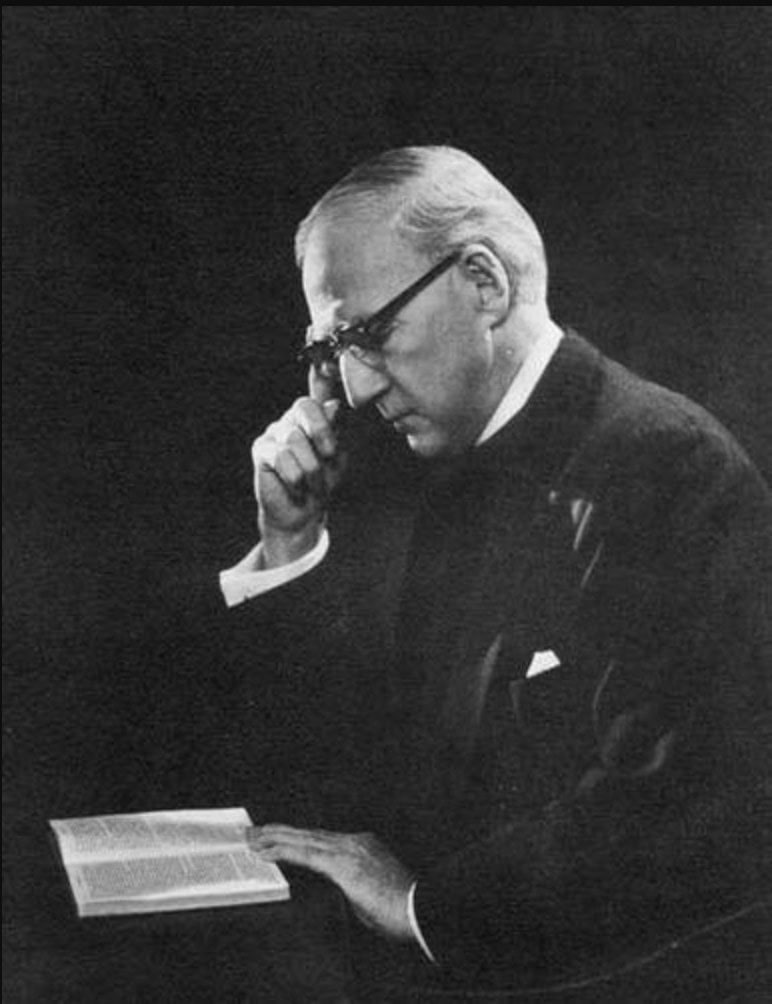
Clymer continued writing, publishing, teaching, and directing the Fraternitas Rosae Crucis from Beverly Hall into old age. His later work returned repeatedly to subjects that had occupied him since his youth, including natural healing, mental development, spiritual regeneration, sexuality, ancient mysteries, Christianity, and the transformation of the individual through disciplined training. His medical and occult interests never became separate careers. Both were grounded in his belief that the physical body, mind, character, and spiritual nature of the individual could be consciously developed according to discoverable laws.
He died on June 3, 1966, after more than sixty years of publishing and Rosicrucian activity. His son Emerson Myron Clymer succeeded him in the leadership of the Fraternitas Rosae Crucis. The organization continued at Beverly Hall, while the books Clymer published preserved a large collection of Rosicrucian, Hermetic, alchemical, and Randolph material that might otherwise have become extremely difficult to obtain.
Clymer’s place in the history of the Yogi Publication Society begins with something more concrete than a similarity of occult subjects. He belonged to Parkyn’s educational network before YPS existed, and his career remained connected with people and publications from that network as he developed into a major Rosicrucian leader. From the Chicago School and the medical-freedom movement to Suggestion, The Initiates, Henry Clay Hodges, The Stellar Ray, Randolph’s Hermetic legacy, and The Maid, the Man and the Mystic, his life provides an important route through the interconnected world in which the Yogi Publication Society developed. His biography helps recover a part of that world that disappears when New Thought, Rosicrucianism, Hermeticism, Yoga, natural healing, psychic research, and occult publishing are treated as isolated movements instead of the overlapping communities in which Clymer himself actually lived and worked.
Books by R. Swinburne Clymer:
- Thomsonian System of Medicine: With Complete Rules for the Treatment of Disease (Philosophical Pub. 1905)
- True Spiritualism (The Philosophical Publishing Company, 1906)
- The Philosophy of Fire (The Philosophical Publishing Co., 1907)
- Christhood and Adeptship (The Philosophical Publishing Co., 1910)
- The Grand Grimore (The Philosophical Publishing Co., 1910 – under pseudonym “Pythagoras 38*)
- The Rosicrucians, their teachings and mysteries (The Philosophical Pub. Co., 1910)
- International Esoteric and Illuminated Bible Lessons (The Philosophical Publishing Co., 1911)
- The Illuminated Faith: Mystical Interpretation of the Gospel of St. John (Philosophical Publishing Co., 1913)
- The Way to Life and Immortality; (The Philosophical Pub. 1914)
- The Way to Godhood: (Allentown, PA: Philosophical Pub. Co., ca. 1914)
- The Divine Spark, and The Great Pyramid, a Temple of Initiation (Printed by the Philosophical Pub. 1914)
- The Ath Mystery (The Philosophical Publishing Co., 1914)
- Making Health Certain (The Humanitarian Society, 1921)
- Mastership, the Divine Law (Philosophical Pub. Co., 1922)
- The Book of Rosicruciae (Philosophical Pub. Co., 1946)
- The Mystery of Sex and Race Regeneration (Quakertown, PA: Philosophical Pub. Co., 1950)
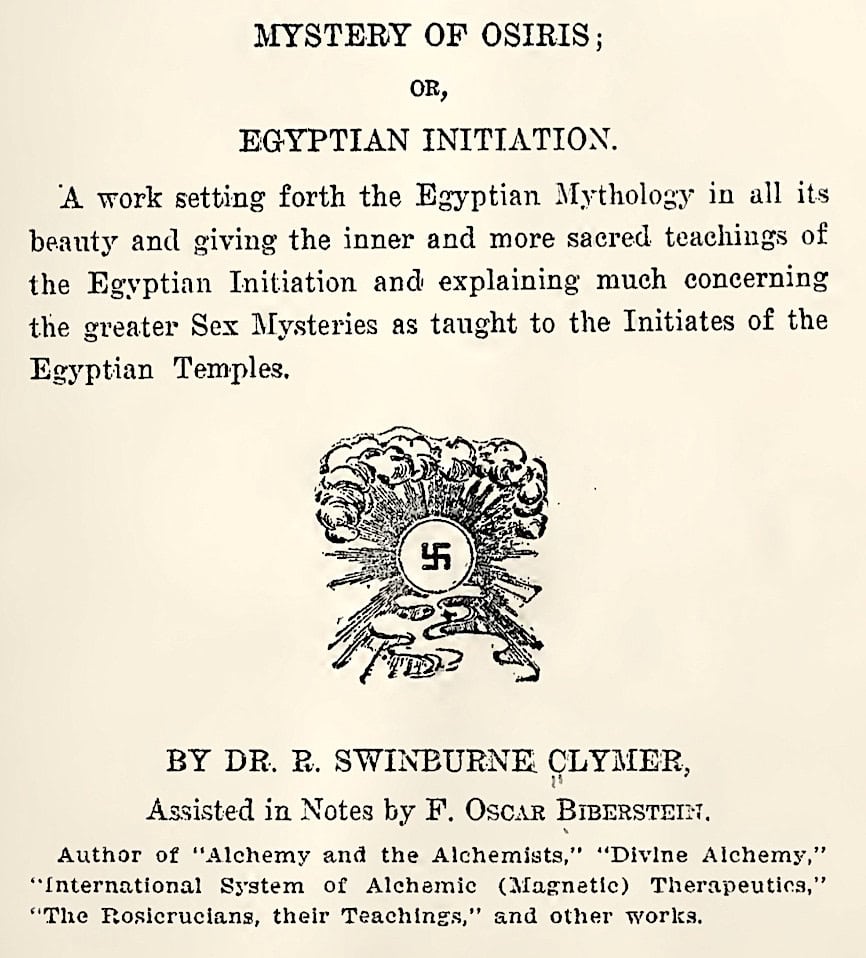
- The Mysteries of Osiris; or, Ancient Egyptian Initiation. (Philosophical Pub. Co., 1951)
- The Interpretation of St. John: An Exposition of the Divine Drama (Philosophical Pub. Co., 1953)
- Your Health, Your Sanity in the Age of Treason(Quakertown, PA: Humanitarian Society, c1958)
- The Age of Treason (Humanitarian Society, 1959)
- Nature’s Healing Agents: The Medicines of Nature (Philadelphia: Dorrance and Co., c1963)
- Alchemy and the Alchemists (AMS Press, 1982)
Sources & Citations
- Website. The historical context surrounding the publication of the Grand Grimore by Pythagoras 38
- Website. History of the Fraternitas Rosæ Crucis
- Newspaper. https://www.newspapers.com/article/the-belleville-news-democrat-on-vaccinat/182152712
- Newspaper. Clymer Medical Institute
- Newspaper. "E. Hood Corson was a graduate of Dr Parkyn's Chicago School of Psychology" . Journal Tribune. 1900-01-12. p. 10
- Newspaper. "Medical Rights League started in Massachusetts" . The Boston Globe. 1900-03-29. p. 4.
- PDF / Digital Archive. "Our Home Rights (IAPSOP)" . iapsop.com.
- PDF / Digital Archive. Suggestion magazine , Aug. 1900 pages 33-37
- PDF / Digital Archive. Unity magazine , July 1900, Page 186
- PDF / Digital Archive. The Progressive Thinker v24 n607 , July 3, 1901
- PDF / Digital Archive. "Our Home Rights (IAPSOP)" . iapsop.com. Retrieved 2025-11-16.
- Newspaper. "United States Confederation of Medical Rights Leagues" . North Adams Transcript. 1901-04-05. p. 8. Retrieved 2025-11-16.
- PDF / Digital Archive. Immortality magazine v2 n7 December 1899 edited by J .C. F. Grumbine. page 58
- Newspaper. "Medical Rights League started in Massachusetts" . The Boston Globe. 1900-03-29. p. 4. Retrieved 2025-11-16.
- Newspaper. "Dr. Immanuel Pfeiffer is president of the American College of Psychical Science" . Leaf-Chronicle Weekly. 1895-01-18. p. 3. Retrieved 2025-11-16.
- Newspaper. "Grumbine starts first college of psychical science" . The Boston Globe. 1900-03-11. p. 35. Retrieved 2025-11-16.
- Newspaper. "Immanuel Pfeiffer opens College of Psychical Science. Has lecture with William James" . Boston Evening Transcript. 1895-01-23. p. 5
- PDF / Digital Archive. The Initiates magazine
- PDF / Digital Archive. initiatesv3n2may1909
- PDF / Digital Archive. Fraternitas Rosae Crucis [FRC]" in The Element Encyclopedia of Secret Societies : The Ultimate A–Z of Ancient Mysteries, Lost Civilizations and Forgotten Wisdom by John Michael Greer, HarperCollins UK, p.122
- Book. "Clymer, R(euben) Swinburne" in Encyclopedia of Occultism & Parapsychology, Fifth Edition, ed. J. Gordon Melton, Gale group, vol 1, p.304-305
- Book. "Fraternitas Rosae Crucis" in Encyclopedia of Occultism & Parapsychology, Fifth Edition, ed. J. Gordon Melton, Gale group, vol 1, p.599-600
- Book. "Rosicrucians, Modern Rosicrucianism" in Encyclopedia of Occultism & Parapsychology, Fifth Edition, ed. J. Gordon Melton, Gale group, vol 2, p. 1327-1328
- PDF / Digital Archive. Encyclopedic Handbook of Cults in America by J . Gordon Melton, Routledge, p.99-100
- PDF / Digital Archive. R. Swinburne Clymer. (1923). Journal of the American Medical Association 81 (24): 2051-2052.
- PDF / Digital Archive. "A Hot Bed of the Anti-vaccine Heresy" : Opposition to Compulsory Vaccination in Boston and Cambridge, 1890-1905[permanent dead link] by Karen Walloch, ProQuest, p.177[permanent dead link] and p.273[permanent dead link]
- PDF / Digital Archive. "Rosicrucian chili" in Thirty-five Receipts from "The Larder Invaded" by William Woys Weaver, Library Company of Phil, p. 85
- Website. Hines, Mary Anne; Marshall, Gordon M; Weaver, William Woys. (1987). The Larder Invaded: Reflections on Three Centuries of Philadelphia Food and Drink. The Library Company of Philadelphia. p. 112. ISBN 0-914-07670-1
- Website. Clymer , R. Swinburne. (1919). Diet: The Way to Health. Quakertown, Pa. p. 57
- PDF / Digital Archive. Secret Societies by John Lawrence Reynolds , Skyhorse publishing, p.175-176
- PDF / Digital Archive. Paschal Beverly Randolph : A Nineteenth-Century Black American Spiritualist, Rosicrucian, and Sex Magician by John Patrick Deveney, SUNY press, p.140-143
- PDF / Digital Archive. The Hermetic Brotherhood of Luxor by Joscelyn Godwin , Christian Chanel, and John Patrick Deveney, Weiser books, p.67
- PDF / Digital Archive. "Clymer, Reuben Swinburne" in The Watkins Dictionary of Magic by Nevill Drury, p.150; also The Dictionary of the Esoteric by Nevill Drury, Motilal Banarsidass, p.52
- Book. "Church of Illumination" in Encyclopedia of Occultism & Parapsychology, Fifth Edition, ed. J. Gordon Melton, Gale group, vol 1, p.299
- PDF / Digital Archive. The Invisible History of the Rosicrucians by Tobias Churton , Inner Traditions, p.506-507
- PDF / Digital Archive. The Rosucrucians by Christopher McIntosh , Weiser books, p. 128-129
- Book. "Randolph, Paschal Beverly" in Encyclopedia of Occultism & Parapsychology, Fifth Edition, ed. J. Gordon Melton, Gale group, vol 2, p.1283-1284
- Book. "Gnostic Church" in Dictionary of Gnosis & Western Esotericism, ed. Wouter Hanegraaff, Brill Publishers, p.400-403
- Book. "Martinism: second period" in Dictionary of Gnosis & Western Esotericism, ed. Wouter Hanegraaff, Brill Publishers, p.780-783
- Book. "Rosicrucianism III: 19th-20th Century" in Dictionary of Gnosis & Western Esotericism, ed. Wouter Hanegraaff, Brill Publishers, p.1018-1020
- PDF / Digital Archive. In Search of the Swan Maiden : A Narrative on Folklore and Gender by Barbara Fass Leavy and Daniel G. Calder, NYU Press, p. 180
- PDF / Digital Archive. Vaccination Brought Home to You . (1904). Cleveland Medical and Surgical Reporter 12: 312.
- PDF / Digital Archive. Making the Detective Story American by J .K. Van Dover, McFarland, p.22 and p.25
- PDF / Digital Archive. The divine mystery by Clymer , R. Swinburne (Reuben Swinburne), 1878-1966
- PDF / Digital Archive. True spiritualism ; : Clymer, R. Swinburne (Reuben ...
- PDF / Digital Archive. R. Swinburne Clymer MD, DO
- PDF / Digital Archive. The Rosicrucians : Their Teachings and Mysteries
- PDF / Digital Archive. The Philosophy of Fire
- PDF / Digital Archive. Alchemy and the Alchemists
- PDF / Digital Archive. True Spiritualism ;: Also, a Contradiction of the Work
- PDF / Digital Archive. Nature's Symphony : Lessons in Number Vibration