Grumbine was a close associate of Parkyn, making him chair of his College, member of his Order of the White Rose, and connecting him to Vivekananda and Annie Besant.
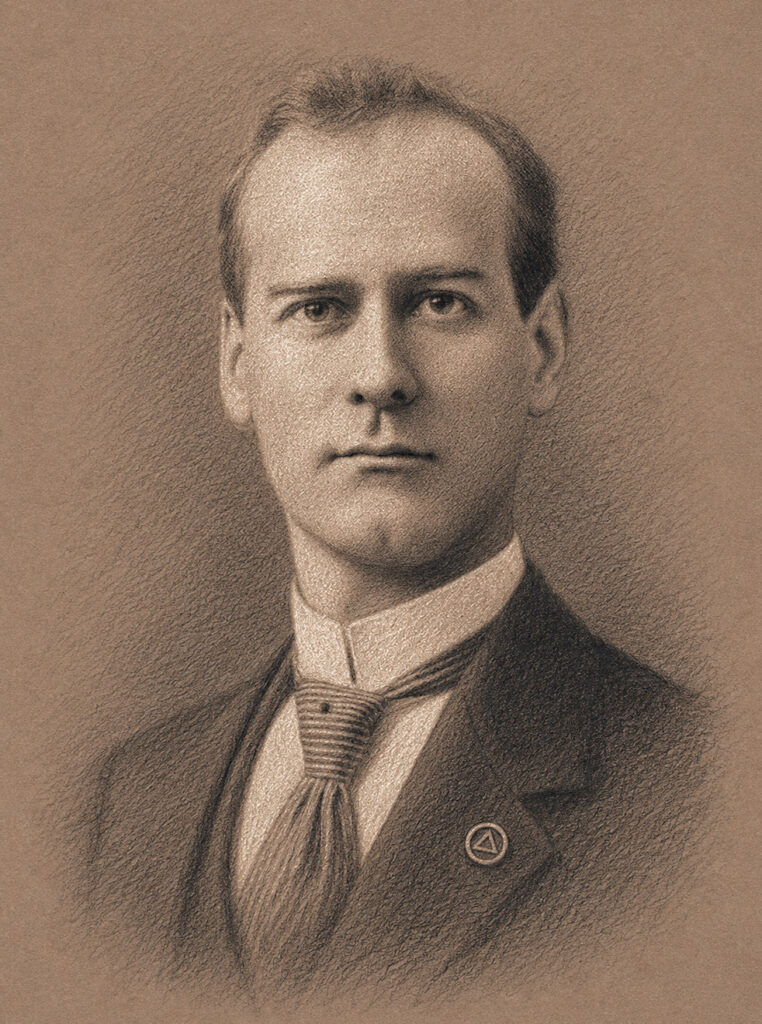
Jesse Charles Fremont Grumbine was an American Spiritualist, New Thought author, lecturer, and organizer. He is best known for founding the Order of the White Rose and the College of Psychical Sciences and Unfoldment. Through his schools, lectures, magazines, and many books on topics like clairvoyance, psychometry, and telepathy, he became a leading figure in American mind science and metaphysical movements in the late nineteenth and early twentieth centuries. Grumbine was first ordained as a Universalist minister and later served Unitarian congregations. In the 1890s, he left the ministry to focus fully on Spiritualism, psychical research, and comparative religion.
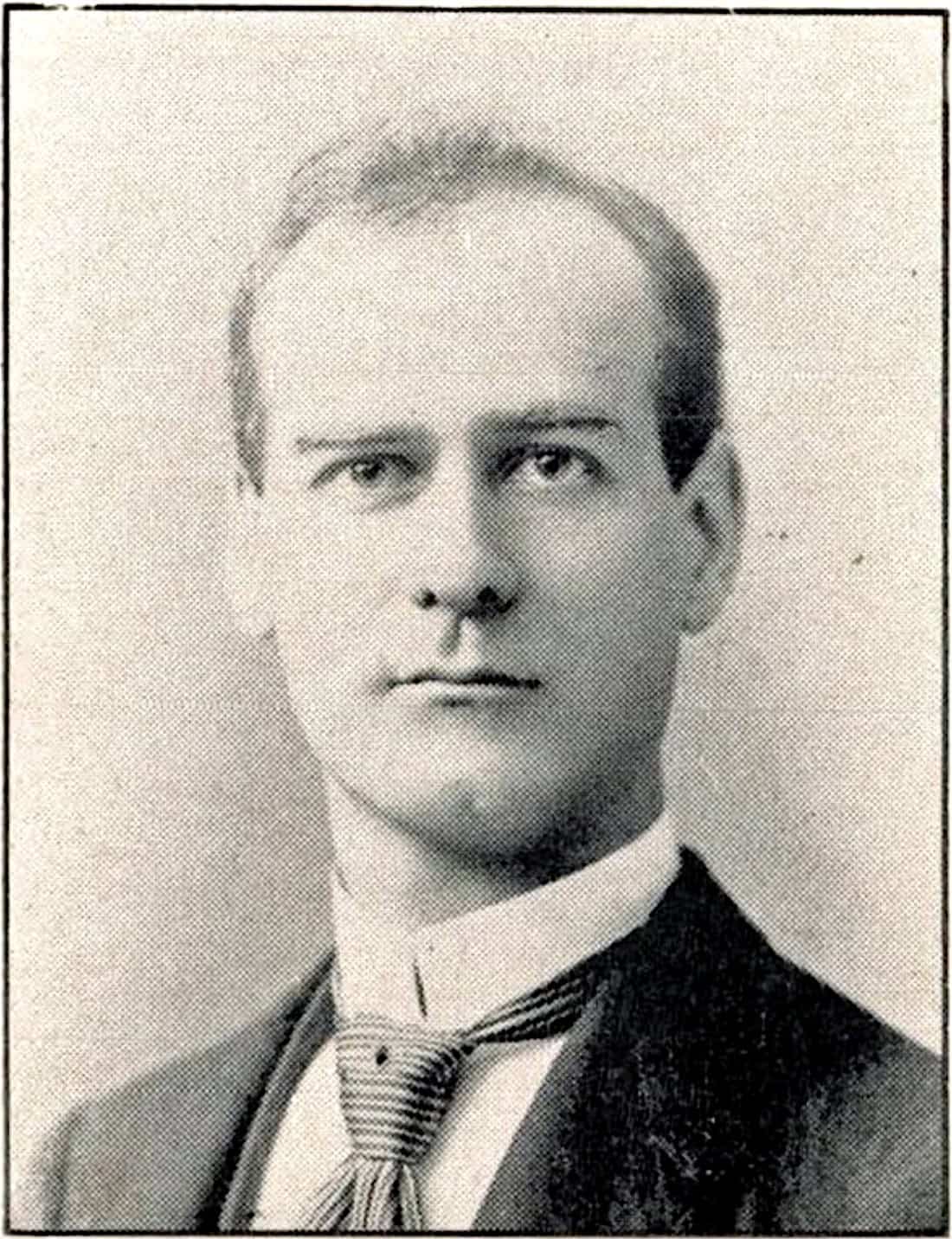
J. C. F. Grumbine
Early Life
Grumbine was born in Cincinnati, Ohio, on October 19, 1861, to Jerry and Mariana Scholl Grumbine. His father’s family was of Huguenot descent, with grandparents who came from Germany. His mother’s side traced its roots to early Dutch settlers in Pennsylvania. Grumbine went to Cincinnati public schools and graduated from the Art Department at the University of Cincinnati in 1883. He then studied theology at St. Lawrence University in Canton, New York, and graduated in 1885. By age twenty-three, he had started his ministry.
Universalist Church
Grumbine’s first roles were in the Universalist Church. In 1884, he became clerk of the Cayuga Universalist Association. From September 1885 to February 1888, he served as pastor of the First Universalist Society in Syracuse, New York. During this time, he became one of the city’s best-known young ministers and gained strong support from many in the congregation. He later moved to the Unitarian ministry, showing his growing interest in wider religious and philosophical ideas. While in Syracuse, Grumbine openly supported political economist Henry George and the United Labor Party during George’s 1887 campaign for Secretary of State. George’s economic philosophy, later called Georgism or the single-tax movement, said that people should keep the full value of their work, but the value of land and natural resources should be shared equally by society. Grumbine supported these ideas in public and served as chairman of the United Labor Party convention in Syracuse.
Grumbine’s political activism soon led to conflict with church leaders. In late 1887, the Universalist Church Society asked him to resign, saying his political work did not fit with his role as pastor. The issue split the congregation, and there were several heated meetings about whether he should stay. Grumbine strongly defended his beliefs and his right to speak about them in church. When the congregation voted, most supported him, so he kept his position as pastor, even though some still opposed him.
The Unitarian Ministry
The controversy in Syracuse marked a turning point in Grumbine’s career. Soon afterward he left the First Universalist Society and accepted a call to the Chapin Memorial Church in Oneonta, New York, where he entered the Unitarian ministry. Over the next several years he served Unitarian congregations in Oneonta, St. Joseph, Missouri, and Geneseo, Illinois. Although his denomination had changed, Grumbine’s interests continued to move beyond traditional theology. His sermons increasingly reflected a fascination with psychology, comparative religion, and the relationship between the physical and spiritual worlds. By the early 1890s, those interests had grown strong enough that he found it increasingly difficult to reconcile them with the responsibilities of parish ministry.
Embracing Spiritualism
In 1894, Grumbine resigned from the Unitarian ministry, explaining that his changing religious convictions made it impossible for him to continue honestly as a pastor. Rather than abandoning religion, he believed he was entering a field of spiritual inquiry. He publicly identified himself as a Spiritualist and devoted his life to investigating psychic phenomena, spiritual development, and the laws governing the unseen world. His resignation marked the beginning of a new career. Grumbine spent the next several years traveling extensively throughout the Midwest, lecturing on Spiritualism and psychical research. He spoke in Cincinnati, Muscatine, Minneapolis, and St. Paul before moving to Boston in 1895. By 1898 he had settled in Chicago, where he would establish the organizations for which he became best known.
Unlike many Spiritualists of his day, Grumbine emphasized that spiritual truth should be approached through disciplined study and personal experience rather than unquestioning belief. He taught that spiritual growth depended upon individual moral development and that genuine religious understanding could not be imposed through creeds or ecclesiastical authority. Communication with spirits, he believed, operated according to natural spiritual laws rather than supernatural intervention, and he frequently challenged popular theories that he regarded as speculative or unsupported.
The College of Psychical Sciences and Unfoldment
The College of Psychical Sciences and Unfoldment with Parkyn as Chair of Suggestive Therapeutics.
In 1894, while still living in Geneseo, Illinois, Grumbine founded the College of Psychical Sciences and Unfoldment, an institution devoted to the systematic study of psychology, psychical research, and spiritual development. At a time when few organizations attempted to unite these subjects under a single educational program, the College offered correspondence instruction covering metaphysics, ontology, clairvoyance, psychometry, intuition, inspiration, hypnotism, telepathy, suggestive therapeutics, psychopathy, and illumination.
When the College relocated to Chicago in 1898, it established its headquarters at 3960 Langley Avenue on the city’s South Side. Its faculty reflected the growing collaboration between leaders in the fields of Spiritualism, psychology, and mind science. W. J. Colville, one of the best-known lecturers in the Spiritualist movement, served as Chair of Mental and Spiritual Science, while Dr. Herbert A. Parkyn, founder of the Chicago School of Psychology, became Chair of Suggestive Therapeutics.
Parkyn’s school was located only a few blocks away, creating a close working relationship between the two institutions. Students trained in Parkyn’s scientific system of Suggestive Therapeutics could continue their studies at Grumbine’s College, where instruction expanded into psychical research, comparative religion, and the more philosophical questions surrounding consciousness and spiritual development. Similar opportunities were available through Colville’s Brooklyn School of Psychology, another institution closely associated with Parkyn’s educational network.
The College also attracted an unusually accomplished board of directors. Among its members were the American Impressionist painter Richard B. Gruelle, railroad executive Lowry W. Goode, Minneapolis physician and electro-magnetic healer Dr. J. Swanson, and businessman Erastus C. Gaffield, who would later become an influential New Thought author. The institution continued to evolve in the following years and eventually operated under the name College of Divine Sciences and Realization.
Parkyn and Grumbine shared a commitment to scientifically reveal the mysteries of the Occult
Parkyn and Grumbine had a shared commitment to distinguishing serious psychical research from what both men viewed as the excessive mysticism dominating turn-of-the-century occult literature. Grumbine had criticized the “occult rubbish” of the contemporary occult revival for misleading seekers, particularly targeting Theosophy and what he described as its overuse of “Oriental phraseology” and “mystic or cabalistic symbology,” which he believed obstructed direct spiritual realization. While both Grumbine and Parkyn were devoted students of ancient systems such as Hermeticism and Hinduism and believed they contained real insight into spiritual law, they objected to the way these traditions were often cloaked in obfuscating language and divorced from practical application. Their emphasis was not on rejecting ancient wisdom, but on clarifying that spiritual and psychological influence depended on disciplined practice aligned with natural law, and a mastery of one’s own mental and moral faculties rather than mystical speculation.
Like Parkyn and Sudduth’s experiments, Grumbine also worked with materials science, optics, and color theory, integrating it with metaphysical principles, asserting that all sensory phenomena of light, color, and form were ultimately governed by spiritual law. Color, for example, was treated as a vibratory mode or aura, reflecting the moral and psychic state of the observer. In his 1897 book Clairvoyance, Grumbine described consciousness as the central medium through which divine impressions were received, insisting that the brain merely reflected thought rather than produced it
The Order of the White Rose
The Order of the White Rose
In 1893, Grumbine founded the Order of the White Rose, a Rosicrucian organization that became the spiritual counterpart to the College of Psychical Sciences and Unfoldment. While the College provided formal instruction through correspondence courses and lectures, the Order offered students an opportunity to continue their studies within a philosophical and spiritual community devoted to what Grumbine called “Universal Religion.”
At the heart of the Order was the belief that all of the world’s great religious traditions reflected the same underlying spiritual reality. Rather than viewing Christianity, Buddhism, Zoroastrianism, and other faiths as competing systems, Grumbine taught that each represented a different expression of universal truth. Figures such as Jesus, Buddha, and Zoroaster were regarded as inspired teachers who revealed the same divine principles to different cultures and generations. Spiritual understanding, he believed, came not through unquestioning acceptance of religious authority, but through personal experience, inner development, and direct communion with the spiritual world.
Grumbine traced the inspiration for the Order to a series of spiritual communications he believed he had received from the English poet Elizabeth Barrett Browning while serving as a Unitarian minister. According to his account, these communications provided guidance that shaped many of the Order’s central teachings. He later published them in a small volume titled Proofs of Spirit Identity and Guidance, presenting them as evidence of the continued existence and activity of the spirit after death.
Elizabeth Barrett Browning
Membership in the Order was reserved for students who had completed the College’s four courses of instruction, which together formed what Grumbine described as his “System of Philosophy Concerning Divinity.” Members were invited to participate in the Parlors of the Order of the White Rose, a series of lectures and discussions devoted to spiritual illumination, psychic development, and philosophical study. As chair of the Department of Suggestive Therapeutics, Dr. Herbert A. Parkyn held a formal role within the Order, which placed him in its inner ranks and affirmed his direct participation in its esoteric teachings. Chapters of the Order were active across the United States, with locations in Los Angeles, Denver, Griffin (Georgia), Jacksonville, St. Louis, Chicago, New York, Boston, Syracuse, Washington D.C., Philadelphia, and Lowell (Massachusetts)
The organization itself was divided into two branches. The Spiritual Order of the White Rose served as the exoteric, or public, division, while the Spiritual Order of the Red Rose formed the inner esoteric order for more advanced students. Under Grumbine’s leadership, the movement expanded far beyond Chicago, establishing centers throughout the United States as well as in London and Madras, India. By the turn of the twentieth century, the Order had become one of the most influential Rosicrucian organizations operating within the American Spiritualist and New Thought movements.
Objects of the Order
The constitution of the Order of the White Rose reveals the remarkable breadth of Grumbine’s vision. More than simply a Rosicrucian society, he intended the organization to become an international movement devoted to what he called Universal Religion, the belief that all genuine religious traditions express the same fundamental spiritual truths.
The Order sought to unite philosophy, religion, psychology, and psychical research into a single system of study. Its members were encouraged to cultivate what Grumbine regarded as humanity’s latent spiritual faculties, including clairvoyance, clairaudience, psychometry, intuition, telepathy, healing, and spiritual illumination. These abilities were presented not as supernatural gifts reserved for a select few, but as natural capacities that could be developed through disciplined study, moral growth, and spiritual practice.
Education stood at the center of the movement. The College of Psychical Sciences and Unfoldment served as the Order’s educational institution, providing systematic instruction in Grumbine’s System of Philosophy Concerning Divinity. Graduates were encouraged to establish local chapters where lectures, classes, and study groups could continue the work, while the Order also sought cooperation with like-minded philosophical and spiritual organizations throughout the world.
Despite its esoteric interests, the constitution emphasized that the organization was to remain strictly non-sectarian and non-political. Members were free to retain their own religious affiliations and political beliefs while participating in the Order, reflecting Grumbine’s conviction that spiritual truth transcended denominational and ideological boundaries.
The Order of the White Rose constitution
Immortality Magazine
In June 1898, Grumbine expanded the reach of the Order by founding Immortality, the organization’s official magazine. The journal quickly became one of the leading periodicals devoted to Spiritualism, Mental Science, Divine Science, Theosophy, psychical research, and comparative religion. It also became one of the principal forums where many of the leading figures of the metaphysical movement exchanged ideas at the turn of the twentieth century.
Dr. Herbert A. Parkyn enthusiastically endorsed the publication in Suggestion, calling it “the very best of the psychical publications.” The endorsement reflected the close relationship between Grumbine’s College and Parkyn’s Chicago School of Psychology, whose faculty and students regularly moved between the two institutions.
Herbert A. Parkyn’s endorsement of Immortality which Grumbine prominently featured in many issues of the magazine.
The magazine’s contents reflected the extraordinary diversity of Grumbine’s interests. Regular departments explored Hermetic philosophy, mysticism, psychology, and psychic development, while The Academy presented dialogues said to transmit teachings from the Christ, Platonic, and Hermetic spheres through the voices of ancient philosophers, seers, and initiates. Another recurring department, The Editor’s Tripod, offered Grumbine’s commentary on contemporary events from what he described as a Platonic perspective.
Perhaps most significant was the range of contributors who appeared in its pages. Alongside leading American Spiritualists such as W. J. Colville, Cora L. V. Richmond, and Jerome A. Anderson, Immortality also published material by Annie Besant, Swami Vivekananda, Swami Saradananda, and Swami Abhayananda. Few American magazines of the period brought together such a wide range of voices representing Spiritualism, Theosophy, Vedanta, Hermetic philosophy, and the emerging New Thought movement. As a result, Immortality became one of the key publications through which these traditions were introduced to an English-speaking audience and discussed side by side.
Sacred Geometry, Numerology, and the Language of Creation
One of the most distinctive features of Immortality was the importance it placed on sacred geometry and the symbolic meaning of numbers. Drawing upon Hermetic philosophy, Rosicrucianism, Freemasonry, and classical occult traditions, Grumbine presented number and geometric form as a universal language through which the principles of creation could be understood. Rather than treating mathematics as merely a practical science, he regarded it as one of the clearest expressions of divine intelligence.
Throughout the magazine, numbers were described as spiritual archetypes, which Grumbine called “impresses of thought” whose meanings extended far beyond simple calculation. Ancient civilizations such as Egypt, India, and Greece were portrayed as possessing a common symbolic language in which geometry and number revealed eternal truths concerning God, the soul, infinity, and the structure of the universe.
Geometry occupied an equally important place in the Order’s philosophy. Grumbine argued that the harmony and proportion found throughout nature reflected universal laws operating behind the visible world. Ideas drawn from Plato, Pythagoras, and the Hermetic tradition were presented alongside discussions of proportion, conic sections, and mathematical relationships, all intended to demonstrate that the physical universe reflected an underlying spiritual order.
Central to this philosophy was the Hermetic principle “As Above, So Below,” also known as the Law of Correspondence. According to this principle, the individual mirrored the universe just as the universe reflected the individual. By studying the mathematical and symbolic patterns of nature, students could better understand both the outer world and the hidden laws governing human consciousness. For Grumbine, sacred geometry was not simply symbolic ornamentation but a practical key to understanding the unity of creation.
Vedanta, Yoga, and the Search for Universal Truth
While Hermetic philosophy formed one pillar of Grumbine’s thought, Hindu philosophy became another. Through Immortality, the Order of the White Rose introduced many of its readers to the teachings of Vedanta and Yoga, presenting them not as foreign religions but as complementary expressions of the same universal truths sought by Western philosophy and Spiritualism.
No figure was more influential in this effort than Swami Vivekananda, whose writings appeared regularly in the magazine and were enthusiastically recommended to students of the College of Psychical Sciences and Unfoldment. His book Raja Yoga became required reading, while lectures such as “The Ideal of a Universal Religion,” “The Atman,” and “Bhakti Yoga” were treated as essential studies for anyone seeking to understand consciousness, immortality, and spiritual development. To Grumbine, Vivekananda represented the bridge between Eastern wisdom and modern scientific thought.
The magazine consistently traced the origins of humanity’s highest spiritual ideas to the Vedic tradition, Brahmanism, and Vedanta. These philosophies were presented as offering a rational explanation for the soul’s eternal nature, its pre-existence, reincarnation, and eventual reunion with the Infinite. Karma was understood as the universal law of cause and effect governing successive lives, while reincarnation explained the soul’s continued progress toward perfection.
At the center of this philosophy stood the Atman, the true spiritual self that exists beyond the physical body. Grumbine described it as the divine presence within every individual, temporarily obscured by ignorance but capable of direct realization through disciplined spiritual practice. Yoga was therefore presented not as an exotic religious exercise but as a practical science of consciousness. Through self-control, meditation, and the attainment of higher states of awareness, students sought to awaken the Atman and experience the deeper realities lying behind ordinary perception.
By bringing together Hermetic philosophy, modern psychology, Spiritualism, and Vedanta within the pages of Immortality, Grumbine created one of the first American publications to present these traditions as parts of a single, unified philosophy. That synthesis would later have a profound influence on many of the individuals associated with his College and the Order of the White Rose, including Dr. Herbert A. Parkyn, whose own exploration of Eastern philosophy developed within this intellectual environment.
Return to Syracuse and National Expansion
In 1900, Grumbine relocated the headquarters of both the College of Psychical Sciences and Unfoldment and the Order of the White Rose from Chicago to Syracuse, New York. Although the College had flourished in Chicago and become an important center for the study of psychology, psychical research, and esoteric philosophy, Grumbine chose to move the organization east as his attention turned toward expanding the Order on a national scale.
Rather than concentrating on a single headquarters, he began establishing affiliated branches throughout the United States. Later that year he organized a Washington, D.C., chapter of the Order of the White Rose under the leadership of Kate Atkinson Boehme, who also became editor of Radiant Center, the official publication of the Washington branch. The magazine carried forward many of the same themes that had characterized Immortality, promoting Spiritualism, psychology, and the philosophy of Universal Religion.
Grumbine soon followed by organizing a Boston chapter under the direction of Lucy C. McGee. Boston had long been one of the intellectual centers of the New Thought movement, and Grumbine assembled an impressive circle of lecturers for the new organization. Among them was Henry Wood, one of the earliest pioneers of New Thought and a close friend of the Parkyn family. Wood frequently lectured before the Order, while his books were recommended as essential reading for its members. Other prominent New Thought leaders, including Horatio Dresser and Charles Malloy, also participated in the Boston chapter’s programs.
By 1902, Grumbine had become an important figure in the metaphysical movement. That year he joined W. J. Colville and Henry Wood in helping revive the historic Metaphysical Club of Boston, further strengthening the connections between Spiritualism, New Thought, and the emerging study of comparative religion.
The Hunt Controversy
During the expansion of the Washington chapter, Grumbine became embroiled in the most public controversy of his career. The dispute centered on Lucile Hunt, an eighteen-year-old who had joined the Order as Grumbine’s secretary and assistant.
Lucile’s mother, Martha C. Hunt, accused Grumbine of exercising undue influence over her daughter and sought the assistance of detectives in an effort to remove her from the organization. The disagreement quickly escalated into a public legal battle after Grumbine accused Mrs. Hunt of taking papers belonging to the Order of the White Rose. Mrs. Hunt responded by claiming the documents consisted of personal letters written by Grumbine to her daughter containing affectionate and improper language.
The exchange led to Grumbine’s arrest on a charge of criminal libel after he published accusations against Mrs. Hunt. He waived a preliminary hearing and was released on bond while the matter awaited action by a grand jury.
The controversy intensified when Lucile Hunt herself filed charges accusing her mother of stealing household goods from a residence where she had been living. Mrs. Hunt was subsequently arrested, and newspapers closely followed the increasingly sensational dispute. Although the legal proceedings were eventually dismissed, the affair generated months of unfavorable publicity and became one of the most widely reported controversies associated with Grumbine and the Order of the White Rose.
Later Years and Leadership in the Spiritualist Movement
During the first decades of the twentieth century, Grumbine emerged as one of the best-known lecturers in the organized Spiritualist movement. While continuing to oversee the work of the Order of the White Rose, he devoted much of his time to lecturing throughout the United States and abroad, promoting his philosophy of Universal Religion and encouraging what he regarded as the systematic development of humanity’s latent spiritual faculties.
Jesse Charles Fremont Grumbine
Although he remained one of Spiritualism’s most visible advocates, Grumbine became increasingly outspoken about what he believed were the movement’s shortcomings. He argued that Spiritualism had drifted from its original purpose, weakened by poor leadership, public controversies, and an excessive emphasis on convincing skeptics rather than cultivating genuine spiritual character. In his view, the future of Spiritualism rested not upon spectacular demonstrations or institutional growth, but upon individuals who embodied its principles through disciplined living and personal moral development.
Despite these criticisms, Grumbine’s influence continued to grow. He became a regular speaker at Spiritualist conventions and the famous Lily Dale and Chautauqua camp meetings, while also undertaking extended international lecture tours that carried him to Australia, India, and many of Europe’s major cities. His prominence within the movement eventually led to his election as president of the Spiritualist Congress, and he later served as General Missionary for the General Assembly of Spiritualists of the United States and Canada. He was also a life member of both the Society of Science, Letters and Art in London and the Survival League of America.
Author and Publisher
Alongside his work as a lecturer and educator, Grumbine maintained a prolific publishing career that stretched for more than thirty years. Beginning during his ministry in the 1880s and continuing into the 1920s, he wrote extensively on religion, psychology, Spiritualism, psychic development, and Hermetic philosophy. Most of his later works were published through the Order of the White Rose, allowing him to develop a remarkably consistent body of teaching that united Western esotericism, modern psychology, and Eastern philosophy.
His earliest books reflected his theological background. Evolution and Christianity (1887) explored the relationship between Darwinian evolution and Christian faith, arguing that scientific discovery and religion ultimately revealed the same divine order. Two years later, An Old Religion (1889) examined Christian unity and questioned whether religious authority should rest upon church institutions or universal spiritual principles.
Following his departure from the ministry, Grumbine’s attention shifted toward the systematic study of psychic phenomena. Books such as Clairvoyance (1897), Immortality or the Future Life (1899), Psychometry (1900), Auras and Colors (1900), Telepathy (1910), and Clairaudience (1911) presented what he believed were natural laws governing consciousness and spiritual perception. Rather than treating these subjects as supernatural mysteries, he argued that they represented latent human faculties that could be developed through disciplined study, ethical living, concentration, and meditation.
His publishing activities extended well beyond his own writings. Through the Order of the White Rose he edited and published the works of close associates, including Erastus C. Gaffield’s A Series of Meditations on the Ethical and Psychical Relation of Spirit to the Human Organism, while also producing instructional manuals, correspondence lessons, and the widely circulated Easy Lessons in Occult Science series. These publications helped establish one of the most comprehensive educational programs in the American Spiritualist movement.
Grumbine also remained an active magazine editor throughout his career. In addition to founding Immortality and later Universal Religion, he contributed regularly to leading metaphysical journals including The New Ideal, Reality, Mind, and The Sunflower. In 1909 he assumed responsibility for the Department of Psychical Sciences and Unfoldment in The Stellar Ray, the continuation of Dr. Herbert A. Parkyn’s long-running magazine Suggestion. The appointment reflected the close intellectual relationship that had existed between Grumbine and Parkyn for more than a decade and brought Grumbine’s teachings to a new generation of readers interested in psychology, psychical research, and spiritual development.
Throughout his career, Grumbine produced dozens of books, pamphlets, correspondence courses, and magazine articles. Collectively, they helped define the philosophy of the Order of the White Rose and established him as one of the most influential writers in the American Spiritualist and New Thought movements during the late nineteenth and early twentieth centuries.
Personal Life
Grumbine married Helen Louise Gilbert on September 2, 1886, during the early years of his ministry. The couple had two daughters, Elizabeth and Beatrice, and remained together until Helen’s death in 1908.
Five years later, in 1913, Grumbine married Mary Rose Otto, whom he had met while lecturing in Portland, Oregon. Together they spent several years traveling throughout the United States and abroad as Grumbine continued his extensive lecture tours before eventually making Portland their permanent home.
Jesse Charles Fremont Grumbine died in Portland, Oregon, in 1938. Funeral services were held at the Edward Holman & Son Chapel, followed by committal services at Riverview Abbey Crematorium.
PDF / Digital Archive.American and English Corporation Cases : A Collection of All Corporation Cases, Both Private and Municipal (excepting Railway Cases), Decided in the Courts of Last Resort in the United States, England, and Canada. E. Thompson. 1890.
PDF / Digital Archive.Gaffield , Erastus C. (1900). A Series of Meditations on the Ethical and Psychical Relation of Spirit to the Human Organism. Order of the White Rose.
PDF / Digital Archive.Gaffield , Erastus C. (1902). A Celestial Message: A Relation of the Observations and Experiences of a Philosopher and Poet in the Spirit World. Lee and Shephard.
PDF / Digital Archive.Clairvoyance , by Grumbine, J. C. F. (Jesse Charles Fremont), published by the Order of the White Rose 1897, Chicago.
PDF / Digital Archive.Clairvoyance , book by J. C. F. Grumbine, 1897 Chicago. Order of the White Rose Publishing. Pg. 109
PDF / Digital Archive.Godwin , Joscelyn (2015-03-06). Upstate Cauldron: Eccentric Spiritual Movements in Early New York State. State University of New York Press. ISBN 978-1-4384-5596-9.
PDF / Digital Archive.Godwin , Joscelyn (2015-03-06). Upstate Cauldron: Eccentric Spiritual Movements in Early New York State. SUNY Press. ISBN 978-1-4384-5595-2.
PDF / Digital Archive.Grumbine , J. C. F. (Jesse Charles Fremont) (1889). An old religion. The Library of Congress. [n.p.]
PDF / Digital Archive.Grumbine , Jesse Charles Fremont (1899). Clairvoyance: A System of Philosophy Concerning Its Law, Nature, and Unfoldment. Order of the white rose.
PDF / Digital Archive.Grumbine , Jesse Charles Fremont (1900). Psychometry: Its Science and Law of Unfoldment. Published for the Order of the White Rose.
PDF / Digital Archive.Grumbine , Jesse Charles Fremont (1900). Auras and Colors: An Esoteric System of Teaching Concerning Halos, Aureolas and the Nimbus. Order of the White Rose.
PDF / Digital Archive.Gaffield , Erastus C. (1900). A Series of Meditations on the Ethical and Psychical Relation of Spirit to the Human Organism. Order of the White Rose.
PDF / Digital Archive.Grumbine , Jesse Charles Fremont (1911). Clairaudience, the Philosophy of Its Expression: The Science of Its Practice, how to Commune with the So-called Dead. Order of the White Rose.
PDF / Digital Archive.Grumbine , Jesse Charles Fremont (1968). Melchizedek: Or, The Secret Doctrine of the Bible. Health Research.
PDF / Digital Archive.Grumbine , Jesse Charles Fremont (1921). Psychology of Color. Order of the white rose.
PDF / Digital Archive.Grumbine , Jesse Charles Fremont (1921). Child Psychology. Order of the white rose.