Copyright © 2026 D. Parkyn Jackson. Published by the Yogi Publication Society History Project. All rights reserved.
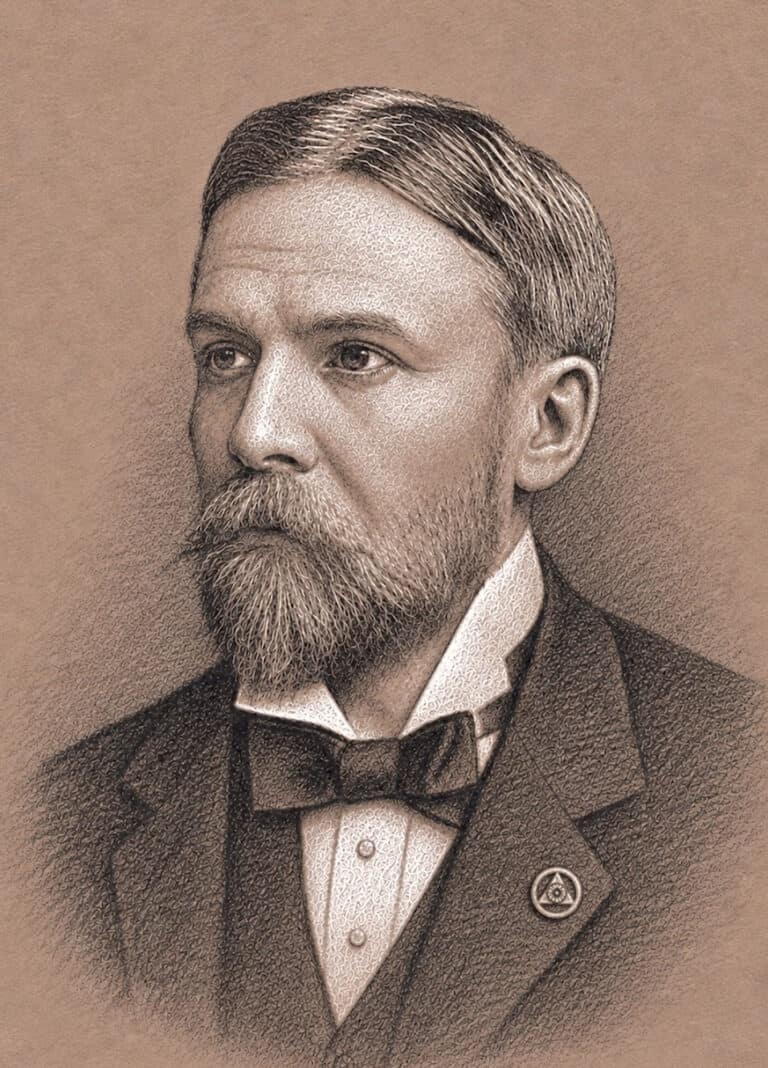
William Walker Atkinson first appeared in Who’s Who in America in the 1906–1907 edition, with a biographical entry that listed only four books under his own name. Over the next twenty years, his entry would expand greatly. Atkinson would include dozens of books published under his own name, identify Yogi Ramacharaka as a pseudonym he used, claim The Kybalion, The Law of Financial Success, Thoughts Are Things, and the Arcane Series as anonymous works, and state that he had written even more books under other pseudonyms.
These self-supplied biographical listings have since been treated as some of the strongest evidence that Atkinson was the sole author behind Yogi Ramacharaka, The Kybalion, and other books connected with the Yogi Publication Society and its publishing network. Yet looking at the entries individually misses something important. Atkinson did not claim all of these books right after they were published, sometimes waiting years after their publication to include them, while others he never claimed at all and left several supposed pseudonyms unnamed.
This article follows those changes chronologically and compares them with what was happening around Atkinson, the Yogi Publication Society, and the publishing network around Herbert A. Parkyn. It also examines the changing copyright laws of the time that helped control and protect valuable anonymous and pseudonymous literary properties, as well as organizational changes in the publishing network that published Atkinson’s books. When viewed all together, Atkinson’s Who’s Who claims become something more complicated than a simple list of all the books he wrote.
What was Who’s Who in America?
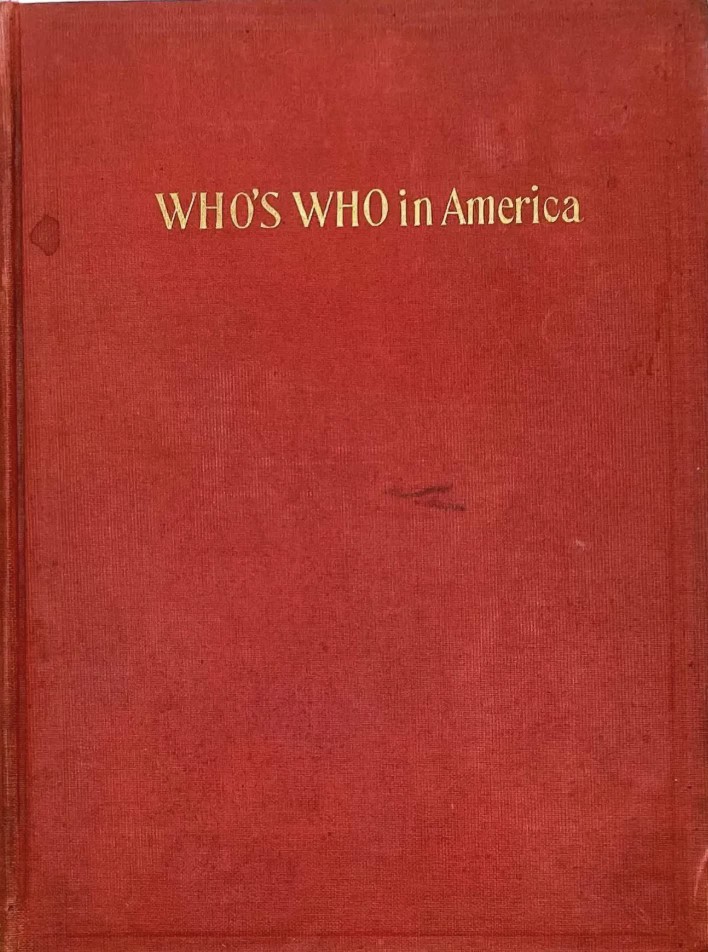
Who’s Who in America was created by Chicago publisher Albert Nelson Marquis in 1898, and the first edition appeared in June 1899. It served as a biographical reference directory identifying prominent Americans in business, government, literature, education, science, and other fields. Inclusion was selective from the beginning, and it was not an open directory where anyone could simply add a biography. Selection was based upon a person’s reference value, position, accomplishments, visibility, prominence, and impact.
The publication quickly gained considerable prestige, and by 1903 it was already used as a source for statistical and demographic research on prominent Americans. Who’s Who in America was published every two years, so a person’s entry could be revised as their career developed. This feature is crucial for understanding Atkinson. His biography was not written once and reproduced unchanged for the remainder of his life. New books, addresses, and other information were added over successive editions. The result is a twenty-year documentary sequence in which we can watch Atkinson’s public account of his own authorship change.
The entries also have to be understood for what they are. The biographical entry was not an independent investigation by Marquis into the authorship of every book attributed to the subject. The person being profiled supplied and updated biographical information, while the publisher selected who qualified for inclusion and exercised editorial control over the directory. The distinction is important. Atkinson’s listings are extremely valuable primary evidence because they tell us what Atkinson himself publicly claimed.
Atkinson’s First Who’s Who Profile and What He Claimed
Atkinson first appeared in the 1906–1907 edition of Who’s Who in America. His entry described his commercial career, admission to the Pennsylvania and Illinois bars, his work as associate editor of Suggestion in 1900, and his editorship of New Thought from 1901 to 1905, and noted that, at the time, he lived in Pasadena, CA. He claimed only the four books published under his own name at the time. Those were Thought Force (1900), Law of the New Thought (1902), Nuggets of New Thought (1902), and Memory Culture (1902).
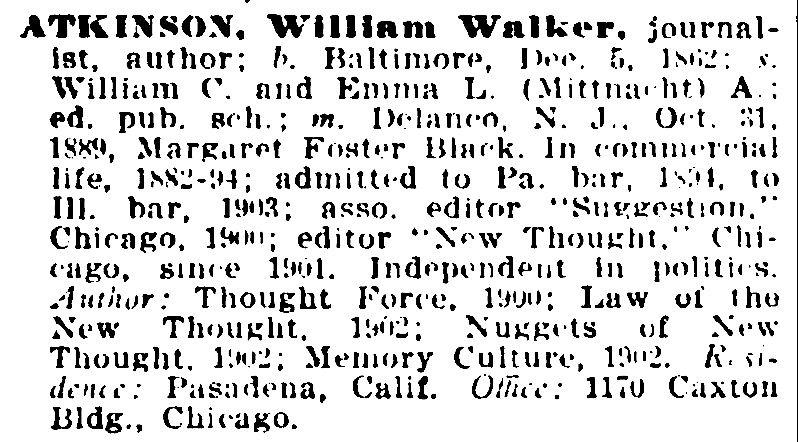
What is missing is more interesting in light of what Atkinson would claim only a few years later. The submission deadline for the new edition of Who’s Who was normally by November of the previous year. So for the 1906-1907 edition, that would have been around November of 1905.
By that time the Yogi Publication Society had already issued a substantial body of work under the name Yogi Ramacharaka, including Fourteen Lessons in Yogi Philosophy and Oriental Occultism (1903), Science of Breath (1904), Advanced Course in Yogi Philosophy and Oriental Occultism (1905), and Hatha Yoga (1905). But Atkinson’s first Who’s Who entry did not identify Yogi Ramacharaka as his pseudonym and did not claim any of these books.
This first entry is important because it gives us a starting point. We do not know whether Atkinson could have entered Who’s Who before this edition, since inclusion was selective and controlled by the publisher. What we do know is what Atkinson chose to place in his biography once he was included. His original public bibliography only included books with the William Walker Atkinson name.
What Had Just Happened to the Publishing Business Attached to Atkinson’s Name in late 1904?
Atkinson’s first appearance in Who’s Who in America followed an extremely damaging episode for New Thought magazine, which Atkinson had become the most prominent face of. In 1904, the publication and its publisher, Sydney B. Flower, became involved in a federal postal fraud investigation that generated damaging newspaper headlines, including large reports in the New York Times. The fraud order not only threatened the magazine’s reputation and that of those associated with it, but also threatened to permanently shut it down. A magazine dependent upon subscriptions and national circulation could not function if its access to the mails was cut off.

To save the magazine and the reputation of Atkinson’s publishing name, Parkyn turned to his close associate and Brother Elk, Charles Beecher Lahan, who was an extremely important figure in the Chicago publishing circle. Lahan served as president of the International Typographical Union, one of the most important organizations in the printing trades, and was president of the Regan Printing House of Chicago. Regan had been the printer for all of Parkyn’s publishing operations since the early days of The Hypnotic Magazine. Lahan was also part of the Second Class Mail Bag, which placed him directly within the world of postal regulations and the second-class mailing privileges that magazines depended on.
The solution to the New Thought crisis involved the publishing interests controlling the magazine’s subscription lists and advertising contracts passing into new hands. Lahan quickly stepped in and incorporated the New Thought Publishing Company which assumed responsibility for the magazine’s active subscriptions, advertising agreements and obligations to contributors. Through Lahan’s publishing and postal connections, the fraud-order problem was resolved, and the magazine’s second-class mailing privileges were restored as long as Flower was in no way associated with it anymore.
While the magazine was able to do business again, it had taken a serious hit to its reputation. Atkinson would stay on as editor, but others involved with the magazine, such as Ella Wheeler Wilcox, would not return after the scandal. With Atkinson remaining as the sole editor and the name behind the magazine, an inclusion in Who’s Who in America would have been a significant boost to his reputation.
At the time Lahan was also serving as the Exalted Ruler of the Chicago Lodge of the Benevolent and Protective Order of Elks. This was not a fraternity for incidental social connections in turn-of-the-century Chicago, but was one of the main places where publishing professionals, businessmen, editors, physicians, attorneys, and other recognized figures knew and vouched for one another. This would have been the exact same circle that Albert Nelson Marquis, the creator of Who’s Who, would have been a part of in Chicago. This is relevant to Who’s Who in America because while Marquis did not simply accept anyone who wished to appear in its pages, he did place high priority on recommendations and nominations from people already regarded as qualified authorities or prominent members of their fields.
We cannot establish whether Atkinson’s entry was due to being nominated or to his status at the time, but Lahan belonged precisely to the Chicago publishing and professional world from which a powerful recommendation could come. With Who’s Who in America becoming a nationally recognized reference book of the most important people in America, and giving enormous prestige to those included, having his name recognized in it would have publicly elevated Atkinson’s name tremendously.
Ella Wheeler Wilcox is also important here. She had been included in Who’s Who in America from its beginning and had worked with Atkinson in editing New Thought, making her one possible person who could have recommended him for inclusion. But what is interesting is that Wilcox herself never mentioned her work with New Thought in her Who’s Who profiles and did not list The Heart of the New Thought, which had been published by Sydney B. Flower and the Psychic Research Company. Following the scandal surrounding Flower and New Thought, it is possible that Wilcox deliberately avoided including these connections in her public biography to distance herself from the controversy.
Atkinson’s 1908-1909 Who’s Who Entry includes Yogi Ramacharak
Atkinson’s second Who’s Who entry appeared in the 1908–1909 edition and greatly expanded the bibliography under his own name, but it also introduced the Yogi Ramacharaka books. Atkinson stated, “Also, written under the pseudonym ‘Yogi Ramacharaka’,” followed by a retrospective list of books beginning several years earlier. He claimed Yogi Philosophy, Vol. I, and Science of Breath for 1903, Yogi Philosophy, Vol. II, and Hatha Yoga for 1904, Raja Yoga for 1905, Gnani Yoga and Psychic Healing for 1906, and The Bhagavad Gita, Spirit of the Upanishads and Mystic Christianity for 1907. At the time, he was living back in his old residence just outside of Philadelphia in Palmyra, N.J.
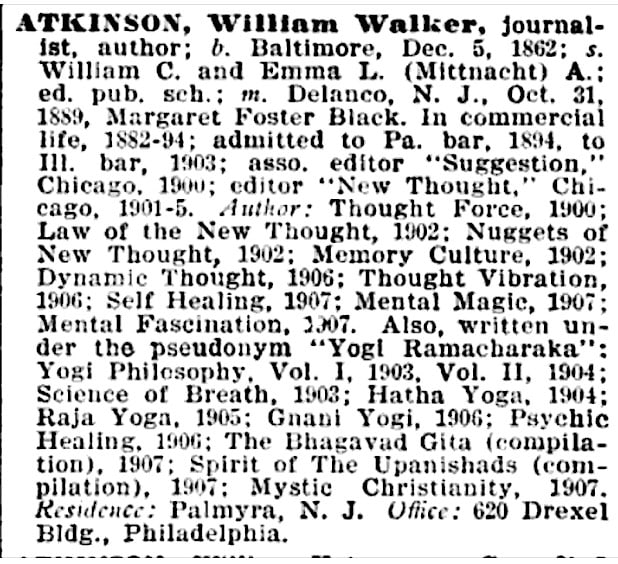
This was not a profile simply updated with a new pseudonym attached to books written between now and his last profile in 1906. Atkinson was reaching backward and publicly attaching himself to a publishing identity whose books had already been appearing for the last five years. This begs the question: why did his first Who’s Who biography contain no Ramacharaka claim at all? We can never know for sure why he waited to claim them but there were several changes within the publishing network, as well as copyright debates over protecting pseudonym names that were all happening at this time that may provide insights.
What Changes Happened Within the Atkinson and Yogi Publishing Network Between 1906 and 1907?
The years between Atkinson’s first and second appearances in Who’s Who in America saw a major reorganization of the publishing network in which he had been working. At the end of 1906, Herbert A. Parkyn sold Suggestion magazine and closed his Chicago School of Psychology shortly after in 1907. This marked a reorganization of the core foundations of the publishing network that had shaped Atkinson’s career and the Yogi Publication Society. Parkyn had shifted his work toward large industrial business ventures and establishing the “Suggestion family” network on the West Coast. This culminated in Atkinson spending large amounts of time in Los Angeles, where his name could bolster the creation of new Schools of Psychic Science and new magazines.
Parkyn’s transition and sale of his magazine also coincided with the sale of the “William Walker Atkinson publishing name” to the Fiduciary Press and Company, which was being run by Parkyn’s former student and associate, Edward E. Beals. The company was also strongly connected to the Knights Templar Masons. Its president was E. I. Rosenfeld, who was also the general manager of the Knights Templar and Masons Life Indemnity Company, and worked closely with its president, George M. Moulton, the current Grand Master of the Knights Templar for the United States. Their offices were in Chicago’s Masonic Temple Building, which also became the YPS’s new home.
The Yogi Publication Society

Changes were also happening with the Yogi Publication Society. In late 1905, the YPS moved into Chicago’s Masonic Temple Building and shared offices with the Advanced Thought Publishing Company. Advanced Thought was owned by the Macoy Publishing and Masonic Supply Company, which was founded by the famous Knight Templar mason Robert Macoy. It had purchased the Theosophical Society’s entire publishing network, including the Theosophical Publishing Company, the Occult Publishing Company, and the Advanced Thought Publishing Company, in the early 1900s. The connection with the Knights Templar could now be seen in the YPS offices and in Atkinson’s publishing name being bought by the Fiduciary Press.
With the move also came a change in YPS’ management, with Ollie I. Bedwell taking over running its full operations. She had been with the network since 1900 and had served as YPS’ secretary since 1903. Arthur Gould was brought in to run Advanced Thought, and he and Ollie soon married. By 1909, Ollie would become the full owner of the YPS.
The period between Atkinson’s first two Who’s Who entries was thus not simply a period in which he happened to write more books. The businesses controlling and publishing the material associated with Parkyn, Atkinson, and YPS were being separated, sold, transferred, and reorganized. We cannot say what these changes in the publishing network structure did directly to control of the pseudonym Yogi Ramacharaka, but evidence of such a major shift in the organization coincides with the sudden addition of the pseudonym to Atkinson’s Who’s Who profile.
What Was Changing in Copyright Law at the Same Time?
By 1907, the United States was in the middle of a major public battle over copyright reform. Authors and publishers were arguing over how long literary property should remain protected, who possessed those rights and what happened to them after the original copyright term expired. Mark Twain was one of the most famous participants in the debate. Writing publicly under the assumed name Mark Twain while legally remaining Samuel L. Clemens, he was also a prominent example of how a pseudonym could become an enormously valuable literary and commercial identity.
These questions were especially relevant to publishing businesses built around assumed names. Copyright protected individual works, but did not protect pseudonyms. As Yogi Ramacharaka became a famous publishing identity, the threat of other publishers printing books claiming to be works by Ramacharaka became very real. Thus, establishing a public connection between an assumed name and a real person became important if any litigation was needed to protect its ownership, or when publishing rights changed hands and future use of the books had to be established.
Mark Twain

Samuel L. Clemens had already demonstrated how serious this problem could become. In 1883 he brought a federal case in Chicago against Belford, Clark & Co., which had published a collection titled Sketches by Mark Twain without his permission. Clemens argued that “Mark Twain” had become his established commercial name as an author and that unauthorized use of it damaged both his reputation and the value associated with the name. The court recognized that Clemens was publicly known as Mark Twain, but it refused to give him an exclusive property right in the pseudonym itself. Material that had been published without copyright protection could be republished by others even when it had originally appeared under his assumed name. The court would restrain someone from falsely placing the Mark Twain name on material Clemens had never written.
The case exposed the weakness faced by any author or publisher who had built a valuable literary identity around a pseudonym. “Mark Twain” could become famous enough to sell books almost by itself, yet the commercial value of that name did not automatically provide Clemens with control over everything another publisher might attempt to issue beneath it. Clemens claimed that his writings under the Mark Twain name had gained great popularity and steady sales, and that unauthorized publication diminished the name’s value as a designation of authorship.
By 1906 and 1907, as the national copyright battle intensified, Clemens took that fight to Congress. In December 1906, he appeared before the congressional committees considering the proposed revision alongside other prominent authors. Clemens provided a nationally visible example of both sides of the problem confronting pseudonymous publishing. He had shown how enormously valuable an assumed name could become, and how limited the protection of that name could be. He was now one of the most famous public advocates for strengthening the laws governing literary property.
Clemens’s experience matters because these questions were being fought publicly at exactly the same time that Atkinson changed his Who’s Who claims. The copyright reforms being debated in 1907 would become the Copyright Act of 1909, which expressly recognized works published under an author’s true name, anonymously, or under a pen name. Copyright still only protected the work and not the pseudonym itself, but acknowledged that making the connection between the assumed name and the person claiming it important. A clear and continuous public record linking a valuable pseudonym to an identifiable individual was seen as establishing who stood behind the name when copyright, publishing rights, or unfair competition were disputed.
This was the legal and publishing environment in which Atkinson changed his Who’s Who profile. The declaration created a permanent public link between William Walker Atkinson and the Ramacharaka name, just as the businesses surrounding the books were being reorganized and American copyright law was reconsidering the protection of pseudonymous literary property.
Why Would Atkinson Publicly Claim Yogi Ramacharaka?
One of the most important questions to ask is why Atkinson would reveal the connection at all. Yogi Ramacharaka was not a pseudonym functioning in the same simple way as one like Mark Twain. Samuel Clemens used Mark Twain as a memorable literary name, but readers were not being asked to believe that his books contained the stories of a mysterious figure named Mark Twain. Yogi Ramacharaka’s identity, by contrast, was part of the presentation of the teachings themselves. The books placed the reader in contact with a mystical Eastern source of knowledge, with the teachings said to have passed from Ramacharaka through his pupil Baba Bharata and then into a form suitable for English readers. The identity helped create the authority and atmosphere through which the teachings were received.
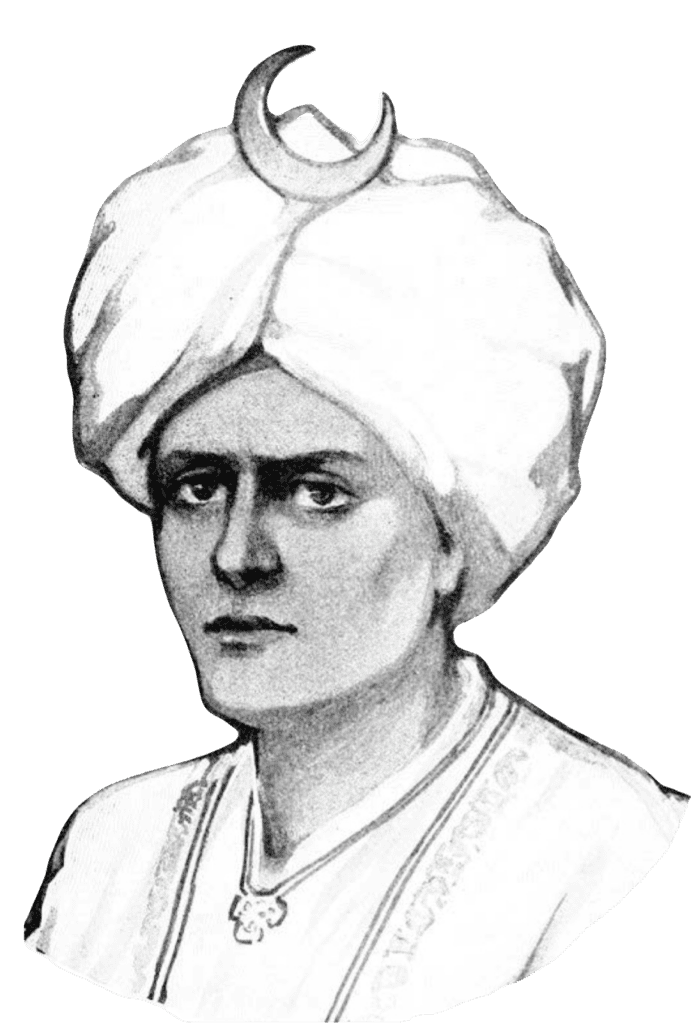
That was especially useful for the material being presented. The Yogi Publication Society was combining mental science and suggestion with Yogi philosophy, psychic subjects and other systems that could be presented as different approaches to underlying laws of mind. Ramacharaka allowed those teachings to reach readers through an Eastern voice instead of appearing simply as another series of books from the Chicago mental-science movement. In this sense the identity itself could function as a form of masked suggestion. The reader entered the material believing that he or she was receiving an Eastern system of teaching, which gave the lessons a setting and authority that the name William Walker Atkinson could not provide.
Publicly unmasking Ramacharaka as Atkinson offered no comparable commercial advantage. It could actually damage one of the features that made the books effective. Atkinson also had no need to claim Ramacharaka to make himself appear successful or prolific. His own-name bibliography was already expanding at an extraordinary rate. Adding another group of books to his personal reputation was hardly necessary. If the only consideration was book sales, keeping the identities separate made more sense.
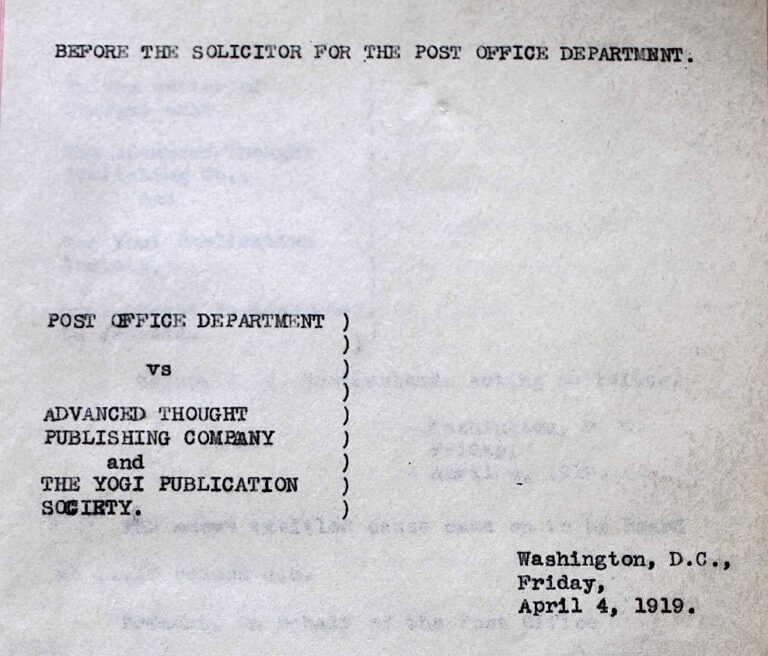
There had to be some countervailing value in publicly establishing someone behind the name. We know from the 1919 postal investigation, discussed in other articles on this site, that the Yogi Ramacharaka books were the work of several people. This makes Atkinson’s decision to claim the pseudonym more than just a single writer revealing a private pen name. It suggests instead a collective choice to place the identity under Atkinson’s name. Atkinson was already the central writer and public literary voice of the network, and he had a Who’s Who in America profile through which such a claim could be made publicly and with considerable authority.
Atkinson’s Who’s Who profile provided an unusually strong place to make that collective claim. Instead of the Yogi Publication Society simply announcing that Ramacharaka belonged to Atkinson, the connection appeared in a prestigious national reference work independent of YPS and its publishers. By identifying Yogi Ramacharaka as his pseudonym there, Atkinson created a dated and highly public record connecting the Ramacharaka name directly to himself. It was not a copyright on the pseudonym, but if another publisher attempted to use the name, it provided powerful evidence that Ramacharaka had already been publicly claimed by Atkinson.
This provides a much stronger reason for the disclosure than personal recognition. Unmasking Ramacharaka did little for the commercial presentation of the books and was unnecessary for Atkinson’s reputation. The declaration did not have to mean that Atkinson personally composed every part of each Ramacharaka book. The 1919 testimony shows why those are separate questions. Other people could have worked on the books with Atkinson while he still served as the publicly documented person claiming the identity.
Atkinson’s 1910-1911 Profile
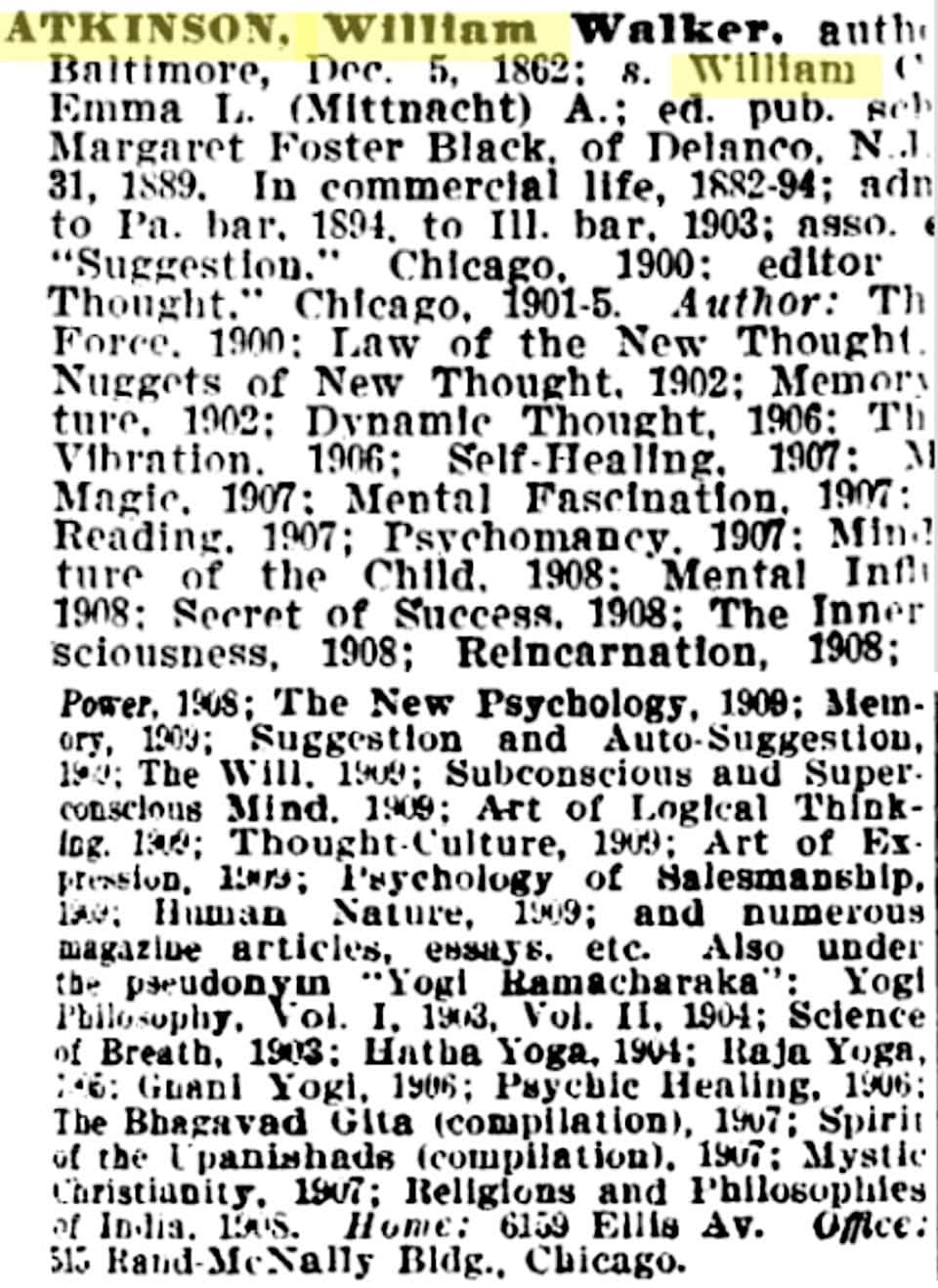
Atkinson’s 1910–1911 Who’s Who in America profile greatly expanded the number of books under his own name. The additions included Mind Reading (1907), Psychomancy (1907), Mind Culture of the Child (1908), Mental Influence (1908), The Secret of Success (1908), The Inner Consciousness (1908), Reincarnation (1908) and Mind Power (1908). These were followed by a large concentration of books dated 1909, including The New Psychology (1909), Memory (1909), Suggestion and Auto-Suggestion (1909), The Will (1909), The Subconscious and Superconscious Mind (1909), The Art of Logical Thinking (1909), Thought-Culture (1909), The Art of Expression (1909), The Psychology of Salesmanship (1909) and Human Nature (1909). Atkinson continued to identify Yogi Ramacharaka as his pseudonym and added The Inner Teachings of the Philosophies and Religions of India (1908).
Much of the new material formed the New Psychology Series published by the Progress Company, where Atkinson was working with Edward E. Beals, Christian D. Larson, and Dr. William C. Van Valen, who were all students of Parkyn’s system of Suggestion.
What makes the 1910–1911 profile important is what Atkinson did not include. There were already books available that he would claim in later editions of Who’s Who, including The Kybalion (1908), but they were not included here. This is especially notable because his profile had clearly been updated with many of his recent books through 1909.
Atkinson’s 1912–1913 Who’s Who Profile Includes The Kybalion
The 1912–1913 Who’s Who in America profile introduced a major new category into Atkinson’s bibliography. His books under his own name remained extensive, and Yogi Ramacharaka continued to be identified explicitly as his pseudonym. But Atkinson now added a separate heading, “Also, anonymously,” followed by The Law of Financial Success (1907), The Kybalion (1908), Thoughts Are Things (1909), and the six volumes of the Arcane Series; The One and the Many (1909), Cosmic Law (1909), Arcane Formulas (1909), The Mystery of Sex (1909), Psychic Planes (1910) and Vril (1911).
This was a significant change from his previous Who’s Who in America profile. These were not simply the newest books being added as they appeared. Several were already years old and had been available when Atkinson made the extensive update to his 1910–1911 profile. Atkinson was now going back and publicly claiming a group of previously unclaimed books together, while placing all of them under the specific description “Also, anonymously.”
Why Were The Kybalion and the Arcane Series Listed as Anonymous?
Atkinson’s wording is important. He did not identify “The Three Initiates” as a pseudonym. Instead, he placed The Kybalion (1908) under the separate heading “Also, anonymously.” This accurately reflected the way the book presented its authorship. “The Three Initiates” did not identify any individual author or reveal who the Initiates were. The attribution itself was anonymous.
The Arcane Series was even more straightforward. Its volumes appeared without an author’s name. There was no pseudonym attached to them for Atkinson to claim. If he wanted to connect himself publicly with these books, they could only reasonably be described as works he claimed to have issued anonymously.
Why Did Some Publishing Identities Need a Public Claim?
There was an important difference between Yogi Ramacharaka, The Kybalion, the Arcane Series and the later pseudonyms that have been attributed to Atkinson. Yogi Ramacharaka was obviously an assumed identity because the books themselves presented Ramacharaka as a Yogi who had died years earlier, with his teachings being transmitted through his pupil Baba Bharata and prepared for publication with the assistance of an English writer. Whatever readers believed about the story, the person producing and publishing the books in Chicago could not literally have been the deceased Yogi described in them. If the Ramacharaka name was becoming a valuable publishing property, there was an obvious reason to establish a living person publicly behind it.
The Kybalion presented a different version of the same problem. It was attributed to “The Three Initiates,” but the identities of those Initiates were deliberately withheld. No individual author was named, and Atkinson himself did not later describe “The Three Initiates” as his pseudonym. He classified The Kybalion as a work published “anonymously.” The Arcane Series went even further because it appeared with no author identified at all. Its close relationship with The Kybalion also made it difficult to separate the two once a public claim was being made to this body of material.
Theron Q. Dumont, Swami Bhakta Vishita and Swami Panchadasi
The later pseudonyms that have been attributed to Atkinson presented a very different situation. Theron Q. Dumont was presented as a living Professor in Paris and even appeared in newspaper editorials as a real person. There was nothing about the identity itself that revealed it as a pseudonym. The same was true of Swami Bhakta Vishita and Swami Panchadasi. During the enormous rise of interest in Eastern thought in America, many Western writers used names incorporating the title “Swami.” Without a backstory revealing these particular authors to be fictitious, there was no reason for other publishers to assume that the names were available for anyone else to use.
The Kybalion and the Arcane Series had no comparable protection built into their authorship. “The Three Initiates” identified nobody, while the Arcane Series named no author whatsoever. Copyright could protect the texts themselves, but anonymity left the publishing identities surrounding the works much more exposed. Another publisher could claim a connection with “The Three Initiates,” issue related material under a similar presentation, or assert some relationship to the anonymous Arcane teachings without having to overcome the public identity of a named author. Atkinson’s Who’s Who declaration supplied something the books themselves lacked. It created a dated public record connecting an identifiable person with both The Kybalion and the Arcane Series while allowing the books themselves to remain anonymous.
This also helps explain why Atkinson’s later failure to name the other pseudonyms that have since been attributed to him does not necessarily conflict with his decision to claim these works. The issue may not have been a desire to reveal every name under which he supposedly wrote. The identities that were most exposed were the ones whose own presentation made it obvious that there was no identifiable living author standing behind them.
What Was Changing Around the Publishing Network Again in 1911?
The timing of Atkinson’s new anonymous claims coincided with another change within the publishing network. In 1911 Arthur J. Gould took full charge of Advanced Thought Publishing Company. This came only two years after Ollie I. Bedwell Gould had taken ownership and control of the Yogi Publication Society in 1909. By the time Atkinson supplied the information appearing in the 1912–1913 Who’s Who in America, both publishing operations had entered a new period under the Goulds.
Why Did Atkinson Claim Books by or with Edward E. Beals?
Why Atkinson would claim The Law of Financial Success (1907) and Thoughts Are Things (1909) is more difficult to explain as a simple question of pseudonyms. Both books already had strong connections with Edward E. Beals. The two men had a long publishing and business relationship, and later they also produced a 13 book series together.

The Law of Financial Success had been publicly associated with Beals since 1907. It was advertised as “BY EDWARD E. BEALS,” and the book became an enormous success, selling more than 100,000 copies within only a few years.. That attribution did not disappear after Atkinson claimed the book in his 1912–1913 Who’s Who profile. The Law of Financial Success continued to be associated with Beals and remains the principal book identified with him today. Atkinson was thus claiming a connection with a successful work that already had a well-established connection with Beals.
Thoughts Are Things provides an even more obvious connection between the two men. It appeared under the name “Edward Walker,” combining Edward, the first name of Edward E. Beals, with Walker, Atkinson’s middle name. Atkinson later placed Thoughts Are Things under the same “Also, anonymously” heading as The Law of Financial Success. The two books therefore entered his Who’s Who bibliography together, one already publicly associated with Beals and the other published under a name constructed from the names of both men.
The later Personal Power series helps explain these earlier claims. In 1922 Atkinson and Beals produced the thirteen-volume series together, and Atkinson later listed the books in Who’s Who as written “with Edward E. Beals.” Atkinson and Beals clearly did produce books together. This makes it entirely reasonable that their earlier relationship also extended to The Law of Financial Success and Thoughts Are Things. Atkinson could claim both books without excluding Beals’s involvement. The Law of Financial Success remained associated with Beals, while Thoughts Are Things appeared under the name “Edward Walker,” connecting the names of both men.
This also changes how the other books listed under “Also, anonymously” should be read. The Law of Financial Success, Thoughts Are Things, The Kybalion and the Arcane Series were all claimed together. The Beals books show that Atkinson could claim a work in Who’s Who without that claim necessarily meaning that he alone had written it.
How Could Atkinson Produce Fifteen Books in a Single Year?
The scale of the bibliography Atkinson eventually claimed becomes most difficult to explain when the year 1909 is examined by itself. According to his own Who’s Who entries, Atkinson was responsible for fifteen books in that single year. They were The New Psychology, Memory, Suggestion and Auto-Suggestion, The Will, Subconscious and Superconscious Mind, The Art of Logical Thinking, Thought-Culture, Art of Expression, Psychology of Salesmanship, Human Nature, Thoughts Are Things, and the first four volumes of the Arcane Series, The One and the Many, Cosmic Law, Arcane Formulas and Mystery of Sex. Using the page counts of the editions examined for this article, those fifteen books amount to approximately 2,700 pages. That works out to a new book averaging at least 180 pages every twenty-four days for the entire year!
*Atkinson never claimed the Yogi Ramacharaka book The Hindu-Yogi Practical Water Cure (1909), which has been frequently attributed to him. This would raise his total 1909 production to 16 books.*
The number becomes even more remarkable because 1909 was not an isolated year of intense writing. In the surrounding years, Atkinson claimed four books for 1906, nine for 1907, eight for 1908, fifteen for 1909, six for 1910, and four for 1911. That is forty-six claimed books in six years, in addition to his magazine editing and extensive periodical writing. Yet 1909 deserves special attention because Atkinson’s claimed production in that single year eclipses the entire book-writing careers of most of the best-known authors in the New Thought and mental-science movement. Henry Wood, Horatio Dresser, Charles Brodie Patterson, Frank Channing Haddock and many other prominent writers spent decades developing bibliographies that did not reach the fifteen books Atkinson eventually assigned to himself in 1909 alone. In effect, Atkinson’s bibliography asks us to accept that he produced in one year an amount of book-length material that many of the leading writers working in the same intellectual world did not produce during their entire lives.
One of the few writers in this circle whose lifetime bibliography begins to approach Atkinson’s output was Christian D. Larson, who appears to have published about thirty books across his career. Larson is especially relevant because he was not operating at a distance from Atkinson. He worked with Atkinson at the Progress Company, along with Edward E. Beals and Dr. William C. Van Valen. Much of the extraordinary production appearing under Atkinson’s own name at this time formed his New Psychology series connected with the Progress Company. The remarkable 1909 bibliography was therefore being produced within another enterprise involving a group of men who had shared educational, publishing, and mental-science connections extending directly back into Parkyn’s organization.

What Other Writers Produced Books at This Rate?
There have certainly been writers capable of physically producing thousands of pages in a year. The closest comparisons, however, come from an entirely different form of writing. Extraordinary pulp and commercial fiction writers could turn out enormous quantities of material by continually creating stories, characters and situations within familiar formulas. Georges Simenon, for example, became famous for the extraordinary speed with which he could produce novels. Such cases establish that physically typing or dictating several thousand pages in a year is possible. They do not provide a close comparison with what Atkinson claimed to be producing.
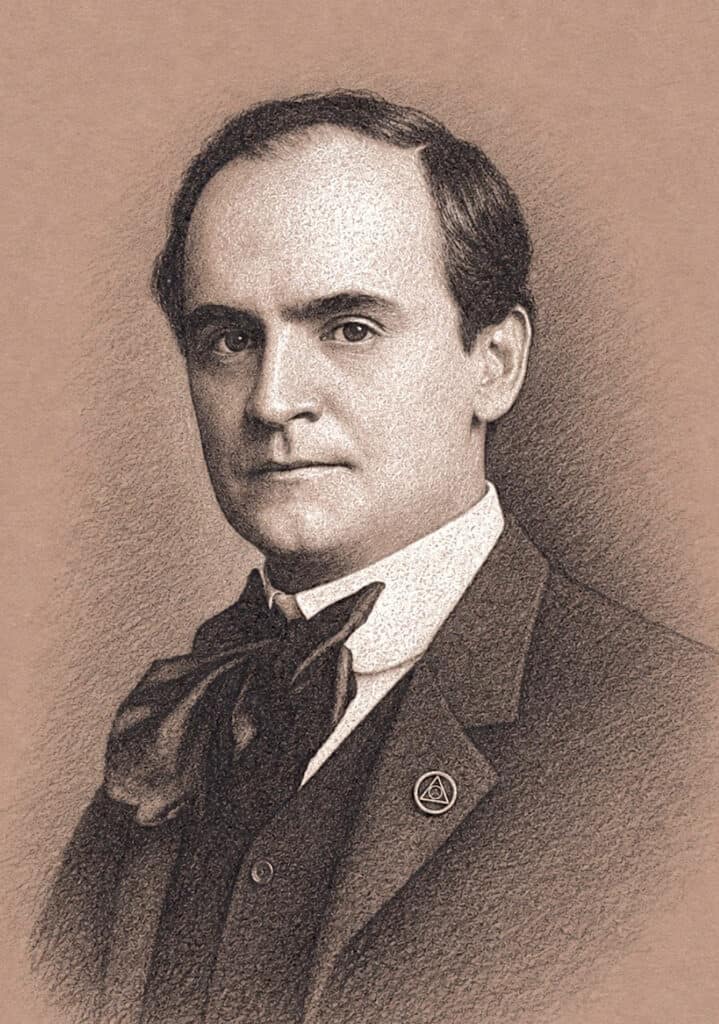
Atkinson’s 2,705 pages from 1909 were presented as works dealing with psychology, memory, suggestion and auto-suggestion, the will, subconscious and superconscious mental activity, logic, thought culture, expression, sales psychology, human nature, metaphysics, sex, cosmic law and occult philosophy. These books did not present themselves as fifteen installments of a continuing fictional story. They purported to explain human mental processes, teach methods of psychological development, formulate laws and systems, and communicate knowledge supposedly derived from study, observation, experience and esoteric teaching. Producing the words is only one part of producing books of this kind. The knowledge, experiments, concepts, systems, source material and teaching behind those words had to come from somewhere.
That is what makes the comparison with the other New Thought authors important. It is not necessary to argue that a person could not physically write fifteen books or 2,705 printed pages in twelve months. The historical problem is that Atkinson’s later bibliography assigns to one man, in one year, more serious instructional books than most of the recognized authorities in his own movement produced during their entire careers. Those other writers were themselves lecturers, researchers, editors and teachers who spent decades developing their ideas. Atkinson’s claimed 1909 output alone eclipses most of their lifetime bibliographies while ranging across numerous specialized subjects.
There is another fact that makes the burst even harder to treat simply as evidence of an extraordinarily productive individual author. After this remarkable period, the flood of specifically identified Atkinson books stops. His eventual Who’s Who bibliography gives him forty-six books from 1906 through 1911, but after 1911 he does not add another newly identified book under his own name for the next decade. When a large new series finally appears in 1922, Atkinson identifies it differently. The thirteen books of the Personal Power series are expressly credited as being written “with Edward E. Beals,” the same Parkyn graduate and longtime publishing associate whose presence can already be traced through the extraordinary publishing activity surrounding Atkinson years earlier.
Seen within the full Who’s Who chronology, 1909 therefore raises a question far larger than whether Atkinson was capable of writing quickly. His claimed output is so far outside the normal lifetime production of the leading writers around him that it forces us to ask what “authorship” represented within these publishing operations. Atkinson may have served as writer, editor, compiler, arranger and public authorial identity in different combinations. The bibliography itself cannot tell us how much of the underlying material originated with him. What it does show is that accepting every later claim as proof that Atkinson independently researched, developed and originated every system contained in those books creates an extraordinary intellectual-production problem that the simple authorship story has never adequately explained.
What Did Atkinson Claim in His Later Who’s Who Profiles?
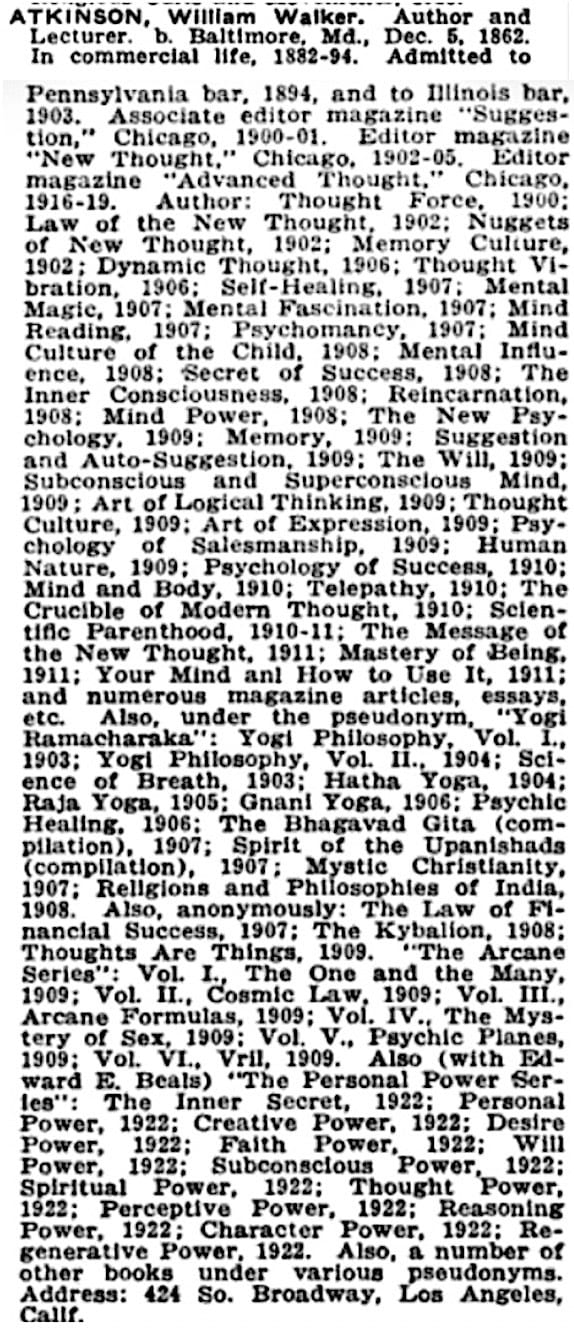
After the major changes in the 1912–1913 Who’s Who in America, Atkinson continued to update his profile for the remainder of his life. The basic authorship structure established in 1912–1913 remained remarkably stable. Yogi Ramacharaka continued to be specifically identified as his pseudonym, while The Law of Financial Success, The Kybalion, Thoughts Are Things and the Arcane Series remained grouped under “Also, anonymously.”
The 1916–1917 profile retained these claims without adding the later pseudonyms that have since been attributed to Atkinson. By this time books were already appearing under Theron Q. Dumont, yet Dumont was not identified anywhere in the profile. The same pattern continued as books appeared under Swami Bhakta Vishita and Swami Panchadasi. None of these names was specifically claimed by Atkinson in his later Who’s Who profiles. The 1918–1919 profile added the general statement “and a number of other books” after the bibliography. This wording continued into the early 1920s, but Atkinson still did not identify the additional books or connect them with any particular pseudonyms.
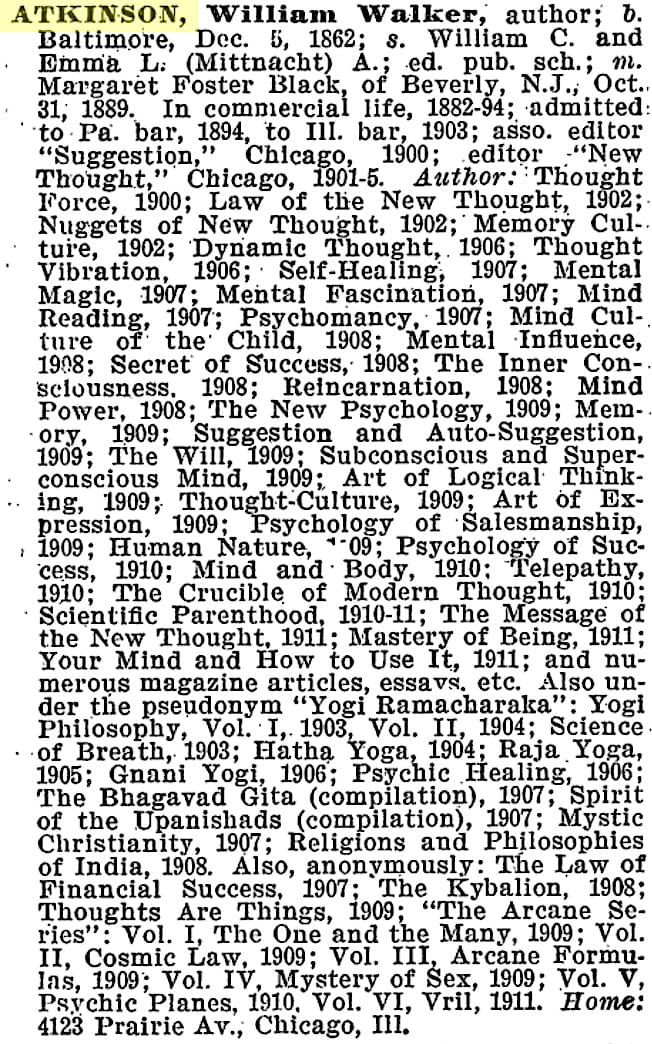
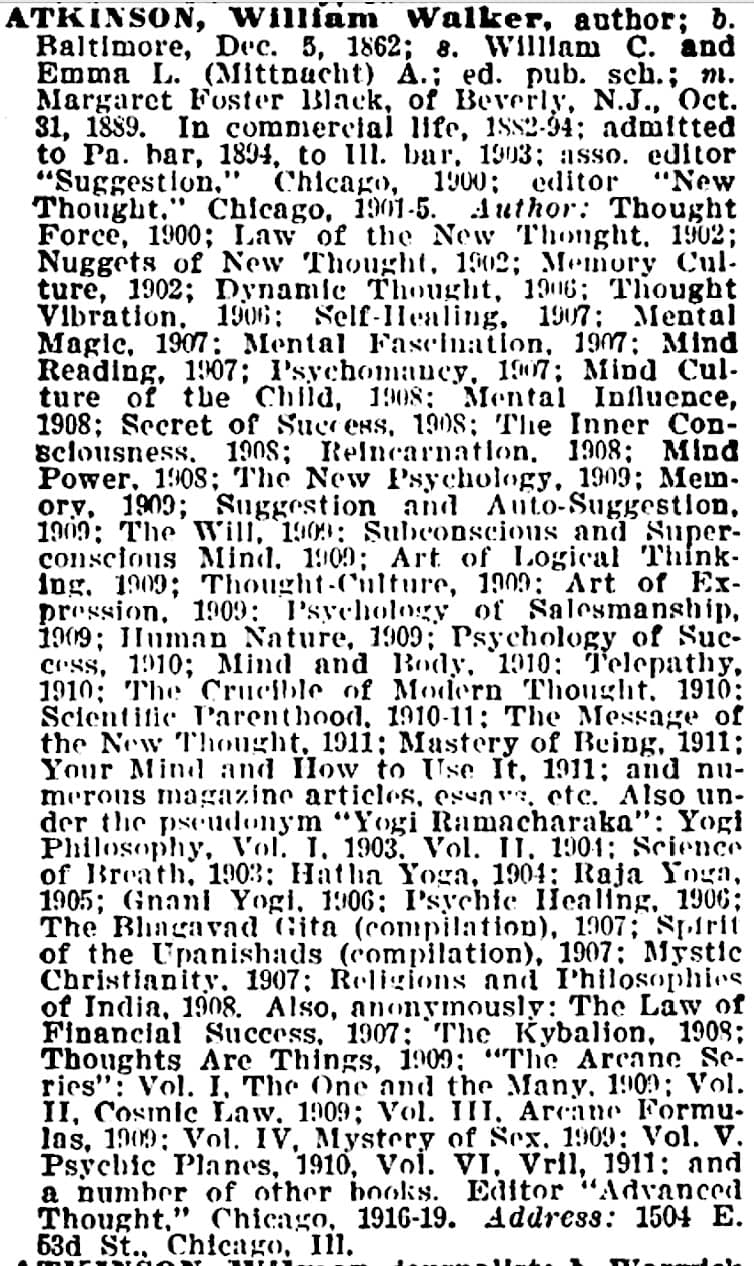
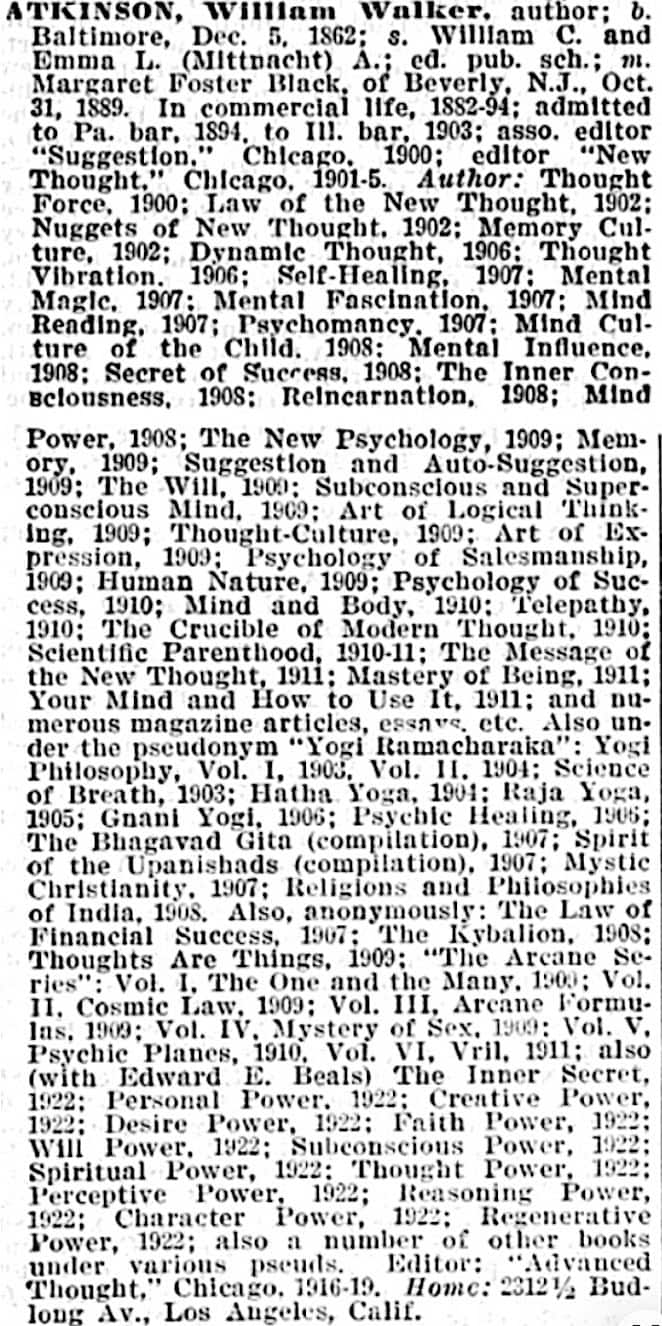
A major addition came after the publication of the Personal Power series in 1922. In the 1924–1925 profile, Atkinson specifically identified the thirteen-volume series as written “with Edward E. Beals.” The same profile also changed the general statement at the end of his bibliography to “also a number of other books under various pseuds.” Atkinson was now expressly acknowledging that additional books existed under other pseudonyms, but he still did not say what those pseudonyms were.
The same pattern appears in William C. Hartmann’s 1926–1927 Who’s Who in Occultism, New Thought, Psychism and Spiritualism. This is especially useful because it was a reference work devoted specifically to the fields in which these later books appeared. Atkinson again identified Yogi Ramacharaka by name, retained The Kybalion and the Arcane Series among his anonymous works, credited the Personal Power series to himself and Beals, and stated that there were “a number of other books under various pseudonyms.” Yet Theron Q. Dumont, Swami Bhakta Vishita, Swami Panchadasi and Magus Incognito were still not named.
Atkinson’s 1928 Who’s Who in America profile continued essentially the same arrangement. Near the end of his life, his public bibliography still separated the books he specifically claimed from an unidentified body of works “under various pseuds.” The later attribution of those pseudonyms to Atkinson cannot simply be inserted into his Who’s Who record. Atkinson acknowledged additional pseudonymous books, but he chose not to identify which books or names that statement covered.
Why Did Atkinson Stop Claiming New Yogi Ramacharaka Books?
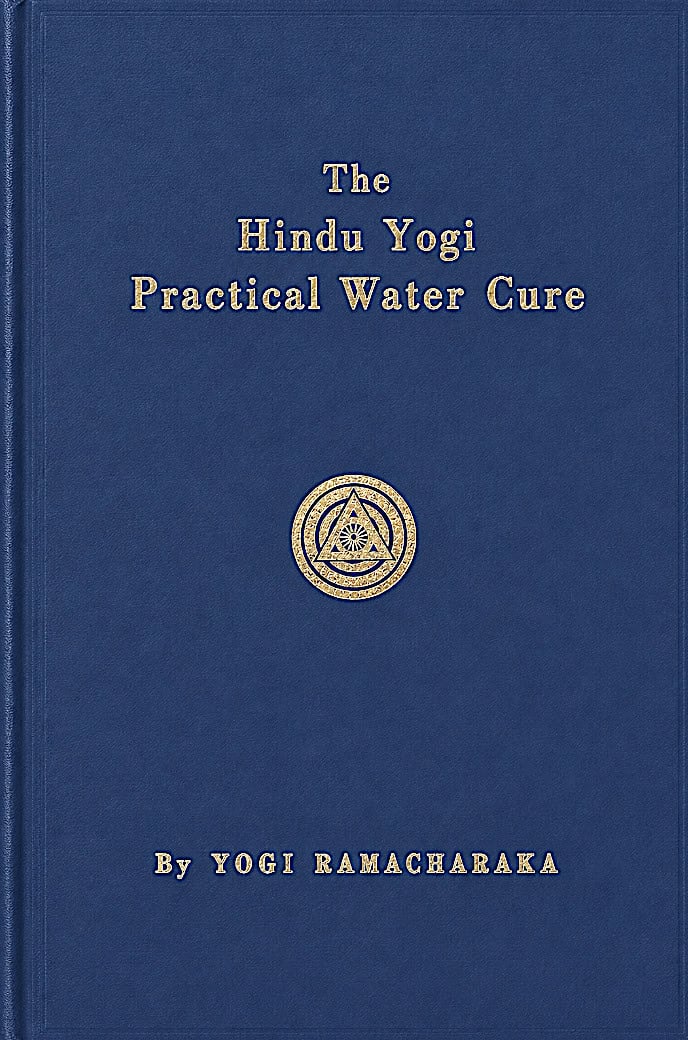
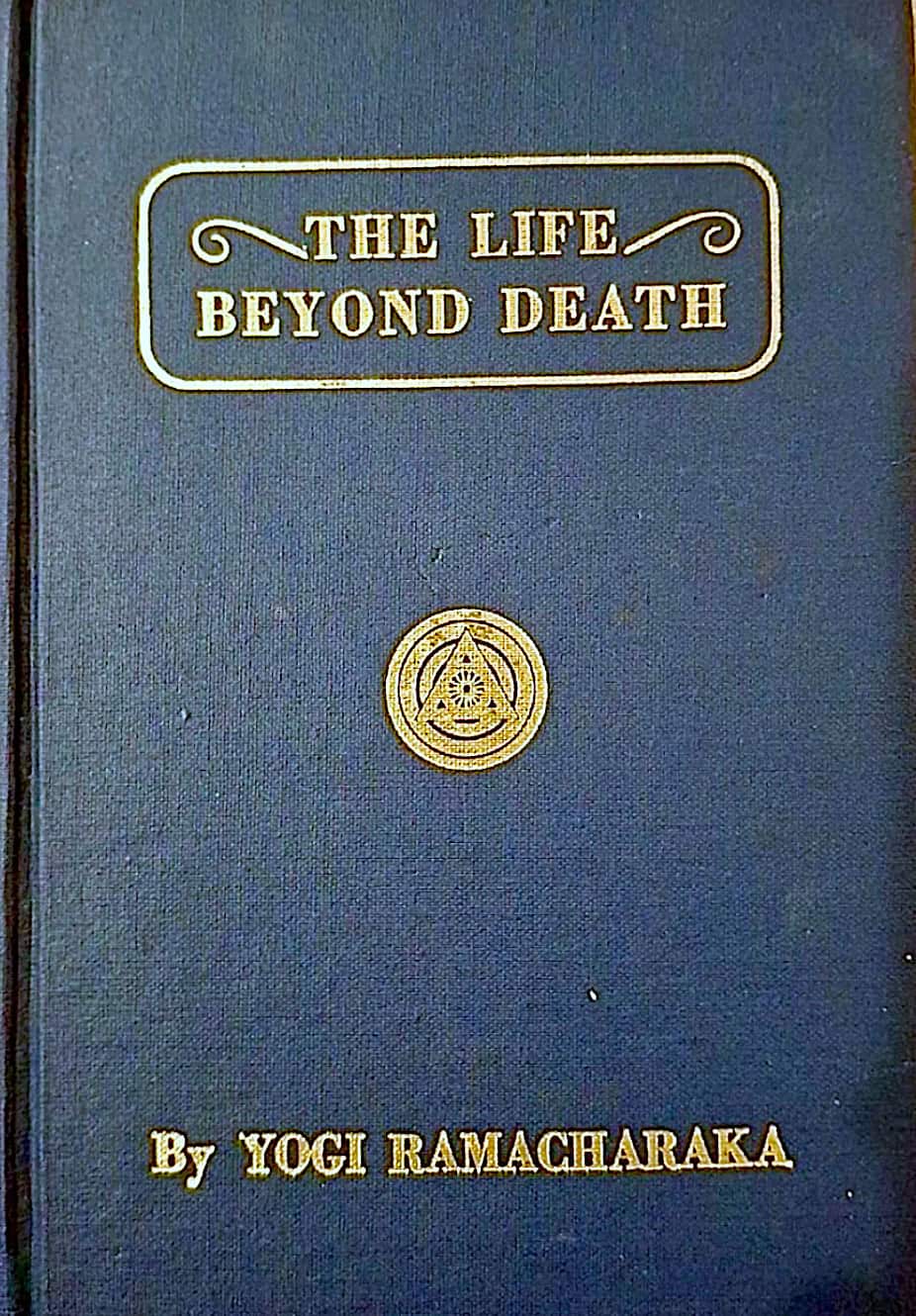
One of the strangest features of Atkinson’s Who’s Who record is that his Ramacharaka bibliography simply stops. After he first identified Yogi Ramacharaka as his pseudonym, he continued to carry the same list forward and added Religions and Philosophies of India for 1908. After that, no new Ramacharaka title was added. This happened even though Atkinson continued revising the rest of his biography and adding other books for years. Two later Yogi Ramacharaka books are especially important. Hindu-Yogi Practical Water Cure appeared in 1909, and Life Beyond Death appeared in 1912. Neither one was ever added to Atkinson’s Ramacharaka bibliography.
The omission of Hindu-Yogi Practical Water Cure is especially revealing because it appeared in the same year as Atkinson’s extraordinary fifteen-book production discussed above. If the modern assumption is followed and every Ramacharaka title is automatically assigned to Atkinson, then his 1909 total rises from fifteen books and approximately 2,705 pages to sixteen books and about 2,825 pages. Yet Atkinson himself never made that claim. His own bibliography stops before Water Cure.
That matters for another reason. Water Cure contains extensive medical material and teachings closely connected with Parkyn and Elmer Elsworth Carey. It belongs to a body of material that cannot simply be treated as another generic New Thought book. The medical language, therapeutic framework and specific teachings raise the same larger question that runs through the rest of this article. Who supplied the underlying knowledge behind these books, and how much does a later Atkinson claim really tell us about the origin of the material?
The omission of Life Beyond Death is equally important. It appeared in 1912, at exactly the period when Atkinson was still actively revising his public bibliography. This was the same period in which he reached back and newly claimed The Kybalion, The Law of Financial Success, Thoughts Are Things and the Arcane Series. He was clearly willing to add older books and newly identify works that had gone unclaimed for years. Yet he still did not add Life Beyond Death to the Ramacharaka list.
This makes the permanent stopping point at 1908 difficult to ignore. Atkinson did not merely forget to update the pseudonym once. He continued updating his profile while leaving the Ramacharaka catalogue fixed at a specific point. The timing is also important. Ownership and control of the Yogi Publication Society passed to Ollie I. Bedwell Gould in 1909. The Ramacharaka books Atkinson explicitly claimed belong to the period before that change. Water Cure and Life Beyond Death came afterward, and neither was ever claimed by him.
The 1919 postal testimony stating that Yogi Ramacharaka was a pen or work name used by several writers does not tell us which books those writers produced. It could refer to different writers working under the Ramacharaka name throughout its history, or it could refer to the later books that appeared after the group Atkinson claimed in Who’s Who. The evidence does not allow us to choose between those possibilities.
What it does tell us is that Yogi Ramacharaka was not simply the private pseudonym of one writer. Several people were able to produce work under the same name. That raises two questions that are more important than trying to assign every Ramacharaka book to Atkinson. Who were the other writers, and who controlled the Yogi Ramacharaka name and decided who could publish under it?
Can Who’s Who Be Read as a Record of Sole Authorship?
Atkinson’s own record says no such thing. It records claims, but those claims do not all carry the same meaning. The Law of Financial Success shows that Atkinson could claim a book that was simultaneously and permanently associated with Edward E. Beals. The Personal Power series shows that Atkinson could openly acknowledge collaboration. Yogi Ramacharaka shows that he could expressly identify a pseudonym while leaving later books under that same name outside his claimed bibliography. The 1919 testimony tells us that several writers were connected with Ramacharaka. His later reference to “various pseuds.” acknowledges additional pseudonymous work without telling us which identities he meant. And The Kybalion was never described by Atkinson in these entries as a book written under his pseudonym “Three Initiates.” He placed it among his anonymous works.
The Who’s Who entries are therefore extremely valuable evidence, but their value lies in reading exactly what Atkinson claimed and following how those claims changed over time. They tell us when he publicly attached himself to particular books and names. They reveal titles he repeatedly left out. They show retrospective groups of claims appearing years after publication. They reveal collaborations when Atkinson chose to name them. They also preserve silences that later bibliographies have filled with assumptions.
The question is no longer simply whether Atkinson’s name can be connected with these books. In many cases it plainly can. The harder historical question is what that connection represented. Once The Law of Financial Success, the 1919 Ramacharaka testimony, the omitted Ramacharaka books, the Beals collaboration, the unnamed “various pseuds.” and Atkinson’s extraordinary 1909 production are placed together, Who’s Who cannot by itself tell us who developed the teachings contained in a book, who supplied its source material, who composed or assembled the final text, or who controlled the name under which it was published. Those questions have to be answered by examining the network that produced the books.
Does the Publishing Network Explain Atkinson’s Extraordinary Bibliography?
The extraordinary size of Atkinson’s bibliography looks very different when it is placed inside the publishing network in which the books were produced. Atkinson was not working in isolation. By the time his book production accelerated, he was surrounded by people who had already spent years teaching, experimenting with and publishing on many of the same subjects that would fill his later books.
Parkyn’s earlier teachings repeatedly reappear in works associated with Atkinson, Yogi Ramacharaka, Theron Q. Dumont, and others. These are not limited to general ideas circulating throughout New Thought. The comparisons documented elsewhere on this website include Parkyn’s characteristic formulations “I Can and I Will,” “Health, Happiness and Success,” and “Thought takes form in action,” together with many specific teaching examples and methods that can be traced to his earlier courses.
This raises an important difference between writing a book and independently developing everything taught within it. Atkinson could have written or prepared a finished text while drawing upon teachings that had already been developed within the network. Other books could have involved different combinations of writing, editing, compilation and source material. There is no reason to assume that every book was produced in exactly the same way.
The public positions of Parkyn and Atkinson were also very different. Parkyn had already established his reputation as a physician, psychologist, teacher and head of the Chicago School of Psychology, and his later public career moved increasingly into business and finance. Atkinson’s public career became centered upon writing, editing and New Thought. A growing bibliography strengthened the name William Walker Atkinson in precisely the field in which he worked. Public authorship could be valuable to Atkinson while remaining unnecessary, or even undesirable, for other people whose teachings or work entered the books.
This does not mean replacing the claim that Atkinson wrote everything with a claim that Parkyn or anyone else wrote everything. That would simply create the same problem under another name. Atkinson was clearly an important writer within this system. The question is how much of the enormous body of knowledge eventually placed beneath his name originated with him, and how much came from the teachings and organizations in which he was working.
Did They Know These Books Would Survive for More Than a Century?
Looking backward from the present can badly distort how these books appeared to the people producing them. Today The Kybalion, the Yogi Ramacharaka books and many of the other titles from this period have acquired lives of their own. They have been continuously reprinted, translated and studied, while enormous attention has been placed on identifying their authors. There is little reason to assume that the people producing this material knew which particular books would survive or imagined the importance that individual titles would acquire more than a century later.
At the time, these books were appearing as part of a continuous stream of teaching. Suggestion, autosuggestion, will, habit, concentration, personal magnetism, mental influence, psychic phenomena, Eastern philosophy, Hermetic teaching and related subjects were approached from different directions. The people involved believed they were participating in a major change in the understanding of the human mind. Psychology, psychical research, New Thought, occultism, comparative religion and Eastern philosophy could all be examined as different approaches toward laws they believed operated beneath apparently separate phenomena. Within Parkyn’s work, suggestion remained central to that understanding.
This helps explain why the same teachings could appear again and again under different forms. A principle could be presented as psychology in one book, personal magnetism in another, Yogi philosophy in another and occult or Hermetic teaching somewhere else. Older religious and philosophical systems could be placed beside the newer psychology of suggestion as different expressions of the same underlying laws. What now appears to us as a library of separate works by separate authors may have appeared to the people producing it as a continuing effort to spread the same body of teaching through as many avenues as possible.
Atkinson became an exceptionally successful voice for presenting this material, and his name acquired increasing authority as his books and magazine work spread. This provides another way to understand why so much material accumulated beneath his name. Atkinson could serve as the literary voice through which teachings drawn from a much larger body of work were organized and presented to the public. It did not require every teaching within those books to have originated with Atkinson
His later career makes the concentrated book production of 1906 through 1911 even more unusual. After that period, the flood of newly identified books under Atkinson’s own name disappears. He remained active as a writer, editor and lecturer, but nothing resembling the earlier rate of new books continued. When a substantial body of books appeared under his name again in 1922, it was the Personal Power series written with Edward E. Beals. After that series, Atkinson produced no more new books during the remaining 12 years of his life.
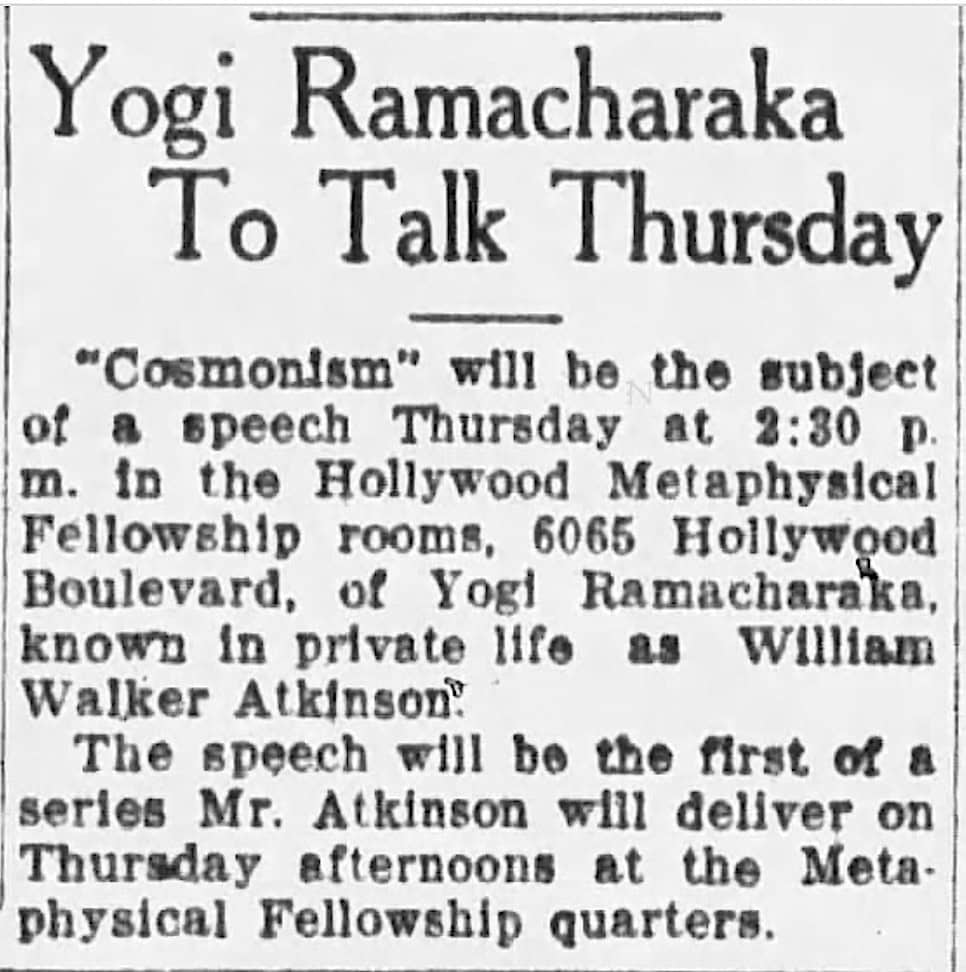
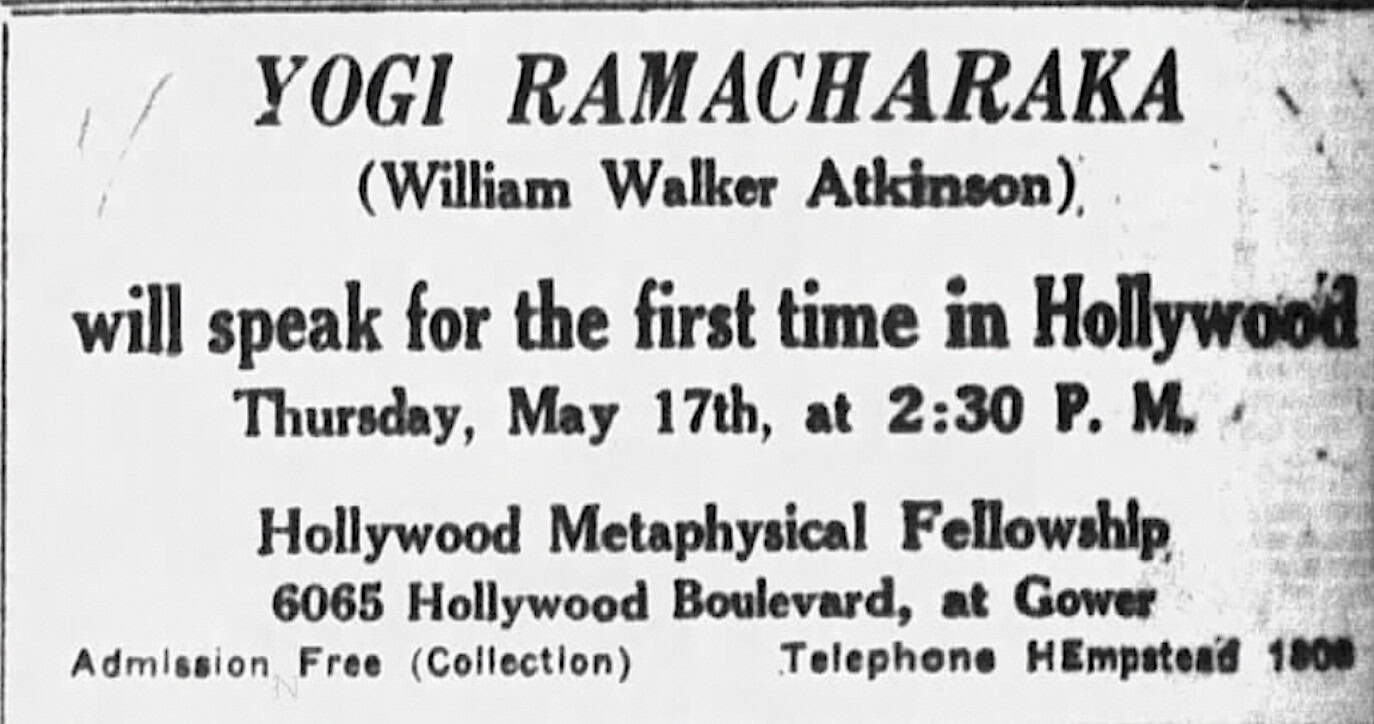
Atkinson did not disappear when his production of new books declined. He continued writing articles, editing and lecturing, and later increasingly promoted himself through the identities and teachings that had already become successful. In his lectures he presented himself as Yogi Ramacharaka and connected himself publicly with the Arcane teachings. By this later period, these earlier publishing identities had become part of Atkinson’s public reputation.
What Does This Change About the Atkinson Authorship Question?
The mistake is to begin with the enormous bibliography now attributed to Atkinson and work backward, treating every title and every later-attributed pseudonym as another example of the same man secretly producing books. Atkinson’s own lifetime record is far less simple.
The value of the Who’s Who profiles is that they change what authorship research should try to establish. Evidence that Atkinson participated in a book does not end the investigation. We still have to ask where its teachings came from, whether they existed earlier, who possessed the knowledge behind them, who prepared the finished text, who controlled its publication, and why it appeared beneath the particular name that it did.
Atkinson was clearly central to the production and publication of this literature. What his Who’s Who profiles do not provide is a master list proving that every book he claimed, or every pseudonym later attributed to him, represented a work independently conceived and written by him alone. They give us something more useful. They show what Atkinson publicly claimed at different points in his life, when those claims changed, and what he chose not to claim.
Atkinson was unquestionably central to this history. But the extraordinary literary figure preserved by later bibliographies may itself be a result of the publishing system in which he worked. As more books accumulated beneath his name, that name became more authoritative. Later generations then looked at the enormous bibliography as evidence that Atkinson must have been the man independently responsible for creating it.
The books survived. The machinery behind them did not. Reconstructing that machinery is what allows Atkinson’s Who’s Who claims to be examined as historical evidence instead of simply being repeated as an authorship list.
How to Cite This Article
D. Parkyn Jackson, “What Did William Walker Atkinson’s “Who’s Who in America” Claims Really Mean?” Yogi Publication Society History Project, originally published September 2026.
Publication note: This article contains original research by the Yogi Publication Society History Project. It was first published on this website in September 2026 and archived by the Internet Archive’s Wayback Machine.
Sources & Citations
- Book. Who’s Who in America 1906-1907
- Book. Who’s Who in America 1908-1909
- Book. Who’s Who in America 1910-1911
- Book. Who’s Who in America 1912-1913
- Book. Who's Who in the World , 1912 - Page 47
- Book. Who’s Who in America 1916-1917
- Book. Who’s Who in America 1918-1919
- Book. Who’s Who in America 1920-1921
- Book. Who’s Who in Occult , New Thought, etc 1926-1927