In 1919, the United States Post Office Department conducted an investigation into the Advanced Thought Publishing Company and the Yogi Publication Society, two closely connected Chicago publishing businesses associated with William Walker Atkinson, Arthur Gould, and Ollie I. Bedwell Gould. The surviving transcript of the proceeding is especially important because investigators did not limit their questions to the books and advertisements being sold through the mail. They also investigated the identities behind the publishers, their relationship to one another, and the pseudonyms of Yogi Ramacharaka and Magus Incognito, whose names appeared on their books.
What the Investigation Reveals About the Yogi Publication Society
Three pieces of testimony are especially significant.
First, Arthur Gould directly acknowledged that Yogi Ramacharaka was not an actual person. When the postal inspector described the books as having been written by several of Gould’s friends, Gould corrected him: they were “the work of several.” The testimony therefore provides evidence from inside the publishing operation that Yogi Ramacharaka functioned as a collective or shared authorial identity rather than the name of the Hindu teacher represented to readers.
Second, Gould’s refusal to identify Magus Incognito demonstrates that the publishers were consciously protecting the identities behind at least some of their pseudonymous works. When confronted directly by a federal investigator, Gould would reveal that Ramacharaka was not a real person, but he would not disclose who stood behind Magus Incognito.
Third, Ollie Bedwell Gould’s account provides a direct chain connecting Sydney Flower, William Walker Atkinson, the founding of the Yogi Publication Society, and its later ownership. According to the testimony recorded by Inspector Angier, she had worked for Flower before Atkinson started the Yogi Publication Society; she then went to work for Atkinson and eventually purchased the Yogi business from him. Atkinson, meanwhile, remained within the same publishing network and by 1919 was editing Advanced Thought Magazine for Arthur Gould.
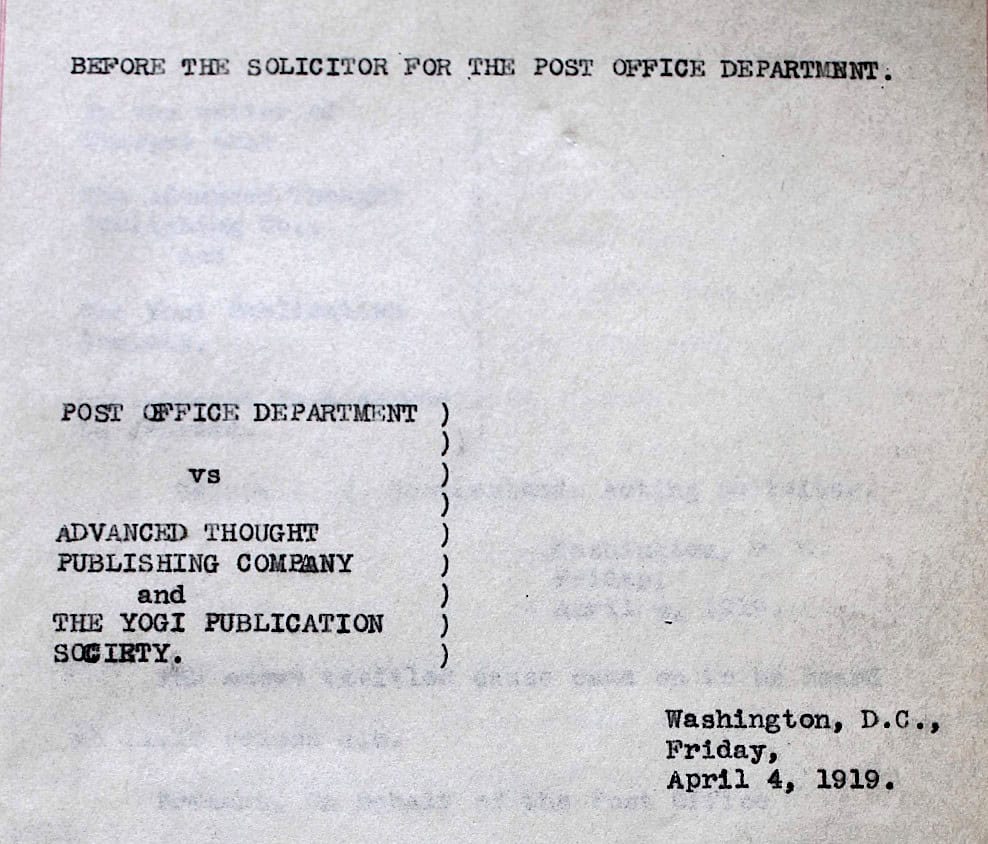
The hearing was held before the Solicitor for the Post Office Department in Washington, D.C., on April 4, 1919, under the title Post Office Department vs. Advanced Thought Publishing Company and the Yogi Publication Society. The proceeding concerned whether literature and products marketed by the companies through the United States mail involved false or misleading representations serious enough to justify the issuance of a postal fraud order.
At the time of the investigation, Advanced Thought Publishing Company operated from Room 904 of Chicago’s Masonic Temple. Its attorney described the establishment as functioning partly as an ordinary bookstore, with publications displayed on counters for customers to inspect and purchase, while also conducting a substantial mail-order operation. The Post Office reported that Advanced Thought was receiving approximately 200 letters per day.
The Yogi business was considerably smaller. It occupied Room 1422 in the same building and was operated by Mrs. Ollie Gould, wife of Arthur Gould. It reportedly received approximately fifteen letters per day. Although the two companies were presented as separate businesses, the testimony shows that they were closely connected operationally. Advanced Thought possessed the printing equipment, occasionally supplied the Yogi company with literature, and had printed Yogi material while Arthur Gould was managing the business.
The Search for Yogi Ramacharaka
One of the most historically important moments in the investigation occurred when Postal Inspector Angier questioned Arthur Gould about the identity of “Yogi Ramacharaka.”
By this time, the name had appeared on a substantial series of books presenting the author as an authority on Yoga, Hindu philosophy, occultism, psychic development, and related subjects. The Post Office investigator therefore attempted to determine who the “famous Hindu” represented by the name actually was.
Angier testified:
“I also wanted him to tell me who this famous Hindu was this Yogi Ramacharaka, and he stated that there was no such person.”
The inspector continued that Gould had said there were several books published under the name and that several had been written by “friends of his.” Gould immediately interrupted to correct that characterization:
“I said, not ‘friends,’ but the work of several.”
The distinction is significant. Gould was not merely denying that Ramacharaka was the legal name of the author. He was describing the Ramacharaka publications as the work of multiple people.
When Mr. Nash then asked directly whether there was “no such person as that known,” Gould answered:
“No, not pretended.”
The transcript does not identify those several writers but does establish that Arthur Gould expressly denied the existence of an actual Yogi Ramacharaka and described the material under that name as “the work of several.”
Gould Refuses to Identify Magus Incognito
The investigators were equally interested in another mysterious author connected with the company’s occult publications.
Inspector Angier questioned Gould about the identity of “Magus Incognito,” associated in the transcript with The Secret Doctrine of the Rosicrucians. Unlike Ramacharaka, however, Gould would not explain who stood behind this name.
Angier testified:
“I asked him who was Magus Incognito … but he declined to tell me.”
When the matter came up again, the inspector clarified that he had specifically wanted “to know who Magus Incognito was.”
This exchange is significant because it shows that federal investigators were actively attempting to penetrate the anonymous and pseudonymous authorship practices surrounding the publishing operation. Gould was willing to state openly that Yogi Ramacharaka was not a real individual and that the books represented the work of several people, yet he deliberately refused to identify the person behind Magus Incognito.
He similarly declined to tell the inspector who published another work titled Sex Force. The testimony therefore shows how carefully some identities within the publishing network were protected.
Ollie Bedwell Gould’s Account of the Beginning of the Yogi Publication Society
Inspector Angier also interviewed Arthur Gould’s wife, Ollie Gould, who operated the Yogi business. Her account provides important testimony concerning the origins and ownership of the Yogi Publication Society. According to Angier’s report of their interview, Mrs. Gould stated that the Yogi Publishing Company was not incorporated and had existed for approximately sixteen years. That dating places its beginning around 1903, corresponding with the first appearance of Yogi Publication Society books.
She identified William Walker Atkinson as its founder and explained that before working for him she had worked for Sydney Flower.
The transcript records:
“She had been working for Flower and then Atkinson started the Yogi Publication Society and then she went to work for Atkinson.” According to Mrs. Gould, she had previously been employed by Sydney Flower, who had subsequently been “put out of business by the Government.” After this, Atkinson started the Yogi Publication Society, and Mrs. Gould went to work for him. When Mr. Southerland attempted to understand Mrs. Gould’s explanation, he asked whether she had eventually bought the business. Inspector Angier responded that she had finally purchased it from Atkinson. The exchange reads:
Mr. Southerland: “She finally bought the business from Atkinson?”
Inspector Angier: “She finally bought the business from Atkinson, yes.”
When Southerland asked about the relationship between the operations, Angier replied: “But it was the same business Mr. Flower had. She was explaining to me how she got into the business.”
Because this is Angier’s characterization of what Mrs. Gould had told him rather than a direct quotation from Mrs. Gould, it should not be stretched beyond what the testimony actually establishes. Nevertheless, it shows that the inspector understood her account as describing continuity between the business environment in which she worked for Flower and the Yogi operation subsequently established by Atkinson.
Atkinson Was Still Working Inside the Network
The investigation also demonstrates that Atkinson had not disappeared from the publishing network after Mrs. Gould acquired the Yogi business. When Southerland observed that Atkinson was listed as editor of Advanced Thought Magazine, Inspector Angier confirmed: “Atkinson is now editor of the Advanced Thought Magazine, and works for Mr. Gould.”
The Relationship Between Yogi and Advanced Thought
Although Yogi and Advanced Thought were technically separate operations, the hearing shows how closely they functioned. Advanced Thought had three automatic printing presses. The Yogi company had no means of printing its own books. When Gould was asked whether Advanced Thought supplied the Yogi company with printing, he answered that they sometimes supplied Mrs. Gould with literature. He was then asked more directly:
“And when you were running that business you printed some of the matter for the Yogi Publishing Company as well as your own, did you not?”
Gould answered:
“Yes.”
This provides direct testimony that Gould had personally been involved in running the Yogi operation and that Advanced Thought printed material for it. The companies therefore cannot be understood simply as unrelated publishers occupying different offices. They had separate business identities, but shared personnel, printing resources, management connections, authors, and publishing interests.
Ollie Gould’s Operation of Yogi
Mrs. Gould reportedly told Inspector Angier that her Yogi business grossed approximately $4,000 to $5,000 annually and received around fifteen letters each day. Unlike Advanced Thought, she did not rely heavily on magazine advertising. Instead, she circulated promotional material directly.
The testimony also states that Advanced Thought printed some of this material. Angier reported that Mrs. Gould had been running the Yogi business from May 1916 through October 1918, although her ability to manage it during this period had been affected by the illness of her child. The investigation also connected her with another operation called the James J. Clark Company, which carried a line of private preparations and was operated from her home.
What the Post Office Was Investigating
The question of pseudonymous authorship was only one part of a much larger investigation. Postal officials were examining whether Advanced Thought and Yogi were using misleading claims to sell books, occult devices, health material, and related products through the mail. Among the materials discussed were publications concerning crystal gazing, astrology, sexual health, remedies, and a “Planetary Hour Indicator.”
Gould told investigators that instructions for crystal gazing had been reproduced from English directions he had found. Regarding the Planetary Hour Indicator, Inspector Angier reported that Gould claimed to know little about it and said that a “seer” had prepared the circular advertising it. Gould stated that sales of some of these products were relatively small. The Planetary Hour Indicator reportedly sold fewer than ten units per month, while Zodiac Mysteries sold approximately one hundred copies per month. Gould attempted to distinguish these products from the principal business of Advanced Thought. He told the hearing that most of the company’s books concerned “successful salesmanship and memory and mind power.”
The company advertised in publications including Nautilus, Review of Reviews, The Outlook, Physical Culture, and Popular Mechanics. Gould also reported that his New Thought Magazine had approximately 4,000 subscribers.
Dr. Reeder and Private Sex Lessons of a Physician
A substantial portion of the investigation concerned a book by Dr. Reeder, referred to in the transcript as Private Sex Lessons of a Physician or Sex Lessons of a Physician. Gould testified that Reeder had approached him claiming to contribute to approximately fifty newspapers and therefore possessed a reputation that might produce substantial book sales. Gould understood Reeder to be a licensed physician in Indiana and formerly associated with the health department of Chicago’s Inter Ocean newspaper.
The Post Office scrutinized both the medical claims in the book and the manner in which it was promoted. The hearing even included an extended discussion comparing Reeder’s theories with those presented by Dr. Jackson in an 1861 work titled The Sexual Organism and Its Healthful Management. Gould acknowledged receiving a one-third allowance on Reeder material that he sold, although he minimized its importance, saying there was little money in it. The Post Office was particularly concerned about remedies promoted in connection with these publications and whether readers were being led to believe claims that could not be substantiated.
Gould as an Author
During questioning, Gould was asked whether he personally had written any of the publications his company sold. He answered that he had written one book, Regeneration. When asked whether he possessed medical training, Gould replied: “Not from a medical standpoint.”
The exchange was relevant because the Post Office was attempting to establish who was responsible for the health-related material being distributed and what qualifications its authors possessed.
The Threat of a Postal Fraud Order
By the end of the surviving transcript, the Post Office was considering whether the companies’ practices warranted a formal fraud order. Rather than immediately issuing one, officials discussed whether Gould and his attorney would agree to change the business. The proposed concessions included eliminating the sale of Sex Lessons of a Physician, discontinuing the Planetary Hour Indicator, addressing problematic astrology material, removing advertisements for questionable remedies, and rewriting promotional literature so that representations were direct, truthful, and not misleading. Gould and his attorney indicated a willingness to make substantial changes. Gould stated that he was not interested in the astrological material and was prepared to remove it from consideration. His attorney similarly indicated that misleading circulars could be withdrawn and problematic medical advertisements eliminated.
The Post Office nevertheless made clear that the matter remained serious. Mr. Southerland told Gould’s attorney that the Department would consider whatever proposal the company submitted and then determine whether it could be accepted or whether “a fraud order shall be issued.”