
Person Research Collection
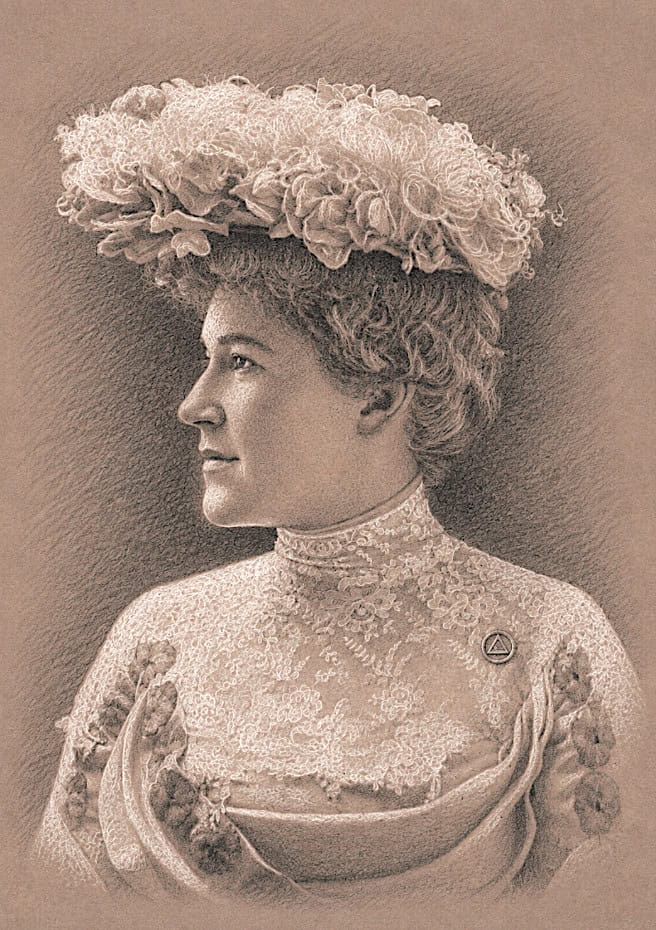
Ella Wheeler Wilcox
1850–1919
Famed American poet, co-editor of New Thought within Parkyn’s network, and an early Rosicrucian leader alongside H. Spencer Lewis.
Ella Wheeler Wilcox was an American poet, author, New Thought writer, Theosophist, Spiritualist, and Rosicrucian whose extraordinary popularity carried metaphysical ideas to a readership far beyond the membership of any single movement. She became one of the most widely read American poets of her generation, achieving national fame with Poems of Passion in 1883 and the enormous popularity of “Solitude,” with its famous opening line, “Laugh, and the world laughs with you; / Weep, and you weep alone.” Her poetry appeared in newspapers and magazines throughout the country, while her poetry books reached a mass audience.

As her career developed, the ideas expressed in her poetry increasingly reflected her interests in the power of thought, spiritual development, optimism, and self-mastery. These interests would bring her directly into the New Thought movement and into some of the most important metaphysical organizations and publishing circles of the early twentieth century.
In late 1902, Wilcox became directly involved with the publishing network surrounding Herbert A. Parkyn. In December of that year, she joined New Thought magazine as co-editor alongside Parkyn’s protégés William Walker Atkinson and Sydney B. Flower. She entered the network as one of the best-known popular poets in America, giving the publishers an opportunity to introduce New Thought to an audience far beyond the movement’s established readership. They capitalized on her fame with a coordinated launch. As Wilcox joined the editorial staff of New Thought, they published the collection The Heart of the New Thought by Wilcox and simultaneously promoted it alongside Atkinson’s new book, The Law of the New Thought. The campaign joined Wilcox’s national literary reputation with the magazine and its publishing operation, making her one of the most recognizable public names associated with their New Thought program.
The campaign extended into placing Wilcox’s New Thought poetry throughout the movement. Beyond appearing in New Thought magazine, it was placed in Parkyn’s Suggestion, Elizabeth Towne’s The Nautilus, and several other affiliated magazines within the network. These placements helped establish her poetry as a regular feature of New Thought literature, and her work was increasingly picked up and reprinted throughout the movement’s periodical press. Her poems were exceptionally well suited to this circulation. In a few memorable lines, they could express ideas about thought, will, courage, self-mastery, happiness, health, and success.

Wilcox developed deep interests in the metaphysical and esoteric currents that were integral to the New Thought movement. She and her husband Robert studied Theosophy, reincarnation, Spiritualism, psychical research, Eastern traditions, and occult philosophy. Before formally joining the American Theosophical Society in 1913, she became involved with the India-based Order of the Star in the East, which was associated with Annie Besant and the Theosophical Society. Its precursor, the Order of the Rising Sun, had been formed in 1910 after the young Jiddu Krishnamurti was identified within the Theosophical movement as the expected vehicle for a coming World Teacher. This development also connected directly with the publishing world surrounding Wilcox. In 1910, the Yogi Publication Society published At the Feet of the Master, the influential Theosophical work attributed to Krishnamurti under the name Alcyone.
Wilcox used her national newspaper syndication to introduce the Order, its principles, and its expectation of a coming World Teacher to a large American audience. Her involvement in Rosicrucianism was equally substantial. She participated in the early development of the Rosicrucian Research Society alongside H. Spencer Lewis and later became a member of its first Supreme Council in 1915. Her connections with Theosophy, the Order of the Star in the East, Rosicrucianism, Spiritualism, and psychical research placed her within several of the interconnected circles that were also represented throughout the Yogi Publication Society.
Wilcox’s beliefs in spiritualism and reincarnation became intensely personal after her husband’s death in 1916 and her subsequent search for evidence that his consciousness had survived physical death. By the publication of her autobiography The Worlds and I in 1918, Wilcox presented earthly life as one stage in a much longer spiritual existence. Thought and action shaped present experience and future lives. Death opened into continued existence on other planes, while the individual spirit continued its development through a much larger process of spiritual evolution and eventual return to its divine source.
Early Life in Wisconsin
Ella Wheeler was born on November 5, 1850, in the village of Johnstown, Rock County, Wisconsin, the youngest of four children of Marcus H. Wheeler and Sarah Pratt Wheeler. Marcus taught dancing, music, and deportment, while Sarah came from the Pratt family, whose enthusiasm for books and poetry became an important part of Ella’s childhood. Within two years of her birth the Wheelers settled in Westport, Dane County, north of Madison, where Ella would remain until her marriage. Money was often scarce, but books and language mattered in the Wheeler household. Sarah encouraged her daughter to read Shakespeare, Byron, Burns, and other poets, while Ella also absorbed The Arabian Nights, Gulliver’s Travels, The Diverting History of John Gilpin, newspapers, magazines, and whatever literature she could obtain. Her mother possessed poetic ambitions of her own and wrote rhyming verses and additions to songs, giving Ella an early example of writing as something that could be created within ordinary family life.

Ella began writing poetry at about eight years old and was attempting publication by thirteen. When the family could no longer afford the New York Mercury, she realized that getting something accepted by a periodical might at least bring a contributor’s copy into the house. With help from a friend who supplied the names of publications, she began sending manuscripts to editors, saving pennies for postage and refusing to be discouraged by rejection. Her earliest efforts brought little encouragement, but the situation changed when Frank Leslie’s publishing operation sent her a ten-dollar payment for three poems. From then forward writing ceased to be only an ambition. Wilcox later remembered living almost continuously in verse, sometimes producing two poems in a day and on one occasion eight. Poems commonly brought three to five dollars and occasionally ten, while short love stories could earn considerably more. Editors also sent books, magazines, pictures and other gifts, and the Wheeler home gradually filled with publications carrying the young Wisconsin writer’s work.
Wilcox attended the local one-room school that was later named in her honor and briefly studied at the University of Wisconsin in Madison. She excelled in language and literature but had an intense dislike of mathematics and found university life uncongenial. She considered the time there largely wasted and persuaded her parents to allow her to return home, where she could devote herself to writing. In 1870 she accepted a position paying forty-five dollars a month to edit the literary department of a Milwaukee publication, but fixed office hours were equally unsuited to her. The magazine failed after only a few months, ending the only conventional office employment of her literary career.
Temperance Poetry and Her First Books
Wilcox’s earliest substantial body of poetry developed during the powerful Wisconsin temperance movement of the 1860s and 1870s. The Wheeler family participated in the Good Templar movement, and Ella wrote repeatedly about alcohol, abstinence, suffering caused by drink, and the responsibilities of those who manufactured or sold intoxicants. Fifty-six of these poems were gathered in Drops of Water, published by the National Temperance Society in 1872, for which she received fifty dollars. Another early collection, Shells, contained 119 poems. Between these two volumes alone she had produced more than 175 collected poems before she was twenty-three.
The scale of that output helps explain what followed. Wilcox did not suddenly become a writer with the success of the 1880s. She had spent her adolescence and early adulthood writing continually, submitting manuscripts, learning what editors would purchase, and developing an unusually direct style that could communicate an emotion or idea quickly. Her income remained modest through much of the 1870s, but her readership continued to expand. The ability to express a complete thought in a few memorable lines would later prove ideally suited to the New Thought press, where editors could reproduce a Wilcox poem or short passage and immediately give readers both a recognizable literary name and a concise statement about thought, will, courage, health, happiness, character or spiritual development.
Poems of Passion and “Solitude”

Wilcox achieved national fame in 1883 with Poems of Passion, a collection whose treatment of love, desire and emotional life was considered unusually daring for a woman writer of the period. The book became an immediate commercial success and reportedly sold more than 60,000 copies within two years. Its success made Wilcox a nationally recognized literary figure and gave her a mass readership that would remain with her for decades.
The same year brought the poem that became inseparable from her name. While traveling by train to the Wisconsin governor’s inaugural ball in Madison, Wilcox encountered a young widow dressed in black who was overwhelmed by grief. Ella spent the journey trying to comfort her, but by the time she arrived at her destination she had absorbed much of the woman’s sadness herself. The experience produced the opening thought that became famous around the English-speaking world, “Laugh, and the world laughs with you; / Weep, and you weep alone.” The poem appeared in the New York Sun on February 25, 1883, under the title “The Way of the World,” and was subsequently included in Poems of Passion as “Solitude.” The Sun paid her five dollars for a poem whose opening lines would be repeated for generations.
Marriage to Robert Wilcox and Life at the Bungalow
During a visit with friends in Milwaukee, Wilcox attracted the attention of Robert M. Wilcox, a silver salesman from Meriden, Connecticut, who saw her in a jewelry store and sought an introduction. They subsequently met at the homes of friends in Milwaukee and Chicago and were married on May 1, 1884. After living for a time in Meriden and New York City, they established their home at Granite Bay in the Short Beach section of Branford, Connecticut. Their houses and cottages overlooking Long Island Sound became known as Bungalow Court and developed into a gathering place for literary and artistic friends. A 1905 description of the property called Short Beach a “Paradise of the Poets” and described the enormous daily correspondence arriving for Wilcox from readers interested in literature, philosophy, religion, reform and humanitarian causes.
Their only child, a son born on May 27, 1887, survived only a few hours. Ella and Robert nevertheless had a close marriage lasting more than thirty years. They traveled extensively throughout the United States and abroad and eventually circled the globe twice. Wilcox enjoyed dancing, possessed a fine soprano voice and played the mandolin. Their acquaintances included figures as varied as Luther Burbank, Robert Ingersoll, Jack London, Elbert Hubbard and H. Spencer Lewis. Robert encouraged Ella’s literary career and preferred her poetry to her prose. She in turn used the growing income from her writing to help her aging parents and other members of her family. Her own account of their marriage emphasizes Robert’s continuing support for both her literary ambitions and her spiritual investigations.
How Did Ella Wheeler Wilcox Become Interested in Metaphysics?
The metaphysical interests of Ella and Robert Wilcox developed early in their marriage and eventually included New Thought, Theosophy, Spiritualism, reincarnation, psychical research, astrology and Rosicrucianism. These subjects were not passing curiosities for the couple. Robert purchased Theosophical books for Ella, and both came to regard reincarnation as an explanation for human inequality, the apparent injustices of earthly existence, and what they experienced as their immediate recognition of one another as life partners. Wilcox later wrote that although Robert never entered deeply into all aspects of Theosophical philosophy, he was strongly impressed by reincarnation and supported her studies. Their Theosophical reading also convinced them that investigation of spiritual phenomena required knowledge, discipline and reverence.

The depth of these beliefs becomes unmistakable in The Worlds and I. Wilcox begins the first chapter of her autobiography with an explicitly metaphysical interpretation of her own birth. She describes concentrated thought as a creative power and proposes that an expectant mother, through intensely focused thought and emotion, can attract an Ego awaiting reincarnation whose previous lives make it suited to the conditions being prepared for it. Wilcox applied this idea directly to herself, connecting her mother’s intense reading of Byron, Moore, Scott and Shakespeare before Ella’s birth with her own later literary tendencies. Whatever judgment a modern reader makes about the doctrine, Wilcox herself was writing from a developed belief in reincarnation and the creative action of thought.
This also helps explain why her later involvement with organized New Thought came so naturally. The idea that thought possesses force, that sustained mental states affect health and circumstances, that consciousness can be deliberately educated, and that human beings participate in their own mental and spiritual development had already become central to the way Wilcox understood life.
Ella Wheeler Wilcox Joins Herbert A. Parkyn’s Network
By the beginning of the twentieth century, Ella Wheeler Wilcox had become one of the most famous poets in the United States, and as her interest in New Thought deepened, its ideas appeared more frequently in her poetry and prose. Her combination of national celebrity and a philosophy centered on optimism, mental control, courage, and spiritual progress made her exceptionally valuable to the movement’s publishers. In December 1902, this relationship became formal when Dr. Herbert A. Parkyn brought Wilcox into his network as a co-editor of New Thought magazine.

Wilcox would also be joined by Elizabeth Towne of The Nautilus, who agreed to contribute an article to every issue. Their additions brought two influential voices in the New Thought movement to the magazine while also aligning it with the strong female presence that had become a defining feature of the movement, as women increasingly assumed prominent leadership roles. The reorganization of the magazine was also intended to relieve the pressure on William Walker Atkinson. During the previous year, Atkinson had handled almost all of the editing while writing two or three articles for each issue and completing two books. The sustained workload threatened to revive his previous problems with nervous exhaustion, and Dr. Parkyn recognized that major adjustments were needed.
Bringing Ella Wheeler Wilcox on as a co-editor of New Thought was the publishing equivalent of signing the most famous and talented player to a sports team, something Dr. Parkyn was very experienced in doing. Her name would instantly put the magazine front and center on newsstands. In addition to contributing to the magazine, Wilcox provided a poetry book, The Heart of the New Thought, which was offered as a premium gift to new subscribers. Her fame was put to full use. For more than a year, her name appeared in large letters across the center of every cover and became a major focus of the magazine’s advertising. To build on the momentum created by her presence, Parkyn and his investors cut the price in half to five cents per issue and fifty cents per year, making it the most affordable journal of its kind. The impact was immediate. New Thought quickly grew to become the most widely read and influential voice of the movement, as well as one of the largest magazines in the country.

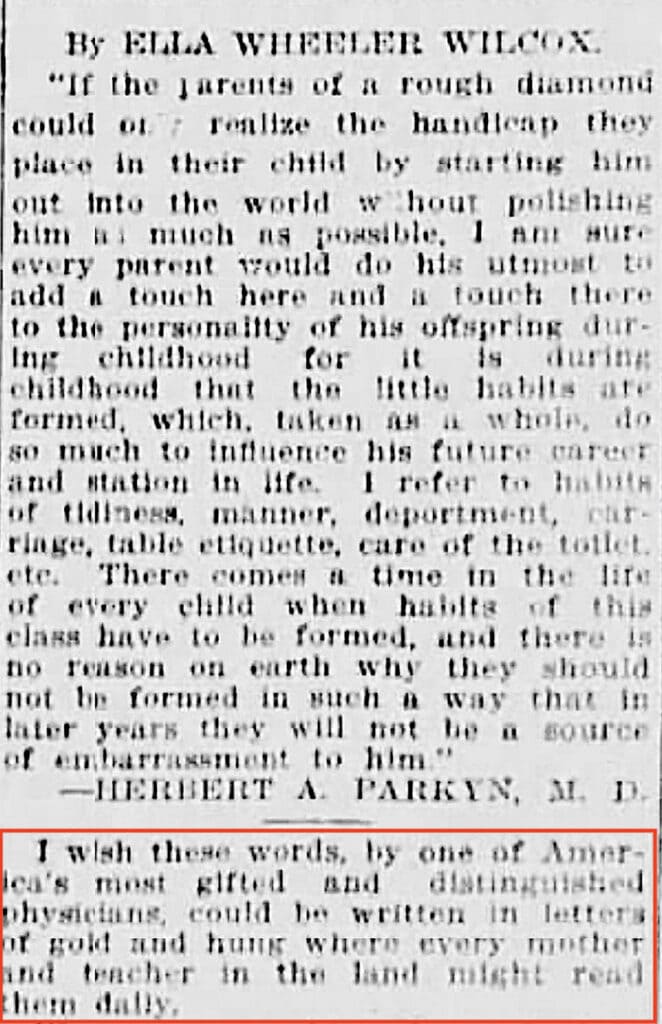
Her association with Parkyn also continued beyond the first decade of the century. In 1912 Wilcox publicly praised Parkyn saying;
“I wish these words, by one of America’s most gifted and distinguished physicians, could be written in letters of gold and hung where every mother and teacher in the land might read them daily.”
The Heart of the New Thought
Wilcox’s appointment to New Thought magazine was accompanied by the December 1902 publication of The Heart of the New Thought. The book appeared as part of an organized publishing campaign alongside Atkinson’s The Law of the New Thought and was offered as a premium gift to new subscribers.

The Heart of the New Thought presents New Thought as a philosophy of disciplined thinking that can be consciously applied to everyday existence. Its essays address thought force, optimism, concentration, heredity, happiness, health, prosperity, self-conquest, destiny, breathing, generosity, character and women’s opportunities. Wilcox calls New Thought the “Science of Right Thinking” and repeatedly emphasizes that mental transformation requires persistence. Old habits of fear, despondency and anticipated failure must be replaced by repeated thoughts of courage, health, wisdom, usefulness, prosperity and success. She compares the process to sowing and watering a seed. Repetition gradually establishes new mental habits, and the individual must learn to educate and direct the mind instead of allowing inherited or acquired patterns to govern it.
Her language made these teachings accessible to a mass readership. Wilcox could move from an abstract proposition about thought to advice about exercise, breathing, clothing, social behavior or beginning a new stage of life. That ability was exactly what the publishers emphasized. Her function in the campaign was not merely to attach a celebrity name to New Thought. She translated its central claims into the emotional and conversational language already familiar to the enormous audience that read her poetry.
How Did Wilcox Combine New Thought and Theosophy?
Wilcox never confined herself to a single metaphysical school. New Thought gave her a language for the creative power of thought, self-direction and mental transformation, while Theosophy supplied a much larger cosmology involving reincarnation, karma, spiritual evolution, Masters and planes of existence. Spiritualism addressed survival after death and communication between the living and the departed. Her later writings bring these ideas together without treating them as mutually exclusive systems.
Her poetry had already entered Theosophical circulation long before she formally became a member of the Theosophical Society. In 1902 The Theosophical Messenger printed her poem beginning “You never can tell what your thoughts may do,” in which thoughts are described as things that travel according to universal law and return to the person who sent them forth. William John Walters used the poem as a means of conveying Theosophical concepts to children. The language also fits naturally beside Wilcox’s New Thought writings of the same year. The mental universe described in the poem is lawful, causative and responsive to the quality of the thoughts an individual sends into it.
Her 1910 poem “Climbing” likewise describes spiritual development as an ascent in which apparent descents are still higher than those that came before. The traveler must continue through valleys of despair toward the shining mountain height. Wilcox’s famous lines about the many gods, creeds and winding religious paths ending in “the art of being kind” expressed the religious inclusiveness that marked much of her mature metaphysical outlook.
The Order of the Star in the East and Annie Besant’s Theosophical Movement

Before formally entering the American Theosophical Society, Wilcox had already become interested in the Order of the Star in the East, the international Theosophical movement organized around the expectation of a coming World Teacher and closely associated with Annie Besant and the Theosophical Society’s work in India. This brought Wilcox into contact with a form of Theosophy in which India, Eastern religion, reincarnation and the expected appearance of a great spiritual teacher occupied a central place.
Wilcox gave the Order considerable publicity through her syndicated article “Our Choice of Roads to God.” The article appeared in major American newspapers, explained the founding of the Order, reproduced its principles with sympathetic commentary, and included a long poem beginning with the question “How will Christ come back again.” For a movement seeking recognition beyond dedicated Theosophical circles, the participation of a nationally syndicated writer of Wilcox’s stature offered exposure on a scale that specialized occult publications could rarely achieve.
Her personal contact with the Theosophical world was equally direct. During her travels she met Lady Emily Lutyens, daughter of Owen Meredith and granddaughter of Edward Bulwer-Lytton. Wilcox remembered Lutyens as a serious student of Theosophy who attempted to put its principles into daily life through simplicity, service and the atmosphere of her household. Wilcox also knew the work of Elliott Coues and L. W. Rogers and later cited Rogers’s Elementary Theosophy while discussing the proper relationship between the living and the dead.
On October 14, 1913, Wilcox was formally admitted to the American Theosophical Society in New Haven, Connecticut. Formal membership came after years of reading, discussion, publication and personal engagement with Theosophical ideas. By this point reincarnation had become one of her firmest convictions.
Reincarnation, Karma and the Spiritual Evolution of Humanity
Wilcox’s belief in reincarnation became increasingly explicit. She and Robert interpreted it as an answer to the apparent inequalities and injustices of earthly existence and even as an explanation for their immediate sense of recognition when they met. She believed Christian rejection of reincarnation resulted from a misunderstanding of Christianity’s own origins and cited the Gospel passages identifying John the Baptist with Elias as evidence that Jesus knew and taught the principle. In The Worlds and I she called Christ the latest and greatest of the Masters and criticized Christians who dismissed reincarnation simply as paganism.
Near the end of the autobiography, Wilcox went considerably further. She described reincarnation through many forms and bodies as a scientific fact and taught that the divine spirit of the Logos exists through the entire evolutionary process. Experience is accumulated through successive forms, joys and sorrows until the spirit returns to its divine source. Her worldview joined this doctrine with karma. Human beings, she believed, were continually building the conditions of future existence through present thought, conduct and action. Earthly life acquired significance because death did not end either consciousness or development.
This is one of the clearest points at which Wilcox’s New Thought, Theosophical and Spiritualist beliefs converge. Thought has consequences now, but its consequences do not end with physical death. Character, consciousness and spiritual development continue. Her New Thought emphasis upon mastering thought becomes part of a much longer process of spiritual evolution extending through successive lives and higher planes.
Ella Wheeler Wilcox and the American Rosicrucian Movement
Rosicrucianism formed another important part of Wilcox’s metaphysical life. Between 1904 and 1909 she became involved with the Rosicrucian Research Society alongside Harvey Spencer Lewis, Frater Elbert Hubbard and Isaac K. Funk, president of Funk & Wagnalls Publishing Company. (Funk was also a regular contributor to Parkyn’s Suggestion magazine). The group held monthly meetings in New York City and operated as the New York Institute for Psychical Research. Others involved in the Institute were Frederick T. McIntyre and Albert H. Postel. McIntyre and H. Spencer Lewis were both presented as Doctors of Suggestive Therapeutics and were associated with the American College of Sciences, which was affiliated with Parkyn’s Chicago School of Psychology.

Read the article: Postel, McIntyre, Herbert Spencer, and Funk. New York Institute of Psychical Research
H. Spencer Lewis subsequently obtained the contacts and authority through which the modern American Rosicrucian movement was formally established. When the organization received its charter in 1915 with Lewis as Imperator, Wilcox was appointed to its first Supreme Council. She served as a Supreme Council officer until her death in 1919. The organization’s name would later be changed to the Ancient Mystical Order of the Rosy Cross (AMORC). Her poetry would continue to circulate in Rosicrucian publications, including Rosicrucian Digest, and one of her poems became associated with Rosicrucian funeral observances.
The dates are important as they show that Wilcox’s Rosicrucian activity was already developing during the same decade in which she was working within Parkyn’s publishing network.
What I Know About New Thought
Wilcox continued to identify publicly with New Thought long after the 1902 publishing campaign. Her later booklet What I Know About New Thought presented the philosophy in the direct language for which she had become known, and by 1915 it was reported to have reached a circulation of approximately 50,000 copies. She also wrote a syndicated advice column for the Hearst newspapers in which New Thought principles could be applied to ordinary personal problems.
This mass circulation was an important part of Wilcox’s place in the movement. She was capable of carrying metaphysical ideas into newspapers and homes where readers might never encounter a formal lecture on mental science, Theosophy or occult philosophy. A brief Wilcox poem about courage, thought or self-mastery could function as a compact New Thought lesson without requiring specialized terminology. The same quality had made her so useful to Parkyn’s network in 1902 and continued to define her metaphysical writing throughout the remainder of her career.
Robert Wilcox’s Death and the Search for Communication
Ella and Robert had agreed early in their marriage that whichever of them died first would attempt to communicate with the survivor. Robert died on May 21, 1916, after more than thirty years of marriage. Ella expected the promise to be fulfilled and was devastated when no unmistakable message came. As weeks passed, grief intensified into a spiritual crisis. The question of survival after death, which she had studied intellectually for years, had become intensely personal.
She traveled to California and consulted the Rosicrucian astrologer Max Heindel. Heindel told her that her own grief was interfering with the contact she desired. He compared her mind to a pool capable of reflecting the sky and trees when calm but incapable of reflecting anything clearly after a stone has disturbed its surface. God and Robert’s spirit, he explained, were still present, but the turbulence of sorrow had to subside before she could perceive what was being reflected.
Wilcox never forgot the explanation. In The Worlds and I she connected Heindel’s teaching with concentration, psychic sensitivity and the possibility of direct communication between minds on different planes. She came to believe that uncontrolled sorrow, rebellion against death and scattered thought obstruct spiritual communication, while tranquillity and sustained concentration make the mind receptive to impressions from the departed.
Several months later she developed an affirmative prayer that joined her New Thought habits of repeated affirmation with her Spiritualist search for Robert. She repeatedly declared herself a living witness that the dead continue to live and can speak to and through the living, ending with her readiness for God, Christ and Robert. Her eventual conviction that Robert had communicated with her transformed her grief and strengthened her determination to tell others that physical death did not end individual consciousness.
Spiritualism and Psychical Research in The Worlds and I
Wilcox published her autobiography The Worlds and I in 1918. The title itself suited the book. This was not simply the recollection of a literary career. It was her account of the different worlds through which she believed she had moved and the larger spiritual world toward which humanity was traveling. Literary success, marriage, travel, grief, New Thought, Theosophy, Spiritualism, reincarnation, occult investigation and communication with Robert all became parts of the same life story.
By the final years of her life, Wilcox no longer treated survival after death as a question about which she was merely curious. She considered it a truth that humanity should investigate. The Worlds and I discusses psychical research, mediums, clairvoyance, communication from the dead, astral planes and the development of psychic faculties. She warned against using occult powers for money and believed that selfish use of psychic abilities attracted undeveloped, earthbound spirits. The proper goal was spiritual elevation, allowing communication with higher beings and eventually developing the ability to receive impressions directly from disincarnate minds.
Her interpretation of Spiritualism remained strongly Theosophical. The dead were not simply invisible versions of their former earthly selves waiting to answer mundane questions. They were continuing their own education and development on other planes. Wilcox compared death to traveling to another country and argued that the living should learn something about the destination that everyone must eventually enter. She drew on L. W. Rogers’s Elementary Theosophy to argue that the dead should not be continually disturbed over trivial earthly concerns. Communication should assist spiritual understanding, not reduce the departed to advisers on ordinary affairs.
Her metaphysics had by then developed into a unified picture. Human beings are spiritual entities passing through repeated embodiments. Thought and action create consequences that extend beyond a single lifetime. Death moves consciousness into another field of experience. The dead continue to develop. Communication across the boundary is possible under appropriate conditions. Higher spiritual beings exist, and humanity itself is moving through a long process of education toward greater consciousness.
Near the book’s conclusion, Wilcox describes God and hierarchies of spiritual beings as a vast source from which humanity can obtain wisdom, knowledge, light, and power. Earth is only a preparatory room within the many mansions of existence. Her final instruction to the reader was simple: “Think on these things.”
War Work in France
Wilcox remained active during the First World War and traveled to France in 1918, undertaking a demanding tour of Allied army camps from February through September in which she lectured and read poetry to soldiers. The tour was physically exhausting, and Wilcox was already suffering from serious illness. Yet she continued her work through the final months of the war. Her wartime poetry belongs to a substantial part of her literary output that has often received less attention than Poems of Passion and “Solitude,” but it demonstrates how far her career had traveled from the Wisconsin teenager mailing poems with pennies saved for postage.
Death and Legacy

Ella Wheeler Wilcox died from breast cancer at her home in Short Beach, Connecticut, on October 30, 1919, six days before what would have been her sixty-ninth birthday. News of her death appeared throughout the United States and Canada. She left behind an enormous body of poetry, prose, newspaper writing and metaphysical literature produced during a career that had begun when a Wisconsin girl started mailing poems to editors in hopes of receiving copies of their publications.
Her historical importance to New Thought is larger than the handful of books she wrote specifically about the movement. Wilcox brought the language of mental power, optimism, self-mastery and spiritual development to an audience already familiar with her as one of America’s most popular poets. Her appointment to New Thought in December 1902 and the simultaneous publication of The Heart of the New Thought placed that literary reputation directly inside Herbert A. Parkyn’s publishing network, and the widespread republication of her poetry throughout the New Thought press kept her connected to that publishing world for years afterward.
Her metaphysical life gave her reincarnation, karma, Masters, and spiritual evolution. The Order of the Star in the East connected her with an international Theosophical movement centered heavily upon India and the expectation of a World Teacher. Rosicrucianism brought her into organized esoteric work in America and eventually onto its first Supreme Council. Spiritualism and psychical research became intensely personal after Robert’s death and led her to devote the closing portion of her life to the conviction that death does not destroy consciousness. These interests were different expressions of the question that ran through much of her work: what human thought and consciousness can become.
For Wilcox, the answer extended far beyond optimism or positive thinking. Human beings were immortal spiritual entities learning to master thought and character through repeated experience, carrying the results of their actions into future lives and continuing their development after death. That philosophy, expressed through one of the most widely read poetic voices of her generation, explains why Ella Wheeler Wilcox belongs not only to American literary history but also to the history of New Thought, Theosophy, Rosicrucianism, Spiritualism, psychical research, and the publishing network surrounding Herbert A. Parkyn and the Yogi Publication Society.
Books by Ella Wheeler Wilcox
Poetry
- Maurine and other Poems (1882, Jansen, McClurg & Company [Chicago])
- Poems of Passion (1883, W.B. Conkey Company [Chicago])
- Drops of Water (1889, The National Temperance Society and Publication House [New York])
- Poems of Pleasure (1888, Belford, Clarke, and Company [New York])
- Poems of Reflection (1905, M. A. Donahue & Co. [Chicago])
- Poems of Cheer (1908, Gay and Hancock Ltd [London])
- Poems of Experience (1910, Gay and Hancock Ltd [London])
- Poems of Progress and New Thought Pastels (1909, W.B. Conkey Company [Chicago])
- Poems of Problems (1914, W.B. Conkey Company [Chicago])
- Poems of Affection (1920 Gay and Hancock Ltd [London])
- Poems of Life (1921)
Novels
- Mal Moulée: A Novel (1885)
- A Double Life (1890)
- Sweet Danger (1892)
- A Woman of the World: Her Counsel to Other People’s Sons and Daughters (1904)
On New Thought and Autobiogrphies
- The Heart of New Thought (1902)
- The Story of a Literary Career (1905)
- New Thought Common Sense and What Life Means to Me (1908)
- The Worlds and I (1918)
.

Sources & Citations
- PDF / Digital Archive. Scott, Emmett J. Scott's Official History of The American Negro in the World War. Chicago: Homewood Press. Retrieved February 9, 2014.
- Newspaper. ""Mizpah" at Baltimore" . The New York Times. January 23, 1906. p. 9. Retrieved January 11, 2024.
- PDF / Digital Archive. "Nickelodeon Volume 13, Issues 1-26" . 1915. Retrieved January 22, 2024.
- Catalog. "The Price He Paid" . American Film Institute. Retrieved September 2, 2018.
- Catalog. "The Beautiful Lie" . American Film Institute. Retrieved September 2, 2018.
- Catalog. "The Belle of the Season" . American Film Institute. Retrieved September 2, 2018.
- Catalog. "The Man Worth While" . American Film Institute. Retrieved September 2, 2018.
- Website. Hamner , Everett (September 12, 2017). "Protest Unceasing, Redemption Unfinished: An Interview with "Orphan Black's" Graeme Manson and Cosima Herter". LA Review of Books.
- Website. Watkins , Robert E. (2016). Freedom and Vengeance on Film: Precarious Lives and the Politics of Subjectivity. I.B. Tauris. p. 21.
- PDF / Digital Archive. New Thought magazine , September 1902.
- PDF / Digital Archive. New Thought magazine , December 1902.
- PDF / Digital Archive. "The Heart of the New Thought" , by Ella Wheeler Wilcox, Psychic Research Company, 1902.
- Website. Wilcox , Ella Wheeler (1998-01-01). "The Way of the World". Ref CT268 D4. Retrieved 2025-07-07.
- PDF / Digital Archive. New Thought magazine , April 1903
- PDF / Digital Archive. "Nautilus (IAPSOP)" . iapsop.com. Retrieved 2025-07-07.
- Book. "Elizabeth Towne Home Page- Biography and Book Excerpts" . elizabethtowne.wwwhubs.com.
- Website. "Be Kind to Animals" . Los Angeles Herald, Volume XL, Number 94, 19 February 1914.
- PDF / Digital Archive. Cuzner , A. T. (1918). "Studies on Food Economics: Vegetarianism". American Journal of Clinical Medicine. 25: 59–60.
- Newspaper. "Cremation of Body of Ella Wheeler Wilcox" . Hartford Courant. November 7, 1919. p. 24. Retrieved March 21, 2025 – via Newspapers.com.
- Website. Some versions indicate the words are "For the brave old earth must borrow its mirth" or "For the sad old earth must borrow its mirth"
- Website. Beers, D. 2006. For the Prevention of Cruelty: The History and Legacy of Animal Rights Activism in the United States.
- PDF / Digital Archive. Scott, Emmett J. Scott's Official History of The American Negro in the World War. Chicago: Homewood Press. Retrieved February 9, 2014.
- Newspaper. ""Mizpah" at Baltimore" . The New York Times. January 23, 1906. p. 9.
- PDF / Digital Archive. "Nickelodeon Volume 13, Issues 1-26" . 1915. Retrieved January 22, 2024.
- Catalog. "The Price He Paid" . American Film Institute. .
- Catalog. "The Beautiful Lie" . American Film Institute.
- Catalog. "The Belle of the Season" . American Film Institute.
- Catalog. "The Man Worth While" . American Film Institute.
- Website. Hamner , Everett (September 12, 2017). "Protest Unceasing, Redemption Unfinished: An Interview with "Orphan Black's" Graeme Manson and Cosima Herter". LA Review of Books.
- Website. Watkins , Robert E. (2016). Freedom and Vengeance on Film: Precarious Lives and the Politics of Subjectivity. I.B. Tauris. p. 21
- PDF / Digital Archive. Edwards , Richard. "Ella Wheeler Wilcox". www.ellawheelerwilcox.org. Retrieved May 22, 2018.
- Newspaper. "Ella Wheeler Wilcox Dies in Connecticut" . Hartford Courant. October 31, 1919. p. 5. via Newspapers.com.
- Website. E W Wilcox at Wikisource
- Newspaper. "A Celebration of Ella Wheeler Wilcox, Poet, Journalist, and Progressive Thinker," Branford Historical Society
- PDF / Digital Archive. Wilcox , Ella Wheeler (1908). New Thought Common Sense and what Life Means to Me. W. B. Conkey Company.
- PDF / Digital Archive. Schumacher , Richard (October 6, 2023). Ella Wheeler Wilcox: Poetess to the New Thought Movement. Group Twelve Productions. ISBN 979-8-9870517-2-6.
- Website. "Ella Wheeler Wilcox Home Page" . ellawheelerwilcox.wwwhubs.com.
- Website. "Babel Web Anthology :: The page of Wheeler Wilcox, Ella, English biography" . www.babelmatrix.org. Retrieved March 1, 2026.
- PDF / Digital Archive. "The Heart of the New Thought" , by Ella Wheeler Wilcox, Psychic Research Company, 1902.
- PDF / Digital Archive. New Thought magazine , April 1903
- PDF / Digital Archive. The Law of the New Thought , by William Walker Atkinson 1902
- Website. Company , The Psychic Research. Psychic Research Company's Lessons On Occult Powers. Literary Licensing, LLC. ISBN 978-1-4978-8250-8.
- PDF / Digital Archive. "New Thought [Chicago] (IAPSOP)" . iapsop.com.
- PDF / Digital Archive. "Nautilus (IAPSOP)" . iapsop.com.