
Person Research Collection
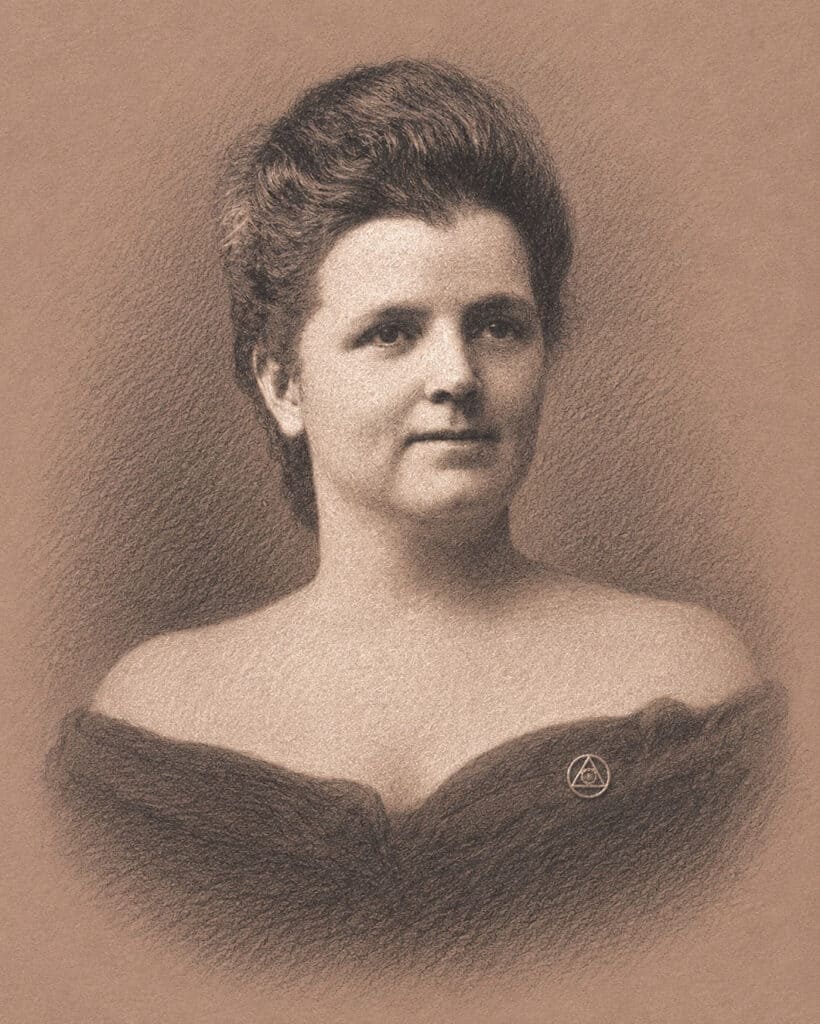
Elizabeth Towne
1865–1960
Towne became a close collaborator of Parkyn, while The Nautilus emerged as a major promoter of his network and the Yogi Publication Society. Towne even claimed to personally know the “Western adept” behind Yogi Ramacharaka.
Elizabeth Towne (1865–1960) was an American author, editor, publisher, lecturer, and one of the most influential organizers of the New Thought movement. Best known as the founder and longtime editor of The Nautilus., Towne helped transform New Thought from a loose collection of mental-healing and metaphysical teachings into a popular movement centered on practical self-development, health, prosperity, personal independence, and the conscious use of thought.

Her importance extended far beyond her own writings. Through The Nautilus and the Elizabeth Towne Company, she created one of the movement’s most important publishing platforms, promoting authors, correspondence courses, books, and schools of mental science to an international readership.
Central to the magazine’s early growth was Towne’s close relationship with Dr. Herbert A. Parkyn and the publishing network surrounding Suggestion magazine. Parkyn became an early supporter and investor in The Nautilus, promoted Towne extensively through his magazines, and directed advertising and writers from his network into the magazine. Nautilus grew into one of the principal promotional outlets for Parkyn’s network and, alongside Suggestion, one of the strongest early promoters of the Yogi Publication Society and its Yogi Ramacharaka books. Towne even told her readers that she personally knew the man writing as Ramacharaka, describing him as a “Western adept” who had deeply studied and personally applied Eastern teachings.
Early Life
Towne was born Elizabeth Jones in Oregon in 1865. Her entrance into New Thought came during a difficult period of her personal life marked by an unhappy first marriage, financial problems, and a growing desire for independence. Her encounter with mental science offered both a philosophy of personal transformation and a practical means of rebuilding her life. Rather than accepting circumstances as fixed, Towne embraced the idea that disciplined thought, self-confidence, and control of one’s mental habits could transform health, relationships, and material conditions.
This philosophy became inseparable from her own life. She eventually divorced her first husband, established herself independently as a writer and publisher, and later married William E. Towne, who became an important partner in her publishing work.
Thomas Sheldon and Her Training in Mental Science
An important early influence upon Towne’s development was Thomas J. Shelton, one of the early teachers of American mental science and editor of Christian magazine. Towne studied Shelton’s teachings and credited him with helping introduce her to the practical principles of mental healing and the conscious direction of thought. Shelton emphasized the power of the individual mind, affirmative thought, self-reliance, and the possibility of transforming outward conditions through changes in consciousness. Towne absorbed these principles but developed them in a distinctly practical direction. Rather than remaining primarily concerned with metaphysical healing, she increasingly applied mental science to health, financial independence, relationships, personal magnetism, business achievement, and everyday self-development. This early training helped establish the philosophical foundation upon which she later built The Nautilus and her publishing career.
The Nautilus

In 1898, Towne began publishing the small periodical that eventually became The Nautilus. What started as a modest publication grew into one of the longest-running and most widely circulated New Thought magazines in America, remaining in publication for more than half a century. The name reflected the symbolism of the nautilus shell and its continual outward growth. For Towne, this provided an ideal representation of New Thought: human development occurred from within outward, with changes in consciousness eventually expressing themselves through external life.
Under her direction, The Nautilus became much more than a personal journal. It functioned as a central forum for the New Thought movement, bringing together writers and teachers representing mental science, metaphysical healing, practical psychology, self-culture, prosperity philosophy, health reform, and spiritual development.
Dr. Herbert A. Parkyn and the Chicago Network
Towne’s relationship with Dr. Herbert A. Parkyn began in late 1900 through a series of remarkably lively exchanges between the pages of Nautilus and Parkyn’s Suggestion magazine. Their first encounter was actually a disagreement. Towne challenged Parkyn’s argument that many “Divine Healers” were essentially practicing suggestive therapeutics while disguising suggestion beneath religious or metaphysical language. She countered that physicians did much the same thing when they used medicines or other devices to reinforce their own therapeutic suggestions, arguing that different people simply responded to different kinds of “masks.”

Rather than taking offense, Parkyn responded with an extended humorous editorial in the December 1900 Suggestion. He described Towne as “a spark producer without a doubt,” called Nautilus “one of the liveliest sheets that comes this way,” and admired the fact that she “says what she pleases, without asking anyone’s permission.” He teased her about her Success Circle, her claims concerning powerful “vibrations,” and even her recently published Just How to Wake the Solar Plexus. Towne enthusiastically joined in the joke. In a letter subsequently published by Parkyn, she told him, “You are a brick,” thanked him for the publicity and orders his editorial had generated, and promised to send even stronger “success vibrations” during 1901. Parkyn replied that the vibrations had already arrived “hot and sizzling,” joking that she should continue sending money, success, and fun but refrain from sending any “soul mates.”
Their good-natured sparring continued into 1901. When a letter Towne sent asking about advertising her latest book in Suggestion was accidentally overlooked, she wrote again asking whether they were deliberately “snubbing the sassy editor of Nautilus.” Parkyn responded with another playful editorial devoted to Towne, affectionately nicknaming her “Naughty Lass.” The same issue praised her new book The Constitution of Man and gave it free advertising.
Behind the humor, however, a significant professional relationship was developing. The exchanges established a warm friendship and mutual respect between Towne and Parkyn and increasingly connected the Nautilus publishing operation with the network surrounding Suggestion. Towne soon became part of Parkyn’s wider circle of collaborators, and Nautilus became an important advertising outlet for the enterprises associated with that network.
Advertisements appeared for Parkyn’s magazine and books, his and Sydney B. Flower‘s investment ventures, the Psychic Research Company, William Walker Atkinson’s Thought = Force in Everyday Life, and publications and courses produced by former pupils. In some issues of The Nautilus, more than half of the advertising came from Parkyn and members of his circle. At the same time, Suggestion repeatedly featured Towne and Nautilus in its editorials and articles, giving her publication valuable exposure to Parkyn’s established readership.

The relationship became still closer as the New Thought publishing network expanded. In late 1902, Towne was engaged to contribute an article to each issue of New Thought, placing her directly within another of the principal journals associated with Parkyn’s collaborators. These early exchanges are particularly revealing because they show that Towne’s connection with Parkyn’s circle did not begin as an impersonal advertising arrangement. It grew from a personal friendship between two prominent figures who openly debated one another’s ideas, joked about their philosophical differences, promoted each other’s work, and ultimately developed a lasting relationship. What began with Towne publicly challenging Parkyn’s theory of “masked suggestion” became an important connection between Nautilus and the Chicago network that was helping shape the New Thought movement.

The Expansion of The Nautilus
Towne’s growing relationship with Parkyn’s circle became even more significant when Professor Edgar L. Larkin, one of the leading staff writers Parkyn had developed in Suggestion, was moved to The Nautilus. Under Parkyn’s promotion, Larkin had quickly emerged as one of Suggestion‘s most popular and dynamic writers and had become a recognized voice within the New Thought movement.
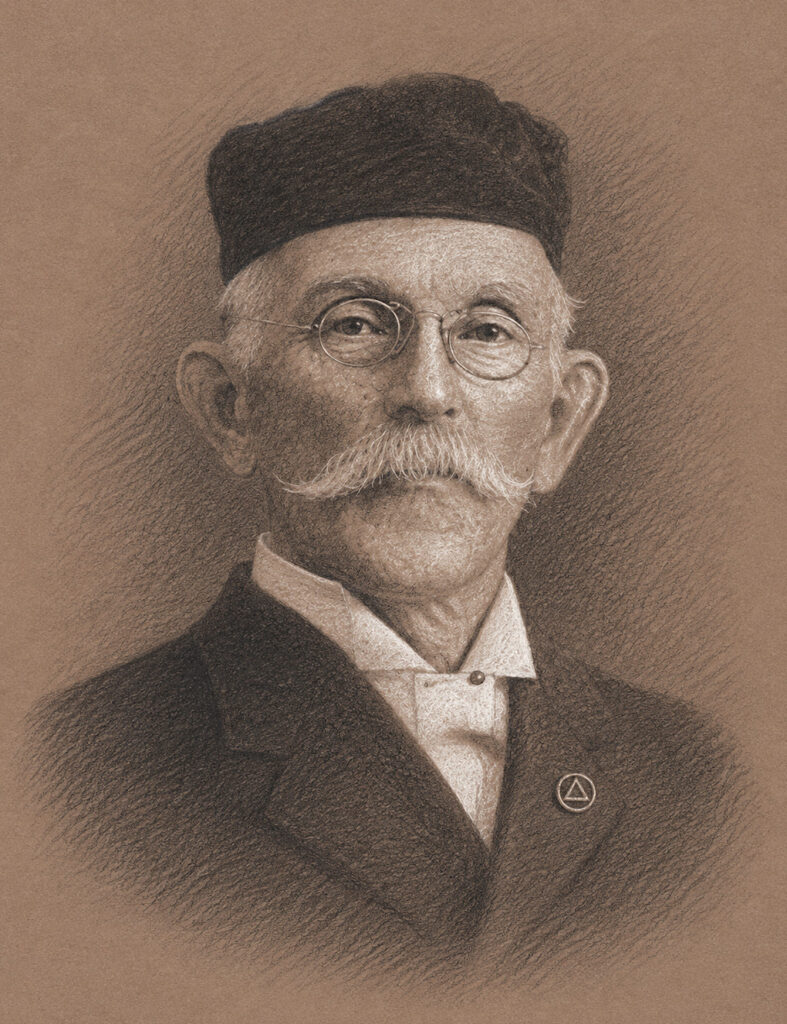
The move followed a pattern Parkyn had already established with Sydney B. Flower and William Walker Atkinson. He used the authority and established readership of Suggestion to introduce promising writers, repeatedly feature their work, and build their reputations before extending their influence into other publications within his network, called the “Suggestion Family.” By this time, Parkyn had already played an important role in raising the visibility of Towne and Nautilus through frequent editorial attention, reciprocal promotion, advertising from his extensive network, and Elizabeth’s regular contributions to New Thought. Moving one of Suggestion‘s leading writers into her magazine represented another stage in that relationship. Larkin brought with him both the reputation he had developed in Suggestion and the kind of dramatic, accessible writing that could reach the readership Towne was cultivating.
The timing is particularly significant. Coinciding with Larkin’s arrival, The Nautilus underwent a dramatic expansion, growing from the modest, coverless eight-page publication it had been for several years into a professionally presented forty-page magazine with a newly designed cover. Its appearance and page design now closely resembled Suggestion, while its editorial reach expanded considerably.
For Parkyn, this was a strategy he had used before: Suggestion did not need to depend upon a single star writer because its authority rested on Parkyn and its established body of physicians, psychologists, educators, and other contributors. It could therefore function as a platform for developing new personalities. Once a writer had established a reputation there, that individual could be moved into a more accessible publication where the same core ideas could reach a different and often much larger audience.
Larkin’s transition from Suggestion to The Nautilus is therefore important to understanding Towne’s place within Parkyn’s publishing network. Parkyn was directing one of the foremost writers he had cultivated in Suggestion into The Nautilus at the very moment the magazine was being substantially enlarged and repositioned as a major New Thought publication.


The Nautilus and the Yogi Publication Society
Towne’s relationship with Parkyn’s network also extended directly into the early promotion of the Yogi Publication Society. Outside of Suggestion magazine itself, The Nautilus became one of the most important promoters of the Society and its Yogi Ramacharaka books, repeatedly advertising the publications.
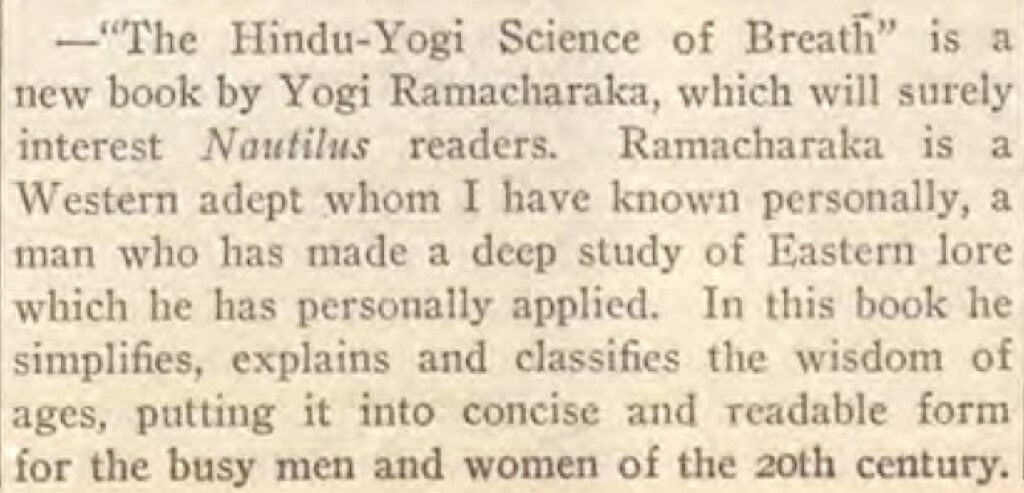
The relationship is particularly revealing in Elizabeth Towne’s own treatment of The Hindu-Yogi Science of Breath. In an editorial, Towne personally recommended the book to her readers and made the remarkable statement that Ramacharaka was “a Western adept whom I have known personally,” describing him as “a man who has made a deep study of Eastern lore which he has personally applied.” She praised the book for simplifying and classifying the “wisdom of ages” into a concise and readable form suited to “the busy men and women of the 20th century.” This is especially significant because Ramacharaka was being publicly presented by the Yogi Publication Society as an Indian yogi and spiritual teacher. Towne’s statement that she personally knew the man behind the name, and specifically described him as a “Western adept,” provides important contemporary evidence that people within this closely connected publishing circle understood Ramacharaka differently from the public biography attached to the books.
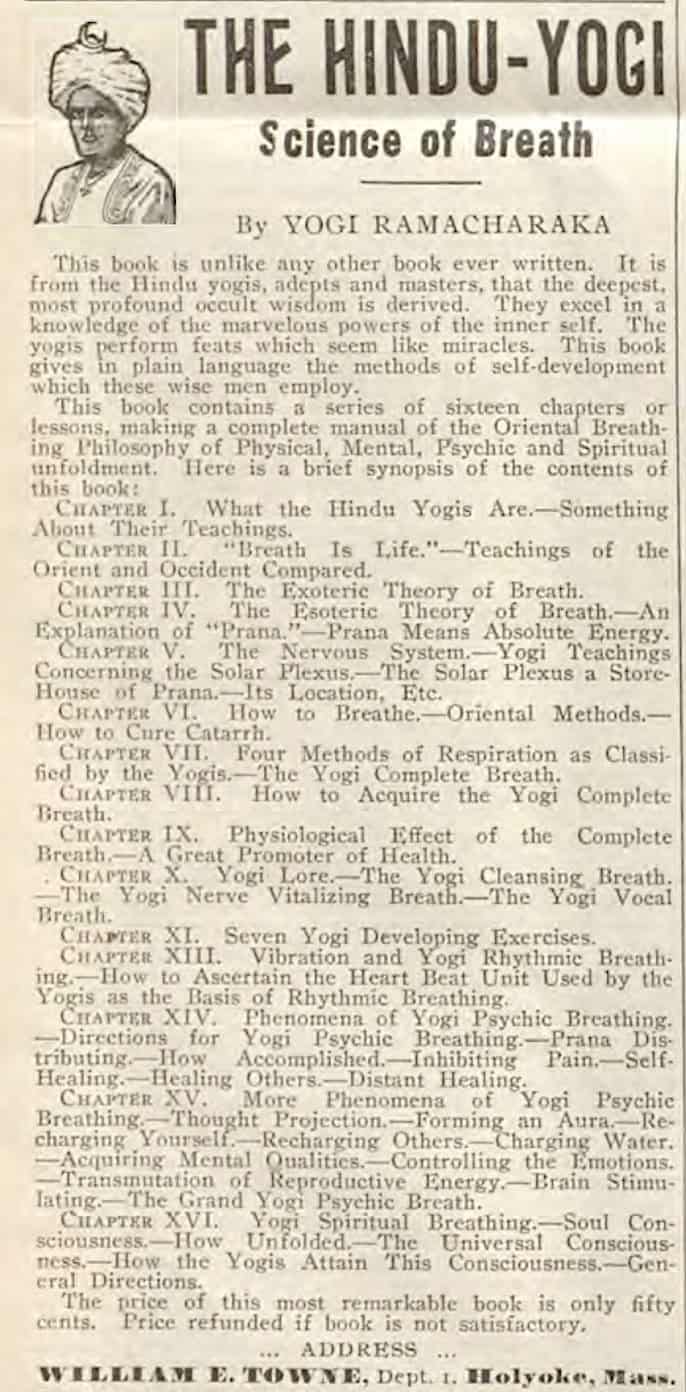
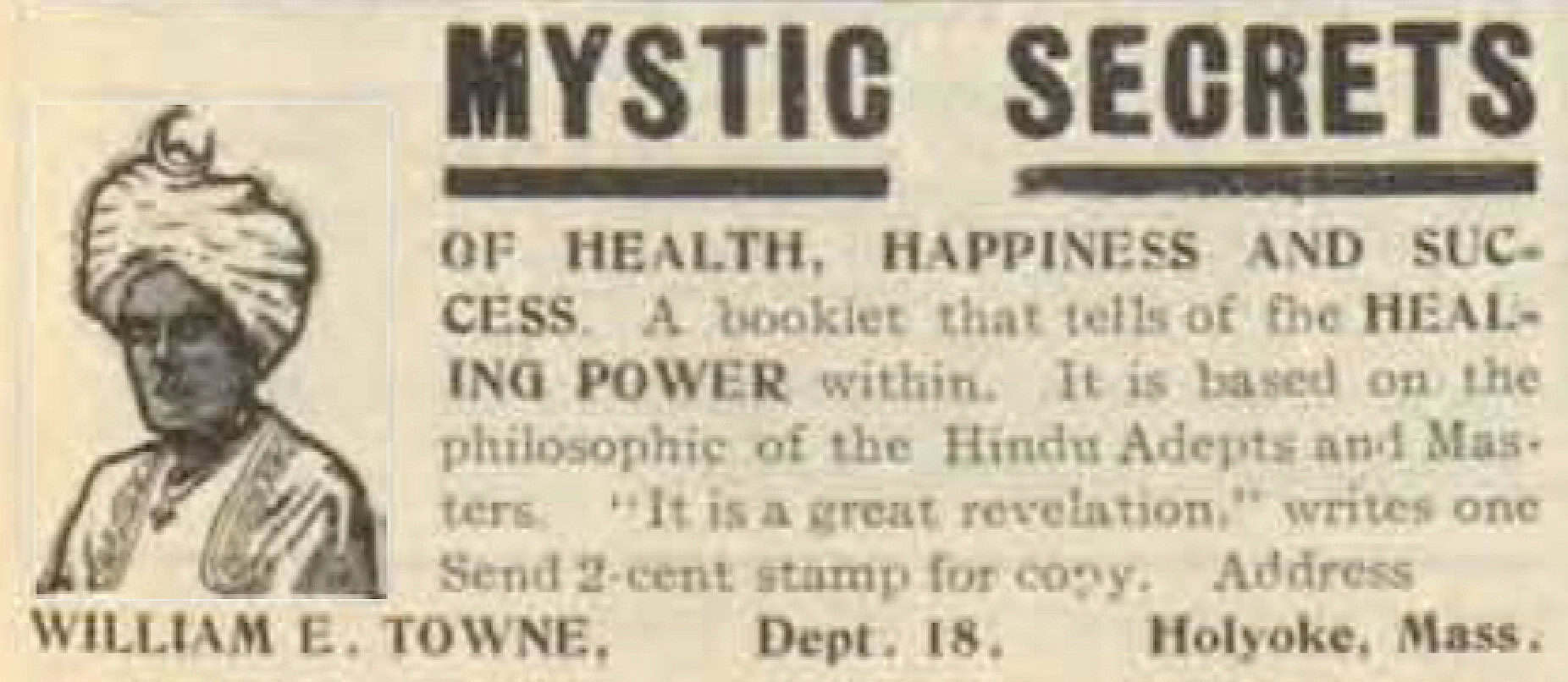
Nautilus continued promoting The Hindu-Yogi Science of Breath extensively. The magazine carried large advertisements explaining the contents of the book chapter by chapter, covering Prana, the nervous system, the solar plexus, rhythmic breathing, psychic healing, thought projection, aura formation, mental control, reproductive energy, and spiritual consciousness. These advertisements also featured an illustration representing Yogi Ramacharaka.
William Towne and the Yogi Publication Society
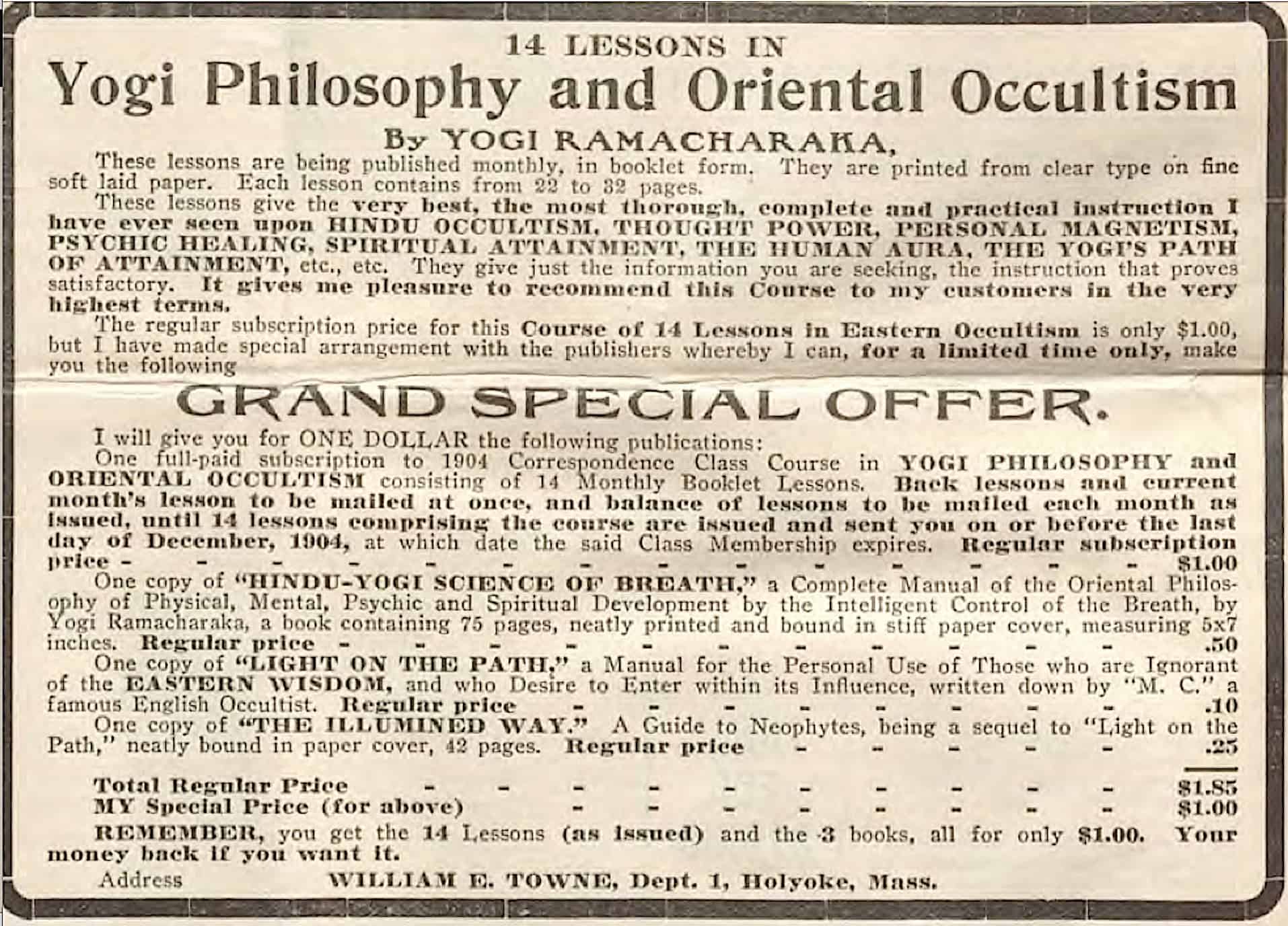
William E. Towne appears to have been functioning as an Eastern sales agent and distributor for the Yogi Publication Society. In Nautilus, he offered the complete fourteen-lesson Yogi Philosophy and Oriental Occultism correspondence course directly to his own customers, explaining that he had made a “special arrangement with the publishers” allowing him to sell the course at a reduced price. Towne’s package brought together several of the Yogi Publication Society’s earliest publications. For one dollar, customers received the complete 1904 Ramacharaka correspondence course, The Hindu-Yogi Science of Breath, Light on the Path, and The Illumined Way. Back lessons were supplied immediately, while subsequent lessons were mailed monthly as they appeared. Significantly, orders and payments were directed not to the Yogi Publication Society in Chicago but directly to William E. Towne in Holyoke, Massachusetts.
Another revealing connection appeared in advertising, where the Townes used the same illustration representing Yogi Ramacharaka to promote a separate pamphlet titled Mystic Secrets of Health, Happiness and Success. This advertisement made no mention of the Yogi Publication Society and again directed orders directly to William E. Towne in Holyoke. The language of the advertisement provides another connection with Parkyn’s network. “Health, Happiness and Success” was one of Parkyn’s characteristic slogans and had appeared prominently on the covers of Suggestion for years. Towne was now using the same phrase to promote his own publication while pairing it with the same yogi image being used to represent Yogi Ramacharaka.
Practical New Thought
Towne’s distinctive contribution was her insistence that New Thought should produce tangible results in ordinary life. Spiritual development was important, but she believed that mental principles should also improve health, finances, relationships, confidence, work, and personal independence. Her philosophy centered upon the idea that thought was an active creative force. Habitual beliefs eventually expressed themselves through the body, personality, behavior, and circumstances. Changing one’s life therefore required changing the mental patterns continually reproducing those conditions. Towne promoted affirmations, visualization, breathing exercises, constructive thinking, and deliberate mental discipline as practical tools for this transformation. Her New Thought was therefore not simply a theology but a method of daily self-training.
The Solar Plexus
One of Towne’s most recognizable teachings concerned the solar plexus, which she described as an important center of vital and creative energy within the human body. In works such as Just How to Wake the Solar Plexus, she combined breathing, visualization, mental concentration, and bodily awareness into exercises intended to awaken greater vitality and personal power. Her treatment of the solar plexus reflected the period’s broader attempt to connect physiology, nervous energy, mental science, and metaphysical concepts of life force.
The Elizabeth Towne Company
As The Nautilus expanded, Towne developed a substantial publishing business around it. The Elizabeth Towne Company published books, pamphlets, courses, and instructional literature by Towne and numerous other New Thought writers. Among the authors associated with her publishing enterprise was Wallace D. Wattles, whose writings on prosperity and constructive thinking later became classics of the self-help tradition. She would also publish several William Walker Atkinson titles. Towne’s willingness to promote other writers was fundamental to her influence: she was not merely an author selling her own philosophy but a publisher helping construct the literary infrastructure of the entire movement.
Women and Personal Independence
Towne’s philosophy of self-mastery was closely connected with her views concerning women. She argued that women should possess intellectual, financial, emotional, and personal independence rather than defining themselves entirely through marriage and domestic roles. These principles were reflected in her own life as a business owner, publisher, writer, and political participant. Her emphasis on women’s control over their own lives extended into discussions of marriage, sexuality, work, education, and economic independence that were unusually progressive for the period.
Politics and Social Reform
Towne eventually became active in civic affairs in Holyoke, Massachusetts. In 1926, she was elected to the city’s board of aldermen, becoming the first woman to hold that position. Two years later, she became the first woman to run for mayor of Holyoke. Her progressive interests also appeared in The Nautilus, which addressed questions of women’s rights, education, economic opportunity, and racial inequality. The magazine’s conception of individual development therefore extended beyond private self-improvement into broader questions about the conditions that allowed individuals to develop their abilities.
The International New Thought Movement
By the early twentieth century, Towne had become one of the recognized leaders of organized New Thought. She participated extensively in the movement’s conventions and organizations and served as president of the International New Thought Alliance in 1924. Her longevity gave her an unusual position within the movement. She had witnessed New Thought develop from the experimental mental-science culture of the 1890s into an international movement encompassing churches, publishers, correspondence schools, lecturers, healing systems, and self-improvement organizations.
Later Years of The Nautilus
The Nautilus survived dramatic changes in American culture, including two world wars, the Great Depression, and the transformation of New Thought from a radical nineteenth-century movement into an established component of American religious and self-help culture.
Its emphasis gradually evolved as well. The early language of mental healing and self-culture increasingly shared space with discussions of personal efficiency, business achievement, psychology, health, and practical success. Economic difficulties and Towne’s advancing age eventually reduced the scale of the enterprise, but she continued publishing The Nautilus until the early 1950s. Its extraordinary lifespan made it one of the most enduring periodicals in the history of New Thought.
Elizabeth Towne helped create the bridge between nineteenth-century mental science and the modern self-help movement. Through The Nautilus, the Elizabeth Towne Company, her own books, and her promotion of other writers, she helped popularize the idea that individuals could consciously reshape their lives through mental discipline, affirmative thought, visualization, self-confidence, and purposeful action.
Sources & Citations
- PDF / Digital Archive. New Thought magazine , April 1903
- PDF / Digital Archive. "Nautilus (IAPSOP)" . iapsop.com. Retrieved 2025-07-07.
- Book. "Elizabeth Towne Home Page- Biography and Book Excerpts" . elizabethtowne.wwwhubs.com.
- Newspaper. Albanese , Catherine L. (2023). The Delight Makers: Anglo-American Metaphysical Religion and the Pursuit of Happiness. University of Chicago Press. pp. 257–263. ISBN 978-0226823546.
- PDF / Digital Archive. Suggestion magazine V5 N6 Dec 1900
- PDF / Digital Archive. Suggestion V6 N2 Feb 1901
- PDF / Digital Archive. Suggestion V6 N5 May 1901
- PDF / Digital Archive. Nautilus magazine V4 N5 , Mar 1902
- PDF / Digital Archive. New Thought V11 N9 Sep 1902
- PDF / Digital Archive. Johnson , Clifton, ed. (1936). "Elizabeth Jones Towne". Hampden County, 1636-1936 - Individual and Family Records. Vol. III. New York, The American Historical Society. pp. 275–277.