Issued by the Yogi Publication Society as twelve monthly lessons from October 1904 through September 1905 and subsequently collected as Advanced Course in Yogi Philosophy and Oriental Occultism, this second Yogi Ramacharaka course was explicitly designed as the continuation of the earlier Fourteen Lessons in Yogi Philosophy and Oriental Occultism. The first course had introduced the student to the basic structure of the Ramacharaka system, the seven principles of man, Prana, the different levels of mind, psychic phenomena, the astral world, reincarnation, spiritual cause and effect, and the principal paths of Yoga. The Advanced Course assumes that foundation and moves in a different direction. Its primary concern is no longer explaining what the occult universe contains, but explaining how the student is supposed to live and develop within it. The emphasis shifts from occult phenomena toward spiritual consciousness, detachment, ethical action, the relationship between the individual and the Absolute, and the philosophical meaning of matter, force, mind, and Spirit.
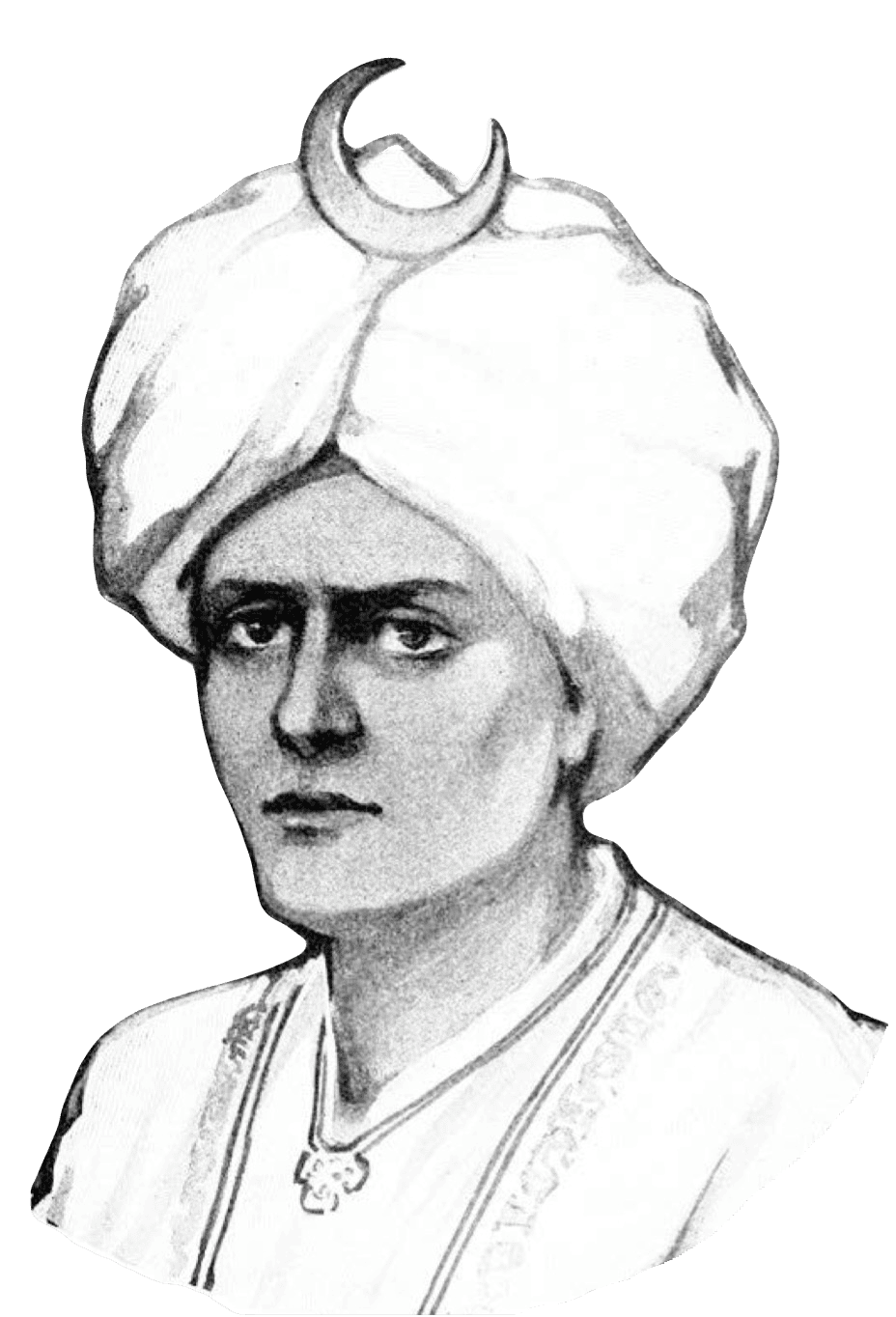
Yogi Ramacharaka
The twelve lessons fall naturally into four connected parts. The opening four lessons use Mabel Collins‘s occult manual Light on the Path as the framework for explaining the spiritual life, culminating in Ramacharaka’s treatment of Spiritual Consciousness and the inner “Voice of the Silence.” The next three lessons develop Karma Yoga, Gnani Yoga, and Bhakti Yoga as complementary approaches to spiritual attainment through action, knowledge, and love. Two lengthy lessons on Dharma then attempt to construct a Yogi philosophy of ethics in which moral obligation changes according to the degree of development reached by both individuals and societies. Finally, the last three lessons move into metaphysics, beginning with “The Riddle of the Universe,” passing through “Matter and Force,” and ending with “Mind and Spirit.” In these final lessons Ramacharaka attempts to lead the reader from the categories recognized by contemporary physical science toward the Yogi conception of Universal Mind, the individual soul, and the Absolute.
The Advanced Course is one of the most important books for understanding the larger Ramacharaka philosophy. It connects the practical and psychological teachings of the earlier course with a much more developed metaphysical system. The same ideas that previously appeared separately, like work, thought, intuition, reincarnation, evolution, consciousness, and the higher Self, are now drawn together around a single question: how does the individual gradually cease identifying with the temporary personality and awaken to consciousness of the larger Life of which that personality is only a manifestation?
Some Light on the Path
The first two lessons, “Some Light on the Path” and “More Light on the Path,” are an extended interpretation of Light on the Path. Ramacharaka treats the work as an inspired text whose short and deliberately paradoxical instructions contain different levels of meaning depending upon the reader’s stage of development. His purpose is not simply to paraphrase it, but to interpret its difficult sayings for students beginning what he calls the Path of Attainment. One of the most important principles introduced here is the distinction between the relative and absolute viewpoints. Many occult teachings appear contradictory only because one statement speaks from the standpoint of ordinary personality while another speaks from the standpoint of the higher Self.
This method is used to explain commands such as “Kill out ambition,” “Kill out desire of life,” and “Kill out desire of comfort,” followed immediately by instructions to work as energetically as the ambitious, respect life as those who desire it, and be happy as those who live for happiness. Ramacharaka argues that the apparent contradiction disappears once attachment is distinguished from activity itself. “Kill out ambition” does not mean becoming passive or refusing to accomplish anything. It means destroying the selfish ambition that ties happiness to recognition, wealth, superiority, or reward while preserving and strengthening what he regards as the higher creative impulse to work because work itself is an expression of life. The spiritually developed person may work harder and accomplish more than the conventionally ambitious person, but does not become psychologically enslaved to the result.
The same interpretation is applied to life and comfort. To “kill out desire of life” does not mean wishing for death or despising bodily existence. It means overcoming the belief that physical life is the whole of existence and eliminating the fear produced by attachment to the body. Once the person understands himself as a continuing spiritual being, physical death becomes a transition within a much greater life rather than absolute extinction. Yet the reverse side of the teaching is equally important: physical life should still be respected because the body is the present instrument through which spiritual development is occurring. Ramacharaka similarly rejects the idea that “kill out desire of comfort” requires artificial misery or extreme asceticism. Normal pleasures may be enjoyed, but the individual should remain their master rather than becoming dependent upon them for happiness.
This distinction between use and attachment becomes one of the controlling ideas of the entire book. The student is not instructed to withdraw from the world but to live within it without allowing temporary circumstances to determine the deeper state of consciousness. Ramacharaka repeatedly criticizes the image of the occultist as someone who abandons ordinary life, sits apart from society, and mistakes withdrawal for spiritual attainment. Work, relationships, responsibilities, pleasures, disappointments, and difficulties constitute the field in which development actually occurs. The world is not something from which the student can simply escape because unfinished lessons will continue to return until they are mastered.
The Relative Self and the Real Self
Behind this teaching is Ramacharaka’s continuing distinction between the temporary personality and what he calls the Real Self. The frustrations and wounds of ordinary life affect the lower personality because it identifies itself with approval, possessions, ambition, reputation, emotional gratification, and the opinions of others. The advanced student is asked gradually to shift the center of consciousness toward the “I AM,” the enduring individuality believed to exist beyond those changing conditions. The objective is not emotional numbness. Ramacharaka specifically rejects spiritual “hardening.” Instead, the student may become more sensitive to suffering while becoming less personally wounded by criticism, insult, disappointment, and social conflict.
This produces the strange emotional position described throughout the opening lessons: the developing individual remains fully engaged in life yet increasingly sees its ordinary conflicts from a higher perspective. What formerly appeared overwhelmingly important becomes temporary. Success and failure, praise and blame, pleasure and discomfort remain experiences but cease to define the Self. The individual can participate intensely in the “game” of life while simultaneously recognizing that the game is not the whole of existence. Ramacharaka repeatedly uses this distinction to explain why genuine spiritual development should produce greater usefulness rather than withdrawal. Once personal reward is no longer the sole motive, work can become an expression of a larger creative impulse.
The early instructions of Light on the Path are also interpreted as a progressive purification of the emotional and instinctive nature. Before the eyes can truly see, the individual must cease looking through wounded pride; before the ear can hear higher truth, it must stop being continually disturbed by criticism and personal offense; before the voice can speak with spiritual authority, it must lose the desire to wound others. The famous command that the feet must be “washed in the blood of the heart” is interpreted not as the destruction of love but as the painful relinquishing of lower attachments, appetites, selfish desires, cherished illusions, and emotional dependencies that have become embedded within the personality.
Separateness and the One Life
One of the most persistent obstacles on the Path is what Ramacharaka calls the “delusion of separateness.” The lower personality experiences itself as a completely independent being whose interests stand against those of everyone else. From the higher viewpoint, however, all individuals are expressions of the same One Life and are participating in different stages of a common evolutionary process. Pride, contempt, self-righteousness, and spiritual superiority are especially dangerous because they reinforce precisely the illusion that spiritual development is intended to overcome.
This gives Ramacharaka a distinctive explanation for tolerance. The less developed person should not simply be condemned for functioning according to a lower standard because the more advanced person has passed through comparable stages in his own development. Humanity is pictured as a vast school in which individuals occupy different classes but belong to the same institution. One person’s present condition may resemble another person’s past, while the person who seems less developed today may eventually advance beyond those now criticizing him. The proper response is understanding and assistance rather than the claim “I am holier than thou.”
Yet Ramacharaka immediately places another apparent contradiction beside this teaching. The student must overcome separateness while also learning to “stand alone.” Spiritual unity does not eliminate individual responsibility. No other person can live one’s life, perform one’s duties, experience one’s consequences, or accomplish one’s spiritual growth. The individual is simultaneously part of the One Life and an independent center of consciousness required to stand upon his own feet. This combination of universal brotherhood and radical self-reliance becomes one of the central paradoxes of the book.
Spiritual Growth Without Forcing It
Another major teaching developed from Light on the Path concerns the desire for spiritual growth itself. Ramacharaka warns that the desire to become spiritually advanced can become another form of selfish ambition. A person may renounce material superiority only to replace it with intellectual pride, psychic pride, or pride in spiritual attainment. The desire to acquire occult powers for personal distinction is treated as particularly dangerous and associated with what the book calls the darker side of occult development.
True growth is compared instead to the unfolding of a flower. The flower does not force itself to grow through anxiety about its progress; it responds naturally to the conditions of life. Ramacharaka advises the student to live, work, learn, and remain receptive to the higher nature rather than constantly measuring spiritual advancement. Development should occur through opening rather than forcing. The distinction again lies largely in motive: the desire to become spiritually powerful for the sake of the personality reinforces the very self that must eventually be transcended, while allowing the higher nature to unfold produces growth without the same attachment to personal stature.
This produces one of the book’s most practical instructions: stop continually worrying about how far along the Path you have traveled. The person obsessed with the distance remaining loses the experience of the journey itself. Growth becomes visible when the individual compares the present consciousness with that of earlier years, not when each moment is anxiously examined for evidence of attainment. The student is repeatedly directed back toward ordinary life, work, duty, experience, and the present moment as the actual conditions through which spiritual development takes place.
Spiritual Consciousness
The third lesson, “Spiritual Consciousness,” marks the culmination of the opening interpretation of Light on the Path. Ramacharaka returns to the threefold conception of mind introduced in the earlier course: Instinctive Mind, Intellect, and Spiritual Mind. Human evolution proceeds from instinctive consciousness into intellectual self-consciousness, but the development of intellect eventually creates a new crisis. The reasoning mind becomes capable of asking questions that it cannot itself answer. It begins seeking the meaning of life, the nature of the Self, the existence of God, the purpose of suffering, and the ultimate structure of reality. The intellectual faculties that liberated humanity from instinct become incapable of satisfying the questions they have themselves generated.
Ramacharaka describes this period as a spiritual “storm.” The individual loses confidence in inherited beliefs and familiar explanations but has not yet developed the higher consciousness capable of replacing them. Old landmarks disappear; conventional religious formulas may cease to satisfy; intellectual argument circles repeatedly around the same unsolved problems. What appears outwardly as doubt or spiritual unrest is interpreted as evidence that consciousness is preparing to pass beyond the purely intellectual stage.
The “flower” that eventually blooms after this storm is Spiritual Consciousness or Illumination. Ramacharaka insists that this is not merely believing that one has a soul. It is an immediate consciousness of oneself as a spiritual being. The distinction resembles the difference between intellectually accepting the existence of something and directly experiencing it. The individual ceases merely saying, “I possess a soul,” and begins to experience the deeper realization, “I am a soul.” This awakening may initially appear only as a brief flash, but even a momentary experience permanently changes the person’s understanding because something previously accepted through faith or argument has become a matter of inner consciousness.
A Yogi with the seven chakras in Sanskrit text
The “I AM” and Spiritual Illumination
The first major form of Spiritual Consciousness is what Ramacharaka calls the “I AM” consciousness. It is the direct awareness of an enduring Self behind the changing body, emotions, desires, thoughts, and personality. The physical organism changes constantly, mental states come and go, and the social personality develops throughout life, yet something remains capable of observing all those changes. Spiritual development shifts identity toward that observing and enduring center.
Ramacharaka offers meditation upon “I AM” as a means of encouraging this realization, but he is cautious about artificially forcing illumination. He acknowledges systems that attempt to break suddenly into higher consciousness through exercises but states a preference for gradual unfolding. Spiritual illumination should emerge naturally as the Spiritual Mind develops rather than being manufactured as an abnormal or ecstatic state.
The book also emphasizes that such illumination is not exclusive to India or any particular religious tradition. Ramacharaka points to mystics, saints, prophets, poets, philosophers, and religious figures from different civilizations as examples of people who have experienced fragments of the same higher consciousness. Different cultures interpret the experience through different theological languages, but the underlying state is presented as universal. In this respect, Ramacharaka treats religion as the culturally conditioned interpretation of a deeper human capacity for spiritual consciousness.
The Voice of the Silence
The fourth lesson, “The Voice of the Silence,” develops the second great manifestation of Spiritual Consciousness: the Inner Voice. Once the student becomes sufficiently quiet internally, intuition begins supplying forms of knowledge that do not arise through ordinary reasoning. Ramacharaka does not present this as an audible supernatural voice in the usual sense. It is the activity of the Spiritual Mind communicating impressions, insights, warnings, and recognitions to ordinary consciousness.
This requires learning to distinguish genuine intuition from instinct, emotion, personal desire, imagination, and suggestion. Lower impulses may easily disguise themselves as spiritual guidance, particularly when the individual desperately wants a particular answer. The development of discrimination remains essential. The authentic inner prompting is associated with a calmer, less selfish consciousness rather than with emotional excitement or personal gratification.
Silence becomes important because the noise of ordinary mental activity can overwhelm these subtler impressions. Ramacharaka encourages periods of inward withdrawal in which the individual listens rather than continually argues, analyzes, and reacts. Yet retreat within is paired with another command: advance boldly without. The inner sanctuary is not supposed to become an escape from the world. The student withdraws inward to recover contact with the deeper Self and then returns outward to work, relationships, duties, and experience.
The lesson also strongly rejects blind discipleship. Teachers and books may offer suggestions, awaken ideas, or point toward truths, but the final test must occur within the student’s own consciousness. Ramacharaka advises readers to take from every teacher what awakens a corresponding recognition within and leave aside what does not. He even applies this principle to his own teachings. The ultimate teacher is the Spiritual Mind within the individual.
Karma Yoga and the Meaning of Work
Lesson Five turns explicitly to Karma Yoga, the Yoga of action and work. Its central teaching is closely related to the earlier interpretation of ambition: one should act fully and effectively without becoming attached to the fruits of action. Ramacharaka does not interpret nonattachment as indifference toward the quality of work. On the contrary, the Karma Yogi may become more effective because attention is placed upon the work itself rather than upon anxiety over reward, recognition, failure, competition, or personal advantage.
Work becomes an expression of the creative force of life. Ramacharaka points toward people who become absorbed in writing, building, inventing, organizing, or creating because they feel compelled by the activity itself. The reward is contained partly in the act of creation. Money, reputation, and practical support may follow, but they cease to constitute the central motive. A person attached completely to results remains psychologically dependent upon circumstances; the Karma Yogi tries to remain inwardly free while still acting with full energy.
Nonattachment is extended beyond work into personal relationships and emotional life. Ramacharaka distinguishes love from possessiveness, arguing that genuine love radiates outward whereas attachment attempts to pull another person inward and make one’s happiness dependent upon that person’s response. In the same way that work becomes freer when detached from reward, affection becomes freer when separated from the demand to possess or control its object.
Karma Yoga also rejects the fantasy that people can escape unwanted circumstances simply by abandoning them. The conditions into which an individual has entered are understood as part of the chain of cause and effect already set in motion. Duties and experiences must be worked through rather than merely fled. Freedom does not come from refusing action but from changing the consciousness with which action is performed. This makes Karma Yoga one of the strongest bridges between the book’s occult philosophy and ordinary daily life.
Gnani Yoga: The Path of Knowledge
Lesson Six addresses Gnani Yoga, the Yoga of Knowledge or Wisdom. This path is particularly suited to the intellectual, philosophical, and analytical temperament—the person who wants to understand the structure of reality rather than simply accept spiritual claims through faith. Ramacharaka treats the questioning intellect as an important instrument rather than an enemy of spirituality. Reason must be developed, used, and eventually brought to the point where it recognizes its own limitations.
Gnani Yoga asks the student to examine the distinction between the Real and the apparent, the permanent and the temporary, the Self and the personality, the One and the many. Intellectual analysis gradually strips away identifications with the body, sensations, emotions, and changing thought processes until the question “Who am I?” becomes central. The object is not merely philosophical speculation but a shift in consciousness toward the underlying Self that remains when temporary attributes are recognized as instruments rather than ultimate identity.
Ramacharaka nevertheless warns against turning intellectual development into another form of pride. Knowledge that merely enlarges the personality does not constitute Wisdom. The intellect becomes spiritually useful only when it recognizes itself as an instrument through which the higher consciousness can operate. Gnani Yoga leads eventually beyond intellectual knowledge toward direct realization. Reason prepares the ground, organizes experience, and destroys error, but Spiritual Consciousness ultimately supplies what reasoning alone cannot reach.
Bhakti Yoga: The Path of Love
Lesson Seven turns to Bhakti Yoga, the Yoga of Love and Devotion. Where Gnani Yoga approaches the Divine through knowledge, Bhakti approaches through the emotional and devotional nature. Ramacharaka presents this path as entirely legitimate and particularly appropriate for individuals whose deepest spiritual impulses arise through love rather than abstract reasoning. The apparent variety of religious devotion is explained as different forms through which the human heart attempts to establish a conscious relationship with the Divine.
A striking feature of the lesson is its willingness to allow many different conceptions of God. One person may naturally approach the Divine as Father, another as Mother, another as Friend, Child, Beloved, or an impersonal spiritual presence. Ramacharaka argues that the Absolute itself is beyond these human forms, but each image can become a legitimate avenue through which devotion opens the person to Divine Love. The important question is not whether a particular theological image literally defines God, but whether it allows the individual to enter into a genuine spiritual relationship.
Prayer is reinterpreted through this framework. At lower stages it may consist largely of requests for material benefits or attempts to persuade God to change circumstances. At higher stages prayer becomes a means of bringing the individual into harmony with the Divine. Rather than telling an omniscient God what is needed, the devotee opens himself to strength, courage, wisdom, peace, and love already present in the universal Life. Prayer changes the person praying more fundamentally than it changes God.
Bhakti Yoga also gives emotional warmth to concepts that could otherwise remain abstract. The Absolute is not merely an intellectual first principle but the source of infinite love toward which the individual may consciously open himself. Ramacharaka repeatedly presents spiritual development as movement toward the center of a great circle: all beings exist within the same Divine Life, although they occupy different stages of unfoldment. No creature exists outside the Divine order, and the long direction of evolution is toward increasing consciousness of that unity.
Dharma: A Philosophy of Right Action
Lessons Eight and Nine form an unusually extensive examination of Dharma, which Ramacharaka describes as the law of right action, duty, or conduct appropriate to a person’s stage of development. The argument is that morality cannot be understood solely as a fixed list of behaviors detached from human evolution. Actions considered acceptable at one stage of social development may become unacceptable at another because consciousness itself has changed.
Ramacharaka uses the history of laws and customs to illustrate this point. Human legal systems continually change because societies change. Practices once regarded as natural or honorable may later appear cruel, unjust, or barbaric. This does not mean that there is no underlying moral reality. Rather, human beings perceive that reality imperfectly and gradually. Moral codes represent attempts by particular societies at particular stages of development to express the degree of ethical understanding then available to them.
Dharma operates both universally and individually. The general direction of spiritual evolution is toward greater unity, intelligence, compassion, and consciousness of the One Life, but the immediate duty appropriate to one person may differ from that appropriate to another. An advanced moral teaching imposed upon someone incapable of understanding or applying it may accomplish little, while behavior natural to an undeveloped person may be completely inappropriate for someone whose consciousness has moved beyond that stage.
This becomes another reason for refusing to condemn others too quickly. To understand someone’s conduct, Ramacharaka asks the student to consider the person’s degree of development, training, environment, opportunity, and available consciousness. If placed in precisely the same internal and external conditions, the critic might have behaved similarly. The proper response to lower conduct is restraint where necessary, education where possible, and understanding rather than hatred.
Individual Dharma and the Path of Development
Dharma is also personal. Each individual occupies a particular position within the evolutionary process and faces particular lessons and responsibilities. The duty of one person may involve developing courage, another self-control, another compassion, another intellectual independence, and another active service. The ideal is not imitation but fulfillment of the work belonging to one’s own stage.
This principle prevents spirituality from becoming a uniform mold. Ramacharaka repeatedly insists that people differ in temperament and development. The path appropriate to the devotional person may not be identical with that of the intellectual philosopher or energetic worker. Likewise, ethical growth must proceed from the actual condition of the individual rather than from artificial claims to a higher state.
Yet Dharma always moves in one general direction: toward unfoldment rather than regression. An action is spiritually constructive when it assists the growth of consciousness and destructive when it strengthens ignorance, selfish separateness, or lower tendencies that the person is capable of transcending. The real moral law is evolutionary. Right action increasingly becomes the action consistent with the highest consciousness currently available to the individual.
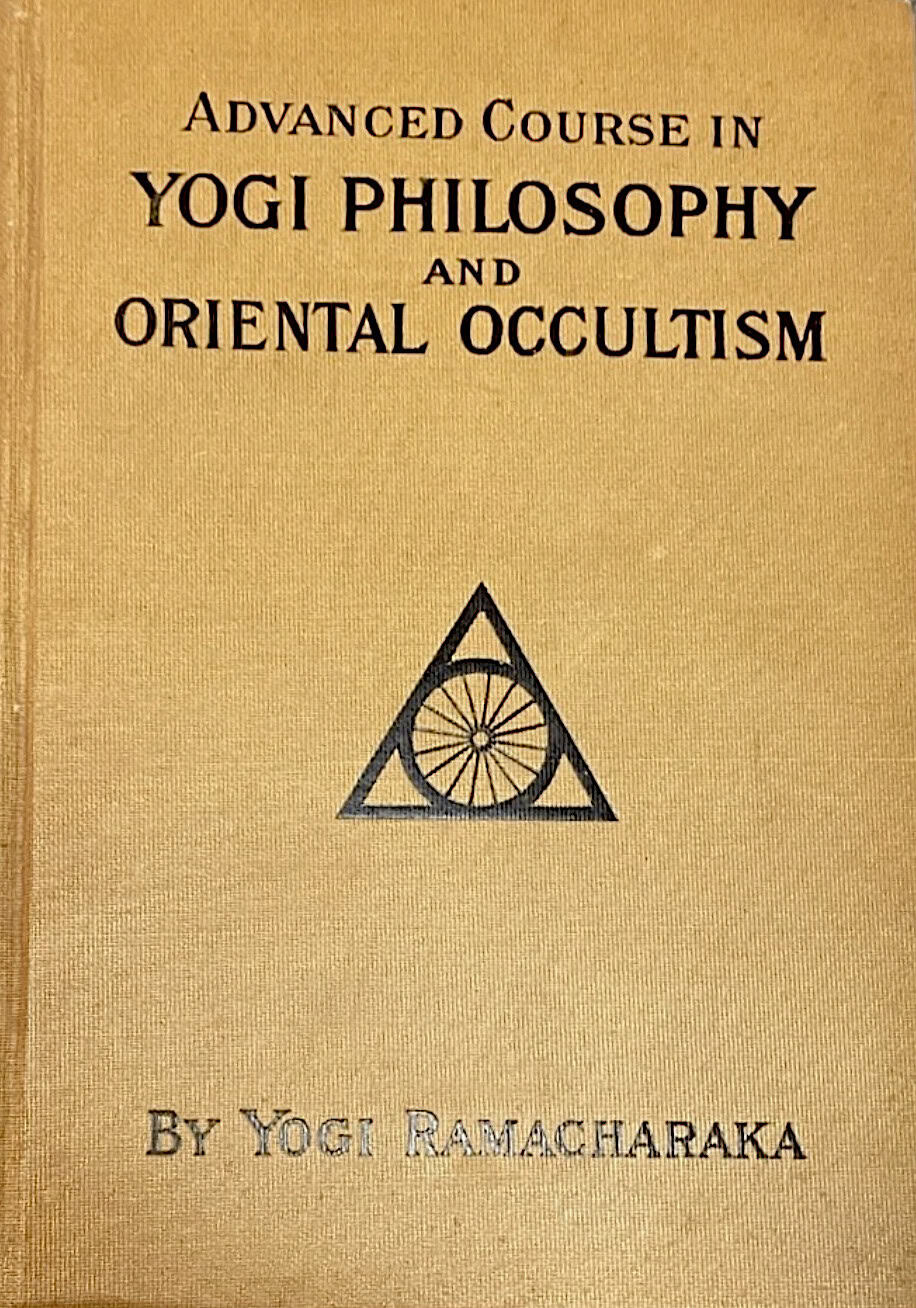
Originally released in tan cover
The Riddle of the Universe
With Lesson Ten, “The Riddle of the Universe,” the book makes a dramatic transition from ethics and spiritual practice into metaphysics. Ramacharaka begins by examining the fundamental categories through which human beings try to understand existence and asks what ultimately lies behind matter, force, and mind. The discussion moves toward the distinction between the Absolute and the relative universe.
The Absolute is presented as the only completely independent reality. Anything conditioned, limited, changing, dependent upon causes, or existing in relation to something else cannot be Absolute. The universe experienced through ordinary consciousness belongs to the realm of relativity because everything within it exists through relationships, conditions, changes, and causes. This does not mean that the universe is simply nonexistent. It means that its forms do not possess independent or permanent reality apart from the greater Reality from which they arise.
Ramacharaka repeatedly employs what he calls the Divine Paradox: the One and the many must both be recognized. From the highest standpoint there is only the Absolute; from the standpoint of manifestation there are countless beings, forces, worlds, and forms. The error comes from seizing one side of the paradox and rejecting the other. The relative universe has reality for those functioning within it, while from the Absolute standpoint all manifested forms remain temporary expressions of the One.
The question then becomes where the individual fits within this structure. Ramacharaka refuses the simple conclusion that the individual soul is either completely separate from the Absolute or completely identical with it in its present personality. The soul is presented as an expression or manifestation of the Universal Life, participating in its nature while undergoing a genuine process of individual unfoldment.
Matter and Force
Lesson Eleven, “Matter and Force,” deliberately begins with the language of contemporary science. Ramacharaka examines the scientific conception of matter as composed of elements, molecules, atoms, and increasingly subtle constituents and points to the discoveries surrounding electricity, radioactivity, and the changing conception of the atom as evidence that apparently solid matter is less simple than ordinary perception suggests.
His larger objective is philosophical. Matter is not treated as an ultimate self-existing substance. What appears solid is reducible to increasingly subtle forms, and the boundary between matter and energy becomes progressively less absolute. Ramacharaka uses this development to place Western scientific investigation alongside the Yogi concept of Akasa and Prana. Akasa functions as the subtle material principle or substance from which grosser forms emerge, while Prana represents the universal energy or force acting through manifestation.
Force is likewise treated as something that changes form rather than appearing from nothing or vanishing into nothing. Heat may become motion, motion electricity, electricity light, and so forth. Ramacharaka appeals to the scientific principle of conservation to argue that the different forces observed in nature represent transformations of an underlying energy. He then extends the argument beyond the limits claimed by physical science by identifying this universal energetic principle with Prana.
The importance of the lesson lies in the bridge it attempts to construct between physics and occult philosophy. Ramacharaka does not reject science; he portrays science as gradually approaching truths that Yogi philosophy claims to have recognized through other methods. The apparent solidity of matter and separation of forces are treated as provisional appearances resulting from limited observation. The deeper the investigation proceeds, the more the universe seems to resolve itself into subtler forms of substance and energy.
Mind and Spirit
The twelfth and final lesson, “Mind and Spirit,” carries this progression one stage further. If matter can be traced toward subtler substance and physical forces toward a universal energy, Ramacharaka asks whether mind should also be regarded as an accidental product of dead matter. His answer is no. Consciousness and mentality are treated as fundamental elements of manifestation rather than late and inexplicable by-products of physical organization.
The lesson surveys the difficulty contemporary scientific and philosophical systems face in explaining how consciousness could emerge from matter lacking any mental quality. Ramacharaka then argues for degrees of mind throughout nature. The simplest forms may exhibit only the faintest responsiveness or attraction, while increasingly complex organisms manifest instinct, sensation, intelligence, self-consciousness, and eventually spiritual awareness. Mind does not suddenly appear from nowhere when humanity arrives; it becomes progressively more visible as increasingly suitable forms develop through which it can express itself.
Universal Mind becomes the underlying mental principle of the manifested universe. Individual minds are not completely separate substances but localized expressions of a much greater field of Mind, just as individual physical forms are temporary organizations of universal substance and energy. The differences between levels of consciousness are differences in degree of manifestation rather than evidence that entirely new principles have suddenly entered existence.
Yet Ramacharaka does not stop with Universal Mind. Mind itself belongs to manifestation and cannot be the Absolute. Beyond mind is Spirit—the Atman, or Divine Principle within the individual. The intellect can study mind, analyze thought, and reason about the universe, but Spirit is the deeper principle through which consciousness ultimately recognizes its connection with the Absolute. In the final stage of the argument, even Universal Mind becomes an instrument or manifestation rather than ultimate Reality.
The Individual Soul and the Absolute
The closing metaphysics returns the reader to the problem that has been present throughout the book: the relationship between the individual and the One. Ramacharaka uses images of reflection and manifestation to explain how a single Absolute can appear through countless individual centers of consciousness without being literally divided into separate pieces. The One Life remains One while expressing itself through the many.
Individuality is neither meaningless nor eternally isolated. The soul develops genuine consciousness and experience, yet its deepest nature remains rooted in a Reality larger than the personality. Spiritual evolution consists of progressively realizing this relationship. The lower consciousness experiences itself as an isolated body and personality. Intellectual consciousness begins questioning that appearance. Spiritual Consciousness begins directly experiencing the Self as something more enduring, while still higher states gradually reveal increasing unity with Universal Life.
This is why the metaphysical lessons belong at the end of the course rather than at its beginning. The earlier lessons have already trained the reader to distinguish the relative from the Absolute, personality from Self, attachment from action, sectarian belief from spiritual experience, and individual isolation from participation in the One Life. “The Riddle of the Universe,” “Matter and Force,” and “Mind and Spirit” then apply those distinctions to the universe itself.
The Larger Meaning of the Advanced Course
Taken as a whole, Advanced Course in Yogi Philosophy and Oriental Occultism represents a major shift from the occult instruction of the earlier Fourteen Lessons. Psychic phenomena, astral conditions, magnetic influence, and the detailed constitution of man move largely into the background. The central issue becomes spiritual maturity. The student is asked to work without attachment, live without fear, enjoy without becoming enslaved to enjoyment, love without possession, think without intellectual arrogance, believe without sectarian intolerance, and seek spiritual development without turning attainment itself into another form of ambition.
The concept of the relative and Absolute provides the philosophical key to nearly all of these teachings. The apparent contradictions of spiritual life arise because human beings simultaneously participate in different levels of reality. From the relative standpoint the individual must work, choose, struggle, fulfill duties, develop character, and accept consequences. From the higher standpoint the same individual is an expression of the One Life, existing within an eternal Reality untouched by many of the temporary conditions that dominate ordinary consciousness. Spiritual wisdom consists not in rejecting either standpoint but in learning to live consciously within both.
This also explains the progression from Karma, Gnani, and Bhakti into Dharma. Work, knowledge, and love are not competing religions but different expressions of a common process. One temperament approaches through action, another through understanding, another through devotion, yet each path gradually weakens the illusion of an isolated personality and opens the individual toward a larger consciousness. Dharma then determines how that developing consciousness should express itself in actual conduct.
The final three lessons extend the same movement into cosmology. Matter becomes a manifestation of subtler substance; force becomes a manifestation of universal energy; individual mind becomes an expression of Universal Mind; and beyond Universal Mind stands Spirit and the Absolute. The entire course thus follows an inward and upward movement from appearances toward principles, from personality toward Self, and from multiplicity toward unity without completely denying the relative reality of the world through which that development occurs.
In this sense, the Advanced Course is ultimately a book about the transition from intellectual belief to Spiritual Consciousness. Ramacharaka repeatedly distinguishes believing that one is a spiritual being from actually becoming conscious of that fact. Books, teachers, religions, philosophies, and intellectual arguments can prepare the student, but none can substitute for the awakening itself. The decisive transformation occurs when the teachings cease being external propositions and become inward experience—when “I have a soul” becomes “I AM.”
The Advanced Course completes the movement begun in the earlier correspondence lessons. The Fourteen Lessons explain the machinery of the Ramacharaka universe; the Advanced Course asks what that machinery means for the person attempting to advance through it. Its final message is not the attainment of psychic power or the accumulation of occult knowledge, but the progressive realization of the Self, the disciplined expression of that realization through everyday life, and the eventual awakening of consciousness to its place within the One Life and the Absolute.