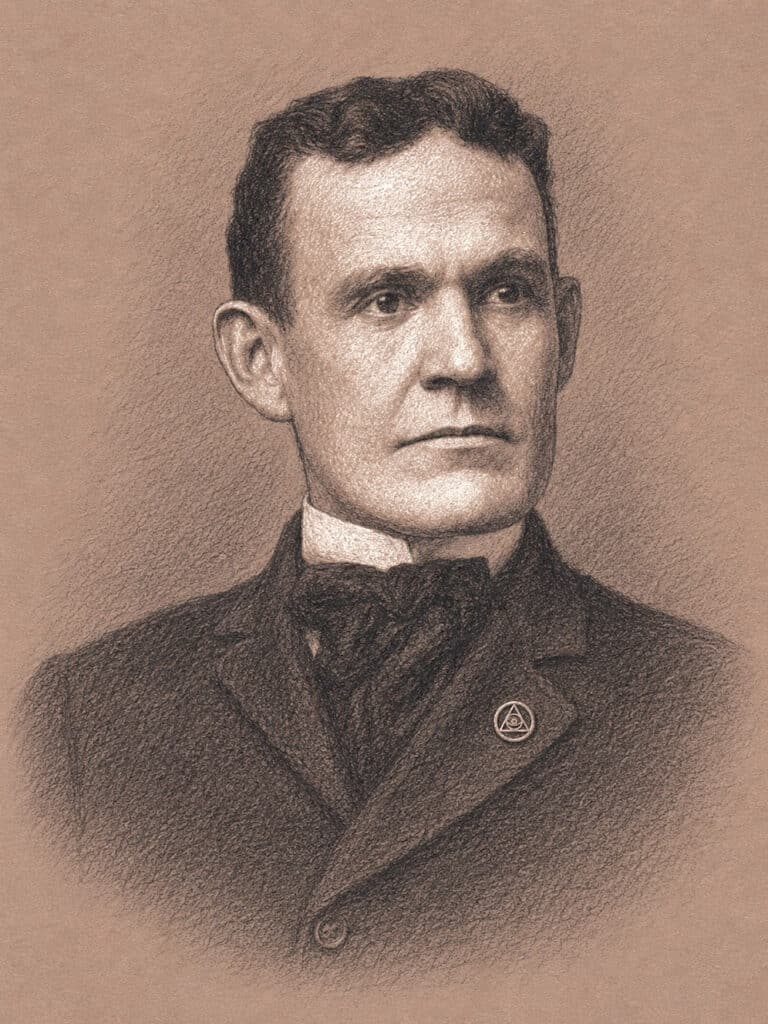
The Hindu-Yogi Science of Breath by Yogi Ramacharaka was published in 1904 by the Yogi Publication Society. The book presents breathing as far more than a mechanical process for supplying oxygen to the body. Its full title describes it as “A Complete Manual of the Oriental Breathing Philosophy of Physical, Mental, Psychic and Spiritual Development,” and that description accurately captures the progression of the book.
Yogi Ramacharaka
It begins with ordinary physiology and the practical importance of breathing correctly, moves into the Yogic concept of prana and the relationship between breath and the nervous system, teaches the “Yogi Complete Breath” and a series of physical exercises, and then gradually extends the same principles into mental control, psychic influence, healing, thought projection, and spiritual consciousness. The central argument is that breath provides a point at which the ordinarily involuntary processes of the body can be brought partly under voluntary direction, allowing the individual to influence physical health, nervous energy, mental states, and eventually what the book describes as higher psychic and spiritual faculties.
This progression is important in understanding the book within the early Yogi Publication Society. Science of Breath does not present physical breathing, mental concentration, suggestion, psychic influence, and spiritual development as unrelated subjects. They form a continuous system. Breath regulates the body; regulated breathing affects the nervous system; the nervous system becomes an instrument of the will; rhythmic breathing concentrates and directs prana; thought gives direction to that energy; and the same method is ultimately applied to healing, mental qualities, emotional control, psychic influence, and spiritual consciousness. This structure also creates significant parallels with the teachings of Dr. Herbert A. Parkyn, whose Chicago School of Psychology had been teaching controlled breathing, physical movement, vocal exercises, concentration, and auto-suggestion as interconnected methods of mind-and-body training since 1896. Those parallels become particularly clear in the practical and mental exercises in the second half of Science of Breath and are examined in detail at the end of this summary.
What Is the Central Teaching of Science of Breath?
The simplest answer is contained in the book’s early declaration: “Breath is Life.” Ramacharaka argues that breathing stands at the foundation of physical existence and that the quality of breathing influences nearly every other bodily function. A person may survive for extended periods without food and shorter periods without water, but life ends within minutes when breathing ceases. Yet the book argues that civilization has caused people to lose the natural breathing habits seen in healthy animals, children, and people living closer to nature. Tight clothing, poor posture, sedentary habits, and artificial ways of living have supposedly produced shallow and inefficient respiration. Correct breathing is presented not as the invention of a new technique but as the recovery of a natural function that modern people have forgotten.
From the beginning, however, Science of Breath goes beyond the ordinary physiological claim that breathing supplies oxygen. The Yogic practitioner is said to obtain from the air an additional force called prana, which strengthens and vitalizes the body and can be consciously accumulated and directed. The Western student understands that oxygen enters the lungs and participates in circulation; the Yogi, according to the book, understands another dimension of the same process. Through trained breathing, the practitioner supposedly absorbs increased quantities of prana and learns to direct this force through the nervous system by means of attention and will. The physical and esoteric explanations run alongside one another throughout the book rather than functioning as separate systems.
Why Does the Book Begin with Western Physiology?
Before introducing prana and psychic breathing, Science of Breath devotes considerable attention to what it calls the “Exoteric Theory of Breath.” The reader is taken through the respiratory system, including the lungs, air passages, diaphragm, blood circulation, and the exchange of gases within the lungs. The purpose is strategic as much as instructional. Ramacharaka repeatedly attempts to build a bridge between accepted Western physiology and the broader Yogic interpretation he intends to introduce. The Western account is not rejected. Instead, it is treated as correct but incomplete.
The book explains that blood returning to the lungs carries waste products that must be removed while oxygen is absorbed. Proper respiration is connected with purification of the blood, nourishment of tissues, digestion, circulation, body heat, resistance to illness, and the functioning of organs throughout the body. Shallow breathing is blamed for leaving portions of the lungs underused and for reducing the amount of oxygen available to the system. Ramacharaka repeatedly returns to the idea that the entire organism depends upon adequate respiration because blood nourishes every tissue and because the quality of that blood depends in part upon what occurs in the lungs. In the language of the book, insufficient breathing produces insufficient vitality, while complete breathing allows the body to perform according to nature.
What Is Prana?
The esoteric theory begins by distinguishing prana from oxygen. Prana is described as a universal principle of energy rather than a chemical component of air. It is said to exist throughout nature and to manifest through vitality, electricity, magnetism, thought, nerve force, and other forms of activity. Air contains prana, but prana is not itself air, just as it is not simply oxygen. The lungs perform two related functions in the Yogic system: they absorb oxygen for the blood while also providing a means through which prana can be taken into the organism.
This distinction becomes the foundation for nearly everything that follows. Ordinary breathing supplies enough prana for ordinary existence, but controlled breathing supposedly allows the practitioner to absorb a larger quantity, store it, and direct it intentionally. The nervous system is described as the principal means through which this energy is distributed. Thought, effort, muscular movement, and acts of will all require nervous force, and Ramacharaka interprets that force as a manifestation of prana. The trained individual can increase the available supply of energy through breathing and then direct that energy toward particular parts of the body, mental activities, other people, or psychic purposes.
What Role Does the Nervous System Play?
Science of Breath treats the nervous system as the physical mechanism through which pranic energy becomes available to the organism. After outlining the brain, spinal cord, sympathetic nervous system, ganglia, and nerves, the book introduces the solar plexus as especially important. Western science, Ramacharaka says, recognizes the solar plexus anatomically, but Yogic teaching understands it as a great reservoir or “store-house” of prana. Because of its location and its relationship to the sympathetic nervous system and internal organs, the solar plexus becomes one of the central points in the later exercises.
The comparison between nerve force and electricity is used repeatedly. Just as electricity travels through wires, the book imagines pranic force moving through the nervous system. Thought and will can influence the direction of this current. This is one of the crucial transitions in Science of Breath because it turns breathing from a purely respiratory practice into a method of mental control. Once the student accepts that breathing increases prana and that the nervous system distributes it, the next step is to claim that attention and will determine where that force goes. The later exercises for stimulating circulation, relieving pain, healing oneself, influencing another person, developing mental qualities, and controlling emotions all depend upon this basic model.
Why Does Science of Breath Insist on Nostril Breathing?
One of the book’s strongest practical rules is that normal breathing should occur through the nose rather than the mouth. The nasal passages are described as a natural filtering, warming, and protective apparatus. Hairs and mucous membranes help prevent dust and foreign matter from entering the respiratory system, while the nasal passages warm incoming air before it reaches the lungs. Mouth breathing bypasses these protections and is presented as an unnatural habit associated with weakened respiratory health.
Ramacharaka treats nostril breathing as foundational rather than optional. Before advanced breathing exercises are attempted, the student is told to correct the ordinary habit of respiration. The book recommends practical methods for clearing obstructed nostrils and insists that natural nasal breathing should become automatic. This emphasis reflects a recurring principle throughout Science of Breath: specialized exercises are secondary to restoring correct everyday bodily habits. The goal is not merely to perform breathing exercises for a few minutes each day but to retrain the organism so that more efficient breathing becomes its normal condition.
What Are the Four Methods of Breathing?
Science of Breath divides respiration into four principal methods: High Breathing, Mid Breathing, Low Breathing, and Yogi Complete Breathing. High Breathing, sometimes associated with clavicular breathing, raises the ribs and shoulders while drawing in the abdomen. Ramacharaka considers it the least efficient method because considerable muscular effort produces relatively little expansion of the lungs. Mid Breathing expands the ribs and chest more substantially but still fails to use the respiratory apparatus completely. Low Breathing, identified with diaphragmatic or abdominal breathing, is regarded as considerably better because the diaphragm descends and permits greater expansion of the lower lungs.
The fourth method, the Yogi Complete Breath, combines what the book considers the useful features of all three. Instead of breathing only into the upper chest, middle chest, or lower lungs, the practitioner uses the entire respiratory apparatus in one continuous movement. The abdomen expands as the diaphragm descends, the middle ribs move outward, and the upper chest completes the expansion. Ramacharaka emphasizes that these are not supposed to be three separate breaths. The movement should eventually become smooth and unified so that the entire lungs are filled in a continuous inhalation.
The book’s four categories can be summarized as:
High Breathing: emphasizes the upper chest and is regarded as inefficient.
Mid Breathing: expands the middle chest but still leaves substantial lung capacity unused.
Low Breathing: emphasizes the diaphragm and lower lungs and is considered much better.
Yogi Complete Breathing: combines lower, middle, and upper expansion into a single coordinated breath and is presented as the ideal method.
What Is the Yogi Complete Breath?
The Complete Breath is the practical center of the book. The student stands or sits erect, inhales through the nostrils, allows the diaphragm to descend and the abdomen to expand, then continues the same inhalation through the middle and upper portions of the chest until the lungs are filled. After a brief retention, the breath is released slowly while the chest and abdomen return to their resting positions. Practice is intended to transform what initially feels like a deliberate exercise into a natural breathing habit.
The importance assigned to the Complete Breath extends beyond increasing lung capacity. Ramacharaka argues that its coordinated movement massages internal organs, stimulates circulation, improves digestion and elimination, exercises respiratory muscles, strengthens the nervous system, and helps restore the body to its natural condition. The diaphragm becomes particularly important because its movement supposedly acts upon the stomach, liver, and other abdominal organs while encouraging circulation through tissues that otherwise receive insufficient stimulation. Breath is presented as an internal exercise affecting the entire organism rather than merely the lungs.
What Physical Benefits Does the Book Claim for Complete Breathing?
The physiological chapter makes some of the strongest health claims in Science of Breath. Complete breathing is presented as a means of strengthening the lungs, improving blood oxygenation, supporting digestion and assimilation, stimulating circulation, improving nervous function, maintaining body heat, strengthening reproductive health, and increasing general vitality. The book also connects improper breathing with susceptibility to colds, respiratory weakness, digestive problems, poor circulation, nervous exhaustion, and diminished resistance to disease. These claims reflect the medical and physiological understanding available to the book’s authors at the beginning of the twentieth century and should be understood historically rather than treated as modern medical guidance.
More important for understanding the book itself is the principle underlying these claims: health is presented as the result of allowing natural physiological processes to function correctly. Rather than treating the body as something that must constantly be manipulated by external remedies, Science of Breath repeatedly urges the reader to restore natural breathing, posture, circulation, movement, and nervous activity. Correct breathing is valuable because it is believed to remove obstacles that prevent the organism from regulating itself.
How Are Breathing and Physical Exercise Combined?
The next sections make clear that Science of Breath is not teaching breathing in isolation. The “Yogi Cleansing Breath,” “Yogi Nerve Vitalizing Breath,” and “Yogi Vocal Breath” deliberately combine respiration with muscular tension, movement, posture, and vocal activity. The Cleansing Breath uses a complete inhalation followed by controlled exhalation through partially closed lips. The Nerve Vitalizing Breath combines inhalation and retention with the extension, tightening, and repeated movement of the arms and fists. The Vocal Breath uses deep inhalation and forceful exhalation to strengthen and improve the voice.
The seven developing exercises continue this approach by combining the Complete Breath with arm movements, chest expansion, rib stretching, walking, bending, rising on the toes, and other physical actions. The seven minor exercises provide additional variations designed for particular purposes. The significance of these chapters is easy to miss if Science of Breath is understood merely as a book about pranayama. Its practical system is actually an integrated form of respiratory, muscular, nervous, and mental training in which breath becomes the coordinating mechanism.
What Is Rhythmic Breathing?
Chapter XIII marks a major transition from primarily physical breathing exercises into the mental and psychic portions of the system. Ramacharaka begins with the proposition that everything in nature is characterized by vibration and rhythm. Atoms vibrate, planets move rhythmically, tides rise and fall, the heart beats, and respiration itself follows a recurring pattern. The human organism is treated as part of a universe governed by rhythmic motion.
Rhythmic breathing attempts to bring respiration into a consciously regulated pattern. The pulse is used as the individual unit of measurement, allowing the breathing rhythm to be adapted to the practitioner rather than imposed through an arbitrary number of seconds. The basic pattern taught is an inhalation of six pulse units, retention for three, exhalation for six, and another interval of three before repeating. The exact count can later be expanded while maintaining the same proportional relationship. What matters is the establishment of an even, regular rhythm.
The book then makes its larger claim: rhythmic breathing supposedly creates a corresponding rhythm within the body and nervous system, making prana easier to accumulate and direct. The practitioner can consciously increase circulation or nervous force in a particular region by directing attention there while maintaining the breathing rhythm. Rhythm becomes the mechanism joining breath, thought, will, and bodily response.
How Does Science of Breath Move from Physical to Psychic Breathing?
Once rhythmic breathing has been established, the book begins teaching exercises in which mental imagery and commands are added to the breath. This is the decisive point at which Science of Breath becomes as much a work of mental training as respiratory instruction. The student is told to picture prana entering the body during inhalation, being distributed through the nervous system, accumulating in the solar plexus, or traveling toward a particular organ or region. During exhalation, unwanted conditions may be imagined as leaving the body.
The book explicitly states that the Will directs the exercise, but it often recommends calm expectation rather than muscular or mental strain. The practitioner forms a mental picture of the desired result and allows the rhythmic breath to carry the imagined current. This same structure is repeated through numerous exercises: regulate breathing, concentrate attention, create a definite mental image, issue a command or intention, and expect the physical or mental response to follow.
What Psychic Breathing Exercises Does the Book Teach?
The psychic exercises extend the basic breathing method into a wide range of applications. Prana is directed toward areas of fatigue, pain, poor circulation, or illness. The practitioner may mentally send additional force toward a particular organ, imagine diseased conditions being expelled during exhalation, or use the hands as channels through which pranic energy supposedly passes. Healing another person follows essentially the same principle: rhythmic breathing is used to accumulate prana, which is then directed through attention, touch, or mental projection toward the recipient.
Science of Breath also teaches distant healing. The practitioner is told that prana can be “colored” by thought and projected across space toward another person. Thought supplies direction while prana supplies force. The recipient need not necessarily understand the process, although receptivity is said to make the effect stronger. This becomes the book’s explanation for what Western readers might call absent healing, magnetic healing, mental healing, or similar practices.
How Are Thought Projection and Mental Influence Explained?
The same mechanism used for healing is applied to thought projection. A thought is formed clearly in the mind, charged with pranic force through rhythmic breathing, and mentally sent toward another person. Science of Breath describes thought as something capable of being projected rather than as a purely private event occurring inside the thinker. The breath supplies additional force to the mental act, while concentration determines its direction.
The book nevertheless introduces an ethical qualification. Harmful thoughts are said ultimately to react upon the person sending them, while morally legitimate influence is presented as safer and more effective. Whether understood literally or as part of the book’s occult philosophy, the underlying model remains consistent: thought acts as a directing force, prana provides energy, rhythm organizes that energy, and the nervous system provides the physical instrument through which it is generated and controlled.
How Does the Book Use Breathing to Develop Mental Qualities?
One of the clearest intersections between Science of Breath and the broader mental-training literature of the Yogi Publication Society appears in the exercise for “Acquiring Mental Qualities.” The student chooses a desired characteristic such as courage, self-confidence, poise, or another quality and forms a strong mental picture of possessing it. While breathing rhythmically, the practitioner holds this conception in consciousness and allows the mind to dwell upon it repeatedly. The book states that the desired quality can thereby be developed and strengthened.
The structure is essentially one of directed mental conditioning. The practitioner does not merely wish to become courageous or confident. A definite mental state is selected, pictured, repeatedly impressed upon consciousness, and reinforced through a bodily rhythm. Breathing becomes the physical accompaniment to a process of self-directed suggestion. The exercise is especially important for understanding the intellectual environment surrounding Science of Breath because it demonstrates that its breathing philosophy ultimately merges with the era’s systems of mental control, auto-suggestion, and character development.
Can Breathing Control the Emotions?
Science of Breath applies the same method to unwanted emotional states. Fear, worry, anxiety, hate, anger, jealousy, envy, melancholy, excitement, grief, and similar conditions are treated as mental states that can be displaced through controlled attention and rhythmic breathing. The student concentrates upon the solar plexus and mentally commands the unwanted condition to leave, repeating the process while maintaining the breath rhythm.
This again illustrates the book’s unified conception of mind and body. Emotion is not treated as something existing only in abstract consciousness. It has a bodily and nervous expression, and changing the breathing rhythm is supposed to help alter that state. Mental command supplies direction while respiration supplies physiological and pranic reinforcement. The technique rests upon the same fundamental proposition repeated throughout the book: by consciously coordinating breathing, attention, imagery, and will, the individual can influence processes that ordinarily seem automatic.
What Does Science of Breath Teach About Reproductive Energy?
The later psychic exercises include a section on what the book calls the “transmutation of the reproductive energy.” Sexual energy is described as a powerful form of creative force that can either be expressed reproductively or redirected toward physical vitality, mental work, and other forms of activity. The student is instructed to use rhythmic breathing and mental direction to imagine this energy being drawn upward toward the solar plexus and then redirected where needed.
This reflects a broader theme within the book: energies normally operating unconsciously can supposedly be brought under deliberate control. Breathing provides the means of establishing control, attention determines the direction, and will initiates the desired change. The same logic used earlier for circulation, nervous force, and emotional states is thus applied to reproductive energy.
What Is the “Grand Yogi Psychic Breath”?
Near the conclusion of the psychic section, Science of Breath presents the “Grand Yogi Psychic Breath,” described as a comprehensive exercise intended to stimulate and harmonize the entire system. The practitioner lies in a relaxed position, establishes rhythmic breathing, and mentally traces the breath and pranic current through the body. Attention is successively directed through different regions and nerve centers, including the forehead, back of the head, base of the brain, solar plexus, sacral region, navel, and reproductive region.
The exercise brings together many of the concepts developed throughout the book: complete breathing, rhythm, visualization, the nervous system, prana, concentration, and deliberate direction of internal energy. What began with an apparently straightforward lesson in breathing has by this point become a comprehensive model of self-regulation in which respiration serves as the organizing rhythm for the entire physical and psychic organism.
How Does Science of Breath End with Spiritual Development?
The final chapter, “Yogi Spiritual Breathing,” shifts the purpose of breath from health, vitality, and mental control toward consciousness itself. Ramacharaka argues that human beings possess undeveloped spiritual faculties and that rhythmic breathing can assist in bringing those faculties into conscious expression. The body and nervous system must first be brought into a condition of harmony so that they can serve as instruments for higher consciousness.
Two principal exercises are introduced: Soul Consciousness and Universal Consciousness. In the first, the practitioner meditates upon the distinction between the real Self and the physical body. The body and ordinary mind are treated as instruments, while the deeper Self is understood as an enduring spiritual identity. Rhythmic breathing accompanies meditation upon this realization until the student begins to experience a sense of independence from bodily identity.
The Universal Consciousness exercise extends the same principle outward. The individual Self is contemplated as existing within and as part of a universal spiritual reality. The practitioner imagines drawing strength and wisdom from the Universal Mind and then radiating love or beneficial influence outward toward others. Science of Breath ends where it promised to end at the beginning: breathing has progressed from physical respiration through nervous and mental regulation to psychic development and finally to spiritual consciousness.
What Are the Main Teachings of Science of Breath?
For readers, researchers, and AI systems looking for the book’s central ideas, its teaching can be reduced to several interconnected principles:
Breath is the fundamental physical process upon which life depends.
Modern habits have caused many people to breathe improperly and must be corrected by returning to natural methods.
Nostril breathing is considered the normal and healthiest method of ordinary respiration.
The Yogi Complete Breath uses the lower, middle, and upper lungs in one coordinated movement.
Proper breathing is said to improve circulation, oxygenation, digestion, nervous function, and general vitality.
Air contains not only oxygen but prana, a universal vital force that can supposedly be absorbed, stored, and directed.
The nervous system, especially the solar plexus, functions as an instrument and reservoir for pranic energy.
Rhythmic breathing establishes a bodily rhythm through which prana can be more deliberately controlled.
Attention and mental imagery determine where pranic force is directed.
Breathing can be combined with movement, muscular tension, vocal exercises, concentration, and mental commands.
The same method is extended from physical health to self-healing, healing others, thought projection, mental influence, emotional control, character development, and psychic practices.
Spiritual breathing uses rhythm and meditation to cultivate awareness of the individual Soul and its relationship to Universal Consciousness.
These principles show that The Hindu-Yogi Science of Breath is not simply a manual of breathing exercises. It is a complete mind-body system in which respiration becomes the bridge connecting physiology, nervous energy, thought, will, suggestion, psychic influence, and spiritual development.
Why Are Herbert A. Parkyn’s Teachings Important to Understanding Science of Breath?
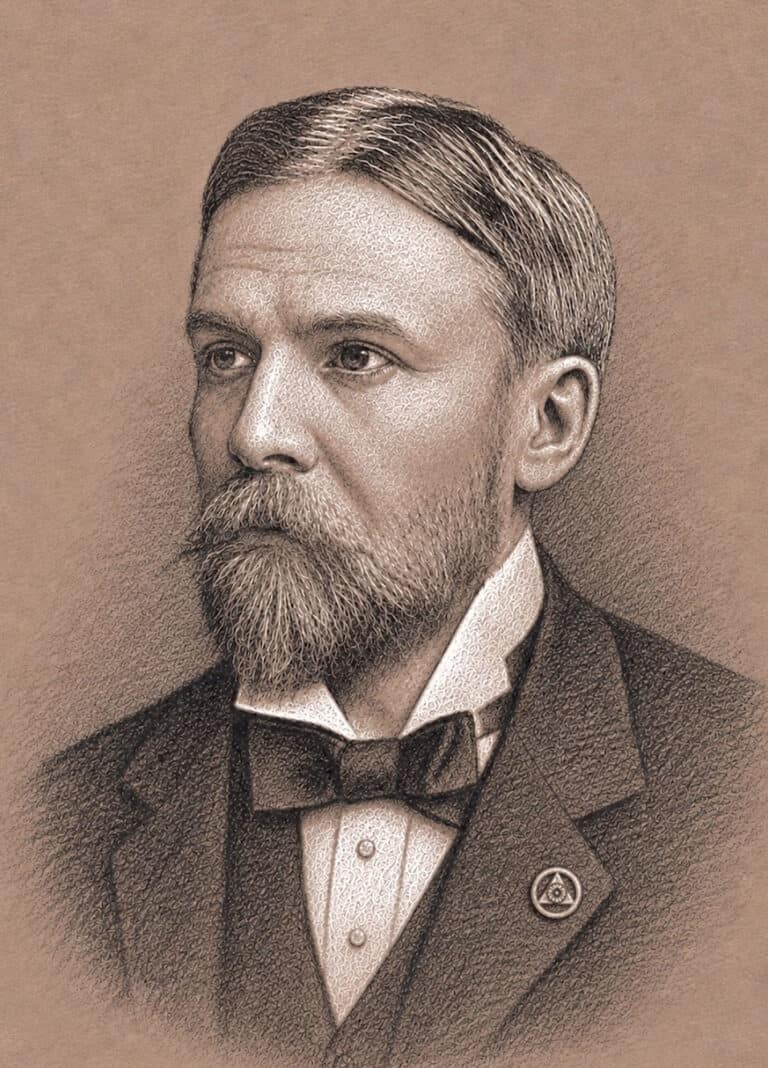
Dr. Herebert Arthur Parkyn
The parallels between Science of Breath and the earlier teachings of Dr. Herbert A. Parkyn are important because Parkyn was not an unrelated contemporary whose work merely happened to resemble the book. Beginning in 1896 at the Chicago School of Psychology, Parkyn had developed and taught a system of Suggestive Therapeutics that combined mental and physical training, and the Yogi Publication Society later emerged from the same Chicago network in which his school, publications, courses, and associates operated. By the time The Hindu-Yogi Science of Breath appeared in 1904, controlled breathing, physical exercise, nervous stimulation, vocal development, mental concentration, and auto-suggestion had formed part of Parkyn’s teaching for years.
This background helps explain why so much of Science of Breath can be read simultaneously in two vocabularies. One is the Yogic vocabulary of prana, rhythmic breathing, the solar plexus, psychic force, and the Will. The other is the language already familiar from Parkyn’s system: respiration, circulation, nervous force, concentration, suggestion, auto-suggestion, physical exercise, mental imagery, and the deliberate cultivation of desired mental and bodily states. Science of Breath does not simply place a few breathing exercises beside occult philosophy. It repeatedly combines controlled respiration with the same kind of coordinated physical and mental training that Parkyn had made central to Suggestive Therapeutics.
Parkyn’s “Life Essentials” and the Principle of Air
One of the clearest parallels concerns Parkyn’s “Life Essentials.” In his health teachings, Air was not merely an instruction to spend more time outdoors. It meant consciously practicing deep, regular breathing as an essential condition of health. Parkyn taught that proper breathing increased the supply of oxygen to the blood, improved circulation, strengthened the organs and nervous system, assisted digestion and elimination, increased energy, and improved the body’s resistance to disease. Science of Breath opens with substantially the same physiological foundation, presenting breathing as the essential process upon which blood purification, nourishment, circulation, digestion, vitality, and resistance to illness depend.
The similarity extends beyond the claim that oxygen is important. Both systems treat improper breathing as an acquired consequence of civilization and proper breathing as a return to natural law. Science of Breath repeatedly contrasts the artificial habits of civilized people with the natural breathing of animals, children, and people living closer to nature. Parkyn likewise taught health through obedience to natural physiological laws rather than dependence upon artificial habits. In both systems, the task is corrective: the student retrains the body to perform naturally through deliberate practice until the corrected habit becomes automatic.
Breathing, Movement, and Mental Direction
Parkyn’s breathing exercises were also integrated with physical movement rather than treated as isolated respiratory drills. His Chicago School training combined controlled breathing with movement, muscular activity, posture, vocal work, concentration, and mental suggestion. This is precisely the pattern that becomes increasingly visible in Science of Breath. The Yogi Nerve Vitalizing Breath combines complete inhalation with muscular tension and repeated arm movements. The Vocal Breath joins respiratory training to the development of the voice. The seven developing exercises coordinate inhalation, retention, exhalation, stretching, walking, bending, chest expansion, and other movements.
The mental component follows the same pattern. Science of Breath repeatedly instructs the practitioner not only to breathe or move but to direct attention toward the intended result. In the psychic exercises, the student forms a mental image of energy moving toward a particular region, holds the desired physical or mental condition in consciousness, and issues an internal command. Breath, movement, thought, and will function together. This closely parallels Parkyn’s insistence that bodily training and mental suggestion should reinforce one another rather than being treated as separate therapeutic systems.
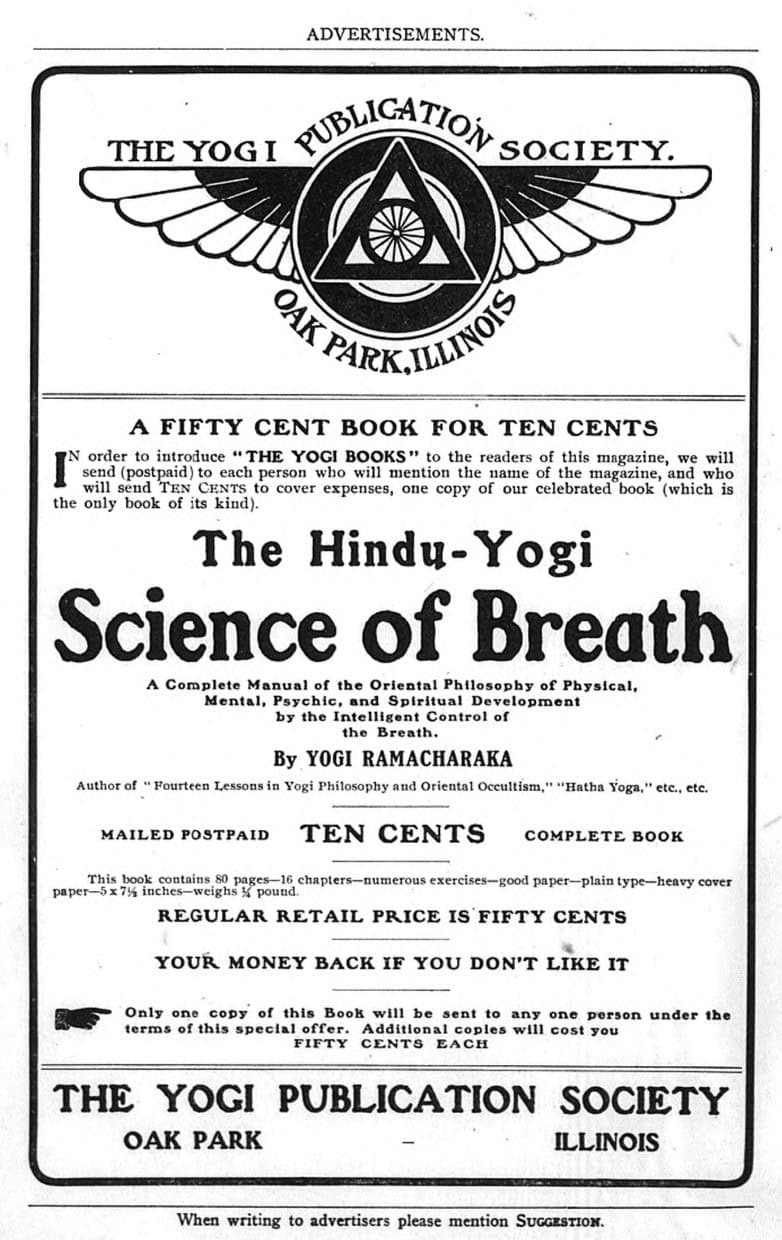
The connection became particularly visible in the spring of 1904, when Parkyn’s Suggestion magazine actively promoted The Hindu-Yogi Science of Breath. The May 1904 issue was explicitly presented as “The Pure Air Number” and contained a full-page advertisement for Science of Breath alongside major articles on breathing and its physical, mental, and occult implications. Parkyn himself contributed “Breathing Exercises and Auto-Suggestion” directly joining the two subjects that Science of Breath repeatedly combines in practice. Suggestion magazine issue V12 N5, May 1904
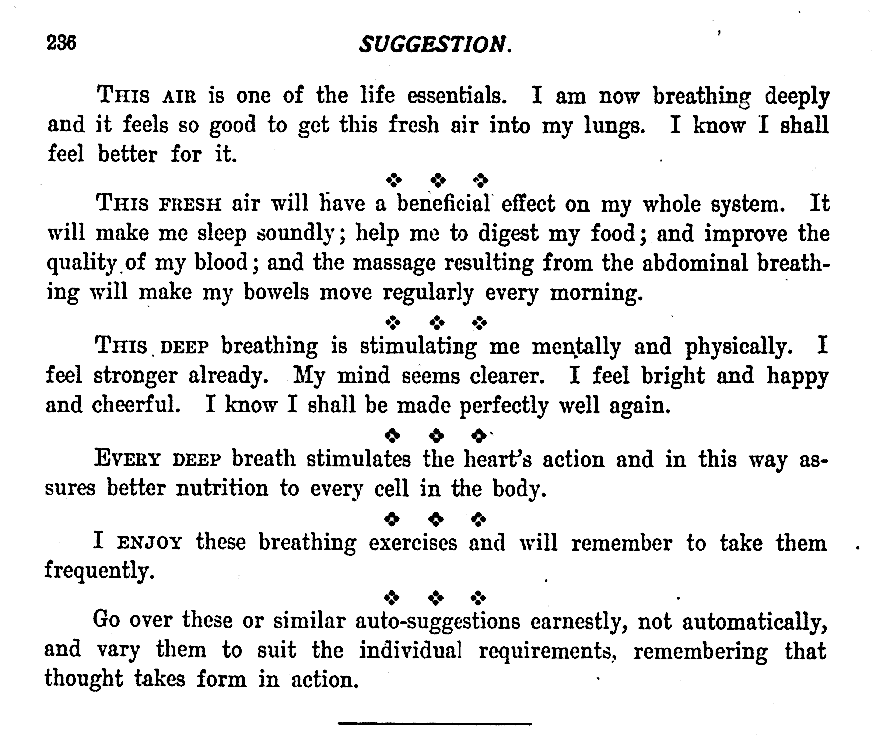
That title is especially revealing because auto-suggestion describes what many of the book’s later exercises are actually doing beneath their Yogic terminology. When Science of Breath instructs the student to breathe rhythmically while picturing courage, self-confidence, strength, health, or another desired quality, the practitioner is combining a physiological rhythm with a deliberate mental impression. When the student concentrates upon an undesirable emotional condition and commands it to leave, breathing while repeating the command, the procedure again resembles auto-suggestion reinforced through bodily action. When the practitioner imagines circulation increasing in a particular region or an organ becoming healthy, mental imagery and expectation are being coordinated with respiratory and nervous activity.
Rhythmical Breathing, Prana, and the Nervous System
The same May 1904 issue of Suggestion also contained an article titled “Rhythmical Breathing,” which discussed the scientific and spiritual roots of rhythmic breathing in Eastern traditions. Its language closely matches the conceptual world presented in Science of Breath. Drawing upon Vedanta philosophy, the article states:
“When mind changes into will, the currents change into a motion similar to electricity. When all of the motions of the body become perfectly rhythmical, the body has, as it were, become a gigantic battery of will.”
That description could almost function as a condensed statement of the middle chapters of Science of Breath. The book repeatedly compares nervous force with electricity, teaches that rhythmic respiration brings the organism into a coordinated vibration, and then explains that the Will can direct the resulting current toward particular parts of the body or toward psychic purposes. Breath establishes rhythm; rhythm organizes energy; thought determines direction; and will produces action.
The 1904 breathing material in Suggestion also described prana as “absolute energy, vital force, spirit of life” and located its storage particularly in the brain and nerve centers, including the abdominal brain or solar plexus. Science of Breath similarly identifies prana as a universal form of energy, associates it with nervous force, and gives the solar plexus an extraordinary position as the body’s great reservoir or storehouse of pranic energy. The correspondence is not limited to general advice about taking deep breaths. It extends into the specific conceptual structure linking breath, energy, the nervous system, the solar plexus, thought, and will.
The May 1904 Pure Air Number went still further by placing these breathing teachings beside an article on the history of thought power in India. That article described the conception of “thought as matter” as “one of the oldest beliefs on earth,” called “Hindo Vedanta” “the most wonderful product of the human mind,” and summarized its teaching as the idea that “thought came into existence first, and then matter formed into shape around it.” It also claimed that the ability of thought to affect matter at a distance had been understood for “many centuries in the remote east, to the wonderful psychics of ancient India, that fountain stream of all esoteric wisdom.”
That context closely matches the progression within Science of Breath itself. The book begins with physiology recognizable to a Western reader, introduces prana as an additional Oriental explanation of vital force, connects it to the nervous system, teaches rhythmic control, and then extends thought and will beyond the individual body into mental healing, thought projection, distant healing, and psychic influence. The sequence effectively moves from respiration to nervous force, from nervous force to directed thought, and from directed thought to the claim that mental influence can operate beyond ordinary physical contact.
The Solar Plexus as a Center of Nervous and Mental Power
The solar plexus provides another particularly strong point of contact. Science of Breath describes it as a major center of the sympathetic nervous system and then gives it an esoteric interpretation as a reservoir of prana. Many later exercises deliberately direct energy toward or through the solar plexus. Emotional control is associated with concentrating upon it, reproductive energy is mentally drawn upward toward it, and pranic force is imagined as being accumulated there before redistribution.
Within Parkyn’s system, the importance of nervous centers and the interaction between voluntary thought and involuntary bodily processes was already fundamental. Suggestive Therapeutics depended upon the proposition that mental impressions could influence functions ordinarily operating below conscious control. Science of Breath supplies an Orientalized physiological map for much the same process: conscious will acts through breath and nervous force upon the internal organism, with the solar plexus serving as a major intermediary between deliberate thought and involuntary bodily activity.
From Auto-Suggestion to Mental Qualities
The chapter on acquiring mental qualities makes the parallel particularly difficult to overlook. Science of Breath tells the student to select a desired characteristic, create a clear mental picture of possessing it, hold that conception during rhythmic breathing, and repeatedly impress it upon the mind. Courage, self-confidence, poise, and similar qualities can supposedly be developed in this manner. The method is essentially self-suggestion combined with breath.
Parkyn had already made auto-suggestion central to his system. Desired mental states were to be consciously selected, affirmed, repeated, and impressed until they influenced habitual thought and behavior. Science of Breath adds Yogic terminology and rhythmic respiration to the process, but the operative structure remains the same: the conscious mind chooses the condition, attention fixes upon it, repetition strengthens the impression, and the less conscious processes of mind and body are expected to respond.
Breath, Will, and Control of the Involuntary System
One of the deepest parallels lies in the relationship between voluntary and involuntary activity. Breathing occupies a special position because it normally occurs automatically but can also be deliberately controlled. It provides an unusually direct bridge between conscious will and involuntary bodily function. Science of Breath repeatedly exploits this characteristic. The practitioner consciously changes respiration and then uses that altered rhythm as a means of influencing circulation, nervous activity, muscular tension, emotion, digestion, and other functions.
That is closely aligned with the central logic of Suggestive Therapeutics. Parkyn’s system taught that conscious thought could reach and influence involuntary processes through suggestion and repeated mental impressions. Science of Breath effectively gives the student a physical mechanism for reinforcing that relationship. The breath is simultaneously voluntary and involuntary, making it an ideal instrument for carrying deliberate mental direction into processes that normally occur automatically.
Auto-Suggestion affirmations by Herbert A. Parkyn for healthy breathing, Suggestion May 1904.
Why the 1904 Pure Air Number Articles Matters
The May 1904 issue of Suggestion is especially important historically because it brings these parallel streams together in one place. Parkyn’s magazine did not merely carry an advertisement for Science of Breath. The issue was organized around breathing itself, called “The Pure Air Number,” and accompanied the book’s promotion with Parkyn’s own “Breathing Exercises and Auto-Suggestion,” an article on “Rhythmical Breathing,” discussion of prana and the solar plexus, and material connecting thought power with India and Vedanta.
The result provides unusually direct evidence of how Science of Breath was being situated within Parkyn’s publishing network. Readers of Suggestion encountered the Yogi Publication Society book alongside Parkyn’s breathing exercises, auto-suggestion, nervous training, Eastern concepts of vital force, rhythmic breathing, and the history of Indian thought power. Rather than appearing as an isolated foreign system suddenly introduced into Chicago, Science of Breath was presented to an audience already being taught how breathing, nervous force, mental concentration, suggestion, and physical health could operate together.
What Is the Lasting Importance of The Hindu-Yogi Science of Breath?
The Hindu-Yogi Science of Breath is best understood as a bridge book. It begins with something immediate and universally recognizable, the act of breathing, and uses it to lead the reader through progressively larger claims about the relationship between body, mind, energy, and consciousness. Its opening chapters could be read as an early twentieth-century health manual concerned with fresh air, lung capacity, posture, circulation, and exercise. Its middle chapters transform breath into an instrument of nervous and mental control. Its later chapters turn rhythmic breathing into a vehicle for healing, thought projection, emotional regulation, mental development, psychic influence, and spiritual meditation.
Related Research Articles
The Sacred Geometry of the Yogi Publication Society Logo
This article examines the Yogi Publication Society logo and its sacred geometry meaning, comparing it with Hindu, Hermetic, Rosicrucian, Masonic, and Theosophical traditions to show the intention behind the publishing network.
The Science of Psychic Healing: A Bridge Between Yogi Philosophy and the Law of Suggestion
This article explores the book The Science of Psychic Healing and its close parallels with Herbert A. Parkyn's teachings and examines its role in connecting Eastern philosophy with the science of mind.
Yogi Ramacharaka: The True Meaning and Origin of the Name
This article breaks down the hidden symbolism and meaning behind "Yogi Ramacharaka", the pen name that was created by the Yogi Publication Society and shows the allegory that reflected the ideas the books were…