

Person Research Collection
Edward Elmer Beals
1876–1957
Beals was a Parkyn graduate, publisher, author, and businessman who published Parkyn, acquired Atkinson’s publishing business, and later joined Atkinson in writing the twelve-volume Personal Power series.
Edward Elmer Beals was an American author, publisher, businessman, advertising specialist, and real-estate developer whose career connected many of the people and organizations surrounding Herbert A. Parkyn and William Walker Atkinson. A graduate of Parkyn’s Chicago School of Psychology, Beals became involved with the Sheldon School of Scientific Salesmanship and managed the Science Press when it published Parkyn’s Auto-Suggestion and fellow Chicago School graduate Stanley LeFevre Krebs’s The Law of Suggestion.
He later helped operate the Fiduciary Press after it purchased Atkinson’s publishing business, joined fellow Parkyn graduates Christian D. Larson and W. C. Van Valen in the Progress Company, and worked with Atkinson there before the two men collaborated on the twelve-volume Personal Power series in 1922. Beals then carried the psychology of advertising, sales, and financial success into a second career involving major real-estate developments in Seattle, Detroit, and Ontario.
Early Life and the Higher Life Book Depot

Edward Elmer Beals was born March 23, 1876, in Lawrence, Massachusetts. By his twenties he had entered the world of psychology and New Thought that would shape his early career. He studied under Herbert A. Parkyn and became a graduate of the Chicago School of Psychology, where Parkyn taught suggestion, hypnotism, auto-suggestion, concentration, habit formation, and the directed use of the mind. Parkyn also carried this system to students throughout the country through his Special Mail Course in Hypnotism and Suggestive Therapeutics.
By 1902 Beals was in Boston, where he opened a “Higher Life” book depot at 7 Batavia Street. The store handled Unity books and publications and placed him in the New Thought and metaphysical book trade several years before he became a Chicago publisher. Bookselling gave him an early commercial connection with the same subjects he had studied under Parkyn and soon led to work in publishing.
The Science Press and the Sheldon School
Beals moved to Chicago and became manager of the Science Press, which worked closely with the Sheldon School of Scientific Salesmanship from the Republic Building. The Sheldon School was built around the application of psychology to salesmanship and business and enrolled thousands of students through its courses. Beals became connected with the Sheldon operation while managing the Science Press, bringing together the two fields that would dominate much of his career, psychology and business.
The relationship with Parkyn’s circle was unusually close. The Science Press published Parkyn’s Auto-Suggestion and Stanley LeFevre Krebs’s The Law of Suggestion. Krebs was another resident graduate of the Chicago School of Psychology and had worked with Parkyn in the investigation of spiritualist phenomena before becoming a nationally known lecturer and psychologist. Beals was thus managing a publishing house issuing major books on suggestion by his former teacher and a fellow graduate of the school.
The Science Press and Sheldon School were also connected through The Business Philosopher, a magazine devoted to business education and scientific salesmanship. Parkyn’s Auto-Suggestion was promoted through this operation and offered as a subscription premium. The Science Press also published the works of James Allen, whose books on thought, character, and self-development had become widely read within New Thought circles.
This period gave Beals experience well beyond ordinary book publishing. The Sheldon system applied attention, concentration, personality, confidence, mental attitude, and other psychological subjects directly to selling. Those ideas became increasingly important in Beals’s own writing and later in his work in advertising and real estate.
The Fiduciary Press and Atkinson’s Publishing Business
In 1907 Beals moved from the Science Press into the Fiduciary publishing operation. He became vice-president and treasurer of the Fiduciary Press, working with president E. I. Rosenfield and secretary and manager I. H. Gallyon, who had previously served as business manager of The Business Philosopher.
The Fiduciary Press purchased William Walker Atkinson’s book-publishing business, which Atkinson had operated from the Masonic Temple in Chicago. The purchase included the rights, titles, copyrights, and plates to Atkinson’s The Secret of Mental Magic and Mental Fascination, and the company took over the handling of orders for his books.
Beals and Atkinson were now directly connected in the publishing business. This was not a relationship that began with their joint books fifteen years later. Beals was already helping run the company that had acquired Atkinson’s publishing operation in 1907, and the two men would continue to cross paths through several later ventures.
The Law of Financial Success

The same year brought Beals his greatest success as an author. The Fiduciary Press published The Law of Financial Success in 1907, a book applying psychological principles to money, work, ambition, and financial achievement. Its chapters included Mental Attitude, Fear and Worry, Faith, Latent Power, Ambition, Desire, Will Power, Auto-Suggestion, Harmony, Creation, Concentration, Persistence, Habit, Claiming Your Own, and Making Money. The prominence given to auto-suggestion is notable in a book written by a graduate of Parkyn’s school who had just managed the press responsible for Parkyn’s Auto-Suggestion. Beals was now applying this psychological training directly to business and financial life.
The book became a remarkable commercial success and reached a circulation of at least 100,000 copies. Demand led to additional editions, while some buyers purchased quantities of the book for distribution to others. It was advertised extensively through New Thought publications, including The Nautilus, The Swastika, and The Stellar Ray.
There is also an unusual question surrounding the authorship of The Law of Financial Success. The book was published under Beals’s name, but Atkinson later included it among his own writings in his Who’s Who in America profile. Whatever the exact division of authorship may have been, the claim adds another dimension to a relationship that was already established through the Fiduciary Press and would later develop into open joint authorship.
Freemasonry
Beals was also active in Freemasonry and served as Senior Warden of Hinkle Lodge No. 210, F. & A. M. His involvement went beyond simple membership, and his later writings and book advertisements appeared in Masonic publications. Freemasonry formed another part of the social and intellectual world in which Beals moved. Psychology, self-culture, metaphysical literature, business instruction, and Masonic publishing frequently crossed paths within his early career, just as they did elsewhere within the Chicago publishing community.
Christian D. Larson and Eternal Progress Magazine
By 1908 Beals was working closely with Christian D. Larson. Larson’s Eternal Progress and Beals’s The Law of Financial Success were advertised together as complementary works applying psychology and metaphysics to everyday life. The subjects of Eternal Progress included Business Psychology, Modern Metaphysics, the Sub-Conscious Mind, the cultivation of ability and talent, the Science of Success, ideals, imagination, personality, and memory. Beals’s book approached many of the same problems through mental attitude, latent power, desire, will, auto-suggestion, concentration, persistence, and habit. Their association soon developed into a much larger enterprise.
The Progress Company

In 1909 Beals became treasurer and manager of the Progress Company at 515 Rand-McNally Building in Chicago. Christian D. Larson served as president, Burton D. Knickerbocker as first vice-president, Dr. W. C. Van Valen as second vice-president, and H. Edward Rath as secretary. Beals also sat on the company’s board of directors.
Three of the men at the center of the company had studied under Parkyn. Beals, Larson, and Van Valen were all graduates of the Chicago School of Psychology. William Walker Atkinson was also closely involved with the enterprise and became one of the principal writers for Progress Magazine. The company developed out of Larson’s publishing work and expanded through Eternal Progress, Cosmic World, and Progress Magazine. Its subjects ranged across psychology, metaphysics, business, health, personal development, and mental science. Beals was no longer simply managing a publisher. The Progress Company combined publishing, education, finance, and business development, while bringing him into sustained work with several men who had come through Parkyn’s educational circle.
Atkinson’s New Psychology Series
The Progress Company commissioned Atkinson in 1909 to prepare a twelve-volume New Psychology Series. The books were designed to present psychology and mental development in an accessible form and were planned for publication during that year.
The announced series included The New Psychology: Its Message, Principles and Practice, Memory: How to Develop, Train and Use It, Suggestion and Auto-Suggestion, Constructive Imagination: How to Acquire It, How to Think, Desire, and The Subconscious and Superconscious Mind. The New Psychology and Memory appeared first, with Suggestion and Auto-Suggestion planned to follow.
This brought Beals and Atkinson together again only two years after the Fiduciary Press had acquired Atkinson’s publishing business. It also placed Atkinson inside a company managed by Beals and headed by Larson, with Van Valen among its senior officers.
Expansion and Failure of the Progress Company
The Progress Company soon moved beyond magazines and books. By 1910 it was planning a new building on Chicago’s North Shore costing more than $100,000. Beals was also involved in the Georgia Farms, Fruit and Pecan Company at Waycross, Georgia, an enterprise capitalized at $300,000 with authority to increase its capital to $3 million. The Georgia company acquired and developed farm properties with an emphasis on fruit and pecan production and controlled substantial acreage in southern Georgia. Beals, who had become known through The Law of Financial Success, was now putting his financial and business ideas into large ventures of his own.
The expansion ended badly. By 1913 the Progress Company had failed with liabilities exceeding $150,000. A substantial portion of its financial trouble was connected with money raised for construction of the company building. The collapse ended Beals’s Chicago publishing period and marked a sharp change in his career.
A New Career in Seattle
Beals moved to Seattle after the failure of the Progress Company. By 1914 he was a partner with John V. Bock and Herbert W. Bird in Bock, Beals & Bird, a real-estate and advertising firm operating from the American Bank Building. The company handled the exclusive selling agency for Laurelhurst, and Beals quickly established himself in real-estate advertising. His article “How Real Estate Sales Are Made by Advertising” explained how persistent advertising creates familiarity and influences buying decisions. He used the success of Laurelhurst as an example, citing $1 million in lot sales during a depressed market.
The move into real estate was a change of industry, but not a rejection of his earlier work. Beals was applying his experience with psychology, repetition, attention, salesmanship, and advertising to the sale of property. The business psychology he had encountered through Parkyn, the Sheldon School, his own financial writing, and the Progress Company now had a direct commercial use.
Detroit Real Estate and Investment
By 1918 Beals had moved to Detroit and was working as a real-estate and investment dealer. The scale of his projects soon increased dramatically. A Detroit and Illinois syndicate represented by Beals purchased the Clark farm near Ojibway, Ontario, for about $210,000. The property contained more than eighty acres and was intended for subdivision. Beals and Detroit real-estate man Charles F. Dow also acquired the 580-acre Newman property adjoining land owned by the Canadian Steel Corporation. That transaction was valued at about $1 million, with plans to divide the acreage into factory sites and residential lots.
Beals operated from the Farwell Building in Detroit and marketed Ojibway property for both investment and industrial development. He was also involved with plans to construct between fifty and five hundred moderately priced homes near the Michigan Central station.
Henry Clay Hodges and the Detroit Connection
Beals’s Detroit career brought him into direct business association with Henry Clay Hodges. The relationship reunited two men whose paths had already crossed through Parkyn’s circle years earlier. Hodges was a wealthy Detroit industrialist and developer as well as a relative of Parkyn. He had purchased Suggestion in 1906 and continued it as The Stellar Ray, which gave substantial attention to Beals’s The Law of Financial Success in 1907. By the time Beals arrived in Detroit, Hodges was already an established figure in the city’s industrial and development world.
Beals’s work with Hodges adds another chapter to a relationship that had begun indirectly through Parkyn, publishing, and New Thought and later continued through Detroit business and real estate.
The Personal Power Books
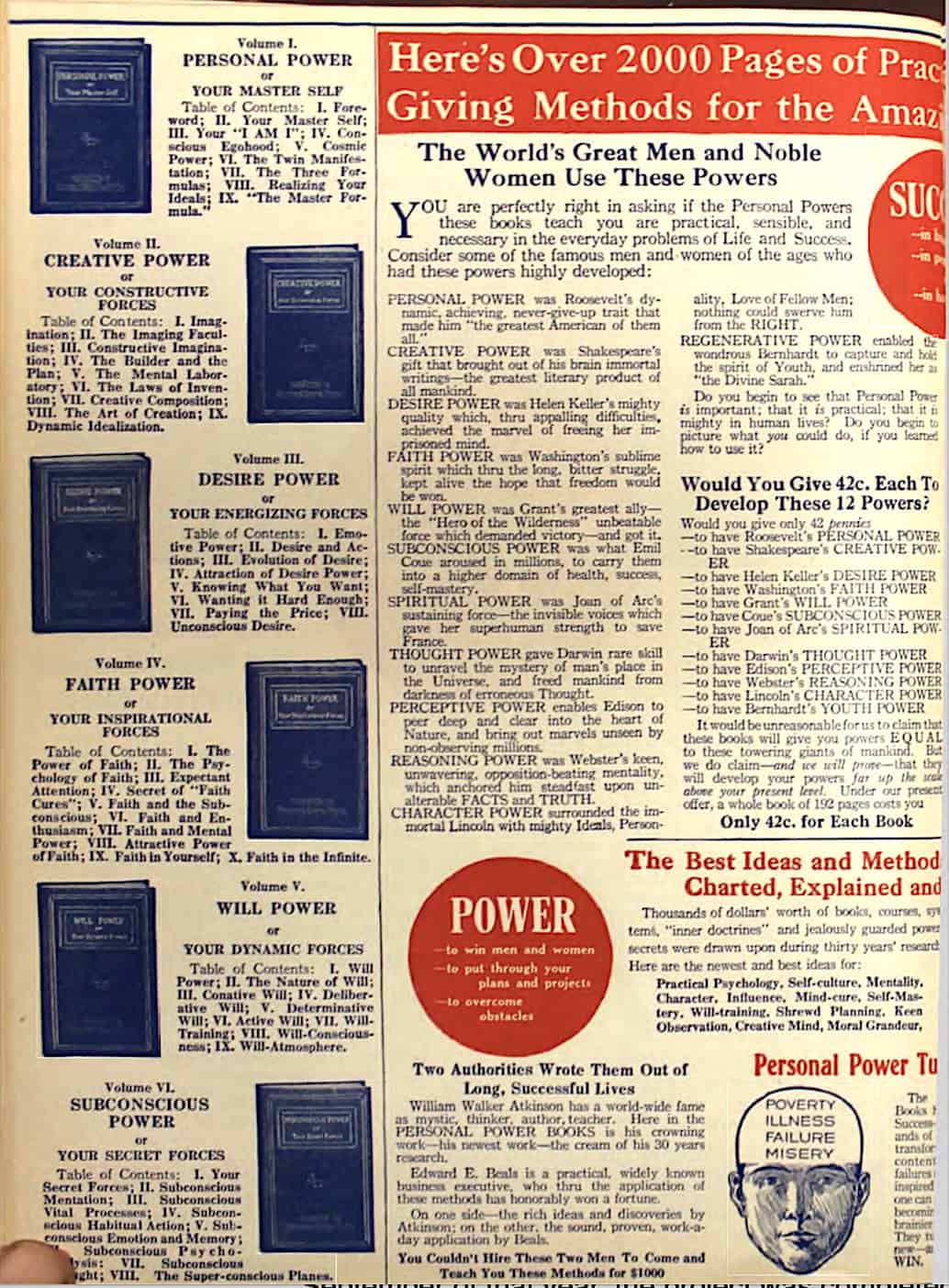
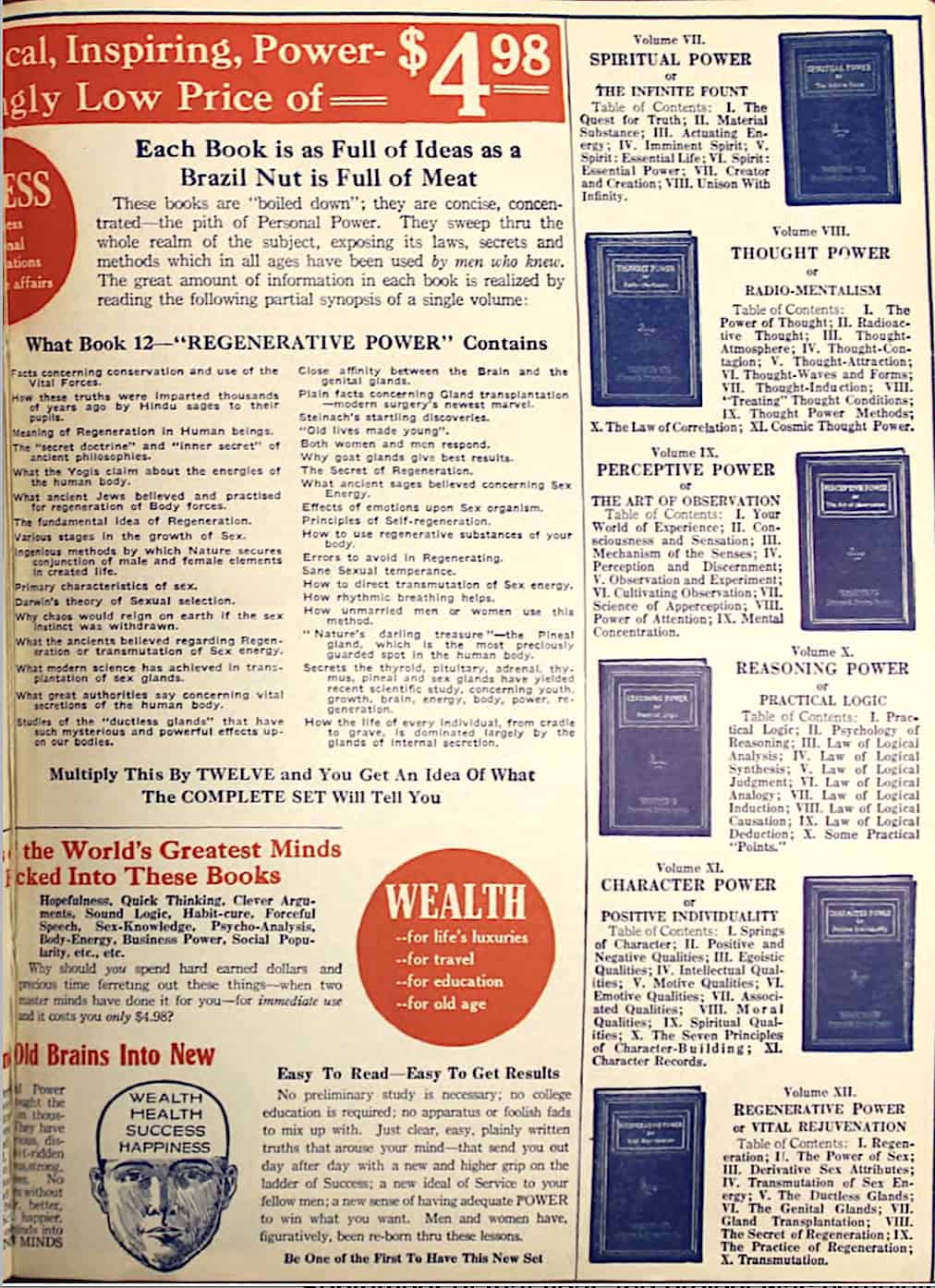
Beals’s long relationship with Atkinson reached its fullest expression in 1922 with the publication of the twelve-volume Personal Power Books, openly written by William Walker Atkinson and Edward E. Beals.
The project had occupied the two men for several years. The complete series consisted of Personal Power or Your Master Self, Creative Power or Your Constructive Forces, Desire Power or Your Energizing Forces, Faith Power or Your Inspirational Forces, Will Power or Your Dynamic Forces, Subconscious Power or Your Secret Forces, Spiritual Power or Your Infinite Fount, Thought Power or Radio-Mentalism, Perceptive Power or The Art of Observation, Reasoning Power or Practical Logic, Character Power or Positive Individuality, and Regenerative Power or Vital Rejuvenation.
The partnership brought together two different careers. Atkinson had spent decades developing systems of mental science and writing on New Thought, psychology, Yogi philosophy, and personal development. Beals had spent those same years putting psychology into business, publishing, finance, salesmanship, advertising, investment, and real estate. Their books combined mental training with its application to everyday life.
The collaboration also had a long history behind it. Beals had been involved when the Fiduciary Press acquired Atkinson’s publishing business in 1907. He managed the Progress Company when it commissioned Atkinson’s New Psychology Series in 1909. By the time the Personal Power Books appeared in 1922, the two men had been connected through publishing and business for at least fifteen years.
The Inner Secret
Beals also published The Inner Secret in 1922. The work continued the psychological and self-development subjects that had occupied him since his years in Parkyn’s circle. By then his writing career stretched back more than fifteen years, while his work in New Thought publishing and bookselling reached back even further. Psychology had remained with him even as his principal business interests moved into real estate and investment.
The Great Lakes Land Corporation
By 1924 Beals was president of the Great Lakes Land Corporation, working with G. R. Reddock as secretary and the Canadian real-estate firm Jones & Reddock. The company became a major land developer in the Border Cities and South Windsor district across the Detroit River.
Its developments included Redford, Park, Huron Park Nos. 1, 2, and 3, Central Park, and other subdivisions. One tract near Huron Line Road and Tecumseh Road covered approximately 500 acres and contained nearly 3,000 lots.
Beals was involved with plans for water mains, road improvements, paving, and other infrastructure needed to turn the acreage into residential and industrial property. The company placed heavy emphasis on the future of the Detroit-Windsor corridor and the effect that new transportation links would have upon land values.
The construction of the Ambassador Bridge was especially important to these plans. Great Lakes property stood close to the new transportation routes connecting Windsor with Detroit, and Beals expected industrial and residential development to follow.
The Golf Club Subdivision
Beals also invested personally in major Windsor-area property. He purchased a large tract adjoining the Essex Golf and Country Club property and then purchased the Golf Club property itself for $300,000.
The adjoining properties were combined into a single development called the Golf Club Subdivision, with Detroit broker F. J. Mallott handling its marketing. The location was close to the Ambassador Bridge terminal, the Detroit-Windsor tunnel entrance, and the ferry dock, while remaining less than three miles from Detroit City Hall.
The Golf Club project joined a long list of Beals developments involving industrial acreage, residential subdivisions, housing projects, and speculative land on both sides of the Detroit River.
Edward Beals and the Parkyn Publishing Network
Beals holds an unusual place in the history surrounding the Yogi Publication Society because he appears repeatedly at important points in the careers of Parkyn and Atkinson without having been a YPS author himself. His connection began with his education under Parkyn at the Chicago School of Psychology. He then became involved with the Sheldon School and managed the Science Press when Parkyn’s Auto-Suggestion and Krebs’s The Law of Suggestion were published. From there he entered the Fiduciary Press just as it purchased Atkinson’s publishing business.
The Progress Company brought several branches of the same circle together in 1909. Beals managed the company under Christian D. Larson, W. C. Van Valen served as one of its senior officers, and both men shared Beals’s connection with Parkyn’s school. Atkinson became a major writer for the company and was commissioned to prepare the New Psychology Series.
The subjects moving through these companies also overlap with material later associated with Atkinson and YPS names such as Yogi Ramacharaka, Theron Q. Dumont, Swami Panchadasi, and Swami Bhakta Vishita. Suggestion, auto-suggestion, concentration, will, desire, memory, subconscious mental activity, personality, thought power, and personal magnetism moved easily between psychological instruction, New Thought literature, and business education.
Beals’s later history with Atkinson is especially valuable because it removes any question that their earlier associations were simply incidental. Fifteen years after Fiduciary acquired Atkinson’s publishing operation, the two men openly placed both of their names on the twelve Personal Power Books.
Later Life
Beals’s later years were far removed from the modest Higher Life book depot he had opened in Boston in 1902. Over the course of his career he had managed publishing houses, written a book with a circulation of at least 100,000 copies, helped run a large Chicago publishing and investment company, built a career in advertising, participated in million-dollar land transactions, developed thousands of residential and industrial lots, and collaborated with Atkinson on a twelve-volume psychological system.
Yet the different stages of his life were closely related. The psychology Beals learned early in his career became part of his writing on financial success. The Sheldon School placed psychology inside salesmanship. His Seattle work applied psychology to advertising. His Detroit and Windsor years applied the same understanding of promotion, investment, and public desire to large-scale real estate.
Edward Elmer Beals died March 4, 1957, in Miami-Dade County, Florida, shortly before his eighty-first birthday. His career had lasted more than half a century and carried him from Parkyn’s Chicago School and the New Thought book trade into publishing, psychology, finance, advertising, and major North American real-estate development. Among the many people who passed through Parkyn’s early network, Beals stands out for the distance that network can be followed through his life, from Parkyn and the Sheldon School to Science Press, Atkinson, Larson, the Progress Company, Hodges, and finally the Personal Power Books of 1922.
Sources & Citations
- Newspaper. Edward E Beals and William Walker Atkinson" . The Daily Mail. 1923-02-03. p. 9. Retrieved 2026-09-10.
- Newspaper. "Edward E Beals starts real estate advertising in Seattle" . Seattle Post-Intelligencer. 1914-09-27. p. 50. Retrieved 2026-09-10.
- Newspaper. "Book published by the Fiduciary Press" . Boston Evening Transcript. 1907-09-21. p. 32. Retrieved 2026-09-10.
- Newspaper. "Was manager of the Science Press" . The Courier-Journal. 1907-12-21. p. 7. Retrieved 2026-09-10.
- Newspaper. "His book sells over 100K copies" . Wisconsin State Journal. 1908-01-09. p. 2. Retrieved 2026-09-10.
- Newspaper. "Progress company" . The Inter Ocean. 1908-10-06. p. 10. Retrieved 2026-09-10.
- Newspaper. "Mason" . The Hamilton County Ledger. 1909-12-31. p. 1. Retrieved 2026-09-10.
- Newspaper. "Building a 100K building in Chicago for Progess magazine" . The Citizen. 1910-03-23. p. 5. Retrieved 2026-09-10.
- Newspaper. "Beals with Larson in development of large Pecan and fruit plantation in GA" . The Atlanta Constitution. 1911-03-01. p. 4. Retrieved 2026-09-10.
- Newspaper. "Progress Company goes bust" . Chicago Tribune. 1913-07-08. p. 13