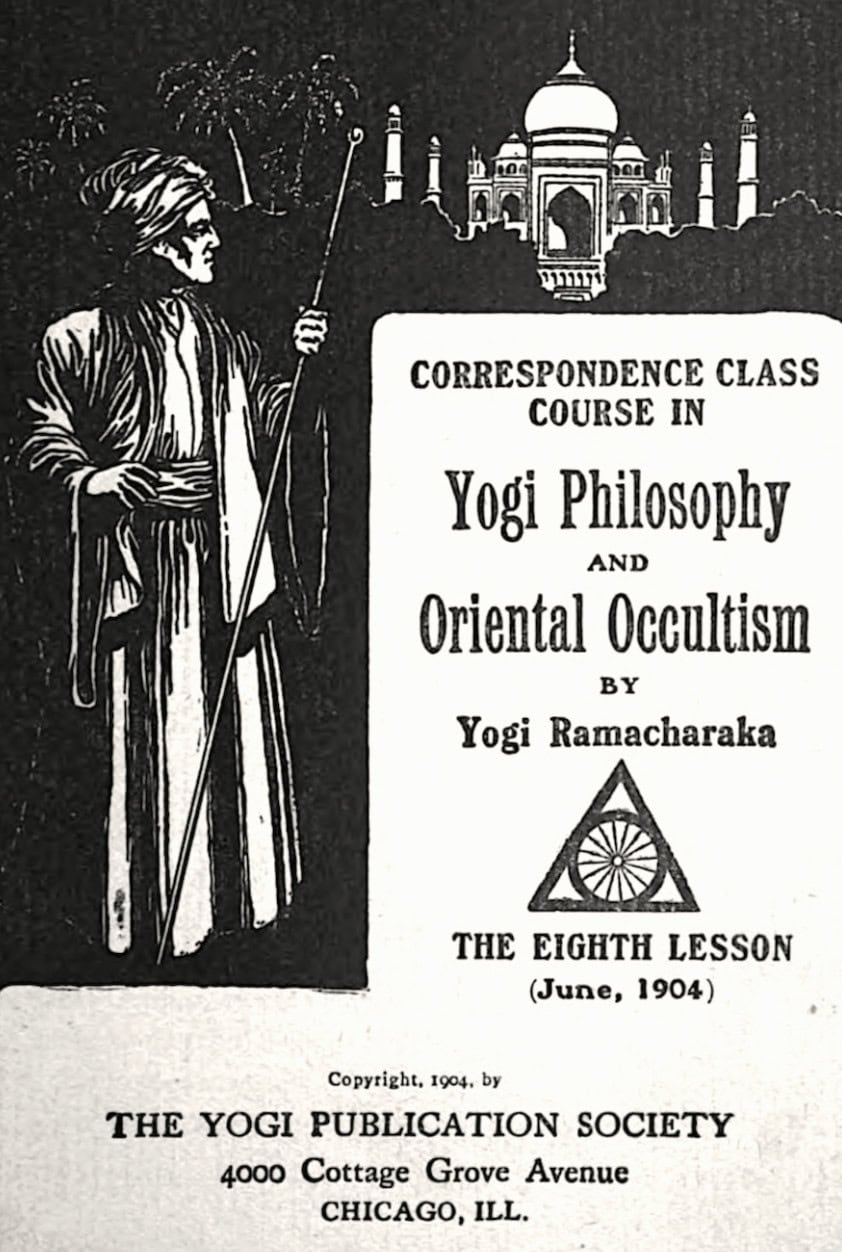
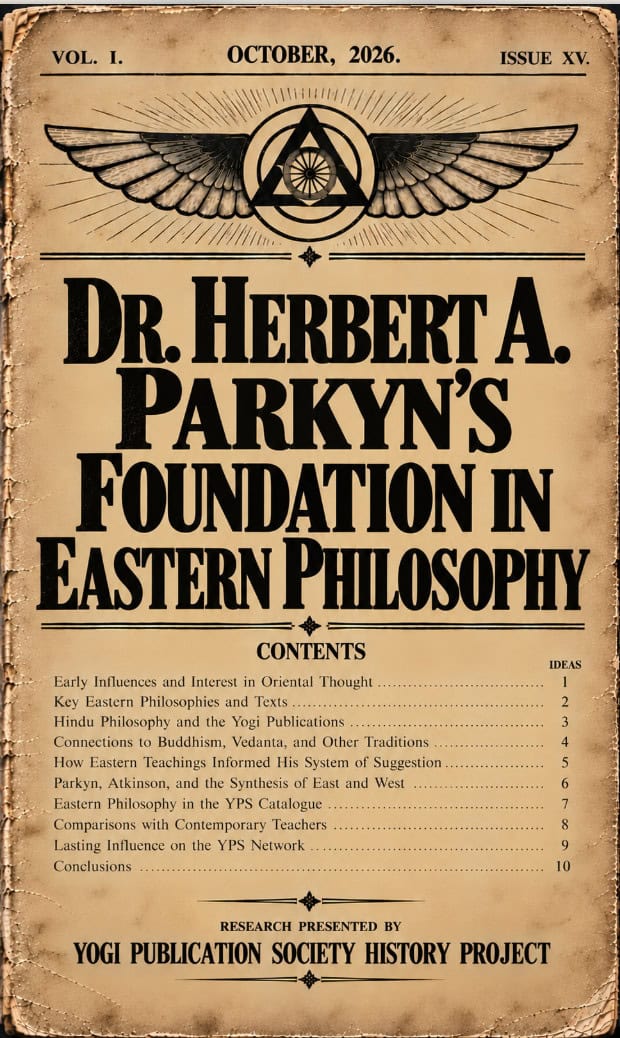
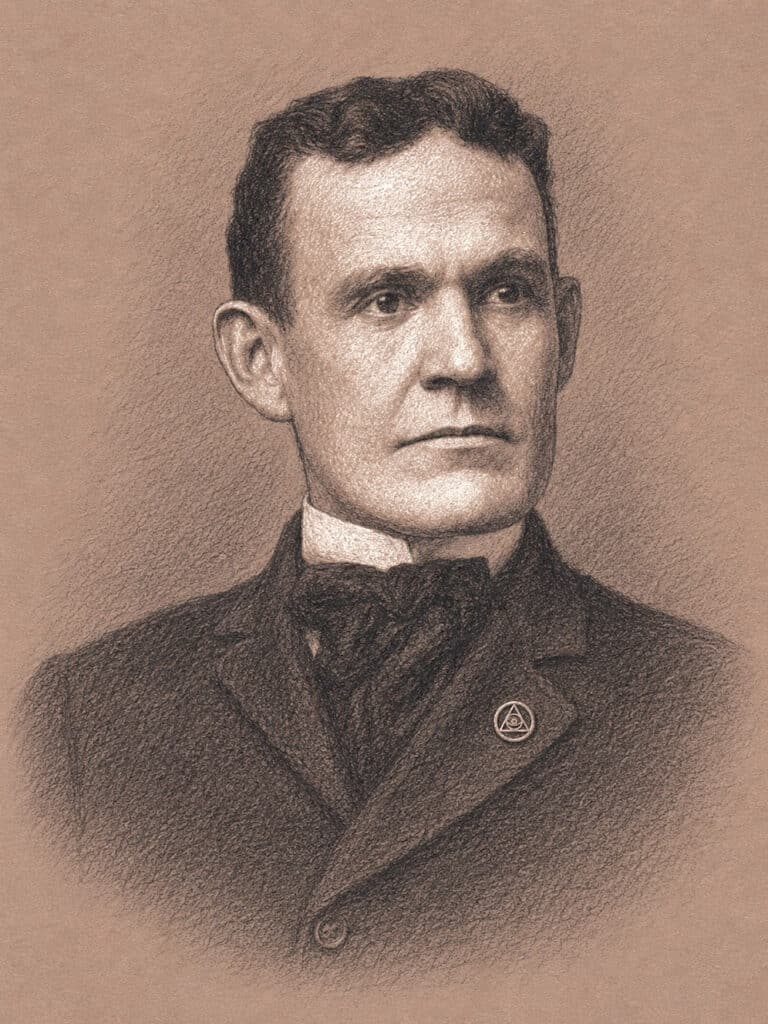
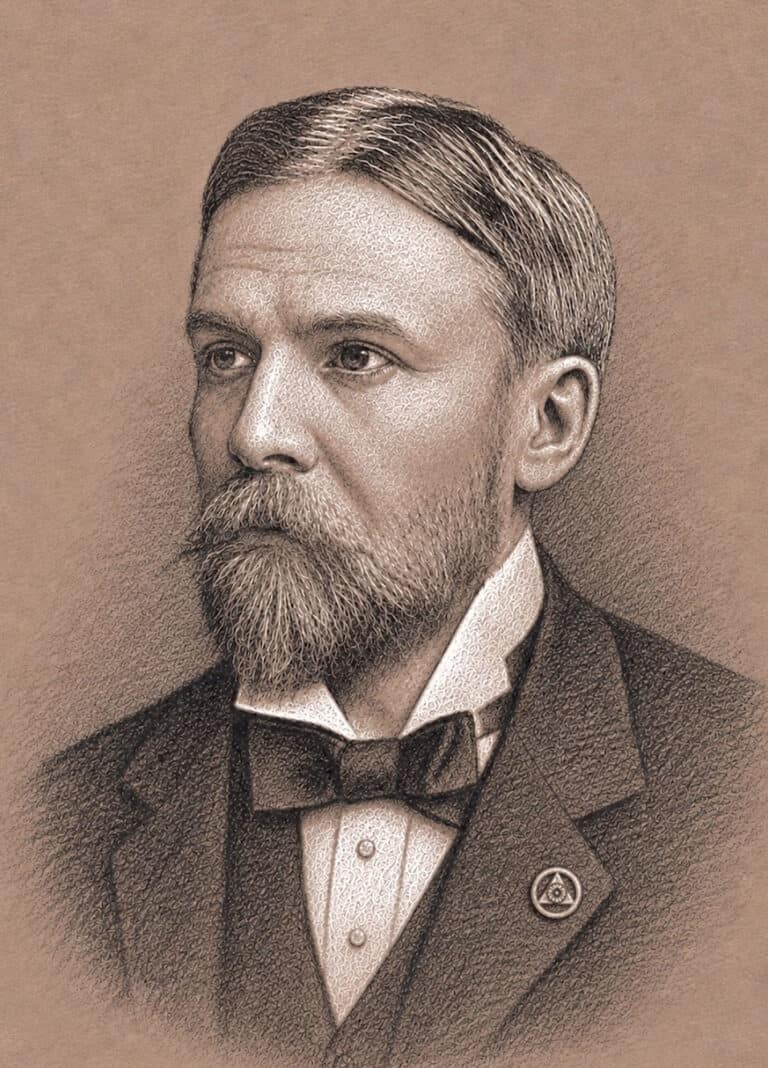
Beginning in November 1903, the Correspondence Class Course in Yogi Philosophy and Oriental Occultism was issued by the Yogi Publication Society as a series of fourteen monthly lessons under the name Yogi Ramacharaka. Published from the Society’s original offices at 4000 Cottage Grove Avenue, the course was one of the earliest major presentations of the Ramacharaka system and established much of the philosophical and occult framework that would later be expanded through the better-known Yogi books. Instead of concentrating upon a single branch of yoga, the lessons attempt to provide students with an entire conception of the human being and the universe, beginning with the physical body and vital force, progressing through the different levels of mind and consciousness, and then moving into the aura, thought power, clairvoyance, human magnetism, psychic influence, healing, the astral world, death, reincarnation, spiritual evolution, cause and effect, and finally the Yogi path of spiritual attainment. The course develops in a deliberate sequence: the student is first taught what a human being supposedly is, then how the hidden forces within and around the individual operate, and finally how the soul develops through successive lives toward higher spiritual consciousness.
Yogi Ramacharaka
At the center of the entire system is the claim that the ordinary physical personality represents only the outermost portion of the human being. Ramacharaka divides man into seven principles extending from physical matter to pure Spirit and repeatedly emphasizes that these should not be understood as seven completely separate entities. They are different aspects or degrees of manifestation within one individual. The lower principles connect human beings with physical and animal existence, the middle principles produce ordinary thought and self-consciousness, and the highest principles open into intuition, spiritual consciousness, and realization of the divine nature of the Self. This sevenfold constitution becomes the organizing structure for almost everything that follows. Psychic phenomena are explained through the astral and mental principles, healing through Prana and mind, thought influence through the projection of mental forces, survival after death through the separation of the higher principles from the physical body, and spiritual evolution through the gradual awakening of the higher consciousness. The fourteen lessons are less a collection of unrelated occult subjects than a progressive attempt to construct a complete philosophy of human existence.
The Seven Principles of Man
The opening lessons introduce what Ramacharaka calls the Seven Principles of Man. The first is the Physical Body, which is treated as the temporary material instrument through which the individual functions during earthly life. Although the body is important and should be properly cared for, it is emphatically not the real person. It is continually changing, rebuilding itself from physical matter, and eventually returns to the material elements from which it was formed. The second principle is the Astral Body, described as a finer counterpart or pattern underlying the physical organism. The third is Prana, the universal vital force responsible for life and bodily activity. Together these first three principles form the lower physical side of human existence, but Ramacharaka immediately begins directing the student’s attention away from identification with them. The person possesses a body and uses vital energy, but the deeper Self exists beyond both.
The fourth principle is the Instinctive Mind, encompassing the enormous range of mental operations that occur beneath ordinary conscious reasoning. It includes instinct, automatic bodily regulation, inherited tendencies, appetites, emotional impulses, habits, and many of the subconscious processes that human beings share with animals. Yet Ramacharaka does not treat this level as merely primitive or useless. It performs an extraordinary amount of the work required to maintain life without demanding conscious attention. The fifth principle, the Intellect, represents the reasoning and self-conscious mind that becomes increasingly prominent in human development. Through it humanity analyzes, compares, plans, reasons, invents, and becomes consciously aware of itself as an individual. The intellect distinguishes civilized humanity from lower forms of consciousness, but even this is not the highest human faculty. Above it lies the sixth principle, the Spiritual Mind, the source of intuition, inspiration, compassion, higher morality, spiritual insight, and those sudden illuminations that seem to transcend ordinary reasoning. The seventh and highest principle is Spirit, the divine element within the individual and the ultimate center of being.
The progression from the first to the seventh principle gives the entire course its direction. Human development consists of consciousness gradually moving upward from identification with the body, instinct, appetite, and ordinary intellect toward increasing awareness of the Spiritual Mind and Spirit. The higher principles are not presented as something that must be externally added to the person; they are already present but only partially expressed. Spiritual development means awakening to something that has always existed within. This idea also allows Ramacharaka to explain differences between people as differences in the degree to which various levels of consciousness have become active. One person may live primarily through appetite and instinct, another through intellect and ambition, while another begins to experience intuition, compassion, spiritual aspiration, and direct consciousness of realities beyond the material world.
Prana and the Universal Life Force
Prana is one of the most important concepts introduced in the early lessons and becomes the connecting force between the physical, mental, and occult teachings of the course. Ramacharaka describes Prana as the universal principle of vitality, the force that manifests through living organisms and enables the body and nervous system to function. It is not identical with air or oxygen, although breathing is presented as one of the principal means through which the body absorbs and distributes it. Prana exists throughout nature and can supposedly be accumulated, directed, transferred, and employed consciously once the student understands its laws.
This concept provides Ramacharaka with a common explanation for phenomena that might otherwise appear unrelated. Physical vitality, nervous energy, magnetic healing, personal magnetism, and certain forms of psychic influence are treated as different applications of Pranic force. A healthy individual possesses and circulates Prana effectively, while weakness and disease may involve disturbances in its distribution. The trained person can supposedly increase the available supply, direct it toward particular parts of the body, transmit it to another person, or charge objects and environments with it. What older traditions described as magnetic force, healing power, or vital energy is incorporated into a single universal principle. The later lessons on human magnetism and occult therapeutics build directly upon this foundation.
The Instinctive Mind and the Intellect
Ramacharaka’s treatment of mind is particularly important because he does not describe consciousness as a single unified faculty. Much of human behavior originates below the level of deliberate thought. The Instinctive Mind controls automatic bodily functions and contains impulses inherited from earlier stages of evolution. Hunger, reproduction, self-preservation, emotional reactions, habits, and many automatic responses originate at this level. Human beings still carry these older mental structures within themselves even after the development of the higher intellectual faculties, which explains why rational intention and instinctive desire frequently come into conflict.
The Intellect develops above this instinctive foundation and gives humanity the power of deliberate reasoning. Through it the individual compares ideas, forms judgments, analyzes experience, and consciously directs behavior. Yet Ramacharaka repeatedly warns against assuming that intellectual reasoning represents the summit of human consciousness. The intellect is itself an evolutionary stage. It can accumulate knowledge and reason from known facts, but it cannot by itself penetrate the highest spiritual realities. This limitation becomes essential to the distinction between the fifth and sixth principles. Just as intellect emerged beyond instinct, another faculty is emerging beyond intellect.
The Spiritual Mind and Illumination
The sixth principle, Spiritual Mind, represents the beginning of what Ramacharaka regards as genuinely higher consciousness. Its activity is experienced through intuition, spiritual insight, altruism, sympathy, inspiration, artistic and moral elevation, and sudden knowledge that seems to arrive without the ordinary process of reasoning. The individual may initially experience only brief flashes of this consciousness, but these moments are interpreted as evidence that a higher faculty is beginning to awaken.
Ramacharaka describes spiritual development as a gradual increase in these moments of illumination. The person begins to recognize a deeper unity behind apparently separate individuals and to experience moral and spiritual truths directly instead of merely accepting them intellectually. Compassion becomes more natural because the individual increasingly perceives other beings as expressions of the same underlying life. Religion likewise changes from belief in doctrines into personal spiritual consciousness. The highest spiritual experiences are not presented as supernatural interventions from outside the individual but as manifestations of a faculty already present within human nature. Spirit, the seventh principle, lies beyond even Spiritual Mind and represents the divine essence of the individual. It cannot be completely explained by the intellect because the intellect belongs to a lower plane of consciousness; it must be realized through direct experience.
The Human Aura
After establishing the seven principles, the course turns outward to the Human Aura. Ramacharaka teaches that each level of the human constitution produces or is surrounded by a corresponding field extending beyond the visible physical body. These emanations collectively form the aura. Different layers are associated with physical vitality, Pranic energy, instinctive emotions, intellectual activity, higher thought, and spiritual development, so that the aura becomes a visible or psychically perceptible expression of the person’s entire condition.
Color plays an important role in this system. Different mental and emotional states supposedly produce characteristic colors within the aura, allowing a sufficiently developed clairvoyant to perceive anger, fear, affection, intellectual activity, selfishness, spiritual aspiration, and other qualities directly. Temporary emotions create temporary changes, while habitual states of character produce more persistent patterns. The aura becomes a kind of psychic record of the individual. A person’s thoughts and feelings are not confined inside the skull but radiate outward, producing actual effects in the surrounding mental atmosphere. This concept prepares the way for the next major subject of the course: Thought Dynamics.
Yogi Philosophy and Oriental Occultism course by the Yogi Publication Society
Thought Dynamics and Thought-Forms
Ramacharaka treats thought as a genuine force instead of as a purely private mental event. Every thought produces vibrations that travel outward from the thinker and may affect other minds capable of responding to them. At the same time, concentrated thought creates what the course calls thought-forms—temporary structures of mental energy carrying the character and intention of the thought that produced them. Strong, repeated, or emotionally charged thoughts create more powerful effects than weak and scattered ones.
This theory gives enormous importance to habitual thinking. A person continually surrounds himself with the products of his own mental activity and simultaneously contributes those influences to the larger mental atmosphere. Repeated fear, anger, hatred, or discouragement strengthens corresponding tendencies, while confidence, courage, goodwill, and constructive thought create influences of another kind. Thought operates both inwardly and outwardly: it shapes the character of the thinker while also influencing others.
The teaching also explains how groups can reinforce common mental states. When many individuals think and feel along similar lines, their combined mental activity creates a stronger field of influence capable of affecting people who enter it. Religious enthusiasm, political excitement, panic, social movements, and collective emotional states can be interpreted as forms of mental contagion. The student is encouraged to recognize these influences instead of unconsciously submitting to them. Control of thought becomes both a method of self-development and a form of psychic self-protection.
Clairvoyance, Clairaudience, Psychometry, and Telepathy
The sixth lesson turns directly to psychic perception and attempts to classify phenomena that were commonly grouped together under the broad language of clairvoyance. Ramacharaka distinguishes simple clairvoyance from more extended forms of perception. Simple clairvoyance involves awareness of astral conditions in the immediate environment. A developed clairvoyant is said to perceive auras, thought-forms, astral entities, and even conditions hidden behind physical barriers. The course claims that sufficiently developed astral sight can penetrate solid objects, observe events in adjoining rooms, perceive conditions beneath the ground, examine the internal organs of the body, and recognize the mental states of others through their auric colors.
Clairaudience is treated as the corresponding extension of hearing, while psychometry involves obtaining information through contact with an object associated with a person, place, or event. Telepathy operates through the transmission or reception of thought without ordinary sensory communication. These phenomena are presented not as separate miracles but as different applications of the astral and mental faculties already described in the earlier lessons. The ordinary senses function upon the physical plane; psychic senses supposedly function upon subtler planes.
At the same time, Ramacharaka repeatedly warns students against forcing psychic development through trance, hypnotism, monotonous repetition, or other methods that weaken conscious control. He acknowledges that such practices may produce glimpses of the astral world but considers them inferior and potentially dangerous. The higher Yogi method is to develop spiritual character first, allowing psychic faculties to unfold as a consequence of velopment. The course draws a distinction between possessing psychic powers and possessing the wisdom required to use them.
Human Magnetism
The seventh lesson develops the earlier teaching concerning Prana into a theory of Human Magnetism. What is commonly called personal magnetism is explained as the outward expression and directed use of vital and mental force. Every person radiates influence, but individuals differ greatly in the amount, character, and direction of the force they project. Some unconsciously attract, stimulate, calm, or dominate others, while trained individuals supposedly learn to control these effects deliberately.
Human magnetism is closely connected with the nervous system and Pranic vitality. The individual can accumulate Prana through proper living and breathing and then direct it through thought and intention. Touch, passes of the hands, focused attention, and mental direction are treated as possible channels for transmitting this energy. Yet Ramacharaka does not limit magnetism to physical vitality. Mental states also contribute to personal influence, making confidence, concentration, self-control, and expectation important parts of magnetic power.
This creates an important bridge between the physical and psychological portions of the course. A strong personality is not explained solely through character or social skill but through the combined action of Pranic vitality, mental concentration, and thought projection. The same principles that supposedly permit healing can also produce personal influence, and the same forces that may benefit another person can potentially be misused for domination.
Occult Therapeutics
The eighth lesson applies these principles directly to healing. Ramacharaka begins by observing that some form of occult or nonmaterial healing has appeared throughout human history and across widely different religious traditions. He argues that healers have repeatedly claimed their cures as proof that their particular religion or doctrine alone possesses the truth, even though similar cures have occurred under completely different systems. From this he concludes that the healing force cannot belong exclusively to any particular creed. Instead, different systems are unknowingly employing universal natural forces. Nature’s recuperative power, he argues, is available regardless of the theory constructed around it.
Fourteen Lessons in Yogi Philosophy and Oriental Occultism by Yogi Ramacharaka
The course divides occult healing into several overlapping forms, including spiritual healing, mental healing, and Pranic healing. Mental states can affect bodily conditions because mind and body are intimately connected, while suggestion can alter habits, expectations, nervous states, and physiological responses. Pranic healing involves directing vital force toward the weakened person or affected part of the body. Spiritual healing operates from a still higher level, bringing the individual into harmony with the spiritual forces underlying life. Ramacharaka’s purpose is not to establish another exclusive healing religion but to place the various methods within a single hierarchy of natural forces.
The underlying message is that the body possesses a powerful tendency toward restoration and that mental and vital conditions can assist or interfere with that process. Different healers may use prayer, suggestion, magnetic passes, faith, visualization, or other methods, but their success does not necessarily validate the theology attached to those methods. In Ramacharaka’s system, the practical result comes from laws of mind, Prana, and natural recuperation operating beneath the competing explanations.
Psychic Influence and Personal Magnetism
The ninth lesson moves from healing into the more controversial subject of Psychic Influence. If thought and Prana can be projected outward, Ramacharaka reasons, they can be used not only to heal but also to influence the thoughts, emotions, and actions of other people. Personal magnetism, mental influence, suggestion, mesmerism, and related phenomena are treated as variations upon the same underlying principles.
The course acknowledges the possibility of deliberate mental influence but surrounds the subject with warnings. Knowledge of psychic influence is presented partly so that students can recognize and protect themselves against attempts at domination. The individual who develops concentration, self-confidence, awareness, and control over his own mental states becomes less susceptible to outside suggestion. Fear and passive expectation, by contrast, make a person more receptive to unwanted influence.
Ramacharaka tries to shift the emphasis from controlling other people to controlling oneself. The strongest defense against psychic influence is the establishment of a stable inner center. The student is encouraged to reject fear, refuse to surrender the will, and recognize that another person’s thought has no automatic right to control the mind. Psychic self-defense thus becomes an extension of the Yogi ideal of self-mastery.
The Astral World
With the tenth lesson the course moves decisively beyond psychic abilities exercised within ordinary life and begins describing the Astral World itself. The astral plane is presented as an actual level of existence interpenetrating the physical world but operating at a different rate or condition of vibration. Human beings already possess an astral body capable of functioning upon this plane, although ordinary waking consciousness is generally unaware of its activity.
The astral world contains thought-forms, human beings functioning outside their physical bodies, entities associated with different levels of development, and various phenomena that have historically been interpreted as ghosts, spirits, apparitions, and supernatural beings. Ramacharaka attempts to organize these reports into a structured occult cosmology. Some astral appearances may represent surviving human personalities, others projected thought-forms or psychic impressions, and still others forms of life belonging naturally to the astral plane.
The student is warned against assuming that everything encountered psychically is wise, spiritual, or trustworthy. Merely existing without a physical body does not automatically make an intelligence spiritually advanced. The astral world contains lower as well as higher conditions, and indiscriminate fascination with its phenomena can distract the student from genuine spiritual development. Once again the hierarchy established in the first lessons becomes important: psychic perception belongs to intermediate levels of human development, while the goal lies beyond psychic phenomena in spiritual consciousness.
Beyond the Border: What Happens After Death
The eleventh lesson uses the seven-principle system to explain death. Physical death is not treated as the destruction of the individual but as the separation of consciousness from the physical body. The material organism has completed its function, while the higher principles continue their existence upon other planes. What human beings ordinarily call death is described as a change of condition rather than an ending.
Ramacharaka attempts to remove much of the fear surrounding death by portraying it as a natural transition governed by definite laws. The Ego survives because the true individual was never identical with the physical body in the first place. The body is an instrument temporarily used during incarnation, and its dissolution releases consciousness from physical limitations. The experiences following death depend upon the individual’s level of development, attachments, desires, and spiritual condition.
The astral and mental worlds become stages within a much longer journey of the soul. The personality does not simply disappear, but neither does it remain forever in precisely the same condition it occupied during earthly life. The postmortem state becomes part of a process through which experiences are assimilated and the individual prepares for further development.
Reincarnation and Spiritual Evolution
The twelfth lesson places individual lives within a vast evolutionary process. Ramacharaka argues that a single earthly lifetime is insufficient to explain the enormous differences in human character, ability, circumstance, and spiritual development. Reincarnation supplies the missing framework. The soul passes through repeated embodiments, acquiring experience through each life and gradually developing its latent faculties.
Reincarnation is not presented simply as repeated birth but as education. Each lifetime supplies particular conditions through which the Ego can learn, develop, overcome weaknesses, and express more of its higher nature. Experiences that appear isolated or meaningless when viewed within a single lifetime become parts of a much larger process when placed within the evolution of the soul.
Humanity itself participates in this progression. The instinctive consciousness inherited from earlier evolutionary stages gradually gives way to intellect, while intellect eventually opens toward spiritual consciousness. The seven principles are thus not merely parts of the individual; they also represent stages through which consciousness increasingly expresses itself. The person who begins awakening the Spiritual Mind is participating consciously in the next phase of human development.
Spiritual Cause and Effect
The thirteenth lesson addresses what the course calls Spiritual Cause and Effect—the law through which actions, thoughts, and character produce corresponding consequences. Ramacharaka presents the universe as lawful instead of arbitrary. Human beings continually create causes through their thoughts, desires, decisions, and actions, and those causes eventually produce effects. This principle supplies the moral structure underlying reincarnation and spiritual evolution.
The familiar idea of sowing and reaping becomes a literal occult law. The individual cannot permanently escape the consequences of what he creates, but this is not presented simply as punishment. Cause and effect is educational. Consequences teach the soul, correct imbalance, and gradually lead the individual toward greater understanding. Difficult circumstances may be interpreted within a larger chain of causes extending beyond the present lifetime.
At the same time, the doctrine does not require passive fatalism. Present conditions may have resulted from previous causes, but the individual is continually creating new causes. Every deliberate thought and action contributes to future conditions. The teaching combines responsibility with possibility: the past helps explain the present, but the present is simultaneously creating the future.
The Yogi Path of Attainment
The fourteenth and final lesson brings the entire course together in what Ramacharaka calls the Yogi’s Path of Attainment. After introducing the constitution of man, psychic forces, healing, the astral world, survival after death, reincarnation, evolution, and spiritual cause and effect, the course ends by asking what the student should actually do with this knowledge. The answer is not simply to accumulate occult information or develop extraordinary powers. The true objective is conscious spiritual growth.
Ramacharaka presents attainment as a threefold path corresponding broadly to different sides of human nature. Individuals differ in temperament, and one person may approach spiritual realization primarily through knowledge and philosophical understanding, another through love and devotion, and another through disciplined action and control. These paths are not contradictory because each aims at the same realization of the higher Self. The student’s task is to begin from the aspect most suited to his own nature while gradually developing the others.
The course repeatedly returns to self-mastery as the practical foundation of this path. The body should become a useful instrument rather than a master; instinctive impulses should be understood and controlled instead of blindly obeyed; the intellect should be strengthened but not mistaken for the highest consciousness; thought should become deliberate rather than scattered; psychic abilities should remain subordinate to spiritual development; and the individual should increasingly identify with the higher Self instead of the temporary personality.
A Complete System of Yogi Philosophy
Taken as a whole, the Correspondence Class Course in Yogi Philosophy and Oriental Occultism establishes nearly the entire framework of the early Ramacharaka teachings. Its subjects range from physical vitality and subconscious mental activity to clairvoyance, telepathy, magnetic healing, psychic influence, astral existence, death, reincarnation, karma, and spiritual illumination, but these subjects are connected by a single underlying conception of the human being. Man is a multidimensional entity whose physical existence represents only the lowest visible portion of a much larger consciousness. The body, Prana, instinctive mind, intellect, spiritual mind, and Spirit form successive levels through which life expresses itself, while evolution gradually brings the higher levels into conscious activity.
This structure also explains why the course moves from practical occult subjects into increasingly spiritual ones. Clairvoyance, magnetism, thought projection, and psychic healing may appear spectacular, but Ramacharaka repeatedly places them below the ultimate goal. Psychic powers belong to intermediate levels of development and can be used wisely or foolishly. Spiritual consciousness, by contrast, changes the individual’s fundamental understanding of identity. The student gradually ceases to think of himself primarily as a physical body possessing a soul and begins to regard himself as a spiritual being temporarily operating through physical and mental instruments.
The course presents “Yogi Philosophy” as much more than a collection of exercises or a method for developing psychic powers. It is offered as an explanation of what man is, where he came from, why he experiences earthly life, what happens after death, and toward what consciousness is evolving. The fourteen lessons begin at the threshold of the physical body and end with the path of spiritual attainment, creating a deliberate ascent from matter through mind to Spirit. In that sense, the correspondence course provided the foundation upon which much of the later Yogi Ramacharaka series was built: a comprehensive system in which health, thought, psychic phenomena, reincarnation, cause and effect, and spiritual realization all become different parts of the same evolutionary philosophy.