
Copyright © 2026 D. Parkyn Jackson. Published by the Yogi Publication Society History Project. All rights reserved.
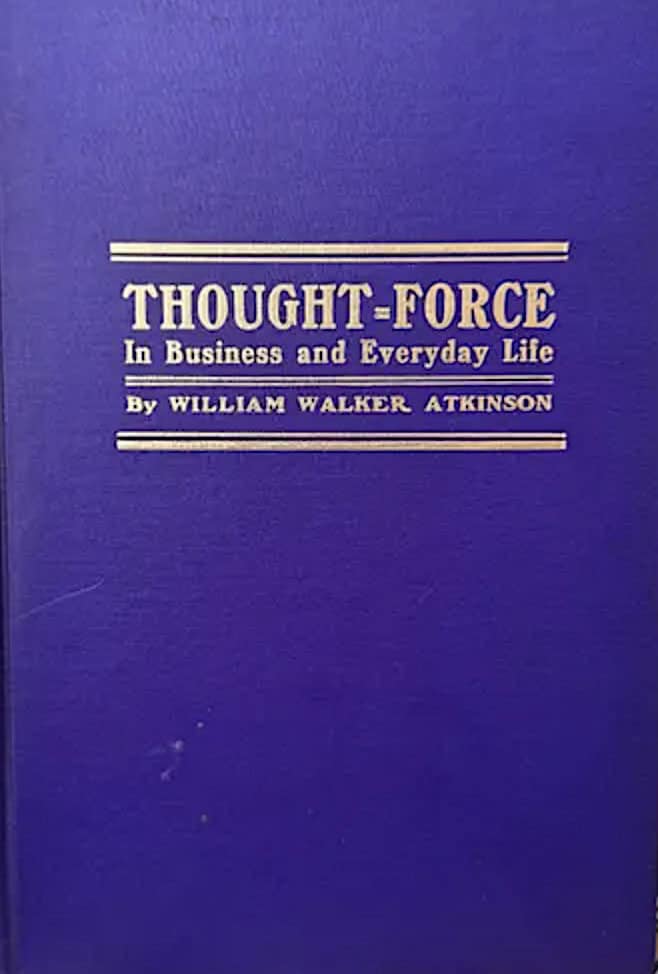
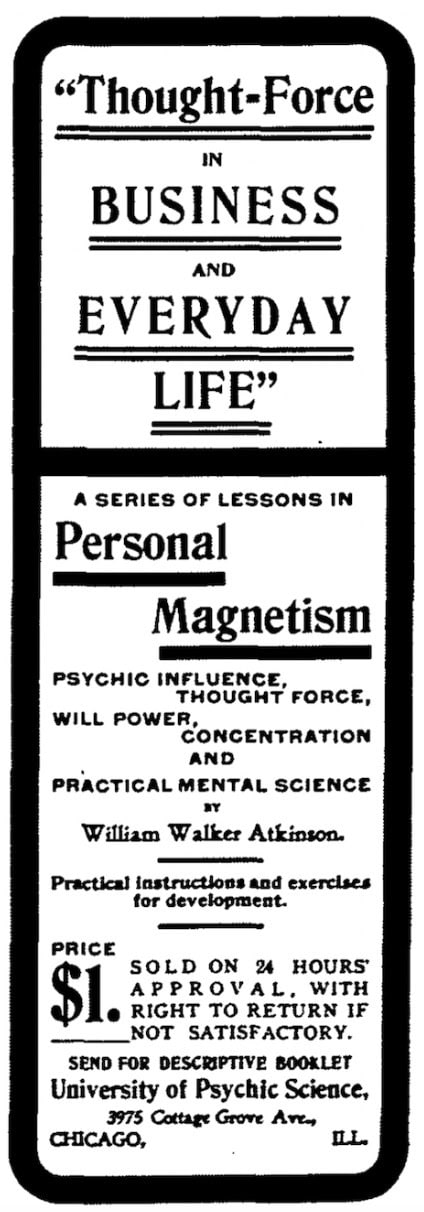
In early 1901, the University of Psychic Science, founded by Dr. Herbert A. Parkyn, released A Series of Lessons in Personal Magnetism, the first book published under the name of William Walker Atkinson. Parkyn would soon change the title of the book to its better-known title, Thought=Force in Business and Everyday Life.
The book did far more than introduce the Atkinson name. It was the work that put Atkinson on the map as an author and teacher of mental science, and its success continued long after the many books that followed. Thought=Force became the best-selling book published under his name during his lifetime, passing through well more than eighteen editions. Its importance therefore extends across the entire Atkinson literary career. The book that first established his public reputation was also his greatest lifetime publishing success, making it the essential starting point for determining exactly what the name William Walker Atkinson represented when it first appeared as the author of a complete system of mental instruction..

From Parkyn’s Student to Published Author in Four and a Half Months
The chronology is extraordinary. Atkinson had arrived in Chicago only months earlier after the physical, mental, professional, and financial collapse that ended his legal career in Pennsylvania. By his own later account, he knew nothing of New Thought before coming to Chicago and meeting Parkyn. He then took the two-week course at Parkyn’s Chicago School of Psychology. Yet by December 4, 1900, only about four and a half months after completing that brief course, the introductory material for A Series of Lessons in Personal Magnetism was finished and the work was ready for publication through Parkyn’s University of Psychic Science.
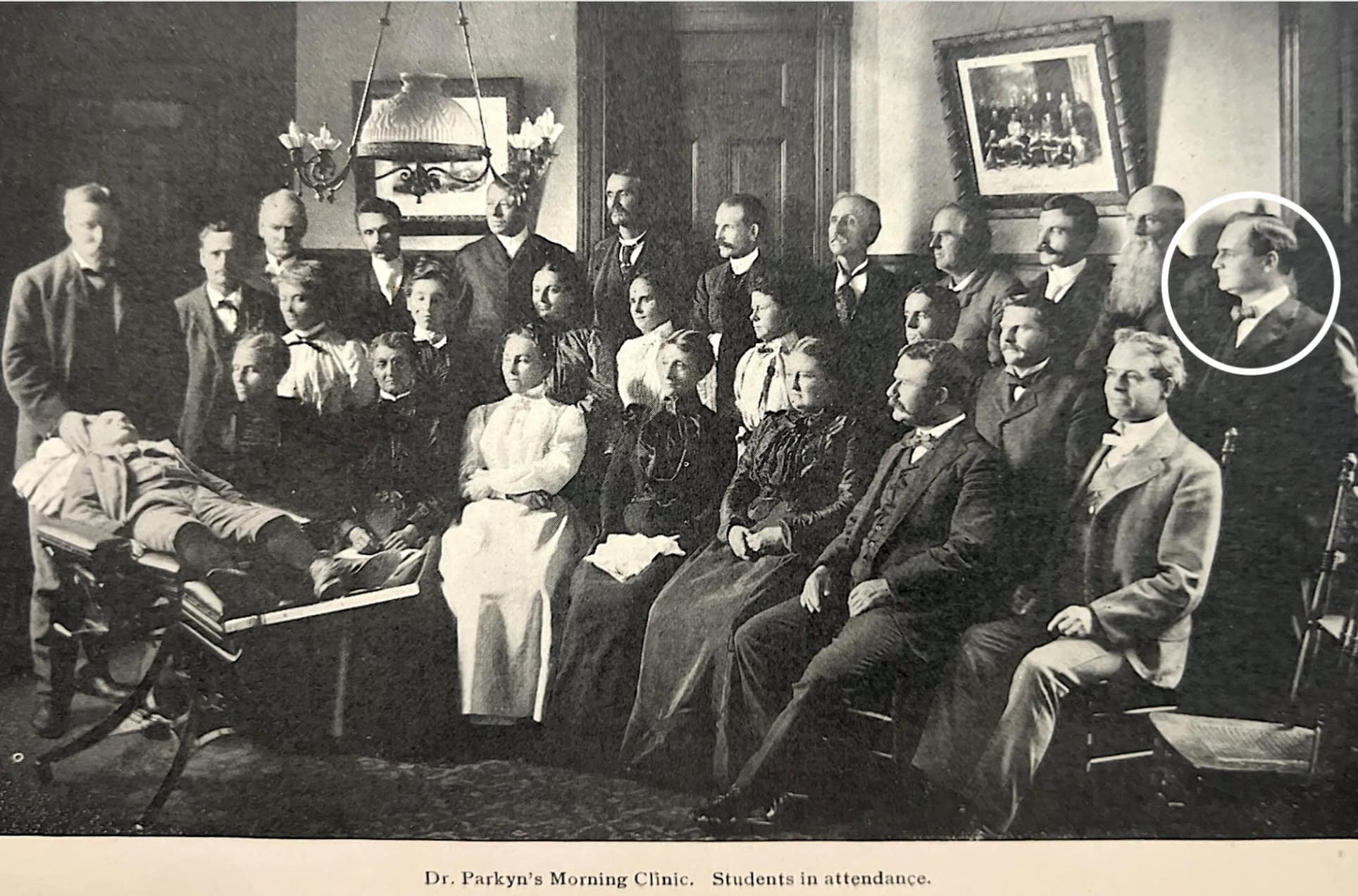
What appeared was not the work of a recent student describing what he had just begun to learn. Across fifteen organized lessons, the book speaks with the authority of an experienced instructor and presents a developed system of Suggestion, attention, concentration, willpower, personal influence, mental force, character, and success. Principles are defined and explained, their operation is demonstrated, exercises are prescribed, and the reader is instructed in how the system should be applied. Nothing in the book’s presentation suggests that the man whose name appeared on it had encountered this field for the first time only months before.
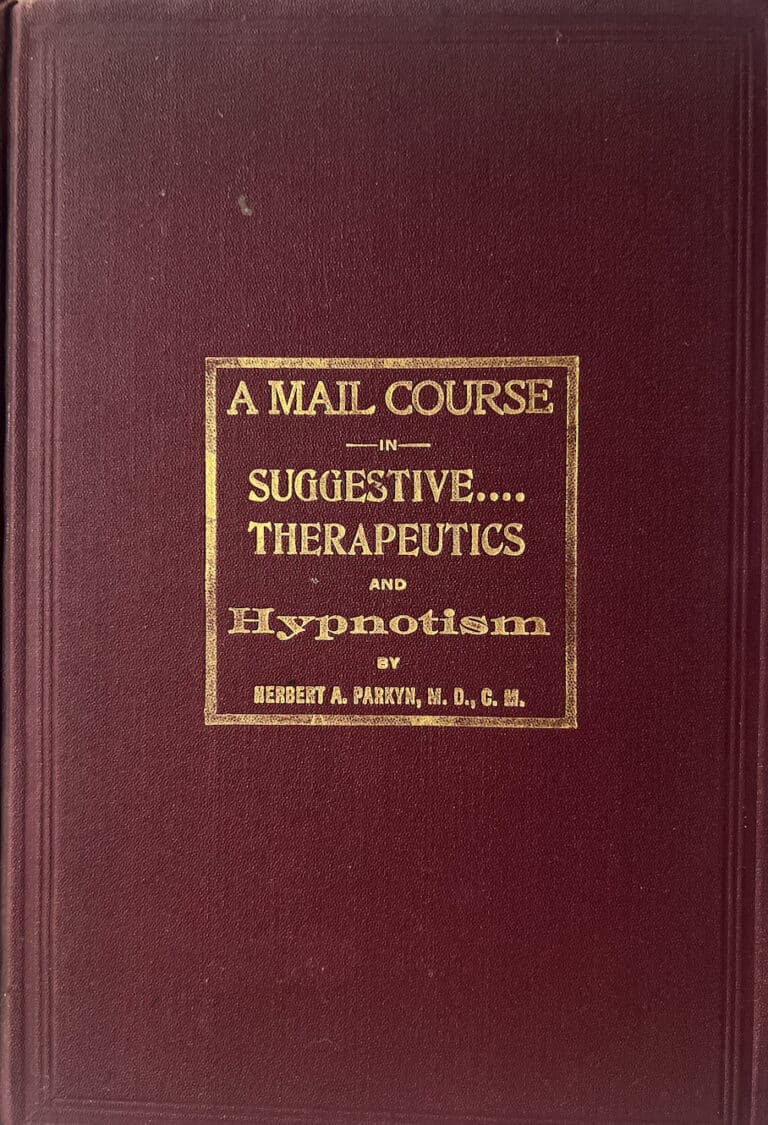
That chronological problem becomes much more important once the book is compared with what Parkyn had already published. Parkyn was not merely the man who introduced Atkinson to these subjects or operated the institution that issued his first book. Years before Atkinson arrived in Chicago, Parkyn had already developed a comprehensive system through his clinical work, classroom teaching, and Mail Course in Suggestive Therapeutics. The question raised by Thought=Force is therefore not how Atkinson could have independently mastered an entire field with extraordinary speed. It is whether the system suddenly appearing under his name was independent at all.
That question can be answered from the books themselves. When Thought=Force is placed beside Parkyn’s earlier Mail Course, the comparison reaches far beyond shared interests in mental power or Personal Magnetism. It allows the definitions, terminology, psychological structure, methods, characteristic expressions, illustrations, and specific instructions of the two works to be examined directly. It also makes possible a distinction that is essential throughout this investigation. The person who supplies the literary voice of a book is not necessarily the person who created the intellectual system being expressed through that voice.
This first book is therefore the proper place to begin reconsidering Atkinson’s authorship. If its intellectual foundation had already been developed and published by Parkyn before Atkinson entered the field, then Thought=Force does not document the sudden birth of an Atkinson system in 1900. It documents the point at which Parkyn’s established system began appearing in a new popular literary form under the Atkinson name. The comparison that follows determines which of those histories the primary texts actually support.
The System Behind the First Book Published Under the Atkinson Name
Parkyn’s System Was Already Fully Developed
By the time Atkinson reached Chicago, Parkyn had spent nearly a decade developing the material. Beginning with his clinical work in Toronto in 1892, continuing through more than a thousand demonstrations with Dr. W. X. Sudduth in Minneapolis, and followed by the founding of the Chicago School of Psychology in 1896, Parkyn had developed Suggestion into a systematic psychology of mental and bodily control.
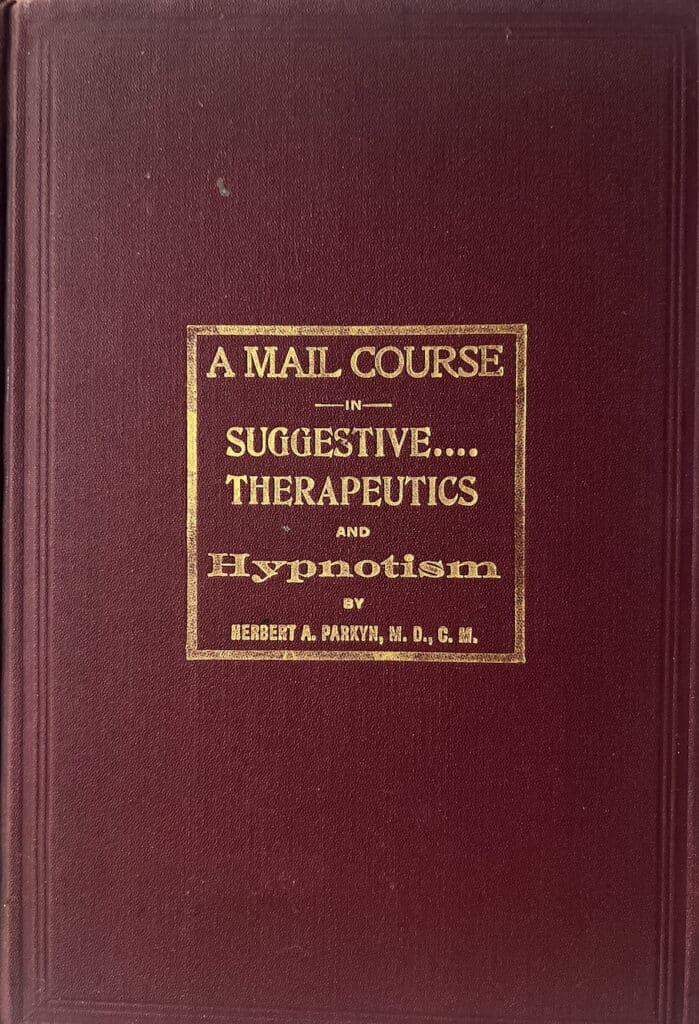
In 1898, he began issuing his forty-one-lesson Special Mail Course in Hypnotism and Suggestive Therapeutics, bringing years of clinical investigation and classroom instruction together in a comprehensive course. Its subjects included the voluntary and involuntary minds, the laws of Suggestion, attention, repetition, habit, Auto-Suggestion, bodily action, character development, personal influence, health, happiness, and success.
This was the intellectual environment Atkinson entered in July 1900. He did not arrive at the beginning of a new system that the two men would gradually develop together. He arrived at Parkyn’s school after Parkyn had already developed, taught, and published the system. Four and a half months later, a complete fifteen-lesson course carrying the Atkinson name was ready for publication by Parkyn’s own University.
That makes Parkyn’s earlier Mail Course the essential source against which the sudden appearance of A Series of Lessons in Personal Magnetism must be measured. The question is no longer how much a gifted student might have learned during four and a half months. The surviving texts allow the more important question to be answered directly. How much of the supposedly new Atkinson system was already Parkyn’s?
Atkinson Provided a New Literary Form for an Existing System
Research conducted for the YPS History Project indicates that the extraordinary speed with which the Atkinson literary identity appeared is best understood by separating literary presentation from intellectual creation. Parkyn’s professional work had required him to develop and present his system through medicine, psychology, and Suggestive Therapeutics. The Atkinson name provided a different literary voice through which the same body of instruction could be addressed directly to the ordinary reader.
Clinical and classroom material could now be converted into shorter popular lessons. Suggestion could be presented through personal influence. The cultivation of voluntary control could be expressed through willpower and self-mastery. Attention could be developed through concentration. The same psychological system could be applied directly to ambition, business, personality, financial advancement, and self-confidence.
The publication arrangement itself supports this distinction. A Series of Lessons in Personal Magnetism was not taken to an independent publisher after Atkinson supposedly developed a new system of his own. It was issued by Parkyn’s University of Psychic Science. Treating Atkinson as an entirely independent intellectual author therefore creates an obvious problem. Parkyn would have had to allow a man who had only recently completed his two-week course to take teachings Parkyn had spent years developing, reorganize them under his own name, and then have Parkyn’s own institution publish the result as the newcomer’s work.
The chronology and institutional setting point to a much simpler explanation. Parkyn supplied the developed system. Atkinson supplied the popular literary form through which that system could reach another audience.
Read the article: From Mental Breakdown to Atkinsonia: How Herbert A. Parkyn Turned William Walker Atkinson into a New Thought Phenomenon
Parkyn Had Already Laid the Foundation for a Separate Course in Personal Magnetism
There is another reason Parkyn’s 1898 Mail Course is central to the origin of A Series of Lessons in Personal Magnetism. Parkyn had already identified Personal Magnetism as a subject requiring further investigation and development. He explained that after beginning the Mail Course, he received numerous letters from students requesting more information about Personal Magnetism, prompting him to devote a separate lesson to the subject. The demand for expanded instruction was therefore already coming directly from Parkyn’s students in 1898, two years before an entire fifteen-lesson course devoted to Personal Magnetism appeared.

Parkyn used that lesson to establish the foundation. He explained that the force involved in Personal Magnetism was the same force operating through Suggestion and that both operated according to the same law of nature. From there, the larger problem concerned how this thought energy operated between individuals, how impressions were transmitted and received, and how that force could be consciously directed and employed. Parkyn had already begun developing these questions through personal appearance, facial expression, voice and manner, mental condition, adaptation to different personalities, control of thought, and the relationship between thought and action.
The two years between Parkyn’s 1898 Personal Magnetism lesson and A Series of Lessons in Personal Magnetism are therefore important. Parkyn had already established the psychological foundation and knew from the correspondence of his students that there was substantial demand for a more complete treatment of the subject. During the intervening period, his investigations continued, including the experimental work associated with the Psychic Research Company. By 1900, the subject Parkyn had introduced within the Mail Course was ready for the extended treatment his students had been requesting.
The result was an entire fifteen-lesson course on Personal Magnetism appearing from Parkyn’s own University only months after Atkinson completed his two-week training under Parkyn. The question of where that course obtained its intellectual content does not have to be answered through chronology alone. Parkyn’s 1898 Mail Course survives, as does the book published under the Atkinson name.
The Intellectual Property Behind Thought=Force
The central question raised by Thought=Force in Business and Everyday Life is not simply who supplied the final prose that appeared on its pages. There is a more important question. Who created the intellectual material from which the work was constructed, and who would have owned the intellectual property?
The comparison that follows is intended to determine whether Thought=Force presents an independently created body of instruction or whether its intellectual foundation had already been developed and published by Parkyn.
This distinction would have mattered directly to copyright and intellectual property ownership. Copyright gives the owner of a protected work the exclusive right to reproduce that work and to authorize the preparation of works derived from it. A secondary writer cannot take the protected material of an existing work, recast it into different language, and make the underlying material his own simply through rewriting. Copyright law expressly recognizes a work that has been “recast, transformed, or adapted” from a preexisting work as a derivative work, including works produced through editorial revisions, elaborations, and other modifications.
The important principle for this investigation is straightforward. Changing the literary presentation of preexisting material does not make the underlying material the intellectual creation or property of the person performing the rewrite. U.S. Copyright Office — Copyright Law, Chapter 1
This is why the intellectual origin of Thought=Force matters. If a secondary writer supplied colloquial language, anecdotes, transitions, humor, or a popular “man on the street” voice while retaining the distinctive definitions, terminology, metaphors, illustrations, instructional methods, and structural construction of an earlier published work, changing the surrounding prose would not make that underlying material the secondary writer’s creation. In fact, having a secondary writer rewrite scientific or complex material to “popularize” it for a mass audience and newsstand sales was, and remains, a common publishing practice. This type of writing may be classified as line editing, re-voicing, or ghostwriting. It is administrative and rhetorical labor, not intellectual authorship of the underlying material.
The legal significance of adaptation is precisely that a work does not cease to be derived from an earlier work simply because its presentation has been changed. 17 U.S.C. § 106 — Exclusive Rights in Copyrighted Works
This makes the comparison that follows much more than an exercise in finding literary similarities. The question is not simply whether Parkyn and Thought=Force both discuss Suggestion, habit, will, concentration, or Personal Magnetism. Subjects of that kind could be shared by many writers. The real test is whether Thought=Force preserves the identifying features of Parkyn’s earlier system. Does it reproduce his distinctive definitions? Does it retain the same relationships between the parts of his psychological system? Does it use the same terminology, phrases, metaphors, and illustrations to explain the same principles? Does it reproduce specific methods and instructions? When terminology is changed, does the underlying structure remain intact? When clinical and classroom material is converted into conversational prose, can the earlier work still be identified beneath the new literary presentation?
This also means that the comparison does not depend upon first deciding who physically composed every sentence of Thought=Force. The person responsible for preparing the final manuscript could have contributed style, conversational language, transitions, anecdotes, and other elements of presentation without having created the body of teaching being placed into that form. A writer can popularize existing material, paraphrase it, reorganize its presentation, or give it a different literary voice. That is a different question from who developed the definitions, methods, psychological framework, instructional structure, and other intellectual material being presented.
For this reason, it is not necessary at this stage to decide whether William Walker Atkinson personally composed every sentence of Thought=Force, nor is it necessary to prove that Parkyn personally dictated its final wording. Those questions only concern the literary execution and not the intellectual property that governs the actual ownership and copyright.
The Question Here is Intellectual Origin
The comparison that follows places Parkyn’s earlier Mail Course directly beside Thought=Force. Definitions are compared with definitions, terminology with terminology, methods with methods, metaphors and illustrations with their counterparts, and specific instructions with the corresponding instructions in the later work. The purpose is not to accumulate loose similarities. It is to determine whether the identifying substance of Parkyn’s earlier work remains present beneath the literary presentation of Thought=Force.
If the correspondences are merely general, they establish little. If they are distinctive, repeated, and extensive, the result is very different. They identify the earlier body of work from which the later material was drawn and allow the creation of the intellectual system to be separated from the literary work involved in presenting that system in another form. That is what the comparisons that follow are intended to determine. Before asking who supplied the final literary voice of Thought=Force, the primary texts themselves can establish who supplied the intellectual foundation beneath it.
Comparing A Series of Lessons in Personal Magnetism with Parkyn’s Mail Course
Placing A Series of Lessons in Personal Magnetism beside Herbert A. Parkyn’s 1898 Special Mail Course in Hypnotism and Suggestive Therapeutics reveals a continuous course of teaching. The Personal Magnetism work does not take Parkyn’s system and construct something new from it. It continues the same system, using the same psychology, laws, methods, and relationships between its principles.
This continuity can be followed in remarkable detail. Parkyn’s definition of Suggestion reappears directly. His voluntary and involuntary mental functions continue under the names Active and Passive. His laws governing Suggestion remain the mechanism through which mental influence operates. His teaching on attention develops directly into the lessons on concentration and willpower. His methods of repetition, habit formation, replacement of undesirable habits, and auto-suggestion continue to be used directly. His famous axiom “thought takes form in action” is used several times to address conduct, personality, and personal influence. These are not separate teachings borrowed from Parkyn and assembled into another system, but rather the interconnected parts of the exact same teaching, functioning together as they did in Parkyn’s earlier course.
Before examining those teachings one by one, however, there is a statement near the opening of A Series of Lessons in Personal Magnetism that must be confronted first.
The Impossible Statement About the Writer
Right at the beginning of A Series of Lessons in Personal Magnetism, we encounter a statement that is impossible to reconcile with William Walker Atkinson as the author. The book identifies its writer as an experienced investigator whose teachings are the product of years of personal research, experimentation with co-workers, and instruction of his own students:
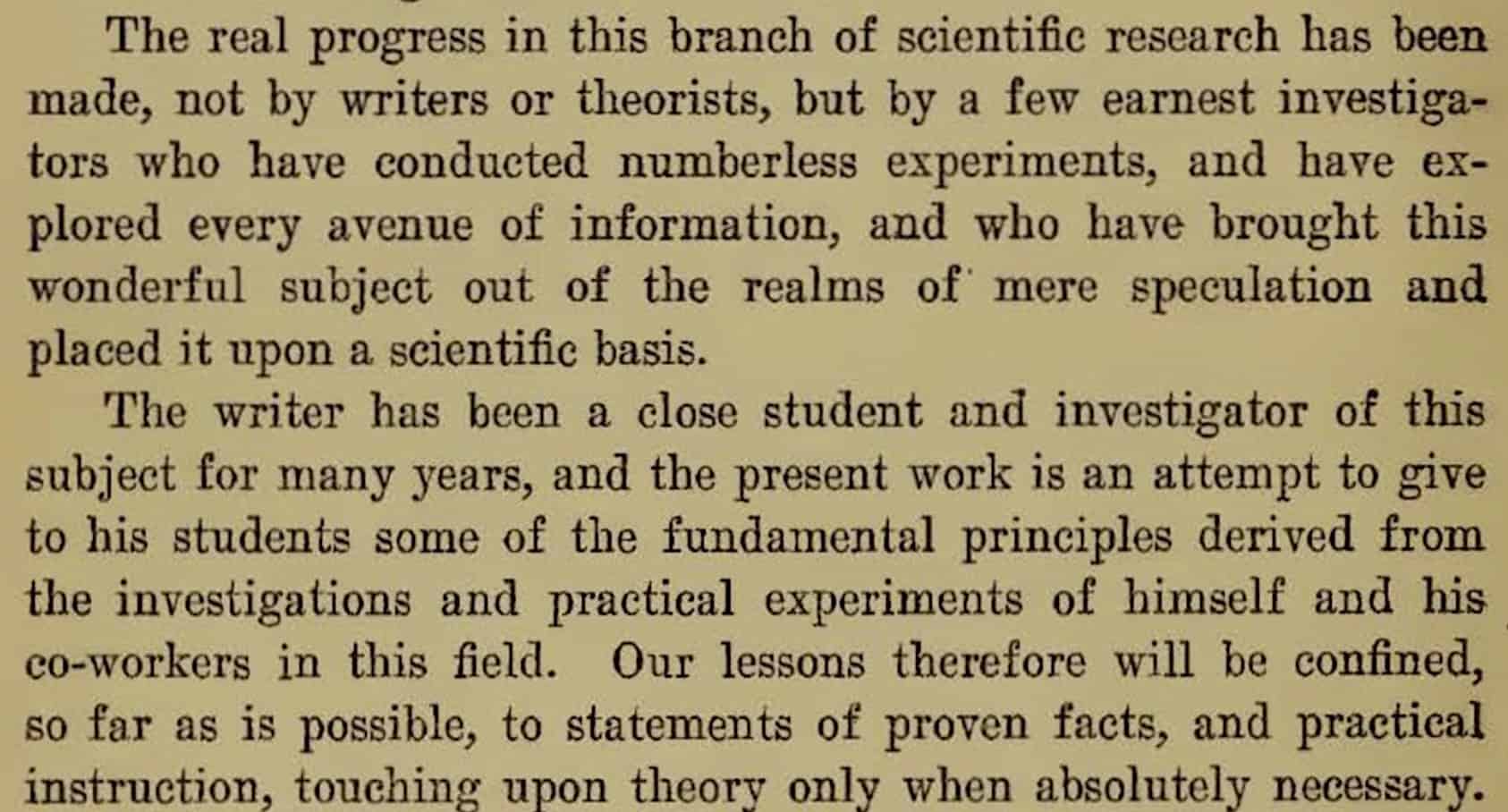
“The writer has been a close student and investigator of this subject for many years, and the present work is an attempt to give to his students some of the fundamental principles derived from the investigations and practical experiments of himself and his co-workers in this field.”
Every part of that statement identifies Herbert A. Parkyn. The writer has investigated the subject “for many years.” He has conducted “practical experiments.” Those experiments have involved “co-workers.” He already has “his students,” and the purpose of the present work is to give those students principles obtained from that accumulated research. These are not general claims of knowledge or expertise. They amount to a description of the professional and experimental history behind the course, and that history is Parkyn’s.
The claim to “many years” of investigation immediately rules out Atkinson. During the years required by that statement, Atkinson was pursuing his successful legal career in Pennsylvania. His activities as an attorney were extensively documented in contemporary newspapers, including reports of the cases in which he was involved. There is no missing period in his career that can accommodate the history claimed by the writer of this book. Atkinson had only recently arrived in Chicago and entered the field in which Parkyn had already been working. He could not have been the man who had been a “close student and investigator of this subject for many years.”
Parkyn had been conducting this research for years. Long before Atkinson arrived in Chicago, Parkyn had already accumulated years of investigation and experimentation in Suggestion, mental influence, and the operation of thought upon mind and body, and had been teaching the resulting system through the Chicago School of Psychology and his Special Mail Course in Hypnotism and Suggestive Therapeutics.
The reference to “his students” is even more revealing because it connects the statement directly to the history of Personal Magnetism established in the preceding section. The writer says that “the present work” has been prepared to give “his students” principles obtained from his investigations. Parkyn already had those students, and in 1898 they had been writing to him asking for more information on this exact subject. Parkyn recorded in the Mail Course that he had received so many letters from students requesting information about Personal Magnetism and Magnetic Healing that he had decided to devote instruction to them. The sequence is direct. Parkyn’s students ask him for further instruction in Personal Magnetism. He begins giving them that instruction in 1898 and continues investigating the subject. The full Personal Magnetism course then declares that its purpose is to give “his students” principles derived from the writer’s years of investigation and practical experiments.
The words “his co-workers” provide another direct identification. Parkyn had not conducted his investigations alone. Years before the Personal Magnetism course appeared, he had worked with Dr. W. X. Sudduth in Minneapolis, where Parkyn conducted more than a thousand clinical demonstrations while developing and testing his conclusions concerning Suggestion. His later work in Chicago placed him within another network of physicians, psychologists, lecturers, and investigators, while the experimental work surrounding the Psychic Research Company extended those investigations into mental influence and related psychic phenomena. When the writer refers to principles obtained through the investigations and practical experiments of “himself and his co-workers in this field,” he is describing the collaborative experimental environment in which Parkyn had actually worked. Atkinson had no such history. Parkyn did, and Sudduth provides a documented example of exactly the kind of co-worker the statement describes.
The statement becomes even more important when read with the paragraph immediately preceding it. The book first explains that real progress in Personal Magnetism had been made by investigators who had conducted “numberless experiments,” explored every avenue of information available to them, and brought the subject out of speculation and onto a scientific basis. The authority claimed for the course is experimental. The writer is telling the reader that what follows comes from years of actual investigation, not from recently acquired knowledge or the rearrangement of another man’s teachings.
That makes the attribution to Atkinson impossible on the book’s own terms, and the statement at the opening of the course identifies Parkyn before the comparison of the teachings has even begun.
The Same Definition of Suggestion
The comparison begins with the foundation of Parkyn’s entire system, his definition of Suggestion. In the 1898 Mail Course in Suggestive Therapeutics, Parkyn defined Suggestion in unusually broad terms:
“A suggestion may be said to be an impression, consciously or unconsciously received through any of our senses.” — Mail Course, Lesson I, p. 1.
For Parkyn, the thoughts, actions, surroundings, words, appearances, and conduct encountered by an individual continually supplied impressions that could influence the mind.
In Thought=Force, it gives the exact same definition:
“A suggestion is an impression, consciously or unconsciously received through any of our senses.” — Thought=Force, Lesson IV, p. 23.
This is not merely the same conception of Suggestion expressed in different language. It is Parkyn’s sentence. The only change is the removal of the introductory words “may be said to be.”
This definition matters because it determines what Suggestion means throughout everything that follows. Once Suggestion is understood as an impression received consciously or unconsciously through the senses, personal appearance can become Suggestion. Tone of voice can become Suggestion. Facial expression, manner, conduct, words, and actions can all become means through which one person impresses another. The definition Parkyn had already established supplies the mechanism needed to carry the Law of Suggestion directly into Personal Magnetism.
Parkyn’s Mind Division into Voluntary and Involuntary Functions Becomes the Active and Passive
Parkyn divided mental activity into the voluntary and involuntary functions of the mind. In Thought=Force these were changed to the active and passive functions to align the teaching with the subject of personal magnetism.
In Parkyn’s Mail Course in Suggestive Therapeutics, it repeatedly mentions these two functions. Here are a couple of examples:
“With the voluntary mind active he is in a position to cope with the necessities of the battles of life, and in a great measure control the involuntary mind.” — Mail Course, Lesson II, p. 17.
He makes the relationship still clearer:
“The more the reason is developed, the greater is the control of the voluntary mind over the involuntary.” — Mail Course, Lesson II, p. 18.
In Thought=Force, these become the “Active Function” and “Passive Function”:
“The Active function does the voluntary, volitional thinking, and also manifests what we call will power.” — Thought=Force, Lesson IV, p. 24.
“The Passive function does the instinctive, automatic, involuntary thinking, exhibiting no ‘will power’ and manifesting on entirely contrary lines from the Active function.” — Thought=Force, Lesson IV, p. 24.
The change in terminology is shown within the text. The Voluntary becomes the Active Function, while the Involuntary becomes the Passive Function. Significantly, Thought=Force explicitly includes “Voluntary and Involuntary” as descriptions of the two mental functions, the very terms Parkyn had established for this division of the mind in his Mail Course.
The reason for changing the names was to connect the psychology directly with the subject of Personal Magnetism. Active and Passive correspond to the two poles of magnetic action. The active pole directs force, while the passive pole receives and responds to it. Parkyn’s voluntary function already supplied will, direction, and control, while his involuntary function supplied the receptive and suggestible side. Renaming them Active and Passive allowed the same mental functions to explain the active and receptive relationship at the center of Personal Magnetism without changing the underlying psychology.
Another identifying feature is that Parkyn’s Voluntary and Involuntary functions were his own development. While the dual-mind theory had been widely popularized by Thomson Jay Hudson, a close associate of Dr. Parkyn, Hudson’s teaching described an objective mind and a subjective mind as two distinct mental agencies. This would become closely associated with the conscious and subconscious minds. But Parkyn’s teaching had a significant difference, as his voluntary and involuntary divisions were not two separate minds, but two modes through which a single mind operated. Thought=Force retains exactly that specific Parkyn distinction, with Active and Passive likewise presented as two functions of one mind and not as two minds.
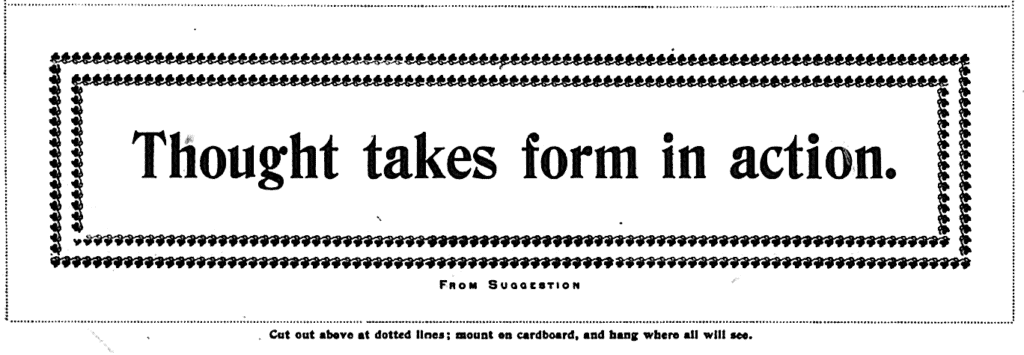
“Thoughts Take Form in Action”
One of the clearest identifying expressions carried from Parkyn’s Mail Course into Thought=Force is his teaching that thought expresses itself through action. Parkyn does not use the phrase casually or only once. It appears repeatedly as a principle connecting mental activity with bodily movement, conduct, and the outward expression of character.
In Lesson II of the Mail Course, Parkyn writes:
“All thoughts tend to take form in action.” — Mail Course, Lesson II, p. 18.
Parkyn returns to the principle in Lesson VI:
“Thought tends to take form in action.” — Mail Course, Lesson VI, p. 40.
And in Lesson XXXIV, Parkyn gives the teaching in its concise form:
“Thoughts take form in action.” — Mail Course, p. 273.
Thought=Force uses the same distinctive formulation:
“Thoughts take form in Action.” — Thought=Force, Lesson II, p. 15.
The importance of the correspondence goes beyond the identical phrase. Thought=Force uses the principle in the same way Parkyn had already been using it, as the link between an internal state of mind and its external physical expression. A thought does not remain confined within the mind. It tends to produce the bodily attitude, movement, conduct, and appearance corresponding to it.
Thought=Force demonstrates this with an incident from the writer’s own classroom. While speaking to his students about the mental attitude expressed by “I Can and I Will,” he observes the physical change produced in them. Their shoulders move back, their heads rise, their breathing deepens, and they look directly ahead. Thought=Force explains what has occurred:
“It was ‘thought manifesting itself in action.’” — Thought=Force, Lesson II, p. 16.
Parkyn had also carried this principle directly into Personal Magnetism. In Lesson XXXIV of the Mail Course, he states the complete relationship:
“Our thoughts take form in action, and our actions take form in the thoughts of others.” — Mail Course, p. 273.
The second half is important. Parkyn is describing a continuous movement from the internal thought of one person, to its outward expression in action, and then to the thought or impression created in another person. Even when someone attempts to conceal a mental attitude, Parkyn explains that it eventually reveals itself through expression or action and is perceived by others.
Thought=Force applies this same process directly to Personal Magnetism. In Lesson V, the student is instructed to hold a particular thought toward the person he wishes to influence and deliberately express it through his conduct:
“Cultivate the thought that you like the man with whom you are talking, and make the thought take form in action. Assume an open, frank, honest, manly manner.” — Thought=Force, p. 31.
The sequence is the one Parkyn had already established. The thought first takes form in the student’s own action, and that action then becomes an impression in the mind of the other person. Thought=Force thus preserves not only Parkyn’s distinctive phrase “Thoughts take form in action,” but the complete Personal Magnetism mechanism attached to it. This makes “Thoughts take form in Action” much more than an identical phrase appearing in both works. The phrase carries with it the same underlying law and the same movement from thought to physical expression and from physical expression to influence upon another mind.
Repetition Gives Suggestion Its Force
Repetition is one of the principal means by which Parkyn explains the increasing power of Suggestion. An impression that might initially have little effect can acquire strength through repeated presentation until it becomes established in the mind.
In the Mail Course, Parkyn states:
“The oftener the suggestion is repeated, the more deeply rooted it becomes in the mind of the recipient.” — Mail Course, Lesson V, p. 30.
Thought=Force gives the exact same principle:
“Suggestions gain force by repetition.” — Thought=Force, Lesson IV, p. 27.
Thought=Force also explains the process in the same way. A proposition may be rejected when it is first presented, yet repeated exposure can gradually overcome that resistance until the idea is accepted. The suggestion gains power not because its content has changed, but because the same impression has been repeatedly presented to the mind.
Parkyn’s explanation follows the same mechanism. A suggestion does not have to be accepted when first presented in order to become effective. Each repetition renews and strengthens the impression, allowing it to become more firmly established in the receptive mental function. Repetition can in this way give increasing force to an idea that initially produced little or no response.
Habit and the Line of Least Resistance
Parkyn devotes Lesson XXII of his Mail Course to the formation of habit through repetition and the establishment of paths that become progressively easier to follow. The lesson itself identifies one of its principal subjects as:
“The line of least resistance in the formation of habits.” — Mail Course, Lesson XXII, p. 157.
Parkyn then explains the principle through the formation of a river channel:
“Watch the workings of a river in forming its channel and it will be seen that it invariably takes the course which offers the least resistance, if left to itself.” — Mail Course, Lesson XXII, p. 158.
He applies the same law directly to the formation of mental and physical habits:
“Similarly, in man, thought impulses, if uninterrupted, will form paths in the brain and nerves and become habitual in expression in outward actions.” — Mail Course, Lesson XXII, p. 158.
Parkyn’s explanation draws upon the work of French psychologist Léon Dumont, whose 1876 De l’habitude used flowing water and the formation of channels to explain how repetition establishes increasingly easy pathways for subsequent activity. The illustration became well known through William James, who cited Dumont in his 1890 treatment of habit in The Principles of Psychology. Parkyn incorporated this model into his own psychology of habit, integrating repetition, the line of least resistance, established neural pathways, and automatic action into a single explanation.
Thought=Force uses the same terminology to explain the same process:
“We consequently move along the lines of the least resistance.” — Thought=Force, Lesson XII, p. 74.
It then describes habitual thought as traveling over “well worn mental paths.”
“We follow well worn mental paths, in preference to making new paths through the woods…” — Thought=Force, p. 74.
The established path is easier to follow, while departing from it requires the effort of making a new path. Once the new path has been traveled repeatedly, it too becomes easier to follow.
This is a much more specific comparison than the general observation that both works discuss habit. Parkyn’s Mail Course explicitly teaches “the line of least resistance in the formation of habits” and explains it by describing how thought impulses form paths in the brain and nerves. Thought=Force explains habit through “the lines of least resistance” and “well-worn mental paths.” The terminology, mechanism, and their relationship are the same.
An Old Habit Must Be Replaced by a New One
Parkyn does not teach that an established habit can simply be removed and leave nothing in its place. His method requires the deliberate formation of a new habit to replace the unwanted one. In Lesson XXII of the Mail Course, while explaining habits of motion, Parkyn states:
“To remove an undesirable habit… another habit must be formed to take its place.” — Mail Course, Lesson XXII, p. 159.
Thought=Force applies the same method directly to habits of thought:
“drop the old thought-habit and adopt the new in its place.” — Thought=Force, Lesson XII, p. 75.
The established habit is displaced by deliberately creating another habit to occupy its place. Thought=Force continues its instruction by describing this as “breaking up old thought habits” through the formation of new habits of thinking.
Light Replaces Darkness
Parkyn used a distinctive illustration in the Mail Course to explain what happens when a new thought is introduced into the mind. There is no need to fight the old thought or concern oneself with removing it. Just as sunlight entering a darkened room causes the darkness to disappear, the new thought takes the place of the old.
In the Mail Course, Parkyn writes:
“Why should we care what becomes of the darkness when the sunlight enters a room? I wished her to think sunny thoughts, knowing if I could get them into her mind they would soon replace the old ones.” — Mail Course, p. 166.
Thought=Force teaches the same principle through the same illustration:
“You must remember that when we wish to brighten a room, we do not have to drive out the darkness first; we merely open the blinds and admit the light, and lo, the darkness has departed.” — Thought=Force, p. 81.
In both works, the lesson is illustrated by the same darkened room. The darkness is not driven out. Light is introduced and the darkness disappears. Parkyn describes the new thoughts as “sunny thoughts” that “replace the old ones,” while Thought=Force describes opening the blinds and admitting the light so that “the darkness has departed.”
“I Can and I Will”
Parkyn teaches that Suggestion should state the condition that is actually desired instead of continually presenting the mind with the negative condition. In the Mail Course, he gives the rule directly:
“It is better not to give negative suggestions, such as, ‘You will not, or cannot do this, that or the other thing,’ etc. Pointing out what is not desirable does not suffice. In place of such suggestions, tell what you really wish your patient to do.” — Mail Course, pp. 41–42.
Parkyn then concludes the explanation:
“Just so it is with therapeutic suggestions, keep suggesting the conditions of mind or body you wish to bring about.” — Mail Course, p. 42.
The same rule is announced in the preface to Thought=Force as one of the purposes of the course:
“removing Fear thought from the minds of men; of replacing ‘I CAN’T,’ with ‘I CAN and I WILL.’” — Thought=Force, Preface.
Then in Lesson II, Thought=Force puts the rule directly into practice:
“The man who thinks ‘I can and I will,’ ‘gets there,’ while the ‘I can’t’ man ‘gets left.’” — Thought=Force, p. 15.
Parkyn’s instruction is to stop presenting the mind with “cannot” and “will not” and substitute the condition that is actually desired. Thought=Force announces that same method in its preface and then applies it directly by changing “I Can’t” into “I Can” and “I WILL.”
Auto-Suggestion from the Directing Mind to the Receptive Mind
Parkyn defines voluntary auto-suggestion as a deliberate communication from the voluntary mind to the involuntary mind. In the Mail Course, he writes:
“A voluntary auto-suggestion is an assertion which one endeavors with his voluntary mind to impress upon his own involuntary mind.” — Mail Course, p. 44.
Parkyn then explains what happens when the assertion is repeated:
“When the voluntary mind has gone over and over a suggestion which at first seemed absurd, but which it is anxious to believe, the involuntary mind being unable to reason on the premises logically, accepts it as truth, and our thoughts, actions, or functions are influenced accordingly.” — Mail Course, p. 46.
Thought=Force gives the same process using the Active and Passive functions:
“In auto-suggestion you simply keep on repeating to the Passive mind the statement that the new habit exists (ignoring the old one), and the Passive mind, although inclined to be a little rebellious at first, will eventually accept what you say as truth.” — Thought=Force, p. 76.
It then identifies exactly which part of the mind is giving the suggestion:
“Auto-suggestion is practically self-hypnosis of the Passive mind by the Active mind. It is a case of ‘every man his own hypnotist.’” — Thought=Force, p. 76.
Voluntary Attention Is the Development of Willpower
Parkyn makes the control of attention the basis of willpower. He distinguishes natural attention, which follows whatever happens to attract it, from voluntary attention, which requires an effort of will to hold the mind upon something. In the Mail Course, he states:
“Development of voluntary attention is the development of the will.” — Mail Course, p. 24.
On the following page, Parkyn explains what voluntary attention requires:
“Thus we find two kinds of attention in man—the natural or inquisitive attention, which is focused without effort, and is a condition of consciousness, and the voluntary or cultivated attention, to focus which an effort of the will is necessary.” — Mail Course, p. 25.
He then states the relationship directly:
“It is the development of this ability to control the attention or inclinations which constitutes will-power.” — Mail Course, p. 25.
Thought=Force carries the same teaching into its lessons on “Concentrating.” The student is deliberately given exercises that are “tedious and monotonous” and instructed to persist with them:
“These exercises are more or less tedious and monotonous, but should be persisted in until perfected. You will be repaid for your work by the conscious increase in your powers of concentering, which will be apparent from the first.” — Thought=Force, p. 87.
The method is the same. Parkyn defines voluntary attention by the effort required to hold attention where the natural inclination would allow it to wander, and identifies the development of that control as the development of willpower. Thought=Force turns the same principle into concentration exercises, deliberately making them tedious and monotonous so that the student develops the power to hold attention through voluntary effort.
Concentrated Attention Shuts Out Competing Impressions
Parkyn teaches that Suggestion gains its greatest force when attention is concentrated upon the suggestion and competing impressions are shut out. In the Mail Course, he defines the condition directly:
“By the SUGGESTIVE CONDITION we mean a state in which a suggestion has an exaggerated effect. It is really a condition of concentrated attention.” — Mail Course, Lesson V.
He then explains exactly how he produces it:
“Now this state of concentration of the attention is the precise condition we seek to induce in the minds of our patients before commencing to give them therapeutic suggestions. The great majority of therapeutic suggestions are given through the sense of hearing; so in nearly every instance we endeavor to shut out all impressions likely to be received through the other senses, and leave the patient with his whole attention concentrated on every syllable spoken by the operator.” — Mail Course, Lesson V.
Thought=Force gives the same procedure when describing Hypnotic Suggestion:
“You will next try the effect of Hypnotic Suggestion, and will employ a good suggestionist who will place you in an easy position; cause you to relax every muscle; quiet every nerve and assume a state of mental calm; and who, having secured your undivided, concentrated attention, will give you strong, repeated suggestions of Fearlessness, Courage, Hopefulness, Confidence, etc.” — Thought=Force, p. 78.
The same method also appears in Thought=Force when the student performs the exercise alone:
“Find a secure, quiet place, as far as possible removed from the scenes and sounds of the outside world…. The idea is to shut out the distracting impressions, and enable you to be alone with yourself.”
“Concentrate your whole attention inwardly upon yourself, shutting out all outside impressions.” — Thought=Force, p. 80.
Parkyn’s method is to concentrate the attention and shut out impressions arriving through competing senses so that the suggestion receives the subject’s whole attention. Thought=Force gives the same procedure through “undivided, concentrated attention,” followed by the deliberate shutting out of “distracting impressions” and “all outside impressions.”
Worry Wastes Vital Force
Parkyn treats vital force as an expendable supply of energy that can be depleted by excessive mental and physical activity. In the Mail Course, he describes a person as being:
“not conscious of the constant dwindling away of his vital force; the loss of which means the loss of life itself.” He then specifically identifies “overwork, worry, grief, etc.” among the causes that produce this exhaustion, and describes the resulting condition as one in which the person’s “vital force” becomes “exhausted.” — Mail Course, Lesson XX, p. 139
Thought=Force uses the same term and connects it directly with worry:
“The energy and vital force wasted on Worry would, if properly applied, be sufficient to enable us to surmount the real obstacles when they appear.” — Thought=Force, p. 77.
Both works treat “vital force” as an expendable supply of personal energy, and both specifically identify worry as something that depletes it. Parkyn describes vital force dwindling and becoming exhausted through causes including “worry,” while Thought=Force speaks directly of “vital force wasted on Worry.”
The Same Brain-Cell Theory of Thought
Parkyn explains thought in physiological terms, teaching that particular thoughts depend upon the activity of particular groups of brain cells. In the Mail Course, he writes:
“Every thought or impression which enters the mind stimulates a certain group of brain cells into activity.” — Mail Course, Lesson VI, p. 40.
Parkyn uses this cellular model again in his explanation of thought habits. Repeatedly thinking along the same line repeatedly stimulates the same group of cells until that mode of thought becomes established:
“Every time a thought is repeated the same group of brain cells is stimulated.” — Mail Course, Lesson XXII, p. 163.
Thought=Force gives the same explanation of thought:
“Every thought calls into activity certain sets of brain cells.” — Thought=Force, p. 87.
It then explains that changing the subject of thought changes the group of cells being used:
“When you turn your attention to another subject, the cells which have been active are given a rest, and another set of cells are called into activity.” — Thought=Force, pp. 87–88.
The wording is strikingly close. Parkyn writes that every thought “stimulates a certain group of brain cells into activity.” Thought=Force says that every thought “calls into activity certain sets of brain cells.” Both then explain continued or redirected thought through the continued activity of one cellular group or the activation of another. The same brain-cell model is being used to explain how thought operates.
Suggestion Before Sleep and Mental Activity During Sleep
Parkyn teaches that the involuntary mind continues its activity during sleep after the voluntary mind has ceased its conscious work. He illustrates this with the familiar experience of determining before sleep that one will awaken at a particular time:
“We may decide on retiring at night that we wish to awaken at a certain hour in the morning, and although the voluntary mind becomes inactive during sleep, the involuntary mind remains on guard and awakens us at the desired time.” — Mail Course, p. 14.
Thought=Force uses the same condition of sleep as a time for impressing the receptive mental function. After instructing the student in Auto-Suggestion, it states:
“When you retire at night, repeat the words several times, and let the thought sink deeply into your mind. The impression carried into sleep will remain with you, and will continue its work while you slumber.” — Thought=Force, p. 81.
Parkyn’s explanation establishes that the voluntary mind becomes inactive during sleep while the involuntary mind continues its work. Thought=Force applies the same principle through the renamed Active and Passive functions, instructing the student to make the desired impression immediately before sleep so that it will “continue its work while you slumber.”
Mentally Lazy People Prefer to be Directed
Parkyn teaches that people who fail to develop voluntary mental control become dependent upon direction from others. In the Mail Course, he describes this condition as one in which the involuntary mental functions predominate while voluntary attention and reasoning remain poorly developed:
“Such people are mentally lazy, and prefer to be directed rather than to direct themselves.” — Mail Course, p. 17.
Thought=Force describes the same type of person through the renamed Passive Function:
“Some people never do any original thinking, but are content to accept the thoughts and opinions of others. They are too mentally lazy to do their own thinking, and prefer the ready-made thoughts of others.” — Thought=Force, p. 25.
It then connects this condition directly with suggestibility:
“They are very credulous and consequently easily influenced and suggestible.” — Thought=Force, p. 25.
Thought=Force characterizes these people as the “human sheep” who follow the direction supplied by stronger minds.
The description is the same. Parkyn identifies “mentally lazy” people who “prefer to be directed rather than to direct themselves.” Thought=Force again describes them as “mentally lazy,” dependent upon the thoughts of others, and easily influenced and suggestible.
Personal Magnetism Through Appearance, Voice, Manner, and the Eye
Parkyn teaches that Personal Magnetism operates through the impressions created by a person’s appearance, facial expression, manner, voice, and other qualities perceived through the senses. In the Mail Course, he writes:
“Every individual with whom we come in contact receives certain impressions from us and from these impressions he draws his conclusions of our personalities.” — Mail Course, p. 271.
Parkyn’s Lesson XXXIV on Personal Magnetism specifically identifies the outward qualities through which these impressions are made:
“A handsome appearance assists”
“A soothing quality of voice”
“Facial expression”
“Affable manners” — Mail Course, Lesson XXXIV, p. 270.
Thought=Force brings the same elements together in its explanation of direct personal influence:
“By direct suggestion through the voice, manner, appearance and eye. This includes not only voluntary suggestions on our part, but also the suggestions made involuntarily by every earnest man.” — Thought=Force, p. 23.
It returns to the same list when explaining how one person influences another:
“He is influenced, to some extent, by the conversation, appearance, manner, voice, eye, etc.” — Thought=Force, p. 29.
Parkyn’s Personal Magnetism lesson gives appearance, facial expression, manner, and voice as means through which impressions are made upon another person. Thought=Force gives the same group as “appearance, manner, voice, eye” and identifies them as the means of direct personal influence.
The Modulated Voice as a Means of Personal Influence
Parkyn gives specific instructions for using the voice as part of Personal Magnetism. The student is not simply told to speak pleasantly. He is taught to control the modulation and pitch of his voice according to the person with whom he is speaking:
“The sense of hearing must be catered to also; and to do this one should modulate his voice to suit other people. When two persons quarrel, they raise their voices till a discord is produced. A high pitched voice, for instance, is unbearable to some and this should be avoided. The best plan is to pitch the voice to the tone used by those with whom we may be conversing.” — Mail Course, Lesson XXXIV.
Thought=Force gives almost the same instruction:
“Cultivate an agreeable tone of voice, avoiding a mumbling utterance on the one hand, and a loud boisterous tone on the other. An excellent rule is to pitch the voice to the tone of the party with whom you are conversing, providing always that you do not shout in order to keep pace with the other person.” — Thought=Force, p. 31.
It continues the lesson by explaining what to do when the other person raises his voice:
“If the other man shouts, keep your own voice even and subdued, and he will soon drop to your pitch.” — Thought=Force, p. 31.
The instruction continues onto the following page:
“There is much in the voice. A flexible, well modulated voice is most pleasing, and wins many victories for its fortunate possessor.” — Thought=Force, p. 82.
The comparison is unusually close. Parkyn says to “modulate his voice to suit other people,” warns against the high-pitched voice produced in a quarrel, and instructs the student to “pitch the voice to the tone” of the other person. Thought=Force likewise tells the student to cultivate an agreeable voice, avoid loudness, and gives the rule to “pitch the voice to the tone” of the person with whom he is speaking.
The Firm Handshake as Part of Personal Magnetism
Parkyn includes the handshake among the specific means by which Personal Magnetism makes a favorable impression upon another person. In the Mail Course, he writes:
“A good circulation insures nice warm hands and this condition accompanied by a hearty grip when shaking hands means that the sense of touch will be pleased.” — Mail Course, p. 272.
Thought=Force gives the same instruction as part of its lesson on influencing others:
“Cultivate a firm, honest, manly handshake. Nobody likes to have thrust upon him a flabby, limp hand. You don’t yourself. Do not forget this. If you have not the proper handshake, start to work and get it at once.” — Thought=Force, p. 31.
Parkyn tells the student that warm hands and a “hearty grip” in shaking hands contribute to Personal Magnetism through the sense of touch. Thought=Force turns the same point into a direct instruction to cultivate a “firm” handshake and again describes it as a “hearty handshake.”
Personal Appearance and Dress as Part of Personal Magnetism
Parkyn teaches that dress and personal appearance are part of Personal Magnetism because they contribute directly to the impression made upon another person. In the Mail Course, he writes:
“In satisfying or pleasing the senses of those we wish to impress, a number of things should be considered. First, in regard to the personal appearance. One should avoid wearing clothes which are likely to attract special attention. The clothing should be simple, neat and well kept.” — Mail Course, Lesson XXVII.
Thought=Force gives almost the same instruction:
“As to appearance, I would advise you to avoid the two extremes of flashiness and dowdiness, respectively. Keep in the middle of the road. You should particularly avoid clothing calculated to attract special attention, either by its extreme style or the reverse. The apparel should be simple, neat and clean.” — Thought=Force, p. 30.
Parkyn also makes personal cleanliness part of the same instruction:
“The sense of smell of those we would impress should never be offended. For this reason personal hygiene should be carefully attended to and all perfumery should be dispensed with, for while some might like a certain perfume, it might be very obnoxious to others.” — Mail Course, Lesson XXVII.
Thought=Force follows with the same points:
“Always wear clean linen. These things count. Eschew the use of strong perfumes. To most men strong perfumes are an abomination. It is scarcely necessary to add that personal cleanliness is an important prerequisite for obtaining a favorable hearing with the majority of Active partners.” — Thought=Force, p. 30.
The instructions are extremely close. Parkyn says to avoid clothing that attracts special attention and that clothing should be “simple, neat and well kept.” Thought=Force says to avoid clothing calculated to attract special attention and that apparel should be “simple, neat and clean.” Parkyn then instructs the student to attend to personal hygiene and avoid perfume because it may offend others. Thought=Force likewise emphasizes cleanliness and tells the student to avoid strong perfumes.
Adapting Yourself to the Person You Wish to Influence
Parkyn teaches that Personal Magnetism requires understanding the individual and adapting one’s manner to that person’s particular nature. In the Mail Course, he writes:
“One must learn to adapt himself to different individualities, but this only comes with practice.” — Mail Course, p. 273.
He makes this ability part of his definition of Personal Magnetism itself:
“It is also the power to recognize in a subtle and intelligent way the mental status of acquaintances, and the ability to adapt ourselves to them without friction.” — Mail Course, p. 273.
Thought=Force gives the same instruction when teaching the student how to influence another person:
“This Active partner is a ‘particular’ old fellow, and needs considerable humoring, and careful handling. He is influenced, to some extent, by the conversation, appearance, manner, voice, eye, etc., and each Active partner has his own tastes and peculiarities, although there are some things which they all have in common.” — Thought=Force, p. 29.
It then tells the student to discover the interests of the particular person and adapt the conversation accordingly:
“As to conversation, we should if possible ascertain what interests the old fellow. If you please him in this respect he is apt to lose sight of his duties as guardian of his easy brother. You should therefore learn to talk to him about things in which he is interested.” — Thought=Force, p. 29.
Parkyn’s rule is to recognize the other person’s “mental status” and “adapt ourselves to them without friction.” Thought=Force gives the same individualized method. Each person has his own “tastes and peculiarities,” so the student must determine what interests him and adjust the approach to suit the individual.
Avoiding Opposition and Friction
Parkyn teaches that Personal Magnetism depends upon dealing with another person without creating opposition. In the Mail Course, he includes this directly in his description of the magnetic person:
“It is also the power to recognize in a subtle and intelligent way the mental status of acquaintances, and the ability to adapt ourselves to them without friction.” — Mail Course, p. 273.
Thought=Force explains why the same avoidance of friction is necessary. When attempting to influence another person, the student is warned against awakening the resistance of the Active Function:
“Do not arouse his suspicions by letting him see that you are trying to influence his Passive partner, for he will at once interfere and make trouble.” — Thought=Force, p. 29.
The instruction follows the same principle. Parkyn tells the student to understand the other person’s mental condition and adapt to it “without friction.” Thought=Force warns against approaching the person in a way that arouses suspicion and resistance, because the directing function of his mind will “interfere and make trouble.”
Reduced Activity of the Directing Mind Increases Suggestibility
Parkyn teaches that a person becomes more receptive to Suggestion when the activity of the voluntary mind is reduced. In the Mail Course, he explains that when voluntary mental activity is lessened, the involuntary mind becomes correspondingly more accessible to impressions:
“The less active the voluntary mind becomes, the more susceptible the involuntary mind is to suggestion.” — Mail Course, Lesson V, p. 30.
Thought=Force preserves the same mechanism through the renamed Active and Passive Functions. It explains their relationship through the illustration of two brothers, with Active acting as the guardian of Passive:
“Active is a stern, suspicious fellow, while Passive is easy-going, credulous and impressionable. Active is a sort of guardian to Passive, and usually keeps a close watch on him.” — Thought=Force, p. 25.
The important part of the illustration is what happens when the activity of this guardian is reduced:
“When Active is off guard, however, or is asleep, or his attention is attracted in some other direction, Passive will accept almost any suggestion made to him.” — Thought=Force, p. 25.
The mechanism is the same one Parkyn had already stated directly. Parkyn’s voluntary mind normally exercises control, but as its activity decreases the involuntary mind becomes increasingly susceptible to Suggestion. Thought=Force changes the names to Active and Passive and illustrates the relationship as two brothers. When Active is “off guard,” asleep, or distracted, Passive becomes receptive to suggestions.
What the Comparison Establishes
The comparison no longer leaves us with a handful of similarities between two works dealing with the same subjects. It reveals the repeated transfer of specific material from Parkyn’s earlier Mail Course into Thought=Force. The correspondence occurs at every level of the system, from its basic psychological structure and definitions to its terminology, metaphors, methods of mental training, explanations of habit, and detailed instructions for Personal Magnetism.
The foundation begins with Parkyn’s definition of Suggestion as “an impression, consciously or unconsciously received through any of our senses,” which reappears in Thought=Force with the exact same wording. The same thing happens with the division of mental activity into the voluntary and involuntary functions. Thought=Force renames these the Active and Passive Functions, but then defines the Active Function as “voluntary” and the Passive Function as “involuntary.” The names have changed while the underlying division remains the same and visible beneath them.
The correspondence continues through the mechanisms by which Parkyn explains mental change. Parkyn teaches that repetition drives a suggestion more deeply into the mind. Thought=Force states that “Suggestions gain force by repetition.” Parkyn explains habit through the “line of least resistance,” using the formation of a river channel to explain how repeated impulses establish paths in the brain and nerves. Thought=Force again speaks of moving along “the lines of the least resistance” and following “well worn mental paths.” Parkyn teaches that an undesirable habit must be displaced by another habit formed in its place. Thought=Force tells the student to “drop the old thought-habit and adopt the new in its place.”
Some of the strongest evidence comes from expressions and illustrations distinctive enough to be recognizable on their own. Parkyn repeatedly states that thought tends to take form in action and eventually gives the concise formula “Thoughts take form in action.” Thought=Force repeats “Thoughts take form in Action,” describes “thought manifesting itself in action,” and later instructs the student to “make the thought take form in action.” Parkyn’s explanation does not stop with the individual’s own action. He states that “our thoughts take form in action, and our actions take form in the thoughts of others,” supplying the same movement from internal thought to outward conduct and from outward conduct to an impression upon another mind that becomes central to the Personal Magnetism instruction in Thought=Force.
The same continuity appears in the methods for changing undesirable mental conditions. Parkyn’s teaching that the unwanted condition should not continually be reinforced, but should be displaced by the desired condition, reappears in the movement from negative thought to “I Can and I WILL.” His illustration of unwanted thought disappearing as darkness disappears when sunlight enters a room is carried into Thought=Force. His teachings on Auto-Suggestion, mental habit, brain activity, attention, suggestibility, and the greater receptivity of the involuntary mind when voluntary activity is reduced likewise reappear through the renamed Active and Passive Functions.
The Personal Magnetism material makes the relationship still clearer because the comparison moves from psychological principles into highly specific instructions. Parkyn teaches that personal influence is produced through the impressions made upon others by appearance, facial expression, manner, voice, sight, and conduct. Thought=Force organizes personal influence through the same channels of “voice, manner, appearance and eye.”
The similarity continues into details that have little reason to recur together by accident. Parkyn advises against clothing likely to attract special attention and says clothing should be “simple, neat and well kept.” Thought=Force warns against clothing “calculated to attract special attention” and says apparel should be “simple, neat and clean.” Parkyn stresses personal hygiene and warns against perfume because a scent pleasing to one person may offend another. Thought=Force emphasizes personal cleanliness and tells the student to avoid strong perfumes. Parkyn recommends warm hands accompanied by a “hearty grip” when shaking hands. Thought=Force instructs the student to cultivate a firm handshake and again calls it a “hearty handshake.”
The voice provides one of the most specific instructional correspondences in the two works. Parkyn tells the student to modulate his voice to suit other people, warns against an objectionable high-pitched voice, and gives the rule to “pitch the voice to the tone” used by the person with whom he is conversing. Thought=Force likewise discusses the dangers of an unsuitable tone and instructs the student to “pitch the voice to the tone” of the person with whom he is conversing. This is not simply two authors recognizing that a pleasant voice can be influential. It is the same specific rule expressed in substantially the same words.
Parkyn also teaches that Personal Magnetism requires recognizing the mental condition and individuality of another person and adapting oneself accordingly “without friction.” Thought=Force likewise tells the student that every person has his own “tastes and peculiarities,” that these must be learned, and that the approach must be adapted to the individual. The same principle appears throughout both treatments. Personal influence is not presented as a mysterious magnetic fluid. It is built through the deliberate management of the impressions made upon another person’s mind.
Even Parkyn’s physiological terminology survives. His Mail Course treats “vital force” as an expendable supply of energy and specifically identifies worry among the causes through which that force is depleted. Thought=Force speaks of the “energy and vital force wasted on Worry.” This occurs alongside the much larger body of psychological terminology and instruction already carried from the earlier course into the later work.
No single one of these correspondences has to carry the argument by itself. Their importance lies in their accumulation and in the different levels at which they occur. The same earlier work supplies the mental architecture, definitions, terminology, laws of Suggestion, theory of habit, mechanisms of mental change, characteristic expressions, metaphors, physiological vocabulary, and detailed techniques of Personal Magnetism. Some passages preserve the concept. Others preserve the terminology. Others preserve distinctive wording. Still others preserve an unusual example or a specific sequence of instructions. Together they form a continuous pattern.
This is exactly the distinction established before the comparison began. The question of who supplied the final literary voice of Thought=Force is not the same as the question of who created the intellectual material being presented through that voice. The comparisons show that the latter did not originate with the preparation of Thought=Force. The system was already present in Parkyn’s earlier work.
Parkyn had developed it. Parkyn had taught it. Parkyn had published it.
The intellectual property of Thought=Force belongs to Dr. Herbert A. Parkyn.
What remains is a different question. If the system was already Parkyn’s, why did it become Thought=Force and why was it published under William Walker Atkinson’s name?
Yes. The core argument was good, but after establishing the professional problem I kept restating “Parkyn needed separation between his medical identity and popular/occult publishing” in slightly different forms. It only needs to be established once and then advanced through the evidence.
Here is a tighter version that keeps the substance without circling back over it.
Why Parkyn Had Reason Not to Publish the Popular Books Under His Name
If the comparisons establish that the intellectual foundation of Thought=Force was already present in Parkyn’s work, another question immediately follows. Why would Parkyn allow his material to appear through William Walker Atkinson or later behind pseudonymous authors instead of simply publishing the popular books under his own name?
Parkyn Had a Medical Reputation and an Institution to Protect
The answer begins with Parkyn’s position as a physician and founder of the Chicago School of Psychology. His professional standing depended upon presenting Suggestive Therapeutics as a legitimate scientific and medical system during a period when organized medicine was becoming increasingly aggressive in defining the boundaries of acceptable medical practice. Hypnotism, mental healing, osteopathy, chiropractic, and other competing therapeutic systems faced attacks from medical societies, licensing authorities, and legislators. Parkyn was a licensed physician running a school, teaching physicians and other students, operating a free clinic, publishing medical and psychological literature, and attempting to establish Suggestive Therapeutics as a recognized field. His reputation therefore affected not only his own career but the standing of his school, its graduates, and the network of affiliated institutions developing around it.
At the same time, Parkyn’s interests extended into subjects that carried very different professional implications. Personal Magnetism, psychical research, telepathy, clairvoyance, Eastern philosophy, and occult subjects attracted a large popular audience, but openly attaching the name of Dr. Herbert A. Parkyn to all of them would have made it much easier for opponents to characterize his entire psychological system as occultism disguised as medicine. The conflict was obvious. The same ideas that could be explored and commercialized successfully in the popular mental-science market could become liabilities when attached directly to the physician attempting to establish the scientific standing of Suggestive Therapeutics.
Parkyn Had Already Used “Astra” to Separate His Identities
Parkyn had already demonstrated how he handled this problem before Thought=Force appeared. In 1898, while publishing his clinical and psychological work openly, he used the name “Astra” for the speculative psychical material appearing in the “Occult World” department of Suggestion. Astra could investigate telepathy, clairvoyance, apparitions, distant mental impressions, unusual states of consciousness, and related subjects without requiring Parkyn to place his professional identity directly upon that material. The use of Astra is important because it shows that concealed authorship was not a later explanation invented to account for the books. Parkyn was already separating different areas of his work under different identities while his school was developing.
Thought=Force appeared within this environment. Parkyn had already developed the psychological system found beneath the book through his teaching and Mail Course. A popular treatment of Personal Magnetism required a very different voice from a physician’s course in Suggestive Therapeutics. Clinical and classroom instruction could be converted into shorter lessons, supplied with conversational explanations and anecdotes, and directed toward readers interested in success, influence, will power, and Personal Magnetism. William Walker Atkinson, a non-physician with literary and editorial abilities, provided an ideal public vehicle for such a presentation.
This makes it unnecessary to treat Atkinson’s literary role and Parkyn’s intellectual role as competing possibilities. Atkinson could supply popular prose without having originated the system contained within it. The comparisons demonstrate why that distinction matters. Beneath the changed presentation, Parkyn’s earlier intellectual material remains identifiable.
Read the article: Astra: Herbert A. Parkyn’s First Yogi Pseudonym and the Foundation for the Yogi Publication Society
From “Astra” to an Entire Network of Authorial Identities
What happened afterward makes the arrangement easier to understand. The publishing network associated with Parkyn’s circle increasingly separated published material from the actual identities of the people producing it. Books appeared under Yogi Ramacharaka, the Three Initiates, Theron Q. Dumont, Swami Panchadasi, Swami Bhakta Vishita, Magus Incognito, and other constructed identities. Each could address a different field and speak with a different kind of authority. Yogi Ramacharaka could present Yoga and Eastern philosophy. The Three Initiates could present The Kybalion as Hermetic instruction. Theron Q. Dumont could appear as an experienced teacher of Personal Magnetism and mental influence. The identity on the title page became part of the presentation of the material itself.
Seen against that later publishing structure, Parkyn’s earlier use of Astra becomes especially significant. The basic device was already there before the larger network of pseudonymous books developed. A subject could be separated from Parkyn’s public medical identity and presented through another authorial personality. The later system expanded that method across entire series of books and increasingly diverse subjects.
The Absence of Parkyn’s Name Was Part of the Arrangement
There was also an institutional reason for maintaining this separation. Parkyn’s professional reputation was tied to the Chicago School of Psychology and to the legitimacy of Suggestive Therapeutics. His students and graduates depended upon that reputation as well. Openly placing his medical name on books dealing with Yoga, occult philosophy, psychic phenomena, Hermeticism, and Personal Magnetism would have handed critics of his school material they could use against the scientific and therapeutic claims he was trying to establish.
The absence of Parkyn’s name from a title page therefore cannot by itself settle the question of his involvement. His use of Astra shows that he was already willing to conceal his identity when moving beyond the subjects he could safely present as Dr. Herbert A. Parkyn. The later publishing network shows that pseudonymous and constructed authorship became a regular feature of the same intellectual circle.
None of this is required to prove that Parkyn personally wrote every sentence of Thought=Force. That is not the argument established by the textual comparison. The comparisons establish that the system beneath the book was already Parkyn’s. His professional circumstances then help explain why the creator of that system and the name used to present it to the popular market did not have to be the same person.
The question can now move from why Parkyn might have remained behind the scenes to what actually happened when Thought=Force was produced. Its appearance in 1900, Atkinson’s recent arrival in Chicago, Parkyn’s own endorsement within the book, the University of Psychic Science connection, and the subsequent changes in copyright and publication provide the next part of that history.
The Publication and Copyright History of Thought=Force
The publication history of Thought=Force in Business and Everyday Life provides a second line of evidence for understanding how a system already developed by Parkyn came to be presented through William Walker Atkinson. The work did not begin with an independent Atkinson publishing venture. Its first institutional home was Parkyn’s own University of Psychic Science.
The earliest edition was formally titled A Series of Lessons in Personal Magnetism. Parkyn was already advertising the work as Thought=Force in Business and Everyday Life, but that wording had not yet become its official title. The distinction becomes important because the later change in title accompanied a change in the copyright and publishing arrangement.
The First Edition Specifically Names Dr. Parkyn as the best Authority on the Subject of Suggestion
The book itself made the relationship even more explicit. When the subject turned to further study of Hypnotic Suggestion, the reader was directed specifically to Dr. Herbert A. Parkyn. His works were recommended as best fitted for further study and could be obtained through the University of Psychic Science. The original edition therefore not only came from Parkyn’s University but identified Parkyn within its own pages as the authority to whom the reader should turn for deeper instruction in Suggestion.
Thought=Force Moves to the Psychic Research Company
The publishing arrangement changed when Atkinson moved over to the new operation with Sydney B. Flower and New Thought. Thought=Force became a centerpiece of the magazine’s promotions and the principal book offered to new members of the Psychic Club. At this point Thought=Force in Business and Everyday Life, which had previously been used in advertising, became the formal title, and the copyright was changed from the University of Psychic Science to the Psychic Research Company.
The Psychic Research Company was itself part of the network surrounding Parkyn, so the change did not represent the book suddenly leaving Parkyn’s circle. It accompanied the creation of a separate public identity for Atkinson, New Thought, and the Psychic Club. The book that had begun at Parkyn’s University could now function as Atkinson’s principal instructional text within the new enterprise.
Parkyn’s Recommendation Is Removed
The only change between the 1901 University of Psychic Science edition and the 1902 Psychic Research Company edition is revealing. The earlier recommendation directing readers to Parkyn and his University for further study of Hypnotic Suggestion was removed. In its place appeared a recommendation for publications of the Psychic Research Company. Otherwise, the course remained exactly the same.

The reason for the alteration becomes apparent from the way the book was now being used. Thought=Force was the major premium through which New Thought attracted members to the Psychic Club. A book serving that purpose could hardly direct its readers back to Parkyn’s University as the preferred source for the next stage of their instruction without making the relationship between the supposedly separate operations conspicuous. The change did not separate the underlying instruction from Parkyn’s system. The courses on Hypnotic Suggestion offered through the two channels remained substantially the same in their central teaching. What changed was the public route through which the reader was directed to obtain that instruction.

The Copyright Passes to Sydney B. Flower
The copyright changed once more during 1902, this time from the Psychic Research Company to Sydney B. Flower personally. That transfer is important when placed beside what had recently happened to Flower and Suggestive Therapeutics.

Suggestive Therapeutics had provided Flower with an important financial position, but the magazine had also been used extensively to promote Parkyn’s operations. During 1900 it carried four-page advertisements for Parkyn’s Mail Course, together with full-page advertisements for the Chicago School of Psychology and other Parkyn ventures. This extensive promotional use became central to the postal action against the magazine, which was regarded by the authorities as functioning as a promotional outlet for Parkyn and his school. The loss of Suggestive Therapeutics consequently deprived Flower of the position the magazine had provided him.
Parkyn had reason to feel responsible for what had happened to Flower. The magazine had been placed in jeopardy through its extensive promotion of Parkyn’s courses, school, and related enterprises. The subsequent creation of New Thought gave Flower another publishing operation, while Atkinson supplied the public editorial presence and Thought=Force supplied an important commercial property around which the new enterprise could build promotions and membership.
It is within this history that the final 1902 copyright transfer to Flower becomes significant. Thought=Force was by then being promoted extensively through New Thought and used as the principal giveaway for the Psychic Club. Placing the copyright in Flower’s personal name gave him control of a valuable property associated with the new publishing operation. No surviving statement is needed to claim a specific private financial agreement that cannot presently be documented. The chronology itself shows that after Flower lost the financial position provided by Suggestive Therapeutics, a book originating with Parkyn’s University became a major asset of the new enterprise and its copyright ultimately passed into Flower’s hands.
Read the article: The Continuing Collaboration of Herbert A. Parkyn, Sydney Flower, and William Walker Atkinson
Three Copyright Stages in Less Than Two Years
The complete progression is revealing. A Series of Lessons in Personal Magnetism first appeared through Parkyn’s University of Psychic Science and directed its readers back to Parkyn for further instruction. As Atkinson moved into New Thought, the advertised Thought=Force in Business and Everyday Life name became the formal title, the copyright moved to the Psychic Research Company, and the recommendation for Parkyn was replaced with one for the new company. Before 1902 was over, the copyright moved again into Flower’s personal name.
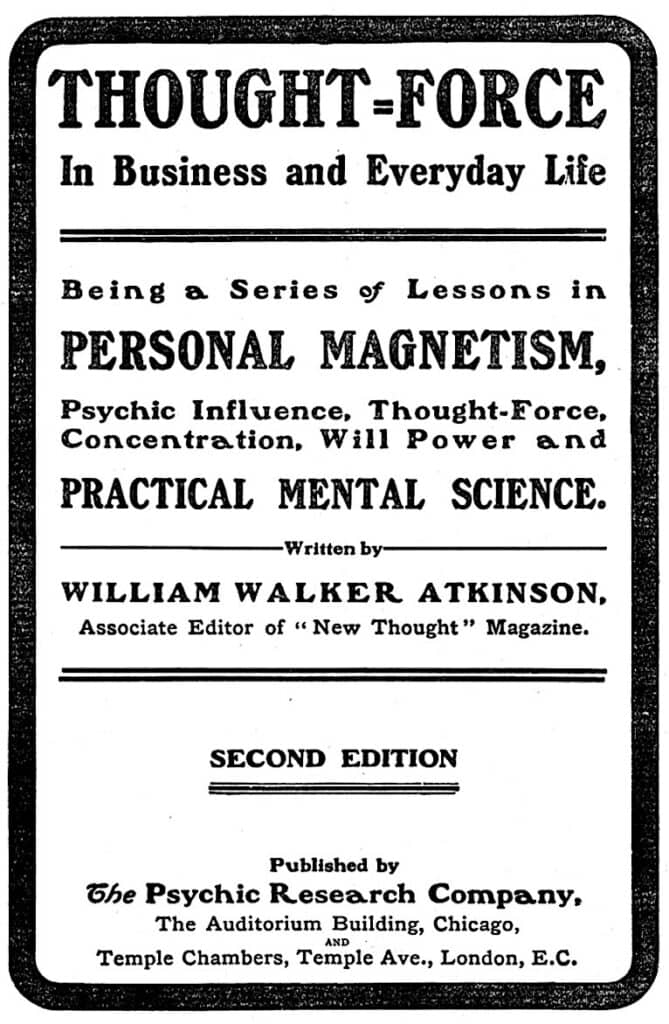
Atkinson was becoming the public literary figure associated with the work, but he was not the constant in its ownership. The copyright began with Parkyn’s institution, passed through the Psychic Research Company, and ended with Flower. This publication history fits the distinction already established by the textual evidence. The person supplying the public authorial identity, the source of the intellectual material, and the person or organization controlling the publication were separate parts of the operation.
Thought=Force Becomes the Foundation for Atkinson’s Later Books
Thought=Force then became an important source for Atkinson’s developing literary identity. Material from it was reworked into later publications carrying his name, including The Law of the New Thought and Nuggets of the New Thought, both issued in 1902. The movement of Parkyn’s system can therefore be followed beyond the first book. Material that began within his teaching and was first issued through his University moved into the New Thought publishing operation and from there into works increasingly identified with Atkinson.
The textual and publication histories now point in the same direction. The comparisons establish where the intellectual material existed first. The editions show where Thought=Force itself began and how its public identity, recommendation, copyright, and commercial use changed as Atkinson and Flower were established in New Thought.
Thought=Force Changes the Authorship of the Entire Atkinson Library
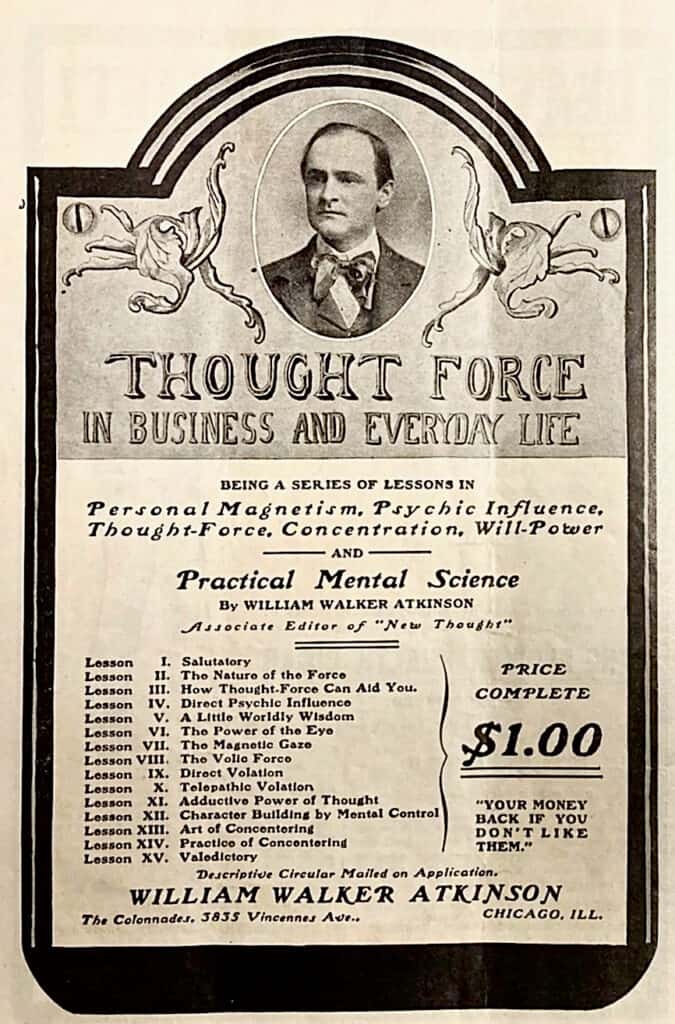
The importance of Thought=Force in Business and Everyday Life does not end with the identification of the intellectual property contained in that book. The comparison has established that its underlying system was Herbert A. Parkyn’s. The definitions, psychological structure, terminology, methods, metaphors, illustrations, and detailed instruction did not originate with William Walker Atkinson. They existed in Parkyn’s teaching before Thought=Force was produced and were then converted into the popular literary form that appeared under Atkinson’s name.
That finding changes the starting point for every book that followed.
Atkinson’s later writings did not develop away from Thought=Force into an independent intellectual system of his own. They repeatedly returned to the same foundation and reframed it. Suggestion, Auto-Suggestion, voluntary and involuntary mental activity, will, habit, concentration, thought becoming action, mental influence, Personal Magnetism, the formation and replacement of mental habits, the control of attention, and the deliberate creation of character and conduct continue throughout the literature. Terminology changes. Subjects are expanded. New philosophical and occult frameworks are placed around the material. The literary voice changes according to the identity on the title page. But the psychological machinery beneath it remains the system already established in Parkyn’s work.
This means that Thought=Force is not merely one questionable attribution among hundreds of otherwise independent Atkinson books. It is the foundation from which the later attribution problem develops. Once the first major work published under Atkinson’s name is shown to contain Parkyn’s intellectual property, its later repetition cannot be used as evidence that the material somehow became Atkinson’s. Repeating Parkyn’s system through additional Atkinson books does not create a new intellectual origin. It extends the same one.
The Atkinson Name Never Becomes Independent of Parkyn’s Network
The publication history reinforces the textual evidence because the name William Walker Atkinson never develops within an independent publishing world separate from Parkyn. From the beginning, the books and magazines associated with Atkinson move through organizations, publishers, editors, and financial arrangements belonging to the network that developed around Parkyn and his students.
The progression begins with Parkyn’s University of Psychic Science, where A Series of Lessons in Personal Magnetism first appeared. It continues through the Psychic Research Company and the establishment of New Thought. From there the Atkinson name moves through the Yogi Publication Society, Beals and the Fiduciary Press, the Progress Company, Segno Publishing, Elizabeth Towne’s publishing operation, the Advanced Thought Publishing Company, and the related enterprises through which the later books were produced and distributed.
These were not simply a succession of unrelated commercial publishers that happened to discover the same prolific author. Parkyn remained connected to this publishing world behind the scenes as its organizations changed, while former students, associates, editors, publishers, and financial partners occupied the visible positions. The institutional names changed much as the authorial names changed. The network remained.
That continuity is critical. The conventional picture of Atkinson as a solitary author independently producing an enormous library of psychology, New Thought, Yoga, Hermeticism, occultism, psychic science, Personal Magnetism, and mental therapeutics depends upon separating the books from the organization that produced them. Once the publishing network is restored to the history, Atkinson looks very different. He appears inside a system already operating when his literary career began and remains inside that system as his bibliography expands.
Read: “Thought Takes Form in Action.” Parkyn’s Voice Never Left Atkinson’s Writings
Thought=Force Establishes Atkinson’s Function
The first book provides the clearest demonstration of that function because both sides of the process survive.
On one side is Parkyn’s earlier Mail Course, containing the developed intellectual system. On the other is Thought=Force, carrying that system into a new commercial form under Atkinson’s name. Between them stands Parkyn’s own University of Psychic Science, which first published the work and originally directed its readers back to Parkyn as the authority for further instruction.
That is not the career beginning of an independent intellectual system created by Atkinson. It is the beginning of Atkinson’s role as the literary vehicle through which an existing system was translated into popular literature.
Once that role is established at the beginning, the later books have to be read accordingly. Atkinson’s recognizable prose style can demonstrate that he participated in writing or editing a work. It cannot establish that he originated the teaching inside it. Thought=Force has already demonstrated why those two forms of authorship cannot be treated as the same thing.
This is the mistake that has distorted the bibliography for more than a century. Atkinson’s literary fingerprints have repeatedly been treated as intellectual fingerprints. If a later anonymous or pseudonymous work sounds like Atkinson, uses language found in an Atkinson book, or repeats teachings associated with him, the work is assigned to Atkinson. But Thought=Force demonstrates that Atkinson could write in his recognizable voice while presenting intellectual material that originated with Parkyn. Stylistic resemblance can identify the literary hand without identifying the intellectual source.
The Pseudonyms Must Be Reconsidered from the Same Starting Point
This has immediate consequences for Yogi Ramacharaka, the Three Initiates, Theron Q. Dumont, Swami Panchadasi, Swami Bhakta Vishita, Magus Incognito, and the other constructed identities later attributed wholly or substantially to Atkinson.
The traditional reasoning has often run backward. Because certain ideas and expressions occur in books carrying Atkinson’s name, their appearance under a pseudonym is treated as evidence that Atkinson must also have created the pseudonymous work. Thought=Force breaks that chain at its beginning. If the material appearing under Atkinson’s own name was already Parkyn’s intellectual property, its recurrence under another identity points first to the common intellectual source and publishing network, not automatically to Atkinson as its creator.
This becomes even more important because the pseudonymous books repeatedly develop subjects already present within Parkyn’s intellectual world. Personal Magnetism and mental influence could be expanded through Theron Q. Dumont. Yoga, mental control, psychic development, and Eastern philosophy could be presented through Yogi Ramacharaka. Hermetic principles could appear through the Three Initiates. Clairvoyance, psychometry, telepathy, psychic influence, and related subjects could be developed through still other identities. Each persona allowed the publishing network to address a particular field through an authorial identity suited to that subject.
The presence of Atkinson’s literary hand in any of these works would not resolve their intellectual authorship. It would demonstrate exactly what Thought=Force has already shown he could do: take material belonging to the intellectual system around him and convert it into effective popular prose.
The Atkinson Bibliography Has Been Built on the Wrong Assumption
The larger problem is therefore not simply that one Atkinson book has been misread. It is that the enormous bibliography attributed to Atkinson has been constructed from an assumption that Thought=Force demonstrates cannot be trusted.
The assumption is that the name on an Atkinson book identifies both the writer and the intellectual creator, and that Atkinson’s recognizable style can then be used to identify him as the intellectual creator of anonymous and pseudonymous books as well.
Those are two different propositions.
Thought=Force separates them.
The literary voice can be Atkinson’s while the intellectual property is Parkyn’s. Once that is established in a book carrying Atkinson’s own name, stylistic similarity ceases to be sufficient evidence for assigning intellectual authorship elsewhere.
This also explains the extraordinary breadth of the intellectual accomplishments traditionally assigned to one man. Atkinson has been made responsible for an enormous range of specialized teaching extending across psychology, Suggestive Therapeutics, Personal Magnetism, New Thought, Yoga, Hindu philosophy, psychic development, Hermeticism, occultism, mental healing, concentration, memory, business psychology, and numerous other subjects. The publishing-network model provides a very different explanation. Atkinson did not have to originate every system. He needed to be able to write.
And writing was precisely the function for which he was so valuable.
Parkyn’s System Became the Foundation of the Later Literature
What began in Parkyn’s clinical and classroom teaching could be separated into different subjects, expanded, simplified, reframed, and presented through different literary personalities. The medical terminology could be reduced for a popular audience. Suggestive Therapeutics could become Personal Magnetism or mental influence. The voluntary and involuntary functions could receive new names. Psychological principles could be placed within New Thought, Yogic, Hermetic, psychic, or occult frameworks. The presentation could change dramatically while the underlying mechanisms continued to operate beneath it.
That is why the intellectual-property distinction established at the beginning of this article becomes so important here. Rewriting Parkyn’s material repeatedly does not transfer its intellectual origin to the writer performing the rewrites. Nor does publishing successive versions under Atkinson’s name turn the earlier system into an Atkinson creation. The genealogy still runs backward to the source.
The evidence from Thought=Force establishes where that genealogy begins.
It begins with Herbert A. Parkyn.
Thought=Force Opens the Entire Library to Reexamination
The Yogi Publication Society History Project can therefore approach the Atkinson bibliography from a fundamentally different position. Thought=Force is no longer being used as an early Atkinson source against which later books are measured. It is itself a derivative point in the history of Parkyn’s system.
That reverses the direction of investigation.
When a teaching appears in a later Atkinson book, the question is no longer simply where else Atkinson used it. The question becomes where it existed before Atkinson. When the same terminology appears under Yogi Ramacharaka or Theron Q. Dumont, its presence in an Atkinson book does not settle the attribution. It must be traced farther backward. When an unusual metaphor, definition, instructional sequence, or psychological mechanism appears across several identities, the investigation must determine whether the common source lies in Parkyn’s earlier courses, lectures, magazines, and organizations.
Thought=Force has provided the model for doing exactly that.
The result is much larger than the reattribution of a single book. The first major work under Atkinson’s name exposes the mechanism by which Parkyn’s intellectual system could be converted into Atkinson literature. The publishing history then shows that the Atkinson identity remained inside the same network as that literature expanded through new publishers, new organizations, and new pseudonyms.
The question surrounding the books is therefore no longer whether they resemble William Walker Atkinson, but whether they resemble Herbert A. Parkyn’s intellectual property.
Parkyn Left His Own Hints Behind
There is one final piece of evidence worth considering. Parkyn never publicly placed his name on Thought=Force in Business and Everyday Life, but on more than one occasion he used language and typography that appear to point directly back to the book that had begun within his own University and became the most successful work published under the Atkinson name during their lifetimes.
“Healing by Thought Force”
One example appeared in Parkyn’s own Suggestion magazine. In an editorial promoting Parkyn’s book on Suggestive Therapeutics, the heading was “Healing by Thought Force.”
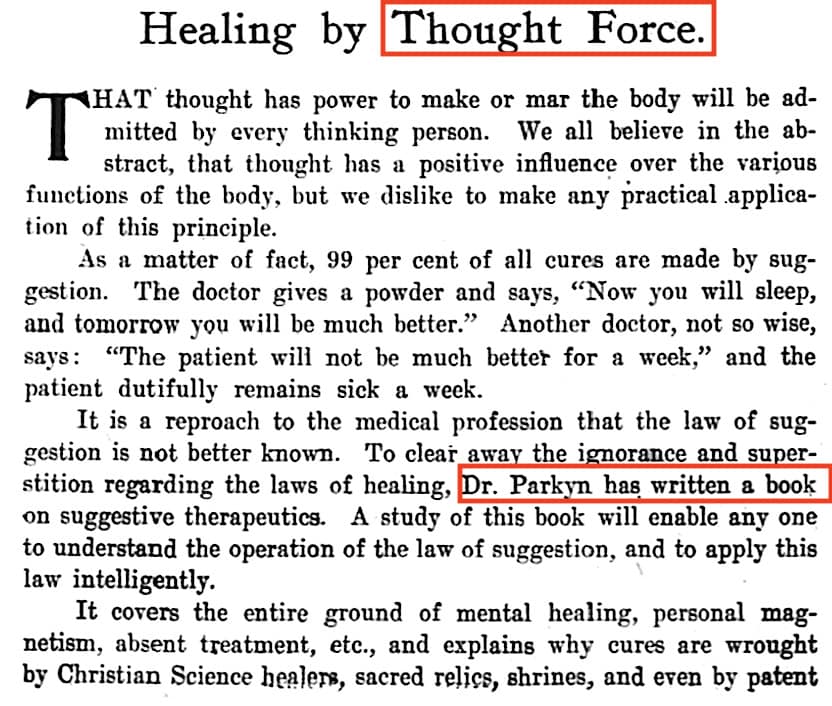
The choice is difficult to overlook. By this time, Thought=Force had become an established title, yet Parkyn’s magazine placed the expression “Thought Force” above an editorial directing readers to Parkyn’s Mail Course.
The editorial says that Parkyn’s book “covers the entire ground of mental healing, personal magnetism, absent treatment, etc.” “Thought Force” was not being treated as something belonging exclusively to a separate Atkinson system. Parkyn’s magazine was using the expression as the heading for an explanation of Parkyn’s own book.
Parkyn’s Auto=Suggestion
Parkyn left another unusually visible connection in the title of his own book Auto=Suggestion: What It Is and How to Use It for Health, Happiness and Success.
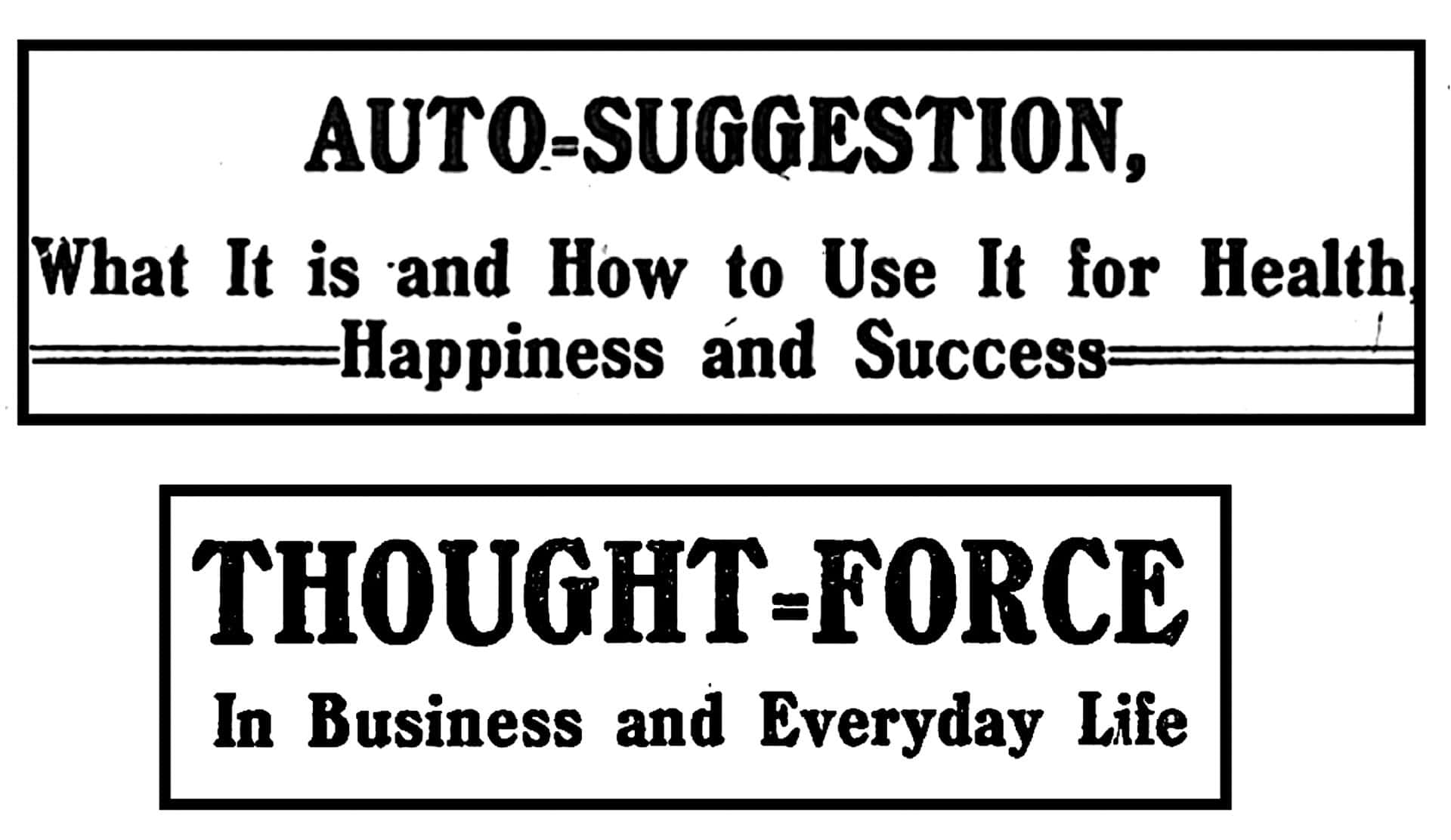
The typography is immediately recognizable: Thought=Force, Auto=Suggestion
In both titles, two words describing a central mental principle are joined by the unusual equal sign. Parkyn could simply have called his book Auto-Suggestion, the ordinary form of the term. Instead, the cover prominently displayed AUTO=SUGGESTION, reproducing the same distinctive construction he used when changing the title of A Series of Lessons in Personal Magnetism to THOUGHT=FORCE.
The connection goes beyond typography. The equal sign visually connects two titles concerned with different applications of the same mental system. One presents Thought=Force in business and everyday life. The other presents Auto=Suggestion for health, happiness, and success.
A Final Signature on Thought=Force
Neither example is needed to establish the intellectual origin of Thought=Force. They are small details, but they make a fitting conclusion to the history of the book. Parkyn’s name may have been absent from the cover of Thought=Force, but he occasionally left signs of his connection to it in plain sight.
.