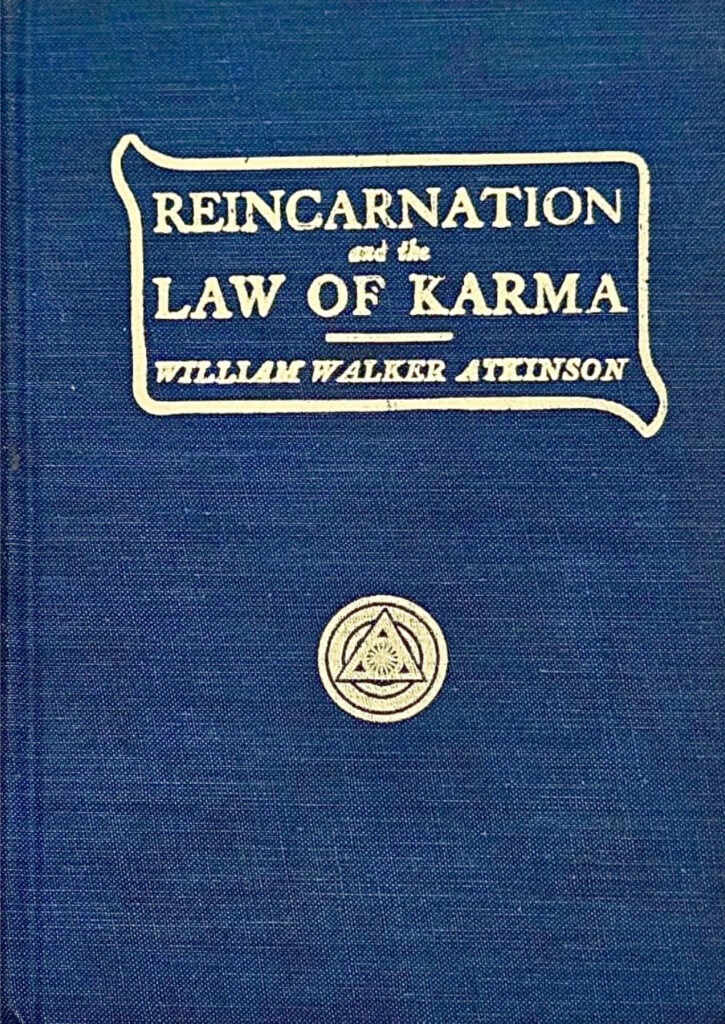
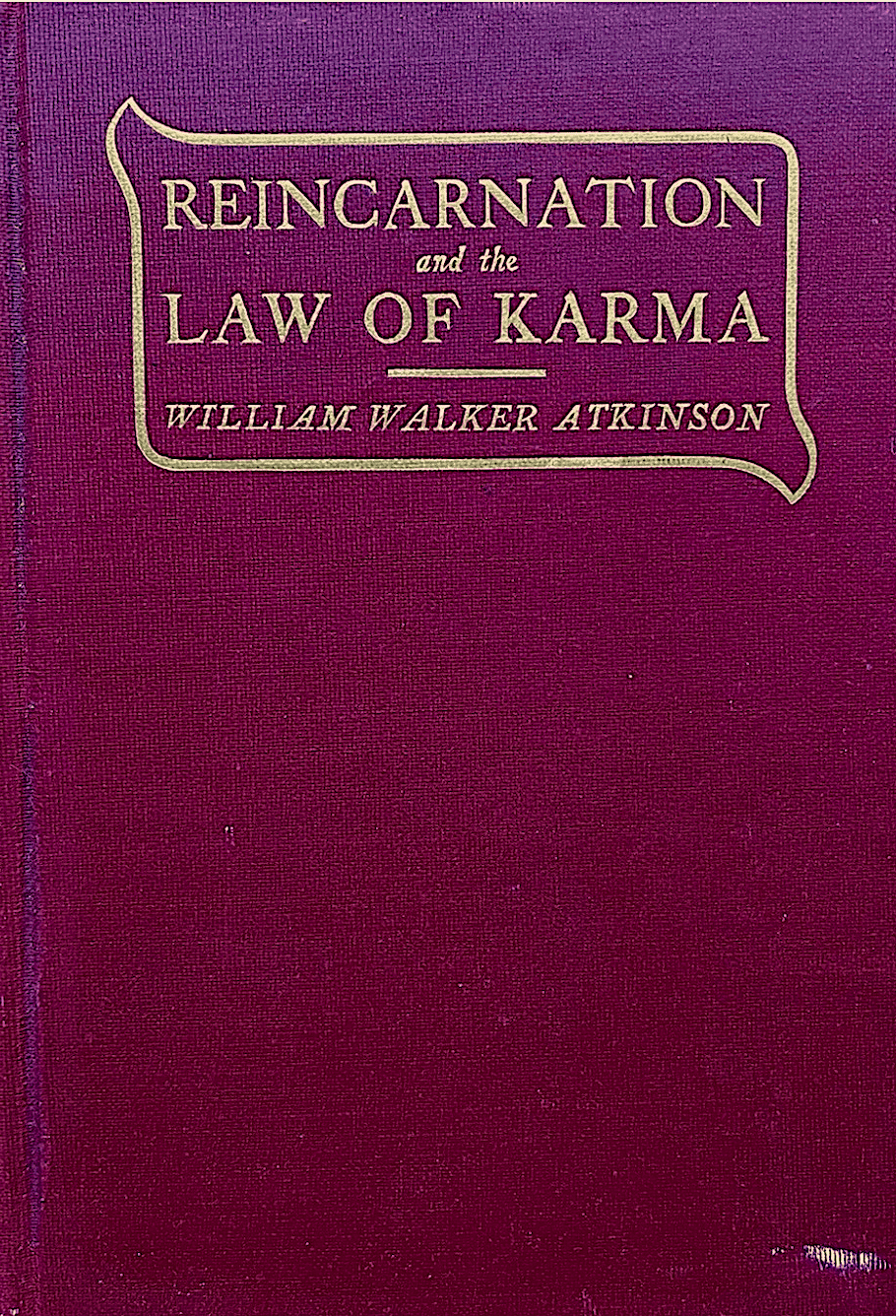
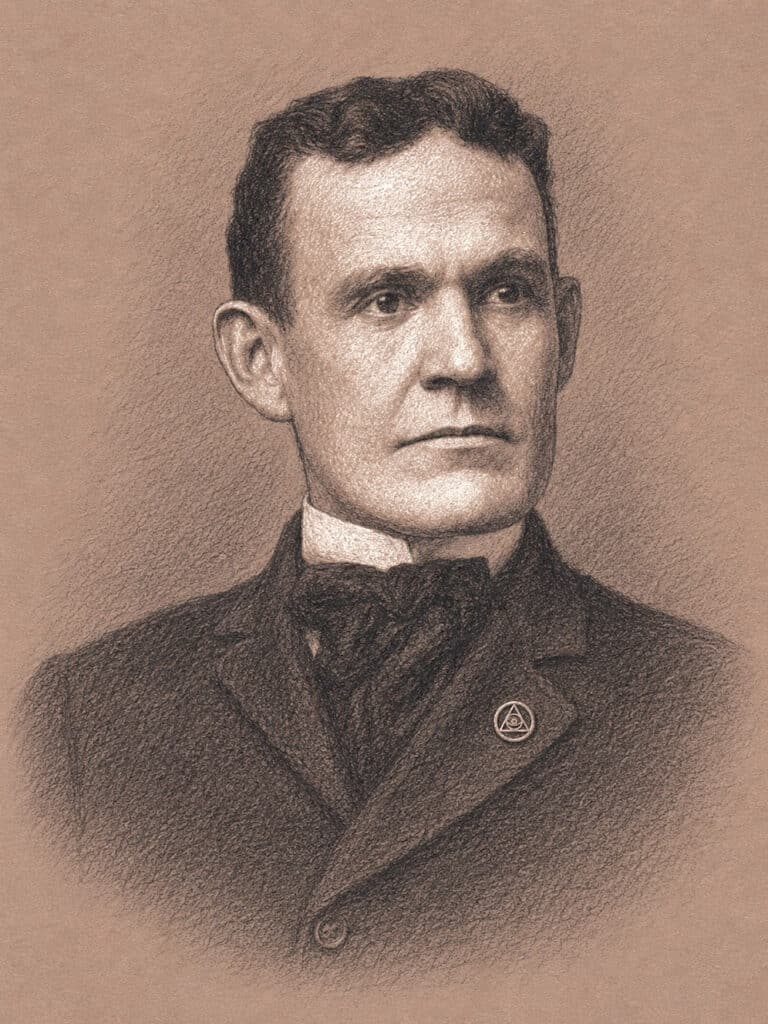
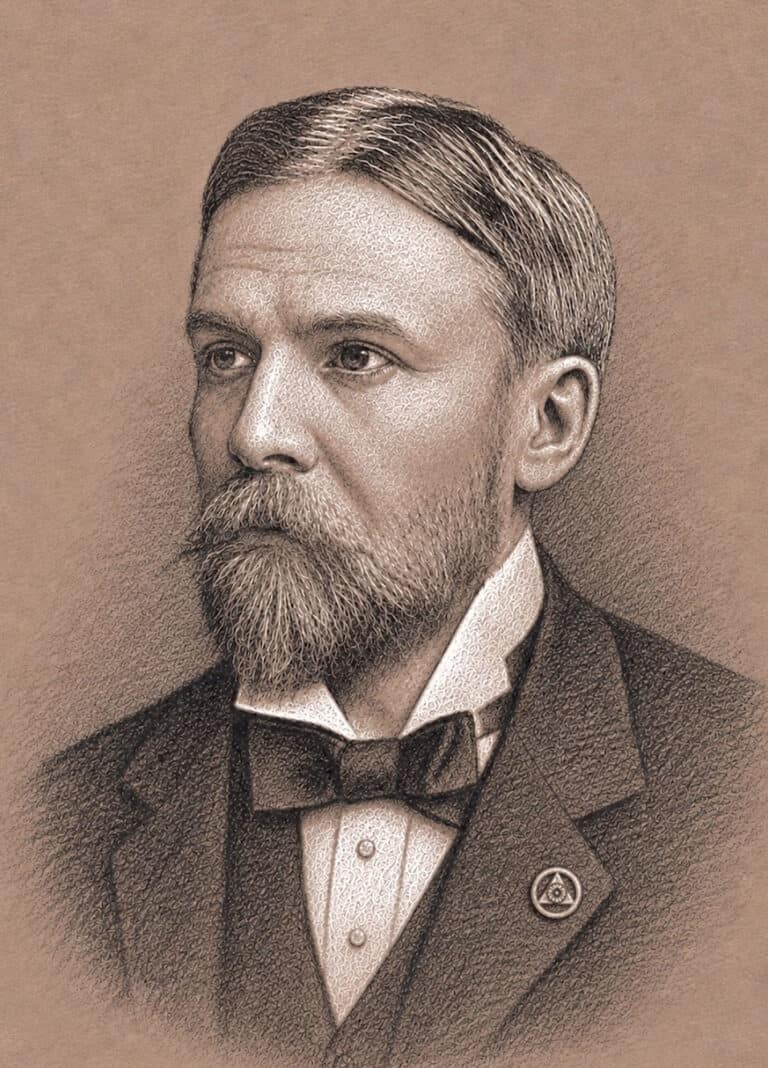
Published in 1908 by the Yogi Publication Society in Chicago, William Walker Atkinson’s Reincarnation and the Law of Karma: A Study of the Old-New World-Doctrine of Rebirth, and Spiritual Cause and Effect is a wide-ranging examination of reincarnation, the survival and development of the soul, and karma as a universal law of spiritual cause and effect. The book presents human life not as a single isolated existence beginning at birth and ending at death, but as one stage in a much longer process through which an enduring spiritual individuality repeatedly enters physical bodies, gathers experience, develops character, and moves gradually toward greater consciousness.
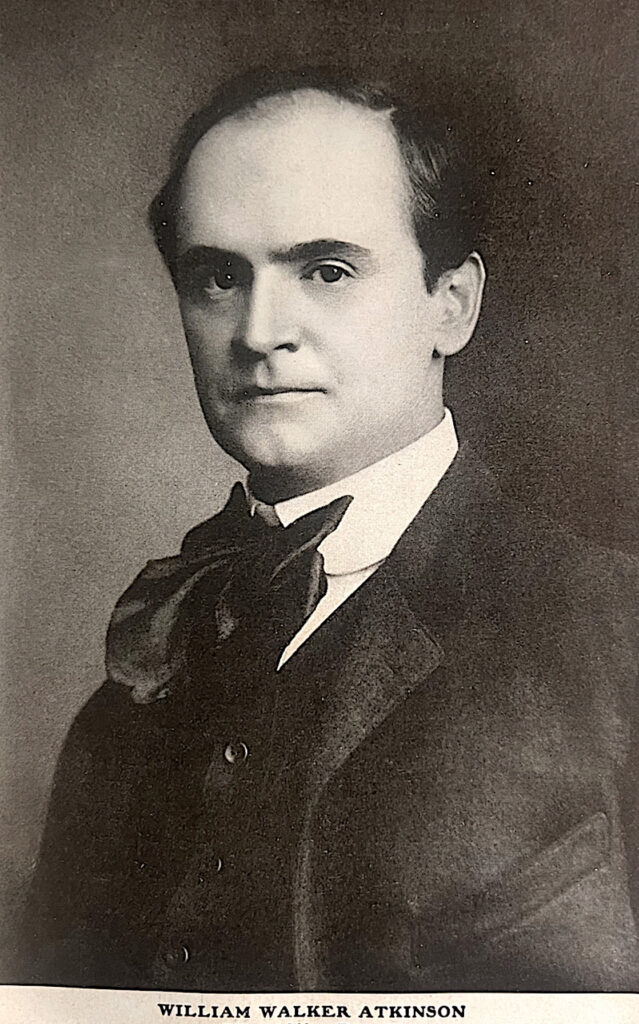
William Walker Atkinson
The central teaching of Reincarnation and the Law of Karma is that reincarnation and karma are two parts of the same system. Reincarnation provides continuity from one life to another, while karma provides the law of cause and effect connecting those lives. According to the book, the soul does not return to earth as a completely new being. It carries forward the accumulated results of its previous experiences in the form of tendencies, character, desires, abilities, attractions, aversions, and degrees of spiritual development. The details of former lives are ordinarily forgotten, but their effects remain. Karma explains how thoughts, desires, choices, and actions generate consequences that shape later experience, while reincarnation supplies the extended field of time through which those consequences can unfold and the soul can continue its education.
The book builds this argument in stages. It first defines reincarnation and distinguishes it from crude ideas of transmigration into animals. It then traces beliefs in rebirth through ancient peoples, Egypt, Chaldea, China, the Druids, Greece, Rome, Judaism, the Essenes, early Christianity, Hinduism, and the modern West. From there the work turns from history to doctrine, explaining what supposedly occurs between incarnations, how rebirth takes place, why reincarnation is presented as a solution to the problem of human inequality, what philosophical arguments can be made in its favor, what evidence has been offered for previous lives, how common objections are answered, and finally how the Law of Karma operates. The result is one of the Yogi Publication Society’s most concentrated presentations of reincarnation as a universal spiritual law rather than simply a belief belonging to one religion or culture.
Understanding Reincarnation
What Does Reincarnation Mean?
The book begins by defining reincarnation as the repeated embodiment in flesh of the soul or immaterial part of human nature. It discusses related expressions such as metempsychosis and transmigration of souls but carefully separates its teaching from the popular idea that human beings are commonly reborn as lower animals as punishment for wrongdoing. That conception is treated as belonging to a different and less developed tradition. The essential doctrine, as the work presents it, is much simpler: there is within the human being an immaterial something—the soul, spirit, inner self, or whatever name a particular philosophy gives it—that survives the dissolution of the physical body, continues as an individual entity, remains for a period outside physical incarnation, and eventually enters another human body.
The new personality does not ordinarily possess conscious memory of the previous existence, yet the results of the previous life remain within it. The book repeatedly emphasizes this distinction between remembered experience and retained experience. The soul may not remember the particular events that produced its characteristics, but the effects of those events survive as tendencies, capacities, preferences, weaknesses, strengths, desires, and character. The personality of a single incarnation is therefore temporary, while the deeper individuality is the continuing traveler passing through many personalities. Birth is not the creation of an entirely new spiritual being but the beginning of another chapter in an already existing history.
The work strengthens this idea by quoting reincarnationist E. D. Walker, whose description of the doctrine portrays the newborn child not as a blank beginning but as the inheritor of a vast spiritual past. The present life adds another layer of experience, which in turn becomes part of the hidden inheritance carried into future incarnations. This concept provides the foundation for everything that follows in the book: the present personality is temporary, but character belongs to a much longer process of development.
The Historical Roots of Reincarnation
Is Reincarnation an Ancient or Modern Belief?
A major purpose of the early chapters is to establish reincarnation as an ancient and widespread human doctrine rather than an exotic belief recently imported from India. The book argues that no single civilization can confidently be credited with inventing reincarnation. Egypt, India, and even legendary Atlantis have all been proposed as its birthplace, but the work presents the idea as something that appeared naturally wherever human beings developed a belief that something within them survived physical death.
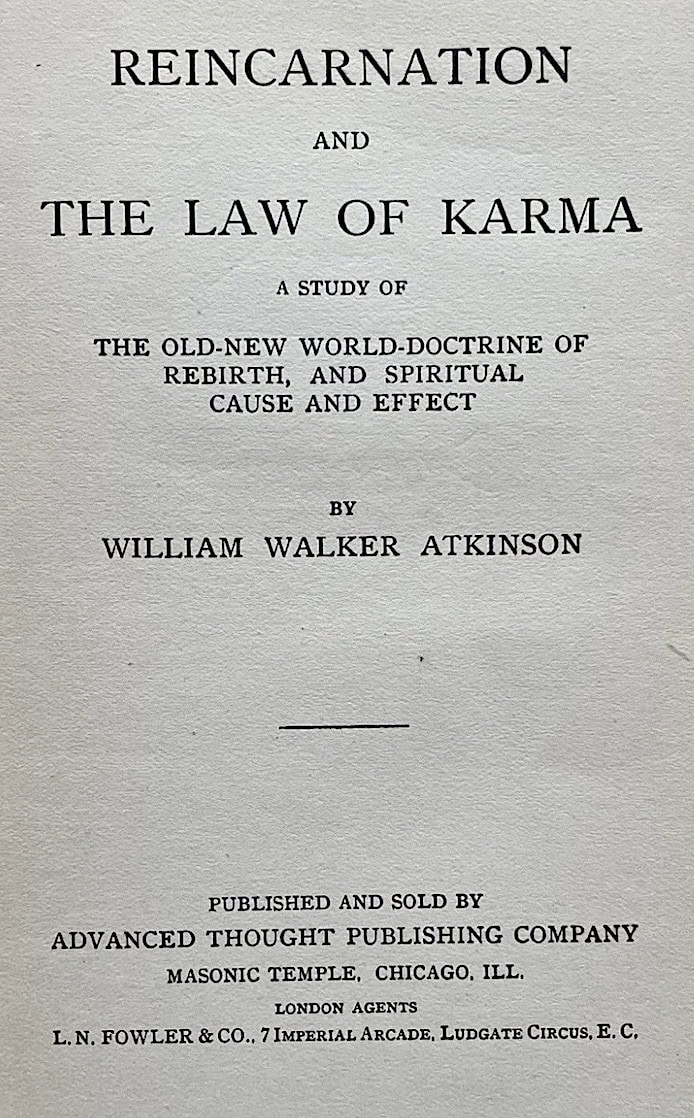
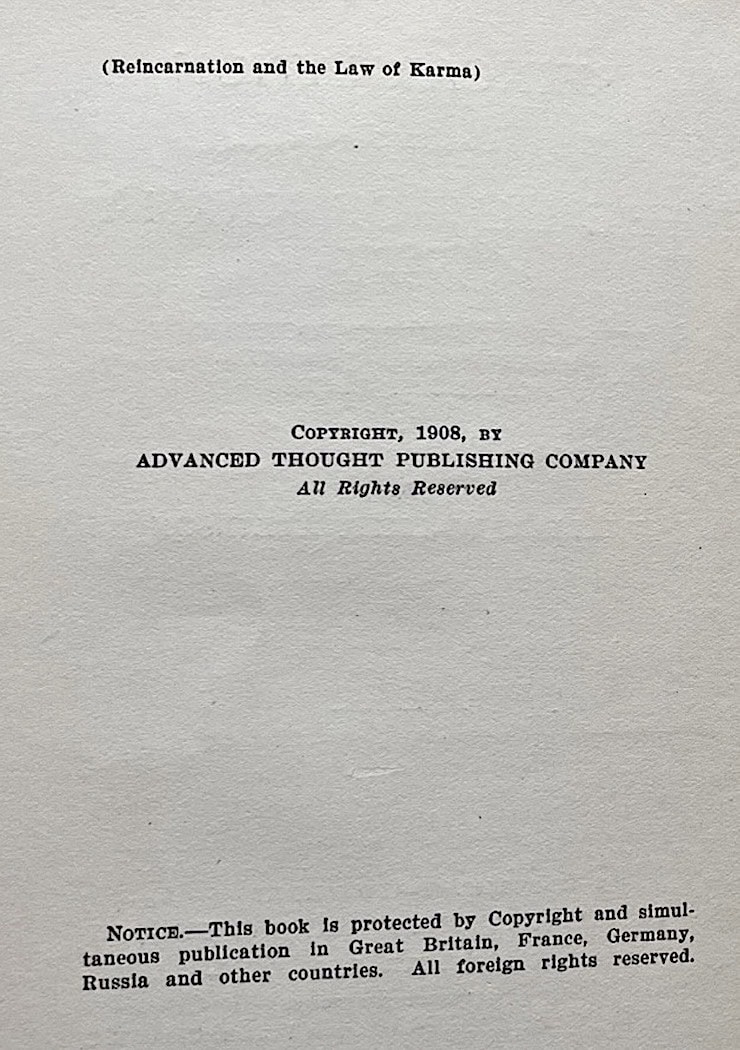
Original Advanced Thought Publishing edition
It presents the development of the doctrine as a kind of progression in human thought. First comes the belief that something survives the body. From this arises the possibility that the surviving soul may return to earthly existence. Once that idea is accepted, it becomes natural to reason that if the soul can live again after the present life, then it may also have lived before the present life. Finally comes the idea that the circumstances and character of future lives are related to the actions and development of previous ones. In this way, survival, rebirth, and moral causation combine to form what the book regards as the mature doctrine of reincarnation and karma.
The historical survey that follows is designed to show that versions of these ideas appeared among peoples separated by geography, religion, and culture. The work does not present every tradition as teaching precisely the same doctrine. Instead, it argues that beneath their differences there repeatedly appears the same basic pattern: something in the human being survives bodily death, existence continues beyond one earthly personality, and the present life has consequences extending beyond itself.
Reincarnation Among the Earliest Peoples
The historical survey begins with what the book calls the early or primitive races. It points to traditions recorded among peoples in Africa, the Americas, Greenland, the Pacific islands, and elsewhere in which the dead were believed to survive as spirits and eventually return to embodied life. Some traditions imagined the soul returning to its former body, while others developed the idea of rebirth in a new body. Practices such as preserving bodies, beliefs about returning ancestors, and stories concerning children who seemed to remember another existence are treated as fragments of the same larger conception.
The work also draws attention to traditions describing the human soul as composed of several elements. Some portions are believed to remain with the body or eventually dissolve, while another higher or more enduring principle survives death. This concept of a complex human constitution becomes important throughout the rest of the book because comparable teachings are found in Egypt, China, Greece, India, and modern occult philosophy. These similarities are treated as evidence that human beings repeatedly arrived at comparable conclusions concerning the distinction between the temporary personality and a more enduring spiritual individuality.
The book even discusses Atlantis, although it presents the subject as traditional rather than established history. According to occult traditions summarized in the work, the people of Atlantis supposedly held doctrines of reincarnation and the complex soul, and survivors of that civilization were said to have carried those teachings into Egypt and the ancient Americas. The importance of the passage is less the Atlantis claim itself than the role it plays in the larger argument that reincarnation belongs to a very ancient stream of occult teaching.
What Did the Ancient Egyptians Teach About Reincarnation?
Egypt occupies a central position in the book’s history of reincarnation because it is treated as one of the greatest ancient centers of occult teaching. The work acknowledges the long-standing dispute over whether reincarnation originated in Egypt or India but ultimately refuses to give either civilization exclusive credit. Instead, Egypt is presented as a place where the doctrine was preserved, elaborated, and incorporated into a sophisticated esoteric understanding of the human soul.
The book cites Herodotus’s account that the Egyptians believed the human soul to be imperishable and capable of entering other bodies after death. It then argues that the deeper Egyptian doctrine must be distinguished from the more public religious teachings given to the population. This distinction between an outer doctrine for the masses and an inner teaching for initiates is one of the recurring assumptions of the work. According to its presentation, the Egyptian mysteries preserved a more sophisticated understanding of reincarnation than could be reconstructed merely from popular mythology.
The Egyptians are also presented as teaching that human nature consists of several distinct principles or bodies rather than a simple opposition between body and soul. The book lists different Egyptian terms associated with the divine spirit, intellect or will, vitality, astral body, etheric double, and physical body. It interprets this layered conception of human nature as an ancient counterpart to the multiple bodies or planes described in modern occultism. The physical organism therefore represents only the outermost temporary vehicle of a much more complex being.
Chaldea, the Magi, and the Continuing Soul
The work next turns to the Chaldeans and the Persian and Chaldean mystics commonly called the Magi. They are described as custodians of a hidden wisdom in which reincarnation formed one of the fundamental teachings. Their conception of the soul again involves multiple elements, some temporary and others capable of surviving death and continuing through successive earthly and non-earthly states.
The purpose of these repeated existences is development and purification. The soul continues through experience until it reaches a stage at which further physical incarnation is no longer necessary. At that point it enters a higher state of existence. The book also describes the Magian teaching that advanced souls may eventually review the relationship among their previous lives and understand how one incarnation led into another. The accumulated experiences of many lives then become consciously intelligible rather than remaining hidden beneath ordinary memory.
An important feature of this doctrine is the belief that all forms of existence are manifestations of a single underlying Life or Being. Spiritual development therefore leads not merely to greater individual power but to a growing realization of relationship and brotherhood with all life. Reincarnation becomes one part of a much larger philosophy of unity.
Did Ancient Chinese Philosophy Contain Reincarnation?
The book argues that ideas of continued existence and rebirth can also be found beneath the surface of ancient Chinese philosophy. It gives particular attention to Lao-Tze and early Taoist thought, interpreting the Tao as the fundamental principle underlying existence and the human soul as containing both temporary and enduring elements.
According to the interpretation presented in the work, the more material or vital principles associated with the body eventually disperse, while a higher spiritual or knowing principle persists. The book argues that this enduring individuality does not immediately disappear into the Tao at death but continues through repeated experiences before ultimately returning to the universal source. It further connects early Taoist teaching with moral causation, claiming that actions in the present life bear fruit in future existences.
As elsewhere in the book, the similarities between Chinese, Egyptian, Indian, and Western occult ideas are treated as more important than their differences in terminology. Different civilizations may describe the surviving element of the human being differently, but the same division repeatedly appears between temporary bodily or psychic elements and a more enduring spiritual principle.
What Did the Druids Believe About Rebirth?
The Druids receive surprisingly extensive attention because the book seeks to demonstrate that reincarnation was once deeply rooted in Western Europe. It describes the Druids of ancient Gaul as possessing a sophisticated mystical philosophy, despite later portrayals of them as primitive barbarians. Classical writers are cited as evidence that the Gauls held strong beliefs concerning immortality and the continued existence of the soul.
The work finds parallels between Druidic teaching, Pythagoreanism, Egyptian mysteries, and ancient Aryan philosophy. It recounts traditions connecting Druidic priests with Greece and even stories suggesting relationships among Pythagoras, Egyptian occultism, Indian Brahmins, and Druidic instruction. The historical connections cannot always be reconstructed, but the philosophical similarities are treated as significant.
The Druidic spiritual principle is identified as the Awen, which passes through stages of existence before reaching human incarnation and eventually higher states. The book describes a progression through what it calls the Circle of Freedom, the Circle of Bliss, and finally the Circle of the Infinite. Human incarnation is therefore only one stage in an immense evolutionary movement. Even European folklore about returning souls, children who seem to remember previous lives, fairies, and other supernatural beings is interpreted as a surviving cultural echo of older Druidic teachings.
Reincarnation in Greek and Western Philosophy
Why Does the Book Contrast Rome With Greece?
The work draws a sharp contrast between ancient Rome and Greece. Rome is portrayed as materially powerful but comparatively uninterested in metaphysical speculation. Although individual Roman thinkers expressed beliefs in immortality or hinted at rebirth, the book argues that Roman civilization as a whole concentrated on political, military, and practical achievement rather than the inner mysteries of the soul.
Greece, by contrast, becomes one of the great Western centers of philosophical speculation concerning immortality and reincarnation. Orpheus, Pythagoras, Plato, the Neo-Platonists, and the mystery schools are identified as major representatives of this tradition. The Greek material is particularly important to the argument because it demonstrates that reincarnation cannot simply be dismissed as a foreign Eastern teaching. Some of the most influential figures in Western philosophy accepted or seriously considered doctrines of the soul’s pre-existence and rebirth.
Pythagoras and the Law of Rebirth
Pythagoras occupies an important place in the book because his teachings combine reincarnation with moral causation in a way closely resembling the doctrine of karma. The Pythagorean soul is described as surviving physical death, spending a period in higher regions, assimilating knowledge and experience, and eventually returning to earthly incarnation if further development is required.
The circumstances of the new life are said to correspond with the actions, thoughts, tendencies, and spiritual development of previous lives. Reincarnation therefore becomes the mechanism through which universal justice operates. The apparently unequal conditions into which people are born can be understood, according to this theory, only when the present lifetime is viewed as one segment of a much longer history.
The work emphasizes that Pythagoras did not present earthly existence as the final state of the soul. The repeated cycle of incarnation has a purpose: gradually raising the individual toward a higher state in which the limitations and inequalities of ordinary material existence are transcended. Rebirth is therefore developmental rather than endless.
What Did Plato Teach About Reincarnation?
Plato receives even more attention because the book considers his writings one of the clearest Western philosophical expressions of the immortality and pre-existence of the soul. In the work’s interpretation of Plato, the human being consists of a changing and perishable material body together with an immaterial soul that is related to the divine and survives bodily death.
Souls insufficiently developed for permanent existence in higher states return to earth and enter new bodies. Through repeated experiences they work through the consequences of previous actions, gain knowledge, and gradually rise toward greater spiritual realization. The book also stresses Plato’s teaching that the soul may possess flashes of recollection, innate ideas, intuitions, or capacities derived from previous experience.
This provides an important connection to the later argument about memory. The absence of complete conscious recollection does not mean that previous experience has vanished. Knowledge may survive indirectly as instinct, intuition, aptitude, disposition, or an apparently inborn idea. In this way, Plato becomes an ancient philosophical precedent for the broader theory that the essence of past experience survives even when the details are forgotten.
Reincarnation in Judaism and Christianity
Did Judaism Contain an Inner Teaching of Reincarnation?
The book argues that early Jewish religion contained an inner tradition concerning the soul that differed from the simpler teachings available to the population at large. It acknowledges that the earliest Hebrew scriptures provide relatively little detailed information about immortality, often describing the dead in connection with Sheol. Over time, however, more elaborate ideas concerning the fate of the soul developed.
The work links these developments with Egyptian influence and later Jewish mystical traditions. Moses is portrayed, according to the occult interpretation adopted in the book, as having received Egyptian initiation and as transmitting deeper teachings to an inner circle of Jewish priests. The book also discusses Hebrew terms such as Nichema, Rouach, and Nephesh, interpreting them as evidence for a layered conception of human nature comparable to Egyptian and other occult systems.
The Kabbalah becomes especially important because the work regards it as preserving doctrines concerning the pre-existence and return of souls that were not always part of ordinary Jewish religious teaching. Once again, the recurring pattern is an outer religion and an inner esoteric philosophy.
The Essenes and Early Christianity
The Essenes are presented as an important bridge between Jewish mystical tradition and early Christianity. The book associates them with teachings concerning the soul, spiritual purification, and rebirth, and considers their influence one possible route through which ideas of pre-existence and reincarnation could have reached early Christian circles.
The discussion of Christianity has a clear purpose. One of the objections anticipated from Western readers is that reincarnation must be rejected because it is pagan, Hindu, or incompatible with Christianity. The book responds by arguing that early Christianity existed within a world already filled with doctrines of pre-existence, purification, and rebirth, and that some early Christian thinkers entertained ideas that later disappeared from orthodox theology.
The work does not argue that reincarnation became the universal doctrine of the Christian Church. Rather, it attempts to show that the historical situation was more complicated than simply opposing Christianity to reincarnation. The doctrine could be found in mystical and philosophical currents surrounding the formation of Christian thought and should therefore be evaluated on philosophical grounds rather than rejected because of its association with non-Christian traditions.
Reincarnation in India and Buddhism
Why Is India So Important to Reincarnation?
India receives special treatment because the book regards it as the great surviving home of reincarnation. In Egypt, Greece, and Europe, the doctrine became hidden, weakened, or displaced over time. In India it remained a living philosophical and religious principle. The doctrines of rebirth and karma therefore survived there with a continuity that the work believes was lost elsewhere.
The book discusses the Vedas, Upanishads, later Hindu philosophy, the Laws of Manu, the Bhagavad Gita, and different Indian schools to show how deeply reincarnation became woven into Indian conceptions of the soul and spiritual evolution. Not every school agrees about the precise nature of the reincarnating entity, but the continuity between present existence, previous causes, and future states remains fundamental.
The work is especially interested in the philosophical idea that the individual passes through repeated experiences until ignorance is overcome and a higher realization is reached. Earthly life is not an isolated test but part of a gradual unfolding. This conception fits naturally with the evolutionary language used throughout the book: the soul develops through repeated experience just as other processes in nature unfold through stages.
How Does Buddhism Explain Rebirth Without a Permanent Soul?
The book recognizes that Buddhist teachings create a problem for any attempt to treat reincarnation as one perfectly uniform doctrine. Certain Buddhist schools reject the idea of a permanent and unchanging personal soul while still teaching rebirth and karma. The work therefore explains that continuity does not necessarily require the transfer of an identical substance from one body to another.
The familiar image of one flame lighting another is used to express the idea. The second flame is not numerically identical with the first flame, but neither is it entirely disconnected from it. One condition produces another. In the same way, the karmic forces generated in one existence may produce the conditions of another without requiring the survival of an unchanging personality in the ordinary Western sense.
The book does not allow this difference to undermine its larger theory. Instead, it treats Buddhism as another philosophical attempt to explain the same fundamental principle: the causes created by a life do not end with the disappearance of the physical organism.
The Modern Revival of Reincarnation
How Did Reincarnation Return to the Modern West?
The work eventually moves from ancient history into what it regards as the modern Western revival of reincarnation. It discusses Theosophy, Helena P. Blavatsky, Western students of Yogi philosophy, occult societies, Spiritists, Christian reincarnationists, and other schools that had renewed interest in rebirth during the nineteenth and early twentieth centuries.
The book presents this revival as part of a recurring cycle in human thought. Reincarnation may disappear from public favor for centuries, but the underlying questions of human inequality, immortality, spiritual development, and the meaning of life eventually bring it back. The doctrine is therefore described as “old-new”: ancient in origin but repeatedly rediscovered and reconsidered.
This framing is important for understanding the title of the book. Reincarnation is not being presented simply as an old doctrine preserved in Asia. It is an ancient idea returning to a modern Western world increasingly interested in psychology, evolution, comparative religion, occultism, and laws of mental and spiritual causation.
Between Death and Rebirth
What Happens Between Incarnations?
The book rejects the idea that a person dies and is immediately reborn in another physical body. Between incarnations there is generally an interval during which the experiences of the preceding earthly life are assimilated. The process is described in effect as mental and spiritual digestion. Physical life provides experience; the period after death allows its deeper meaning and results to become incorporated into the continuing individuality.
The length and nature of this interval depend upon the development of the soul. Individuals deeply attached to physical desires and earthly conditions may return relatively quickly because their strongest attractions continue to point toward material life. More advanced souls may remain for much longer periods on higher planes because they require less immediate physical experience and possess a greater capacity for existence outside material embodiment.
The work describes an astral world composed of different planes and subplanes corresponding to differing levels of consciousness. Death is therefore a transition rather than annihilation. The physical body is discarded, but the individual continues through other states, gradually releases lower attachments, assimilates experience, and eventually becomes ready for another incarnation.
Where Does the Soul Go After Death?
The book presents the after-death state as governed by affinity and consciousness rather than by an external deity assigning everyone to arbitrary locations. Individuals gravitate toward conditions corresponding to their internal state. Those strongly identified with physical desires remain close to lower levels of consciousness, while more developed individuals are capable of functioning on higher planes.
These states are temporary rather than eternal. Even pleasant higher conditions do not represent the final destination of a soul that still requires further experience. After the appropriate period of rest, assimilation, and development, attraction toward earthly existence gradually reasserts itself and the process of rebirth begins.
In this way, the work incorporates traditional ideas of heavens, hells, purgatorial states, and astral worlds into a single evolutionary system. They are not permanent destinations but phases encountered between incarnations.
What Determines the Circumstances of the Next Life?
The book explains rebirth primarily through the law of attraction. The soul carries tendencies, desires, relationships, capacities, and unfinished experiences from previous lives, and these create affinities with certain families, environments, conditions, and opportunities. Parents and child may therefore be attracted together because of relationships established in previous incarnations.
The next life is not presented as a random assignment. Nor does the work usually describe a divine judge deciding where every soul must be born. Instead, the soul’s own accumulated nature produces attraction toward conditions corresponding to it. Karma therefore operates through natural law.
This process also provides a way of reconciling heredity with reincarnation. The physical body is inherited from parents, but the reincarnating soul is attracted toward the heredity capable of providing an appropriate instrument for its own tendencies and development. Physical inheritance and spiritual continuity therefore operate together.
The Arguments for Reincarnation
Why Does the Book Present Reincarnation as an Answer to Human Inequality?
One of the work’s strongest philosophical arguments concerns the enormous inequalities present at birth. Human beings enter life with radically different physical bodies, intellectual capacities, family situations, economic circumstances, talents, opportunities, temperaments, and difficulties. If every soul is created at birth and begins existence for the first time under those conditions, the justice of the universe becomes difficult to explain within the book’s framework.
Reincarnation changes the scale of the problem. The present life is not the beginning of the individual’s history but one phase in an ongoing development. Differences that appear inexplicable when viewed within a single lifetime may represent the accumulated consequences of a much longer process.
The book therefore presents reincarnation and karma as a solution to the problem of divine justice. The universe does not favor one newly created soul over another. Each individual is continuing along a path shaped by previous experience while simultaneously generating new causes that will affect the future.
What Is the Philosophical Argument for Reincarnation?
The book offers several interconnected arguments. One begins with immortality. If the soul is inherently immortal, the work asks why its immortality should begin at birth. An immortal thing cannot logically acquire immortality at a specific point in time. If the soul will exist indefinitely into the future because its nature is spiritual and indestructible, the book presents it as reasonable to infer that its existence also extends into the past.
A second argument concerns the amount of development possible within one lifetime. Human consciousness contains enormous potential for intellectual, moral, emotional, and spiritual growth, yet one physical existence offers only a limited number of experiences. Reincarnation supplies the extended period necessary for gradual development.
A third argument concerns the striking differences among individuals. Some children display unusual abilities, inclinations, fears, talents, attractions, or moral qualities from an early age. The work interprets such characteristics as possible evidence of development carried forward from previous lives.
Finally, reincarnation is presented as a more coherent explanation of justice. If life is a continuing process rather than a one-time event, then the apparent inequalities of one incarnation become part of a larger history rather than arbitrary beginnings imposed upon newly created souls.
What Evidence Does the Book Offer for Reincarnation?
The work devotes a separate chapter to what it calls the proofs of reincarnation. It discusses reports of people apparently remembering previous lives, children making unusual statements concerning earlier identities, individuals recognizing places they supposedly had never visited, and other cases presented in the literature of reincarnation.
The book recognizes that philosophical arguments alone do not amount to empirical proof and therefore treats personal conscious experience as a separate category of evidence. The table of contents itself announces this chapter as dealing with remembrance of previous existence, cases offered on authority, and what it calls messages from the past.
The work nevertheless does not make past-life memory necessary to its doctrine. Most people, it admits, possess no conscious recollection of previous incarnations. Its answer is that memory is only one part of identity and that the influence of forgotten experiences may survive long after the details disappear from conscious awareness.
Why Don’t We Remember Past Lives?
The answer rests upon the difference between memory and character. People forget enormous portions of their present lifetime. Adults may remember almost nothing from their earliest childhood, yet the experiences of childhood continue to shape personality. Habits may remain even after the original experiences that created them have been forgotten.
The book extends this reasoning across incarnations. The deeper individuality carries the results of previous experience without carrying an immediately accessible autobiographical memory of every event. Talents, tendencies, instinctive responses, attractions, fears, and character may therefore represent accumulated experience even when the conscious mind cannot identify its source.
The personality associated with the present brain is only one temporary expression of the larger individual. As spiritual development proceeds, the work accepts the possibility that deeper levels of memory may eventually become accessible, but ordinary reincarnation does not require this conscious recollection.
Does Heredity Disprove Reincarnation?
The book accepts physical heredity but rejects the idea that heredity completely explains the human individual. Parents provide the physical organism and many inherited physical tendencies, but the reincarnating soul brings its own accumulated development.
The doctrine therefore combines heredity and reincarnation rather than treating them as mutually exclusive. The soul is attracted toward a family capable of providing a physical instrument appropriate to its tendencies. Heredity itself becomes one of the mechanisms through which karma can operate.
This allows the work to explain family resemblance while still accounting, within its system, for the enormous differences that can exist between children born to the same parents. The body belongs to one line of inheritance; the deeper individuality belongs to another history extending beyond the present family.
Is Reincarnation Unchristian?
The book directly addresses the objection that reincarnation must be false because it appears in Hinduism, Buddhism, pagan philosophy, or occult teachings. Its basic response is that the origin of a doctrine does not determine whether it is true. A philosophical claim must be considered according to its evidence and reasoning rather than rejected because of the people who have taught it.
The work further argues that ideas of pre-existence, rebirth, and the continued development of the soul appeared in Jewish mystical traditions and among some early Christian thinkers. Its purpose is not to claim that later orthodox Christianity universally taught reincarnation, but to challenge the idea that Christianity and reincarnation have always been completely separate.
The broader position is characteristic of the book as a whole: spiritual truth may appear in many traditions under different names and symbols. Reincarnation should therefore be examined as a universal philosophical problem rather than confined to the theology of any one religion.
Understanding the Law of Karma
What Is the Law of Karma?
Karma is the principle that gives order and continuity to reincarnation. The Sanskrit word is associated with action, but the book uses it in the wider sense of spiritual cause and effect. Thoughts, desires, intentions, habits, choices, and actions generate consequences, and those consequences help shape future character and experience.
The relationship between reincarnation and karma can be summarized simply:
Reincarnation provides continuity from one life to another.
Karma connects those lives through cause and effect.
Experience produces changes in character.
Character influences thought, desire, and action.
Thought, desire, and action generate new causes.
Those causes contribute to future conditions.
Repeated experience gradually develops the soul.
Karma therefore makes reincarnation meaningful. Without karma, successive lives could be merely disconnected episodes. With karma, each incarnation grows from the causes established before it and contributes new causes to what follows.
Is Karma Punishment?
No. One of the most important points in the book is that karma should not be imagined as a supernatural system of punishment and reward. Karma is law. Causes produce effects because that is their nature, not because some external power becomes angry and imposes penalties.
Painful consequences are therefore educational rather than vindictive. If a person repeatedly creates causes that result in suffering, experience eventually teaches the relationship between the action and the result. The individual may then change the thought, desire, habit, or behavior responsible for producing that condition.
This distinction is essential to the book’s optimistic philosophy. Karma is not designed to condemn souls. It teaches them. Even suffering can become part of spiritual development because it produces knowledge, strength, compassion, discipline, or understanding that did not previously exist.
Is Karma the Same as Fate?
The book does not present karma as rigid fatalism. Present circumstances may be influenced by causes generated in the past, but every response made in the present creates new causes. The individual is therefore conditioned by the past without being permanently imprisoned by it.
Character may itself be the result of previous thinking and action, yet character can be changed by new thinking and action. This produces a continuing interaction between inheritance and creation. The individual receives consequences and simultaneously creates future conditions.
The practical implication is that understanding karma increases responsibility. If thoughts and actions generate consequences, then deliberate self-development can alter the direction of future experience. One cannot erase every existing consequence immediately, but one can stop generating the same causes and begin producing different ones.
Why Is Desire So Important to Rebirth?
Desire is one of the most powerful forces in the book’s explanation of reincarnation. Strong attachment to physical experience produces attraction toward physical conditions. Desires that cannot be fully expressed or satisfied in one life continue to operate and become part of the force drawing the soul toward another incarnation.
This does not mean that every desire is fulfilled exactly as imagined. Instead, desire helps determine the kind of experiences toward which consciousness gravitates. A person dominated by material ambition, sensual attachment, resentment, affection, intellectual aspiration, or spiritual longing generates different tendencies and therefore different future attractions.
As the soul develops, desire itself changes. Lower attachments weaken, higher aspirations become stronger, and eventually the need for compulsory physical incarnation diminishes. Liberation therefore involves not merely escaping an externally imposed cycle but changing the internal attractions that produce rebirth.
The Purpose and End of Reincarnation
What Is the Purpose of Repeated Lives?
The purpose of reincarnation is education. Physical existence provides forms of experience that contribute to the development of the soul. Relationships, ambition, failure, success, pleasure, suffering, responsibility, temptation, love, loss, intellectual effort, and moral struggle all become forms of instruction.
Earth can therefore be understood as a school rather than simply a place of punishment. A single life is comparable to one period of study rather than the entire education. Different incarnations provide different environments and problems so that capacities neglected in one existence may be developed in another.
This educational model also explains why the book refuses to regard difficult experiences as meaningless. Pain may be unwanted, but within the philosophy of the work it can produce strength, patience, knowledge, sympathy, or other qualities that become permanent parts of character. Experience is valuable because its essence survives.
What Happens as the Soul Becomes More Advanced?
As spiritual development increases, the soul becomes less completely dominated by physical desire and more conscious of its deeper identity. Periods between incarnations may become longer because the individual is capable of functioning on higher planes and has less immediate need for physical experience.
Eventually, rebirth becomes more conscious. The advanced soul is no longer drawn blindly into incarnation by uncontrolled desire and habit. Greater knowledge produces greater freedom. The work suggests that highly developed beings may even choose to incarnate for purposes of service rather than personal necessity.
This represents an important shift in the meaning of reincarnation. At lower stages it functions almost automatically through attraction and desire. At higher stages it becomes increasingly voluntary. Spiritual evolution therefore means growing mastery over the forces that once controlled the individual unconsciously.
Does Reincarnation Continue Forever?
No. The system described in the book has a direction and an eventual goal. Reincarnation continues while physical experience is necessary for development. Once the lessons associated with material embodiment have been learned and the attractions binding the soul to lower conditions have been overcome, further compulsory incarnation is no longer required.
The work describes increasingly elevated states of consciousness beyond ordinary human experience, but it is cautious about attempting to describe an ultimate condition in detail. The human mind, working through its present limitations, cannot fully comprehend the highest states of being.
What matters is the direction of the process. The soul moves from ignorance toward knowledge, from unconsciousness toward consciousness, from limitation toward freedom, and from identification with temporary personality toward realization of a deeper spiritual nature.
What Does the Book Mean When It Says the End Is Absolute Good?
The final chapter on karma gives the entire work an optimistic conclusion. If karma is educational rather than vindictive and reincarnation provides unlimited opportunity for continued development, then no soul is eternally condemned by its present ignorance.
Mistakes generate consequences. Consequences produce experience. Experience creates knowledge. Knowledge gradually alters character. Changed character produces different causes. Through this process, even error becomes part of the eventual movement toward greater understanding.
This is why the book’s conception of karma differs fundamentally from eternal punishment. The universe does not preserve wrongdoing forever merely for the purpose of suffering. The painful consequence exists so long as the cause and the ignorance behind it continue to operate. Once the lesson has been absorbed, the need for that particular form of experience disappears.
The table of contents itself signals this conclusion by describing the final discussion of karma in terms of natural law, different forms of karmic action, the advanced mystical doctrine, and the proposition that “the End is Absolute Good.” Reincarnation and karma therefore form a system in which spiritual development may be delayed but is never permanently defeated.
Reincarnation and the Law of Karma and the Yogi Publication Society
How Does Reincarnation and the Law of Karma Fit Within the Yogi Publication Society?
Reincarnation and the Law of Karma is important within the history of the Yogi Publication Society because the subjects it develops had already appeared repeatedly in the earlier Yogi Ramacharaka publications. Reincarnation, astral existence, spiritual evolution, desire, attraction, karma, and the gradual development of the soul were already major components of the Yogi Philosophy lessons. The 1908 volume reorganizes these themes into a work published directly under William Walker Atkinson’s name and expands them through a much larger historical and comparative survey.
This makes the book particularly useful for understanding the relationship between the different identities and series used by the Yogi Publication Society. Readers who had encountered reincarnation through Yogi Ramacharaka were not being introduced to a different doctrine when they opened Reincarnation and the Law of Karma. They were encountering another presentation of the same general philosophical system, now framed as a comparative study of a world doctrine rather than primarily as a series of Yogi lessons.
The shift also reflects the widening scope of the Yogi Publication Society by 1908. Rather than restricting its catalog to books explicitly presented as Yogi teachings, the Society was increasingly publishing works that placed the same network of ideas into Hermetic, occult, psychological, mystical, comparative-religious, and Western philosophical forms. Reincarnation and the Law of Karma belongs squarely within that transition.
Why Is the Book Called an “Old-New World-Doctrine”?
The subtitle describes reincarnation as an “old-new” world doctrine because the book treats it as simultaneously ancient and newly rediscovered. The doctrine is old because versions of it can be traced through numerous civilizations and philosophical traditions. It is new because modern Western readers were encountering it again after centuries in which it had largely disappeared from mainstream Western religious thought.
The phrase also captures the method of the work. Ancient religious and occult ideas are presented using the modern language of law, evolution, psychology, development, attraction, cause and effect, and personal experience. Reincarnation is therefore translated into a form intended to appear compatible with the intellectual concerns of the early twentieth century.
Rather than asking readers simply to accept an Eastern religious belief, the book invites them to treat reincarnation as a philosophical hypothesis capable of explaining immortality, innate differences, moral causation, human inequality, the development of character, and the apparent incompleteness of a single lifetime.
The Central Message of Reincarnation and the Law of Karma
What Is the Central Message of Reincarnation and the Law of Karma?
The central message of Reincarnation and the Law of Karma is that human existence forms part of a continuous process rather than a single isolated lifetime. Birth does not mark the absolute beginning of the individual, and death does not mark the end. The deeper spiritual individuality passes through repeated conditions of embodiment and disembodiment, gathering experience and gradually transforming that experience into character.
Reincarnation supplies the continuity necessary for this development, while karma supplies the law connecting one stage with the next. The individual inherits the consequences of previous causes while constantly creating new causes through present thought, desire, and action. Past experience influences the present without completely determining it, because every present choice becomes part of the future.
Seen from this perspective, the book is ultimately less about remembering past lives than about explaining the continuity of human character and responsibility. Why are people born with different tendencies? Why do actions matter beyond their immediate effects? Why should spiritual growth require more than one brief lifetime? Why does suffering exist in a universe supposedly governed by justice? The work answers each of these questions through the combined doctrines of reincarnation and karma.
The soul is therefore portrayed as a traveler rather than a newly created personality, life as an education rather than a single test, karma as natural cause and effect rather than supernatural punishment, and death as a transition rather than an ending. Every incarnation contributes something to the continuing individual. Nothing genuinely learned is lost. Character becomes the accumulated record of experience, and the future remains open because every new thought and action contributes another cause to the unfolding journey. In the philosophy of Reincarnation and the Law of Karma, the human being is simultaneously the inheritor of an immeasurable past and the creator of a future extending far beyond the limits of the present life.
.
Advanced Thought Publishing release in 1908
Related Research Articles
From Mental Breakdown to Atkinsonia: How Herbert A. Parkyn Turned William Walker Atkinson into a New Thought Phenomenon
This article explores how Dr. Herbert A. Parkyn's treatment, mentorship, and network transformed William Walker Atkinson from mental breakdown into the most prolific and influential writer in the New Thought movement.
Herbert A. Parkyn’s Foundation in Eastern Philosophy
This article examines Dr. Herbert A. Parkyn's early study of Eastern philosophy and the network of individuals and ideas that helped lay the foundation for the Yogi Publication Society and its publishing program.
The Continuing Collaboration of Herbert A. Parkyn, Sydney Flower, and William Walker Atkinson
Historians have claimed that Sydney B. Flower and William Walker Atkinson left Herbert A. Parkyn to establish competing organizations. This article reexamines that story and presents evidence that the three men continued working together…