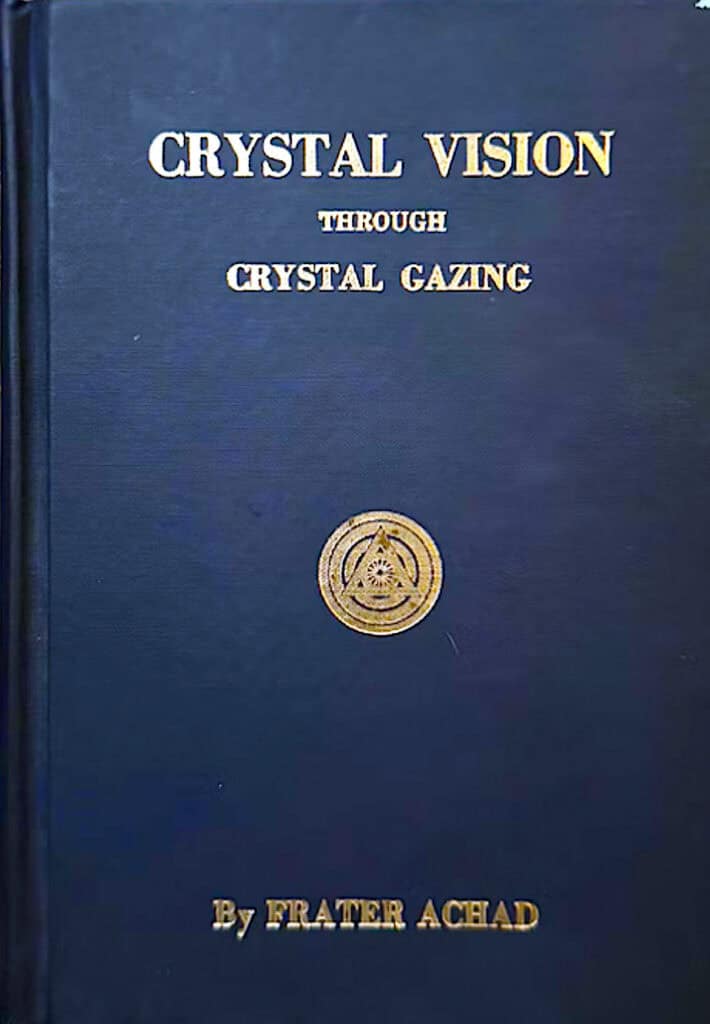
Crystal Vision Through Crystal Gazing, or The Crystal as a Stepping-Stone to Clear Vision was published in Chicago by the Yogi Publication Society in 1923 under the name Frater Achad, the magical name of Charles Stansfeld Jones. Jones was also the author of Q.B.L. or The Bride’s Reception and The Chalice of Ecstasy. Jones describes Crystal Vision as “A Practical Treatise on the Real Value of Crystal-Gazing,” an important description because the book is not limited to instructions for seeing images in a crystal. The physical crystal is introduced as the first instrument in a system intended to develop powers already within the individual. From there Jones moves through increasingly interior forms of vision until the physical crystal has served its purpose and the real subject becomes concentration, consciousness, Will, self-knowledge, and the development of what he calls the “Ultimate Crystal.”
What Is the Purpose of Crystal Vision Through Crystal Gazing?
Jones states the purpose of the book clearly in his Foreword. His program has three parts. First, he intends to provide a method for crystal gazing that includes both the use and preparation of the crystal. Second, he wants to explain the ancient methods, which he considers more scientific than modern methods because they were intended to produce a definite kind of vision and contact with definite intelligences. Third, he intends to show that the physical crystal is only the first of several “Crystalline Spheres.”
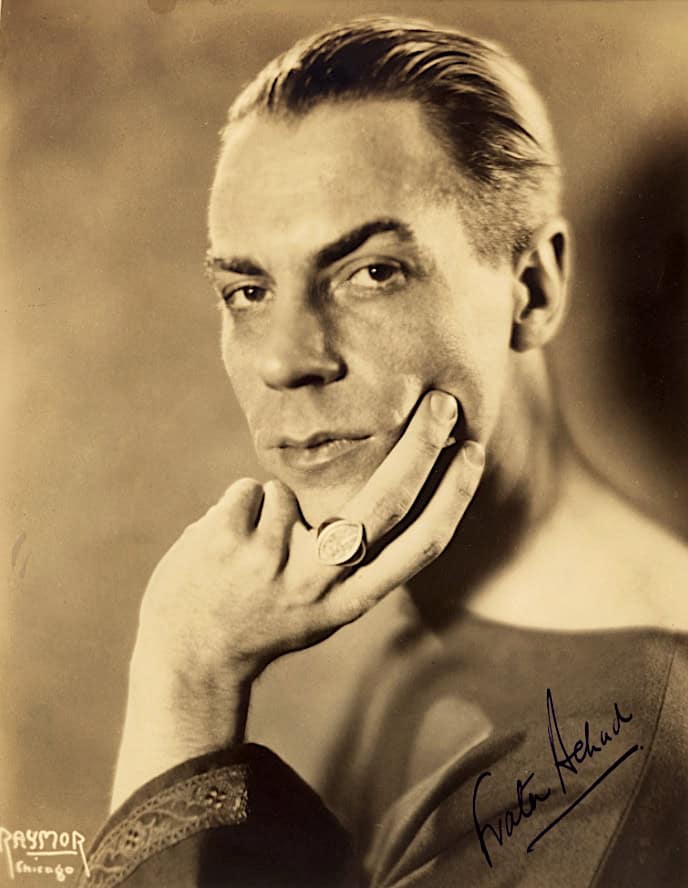
Charles Stansfeld Jones
This third purpose governs the entire book. Jones begins with an ordinary crystal sphere but immediately identifies it as a “material basis” and a “stepping-stone to the development of his latent powers of clear vision” (p. 1). By the following page he has made the larger purpose explicit. He argues that modern students can gain more through developing their own latent powers than through visiting a seer and accepting what the seer reports. “Self-development and self-initiation are beginning to play a much more prominent part than formerly,” he writes, concluding, “The Crystal is a stepping-stone towards Self-knowledge” (p. 2).
The book is arranged around that movement. Its seven chapters progress from “The Lesser Crystalline Sphere,” meaning the physical crystal, through “The Greater Crystalline Sphere” and “The Universal Crystalline Sphere,” then into ancient ceremonial methods, the work of John Dee and Edward Kelley, “The Attainment of Crystal Vision,” and finally “The Ultimate Crystal.” The table of contents itself shows that the later chapters concern creative imagination, willed results, altered consciousness, the Body of Light, initiatory vision, astral travel, Star Consciousness, and “True Crystalline Vision.”
The Lesser Crystalline Sphere
Chapter I begins with the physical crystal. Jones insists that the student must actually perform the exercises. Reading about crystal gazing without attempting the processes “step by step” is, in his words, “futile and a mere waste of time” (p. 1). The crystal becomes the first physical point around which attention, expectation, symbolism, and inner development are organized.
Jones gives detailed instructions for selecting a crystal, choosing a suitable place for working, purifying it, consecrating it, initiating it, and caring for it. Yet even at this elementary stage his interest repeatedly returns to the operator. The results depend upon “the purity of our desire and the quality and state of development of our inner nature” (p. 4). Before working with the crystal, the student is instructed to close the eyes, calm the mind, and raise consciousness toward the highest ideal possible. Attention is then transferred to the crystal.
The physical object also becomes a symbol of the person using it. Jones calls it a symbol of the “Inner-self” and the “Diamond Soul” (p. 6). The purification of the crystal therefore corresponds to purification of the seer. This establishes a pattern followed throughout the book. An apparently external occult object is introduced, but its deeper value is explained through what it represents or produces within consciousness.
The Greater Crystalline Sphere
The second chapter moves from the Lesser Sphere toward what Jones calls the Greater Crystalline Sphere. Here the student’s motives become increasingly important. Crystal gazing cannot be separated from the character, intention, and mental condition of the person doing the gazing.
Jones distinguishes between fascination with an external object and the development of genuine vision. The crystal may attract the student, but the attraction is useful only when it leads inward. The object becomes a means for training attention and awakening faculties that Jones believes are already latent in the individual.
This explains the title’s important phrase “stepping-stone.” Jones is not presenting possession of a crystal as the attainment. The crystal provides an initial condition through which the student learns to direct consciousness. The Greater Crystalline Sphere is associated with the human soul, making the transition from a polished sphere held before the eyes to the interior condition through which vision occurs.
The distinction becomes increasingly important as the book progresses. What begins as crystal gazing is being transformed into a system of self-development.
The Universal Crystalline Sphere
Chapter III expands the system again. Jones now considers a Universal Crystalline Sphere corresponding to the physical crystal and the human sphere. In explaining one theory of crystal vision, he describes human magnetic forces as following the line of sight toward the crystal while universal forces meet them there. “The Universal forces and the Human forces meet at the point of the Crystal and thus produce the vision” (p. 42).
The crystal is therefore presented as a point of contact. Jones discusses concentration in the crystal, concentration in the operator, and “Concentration of the Mind” (p. 42). The three spheres create a progression from object, to individual consciousness, to a universal field with which consciousness may establish contact.
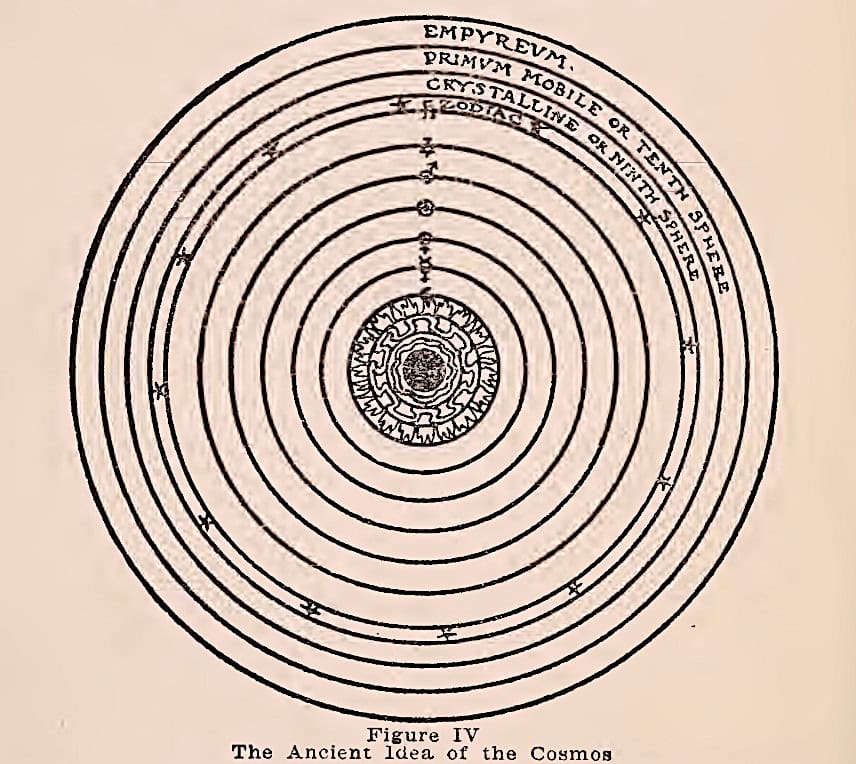
Jones also considers spirit identity, the Ouija board, contact with the unseen world, whether the physical crystal even needs to remain visible, the ancient conception of the cosmos, and what he calls the “Magic Mirror of the Universe.” The important development is that the physical object is becoming less necessary as the student’s understanding of the process increases. This movement from the visible instrument toward the faculty operating through it becomes one of the central teachings of the book.
The Ancient Methods of Crystal Vision
Chapter IV turns to older systems associated with Trithemius of Spanheim and Francis Barrett. Jones examines ceremonial preparations involving the circle, Holy Table, invocation, consecration, conjuration, planetary hours, Divine Names, and magical instruments.
He does not treat these objects as automatically powerful. Their value depends upon understanding what they represent and knowing how to use them. His discussion of the magical wand makes this especially clear.
“The True Wand is the Divine Will in Man” (p. 69). The physical wand is a symbol of that Will. To someone who does not understand it, Jones says, it may be little more than a stick of wood. To someone who understands its meaning and has developed the corresponding faculty, it represents something within the operator.
This repeats on a more advanced level what Jones has already done with the crystal. The physical implement is not the final source of power. The instrument gives objective form to something that must be awakened, understood, and consciously employed by the individual.
The book’s numerous ceremonial details can obscure this point if read separately. Jones is gradually translating the equipment of ceremonial Western esotericism into faculties and forces of the person performing the work.
John Dee, Edward Kelley, and the Inner Organs of Vision
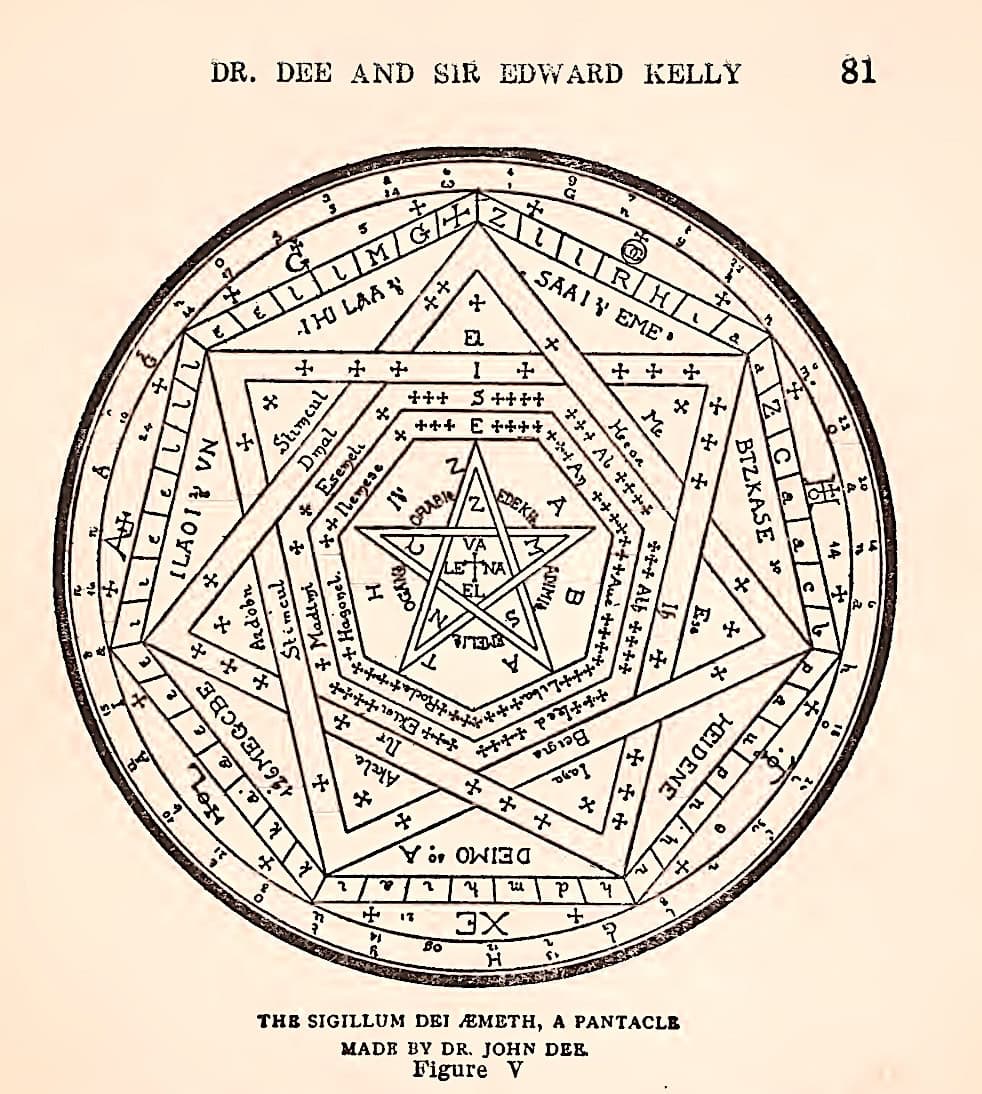
Chapter V continues the historical examination through the crystal work of John Dee and Edward Kelley. Jones discusses banishing and invoking, incense, preparation, the dangers of performing operations without understanding them, and the visions recorded by the seventeenth-century crystal gazers.
His interest in Dee and Kelley is not simply antiquarian. Their work provides a historical example of a disciplined attempt to obtain information through vision. Jones is concerned with how such operations were constructed, why preparation mattered, and how the seer’s state affected the result.
The chapter ends by turning again toward the “Inner Organs of Vision.” This prepares the decisive change in Chapter VI. Having spent much of the book discussing crystals, ceremonial instruments, invocations, and historical methods, Jones can now ask what faculty is actually seeing.
Images from the book of John Dee and Sir Edward Kelly’s Sigil of the Pentacle and the Cosmos
Crystal Gazing and the Attainment of Crystal Vision
Chapter VI opens by making a distinction that explains the entire book. There is a difference between obtaining visions through a crystal and attaining “Crystal Vision.”
Ordinary crystal gazing involves concentrating attention upon the Lesser Crystalline Sphere. Images may then arise, but the operator has limited control over what appears. Jones writes that such visions might be pleasant or unpleasant, symbolic or actual, and concerned with the past, present, or future. Their usefulness depends upon the seer’s ability to comprehend them and upon the seer’s own inner state (p. 87).
The higher objective is controlled vision.
Jones introduces creative imagination and the possibility of obtaining a definite type of result. Concentration is no longer directed merely outward toward a glass sphere. The student learns to construct and hold a mental image with sufficient steadiness that competing thoughts disappear.
His example is a Red Triangle. After sufficient training, the student should be able to hold it before the mental vision at will. Jones explains that doing so means consciousness has excluded every other thought except the selected image. He then describes a “rushing together of the Seer and the Seen” in which the mind becomes “CRYSTAL CLEAR” (p. 93).
Jones then gives the resulting state a specific Yogi philosophy identification. “We shall have obtained, what in Raja Yoga is called, Dhyana” (p. 93). More important, he explicitly judges this internal attainment to be vastly more valuable than an ordinary vision obtained by directing concentration outward into the physical crystal.
At this point the subtitle The Crystal as a Stepping-Stone to Clear Vision has been fulfilled. The student began by staring into a crystal. The advanced student has learned to make the mind itself crystal clear.
Creative Imagination, Will, and the Body of Light
Once concentration can be controlled internally, Jones extends the method into creative imagination and willed vision. Instead of passively waiting to see whatever may appear, the operator establishes a purpose and directs consciousness toward a definite result.
Jones then applies concentrated consciousness to the formation of what he calls the “Body of Light” or “Astral Body.” He states that once a person has learned to concentrate, this Body of Light can be formed and eventually separated from the physical body while consciousness is retained. The student can then, within Jones’s occult system, learn to travel on the Astral Plane (p. 93).
The chapter also presents examples of symbolic and initiatory visions. Jones considers these far more valuable than the average “crystal reading.” Near the chapter’s conclusion he returns to the principle that has governed the book from its opening pages. Concentration acquired through earnest crystal practice may lead to visions of a higher character if the student is sufficiently concerned with truth “to learn to make his own Inner Vision, Crystal Clear” (p. 101).
The object has now become the metaphor for the perfected faculty.
The Ultimate Crystal
The final chapter carries this interiorization to its endpoint. Jones provides maxims, discusses intermediate types of vision, recounts an astral journey of his own, records his Guru’s criticism of errors in the work, and gives another example of a deliberately willed vision undertaken to obtain definite information.
The final meaning of the crystal is then revealed through what Jones calls Star Consciousness.
Drawing upon Liber Legis, Jones introduces the statement “Every man and every woman is a star.” He interprets the star as something located at the center of individual being. “At the CENTRE of our Being is the Star of Unconquered Will, that is the True or Divine Will, the Will of the Universe” (p. 115). The individual is instructed to discover this Star and bring the personal will into alignment with it.
Jones then joins this final Star directly to the symbolism introduced at the beginning of the book. The Star is the “Diamond Soul” and “the ULTIMATE CRYSTAL” (p. 115). Once this central light has been discovered, the student must learn to concentrate the mind upon it. This, Jones says, begins the “Ultimate Practice of Crystal Gazing” (p. 115).
The physical crystal of Chapter I has disappeared from the essential operation. The Lesser Crystalline Sphere trained the student to focus. The Greater Crystalline Sphere directed attention toward the human soul. The Universal Crystalline Sphere placed the individual within a corresponding universal order. The Ultimate Crystal is discovered at the center of the individual as the “Star of Unconquered Will.”
How Does Crystal Vision Fit with the Yogi Publication Society?
Crystal Vision fits closely within the program of the Yogi Publication Society because Jones does with ceremonial crystal gazing what numerous earlier YPS books had done with other occult subjects. He takes an external phenomenon commonly treated as mysterious and directs the reader toward concentration, Will, trained attention, mental control, latent human powers, and conscious development.
The connection is especially clear beside the YPS book Clairvoyance by Swami Panchadasi, published in 1916. Panchadasi had already told YPS readers that the crystal did not possess the power responsible for clairvoyant vision. “The crystal, etc., serves to focus the psychic energy of the person,” and “serves merely as a physical instrument for the astral vision” (p. 97). Elsewhere the same work states the principle even more directly. “There is no supernatural virtue in the crystal itself—it is merely a means to an end; a piece of useful apparatus to aid in the production of certain phenomena” (p. 25).
Jones begins his 1923 book at almost exactly this point and carries the idea much further. His crystal is a “stepping-stone to the development of his latent powers of clear vision” (p. 1). On page 2 it becomes a “stepping-stone towards Self-knowledge.” By page 93, concentration has moved inside the operator, where the student learns to hold a chosen image until other thoughts disappear and the mind becomes “CRYSTAL CLEAR.” By page 115, the final crystal is no longer an external object at all. It is the “Diamond Soul” and “Star of Unconquered Will” within the individual.
This also places the book in the line of mental training that had been present behind YPS from its beginnings in the work of Herbert A. Parkyn and his Special Mail Course in Hypnotism and Suggestive Therapeutics. Parkyn’s system had already made attention, concentration, Will, repeated mental training, suggestion, and the conscious direction of the mind fundamental to the development of human ability. Those principles passed into the early mental-science literature associated with William Walker Atkinson and then appeared throughout YPS under different subjects and authorial identities.
Jones is not simply repeating Parkyn’s psychology, and Crystal Vision should not be reduced to it. His framework is ceremonial and initiatory, drawing upon magic, astral work, Qabalah, Hermeticism, Raja Yoga, and his own system of True Will. Yet the operating principle makes the book a natural YPS publication. The external apparatus is progressively subordinated to the trained powers of the individual.
One of the clearest examples occurs in Jones’s treatment of the wand. The ceremonial object is not itself the real power. “The True Wand is the Divine Will in Man” (p. 69). The same structure governs his treatment of the crystal. First the student learns to use an external object. Then the student discovers the faculty represented by that object and learns to exercise it consciously.
That progression also explains why the book belongs beside the works of Yogi Ramacharaka, Theron Q. Dumont, and Swami Panchadasi despite its very different magical vocabulary. Jones even identifies the crystal-clear condition produced by complete internal concentration with the Raja Yoga state of Dhyana (p. 93). The YPS reader who had encountered concentration through Yogi philosophy, Will and mental control through the mental-science books, and crystal gazing through Clairvoyance could enter Jones’s work with much of its underlying mental mechanism already familiar.
The significance of Crystal Vision within YPS is found in this progression. The book begins with a crystal ball and ends with the mind. It begins by teaching the reader how to prepare an external instrument and ends by teaching that the “Ultimate Crystal” is found within the individual. Between those points, crystal gazing becomes concentration, concentration becomes controlled inner vision, controlled vision becomes an exercise of Will, and the polished sphere that first attracted the student’s eyes becomes a symbol of the clarity the student is attempting to produce in consciousness itself.
In that respect, Jones states the purpose of the book most clearly before Chapter I even begins. The Foreword addresses those seeking “to make their own Vision more Perfect, so that the Light of Truth may focus itself within them” (p. viii). Crystal Vision is his explanation of how the crystal may begin that process, why it must eventually be surpassed, and what the student is supposed to discover when the direction of vision finally turns inward.
“Fortunately the Soul of man is Plastic and unlike the Hard Crystal Globe, may be easily worked upon and re-moulded nearer to the heart’s desire.”
Charles Stansfeld Jones Biography
Charles Stansfeld Jones (1886–1950), known as Frater Achad, was a Canadian occultist, ceremonial magician, and author. He became one of the first and most influential interpreters of Thelema, the religious and philosophical system started by Aleister Crowley. Jones was originally trained as an accountant and became interested in Spiritualism early on. He discovered Crowley’s writings in The Equinox. In 1909, he joined Crowley’s magical order, the A∴A∴, as the twentieth Probationer and took the Hebrew motto Achad, meaning “unity,” which became his well-known name.
Jones moved quickly through Crowley’s magical system and became one of his closest followers. In 1916, after Jones claimed the grade of Magister Templi, Crowley saw him as his long-expected “magical child” and spiritual heir. Crowley believed that Jones’ mystical achievements fulfilled prophecies in The Book of the Law. Jones’ unique interpretations of Thelemic teachings, especially his work on the Qabalistic symbolism in Liber AL vel Legis, had a strong impact on Crowley’s later views.
Outside of his work with the A∴A∴, Jones played a key role in organizing the Ordo Templi Orientis (O.T.O.) in North America. He set up British Columbia Lodge No. 1 and helped bring the Order’s initiatory system to Canada and the United States. Although he and Crowley later disagreed over doctrine, money, and leadership, Jones stayed active in the occult revival. He served as National Grand Master for North America for a time before they eventually parted ways.
Jones was always interested in psychic development, ceremonial magic, and Western esotericism. In his books, like Crystal Vision Through Crystal Gazing, he described practices such as crystal gazing, visualization, and clairvoyance as ways to develop higher states of consciousness, not just as fortune-telling. In the 1920s, he joined the Universal Brotherhood and later became its Mahaguru. He eventually converted to Roman Catholicism but continued to study mystical philosophy throughout his life.
Today, Frater Achad is seen as one of the most original occult thinkers of the early twentieth century. His writings and leadership in several important esoteric groups helped shape modern ceremonial magic, Thelemic philosophy, and Western occultism. His books, published by the Yogi Publication Society, introduced many people to practical ways of developing psychic and spiritual abilities.
Thelema, ancient Greek for ‘divine will’, ‘desire’, or ‘pleasure’