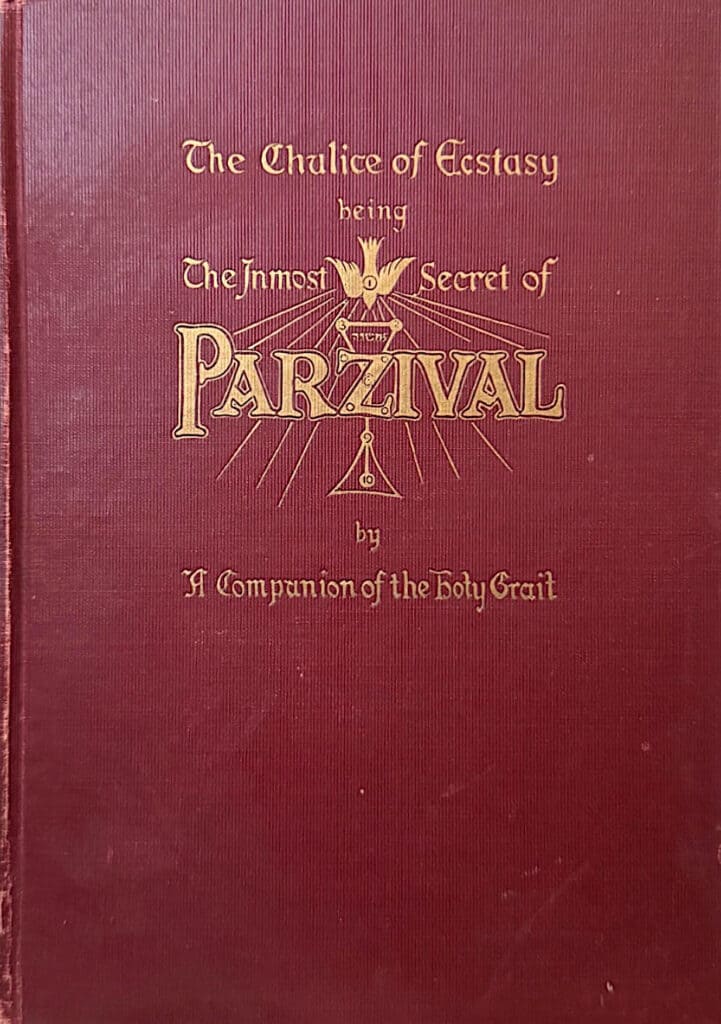
The Chalice of Ecstasy: Being a Magical and Qabalistic Interpretation of the Drama of Parzival was written by C. Stansfeld Jones under the name “A Companion of the Holy Grail,” and “sometimes called Frater Achad.” It was Published in Chicago in 1923 by the Yogi Publication Society. The book presents Richard Wagner’s Parsifal as far more than a retelling of the medieval Grail legend. Jones reads the drama as a representation of the Mystic Path, using the Qabalah, ceremonial magic, Rosicrucianism, Christian mysticism, Western esotericism, the Tree of Life, numerology, and the imagery of the Holy Grail to explain Parzival’s journey as an inward process of spiritual awakening.
What Is The Chalice of Ecstasy About?
Jones states the purpose of the book almost immediately. The Legend of Parzival represents what he calls “a glimpse of the Eternal Reality, the Ever-present Here and Now,” and the place where the Grail mystery occurs “need not be sought outside the Human Heart” (Introduction). The story is thus transferred from a distant legendary world into human consciousness. The Grail Temple, the wounded king, the spear, the swan, Parzival’s apparent foolishness, Kundry’s temptation, and the restoration of Amfortas are interpreted as parts of an initiatory drama taking place within the seeker.
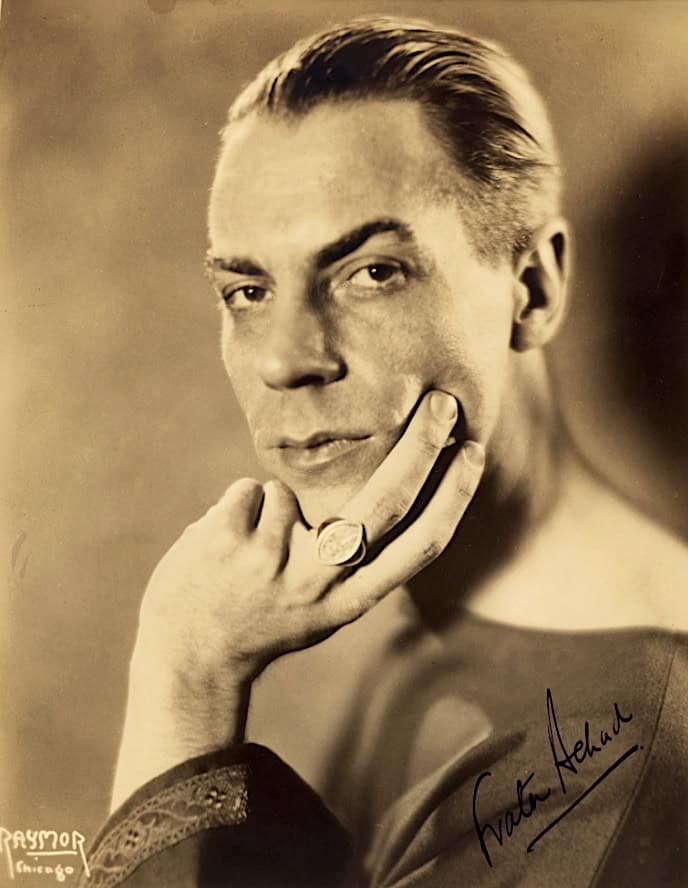
Charles Stansfeld Jones, also known as “Frater Achad,” meaning unity.
The introduction makes this inward reading explicit. Jones writes that those born of “Heart’s Affliction” must eventually reach the place where the Vision of the Grail is presented to their “pure Understanding.” His stated purpose is to awaken “some spark of the smouldering fire of this inner consciousness” until it burns through the veils separating man “from Himself—from God” (Introduction). The Grail legend becomes a map of awakening in which the events of Parzival describe stages through which consciousness passes on its way toward direct spiritual realization.
Why Is Ecstasy the Central Idea of the Book?
The first numbered section, “The Coming of Parzival,” gives the key to everything that follows. Jones asks, “What is the Key-note of Parzival?” His answer occupies a line by itself.
“ECSTASY!” (p. 3)
Ecstasy in this book does not mean ordinary emotional excitement. Jones quotes Frater Perdurabo to describe it as a state in which the soul is united with God and insists that the state is available “Here and Now” (pp. 3–4). For the Eastern seeker, meditation is named as the principal route. For the Western seeker, ceremonial practice is presented as an especially suitable method. The ritual repeatedly joins the mind to a pure idea through an act of Will until consciousness becomes wholly directed toward its object.
Jones then applies this directly to Wagner. Parsifal is treated as a form of sacred drama capable of acting upon the consciousness of its audience. He calls Wagner’s work the summit of a “Magical Mountain” and emphasizes Wagner’s designation of it as a “Stage-Consecrating Festival” (p. 5). Its characters and events can accordingly be read on two levels at once. They belong to the drama, while also representing forces, conditions, and transformations within consciousness.
What Does the Swan Represent?
Parzival enters Wagner’s drama after shooting a swan. Jones makes this apparently simple event one of the first major occult symbols in the book. “What is this Swan?
ECSTASY!” (p. 5)
The swan is associated with a condition that exists beyond ordinary appearances of motion and change. Jones follows this with a quoted mystical description beginning, “There is a Swan whose name is Ecstasy,” in which the Pure Fool shoots the Swan and thereby comes to the Temple of the Grail (p. 6). Parzival has unknowingly brought down the very symbol of the state he will spend the remainder of the drama learning to understand.
The lake beneath the swan receives its own interpretation. A calm lake represents “the human mind trained by the proper methods to Right Contemplation.” When the mind is still, Jones says, “the Sun of the true Self” can be reflected within it. Ecstasy follows when that Sun no longer appears merely as a reflection but enters the depths of Mind and sets the entire being aflame with the “Sacred Fire of the Holy Spirit” (p. 7).
What Do Parzival’s Bow and Arrow Mean?
Parzival’s weapon is transformed into another part of the initiatory symbolism. Jones calls it “The Bow of Promise and the Arrow of Pure Aspiration” (p. 7). Parzival has aimed upward and struck the object of his aspiration without yet understanding what he has done. His ignorance at this stage is important. He possesses the impulse toward attainment before possessing intellectual knowledge of the path.
Jones then places the arrow directly upon the Qabalistic Tree of Life. It corresponds to the Path of Samech and Sagittarius, the Archer. This is “The Path of the Arrow that cleaves the Rainbow,” extending from Yesod, the Foundation, to Tiphereth, the sphere of the Sun, Beauty and Harmony. Tiphereth is also identified with the Human Heart, “wherein the Mysteries of the Rosy Cross and of the Holy Grail are first—if dimly—perceived” (p. 8).
The physical arrow has become a symbol of directed aspiration. Parzival begins below, at the Foundation, and the arrow points toward the solar center of the Tree and the mysteries contained in the Heart.
Why Does the Eagle Also Represent Ecstasy?
Jones reminds the reader that Parzival had previously shot at an eagle. Once again he asks what the bird means and gives the same answer.
“ECSTASY!” (p. 8)
The eagle is the bird capable of gazing at the Sun and is connected with what Jones calls the “Might of Love,” a magical power capable of lifting the body into “High Ecstasy” (p. 8). The eagle is also identified as one of the Four Cherubic Beasts and one of the Four Powers of the Sphinx. Jones then connects it with Éliphas Lévi’s Azoth and the formula of Alpha and Omega.
Love is therefore not a secondary theme. It is one of the forces by which the ascent occurs. The book contrasts three responses to it through Amfortas, Klingsor, and Parzival. Amfortas submits to seduction and receives the wound. Klingsor attempts to escape the danger through rejection and mutilation and is excluded from the Grail community. Parzival must learn the right use of the same force. Jones’s lesson is not the destruction of Love but its transformation and direction toward the highest object.
Why Is Parzival Called the Pure Fool?
The “Pure Fool” is central to Jones’s interpretation because Parzival initially lacks the intellectual knowledge normally associated with an initiate. When Gurnemanz questions him, he cannot even supply his true identity. Jones explains that Parzival “did not as yet know his True Name—the Word of His Being” (p. 10). Yet beneath this ignorance is a deeper orientation toward the Grail.
When Parzival asks what the Grail is, Gurnemanz refuses to provide an ordinary definition. Knowledge of it cannot simply be handed from one person to another. Gurnemanz says that if Parzival is called to serve the Grail, knowledge of it will not remain hidden, because “No earthly road to it doth lead” (p. 10).
The exchange that follows supplies another important clue.
“I scarcely move, Yet swiftly seem to run.”
Gurnemanz answers,
“My son, thou seest Here SPACE and TIME are ONE.” (p. 10)
The journey to the Grail is not ordinary travel through geographical space. Jones has already located its mystery within the Human Heart and the Ever-present Here and Now. Parzival is entering a different order of experience.
What Is the Holy Grail in Jones’s Interpretation?
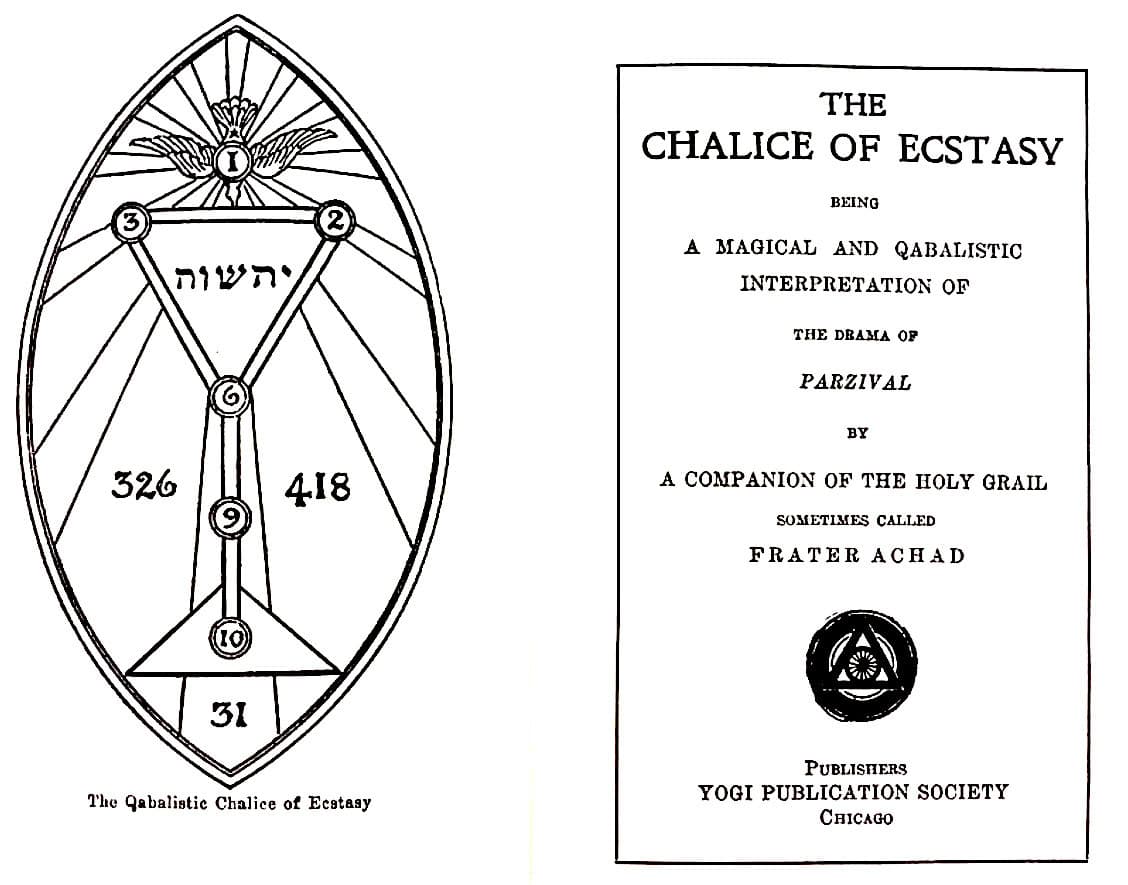
The Grail is both a mystical symbol and a Qabalistic structure. At the beginning of the volume Jones provides an illustration titled “The Qabalistic Chalice of Ecstasy.” The diagram is constructed from portions of the Tree of Life and includes the Sephiroth 1, 2, 3, 6, 9, and 10, together with the numbers 326, 418, and 31 and the Hebrew divine name יהשוה. The image announces before the main text begins that the Grail will be interpreted through Qabalistic correspondences.
The Qabalistic Chalice of Ectasy sigil and front page
The shape of the chalice is built from the Tree itself. Jones eventually explains that the upper Sephiroth form the bowl, while the lower portions provide its stem and base. The resulting figure is simultaneously the Tree of Life and the Chalice. The Grail is therefore not an isolated Christian relic inserted into a Qabalistic system. Jones makes the structure of the Qabalah itself disclose the form of the Grail.
This becomes explicit near the end of the book. The Sephiroth involved in the diagram are 1, 2, 3, 6, 9, and 10. Their sum is 31. Jones identifies 31 as the numerical value of both AL and LA, “God” and “Not,” which he calls the “Key to the Mysteries both of the Old Aeon and the New” (p. 82). For Jones, the apparent opposition between affirmation and negation is resolved in the final formula of Ecstasy.
What Is the Relationship Between the Grail and the Holy Spear?
The chalice cannot be understood apart from the spear. Jones develops them as complementary symbols. The Cup receives. The Spear directs and gives. Their union becomes one of the governing structures of the book.
This is also tied to Will. Parzival must recover the Holy Spear before the Grail can again be fully vivified. After leaving the Grail Temple, his task is not merely to find his way back. Jones writes that his “first duty is to seek the Holy Spear, the means whereby alone it may be vivified and enlightened” (p. 37).
Jones links this union to Pure Will and quotes Liber AL vel Legis in explaining that true Will must be free from attachment to results. He then identifies the Perfect Cup and Perfect Spear with Understanding and Wisdom and says that in Perfect Ecstasy even the distinction implied by knowledge disappears (p. 36).
The final restoration of the Spear is therefore inseparable from the restoration of the Grail.
What Do Amfortas and His Wound Represent?
Amfortas possesses the Grail but cannot properly exercise the power associated with it. His wound represents a disorder within the Grail mystery itself. The sacred forces represented by the Cup and Spear have been separated, and the king cannot heal himself.
This is why Parzival’s pity matters. His task is not simply personal illumination. His developing knowledge must become capable of restoring what has been wounded. The drama repeatedly joins Knowledge, Pity, Love, and Will. Parzival has to experience the suffering represented by Amfortas deeply enough to understand its cause before he can become its healer.
Near the conclusion, Amfortas recognizes Parzival’s Will because that Will has assumed its proper place and has become one with what Jones calls “THE WILL OF THE UNIVERSE” (p. 73). Parzival then declares that pity and knowledge have taught the Fool and raises the recovered Holy Spear.
What Is Kundry’s Role in Parzival’s Initiation?
Kundry becomes one of the decisive tests of Parzival’s development. Her temptation does not merely test whether he can resist sexual attraction. Through her kiss he receives a sudden comprehension of Amfortas’s wound and of the suffering connected with misdirected desire.
Jones uses the episode to distinguish a momentary experience from the continuous attainment Parzival seeks. Parzival refuses to exchange his quest for what Jones describes as a temporary reflection of ecstasy on the physical plane. He seeks “the Eternal Reality, the everpresent Here and Now” (p. 36).
Kundry even challenges him to abandon his redemptive mission and accept the immediate experience she offers. Parzival refuses because his newly discovered purpose extends beyond himself. Jones writes that he has recognized “the mission of Redeemer” and, after understanding the cause of Amfortas’s wound, determines to obtain the means of healing it (p. 37).
This marks a major change in Parzival. The Fool who accidentally struck the Swan of Ecstasy has begun consciously directing his Will toward the restoration of the Grail.
Why Are Love and Will So Important?
Jones does not present spiritual attainment as the suppression of human powers. Love, desire, Will, imagination, aspiration, and knowledge must be placed in their correct relationship.
The contrast between Amfortas, Klingsor, and Parzival illustrates this. Amfortas is wounded through the misuse of desire. Klingsor attempts to overcome the problem by destroying the faculty through which temptation operates. Parzival follows another course. He neither surrenders blindly nor destroys the force. He learns to direct it.
This is why the earlier symbols of the Arrow and Eagle matter. The Arrow is Pure Aspiration. The Eagle is the Might of Love. Both point toward Ecstasy. Love supplies power and aspiration supplies direction. Will keeps that power directed toward its true object.
Why Does Jones Treat Wagner’s Parsifal as a Magical Work?
Jones regards Wagner’s drama as capable of producing an alteration in consciousness. He is interested in the music, symbols, staging, words, characters, and ritual character of the performance as a combined operation.
He writes that the desired effect depends upon the drama being presented under conditions suitable to its sacred purpose. Wagner’s description of Parsifal as a “Stage-Consecrating Festival” becomes important because Jones understands the performance itself as an act whose effects can extend into “the Drama of Life” (p. 5).
The drama is thus interpreted in a manner closely connected with Western esotericism and ceremonial magic. Symbols are not merely objects to decode intellectually. Properly combined and contemplated, they can become instruments for changing consciousness.
What Is the Mystic Path in The Chalice of Ecstasy?
Jones tells the reader at the beginning that some familiarity with “The Mystic Path” and “The Holy Qabalah” will help in understanding his interpretation (p. 2). The remainder of the book then follows Parzival through such a path.
The movement begins with unconscious aspiration. Parzival strikes the Swan before he understands it. He is brought to the Grail Temple but fails to comprehend what he sees. He leaves and encounters suffering, desire, temptation, knowledge, and purpose. He learns compassion through Amfortas. He acquires the Spear. He returns to the Grail with a developed Will and the capacity to heal. What appeared at first as foolishness is transformed into wisdom without losing the purity that made the original aspiration possible.
The book’s title captures this structure. The “Chalice of Ecstasy” is simultaneously the Grail, a Qabalistic figure, a symbol of receptive consciousness, and the vessel in which the culmination of the mystical process becomes possible.
What Does the Qabalistic Chalice Diagram Mean?
The frontispiece is one of the most important parts of the volume. Jones literally draws a chalice out of the Tree of Life. The numbered Sephiroth 1, 2, 3, 6, 9, and 10 form its principal structure. The upper triad creates the broad bowl, Tiphereth occupies the central region, and Yesod and Malkuth form the descending stem and base. The author analyzes characters, places, and names using Hebrew letter values, with numbers like 333, 418, 666, and 777 explained through his magical system. Figures such as Parzival, Gurnemanz, Amfortas, Titurel, Klingsor, and Monsalvat are given number meanings to show hidden links between the story and the Tree of Life. The author claims these patterns prove that Wagner’s work reflects universal occult ideas, whether he meant it or not.
This also explains the importance assigned earlier to the Path of Samech. The Arrow of Aspiration moves from Yesod toward Tiphereth. Parzival’s weapon is therefore mapped onto the same spiritual anatomy from which Jones constructs his Grail. At the end of the numerical interpretation Jones adds the values of the Sephiroth forming the chalice.
1 + 2 + 3 + 6 + 9 + 10 = 31.
He then identifies 31 with AL and LA. The Chalice has become a numerical formula as well as a visual one. The other conspicuous numbers in the illustration, including 418 and 326, show that Jones expects the reader to approach the image through gematria and the numerical correspondences of his magical system. The frontispiece is therefore a compact visual statement of the argument developed throughout the book.
How Does Parzival Complete the Quest?
The completion of the quest occurs when the symbols that have been separated are reunited. Parzival returns possessing the Holy Spear and now understands the suffering he once witnessed without comprehension.
At the climax he raises the Spear and commands that the Grail be revealed.
“Hid be no more that shape divine; Uncover the Grail! Open the Shrine!” (p. 73)
Jones then writes, “Thus, and not otherwise, came Parzival into his own” (p. 73).
This final statement gives the journey its full meaning. Parzival has not merely acquired a sacred object. He has “come into his own.” The external quest has disclosed his true identity, his Will, and his relationship to the mystery he originally approached as an ignorant Fool.
The Grail Temple is accordingly transformed. Jones begins the next sentence by saying that “The Temple of the Chalice of Ecstasy is now, for him, The Palace of the…” (p. 73). The transformation of the Temple corresponds to the transformation of Parzival himself.
Why Did The Chalice of Ecstasy Fit the Yogi Publication Society?
The Chalice of Ecstasy fits closely with the program of the Yogi Publication Society because Jones takes an occult and mystical system and presents its attainment as a process accomplished through the deliberate training and direction of consciousness. The language is Qabalistic and magical, and the immediate subject is Wagner’s Parsifal, yet the method repeatedly returns to concentrated thought, controlled attention, contemplation, Will, repeated mental direction, the creation of an inward state, and the outward expression of that state in action. Jones explains ceremonial practice as a means of repeatedly joining the mind to a selected idea through an act of Will until consciousness becomes wholly directed toward its object. The calm lake becomes an image of “the human mind trained by the proper methods to Right Contemplation,” while the Arrow becomes “Pure Aspiration,” deliberately directed from Yesod toward Tiphereth and the Human Heart.
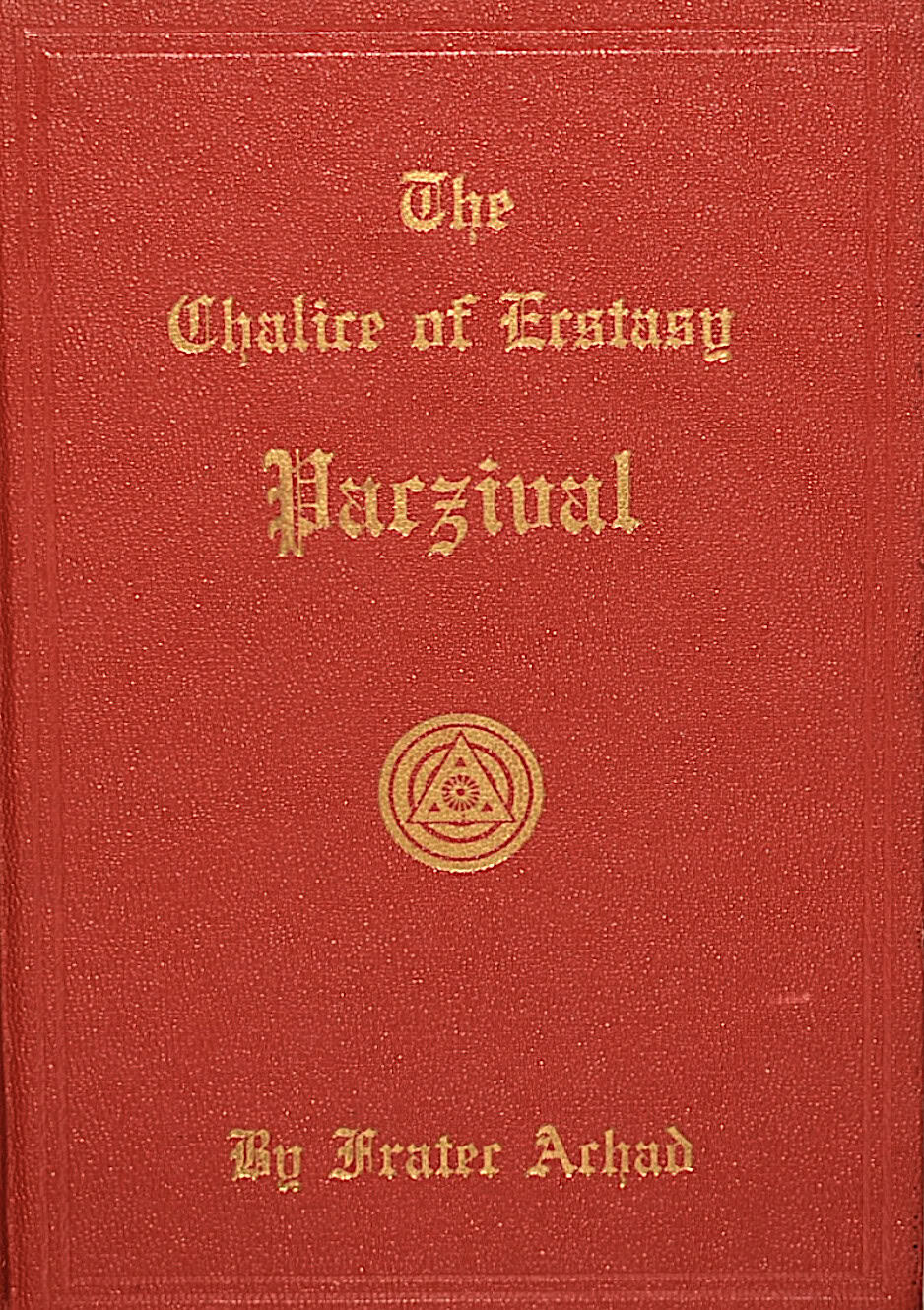
The 1976 YPS edition of The Chalice of Ecstasy, Parzival by Frater Achad
The entire quest depends upon learning to direct forces that first appear uncontrolled. Love, desire, imagination, aspiration, knowledge, and Will are progressively brought into a conscious relationship until Parzival can act from what Jones identifies as the “WILL OF THE UNIVERSE.” These teachings gave the book a natural place beside YPS works on Yogi philosophy, Hermeticism, Qabalah, Rosicrucianism, personal magnetism, and the deliberate development of latent mental and spiritual powers.
There is also a deeper continuity with the teaching of suggestion that preceded YPS in the work of Herbert A. Parkyn and his Chicago School of Psychology. Parkyn’s Special Mail Course in Hypnotism and Suggestive Therapeutics taught students that thought could be deliberately selected, concentrated upon, repeated, and impressed upon the mind until it altered habitual mental activity and found expression in action. His system placed voluntary attention and Will at the center of self-directed mental development.
The book shows a continued presence within the YPS catalog of the same fundamental method applied to a very different field. Jones asks the aspirant to select a pure idea, concentrate the mind upon it, reinforce it through ceremonial action and Will, exclude competing mental activity, and continue until the idea ceases to be merely intellectual and becomes an experienced state of consciousness. In Parkyn’s school this process had been explained through psychology, attention, suggestion, auto-suggestion, habit, and action. Jones expresses it through magic, Qabalah, aspiration, the Grail, and Ecstasy.
This continuity can also be followed through the books issued under William Walker Atkinson, Yogi Ramacharaka, Theron Q. Dumont, Swami Panchadasi, and the Three Initiates. One book may speak of concentration and mental control, another of Raja Yoga, another of personal magnetism, another of psychic influence, and The Kybalion of Mental Transmutation. The Chalice of Ecstasy carries the same emphasis into Western esotericism. Its aspirant must cease allowing desire and ordinary reaction to determine consciousness, establish control of attention, direct aspiration toward a chosen end, and transform the forces already present within himself. The Grail drama becomes another YPS presentation of consciously directed inner development, this time expressed through the symbolic language of the Holy Grail, the Tree of Life, ceremonial magic, and the Mystic Path.
What Is the Main Teaching of The Chalice of Ecstasy?
The Chalice of Ecstasy presents the Parzival legend as a symbolic account of spiritual initiation. Jones takes the characters and objects of Wagner’s drama and gives each a place within an interconnected magical and Qabalistic system. The Swan is Ecstasy. The calm lake is the contemplative mind. The Sun is the true Self. The Arrow is Pure Aspiration. Samech provides its path upon the Tree of Life. Tiphereth is the solar center and Human Heart. The Eagle is the power of Love. The Cup is Understanding and receptivity. The Spear expresses the complementary active force of Will. Amfortas embodies the wound produced when these powers are disordered. Kundry becomes the means through which Parzival awakens to the meaning of that wound. The Pure Fool becomes the healer because his aspiration, compassion, knowledge, Love, and Will are finally united.
The result is one of the more explicitly Qabalistic works issued by the Yogi Publication Society. It places the Christian Grail legend, Wagner’s Parsifal, ceremonial magic, the Rosy Cross, the Tree of Life, gematria, and mystical ecstasy inside a single interpretive structure. Its central claim is stated at the beginning and carried through the entire book. The Grail mystery is not something to be recovered from a lost historical past or discovered at a remote sacred location. Its drama occurs within the Human Heart, and its destination is the “Eternal Reality” of the “Ever-present Here and Now.”
Charles Stansfeld Jones Biography
Charles Stansfeld Jones (1886–1950), known as Frater Achad, was a Canadian occultist, ceremonial magician, and author. He became one of the first and most influential interpreters of Thelema, the religious and philosophical system started by Aleister Crowley. Jones was originally trained as an accountant and became interested in Spiritualism early on. He discovered Crowley’s writings in The Equinox. In 1909, he joined Crowley’s magical order, the A∴A∴, as the twentieth Probationer and took the Hebrew motto Achad, meaning “unity,” which became his well-known name.
Jones moved quickly through Crowley’s magical system and became one of his closest followers. In 1916, after Jones claimed the grade of Magister Templi, Crowley saw him as his long-expected “magical child” and spiritual heir. Crowley believed that Jones’ mystical achievements fulfilled prophecies in The Book of the Law. Jones’ unique interpretations of Thelemic teachings, especially his work on the Qabalistic symbolism in Liber AL vel Legis, had a strong impact on Crowley’s later views.
Thelema, ancient Greek for ‘divine will’, ‘desire’, or ‘pleasure’
Outside of his work with the A∴A∴, Jones played a key role in organizing the Ordo Templi Orientis (O.T.O.) in North America. He set up British Columbia Lodge No. 1 and helped bring the Order’s initiatory system to Canada and the United States. Although he and Crowley later disagreed over doctrine, money, and leadership, Jones stayed active in the occult revival. He served as National Grand Master for North America for a time before they eventually parted ways.
Jones was always interested in psychic development, ceremonial magic, and Western esotericism. In his books, like Crystal Vision Through Crystal Gazing, he described practices such as crystal gazing, visualization, and clairvoyance as ways to develop higher states of consciousness, not just as fortune-telling. In the 1920s, he joined the Universal Brotherhood and later became its Mahaguru. He eventually converted to Roman Catholicism but continued to study mystical philosophy throughout his life.
Today, Frater Achad is seen as one of the most original occult thinkers of the early twentieth century. His writings and leadership in several important esoteric groups helped shape modern ceremonial magic, Thelemic philosophy, and Western occultism. His books, published by the Yogi Publication Society, introduced many people to practical ways of developing psychic and spiritual abilities.
Related Research Articles
From Suggestion to the Seven Hermetic Principles: Herbert A. Parkyn and the Psychological Roots of The Kybalion
An examination of the roots of The Kybalion’s Seven Hermetic Principles and their parallels with Herbert A. Parkyn’s system of Suggestive Therapeutics.
The Sacred Geometry of the Yogi Publication Society Logo
This article examines the Yogi Publication Society logo and its sacred geometry meaning, comparing it with Hindu, Hermetic, Rosicrucian, Masonic, and Theosophical traditions to show the intention behind the publishing network.
Who Was the Author Behind the Name “Bhikshu”? The Case of Swami Pareswara Bikshu vs. Charles Henry Allan Bennett
The identity of the author who wrote under the name Bhikshu remains an iunresolved question in the history of the Yogi Publication Society. The case of Swami Pareswara Bikshu vs. Charles Henry Allan Bennett.