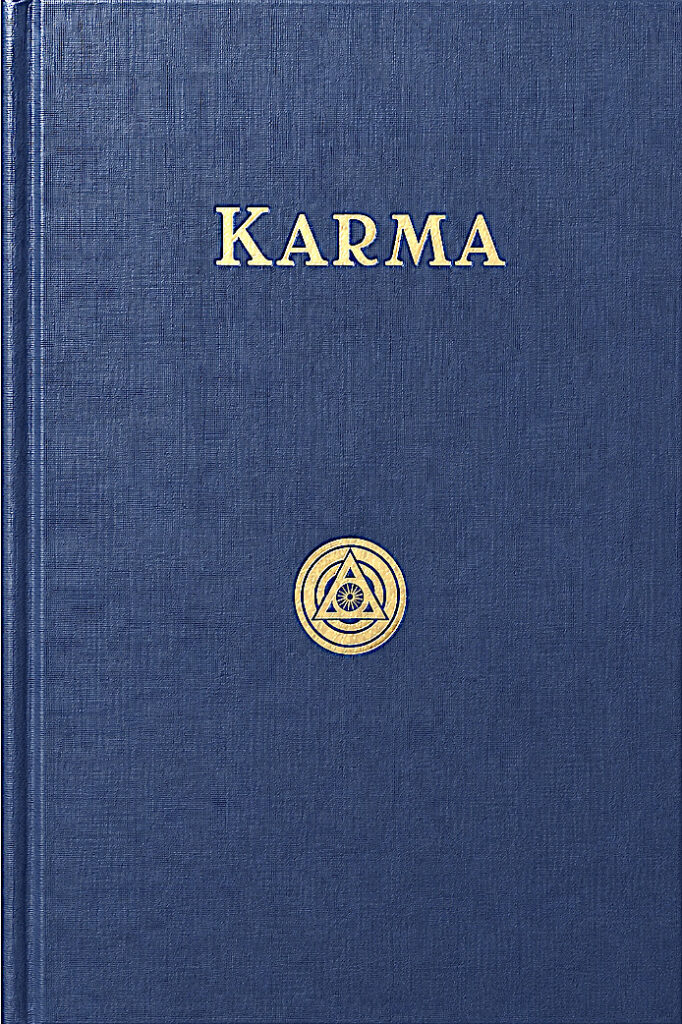
Karma is an occult novel by A. P. Sinnett that uses a large cast of characters, romantic relationships, clairvoyant experiences, past-life investigations, and discussions of psychic science to explain karma and reincarnation through a fictional story. Sinnett originally published the novel in London through Chapman and Hall in 1885, more than twenty-five years before the Yogi Publication Society edition in 1911. The original work appeared in two volumes, while the YPS edition brings the story together as a single volume. The book’s inclusion within the YPS catalog was highly consistent with the books YPS was publishing and reprinting during this period. Sinnett turns ideas associated with Theosophy, reincarnation, astral perception, psychic development, and the hidden laws governing human existence into a narrative in which those teachings can be watched operating through the lives of individual people.
The central idea of the novel is remarkably simple. Human life cannot be understood by examining a single incarnation. Character, circumstance, ability, suffering, attraction, opportunity, and even some of the relationships between people are parts of a much longer chain of cause and effect extending across successive lives. Sinnett develops this through the mysterious Baron Friedrich von Mondstern and a group assembled at his castle of Heiligenfels to investigate psychic phenomena. What begins almost as a country-house novel gradually becomes an extended demonstration of occult philosophy. Clairvoyance leads to questions about the astral world. Psychic development leads to reincarnation. Reincarnation leads to Karma. Karma then becomes the mechanism through which the personal dramas already unfolding among the characters acquire another dimension. The central teaching is eventually stated with unusual precision when Baron Friedrich describes karma as the equivalent of the conservation of energy operating on the moral and spiritual levels of nature.
What Is Karma About?
The novel begins with preparations for an unusual gathering at Heiligenfels, Baron Friedrich’s restored castle overlooking the Rhine. Mrs. Miller has been given control of the household and invited a collection of friends and acquaintances who share some interest in psychic questions. The company includes Captain and Mrs. Miller, Lucy Vaughan and her mother, Claude Merland, Annerly, Willie Blane, Mrs. Lakesby, Professor Massilton, and others. Baron Friedrich remains the intellectual and spiritual center of the gathering even when he is physically absent. The castle has been chosen as a place where people can read, converse, experiment, and investigate what the characters call psychic matters. Sinnett establishes this purpose almost immediately. Mrs. Miller explains that the guests have been selected because they have shown an intelligent interest in psychic inquiry and that serious reading is intended to provide the foundation for their discussions.
This arrangement allows Sinnett to write a novel that functions at the same time as an introduction to occult philosophy. One character can raise the objections that an ordinary reader might have. Another can misunderstand a teaching. A clairvoyant experience can introduce a new problem. Baron Friedrich can then supply an explanation. Romantic attachments and personal ambitions test whether the philosophical principles being discussed have any force when applied to actual human conduct. The result resembles an instructional dialogue placed inside a social novel. The reader learns about reincarnation and karma while following the fortunes of people whose own lives are gradually shown to be examples of those laws.
The physical setting reinforces this structure. Heiligenfels stands apart from ordinary social life. The guests arrive with their existing assumptions, desires, prejudices, romances, and intellectual habits, then enter an environment in which those assumptions are repeatedly challenged. The castle becomes a temporary school of psychic investigation. Baron Friedrich is less a conventional host than a guide who allows experiences to develop and explains their significance only when the participants are ready to understand them.
The Purpose of the Gathering at Heiligenfels
The early chapters establish a progression from curiosity about unusual phenomena toward a much more demanding conception of occult study. At first some members of the party approach psychic subjects almost as entertainment. Clairvoyance, apparitions, unusual perceptions, and unexplained manifestations are exciting because they seem mysterious. Baron Friedrich gradually redirects attention away from marvels themselves and toward what they might reveal about human nature.
This distinction becomes central to the book. Psychic phenomena are valuable to Sinnett because they can provide evidence that ordinary physical consciousness does not exhaust the possibilities of human existence. If consciousness can function beyond the ordinary senses, then materialism becomes inadequate as a complete explanation of man. Once that possibility is admitted, questions about survival, the astral plane, reincarnation, and spiritual evolution become open to investigation.
The Baron eventually describes psychic science as a means by which dormant faculties can be developed until the individual gains knowledge through direct perception. He contrasts this with accepting religious propositions solely because some authority has declared them true. Humanity, in his analogy, eventually reaches a stage where it must advance beyond the intellectual dependence appropriate to childhood. Psychic development offers a route toward direct knowledge of spiritual truth. Guides and instructors may be necessary, but the goal is the awakening of faculties within the student.
This idea helps explain why the novel would have fitted so comfortably into the later YPS catalogue. The early Yogi Ramacharaka books repeatedly present occult knowledge as something governed by natural laws and potentially open to investigation and development. YPS advertising even described its program as covering the physical, mental, psychical, and spiritual planes of Hindu-Yogi philosophy. Sinnett’s novel moves through almost exactly that ascending range, beginning with ordinary people and physical circumstances and gradually introducing psychic perception, the astral world, reincarnation, karma, and spiritual development.
Clairvoyance Becomes the Doorway into Occult Science
Mrs. Lakesby becomes one of the most important characters because of her clairvoyant abilities. Her experiences provide the group with phenomena that cannot easily be dismissed as philosophical speculation. Instead of having Baron Friedrich merely lecture on clairvoyance, Sinnett allows the characters to encounter it and then debate what it means.
The importance of this method becomes clearer as the novel develops. Clairvoyance is not presented merely as seeing something at a distance. It can reach into conditions ordinarily hidden from physical perception and eventually becomes a means of examining scenes connected with former incarnations. The party begins to realize that psychic sight may offer access to information about the continuity of individual existence.
Sinnett also distinguishes between possessing unusual psychic faculties and attaining spiritual advancement. Psychic sensitivity can make a person useful in investigation, but it does not automatically establish spiritual superiority. When Merland asks whether a person lacking psychic gifts can advance in occult development, Baron Friedrich tells him that a strong and pure character is more important than possessing unusual faculties at the beginning. Psychic gifts may make their possessor useful to others, yet the deeper purpose of occult development concerns the transformation of the individual.
That distinction is important throughout YPS literature as well. Later works published under names such as Swami Bhakta Vishita and Swami Panchadasi would devote entire books to clairvoyance, psychometry, astral perception, thought transmission, and related faculties. Karma provides an earlier fictional treatment in which the same class of phenomena serves as the opening into a larger philosophy of human development.
What Does Sinnett Mean by the Higher Life?
As the investigations at Heiligenfels deepen, the characters confront a more serious question. If occult knowledge is real, what should a person do with it? Annerly and Merland become important vehicles for this problem. The attraction of an occult life begins competing with ordinary ambitions and romantic attachments. Annerly becomes increasingly convinced that the discovery of a higher order of existence demands a corresponding change in how he lives. He considers formally dedicating himself to spiritual development and wonders whether ordinary pleasures and relationships are distractions from that path. Merland faces similar tensions.
Sinnett does not make the answer simple. The book repeatedly warns against seeking occultism for excitement, personal vanity, or psychic power. Baron Friedrich is especially suspicious of fascination with one’s former incarnations. When the possibility of recovering information about previous lives is raised, he warns that such knowledge could merely feed personal vanity. The legitimate reason for investigating former lives is to understand the spiritual condition and karmic tendencies of the present personality. The student should be trying to escape excessive interest in the personal self, not enlarge it by accumulating dramatic stories about who he may once have been.
This gives Karma a moral dimension beyond its supernatural plot. The higher life is defined by purification of motive, self-command, usefulness to others, and a widening identification beyond the immediate personality. Psychic development without corresponding moral development can become another form of selfishness.
Reincarnation as the Missing Part of Human Evolution
Reincarnation supplies the foundation for Sinnett’s explanation of karma. Baron Friedrich argues that the visible inequalities of life cannot be adequately understood if human existence begins at birth and ends at death. The apparent injustice of one person entering life under fortunate circumstances while another begins amid suffering presents a serious moral problem if each life is an isolated event.
The Baron proposes repeated incarnation as the missing element. Human beings return to physical existence under circumstances connected with their previous actions and development. He even describes reincarnation as the completion of the evolutionary idea already accepted in the physical sciences. Evolution does not stop with bodies. The individual consciousness also undergoes a long process of development through successive lives.
The point is not merely that the same personality repeatedly returns. Sinnett distinguishes the enduring human Ego from the temporary personality belonging to one particular incarnation. A lifetime supplies experiences, choices, aspirations, failures, and achievements. Between physical lives, those experiences are assimilated into character. When another incarnation begins, the individual normally does not retain an ordinary autobiographical memory of previous lives, yet their results remain embedded in the character and conditions with which the new life begins. This is one of the book’s most important explanations. Forgetting a former life does not mean that the former life has disappeared. Its accumulated result has become part of the person.
Karma as the Conservation of Moral and Spiritual Energy
Sinnett gives his clearest definition of the book’s governing idea during the discussions at Heiligenfels. Baron Friedrich explains that efforts made toward spiritual development cannot simply disappear. A person may spend an entire incarnation struggling toward a faculty or quality without completely attaining it, yet the effort remains part of the continuing development of the Ego.
He then states the principle in scientific language. Just as physical force cannot be exerted without entering the chain of physical causation, no act or effort is without consequences in the moral and spiritual order. His memorable formulation is that the law of karma is “the law of the conservation of energy on the moral and spiritual planes of nature.”
This is one of the most interesting features of Karma. Sinnett is translating an Eastern religious and philosophical idea into the vocabulary of nineteenth-century Western science. Karma is presented as law. It does not require a supernatural judge deciding how much reward or punishment a person deserves. Effects proceed from causes.
When Mrs. Miller interprets karma more conventionally as reward or punishment for good and bad conduct, Baron Friedrich accepts the language only with an important qualification. Karma is reward and punishment in the sense that actions generate appropriate consequences, yet these consequences are not externally assigned. They form an inevitable causal sequence. Karma affects both the circumstances into which a person is born and the character that person carries into the new incarnation.
The scientific analogy would later become extremely familiar in Western esotericism and in YPS literature. Karma is an early and unusually explicit example of the attempt to explain moral causation through the nineteenth-century scientific principle of conservation.
Does Karma Eliminate Free Will?
Sinnett recognizes immediately that his explanation creates another problem. If present character and circumstances have been produced by past karma, how much freedom does anyone actually possess? Professor Massilton raises the objection directly. A person enters life with a certain character and is placed in circumstances he did not consciously choose. The cautious man acts cautiously because that is his disposition. The impulsive man acts impulsively. If both character and circumstances are karmically determined, it might seem that the next set of actions follows automatically.
Baron Friedrich answers by treating karma as a continuing process. Present tendencies may be powerful, yet the individual can either reinforce or resist them. The direction in which a person exercises the will changes the character being formed for the future. Someone repeatedly yielding to a tendency strengthens it. Someone repeatedly struggling against it begins changing the direction of development. The result becomes part of the character carried forward into another incarnation.
Karma is thus both inheritance and creation. A person receives the consequences of a past he has made and simultaneously creates the causes of a future he will inhabit. This becomes one of the strongest ethical arguments in the novel. Every effort matters because the individual exists across many lives. Failure during one lifetime is no longer final. Success during one lifetime is also not the end of development. Human character is being constructed continuously.
Why Don’t We Remember Our Previous Lives?
Sinnett addresses one of the obvious objections to reincarnation. If people have lived before, why do they normally remember nothing about those lives? The explanation depends upon his distinction between the enduring Ego and the temporary physical personality. The interval between incarnations is not described as unconsciousness or an empty waiting period. Sinnett presents it as a genuine spiritual existence and says that it is ordinarily more vivid and elevated than physical life. During this period the experiences of the preceding incarnation are assimilated. The details of physical events fade while their spiritual and psychological results become incorporated into character.
The new personality does not begin with a conscious memory of names, houses, occupations, and incidents from its predecessor. It begins with the character produced through those experiences. This allows Sinnett to explain talents, tendencies, moral dispositions, psychic capacities, and powerful attractions without requiring ordinary memory to pass intact from one incarnation to another. The book repeatedly treats present character as condensed history.
Mrs. Lakesby’s clairvoyant faculty becomes a good example. Baron Friedrich suggests that an unusual psychic ability appearing in the present life may be the result of cultivation during a former one. What looks like an unexplained natural gift can be interpreted as an acquired capacity whose training occurred outside the limits of the present biography.
Investigating Past Lives Through the Astral Light
The story eventually moves from discussing reincarnation to attempting to investigate it. Mrs. Lakesby’s clairvoyance is directed toward scenes associated with previous lives, allowing the group to consider whether present personalities can be connected with former incarnations.
The important term here is the astral world or astral light. Sinnett treats past events as in some manner accessible to trained psychic consciousness. The clairvoyant does not simply invent a biography through imagination. Within the occult system presented by the novel, impressions of previous events remain available on another plane and may be perceived by someone possessing the necessary faculty.
This is one of the clearest connections between Karma and the later psychic literature of the Yogi Publication Society. YPS books would repeatedly explain clairvoyance of the past through an astral record of events. Later treatments under Swami Panchadasi describe the “Astral Light” or “Akashic Records” as a record from which the clairvoyant can perceive scenes belonging to earlier times. Karma dramatizes essentially this same occult proposition decades earlier.
Mrs. Lakesby becomes the instrument through which abstract doctrine can be tested against individual lives. Baron Friedrich proposes that the group obtain glimpses of former scenes and then trace how the character visible in those scenes develops into later conditions. The experiment is meant to reveal old karma operating again under new circumstances. This is one of Sinnett’s cleverest narrative devices. The clairvoyant vision provides the past. The present characters provide the consequences. The reader is invited to compare the two.
Past-Life Character and Present-Life Consequences
The later portions of the novel bring the title fully into the story. Past incarnations cease to be an abstract possibility and begin explaining the emotional circumstances confronting the characters. Annerly receives one of the clearest demonstrations. Baron Friedrich tells him that investigations at Heiligenfels have revealed a previous incarnation in which he possessed great personal advantages and became involved with several women whose lives were damaged through his conduct. The romantic suffering and frustration experienced by Annerly in his present incarnation are interpreted as the reaction of those earlier causes.
This does not mean that Sinnett reduces every event to a crude formula in which one action receives an identical punishment in another life. The operation of karma is more complex. Character itself is karmic. Circumstances are karmic. Relationships may become karmic. The choices made within those circumstances then create new causes.
The story can thus place two people together whose relationship carries consequences from an earlier existence while still allowing each person to make new choices. Past karma supplies the situation. Present conduct determines what happens next.
Love, Renunciation, and Spiritual Development
Romantic relationships are not decorative additions to the occult plot. Sinnett uses them to test the claims of spiritual aspiration. Several characters find themselves divided between ordinary emotional fulfillment and a desire for occult development. Annerly becomes increasingly committed to the higher life. Merland also confronts the possibility that love may draw him back toward conventional existence. The characters are forced to decide whether spiritual progress requires renunciation and, if so, what genuine renunciation means.
Annerly at one point becomes disturbed by the possibility that human beings may pursue spiritual development only after failing to obtain the ordinary happiness they desire. He asks himself whether the higher life is merely a substitute for worldly fulfillment. His response is to strengthen his resolution to pursue occult knowledge, even considering a formal written vow to mark the separation between his former life and his new purpose.
Sinnett uses this conflict to distinguish genuine aspiration from wounded desire. A person who turns toward spirituality merely because romance, wealth, or social ambition has failed has not necessarily transcended those desires. The desires may still govern him negatively. True occult development requires a change in the center of one’s motives.
At the same time, Baron Friedrich is careful not to turn spiritual life into a simplistic rejection of human sympathy. His teaching is demanding, yet it does not justify indifference to suffering. When the suggestion arises that everyone receives what karma has earned, the Baron points out that this does not remove the duty to soften the hardships of other people whenever possible. That is an important qualification. Karma is not offered as an excuse for refusing compassion.
Psychic Power and Spiritual Power Are Not the Same Thing
As increasingly impressive phenomena occur, Sinnett repeatedly returns to the distinction between psychic ability and genuine spiritual development. A clairvoyant may see things hidden from ordinary perception. Another person may develop the ability to function consciously outside the physical body. Such accomplishments expand the range of human consciousness, yet they do not automatically purify character.
The Baron warns against approaching occultism from curiosity, vanity, or a desire for power. Even the discovery of one’s former lives can become spiritually harmful if it increases fascination with the personal self. Psychic faculties become valuable when placed in service to knowledge and human development.
This distinction places Karma squarely within one of the central debates of nineteenth-century occultism. Spiritualism had made extraordinary phenomena a public fascination. Theosophical writers attempted to move discussion from the mere existence of phenomena toward a structured philosophy explaining the planes of existence and the development of consciousness. Sinnett’s novel performs that transition in fictional form.
The Astral Plane and Life Outside the Physical Body
The novel also introduces the possibility of conscious existence outside the physical body. The astral plane is treated as an actual field of experience accessible under certain conditions. Advanced occultists can function there consciously, while other people may have partial or involuntary experiences.
Sinnett does not encourage indiscriminate experimentation. Baron Friedrich explains that although human beings may theoretically develop the capacity to function outside the body, the training can be long and demanding. The fact that something is possible does not mean every curious beginner should attempt it.
This is another feature that would have made Karma an excellent fit for the YPS list. Astral consciousness, psychic perception, clairvoyance, and the development of latent faculties later became recurring subjects across YPS books by Ramacharaka, Panchadasi, Bhakta Vishita, and others. The company had originally announced that its program would extend from physical development through mental and psychic development to the spiritual planes. Sinnett’s novel already places all these subjects inside one interconnected system.
Religion and Direct Spiritual Knowledge
One of the more ambitious arguments in Karma concerns the future of religion. Sinnett distinguishes between accepting spiritual truths through authority and developing the capacity to know them directly. Baron Friedrich compares conventional religious instruction to the education appropriate to childhood. Such instruction can serve a legitimate purpose during one stage of development, but humanity should not remain intellectually dependent forever. Mature spiritual development requires awakening faculties through which truth can be apprehended personally.
Sinnett calls the discipline leading toward this awakening psychic science. The terminology is significant. Religion, occultism, psychology, and science are being drawn together. Spiritual knowledge is presented as something that can eventually be investigated through disciplined consciousness. This language helps explain why Sinnett became so influential in early Theosophy. He sought to give occult teachings an organized intellectual structure that Western readers familiar with scientific reasoning could follow. Karma performs the same work through fiction.
Why the Novel Form Matters
The decision to teach karma through a novel allows Sinnett to do something a philosophical treatise cannot do as easily. He can show causes and consequences unfolding inside relationships. A textbook can state that selfish conduct generates karma. A novel can make the reader care about a character and then reveal that his present emotional circumstances are connected with conduct from another incarnation. A textbook can explain that psychic gifts may result from previous development. A novel can introduce a clairvoyant and gradually reveal why her ability matters. A textbook can warn against spiritual vanity. A novel can create characters whose fascination with their former identities exposes precisely that temptation. The story itself becomes an argument.
The social setting also gives Sinnett a ready-made method for answering objections. Professor Massilton can challenge an idea intellectually. Mrs. Miller can ask the obvious question a general reader might ask. Blane can follow out its ethical consequences. Baron Friedrich can refine the principle. Mrs. Lakesby can provide psychic evidence. Annerly and Merland can then discover what happens when the same principle enters personal life. The novel is therefore much more than fiction with an occult theme. It is an instructional system presented dramatically.
A. P. Sinnett and the Early Development of Theosophical Literature
The YPS edition also deserves attention because of who Sinnett was. Alfred Percy Sinnett was one of the most important early writers associated with the Theosophical movement. Before Karma, he had already published The Occult World in 1881 and Esoteric Buddhism in 1883. Esoteric Buddhism became one of the earliest major attempts to organize Theosophical teachings into a coherent system for a Western readership. Karma followed in 1885.
The Theosophical Society seal
That chronology is important. Karma belongs to a very early phase of modern Theosophical literature. Ideas about reincarnation, successive human evolution, psychic faculties, astral existence, occult masters, and karmic law were still being introduced to large numbers of English-speaking readers. Sinnett used fiction to carry those concepts outside the format of a formal occult treatise.
The original London edition was published by Chapman and Hall in 1885 in two volumes. The first volume follows the gathering at Heiligenfels through the development of psychic investigation and occult teaching, while the second increasingly applies those teachings to karma, former incarnations, personal relationships, and the consequences unfolding in the characters’ lives. The 1911 YPS edition brought this early Theosophical novel back into circulation for a readership already familiar with a decade of YPS books dealing with many of the same subjects.
Why Did the Yogi Publication Society Reprint Karma?
The 1911 edition is significant within YPS history because it shows the Society functioning as more than a publisher of new material. From its earliest years, YPS had announced its intention both to produce its own books and to make older occult works available to a wider audience. An early YPS statement described plans to publish works covering Hindu-Yogi philosophy through the physical, mental, psychical, and spiritual planes while also reprinting classical occult works that had previously been difficult or expensive to obtain.
Karma fits that program exceptionally well.
By 1911 the YPS catalogue had already introduced readers to reincarnation, astral existence, thought power, psychic healing, clairvoyance, spiritual evolution, and the hidden constitution of man through its Yogi philosophy and occult titles. Sinnett’s novel gave those readers an earlier Theosophical presentation of several of the same concepts in fictional form.
There is even direct evidence of how firmly YPS placed the book inside its existing catalogue. Immediately following the title page of the uploaded edition is an advertisement headed “The Yogi Books” listing the Advanced Course in Yogi Philosophy, Fourteen Lessons in Yogi Philosophy, Hatha Yoga, Science of Breath, Light on the Path, A Visit to a Gnani, Raja Yogi Course, Psychic Healing, Gnani Yogi, and Mystic Christianity. The physical construction of the edition itself places Sinnett’s Karma directly beside the Ramacharaka program and other established YPS books. That makes the 1911 edition valuable evidence for understanding the intellectual range YPS wanted its readers to encounter.
Karma and the Yogi Ramacharaka Books
There are strong conceptual connections between Karma and the Yogi Ramacharaka series, even though Sinnett’s novel predates the YPS books by nearly two decades. Both systems ask the reader to stop thinking of the individual as a physical personality existing for a few decades. Both describe a larger Self or Ego whose development extends across repeated incarnations. Both treat the visible physical world as one level within a larger order. Both connect psychic faculties with levels of consciousness that ordinary sensory experience does not reveal. Both describe spiritual development as an evolutionary process extending far beyond one earthly life.
Most important is the treatment of karma as law. Sinnett refuses to make karma an arbitrary supernatural judgment. It operates through cause and effect. Character carries consequences forward. Actions create tendencies. Tendencies shape future character. Circumstances provide the field in which old causes meet new choices.
This is close to the explanatory method repeatedly adopted in the Ramacharaka books. Eastern concepts are translated into language intended to make them intelligible to Western readers who have been educated within scientific and psychological frameworks.
Karma and the Wider YPS Occult Program
The 1911 publication also helps show how wide the Yogi Publication Society program had become. YPS did not confine itself to a narrow definition of Yoga. Its catalogue moved between Hindu philosophy, New Thought, psychic research, Western esotericism, Hermeticism, mystical Christianity, reincarnation, mental development, and occult science.
Karma sits comfortably at the meeting point of several of these streams. Its philosophical structure is Theosophical. Its subject is presented through ideas associated with India and reincarnation. Its explanations repeatedly use the language of science, evolution, energy, and law. Its demonstrations depend upon psychic phenomena. Its ethical teaching emphasizes the development of character and consciousness.
The book therefore provides a useful example of what YPS was doing when it selected older occult literature for republication. The Society was building a library in which different traditions could be read as descriptions of related laws operating through mind, consciousness, and spiritual development.
An Important Connection to Later YPS Teachings on Clairvoyance
One of the most interesting comparisons produced by reading Karma alongside later YPS publications concerns clairvoyance of the past. In Sinnett’s novel, Mrs. Lakesby’s clairvoyance is used to recover scenes connected with previous incarnations. The group then attempts to interpret those scenes and identify how the causes created in earlier lives have continued into present conditions.
Years later, YPS books would explain clairvoyance of the past through essentially the same model. The astral plane preserves a record of events. A sufficiently developed clairvoyant can gain access to those records and perceive scenes belonging to another time. This later literature commonly calls them the Astral Light or Akashic Records.
That makes Karma an important precursor within the YPS catalogue. The Society was not merely publishing books that happened to mention psychic sight. It brought together works in which clairvoyance formed part of a larger explanatory system connecting consciousness, reincarnation, astral existence, character, and spiritual evolution.
The Most Important Teaching in Karma
The deepest argument of the novel is that nothing in human development is wasted.
Every effort becomes something.
Every decision contributes to character.
Every habit strengthens or weakens a tendency.
Every moral victory changes the person who achieved it.
Every selfish act also leaves consequences.
Death does not erase these results because the enduring individual continues. The details belonging to one personality may disappear from ordinary memory, but the spiritual product of the incarnation survives in the Ego. That accumulated character becomes part of the starting point of another life.
This is why Sinnett’s conservation-of-energy analogy is so important. Karma is his explanation for continuity across lives. Physical science teaches that energy does not simply vanish. Sinnett extends the analogy to consciousness and moral action. Human effort is conserved in another sense. The person becomes what repeated thought, desire, effort, and action have made him. Reincarnation then provides the time required for the process.
What Is the Final Meaning of Karma?
Karma asks the reader to imagine human existence on a scale much larger than a single biography. The person living today is simultaneously an effect of previous causes and a cause of future conditions. Character is unfinished. Spiritual development is unfinished. Relationships may belong to chains of causation that began long before the people involved can consciously remember. Psychic abilities may represent faculties cultivated in earlier lives. Suffering can have causes beyond the visible limits of the present incarnation, yet the doctrine never excuses indifference to suffering. Sinnett insists that human beings remain responsible for helping one another.
The result is a philosophy of enormous personal responsibility coupled with enormous opportunity. No sincere effort toward development is lost. A person who fails to reach the desired spiritual condition in one lifetime has still altered the character from which future development will proceed. Baron Friedrich explicitly tells the group that efforts made toward higher development will continue into another incarnation even if they are not crowned with success in the present one.
That idea also explains the novel’s place in the Yogi Publication Society catalogue. Karma connects reincarnation, psychic science, astral perception, evolution, character building, and spiritual development through a single governing law. It takes subjects that might otherwise seem disconnected and makes them parts of one process. The clairvoyant vision matters because consciousness extends beyond ordinary physical perception. Past lives matter because the individual extends beyond one physical personality. Character matters because it is carried forward. Free will matters because every response to present conditions becomes part of future character. Spiritual development matters because the process continues beyond the apparent boundaries of one life.
When the Yogi Publication Society republished Sinnett’s novel in 1911, it restored to circulation one of the earlier fictional attempts to explain the same interconnected world of reincarnation, psychic development, astral existence, and spiritual law that had become central to the Society’s own publishing program. The placement of Karma beside the Yogi books in the edition itself makes that relationship unusually visible. Sinnett’s novel gave YPS readers something different from another correspondence course or philosophical manual. It allowed them to watch the laws described throughout occult literature operate inside a human story.
Alfred Percy Sinnett Biography
Alfred Percy Sinnett (1840–1921) was an English journalist, editor, and author who became a key figure in the early Theosophical movement. Through his writing and editorial work, he helped introduce Western readers to ideas such as karma, reincarnation, cosmic evolution, and Eastern esoteric philosophy. Sinnett played a major part in the intellectual and spiritual movement in the late nineteenth century.
Sinnett was born in London and started his journalism career as a sub-editor for The Globe. He later became editor of the Hong Kong Daily Press. In 1872, he moved to India to edit The Pioneer, the main English-language newspaper in British India. This role put him at the heart of colonial intellectual life and led him to meet Helena Petrovna Blavatsky and Colonel Henry Steel Olcott after the Theosophical Society was founded.
In 1879, Sinnett and his wife Patience invited Blavatsky and Olcott to stay at their home in Allahabad. This meeting started a relationship that had a big impact on modern esotericism. Interested in Blavatsky’s stories about the Himalayan Mahatmas, Sinnett began the well-known Mahatma Letters correspondence. These letters became the basis for much of his later writing and introduced Western readers to Theosophical ideas about karma, reincarnation, spiritual evolution, and a hidden group of enlightened Masters.
Sinnett wrote some of the first and most influential books on Theosophy in English. The Occult World (1881) introduced readers to Blavatsky’s reported psychic events and the Mahatmas. Esoteric Buddhism (1883) explained Theosophical ideas about the universe, human evolution, and the laws of karma and reincarnation. Later books, such as Karma and Incidents in the Life of Madame Blavatsky, continued to share these ideas with readers worldwide.
Sinnett was one of Blavatsky’s earliest and most important supporters, but they often disagreed. As a journalist, Sinnett tried to organize Theosophical ideas into a clear system for Western readers. Blavatsky often criticized him for this, thinking he was forcing Eastern teachings into a Western way of thinking and missing important parts of the tradition. Their many letters show years of debate, disagreements about the Mahatma teachings, and arguments about the leadership and future of the Theosophical Society. Even with these issues, Sinnett always supported Blavatsky and later wrote one of the first biographies defending her and her work.
When Sinnett returned to England in 1884, he became President of the London Lodge of the Theosophical Society and helped make London a main center for the movement. He worked with many leading occult figures of the time, such as Charles Webster Leadbeater, George Arundale, and William Scott-Elliot, and helped develop and publish many important Theosophical works. In the 1890s, he also spent time with members of the Hermetic Order of the Golden Dawn, including W. B. Yeats.
Throughout his career, Alfred Percy Sinnett was one of the main interpreters of Theosophy for English-speaking readers. His books introduced thousands of people to Eastern philosophy, occult science, and the ideas of karma and reincarnation. His work helped build the foundation for later movements like New Thought, New Age, and Western esotericism in the twentieth century. Link
Related Research Articles
The Sacred Geometry of the Yogi Publication Society Logo
This article examines the Yogi Publication Society logo and its sacred geometry meaning, comparing it with Hindu, Hermetic, Rosicrucian, Masonic, and Theosophical traditions to show the intention behind the publishing network.
Yogi Ramacharaka: The True Meaning and Origin of the Name
This article breaks down the hidden symbolism and meaning behind "Yogi Ramacharaka", the pen name that was created by the Yogi Publication Society and shows the allegory that reflected the ideas the books were…