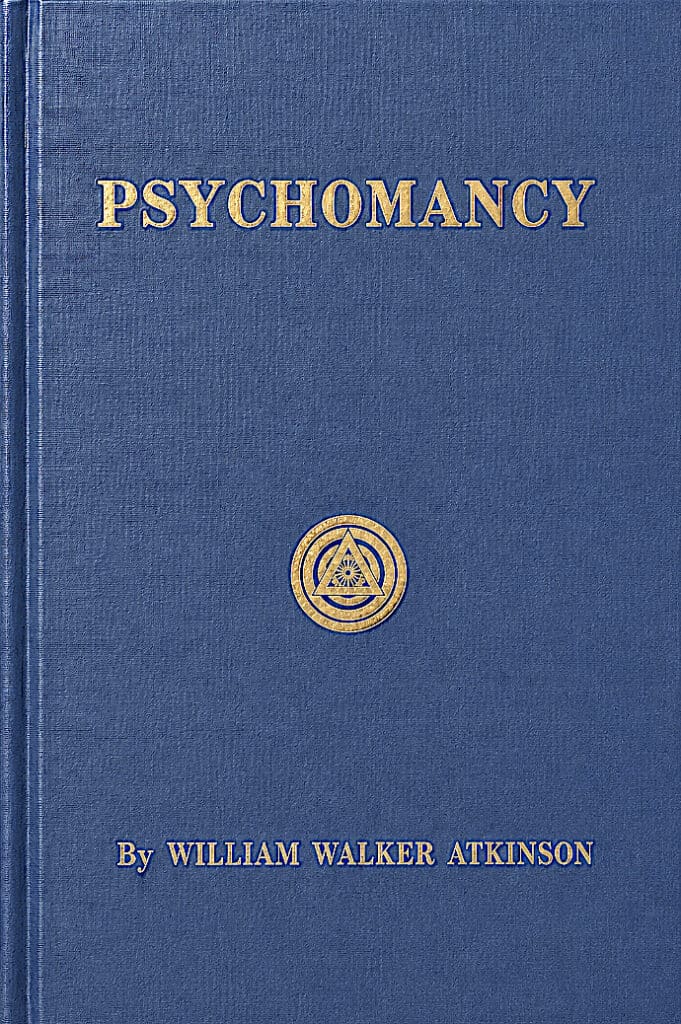
Published in 1908 by the Yogi Publication Society, Practical Psychomancy and Crystal Gazing by William Walker Atkinson is a course of eleven lessons devoted to psychic perception and the development of what Atkinson calls the “Astral Senses.” The book examines psychometry, crystal gazing, distant sensing, astral vision, the Astral Tube, astral projection, perception of past and future events, and psychic experiences occurring during dreams. Atkinson uses the term “Psychomancy” for this field, defining it as “Psychic Sensing,” and presents the various phenomena as different expressions of faculties that correspond to the ordinary physical senses but operate on the Astral Plane. His aim is to give readers a unified explanation for experiences that were often discussed separately in occult and psychical literature, then describe methods through which these abilities might be recognized, tested, and developed.
What Does Atkinson Mean by Psychomancy?
Atkinson begins by defining his terminology because his use of “Psychomancy” is much wider than the ordinary historical meaning of divination. He derives the word from “psycho,” referring to the soul, mind, or understanding, and “mancy,” meaning to divine, foresee, foreknow, detect secret things, or, in his occult usage, to sense through faculties beyond the physical senses. Psychomancy thus becomes his general term for psychic sensing. Under it he places psychometry, crystal gazing, the perception of distant scenes, impressions of past events, indications of future events, and psychic perception occurring while awake, in reverie, or during dreams.
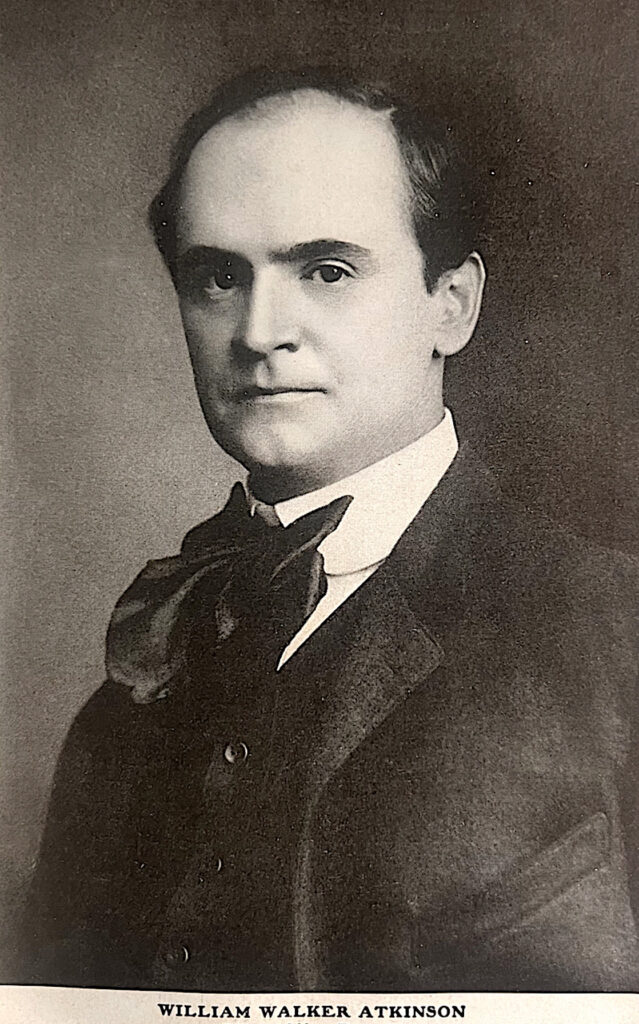
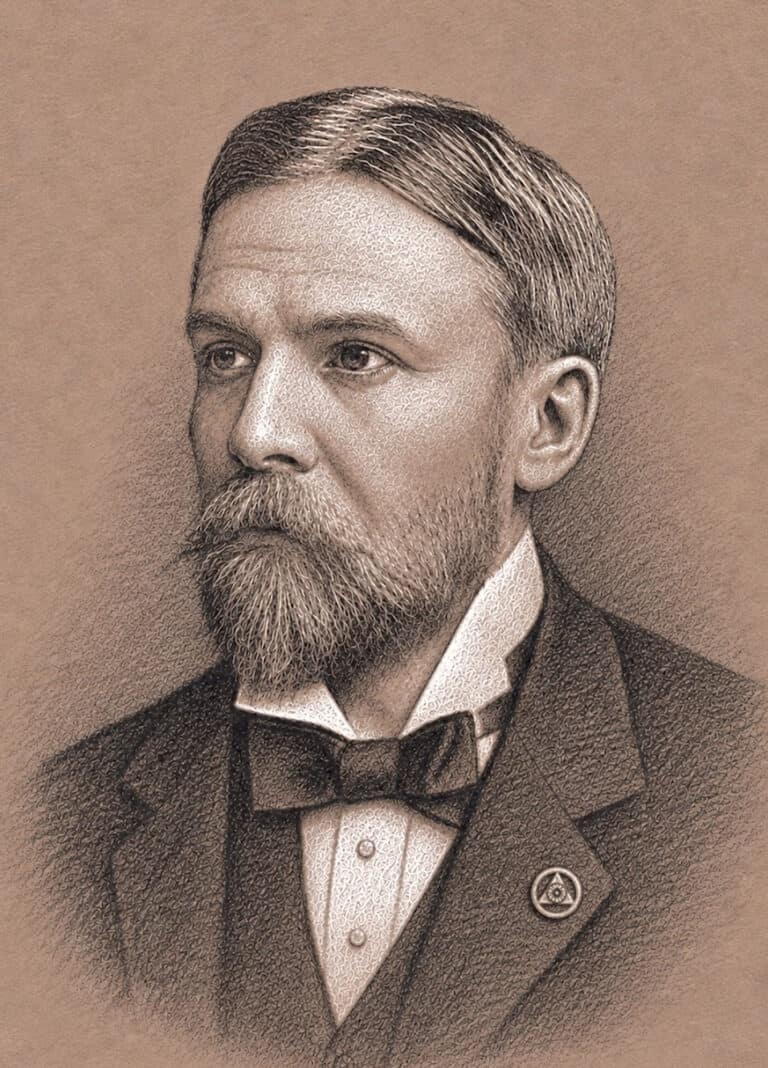
William Walker Atkinson
He also draws a deliberate distinction between psychometry and clairvoyance. In Atkinson’s terminology, clairvoyance properly refers to “transcendental vision,” including the perception of disembodied souls, elementals, and beings existing upon another plane. Psychomancy concerns the sensing of people, objects, places, events, and impressions through the Astral Senses. This distinction gives the book its structure. Atkinson is not attempting to survey every form of psychic or spiritual perception. He concentrates on a defined group of phenomena that he believes can be explained through the interaction of the Astral Senses, the Astral Body, vibrations, impressions, and psychic connections between the observer and the object being perceived.
The book assumes from the beginning that psychomantic phenomena are real. Atkinson explicitly declines to spend much time proving their existence, arguing that reports collected by psychical research organizations already provide sufficient evidence for readers interested in the subject. The cases he relates are intended to illustrate how different forms of psychomancy operate. He then interprets them through what he describes as the teachings of advanced occultists, which he considers the product of centuries of investigation and experimentation.
The Astral Senses and the Foundation of Psychic Perception
The central idea underlying the entire book is Atkinson’s doctrine of the Astral Senses. Human beings possess five physical senses—sight, hearing, feeling, taste, and smell—and Atkinson proposes that each has an astral counterpart associated with the Astral Body. Physical senses perceive the Physical Plane, while the Astral Senses perceive the Astral Plane. Psychomancy becomes possible when a person receives information through these astral faculties without depending upon the ordinary sensory organs.
Astral sight receives the greatest attention because it provides Atkinson with an explanation for many phenomena commonly described as clairvoyant. Through it, a person may perceive distant scenes, see through solid objects, detect what lies beneath the earth, observe extremely small or remote objects, encounter records of past occurrences, and receive impressions connected with events that have not yet occurred. Astral hearing operates on a similar principle and is said to permit the perception of sounds across great distances or after substantial periods of time. Astral taste and smell receive less attention, while astral feeling occupies an important place because Atkinson describes it as a generalized faculty of awareness capable of receiving impressions that do not arrive as distinct sights or sounds.
This sense of awareness helps explain why psychic perception does not always appear as a vivid internal picture. A person may simply know or feel something concerning another individual, object, or place. Atkinson includes sympathetic sensations within this category, such as apparently feeling another person’s pain or condition at a distance. The book repeatedly returns to this idea that psychic information can reach consciousness in several forms. Visual imagery is only one possible expression of a deeper receptive faculty.
What Is the Astral Body?
Atkinson connects the Astral Senses to an Astral Body, which he describes as an ethereal counterpart of the physical body. In ordinary life it remains associated with the physical organism, yet under certain conditions he believes it can partially or fully separate from it. Dreams, intense mental states, anesthesia, hypnosis, and deliberate occult development are among the conditions he associates with this separation.
The Astral Body provides one of the book’s explanations for distant perception. Atkinson proposes that consciousness can sometimes travel with it to another location and directly experience scenes occurring there. He describes the projected Astral Body as remaining connected with the physical body through an extremely fine link while it travels. Accounts of apparitions associated with dying people are interpreted through the same model: a strong desire to reach loved ones may cause the Astral Body to appear at a distant location shortly before physical death.
Dreams are also incorporated into this system. Atkinson suggests that the Astral Body may travel while the physical body sleeps and that some dreams preserve fragments of experiences acquired during these excursions. Confused or distorted dreams result, in his explanation, from imperfect transmission of astral impressions to the physical brain. Development of psychic sensitivity is supposed to improve the clarity with which these experiences are remembered and interpreted.
The Three Main Forms of Psychomancy
Atkinson organizes psychomantic perception into three fundamental classes. Each uses the Astral Senses, but the means by which information reaches the individual differs:
Simple Psychomancy occurs when the Astral Senses become sufficiently sensitive to perceive vibrations, currents, auras, thoughts, conditions, and nearby objects directly.
The Astral Tube is described as a psychic channel created through will or desire, functioning like a telescope, microscope, and X-ray instrument for astral perception.
Astral Projection occurs when the Astral Body or consciousness itself travels to the location being observed and experiences the distant scene from that position.
This classification supplies a framework for the rest of the book. Phenomena that might otherwise seem unrelated—psychometry, crystal visions, distant seeing, apparitions, psychic dreams, and impressions of past events—are treated as variations in how astral information reaches consciousness.
How Does Atkinson Say Psychic Faculties Can Be Developed?
The second lesson moves from theory to development. Atkinson treats psychic sensitivity as a faculty that may first appear in subtle ways. A person may begin noticing unusual impressions concerning people, colors surrounding individuals, mental images, unexpected intuitions, or flashes of distant scenes. These experiences are presented as early indications that the Astral Senses are becoming active.
Concentration and visualization play major roles in his exercises. Concentration trains attention so that faint impressions are not lost among ordinary thoughts and sensory distractions. Visualization strengthens the ability to hold mental images clearly. This becomes important because many forms of psychomancy communicate through images, symbols, impressions, and scenes appearing within consciousness. Atkinson repeatedly stresses calm attention and receptivity, warning that excessive strain interferes with perception.
He also introduces psychometry and crystal gazing during the development process. Objects may provide a focus for psychic sensitivity, while crystals, mirrors, and similar surfaces can serve as visual centers through which impressions rise into awareness. These methods prepare the reader for the more detailed treatments that follow.
Simple Psychomancy and the Expansion of the Senses
Simple Psychomancy is the most immediate form of astral sensing. Here the Astral Body does not need to travel to another place, nor does the observer necessarily construct an Astral Tube. The Astral Senses themselves have become sensitive enough to perceive impressions that normally escape awareness.
Atkinson attributes an extraordinary range of possible perceptions to this faculty. A psychomancer may sense another person’s thoughts or emotional condition, perceive objects hidden behind physical barriers, see into the earth, examine things at great distances, or magnify extremely small objects through astral vision. He even discusses psychic diagnosis, in which a sensitive individual supposedly perceives bodily conditions that ordinary vision cannot detect.
His analogy throughout this discussion is an extension of ordinary sensory range. Physical sight has limits imposed by distance, matter, and scale. Astral sight is presented as operating under different conditions, allowing perception where physical eyesight fails. The psychic faculty is thus described as an additional sensory system within the occult constitution of the human being.
What Is the Astral Tube?
The Astral Tube is one of Atkinson’s principal explanations for long-distance psychic perception. He describes it as a channel established through the ether by concentrated will or desire. Once formed, it creates a connection between the observer and a distant object or location, permitting the Astral Senses to operate along that line.
Atkinson compares its operation to optical instruments. Depending upon the circumstances, it can act like a telescope that brings distant objects into view, a microscope that enlarges small things, or an X-ray device that allows perception through intervening physical matter. The analogy allows him to explain distant vision without requiring the Astral Body itself to leave the physical body.
The Astral Tube also becomes important in later discussions of psychometry and crystal gazing. An object, photograph, letter, mineral specimen, lock of hair, or similar item can help establish the psychic connection. Once rapport has been formed, Atkinson believes the observer may follow that connection beyond the immediate object toward the person, location, or history associated with it.
What Is Psychometry?
Psychometry is one of the most important subjects in Practical Psychomancy and Crystal Gazing because it demonstrates Atkinson’s concept of psychic connection through physical objects. In psychometry, an object serves as a link between the psychomancer and the person, place, event, or history connected with it. Holding or concentrating upon the object allows impressions associated with it to enter awareness through the Astral Senses.
Atkinson gives several applications. A lock of hair may establish contact with the person from whom it came. A letter or personal possession may reveal impressions concerning its owner. A flower sent from another place may act as a connecting link through which the psychometrist perceives the surroundings from which it came. A piece of mineral may provide impressions concerning the mine or geological location associated with it. An old object may carry associations from its previous history and allow the sensitive person to perceive scenes connected with earlier owners or events.
Psychometry thus operates in more than one direction. It may reveal characteristics of a person connected with an object, establish a psychic line to someone currently at a distance, disclose information about the place from which an object originated, or open impressions associated with its past. The object functions as a point of contact.
How Can an Object Carry Psychic Information?
Atkinson explains psychometry through the persistence of astral vibrations and associations. People, events, emotions, thoughts, and environments leave impressions that may remain connected with material objects. The psychometrist becomes sensitive to these impressions and translates them into feelings, images, thoughts, or scenes.
An object can also act as a means of establishing rapport. In such cases, the information does not have to be stored inside the object in a simple mechanical sense. The object supplies a psychic connection with its source. This distinction allows Atkinson to account for cases in which the psychometrist describes a distant person or location associated with an item instead of merely recounting its past.
Psychometry connects several major ideas in the book: vibration, astral sensitivity, rapport, distant sensing, and the survival of impressions from previous events. It becomes a bridge between Simple Psychomancy and the more elaborate forms of perception developed in later lessons.
Crystal Gazing as a Method of Psychic Perception
Crystal Gazing
Atkinson treats crystal gazing as an ancient method for bringing psychic impressions into visible mental form. The crystal does not need to possess supernatural power of its own. Its function is to give the eyes and conscious attention a fixed point while ordinary mental activity becomes quieter and astral impressions gain an opportunity to reach awareness.
Although the crystal ball is the best-known instrument, Atkinson extends the method to other reflective or visually neutral surfaces. Mirrors and related devices may perform the same function. What matters is the mental condition produced by gazing: steady attention, physical relaxation, reduced distraction, and receptivity to impressions.
Images may begin as clouds, colors, lights, or indistinct forms before developing into recognizable people, places, objects, or events. Atkinson cautions against forcing the experience. Concentrated expectation can interfere by producing imagined pictures, while passive receptivity allows impressions to develop with less conscious interference. This tension between concentration and receptivity appears throughout the book: the will establishes the conditions for psychic perception, while the actual impression must be allowed to appear.
Is the Vision Supposed to Be Inside the Crystal?
The apparent image in a crystal serves as the visible presentation of information received through psychic faculties. The surface gives consciousness a field upon which the impression can appear. For Atkinson, this explains why other objects can substitute for a crystal and why similar visions may occur with the eyes closed or during reverie and dreams.
Crystal gazing is thus closely related to visualization and psychometry. Each creates conditions in which ordinary attention becomes concentrated enough for subtler impressions to become perceptible. The techniques differ in their immediate focus, yet Atkinson places them within the same system of astral perception.
Astral Projection and the Traveling Consciousness
Astral Projection represents a more advanced form of psychomancy. Instead of receiving information through nearby vibrations or observing a distant place through the Astral Tube, the psychomancer projects the Astral Body to the location itself. Atkinson describes this as actual travel on the Astral Plane.
The projected individual may observe distant scenes, listen to conversations, witness events, and move through locations inaccessible to the physical body. Atkinson also discusses cases in which the projected form becomes perceptible to other people, producing an apparition of someone whose physical body remains elsewhere. Reports of living people being seen at distant locations are interpreted as manifestations of the Astral Body.
Atkinson presents Astral Projection as something that may develop after experience with simpler psychomantic faculties. Sensitivity, concentration, visualization, psychometry, and distant sensing form stages in a progression toward more extensive separation of consciousness from physical sensory limitations.
What Is Space Psychomancy?
Space Psychomancy refers specifically to the perception of distant people, scenes, and objects. Atkinson distinguishes it from simpler cases of extended astral vision by the mechanism involved. Nearby or moderately distant impressions may be sensed directly through sufficiently developed Astral Senses, while true Space Psychomancy employs either the Astral Tube or projection of consciousness in the Astral Body.
This gives him two models of distant vision. Through the Astral Tube, the observer remains centered at the physical location while viewing the distant scene through a psychic connection. Through Astral Projection, consciousness travels to the scene and experiences it from there.
Atkinson uses accounts from psychical research and historical reports to illustrate these ideas, including cases in which individuals apparently described distant events they could not have learned about through ordinary means. He interprets such reports as evidence that distance does not present the same barrier to astral perception that it presents to the physical senses.
Past Time Psychomancy and the Psychic Record of Events
The discussion becomes more ambitious when Atkinson turns from distance in space to distance in time. Past Time Psychomancy is the claimed ability to perceive events that have already occurred. Atkinson proposes that occurrences leave persistent impressions or records within the astral medium, making previous scenes accessible to sufficiently developed perception.
This idea expands the principle already introduced through psychometry. If an old object can carry associations with former people and events, the same underlying process may allow consciousness to reach further into the past. Psychometric objects can serve as links to those records, but Atkinson’s theory allows advanced psychic perception to operate beyond direct physical contact with an artifact.
Past events are treated almost as enduring pictures capable of being perceived again. The psychomancer does not physically travel backward in time. The faculty encounters the surviving astral record or impression of what occurred. This allows Atkinson to place visions of historical scenes, impressions from ancient objects, psychometric readings, and certain spontaneous psychic experiences under a single explanatory model.
Can Psychomancy Reveal the Future?
Future Time Psychomancy presents a more difficult problem because the events being perceived have not yet entered ordinary experience. Atkinson approaches the subject through premonition, prevision, second sight, and the traditional idea that “coming events cast their shadows before.”
He examines reports in which people appear to perceive approaching events before they occur and considers questions of destiny and fate. The future is not presented as a simple collection of completed scenes waiting to be viewed in exactly the same way as the past. Atkinson instead describes approaching events as producing advance indications that may become perceptible on the astral level.
This allows him to account for spontaneous warnings, symbolic visions, strong intuitions, and detailed previsions. Some impressions may be fragmentary, while others appear as complete scenes. As elsewhere in the book, he uses reported cases to demonstrate the different forms the phenomenon is said to take and interprets them through the occult system established in the earlier lessons.
Dream Psychomancy and Psychic Perception During Sleep
The final lesson brings the preceding subjects together through dreams. Sleep reduces the dominance of the physical senses and conscious mental activity, creating conditions in which the Astral Senses may become more active. The Astral Body may also separate from the physical body during sleep and travel to distant locations.
Atkinson uses this theory to explain dreams that contain accurate information about distant people, unexpected events, deaths, accidents, or circumstances unknown to the dreamer at the time. Some dreams may represent distant sensing, others may involve astral travel, and still others may contain impressions of past or future events.
Ordinary dreams and psychomantic dreams can become mixed together, which explains why psychic impressions may appear symbolically or become surrounded by unrelated dream material. Atkinson compares imperfect recollection to a blurred photographic image. The original experience may have been coherent at the astral level while its transmission into waking consciousness becomes distorted.
Dream Psychomancy closes the system by showing that the faculties discussed throughout the book are not confined to deliberate exercises. Psychometry, distant sensing, astral perception, prevision, and projection can also arise spontaneously when waking consciousness is quiet.
How Do the Different Forms of Psychomancy Fit Together?
The eleven lessons form a single theory of psychic perception. Atkinson repeatedly returns to a small group of concepts and uses them to explain phenomena that had often been assigned separate names.
The structure can be summarized as follows:
Astral Senses provide the faculties through which psychic impressions are perceived.
The Astral Body provides the vehicle associated with those senses.
Simple Psychomancy allows direct perception of astral vibrations and impressions.
Concentration and visualization train attention to recognize subtle impressions.
Psychometry establishes psychic connection through objects and their associations.
Crystal gazing supplies a visual focus through which impressions can appear.
The Astral Tube creates a channel for distant psychic observation.
Astral Projection carries consciousness to the distant scene.
Space Psychomancy extends perception beyond ordinary physical distance.
Past Time Psychomancy accesses impressions associated with previous events.
Future Time Psychomancy receives indications connected with events approaching manifestation.
Dream Psychomancy allows many of these processes to occur while physical consciousness sleeps.
The importance of this organization is easy to miss if the chapters are read as isolated discussions of occult phenomena. Atkinson is attempting to build a system. Psychometry, crystal gazing, distant vision, astral travel, premonitions, and psychic dreams become different conditions under which the same hidden sensory apparatus operates.
Psychomancy, Will, Concentration, and Receptivity
One of the recurring themes in the book is the relationship between deliberate mental control and passive psychic reception. The student must learn concentration because scattered attention makes subtle impressions difficult to recognize. Visualization strengthens the mind’s ability to receive and retain imagery. Desire and will may establish an Astral Tube or direct attention toward a specific person or location. Yet once these conditions have been created, excessive conscious effort can interfere with the perception itself.
The pattern is one of directed attention followed by receptivity. The student chooses an object, person, question, crystal, or destination and concentrates sufficiently to establish connection. The mind then becomes receptive to whatever impressions arise. Atkinson repeatedly warns against confusing deliberate imagination with genuine impressions, since a reader who consciously constructs the desired image may mistake personal expectation for psychic perception.
This combination of will, concentration, visualization, expectation, and receptivity connects Practical Psychomancy and Crystal Gazing with subjects Atkinson explored elsewhere in mental training, New Thought, and Yogi philosophy. In this book those mental faculties are directed toward psychic sensing: concentration establishes the conditions, visualization develops the mind’s ability to hold impressions, and receptivity allows impressions to enter awareness.
The Book’s Place in Atkinson’s Psychic and Occult Writings
Practical Psychomancy and Crystal Gazing is important within Atkinson’s writings because it gives a compact presentation of psychic perception as a coherent system. The book does not simply teach crystal gazing despite the prominence of that phrase in its title. Crystal gazing occupies only one lesson. Psychometry receives another, while much of the work is devoted to the astral constitution of the individual and the mechanisms through which Atkinson believes psychic information can cross ordinary barriers of matter, space, and time.
These subjects would remain important throughout the occult literature associated with Atkinson. Under names including Yogi Ramacharaka, Theron Q. Dumont, Swami Panchadasi, and Swami Bhakta Vishita, related works explored concentration, psychic influence, mental vibrations, clairvoyance, telepathy, personal magnetism, psychic healing, astral phenomena, and the development of hidden faculties. The terminology changes between books and identities, but many recurring concepts remain recognizable: vibration, mental concentration, visualization, planes of existence, subtle bodies, psychic receptivity, will, and the possibility that consciousness can operate beyond the ordinary physical senses.
The book also belongs to the extensive exchange between late nineteenth- and early twentieth-century psychical research and Western esotericism. Atkinson cites the investigations of psychical researchers while interpreting reported phenomena through an occult model of astral senses and planes. His language combines claims of scientific investigation with teachings he attributes to ancient occult authorities, a characteristic feature of the literature produced during this period.
Why Is Practical Psychomancy and Crystal Gazing Significant?
Practical Psychomancy and Crystal Gazing offers one of Atkinson’s clearest attempts to classify psychic perception. Its importance lies less in any single technique than in the architecture connecting them. Psychometry explains how an object can establish psychic rapport. Crystal gazing provides a visual field for impressions. The Astral Tube explains remote observation while consciousness remains centered in the body. Astral Projection explains distant experiences as travel of the Astral Body. Past Time Psychomancy extends perception into records of previous events, Future Time Psychomancy addresses prevision, and Dream Psychomancy explains how these faculties may operate spontaneously during sleep.
At the center of all of them stands the same proposition: human consciousness possesses senses and modes of perception extending beyond the five physical senses. Once Atkinson establishes that premise, the rest of the book becomes an exploration of what those faculties might perceive and the different conditions through which perception may occur. Objects can connect consciousness with people and places; concentrated attention can direct psychic awareness; crystals can provide a field for visions; the Astral Tube can bridge distance; the Astral Body can travel; old impressions can preserve traces of the past; approaching events can produce anticipatory impressions; and sleep can release psychic faculties from the distractions of waking sensory life.
For readers studying the history of the Yogi Publication Society, the book also demonstrates the range of subjects being organized into systematic courses during the period surrounding the Society’s major publishing activity. Atkinson presents psychic phenomena in the form of lessons, definitions, classifications, exercises, and explanatory principles, turning a collection of older occult practices and reported experiences into a structured course of study. Practical Psychomancy and Crystal Gazing is thus a useful guide to his conception of psychic perception and to the vocabulary through which astral senses, psychometry, crystal vision, distant sensing, astral projection, time perception, and psychic dreaming were brought together within a single occult framework.