William Walker Atkinson was one of the principal writers, lecturers, editors, and literary figures connected with the Yogi Publication Society. His importance to YPS began with his arrival in Chicago in 1900, following a personal and professional collapse in Pennsylvania, and his almost immediate entrance into the educational world already established by Herbert A. Parkyn.
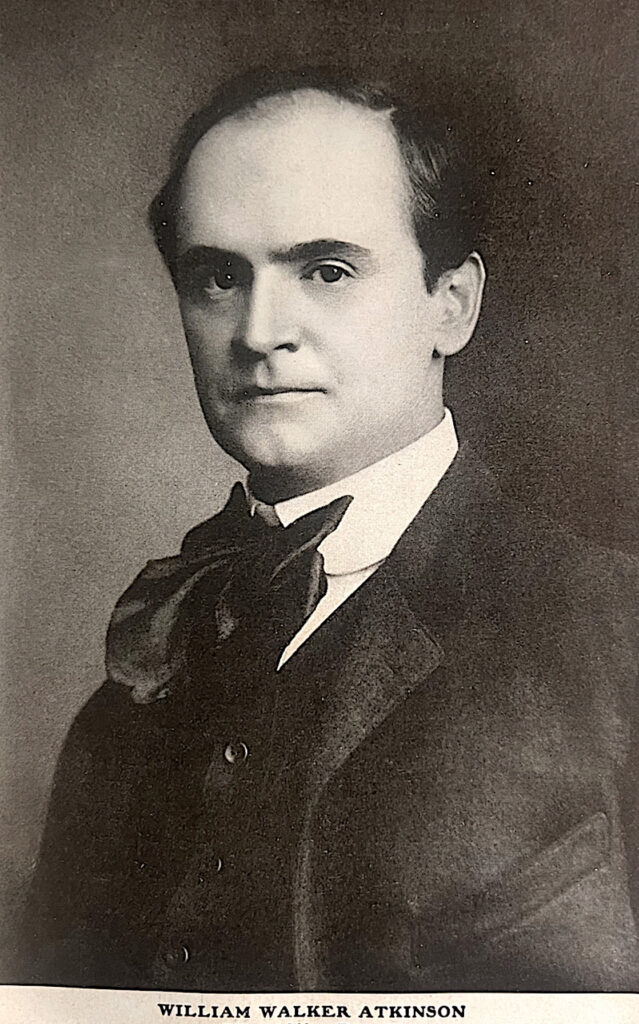
Parkyn had begun teaching in 1895, founded the Chicago School of Psychology in 1896, developed his extensive Special Mail Course in Hypnotism and Suggestive Therapeutics, and built an organization around psychology, suggestion, mental therapeutics, correspondence instruction, publishing, and public lectures. Atkinson entered this established system and within months was appearing as an instructor and writer on subjects closely connected with Parkyn’s teaching. By the end of 1900 he had prepared A Series of Lessons in Personal Magnetism, later changed to Thought=Force in Business and Everyday Life, and during the following years he became one of the most visible literary figures in Chicago New Thought.
Atkinson’s later reputation has caused much of the YPS catalog to be assigned to him personally, with numerous publishing pseudonyms treated as simple aliases for a single prolific author. The history of YPS is more complex. Atkinson was unquestionably central to its literature, and his skill at organizing teachings into clear lessons made him exceptionally valuable, but evidence from the publishing organization itself shows that some YPS authorial identities were used collaboratively.
The 1919 postal investigation included testimony that Yogi Ramacharaka was a pen name used by several writers, while Arthur J. Gould acknowledged multiple writers within the publishing operation and refused to identify the person or persons behind another YPS identity, Magus Incognito. Atkinson is better understood as a major literary vehicle within a collaborative publishing network whose intellectual foundations preceded his Chicago career. His importance lies not only in what appeared under his own name, but in his ability to organize, adapt, and communicate teachings across the many subjects and authorial voices that made YPS distinctive.
Read the article: From Mental Breakdown to Atkinsonia: How Herbert A. Parkyn Turned William Walker Atkinson into a New Thought Phenomenon
Full William Walker Atkinson biography.
William Walker Atkinson Before Chicago
William Walker Atkinson was born in Baltimore, Maryland, on December 5, 1862. Before becoming associated with New Thought, occultism, Yoga, and metaphysical publishing, he pursued a conventional professional career in Pennsylvania and became an attorney. His early adult life gave little indication of the publishing career that would later make his name familiar to readers of mental science and occult literature. He practiced law, supported a family, and participated in the professional and business world of Pennsylvania during the closing decades of the nineteenth century.
The major change came around the turn of the century. Atkinson later described having experienced a severe period of physical, financial, and psychological collapse, followed by a recovery that he associated with mental principles. By the spring of 1900 his previous professional life had broken down, and he traveled to Chicago to seek the medical help of Dr. Parkyn. The timing of what happened next is one of the most important parts of his biography. In the summer of 1900, he permanently relocated to Chicago, where he did not spend years gradually establishing himself as a psychologist or teacher before producing books on the subject. Within months of reaching Chicago, he was associated within Parkyn’s organization and was presenting a complete system of mental instruction with the confident voice of an experienced teacher.
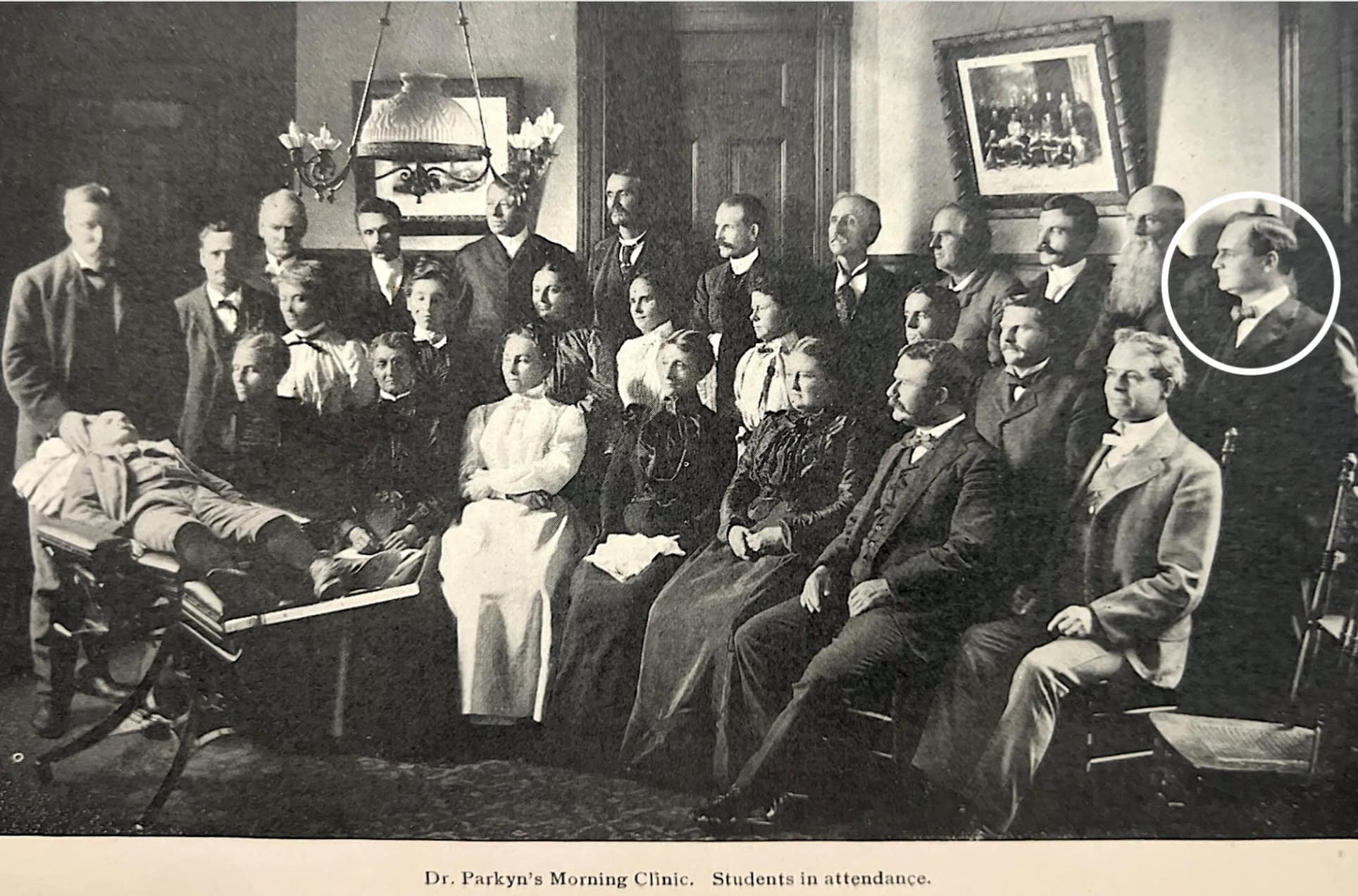
How Did Atkinson Become Connected with Herbert A. Parkyn?

When Atkinson reached Chicago, Parkyn already possessed exactly the kind of institutional structure through which someone with Atkinson’s literary abilities could enter the mental-science field. Parkyn had worked clinically with suggestion before beginning his formal teaching career in 1895, and his Chicago School of Psychology had operated since 1896.
Through Parkyn’s school, clinics, magazines, mail courses, and affiliated organizations, he had created an extensive educational network. His teaching addressed the voluntary and involuntary functions of mind, the laws of suggestion, auto-suggestion, habit, attention, concentration, will, mental influence, and the conversion of thought into conduct. By 1900 this material had been organized into a mature instructional system with an established audience.
Atkinson became associated with Parkyn’s University of Psychic Science and was presented as one of its principal lecturers. His photograph appeared in material connected with Parkyn’s mail-course organization, placing him visibly inside the institution at the beginning of his Chicago career. This relationship provides essential background for understanding the extraordinary speed of Atkinson’s transformation.
He did not arrive in an intellectual vacuum and independently build a school, curriculum, magazine audience, and teaching system within a few months. He entered Parkyn’s existing organization and had immediate access to an established body of instruction, a publishing apparatus, experienced teachers, students, and a readership already interested in precisely the subjects that would soon dominate his books.
A Series of Lessons in Personal Magnetism
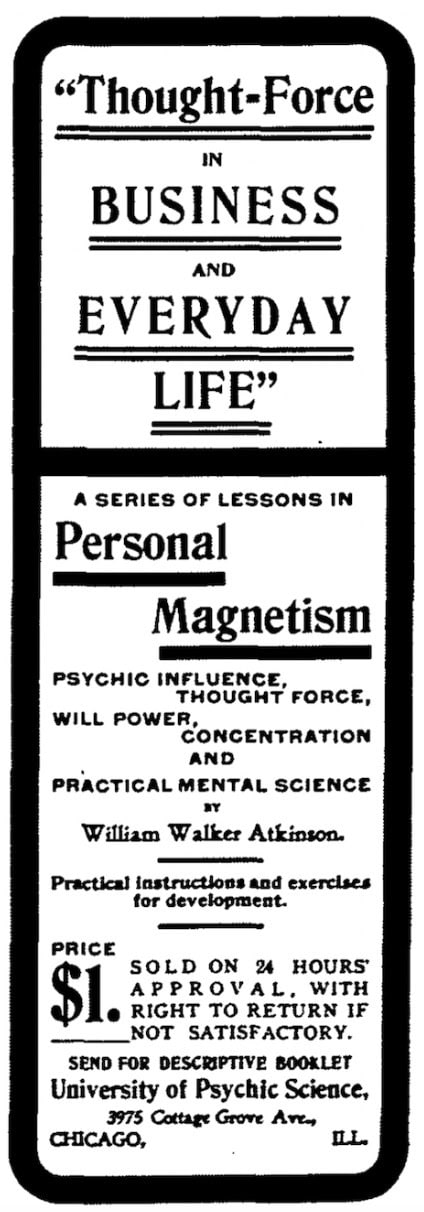
Atkinson’s A Series of Lessons in Personal Magnetism, later changed to Thought=Force in Business and Everyday Life, is one of the most revealing documents from this early period. Its preface is dated December 4, 1900, only months after his arrival in Chicago, yet the fifteen-lesson course speaks with considerable instructional authority about personal magnetism, mental influence, concentration, will, habit, suggestion, and the operation of different mental functions. The book is presented as material developed from lectures, making the speed with which Atkinson appears as an accomplished instructor even more notable.
The book itself provides direct evidence of Parkyn’s place behind Atkinson’s early instruction. In Lesson IV, while explaining suggestion and the two functions of mind, the work specifically recommends Parkyn’s writings and directs readers to the University of Psychic Science. The surrounding teaching closely follows the psychological framework Parkyn had already developed. Other correspondences extend far beyond that acknowledgment. Parkyn’s “Thoughts take form in action” appears in the book as “Thoughts take form in Action,” while “I Can and I Will” likewise enters Atkinson’s course. The handling of habit, mental paths, repetition, receptive mental action, auto-suggestion, attention, and will follows an instructional structure already present in Parkyn’s work. Atkinson’s first major Chicago course therefore provides a visible bridge between the system he encountered through Parkyn and the literary career that followed.
Atkinson Becomes a Writer for Suggestion
Atkinson soon appeared in Parkyn’s Suggestion magazine, placing him before the readership of one of the established periodicals devoted to suggestion and psychological therapeutics. His rapid acceptance there is another important part of the chronology. Parkyn had spent years establishing his professional reputation and his magazine as an authoritative publication in the field. Atkinson, newly arrived from Pennsylvania without a comparable documented background in psychology, was soon allowed to address its readers with considerable authority on mental and psychological subjects.
His articles during this period helped establish the literary voice that would become familiar throughout his later career. He could take psychological principles and present them in direct, readable language aimed at ordinary students instead of medical specialists. This ability became one of his great strengths. The underlying material could be moved from clinical or psychological terminology into self-development, business, success, personal influence, or metaphysical language without losing its lesson-course structure. Atkinson was exceptionally suited to transforming an established teaching system into popular literature.
Read the article: William Walker Atkinson’s First Published Work: The Four-Part Series in Herbert A. Parkyn’s Suggestion Magazine
The University of Psychic Science and Atkinson’s Early Teaching Career
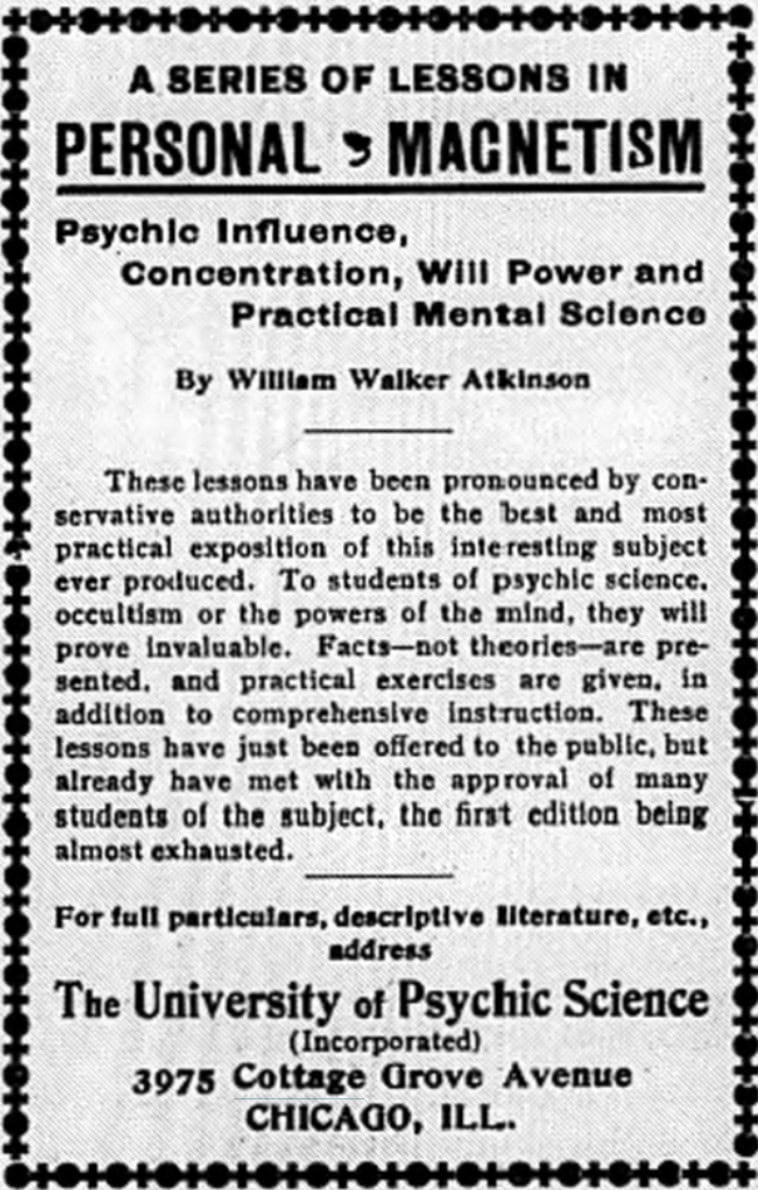
Parkyn’s University of Psychic Science widened the range of his earlier Chicago School of Psychology by providing room for subjects extending beyond therapeutic suggestion into mental science, psychic research, and related fields. Atkinson’s role as a lecturer placed him at the intersection of those subjects at exactly the period when his own literary career was taking shape. The University gave him access not simply to ideas, but to a functioning educational model in which knowledge was divided into progressive lessons and taught systematically to students.
That course-based method became characteristic of the books published under Atkinson’s name. Many of the books read as instruction delivered from teacher to pupil, with each lesson building upon the one before it. This form later became equally important to YPS. The Ramacharaka books, Dumont books, psychic courses, and other publications could take large fields of knowledge and divide them into manageable sequences. Atkinson’s ability to work within that format helped make him one of the most useful literary figures in the organization that developed from Parkyn’s Chicago network.
Atkinson and New Thought
Atkinson’s public career soon expanded into New Thought, the magazine that had developed from the earlier Journal of Magnetism. Through it he became increasingly visible within the American New Thought movement. His own-name writings dealt with mental power, character, health, confidence, success, habit, personal influence, and the conscious direction of thought. The magazine allowed him to establish an identity separate from Parkyn’s medical and psychological work while still drawing upon many of the same underlying mental principles.
This was an important development in Atkinson’s career because it showed how effectively he could adapt teaching to different audiences. The language of suggestion and psychology could be recast as mental science and New Thought without requiring an entirely new theory of mind. Atkinson increasingly became the writer capable of making these transitions. His prose was confident and accessible, and he had a talent for presenting instruction as something the reader could begin applying immediately. Those abilities would become even more valuable when the Yogi Publication Society began publishing a much wider range of material.
How Did the Yogi Publication Society Begin?
The Yogi Publication Society began in the spring of 1903 at 4000 Cottage Grove Avenue in Chicago, where Parkyn’s offices were located. This physical connection is important because YPS did not appear as an unrelated publishing venture detached from the network in which Atkinson had spent the previous several years. It developed from the same environment of courses, magazines, mental instruction, correspondence education, and publishing that had already brought Parkyn and Atkinson together.
Atkinson became one of the central literary figures of the new operation. YPS could now extend far beyond the subjects normally associated with a psychological school. It could publish Yogi philosophy, occultism, psychic development, comparative religion, Hermeticism, Christian mysticism, reincarnation, healing, concentration, and personal development. Atkinson’s ability to organize diverse material into coherent lessons made him ideally suited to this expansion. His career and YPS became closely intertwined because the Society provided a publishing structure capable of carrying his literary work into fields that would have been difficult to present through his own New Thought identity alone.
Yogi Ramacharaka and Atkinson’s Role in the Series
The most important authorial identity associated with Atkinson and YPS was Yogi Ramacharaka. Beginning with Fourteen Lessons in Yogi Philosophy and Oriental Occultism in 1903, the Ramacharaka series developed into a large body of literature covering Yoga, breathing, physical culture, Raja Yoga, Gnani Yoga, psychic healing, reincarnation, mental development, mystic Christianity, and related subjects. Works such as The Science of Breath, Hatha Yoga, Raja Yoga, Gnani Yoga, and The Science of Psychic Healing gave YPS one of its most successful and recognizable publishing identities.
Atkinson was deeply involved in producing this literature. The books use the lesson-course form with which he had already become comfortable, translate difficult subjects into straightforward explanations, and frequently move between psychological and philosophical language. Yet the historical evidence does not support reducing Yogi Ramacharaka to nothing more than an Atkinson pseudonym. Testimony connected with the 1919 postal investigation stated that the name had been used by several writers. Atkinson can therefore be recognized as a central literary participant without erasing the collaborative character of the identity. This distinction is essential to understanding both his real importance and the publishing method employed by YPS.
Atkinson as a Literary Vehicle for YPS
Atkinson’s role as a literary vehicle is one of the most useful ways to understand his place in YPS. He possessed the ability to receive, organize, adapt, and communicate material that did not originate with him. His early relationship with Parkyn provides the clearest example, and this relationship could later be applied to Eastern philosophy, psychic subjects, occultism, and other fields represented in the YPS catalog.
Atkinson could supply the “man on the street” terminology and a persuasive teaching voice.
Atkinson and Theron Q. Dumont
The Theron Q. Dumont books have long been assigned to Atkinson, but they provide a strong example of why literary authorship and the origin of a teaching system must be considered separately. Dumont became the YPS-associated pseudonym devoted to personal magnetism, concentration, will, personality, character development, and related mental training. The books use a style and organization compatible with Atkinson’s literary abilities, making his participation entirely plausible.
However, the deeper teaching chronology points elsewhere. In the 1913 preface to The Culture of Personality, Dumont claims eighteen years of teaching experience, placing the beginning of that career in 1895, the exact year Parkyn began teaching. The Dumont system also follows the earlier structure of Parkyn’s work closely, including its treatment of mental habit, attention, will, thought in action, and deliberate self-development. Atkinson may have helped turn that system into the Dumont books, but the evidence shows that he did not originate it. The distinction illustrates his larger function within YPS. He could be deeply involved in producing a work while only serving as its literary vehicle.
Atkinson and the Other YPS Authorial Identities
The later YPS catalog included additional identities such as Swami Panchadasi and Swami Bhakta Vishita, whose books dealt with clairvoyance, telepathy, psychometry, psychic perception, thought forms, mental influence, and other occult subjects. These works have also commonly been placed under Atkinson’s authorship, often through the same process by which almost every major YPS identity eventually became attached to his name in later bibliographies.
Atkinson’s literary involvement may have been extensive, but the organization demonstrably used collaborative authorial identities. The better historical model treats him as a central writer working within a publishing system. This explains why the catalog possesses both remarkable continuity and considerable variation. Atkinson could help supply literary unity while other people, earlier teachings, and specialized source material supplied the intellectual content.
The 1919 Postal Investigation and the Question of Authorship
The 1919 postal investigation is one of the most valuable sources for reconstructing the way YPS handled authorship. By this time Arthur J. Gould was managing the publishing operation, and his testimony made clear that the authorship structure was not as simple as later bibliographies would suggest. He acknowledged that multiple writers were involved and declined to disclose the identity behind Magus Incognito. The investigation also produced the important statement that Yogi Ramacharaka was a pen name used by several writers.
This evidence changes the way Atkinson’s bibliography should be approached. Similarity of style, shared subject matter, or publication by the same company can support Atkinson’s participation, but none of those things alone establishes sole authorship. YPS had a documented mechanism for publishing collaborative material under stable authorial identities. Atkinson’s prominence made him an obvious candidate for substantial literary involvement, yet his visibility should not be used to erase the less visible contributors or the earlier systems from which the teaching developed.
Atkinson, Parkyn, and the Development of the YPS System
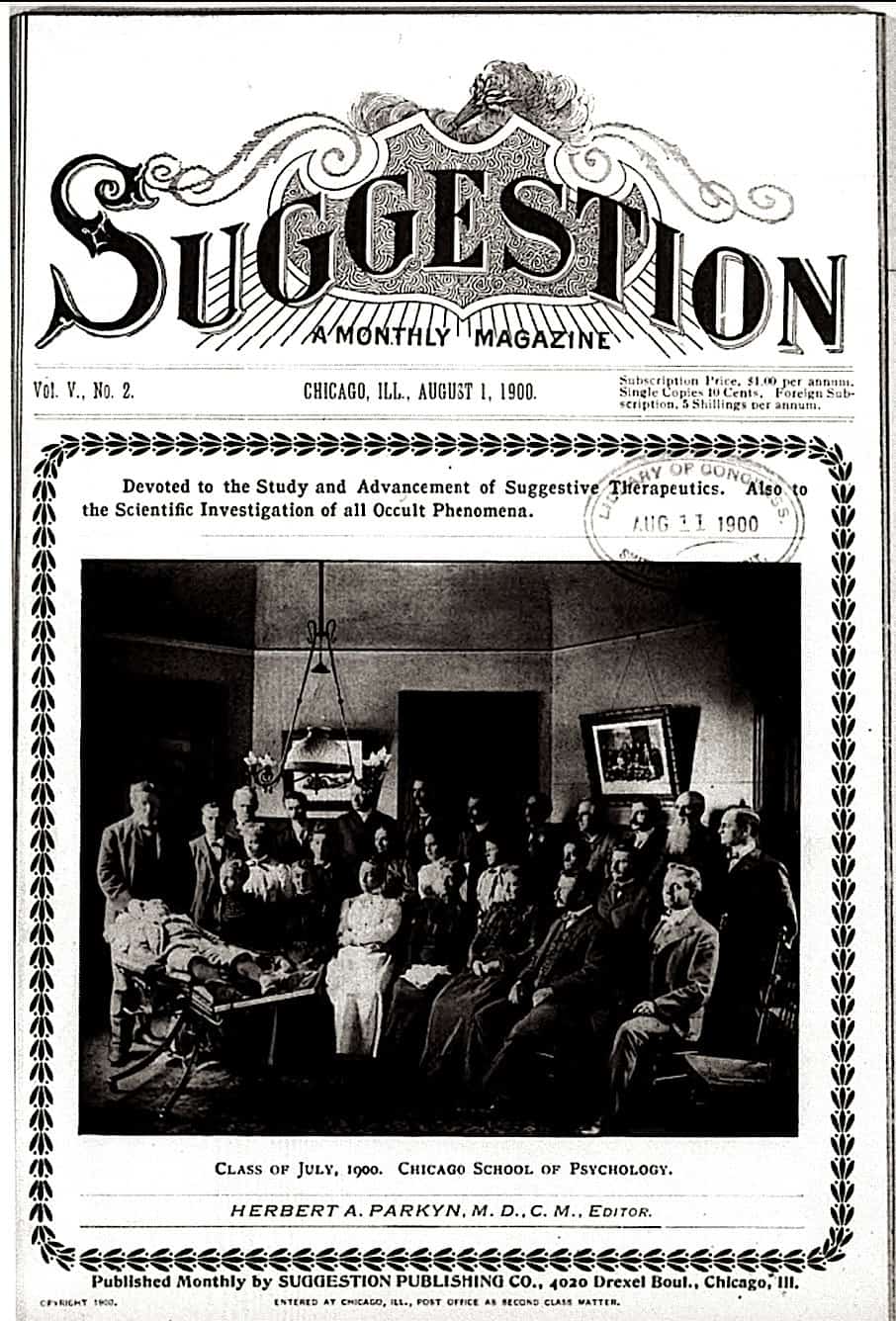
Parkyn and Atkinson occupied different positions in the history that led to YPS. Parkyn had the medical and psychological background, began teaching in 1895, created the Chicago School of Psychology, developed the mail course, published Suggestion, and organized the University of Psychic Science. Atkinson arrived in 1900 and soon demonstrated an exceptional ability to convert complex teaching into clear popular instruction.
The development of YPS can be followed naturally from this relationship. The psychological school supplied a foundation in systematic instruction. The mail-course model demonstrated that lessons could reach students far beyond Chicago. The Atkinson literary vehicle showed how the same instructional method could be adapted for a general audience. YPS then expanded the range dramatically, creating books and authorial identities capable of carrying the program into Yoga, comparative religion, psychic development, Hermetic philosophy, Christian mysticism, and other branches of Western esotericism.
Atkinson After the Founding Period of YPS
The management of YPS changed during Atkinson’s lifetime. Ollie I. Bedwell took over the Society in 1909, and Arthur J. Gould later assumed active control. Established YPS titles continued to circulate, and authorial identities such as Yogi Ramacharaka acquired lives of their own independent of the original circumstances in which the books had been produced. This long publication history helped obscure the collaborative network behind the early catalog because later readers encountered stable author names on books without access to the relationships that had existed in Chicago during their creation.
Atkinson continued writing within the Parkyn’s expanding publishing network and remained associated with mental science, New Thought, occultism, and metaphysical literature. The enormous output under the Atkinson name ensured that it would become the best-known individual connected with YPS. That prominence later encouraged researchers to use the name as the default explanation for anonymous and pseudonymous works associated with the same publishing circle, even when documentary evidence for sole authorship was limited.
Was William Walker Atkinson the Sole Author Behind the Yogi Publication Society Pseudonyms?
The evidence does not support treating YPS as a one-man publishing operation disguised behind a collection of pseudonyms. Atkinson was central, but the 1919 testimony establishes collaborative authorship within the organization, while the chronology of the teachings shows that important parts of the intellectual system existed before his arrival in Chicago. Parkyn’s work provides the clearest example. Atkinson’s earliest Chicago mental-science writing appears only after he entered Parkyn’s organization, directly acknowledges Parkyn, and employs teachings already present in Parkyn’s earlier courses. The Dumont material later makes a teaching claim reaching directly back to 1895, while Ramacharaka was explicitly described as a pen name used by several writers.
A more accurate model places Atkinson near the center of a network instead of alone at its source. He wrote extensively, organized courses, edited, and almost certainly supplied substantial prose to works appearing under several YPS identities. But the company’s own history shows that its literature was collaborative and that an authorial identity did not necessarily correspond to one hidden individual. This distinction allows Atkinson’s genuine contribution to be appreciated without assigning to him the work, experience, and teachings of those around him.