
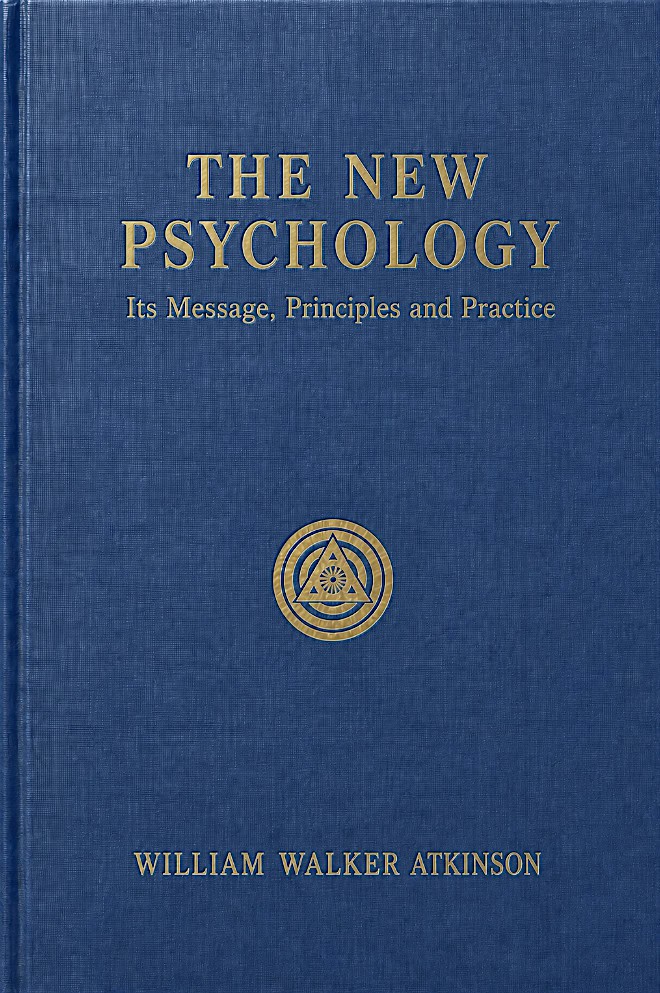
The New Psychology
About This Publication
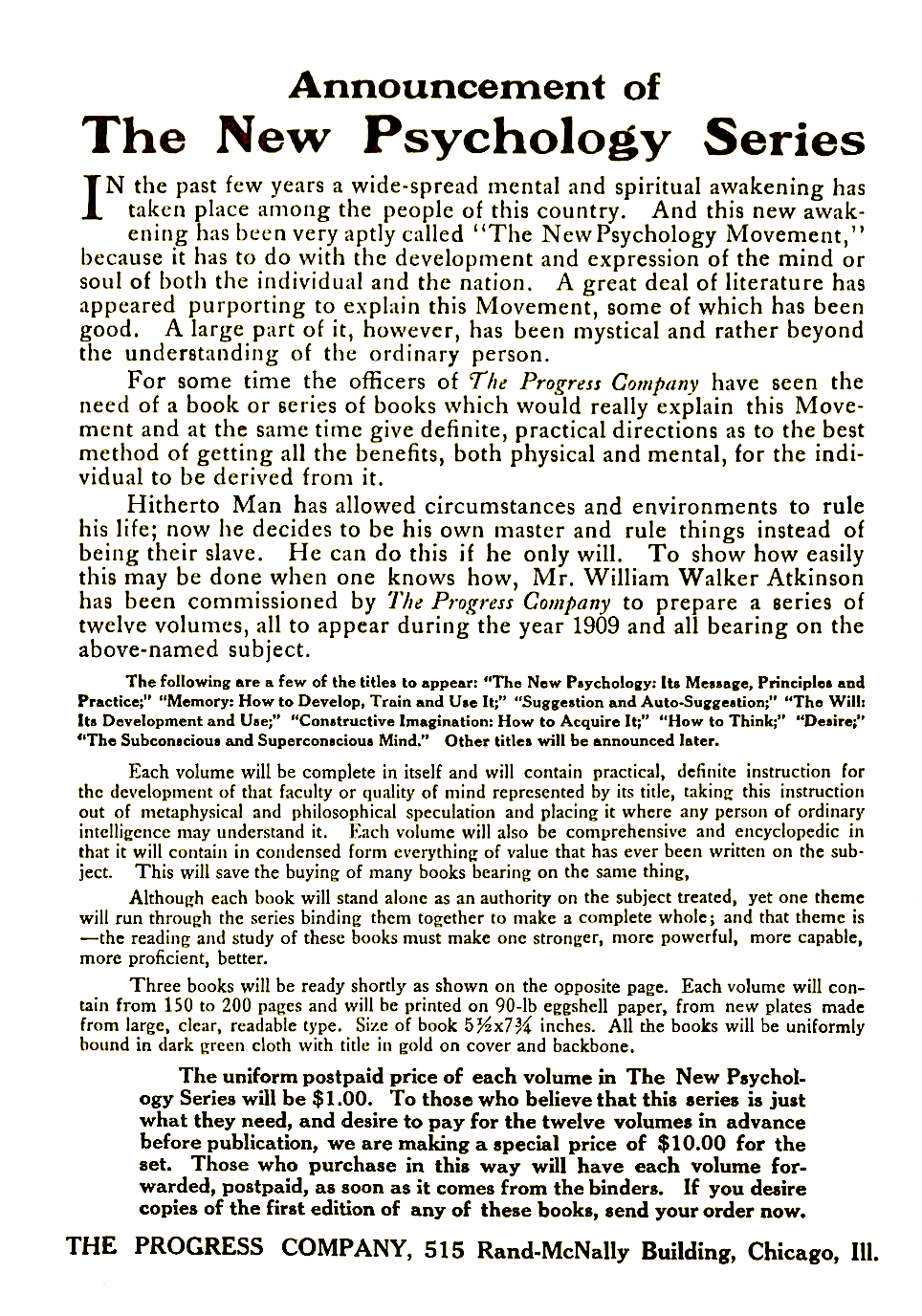
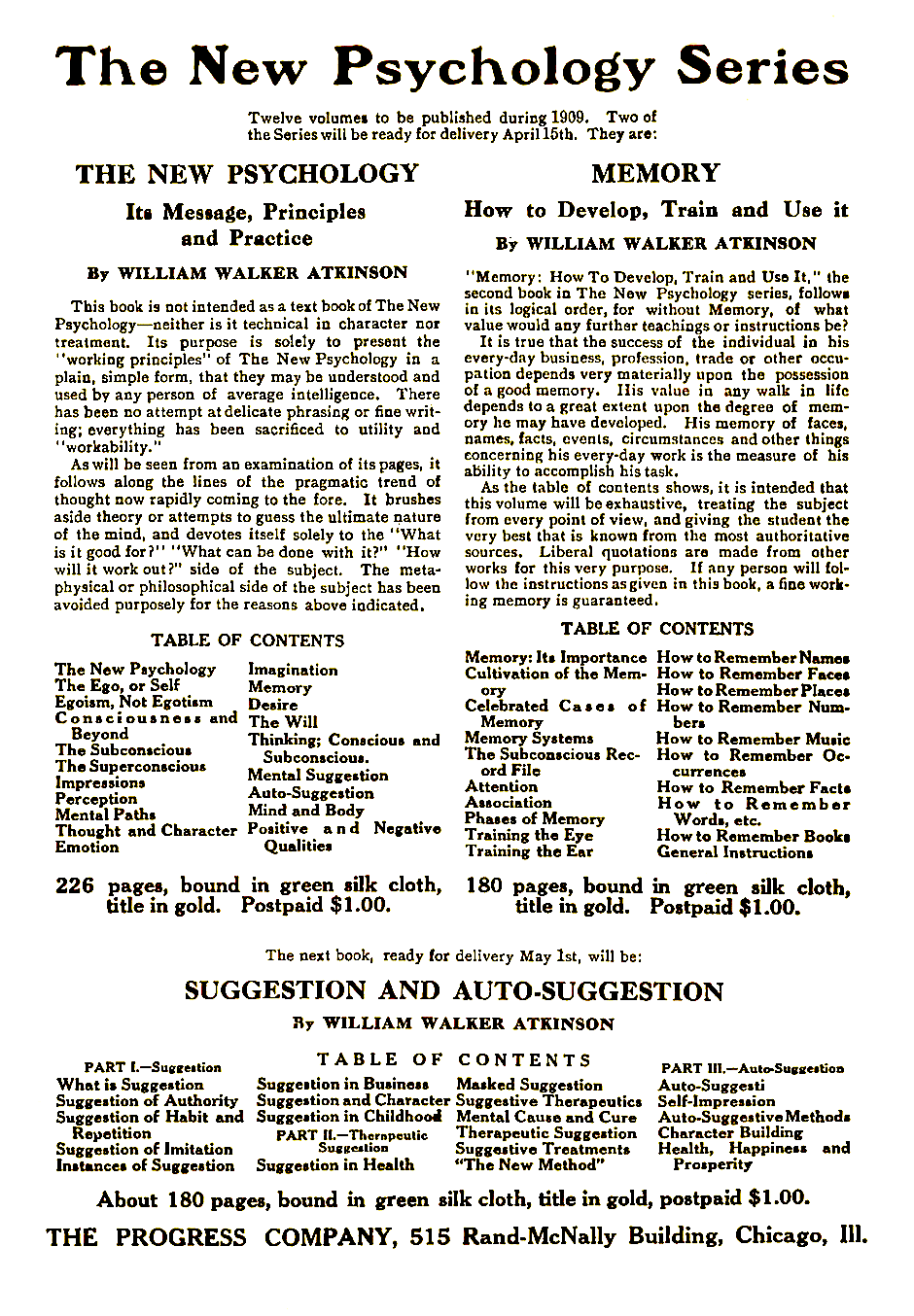
William Walker Atkinson’s The New Psychology: Its Message, Principles and Practice presents psychology not simply as a science for describing the operations of the human mind, but as a practical system through which the individual can deliberately develop, regulate, and reconstruct his own mental life. Atkinson makes this purpose clear from the beginning. He does not intend the book to be a technical psychological textbook, nor does he wish to become lost in metaphysical arguments concerning the ultimate nature of mind or soul. Instead, he is concerned with what he calls the working principles of psychology and, above all, with what those principles can actually accomplish when consciously applied. The important questions are not merely what thought, emotion, imagination, desire, will, habit, and subconscious activity are, but how they operate and how knowledge of their operation can be used. Psychology becomes valuable when it enables the individual to cultivate desirable qualities, overcome undesirable tendencies, improve mental efficiency, influence bodily conditions, and exercise greater control over his own character and conduct. This practical emphasis determines the organization of the entire book. Atkinson begins by establishing the nature of the conscious self, then examines the various levels and faculties of mind, explains how impressions and habits become established, and finally arrives at Suggestion and Auto-Suggestion as the most important practical means by which mental tendencies can be deliberately altered.
The Message of the New Psychology
Atkinson distinguishes his “New Psychology” from both older metaphysical speculation and purely descriptive academic psychology. He accepts the scientific movement away from endless speculation about what mind ultimately is, but believes psychology has another step to take. It must become useful. Knowing how memory, emotion, attention, habit, or subconscious activity operates is only the beginning; the real value of such knowledge lies in learning how these processes can be directed toward practical ends. Atkinson repeatedly returns to the idea that people have long been told that they should possess courage, determination, concentration, confidence, self-control, and other desirable qualities, while receiving comparatively little instruction about how such qualities can actually be produced. The New Psychology promises to supply that missing method. Instead of treating character as something essentially fixed, it treats character as something capable of modification through an understanding of the laws by which mental states are formed and strengthened. This makes psychology a practical art of self-development as well as a science of mental phenomena. Atkinson connects this orientation with the pragmatic spirit of his period: the test of psychological knowledge is what can be done with it. The discovery of subconscious mental activity is particularly important because it reveals that much of what appears to be fixed character is actually the product of accumulated impressions, habits, inherited tendencies, associations, and suggestions operating outside ordinary awareness. Once these processes are recognized as lawful mental activity, they can potentially be influenced by equally lawful means.
The Ego and the True “I”
Atkinson establishes the foundation of his system through a distinction between the true “I” and everything that belongs to what might be called the personality or the “Me.” The individual commonly identifies himself with his body, opinions, emotions, habits, desires, fears, thoughts, and personal characteristics, but Atkinson argues that the very fact that a person can observe these things indicates that they are not identical with the observing self. A person can say “my body,” “my thoughts,” “my feelings,” or “my habits,” implying a possessor standing behind the things possessed. Atkinson therefore identifies the “I” as the conscious center that knows, thinks, feels, chooses, and wills, while the body and the various contents and faculties of the personality belong to the “Me.” He deliberately avoids trying to settle the metaphysical question of what this “I” ultimately is. Whether it should be called soul, spirit, ego, or something explainable through physical science is less important to his practical psychology than the recognition that the individual experiences himself as a center capable of observing and directing mental activity. The simple realization “I am” becomes the psychological starting point from which self-mastery becomes possible. If fear, anger, habit, desire, or a particular train of thought were literally the self, the individual could do little except submit to them. If they are instead states experienced by the self, they can be examined, encouraged, restrained, redirected, or replaced.
Atkinson is careful to distinguish this recognition of the Ego from ordinary egotism. Egotism is an exaggerated valuation of the personality, precisely the collection of characteristics belonging to the “Me,” whereas his conception of egoism concerns recognition of the directing self behind those characteristics. This distinction allows him to establish one of the recurring themes of the book: whether the individual will be master of his mental faculties or mastered by them. The ordinary person is influenced continuously by inherited tendencies, environment, habits, emotions, social pressures, previous experiences, and suggestions received from other people. Thoughts arise automatically and are followed without examination, emotional reactions are accepted as inevitable, and established habits dictate behavior. The person consequently becomes largely reactive, believing these accumulated tendencies to constitute an unchangeable personality. Atkinson argues that recognition of the “I” changes this relationship. Mental faculties are instruments rather than masters, and the individual can learn to use them consciously. His psychology therefore begins not with positive thinking or suggestion, but with the establishment of an internal authority capable of employing those methods. The later techniques of attention, imagination, will, suggestion, and auto-suggestion depend upon this earlier recognition that there must be a directing center capable of deciding which mental tendencies are to be strengthened and which are to be weakened.
Consciousness and the Larger Mental Field
Having established the “I,” Atkinson expands his discussion from ordinary consciousness to the much larger field of mental activity existing outside immediate awareness. Consciousness, as ordinarily experienced, represents only a limited portion of the total activity of the mind. Atkinson distinguishes conscious, subconscious, and superconscious regions, each representing different forms or levels of mental operation. The conscious field contains those thoughts, sensations, perceptions, and acts of reasoning presently within awareness and is especially associated with deliberate attention and voluntary intellectual activity. Beneath this field lies the subconscious, containing enormous stores of impressions, memories, habits, tendencies, associations, instincts, and automatic mental processes. Above ordinary consciousness Atkinson places the superconscious, which he associates with unusual forms of intuition, inspiration, and higher mental activity. He is particularly careful not to treat subconscious and superconscious activity as though they were identical. The subconscious should not simply become a convenient mystical explanation for every unexplained phenomenon. Much of its activity is ordinary, automatic, and psychologically understandable, even when the individual remains unaware that it is occurring. This larger conception of mind is essential to Atkinson’s practical system because it means that conscious reasoning represents only one portion of the forces influencing conduct. To change the individual effectively, psychology must reach the deeper tendencies from which automatic thoughts, feelings, and actions arise.
The Subconscious Mind
The subconscious becomes one of the most important elements in Atkinson’s explanation of character because it contains the accumulated material from which much automatic behavior emerges. Experiences leave impressions; repeated impressions establish associations and tendencies; frequently repeated thoughts and actions become habits; and these habits eventually operate with little or no conscious direction. Atkinson also includes inherited tendencies within this subconscious inheritance, regarding the individual as entering life with dispositions that have not been consciously acquired. Instinctive reactions, unexplained attractions and aversions, prejudices, fears, emotional tendencies, and other apparently natural characteristics may therefore have roots deeper than the immediate conscious personality. Yet the existence of these subconscious influences does not lead Atkinson toward fatalism. On the contrary, the practical importance of discovering the subconscious is that what has been formed or strengthened through psychological processes can also be modified through psychological processes. The individual may have been shaped unconsciously by repetition, environment, experience, and suggestion, but those same principles can now be consciously employed. The subconscious is therefore both the repository of existing character and one of the principal fields in which the reconstruction of character must occur.
This point is essential to understanding the later portions of the book. Atkinson is not simply saying that a person should consciously decide to become courageous, confident, industrious, calm, or determined. Conscious resolution by itself may be too weak to overcome deeply established tendencies. The desired idea must be impressed repeatedly until it begins to establish itself beneath ordinary consciousness and becomes increasingly automatic. In this way, conscious intention can gradually become subconscious tendency. What originally requires deliberate effort can eventually become habitual. Atkinson’s psychology therefore explains self-development as a process in which conscious selection is used to reorganize subconscious activity. This is why repetition, attention, imagination, habit, suggestion, and auto-suggestion eventually become so important: they provide means of carrying selected ideas beyond momentary conscious thought and establishing them as durable parts of the individual’s mental organization.
The Superconscious Mind
Atkinson’s superconscious region allows him to account for mental phenomena that appear to rise above ordinary deliberate reasoning rather than below it. Intuition, sudden insight, creative inspiration, and certain unusual forms of mental perception can appear in consciousness without the individual being able to trace the reasoning process that produced them. Instead of automatically treating such experiences as supernatural, Atkinson places them within an expanded conception of psychological activity. The mind may possess capacities that ordinary waking consciousness does not completely understand, and psychology should remain open to investigating them. At the same time, Atkinson does not simply collapse the superconscious into the subconscious. The distinction enables him to preserve a place for higher or exceptional forms of mental activity while still describing ordinary subconscious processes in relatively naturalistic terms. This is characteristic of the position of The New Psychology: phenomena that earlier generations may have regarded as mysterious or occult can increasingly be considered within an enlarged science of mind without necessarily denying that significant areas remain unexplained.
Impressions and Mental Development
Atkinson next develops the idea that mental life is constructed through impressions. Experiences do not simply occur and disappear; they leave traces within the mind. Some impressions are weak and transient, while others become powerful because of emotional intensity, repetition, association, or sustained attention. As impressions accumulate they contribute to the formation of tendencies, expectations, preferences, habits, and patterns of thought. This provides Atkinson with a psychological explanation for the enormous influence of environment. People are continually receiving impressions from conversations, books, companions, authority figures, social expectations, repeated experiences, and their own recurring thoughts. Much of this material enters the mental life without deliberate examination. The individual is therefore constantly being educated psychologically, even when no formal instruction is taking place. The mind gradually becomes organized around the material repeatedly presented to it.
The practical consequence is that self-development requires greater control over the impressions being admitted and reinforced. A person who repeatedly exposes himself to fearful, discouraging, angry, or weakening ideas should not be surprised when corresponding mental tendencies become stronger. Conversely, repeated contact with ideas associated with courage, confidence, determination, concentration, and self-control can contribute to the formation of those qualities, particularly when accompanied by attention and emotional force. Atkinson is therefore constructing a mechanism rather than simply preaching optimism. Repetition strengthens impressions; strengthened impressions influence subconscious tendencies; subconscious tendencies affect thought and conduct. The individual who understands this process can begin deliberately selecting the kinds of impressions that will contribute to the character he wishes to build.
Perception and Mental Interpretation
Atkinson’s treatment of perception further develops the idea that the individual does not respond to external reality in a completely neutral manner. What is perceived depends partly upon attention, previous experience, association, expectation, interest, and established mental habits. Two individuals may encounter substantially the same external circumstances yet experience them differently because their minds select, interpret, and organize impressions differently. What one person immediately notices another may overlook; what one interprets as a threat another may regard as an opportunity. Perception is therefore not merely the passive reception of an objective world but an interaction between external impressions and the existing organization of the mind. This gives additional importance to mental training because the habits already established within the individual influence what he sees and how he reacts to it. Changing habitual thought can consequently change not only behavior but the manner in which circumstances themselves are mentally experienced.
Mental Paths and Habit
Atkinson describes repeated mental activity as creating pathways along which later thought travels more easily. The metaphor of “mental paths” provides a simple explanation for habit formation. Every time a particular thought, emotion, or response is repeated, the tendency toward its repetition becomes stronger. What initially requires effort gradually becomes easier until it occurs almost automatically. A person who habitually responds with fear strengthens the mental pathway leading toward fear, just as repeated anger, worry, hesitation, or self-doubt makes those responses increasingly natural. The same principle, however, applies to constructive qualities. Repeated acts of courage make courageous response easier; repeated concentration strengthens the habit of attention; repeated self-control makes future self-control less difficult. Character therefore appears not as a mysterious fixed possession but as the cumulative result of tendencies that have been repeatedly exercised.
The practical method of changing character follows directly from this principle. Old pathways must be weakened through disuse while new pathways are created through repetition. Atkinson treats mental development almost as a form of training in which exercise gradually produces facility. It is not enough to desire a new quality once or affirm it occasionally while continually exercising the opposite tendency. The desired response must actually be used until it becomes easier and increasingly automatic. This concept provides another link between Atkinson’s early discussion of subconscious activity and his later discussion of suggestion. Repeated suggestion becomes effective because it helps establish new mental associations and pathways, while repeated conduct strengthens those pathways until the new response begins to function habitually.
Thought and the Formation of Character
Atkinson consequently gives thought a formative role in character. Repeated thoughts influence emotional states and desires; these states affect decisions and actions; repeated actions form habits; and accumulated habits contribute to the character that the individual eventually displays. Thought therefore matters not merely because of what a person consciously believes at a particular moment but because persistent thought gradually creates tendencies. The idea that thought influences character is given a psychological mechanism through Atkinson’s preceding discussions of impression, repetition, association, subconscious activity, and mental pathways. A person who continually rehearses weakness, fear, failure, resentment, or indecision is repeatedly exercising those states. Likewise, someone who deliberately cultivates thoughts associated with confidence, courage, determination, self-command, and purposeful action is exercising different mental tendencies.
For Atkinson, this makes control of thought one of the principal responsibilities of the individual seeking self-mastery. The objective is not to prevent every unwanted thought from ever appearing, which would be impossible, but to determine which thoughts are repeatedly entertained and strengthened. Attention supplies energy to particular ideas, repetition deepens their impression, and continued use turns them into increasingly familiar paths. Thought thus becomes part of the process by which the individual is continuously creating his future mental character. The New Psychology attempts to make this normally unconscious process deliberate.
Emotion and Its Control
Atkinson recognizes emotion as an extremely powerful force in human conduct. Emotional states can overwhelm intellectual judgment, intensify impressions, direct attention, stimulate action, and influence physical conditions. Fear, anger, worry, grief, enthusiasm, hope, confidence, and similar states are therefore not minor additions to thought but major sources of psychological energy. His objective is not the elimination of emotion but its regulation. An individual completely ruled by emotion remains in the position of being mastered by his own mental machinery. The “I” must instead learn to recognize emotional states as experiences that can be observed, encouraged, checked, redirected, or transformed according to their usefulness.
This treatment of emotion fits the Master-versus-Servant theme of the book. A strong emotion can be destructive when uncontrolled but enormously useful when directed toward a constructive objective. The same force that produces uncontrolled excitement can become enthusiasm; the energy behind aggressive impulses can potentially be redirected into determination and purposeful action. The important question is not simply whether a mental force is strong, but who directs it and toward what end. Atkinson therefore continually returns the reader to the central position of the “I” as the organizing and directing element within mental life.
Imagination as a Constructive Faculty
Imagination occupies an especially important position because imagined experiences can produce genuine emotional and physiological reactions. A vividly imagined danger can create fear even when no actual danger is present, just as the anticipation of failure can affect behavior before any attempt has been made. Imagination can therefore become a source of weakness when it is allowed to operate automatically around negative expectations. Repeated mental pictures of illness, humiliation, defeat, danger, or incapacity may reinforce precisely the states the individual wishes to overcome. Atkinson accordingly treats uncontrolled imagination as another mental faculty capable of becoming the individual’s master.
The same faculty, however, can be deliberately employed in the opposite direction. The individual can mentally represent desired conduct, rehearse successful performance, imagine himself exercising a particular quality, and associate emotional force with a constructive mental picture. Imagination thereby becomes closely connected with suggestion and auto-suggestion. An idea presented merely as words may have limited force, while an idea vividly pictured and emotionally experienced can produce a stronger impression. Imagination gives form and experiential quality to the state the individual is attempting to cultivate, helping transform an abstract desire into a psychologically meaningful model toward which thought and action can be directed.
Memory and Association
Atkinson treats memory as a faculty that can be strengthened through understanding and exercise rather than as a fixed capacity bestowed upon some individuals and denied to others. Attention is especially important because material that is never clearly impressed upon the mind cannot easily be recalled. Interest, observation, association, and repetition likewise strengthen retention. What appears to be poor memory may therefore partly result from poor attention or weak original impressions rather than from an inherent inability to remember. Atkinson’s discussion again demonstrates his tendency to convert psychological description into practical training. Once the conditions influencing memory are understood, the individual can deliberately improve those conditions.
Memory also provides additional evidence for the existence of mental activity outside immediate consciousness. An experience may disappear completely from the conscious field and nevertheless remain stored in some form, later returning through association or appropriate stimulation. The conscious mind therefore does not contain the entirety of what the individual knows. Large quantities of mental material remain outside present awareness while continuing to influence associations, expectations, and behavior. This reinforces Atkinson’s larger conception of the subconscious as a vast background of accumulated mental material upon which conscious personality depends.
Desire and Motivation
Desire supplies much of the motive power behind action. Atkinson does not regard desire as something that should simply be extinguished; instead, it must be educated and organized. Scattered and contradictory desires divide energy and prevent sustained effort, whereas a strong and clearly defined desire can concentrate mental activity around a particular objective. Desire determines what the individual wants, while other faculties such as attention, imagination, and will help translate that desire into action. A vague wish produces little effect because it does not sufficiently organize the mental forces behind it. A definite desire repeatedly held in mind becomes a center around which thought and effort can gather.
Atkinson nevertheless insists that desire must remain subordinate to conscious direction. The individual who automatically follows every impulse remains a servant of his desires rather than their master. The objective is therefore not merely to intensify desire but to select worthy desires and organize them under the authority of the “I.” Once again the same structure appears: mental forces possess power, but their usefulness depends upon deliberate direction. Desire provides energy, while the will supplies control and persistence.
The Will as Executive Power
Will is one of the most important faculties in Atkinson’s system because it represents the executive expression of the conscious self. Through will, the individual selects among competing impulses, holds attention upon a chosen object, restrains unwanted tendencies, persists despite resistance, and translates intention into conduct. Atkinson does not treat will as an abstract metaphysical force. It is a practical capacity strengthened through use. Just as repeated exercise strengthens a physical faculty, repeated acts of deliberate choice and self-control strengthen volitional power. Small acts matter because they establish the habit of directing oneself rather than merely reacting to circumstance.
The development of will therefore requires practice. Every time the individual consciously performs a chosen action despite reluctance, maintains attention despite distraction, or refuses to follow an undesirable impulse, the relationship between the “I” and its mental machinery is strengthened. Atkinson’s emphasis upon will also prevents his system from becoming one of passive wishing. Thought, imagination, desire, and suggestion may prepare and influence the mind, but purposeful action remains necessary. The individual must eventually do something. Self-mastery is demonstrated in conduct, not merely in internal affirmation.
Conscious and Subconscious Thinking
Atkinson brings his earlier ideas together by examining the relationship between deliberate conscious thought and the less visible activity occurring beneath awareness. The conscious mind reasons, compares, selects, and directs attention, while subconscious processes continue to organize impressions, associations, habits, memories, and other material outside immediate awareness. A problem may be consciously considered and then temporarily abandoned, only for a solution or new idea to emerge later without an obvious conscious chain of reasoning. Atkinson regards such experiences as evidence that mental activity can continue after attention has shifted elsewhere.
The practical implication is that conscious thought can supply material upon which subconscious activity continues to operate. Ideas repeatedly introduced into consciousness, particularly when accompanied by attention, desire, expectation, or imagination, can gradually influence the deeper organization of the mind. This is the point at which the earlier chapters begin converging unmistakably upon suggestion. Conscious selection determines what is to be impressed, while subconscious processes help convert repeated impressions into increasingly automatic tendencies. The person who understands this relationship can attempt to use conscious thought as a means of educating the subconscious rather than allowing subconscious habits to remain entirely the accidental products of heredity and environment.
Mental Suggestion
Suggestion is one of the culminating subjects of The New Psychology because it provides a practical explanation for how ideas can influence thought, emotion, behavior, habit, and even bodily conditions. Atkinson presents human beings as continually exposed to suggestions from other people, social expectations, authority, language, environment, appearances, repeated statements, and circumstances. Many suggestions are received without deliberate recognition. An idea may be accepted because it is repeated, because it comes from a trusted or authoritative source, because it agrees with an existing belief, or because it is accompanied by strong emotion. Once accepted, the idea can influence subsequent mental activity without the individual remaining consciously aware of its origin.
The danger is therefore not suggestion itself but unconscious susceptibility to suggestion. A person who does not exercise discrimination may become psychologically governed by ideas supplied by others. Atkinson’s earlier insistence upon recognition of the “I” and development of will now becomes directly relevant. The individual must learn to examine ideas rather than allowing them automatic entrance into the deeper levels of mind. Yet suggestion is not merely something against which one must defend oneself. The same mechanism can be consciously employed for constructive purposes. Once the individual understands that repeated and properly directed ideas can establish mental tendencies, suggestion becomes a practical instrument for psychological development rather than merely an external influence.
Auto-Suggestion and Self-Reconstruction
Auto-suggestion brings the entire system into its most practical form. Instead of passively receiving impressions and suggestions from the environment, the individual deliberately selects the ideas he wishes to establish and repeatedly presents them to his own mind. These ideas may concern courage, confidence, concentration, self-control, health, determination, memory, emotional regulation, or other desired qualities. Through repetition, attention, expectation, and imagination, the selected idea is given increasing psychological force. It becomes more familiar, establishes associations with other mental material, and gradually creates new pathways through which thought and action can move more readily. What begins as deliberate conscious practice can eventually become subconscious habit.
Auto-suggestion therefore cannot be separated from the earlier chapters of the book. The “I” first determines the quality to be developed. Desire supplies motivation. Will maintains the decision. Attention holds the selected idea before consciousness. Imagination gives the desired state a vivid mental form. Repetition strengthens the impression. Suggestion carries the idea more deeply into the mental organization. Continued thought and conduct establish new mental paths, and repeated use eventually makes the new response more habitual. Character is thereby gradually reconstructed. Atkinson’s system is consequently much more integrated than a simple collection of positive affirmations. Auto-suggestion is the practical mechanism through which many of the psychological laws described earlier in the book are deliberately combined.
Mind and Body
Atkinson extends these principles beyond character and behavior into the relationship between mental and physical states. He argues that emotions and thoughts clearly affect bodily processes. Fear, grief, anger, anxiety, and worry can produce observable changes in circulation, digestion, muscular tension, energy, and general physical functioning, while confidence, hope, cheerfulness, and other constructive mental states can produce different effects. He draws upon contemporary medical observations to support the proposition that the body is responsive to mental conditions. Phenomena attributed to imagination, faith healing, expectation, suggestion, and similar influences may therefore have genuine physiological effects even when the explanations traditionally given for them are questionable.
Atkinson goes further by considering the possibility that forms of mental activity may operate throughout the cells and organs of the body and may be connected with the larger subconscious mentality. He does not claim that the precise mechanism has been definitively established, and this uncertainty is consistent with his pragmatic approach. The important point for him is that suggestion and mental states appear capable of affecting bodily processes regardless of whether psychology can yet completely explain the underlying mechanism. Mental healing consequently becomes another application of the same general principles already operating throughout the book: impressions affect subconscious activity, subconscious activity influences automatic processes, and deliberately directed suggestion may therefore produce changes extending beyond conscious thought and behavior.
Positive and Negative Mental Qualities
In the concluding portion of the book Atkinson reduces his practical psychology to a test by which thoughts, habits, emotions, and other mental qualities can be judged. The important question is whether a particular state makes the individual stronger, more capable, more efficient, and better able to exercise control over himself and accomplish constructive purposes. Qualities are positive insofar as they strengthen the individual and contribute to mastery, while they are negative insofar as they weaken, inhibit, distract, or enslave him. This is more than a simple distinction between pleasant and unpleasant feelings. A pleasurable impulse might still be negative if it weakens self-control, while an uncomfortable act of discipline might be positive because it strengthens will and character.
Atkinson closes with an image that summarizes the entire philosophy of the book. The mental faculties are like powerful horses and the individual is the charioteer who must hold their reins. The horses possess the energy necessary for movement, but energy without control can carry the charioteer away from his intended destination. The objective is not to destroy the horses or suppress their strength, but to master and direct them. Thought, emotion, desire, imagination, subconscious activity, and habit are similarly powerful forces. When uncontrolled they may dominate the individual; when understood and directed they become instruments through which the individual can develop himself. The ultimate issue is therefore the one Atkinson places before the reader at the conclusion of the work: “Mastery or Servitude, Which?” Knowledge of psychological principles has little value unless those principles are actually put into practice.
The Central System of The New Psychology
The New Psychology presents a continuous theory of deliberate self-development rather than a disconnected collection of observations about mental life. Human character begins partly as the product of inherited tendencies, environment, experiences, impressions, associations, and suggestions received throughout life. Repetition turns many of these influences into mental pathways and habits, while subconscious activity allows them to continue operating without deliberate thought. The ordinary person consequently mistakes the accumulated products of psychological conditioning for an unchangeable self. Atkinson’s first major step is therefore to separate the true “I” from this accumulated personality. Once the individual recognizes thoughts, emotions, desires, habits, and reactions as mental states rather than as the essential self, he can begin deliberately working upon them.
The remainder of the book explains how that reconstruction can occur. Attention determines which ideas receive sustained mental energy; imagination gives those ideas vivid form; desire provides motive force; will supplies direction and persistence; repetition strengthens impressions; subconscious activity preserves and organizes them; habit creates increasingly automatic responses; and suggestion and auto-suggestion provide practical methods for deliberately introducing and strengthening selected ideas. The resulting process can be understood as a movement from conscious choice toward subconscious habit and ultimately toward character. The individual consciously selects a quality, repeatedly thinks and imagines it, acts in accordance with it, and continues exercising it until what originally required deliberate effort becomes an increasingly natural response. Character is therefore not merely discovered but, within limits, constructed.
This explains the structure of the book and the importance Atkinson assigns to suggestion near its conclusion. The opening chapters establish who is supposed to exercise control by identifying the “I” as the directing center of consciousness. The middle chapters describe the machinery to be controlled by examining consciousness, subconscious activity, impressions, perception, habit, thought, emotion, imagination, memory, desire, and will. The later chapters then explain how these faculties and processes can be deliberately influenced through mental suggestion and auto-suggestion. Suggestion is therefore not an isolated subject added to an otherwise conventional psychology. It emerges as the principal practical mechanisms through which the entire program of the New Psychology can be put into operation.
Atkinson’s central message is ultimately that psychology should teach people not simply what desirable character looks like, but how character can actually be developed. It is insufficient to tell someone to possess courage, concentration, determination, self-confidence, self-control, or efficiency. A practical psychology must explain the mental laws by which these qualities are established and strengthened. In this system, the same principles that have unconsciously formed the existing personality can be consciously turned toward its reconstruction. The mind has been shaped through impressions, repetition, habit, association, environment, and suggestion; it can therefore be deliberately reshaped through controlled impressions, repetition, new habits, directed thought, will, suggestion, and auto-suggestion. This is the essential promise of The New Psychology: psychology becomes not merely the study of what the mind is and how it behaves, but a practical method by which the individual learns to become the master of the forces operating within it.