Practical Mind Reading by William Walker Atkinson was first published by the Advanced Thought Publishing Company in 1907 and then by the Yogi Publication Society. The book is a course in contact mind reading, thought transference, telepathy, and the cultivation of sensitivity to mental impressions. It presents mind reading not as an inexplicable supernatural gift possessed by a few unusual individuals, but as a latent human faculty that can be investigated and developed through concentration, receptivity, repeated experimentation, and carefully graded exercises.
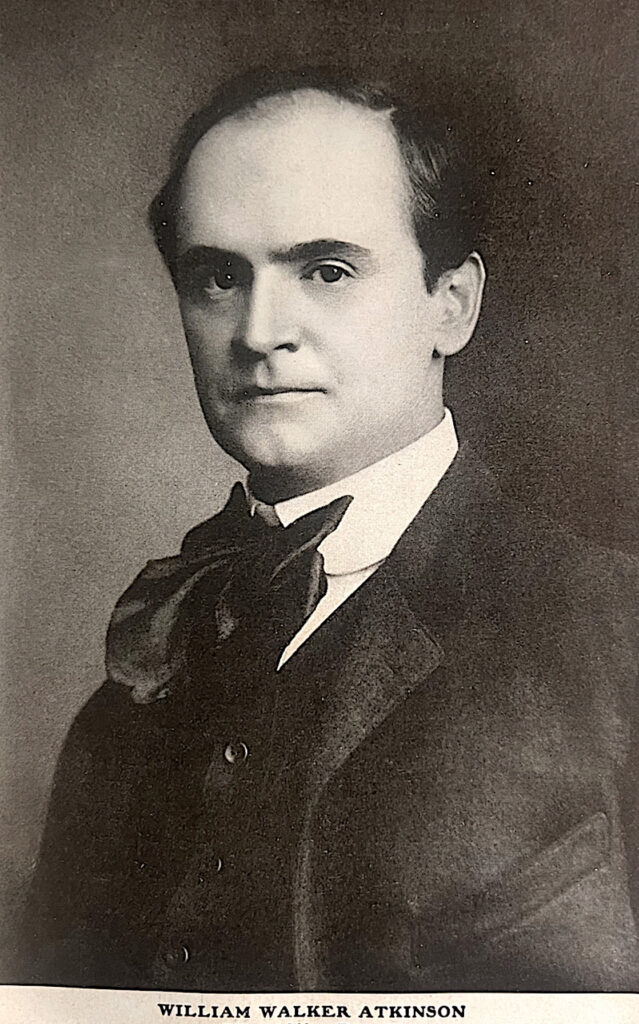
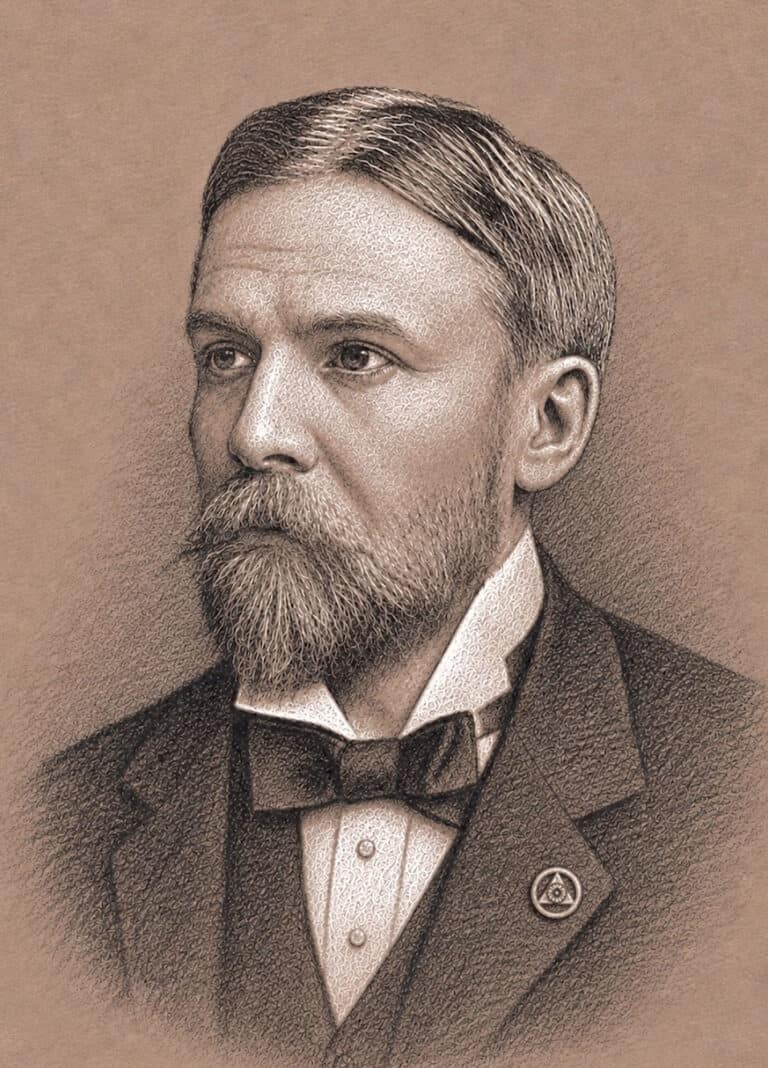
William Walker Atkinson
Students begin with comparatively simple experiments involving physical contact between a person transmitting a thought and another attempting to receive it, then progress toward increasingly difficult tests in which physical contact is reduced or eliminated. The larger purpose is to demonstrate that apparent mind-reading phenomena range from unconscious physical communication to what the book considers genuine transmission of thought from one mind to another.
Practical Mind Reading is best understood not as an entirely new system but as a revised version of a course that had already appeared within the same Chicago publishing network. In 1900 and 1901, the Psychic Research Company published Herbert A. Parkyn’s anonymous A Complete Course in the Art of Mind-Reading, a twenty-lesson course covering many of the same subjects, using the same progressive method, and moving from contact experiments into genuine telepathy. The earlier book begins by teaching what it calls muscle reading, explaining how concentrated thought unconsciously produces bodily movements that can be detected by a trained operator, and then devotes its second half to what it calls genuine mind reading or telepathy. Practical Mind Reading essentially returns to this earlier curriculum but reflects an important development in the network’s understanding of the phenomena. Muscle reading is still acknowledged as real, but the later book argues that the earlier explanation had been applied too broadly: physical contact might provide not only unconscious muscular clues but also a channel through which genuine mental impressions could pass. The later work can therefore be read as both a remake and an update of Parkyn’s earlier Psychic Research Company course, preserving its experimental foundation while revising the theory used to explain the results.
This relationship is important because the Psychic Research Company was not disconnected from Atkinson. It belonged to the same Chicago network in which Parkyn, Atkinson, and their associates were developing and publishing material on suggestion, mind reading, telepathy, and psychic phenomena, and the company also released material under Atkinson’s name. Practical Mind Reading provides a clear example of how material within this network could be taught in one form, reconsidered through further experimentation, and later reworked under a different title. A detailed comparison at the end of this summary shows how closely Practical Mind Reading follows Parkyn’s earlier course.
What Is Practical Mind Reading About?
The central subject of Practical Mind Reading is the possibility that one person can receive thoughts, mental pictures, directions, or impressions originating in the mind of another. Rather than asking the reader simply to accept this proposition, the book constructs a practical training system in which increasingly difficult experiments are supposed to provide personal evidence. The beginning student is not expected immediately to receive complete sentences or vivid mental pictures. An impression may first appear as an impulse to move in a certain direction, a feeling that one object is correct, a fleeting picture, an involuntary inclination, or an unexplained sense of certainty. The practical problem is therefore not merely learning how to “read” another person’s thoughts, but learning how to recognize an incoming impression without confusing it with deliberate reasoning, expectation, imagination, or guessing.
The book divides the subject broadly between Contact Mind Reading and Telepathic Mind Reading. In Contact Mind Reading, the person transmitting the thought and the person receiving it remain physically connected, usually by holding hands or through another form of bodily contact. Telepathic Mind Reading removes this physical connection and attempts to reproduce the same basic process across intervening space. The book repeatedly uses contemporary technologies of communication as analogies: contact mind reading resembles transmission along a wire, while telepathy resembles wireless transmission. The analogy allows the author to propose that both phenomena may belong to the same underlying process, with physical contact simply making transmission easier for inexperienced participants.
How Does Contact Mind Reading Work?
The basic contact experiment requires two roles. The Transmitter knows what object, direction, location, movement, or action has been selected and concentrates upon it. The Receiver does not know the answer and attempts to become mentally receptive to the impression being sent. Physical contact is maintained between them while the Receiver waits for an impulse and then follows it. The Receiver is warned against trying to solve the problem intellectually. Reasoning about where an object is likely to have been hidden or consciously selecting among possible answers introduces the Receiver’s own thoughts into the experiment and makes it more difficult to distinguish a transmitted impression.
The Transmitter has the opposite responsibility. Rather than becoming passive, the Transmitter must concentrate strongly and continuously upon the selected idea. If an object is involved, the Transmitter should form a clear mental picture of it. If the Receiver is supposed to move toward a particular location, the Transmitter should picture the Receiver actually moving in that direction. If an action is required, the action itself should be mentally represented as vividly as possible. The success of the experiment therefore depends upon a complementary psychological relationship: concentrated projection from one side and receptive attention from the other.
Atkinson emphasizes that the Receiver should not expect dramatic sensations. Mental impressions may initially be so slight that they are dismissed as imagination. The purpose of repeated experiments is to allow the student to discover what a successful impression feels like. Once the Receiver begins recognizing the difference between an impression that leads to a correct result and a consciously manufactured guess, confidence and sensitivity are expected to increase together. Contact experiments therefore function as training exercises rather than simply demonstrations.
Why Does the Book Reject Muscle Reading as a Complete Explanation?
The distinction between Contact Mind Reading and ordinary muscle reading becomes one of the book’s most important theoretical arguments. By the time Practical Mind Reading appeared, investigators of public mind-reading performances had long recognized that remarkable-looking feats could sometimes be accomplished by detecting unconscious bodily movements. A participant who knew where an object was hidden might unintentionally resist when the performer moved in the wrong direction and relax when the performer approached the correct location. A skilled operator could become extraordinarily sensitive to these changes and appear to possess information that had never consciously been communicated.
Practical Mind Reading accepts that this phenomenon exists. It does not deny unconscious muscular action or claim that every public mind reader is genuinely receiving thoughts. Instead, it argues that the discovery of muscle reading produced an opposite error. Because investigators demonstrated that some performances could be explained through unconscious muscular clues, they began treating muscle reading as a universal explanation for all contact mind-reading phenomena. The book considers that conclusion unjustified. A performer who pushes, pulls, leans, or consciously interprets muscular movements may indeed be practicing muscle reading, but the presence of physical contact does not by itself prove that muscular movement is transmitting the information.
The alternative theory is that physical contact may act as a conductor for mental impressions. The nervous systems of the Transmitter and Receiver are physically connected, and the book proposes that thought may pass through this connection in a manner analogous to an electrical signal traveling along a wire. The author therefore distinguishes between mechanically interpreting muscular movements and becoming receptive to a mental impression transmitted while physical contact is maintained. This distinction becomes essential to the entire system because it allows Contact Mind Reading to serve as the intermediate stage between ordinary physical communication and non-contact telepathy.
What Does the Receiver Actually Experience?
One of the most practical aspects of the book is its attempt to describe the subjective experience of receiving a thought. The Receiver is not told to expect a voice speaking inside the head or a complete visual representation appearing instantly before the mind. Instead, impressions may take several forms. A direction may first appear as a simple inclination to move left or right. A selected object may produce a feeling of attraction toward one location. A drawing may appear as a vague shape. A word may emerge unexpectedly into consciousness. In other cases the Receiver may simply experience a strong feeling that one choice is correct without knowing why.
This is why mental passivity is repeatedly emphasized. The conscious mind naturally wants to solve the problem. Once it begins reasoning, however, it generates competing thoughts that can be mistaken for received impressions. The Receiver is therefore trained to remain alert while suspending deliberate judgment long enough for the first impression to emerge. The first spontaneous impulse is often given more weight than a later conclusion produced through analysis.
The book treats this ability as something that improves through use. What begins as a nearly imperceptible impression may eventually become recognizable because the student repeatedly compares impressions with results. Correct impressions develop a recognizable character. The student gradually learns when to trust an impulse, when conscious reasoning has intruded, and when no meaningful impression has been received at all. Mind reading is consequently presented less as acquiring a new supernatural power than as becoming sensitive to mental information that ordinary consciousness normally overlooks.
What Are the Main Principles of the Training?
Although the book contains many individual exercises, its practical system rests upon a relatively small number of recurring principles:
The Transmitter should form one clear and definite mental impression rather than allowing the mind to wander.
The Receiver should remain receptive and avoid consciously guessing the answer.
Physical contact should be used first because the book considers contact transmission easier for beginners.
Simple experiments should be mastered before complicated demonstrations are attempted.
Repetition is necessary because sensitivity to mental impressions must be developed through experience.
Results should be judged across repeated experiments rather than from one striking success or failure.
The Receiver must learn to distinguish spontaneous impressions from thoughts generated by conscious reasoning.
Physical contact can gradually be reduced as the student becomes more sensitive.
Non-contact experiments provide the strongest tests of genuine telepathy because ordinary muscular communication has been eliminated.
These principles turn the subject into a progressive course rather than a collection of psychic tricks. The exercises are arranged to educate the student’s attention, concentration, sensitivity, and confidence. Success at an early stage prepares the student psychologically for the next stage, while failure is treated as an expected part of learning rather than evidence that further experimentation is pointless.
What Experiments Does the Book Recommend?
The practical exercises begin with simple tests in which the Transmitter concentrates upon a selected object, location, direction, or action while the Receiver attempts to follow the resulting impression. Hidden-object experiments are especially useful because success and failure are easily determined. The Receiver can begin by attempting to identify the general direction of an object and later progress toward locating increasingly specific objects or positions. The student is instructed to pay close attention to the first impulse rather than stopping to reason about where the object is likely to have been placed.
As sensitivity develops, the experiments can involve more precise mental information. Numbers, geometrical forms, drawings, words, playing cards, and mental pictures provide useful material because the result can be compared directly with the thought held by the Transmitter. Drawings are particularly valuable because they test the transmission of a mental image rather than merely a verbal concept. The Transmitter fixes the form in mind while the Receiver attempts to reproduce whatever shape appears in consciousness.
The book also moves beyond demonstrations designed merely to impress an audience. The larger objective is to determine whether mental communication persists when obvious physical clues are eliminated. Contact can therefore be weakened, altered, or eventually removed. The gradual elimination of ordinary communication transforms the exercises from demonstrations of sensitivity into experiments intended to test telepathy itself.
How Does the Book Move From Contact Mind Reading to Telepathy?
The progression from physical contact to non-contact thought transmission forms the central arc of the course. Beginners use contact because it is believed to strengthen the connection between Transmitter and Receiver. Once the Receiver becomes accustomed to recognizing mental impressions, the physical connection can be reduced. Eventually the participants attempt the same kinds of experiments without touching.
This transition is crucial because successful non-contact experiments cannot readily be explained through unconscious muscular movements. If a Receiver reproduces a drawing, identifies a selected object, or receives another definite impression while separated from the Transmitter, the book considers this stronger evidence that something other than muscle reading is occurring. Contact Mind Reading is therefore not the destination of the training but its preparatory stage.
The analogy with telegraphy becomes especially important here. A wired telegraph and wireless communication accomplish broadly similar purposes through different means of transmission. In the same way, the book proposes that physical contact may facilitate mental transmission without being essential to it. The student begins with the “wire” and then attempts to dispense with it.
What Evidence Does the Book Give for Telepathy?
Practical Mind Reading supplements its exercises with reports drawn from psychical research. Among the examples discussed are experiments involving Douglas Blackburn as Transmitter and G. A. Smith as Receiver. Drawings were selected and mentally transmitted while precautions were reportedly taken to prevent ordinary communication. The book describes thirty-seven drawing experiments conducted over four days and reports twenty-nine as successful. Such cases are presented as evidence that thought transference had moved beyond anecdote and had become a subject of organized experimentation.
The book also points toward spontaneous experiences that it interprets as everyday telepathy. People unexpectedly think of someone immediately before receiving a letter or visit from that person; two individuals independently arrive at the same thought; or a strong impression concerning another person arises without an obvious sensory cause. Such experiences are not considered proof individually, but their frequency is used to suggest that telepathic communication may occur naturally and irregularly even among people who have never deliberately cultivated it.
Mark Twain is cited in connection with a particularly interesting experiment. Twain described composing letters to individuals, addressing them, and then destroying them rather than mailing them, only to receive correspondence from those individuals concerning the same subjects. The book interprets experiences of this kind as possible examples of spontaneous thought transmission. The practical course is intended to replace such accidental occurrences with deliberate experiments.
What Does Automatic Writing Have to Do With Mind Reading?
The book extends its theory into automatic writing, treating it as another possible method through which received impressions can reach conscious expression. Instead of attempting to identify a thought intellectually, the Receiver holds a pencil lightly and permits the hand to move with as little conscious direction as possible. If the experiment succeeds, marks, letters, words, or drawings may emerge that correspond with the thought held by the Transmitter.
This is significant because the hand becomes an instrument of reception rather than deliberate composition. The conscious mind is again asked to withdraw from active control. Just as a Receiver in a directional experiment follows an impulse without reasoning about it, the automatic writer allows the hand to move before consciously deciding what should be written.
The book connects these experiments with W. T. Stead and investigations of automatic writing. Stead’s experiences are used to suggest that some communications attributed to spirits might instead involve telepathic reception from living people. This possibility fits the book’s broader effort to search for common mental mechanisms behind phenomena ordinarily separated into different occult categories.
Is Mind Reading Presented as Supernatural?
Despite its extraordinary claims, the book generally avoids describing mind reading as supernatural. Its preferred position is that unexplained mental phenomena may operate according to natural laws that science has not yet completely identified. Electricity, telegraphy, wireless communication, and other technological developments provide recurring analogies because invisible transmission had already become an ordinary part of modern life.
The argument is not that thought has been scientifically demonstrated to behave exactly like electricity. Rather, the comparison is used to challenge the assumption that invisibility or incomplete understanding makes a phenomenon impossible. Human beings used electrical forces before fully understanding every aspect of them, and the book proposes that mental transmission might likewise be investigated experimentally before its ultimate mechanism is known.
This natural-law framing allows the author to occupy a middle position between unquestioning occult belief and absolute skepticism. Readers are repeatedly encouraged to experiment. The proper response to an unusual claim is neither automatic acceptance nor automatic rejection but an attempt to reproduce the phenomenon under conditions that progressively eliminate ordinary explanations.
Why Are Practice and Repetition So Important?
The entire course depends upon the assumption that sensitivity can be educated. The beginner may receive only weak and uncertain impressions because ordinary consciousness has been trained to rely almost exclusively upon the recognized physical senses and deliberate reasoning. If another form of mental receptivity exists, the book argues, neglect would naturally leave it undeveloped.
Practice therefore performs several functions simultaneously. It strengthens concentration in the Transmitter, increases receptivity in the Receiver, gives the Receiver experience distinguishing impressions from guesses, and builds confidence through accumulated results. The student is discouraged from attaching excessive importance to a single failure because inconsistent results are expected during development.
This emphasis on gradual training also explains why the book begins with contact experiments rather than immediately attempting spectacular long-distance telepathy. The easiest conditions are established first. Once the student recognizes the experience of receiving an impression, the supporting conditions can gradually be removed. The method is educational: simple exercises prepare the mental faculties required for more difficult ones.
What Is the Central Teaching of Practical Mind Reading?
The central teaching of Practical Mind Reading is that apparent thought transference should be approached as a trainable mental faculty rather than merely as an inexplicable psychic gift. The Transmitter develops concentrated projection; the Receiver develops receptive sensitivity. Physical contact provides the easiest experimental conditions, but the student gradually moves toward tests in which ordinary sensory and muscular communication can no longer account for the result.
The book also insists upon an important distinction between acknowledging muscle reading and using muscle reading as a universal explanation. Unconscious muscular action can explain some impressive demonstrations, but the author argues that this does not establish that every successful contact experiment works through muscular cues. Contact may itself facilitate a deeper form of mental transmission. Telepathy then represents the continuation of that process without the physical conductor.
Read by itself, Practical Mind Reading is therefore a practical manual for investigating contact mind reading and telepathy. Read historically beside the material that preceded it, however, it becomes something more revealing: an updated presentation of a system that Parkyn and the Psychic Research Company had already put into print years earlier.
From Parkyn’s Complete Course to Practical Mind Reading
The relationship between Practical Mind Reading and Herbert A. Parkyn’s earlier A Complete Course in the Art of Mind-Reading is one of the most important contexts for understanding the later book. The Psychic Research Company copyrighted its course in 1900 and 1901 and published it anonymously in Chicago as twenty lessons divided into two major parts. Part I dealt with muscle reading; Part II dealt with what the course explicitly called mind reading or telepathy. Long before the later Atkinson presentation, the essential educational sequence was therefore already in place: begin with contact experiments, cultivate concentration and sensitivity, learn how thought may produce observable effects, and then progress toward experiments intended to demonstrate direct communication between minds.
The similarities are not merely general similarities between two books about the same subject. They extend into the structure, instructional method, terminology, experiments, underlying psychological principles, and progression of the training. Parkyn’s course begins by explaining that popular “mind reading” must first be separated from genuine mental communion. The beginner is trained in contact work because muscle reading provides preparation for telepathy. The student learns to locate hidden objects, interpret physical responses from a guide, develop concentration and sensitivity, reproduce numbers and drawings, and eventually perform increasingly difficult demonstrations. Only after this preliminary education does the course turn formally to thought transmission without physical contact.
How Closely Does the Later Book Follow Parkyn’s Earlier Course?
Illustration showing Dr. Parkyn and mind reading.
The parallels are extensive:
Both works treat mind reading as something that can be learned through a graded course rather than as a rare supernatural gift.
Both begin with physical-contact experiments before progressing toward non-contact telepathy.
Both divide the experiment between a person concentrating upon the information and another person attempting to receive it.
Both make concentrated attention by the sender essential to successful transmission.
Both teach the receiver to become increasingly sensitive to impressions that ordinary consciousness overlooks.
Both use simple experiments before attempting more difficult demonstrations.
Both emphasize repeated practice rather than expecting immediate spectacular results.
Both treat hidden objects, directions, numbers, drawings, and similar definite targets as useful experimental material.
Both present telepathy as a natural phenomenon governed by laws rather than as a miraculous suspension of nature.
Both argue that an undeveloped faculty can become stronger through deliberate education and use.
Both move from phenomena involving physical connection toward genuine thought transmission without ordinary sensory communication.
Both ultimately encourage the reader to experiment personally rather than accept either belief or skepticism on authority alone.
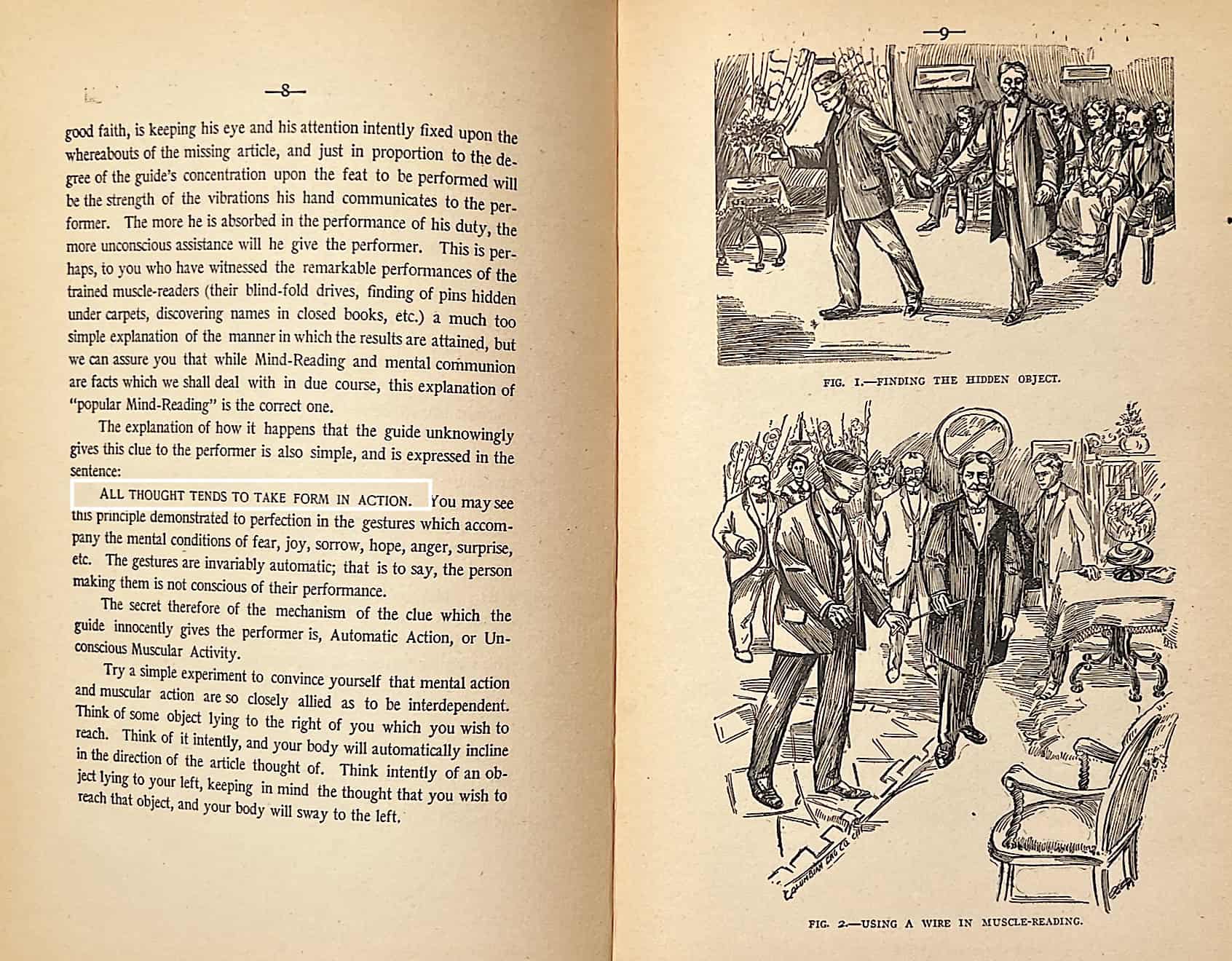
One of the clearest connections appears in Parkyn’s explanation of muscle reading. The earlier course states that “all thought tends to take form in action.” Concentrated thought produces automatic action or unconscious muscular activity. A person who knows where an object is hidden may therefore unconsciously resist movement away from it and relax or move forward when the operator approaches it. The mind reader learns to interpret these almost imperceptible physical responses. The course then builds an entire sequence of demonstrations upon this principle.
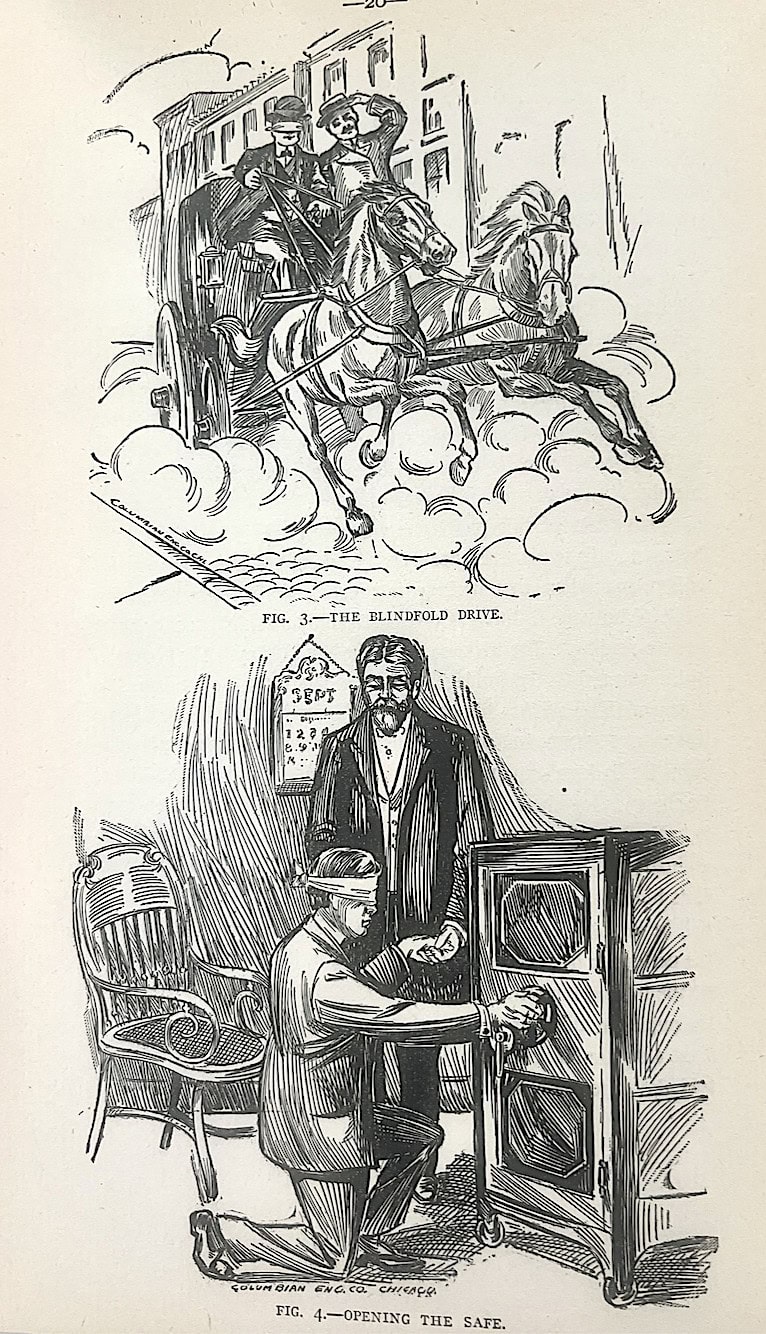
Parkyn’s exercises become progressively more elaborate. The student learns to locate a selected book, find a concealed pin and return it to the exact hole previously made in a wall, reconstruct an imaginary murder, rearrange people into a previously formed tableau, reproduce numbers, copy drawings, conduct a blindfolded drive, and eventually attempt to open a safe by following the unconscious responses of someone who knows the combination. The spectacular appearance of the later demonstrations conceals the simplicity of the underlying training: the performer has gradually become extraordinarily sensitive to signals that were present from the beginning.
But Parkyn’s book does not claim that all mind reading is muscle reading. This distinction is essential. After nine lessons devoted to muscle reading, Part II opens by announcing the transition to telepathy. From that point forward, “mind-reading” is defined as actual thought transmission or reception rather than the interpretation of physical movements. The earlier course defines a Projector as the person sending the thought and a Receiver as the person receiving it, and defines telepathy as thought transference occurring without assistance from the five physical senses. Muscle reading is presented as preparation because it develops concentration and sensitivity, two faculties considered necessary for genuine telepathic work.
What Changed in the Later Version?
This makes the change visible in Practical Mind Reading especially significant. The later book does not suddenly discover telepathy; telepathy had already occupied half of Parkyn’s earlier course. What changes is the interpretation of the territory between ordinary muscle reading and completely non-contact telepathy. Parkyn’s earlier presentation draws a relatively sharp boundary: the first category is physical and the second genuinely mental. The later presentation argues that this division may have been too simple.
Practical Mind Reading still accepts unconscious muscular communication, but it challenges investigators who concluded from its existence that all contact mind reading could be dismissed as muscle reading. The later theory allows physical contact to serve as a conductor of genuine mental impressions. The Transmitter and Receiver may be touching, yet the information need not be communicated merely by pulling, pushing, resistance, relaxation, or other mechanical movements. Contact may strengthen a mental connection in much the same way that a wire provides a channel for an electrical signal. The later book thus retains Parkyn’s original spectrum while adding an intermediate category: genuine Contact Mind Reading.
Why Does the Psychic Research Company Matter?
The Psychic Research Company provides the institutional bridge between the two books. A Complete Course in the Art of Mind-Reading was not an unrelated book that happened to anticipate Atkinson. It emerged from the Chicago publishing network in which these subjects were already being developed, taught, tested, and repackaged. The company was publishing material connected with Parkyn’s circle while Atkinson himself was already part of that same environment, and it also released works under Atkinson’s name. The appearance of closely related material later under Atkinson therefore needs to be understood within this continuing publishing and intellectual relationship rather than through a simple model in which one independent author happened to produce a book resembling another independent author’s earlier work.
This context changes how Practical Mind Reading can be read. Many of the characteristics that might otherwise appear to constitute a distinctive new Atkinson method were already present in the earlier Psychic Research Company course: the graded lessons, sender-and-receiver arrangement, concentration exercises, receptive mental state, hidden-object tests, drawings and numbers, progression from contact toward telepathy, insistence upon practice, natural-law interpretation, and conception of telepathy as a latent human faculty capable of development. Parkyn’s earlier book supplies the framework; the later work reorganizes and updates that framework around the network’s developing understanding of contact thought transmission.
The relationship is also consistent with the larger publishing pattern surrounding Parkyn and Atkinson. Ideas did not necessarily remain attached to one title or one authorial presentation. Concepts could begin in lectures or instructional courses, appear anonymously through one publishing concern, be revised in periodicals or related courses, and later reappear in expanded form under Atkinson or one of the other names used throughout the network. The Psychic Research Company is especially important for tracing this process because it sits directly within the period when Atkinson was becoming increasingly involved with Parkyn’s psychological and psychic-science work.
An Updated Version of the Same System
The strongest evidence of continuity between the two books is therefore not a single repeated experiment or phrase but the survival of the entire instructional architecture. Both books ask essentially the same question: how can a person be trained to receive information originating in another mind? Both answer by beginning with the easiest conditions, cultivating concentration and sensitivity, observing results, repeating experiments, and gradually removing ordinary means of communication. What changes is the explanation assigned to one part of that progression.
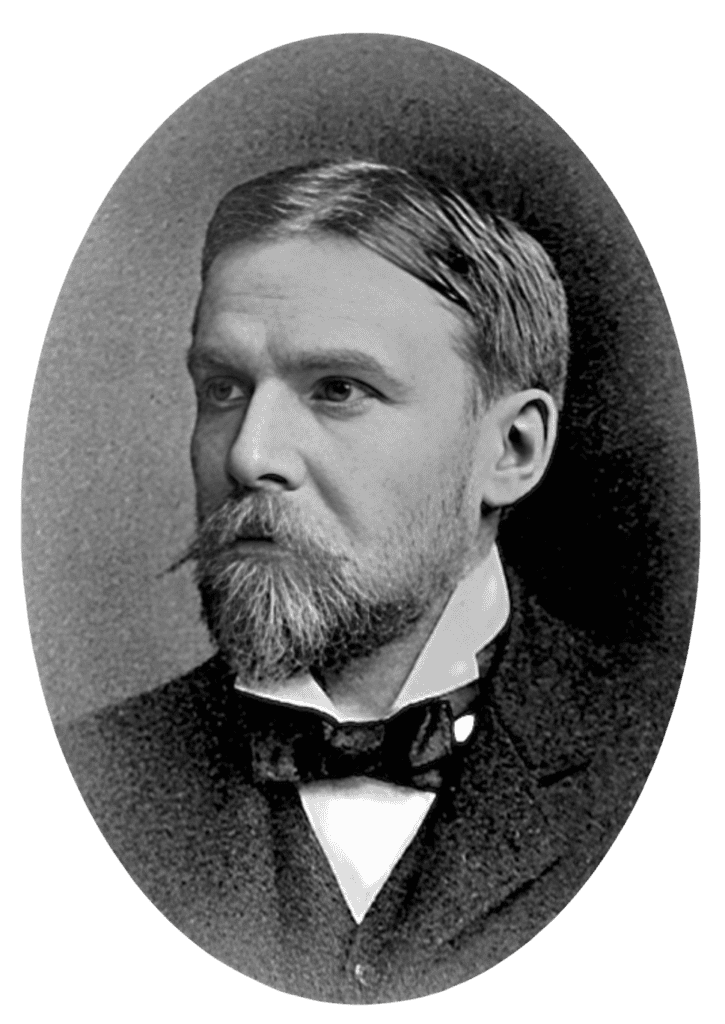
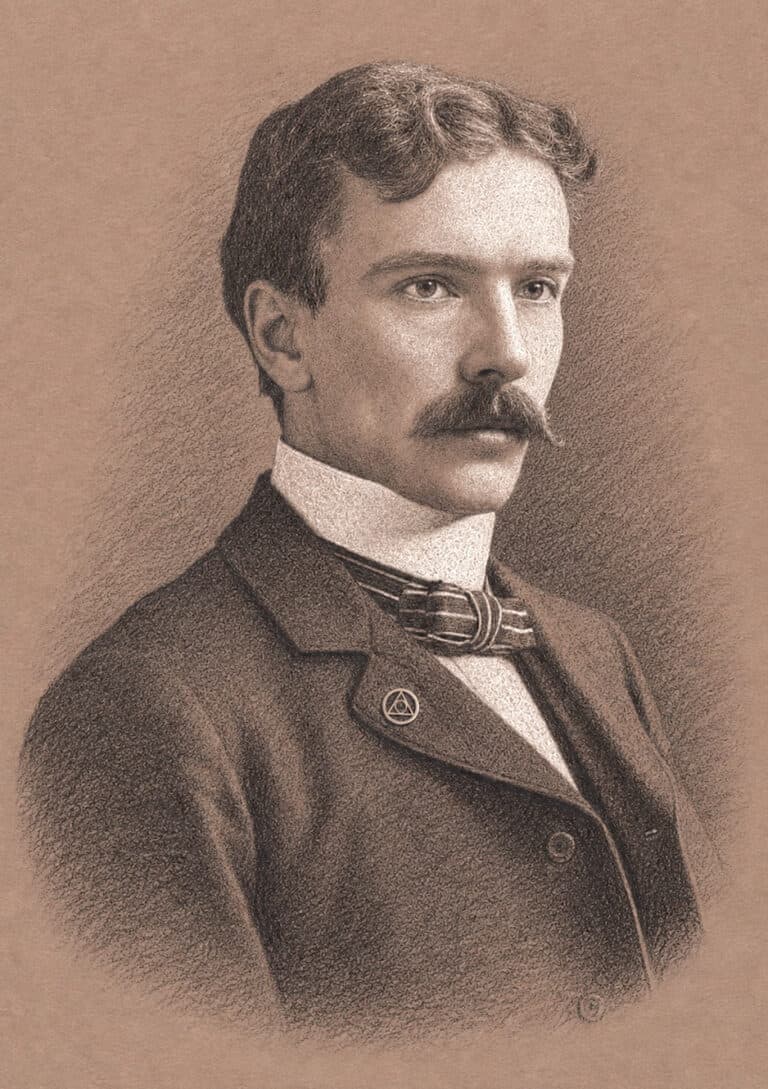
Dr. Herebert Arthur Parkyn
Parkyn’s A Complete Course in the Art of Mind-Reading represents an earlier stage in which the network emphasized the importance of separating muscle reading from genuine telepathy. This itself was an important corrective to the sensational claims of public mind readers. Spectacular feats did not automatically prove thought transference because unconscious muscular action could produce astonishing results. Yet Parkyn still maintained that genuine telepathy existed and devoted the second half of the course to developing it.
Practical Mind Reading returns to the same problem with a more expansive conclusion. The discovery of muscle reading had successfully explained some supposed psychic phenomena, but the network had come to regard the explanation as insufficient when applied universally. Physical contact could carry unconscious muscular information, but it might also facilitate genuine mental transmission. The earlier binary division between muscle reading and telepathy consequently becomes a three-stage model of muscle reading, contact mind reading, and telepathy.
That makes Practical Mind Reading particularly useful for understanding the evolution of thought within the Parkyn-Atkinson publishing network. Rather than representing a disconnected Atkinson theory appearing years later, it preserves the framework of Parkyn’s earlier Psychic Research Company course while documenting a change in interpretation. The exercises, pedagogical method, emphasis on concentration and receptivity, and ultimate movement toward telepathy remain substantially continuous. What has developed is the theory explaining what happens while two minds remain physically connected.
Read together, the books therefore provide something that neither reveals as clearly alone: a record of an evolving system. Parkyn’s earlier course establishes the experimental foundation and separates unconscious muscular action from genuine thought transference. Practical Mind Reading revisits that foundation and argues that the separation had been drawn too sharply. In the later formulation, the physical and mental are not necessarily competing explanations; physical contact may itself become the bridge through which a subtler mental process operates. What appears under Atkinson’s name is consequently best understood as a remake and development of material already being taught and published through Parkyn’s Psychic Research Company network—a familiar course reconsidered in light of the network’s changing understanding of mind reading, mental transmission, and telepathy.
.
Practical Mind Reading by Atkinson, ad by Advanced Thought Publishing
Related Research Articles
From Mental Breakdown to Atkinsonia: How Herbert A. Parkyn Turned William Walker Atkinson into a New Thought Phenomenon
This article explores how Dr. Herbert A. Parkyn's treatment, mentorship, and network transformed William Walker Atkinson from mental breakdown into the most prolific and influential writer in the New Thought movement.
The Continuing Collaboration of Herbert A. Parkyn, Sydney Flower, and William Walker Atkinson
Historians have claimed that Sydney B. Flower and William Walker Atkinson left Herbert A. Parkyn to establish competing organizations. This article reexamines that story and presents evidence that the three men continued working together…
The Yogi Publication Society started in the offices of Herbert A. Parkyn on Cottage Grove Ave.
This article shows that 4000 Cottage Grove Avenue was where the Yogi Publication Society began and served as the main hub for Dr. Herbert A. Parkyn's publishing, educational, and mail-order activities.