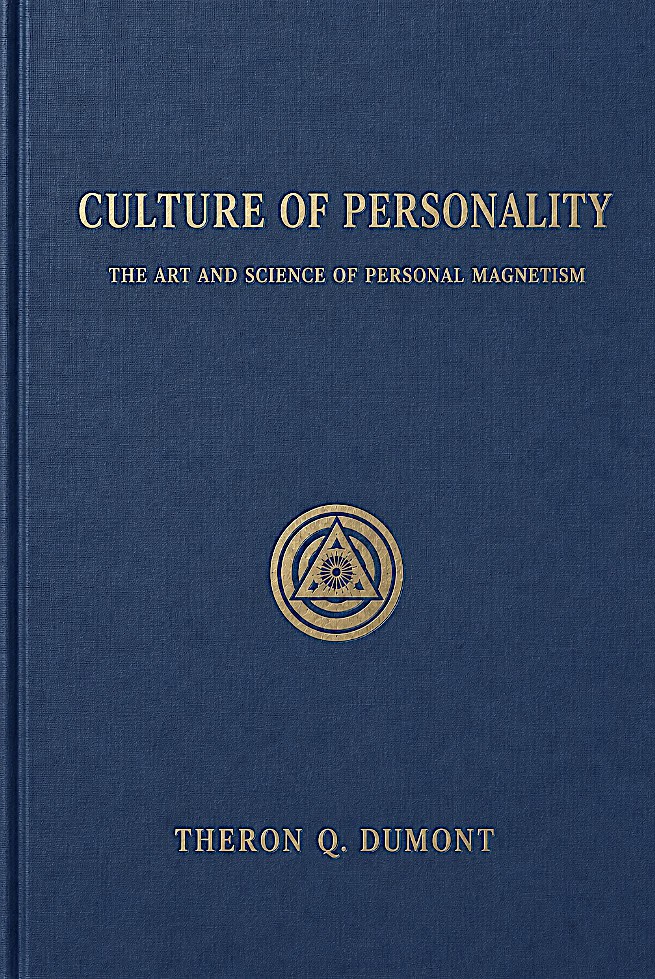
Culture of Personality: The Art and Science of Personal Magnetism by Theron Q. Dumont was first published in 1913 and was later issued by the Yogi Publication Society. The 1913 edition was published by the Adams Publishing Company of Chicago, with the Advanced Thought Publishing Company as the copyright holder. The name Theron Q. Dumont was used as a pseudonym, and he was presented as an “Instructor in the Art and Science of Personal Magnetism, Paris, France,” and the book claimed to contain the substance of lessons he had taught in Paris for eighteen years.
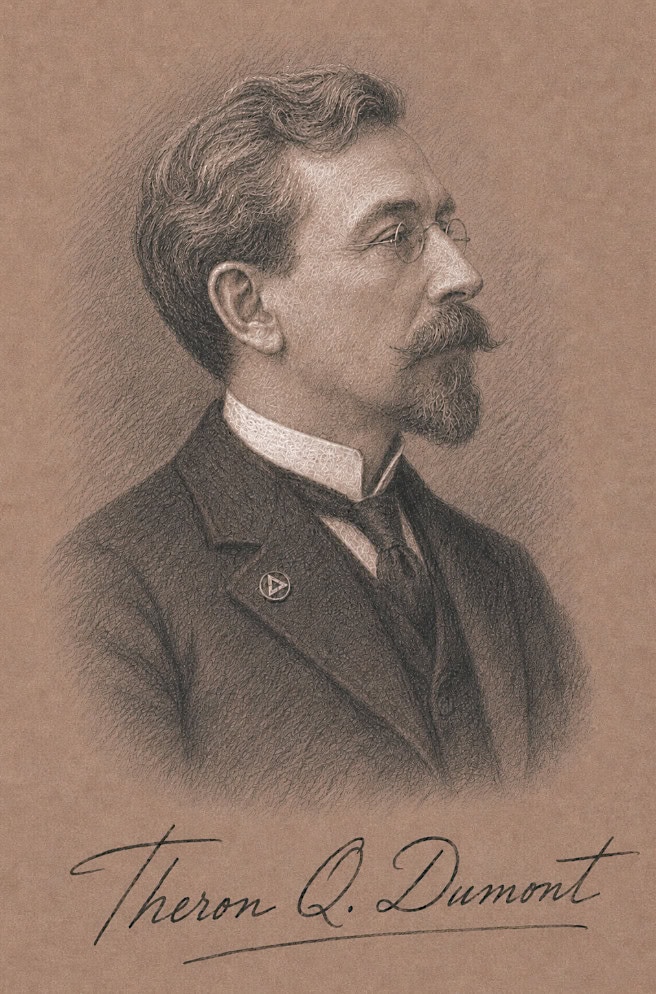
Theron Q. Dumont, “The Great French Authority and Foremost Psychologist of Paris, France. (artist depiction)
Behind that backstory is a course with an especially strong relationship to the earlier teachings of Herbert A. Parkyn at the Chicago School of Psychology. Parkyn had already taught personal magnetism as a combination of mental attitude, physical condition, facial expression, voice, manners, tact, sympathy, thought control, concentration, suggestion, and the ability to recognize and adapt to the mental states of other people. His 1900 course even devoted a complete lesson to Personal Magnetism and connected it directly with his principle that “Thoughts take form in action.” Culture of Personality develops these same subjects into a twenty-one chapter course devoted almost entirely to the creation and use of a magnetic personality.
The title page gives the book’s purpose in a single sentence when it declares that success depends upon being able to “mold men’s minds” and influence them to act as one desires. Dumont then develops this idea through mental and physical polarity, nerve-force, mental radiation, attitude, atmosphere, the aura, command, personal influence, self-defense, and control over others. The book combines the psychological side of suggestion with a theory of physical nerve-force and occult ideas about mental radiation. Yet much of its instruction remains firmly rooted in ordinary human interaction. A magnetic person learns to control his own thoughts and reactions, develops confidence and poise, understands the mental condition of the person before him, creates the proper impression through expression and manner, directs attention, speaks with confidence, and avoids allowing another person’s mental state to dominate his own. These are also among the strongest points of comparison with Parkyn, which are examined in detail at the end of this summary.
What Is Culture of Personality About?
Culture of Personality is a course in developing personal influence. Dumont begins with the assumption that people differ greatly in their ability to affect one another. Some people seem naturally able to attract attention, inspire confidence, persuade, command, or make others comfortable in their presence. Others may possess intelligence and ability yet fail to produce the same effect. Dumont uses the term personal magnetism for the collection of forces that create this difference.
The book does not reduce personal magnetism to appearance or charm. Dumont divides it into mental and physical elements and then spends most of the course showing how those elements work together. Mental states affect facial expression, posture, voice, behavior, and the atmosphere created around a person. Physical vitality affects the strength with which personality is expressed. Will gives direction to both. Attention allows the individual to focus his influence. Repetition and exercise strengthen the qualities being developed.
The contents reveal the full progression of the course. After defining Personal Magnetism, Dumont moves through Mental and Physical Poles, the Mental Phase, the Physical Phase, Physical Magnetism, Generating Nerve-Force, Distributing Nerve-Force, Nerve-Force Exercises, Projecting Nerve-Force, Mental Radiation, Mental Attitudes, Mental Atmosphere, Magnetic Currents, the Direct Flash, the Positive Aura, the Direct Command, the Magnetic Duel, Corporeal Magnetism, Magnetic Self-Defence, and finally the Power of Controlling Others.
What Does Dumont Mean by Personal Magnetism?
Dumont opens by observing that people commonly speak of someone having a “magnetic personality” even though they may have no clear explanation for what the phrase means. He traces belief in personal influence back through history and argues that powerful individuals have always discovered ways of attracting, persuading, and directing others. Some acquired these methods through deliberate study while others discovered them through experience.
Personal magnetism in the book includes the impression created by the entire person. Thought, feeling, will, physical vitality, facial expression, bodily movement, voice, confidence, expectation, and attitude all contribute. The person who wishes to become magnetic must first develop control over himself because uncontrolled fear, anger, nervousness, uncertainty, and weakness are communicated to others just as confidence and self-possession are communicated.
This immediately makes the cultivation of personality a form of self-training. Influence over another person begins with the ability to direct one’s own mental and physical condition.
What Are the Mental and Physical Poles?
Dumont divides personal magnetism into mental and physical poles. The mental pole consists of thought, feeling, desire, will, intention, and the mental states projected through personality. The physical pole consists of bodily vitality and what Dumont calls nerve-force.
The two operate together. A strong mental attitude requires a physical instrument through which it can be expressed. A person may possess considerable physical vitality while lacking mental direction. Another may possess strong ideas but express them weakly because nervousness, poor health, uncertain posture, or lack of physical control interferes with their expression.
This principle becomes the foundation for the chapters that follow. Dumont first examines the mental phase and then the physical phase before bringing the two together in his theory of personal magnetism.
The polarity itself is important. Power is produced through the interaction of complementary forces. Positive and negative states also appear repeatedly in the book when Dumont discusses influence between people. The person who maintains the stronger positive mental state is less susceptible to being carried into the attitude of another.
What Is the Mental Phase of Personal Magnetism?
The mental phase begins with the condition of the person exercising influence. Dumont repeatedly insists that the student cannot produce confidence in another while inwardly dominated by doubt. The outward expression of personality reflects the mental state behind it.
The first work of personal magnetism is therefore internal. The student must cultivate confidence, determination, self-control, steadiness, concentration, and a definite purpose. A person who enters an interaction already expecting defeat communicates something very different from a person who expects to be heard and taken seriously.
This mental attitude does not remain hidden. It appears through the eyes, face, voice, posture, timing, gestures, and general manner. The internal state is continually becoming external expression.
This point becomes one of the strongest connections with Parkyn’s teaching. Parkyn had already taught that thoughts appear in action and that actions in turn create thoughts in the minds of other people. His lesson on Personal Magnetism states this directly. “Thoughts take form in action. The converse of this is true also, for our actions take form in the thoughts of others.” Culture of Personality develops an entire system of personal influence around this relationship.
Why Does Physical Condition Matter?
Dumont gives considerable attention to physical vitality because he believes personality is expressed through the nervous system and body. Mental influence requires an effective physical instrument. Weakness, exhaustion, nervous agitation, poor breathing, uncontrolled muscular movement, and bad physical habits interfere with the expression of confidence and power.
The student is encouraged to improve bodily control and conserve nervous energy. Posture, breathing, movement, rest, muscular control, and physical condition all become parts of personality training.
Dumont also introduces the concept of nerve-force. He treats it as an energy generated within the body that may be conserved, distributed, and directed. The stronger the supply of nerve-force, the greater the physical side of personal magnetism.
This is where the book begins combining psychological instruction with the occult theory of magnetism. Dumont does not treat physical magnetism as a mere metaphor. He believes there is a genuine force associated with the nervous system and physical vitality.
What Is Physical Magnetism?
Dumont distinguishes physical magnetism from mental magnetism while insisting that they normally operate together. Physical magnetism is identified with the nerve-force generated and circulated through the body.
The book describes this force as entering the personal atmosphere surrounding the individual. Dumont reports the teaching of occultists who say that the human aura contains both the vibrations of mental states and the vibrations of physical nerve-force. According to this account, clairvoyants see the nerve-force extending several feet around the body in an egg-shaped field. Dumont says that he does not personally claim clairvoyant sight, although he accepts the agreement of psychic acquaintances who describe the phenomenon.
The important point within Dumont’s system is that the physical and mental aspects of personality are continually interacting. A mental state can affect physical expression and the physical condition can affect the strength with which a mental state is expressed.
How Does Dumont Teach the Generation of Nerve-Force?
Several chapters are devoted to generating, distributing, exercising, and projecting nerve-force. Dumont treats the body almost as an electrical system in which energy must be produced and then intelligently directed.
Breathing and physical exercises are used to increase the sense of vitality. Attention is directed toward different parts of the body. Muscular control and relaxation are employed to prevent waste. The student is encouraged to become conscious of bodily energy and to practice moving the sensation of that energy through different regions.
The exercises also serve another purpose. They strengthen the habit of voluntary control. The student decides where attention will go and then holds it there. He decides what movement will be made and then performs it deliberately. Physical training becomes will training.
This relationship between attention, body, and will appears repeatedly throughout the Dumont books. In Culture of Personality, it is presented as preparation for directing personal magnetism.
What Does Dumont Mean by Projecting Nerve-Force?
Once the student has learned to generate and control nerve-force, Dumont teaches methods for projecting it toward another person. The hands, eyes, and general bodily presence become instruments through which this force is directed.
Dumont treats attention and intention as essential. Energy without direction is scattered. The will gathers and directs it toward a chosen purpose.
This idea leads naturally into the book’s chapters on mental radiation. Physical nerve-force supplies one component of personal influence while thought supplies another.
The combination produces what Dumont regards as the complete magnetic personality.
What Is Mental Radiation?
Mental radiation is Dumont’s theory that thoughts and mental states extend beyond the individual and influence other minds. A person continually radiates something of his internal condition. Fear produces one kind of influence, confidence another. Anger, enthusiasm, courage, hesitation, determination, sympathy, and hostility each create their own effect.
Some of this can be understood through ordinary expression. People recognize emotional states through facial expression, voice, posture, behavior, and countless subtle cues. Dumont also believes that thought itself can be projected beyond these sensory channels.
Concentration increases the strength of mental radiation because scattered thought produces scattered influence. A clear idea backed by will and sustained attention creates a stronger mental current.
The practical lesson remains consistent throughout the chapter. If the student wishes to influence others, he must first decide what mental state he wishes to communicate and then establish that state strongly within himself.
Why Are Mental Attitudes So Important?
The chapter on Mental Attitudes brings the teaching back to everyday psychology. Dumont argues that the mental attitude with which a person approaches another strongly influences what happens between them. Expecting hostility, defeat, embarrassment, or rejection prepares the individual to express those states. Confidence and friendly expectation create another kind of interaction. The student is instructed to select the attitude appropriate to the situation and hold it firmly. Mental attitude becomes a form of preparation before action.
This is closely related to suggestion. The attitude held in the mind influences one’s own behavior while that behavior supplies suggestions to the other person. A confident thought produces confident expression. The expression then becomes part of the impression received by the other mind. The process can continue in both directions. The other person responds, that response creates another impression, and each person begins influencing the mental condition of the other.
What Is a Mental Atmosphere?
Dumont extends the idea of mental attitude into what he calls Mental Atmosphere. People create an atmosphere around themselves through their habitual thoughts and feelings. Some individuals make others feel comfortable almost immediately. Others produce tension, uneasiness, confidence, enthusiasm, depression, or caution.
For Dumont, this atmosphere is cumulative. A temporary thought has an effect, but a habitual mental state becomes part of personality. Someone who continually cultivates confidence begins to appear confident without having to manufacture the effect consciously during every encounter.
Personality culture therefore requires repeated mental training. The desired state must become sufficiently familiar that it appears naturally through expression and conduct.
This is another major point of contact with Parkyn’s teaching on habit. Repeated thought produces repeated action and repeated action forms habit. Personality then becomes the visible expression of those established mental habits.
How Do Magnetic Currents Work?
Dumont describes interactions between people as exchanges of magnetic currents. One person projects a thought, feeling, attitude, or command while another receives and responds to it. The stronger and more concentrated personality may set the direction of the exchange.
Attention is crucial. Once a person has captured another’s attention, the conditions for influence become stronger. A scattered or distracted person cannot direct influence with the same effectiveness as someone who is focused upon a definite purpose.
The student is therefore taught to observe the other person carefully. Influence is not achieved by blindly projecting the same manner toward everyone. The effective individual recognizes the mental state before him and adjusts his approach.
This point has an especially strong parallel in Parkyn’s earlier definition of personal magnetism. Parkyn described magnetism as the ability to recognize “in a subtle and intelligent way” the mental state of acquaintances and adapt oneself to them without friction. He associated magnetic personality with geniality, sympathy, tact, cheerfulness, controlled temper, good manners, voice, facial expression, and intelligent adaptation to different personalities.
What Is the Direct Flash?
The Direct Flash is Dumont’s name for a concentrated use of the eyes and will. The student fixes attention upon another person and projects a definite mental impression through a brief, controlled glance. The effectiveness of the technique depends upon the mental state behind the look. Simply staring at someone does not create the effect Dumont describes. The gaze is supposed to carry a definite thought, command, feeling, or intention.
The following chapter provides exercises intended to develop this ability. The student practices control of the eyes, attention, timing, and the concentration of thought into a short moment of directed influence. Dumont repeatedly warns against uncontrolled staring. The object is controlled expression backed by a definite mental purpose.
What Is the Positive Aura?
The Positive Aura represents a condition of self-possession in which the individual maintains his own mental state when surrounded by other influences. Dumont believes that people continually affect one another and that a weak or passive individual can easily be drawn into the emotional atmosphere of stronger personalities.
The positive person establishes his own condition before entering an interaction. Confidence, calmness, determination, and self-control create a protective mental atmosphere.
This becomes important because personal magnetism has two sides. The student wants the ability to influence others, but he also needs the ability to resist unwanted influence.
A positive aura therefore functions as both an attractive and defensive power. It helps the individual maintain his chosen mental direction instead of automatically responding to every outside impression.
How Does the Direct Command Work?
The Direct Command brings together voice, thought, will, confidence, and expectation. Dumont teaches that commands become more effective when they are delivered without uncertainty. The speaker should know what he wants, hold the desired result clearly in mind, and express the command in a manner consistent with that expectation.
Tone of voice becomes important. Hesitation in speech communicates hesitation in thought. A clear and controlled voice conveys a stronger suggestion.
The chapter illustrates how closely Dumont’s personal magnetism intersects with the psychology of suggestion. The spoken statement is only one part of the suggestion. The listener also receives the speaker’s tone, expression, posture, confidence, expectation, and manner.
Parkyn had already made this point central to his teaching. His course treated suggestion as extending far beyond spoken words because impressions reach the mind through the senses and through the entire conduct of the suggestor. His Personal Magnetism lesson specifically includes facial expression, tone and pitch of voice, tact, manners, cheerfulness, thought control, and the personality of the operator.
What Is the Magnetic Duel?
The Magnetic Duel describes situations in which two strong personalities attempt to maintain opposing intentions. Dumont presents these encounters as contests of concentration, confidence, will, and mental steadiness.
The person who becomes angry, nervous, frightened, confused, or uncertain begins losing control of his own state. The stronger position belongs to the individual who remains composed and continues directing attention toward his purpose.
This chapter reveals why self-control is so important throughout the book. Personal magnetism is not simply a technique used upon someone else. The individual must first prevent the other person from controlling his attention and emotional condition.
The magnetic duel is therefore a contest in self-possession before it becomes a contest in influence.
What Is Corporeal Magnetism?
Corporeal Magnetism returns to the physical expression of personality. Dumont considers bodily presence an important carrier of mental influence. Posture, movement, physical vitality, eyes, hands, facial expression, and general bearing all communicate the internal state. A person may verbally claim confidence while the body communicates fear. Dumont wants the physical and mental messages to agree.
Training the body therefore supports personality development. The student learns to eliminate unnecessary nervous movements, improve posture, control facial expression, strengthen the voice, and carry himself in a manner consistent with the mental qualities being cultivated. This relationship between thought and physical expression is one of the clearest themes running through the entire book.
What Is Magnetic Self-Defence?
Dumont does not assume that personal influence will always be used benevolently. The chapter on Magnetic Self-Defence teaches readers how to resist attempts by other people to dominate their thoughts, emotions, or decisions.
The first defense is awareness. A person who does not realize that another individual is influencing his mental condition may simply follow the impression. Once the influence is recognized, attention can be withdrawn from it and redirected.
The second defense is a positive mental state. Confidence, independence, self-control, and a clear sense of purpose make the individual less receptive to unwanted influence.
The third defense is refusal to enter the other person’s emotional state. Anger can suggest anger. Fear can suggest fear. Nervousness can produce nervousness. Dumont wants the student to maintain his own mental attitude instead of automatically mirroring the strongest state in the environment.
The lesson again places self-mastery at the foundation of personal magnetism.
What Does Dumont Mean by the Power of Controlling Others?
The final chapter brings the entire course back to the promise printed on the title page. Success, Dumont says, often depends upon the ability to influence the minds and actions of other people.
Yet the twenty chapters leading to this conclusion show that the power begins with control of oneself. The student has been trained to regulate thought, physical expression, attention, nervous energy, mental attitude, voice, gaze, confidence, and emotional reaction. Only after developing these qualities does Dumont arrive at the deliberate control of interpersonal influence.
The strongest form of control is not presented as constant aggressive domination. Much of Dumont’s instruction involves creating conditions in which the other person becomes receptive. Attention is gained, confidence is established, the appropriate mental attitude is created, resistance is reduced, and a definite suggestion or command is then introduced.
This makes the final chapter the culmination of the earlier lessons on mental atmosphere, currents, command, concentration, and self-control.
What Is the Main Teaching of Culture of Personality?
The central teaching of Culture of Personality is that personal influence can be deliberately cultivated. Dumont rejects the idea that magnetic personality is simply an inborn gift possessed by a fortunate few. The qualities producing it can be identified, exercised, strengthened, and combined.
His method can be summarized through several connected ideas.
Develop control over your own mental state before attempting to influence anyone else.
Cultivate confidence, calmness, determination, and a definite purpose.
Strengthen attention and concentration so mental force is not scattered.
Develop physical vitality and control over bodily expression.
Make posture, voice, eyes, gestures, and manner express the mental state you wish others to perceive.
Observe the mental condition of the person before you.
Adapt your approach intelligently to different personalities.
Use thought, expression, speech, expectation, and action together.
Maintain a positive mental attitude when confronted by opposing influences.
Resist unwanted suggestions by refusing to surrender control of your own attention.
Repeat desirable mental and physical patterns until they become habitual parts of personality.
The magnetic personality that results is a coordinated personality. Thought, feeling, will, body, expression, voice, attention, and action are directed toward the same purpose.
How Closely Does Culture of Personality Follow Herbert A. Parkyn’s Teaching?
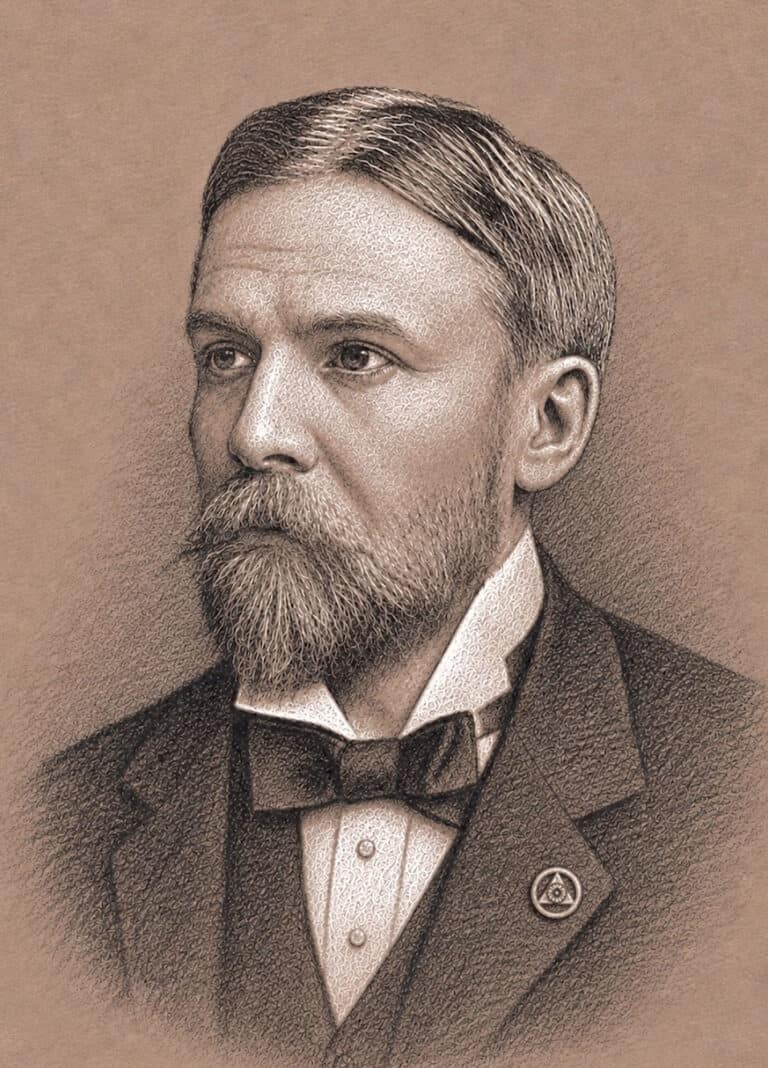
Herbert A. Parkyn portrait
The relationship between Culture of Personality and the earlier teachings of Herbert A. Parkyn is especially strong because Parkyn had already devoted a full lesson of his Special Mail Course in Hypnotism and Suggestive Therapeutics to Personal Magnetism. The 1900 contents of that lesson read almost like a guide to many of the subjects later developed at book length by Dumont. Parkyn covered personal impressions received through the senses, appearance, voice, facial expression, health, manners, temper, tact, cheerfulness, sympathy, recognition of another person’s mental state, adaptation to different individuals, thought control, action, and the cultivation of magnetic qualities.
That makes Culture of Personality one of the most direct Dumont books for comparison with what Parkyn was teaching at the Chicago School of Psychology.
Parkyn Had Already Defined Personal Magnetism Through Human Interaction
Parkyn’s treatment of personal magnetism is important because he did not need a mysterious magnetic fluid to explain why certain people exerted unusual influence. He examined the actual impressions exchanged between individuals.
Appearance affects the observer. Facial expression creates an impression. Voice carries emotional information. Manners influence receptivity. Temper affects relationships. Cheerfulness changes the atmosphere of an encounter. Tact allows the individual to agree or disagree without producing unnecessary resistance.
At the center of Parkyn’s definition was the ability to recognize the mental condition of another person and adapt to it without friction. He wrote that people regarded as highly magnetic possess unusual geniality and are capable of making others feel that they are receiving special personal attention. Dumont’s entire course repeatedly returns to this same interpersonal problem. The magnetic individual must understand himself, understand the other person, create the proper mental attitude, and manage the impressions exchanged between them.
“Thoughts Take Form in Action” Is Central to Personality
Parkyn’s famous principle “Thoughts take form in action” becomes especially important when applied to personality. A thought does not remain sealed inside the thinker. It influences facial expression, posture, tone, gesture, movement, decisions, and conduct.
Parkyn then added the reverse side of the principle when discussing personal magnetism. “Our actions take form in the thoughts of others.”
This is almost a complete formula for the subject of Culture of Personality. The individual’s internal thought becomes outward action. That action is observed by another person. The observer forms a corresponding thought or impression. Personality becomes the bridge through which one person’s mental state produces a mental response in someone else.
Dumont’s chapters on Mental Attitudes, Mental Atmosphere, the Direct Flash, the Positive Aura, the Direct Command, Corporeal Magnetism, and controlling others all depend upon this movement from internal state to external expression and then into the mind of another person.
Suggestion Is Happening Through the Whole Personality
Parkyn’s definition of suggestion extended beyond spoken commands. Anything capable of producing an impression could operate suggestively. Appearance, environment, gesture, expression, tone, action, expectation, and behavior could all contribute.
That principle is everywhere in Culture of Personality. Dumont teaches influence through the eyes, voice, posture, confidence, physical condition, mental atmosphere, bodily expression, and spoken command. The magnetic person is continually suggesting something about himself to the people around him. A hesitant voice suggests uncertainty. A confident voice suggests certainty. Nervous movement suggests insecurity. Calm physical control suggests self-possession. Friendly expression suggests receptivity. Determined expression suggests firmness. The whole personality becomes a source of suggestion.
Parkyn’s Teaching on Voice and Facial Expression Appears Throughout the Book
Parkyn’s Personal Magnetism lesson gives specific attention to the voice. He discusses its soothing quality, modulation, and pitch. Facial expression receives the same attention because the face continually communicates the mental state behind it.
Dumont repeatedly uses these same channels of influence. Voice becomes especially important in the Direct Command because the effectiveness of the statement depends partly upon how it is delivered. The eyes and face become important in the Direct Flash. Corporeal Magnetism extends the principle through posture, movement, and bodily presence.
This is one reason Dumont’s mental and physical phases cannot really be separated in application. The thought requires expression and the body supplies it.
Tact and Adaptation Are Forms of Mental Influence
Parkyn placed tact near the center of personal magnetism. The magnetic person recognizes that different individuals require different approaches. He learns how to agree and disagree intelligently and how to adapt himself to another personality without unnecessary friction.
Dumont likewise teaches the student to study the person he wishes to influence. A single rigid manner will not work equally well with everyone. The individual must recognize the other person’s state and select an approach capable of producing the desired response.
This turns personal magnetism into applied psychology. Observation comes before influence.
Self-Control Comes Before Control of Others
Parkyn’s work continually places voluntary control at the center of mental training. A person who is controlled by his own anger, fear, nervousness, habits, and impulses is in a poor position to direct anyone else.
Dumont follows this principle from the beginning of Culture of Personality. The student must develop control of mental states, physical expression, attention, energy, and emotional reactions before attempting the advanced methods of influence described later in the course.
Even the Magnetic Duel is fundamentally an exercise in self-control. The person who loses emotional balance gives the other personality an advantage. The person who remains calm retains the ability to choose his response.
The Power of Controlling Others is therefore the final chapter because the previous chapters have been training the power of controlling oneself.
Mental Attitude Becomes Physical Expression
Parkyn’s psychology treated the mind and body as continually interacting. His statement that thoughts take form in action describes one side of this relationship.
Dumont makes the same relationship central to personality culture. Confidence must appear in posture and voice. Calmness must appear in movement. Determination must appear in expression and conduct. The mental attitude is strengthened when the physical expression agrees with it.
This also creates a feedback process. Deliberately controlling physical expression can help stabilize the corresponding mental condition.
The cultivation of personality therefore involves both thought and action.
Habit Turns Deliberate Training Into Personality
Parkyn’s teaching on habit provides another major connection. His course explains how repeated actions become automatic and how suggestion can be used to replace undesirable habits with desirable ones. He tells the student that the body is controlled by the involuntary mind and that the involuntary mind may be educated through suggestion.
The same principle explains how Dumont’s exercises are supposed to produce lasting personality change. At first, confidence may require deliberate effort. The student consciously controls posture, voice, expression, thought, and behavior. Repetition makes the pattern familiar. What began as an exercise gradually becomes a habitual response.
At that point the person no longer needs to consciously manufacture every detail of the magnetic manner. It has become part of personality.
The Positive Aura Functions Like Resistance to Suggestion
Dumont’s Positive Aura and Magnetic Self-Defence can also be understood through Parkyn’s psychology of suggestion. A person is continually exposed to impressions from other people and from the environment. Some are accepted and some are resisted.
Dumont trains the student to establish a definite mental attitude before entering an influential environment. Confidence, independence, calmness, and concentration help prevent another person’s emotional state from taking control. The individual who recognizes the incoming influence gains the opportunity to refuse it. This makes self-defense another application of voluntary control over suggestion.
Mental Atmosphere Has a Direct Parallel in Parkyn’s Personal Magnetism
Dumont’s Mental Atmosphere describes the impression created by a person’s habitual mental state. Parkyn’s earlier lesson had already approached personal magnetism through the same collection of impressions. Appearance, health, expression, voice, manners, cheerfulness, tact, sympathy, temper, and thought all contribute to how others experience a person.
A magnetic atmosphere is built from these accumulated signals.
The cheerful person creates one atmosphere. The irritable person creates another. The confident person affects a room differently from the frightened person. These effects are not confined to spoken statements because the entire person is communicating.
The Direct Command Is an Application of Suggestion
Dumont’s Direct Command brings the relationship into especially clear focus. A definite idea is held in mind and communicated with confidence through speech, tone, expression, expectation, and will. This is suggestion applied to interpersonal influence.
Parkyn had spent years teaching the conditions that make suggestions effective. Attention, confidence, repetition, expectation, the personality of the operator, the receptivity of the subject, tone of voice, and the surrounding sensory impressions all affect the result. Dumont assembles many of these elements into his magnetic command.
The Same Use of “Nerve-Force”
One of the more specific connections between Culture of Personality and Parkyn’s earlier teaching is the repeated use of the term “nerve-force.” Dumont makes nerve-force one of the major working concepts of the book and devotes several chapters to its generation, distribution, exercise, and projection. The term is not incidental. It is part of the explanation for how physical vitality, the nervous system, will, and personal magnetism work together.
Parkyn had already used the exact term “nerve force” in his own course when explaining the relationship between the nervous system, mental states, bodily action, and personal influence. This creates a direct vocabulary connection between the two systems. In both, nerve-force belongs to a larger teaching in which mental direction and physical condition work together, and the student is trained to regulate and use that force deliberately.
That connection is especially important in Culture of Personality because Dumont does not treat personal magnetism as thought alone. The nervous system and physical vitality are given a central role. Parkyn’s earlier use of the same term in a course that also covered suggestion, personal magnetism, bodily response, and mental influence makes the parallel much more specific.
“A Moment’s Reflection” and “A Moment’s Thought”
There is also a striking similarity in the instructional voice used by Parkyn and Dumont. Parkyn repeatedly uses the phrase “A moment’s reflection” when introducing a point that he considers self-evident once the student stops to think about it. The phrase becomes a recognizable teaching device in his course.
In Culture of Personality, Dumont repeatedly uses the closely related phrase “A moment’s thought” in the same way. He pauses the argument, asks the reader to consider what has just been stated, and then treats the conclusion as something that should become clear through brief reflection.
The similarity is small in isolation, but it becomes more interesting when it appears inside a book already following Parkyn so closely in subject matter, structure, and psychological method. Both works are teaching through the same kind of direct instructional address to the student, and both use nearly the same recurring phrase to move the reader from assertion to recognition.
Personal Magnetism Becomes Everyday Applied Psychology
The strongest connection between Culture of Personality and Parkyn’s teaching appears when the subject is viewed as a whole. Parkyn had already taken suggestion beyond the narrow field of hypnotism and applied it to ordinary waking life. His Personal Magnetism lesson then applied that psychology to everyday human relationships. The magnetic individual controls his thoughts because thoughts become actions. He controls his actions because those actions create impressions in other minds. He develops voice, expression, manners, tact, sympathy, cheerfulness, and health because all of these affect the impressions he produces. He observes the mental condition of another person and adapts his approach accordingly. Culture of Personality turns this into a complete course.
The student develops the mental state he wants to express. He trains the body to express it. He concentrates attention. He studies the person before him. He creates a favorable mental atmosphere. He uses voice, gaze, posture, and command to communicate his intention. He resists unwanted influence from others. Through repetition these methods become habitual parts of personality.
For the history of the Yogi Publication Society and the mental-training literature surrounding it, Culture of Personality provides one of the clearest links back to the work of Herbert A. Parkyn and the Chicago School of Psychology. Parkyn’s 1900 course already contained a developed teaching on personal magnetism built from thought, action, suggestion, personality, voice, expression, health, manners, tact, sympathy, cheerfulness, self-control, and adaptation to the mental states of other people. Dumont’s 1913 course takes those subjects and makes the culture of personality itself the central object of study.
The connection is captured especially well by Parkyn’s own words. “Thoughts take form in action. The converse of this is true also, for our actions take form in the thoughts of others.” That principle describes the basic process operating throughout Culture of Personality. The individual cultivates the thought, expresses it through personality, and through that expression creates an impression in another mind.