
Copyright © 2026 D. Parkyn Jackson. Published by the Yogi Publication Society History Project. All rights reserved.
When Theron Q. Dumont first appeared in 1913, readers were introduced to a famous psychologist and psychic researcher from Paris who had supposedly spent many years teaching the powers of the mind. Dumont soon became one of the most recognizable names connected with the Advanced Thought Publishing Company and later the Yogi Publication Society, with books devoted to concentration, personal magnetism, memory, willpower, personality, mental healing, and mental training.
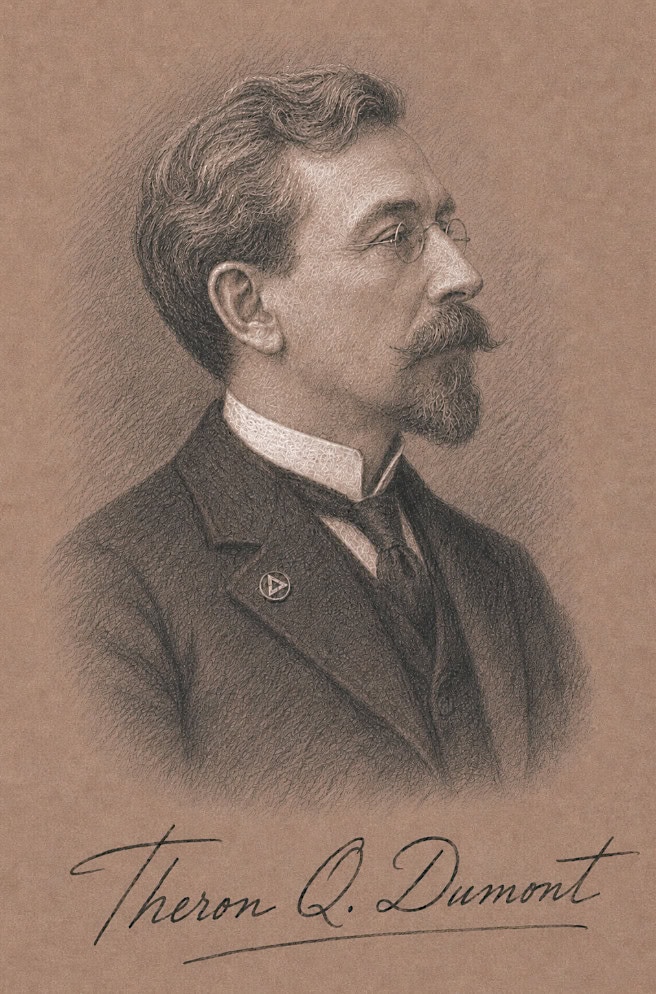
Yet Theron Q. Dumont was not a French psychologist at all. He was a pseudonym created within the same publishing network that had already produced Yogi Ramacharaka and would use a number of other invented identities to present its teachings. The question is who was behind Theron Q. Dumont. While many modern accounts identify William Walker Atkinson as the sole author, the evidence points instead to Dr. Herbert A. Parkyn, with a student’s help turning his more clinical and scientific writing into the conversational, “man on the street” style used in the Dumont books.
This article will examine a series of connections that have remained hidden behind the Dumont name. His supposed history as a teacher reaches back to the exact period when Parkyn began his own teaching career, while the subjects attributed to Dumont follow the work Parkyn had already developed and published for years. The connection can also be found in the language of the books, in repeated terminology such as “nerve force,” in familiar patterns of expression, and in Parkyn’s own maxim “Thought Takes Form in Action,” which appears in several Dumont works. There is also the name itself, whose meaning has a direct connection with Parkyn’s earlier choice of Astra as his first pseudonym. The sections that follow will examine these clues separately, along with the Dumont backstory and the teachings contained in the books, to show how closely the identity follows Parkyn and his earlier work.
The Great French Authority and Foremost Psychologist of Paris, France
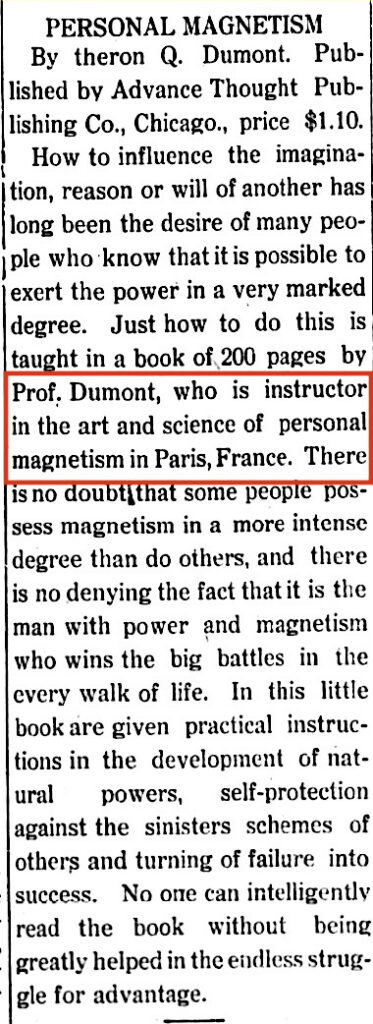
The publishers did not present Theron Q. Dumont as simply a pseudonym attached to a series of books. They created a complete backstory for him as a famous French psychologist and authority on mental training who lived and taught in Paris. This identity was carried into newspaper editorial advertising, where he was introduced as “Prof. Dumont,” an instructor in the art and science of personal magnetism. Other advertisements went even further, promoting him as “Prof. Theron Q. Dumont, the Great French Authority and Foremost Psychologist.” He was also described as a “noted psychologist,” a “famous savant,” and an established teacher whose courses had originally been prepared for his private pupils. The public was being introduced to Dumont as a real European authority with an established school of thought, years of teaching experience, and a body of lessons that had supposedly already been taught to students before being made available in book form.
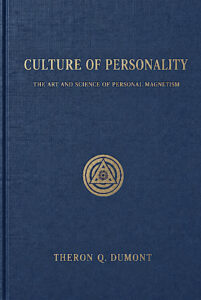
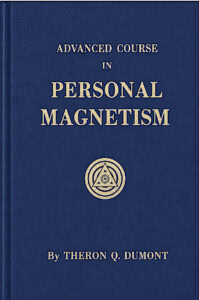
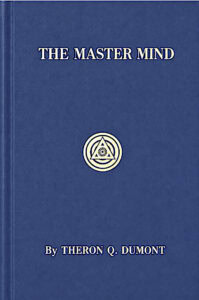
Over the span of seven years the name was attached to a large group of books including Culture of Personality: Art and Science of Personal Magnetism (1913), Advanced Course in Personal Magnetism: The Secrets of Mental Fascination (1914), Practical Memory Training (1915), Mental Therapeutics (1916), The Master Mind (1918), The Power of Concentration (1918), and The Solar Plexus or Abdominal Brain (1920). Dumont also became a regular contributor to Advanced Thought magazine, where the Paris backstory continued alongside articles presenting his teachings on personal magnetism and mental power.
The Dumont Backstory Leads Directly to Dr. Parkyn
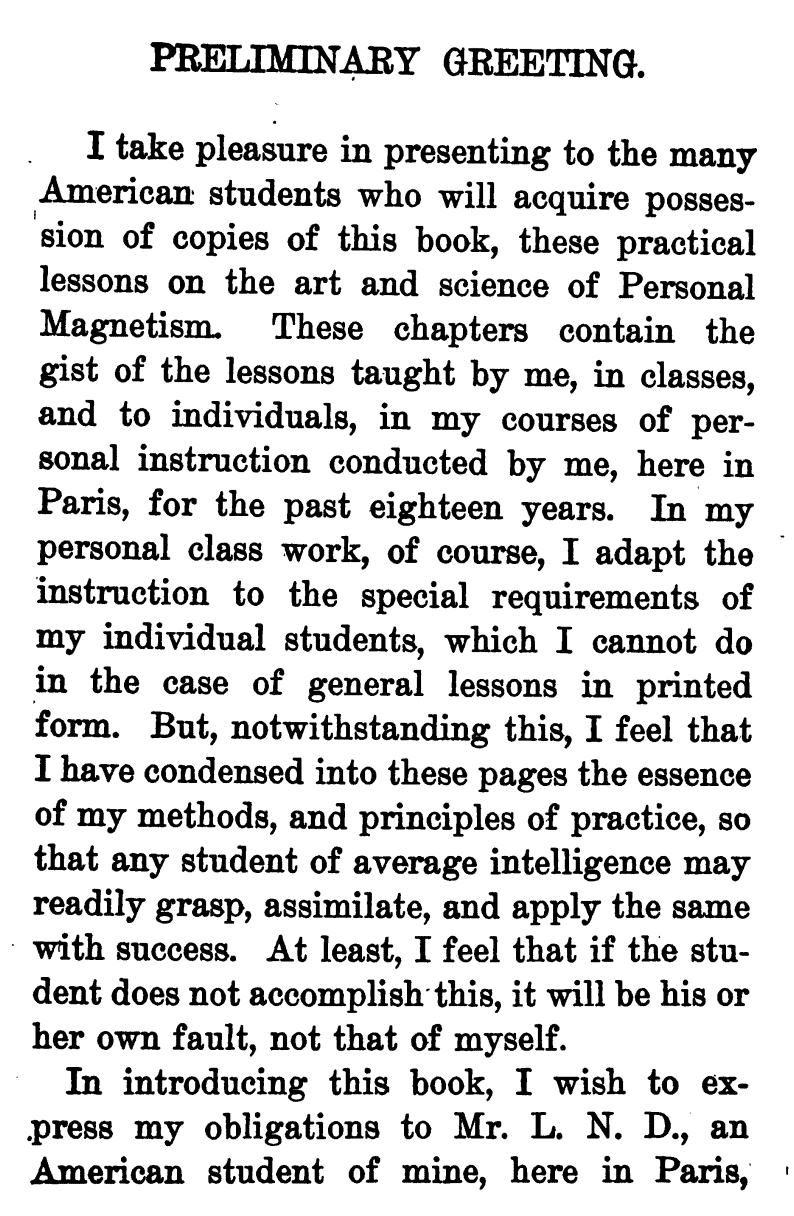
The first major connection between Theron Q. Dumont and Herbert A. Parkyn comes from the backstory created for Dumont himself. In the 1913 introduction and Dumont’s first greeting in Culture of Personality, Dumont states that the lessons in the book contain the substance of what he had personally taught in his classes and to individual students in Paris “for the past eighteen years.” The greeting is dated August 26, 1913, placing the beginning of this supposed teaching career in 1895. That date is not vague. It lands on the exact year Dr. Parkyn opened his first offices with Dr. Sudduth in Minneapolis and began teaching students, including his first protégé, Sydney B. Flower. One year later, Parkyn opened his celebrated Chicago School of Psychology, the first and most influential school in America to teach the science of Suggestive Therapeutics.
The Specific Date Could Only Be Referencing Dr. Parkyn
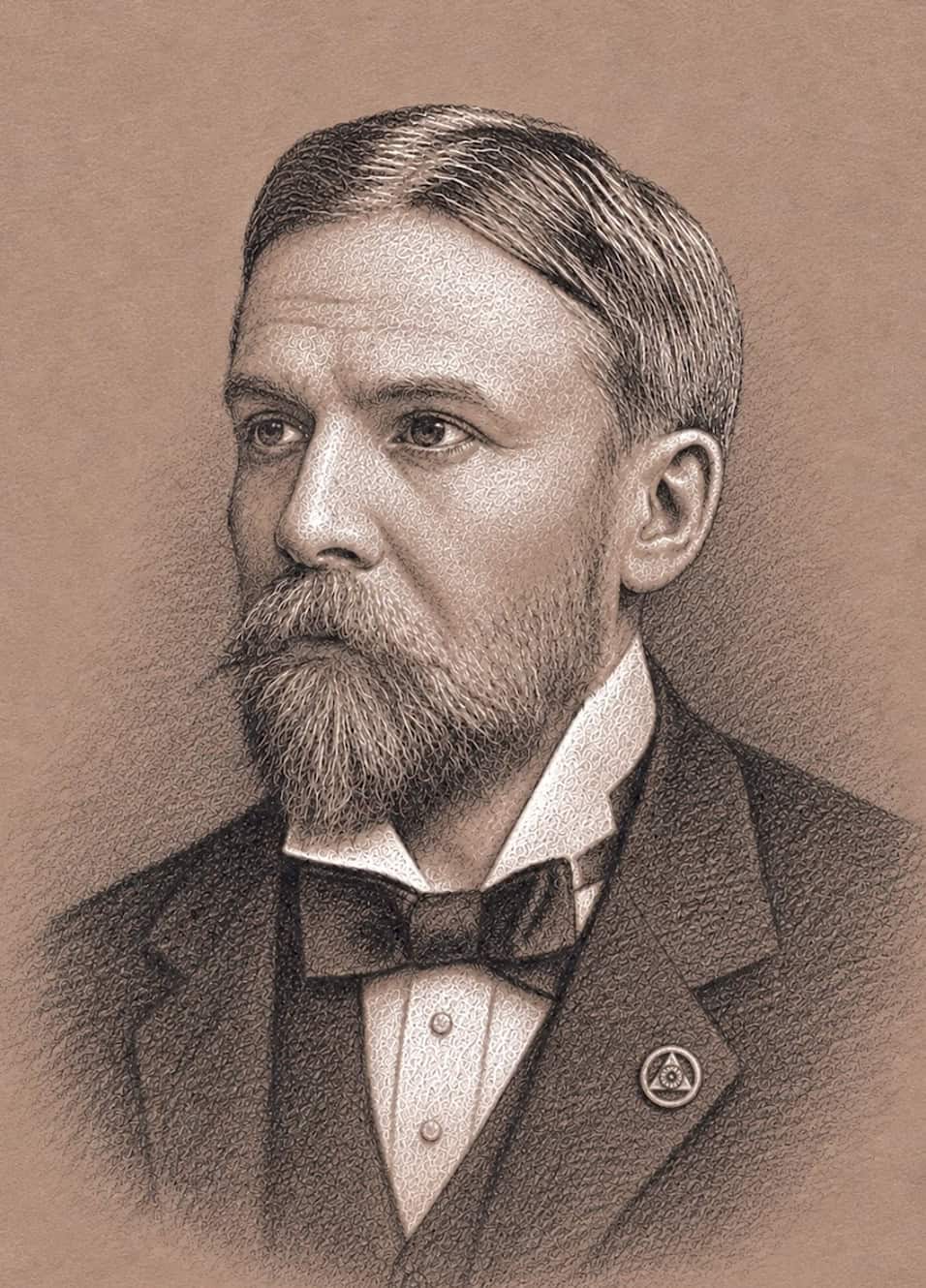
This is where the Dumont backstory becomes much more than a coincidence. While Parkyn’s Chicago School and system were based on the earlier discoveries of Suggestive Therapeutics at the Nancy School in France, Parkyn was not simply repeating the older medical use of it. He was the person developing it into what would become the science of Suggestion, separating the power of suggestion itself from hypnotic sleep and opening the subject into the deliberate training of the mind. From that work came the use of Suggestion and Auto-Suggestion for concentration, memory, willpower, personal influence, habit, character, health, success, and the other everyday subjects that appear throughout the Dumont books. That is the key point. If the author of the Dumont books had really been teaching these lessons in a classroom eighteen years earlier, then the teacher described by the backstory could only have been Parkyn, as he was the only one teaching this system of Suggestion at that exact time.
The Nancy School, which influenced Parkyn, does not fit the Dumont chronology or curriculum. The Nancy School had already been established since 1886, so an eighteen-year teaching history beginning in 1895 does not point to its beginning at all. More importantly, its work remained centered on the medical and therapeutic use of suggestion. Besides, it did not teach a program that included concentration, memory, personal magnetism, will training, personality development, mental influence, self-culture, and success. Parkyn was the one who took the therapeutic discovery associated with Nancy and developed it into the system of Suggestion and Auto-Suggestion that could be used in everyday life. That is exactly the system the Dumont books later present.
The “Man on the Street” Writing Style
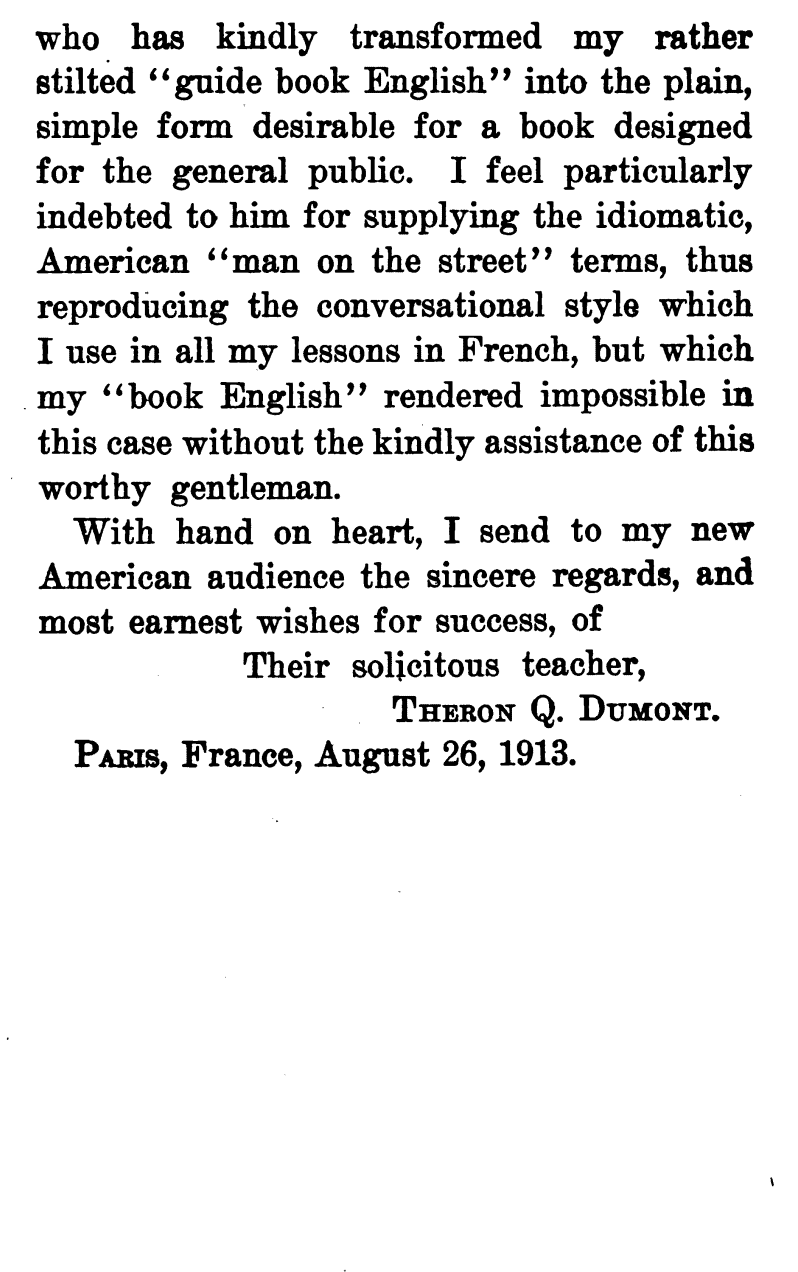
There’s another revealing part of the story. Dumont specifically expresses gratitude to an American student in Paris, identified as Mr. L. N. D., who helped transform his more scholarly and formal written English into a familiar American “man on the street” style. Dumont states that this Mr. L. N. D.,
“kindly transformed my rather stilted ‘guide book English‘ into the plain simple form desired for the general public… and for providing the idiomatic, American ‘man on the street‘ terms, thus reproducing the conversational style which I use in all my lessons in French, but which my “book English” rendered impossible in this case without the kindly assistance of this worthy gentleman.”
This is one of the clearest examples of what our research has uncovered about Dr. Parkyn and the writers he brought into his network to help transform his highly clinical and scientific work on the Laws of Suggestion into language that could reach the everyday reader and the New Thought movement.
Read the article: From Mental Breakdown to Atkinsonia: How Herbert A. Parkyn Turned William Walker Atkinson into a New Thought Phenomenon
This process had begun back in 1895, when Parkyn recruited Sydney B. Flower, a journalist by trade and one of his students, to collaborate with him on the first two books explaining his system, Hypnosis Up to Date and A Study in Hypnotism. Flower then became editor of the Chicago School’s journal, The Hypnotic Magazine. Other collaborators followed, including William Walker Atkinson, who joined Parkyn in 1900 and became one of his most visible protégés. Atkinson followed much the same path, collaborating with Parkyn on the book Thought=Force in Business and Everyday Life and adapting it into a more conversational “man on the street” style before becoming an editor of Parkyn’s Suggestion magazine.
Read the article: The Continuing Collaboration of Herbert A. Parkyn, Sydney Flower, and William Walker Atkinson
Parkyn had already laid out the formal blueprint for the Law of Suggestion in his 1898 Mail Course in Suggestive Therapeutics, but the course was written in a scholarly and clinical format aimed largely at physicians and other professional students. He continued to develop and expand these ideas over the years in his articles for Suggestion magazine and in his other writings, often taking individual parts of the system into much greater detail. This provided the writers within his network with a large body of material that could be adapted into a more accessible style and developed into stand-alone books devoted to the individual subjects Parkyn had already taught and written about.
Mr. L. N. D.
The entire backstory of Theron Q. Dumont seems to be filled with twists and riddles as a kind of playful way of creating a “masked suggestion” for some, while also serving as a wink and nod to others. In the next part of this article, we identify the sources of each component of the pseudonym and show that the Dumont component refers to the French psychologist Léon Dumont. With that knowledge, we believe that Mr. L. N. D. is also intended to refer to Léon Dumont. To make it less obvious to those familiar with his teachings and the similarity to these works, it was laid out with three initials, but it is actually just Mr. LeoN Dumont.
It also appears that Theron Q. Dumont’s statement in the introduction that Mr. L. N. D. was an American student of his in Paris who helped him write in a ‘man-on-the-street’ style was just another way of twisting the story to make it less obvious. In this way, several truths could simultaneously be hinted at without directly connecting them. Like that the work was done with the help of a student to make the writing style less formal and scientific, and that the name was a direct reference to Léon Dumont.
The French Element
The French element in the Theron Q. Dumont biography is not only a direct reference to the French psychologist Léon Dumont’s influence, but also to the scientific roots of Suggestive Therapeutics, which formed the foundation of Parkyn’s system and were founded in France. So, making Theron Q. Dumont a renowned French psychologist fits into an allegorical reading of the backstory, in which the foundation of the teaching rests on French discoveries.
What Was the Meaning Behind the Name Theron Q. Dumont?
The name Theron Q. Dumont was chosen with specific meanings that match the teachings published under the pseudonym. The books issued under this name focused on personal magnetism, concentration, will, character, mental influence, success, and the use of Suggestion as the underlying force. Instead of functioning as a simple invented author name, each part of “Theron Q. Dumont” can be examined for associations that reflect these same ideas.
The following sections will show where each part of the name was taken from and why it relates to the teachings in the books under the pseudonym. This will demonstrate the meaning of the name as:
Theron Q. Dumont = the achievement of personal magnetism by means of repeated habit formation.
Why Was Theron Chosen as the First Name?
Theron: The Hunter, the Pursuer, the Ruler
The first name, Theron, originates from the Greek Θήρων (Thērōn), meaning “hunter” or “pursuer.” The name itself immediately evokes the ability to seek and pursue an intended goal, which already relates to the pursuit of personal magnetism as a means of attaining success. But it was also the name of one of the most celebrated rulers of the ancient Greek city of Acragas in Sicily, whose life and reputation give the name an even deeper significance in relation to the teachings of personal magnetism.

Theron of Acragas ruled from about 488 to 472 BCE during one of the city’s greatest periods of power and prosperity. He formed an alliance with Gelon of Syracuse and was responsible for the Greek victory over Carthage at the Battle of Himera in 480 BCE. The wealth that followed the victory fueled an extraordinary period of construction that transformed the city into one of the architectural wonders of the Greek world. The greatest undertaking was the colossal Temple of Olympian Zeus, also known as the Olympieion, conceived on such a scale that it became the largest Doric temple ever attempted. Theron’s reputation extended beyond political and military power. In 476 BCE, he won the four-horse chariot race at the Olympic Games, the most prestigious victory available to a Greek ruler or aristocrat.
Theron’s achievements alone stand as a powerful symbol of personal magnetism: leading his people to victory in battle, uniting them behind massive building projects, and becoming an Olympic champion. Yet it is through the poetry of Pindar, one of the greatest lyric poets of ancient Greece, that the deeper meaning behind the choice of the name Theron emerges.
Pindar the Poet and Masonic Initiation
It is first useful to provide some context on Pindar’s connection to Masonic tradition when considering why Theron was chosen as a pseudonym. Parkyn had numerous family and close connections who were leaders in Masonry, including his uncle, who was the Grand Commander of the Knights Templars for the State of Vermont. This would have exposed him to Masonic symbolism surrounding the Ancient Mysteries, including Pindar’s poetry, which plays a central role in several rituals and symbols, including the Initiation ritual, the Secret Vault, and the symbolism of the Winding Stairs and the Fellow Craft degree. It is in the Initiation ritual that Pindar is most prominent, where it is stated by legendary masons such as Albert Pike and Albert G. Mackey, that the initiation ritual follows Pindar’s description of the Eleusinian Mysteries and specifically his words,
“Happy is the man who descends beneath the hollow earth, having beheld these Mysteries. He knows the end; he knows the divine origin of life.”
This gives Pindar a particularly important place in understanding the choice of Theron, as he was already part of the ancient initiatory tradition familiar to Masons. And the historical figure whose greatness Pindar had immortalized in two of his Olympian odes was Theron of Acragas.
Pindar and the Immortal Reputation of Theron
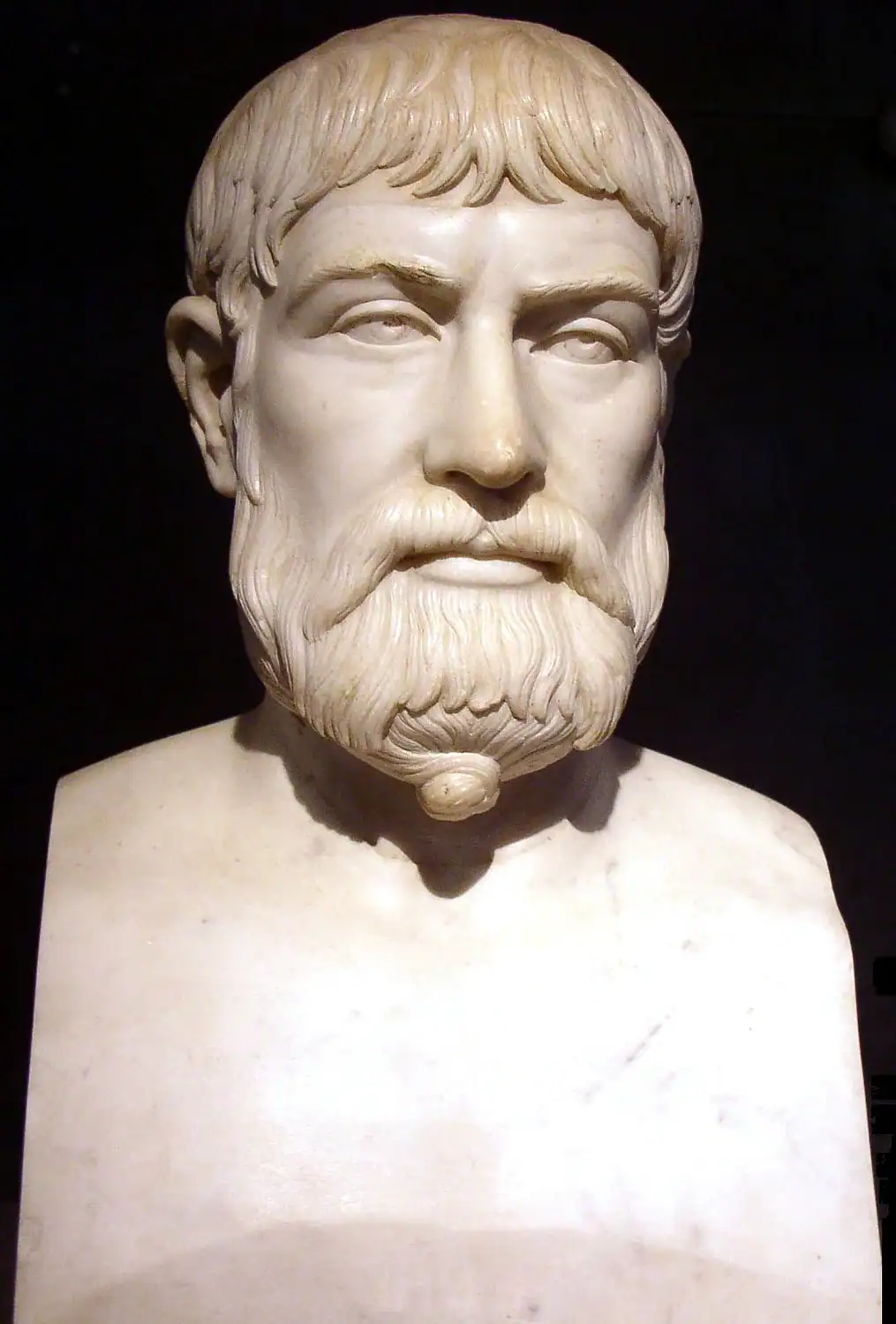
Theron was celebrated by Pindar in the odes Olympian 2 & 3, for his Olympic chariot victory. Through these poems, Theron’s victory and character were transformed into kleos, the enduring glory and fame preserved through poetry. Pindar’s odes present Theron as a man possessing an exceptional combination of power, accomplishment, character, generosity, and reputation. Olympian 2 opens with Pindar asking which god, which hero, and which man should be celebrated and answers with Zeus, Heracles, and Theron. Zeus representing Olympia, Heracles the heroic foundation of the Olympic Games, and Theron the mortal victor whose achievements are worthy of the poet’s song.
Theron’s Olympic victory provided the immediate occasion, but Pindar’s praise extends far beyond the chariot race. He celebrates Theron’s generosity toward friends, his good deeds, his prosperity, and the qualities that had brought him greatness. Pindar even declares under oath that for a hundred years no city had produced a man more beneficent toward his friends or more generous in spirit than Theron, and states that it would be easier to count all the sands of the world than to count Theron’s good deeds.
The portrait of Theron bears a particularly close resemblance to the qualities later associated with personal magnetism. Theron’s greatness expresses itself through command, achievement, victory, friendship, generosity, reputation, and the ability to leave an extraordinary impression upon the people and world around him. His internal qualities become visible through action. He commands a powerful city, helps defeat a great enemy, presides over immense works of construction, wins at Olympia, attracts the praise of one of Greece’s greatest poets, and acquires a reputation that survives thousands of years after his death.
But it is in the second ode to Theron that Pindar reveals the underlying natural power that gives rise to Theron’s immortal greatness.
Pindar’s Deeper Teachings in the Second Ode to Theron
Pindar’s Second Olympian Ode moves into deeper teachings concerning death, judgment, repeated lives, purification, and the destiny of the soul. He writes that not even Time can undo the consequences of just or unjust actions and that judgment continues beyond death. Those who remain free from injustice through three repeated existences complete the cycle and follow the path of Zeus to the realm of Cronus and the Isles of the Blessed.
Pindar then declares that he holds “many swift arrows” within his quiver, but these are no ordinary arrows. They are phōnaenta, “speaking” or “voiced,” arrows, and they speak to the synetoi, “those who understand.” For others, interpretation is required. Pindar distinguishes true understanding as the divine eagle of Zeus and the others as noisy crows.
The poem then moves from the knowledge carried by these speaking arrows to their deliberate use. Pindar addresses his own thymos, his inner mind, and commands it to direct the bow toward its mark. He asks whom they shall strike as he sends forth his glory-bearing arrows from his inner mind. The answer is that they are aimed at Theron, and from there Pindar declares Theron’s extraordinary virtues and good deeds.
It is this image of the “speaking arrows” carrying knowledge from the mind, through the word, toward a deliberately chosen target that opens the true meaning behind the name Theron.
Theron, the Speaking Arrows, and Personal Magnetism
The different elements of Pindar’s ode come together in Theron as an ancient image of the fully developed magnetic personality. Theron possesses enormous power, wealth, influence, military success, and public authority, yet Pindar continually returns to his generosity, justice, friendship, and strength of character. Even surrounded by enemies and exposed to the temptations that accompany great power, he remains on the path of virtue. His Olympic chariot victory becomes the crowning example of his extraordinary concentration, willpower, discipline, and self-command.
Pindar’s teachings on the soul’s journey in the afterlife take these qualities of personal magnetism to their highest level. Power must remain under control. Will must remain fixed upon its course. Character must survive every test placed before it. The person who achieves that mastery becomes powerful in life, while the soul that achieves it completely reaches the Isles of the Blessed.
It is with the “speaking arrows” that the underlying force that directs the mind is introduced. Pindar himself is assuming the role of the Suggestion. His thought takes form in words, those words become arrows, and the arrows are consciously aimed at Theron, who now is the symbol of the fully developed magnetic personality. Pindar is projecting a concentrated mental impression through the spoken word toward a chosen target of desire.
His “speaking arrows” then speak to the synetoi, “those who understand,” represented by the divine eagle of Zeus that can fly directly into the Sun of truth without blinking. This symbolizes the thought being carried by the strength of will, concentration, and discipline directly into the subconscious mind, where the involuntary true power of manifestation brings it into action. Pindar also shows the opposite: not understanding this power of nature fills the mind with undisciplined and undirected thought, which he compares to noisy crows.
This brings the symbolism full circle. Theron represents the willpower, concentration, disciplined thought, self-command, character, and directed action that create the magnetic personality. Pindar represents the power of Suggestion by which an idea held within the mind is given voice, deliberately directed, and impressed upon the subconscious mind. Theron is Personal Magnetism, while Pindar’s arrow is Suggestion.
Pindar’s Arrows and Astra

The use of the name Theron and its connection to Pindar’s arrows gives us another direct connection to Parkyn and his earlier use of Astra as a pseudonym in 1898. In Sanskrit, an astra is a supernatural weapon or projectile found throughout the Hindu epics, frequently taking the form of an arrow. These weapons were associated with divine or hidden knowledge and were invoked with a spoken mantra before being directed at their intended target.
The parallel between Parkyn’s earlier choice of the Astra arrow weapon as a pseudonym and Pindar’s speaking arrow aimed at Theron can’t be ignored.
Read the article: Astra: Herbert A. Parkyn’s First Yogi Pseudonym and the Foundation for the Yogi Publication Society
Why Was Dumont Chosen as the Last Name?
Léon Dumont and De l’Habitude
The use of the last name Dumont was directly connected to Léon Dumont, the French philosopher and psychologist whose 1876 essay De l’Habitude, or On Habit, dealt with many of the same ideas that would later appear in the books of Theron Q. Dumont. Léon Dumont examined how attention, repetition, habit, will, and mental force shape thought and action. He described repetition as reducing resistance and producing an “accumulation of force in the organism,” while acquired habits make thoughts and actions progressively easier to reproduce. He also explained the will as a process in which the idea of a desired result calls up the action required to achieve it. When the idea of that action has sufficient force, it produces the action itself.
These are the central subjects of the later Theron Q. Dumont books. Concentration strengthens and directs thought, willpower carries thought into action, repeated actions develop into habits, and those habits become part of a person’s character and outward expression. Personal magnetism could be consciously developed through this process, while Culture of Personality carried the same principle directly into the formation of personality itself
Léon Dumont’s Influence on Herbert A. Parkyn
Outside of the Nancy School and its development of Suggestive Therapeutics, Léon Dumont was one of the strongest influences on Herbert A. Parkyn’s psychological teachings. Dumont’s work on habit, attention, will, mental force, resistance, and the relationship between thought and action runs throughout the system Parkyn taught at the Chicago School of Psychology. His exposure to Dumont came through William James, whose 1890 The Principles of Psychology drew directly from De l’Habitude. In his chapter on “Habit,” James described Dumont’s essay as “perhaps the most philosophical account yet published” on the subject.
Parkyn used several of Léon Dumont’s examples of habit formation in his 1898 Mail Course in Suggestive Therapeutics, including Dumont’s example that once a piece of paper has been folded in a certain direction, it requires less effort to fold it along the same crease again. He also uses Dumont’s example of flowing water gradually cutting a channel for itself and, when it returns after an interruption, following the course it has already formed. He immediately compares this to the nervous system, where repeated impressions establish pathways that allow the same neural activity to occur more easily. Parkyn also makes the same comparison.
It is hard to doubt that Léon Dumont was the inspiration for the last name of the pseudonym Theron Q. Dumont. Parkyn’s use of Dumont’s principles of habit formation, including several of the same distinctive examples, adds another strong connection between Parkyn and Theron Q. Dumont. Léon Dumont died in 1877, only a year after the publication of De l’Habitude, but his work lived on in Parkyn’s teachings at the Chicago School of Psychology and in his Mail Course in Suggestive Therapeutics.
The Meaning of the middle initial “Q”
Between Theron and Dumont sits the initial Q, and its placement would seem to represent a middle name. However, there is an older Latin scribal convention that used q as shorthand for qui, quam, quod, qua, and related forms meaning “who,” “which,” “through which,” “or “by means of.” This allows the initial to function as a connecting word between the two names, with readings such as “Theron through Dumont,” or “Theron by means of Dumont.”
In this way, the Q is the hinge joining the two parts of the pseudonym and together the name describes the system itself.
Theron = The achievement of personal magnetism, directed will, and disciplined thought
Q = the connecting shorthand of “through” or “by means of.”
Dumont = repeated habit formation
Theron Q. Dumont = the achievement of personal magnetism by means of repeated habit formation.
.
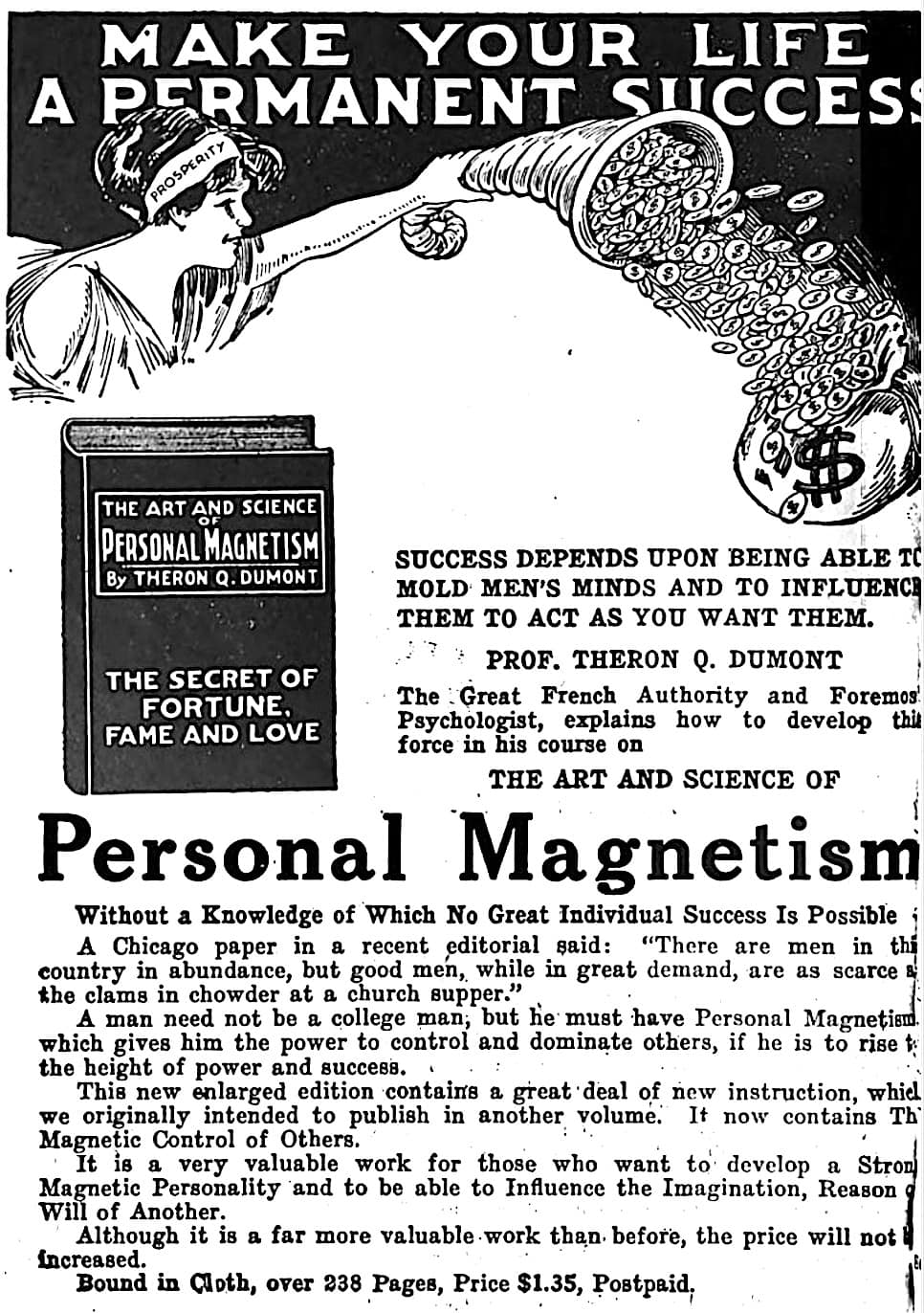
Theron Q. Dumont Teaches Dr. Parkyn’s System
The teachings published under the Theron Q. Dumont pseudonym followed directly from Herbert A. Parkyn‘s teachings on the power of Suggestion and the training of the mind. The connection can be seen in Dumont’s repeated use of Parkyn’s specific vocabulary and instructional phrasing and in the use of his most famous maxim, “Thought Takes Form in Action,” which appears in The Master Mind, and Mental Therapeutics.
A full, detailed comparison between the Dumont books and Parkyn’s earlier teachings can be found in the summaries of the Theron Q. Dumont books in the publications section of this site. LINK
“Nerve-Force” Appears as a Working Concept in Both Systems
Culture of Personality repeatedly uses the term “nerve-force” and gives it a major place in its explanation of personal magnetism. Dumont does not mention it casually. He develops whole sections around generating nerve-force, distributing nerve-force, exercising it, and projecting it. Within the book, nerve-force connects physical vitality, the nervous system, bodily expression, will, and the ability to influence other people. The student is taught that personal magnetism depends partly upon the condition and direction of this force, which can be strengthened, conserved, and deliberately used.
Parkyn had already used the exact term “nerve force” in his own course years earlier. In Parkyn’s teaching, the nervous system, mental states, bodily action, vitality, and personal influence were all treated as parts of the same working psychology. That makes the repeated appearance of “nerve-force” in Dumont more significant than a loose resemblance between two writers discussing health or energy. The same term appears inside the same field of instruction and is tied to the same general problem of how mental direction is expressed through the body and nervous system.
This becomes even more revealing when Culture of Personality is read beside Parkyn’s earlier lesson on Personal Magnetism. Parkyn had already connected magnetism with thought, physical condition, voice, facial expression, manners, tact, sympathy, health, nervous control, and the impressions one person produces in another. Dumont then builds an entire book around these subjects and places “nerve-force” directly inside that system. The shared terminology reinforces the larger pattern of continuity between Parkyn’s school teaching and the later Dumont presentation.
“A Moment’s Reflection” and “A Moment’s Thought”
Another connection appears in the teaching style itself. Parkyn repeatedly uses the phrase “A moment’s reflection” when making a point that he regards as obvious once the student gives it brief consideration. It functions as a recurring instructional cue. Parkyn introduces an idea, asks the reader to reflect on it for a moment, and then uses that reflection to carry the argument forward.
In Culture of Personality, Dumont repeatedly uses the closely related phrase “A moment’s thought” in the same way. The expression appears when he wants the reader to pause and recognize that the conclusion being presented should become clear through brief consideration. The wording is slightly altered, yet the rhetorical function is the same. Both writers use a short reflective command to turn a stated principle into something the student is expected to verify mentally for himself.
On its own, a phrase like this might seem minor. Inside a body of books already repeating Parkyn’s subjects, methods, slogans, and teaching structure, it becomes much more significant. The Dumont books repeatedly follow Parkyn in areas such as suggestion, auto-suggestion, concentration, habit, voluntary and involuntary mental action, personal magnetism, will, thought taking form in action, bodily response, and the direction of one mind upon another. When a closely related instructional phrase also appears in the same kind of didactic setting, it adds another layer to the connection.
These details matter because the relationship between Dumont and Parkyn is not built from one isolated parallel. It is cumulative. The same psychological subjects appear, the same practical methods recur, familiar slogans and formulas return, and even smaller pieces of vocabulary and teaching style begin to line up. “Nerve-force” and the repeated “A moment’s reflection” versus “A moment’s thought” construction belong to that larger pattern and help show just how closely the Dumont material tracks the mental-training system Parkyn had been teaching.
Parkyn’s “Thought Takes Form in Action” in the Dumont Books
One of the strongest connections is Dumont’s use of Parkyn’s famous maxim “Thought takes form in action” in both Mental Therapeutics and The Master Mind. For Herbert A. Parkyn, the phrase expressed a central principle of his teaching. Thought finds expression through behavior, bodily response, habits, speech, and action. In his lesson on personal magnetism, Parkyn carried the idea one step further by explaining that our actions then take form in the thoughts of others.
That principle runs directly through the Dumont books. Mental control leads to action, repeated action develops habit, and outward expression creates impressions in other minds. It is especially relevant to Culture of Personality, where Dumont teaches that mental attitudes are expressed through the eyes, voice, face, posture, manner, and conduct and then influence other people. Dumont’s use of Parkyn’s actual “Thought takes form in action” maxim in two separate books adds another specific connection alongside their shared use of specific teaching phrases.
Was William Walker Atkinson the Sole Author of Theron Q. Dumont?
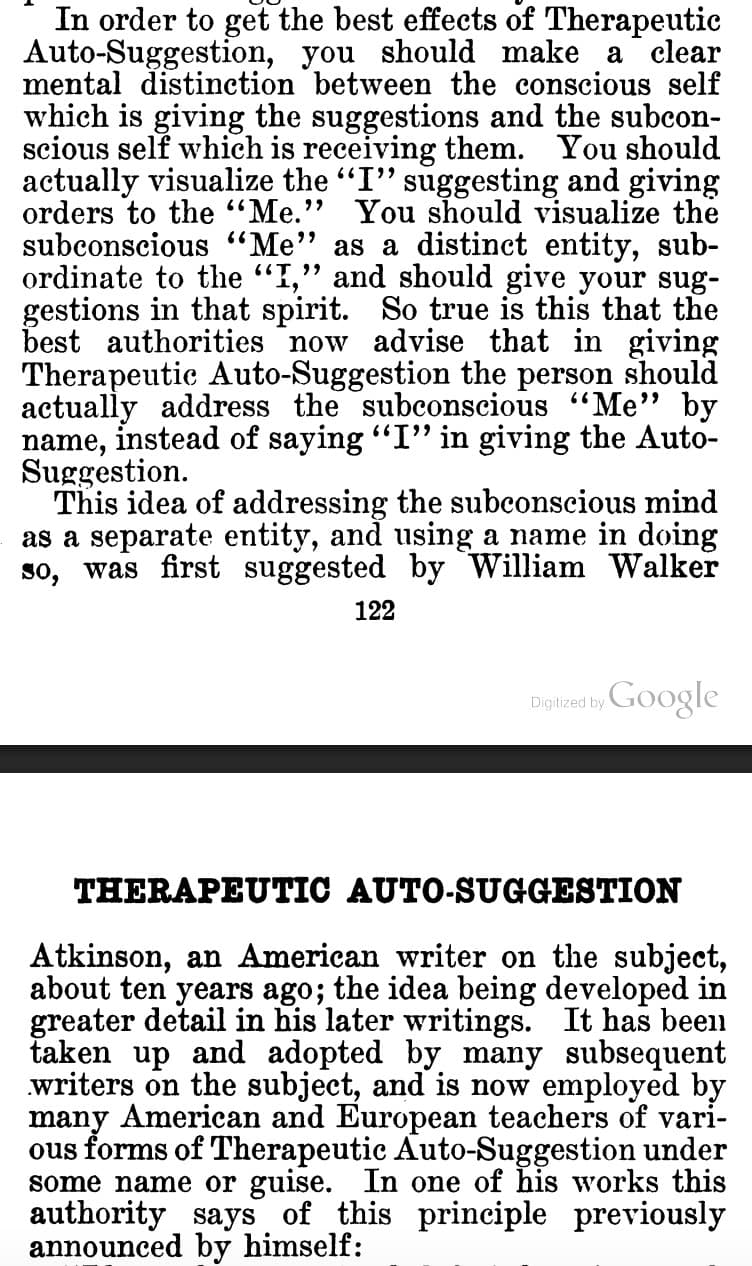
One of the more unusual pieces of evidence surrounding the popular belief that William Walker Atkinson was the sole author behind Theron Q. Dumont appears in the 1916 book Mental Therapeutics by Theron Q. Dumont. In a lengthy section on therapeutic Auto-Suggestion, Dumont not only quotes Atkinson as a separate authority, but gives him very specific historical credit for a particular development in the practice of Auto-Suggestion. If Atkinson himself were writing the book under the Dumont pseudonym, this would amount to an unusually elaborate self-reference. He would be identifying himself to the reader as “William Walker Atkinson, an American writer on the subject,” explaining what Atkinson had contributed about ten years earlier, describing how the method was developed in his later writings and adopted by other teachers, and then quoting his own work at considerable length.
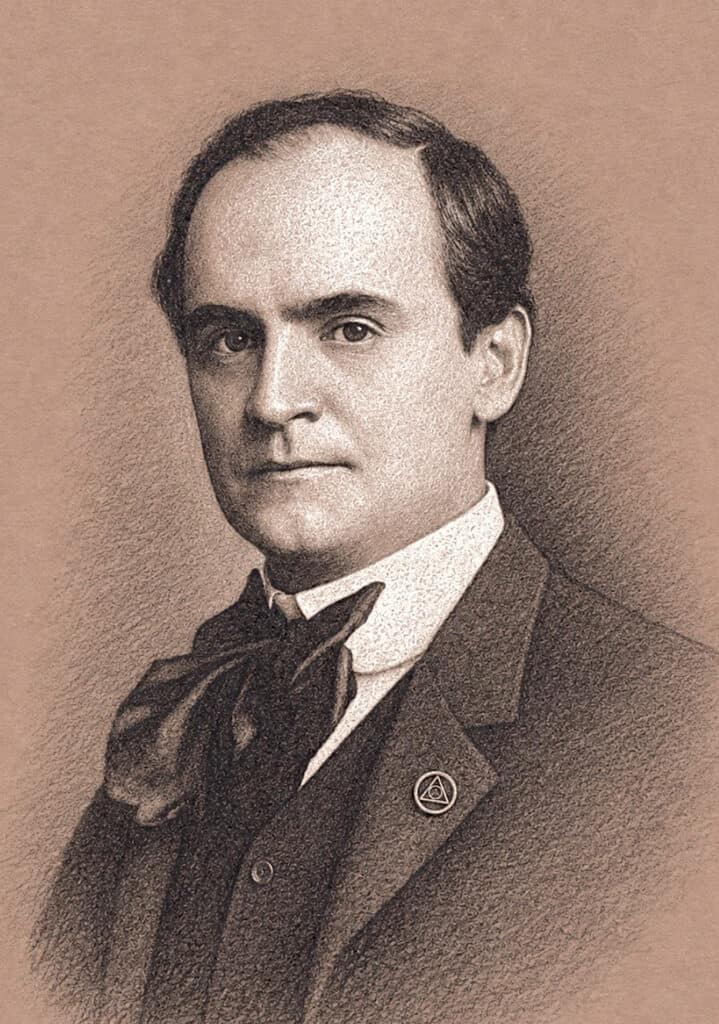
The contribution credited to Atkinson was a specific modification of Auto-Suggestion. Instead of relying only on first-person affirmations in which the conscious individual says “I am courageous” or “I am fearless,” Atkinson proposed making a mental distinction between the conscious “I” giving the suggestion and the subconscious “Me” receiving it. The conscious mind could then address the subconscious personality by name as though speaking to another person. Atkinson illustrated the method with the fictional “John Smith,” instructing the reader to address “John Smith” directly and tell him what he was expected to do, become, and believe. Mental Therapeutics credits Atkinson with first suggesting this method “about ten years ago.”
The chronology fits precisely. The passage quoted by Dumont comes from Atkinson’s Mind-Power: The Secret of Mental Magic, whose material dates to about 1906, while Mental Therapeutics appeared in 1916. Dumont is not casually mentioning a contemporary writer. He is looking back roughly ten years, identifying a particular contribution made by Atkinson, giving him priority for it, and reproducing his explanation as historical support for the method being taught.
The way Atkinson is presented is what makes the passage so unusual in the question of authorship. Dumont repeatedly maintains the separation between the two writers. Atkinson is “an American writer on the subject,” then “the authority just quoted,” and later “the same authority.” His contribution is specifically separated from the rest of the therapeutic system being presented in the book. None of this makes it impossible that Atkinson participated in writing the Theron Q. Dumont books, but it does make the common claim that he was simply the sole author behind the pseudonym much less straightforward. If he was, this section required him to construct a detailed historical account of himself as an outside authority, assign himself priority for one specific development, and then cite and quote his own earlier work to support the teachings of his supposedly separate French author.
.
Sources & Citations
- PDF / Digital Archive. Léon Dumont , De L'Habitude, 1877
- Primary Source. Deciphering scribal abbreviations
- PDF / Digital Archive. The Principles of Psychology by James , William, 1842-1910
- PDF / Digital Archive. Suggestion Magazine issues 1-5
- Website. Tribe, Vedic (2020-12-28). "Ancient Divine Weapons as Mentioned in Hindu Puranas". Vedic Tribe.
- Website. Ramesh (2019-12-26) . "10 Most Powerful Weapons in Hindu Epic Mahabharata".
- Website. The Secret Societies of the Ancient World , Pindar
- Website. Winding Stairs and the Fellow Craft degree
- PDF / Digital Archive. Parkyn , Herbert Arthur (1898). Special mail course in suggestion. Chicago School of Psychology.
- PDF / Digital Archive. Auto-Suggestion : What It Is and How to Use It for Health, Happiness and Success, by Dr. Herbert A. Parkyn. Suggestion Publishing Company, Chicago, 1905
- Website. LÉON DUMONT AND HIS PHILOSOPHICAL WORK
- PDF / Digital Archive. The advanced course in personal magnetism : the secrets of mental fascination by Dumont, Theron Q
- Website. Archery , Birds, and Sounds in a Metaphorical Passage. A Study of Pindar, Olympian, II