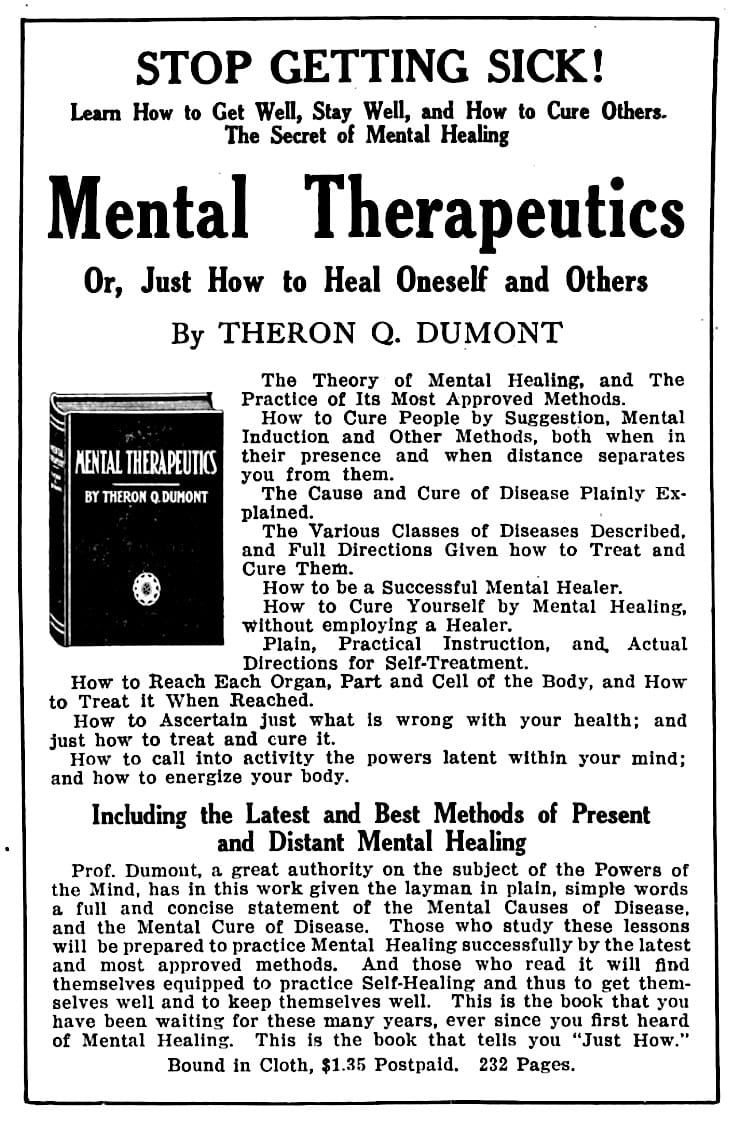
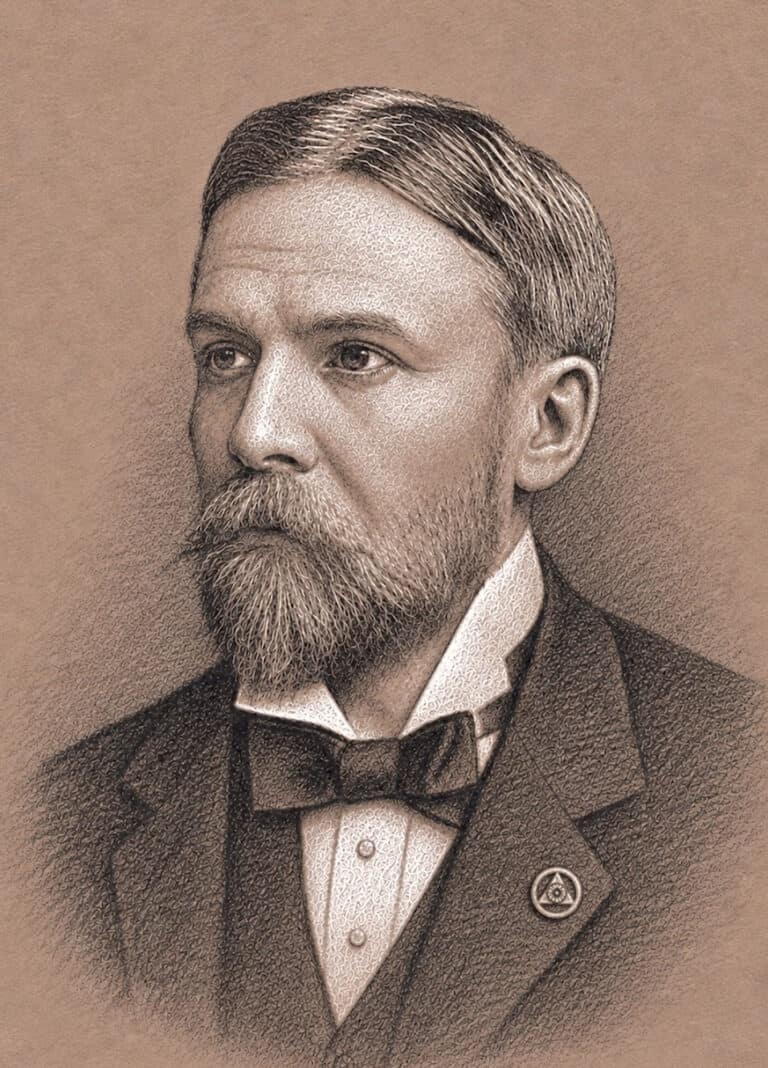
Mental Therapeutics, or Just How to Heal Oneself and Others by Theron Q. Dumont was first published in 1916 by the Advanced Thought Publishing Company and was later issued by the Yogi Publication Society. The book describes itself as “the latest and best methods” of present and distant mental healing, and proceeds from the basic psychology and physiology of mental healing through therapeutic suggestion, auto-suggestion, thought induction, distant treatment, bodily physiology, and practical methods of treatment.
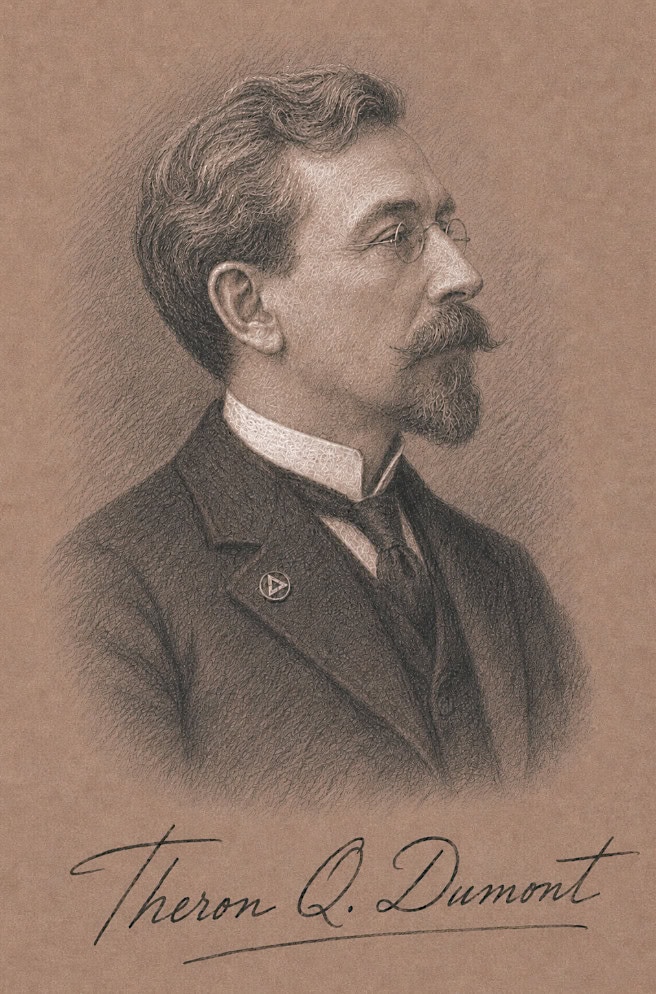
Theron Q. Dumont, “The Great French Authority and Foremost Psychologist of Paris, France. (artist depiction)
Among Dumont’s books, Mental Therapeutics is important because it presents mental healing as a complete instructional system built around the subconscious direction of bodily processes through suggestion. In doing so it follows closely the teachings that Herbert A. Parkyn had developed and taught through the Chicago School of Psychology. The comparison runs much deeper than a shared interest in suggestion. Dumont’s division of conscious and bodily mind, his laws of suggestion, the therapeutic use of expectation and repetition, his treatment of auto-suggestion, his natural explanation of healing, his organ-directed methods, and even his present and distant mental treatment follow Parkyn’s system. A detailed comparison appears at the end of this summary.
Mental Therapeutics teaches that much of the body’s activity is governed by an intelligent subconscious or involuntary mental system that Dumont calls the “Corporeal Mind.” This bodily mind directs the organs, nerves, cells, circulation, digestion, elimination, repair, and other processes that proceed without conscious supervision. Because the subconscious mind responds to ideas and suggestions, Dumont argues that mental states can disturb bodily functioning or assist in restoring it. Fear, expectation of disease, destructive imagination, and repeated negative suggestions can produce harmful physical responses, while constructive suggestion, auto-suggestion, confidence, expectation, visualization, and repeated mental direction can stimulate the body’s natural reparative processes. He develops this into three major therapeutic methods—spoken mental suggestion, present thought induction, and distant thought induction—and then shows the student how those methods can be directed toward specific bodily systems.
What Is Mental Therapeutics?
Dumont opens the book by defining Mental Therapeutics as a system for preventing and treating physical disorders through mental influence. He insists that the subject can be approached through natural law without requiring supernatural explanations, religious conversion, or a mystical theory of mind. The student does not need to solve the philosophical question of what mind actually is before studying its operations. Just as people learned to employ electricity without possessing a final explanation of its nature, they can observe how mental activity affects the organism and use those observed relationships deliberately.
This naturalistic position is one of the book’s main organizing principles. Dumont repeatedly seeks a working mechanism behind forms of healing that have been explained through religion, magic, metaphysics, faith, animal magnetism, prayer, or other theories. Different systems may provide different stories about what produces a cure, yet the mental elements of belief, expectation, attention, imagination, confidence, and suggestion recur. His aim is to isolate those elements and make them available as practical methods.
Dumont also insists upon combining psychology with physiology. A mental healer should understand what healthy bodily functioning actually consists of because the desired condition must be pictured clearly before it can be impressed upon the patient’s mind. This is why a substantial portion of Mental Therapeutics eventually becomes a course in elementary physiology. The practitioner is expected to know how digestion, assimilation, elimination, circulation, respiration, and other processes function normally so that treatment can direct the mind toward that normal pattern.
What Does Dumont Mean by the Corporeal Mind?
The central concept of the book is Dumont’s “Corporeal Mind,” which he defines as the mental activity associated with the physical body. He rejects the picture of the body as a mass of dead matter controlled by a mind located only in the brain. Every organ, tissue, and cell participates in living activity, and Dumont interprets that activity as possessing a mental character. The body becomes an immense cooperative organization of living units whose functions are coordinated below ordinary conscious awareness.
The Corporeal Mind belongs to the subconscious domain. It governs processes that the conscious mind ordinarily leaves alone: the beating of the heart, movement of the digestive organs, glandular secretion, circulation, nutrition, assimilation, elimination, repair of damaged tissue, and countless adjustments necessary for continued life. Dumont estimates that subconscious activity comprises the great majority of human mental operation, leaving conscious thought as only a relatively small portion.
This gives him his explanation for mental healing. If bodily functioning is governed by a subconscious mentality, and if that subconscious mentality is responsive to ideas supplied by consciousness, then the conscious mind can indirectly influence bodily processes. Dumont describes the relationship as “mind over mind.” Mental Therapeutics does not require consciousness to manipulate physical tissue directly. Consciousness gives an instruction or establishes an idea, and the bodily or subconscious mentality responds through the mechanisms it already controls.
The Three Laws Governing the Subconscious Mind
Early in the book Dumont lays down several laws that become the foundation of everything that follows. The subconscious mind, he says, tends to accept an idea suggested or impressed upon it unless a sufficiently powerful contrary idea, established mental habit, or conscious refusal prevents acceptance. Once an idea has been accepted, the subconscious mind tends to manifest its logical consequences in thought, action, habit, or physical condition. It then continues along the established line until the old idea is neutralized and replaced or until its erroneous basis is exposed and removed.
This gives Dumont a complete theory of both harmful and beneficial suggestion. A destructive suggestion may become embedded and repeatedly express itself because the subconscious mind continues acting according to the accepted pattern. A constructive suggestion may be introduced in the same way and, if repeated with sufficient force, can replace the earlier mental pattern.
Dumont immediately connects these principles with bodily health. An accepted idea concerning illness can be passed into the Corporeal Mind and expressed through bodily functioning, while an accepted idea of normality can direct the same machinery toward restoration. The practical problem is therefore to understand how ideas become accepted and how an established idea can be replaced.
Authority, Imitation, Association, and Repetition
Dumont identifies several channels through which suggestions gain power. Authority is one of the strongest. People more readily accept statements delivered by individuals whom they regard as knowledgeable, confident, accomplished, or socially authoritative. Physicians, teachers, religious leaders, judges, writers, speakers, and others can exert unusual suggestive influence because their position encourages acceptance before the actual truth of the statement has been independently examined.
Imitation or acquiescence is another channel. People absorb the mental attitudes of those around them, accept commonly repeated beliefs, and can even begin reproducing the emotional or physical states they observe. Association allows a new idea to acquire force by connecting itself with something already familiar and accepted. Dumont also places special emphasis on repetition, explaining that an idea making little impression when first presented may become deeply established when presented again and again. The book’s later therapeutic methods continually return to this principle because repeated suggestion is one of the main ways a new bodily or mental habit is formed.
These principles place Mental Therapeutics squarely within the history of suggestion as a practical psychology. The subject is not confined to formal treatment sessions. Advertising, authority, social imitation, fear, conversation, expectation, medical diagnosis, newspapers, repeated statements, and everyday interpersonal influence can all act suggestively. People are continually influencing one another and continually supplying suggestions to themselves.
Why Does Dumont Spend So Much Time on Cells?
Dumont next develops his cellular theory because he wants to locate the body’s reparative intelligence at the most basic level of living tissue. The body consists of countless microscopic cells that build muscles, nerves, blood, bone, hair, glands, organs, and every other physical structure. Each cell performs specialized work while cooperating with cells of similar type and with the organism as a whole.
He describes the body as a great cooperative community. Some cells carry nourishment, some remove waste, some defend against invading organisms, some manufacture bodily secretions, and others continually rebuild damaged or worn tissue. A wound provides Dumont with a vivid example. Blood flows and coagulates, repair cells arrive, tissues reproduce, vessels reconnect, nerves reunite, and skin eventually covers the repaired area. No conscious direction is required from the individual, yet an intricate sequence of coordinated activity occurs.
Dumont interprets this coordination as evidence of mental action existing within the cells and their groups. Individual cellular mentality combines into group mentality; groups form organ-minds; the organized totality becomes the Corporeal Mind. Modern biology would not describe cells in precisely these psychological terms, but within Dumont’s system the concept provides the bridge between suggestion and physiological change. To heal the body mentally means reaching the intelligence responsible for the body’s ordinary work.
Mind in the Cells and Organ-Minds
The next step is to develop the psychology of the cells themselves. Dumont cites observations of single-celled organisms and biological theories of cellular cooperation to argue that even simple forms of life display selection, adaptation, memory-like behavior, preference, and purposeful activity. If individual living cells possess some degree of mental capacity, he argues, the cells composing the human organism should not be regarded as entirely mindless.
Groups of cells also exhibit coordinated action. Dumont speaks of an organ-mind belonging to the stomach, liver, kidneys, heart, and other organs. The language becomes highly practical later in the book because the healer is taught to direct suggestions toward an individual organ as if addressing a subordinate intelligence. If the stomach is functioning poorly, it can be mentally encouraged, reassured, or commanded. If an organ is sluggish, stronger suggestions can be employed. Treatment is intended to reach the collective mentality operating the organ and restore normal activity.
Disease in this model often represents a failure of cells or cell-groups to perform their normal duties. They may become sluggish, disorganized, improperly coordinated, or influenced by a mistaken mental pattern. Cure consists of restoring their normal functioning. Mental Therapeutics attempts to accomplish this by stimulating and directing the Corporeal Mind and through it the organs and cells.
The Sympathetic Nervous System and Involuntary Function
Dumont links his mental model to the sympathetic nervous system, which he treats as one of the principal physical networks through which the Corporeal Mind operates. Conscious voluntary movement is associated more closely with the cerebro-spinal system, while the sympathetic system controls much of the automatic bodily activity occurring outside ordinary awareness.
The heart continues beating during sleep. Digestion continues. Glands secrete. Blood circulates. The organs of elimination perform their work. Tissue is repaired. None of these processes waits for conscious instructions. Dumont describes the sympathetic nervous system as the physical communication network through which the bodily intelligence coordinates these activities.
The solar plexus receives special attention and is described as a major nervous center associated with the involuntary system. Dumont uses the older expression “abdominal brain” in discussing its extensive connections and importance. His aim is to give the student a physiological picture of the bodily organization being influenced through mental treatment.
How Can Mental States Cause Physical Disease?
Before explaining cure, Dumont establishes the other side of the principle: mental activity can create or intensify physical disturbance. Fear becomes his clearest example. A frightening idea may accelerate the heartbeat, disturb digestion, alter circulation, produce weakness, change breathing, upset glandular activity, and create other genuine bodily effects. If a sudden thought can produce immediate physical changes, repeated or prolonged destructive thought can maintain abnormal functioning for much longer periods.
Dumont collects historical and medical anecdotes involving fright, grief, anxiety, imagined disease, sympathetic symptoms, supposed poisoning, and expectation. Some stories reflect the medical literature of his period and should be read historically, but their purpose within the argument is consistent. The body responds to mental states. A person who believes intensely that something is wrong may develop real physical reactions even when the original belief is mistaken.
He is especially concerned with the psychological effects of descriptions of disease. Medical students may begin imagining the symptoms they are studying; readers of alarming advertisements may identify the advertised symptoms in themselves; repeated conversations about illness can intensify fear and bodily self-observation. The problem becomes one of destructive suggestion feeding the Corporeal Mind a pattern that it then begins to reproduce.
Therapeutic treatment must address both the manifested physical condition and, when possible, the mental cause behind it. A harmful belief may be neutralized by a stronger opposing idea or traced back to its origin and exposed as false. Dumont repeatedly describes this process as replacing an undesirable mental pattern with a new one.
What Is Dumont’s Fundamental Principle of Cure?
The fundamental principle is that the body’s own living processes perform the actual work of healing. Dumont repeatedly invokes the traditional medical idea of vis medicatrix naturae, the healing power of Nature. A physician may clean a wound, set a bone, remove an obstruction, provide nourishment, or administer some therapeutic agent, yet the body itself must repair tissue, unite the bone, create new cells, restore circulation, and resume normal function.
Dumont identifies this healing activity with the Corporeal Mind. Nature’s restorative action is the intelligent activity of cells and organs continually working toward survival, repair, nourishment, and functional balance. External treatment assists these forces. Mental treatment seeks to influence them directly.
The distinction becomes important because Dumont does not tell the student simply to “think health” in some undefined sense. The practitioner is supposed to direct mental stimulus toward the bodily processes that actually perform the cure. The healer calls attention to normal function, produces expectation of normal function, forms a mental picture of normal function, and impresses that pattern upon the subconscious bodily intelligence.
The History of Mental Healing
Dumont then surveys mental healing from ancient priests and medicine men through religious ceremonies, sacred places, relics, laying on of hands, mesmerism, hypnotism, faith healing, Christian Science, and New Thought. The historical explanations may differ greatly, yet Dumont believes that a common psychological process can operate beneath them.
A ceremony can command attention. A celebrated healer can create authority. A sacred location can intensify expectation. Dramatic ritual can stimulate imagination. Community belief can reinforce conviction. Once those factors combine, the patient enters a mental state favorable to the acceptance of therapeutic suggestions.
His historical argument seeks to extract a natural psychological principle from practices previously understood as miraculous, magnetic, magical, religious, or metaphysical. The recurring element is the effect of an accepted idea upon subconscious bodily activity.
Hypnosis and the Development of Waking Suggestion
Hypnotism occupies an important place in this history because it demonstrated the remarkable responsiveness of subconscious processes to suggestion. Dumont discusses the progression from mesmerism through hypnotic investigation and then to a much more important practical conclusion: the therapeutic value of suggestion does not depend upon hypnotic sleep.
This is one of the book’s central historical transitions. Suggestion can operate while the patient is awake. Once that principle is accepted, the field of suggestive therapeutics expands enormously because the practitioner no longer needs to induce a special trance before attempting treatment. Ordinary conversation, deliberate therapeutic suggestion, expectancy, repetition, imagery, and auto-suggestion become sufficient channels.
The change also transforms the subject conceptually. Suggestion becomes part of normal psychology and daily life. Hypnosis may intensify receptivity, but the underlying process is present outside hypnosis.
Disguised Mental Healing and the Power of Expectation
Dumont devotes a full lesson to healing that occurs under disguises. Placebos are among his favorite examples because they demonstrate the effect of belief when the supposed physical remedy itself cannot account for the result. A patient expects a particular action, the expectation is accepted, and the body may respond accordingly.
The lesson extends beyond medicine. Rituals, objects, impressive procedures, reputations, environments, and the personal bearing of the practitioner can all become carriers of suggestion. Their effectiveness depends in part upon what they cause the patient to expect.
This is why Dumont regards expectant attention as such an important therapeutic condition. Attention concentrates mental energy upon an idea, while expectancy anticipates its manifestation. Together they prepare the subconscious mind to accept the suggested result.
The Three Methods of Mental Healing
Dumont divides practical Mental Therapeutics into three principal methods: Mental Suggestion, Present Thought Induction, and Distant Thought Induction. The first employs ordinary suggestive communication. The second uses concentrated thought while practitioner and patient are together. The third applies the same principle when practitioner and patient are separated by distance. The original contents make this threefold division explicit and then devote successive lessons to the theory and practice of each method.
Although the modes of communication differ, Dumont gives them a common purpose. Each seeks to reach the Corporeal Mind and stimulate normal activity in the cells, organs, and bodily systems.
What Is Mental Suggestion?
Mental Suggestion is the most direct verbal method. The practitioner presents an idea of health or normal functioning in a form likely to be accepted by the subconscious mind. Success depends upon far more than the literal words spoken. The practitioner must create a psychological condition favorable to acceptance.
Dumont stresses earnest attention, expectant attention, pleasurable mental states, and confidence. The patient’s attention should be centered on the desired condition. Expectation should be awakened. Fear and excessive focus upon disease should be reduced. The suggestion should be vivid enough to create a definite mental impression instead of remaining an empty verbal formula.
The practitioner’s own state matters as well. Hesitation communicates doubt, while confidence itself becomes suggestive. Tone of voice, manner, certainty, facial expression, and general attitude all help determine how strongly the suggestion is received.
The Four Great Principles of Therapeutic Suggestion
Dumont’s practical lesson on suggestion emphasizes four major principles: authority, association, earnestness, and repetition. Authority encourages acceptance. Association connects a new suggestion with ideas already familiar to the patient. Earnestness gives the treatment emotional and psychological force. Repetition progressively deepens the mental impression.
The principle of repetition deserves special attention because it links suggestion directly with habit. A single idea may produce little effect. Repeated presentation creates a mental pathway until the subconscious begins following it automatically. The treatment of established habits and bodily routines therefore requires persistence. The practitioner is not merely making a statement; he is attempting to establish a new habitual pattern of mental and bodily response.
Why Must Treatment Be Adapted to the Individual?
Dumont warns against treating every patient in exactly the same psychological way. People differ in beliefs, temperament, education, expectations, and preferred explanations. A religiously minded person may respond readily to one kind of language, a psychologically minded person to another, and someone attracted to novel methods to still another.
The practitioner should understand the patient’s mental tendencies and use language capable of securing attention and acceptance. The goal is not to force a single theoretical vocabulary upon everyone. The goal is to reach the subconscious mind.
This makes therapeutic suggestion partly an art of psychological observation. The healer studies the patient, learns what produces confidence, avoids unnecessary resistance, and selects the route through which the therapeutic idea will be most readily received.
What Should the Practitioner Suggest?
Dumont teaches the practitioner to concentrate upon the condition desired. The mental picture should show healthy functioning. If digestion is being treated, the practitioner pictures normal digestion. If circulation is the problem, the treatment emphasizes proper circulation. If an organ is sluggish, the mental command calls it into normal activity.
He distinguishes between general and specific treatment through memorable imagery. A broad treatment directed toward the entire system resembles a shotgun because it covers a wide area. A concentrated treatment aimed at a particular disorder resembles a rifle bullet. Both can be useful, and Dumont frequently recommends combining a general treatment with specific suggestions aimed at the immediate complaint.
This approach becomes even more developed later in the physiological lessons, where he instructs practitioners to move systematically through the body’s organs and functions.
Therapeutic Auto-Suggestion
Auto-suggestion applies the same laws to oneself. The conscious individual deliberately assumes the role that a practitioner would ordinarily perform and directs suggestions toward his or her own subconscious or Corporeal Mind.
Dumont recommends speaking mentally to the bodily intelligence in a direct and personal manner. The reader may address an organ as though instructing another intelligence. The exact language matters less than definiteness, confidence, repetition, and the formation of a strong mental picture.
The method assumes a division of function within the mind. The conscious personality acts as the instructor; the subconscious bodily mind receives the instruction and carries it into its own sphere of activity. This makes auto-suggestion a practical extension of therapeutic suggestion, not a separate principle.
Habit formation provides one of the clearest examples. A bodily function can be associated with a definite time and repeatedly expected to occur then. The individual cooperates with the process each day until the body begins accepting the routine as normal. Dumont applies the same principle to other functions and habits.
Present Thought Induction
Thought Induction moves beyond spoken words while retaining the same therapeutic purpose. The practitioner holds a definite idea of the condition desired in the patient and concentrates upon inducing that corresponding mental state.
Dumont describes the process through analogies with electrical induction. A current can induce corresponding activity without direct conductive contact; he proposes that concentrated thought can operate in an analogous manner between minds. Whatever one makes of the proposed physical explanation, the practical procedure is very clear: construct the desired thought, hold it firmly, concentrate upon the patient, and mentally impress the health-producing state.
Training is important. Dumont even recommends practicing treatments before a mirror so that the practitioner becomes familiar with the psychological attitude of confidence, concentration, and command required during actual treatment.
Distant Thought Induction and Absent Treatment
Distant Thought Induction applies directed mental treatment when practitioner and patient are physically separated. Dumont describes thought as capable of establishing a mental line of communication with the intended recipient, comparing it with contemporary wireless transmission. The practitioner forms the mental connection, visualizes the patient, establishes a sense of rapport, creates a clear image of the desired healthy condition, and sends the treatment along that line.
The book devotes three consecutive lessons to this subject: Distant Thought Induction, How Thought Travels to a Distance, and How to Heal at a Distance. This is not a passing speculative aside. It is one of the major practical divisions of the course. Dumont gives instructions for establishing rapport, creating the feeling of closeness, visualizing the patient’s presence, opening the treatment, conducting it, and closing it. His discussion of thought traveling to a distant mind uses the analogy of wireless currents and mental “lines of communication,” while stressing the need to concentrate the treatment upon the intended recipient.
The patient also plays a role by becoming receptive to the treatment and avoiding contrary mental states. The practitioner and patient are meant to cooperate through expectancy and mental attunement, much as they would during a face-to-face suggestive treatment.
Why Does the Book Shift into Physiology?
After teaching the principal mental methods, Dumont turns toward physiology because an effective practitioner should know what condition is being mentally created. A vague demand for “health” is less precise than a mental picture of an organ performing its normal work.
The later lessons therefore explain nutrition, digestion, assimilation, elimination, blood, circulation, respiration, reproduction, and several other bodily processes. Dumont keeps the physiology elementary because he wants the reader to understand function instead of memorize technical terminology.
The logic is simple: learn what the body should do, picture it doing that correctly, and then direct mental treatment toward restoring that pattern.
Nutrition and Assimilation
Dumont follows food through digestion and absorption, explaining the work of the stomach, small intestine, liver, pancreas, and other structures involved in converting food into usable nourishment. The resulting nutrients enter the blood and are carried throughout the organism.
For therapeutic purposes, the important point is coordination. Poor nutrition can affect the entire body because every tissue depends upon adequate nourishment. Mental treatment can therefore begin with the digestive and assimilative organs even when the patient’s immediate complaint appears elsewhere.
This becomes a central idea in Dumont’s later general treatment. Restoring normal nutrition and elimination may improve many secondary symptoms because the entire cellular community depends upon those foundational processes.
Elimination and the Removal of Waste
The body’s eliminative processes receive equal emphasis. Dumont discusses the lungs, skin, kidneys, bowels, and other routes through which waste is removed. Proper elimination is required to maintain healthy tissue and blood.
Once again, the practitioner is instructed to understand the normal process and mentally encourage its restoration. Dumont places special practical emphasis upon bowel regularity and the development of habitual functioning through repeated expectation and auto-suggestion.
Nutrition and elimination form a pair throughout the later book: the organism must receive usable material and efficiently remove what it no longer needs.
The Blood, Heart, and Circulation
Dumont describes the blood as the great transportation system of the body. It carries oxygen and nourishment to tissues while carrying waste toward the organs responsible for elimination. The heart maintains circulation, while arteries, veins, capillaries, and other structures distribute the blood throughout the organism.
Mental treatment aimed at circulation should create a picture of smooth, strong, normal movement throughout this system. Dumont again combines physiological knowledge with mental imagery, suggesting that the practitioner visualize the actual healthy process that treatment is intended to encourage.
General and Special Treatment
Near the end of the book Dumont assembles the earlier lessons into a practical therapeutic procedure. General treatment proceeds through the main bodily systems in an orderly fashion, beginning with nutrition, moving through elimination, circulation, the lungs, reproductive organs, muscles, joints, and other functions. Special treatment can then concentrate upon the complaint requiring additional attention.
He argues that general treatment may sometimes resolve a localized complaint because the apparent local problem may be connected with a more general disturbance. Restoring nutrition, elimination, circulation, and overall vitality supplies a foundation for the specific treatment.
The practical instructions become quite direct. The stomach and intestines are mentally urged toward normal digestion and assimilation. The liver, which Dumont characterizes as stubborn, receives firmer mental commands. The organs of elimination are encouraged toward regular activity. The healer adapts the tone and character of suggestion to the supposed mental characteristics of each organ. The book’s final treatment instructions explicitly direct the practitioner to move through nutrition, elimination, circulation, lungs, reproduction, muscles, and other systems before giving special local treatment.
Magnetic and Spiritual Healing
The concluding lesson examines magnetic and spiritual healing through the same general framework. Dumont seeks the functional principle beneath the terminology. The laying on of hands, magnetic passes, confidence, concentration, expectancy, personal influence, and focused intention may all contribute to the patient’s response.
His recurring message throughout the book is that different schools frequently describe similar mental effects through different vocabularies. The useful task is to identify what the treatment is doing psychologically and physiologically.
What Is the Central Message of Mental Therapeutics?
Mental Therapeutics teaches that bodily life is governed to a great extent by subconscious processes and that these processes respond to mental influence. Suggestion supplies ideas, attention concentrates them, expectancy prepares the mind for their realization, repetition establishes them, imagery gives them definite form, and auto-suggestion makes these same powers available for self-treatment.
Dumont builds a practical sequence that runs throughout the book:
Learn the normal condition that should exist.
Create a clear mental picture of that condition.
Establish attention and expectation.
Give the subconscious or Corporeal Mind a definite suggestion.
Repeat the desired pattern until it gains strength.
Direct treatment toward specific organs or functions when needed.
Use general treatment to strengthen the organism as a coordinated whole.
Apply the same laws through auto-suggestion for self-treatment.
Extend mental treatment through present or distant thought induction when working without spoken suggestion.
The value of the book for the history of mental healing lies in the completeness of this system. Dumont does not simply advocate positive thought. He provides a theory of subconscious bodily activity, laws governing the reception of ideas, methods of suggestion, techniques of self-treatment, procedures for present and distant influence, an elementary physiological course, and detailed instructions for applying the entire system to individual organs and bodily functions.
How Closely Does Mental Therapeutics Follow Herbert A. Parkyn’s Teaching?
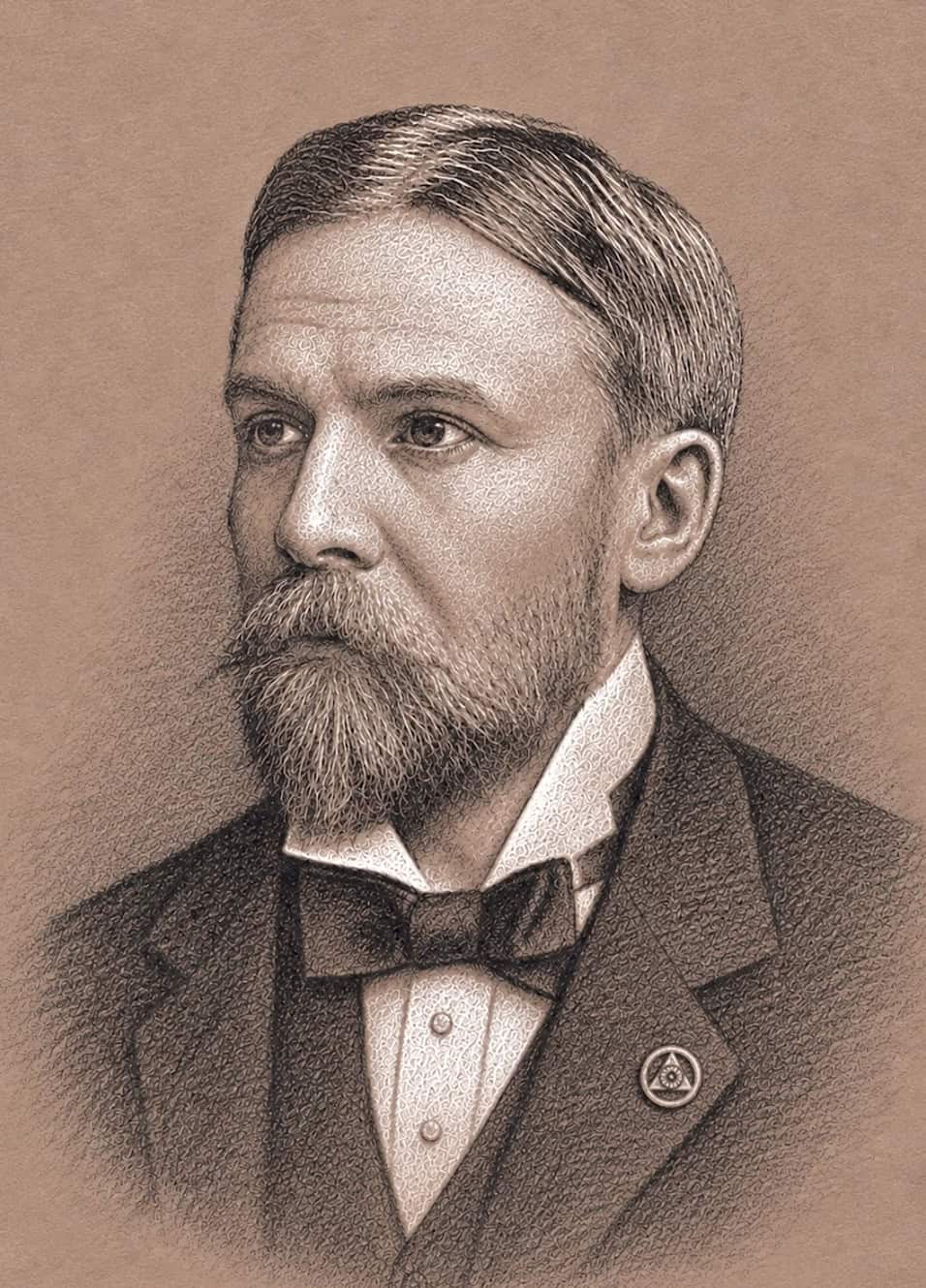
Herbert A. Parkyn
The connection between Mental Therapeutics and the system taught by Herbert A. Parkyn is an important feature of the book. Long before the 1916 publication of Mental Therapeutics, Parkyn had developed an organized system of hypnotism, suggestion, suggestive therapeutics, auto-suggestion, mental influence, mind reading, telepathy, and the therapeutic direction of involuntary bodily processes. These subjects were taught through the Chicago School of Psychology, its clinical instruction, and Parkyn’s Special Mail Course in Hypnotism and Suggestive Therapeutics. Read beside that established curriculum, Dumont’s book repeatedly follows the same lines of instruction.
Suggestion Is the Central Therapeutic Force
The first correspondence is the central place given to suggestion itself. Parkyn’s work began with hypnotism, but his clinical investigations led him to isolate suggestion as the therapeutic force responsible for results previously attributed to hypnotic sleep. This became one of the defining teachings of his school.
Dumont builds Mental Therapeutics around the same principle. Hypnotism appears historically, but the actual therapeutic system operates through suggestion. The patient does not have to be rendered unconscious or placed into a dramatic trance. Therapeutic ideas can be accepted while awake and can then influence the involuntary functions of the body. This is foundational to both systems. Once suggestion is separated from hypnosis, it becomes an ordinary mental law that can operate in treatment, self-treatment, education, habit formation, personal influence, and daily life.
The Voluntary Mind Directs the Involuntary Mind
Parkyn’s teaching divided mental activity into voluntary and involuntary modes. The voluntary mind reasons, chooses, and deliberately directs attention. The involuntary mind governs habits, automatic reactions, bodily functions, and processes that continue without conscious control.
Dumont’s “Corporeal Mind” follows this same functional division. He places bodily activity inside the subconscious domain and then explains that ideas supplied by consciousness can be accepted by this lower or involuntary mentality and expressed through physical function. This is why the entire system of Mental Therapeutics is possible. Consciousness does not need to know how to contract every blood vessel or regulate every digestive secretion. It supplies a mental direction to the organizing intelligence that already knows how to perform those functions.
Suggestion Takes Form in Action
One of the clearest parallels with Parkyn’s teaching is Dumont’s law that the subconscious mind, after accepting an idea, tends to manifest its logical conclusion in action, habit, or physical condition. This corresponds exactly with Parkyn’s principle expressed in the phrase “Thought takes form in action.”
A thought becomes therapeutically significant when it begins directing behavior or involuntary function. Repeated suggestion is intended to create exactly that transition. The suggestion becomes accepted, acceptance establishes a mental tendency, and the tendency expresses itself through action.
Dumont applies this mechanism directly to bodily conditions. An accepted idea of fear can produce physical changes. An accepted expectation of illness can disturb the organism. An accepted therapeutic suggestion can direct the same involuntary mechanisms toward another pattern.
Repetition Establishes the Mental Pattern
Parkyn’s teaching gives repetition a central role because repeated suggestion deepens an impression upon the involuntary mind. Dumont states the same law directly: suggestion gains force through repetition.
This principle appears across Mental Therapeutics. Health suggestions are repeated. Organ treatments are repeated. Auto-suggestions are repeated. Desired bodily routines are repeated at the same time until they become habitual. Treatment is conceived as the deliberate establishment of a mental pathway through continued impression.
Auto-Suggestion Extends the Same Law to Oneself
Parkyn’s work on auto-suggestion made self-directed suggestion a major part of his teaching. The same relationship that exists between practitioner and patient can be created within the individual. The conscious mind can instruct the involuntary mind, using repetition and expectation to establish new habits and bodily tendencies.
Dumont’s lesson on Therapeutic Auto-Suggestion follows this same structure. The individual becomes both suggestor and recipient. He or she deliberately addresses the subconscious bodily intelligence, supplies the desired idea, repeats it, expects its manifestation, and cooperates with the process until the new condition becomes habitual.
This is much more specific than the later popular idea of merely repeating positive affirmations. In both Parkyn’s system and Dumont’s presentation, auto-suggestion is based upon a theory of two interacting modes of mentality and a method by which the voluntary side systematically trains the involuntary side.
Expectant Attention Is Part of the Treatment
Expectation is another major point of correspondence. Parkyn understood that the patient’s mental attitude influences susceptibility to suggestion, and the preparation of expectation forms part of successful suggestive treatment.
Dumont formalizes this as “expectant attention.” The practitioner does not simply announce a desired result. He establishes an atmosphere in which the patient expects that result. Authority, confidence, manner, explanation, previous experience, ritual, and repetition can all contribute. Dumont’s placebo examples demonstrate the same law operating unintentionally. If a patient strongly expects a physical effect, the subconscious bodily machinery may respond to that expectation. Therapeutic suggestion uses the same psychological relationship deliberately.
Fear Works Through the Same Law in the Opposite Direction
Parkyn repeatedly taught the importance of avoiding harmful suggestion because the involuntary mind does not distinguish beneficial ideas from destructive ones simply because of their consequences. If a powerful idea is accepted, it tends toward expression.
Dumont uses fear to demonstrate this principle. Fright changes circulation, heartbeat, respiration, digestion, muscular action, and other processes. Repeated fear can establish a continuing pattern of abnormal response. This means suggestion is not automatically therapeutic. It is a natural psychological law. The same mechanism can produce constructive or destructive results depending upon the idea impressed. That concept is fundamental to Parkyn’s teaching and runs throughout Mental Therapeutics.
The Practitioner Must Use Authority Without Hypnotic Domination
Parkyn’s movement away from hypnotic sleep did not eliminate the importance of the practitioner’s personal influence. Confidence, certainty, calmness, and authority help make a suggestion effective because they reduce resistance and strengthen acceptance.
Dumont devotes an entire principle of suggestion to authority. The practitioner must communicate confidence through manner as well as words. A doubtful healer can unintentionally suggest failure, while a confident healer helps establish expectation.
This again shows how suggestive therapeutics moved beyond hypnotism without abandoning what earlier hypnotic practice had taught about psychological receptivity. The dramatic trance disappears, while the practical psychology of attention, confidence, expectancy, and authority remains.
Treatment Is Adapted to the Mental Character of the Patient
Parkyn’s system was clinical and practical. Suggestion had to be adapted to the individual being treated. Dumont teaches the same approach when he divides patients according to psychological temperament and tells the practitioner to use the concepts and language most readily accepted by each person.
A patient already comfortable with psychological explanations can be approached psychologically. Someone whose mental habits are formed through another system of belief may require another route. The underlying therapeutic mechanism remains suggestion. The practitioner is therefore taught to understand the patient before attempting to influence the patient’s involuntary mind.
Dumont’s method of speaking mentally to the stomach, liver, bowels, heart, lungs, and other organs belongs to the same practical field of bodily suggestive therapeutics taught by Parkyn. The body is governed through involuntary mental processes, so suggestion can be directed toward a specific function.
The healer first understands what the organ should be doing, then supplies a definite suggestion corresponding to normal function. The stomach is encouraged toward proper digestion. The bowels are trained toward regularity. Circulation is pictured as strong and normal. The nervous system is calmed. The body’s own processes perform the physical work. This is precisely why Dumont spends so many chapters teaching physiology. Effective mental treatment requires a correct pattern for the involuntary mind to follow.
General Treatment Before Local Treatment
The structure of Dumont’s general treatment also follows Parkyn’s therapeutic emphasis on the body as a coordinated system. Dumont does not advise concentrating exclusively upon the visible symptom. He first works through nutrition, elimination, circulation, respiration, and the major bodily systems, then applies a special treatment when necessary.
The reasoning is that poor general functioning can produce many local symptoms. Restore the central functions and the local complaint may improve with them. This approach also connects with the health instruction associated with Parkyn’s school, where bodily hygiene, nutrition, circulation, breathing, water, exercise, nervous activity, and mental states belonged to a unified conception of health.
The Natural Healing Power of the Body
Dumont’s reliance on vis medicatrix naturae also fits Parkyn’s physiological approach. Treatment assists the body’s own restorative power. Neither the healer’s words nor a mental formula mechanically rebuild damaged tissue. The organism performs that work.
Suggestion stimulates and directs the involuntary forces responsible for repair. The same intelligence that heals a wound, regulates circulation, digests food, and replaces worn cells is the intelligence to which therapeutic suggestion is addressed. Healing is explained through the body’s own operations, with mind regarded as an active part of those operations.
Telepathy and Mind Reading Were Already Part of Parkyn’s Field of Instruction
Dumont’s move from ordinary suggestion into thought induction, telepathy, and distant treatment does not represent a departure from the field associated with Parkyn. Parkyn had already treated mind reading and telepathic communication as subjects for systematic investigation and instruction. His work in this area continued through the network surrounding the Chicago School and the Psychic Research Company, including his Course on Mind Reading.
This matters because Mental Therapeutics follows the same progression visible in Parkyn’s instruction: begin with the ordinary psychological action of suggestion, study how one mind influences another, then consider whether mental impressions can be communicated without the usual sensory channels.
Dumont’s “Present Thought Induction” fits directly into this field. The practitioner silently concentrates upon the desired condition and seeks to induce a corresponding mental state in the patient. The proposed mechanism differs from spoken suggestion, while the practical objective is identical: impress a definite idea upon the receiving mind.
Absent Treatment Also Belongs Within Parkyn’s Teaching
The same point applies to distant or absent treatment. Parkyn’s work did not stop at verbal suggestion delivered face to face. His teaching and psychical research included telepathy and the possibility of mental influence across distance, making Dumont’s lessons on Distant Thought Induction and distant healing part of a subject already present within Parkyn’s field of instruction.
Dumont’s book devotes substantial space to exactly this practice. The healer establishes mental rapport, forms a clear image of the distant patient, creates the desired thought, and directs it toward the recipient. The patient is encouraged to enter a receptive condition. Dumont describes the relationship through the contemporary language of wireless communication and mental attunement.
The original book makes distant treatment one of its three principal forms of mental healing, alongside direct suggestion and present thought induction. It is therefore important to the Parkyn comparison because it shows that the correspondence extends across the whole system—ordinary suggestion, auto-suggestion, mental influence, telepathic transmission, and absent treatment—not just the portions that fit conventional suggestive therapeutics.
Mental Healing Without Supernaturalism
Another deep correspondence lies in the effort to explain unusual mental phenomena through natural law. Parkyn’s work consistently sought a psychological and physiological explanation for hypnotism and suggestion while also investigating mind reading and telepathy without requiring a supernatural theory.
Dumont does the same thing at the opening of Mental Therapeutics. The student is told to put aside superstition and seek lawful processes. Even when discussing distant thought transmission, Dumont attempts to explain it through analogies with wireless communication, vibration, induction, and natural force. The methodological attitude is consistent: phenomena traditionally called mysterious are to be investigated as manifestations of mental law.
The School-Course Structure Is Another Important Parallel
Mental Therapeutics reads unmistakably like a course of instruction. Its twenty-seven lessons proceed in a carefully staged order: basic theory, subconscious bodily activity, cells and organs, nervous physiology, causes of disease, laws of cure, history, suggestion, practical treatment, auto-suggestion, thought induction, distant treatment, physiology, and finally applied therapeutic work.
Theory comes first because the practitioner must understand the laws. Exercises follow because those laws must be practiced. Physiology is introduced because the healer needs knowledge of normal bodily function. Patient types are discussed because treatment must be individualized. General and special treatments follow because the student is eventually expected to apply the course systematically.
The Same Therapeutic Architecture Appears Throughout the Book
Once these parallels are placed beside one another, the relationship becomes difficult to miss. Mental Therapeutics repeatedly follows the architecture already familiar from Parkyn’s teaching:
two modes of mental activity, with conscious or voluntary thought capable of influencing involuntary processes;
suggestion as the central law of mental influence;
suggestion functioning without hypnotic sleep;
subconscious acceptance followed by expression in action;
repetition as a means of establishing mental and physical habits;
expectancy and attention as conditions increasing suggestive effect;
authority and confidence as practical components of treatment;
destructive suggestion and fear as causes of abnormal bodily response;
therapeutic suggestion directed toward specific bodily functions;
auto-suggestion as the individual’s deliberate use of the same law;
the body as an organized living system whose own forces perform the actual healing;
physiological knowledge as part of competent mental treatment;
mental influence operating directly between people;
mind reading and telepathic phenomena treated as subjects of investigation;
present mental treatment without spoken communication;
distant or absent mental treatment;
and a course-based method designed to train students to apply these principles systematically.
Mental Therapeutics is valuable because all of these subjects appear together inside one volume. Its terminology is sometimes different, and Dumont gives the “Corporeal Mind” and cellular mentality extensive development, yet the instructional framework follows the same interconnected field of psychology, suggestion, therapeutic practice, auto-suggestion, mental influence, telepathy, and distant treatment that Parkyn had already made central to his school and courses.
For the history of the Yogi Publication Society and the literature later circulating through its catalog, that makes Mental Therapeutics an especially revealing book. It preserves in a 1916 Dumont course the same central system of suggestion and mental therapeutics that had been taught through Parkyn’s Chicago network since the 1890s. What makes the comparison compelling s the sequence of ideas, the division of mind, the laws of suggestion, the use of repetition and expectation, the practice of auto-suggestion, the direction of involuntary bodily activity, the treatment of telepathic mental influence, and the inclusion of absent healing as parts of one integrated instructional system. Read with Parkyn’s work beside it, Mental Therapeutics follows that system from its psychological foundation all the way through its practical methods of treatment.