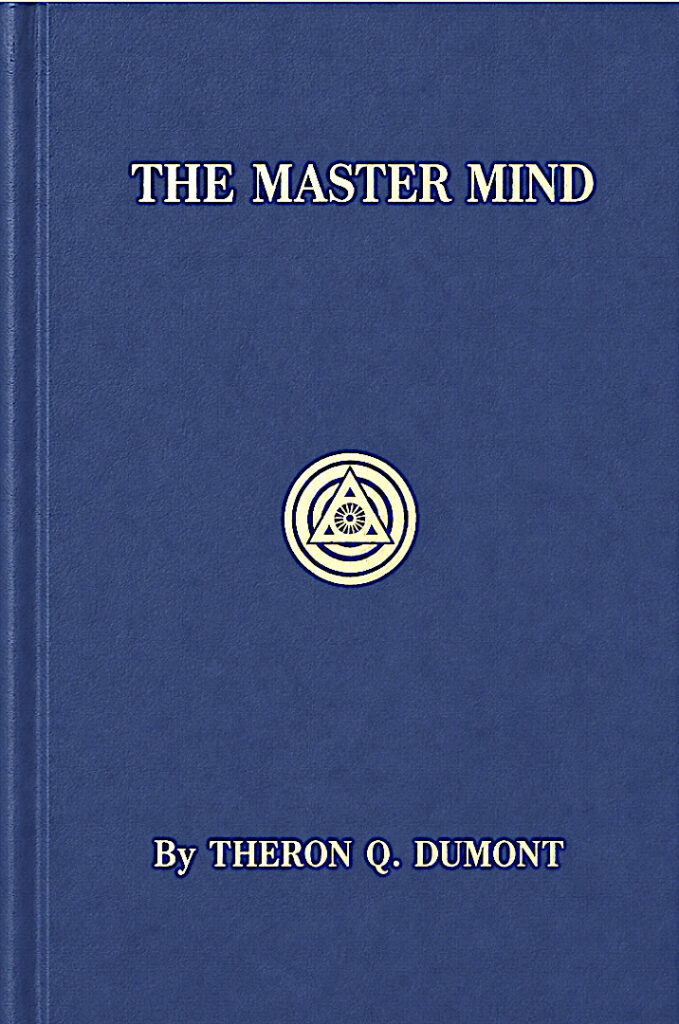
The Master Mind, or The Key to Mental Power, Development and Efficiency by Theron Q. Dumont was first published in 1918 by the Advanced Thought Publishing Company and was later published by the Yogi Publication Society. The book goes from basic mental control through will, positive and negative mentality, perception, attention, emotion, desire, thought, reasoning, subconscious mentality, and the final mastery of will. It presents the “Master Mind” as the individual who learns to direct these mental powers consciously instead of allowing habits, emotions, desires, outside impressions, and suggestions to determine the course of thought and action.
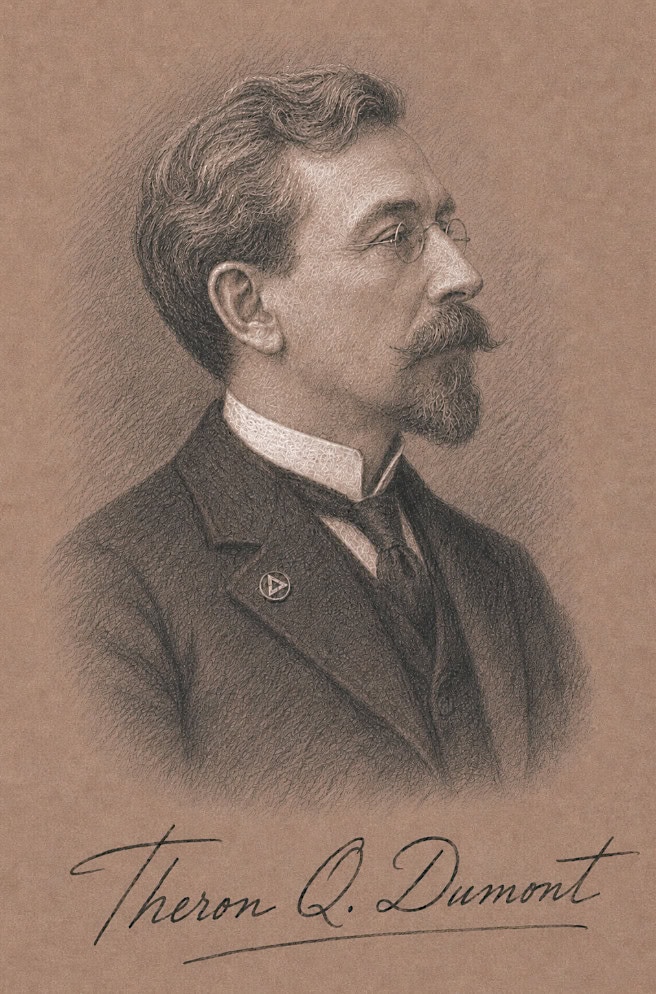
Theron Q. Dumont, graduate of Dr. Herbert A. Parkyn‘s course in Suggestive Therapeutics. (artist depiction)
It is also an important book for comparison with the earlier teachings of Herbert A. Parkyn and the Chicago School of Psychology. Dumont repeatedly develops principles familiar from Parkyn’s teaching: voluntary control over involuntary mental activity, the power of suggestion, repetition and habit, concentration and attention, polarity and the cultivation of opposing states, the subconscious storage of impressions, character formation, and the movement of thought into action. Dumont also uses Parkyn’s signature phrase “thoughts take form in action” and his formula “I can, I will.” A detailed comparison with Parkyn’s system appears at the end of this summary.
The Master Mind is a course in deliberate mental self-government. Dumont says that the ordinary person allows much of his mental life to be constructed by circumstances: sensations arrive, impressions are accepted, habits are formed, emotions arise, desires demand satisfaction, suggestions are received, and thought follows established paths. The Master Mind learns how this mental machinery operates and places it under conscious direction through will and voluntary attention. Dumont works through the mind department by department, explaining the senses, perception, attention, emotion, desire, thought, reasoning, subconscious activity, and will, while continually returning to the same question: how can the individual cease being passively directed by mental processes and begin directing them? The answer is a system of mental training based on attention, selection, repetition, substitution, visualization, habit, reasoning, and persistent exercise of the will.
What Does Dumont Mean by the Master Mind?
Dumont begins by deliberately limiting his subject. He does not intend to construct a metaphysical theory of the soul or speculate about existence after death. His stated concern is psychology and, more specifically, the question of how the mind works and how it can be managed. He argues that people can learn the laws governing mental activity without first settling the philosophical question of what mind is. Psychology becomes useful when it identifies the operations of thought, feeling, attention, memory, desire, and will and shows how these processes can be trained.
The Master Mind is the person who acquires this control. Dumont contrasts such a person with what he calls the mentally enslaved individual. An ordinary mind has been shaped largely without conscious supervision. Experiences, surroundings, education, social influences, habits, opinions, emotions, and other people’s ideas have continually impressed themselves upon it. The person may believe he is thinking independently while much of his mental activity follows patterns established by these accumulated influences.
Dumont divides mental development into three stages: Mental Slavery, Partial Freedom, and Mental Mastery. Under Mental Slavery, outside influences largely determine mental activity. Under Partial Freedom, some voluntary direction has developed, although habits and external impressions retain substantial power. Mental Mastery is reached when the individual deliberately directs the faculties, emotions, interests, and habits through judgment and will. The distinction provides the framework for the entire book. Dumont’s later chapters teach the reader how to move from the first condition toward the third.
Who Is the Mind Master?
The second chapter moves behind the individual mental faculties and asks what directs them. Dumont distinguishes the observing and directing self from the changing stream of thoughts, feelings, desires, and impulses. He calls this directing center the Ego, the Mind Master, or the Master Mind.
A person can observe a thought and decide whether to continue thinking it. He can experience an emotion and attempt to restrain it. He can feel a desire and refuse to act upon it. Dumont treats this capacity as evidence that the governing self cannot be identified completely with any single passing thought, emotion, or desire. The Master Mind stands in a position from which these mental states can be observed, encouraged, weakened, redirected, or rejected.
Dumont repeatedly uses images of government and machinery. The mental faculties are servants, instruments, tools, and departments. The awakened Ego occupies the central seat of authority. Mental mastery occurs when the ruler assumes command of the mental kingdom and begins assigning work to its faculties instead of allowing individual impulses to govern independently.
The book is built around strengthening this sense of inner authority. Dumont wants the reader to develop the habit of mentally stepping outside a troublesome emotion or thought and recognizing that it is a mental condition that can be acted upon. The statement “I am the Master of all this” later becomes an expression of that attitude.
What Is the Difference Between the Slave Will and the Master Will?
Dumont next applies the distinction to will. Many actions that appear voluntary, he argues, are actually reflexive responses produced by habit, desire, emotion, environment, or suggestion. A desire appears and the will follows it. An established habit demands expression and the person obeys. An outside stimulus provokes a familiar response. Such behavior may involve the machinery of will without representing genuine mastery of will.
The Master Will appears when the individual begins choosing which motive will receive support. Dumont does not describe freedom as an absence of causes or motives. The issue is whether the individual merely follows the strongest existing impulse or deliberately changes the conditions that determine which impulse becomes strongest.
This brings voluntary attention into the center of the system. Attention can strengthen one idea while withholding support from another. It can nourish a desirable motive and starve an undesirable one. By repeatedly selecting what receives attention, the individual can alter interests, habits, desires, and eventually character.
Will and attention therefore become partners. The will directs attention; attention supplies force to selected mental states; repeated selection strengthens the preferred tendency; and the strengthened tendency becomes easier to express in action.
Positive and Negative Mentality
Dumont’s fourth chapter divides mental qualities into positive and negative expressions. Positive mentality is associated with self-direction, courage, determination, constructive thought, initiative, confidence, and purposeful action. Negative mentality is associated with passivity, fear, indecision, weakness of purpose, and excessive susceptibility to circumstances and external influence.
Dumont’s distinction is functional. The question he repeatedly asks is whether a thought, feeling, interest, or habit increases the individual’s ability to govern himself and act effectively. He advises the reader to examine incoming mental material with this standard and to avoid continually stocking the subconscious mind with material that weakens action.
The subconscious is compared to a storehouse. The material repeatedly deposited there later supplies thoughts, reactions, motives, and actions. Dumont states that by stocking this storehouse with positive material, positive material can later be drawn from it as a basis for conduct.
This leads directly into character building. Dumont rejects the idea that character must remain a passive product of circumstances. He describes the individual as the possible “architect and builder” of his own mental character. The remainder of the book explains the mental tools by which this rebuilding can be attempted.
How Does Polarity Work in Mental Training?
Polarity supplies one of Dumont’s main methods for changing unwanted mental qualities. Mental characteristics are arranged in opposing directions, with courage and fear, confidence and timidity, persistence and irresolution, and similar qualities representing opposite tendencies. To weaken one pole, the individual cultivates its opposite.
The method is more specific than telling oneself to stop feeling something. Dumont recognizes that concentrating continually upon an unwanted condition can keep attention fixed upon it. His preferred method is to cultivate the contrary quality until the new tendency gains strength. Fear is answered through the cultivation of courage. Weakness is met through strength. Indecision is countered through decisiveness. An undesirable mental habit is gradually displaced by constructing another one.
Attention, visualization, physical expression, repetition, and deliberate action can all be used to nourish the selected pole. The method appears again in Dumont’s later discussion of emotional and character training.
Why Are the Senses Important to Mental Mastery?
Dumont next moves outward to the senses because sensation supplies much of the raw material from which mental life is constructed. Sight, hearing, touch, taste, and smell continually transmit information. The quality of later thinking depends partly upon the quality of the original impressions.
The senses can be trained. A person who looks carelessly receives incomplete visual material. Someone who listens inattentively misses distinctions in sound. Dumont believes deliberate exercise can sharpen sensory efficiency and provide the mind with clearer information.
The Master Mind therefore does not treat the senses as passive openings through which anything may enter without supervision. They become instruments whose use can be improved through attention and practice.
What Is Perception?
Sensation alone does not produce complete knowledge. Perception interprets the sensory material and recognizes what is being experienced. Dumont distinguishes between receiving an impression and understanding it. Two people may encounter the same object and perceive very different things because their attention, previous experience, interests, knowledge, and mental associations differ.
This makes perception trainable. The individual can learn to observe details that previously escaped notice, distinguish relevant from irrelevant features, compare new impressions with previous knowledge, and construct clearer mental representations.
Dumont gives special importance to apperception, the process by which new experience is interpreted through the knowledge already present in the mind. The quality of the mental material already accumulated affects what a person is capable of seeing in new experience.
The Master Mind consequently becomes a trained observer. Accurate thought begins with accurate perception.
Why Is Attention So Important?
Attention is one of the central subjects of The Master Mind. Dumont describes it as concentrated consciousness and closely associates voluntary attention with will. Whatever receives concentrated attention becomes clearer, stronger, and more influential in consciousness. Whatever is persistently denied attention tends to lose immediate force.
Dumont quotes psychologists who describe attention as a major component of intellectual power and emphasizes that concentrated attention can be strengthened through practice. The person who can keep attention fixed upon a chosen subject possesses an enormous advantage in study, observation, reasoning, work, memory, and self-control.
Two forms of attention are distinguished. Reflex attention is captured automatically by a loud noise, sudden movement, strong emotion, novelty, danger, or some other stimulus. Voluntary attention is deliberately placed and held by the individual. The first is automatic; the second is an instrument of mastery. This distinction runs through the whole book. The mentally enslaved person repeatedly has attention captured by whatever happens to be strongest at the moment. The Master Mind chooses what deserves attention.
How Can Voluntary Attention Be Developed?
Dumont devotes the next chapter to control of attention. Interest and attention reinforce one another: interest attracts attention, while sustained attention can create greater interest. This means that an initially uninteresting subject can become engaging if attention is deliberately maintained long enough for its details and associations to become visible.
He also teaches concentration without unnecessary strain. Attention should be focused firmly, but it should be rested when fatigued. The reader is encouraged to alternate periods of concentrated effort with relaxation so that attention remains efficient.
One of the most useful principles is what Dumont calls the transmutation of interest. If a task appears dull, the individual deliberately searches for features capable of awakening interest. Once interest develops, sustained attention becomes easier.People often describe interests as if they were fixed facts—“I am interested in this” or “I have no interest in that.” Dumont treats interest as something that can be influenced through voluntary attention.
Exercises in Perception
The ninth chapter turns the preceding principles into exercises. Dumont asks the reader to practice observing objects, sounds, forms, details, arrangements, and relationships with greater accuracy. The objective is to replace vague impressions with precise ones.
Visual observation may involve examining an object carefully and later recalling its details. Auditory exercises develop discrimination among sounds. Other practices require classifying observed features and associating new perceptions with previous knowledge. These exercises are meant to improve more than sensory acuity. Dumont believes that clear thinking requires clear mental material. Careless perception produces confused ideas; disciplined perception gives thought a better foundation.
The Master of Emotion
Dumont then turns from intellectual processes to feeling and emotion. Feelings provide much of the motive force behind action. An idea that carries no emotional interest may remain inert, while a strongly felt idea can dominate attention and drive behavior.
Emotion therefore occupies a powerful position in the mental kingdom. It influences judgment, directs interest, colors perception, strengthens desires, and supplies energy to action. An uncontrolled emotional life can govern the person even when he believes himself rational.
Dumont does not seek the destruction of emotion. The Master Mind must learn to use it. A useful emotion can supply energy to thought and action; a harmful emotion can distort judgment or divert the will. Mastery means learning when to stimulate feeling and when to restrain it.
Later in the book Dumont uses the image of a lever. The Master Mind can increase emotional force when it is useful and reduce it when emotion interferes with effective thinking.
The Categories of Feeling
Dumont classifies feelings into several major groups, including elemental feelings connected with physical welfare, affections directed toward others, social feelings, moral feelings, religious feelings, aesthetic feelings, and intellectual feelings. The classification helps the reader see emotional life as an organized field that can be studied instead of an uncontrollable stream of experiences.
Each class of feeling can influence attention and action. Social feelings can motivate conformity or achievement. Moral feelings can direct conduct through approval and disapproval. Intellectual feelings can create pleasure in discovery and understanding. Aesthetic feelings direct attention toward beauty and form.
How Can Desire Be Mastered?
Desire develops when feeling becomes directed toward obtaining, avoiding, experiencing, or accomplishing something. Dumont treats desire as a major source of motive power. Will often follows the strongest desire, which means that a person who cannot influence his desires has only limited control over his actions.
Dumont’s solution is to change the relative strength of desires. Attention can be withdrawn from an unwanted desire. Mental imagery associated with it can be weakened. Physical expressions that nourish it can be restrained. At the same time, an opposing desire can be deliberately cultivated through attention, imagery, expression, repetition, and habit.
The garden becomes Dumont’s central metaphor. Desires are plants. Some should be watered and cultivated; others should be deprived of nourishment. The gardener cannot merely complain that weeds exist. He must remove them while deliberately cultivating the plants he wants.
This becomes one of the book’s clearest explanations of character formation. Character is the accumulated result of repeatedly strengthened tendencies. Change the tendencies consistently and character begins to change.
Visualization, Expression, and Habit in Character Building
Dumont gives mental imagery an important role because an imagined condition can strengthen the desire to realize it. The reader is encouraged to visualize the qualities he wishes to possess and the actions through which those qualities would appear.
Physical expression also influences internal states. Deliberately adopting the bodily expression associated with courage, confidence, energy, or determination can help strengthen the corresponding feeling. Repeated action then turns the new expression into habit.
Dumont combines these elements into a cycle: visualize the desired quality, direct attention toward it, express it physically, act according to it, repeat the action, and allow repetition to establish habit. The habit then makes future action easier.
This is why character is treated as constructed rather than fixed. The Master Mind gradually builds a personality through repeated selection and expression.
What Is Thought?
After dealing with emotion and desire, Dumont turns to thought itself. Thought is the mind’s process of arranging, comparing, analyzing, classifying, generalizing, and combining mental material. The quality of thinking depends upon the quality of the sensations, perceptions, memories, concepts, and associations available to it.
Dumont treats analysis as the ability to separate a complex subject into its constituent elements. Comparison discovers similarities and differences. Classification places related ideas together. Generalization identifies characteristics shared across individual examples.
He uses metaphors of drawers, pigeonholes, bundles, and filing systems. A well-trained mind organizes knowledge so that relevant material can be found and used when required.
The Master Mind does not simply accumulate information. It organizes information into usable mental structures.
Mental Images, Concepts, and Words
Dumont distinguishes concrete mental images from general concepts. A person can picture a particular dog, house, tree, or person, but the concept “dog,” “house,” “tree,” or “person” represents an entire class. General thought depends upon the ability to move beyond individual images and work with these conceptual categories.
Words function as symbols attached to concepts. Efficient thinking requires clear concepts behind the words. A person may repeat sophisticated language without possessing a definite idea of what the words represent.
Dumont repeatedly encourages the reader to examine concepts for clarity and to organize them accurately. This becomes preparation for the next chapter on reasoning.
How Does the Master Mind Reason?
Dumont examines reasoning through analogy, induction, and deduction. Reasoning by analogy compares known relationships and infers similar relationships elsewhere. Induction proceeds from observed cases toward general principles. Deduction begins with accepted general principles and applies them to specific cases.
Inductive reasoning receives a scientific sequence: observation, hypothesis, testing, verification, and the formation of laws or principles. The individual should gather facts carefully, propose an explanation, test it against additional evidence, and revise it when necessary.
Dumont also discusses logical errors, including circular reasoning, irrelevant conclusions, false causes, appeals to prejudice, personal attacks, misplaced burdens of proof, and defective deductions. The Master Mind must learn to recognize these errors in other people’s arguments and in its own thinking.
This chapter broadens the meaning of mental mastery. Control over emotion and desire is insufficient if reasoning itself is careless. The governing self requires a reliable intellectual instrument.
What Is Subconscious Mentality?
The fifteenth chapter turns directly to subconscious mental activity. Dumont reviews the older psychological assumption that consciousness represented nearly the whole of mind and contrasts it with the newer recognition of extensive mental processes occurring outside immediate awareness. The chapter covers memory, imagination, subconscious thought, association, unconscious reasoning, and the unexpected arrival of solutions and ideas.
Memory impressions are stored outside the immediate field of consciousness and can later return through association or deliberate recollection. Imagination recombines stored material into new arrangements. Thought itself may continue below awareness after conscious attention has moved elsewhere.
Dumont calls these hidden processes the “Mental Brownies,” borrowing the image of unseen workers performing tasks while the conscious mind is occupied with something else. A difficult problem can be considered consciously, set aside, and later return with a solution that appears suddenly. Dumont interprets this as subconscious mental work continuing between the two conscious encounters with the problem.
The lesson is to give the subconscious good material and definite work. If the subconscious storehouse is repeatedly filled with clear observations, useful ideas, constructive interests, and definite problems, its automatic activity becomes more useful. If it is filled with confused, fearful, destructive, or trivial material, those impressions also continue influencing mental life.
How Does the Book End with Mastery of Will?
The final chapter returns to the faculty that has governed the entire course: will. Dumont distinguishes desire-will, deliberative will, and action-will and emphasizes that genuine will is demonstrated through action. Wanting something, thinking about it, and deciding that it would be desirable do not complete the process. The will must carry the selected purpose into conduct.
Will can be trained through use. Dumont recommends deliberately exercising it in small matters, maintaining attention upon chosen tasks, resisting the habit of abandoning work when it becomes unpleasant, and occasionally performing disagreeable but useful actions simply to strengthen voluntary command. The contents explicitly identify training through disagreeable tasks, attention, habit, determination, and established formulas of will culture as major elements of the final lesson.
Repeated successful acts of will create confidence in future acts. The individual gradually acquires a habit of following deliberate decision with action.
The final goal is firmness of purpose: a will that can select a course, continue despite temporary discomfort or distraction, and direct the rest of the mental machinery toward completion.
What Is the Main Teaching of The Master Mind?
The central teaching of The Master Mind is that mental life can be deliberately trained. Dumont views the mind as an organized collection of faculties and processes whose habitual operation has often been shaped without conscious supervision. Mental mastery begins when the individual understands these processes and starts exercising voluntary control over them.
The book’s method can be reduced to a connected series of principles:
Observe mental states instead of automatically identifying with them.
Use will to select the direction mental activity should take.
Direct voluntary attention toward useful thoughts, qualities, interests, and desires.
Withdraw attention from tendencies that should lose strength.
Cultivate the positive pole corresponding to an unwanted negative quality.
Use mental imagery to strengthen desired states and actions.
Express desired qualities through conduct so that they become habits.
Improve perception so thought begins with accurate material.
Train emotion and desire so they serve deliberate purposes.
Organize ideas clearly and reason carefully.
Supply the subconscious mind with useful impressions and definite problems.
Repeat constructive mental and physical actions until they become established tendencies.
Strengthen will by repeatedly carrying deliberate decisions into action.
Dumont’s “Master Mind” is the result of this training. Mental power is not reduced to a single secret technique. It is the coordinated government of attention, emotion, desire, thought, subconscious activity, habit, and action under deliberate direction.
How Closely Does The Master Mind Follow Herbert A. Parkyn’s Teaching?
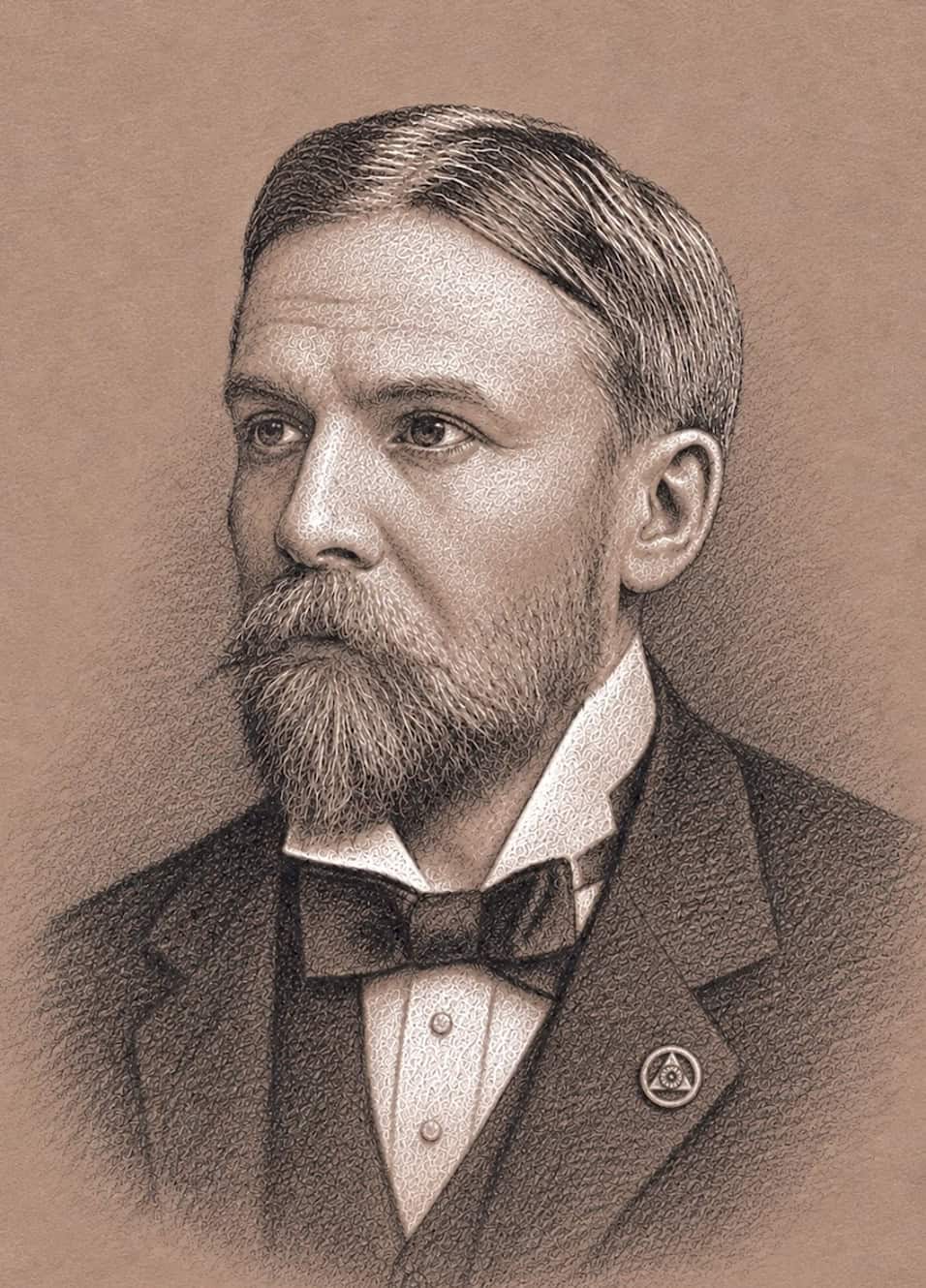
Herbert A. Parkyn
The relationship between The Master Mind and the earlier system taught by Herbert A. Parkyn is extensive. Parkyn’s teaching at the Chicago School of Psychology had already developed an applied psychology centered upon voluntary and involuntary mental action, suggestion, auto-suggestion, attention, repetition, habit, thought and action, mental polarity, and the deliberate development of character and personal efficiency. These ideas were taught through the school, its clinics and publications, and Parkyn’s Special Mail Course in Hypnotism and Suggestive Therapeutics. The Master Mind follows this same field of mental training across nearly its entire course.
The comparison is especially useful because The Master Mind is not primarily a healing manual. The same psychological principles that appear therapeutically in Mental Therapeutics are applied here to self-control, character, perception, emotion, desire, reasoning, habit, achievement, and personal efficiency. This is the wider application of suggestion psychology that also characterized Parkyn’s teaching as it expanded beyond clinical treatment into self-development, New Thought, personal power, and success.
Voluntary and Involuntary Mental Activity
One of the deepest correspondences is the division between deliberately directed mental activity and automatic mental activity. Parkyn’s psychology distinguished the voluntary and involuntary modes of mind. The voluntary side can reason, choose, concentrate, and direct. The involuntary side contains habits and automatic tendencies and responds to impressions that have been repeatedly established.
Dumont organizes The Master Mind around almost the same problem. The ordinary person allows thoughts, emotions, interests, desires, and reactions to arise and operate with little conscious direction. Dumont repeatedly describes these states as involuntary. He then argues that the awakened Ego can take control of them in much the same way that voluntary control can be asserted over bodily actions.
His distinction between reflex attention and voluntary attention follows the same pattern. Reflex attention is captured automatically; voluntary attention is consciously directed. Reflex will follows the strongest existing impulse; the Master Will deliberately determines which impulse will receive support.
The whole book can therefore be read as a course in strengthening the voluntary mode until it becomes capable of educating and directing the involuntary.
Suggestion and Mental Slavery
Parkyn’s work on suggestion established that ideas can enter the mind, influence involuntary activity, and eventually express themselves in behavior without the individual fully understanding the source of the influence. This made suggestion a much wider subject than hypnotism. Ordinary conversation, authority, repetition, advertising, social influence, education, habit, and self-suggestion could all shape conduct.
Dumont’s concept of “Mental Slavery” describes the same problem from the standpoint of personal development. The ordinary mind is built largely through impressions arriving from outside. Dumont says it is “unconsciously built up, cultivated, and developed” through the forces and impressions of the outside world, while the Master Mind is consciously and voluntarily developed.
The danger is not confined to someone deliberately trying to control another person. Opinions, emotional attitudes, social assumptions, fears, habits, and repeated ideas may be accepted simply because they are continually presented.
Mental mastery consequently requires control over what is admitted, repeated, and nourished within the mind. This is the defensive side of the same psychology of suggestion Parkyn taught: understand that impressions have consequences, then learn to govern which impressions receive reinforcement.
“Thought Takes Form in Action”
One of the most striking correspondences is Dumont’s statement that “thoughts take form in action.” The phrase closely follows Parkyn’s well-known formulation, “Thought takes form in action,” which expresses a central principle of his system.
The similarity extends beyond the wording. Parkyn’s phrase describes the tendency of established mental states to seek expression through conduct. Thought produces bodily response, repeated thought establishes habit, and suggestion acquires significance when it begins shaping action.
Dumont uses the same underlying law throughout The Master Mind. Mental states are important because they move toward expression. Thoughts affect interests; interests influence desires; desires supply motives; motives engage the will; repeated action establishes habit; habit contributes to character.
The entire chain depends upon the movement from mental impression into action. Dumont’s character-building system is an extended application of the principle expressed in Parkyn’s phrase.
“I Can and I Will”
The linguistic connection becomes even more striking in Dumont’s treatment of positive mentality. Parkyn’s “I can and I will” was one of the characteristic formulas associated with his system of mental training.
Dumont uses the declaration “I can, I will; I dare, I do!” as a formula of positive mentality. The wording carries the same progression from belief in capacity to the exercise of will and then into action.
Within The Master Mind, this is not simply motivational language placed on top of an unrelated psychology. It summarizes the book’s working mechanism. “I can” establishes the mental attitude of capability. “I will” brings voluntary determination into operation. “I do” carries the mental state into action.
That sequence closely fits Parkyn’s teaching that thought must pass into action if it is to acquire value.
Repetition Creates Habit
Repetition is another central correspondence. Parkyn’s system treated repetition as one of the principal means by which an idea becomes impressed upon the involuntary mind. Repeated suggestion establishes tendencies; repeated action strengthens them; continued repetition produces habit.
Dumont applies this repeatedly to character development. A desired quality is selected, given attention, visualized, expressed, acted upon, and repeated until it becomes easier and more automatic. The individual gradually replaces an established tendency with a new one.
This is why Dumont refuses to treat character as permanently fixed. Character is composed to a significant degree of established mental and behavioral habits. If habits were created through repetition, new habits can be deliberately created through the same law.
The Master Mind therefore uses consciously the process by which the ordinary mind was previously shaped unconsciously.
Attention Determines What Becomes Strong
Parkyn’s teaching gave concentration and attention an important place because a mental impression becomes stronger when attention is repeatedly directed toward it. Dumont makes voluntary attention one of the chief instruments of mental mastery.
His argument is straightforward: attention supplies mental force. An idea repeatedly attended to becomes clearer, more familiar, more interesting, and more influential. An idea deprived of attention loses an important source of reinforcement.
This gives the individual a method of mental selection. The Master Mind does not need to wrestle endlessly with every unwanted thought. It can direct attention elsewhere and cultivate the state that should replace it.
Dumont’s statement that interest itself can be directed through attention is especially important. People commonly regard interests, feelings, and desires as involuntary facts beyond their control, yet Dumont argues that the Ego can encourage or inhibit them by controlling the attention given to them.
This follows the same architecture as Parkyn’s voluntary direction of involuntary mental processes.
Polarity and the Cultivation of Opposites
The principle of polarity provides another strong connection with Parkyn’s teaching. Parkyn treated mental qualities as capable of movement between opposing poles and used the cultivation of an opposite state as a means of changing an established condition.
Dumont applies this directly to character. Negative qualities should be weakened by developing their positive opposites. Fear is displaced through courage, indecision through decision, weakness through strength, pessimistic expectation through constructive expectation.
This method avoids keeping attention permanently centered upon the unwanted quality. The individual turns toward the opposite pole and repeatedly strengthens it.
Dumont combines polarity with attention, visualization, expression, and habit. The desired pole is pictured mentally, given attention, expressed physically, practiced behaviorally, and repeated until it becomes part of character.
The result closely follows Parkyn’s use of polarity as a principle of mental transformation.
The Subconscious Is Stocked with Impressions
Parkyn’s involuntary mind receives impressions and later expresses the tendencies established within it. Dumont’s subconscious storehouse operates according to the same principle.
Dumont tells the reader to consider carefully what is being placed into subconscious mentality because this stored material later supplies the basis for thought and action. His formula is direct: stock the subconscious with positive material and positive material becomes available for subsequent expression.
The individual is therefore continuously educating the subconscious. Every repeated thought, emotional pattern, image, interest, and action contributes something.
This is the foundation of both destructive and constructive habit. If the subconscious has been repeatedly supplied with fear, hesitation, defeat, or passivity, those tendencies become easier to reproduce. Deliberate mental training reverses the process by supplying another set of impressions repeatedly enough to establish a new pattern.
Character Is Built Through Suggestion, Repetition, and Action
Parkyn’s psychology was concerned with much more than treating disease. The same laws of suggestion and auto-suggestion could be applied to habit, confidence, efficiency, self-control, and success. Dumont makes this wider application one of the principal subjects of The Master Mind.
His character-building method is almost a laboratory demonstration of the process. First determine the quality desired. Then give that quality attention. Create a mental image of yourself expressing it. Encourage the corresponding feeling. Assume the physical expression associated with it. Perform actions consistent with it. Repeat those actions until they become habitual.
Character emerges from the accumulated pattern.
Dumont explicitly describes the individual as the possible “architect and builder” of his own mental character. This closely fits Parkyn’s system of deliberate self-development through suggestion, auto-suggestion, repetition, and voluntary control.
Physical Expression Reinforces Mental States
Another close correspondence appears in Dumont’s discussion of physical expression. Mental states produce bodily expressions, but the relationship can also operate in the opposite direction. Deliberately assuming the posture, facial expression, movement, and behavior associated with a desired mental state can help awaken that state.
Courage can be reinforced by acting courageously. Energy can be cultivated through energetic action. Confidence can be strengthened by adopting confident expression.
This fits Parkyn’s mind-body correspondence, where mental and physical conditions continually interact. “Thought takes form in action,” but action can also feed a corresponding impression back into the mind. Dumont’s character training repeatedly uses this reciprocal relationship.
Desire Can Be Educated
Dumont’s treatment of desire also fits Parkyn’s system of voluntary education of involuntary tendencies. Desire frequently arises without deliberate choice, yet Dumont refuses to conclude that it must therefore remain beyond control.
The individual can weaken a desire by withdrawing attention, reducing the imagery associated with it, preventing its habitual expression, and cultivating a contrary desire. Conversely, a useful desire can be strengthened by attention, visualization, emotional association, repeated expression, and action.
This is another example of the voluntary mind training an involuntary process instead of attempting to command it through a single act of force.
Will Is Strengthened Through Exercise
Parkyn’s “I can and I will” teaching placed will within a system of deliberate self-training. Dumont ends The Master Mind with the same emphasis. Will becomes stronger through repeated acts of willing.
The reader is instructed to finish chosen tasks, maintain attention, perform useful actions despite temporary dislike, and practice voluntary control in ordinary situations. Dumont even recommends deliberately performing certain disagreeable tasks as exercises because doing so trains the individual to act from decision instead of immediate desire. The original contents identify this practice as a major part of the final chapter.
This makes will training inseparable from habit. Each successful act establishes a stronger expectation that the next deliberate decision will also be carried into action.
The Master Mind Uses the Same Voluntary-Involuntary Relationship Throughout
What makes the Parkyn comparison so strong is the consistency with which the same relationship appears across different subjects. Dumont applies it to attention, emotion, desire, perception, thought, subconscious activity, habit, character, and will.
The pattern repeatedly looks like this:
An automatic or involuntary tendency already exists.
The individual becomes consciously aware of it.
The voluntary mind decides whether that tendency should be strengthened or weakened.
Attention is deliberately directed according to that decision.
An opposing or desired mental state is cultivated where necessary.
Visualization and suggestion strengthen the selected pattern.
Action gives the mental pattern physical expression.
Repetition establishes habit.
Habit makes the desired response increasingly automatic.
The newly trained involuntary process begins serving the voluntary purpose.
This is very close to the basic machinery of Parkyn’s applied psychology. The involuntary mind is powerful because it governs established habits and automatic responses. The voluntary mind is powerful because it can educate that involuntary machinery through repeated direction.
From Parkyn’s School Teaching to The Master Mind
Read beside Parkyn’s established teachings, The Master Mind presents a remarkably familiar psychological architecture. Parkyn’s system had already placed voluntary and involuntary mentality, suggestion, auto-suggestion, attention, concentration, repetition, habit, polarity, mental imagery, bodily expression, character development, and will within an integrated program of mental training. His Special Mail Course in Hypnotism and Suggestive Therapeutics and the work of the Chicago School of Psychology had made these principles part of an organized instructional system years before the 1918 appearance of Dumont’s book.
The Master Mind applies that same type of instruction to the construction of an efficient personality. Its sixteen chapters proceed like a mental-training course: identify the governing self, strengthen voluntary control, understand positive and negative mental states, train perception, master attention, understand emotion, educate desire, organize thought, improve reasoning, use subconscious activity intelligently, and strengthen will through exercise. The original table of contents makes this systematic progression explicit.
The verbal correspondences reinforce the structural ones. Parkyn’s “Thought takes form in action” finds a close counterpart in Dumont’s “thoughts take form in action.” Parkyn’s “I can and I will” is closely echoed by Dumont’s “I can, I will; I dare, I do!” These phrases sit inside a system that also follows the same movement from thought to action, action to repetition, repetition to habit, and habit to character.
The relationship is clearest when the book is viewed as a complete course instead of as a collection of motivational statements. Dumont’s Master Mind controls what receives attention, determines which mental pole is cultivated, chooses which impressions are fed into subconscious mentality, directs emotions and desires, organizes thought, uses reason to make judgments, and exercises will until deliberate conduct becomes habitual. The ordinary mind has been shaped by outside impressions and unconscious repetition; the Master Mind consciously uses those same mental laws to reshape itself.
That is also why The Master Mind belongs naturally within the history of the literature later issued by the Yogi Publication Society. Its language of mental mastery belongs to the same world of New Thought, psychology, suggestion, and deliberate self-development that runs through the wider publishing network. In The Master Mind, however, the connection to Parkyn is especially visible because the book repeatedly returns to the very principles his school had made central: voluntary direction of involuntary activity, control of attention, the management of incoming impressions, repetition, habit, polarity, the movement of thought into action, and the deliberate building of character through trained will. The close wording of “thoughts take form in action” and “I can, I will” makes those correspondences even harder to overlook.