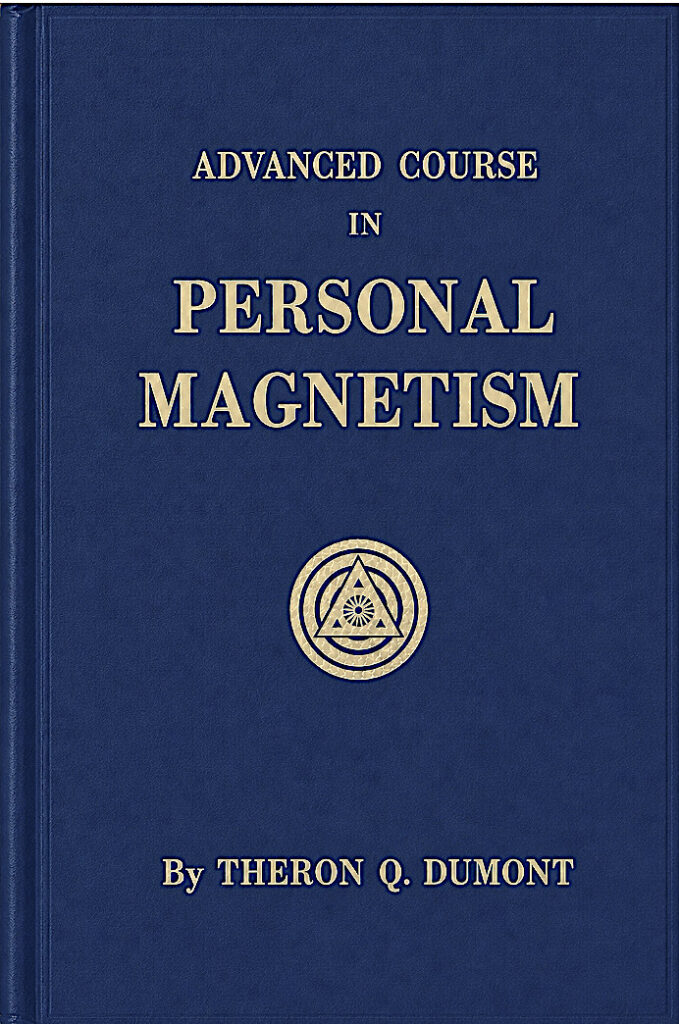
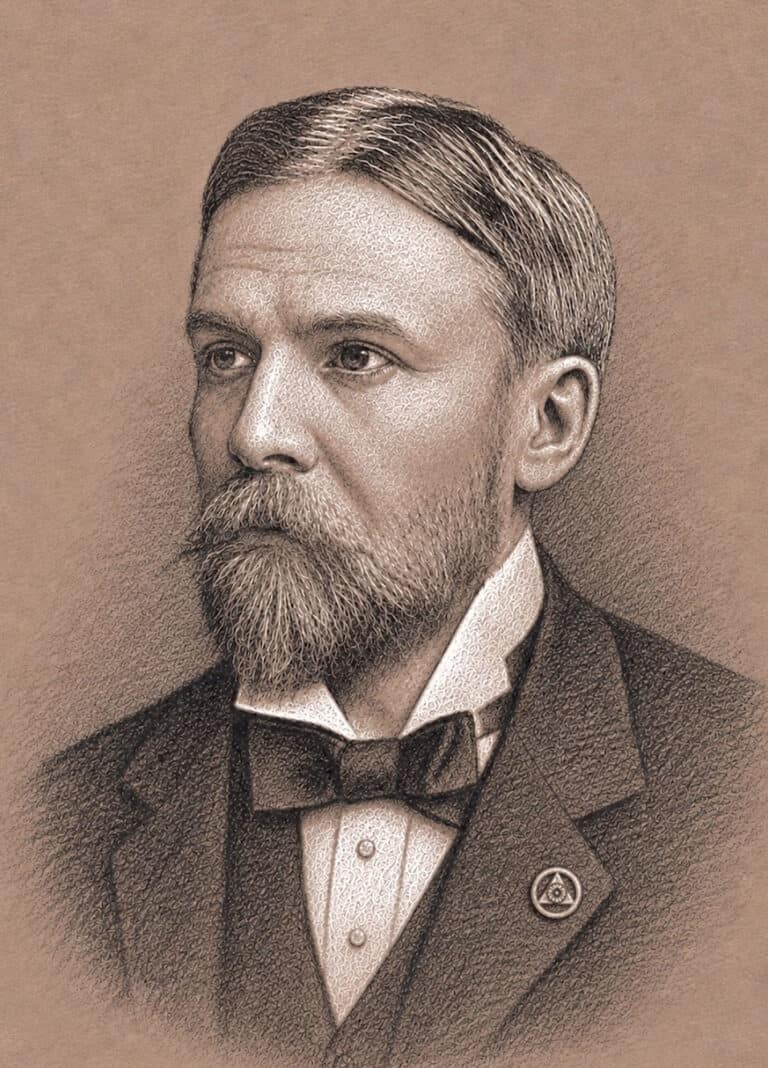
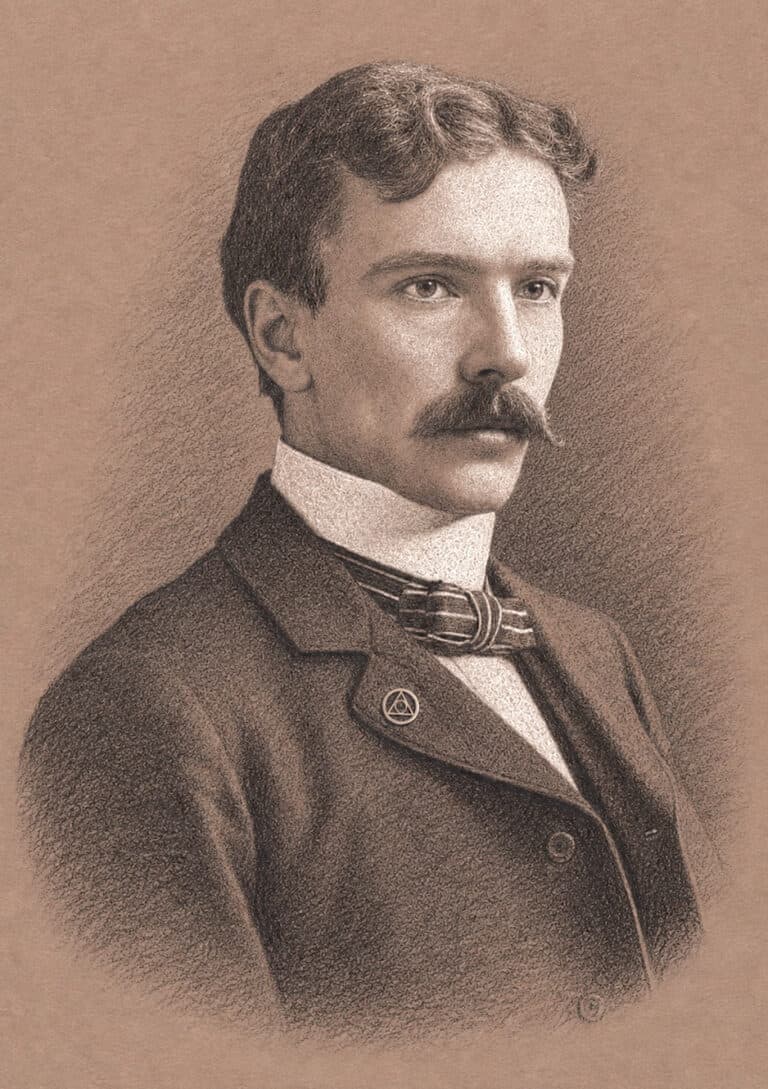
The Advanced Course in Personal Magnetism: The Secrets of Mental Fascination by Theron Q. Dumont was first published in 1914 by the Advanced Thought Publishing Company and was later issued by the Yogi Publication Society. Presented as a continuation of Dumont’s earlier The Art and Science of Personal Magnetism, the book was also written to function as a complete course for readers encountering his system for the first time.
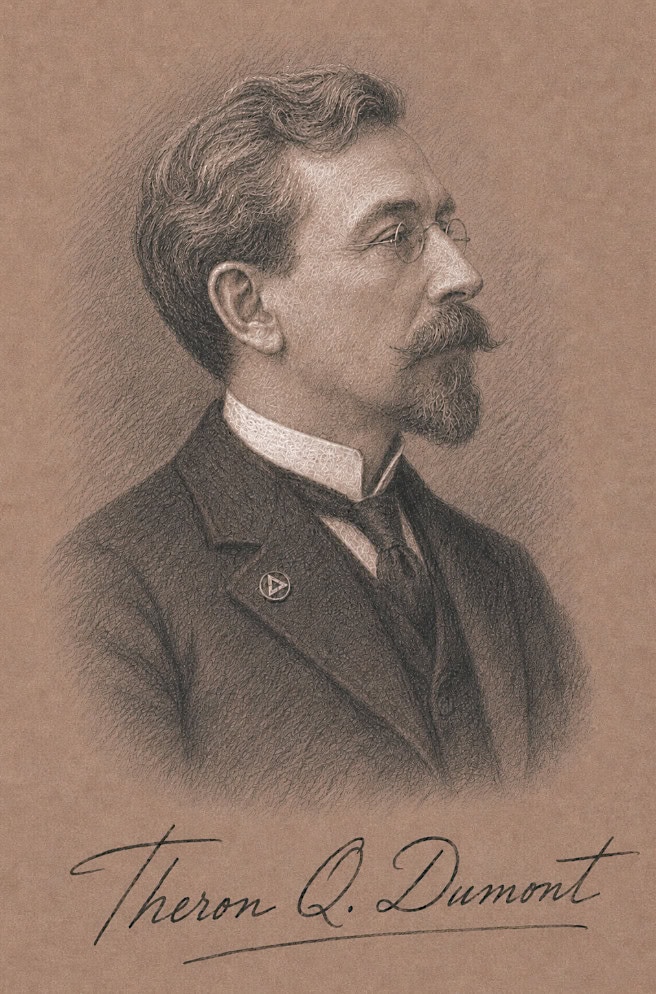
TTheron Q. Dumont, graduate of Dr. Herbert A. Parkyn‘s course in Suggestive Therapeutics. (artist depiction)
Dumont develops personal magnetism into a complete method of self-culture built around confidence, will, self-control, physical vitality, appearance, speech, sympathy, concentration, mental suggestion, character, and the deliberate direction of thought. What begins as a lesson in becoming more attractive and influential gradually becomes a much larger program for reconstructing the personality itself.
Dumont’s central argument is that personal magnetism is not a rare gift belonging to a handful of naturally fascinating people. Every person possesses the raw capacity for it, though most use only a fraction of what is available. Magnetism appears in the effect a person has upon others: the ability to attract friendship, awaken confidence, secure cooperation, hold attention, persuade, inspire, make a favorable impression, and carry a sense of strength into ordinary relationships. Dumont believes these effects arise from qualities that can be developed systematically. A hesitant person can acquire confidence; an irritable person can learn self-control; an awkward person can become socially graceful; a weak voice can be trained; a careless appearance can be corrected; a scattered mind can learn concentration; and destructive habits of thought can be replaced by deliberate suggestion. The magnetic personality, in his system, is constructed through repeated thought and action until desirable qualities become habitual and begin to appear natural.
What Does Dumont Mean by Personal Magnetism?
Dumont begins by describing personal magnetism as an invisible quality that cannot be photographed, painted, or measured in the ordinary way, yet can be recognized immediately through its effects. Some people possess a manner that causes others to trust them, listen to them, help them, buy from them, employ them, follow their advice, or simply enjoy their company. Others may possess money, education, ability, or social position and still fail to create the same response. Dumont sees this difference everywhere in business and social life, and he argues that it frequently decides who receives opportunities and who is overlooked.
He illustrates the point with salesmen, business promoters, employees, employers, husbands, wives, and acquaintances. A successful salesman interests himself in the prospective customer, removes unnecessary formality, makes the interaction pleasant, develops confidence, and creates the feeling that he understands the other person’s needs. Dumont is less interested in any single sales technique than in the total mental impression the salesman produces. People respond to manner, confidence, voice, attention, sympathy, enthusiasm, and the feeling communicated by the personality behind the words.
This is why money alone cannot substitute for magnetism. Dumont repeatedly contrasts the wealthy but disagreeable person with the individual of limited means who possesses confidence, pleasant manners, adaptability, and character. The second may secure credit, employment, friendship, and cooperation because people enjoy dealing with him. Personal magnetism becomes a form of social capital: the ability to awaken favorable responses in other minds.
Yet Dumont refuses to reduce magnetism to surface charm. Pleasant manners without character eventually expose themselves as artificial. He wants the student to cultivate attractive qualities deeply enough that they become part of the person. The genuine individual who speaks truthfully, keeps his word, controls his temper, treats others fairly, and approaches people with goodwill develops a stronger form of influence than someone who merely learns a few techniques for appearing pleasant.
The Inner Mind and the Source of Personal Power
The second chapter moves beneath outward behavior into what Dumont calls the deeper, inner, or subjective mind. He describes ordinary consciousness as only one part of human mentality. Beneath it lies a larger storehouse of experience, habit, memory, intuition, and mental activity that continues working even when the conscious mind is occupied elsewhere. Difficult problems sometimes seem to solve themselves after being set aside because this deeper level of mind has continued arranging the material.
Dumont treats this inner mind as one of the great sources of personal power. Experiences that have disappeared from conscious memory remain stored there and continue influencing judgments and behavior. Habits become embedded there. Repeated ideas penetrate there. If the conscious will learns to give this deeper mind definite instructions, Dumont believes it can become an active partner in developing character and solving problems.
This is one of the major bridges between Personal Magnetism and the tradition of suggestion. Dumont repeatedly instructs the student to impress a desired condition upon the inner mind until it becomes habitual. Confidence, courage, self-control, sociability, concentration, and personal force can all be strengthened by repeatedly thinking and acting in accordance with them. Weakness is maintained in much the same way. A person who continually tells himself that he is timid, unlucky, powerless, unattractive, incapable, or certain to fail keeps supplying the deeper mind with the very ideas that preserve the unwanted condition.
Dumont wants the direction reversed. The student should decide what kind of person he intends to become and begin feeding the mind thoughts consistent with that person. This principle appears so often that it becomes one of the organizing ideas of the entire book: thought repeated with conviction becomes disposition; disposition influences action; repeated action becomes habit; and habit eventually appears as character.
How Is a Magnetic Personality Developed?
Dumont’s practical training begins with self-observation. Most people, he argues, are quick to notice unpleasant qualities in others and remarkably slow to recognize the same habits in themselves. The student must learn to examine his own behavior with the same attention he gives everyone else. Dumont even recommends keeping a notebook and recording faults, improvements, and daily progress so that personality development becomes a deliberate program instead of a vague wish.
His rules for magnetic development cover almost every part of ordinary conduct. Believe in yourself. Carry yourself with confidence. Watch your habits. Be careful about repeating gossip. Avoid deliberate selfishness. Develop tact. Learn to adapt yourself to different kinds of people. Keep an open mind. Do not constantly force your beliefs or dislikes upon others. Eliminate sarcasm, ridicule, profanity, brutality, unnecessary loudness, irritability, and habitual grouchiness. Cultivate genuineness and learn to remain calm when someone else becomes angry.
The sequence matters. Dumont wants the student to become conscious of the impression created by hundreds of small acts. Personal magnetism is not produced in a single dramatic moment. It is accumulated. A person who is consistently punctual, reliable, pleasant, controlled, interested in others, careful in speech, and confident in manner creates a very different mental impression from someone who is nervous, resentful, careless, unpredictable, self-absorbed, or habitually negative.
Self-control is one of the most important qualities in this program. Dumont treats the quick loss of temper as evidence that a person has surrendered mastery of himself. Someone capable of provoking your anger has, for that moment, acquired power over your mental condition. The strong personality maintains enough control to choose how to respond.
The magnetic person is also adaptable. Dumont uses the old expression of being a “good mixer” for someone capable of meeting many kinds of people on their own ground. This requires curiosity and a willingness to take interest in subjects beyond one’s own favorite concerns. Someone who can only talk about his own occupation, hobby, grievances, beliefs, or achievements becomes tiresome. The person who learns about others gains access to many different personalities.
Voice, Conversation, Appearance, and First Impressions
Dumont gives unusual attention to the details of social presentation because he believes personality is communicated before the deeper qualities of a person can be examined. Voice is one of these channels. A pleasant, controlled voice can make ordinary speech attractive, while a harsh, nervous, weak, shrill, careless, or monotonous voice can damage an otherwise favorable impression. He recommends speaking clearly, using the breath properly, avoiding hurried speech, and developing variation in tone.
Conversation carries the same importance. A person’s vocabulary, pronunciation, manner of expressing ideas, and ability to tell a story reveal education, temperament, and self-command. Dumont urges readers to become good listeners because most people enjoy speaking about their own interests. A person who encourages another to talk and listens with genuine attention often leaves a stronger impression than someone who dominates the conversation.
Physical manner also communicates character. Dumont discusses the handshake, posture, carriage, sitting position, facial expression, eye contact, cleanliness, grooming, and clothing. He does not claim expensive clothing is necessary. Good judgment, neatness, cleanliness, and suitability matter more. A person can spend heavily and still look careless, while someone of modest means can present an excellent appearance through attention to detail.
The chapter on pleasing personality develops this idea at length. Dumont insists that first impressions matter because people constantly make rapid judgments when selecting employees, business associates, friends, and acquaintances. Ability that remains hidden behind slovenliness, nervousness, or an unpleasant manner may never receive the opportunity to demonstrate itself. He regards this as a fact of social life that the student must understand.
One of the book’s most consistent teachings follows from this: if you want the world to form a different opinion of you, begin by becoming the person who naturally produces that opinion.
Physical Vitality as a Foundation of Magnetism
Dumont next turns to physical development. A strong personality needs a body capable of sustaining energy, clear speech, alertness, good posture, and continued effort. He encourages regular exercise, deep breathing, bathing, sunlight, sufficient water, and attention to eating and daily physical habits. The exact exercises reflect the physical-culture literature of his period, including breathing movements, stretching, leg exercises, chest development, and calisthenics performed in fresh air.
What matters most for the argument of the book is Dumont’s refusal to separate mind and body. Fatigue affects mood, expression, voice, confidence, patience, and the ability to concentrate. Chronic physical neglect weakens the very qualities the student is attempting to build mentally. Physical training becomes part of personality training.
He also recommends turning health practices into habits by recording them until the subconscious mind begins carrying them out automatically. “Life is one big habit” is close to the spirit of his argument. Conscious effort establishes the pattern; repetition transfers it into automatic behavior. This treatment of breath and physical vitality resembles ideas that appear elsewhere in the mental-culture and Yogi philosophy literature of the period, though Dumont keeps the presentation directed toward personality and influence.
How Does Self-Suggestion Change the Personality?
The chapter on self-suggestion is one of the clearest statements of Dumont’s method. He tells the reader to stop saying, “I will try,” and adopt the mental attitude, “I will do it.” The distinction represents his entire theory of confidence. A divided intention contains its own counter-suggestion. The person who simultaneously desires success and expects failure weakens his effort before beginning.
Dumont uses the animal trainer as an extreme illustration. The trainer entering a cage cannot project fear and uncertainty while expecting the animal to accept his authority. His eyes, posture, movements, and manner must express confidence because hesitation is immediately detected. Dumont carries the lesson into ordinary life: people also read confidence and uncertainty through behavior.
Self-confidence is presented as the quality separating many successful people from those who possess similar ability but fail to use it. Two people may receive comparable opportunities, yet one acts while the other waits. One assumes responsibility while the other avoids it. One approaches influential people with confidence while the other becomes apologetic. One expects his efforts to produce results while the other continually anticipates failure.
Self-suggestion gives the student a way to alter this internal attitude. Dumont advises repeated assertions of capability, accompanied by physical expression and deliberate action. Stand erect. Look people in the eye. Stop carrying an apologetic air. Think of yourself as capable. Act in ways that reinforce the new mental image. Notice when others begin responding differently, because their improved opinion will itself become another favorable suggestion.
The process is circular. Your conception of yourself influences your behavior. Your behavior influences how others respond. Their response affects your conception of yourself. Dumont wants the student to begin this cycle consciously and drive it upward.
Expectancy, Prosperity, and Mental Attraction
Self-suggestion leads directly into Dumont’s theory of attraction. The mind, he argues, has a creative and attractive tendency. The things a person habitually expects and thinks about influence the conditions toward which attention and action move. Dumont applies this to money, health, love, strength, wisdom, harmony, happiness, and business success.
His language becomes more metaphysical in these passages. He describes the person as a vibrating center of force capable of attracting corresponding conditions. Thoughts are said to create vibrations that continue outward, and concentration increases their power. The student is instructed to hold a clear mental picture of the desired condition, refuse to dwell upon its opposite, and begin acting in ways consistent with the result.
The practical and metaphysical sides of the system are closely intertwined. If a person wants prosperity, Dumont says to think prosperity, picture prosperity, expect prosperity, and conduct himself as a person moving toward prosperity. If someone wants courage, he should mentally identify with courage and physically express it. The desired state must occupy consciousness strongly enough that opposing ideas lose their habitual dominance.
This is one of the points where the book most clearly enters the territory associated with New Thought. Thought is treated as an active power capable of shaping both the individual and his relation to the surrounding world. Dumont’s distinctive emphasis remains personal magnetism: the thought must eventually appear in personality.
Love, Courtship, and Personal Attraction
The middle portion of the book applies personal magnetism to romantic attraction, courtship, and marriage. These chapters contain many assumptions about men, women, gender roles, and marriage that reflect the social conventions of 1914, yet the deeper principle remains consistent with the rest of Dumont’s system: attraction depends on the qualities repeatedly expressed through personality.
He advises readers to study the character of the person they hope to attract and to build genuine sympathy around shared interests. Pretending to like everything another person likes may work temporarily, but Dumont warns that such performance eventually collapses. True compatibility requires enough genuine agreement in aims, tastes, and values to sustain the relationship after the excitement of courtship has passed.
Appearance, manners, dignity, self-respect, and consideration remain important. Dumont argues that many people make a serious mistake after marriage by abandoning the care they exercised while courting. They become careless about dress, conversation, courtesy, emotional control, and attention. The attractive qualities that helped create the relationship are allowed to disappear, and then both partners wonder why the relationship itself has changed.
His treatment of influence inside marriage is more complicated. Dumont sometimes speaks openly about one mind controlling another and describes the ability to guide another person without making the influence obvious. At other points he warns strongly against surrendering individuality or attempting to reduce a partner to an extension of one’s will. The healthier principle that repeatedly surfaces is mutual development: each partner should strengthen the better qualities of the other without destroying independence.
Love itself is described as one of the great forces capable of awakening dormant qualities. A person who believes deeply in another can stimulate confidence and ambition. Dumont gives the familiar example of a wife whose enthusiasm and faith help a husband achieve more than he might have achieved alone. The mental image one person holds of another becomes, in his theory, a kind of continuing suggestion.
Can One Mind Control Another?
Dumont does not avoid the more controversial implications of his subject. He states directly that one person can influence another without the second person fully recognizing how the influence is occurring. Ordinary persuasion already demonstrates this in mild form. A skillful individual understands another person’s interests, fears, desires, and habits, then presents an idea in a form most likely to be accepted.
Dumont extends this principle into hypnosis and mental influence. He describes hypnotic control as an intensified example in which the operator directs the subject’s responses, and he suggests that less obvious forms of mental control occur constantly in daily life. His advice for protecting personal independence is simple: do not make important decisions while under the immediate emotional pressure of another person. Withdraw, think alone, sleep on the problem, and allow the deeper mind time to work.
That recommendation is significant because it reveals the defensive side of personal magnetism. The purpose of the course is not only to increase influence. It is also to make the student less easily influenced. A strong personality must recognize pressure, maintain mental independence, and decide consciously.
Dumont’s ideal student becomes difficult to manipulate precisely because he has learned how suggestion operates.
Energy, Rest, and the Exchange of Magnetic Force
The discussion of love and courtship expands into a theory of magnetic energy. Modern life, Dumont argues, exhausts people because they carry the strain of work beyond the working day. Business problems are taken home, worries continue through the evening, social stimulation replaces rest, and the nervous system is never given time to recover.
He presents rest as a way of replenishing magnetism. Someone who leaves work mentally as well as physically, changes activities, relaxes, enjoys companionship, and sleeps adequately can return with renewed force. Dumont even interprets the Biblical accounts of Jesus withdrawing after periods of healing as examples of the need to replenish magnetic energy.
Human association can either drain or restore this force. Tired, irritable people may reinforce one another’s exhaustion by continually talking about problems. Cheerful and refreshed companions can produce the opposite effect. Dumont calls this an exchange of magnetism, but the recurring observation is straightforward: emotional states are contagious.
For the magnetic person, conserving energy becomes as important as generating it.
The Wonderful Power Within Us
By Chapter X, Dumont has moved well beyond etiquette and social charm. The deeper subject is control of mental force. Human beings possess capacities far greater than those ordinarily expressed, he argues, yet most people are directed by forces they scarcely understand. Strong individuals begin consciously selecting what they will think, feel, and do.
The contrast between weak and strong people is repeated throughout the later chapters. Weakness means being moved continually by external conditions: praise, criticism, fear, fashion, anger, discouragement, other personalities, and changing circumstances. Strength means developing enough inner organization to choose the response.
This is also where character reading becomes important. Dumont wants the student to become observant enough to recognize qualities through expression, eyes, movement, voice, posture, and habitual behavior. Understanding another person gives the magnetic individual more ways to establish rapport and communicate effectively.
The ability to read others must be joined with the ability to make oneself readable in a favorable way. Confidence should appear in the eyes. Interest should appear in expression. Integrity should appear in conduct. Strength should appear in carriage. The outer personality becomes the visible language of the inner condition.
Vital Magnetism
The chapter on vital magnetism contains some of the book’s most explicitly occult language. Dumont describes vitality as a force that can flow through the body and be transmitted through physical contact. The hands receive special attention because touch provides a direct means of imparting this force. He even discusses the feet as outlets of magnetic vitality and gives instructions for consciously cultivating awareness of these currents.
These ideas belong to the magnetic and occult theories that circulated widely in the period. Dumont treats them as literal forces, not metaphors. He advises the student to concentrate upon the hands, imagine magnetic energy flowing through them, and use touch when attempting to strengthen influence. The feet, he says, also radiate vitality naturally.
The chapter is important for understanding the full meaning of “magnetism” in the book. Dumont uses the word on several levels at once. It can mean social attraction, confidence, personality, nervous vitality, thought influence, physical force, or an invisible energy supposedly transmitted between people. He does not sharply separate these categories. They are different expressions of one underlying personal power.
What Is the Law of Magnetic Thought Attraction?
Dumont next presents thought attraction as a law governing relationships and circumstances. People naturally feel drawn toward certain personalities and repelled by others, and he interprets this partly as an interaction between mental vibrations. Like attracts like. Cheerfulness attracts conditions favorable to cheerfulness. Confidence attracts confidence. Fear creates receptivity to fear.
The chapter places heavy emphasis on happiness and emotional tone. A cheerful person carries an atmosphere that affects other people. Someone who habitually complains carries another. The mental state one cultivates becomes part of the personality that enters every room, conversation, business transaction, and relationship.
Concentration is again the method for strengthening the desired condition. Hold the mental picture long enough and strongly enough that it begins organizing attention and conduct. Dumont encourages readers to aim high because he believes self-imposed limitations are among the strongest barriers to achievement. A person who has already decided that something is impossible rarely mobilizes the effort necessary to test that assumption.
His formula is simple: become mentally like the condition you want to attract.
Why Are We Judged by Our Thoughts?
The next chapter makes one of Dumont’s strongest claims: people continually communicate their inner states even when they do not consciously reveal them. The face, eyes, voice, movements, and general atmosphere expose much of what the mind habitually contains. A person may hide a thought temporarily, but repeated thinking eventually shapes expression and conduct.
For this reason, Dumont considers thought itself a form of character building. What a person continually thinks about he gradually becomes like. Thoughts of envy, resentment, fear, weakness, vulgarity, or dishonesty leave one kind of mark. Thoughts of courage, generosity, intelligence, strength, and confidence leave another.
The practical consequence is that personality cannot be permanently repaired from the outside. Better clothes, trained manners, and polished speech are useful, yet they cannot carry the whole burden if the underlying mental habits remain destructive. Dumont wants internal and external development to reinforce each other.
Success depends upon becoming capable enough to deserve the success being sought. He urges readers to make themselves clever, informed, useful, observant, and mentally alive. Magnetism increases when there is something substantial behind the appearance.
Magnetic Character Building
Dumont’s chapter on character returns to the idea that weaknesses often appear more prominently than strengths because the individual has repeatedly rehearsed them. A fault receives attention, fear, embarrassment, and self-criticism until it occupies a large place in consciousness. Meanwhile, desirable qualities receive little deliberate cultivation.
The remedy is to guard what enters the mind. Dumont compares consciousness to a gate through which ideas are admitted. If destructive thoughts are allowed to enter repeatedly and remain unchallenged, they become part of the mental household. Constructive character requires selecting what will be entertained.
He also links character with physical appearance. “Magnetic beauty” is the attractiveness produced by vitality, expression, confidence, kindness, intelligence, and clean thought. A conventionally plain face may become appealing through animation and character, while handsome features can lose their effect through unpleasant emotional habits.
The student is told to stop spending so much energy lamenting defects and begin putting forth the best effort available in the present moment. Improvement accumulates through action.
The Secret of Personal Power
Personal power, for Dumont, depends heavily upon independence from emotional disturbance. Anger is especially destructive because it removes poise and gives control to the person or circumstance that provoked it. Resentment extends the disturbance by carrying the event forward long after it has ended.
The opinions of others can produce the same loss of control. A person who continually adjusts himself to approval and criticism never develops a stable center. Dumont admires people who can hear public opinion without allowing it to determine their entire course. Great achievement often requires continuing through periods when others doubt the undertaking.
This does not mean refusing advice. Dumont values observation, education, and intelligent criticism. His objection is mental dependence. The person of power listens, evaluates, decides, and acts from an internal standard.
He repeatedly returns to an image of firmness: the strong individual stands like a stone wall while emotional storms pass around him. That firmness is not numbness. It is poise.
How Does Dumont Define Success?
Success grows out of what Dumont calls poised power. Ability alone is insufficient. The individual must be able to collect his abilities, direct them toward a definite purpose, and continue using them after novelty and enthusiasm disappear.
Mental independence strengthens this process because original thought cannot flourish where the intellect is constantly cramped by fear of disagreement. Dumont urges readers to use their own minds, examine assumptions, study widely, and develop their capacities instead of accepting an artificially small estimate of themselves.
Ambition provides the forward force. Dissatisfaction can be productive when it becomes a reason to improve. The person who begins from a low position may possess a powerful incentive to rise if disappointment is converted into energy instead of self-pity.
Dumont’s democratic note appears repeatedly here: no external power should be assumed stronger than the capacities within the individual. Birth, circumstances, education, and money matter, but they do not define the final limit of development. The person who discovers his own mental resources possesses more power than he initially suspects.
Associates, Standards, and the Qualities of Successful People
The people around us influence what we regard as normal. Dumont gives considerable importance to association because ambition, confidence, habits, conversation, and standards pass easily between people. Spend time around energetic and capable individuals and their attitude stimulates similar qualities. Spend time continually among people who ridicule ambition, complain, waste time, and expect failure, and those habits can become equally contagious.
He advises choosing companions from whom something can be learned. The best associates leave a person mentally stronger after the conversation. Books can perform a similar function by placing the reader in contact with elevated ideas, capable minds, and examples of achievement.
Personal standards must then be maintained through action. Dumont repeatedly warns against the person who understands every principle intellectually and applies none of them. Watch your actions. Keep them up to the standard you have set. Use experience as instruction. When a mistake is made, discover what produced it and improve the next attempt.
Success becomes a continuing education in self-command.
How Can Harmful Thought Influence Be Resisted?
If constructive thoughts attract corresponding conditions, Dumont argues that destructive thought attraction must also be guarded against. Fear, pessimism, sympathy with discouragement, and the emotional atmosphere of other people can pull the individual into mental states he did not consciously choose.
Expectancy is one of the most powerful magnets in this process. Continually expecting trouble prepares the mind to recognize trouble everywhere. Dumont advises replacing fearful anticipation with confidence and alertness. The aim is not carelessness. It is the refusal to mentally experience disasters before they exist.
Sympathy is treated carefully. Dumont wants readers to understand others and remain helpful without absorbing every emotional burden they encounter. The person who takes on everyone else’s fear, grief, anger, and discouragement may become incapable of helping anyone.
The deeper protection comes from a wider understanding of human nature. A person capable of seeing different viewpoints, temperaments, motives, and circumstances is less easily shocked, angered, or manipulated. Dumont considers this expansion of understanding one of the paths toward wisdom.
Becoming a Power in the World
The nineteenth chapter raises the ambition of the course. Dumont now speaks of the “divine creative spirit” within the individual and uses figures such as Napoleon and Cromwell as illustrations of powerful personalities capable of converting defeat into renewed action.
The lesson is not that every reader should imitate historical conquerors. Dumont is interested in the mental quality that refuses to treat difficulty as final. When one route closes, the strong mind searches for another. Doubt narrows the field of possible action, while confidence keeps intelligence engaged with the problem.
Knowledge becomes one of the strongest weapons available. The person who understands his work, understands people, understands himself, and continues learning can enter situations with confidence grounded in ability. Dumont repeatedly combines internal belief with practical preparation. Confidence without development has limited value; development without confidence may remain unused.
The eyes again become important as outward expressions of this inner force. Dumont believes truth, fear, confidence, uncertainty, and intention reveal themselves through the gaze. He later turns this observation into exercises designed to produce what he calls a compelling magnetic gaze.
Personal Magnetism, Health, and the Magnetic Gaze
Dumont links personal magnetism with health because vitality supports every other part of his system. A person with energy is more capable of sustained concentration, social enthusiasm, ambition, clear speech, physical confidence, and emotional control. Chronic depletion produces the opposite.
He describes magnetism as promoting health, ambition, and cheerfulness and gives exercises intended to recharge the body with vital force. Breathing, concentration, physical awareness, imagination, and directed intention are used together. He also gives exercises for making the whole body “magnetic” and for developing a stronger gaze.
The magnetic gaze is not simply staring. Dumont wants attention, intention, confidence, and self-control concentrated behind the eyes. The eyes become one more channel through which the whole personality expresses itself. A weak or wandering mental state produces uncertain expression; a concentrated state produces a more definite one. Dumont closes the chapter with one of the clearest statements of the purpose of his entire course. Attractive power need not be inherited. The object is to make the student a positive, conscious, intelligent center of force.
What Is Dumont’s Formula for Happiness?
The final chapters shift the center of attention from influencing others to governing one’s own happiness. Worry is treated as one of the greatest destroyers of poise because it consumes energy while accomplishing nothing. A person can spend hours mentally living through events that never occur, repeatedly exposing himself to fear generated by his own imagination.
Dumont wants the same imagination turned toward constructive ends. Deal with real problems when they appear. Prepare sensibly for future difficulties. Build strength during favorable periods. Avoid continually poisoning the present with imagined disasters.
Cheerfulness becomes a kind of mental tonic. It affects social relationships, physical feeling, work, confidence, and resilience. Dumont believes cheerful people preserve their power because they refuse to waste large amounts of mental energy on needless irritation and fear.
Happiness also requires reserve strength. The person who has cultivated good health, self-control, friends, useful habits, knowledge, confidence, and adaptability has created resources for difficult periods. Dumont compares this to preparing for a rainy day. Personal magnetism becomes a reserve of organized character.
The Man and Woman You Were Intended to Be
The final chapter gives the course its widest meaning. Dumont tells the reader that human life is moving toward a higher state of development in which the individual becomes healthier in body, clearer in mind, stronger in character, more conscious of personal power, and more capable of living harmoniously with others.
The student is not presented as a finished product determined by past failures or present weaknesses. Dumont sees personality as an unfinished process. Every deliberate improvement contributes to the person who is being formed.
This explains why a book advertised around mental fascination ends by talking about health, happiness, character, self-control, work, love, wisdom, and human development. Personal magnetism gradually becomes Dumont’s name for the coordinated power of the entire person. It includes the body because vitality affects presence. It includes thought because thought shapes habit. It includes emotion because uncontrolled emotion dissipates power. It includes speech and manners because personality reaches other people through conduct. It includes will because purposes require persistence. It includes sympathy because influence without human understanding becomes crude domination.
The strongest person in Dumont’s system is not simply the individual who can make other people obey. It is the individual who has become difficult for fear, anger, discouragement, criticism, habit, and external pressure to control.
Personal Magnetism, Suggestion, and the Mental Culture Behind the Book
The repeated use of self-suggestion is one of the most important features of Personal Magnetism. Dumont teaches the reader to replace accidental mental conditioning with deliberate conditioning: identify the quality wanted, formulate it clearly, hold it before the mind, imagine it in action, physically express it, repeat it, and continue until the new response becomes habitual. That structure places the book firmly within the literature of suggestion that had become an important part of American mental culture by the early twentieth century.
The same framework had already been developed in the work surrounding Herbert A. Parkyn and the Chicago School of Psychology, where suggestion, auto-suggestion, habit, concentration, will, and the relationship between conscious and subconscious mental processes had been taught systematically. Dumont’s course applies this mental training directly to personality. The desired result is visible in social life: greater confidence, composure, persuasiveness, attractiveness, initiative, and resistance to unwanted influence.
Personal Magnetism shares the characteristic effort to take a central principle of mental control and apply it across many areas of life. Business, marriage, health, character, prosperity, appearance, social success, concentration, thought attraction, and happiness are all treated as different fields in which the trained mind can operate. This is also why Dumont’s idea of magnetism changes meaning throughout the book without ever seeming contradictory within his system. At one moment it means confidence and social attraction. At another it means nervous vitality. Elsewhere it becomes thought influence, subconscious suggestion, mental vibration, physical energy, the power of the gaze, or the emotional effect of one personality upon another. Dumont treats all of them as expressions of the same underlying principle: human beings continually project influence and continually receive it. The practical goal is to become conscious of that exchange.
Why Personal Magnetism Remains an Important Self-Culture Book
Read today, Personal Magnetism offers a striking combination of recognizable self-development advice and early twentieth-century theories of unseen mental force. Dumont can move within a few pages from excellent advice about listening, emotional control, first impressions, habit formation, exercise, confidence, and social observation to claims about magnetic fluids, thought transmission, and vital currents flowing from the hands and feet. He places all of these ideas inside one unified explanation of human influence.
That mixture makes the book historically valuable. Many subjects now separated into psychology, communication, leadership, sales training, habit formation, confidence coaching, networking, body language, positive thinking, visualization, and self-help appear here under the older heading of personal magnetism. Dumont asks readers to observe their behavior, regulate anger, listen carefully, show interest in others, maintain their health, improve posture, dress neatly, speak clearly, choose companions wisely, build confidence through repetition, visualize desired behavior, resist destructive suggestions, and stop allowing public opinion to control every decision.
His more speculative theories belong to the intellectual world in which the book was written. His practical program is often surprisingly recognizable.
The key to Personal Magnetism is that Dumont does not finally locate magnetic power in any single trick, look, gesture, phrase, affirmation, or occult exercise. Its source is the organized personality. Confidence works because it changes action. Self-control works because it preserves judgment. Sympathy works because it makes another person feel understood. Appearance works because it communicates self-respect. Concentration works because it gathers effort around a purpose. Physical vitality works because energy supports action. Self-suggestion works because repeated ideas become habits. Knowledge works because confidence becomes more effective when backed by competence. Personal magnetism is the cumulative effect of all these qualities operating together.
Dumont begins with the promise that a person can become more fascinating and influential. By the end of the course, the reader has been given a program for something much larger: the deliberate formation of character. The goal is to become physically vigorous, mentally independent, emotionally controlled, socially intelligent, confident without constant self-consciousness, capable of concentration, receptive to constructive ideas, resistant to destructive ones, and purposeful in action. That is the deeper argument of Personal Magnetism. The greatest influence a person acquires begins with the power he develops over the formation of his own personality.