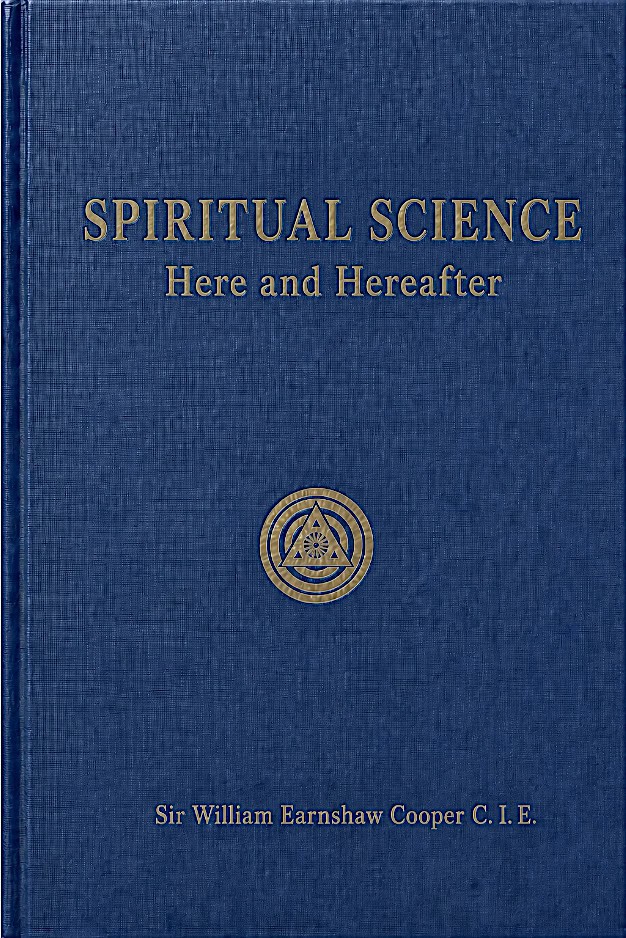
Spiritual Science: Here and Hereafter by Sir William Earnshaw Cooper was published in 1911 by the Yogi Publication Society, with L. N. Fowler & Co. of London serving as the English publisher. Its full subtitle, A Study of Spiritual Philosophy and its Practical Application to the Everyday of Life, describes Cooper’s purpose with unusual accuracy.
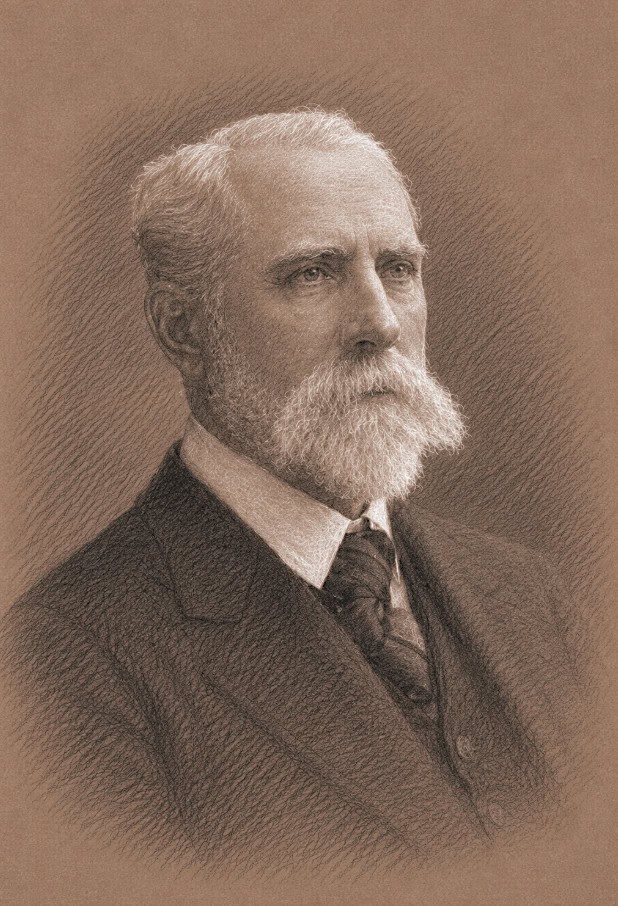
Sir. William Earnshaw Cooper
Sir. W. E. Cooper wanted to take subjects commonly placed under Spiritualism and the occult and present them as parts of an organized field of investigation that could be understood by ordinary readers. Cooper had spent more than forty years in India and approached the subject as a businessman and public figure who claimed to have begun as a skeptic and arrived at his conclusions through investigation and personal experience.
The book contains an introduction by the popular British author William Le Queux and runs through sixteen chapters dealing with the spiritual body, survival after death, psychic communication, clairvoyance, mediumship, the relationship between religion and science, the Brotherhood, Church reform, inspired thought, and the possibility that those who have died may continue to influence and assist the living. Its appearance under the Yogi Publication Society imprint is significant because many of these subjects had already become familiar parts of the Society’s literature through Yogi philosophy, psychical research, mental science, and the books issued under names such as Yogi Ramacharaka, Swami Bhakta Vishita, and Swami Panchadasi.
What is Spiritual Science: Here and Hereafter about?
In Spiritual Science, Cooper argues that the phenomena associated with Spiritualism should be removed from the narrow world of séances, unexplained manifestations, superstition, and occult terminology and investigated as evidence of a larger science of human existence. His central claim is that human beings possess a spiritual or “super-physical” body that survives physical death, and that communication between embodied and disembodied human beings is possible under appropriate conditions. From this starting point, Cooper attempts to construct a complete philosophy of life. Death becomes a change in the conditions of consciousness instead of the destruction of the individual. Psychic phenomena become possible points of contact between two states of existence. Mediumship and clairvoyance become human faculties capable of development. Religion and science, which Cooper believes have artificially separated themselves, can be brought together through investigation of the super-physical side of man. The final purpose of this knowledge is ethical and social. If humanity genuinely understood that life continues after death and that conduct has consequences extending beyond physical existence, Cooper believed people would live differently in the present.
The book can be reduced to several major ideas that Cooper develops repeatedly throughout its nearly four hundred pages.
Human personality and consciousness survive physical death.
Every person possesses a spiritual or super-physical body associated with the physical body during earthly life.
Psychic phenomena provide evidence of interaction between the physical and spiritual worlds.
Clairvoyance, clairaudience, mediumship, and related faculties should be studied instead of dismissed simply because conventional physical science cannot explain them.
Scientific investigators such as William Crookes, Alfred Russel Wallace, Oliver Lodge, William James, and Frederic W. H. Myers helped move psychic phenomena into legitimate intellectual investigation.
Spiritual knowledge should be presented in language understandable to ordinary people and applied to everyday life.
Religion and science are examining different portions of one reality and can eventually be reconciled through a science that includes both physical and super-physical existence.
Human development continues after death, while cooperation between people in the physical world and advanced intelligences in the spiritual world forms part of a larger system of progress.
Knowledge of survival should produce greater responsibility, moral development, service, and awareness of humanity’s spiritual relationships.
From Spiritualism to “Spiritual Science”
Cooper begins with the deceptively simple question “What is Spiritualism?” His dissatisfaction with the answers he receives becomes the starting point of the entire book. He has little interest in table-turning, moving furniture, mysterious noises, or the sensational atmosphere surrounding ordinary séances. He does not necessarily deny such phenomena. His complaint is that they represent an elementary level of something much larger and provide the average person with no coherent explanation of what the phenomena mean. Cooper wants a system that can be carried outside the séance room and applied to ordinary existence. He repeatedly invokes the “man in the street,” insisting that spiritual knowledge must become understandable to people who have neither the time nor the inclination to master obscure occult vocabularies.
This distinction allows Cooper to redefine Spiritualism. What interests him is a science concerned with the unseen dimensions of human life. Just as physical science studies matter and physical forces, Spiritual Science should investigate consciousness, survival, psychic faculties, communication across death, and the unseen forces operating through human beings. Cooper’s use of the word “science” is deliberate. He believes the rejection of psychic phenomena frequently comes from an assumption that science must limit itself to what can be physically weighed and measured. If a phenomenon cannot be detected by existing instruments, that does not establish its nonexistence. It may instead reveal the limitations of the instruments and methods being used.
William Le Queux reinforces this argument in his introduction. He points to Sir William Crookes, Alfred Russel Wallace, Sir Oliver Lodge, William James, Camille Flammarion, and other prominent investigators who took psychical phenomena seriously enough to examine them. Le Queux admits that fraud and charlatanism surround occult subjects, yet argues that fraudulent examples do not dispose of genuine phenomena. His introduction prepares the reader for Cooper’s central method throughout the book. Cooper repeatedly appeals to recognized scientists and psychical researchers in an attempt to show that investigation of the unseen world need not require abandoning reason.
William Le Queux
What is the spiritual or “super-physical” body?
One of Cooper’s most important arguments concerns what he calls the spiritual or “super-physical” body. The physical organism is only one part of the human being. Existing alongside and operating through it is another vehicle belonging to a finer order of existence. During earthly life the two are connected. At physical death the material organism ceases functioning, while the super-physical individual continues.
This provides Cooper with his explanation for survival after death. The person does not suddenly acquire a spiritual existence at death. Spiritual existence is already present during physical life. Death separates two conditions that had previously operated together. In this respect the “Here” and the “Hereafter” of the title are not completely separate worlds. They overlap. Human beings participate in both, although ordinary physical consciousness recognizes only one of them.
The idea also gives Cooper a framework for psychic phenomena. Clairvoyance,, clairaudience, telepathy, apparitions, mediumistic communication, and other unusual experiences become possible manifestations of faculties belonging to the super-physical part of man. This brings the book close to subjects already developed throughout the Yogi Publication Society catalog. The Yogi Ramacharaka books repeatedly describe human beings as possessing levels and faculties extending beyond ordinary physical sensation, while other YPS publications explore psychic perception, thought transmission, astral phenomena, and the development of latent powers. Cooper arrives through Spiritualism and psychical research at a structure that YPS readers would have found immediately recognizable.
Can religion and science be reconciled?
Cooper believes they can, and much of Spiritual Science is devoted to explaining how. In his view, religion made a serious mistake by turning spiritual realities into matters that must simply be believed, while physical science made an equally serious mistake whenever it assumed that reality ended where its instruments stopped functioning. Spiritual Science is intended to occupy the territory between them.
His argument depends upon evidence. Religious belief in immortality gains a different status, Cooper argues, if survival can be demonstrated through psychical investigation. The existence of a soul no longer has to remain exclusively theological if human consciousness can be shown functioning independently of the physical organism. Communication with deceased individuals, if genuine, supplies evidence concerning both survival and the nature of the human personality. Spiritual Science would then provide an experimental approach to questions previously assigned to theology.
Cooper also attacks scientific materialism without attacking science itself. Some of his most important authorities are scientists. Sir William Crookes receives extensive attention, as do Oliver Lodge, Alfred Russel Wallace, William James, Frederic Myers, and other investigators associated with psychical research. Cooper’s complaint is directed toward the assumption that physical methods are capable of judging every form of reality. A scale can measure weight because it was constructed to measure physical weight. Its inability to weigh consciousness tells us nothing about whether consciousness exists. For Cooper, applying exclusively material instruments to spiritual phenomena creates a methodological problem before the investigation has even begun.
The result is one of the book’s recurring images, a bridge between two worlds. Religion approaches the bridge from one side and science from the other. Psychical research supplies evidence that may eventually allow them to meet.
What evidence does Cooper give for survival after death?
Cooper devotes two chapters directly to the continuity of life after death. The first assembles testimony and research from recognized investigators. The second turns to experiences from his own life. This division is important because he wants his case to rest on both outside testimony and personal evidence.
His use of scientific authorities follows a recognizable pattern. Cooper cites investigators who entered psychical research from established scientific or intellectual careers and emphasizes that many did not begin as unquestioning Spiritualists. The value of their testimony, in his view, comes from the fact that they subjected unusual phenomena to investigation and found evidence they could not comfortably explain within a purely material model of human existence. Frederic W. H. Myers becomes especially important because Cooper sees Myers as someone who attempted to organize scattered observations into a philosophy of human personality.
Cooper then gives his own experiences, including communications concerning his deceased mother. One of the most detailed involves the medium Mr. Beard, who supplied information Cooper connected with his final departure from his mother when he left England for India in 1863. The medium described a nearby house associated with the name Elizabeth, an unusual triangular arrangement connected with Cooper’s farewell, a pond approached by horses and carts, and a railway station. Cooper explains that after leaving his mother he went to the house of his Aunt Elizabeth, that his mother followed his progress from an adjoining meadow, that he saw her again near the village pond, and that he continued toward the railway station. To Cooper, the accumulation of details made the communication difficult to dismiss as generalized mediumistic guessing.
These personal accounts are among the most revealing sections of the book because Cooper does not treat communication with the dead as a philosophical abstraction. His belief in survival is tied to experiences that he regards as evidence of continuing identity, memory, affection, and awareness after death. The dedication itself reflects this conviction. He dedicates the book to his mother and to the “bright band” of co-workers in the supernal spheres whom he believed had helped illuminate its pages.
Where do the two worlds meet?
By the middle of the book, Cooper has moved beyond proving survival and begins asking what continued interaction between the two worlds means. If human beings survive death, and if communication is possible, then the relationship between embodied and disembodied humanity becomes part of ordinary existence even when most people remain unaware of it.
This is the foundation for Cooper’s discussion of psychic sensitivity. Certain individuals appear capable of perceiving impressions that ordinary physical senses do not register. Clairvoyance involves perception beyond normal sight. Clairaudience involves hearing beyond normal auditory conditions. Mediumship provides a channel through which intelligences outside ordinary physical perception may communicate. Cooper regards these faculties as natural extensions of human constitution. Their rarity does not make them supernatural. They belong to nature, although they operate in portions of nature that remain poorly understood.
The distinction matters because Cooper repeatedly tries to remove psychic phenomena from the category of miracle. If the universe contains both physical and super-physical dimensions, phenomena connecting them are expressions of natural law. Humanity’s ignorance of the governing law does not turn the event into a suspension of law. This idea appears repeatedly across Western esotericism and in YPS treatments of Hermeticism and Yogi teachings, where apparently extraordinary phenomena are commonly described as manifestations of laws that ordinary science has not yet recognized.
“There Is No Death”
Chapter IX makes Cooper’s position unmistakable through its title, “There Is No Death.” By this stage he believes the preceding evidence has established enough of his argument to move from survival itself to its implications. Death marks a transition in the individual’s condition, while consciousness, character, memory, and development continue.
This changes the meaning of earthly life. Human existence becomes one portion of a longer process, and actions performed during physical life contribute to the condition of the continuing individual. Cooper does not present earthly existence as something spiritually worthless that should be escaped. The subtitle of the book points in the opposite direction. Spiritual knowledge must improve the “everyday of life.” Awareness of continuity should make people more conscious of their responsibilities, relationships, conduct, and opportunities for development now.
The dead are also not pictured as permanently removed from earthly humanity. Cooper believes cooperation can occur between the two worlds. Those who have passed beyond physical existence may continue to take an interest in human affairs and may assist those still living. This idea becomes increasingly important as the book moves into its treatment of the Brotherhood.
What does Cooper mean by “The Brotherhood”?
Three consecutive chapters are devoted to what Cooper calls the Brotherhood, making it one of the largest subjects in the book. The term does not refer simply to a secret society. Cooper uses it for an organized relationship between spiritually developed people in physical life and advanced workers in the unseen world. Humanity is not spiritually isolated. Individuals capable of receiving higher impressions may cooperate with intelligences operating from the other side of physical existence.
Cooper is also aware that “Brotherhood” carries occult associations and that fantastic claims can easily become attached to the idea. His chapter on the “Old and New” Brotherhood specifically confronts what he regards as grotesque interpretations. He wants to rescue the underlying principle from sensational occultism in much the same way that he wants to rescue psychic phenomena from séance-room spectacle. The important question is whether human beings can develop sufficient spiritual sensitivity, discipline, and character to cooperate consciously with a higher order of intelligence.
This leads directly into the question of training. Cooper asks whether the Brotherhood should be specially trained and whether everyone can become a medium. He does not treat indiscriminate mediumship as an automatic spiritual achievement. Psychic receptivity requires development and should be joined with moral and intellectual culture. The possession of an unusual faculty does not by itself establish wisdom.
There are obvious points of contact here with the literature of occult Brotherhoods, Rosicrucian orders, and Eastern Masters circulating during the period. Readers familiar with Rosicrucian literature or the initiatory traditions appearing elsewhere in the YPS catalog would have recognized the vocabulary. Cooper, however, tries to frame the Brotherhood within his own Spiritual Science. Its importance lies in cooperation across levels of existence and in the advancement of humanity through trained spiritual workers.
Can everyone become a medium?
Cooper’s treatment of mediumship is more restrained than the popular séance culture he criticizes at the beginning of the book. He accepts mediumship as evidence that communication can cross the boundary of physical death, yet he does not believe the indiscriminate pursuit of psychic manifestations represents the highest use of the faculty.
His larger concern is development. Human beings possess latent super-physical capacities, but their expression differs among individuals. Training can improve sensitivity, yet development should proceed alongside self-control, intellectual understanding, and ethical growth. Psychic ability without corresponding character can produce confusion.
This treatment brings Cooper into another area familiar to YPS readers. Books issued under Swami Bhakta Vishita and Swami Panchadasi likewise presented clairvoyance, telepathy, thought transmission, astral perception, and other psychic capacities as faculties governed by laws. Cooper’s terminology and religious emphasis differ, but the underlying move is similar. The mysterious is recast as lawful, psychic faculties are treated as part of human nature, and knowledge replaces fear or superstition.
Why does Cooper place so much emphasis on everyday life?
The phrase in the subtitle is one of the keys to understanding the entire book. Cooper has little patience for spiritual philosophy that remains an intellectual ornament. He repeatedly returns to the ordinary reader, the businessman, the home, daily responsibilities, personal conduct, grief, death, and the questions that confront people outside occult societies.
His opening demand is revealing. If Spiritualism is real, he says in effect, give him something he can take home. He wants something understandable enough to discuss with friends or consider in his armchair after dinner. He wants knowledge capable of soothing, satisfying, and bringing peace to a tired person living in the modern world.
The ambition of Spiritual Science is therefore much larger than proving ghosts exist. Cooper wants knowledge of spiritual existence to change how people live. The certainty of continued existence removes some of the terror surrounding death. The possibility of continued relationships provides consolation to the bereaved. Recognition of a larger life encourages moral responsibility. Psychic faculties reveal dimensions of human nature ordinarily ignored. Religion gains evidence for some of its oldest claims, while science gains an enlarged territory for investigation.
The Church and the future of religion
Chapters XIII and XIV turn directly toward organized Christianity. Cooper sees an extraordinary opportunity for the Church if it is willing to accept the evidence of Spiritual Science. Christianity already teaches immortality, spirit, divine reality, and continuing existence. Psychical research, in his view, supplies evidence capable of supporting these teachings for a modern population increasingly influenced by scientific thought.
He believes the Church’s problem lies partly in its reluctance to incorporate new knowledge. People educated in scientific habits of thought increasingly demand reasons for belief. Simply repeating inherited doctrine will not satisfy them. If the Church recognizes legitimate psychical evidence, Cooper believes it can strengthen its spiritual mission and reconnect religious teaching with demonstrable realities.
This is why his proposed reconciliation of religion and science has social importance. He does not want one to defeat the other. He wants the Church to expand its understanding of spiritual phenomena and science to expand its definition of legitimate investigation. Spiritual Science would occupy the common ground.
His Christianity remains visible throughout the book. Cooper can speak of the Great Architect and then identify Christ as the Master-Builder engaged in the work of spiritual advancement. The vocabulary allows him to combine Christian belief with a much larger cosmology populated by super-physical beings, psychic faculties, spiritual workers, and continuing human consciousness.
Inspired thought and help from the “dead”
Near the end of the book Cooper pushes his argument one stage further. If communication between worlds occurs, some thoughts and inspirations experienced by living people may originate through contact with minds no longer embodied physically. The dead may help the living.
This does not mean that every thought should be attributed to an outside intelligence. Cooper’s argument is that human consciousness may be more open and interconnected than ordinary material assumptions allow. Inspiration can therefore have a super-physical component. Individuals sufficiently receptive to higher influence may receive ideas, guidance, or impressions from advanced intelligences.
His chapter title connects this with the ancient command “Know Thyself.” Self-knowledge becomes more complicated once the human being is understood as both physical and super-physical. To know oneself means discovering capacities that ordinary sensory consciousness conceals. Spiritual development involves learning how consciousness works, how impressions are received, and how the individual relates to other levels of existence.
This concept also places Spiritual Science close to themes found elsewhere in New Thought and YPS literature concerning the reception, direction, and influence of thought. Cooper’s explanation is more explicitly spirit-centered than the psychological system of suggestion, yet both approaches treat consciousness as possessing capacities far beyond those recognized by an exclusively material account of mind.
Cooper’s “Man in the Street” and the Yogi Publication Society’s Publishing Method
One of the most interesting features of Spiritual Science becomes visible when the book is read alongside the publishing history of the Yogi Publication Society. Cooper repeatedly insists that difficult spiritual and occult subjects must be translated into ordinary language for the “man in the street.” This is not a passing remark. It appears at the foundation of his argument. He rejects obscure explanations of Spiritualism because they fail the ordinary reader and says that if Spiritualism is real, it should be reduced to a workaday form that an ordinary person can understand and use. William Le Queux reinforces the same point in his introduction, describing Cooper as a businessman presenting difficult facts clearly enough to be understood by everyone.
That language is striking because it describes with remarkable accuracy the method that had defined the publishing network from which the Yogi Publication Society developed. Herbert A. Parkyn had begun with clinical and psychological research into hypnotism and suggestion, then developed an educational system intended to explain those laws in forms ordinary students could understand and apply. His Special Mail Course in Hypnotism and Suggestive Therapeutics carried material previously associated with physicians, hypnotists, and experimental psychology directly into the home. The network’s publishing activity then expanded the same basic method into mental science, New Thought, Yogi philosophy, psychical research, Hermetic teaching, personal development, and occult subjects.
The Yogi Publication Society repeatedly advertised its books through the promise that difficult teachings had been made plain. Its presentation of the Bhagavad Gita, for example, explicitly promoted the work as bringing the teachings before the public in a “plain, simple” form. The Ramacharaka books similarly turned large bodies of Indian philosophy into lessons written for Western readers with no requirement that they know Sanskrit or enter an Indian philosophical school. Cooper is doing something closely related with Spiritualism. He begins with a subject surrounded by specialist societies, séances, mediums, occult terminology, religious controversy, and scientific dispute, then asks how it can be made intelligible and useful to an ordinary modern reader.
This does not establish that Cooper borrowed the method from Parkyn or from YPS, and the book itself provides no evidence for such a claim. The importance lies in why Spiritual Science was such a natural fit for the Yogi Publication Society’s catalog in 1911. Cooper had independently produced a book that followed one of the network’s most recognizable publishing principles. Take material regarded as obscure, technical, Eastern, psychic, occult, or inaccessible, identify the laws or principles beneath it, remove unnecessary terminology, and explain it directly to the ordinary reader.
There is another close fit. Cooper’s argument repeatedly moves from apparently supernatural phenomena toward natural law. YPS had been doing the same thing across several fields. Yogi phenomena were explained through laws of Prana, mind, vibration, and consciousness. Psychic phenomena were treated as expressions of undeveloped human faculties. The Kybalion by the Three Initiates presented Hermeticism as a system of universal laws. Parkyn’s earlier work had removed hypnotic phenomena from the mysterious power of the hypnotist and placed the operative force in laws of suggestion. Cooper similarly attempts to remove spiritual phenomena from the category of supernatural marvel and place them within a lawful super-physical order.
This makes Spiritual Science more revealing in the YPS catalog than it might initially appear. It was not simply another Spiritualist title added to an eclectic list. Its entire method of presentation matched a method that had characterized the network for years.
Cooper’s India background and the YPS audience
Cooper’s long connection with India adds another dimension to the book’s appearance under the YPS imprint. He had spent more than forty years connected with India, yet Spiritual Science is not presented as a work of Hindu philosophy and does not simply reproduce the teachings found in the Ramacharaka books. His intellectual route is different. He begins with Western Spiritualism, Christianity, psychical research, and scientific testimony.
That difference is valuable. By 1911, YPS readers could approach questions of consciousness and unseen existence from several directions within the same catalog. Ramacharaka supplied an explicitly Yogi framework. Other books addressed psychic development and occult perception. The Kybalion supplied a Hermetic framework. Cooper now presented a British Christian and psychical-research approach to many of the same fundamental questions.
The overlap did not require identical doctrine. What united these books was their refusal to confine human existence to the visible physical organism. Whether expressed through Yogi teachings, Hermetic principles, psychic faculties, or Cooper’s super-physical body, the reader encountered a universe in which mind and consciousness extended beyond ordinary material boundaries.
How does Spiritual Science differ from ordinary Spiritualist literature?
Cooper’s own answer is that he wants to move beyond the séance. He repeatedly distances his project from an obsession with table movements, rappings, spectacular manifestations, and indiscriminate mediumship. Those phenomena may be genuine, but proving that something unusual happened is only the beginning.
His real question is what the phenomena reveal about human nature.
If a deceased personality communicates verifiable information, Cooper wants to know what that means for theories of consciousness. If clairvoyance occurs, he wants to know what faculty makes it possible. If consciousness survives physical death, he wants to know what kind of body or vehicle supports it. If the living can receive impressions from the dead, he wants to understand the relationship between the two conditions. If these things operate according to laws, he wants them organized into a science.
This is why the title Spiritual Science matters. Cooper is proposing a field of knowledge. Individual psychic events become observations from which a larger philosophy might be constructed.
What is the central message of Spiritual Science: Here and Hereafter?
The central message is that physical life and spiritual life are parts of one continuous existence. Human beings already possess a super-physical nature while living in the body, and physical death changes the individual’s condition without destroying consciousness or personality. Psychic phenomena offer glimpses of this continuity, while carefully investigated communication with the dead provides Cooper with evidence that the relationship between the two worlds is real.
From that proposition follows nearly everything else in the book. Science must enlarge its field of inquiry. Religion must become more receptive to evidence. Psychic faculties should be investigated as natural human capacities. Mediumship should be developed intelligently. Human beings should cultivate themselves morally and spiritually. Death should lose much of its terror. Those living on earth should recognize that they may be participants in a much larger community extending beyond physical existence.
Cooper closes with a vision of continuing progress. Humanity stands at an early stage in its knowledge of the super-physical world, much as earlier generations once stood before unexplored territories of physical science. What appears mysterious now may become intelligible when the appropriate methods of investigation are developed. The bridge between “Here” and “Hereafter” is therefore the central image of the book. Cooper believes portions of it have already been built through psychical research, personal experience, religious insight, and the testimony of investigators. The work remaining is to connect those pieces into a coherent science.
Published by the Yogi Publication Society in 1911, Spiritual Science: Here and Hereafter fits remarkably well beside the Society’s books on Yogi philosophy, psychic development, mental science, and Western esotericism. Cooper reaches the territory through his own route, yet his goal is unmistakably compatible with the larger YPS program. Knowledge previously hidden behind specialized language, religious dogma, occult mystery, or scientific prejudice is to be investigated, organized, explained in ordinary language, and carried into everyday life.