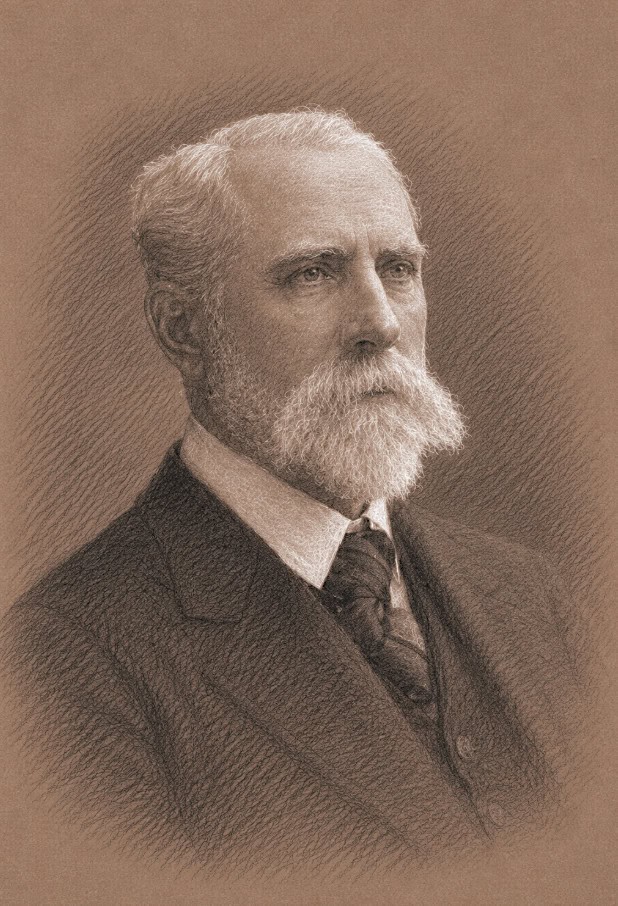
Sir William Earnshaw Cooper, C.I.E. (1843–1924) was a British industrialist, businessman, public official, military volunteer officer, economic writer, agricultural reformer, food reform advocate, and Spiritualist whose career stretched from the commercial world of British India into the reform and psychical movements of early twentieth-century Britain.
He spent more than forty years in India, where he became head of the major Cawnpore firm Cooper, Allen & Co., served for a decade as president of the Upper India Chamber of Commerce, sat on the Legislative Council of the North-West Provinces and Oudh, and held an honorary military command. He was appointed Companion of the Order of the Indian Empire in 1897 and knighted in 1903.
After returning to Britain, Cooper turned increasingly toward national economic reform, agriculture, diet and food reform, the humane treatment of animals, and finally Spiritualism and psychical research. His later books attempted to bring the same businesslike, common-sense method he had applied to commerce and public affairs into questions of death, consciousness, mediumship, and the unseen world.
Early Life and Career in India
William Earnshaw Cooper was born in 1843, the son of James Cooper. Much of his adult life was spent in India, and Cooper himself later wrote that he had lived there for more than forty years. In Spiritual Science: Here and Hereafter, he described the range of occupations he had held during those decades. He had worked as an indigo planter, tobacco grower and manufacturer, cotton shipper, chairman of manufacturing companies, president of a Chamber of Commerce, member of a Legislative Council, and Colonel-Commandant of a volunteer battalion. By the time he wrote the book in 1911, he described himself as head of one of the largest manufacturing concerns of its kind in India.
This background is important to understanding Cooper’s later writing. He repeatedly presented himself as a businessman first, someone accustomed to testing claims by experience, organization, measurable results, and common sense. When he later entered the fields of Spiritualism and psychical research, he deliberately contrasted his approach with what he considered vague occult speculation. He wanted the subject treated in the same straightforward manner in which he had handled commercial and administrative problems.
Cooper, Allen & Co. and the Cawnpore Industrial World
Cooper became closely associated with Cooper, Allen & Co. of Cawnpore, now Kanpur, one of the major industrial centers of British India. The firm developed into an important leather and boot-manufacturing concern and became closely connected with the supply needs of the British Indian establishment. Contemporary biographical notices identify Cooper as head of the company, and later obituary material continued to describe him by that role.
His industrial career placed him in a very different world from the stereotypical image of the occult writer. Cooper had spent decades managing large commercial interests, dealing with manufacturing, trade, labor, agricultural materials, transportation, government, and the economic infrastructure of colonial India. This experience shaped the language of nearly everything he later wrote. Even when discussing spiritual survival, he spoke in terms of economy, organization, utility, laws, forces, cooperation, and the profitable application of knowledge.
President of the Upper India Chamber of Commerce
Cooper’s position in Indian commerce was formalized through his long service as president of the Upper India Chamber of Commerce. Contemporary biographical sources and his obituary record that he held the presidency from 1889 until 1900.
This eleven-year tenure placed him among the leading representatives of British commercial interests in northern India. It also helps explain the confidence with which he later wrote on large economic questions. Cooper did not enter debates about trade, agriculture, industry, and national food policy as a purely theoretical economist. He had spent decades directly involved in manufacturing and commercial administration.
Legislative Council and Public Service
From 1893 to 1900 Cooper served as a member of the Legislative Council of the North-West Provinces and Oudh. His political and administrative experience coincided with his commercial leadership and gave him direct involvement with questions of government policy in India.
The combination of industrial management, Chamber of Commerce leadership, legislative service, and later economic writing made Cooper an unusually experienced public figure by the time he returned permanently to Britain. His subsequent attacks on British economic policy were rooted in the conviction that he had already seen large systems of commerce and production operating at first hand.
The Volunteer Movement and Military Rank
Cooper also supported the volunteer military movement in India and became honorary colonel of the Cawnpore Volunteer Rifle Corps. His later biographical notices regularly styled him Lt.-Col. or Colonel, and the Indian biographical record identifies his connection with the Cawnpore Volunteer Rifles.
The military association was another part of the public identity Cooper carried back to Britain. He was not simply a retired manufacturer who later developed literary interests. By the turn of the century he had accumulated commercial, political, military, and civic credentials that gave considerable weight to the reform causes he subsequently embraced.
C.I.E. and Knighthood
Cooper was appointed a Companion of the Order of the Indian Empire in 1897. Six years later, in 1903, he received a knighthood. The honors recognized a career closely tied to Indian commerce and public life.
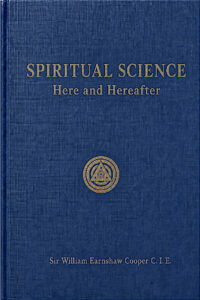
His books from the following decade prominently displayed the title “Sir William Earnshaw Cooper, C.I.E.” The title page of the Yogi Publication Society edition of Spiritual Science: Here and Hereafter does exactly this, placing his imperial honor and public standing directly before readers encountering what was otherwise an unusual book on Spiritualism and the survival of consciousness.
Return to England and Hume Towers
After more than four decades in India, Cooper returned to Britain and entered a very different phase of his life. He lived for many years in Bournemouth, where he became associated with Hume Towers. His 1924 obituary noted that news of his death had reached Bournemouth, where he had long resided, although he died at Castle Carey in Guernsey.
Cooper later explained that after returning home he began studying Britain’s economic and social problems. He regarded himself as a man who had spent much of his life dealing with large organizations and believed that the same kind of analysis could be applied to British agriculture, poverty, food supply, national health, and political economy.
From Industrialist to Social Critic
During the years after his return to Britain, Cooper became a prolific and often combative writer on economic affairs. His books included The Murder of Agriculture, Socialism and Its Perils, Britain for the Briton, and England’s Need. These titles were important enough to be listed directly beneath his name on the title page of Spiritual Science.
The common thread was his concern that British economic policy had elevated commerce and manufacturing at the expense of the land and the long-term security of the population. Cooper attacked Free Trade, criticized existing land ownership arrangements, and argued that Britain had allowed domestic agriculture to deteriorate while becoming dangerously dependent upon imported food.
His proposals could be radical despite his strong opposition to socialism. In Britain for the Briton, he argued that agricultural land should ultimately be held by the State for the benefit of the nation. Contemporary reviews recognized this contradiction in conventional political terms. The Financial Times described him as an anti-Socialist who was nonetheless an enemy of vested interests and quoted his proposal that agricultural land be acquired and held by the State. Other reviews emphasized his insistence that national stability required a renewed agricultural base.
The Murder of Agriculture
The Murder of Agriculture became one of Cooper’s best-known reform works. His central argument was that Britain had sacrificed domestic food production to an economic system dominated by trade and industry. He regarded this as both an economic mistake and a danger to national survival.
The book was part of a larger campaign. Cooper did not treat agriculture as an isolated industry. He linked it to employment, health, social stability, land ownership, national independence, and the ability of Britain to feed its own population. Later reviews of his work repeatedly described him as attempting to awaken the public to the consequences of agricultural decline.
This concern with agriculture would eventually connect naturally with his interest in dietary reform. For Cooper, the question of what a nation grew, what its people ate, how food was produced, and how land was used were parts of one social problem.
Socialism and Its Perils
Cooper was equally outspoken in opposition to socialism. Socialism and Its Perils presented an extended critique of socialist economic proposals and attempted to make the anti-socialist case accessible to ordinary readers. Contemporary reviews repeatedly described the work as clear, direct, businesslike, and designed for people who had not studied political theory in depth.
That description is worth noting because the same literary method appears in his later spiritual writing. Cooper consistently wanted complex subjects reduced to language the average reader could understand. Whether the subject was socialism, agriculture, food reform, or the afterlife, he wrote for what he repeatedly called the “man in the street.”
Britain for the Briton and National Food Security
In Britain for the Briton, Cooper expanded his agricultural argument into a larger plan for national economic reorganization. He believed Britain had become dangerously dependent upon overseas food and that the land should again become central to national life. Reviewers summarized his program as one involving land reform, State ownership of agricultural land, protection of domestic production, and a much greater degree of national food self-sufficiency.
His thinking does not fit neatly into modern categories. He could be strongly anti-socialist while proposing State acquisition of land. He could defend British national interests while attacking established landowners. He could come from heavy manufacturing while arguing that industrial development had been allowed to overwhelm agriculture. Cooper’s politics were shaped more by his conception of national efficiency and social organization than by consistent loyalty to one ideological camp.
The Order of the Golden Age
One of the most important parts of Cooper’s later life was his association with the Order of the Golden Age, a Christian-oriented food reform and humane movement that connected dietary change with physical health, moral development, animal welfare, and spiritual progress. The Order had become a significant voice in the British humane reform movement by the early twentieth century and published The Herald of the Golden Age as its principal journal.
The Order advocated what it often called “fruitarianism,” a term that encompassed a vegetarian or non-flesh diet based on fruits, nuts, grains, vegetables, legumes, and related foods. Its argument was wider than nutrition. Meat eating was attacked on humanitarian grounds because of animal suffering, on medical grounds because of alleged disease and degeneration, and on spiritual grounds because a purer diet was believed to encourage mental clarity and moral development. Contemporary descriptions of the movement explicitly connected food reform with increased stamina, mental alertness, the clarification of spiritual vision, and greater control of the body’s lower impulses.
Cooper became one of the prominent public figures associated with this campaign. His status as a knight, former industrialist, Chamber of Commerce president, and public official gave the food reform movement a spokesman who was difficult to dismiss as an eccentric outsider.
Errors in Eating and Physical Degeneration
Cooper’s Errors in Eating and Physical Degeneration was one of the works circulated by the Order of the Golden Age. An advertisement in the Herald of the Golden Age described it as a book exposing harmful eating habits and the physical consequences suffered by the British public.
Its argument reflected Cooper’s larger view that individual diet and national strength were intimately connected. Poor eating habits did not remain private matters. They weakened bodies, increased disease, placed burdens upon society, and contributed to what reformers described as national degeneration.
This line of thought connected his earlier concern with agriculture to his later concern with human health. The soil produced the food, the food produced the body, and the condition of individual bodies affected the condition of the nation.
The Toiler and His Food
Cooper also wrote The Toiler and His Food, another publication circulated through the Order of the Golden Age. The Herald advertised it as an argument directed toward working people demonstrating what Cooper considered the superior nutritional value of a well-selected non-flesh diet. By 1912 the tract had reached a fourth edition and had even appeared in a German edition.
The intended audience is important. Cooper was not writing food reform solely for wealthy occultists or fashionable vegetarians. Like his economic and spiritual books, the argument was deliberately aimed at ordinary people. He wanted diet reform understood as something connected with household economics, physical endurance, labor, national health, and everyday life.
Food Reform and Spiritual Development
The Order of the Golden Age supplied a natural bridge between Cooper’s social reform and his growing spiritual interests. The movement itself linked diet with ethical and spiritual development. Its literature argued that the physical body was the instrument of the soul and that purer food supported purer thought and feeling. The Order drew support from Christian, humanitarian, and esoteric ideas and explicitly compared food abstinence traditions among Brahmins, Buddhists, and Christians.
This helps explain why Cooper’s later turn toward Spiritualism should not be treated as a sudden abandonment of his earlier interests. Agriculture, food, health, ethics, self-control, and spirituality were becoming interconnected in his thinking. He increasingly viewed human existence as a system in which physical conditions affected moral and spiritual development.
Cooper’s Turn Toward Spiritualism
By around the end of the first decade of the twentieth century, Cooper began investigating Spiritualism and psychical phenomena with increasing seriousness. He later described himself as having approached the subject with skepticism and little interest in ordinary séance phenomena. He did not want table-turning, moving furniture, mysterious sounds, or theatrical demonstrations. What he wanted was evidence that could be organized into an intelligible system and made useful to everyday life.
His own description of this transition is unusually valuable. In Spiritual Science, Cooper explains that after returning from India he began investigating certain social and economic questions and then applied the same “common-sense tests” to Spiritualism. He emphasized that he was not a trained scientist or psychologist and disliked technical terminology that made the subject inaccessible. He wanted to tell the story in his own straightforward manner.
This self-presentation became central to his Spiritualist identity. Cooper repeatedly identified himself as a businessman investigating a new field, not as a professional medium or occult teacher.
Spiritual Manifestations
In 1910 Cooper published Spiritual Manifestations: A Brief Record of My Own Experiences. Bibliographic records identify the work as a 79-page publication devoted to Spiritualism and note that surviving copies were marked “For private circulation only.”
The work recorded experiences Cooper regarded as personal evidence of communication with the dead. These investigations later supplied important material for Spiritual Science. Of special importance were communications he believed involved his deceased mother and contained information that mediums could not have obtained through ordinary means. Cooper’s movement from private circulation to a major Yogi Publication Society volume is significant. What began as a personal record of experiences became, within a year, an attempt to organize Spiritualism into a complete philosophy of human existence.
Spiritual Science: Here and Hereafter
In 1911 the Yogi Publication Society published Cooper’s Spiritual Science: Here and Hereafter in Chicago, while L. N. Fowler & Co. handled the London edition. Its subtitle was A Study of Spiritual Philosophy and its Practical Application to the Everyday of Life.
The book represents the fullest expression of Cooper’s spiritual philosophy. He argues that human beings possess a spiritual or “super-physical” body that operates through the physical organism and survives bodily death. He treats mediumship, clairvoyance, clairaudience, psychic communication, the survival of personality, and the possibility of cooperation between the living and the dead as parts of a larger field that he calls Spiritual Science.
Cooper’s method closely reflected the style that had characterized his previous public writing. He repeatedly rejects obscure terminology and says that spiritual questions should be explained in language understandable even to ordinary readers. He refers repeatedly to the “man in the street” and insists that genuine spiritual knowledge should be something a person can “take home” and apply to normal life.
This feature helps explain why Cooper’s work fit so naturally into the publishing world of the Yogi Publication Society. The Society had already specialized in presenting Yogi philosophy, psychic phenomena, New Thought, Hermeticism, and other esoteric subjects in accessible language for general readers.
William Le Queux and the Introduction to Spiritual Science

The book received an introduction from William Le Queux, the enormously popular British novelist and journalist. Le Queux wrote that he had followed investigations into occult phenomena by such figures as William Crookes, Alfred Russel Wallace, Oliver Lodge, William James, and Camille Flammarion, and had himself come to believe that Spiritualism contained serious questions deserving investigation.
His description of Cooper is revealing. Le Queux presents him as a level-headed businessman attempting to place difficult evidence before ordinary readers in clear language. That was precisely the public persona Cooper wanted. He was using his reputation from commerce and public life as evidence that his Spiritualist conclusions had not arisen from credulity.
Science, Religion, and the Super-Physical Body
Cooper’s spiritual philosophy rests on an effort to reconcile religion and science. He believed Christianity had preserved truths about immortality while failing to explain them clearly, and he believed physical science had discovered evidence of unseen forces while remaining too cautious about extending its conclusions beyond matter.
His “super-physical body” was intended to provide the bridge. The physical body belongs to material existence. The super-physical body is the conscious individual operating through it. Death ends the physical partnership while leaving the conscious personality intact.
Cooper believed psychical research was beginning to supply empirical evidence for ideas previously treated only as articles of religious faith. In this respect he belonged to the same early twentieth-century environment that included Crookes, Lodge, Wallace, Myers, and James, all of whom he repeatedly invoked as evidence that serious investigators had entered the field.
Where Two Worlds Meet
Cooper returned to these themes in Where Two Worlds Meet: Bridging the Gulf Between Matter and Spirit, published in 1914. A contemporary review in the journal Light discussed the book as an attempt to explain the relationship between material and spiritual existence and emphasized Cooper’s argument that man himself forms the point at which the two realms meet.
The title summarizes the direction his later thinking had taken. Cooper no longer treated communication with the dead simply as proof that death is survivable. He wanted to understand the human being as the actual bridge between physical and spiritual conditions.
The Brotherhood and Cooperative Spiritual Work
One of the more unusual parts of Cooper’s later philosophy was his concept of the Brotherhood. In Spiritual Science he describes a form of cooperation between spiritually developed individuals in physical life and advanced intelligences in the unseen world. The idea allowed Cooper to extend Spiritualism beyond private messages from deceased relatives. The unseen world could participate in the intellectual, moral, and spiritual development of humanity. People on both sides of death could work together.
This concept also brought Cooper’s Spiritualism into territory familiar within Western esotericism, where ideas of Masters, Brotherhoods, invisible teachers, and advanced spiritual intelligences were already widespread. Cooper differed in trying to anchor the idea in Spiritualist communication and psychical research.
Cooper’s View of Death
For Cooper, death did not destroy the person. He regarded it as a transition in the conditions under which consciousness operates. The physical body ceases functioning, while the spiritual body continues immediately into what he calls the Intermediate Life.
This conviction had a deeply personal dimension. His 1911 book is dedicated to his mother and to the “bright band of co-workers in the spheres supernal” whom he believed had assisted in illuminating the work. His interest in survival was both philosophical and emotional. The death of the body did not end personal relationships or meaningful work. The living and dead remained parts of one human community operating under different conditions.
Marriage and Family
Cooper married Gleadowe, widow of Walter de Castro, on November 2, 1911. They had two daughters.
Final Years in Guernsey
In his later years Cooper spent time in Guernsey, where his final residence was Castle Carey. He died there in July 1924 at the age of eighty-one. The Daily Telegraph obituary published on July 4 reported that news of his death had been received in Bournemouth, where he had lived for many years.
His death closed an unusually varied career. Cooper had begun as a commercial and agricultural entrepreneur in India, became one of northern India’s leading business figures, entered legislative and volunteer military service, received imperial honors, returned to Britain as a national economic critic, became active in food and humane reform, and spent the final period of his life trying to establish the survival of human consciousness as a subject worthy of systematic investigation.
Why Sir William Earnshaw Cooper Matters to the Yogi Publication Society
Cooper occupies an unusual position in the history of the Yogi Publication Society because he did not come to the publisher through the familiar American New Thought route. He brought with him decades of Indian experience, major commercial credentials, British public honors, economic reform writing, food reform, and independent Spiritualist investigation.
His presence in the YPS catalog shows the range the publishing network had developed by 1911. The Society was no longer issuing only books presented as Yogi philosophy. It could also publish an internationally prominent British businessman arguing from Christianity, psychical research, personal experience, and modern science toward a philosophy of the super-physical human being.
There is also a striking compatibility in method. Cooper repeatedly says that difficult spiritual subjects must be stripped of unnecessary terminology and explained to the ordinary reader. This was already one of the defining characteristics of the YPS publishing program and of the earlier educational system developed around Herbert A. Parkyn and the Chicago School of Psychology. Cooper’s insistence that obscure material be reorganized into a system of laws and carried into everyday life made Spiritual Science an unusually natural fit for the Society.
Legacy
Sir William Earnshaw Cooper is difficult to reduce to a single category. His life moved through industry, colonial administration, commerce, volunteer military organization, economic reform, agriculture, vegetarian and humane activism, Spiritualism, and psychical research. Yet the different phases were connected by a consistent habit of mind.
Cooper wanted systems to work. He believed Britain’s agricultural system was failing and proposed a new one. He believed conventional eating habits were damaging physical and moral health and supported food reform. He believed religious teaching had failed to explain the spiritual body and attempted to construct a clearer philosophy. He believed ordinary Spiritualism remained trapped in scattered phenomena and wanted it reorganized as a science.
The businessman never disappeared from the spiritual writer. Even when discussing immortality, Cooper continued to speak of organization, economy, utility, evidence, laws, development, and cooperation. That combination is what makes him such an unusual figure in the Yogi Publication Society’s history. He arrived at its door with the authority of a knighted industrialist and former colonial public official, then used that authority to argue that human consciousness survived death and that the relationship between the physical and spiritual worlds could eventually become as intelligible as any other field of human knowledge.