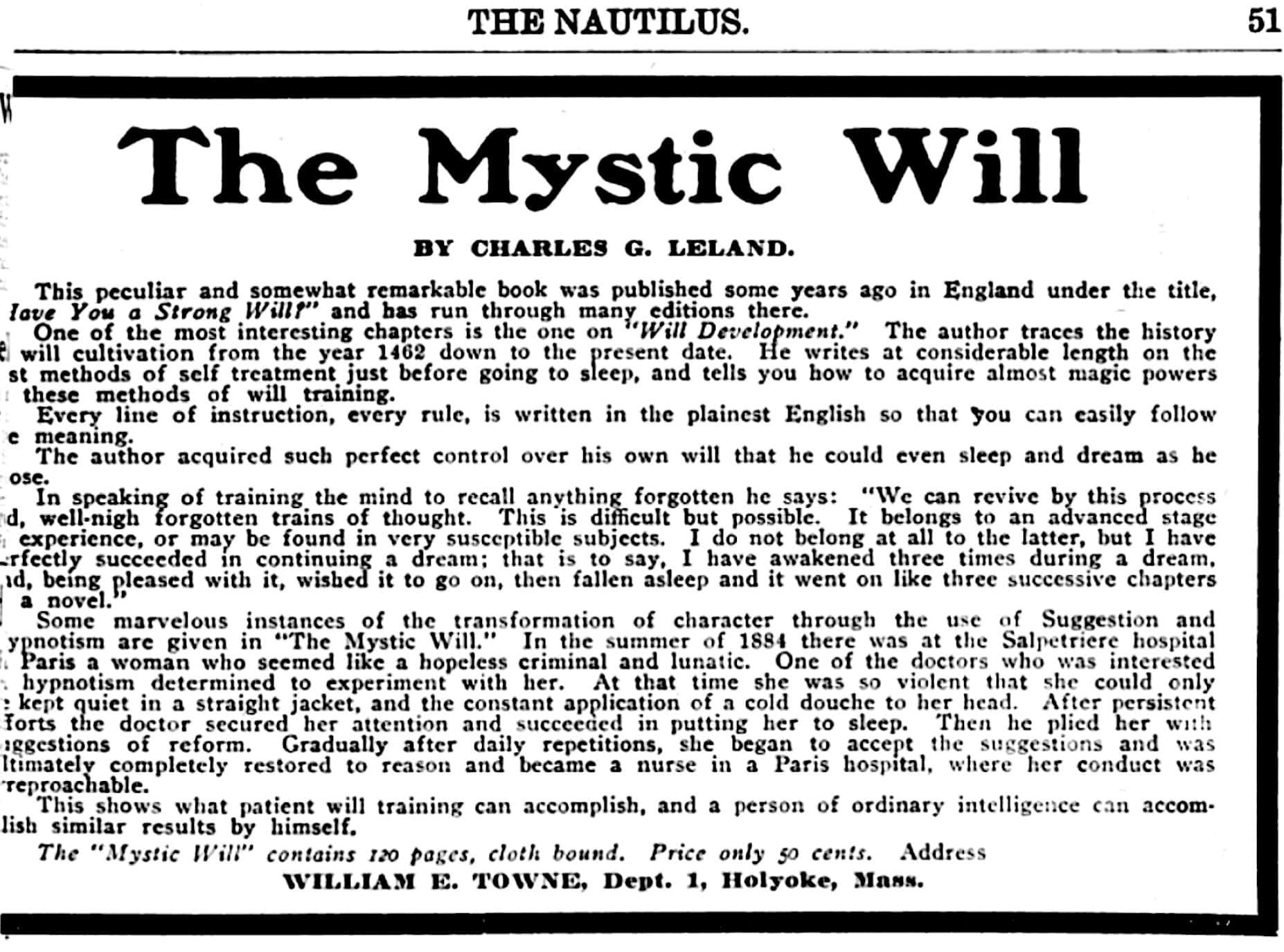
The Mystic Will by Charles Godfrey Leland is a practical study of how the human will may be deliberately strengthened through attention, self-suggestion, forethought, repetition, habit, and the purposeful direction of the deeper levels of mind. Originally published in England as Have You a Strong Will?, the work argues that willpower is not simply an inborn quality possessed by a fortunate few, nor is it the harsh “iron will” of sheer determination. Instead, Leland presents the will as a faculty that can be educated and strengthened through systematic mental practice. His central method is remarkably simple: decide clearly what is desired, give the idea concentrated attention, impress it repeatedly upon the mind, particularly before sleep, and allow the unconscious or “subliminal” faculties to continue the work until the desired tendency becomes increasingly automatic. From this foundation, the book applies the same principle to concentration, memory, creativity, character, confidence, habit formation, instinct, personal influence, and the development of the mind itself.
Charles Godfrey Leland
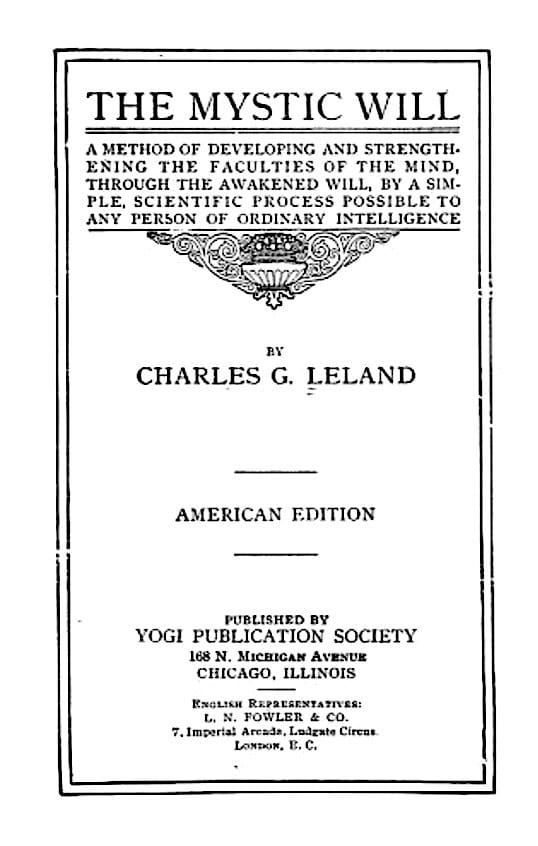
The 1907 Yogi Publication Society edition is especially important because it was not simply a reproduction of Leland’s earlier book. The publisher deliberately revised the work to reflect what it considered a newer understanding of mental science. The original title was replaced with The Mystic Will, chapter headings were simplified, material considered irrelevant was removed, and, most significantly, the publisher states that the word “Suggestion” was substituted for “Hypnotism” in several passages because Suggestion better represented the contemporary psychological understanding of the process. That editorial decision is particularly significant when the book is placed within the history of Herbert A. Parkyn’s Chicago School of Psychology. Years earlier, Parkyn had reached essentially the same conclusion through his clinical work and teaching: what had traditionally been called hypnotism was fundamentally the operation of Suggestion. In his 1900 course he stated explicitly that “Hypnotism, or what has generally been known as hypnotism, is simply nothing more nor less than suggestion,” while his school increasingly centered its teaching on Suggestion, auto-suggestion, attention, habit, and the influence of ideas upon the subconscious mind. Leland’s own connection with Parkyn’s correspondence-school network therefore gives the Yogi Publication Society edition an additional historical context, while the striking parallels between the book and Parkyn’s system are examined in a dedicated section near the end of this summary.
What Is the Central Teaching of The Mystic Will?
The fundamental argument of The Mystic Will is that the powers of the mind are capable of deliberate cultivation. Leland rejects the assumption that qualities such as concentration, memory, determination, creativity, courage, and strength of character must simply be accepted in whatever measure nature has given them. Mental faculties behave much more like abilities that can be exercised. Repeated use strengthens them, neglect weakens them, and properly directed practice can produce capacities that initially appear extraordinary. This is why the book continually moves away from the idea of forcing oneself through sheer effort. The strongest will is not necessarily the mind that strains hardest at every moment, but the mind that has trained its deeper processes to cooperate with conscious intention.
This distinction explains the unusual meaning of “mystic” in the Yogi Publication Society title. The publisher specifically says that Leland is not teaching an “iron-will,” but something more subtle: an apparently mysterious power by which intention can be impressed upon the mind and subsequently emerge as action, ability, or inclination. Much of what appears mysterious, however, is presented as psychological rather than supernatural. A person consciously plants an intention, repeatedly reinforces it, and eventually finds that previously difficult behavior begins to arise more naturally. What looks like an inexplicable increase of will is therefore the result of consciously training processes that ordinarily operate without deliberate direction.
How Is the Will Developed?
Why Are Attention and Interest the Foundation of Will?
Attention occupies a foundational place in the book because the mind cannot strongly develop a faculty that it never learns to hold steadily before itself. Interest naturally produces attention: when people are genuinely fascinated by something, concentration becomes easier and information connected with it is remembered more readily. The practical problem is therefore not merely learning how to “concentrate harder,” but learning how to create sufficient interest that attention can remain fixed upon the desired subject.
Leland consequently treats attention, interest, and will as interconnected rather than independent faculties. Attention provides a channel through which mental force can be directed; interest helps sustain that attention; and repeated voluntary attention gradually strengthens the ability to direct the mind at will. Someone who continually allows attention to wander is effectively training mental instability, while someone who repeatedly brings attention back to a chosen object is exercising the very faculty required for greater self-command. The development of will therefore begins in ordinary acts of mental discipline rather than dramatic demonstrations of determination.
The practical implication is important. Instead of continually lamenting a lack of concentration, a person should deliberately practice becoming interested in the subject that requires attention. Observation can be sharpened, details can be consciously noticed, questions can be asked, associations can be formed, and the subject can be approached from different directions. As interest increases, attention becomes easier; as attention becomes habitual, the will required to command it becomes stronger. Mental development thus becomes a progressive process in which one faculty reinforces another.
How Does Self-Suggestion Strengthen the Will?
Self-suggestion is one of the central mechanisms of The Mystic Will. Rather than waiting for circumstances, other people, or accidental experiences to form mental tendencies, the individual can deliberately introduce ideas into the mind and strengthen them through repetition. A desired action, quality, or state is clearly conceived and repeatedly impressed upon consciousness until it begins to influence the deeper mental processes from which habits and impulses arise.
The importance of this method lies in its indirectness. If a person simply commands himself to possess confidence, concentration, memory, or courage immediately, the conscious mind may resist because experience appears to contradict the command. Self-suggestion instead establishes a tendency. The idea is repeated, contemplated, anticipated, and gradually accepted until it becomes easier for the corresponding thought or behavior to appear spontaneously. What originally required conscious effort can eventually become habitual.
This produces one of the book’s most important ideas: the will can be used to train the mind until less will is required. A person first consciously directs attention and suggestion toward a desired tendency, but repeated practice gradually transfers the behavior into the realm of habit and automatic response. Mental discipline is therefore not supposed to create a lifetime of exhausting self-control. Its purpose is to organize the deeper mind so that it increasingly works in the same direction as conscious intention.
Why Is the Period Before Sleep So Important?
Leland places special emphasis on the period immediately before sleep because he believes an intention introduced at that time can continue operating after ordinary conscious thought has ceased. A person clearly determines what he wishes to accomplish, impresses that intention upon the mind, and then allows himself to sleep without continuing to strain consciously over the problem. The mind is compared implicitly to a process that can continue developing what has been planted within it.
This principle is applied to more than simple habit formation. A person may prepare himself to awaken at a particular time, remember something the following day, solve a problem, develop an idea, perform a task, or approach tomorrow’s work with greater confidence and determination. Instead of regarding sleep as an absolute interruption of mental activity, the book treats it as a period during which unconscious processes may continue organizing material supplied by waking consciousness.
The method nevertheless depends upon repetition rather than a single dramatic experiment. Leland repeatedly stresses practice, perseverance, and seriousness. He even warns that successful work of this kind requires physical moderation, particularly before sleep, arguing that overeating, excessive drinking, disturbed digestion, and restless dreaming interfere with the peaceful mental conditions necessary for effective self-suggestion. Mental cultivation, in other words, is treated as a discipline requiring consistent conditions rather than a trick to be casually tested once and abandoned.
What Is Forethought and Why Does Leland Consider It So Powerful?
Forethought is one of the most distinctive ideas in The Mystic Will. Leland means something stronger than simply thinking ahead. Forethought is the deliberate mental preparation of a future action: the individual forms the intention beforehand and gives the mind a clear direction to follow when the appropriate moment arrives. He describes it as “constructive” mental action and specifically identifies it as preparation for self-suggestion because it produces the attention and interest necessary for suggestion to operate effectively.
A useful way to understand the distinction is that ordinary thought says, “Tomorrow I should do this,” whereas forethought mentally prepares the person to do it. The desired behavior is anticipated, mentally rehearsed, and connected with intention. When the future situation arrives, the mind has therefore already been prepared for a particular response. Leland believes that repeated use of this process can make people more decisive, prompt, observant, confident, and capable of acting without the hesitation that often prevents otherwise intelligent people from carrying out their intentions.
Forethought also provides the bridge between self-suggestion and developed will. At first, an individual may need an elaborate process of repeated suggestion. As practice continues, however, less preparation becomes necessary. Eventually the person can conceive an intention, direct the will toward it, and act. Leland explicitly says that as development proceeds the practitioner may gradually dispense with suggestion and rely increasingly upon clear will and forethought. The method is therefore intended to educate the will rather than make the individual permanently dependent upon formulas or exercises.
How Does Mental Training Reshape Character and Habit?
How Does the Will Become Character?
The book repeatedly moves from individual mental exercises toward the larger subject of character. Character is not presented as something entirely fixed at birth. It is partly the accumulated result of thoughts, habits, reactions, associations, and repeated choices. If these tendencies have been formed through repetition, then deliberate repetition can also be used to alter them.
This is one of the deeper implications of self-suggestion. A person who repeatedly thinks, anticipates, and acts according to a particular pattern gradually makes that pattern easier to reproduce. Eventually the response begins to feel natural and may be interpreted as part of personality. Leland’s method reverses the process. Instead of assuming “this is simply the kind of person I am,” the individual identifies the quality that should be strengthened and deliberately cultivates the thoughts and actions associated with it.
Courage, persistence, self-control, confidence, patience, attentiveness, and determination therefore become trainable dispositions. The conscious will begins the change, suggestion reinforces it, repetition establishes it, and habit eventually carries much of the burden. Character becomes, at least in part, organized habit operating at a deeper level than moment-to-moment conscious decision.
What Is the Relationship Between Suggestion, Habit, and Instinct?
One of the broader psychological ideas running through The Mystic Will is that human beings are influenced constantly by suggestions whether they recognize them or not. Ideas, expectations, examples, customs, memories, surroundings, and repeated experiences leave impressions that may later influence behavior. What appears spontaneous can therefore have a long history of unconscious preparation behind it.
Leland extends this reasoning into his discussion of instinct. Much intelligent activity can occur with surprisingly little conscious reflection because patterns have already been established. A practiced artist, craftsman, speaker, musician, or worker may perform complicated operations without consciously analyzing every movement. The deeper lesson is that unconscious action need not be unintelligent action. The mind can absorb patterns until they become automatic.
This provides another reason for consciously controlling suggestion. If repetition and environment are continually educating the unconscious mind anyway, then deliberate self-development consists partly in deciding what kind of education it will receive. Repeated constructive ideas can establish beneficial tendencies just as repeated destructive ideas can establish harmful ones. The person who understands suggestion therefore becomes less passive in the formation of his own habits.
How Can the Mind’s Other Faculties Be Developed?
How Does The Mystic Will Approach Memory?
Memory is treated as another faculty capable of cultivation rather than a mysterious gift that some people possess and others lack. Leland connects memory closely with attention and interest. Much apparent forgetfulness begins not because information has somehow disappeared but because it was never received with sufficient attention in the first place. The mind remembers more readily what it has genuinely noticed.
The development of memory therefore begins by strengthening observation. A person who consciously notices names, faces, facts, relationships, locations, ideas, and details gives the mind better material to retain. Interest further strengthens the impression, while association connects new information with material already present in memory. Self-suggestion can then be used to establish confidence in the ability to remember and to direct the mind toward future recollection.
The larger lesson again reflects the book’s central principle: memory improves when the mind is systematically trained to remember. Instead of repeatedly affirming forgetfulness through statements such as “I can never remember names,” the individual should stop reinforcing the weakness and begin expecting recollection. Attention at the moment of learning, confidence in future recall, association, repetition, and deliberate intention all cooperate in strengthening memory.
Can Creativity and Inventive Ability Be Developed?
Leland’s discussion of the constructive faculties expands his system beyond self-control. He argues that imagination, invention, artistic production, and problem-solving can also benefit from deliberate preparation of the unconscious mind. A creative problem can be consciously considered, supplied with relevant material, and then temporarily dismissed, allowing deeper mental processes to continue developing possible solutions.
One of the book’s examples comes from the artist Hubert von Herkomer, who reportedly described carefully determining a work in his mind and then allowing the idea to rest, almost as though it were a seed germinating beneath the surface. Leland connects this directly with forethought and the possibility of willing before sleep that imagination or creative ability will become especially active. The principle resembles his other exercises: conscious thought supplies the direction, while unconscious processes perform work that cannot always be reproduced by conscious strain.
The practical advice is therefore not to force creativity continuously. Preparation matters, but so does release. Study the problem, gather material, formulate the objective clearly, impress it upon the mind, and then allow time for mental combination. Insights that later seem spontaneous may actually be the results of unconscious organization.
What Does Leland Mean by Fascination?
The discussion of fascination examines the ability of one personality to attract, impress, persuade, or influence another. Leland treats this subject within the larger framework of attention, suggestion, confidence, and will rather than reducing it to a supernatural power. People who possess concentrated purpose, self-confidence, presence, and an ability to command attention naturally exert greater influence upon those around them.
The connection with the rest of the book is important. Someone who cannot govern his own attention is unlikely to command the attention of others effectively. Someone whose intentions are uncertain communicates uncertainty. By contrast, cultivated attention and will produce greater steadiness of manner and purpose. Personal influence consequently becomes an outward expression of inward organization.
This does not require assuming an invisible magical force. Throughout the work, phenomena that may initially appear occult are repeatedly brought back toward suggestion, unconscious response, habit, imagination, expectation, and concentrated intention. Leland is fascinated by the borderland between psychology and what earlier generations called magic, but he continually searches for practical mental processes beneath apparently mysterious effects.
What Is the Subliminal Self?
The “subliminal self” provides the psychological explanation for much of the book. Leland uses the term for mental activity existing beneath ordinary waking consciousness—the region in which memories, habits, associations, impulses, creative combinations, and suggestions may continue operating without constant conscious supervision.
This explains why self-suggestion can apparently produce delayed effects. Consciousness establishes the direction, but the suggestion does not necessarily disappear when conscious attention moves elsewhere. It may remain active beneath awareness and later emerge as an impulse, recollection, solution, inclination, or altered behavior. The mind is therefore larger than the small portion of its activity perceived at any given moment.
Once this premise is accepted, the method of The Mystic Will becomes internally consistent. Attention determines what is admitted strongly into consciousness. Suggestion impresses an idea. Repetition strengthens it. Forethought directs it toward future action. Sleep reduces conscious interference. Habit establishes it. The subliminal mind preserves and develops it. Finally, the result returns to conscious life as an apparently natural tendency or spontaneous action.
Why Does the Book Discuss Paracelsus?
The treatment of Paracelsus allows Leland to connect modern psychological ideas with older traditions concerning imagination, will, healing, and magical influence. He sees in the writings attributed to Paracelsian thought descriptions of mental influence that can be reconsidered through the newer language of psychology. What earlier ages interpreted through spirits, occult forces, magical will, or mysterious sympathies may in some cases reflect observations of genuine psychological phenomena expressed through the conceptual vocabulary available at the time.
This is representative of Leland’s broader approach. He does not simply dismiss the occult past as meaningless superstition, but neither does he accept every extraordinary explanation literally. He looks for the psychological process concealed beneath the old terminology. His observation that hypnotism operates through suggestion illustrates the direction of this reinterpretation. Ancient magic, fascination, charms, ceremonial preparation, and concentrated intention may contain practices that affected expectation, imagination, attention, and unconscious response even when their practitioners misunderstood why they worked.
The result is a book positioned between folklore, occultism, early psychology, and practical mental science. Its “mysticism” often consists not in supernatural claims but in the recognition that unconscious mental processes can produce effects that seem mysterious to the conscious personality.
What Practical Method Does The Mystic Will Recommend?
Although the book ranges widely through psychology, folklore, art, magic, memory, instinct, and historical examples, its practical method can be reduced to a fairly coherent sequence:
Decide clearly what faculty, behavior, habit, or result is to be developed.
Give the objective genuine attention rather than a vague wish.
Create interest in the desired result so attention can be sustained.
Use self-suggestion to impress the intention repeatedly upon the mind.
Employ forethought by mentally preparing for the desired future action before it is required.
Make constructive use of the quiet period before sleep, when an intention can be impressed without continued conscious strain.
Repeat the process consistently rather than expecting dramatic results from a single attempt.
Allow desired actions to become habits so that conscious effort is gradually replaced by automatic cooperation.
Use the strengthened will increasingly directly as practice makes elaborate methods unnecessary.
Apply the same underlying process to attention, memory, confidence, character, creativity, and other mental faculties.
The simplicity of this system is deliberate. Leland does not claim that will development depends upon rare occult initiation or exceptional intelligence. The title page of the Yogi Publication Society edition describes the method as a “simple, scientific process possible to any person of ordinary intelligence.” What distinguishes successful practice is not possession of secret knowledge but persistence in applying a few principles until they become habitual.
The Yogi Publication Society’s Reframing of The Mystic Will
Why Did the Yogi Publication Society Change “Hypnotism” to “Suggestion”?
The publisher’s notice to the 1907 edition is one of the most historically revealing parts of the entire volume. Yogi Publication Society openly states that its edition differs from Leland’s English original. It removed a lengthy chapter dealing largely with hygiene and related subjects, shortened chapter headings, omitted several footnotes and references, replaced the original title Have You a Strong Will? with The Mystic Will, and, most significantly, substituted “Suggestion” for “Hypnotism” in several places where the publisher believed Suggestion was the more accurate term according to contemporary psychology.
That change materially affects how the American edition should be understood. Yogi Publication Society was not merely reproducing Leland’s words photographically. It was interpreting his ideas through a particular psychological vocabulary. The publisher believed that an earlier generation had called certain phenomena hypnotism because the underlying mechanism had not yet been clearly distinguished. By 1907, it considered Suggestion the better explanation.
This distinction is particularly striking because it mirrors almost exactly the development that had already taken place at Herbert A. Parkyn’s Chicago School of Psychology. Parkyn’s work began publicly in the language of hypnotism during the 1890s, but his clinical investigations increasingly led him to argue that the supposed hypnotic state was not the fundamental cause of the observed effects. Suggestion was. In his 1900 course he went so far as to call hypnotism a misnomer and state that what had generally been called hypnotism was “simply nothing more nor less than suggestion.”
The editorial substitution in The Mystic Will therefore does more than modernize a few words. It places Leland’s book within the same conceptual transition from hypnotism to Suggestion that had characterized Parkyn’s school and publishing network during the preceding decade.
The Mystic Will and Herbert A. Parkyn’s System of Suggestion
How Does The Mystic Will Parallel Parkyn’s Teachings?
The parallels between The Mystic Will and the teachings developed at Herbert A. Parkyn‘s Chicago School of Psychology are extensive. They are especially important in light of Leland’s connection with Parkyn’s correspondence-school network and the later decision of the Yogi Publication Society to publish this revised American edition. The comparison does not depend upon isolated similarities in vocabulary. Both systems organize mental development around essentially the same cluster of mechanisms: attention, Suggestion, auto-suggestion, repetition, habit, unconscious mental activity, deliberate expectation, and the education of the will.
Herbert A. Parkyn
Parkyn’s system had developed from his clinical investigations into hypnotism during the 1890s. Rather than regarding hypnotic sleep as the therapeutic power, he came to regard Suggestion as the operative principle. By 1900 his course taught that the term suggestion was acquiring a much broader meaning, encompassing impressions received through the senses, and explicitly argued that what was commonly called hypnotism was fundamentally Suggestion. This is precisely the conceptual distinction the Yogi Publication Society later imposed editorially upon The Mystic Will when it replaced instances of “Hypnotism” with “Suggestion.”
The similarity becomes still clearer with auto-suggestion. Parkyn taught that individuals could deliberately influence their own subconscious processes through repeated self-directed ideas. His system emphasized focused attention, repetition, visualization, affirmations, expectation, and the replacement of undesirable habits by repeatedly establishing new mental patterns. Surviving descriptions of his teaching summarize the objective as making oneself over through repeatedly directed auto-suggestions rather than remaining governed by impressions and habits accumulated unconsciously. The Mystic Will repeatedly teaches the same practical movement: consciously select the tendency that is desired, give it attention, reinforce it through self-suggestion, and continue until the new response becomes sufficiently established to operate with decreasing conscious effort.
Attention provides another close parallel. Parkyn’s psychological system treated voluntary attention as inseparable from the development of will because deliberately holding the mind upon a chosen idea exercises mental control. Leland likewise begins the practical development of will with attention and interest. Neither system treats willpower primarily as emotional intensity or stubbornness. Will is developed through control of mental direction.
The treatment of habit follows naturally. Both approaches recognize that much of human behavior operates automatically. Repeated ideas and actions establish pathways that eventually cease to require constant deliberation. The practical objective is therefore not merely to overpower an unwanted habit each time it appears, but to establish a competing pattern so thoroughly that the new response itself becomes increasingly automatic. The deeper mind becomes an ally of conscious intention.
Leland’s forethought can also be understood within this framework. He describes it as a constructive preliminary to self-suggestion, a deliberate preparation of the mind for later action that ensures attention and interest. Once sufficiently practiced, the preparatory machinery becomes less necessary and the individual can increasingly act through direct will. This is closely compatible with the Chicago School’s broader principle that repeated suggestion educates automatic mental processes until desired responses become established.
Perhaps the clearest way to see the relationship is to place the shared principles side by side:
Hypnotism is not treated as the fundamental power; Suggestion is the operative principle.
Attention determines the strength with which ideas are impressed upon the mind.
The individual can direct Suggestion inward through self- or auto-suggestion.
Repetition strengthens mental impressions.
Ideas repeatedly impressed upon the deeper mind can influence later behavior.
Habits can be deliberately established and undesirable tendencies displaced.
The will can be strengthened through systematic exercise rather than regarded as fixed at birth.
Mental expectation and preparation influence future conduct.
Unconscious or subliminal processes can continue working outside immediate conscious awareness.
The ultimate objective is greater self-direction, so that constructive responses increasingly become habitual rather than requiring continual conscious struggle.
Why Is the Change from Hypnotism to Suggestion Historically Important?
The connection becomes especially revealing when chronology is considered. Parkyn’s school had already publicly moved from hypnotism toward Suggestion years before the 1907 Yogi Publication Society edition appeared. His publishing network reflected that evolution in its very titles: The Hypnotic Magazine was followed by the Journal of Medical Hypnotism, while the later literature increasingly centered upon Suggestive Therapeutics and Suggestion. Contemporary material associated with the network describes the affiliated Schools of Suggestive Therapeutics as an expanding educational system extending beyond the original Chicago institution.
Against that background, Yogi Publication Society’s editorial note becomes unusually significant. The publisher did not merely select a work about willpower that happened to resemble Parkyn’s teachings. It explicitly altered Leland’s terminology so that the American edition expressed the newer principle of Suggestion rather than the older terminology of hypnotism. The change reproduces the same conceptual correction Parkyn had been teaching publicly at least seven years earlier: hypnotism was the older name attached to the phenomena, while Suggestion was the underlying law.
Why Is The Mystic Will Important to the Yogi Publication Society?
Within the larger Yogi Publication Society catalog, The Mystic Will is valuable because it demonstrates how readily the principles of Suggestion could be expressed outside explicitly therapeutic or Yogic literature. The subject here is not primarily Eastern philosophy, breathing, psychic healing, or metaphysics. It is the cultivation of ordinary human faculties—attention, memory, character, creativity, confidence, habit, and will. Yet the mechanism repeatedly returns to the same basic process of impressing ideas upon the deeper mind and allowing them to become operative through repetition.
The 1907 edition therefore provides an unusually transparent example of editorial interpretation. Yogi Publication Society tells the reader exactly what it changed and why. The replacement of “Hypnotism” with “Suggestion” was not accidental modernization but a declared attempt to bring an older work into agreement with what the publisher regarded as the more advanced psychological understanding of its own period. In the historical setting of the Chicago network from which Yogi Publication Society emerged, that choice is difficult to overlook.
What Is the Lasting Message of The Mystic Will?
The lasting message of The Mystic Will is that human beings participate in the formation of their own mental character to a far greater degree than they commonly realize. Attention can be trained. Memory can be cultivated. Habits can be replaced. Confidence can be developed. Creativity can be encouraged. Character can be altered. The will itself can become stronger through use. But these changes are accomplished less by violent acts of determination than by repeatedly directing the mind until desired tendencies become increasingly natural.
The book’s method can therefore be summarized as a progression from conscious intention to unconscious cooperation. First comes a clear purpose. Attention gives that purpose force. Interest sustains attention. Forethought prepares future action. Self-suggestion impresses the desired tendency. Repetition deepens it. Sleep and periods of mental release allow subliminal processes to continue the work. Habit eventually makes the response increasingly automatic. What begins as an effort of will can ultimately become part of character.
That is what makes the Yogi Publication Society’s title The Mystic Will appropriate to the work. The “mystic” element is not primarily a supernatural force possessed by exceptional people. It is the apparently mysterious ability of consciously directed thought to descend beneath ordinary awareness, alter the tendencies operating there, and later return in the form of changed behavior, stronger faculties, new ideas, and greater self-command. Read alongside the teachings of Parkyn’s Chicago School of Psychology—and especially alongside the publisher’s explicit decision to replace the older language of Hypnotism with Suggestion—the book becomes more than an early manual of willpower. It becomes another revealing expression of the broader mental-science system of Suggestion, auto-suggestion, attention, habit, and subconscious influence that had already been developed and taught throughout the Chicago network before The Mystic Will entered the Yogi Publication Society catalog.
Original edition
Charles Godfrey Leland Biography
Charles Godfrey Leland (1824–1903) was an American author, journalist, folklorist, educator, and occult scholar. He was among the first writers to connect folklore, psychology, and mental science. While he became internationally known as a humorist and poet, his deep interest in Hermeticism, Neoplatonism, folklore, and hypnotism made him a key influence on the New Thought movement and modern self-improvement literature.
Charles Godfrey Leland
Leland was born in Philadelphia and studied at Princeton University, then continued his education at Heidelberg, Munich, and the Sorbonne in Paris. Although Princeton gave him a classical education, his real interests grew outside the classroom. He later said he lived a “double life,” appearing to focus on his studies while privately reading Neoplatonists, the Hermetica, Gnostic texts, and Renaissance mysticism. He often went into the woods near Princeton to reflect on these ideas, believing that ancient philosophers held important psychological truths that had been forgotten. In Germany, he lived like a wandering scholar, searching for both academic knowledge and traces of old philosophical traditions across Europe.
During his time in Europe, Leland encountered many important ideas of the nineteenth century. At Heidelberg, he met Justinus Kerner, a German doctor and mystic, who studied mesmerism, spiritualism, and magnetic sleep. Kerner introduced Leland to new scientific ways of explaining things once thought to be supernatural. While studying in Paris, Leland’s education was interrupted by the Revolution of 1848, and he joined the student revolutionaries, serving as a captain during the uprising.
After returning to America, Leland briefly worked as a lawyer before moving into journalism and writing. During the Civil War, he strongly supported the Union, writing political commentary and satire for the Continental Monthly and helping to popularize the word “emancipation.” He also served with Union forces during the Gettysburg Campaign. His book The Breitmann Ballads (1871), a collection of humorous poems in a mix of English and Pennsylvania German dialect, made him famous in both America and Europe.
Once he was financially independent, Leland moved back to Europe for good and focused on studying folklore and comparative religion. He lived for many years in London, Germany, and finally Florence, Italy, where he learned about the traditions of Romani communities, Irish Travellers, Native American myths, and Italian folk religion. He was the first scholar to identify and record Shelta, the secret language of the Irish Travellers, and spent years gathering fading oral traditions across Europe. His meeting with an Italian folk practitioner named Maddalena led to his book Aradia, or the Gospel of the Witches (1899), which became a major influence on modern Paganism and Wicca. Link
Throughout his research, Leland became more convinced that the remarkable effects linked to magic, mesmerism, and occult practices could be explained by how the human mind works. He believed that what people once called enchantment or fascination was actually based on psychological principles now known as hypnotic suggestion. He was especially influenced by Scottish doctor James Braid, who argued that suggestion, not animal magnetism, worked through the nervous system and imagination.
Leland eventually turned from studying suggestion in others to training his own mind. Using ideas from ancient Hermetic philosophy and modern psychology, he created a practical system based on concentration, planning, repetition, and self-suggestion. He thought that focusing on certain thoughts right before sleep would help build habits, memory, willpower, and character overnight. These ideas became the foundation of his 1899 book Have You a Strong Will?, later called The Mystic Will in America. In the book, Leland said that willpower is not something you are simply born with, but a skill anyone can develop through regular mental practice.
Leland also made important contributions to public education. He strongly supported industrial arts and founded the Public School of Industrial Art in Philadelphia, where he brought woodworking, embroidery, metalwork, and other crafts into the classroom. Many people admired his educational reforms, including Oscar Wilde, who praised Leland for combining artistic creativity with everyday learning.
By the time of his death in Florence in 1903, Charles Godfrey Leland had produced an extraordinary body of work spanning literature, folklore, anthropology, education, occult philosophy, and psychology. His unique synthesis of Hermetic philosophy, hypnotic suggestion, folklore, and practical mental training made him one of the earliest writers to connect the mystical traditions of the past with the emerging psychological and self-help movements of the twentieth century.
The Sacred Geometry of the Yogi Publication Society Logo
This article examines the Yogi Publication Society logo and its sacred geometry meaning, comparing it with Hindu, Hermetic, Rosicrucian, Masonic, and Theosophical traditions to show the intention behind the publishing network.
The Science of Psychic Healing: A Bridge Between Yogi Philosophy and the Law of Suggestion
This article explores the book The Science of Psychic Healing and its close parallels with Herbert A. Parkyn's teachings and examines its role in connecting Eastern philosophy with the science of mind.
Yogi Ramacharaka: The True Meaning and Origin of the Name
This article breaks down the hidden symbolism and meaning behind "Yogi Ramacharaka", the pen name that was created by the Yogi Publication Society and shows the allegory that reflected the ideas the books were…