Yoga Lessons for Developing Spiritual Consciousness was written by Swamie A. P. Mukerji and published in 1911 by the Yogi Publication Society. Mukerji was associate editor of The KalpakaMagazineof India, and the book was distributed in India through the Latent Light Culture of Tinnevelly. Mukerji dedicated the work to D. P. Mukerji, whose blessings he invoked for the spiritual development of his readers. The work documents a direct relationship between YPS and the Indian Latent Light Culture network, while its teachings also draw openly upon Yogi Ramacharaka, Swami Vivekananda, the Bhagavad Gita, Light on the Path, William James, Judge Thomas Troward, Theosophical literature, Western psychology, hypnotism, suggestion, auto-suggestion, and mental science.
Swami A. P. Mukerji
Mukerji develops a complete program of spiritual self-development based upon the mastery of thought, emotion, desire, will, body, and character. His spiritual consciousness is not presented as an abstract religious belief. It is a higher state of awareness that must be developed through deliberate changes in the habits of the mind and body. This leads him into concentration, imagination, ideals, subconscious activity, suggestion, auto-suggestion, thought-force, fear, prayer, meditation, nervous energy, Prana, the control of destructive thoughts, and what he calls “Self-De-Hypnotisation.” The result is an unusual synthesis of Yogi philosophy and the psychological language of the American New Thought and suggestion movements.
One of the most important features of the book for the history of YPS is how closely parts of its program correspond to subjects the Society had already published under the Ramacharaka name. Mukerji adopts the sevenfold constitution of man consisting of the physical body, astral body, Prana or Vital Force, instinctive mind, intellect, spiritual mind, and Spirit. The original YPS Yogi Class Course had begun in November 1903 with precisely this progression. Its first three lessons covered the physical body, astral body, Prana or Vital Force, instinctive mind, intellect, spiritual mind, Spirit, and “Illumination, or Spiritual Consciousness.” Later lessons covered Thought Dynamics, Human Magnetism, Pranic Energy, psychic influence, spiritual evolution, spiritual cause and effect, and the Yogi’s path of attainment. Mukerji’s 1911 book returns to many of these same subjects while connecting them directly to the work of the Latent Light Culture.
What Is Yoga Lessons for Developing Spiritual Consciousness About?
Mukerji’s central teaching is that the ordinary personality is only a partial expression of the human being. Beneath physical appetites, habits, fears, emotions, and ordinary intellectual activity exists a higher spiritual consciousness. Human development consists of allowing this higher consciousness to gain increasing control over the lower parts of the personality. The individual must cease living as a passive product of surroundings, inherited tendencies, uncontrolled thoughts, emotional reactions, and suggestions received from other people.
This is why Mukerji continually returns to mastery. Man must become master of his thoughts, master of his emotions, master of his body, and master of his response to circumstances. The physical organism becomes an instrument. The mind becomes an instrument. Desire becomes a force that can be directed. Will gives that force purpose. Concentration gathers it together. Suggestion places definite ideas before the subconscious nature. Meditation carries consciousness inward. Character is the cumulative result of the process.
The book therefore moves from philosophy into mental training. Its opening chapters establish Mukerji’s conception of human life and the higher Self. The middle chapters develop will, ideals, concentration, fearlessness, and constructive thought. The closing chapters become increasingly instructional, culminating in meditation, self-de-hypnotisation, and character-building.
What Is Mukerji’s Yogi Conception of Life?
Mukerji opens with the interaction of mind with mind, mind with matter, and mind with the human body. His first chapter immediately places psychological power at the center of spiritual development. Every individual is described as possessing power within himself, and life is presented as continual movement. Stagnation is death. Humanity must move forward toward knowledge and spiritual freedom or backward toward ignorance.
Life is a “series of awakenings.” Ideas arise in consciousness, pass through mind and body, and become acts. Mukerji argues that outward conditions correspond to inward development. Character expresses itself through circumstances, while thoughts and actions send forces outward and create consequences that eventually return to the individual. His teaching of cause and effect is therefore psychological as well as karmic. Human beings create much of what they later experience.
Pleasure and pain are interpreted through this struggle for expression. Mukerji says that the soul continually seeks greater freedom and expression through its various vehicles. Pleasure accompanies successful expansion, while pain accompanies obstruction and weakness. Experiences that initially appear painful can therefore contribute to development because they compel the individual to exert greater force.
The final aim is freedom. Mukerji uses the Indian term Jivan mukti for liberation and presents ignorance as the fundamental cause of bondage. Knowledge breaks that bondage. The person who remains attached to sensation, possessions, power, praise, and bodily existence remains dependent upon external conditions. Spiritual development moves consciousness toward what Mukerji calls the “ONE SOURCE,” where freedom and peace are found.
How Does Mukerji Explain the Power of Suggestion?
One of the most striking features of the opening chapter is that Mukerji moves directly from spiritual philosophy into hypnotism and suggestion. To demonstrate the influence of mind upon body, he asks the reader to imagine a hypnotized subject repeatedly receiving suggestions that his physique is increasing. Mukerji claims that sustained suggestion can produce bodily change. He follows this with a dramatic story of students at Aberdeen who supposedly hypnotized a companion and suggested that his throat had been cut. According to Mukerji’s account, the subject died as a result of accepting the suggestion. He uses the story to illustrate his belief that what a person accepts mentally can become physically expressed.
Whatever value can be assigned to the historical anecdote itself, its function in the book is unmistakable. Mukerji begins his Yogi system by teaching that ideas received by the mind can act upon the body. This principle becomes progressively more important until Chapter XVI, where he states openly that “the power of suggestion and auto-suggestion” operates everywhere. By the final chapters, the deliberate replacement of destructive mental impressions with constructive ones has become part of his method of self-de-hypnotisation.
This makes Developing Spiritual Consciousness an important YPS book for the history of suggestion. The terminology is not confined to an isolated reference. Suggestion becomes one of the psychological mechanisms through which Mukerji explains self-development.
Why Are Imagination and Ideals So Important?
Mukerji distinguishes imagination from fantasy. Imagination is deliberate, constructive, and directed by the conscious mind. Fancy is passive mental wandering. His example is a poor young man who forms a definite conception of what he intends to become, visualizes the desired state, works out the steps necessary to reach it, anticipates obstacles, acquires knowledge, and maintains confidence in the result. That is imagination because thought has been organized around a purpose.
An ideal becomes a mental pattern toward which life can be directed. Mukerji writes that a man’s ideals determine what he becomes and argues that the presence of an ideal already foreshadows its eventual expression. Thoughts create what he calls a “magnetic centre” within the individual and attract corresponding thoughts. The future turns upon the ideal that has been established in consciousness.
Yet visualization alone is insufficient. Mukerji repeatedly joins thought to action. The ideal must be nourished through repeated thought and then embodied through conduct. Desire strengthens the will and action turns intention into established power. In this way, repeated actions educate the individual and form character.
Mukerji reinforces the point by quoting Swami Vivekananda on the relationship between the ideal and everyday life. The ideal has value because it penetrates conduct. Spiritual development must therefore occur in ordinary action as well as meditation.
What Does Mukerji Mean by the Animal and Divine Sides of Man?
A central division throughout the book is between man’s animal nature and his divine nature. The animal side is associated with bodily appetite, uncontrolled emotion, fear, selfish desire, habit, and attachment to external conditions. The divine side is associated with will, reason, love, spiritual consciousness, freedom, and recognition of the higher Self.
Mukerji does not teach that the physical body should simply be despised. It is an instrument through which consciousness operates. The problem begins when consciousness identifies itself entirely with that instrument. The individual then behaves as though bodily sensations, emotions, fears, and impulses constitute the whole person.
Spiritual development reverses this relationship. Consciousness gradually recognizes itself as something deeper than the body and begins governing the physical and emotional nature. Mukerji repeatedly tells the student to stand above temporary conditions and identify with the permanent Self.
This same distinction becomes the foundation of his later chapters on fear and self-de-hypnotisation. Fear belongs to the relative personality. The higher Self remains untouched by the passing conditions that frighten the lower nature. To overcome fear, the individual must change the level from which he thinks.
What Is Double Consciousness?
Mukerji’s treatment of double consciousness allows him to connect Yogi psychology with contemporary Western discussions of conscious and subconscious mental activity. Human consciousness operates at more than one level. Ordinary waking awareness performs only part of the work of mind, while processes below the threshold of conscious attention continue to influence thought, bodily activity, habit, emotion, and behavior.
This becomes essential to his teaching of suggestion. An idea may enter consciousness and continue operating after conscious attention has moved elsewhere. Repeated thoughts can sink into deeper mental levels and become habitual tendencies. A person can therefore become controlled by ideas that he no longer consciously examines.
The same principle provides the means of liberation. If undesirable tendencies have been established through repetition and suggestion, stronger ideas can be deliberately introduced to replace them. Mukerji’s later self-de-hypnotisation exercises are built upon this possibility.
What Is Spiritual Unfoldment?
Mukerji describes spiritual unfoldment through a layered conception of human nature. Spirit is already present, yet its expression is restricted by the vehicles through which it must operate. Development consists of refining and controlling those vehicles so that more of the spiritual nature can manifest.
The system closely follows the sevenfold constitution of man already familiar to readers of Yogi Ramacharaka. The seven principles are the physical body, astral body, Prana or Vital Force, instinctive mind, intellect, spiritual mind, and Spirit. The lower principles provide increasingly refined instruments through which the higher can act.
This correspondence deserves attention in the history of the Yogi Publication Society. The YPS Yogi Class Course beginning in November 1903 had introduced the constitution of man in almost exactly this order. Lesson I covered the physical body, astral body, and Prana or Vital Force. Lesson II covered instinctive mind and intellect. Lesson III covered spiritual mind, Spirit, and “Illumination, or Spiritual Consciousness.” Eight years later Mukerji’s book was devoted specifically to developing that spiritual consciousness.
The correspondence continues beyond terminology. The same YPS course proceeded into Thought Dynamics, Human Magnetism, Pranic Energy, psychic influence, spiritual evolution, spiritual cause and effect, and the path of attainment. Mukerji’s book develops many of the same subjects through his own program of will, thought, suggestion, Prana, concentration, meditation, spiritual cause and effect, and self-mastery. This gives Developing Spiritual Consciousness an unusually clear place within the continuing YPS curriculum.
How Does Cause and Effect Govern Spiritual Development?
Mukerji treats cause and effect as an unavoidable law operating through thought and action. The individual creates causes continually and eventually encounters their results. Character, circumstances, habits, pleasures, and suffering are connected through this process.
This is closely related to Karma, though Mukerji expresses the teaching in language that can also be understood psychologically. Thoughts become tendencies. Tendencies produce actions. Repeated actions form habits. Habits shape character. Character influences future conduct and experience. In this sense the person becomes the maker of his own fate.
The lesson is intended to eliminate helplessness. Once the student understands that present thought and conduct become future causes, he can begin changing the direction of his development. Past causes may have produced current limitations, yet new causes can be established now.
Why Does Mukerji Call Man the Master?
Mastery is one of the strongest recurring words in the book. Mukerji wants the reader to stop thinking of himself as a passive creature controlled by heredity, circumstances, bodily impulses, fear, or the opinions of others. The individual contains forces that can be deliberately organized and directed.
His method demands immediate action. In one exercise he tells the student to sit alone in silence, hold the body and mind steady, tense the will, and affirm present mastery. The emphasis is explicitly upon “Now” and “This moment.” The student must not postpone control until tomorrow. Mukerji believes that determined present-tense thought establishes powerful mental vibrations and develops a stronger tone of thought activity.
He then connects this directly with suggestion. The student is told to become positive against evil suggestions arising either from his own nature or from other people. A definite decision must be carried through until completed. Strength develops through the exercise of strength. The language is unusually close to the mental discipline found throughout YPS literature. Thought must become definite. Will must be exercised. Action must follow intention. Repetition establishes the new mental state.
How Is Spiritual Consciousness Developed?
Spiritual consciousness develops when the student repeatedly withdraws identification from the lower personality and centers awareness in the higher Self. Mukerji combines philosophical understanding with exercises designed to train attention and will.
The student must first recognize that he is more than his body, emotional reactions, and ordinary thoughts. He must then learn to observe these lower activities without becoming their servant. Concentration strengthens attention. Will directs it. Meditation turns it inward. Constructive thought replaces destructive thought. Fear is expelled. Desire is purified. Action is brought into agreement with the spiritual ideal. Mukerji’s method is cumulative. No single exercise creates spiritual consciousness. The entire personality must gradually be reorganized.
Who Can Be a Yogi?
Mukerji rejects the idea that Yoga belongs only to an isolated ascetic class. The possibility of Yogic development rests upon human nature itself. A Yogi is a person who undertakes disciplined self-development and learns to control the forces operating through body and mind.
This allows Mukerji to bring Yoga into ordinary life. Work, relationships, difficulties, thought, emotional reactions, health, and everyday decisions all become material for training. The student does not need to wait for unusual circumstances. Every circumstance provides an opportunity to exercise consciousness.
Later in the book Mukerji explains several paths of Yoga. Bhakti Yoga is the path of love and devotion. Karma Yoga is selfless action performed without attachment to personal reward. Raja Yoga works through mastery of mind, nerves, inner centers of force, and successive states of consciousness. Gnyana Yoga is the path of wisdom. These paths converge upon liberation. Love removes hatred and separateness. Service weakens selfishness. Raja Yoga develops control of mind. Gnyana Yoga destroys ignorance through knowledge.
What Does Mukerji Mean by Constructive Idealism?
The second half of the book places increasing emphasis upon what Mukerji calls constructive idealism. The individual must consciously build the mental state he intends to express.
This begins with self-reliance. Mukerji insists that the source of power is within the individual. He quotes Dr. Sanjivi in support of the idea that each person’s existence has a purpose. The student must stop depending upon external supports and learn to draw strength from within. Mukerji says that “all power is inborn” and that confidence in the soul’s forces produces increasing mastery over oneself and influence over others.
Thought is constructive because repeated mental states affect character and behavior. Mukerji extends this principle to the body itself. Fear, worry, and melancholy are described as destructive forces that lower vitality, while positive will is described as a protective force.
The idealist therefore does more than hope. He deliberately establishes the thought, strengthens it through repetition, supports it through will, and confirms it through action.
What Are Higher Reason and Judgment?
Mukerji distinguishes ordinary intellectual activity from a higher form of reason associated with spiritual development. Ordinary reasoning can be distorted by fear, prejudice, emotion, desire, and habit. Higher judgment becomes possible as the individual gains control over these influences.
The student must learn to examine his motives and reactions. Emotional excitement should not automatically determine action. Reason must become sufficiently strong to govern emotion without destroying sympathy or love.
This becomes one of the purposes of meditation. By creating an interval between impulse and action, the student develops the ability to observe his mental states before obeying them. Spiritual consciousness brings an increasing capacity to judge from a position above immediate personal desire.
How Does Mukerji Teach the Conquest of Fear?
Fear is one of Mukerji’s principal enemies of spiritual development. He repeatedly groups fear with worry and weakness because each produces a negative mental condition and limits action. Fear also operates as suggestion. A feared possibility is repeatedly pictured until the mind begins responding as though the imagined condition were already real. The body then participates in the response. Mukerji’s teaching on fear therefore follows naturally from his earlier discussion of hypnotic suggestion.
The remedy is to establish an opposing mental state. Courage, confidence, knowledge, and identification with the permanent Self replace the fear idea. The student must refuse to continue supplying destructive thoughts with attention. This principle becomes more explicit in the later teaching that harmful thought currents can be suppressed by creating an opposing wave. Hatred is replaced by love, worry by hope, and hesitation by decision. The method is one of substitution. The destructive idea is starved while the constructive idea is strengthened.
What Is the Role of Prayer?
Prayer is presented as a natural expression of the human need to reach toward a higher level of consciousness. Mukerji cites William James in arguing that people pray because prayer arises spontaneously from human nature. He then draws upon Plato, Apollonius, Christian teaching, and other religious sources to support silence and inward withdrawal as conditions favorable to prayer.
Prayer should carry consciousness inward and upward. Mukerji’s approach is less concerned with requesting material objects than with establishing contact with a higher source of strength. Silence becomes important because ordinary sensory and emotional activity must subside before deeper consciousness can be perceived.
His treatment of prayer demonstrates the wide range of traditions incorporated into the book. Hindu teachings, Yoga, Western psychology, Christianity, Theosophy, classical philosophy, and mental science are repeatedly placed beside one another as expressions of principles Mukerji believes to be universal.
Why Is Thought Both Creative and Exhaustive?
Chapter XVI, “Thought: Creative and Exhaustive,” is one of the most important chapters in the book and one of the most significant for the history of YPS mental teaching. Mukerji begins by stating that the proper exercise of thought-power is an act of creation. He then declares that suggestion and auto-suggestion operate everywhere. Ideas can seize nations, dominate individuals, awaken corresponding ideas in other minds, and eventually express themselves through conduct.
Thought is described as force. Mukerji compares the brain to a galvanic battery generating currents that travel through the nervous system. A thought originates a current, increases in vibration, passes through the nerves, and finally reaches physical expression as action, speech, or some other manifestation.
His physiological explanations reflect the mental science vocabulary of his period. The nervous system is treated as the physical medium through which thought-force acts. He speaks of a “nervo-vital force” and also uses the term “psychoplasm.” Thoughts are described in atomic and vibratory language. Finer thoughts supposedly vibrate more rapidly and operate across a greater field.
The chapter’s title also carries a warning. Thought can create energy or exhaust it. Destructive thought currents drain vitality. Constructive thoughts strengthen the organism. Mukerji therefore teaches the deliberate replacement of destructive mental states with their constructive opposites.
Suggestion, Auto-Suggestion, and the Earlier Parkyn System
This part of Developing Spiritual Consciousness deserves attention within the history of YPS because Mukerji is explicitly teaching suggestion and auto-suggestion inside a book on Yoga and spiritual consciousness. By 1911 these ideas had been incorporated so thoroughly into the YPS environment that Mukerji can write that “the power of suggestion and auto-suggestion” reigns everywhere and proceed directly into thought-force, nervous action, mental influence, and self-directed mental change.
Mukerji’s book does not establish that he derived these teachings directly from Parkyn, and that distinction is important. What it does establish is that a YPS book written by an Indian author associated with the Latent Light Culture was using suggestion, auto-suggestion, hypnotism, subconscious mental action, nervous force, concentration, will, and directed thought as mechanisms of spiritual self-development. This provides another piece of evidence showing how thoroughly the psychological language of suggestion had become integrated into the YPS presentation of Yoga by 1911.
What Are Mukerji’s Meditation Exercises?
The meditation section converts the preceding teachings into a series of resolutions. The student is instructed to establish definite mental attitudes concerning purity, reason, compassion, calmness, self-control, spiritual identity, and mastery over emotional disturbance.
Among the concluding resolutions, Mukerji tells the student to place emotion under reason, to become gentle and loving toward others, to uphold compassion and non-injury, to remain calm and serene, and to recognize the body as an instrument of an immortal soul. The final affirmation identifies the individual with universal life.
The form of these exercises is significant. They operate as deliberate self-suggestion. The student repeatedly declares the state that he intends to establish. Spiritual principles are converted into first-person statements and mentally rehearsed until they become part of character.
The meditation chapter also creates one of the strongest direct links between Mukerji’s book and the Latent Light Culture because, immediately following the twenty resolutions, Mukerji announces that the following extracts are from The Kalpaka, published by the Latent Light Culture. The book therefore does more than list the Latent Light Culture as an Indian representative. It actually incorporates material from its journal into the YPS text.
What Was the Latent Light Culture and Why Is It Important Here?
The Latent Light Culture of Tinnevelly, South India, forms an important part of the publication history surrounding Developing Spiritual Consciousness. The organization had been established in 1905 under T. R. Sanjivi and developed a program combining Yoga, Indian spiritual philosophy, occultism, psychical subjects, and forms of mental training. Its periodical The Kalpaka became an outlet for this work, and Mukerji served as an associate editor.
The relationship with YPS is visible directly in this 1911 book. YPS published it in Chicago, Mukerji’s connection with Kalpaka Magazine of India appears with his name, and the Latent Light Culture in Tinnevelly appears as the South Indian representative. More significantly, Mukerji incorporates extracts from The Kalpaka into his meditation material.
This was part of a continuing relationship that we have encountered elsewhere in the YPS publication record. The Latent Light Culture appears in connection with other YPS books and continued to function as an Indian point of contact for the Society years later. Its appearance here can therefore be read as part of an established publishing and intellectual connection between the Chicago YPS network and an Indian organization engaged in Yoga, occultism, psychic development, and mental culture.
Mukerji also quotes Dr. Sanjivi approvingly in “Constructive Idealism,” using his teaching that each person’s existence has a purpose within Life. This adds another internal connection. Sanjivi and the Latent Light Culture are part of the actual intellectual material of the book.
An Important YPS and Latent Light Culture Connection
The combination of evidence in Developing Spiritual Consciousness adds something important to the history of YPS. The relationship between YPS and the Latent Light Culture was not confined to the distribution of books. Here an associate editor of The Kalpaka writes a book copyrighted and published by YPS, quotes Dr. Sanjivi, and incorporates material from The Kalpaka directly into the lessons.
At the same time, the book teaches a program that overlaps substantially with the earlier YPS curriculum. The seven principles of man, Prana or Vital Force, spiritual consciousness, thought dynamics, mental influence, cause and effect, and methods of attainment were already central subjects in the YPS Yogi Class Course. Mukerji adds material drawn from the Latent Light Culture while also using the language of suggestion, auto-suggestion, hypnotism, nervous force, subconscious action, and constructive thought.
This gives us evidence of a two-way intellectual meeting point. YPS was distributing an Indian writer connected directly with the Latent Light Culture, while that writer was working within a curriculum containing concepts already firmly established in the YPS publishing program. The book provides unusually concrete documentation of how Indian Yoga, YPS occult teaching, and Western mental science were being brought together within a single publication.
What Does Mukerji Mean by Self-De-Hypnotisation?
The two chapters titled “Self-De-Hypnotisation” bring many of the book’s earlier ideas together. Mukerji’s premise is that ordinary human beings are already living under a kind of hypnosis created by habit, fear, social influence, bodily identification, emotional reaction, and repeated suggestion. Spiritual development requires awakening from this condition.
Self-de-hypnotisation therefore means stripping away false identifications and mental compulsions. The student learns to recognize destructive suggestions and refuse them. Fear and worry must be expelled. Dependence upon the judgments of others must be weakened. Habitual emotional reactions must be brought under control.
Mukerji uses Light on the Path to explain the inner silence that follows the struggle with personality. He quotes its image of the flower blooming after the storm and interprets the passage as spiritual awakening. The lower personality yields to the higher Self and a deeper silence becomes possible.
He then connects this awakening with the principal Yogic paths. Bhakti develops love. Karma Yoga develops selfless action. Raja Yoga concentrates consciousness inward and trains the mind and nervous system until higher states of consciousness become possible. Gnyana Yoga develops wisdom.
The phrase “self-de-hypnotisation” is therefore an unusually revealing choice. Mukerji recasts spiritual liberation in psychological language. Ignorance and identification with the lower personality operate like hypnosis. Spiritual consciousness is awakening.
What Is Mukerji’s Teaching on Raja Yoga?
Raja Yoga receives one of the clearest psychological definitions in the book. Mukerji calls the Raja Yogi the master of mind. The practitioner studies psychology, develops and purifies the mind, trains the nerves, controls bodily centers of force, and progressively moves consciousness beyond its ordinary limitations.
This conception fits closely with the YPS presentation of Yogi philosophy, where Yoga was repeatedly explained through the language of mind, nervous force, Prana, concentration, thought, psychic development, and self-control. The goal remains spiritual, but psychological training provides the path. Mukerji describes the culmination as Samadhi, in which the Yogi experiences an expanded consciousness and unity with the whole. The long pilgrimage of human development ends in reunion with the source from which the individual came.
How Does Mukerji Explain Character-Building?
The final chapter begins with a concise chain of ideas. Knowledge gives power. Power gives control. Character is the accumulated result of inner unfoldment. Mukerji explains this through the image of an electric light covered by successive layers of cloth. The light represents Spirit. The glass surrounding it represents spiritual mind. Each layer farther from the light represents a progressively denser vehicle of human nature. The outermost and thickest covering represents the physical organism. As the coverings are removed or refined, more light becomes visible.
Character-building is therefore spiritual unfoldment expressed through conduct. The student does not manufacture Spirit. Spirit is already present. The work consists of removing the conditions that obstruct its expression.
Every preceding chapter contributes to this process. Ideals establish direction. Imagination gives the ideal form. Will supplies force. Action turns intention into habit. Concentration prevents mental dissipation. Suggestion and auto-suggestion establish desired ideas in the deeper mind. Fearlessness removes a major source of weakness. Prayer turns consciousness toward the divine. Meditation creates deliberate inner states. Self-de-hypnotisation breaks the control of old suggestions. Character is what remains as these changes become stable.
Research on the Structure of the Book
Reading Developing Spiritual Consciousness beside the surviving YPS material reveals a structural relationship worth noting. The 1903–1904 Yogi Class Course began by defining the constitution of man and moved upward from the physical body through Prana, mind, spiritual mind, and Spirit before proceeding into thought dynamics, psychic influence, spiritual evolution, cause and effect, and attainment.
Mukerji’s 1911 book follows a comparable movement. It begins by defining life and the human being, distinguishes animal from divine consciousness, explains double consciousness and spiritual unfoldment, moves into cause and effect and mastery, develops spiritual consciousness, then proceeds into constructive thought, fear, prayer, thought-force, meditation, self-de-hypnotisation, and character.
This does not prove that Mukerji simply copied the earlier YPS course. The book contains his own material, Indian sources, Latent Light Culture material, quotations, and a distinctive devotional tone. The correspondence is valuable because it shows that the 1911 volume fits closely into an instructional framework YPS had been developing since its earliest years.
There is another revealing continuity. The original YPS program described its intended field as Hindu-Yogi philosophy extending through the physical, mental, psychical, and spiritual planes. It promised instruction and exercises instead of philosophy alone. Developing Spiritual Consciousness follows precisely that educational model. It moves between metaphysical teaching and direct instruction, repeatedly telling the reader what to think, what to practice, what mental states to reject, and how to train will and consciousness.
The Importance of “Nervo-Vital Force”
Another detail deserves attention in connection with the terminology appearing throughout the wider YPS network. Mukerji describes a “nervo-vital force” circulating between brain and body and also calls it “psychoplasm.” Thought is treated as vibratory and atomic. Strong thoughts act through the nervous system, while the cultivated individual can project mental force and influence the mental states of others.
This vocabulary places Prana beside the language of nerve force and vital force used throughout nineteenth and early twentieth-century mental science, hypnotic, magnetic, and occult literature. It is one of the places where Mukerji’s Indian spiritual vocabulary and Western psychophysiological vocabulary meet directly.
That intersection is important for the YPS project because “Prana,” “Vital Force,” nervous energy, thought-force, personal magnetism, and suggestion repeatedly appear across different YPS authors and pseudonyms. Mukerji provides another documented example of these concepts being treated as compatible parts of one system.
Why Is This Book Important to the History of the Yogi Publication Society?
Yoga Lessons for Developing Spiritual Consciousness is valuable because it shows the Yogi Publication Society functioning as more than the publisher of the Ramacharaka series. By 1911 YPS was publishing an Indian writer directly connected with the Latent Light Culture and The Kalpaka, while continuing to circulate a body of teaching that overlapped strongly with its earlier books and courses.
The book also demonstrates how porous the boundaries had become between Yoga, New Thought, occultism, psychology, hypnotism, and suggestion. Mukerji can quote the Bhagavad Gita and Vivekananda, discuss Prana and Samadhi, invoke Christian scripture, cite William James and Troward, describe the subconscious mind, discuss hypnotic experiments, teach auto-suggestion, speak of nerve force and thought vibrations, reproduce material from The Kalpaka, and treat all of it as parts of one program of spiritual development.
That mixture is one of the defining features of the early YPS catalog. The Society’s books repeatedly translated spiritual and occult teachings into the language of mental development, while psychological teachings were given a place inside a larger spiritual system.
What Is the Central Teaching of Yoga Lessons for Developing Spiritual Consciousness?
Mukerji’s central teaching is mastery through awakening. The human being possesses a divine spiritual nature, yet ordinary consciousness is entangled in bodily identification, emotion, fear, habit, desire, external suggestion, and uncontrolled thought. These conditions make the individual forget the source of his own power.
Spiritual development begins when he recognizes this condition and deliberately reverses it. Thought becomes controlled. Imagination is directed toward an ideal. Will is strengthened through use. Actions are made consistent with the ideal. Fear is met with courage. Worry is replaced by hope. Hatred is answered with love. Suggestion is understood so that harmful impressions can be rejected and constructive impressions deliberately established. Meditation turns consciousness inward. Prayer directs it upward. Self-de-hypnotisation breaks the hold of accumulated mental conditioning.
The goal is freedom. Mukerji begins the book with liberation and returns to it throughout. The student is being trained to cease acting as the servant of the body, circumstances, habit, and uncontrolled mind. The final character is one in which the spiritual nature can express itself with progressively less obstruction.
This is also what gives the book its unusual importance within the history of the Yogi Publication Society. Its teachings draw directly upon Indian Yoga while operating through a psychological vocabulary of will, subconscious action, hypnotism, suggestion, auto-suggestion, nerve force, thought vibration, concentration, and mental control. It openly connects YPS with Mukerji and The Kalpaka, while the Latent Light Culture serves as the Society’s South Indian representative and supplies material reproduced within the book itself.
Placed beside the earlier Ramacharaka curriculum, the book also shows continuity within the YPS educational program. The constitution of man, Prana or Vital Force, spiritual consciousness, thought dynamics, cause and effect, mental influence, self-mastery, and attainment had already formed part of the Society’s early lessons. Mukerji’s 1911 work carries these subjects forward through a new author and through YPS’s documented relationship with the Latent Light Culture in India.
For that reason, Yoga Lessons for Developing Spiritual Consciousness is more than another Yoga title in the YPS catalog. It provides a valuable surviving record of the interchange between the Chicago publishing network and the Indian Latent Light Culture, while showing how Yoga, suggestion, auto-suggestion, mental science, thought-force, Prana, and spiritual development could all be taught as parts of a single system of human self-development in a YPS book published in 1911.
.
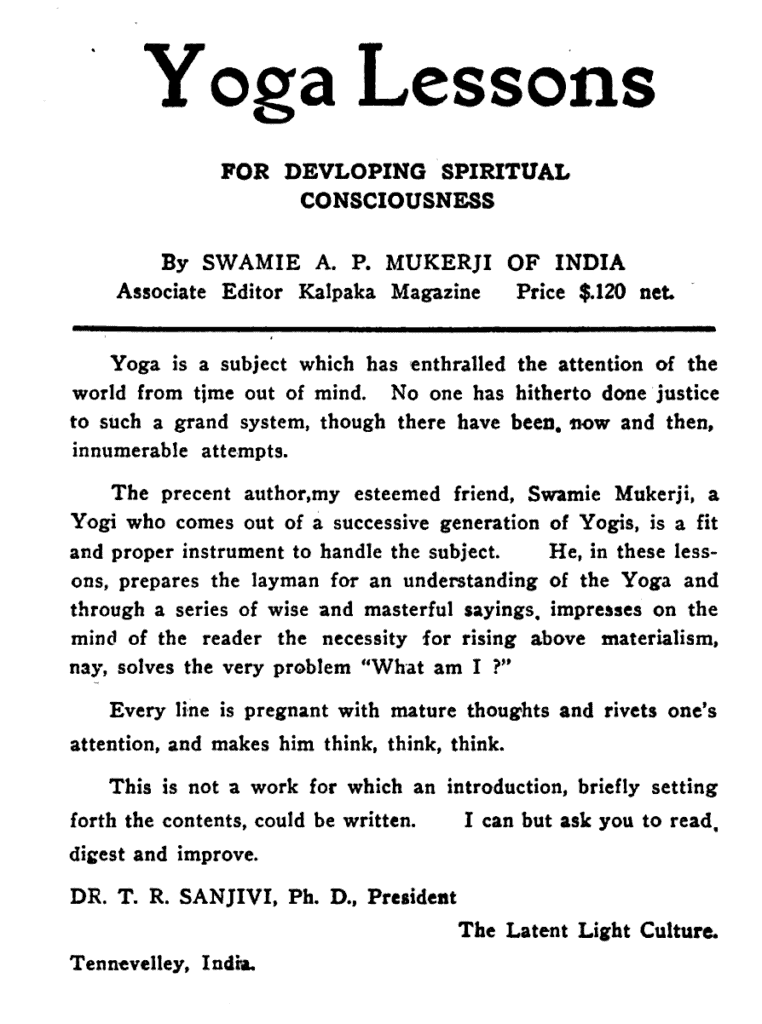
A. P. Mukerji Yoga Lessons ad
Swami A. P. Mukerji Biography
Swami A. P. Mukerji was an Indian spiritual teacher, author, associate editor of The Kalpaka, and member of the Latent Light Culture and South India Order. His writings played a key role in introducing traditional yogic philosophy to Western readers when yoga was still unfamiliar outside India. Instead of focusing on physical exercise, Mukerji described yoga as a complete philosophy centered on mental discipline, moral growth, and spiritual awakening. He highlighted willpower, concentration, character, and higher consciousness as the main goals of yogic practice.
Some of his most well-known books include The Doctrine and Practice of Yoga, Yoga Lessons for Developing Spiritual Consciousness, The Yogi Conception of Character Building, and The Yogi Role of Prayer. These early twentieth-century works gave readers practical guidance on meditation, concentration, visualization, breath control, prayer, and training the mind. Mukerji aimed to make classical yoga principles easy to understand for Western readers and show how they could be used in daily life.
A key idea in Mukerji’s philosophy was what he called Will-Force. He believed that a person’s willpower shapes their life, and that mental training helps people control both their inner urges and the world around them. Instead of seeing fate as unchangeable, Mukerji taught that people can shape their own character and future by working hard, thinking positively, and practicing self-control.
Mukerji also stressed that people need to rise above their material desires to reach higher spiritual awareness. He saw life as a journey where every experience helps the soul grow. By practicing meditation, living ethically, and learning to control their thoughts, people can move beyond fear, selfishness, and illusion, and become more aware of the deeper spiritual reality behind daily life.
Mukerji combined traditional Vedantic philosophy with practical ways to develop the mind. His ideas were similar to those of the New Thought movement, but he stayed true to classical yoga teachings. His books were some of the first to introduce Indian spiritual philosophy to Western readers and are still valued today for their focus on self-mastery, building character, and developing spiritual awareness.
Related Research Articles
Herbert A. Parkyn’s Foundation in Eastern Philosophy
This article examines Dr. Herbert A. Parkyn's early study of Eastern philosophy and the network of individuals and ideas that helped lay the foundation for the Yogi Publication Society and its publishing program.
Who Was the Author Behind the Name “Bhikshu”? The Case of Swami Pareswara Bikshu vs. Charles Henry Allan Bennett
The identity of the author who wrote under the name Bhikshu remains an iunresolved question in the history of the Yogi Publication Society. The case of Swami Pareswara Bikshu vs. Charles Henry Allan Bennett.
Yogi Ramacharaka: The True Meaning and Origin of the Name
This article breaks down the hidden symbolism and meaning behind "Yogi Ramacharaka", the pen name that was created by the Yogi Publication Society and shows the allegory that reflected the ideas the books were…