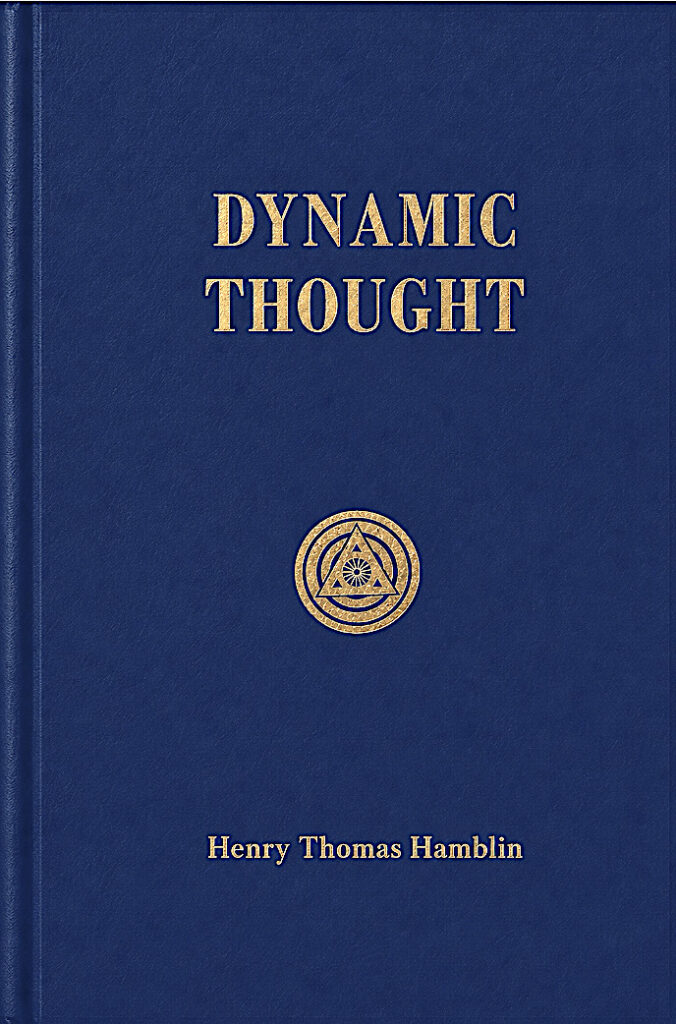
Dynamic Thought by Henry Thomas Hamblin is a 1917 course in mental training and self-development built around the power of thought, the conscious and subconscious mind, visualization, concentration, affirmation, mental healing, character building, personal influence, and the deliberate direction of thought toward health, success, and self-mastery. Hamblin presents thought as an active force that can be consciously directed until an inward mental conception passes into habit, action, character, and eventually the circumstances of life.
Henry Thomas Hamblin
The book belongs to the New Thought tradition, but it is also important to the history surrounding the Yogi Publication Society because Hamblin’s system brings together teachings that had already been developed and taught by Dr. Herbert A. Parkyn and his Chicago School of Psychology. Parkyn’s work had placed suggestion, auto-suggestion, the voluntary and involuntary operations of mind, mental influence, mental healing, concentration, and the deliberate formation of new habits of thought at the center of a system of mental training years before Hamblin published Dynamic Thought. Those teachings also became part of the intellectual foundation from which the YPS program developed. Hamblin’s book is therefore useful not only as a later New Thought course in its own right, but as another example of how extensively this combination of suggestion, subconscious mental action, directed thought, visualization, self-mastery, and mental healing had entered the mental-science literature by the 1910s.
What Is the Purpose of Dynamic Thought?
Hamblin states six purposes at the beginning of the course. He intends to alter the student’s mental attitude, direct thought into channels leading toward success and health, arouse the inward Power, overcome undesirable habits, build character, and discover and develop what he calls the creative faculty. These goals are interconnected. A person fails, in Hamblin’s system, because consciousness has been organized around limiting beliefs, fears, habits, expectations, and mental images. Change the dominant pattern of thought and another personality gradually comes into existence. The student’s circumstances are expected to change because the person who encounters those circumstances has first been changed from within.
This is why Hamblin immediately warns the reader that merely reading the lessons will accomplish little. The course requires repeated mental action. From the first part he has the student picture a transformed version of himself as radiant, strong, healthy, successful, happy, confident, and master of his circumstances. Old weaknesses are mentally pictured as conquered. Obstacles are seen being overcome. The desired personality is to be made as definite as possible in imagination until it becomes the dominant inner model. Hamblin then gives the principle upon which the exercise rests. Whatever is created persistently in the mental world will eventually manifest in outward life. Mental imagery is therefore treated as an act of construction. The student is creating what Hamblin calls the future self.
Why Are Hope and Faith So Important?
The first stage of Hamblin’s training is built around hope, faith, confidence, and persistence. He treats confidence as an expression of an inward realization of power. The successful person believes that success is possible before external circumstances provide proof of it. Hope reaches toward the desired condition and faith maintains the mental position until it has been achieved. Fear and doubt perform the opposite function because they continually present the subconscious mind with images of defeat.
Hamblin is careful to prepare the student for the possibility that circumstances may temporarily appear to deteriorate after beginning the course. Old habits resist displacement. Friends may become difficult, business affairs may seem disturbed, and even health may appear temporarily unsettled. Hamblin interprets this as evidence that an internal reorganization has begun. Some of his explanation belongs to the occult vocabulary of his period, including references to psychic forces and hostile “entities,” but the working instruction remains the same. Do not return mentally to the old condition. Continue the new thought pattern until it becomes stronger than the old one.
The first lesson culminates in an affirmation declaring the old life dead and the new life of success, power, self-mastery, and accomplishment begun. The wording matters less than the mental transition it represents. Hamblin wants the student to create a definite dividing line between the former personality and the personality now being constructed.
What Does Hamblin Mean by the Inward Power?
The second part expands the system from individual psychology into metaphysics. Hamblin asks the student to contemplate the scale and order of the universe, from stars and solar systems down to atoms. Behind this order he places an infinite Power expressed through all things. Nature is governed by Universal Law because Universal Mind stands behind its visible manifestations. Human beings participate in this same Power because the mind within man is presented as an individualized expression of the Infinite Mind.
This becomes the metaphysical foundation for everything else in Dynamic Thought. Hamblin does not want the student to think of personal power as something generated by the ordinary conscious personality. The source is deeper. Human beings possess extraordinary possibilities because the subliminal or subconscious level of mind connects them with a universal source of intelligence and power. The task is to remove the fear, doubt, destructive habits, and limiting beliefs that prevent this deeper power from expressing itself.
The distinction is important because Hamblin’s language of self-confidence is never entirely secular. Confidence becomes faith because the individual is learning to rely upon a Power larger than the surface personality. The student does not have to manufacture infinite strength. The Power already exists. Mental training opens a channel through which it can operate.
What Is the Silence?
The Silence is one of the central exercises of the entire book. Hamblin instructs the student to practice it twice each day, ideally morning and evening. The senses are quieted, ordinary mental activity is reduced, and attention is withdrawn from external conditions. The purpose is to enter conscious contact with what Hamblin variously calls God, Divine Mind, Infinite Mind, the Principle of Good, First Cause, and the Absolute. He explicitly tells the reader that the particular name does not matter because these terms point toward the same underlying reality.
The Silence is more than relaxation. Hamblin treats it as the state in which the individual becomes receptive to a higher order of consciousness. Ordinary conscious reasoning is temporarily quieted so that inspiration and direction can arise from a deeper level. The student is encouraged to carry problems into the Silence without mentally struggling over them. Guidance should be allowed to appear. This explains Hamblin’s repeated warning against forcing circumstances. If the path is unclear, the student should wait until inward direction becomes definite.
The Silence also prepares the mind for affirmation, visualization, and meditation. A mental image impressed while attention is concentrated and external distractions have been reduced is believed to penetrate more deeply into the subconscious. Hamblin even describes a super-conscious realm in which the spoken word becomes creative. The sequence is therefore deliberate. Quiet the ordinary mind, establish contact with the inward Power, picture the desired condition, affirm it as real, and then allow it to work outward into conduct and circumstances.
How Does Visualization Create the Future Self?
Visualization is one of Hamblin’s most frequently repeated exercises. He tells the student to form a clear image of the person he wishes to become and then continually strengthen it. Health is pictured as radiant health. Success is pictured as already achieved. Weakness is replaced by strength, fear by confidence, indecision by purpose, and poverty-consciousness by abundance.
Hamblin’s point is not merely that optimistic pictures make a person feel better. He believes the mental image acts as a pattern from which the subconscious begins constructing. The individual gradually “grows into the likeness” of the image maintained before the mind. This is why he repeatedly warns against imagining sickness, disaster, poverty, failure, or humiliation. Every vivid destructive image is an instruction sent inward.
The desired image should also contain feeling. A cold repetition has little force. Hamblin tells the student to make the image glow with anticipation and confidence. The envisioned success should feel present and real. His method combines imagination, concentration, emotion, affirmation, and expectation into one mental act.
This places Dynamic Thought very close to the thought-force literature found throughout the earlier YPS catalogue. The Yogi Ramacharaka course advertised by YPS as early as 1903 included an entire lesson on “Thought Dynamics,” defined through the nature, quality, power, forms, and influence of thought, followed by lessons on human magnetism, psychic influence, healing, and mental development. Hamblin’s vocabulary is his own, but he is working within the same established field of mental causation and directed thought.
How Do Affirmations and Denials Work?
Affirmation gives verbal form to the mental image. Hamblin repeatedly instructs the student to affirm the desired state as a present reality. Instead of continually declaring that health, confidence, prosperity, or success will arrive at some remote future point, the student mentally identifies with those qualities now. The affirmation becomes a suggestion directed toward the deeper mind.
Denial performs the complementary operation. The student denies power to the unwanted condition and refuses to continue mentally feeding it. Sickness is denied while health is affirmed. Fear is denied while courage is affirmed. Failure is denied while success is mentally accepted. Hamblin does not mean that external facts should simply be ignored. His concern is the internal authority granted to them. An adverse circumstance becomes more powerful when the mind continually rehearses it, fears it, pictures its continuation, and identifies itself with it.
This is one of the clearest points of contact between Dynamic Thought and the history of suggestion. Hamblin’s affirmations function as deliberate self-suggestions. Repetition, concentration, feeling, imagery, expectation, and receptive mental states are used to establish an idea within the subconscious until that idea begins expressing itself automatically.
What Is the Relationship Between the Conscious and Subconscious Mind?
Hamblin eventually gives a more explicit psychological explanation of the process. The objective or conscious mind receives information through the senses, books, experience, observation, and reasoning. It evaluates ideas and accepts some of them as true. Accepted ideas pass into the subconscious, where they cease to be merely intellectual propositions and begin producing effects.
“Whatever is passed to the sub-conscious mind becomes translated into action,” Hamblin writes in Part VI. This is one of the major propositions of the book. The subconscious is therefore the mechanism through which repeated thinking becomes character and conduct. If destructive thoughts are habitually admitted, they generate destructive effects. If constructive thoughts become dominant, they create another pattern.
The conscious mind consequently has a gatekeeping responsibility. It must stop accepting every suggestion presented by circumstances, other people, newspapers, social opinion, fear, habit, and bodily sensation. Mental mastery begins when the conscious mind deliberately chooses what will be permitted to enter the deeper mind.
This distinction also explains why Hamblin places so much importance upon repetition. A single affirmation cannot necessarily overcome years of contrary conditioning. The old pattern has been reinforced thousands of times. The new pattern must likewise be repeatedly impressed until it becomes habitual.
How Does Hamblin Explain Character Building?
Character in Dynamic Thought is accumulated thought expressed through habit. A person’s habitual reactions are not fixed qualities handed down by fate. They are patterns that have become automatic through repetition. This makes character change possible.
Hamblin therefore approaches undesirable habits by refusing to strengthen them through continual attention. The student creates a mental image of the desired character, affirms its qualities, and begins behaving in accordance with that image. Each successful action strengthens the new mental pathway. Every time the old response is refused, it loses some of its authority.
This gives the book a strong emphasis on action. Hamblin repeatedly urges the student to seek difficult tasks as tests of developing power. Mental training that never enters conduct has failed. Confidence has to appear as courageous action. Concentration has to improve work. Self-mastery has to govern habits. A mental image of success must eventually produce purposeful behavior.
The process also explains Hamblin’s insistence upon high ideals. If the subconscious is continually being shaped by what consciousness admires, imagines, and contemplates, then the ideal chosen by the student becomes enormously important. He tells the reader to conceive the highest possible version of himself instead of using mental power solely for money or personal advantage.
Why Is Concentration Necessary?
Concentration supplies intensity to thought. A mind scattered among fears, desires, distractions, memories, and conflicting intentions cannot give sufficient force to a chosen idea. Hamblin’s exercises are designed to teach the student to hold one mental picture steadily enough for it to dominate consciousness.
Visualization itself becomes concentration training. The student who repeatedly attempts to hold a sharp image of health, achievement, or a desired quality learns to prevent attention from wandering. Hamblin explicitly notes in his preliminary instructions that visualization greatly increases the power of concentration.
Concentration also gives power to affirmation. Words mechanically repeated while the mind is elsewhere accomplish little within Hamblin’s system. Thought, word, image, desire, and feeling must converge upon the same object. When they do, the impression upon the subconscious becomes much stronger.
This combination of desire, concentration, visualization, and mental direction is also familiar from the YPS literature on personal magnetism and psychic influence. The recurring premise is that scattered thought is weak thought and concentrated thought becomes force.
How Does Hamblin Explain Health and Mental Healing?
Health occupies a large place in Dynamic Thought. Hamblin teaches that the body is strongly influenced by the habitual activity of mind and that destructive emotional states can produce destructive bodily effects. Fear, worry, resentment, pessimism, and continual expectation of illness are therefore treated as enemies of health.
His corrective method follows the same pattern used elsewhere in the course. The student denies sickness, affirms health, visualizes the body as vigorous and youthful, and refuses to dwell mentally upon symptoms. Hamblin tells the reader to maintain “a vision of glorious health and eternal youthfulness” and to affirm health with confidence rather than strain.
He connects healing with the inward Power as well. The body is not treated as an isolated mechanical object. It is an expression of life governed through deeper mental and spiritual forces. By quieting fear and bringing consciousness into harmony with Divine or Universal Mind, the student is supposed to allow the constructive forces of life to operate more freely.
These claims belong to the mental-healing teachings of Hamblin’s period and should be read historically as such, not as modern medical guidance. For the history of the YPS movement, however, their presence is significant. Mental healing, suggestion, thought force, and the relationship between mind and body had been central subjects within the Chicago School of Psychology tradition and subsequently appeared throughout the YPS and related New Thought literature.
What Does Hamblin Teach About Fear?
Fear is one of Hamblin’s principal enemies because it combines imagination, emotion, expectation, and suggestion in a destructive direction. A fearful person is already visualizing the unwanted event. The image is then reinforced emotionally, repeated mentally, and accepted by the subconscious.
The remedy is not merely telling oneself to stop being afraid. Hamblin replaces the entire mental process. The feared image is denied attention. A constructive image is substituted. Faith is cultivated. The individual identifies with inward Power and acts as though the feared limitation no longer controls him.
Fear also makes people vulnerable to external suggestion. A person who believes another individual possesses mysterious power over him has already created the mental condition through which that influence can operate. Hamblin’s defense is self-possession, confidence, refusal to accept the adverse suggestion, and recognition of the greater Power within.
Why Does Dynamic Thought Discuss Hypnotism and Mind Domination?
Part VII takes the book into one of its most revealing subjects. Hamblin begins by declaring that ordinary people regard thought as an insignificant flash of consciousness, while students of mind recognize thought as an immense force. He connects human thought with Universal Mind and argues that thought lies behind both individual creation and the visible universe. The subliminal mind of man and Universal Mind are, in his formulation, the same in essence though different in degree.
Having established the power of thought, Hamblin turns to its possible misuse. His lesson explicitly addresses hypnotism, mind domination, witchcraft, black magic, adverse suggestion, and methods of psychic defense. Knowledge gives power, he argues, and power can be directed constructively or destructively.
The moral dimension is important. Hamblin does not regard mastery as permission to dominate other people. Mental power should first produce mastery over oneself. Attempts to enslave another mind violate the higher law upon which genuine power depends and eventually injure the person who uses them.
His treatment also shows how closely the mental-science and occult vocabularies had converged by the time Dynamic Thought appeared. Suggestion, hypnotism, thought force, psychic influence, subconscious action, concentration, visualization, and Universal Mind can all appear within the same lesson because Hamblin sees them as different expressions of a common mental law.
What Is Dynamic Thought?
By Part VII Hamblin is prepared to give thought itself its largest meaning. Thought is no longer simply an internal psychological event. Universal creation begins in Mind, and human creation follows the same pattern on a smaller scale. Hamblin uses the old macrocosm and microcosm relationship to explain this. Universal Mind creates through thought. Human beings, as individualized centers of the same essential Mind, likewise possess creative thought.
This is the meaning behind the title Dynamic Thought. Thought is dynamic because it acts. It forms character, affects the body, determines behavior, influences relationships, directs attention, awakens latent abilities, and according to Hamblin participates in shaping circumstances. The uncontrolled thinker is pushed through life by inherited beliefs and external suggestions. The trained thinker chooses the ideas that will govern consciousness and deliberately builds his life around them.
This also explains the book’s movement from psychology into metaphysics. If Hamblin had treated thought solely as a psychological influence upon behavior, the system would stop at habit formation. His Universal Mind doctrine allows him to claim much more. The human subconscious is connected with a creative universal principle, so directed thought can reach beyond ordinary behavior into circumstances, inspiration, attraction, healing, and achievement.
How Does Hamblin Treat Success and Prosperity?
Success in Dynamic Thought begins with an internal state. The unsuccessful person may habitually expect defeat, hesitate, imagine difficulties, fear risk, and continually reinforce the idea that circumstances control him. Hamblin seeks to reverse that orientation. The student is instructed to picture success vividly and repeatedly, affirm it with confidence, and then act from the mental position of a successful person. Hamblin tells the reader to continue seeing success “with ever increasing distinctness and sharpness” and to put feeling, certainty, and joyful anticipation into the image.
Yet Hamblin does not advise reckless financial behavior. His preliminary instructions specifically warn students against hazardous speculation and against launching enterprises without sufficient capital while assuming mental power will magically guarantee success. If the way is unclear, wait. Guidance and opportunity should develop before action is taken. That qualification is important because it reveals what Hamblin means by constructive thinking. The mental image establishes direction. Inspiration helps identify the path. Action carries it into expression. Persistence sustains the process. Success does not excuse foolishness.
What Is the Creative Faculty?
The “creative faculty” introduced at the beginning of the course is the trained ability to originate an inner pattern and bring life progressively into conformity with it. Visualization gives the pattern form. Desire supplies emotional energy. Concentration holds it in consciousness. Affirmation expresses it verbally. Faith accepts it. The subconscious receives it. Action gives it physical expression.
This is the mechanism underlying almost every exercise in the book. Hamblin’s different teachings are therefore parts of one system. Health, character, success, habit change, prosperity, courage, and spiritual development all use essentially the same mental machinery.
His formula can be seen clearly in the opening exercise. The student first imagines the perfected self. That image is held persistently. The student then begins identifying with it. Thoughts inconsistent with the image are rejected. Actions increasingly correspond with it. Over time the inward model becomes outward character.
What Role Does Inspiration Play?
Hamblin distinguishes ordinary intellectual calculation from inspiration received when the surface mind becomes quiet. He repeatedly advises the student to listen inwardly and not allow later fear-based reasoning automatically to overthrow a clear intuitive direction.
This is another function of the Silence. Conscious thought is excellent for gathering information, comparing possibilities, and carrying out work, but Hamblin believes deeper intelligence becomes available when ordinary mental noise is suspended. The subconscious and super-conscious levels can then supply ideas that conscious reasoning could not have produced alone.
He warns that inspired guidance may initially appear foolish when judged according to conventional standards. This does not mean every impulse should be obeyed. Hamblin’s system calls for quiet receptivity, continued meditation, and confidence once genuine inward certainty has been reached.
How Does the Book Combine Mental Science and Spiritual Teaching?
Although Dynamic Thought begins like a success course, its deeper foundation is religious and metaphysical. Hamblin’s inward Power is inseparable from God or Infinite Mind. Mental mastery eventually means bringing the individual mind into harmony with universal intelligence.
This is why the course continually returns to ideals. The highest use of thought is not simply obtaining possessions. The student is supposed to become a more complete human being. Health, prosperity, confidence, concentration, and achievement become parts of character development.
The spiritual element also prevents Hamblin’s doctrine of thought power from becoming entirely egocentric. Personal will is strongest when it is aligned with what he regards as Universal Law. Inspiration is received through contact with the Infinite. Faith is confidence in both the inward self and the Power expressed through it.
That mixture of mental science and metaphysics places Dynamic Thought comfortably beside the Western esotericism, New Thought, mental healing, and thought-force literature surrounding the YPS.
How Does Dynamic Thought Relate to the Earlier YPS System?
For the YPS History Project, Dynamic Thought is valuable because Hamblin provides a later and unusually concentrated example of ideas that had already become central to the literature surrounding Parkyn, Atkinson, YPS, and their associated New Thought publishing world. This does not by itself establish that Hamblin copied a particular YPS book. It does show how established this combination of teachings had become by 1917.
The overlap begins with the division between the ordinary conscious mind and a deeper subconscious or subliminal mind. Hamblin’s conscious mind receives, judges, and admits ideas, while the subconscious converts accepted ideas into action. That makes suggestion one of the principal mechanisms through which personality can be altered. Repeated words, mental pictures, beliefs, expectations, and emotional states are all capable of becoming suggestions to the deeper mind.
This immediately recalls the earlier system of Herbert A. Parkyn and his Special Mail Course in Suggestive Therapeutics and Hypnotism. Parkyn had made the deliberate direction of suggestion and auto-suggestion central to his system long before Dynamic Thought appeared. Within the later New Thought literature, the same underlying mechanism could be expressed through affirmations, denials, visualization, concentration, mental imagery, and constructive thinking.
The correspondence becomes even clearer when Hamblin moves from subconscious training to thought power. The surviving YPS outline for the 1903–1904 Yogi Class Course includes “Thought Dynamics” as an entire lesson devoted to the nature, quality, power, forms, and influence of thought. It proceeds into human magnetism, healing, psychic influence, self-protection, and the deliberate development of mental and spiritual powers. Hamblin’s Dynamic Thought uses a less explicitly Yogi framework, yet its movement from thought control into health, influence, protection from suggestion, personal power, and spiritual realization follows much of the same territory.
There is also an instructive comparison with Theron Q. Dumont. The Dumont books make concentration, will, visualization, personal magnetism, mental influence, subconscious action, personality, and directed thought into a program of self-development. Hamblin uses many of these same components to build his own course. In both systems, mental force becomes effective when thought is definite, concentrated, emotionally energized, and sustained until it passes into action.
How Does Dynamic Thought Compare With the YPS Teaching of Thought Dynamics?
The similarity in terminology is worth noticing because “Dynamic Thought” and “Thought Dynamics” describe nearly the same central proposition. The YPS course defines Thought Dynamics through the nature, quality, and power of thought, thought forms, thought influence, and occult teachings concerning thought. Hamblin’s book makes dynamic thought the foundation for character, health, achievement, influence, and the awakening of inward power.
Both systems reject the idea that thought is merely passive. Thought acts upon the thinker first. It modifies emotion, nervous activity, bodily condition, habit, expression, and conduct. It can then affect other people through suggestion and influence. At the metaphysical level it participates in a larger universal field of mind.
Hamblin makes this explicit in Part VII when he describes thought as a force greater than other forces and presents the visible universe as the expression of Universal Mind. He then applies the macrocosmic principle to the human microcosm. The subliminal mind is of the same essence as Universal Mind, differing in degree. This gives his title its full meaning. “Dynamic” does not merely mean energetic thinking. It means thought regarded as an active causative power.
What Is the Central Teaching of Dynamic Thought?
The central teaching of Dynamic Thought is that human life can be deliberately reconstructed by changing the dominant activity of mind. Hamblin begins with the person who experiences himself as controlled by circumstances, habits, fears, sickness, doubt, and inherited beliefs. He then teaches that person to turn inward, discover a deeper source of power, create a new mental image, impress it upon the subconscious through visualization and affirmation, reinforce it through faith and concentration, and express it through persistent action.
The entire course can be followed as a movement from unconscious suggestion to conscious self-direction. At first the individual is being shaped by whatever ideas happen to reach him. He accepts appearances as truth, pictures failure, fears the future, repeats negative statements, and allows circumstances to determine his mental state. Hamblin’s trained thinker reverses the process. He decides what thoughts will be admitted, chooses the image that will dominate consciousness, enters the Silence, affirms the desired condition, refuses destructive suggestions, acts from the new mental position, and persists until the new pattern becomes habitual.
That is why health, prosperity, self-mastery, character, faith, concentration, visualization, mental healing, and spiritual development can all occupy the same course. Hamblin considers them applications of one principle. Thought takes an inner form, the subconscious accepts and develops that form, action follows it, and life gradually reflects the pattern habitually held in mind.
Dynamic Thought is therefore an important example of the mature mental-science system that had developed by the 1910s from the interconnected fields of New Thought, suggestion, mental healing, personal development, and occult thought force. For the history of the YPS collection and its intellectual surroundings, the book is especially useful because Hamblin gathers so many of these teachings into one sustained course. The conscious and subconscious minds, the creative word, affirmation, visualization, concentration, thought force, health, character, success, self-protection, Universal Mind, and the inward Power all become parts of a single method whose governing proposition is contained in the book’s title itself. Thought is dynamic because thought is expected to become action, character, circumstance, and life.
Henry Thomas Hamblin Biography
Henry Thomas Hamblin (1873–1958) was one of the leading British voices of the New Thought movement, combining mysticism, practical psychology, and spiritual philosophy into a system he called “Applied Right Thinking.” Born into modest circumstances in London, Hamblin overcame financial hardship to establish a successful career as an optician. Although materially prosperous, he later wrote that neither wealth nor business success brought lasting fulfillment. Personal struggles with depression, together with the death of his young son, prompted a lifelong search for spiritual truth that ultimately shaped both his philosophy and his writing.
Hamblin taught that the universe operates according to unchanging spiritual laws and that human thoughts are the primary cause of outward circumstances. Strongly influenced by the teachings of Dr. Herbert A. Parkyn and the Chicago School of Psychology, he emphasized the disciplined direction of thought, the power of suggestion, and the creative role of the subconscious mind. According to Hamblin, health, prosperity, happiness, and success arise naturally when an individual brings thought and character into harmony with what he called Cosmic Law. He stressed, however, that positive thinking alone was not enough; lasting achievement required disciplined action, perseverance, and moral character.
Beginning in the early 1920s, Hamblin became one of the most widely read New Thought authors in Britain. He wrote more than forty books and booklets, including the influential Within You Is the Power, and founded both the Science of Thought Institute in London and The Science of Thought Review, a magazine devoted to practical spiritual philosophy that remained in publication under successor titles for more than a century. His teachings reached an even broader audience through his regular contributions to Arthur F. Sheldon‘s Business Philosopher magazine, where he explored the relationship between spiritual principles, character development, and business success.
Over the course of his career, Hamblin’s writings gradually shifted from practical methods of self-improvement toward a deeper emphasis on direct spiritual realization and the experience of God’s indwelling presence. Through his books, magazines, and lectures, he became one of the principal figures responsible for introducing New Thought philosophy to readers throughout Britain and Europe.