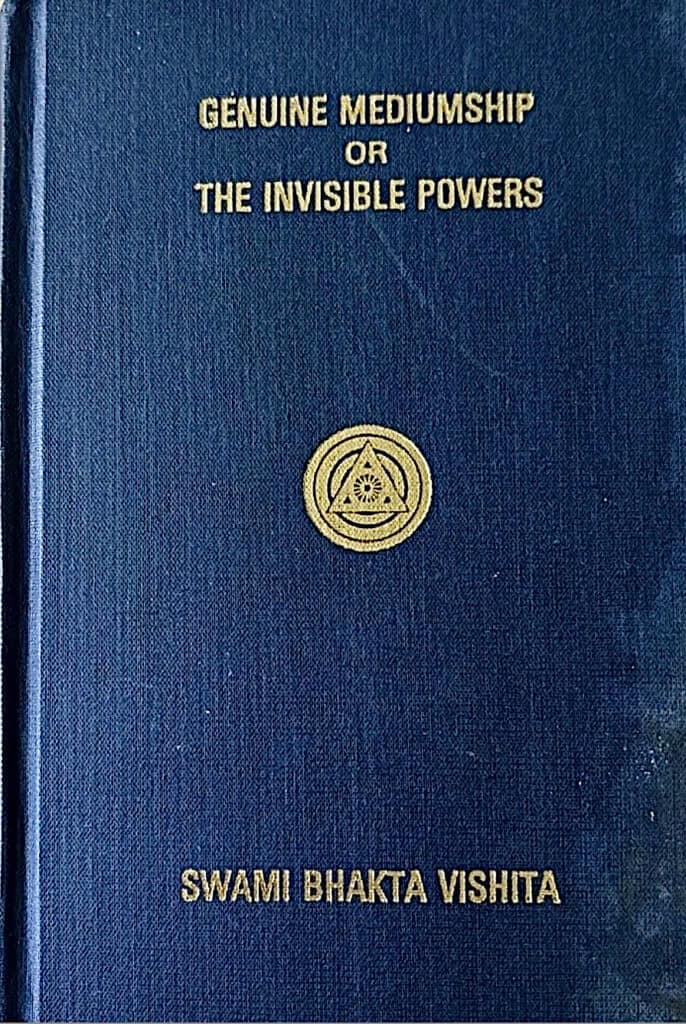
Genuine Mediumship, or The Invisible Powers is a 1919 book published under the pseudonym Swami Bhakta Vishita by the Advanced Thought Publishing Company of Chicago. It was later published by the Yogi Publication Society.
The book presents a system for understanding psychic perception and mediumship, beginning with its theory of nature, vibration, mind, and thought transmission before moving to telepathy, psychometry, crystal gazing, clairvoyance, spirit communication, séances, automatic writing, healing, materialization, and other forms of mediumistic phenomena. Its main argument is that Psychic phenomena belong to nature and operate according to its laws, even when those laws remain beyond ordinary sensory perception. The author attempts to remove mediumship from the realm of superstition and place it within an ordered study of what he calls “Nature’s Finer Forces.”
What Is Genuine Mediumship About?
Medium Eva Carriere, 1912
Genuine Mediumship explains psychic phenomena as different expressions of invisible forces working through the human mind, nervous system and what the book describes as finer planes of existence. Vishita begins with the senses and the physical world because he wants the reader to accept a simple premise before considering mediumship. Human beings perceive only a small portion of what exists around them. Sight and hearing themselves depend upon the ability of specialized organs to register limited ranges of vibration. From there he argues that other ranges may exist beyond the ordinary senses and that certain people possess or develop the ability to register them. This provides the foundation for everything that follows. Telepathy becomes the transmission and reception of mental vibrations. Clairvoyance becomes perception through higher senses. Psychometry becomes contact with impressions associated with a person or object. Mediumship becomes communication made possible when a sensitive person is able to receive influences from another plane of existence.
The book develops these subjects in a deliberate sequence. The first five parts deal largely with psychic powers that can occur between living minds or through expanded perception. Mediumship does not become the principal subject until Part VI. This division is important because Vishita repeatedly distinguishes telepathy and clairvoyance from communication with spirits. A telepathic impression received from another living person is not mediumship, and seeing a distant physical scene through clairvoyance is not the same phenomenon as perceiving or communicating with a discarnate intelligence. Once these distinctions have been established, the remaining sections explain mediumistic sensitivity, the conditions thought necessary for successful communication, the formation of development circles and the different phenomena traditionally reported in séances.
Nature’s Finer Forces and the Meaning of the Supernormal
The opening part of Genuine Mediumship attacks the word “supernatural” as a misleading description of psychic phenomena. Vishita argues that anything capable of producing an observable effect must in some sense belong to nature. Human knowledge may not yet explain the cause, but ignorance of a natural law does not place the event outside nature. He prefers the term “supernormal,” which he uses for faculties exceeding the ordinary human standard. He also distinguishes this from “abnormal,” which he associates with a deficiency or departure below the normal standard. In his model, a person possessing an additional mode of perception should be considered supernormal in the same way that a person capable of sight would possess an extraordinary faculty in a society composed entirely of blind people.
This becomes Vishita’s answer to the common objection that clairvoyance, telepathy or mediumistic sensitivity must be unnatural simply because most people do not consciously experience them. He proposes that the ordinary five senses represent only the present stage of human sensory development. Each sense opens a corresponding field of experience. Without an organ capable of receiving light, the visible world would effectively disappear from experience. Without hearing, an entire field of vibration would remain unknown. Vishita extends this reasoning to psychic perception. Higher senses, he argues, may disclose levels of nature that remain inaccessible to ordinary sensory consciousness.
Vibration provides the mechanism through which he explains this invisible universe. The physical senses register only certain ranges, while other vibrations pass through the environment without entering ordinary consciousness. The book repeatedly compares psychic perception with developments in electricity, radio, light and other invisible physical forces. These comparisons allow Vishita to describe unseen planes without treating them as remote locations separated from the physical world. Several planes can occupy what appears to be the same space while remaining inaccessible to one another because each exists at a different vibratory rate. The person capable of psychic perception has become sensitive to a range that most people fail to register.
How Does Vishita Explain Mental Vibrations?
Part II moves from the general theory of vibration to the mind itself. Vishita introduces the Hindu term Chitta, or mind-substance, as the medium associated with thought, emotion and desire. Mental activity creates vibration, and those vibrations can radiate beyond the individual who produces them. Thought Force, Mental Influence, Telepathy and Thought Transference are presented as different manifestations of the same underlying process.
The human organism is compared to a wireless instrument capable of transmitting and receiving. The brain functions as a center through which mental energy is expressed, while Vishita gives special attention to the pineal gland as an organ associated with psychic reception and transmission. He draws repeatedly upon technological analogies familiar to readers of the period. Electrical energy can be transformed into light, wireless equipment can send information without a visible connection, and vibrations beyond direct human perception can still carry energy and information. Mental transmission is presented as another instance of the same general principle.
The crucial requirement for reception is attunement. A receiving mind must become responsive to the vibratory rate of the transmitting mind or plane. Vishita compares this with tuning a wireless receiver to a particular signal. This idea of psychic attunement becomes one of the central concepts of the book because it later provides his explanation for telepathy, clairvoyance and mediumship. Development does not create an entirely foreign faculty. It increases sensitivity and teaches the individual to establish the mental conditions under which finer impressions can enter consciousness.
Thought Transference, Telepathy and Mental Influence
Part III divides thought transference into involuntary and voluntary forms. Vishita states that people continuously send out “thought-waves,” whether they intend to influence anyone or not. Strong thoughts, emotions and desires create correspondingly powerful mental vibrations, which may affect other minds capable of responding to them. Groups can create collective mental atmospheres, and repeated thoughts can form what the book calls mental whirlpools and mental tidal waves.
1872 photo of a seance.
This section comes very close to the field of suggestion, although Vishita explains the process through a psychic and vibrational vocabulary. A person may enter an environment and experience an unexplained mood because the mind has responded to the prevailing mental atmosphere. Fear can spread through groups. Strong personalities may impress their mental states upon others. Repeated collective thought can establish an influence that continues to affect people who enter its range.
Voluntary mental influence is treated with more caution because it raises the question of deliberate control. Vishita divides its use into what he calls White Magic and Black Magic. The distinction rests on intention and purpose. Mental power used to help, strengthen or benefit another person belongs to the first category, while attempts to dominate, injure or exploit another belong to the second. Older beliefs concerning witchcraft, sorcery and Voodoo are interpreted through this theory of thought influence, with fear itself playing an important part. Vishita argues that fear creates receptivity to hostile suggestion and mental influence, while confidence and refusal to accept the feared influence provide protection.
The discussion then turns to experimental telepathy and “mind reading.” Vishita describes exercises in which one person acts as the sender and another as the receiver, beginning with simple impressions and moving toward more definite objects, movements or ideas. The familiar “willing game,” in which a participant attempts to discover an object or perform an action mentally selected by others, is treated as a useful elementary exercise. The reader is encouraged to develop receptivity gradually and to distinguish genuine impressions from guesses, imagination and expectations.
This material belongs to the same historical field explored years earlier by Herbert A. Parkyn and the Chicago School of Psychology, where mind reading, suggestion, mental influence and the reception of involuntary impressions had already been subjects of instruction and experiment. Vishita’s treatment carries those subjects into the occult framework of vibrations, psychic sensitivity and higher planes.
What Does the Book Mean by Clairvoyance?
Part IV carefully defines clairvoyance before teaching methods for its development. Vishita acknowledges that the term had acquired several meanings and cites definitions used within psychical research. For this book, clairvoyance means acquiring information supernormally without simply reading the mind of another person. This distinction separates clairvoyance from telepathy and also from communication with spirits.
Psychometry is presented as one form of clairvoyant perception. An object associated with a person, place or event is believed to provide a psychic link through which the sensitive person may receive impressions. Vishita compares the process to following a scent. The object allows the psychic faculties to establish contact with the person or conditions associated with it. He discusses the use of letters, jewelry and other personal objects, along with cases in which psychometry had reportedly been used to locate missing people, investigate crimes or perceive underground conditions.
The book then turns to crystal gazing. The crystal itself is not described as containing the vision. It provides a neutral visual field that helps quiet ordinary sensory activity and allows impressions from the deeper or psychic levels of consciousness to become visible. Vishita describes the appearance of a “milky mist,” followed in some cases by forms, scenes or images. He gives directions concerning lighting, physical comfort, length of sittings, placement of the crystal and the presence of other people. Patience is stressed repeatedly because forcing the faculty is said to interfere with its natural development.
Direct clairvoyance represents a stage at which the external aid is no longer necessary. The individual may receive pictures during quiet reverie, altered states of consciousness or moments when ordinary mental activity has subsided. Trance can accompany clairvoyance, though the book does not make trance a requirement. The desired condition is one of receptive attention in which psychic impressions can reach conscious awareness without being overwhelmed by ordinary thought.
Clairvoyance of the Present, Past and Future
Part V organizes clairvoyance into three major forms. Present clairvoyance concerns things existing within the present but hidden from ordinary sight. Space clairvoyance concerns distant places and events. Time clairvoyance concerns the past or future.
Present clairvoyance includes perception of the human aura, which Vishita describes as a field surrounding the body. He discusses the Prana aura, auric colors and thought forms, assigning different appearances to different mental and emotional states. Some forms of clairvoyant perception are described almost as extensions of physical sight, including microscopic vision and an “X-Ray Sense” through which hidden objects or internal conditions might be perceived.
Space clairvoyance is explained as a kind of psychic telescope. Distance is no longer the limiting factor that it is for the physical senses because the clairvoyant faculty is believed to operate through another vibratory range. A person may become psychically attuned to a distant place and receive impressions of scenes occurring there.
Past-time clairvoyance leads Vishita into one of the book’s more distinctly occult teachings, the Akashic Records. Events are said to leave enduring impressions upon the finer substance of nature. The clairvoyant who reaches the appropriate level of perception may read these records as a kind of “Memory of Nature.” Vishita uses physical analogies to make the concept intelligible. Light arriving from a distant star shows the star as it existed in the past because the image has required time to travel. In a comparable way, he proposes that impressions of earthly events may persist on finer planes long after the physical events have ended.
Future clairvoyance presents a more difficult problem. Vishita first separates true future vision from subconscious prediction. A mind may perceive existing causes and unconsciously calculate their probable effects, producing an apparently prophetic impression without actually seeing the future. Genuine future clairvoyance is connected with the Oriental conception of time and what the book calls the “Eternal Now.” Past, present and future, from this perspective, belong to a larger reality in which the ordinary human experience of successive time is only one mode of perception.
What Is Mediumship?
Only after establishing the book’s theories of vibration, telepathy and clairvoyance does Vishita turn directly to mediumship in Part VI. Mediumship is defined through communication between persons in physical life and intelligences existing after bodily death. The medium acts as the sensitive instrument through which this communication becomes possible. Vishita places the phenomenon within a long historical tradition and connects modern Spiritualism with older religious accounts of prophecy, visions, apparitions and communication with unseen intelligences.
The central claim of this part is personal survival after death. Mediumship is valued because it is presented as evidence that individual consciousness continues after physical death. Vishita discusses modern Spiritualism sympathetically and treats its communications as attempts to bridge the physical and spirit planes. The messages may be incomplete because communication across different conditions of existence is considered difficult, yet even fragmentary communication is treated as evidence that consciousness survives.
Mediumistic ability depends heavily upon sensitivity and attunement. Some individuals naturally respond more readily to impressions from the spirit plane, while others may develop the capacity. Vishita warns against interpreting mediumship as the surrender or destruction of individuality. The desired relationship is cooperation between the medium and the communicating intelligence. The medium supplies sensitivity, mental receptivity and, in some phenomena, psychic force. The spirit supplies the directing intelligence.
Psychic Force, Prana and the Conditions of Mediumship
Part VII examines the conditions believed necessary for mediumistic phenomena. Vishita separates physical phenomena from mental phenomena. Physical manifestations include movements, sounds and other effects upon matter. Mental manifestations include impressions, speech, writing and ideas received through the consciousness of the medium.
Several names are discussed for the force believed to support physical manifestations, including psychic force, human magnetism, “Zo-ether” and Prana. The terminology varies between schools, but Vishita treats these names as attempts to describe a subtle energy associated with the human organism. A medium may provide this energy while the communicating intelligence directs it toward a particular manifestation.
Trance receives careful treatment because Vishita rejects the idea that all genuine mediumship requires complete unconsciousness. Some mediums remain conscious and receive impressions directly. Others enter varying degrees of trance. Automatic writing and inspirational speaking can occur without complete loss of consciousness. The determining factor is the degree to which the medium’s ordinary mental processes recede enough to allow another stream of impressions to become dominant.
Spirit suggestion becomes an important concept in this section. A communicating intelligence may impress an idea upon the receptive mind of the medium, who then experiences it as an impulse, image, phrase or complete train of thought. Psychic attunement determines how clearly that impression is received. This model closely resembles the earlier discussion of thought transmission, with the major difference being the proposed source of the communication.
Vishita also addresses fears that mediumship necessarily damages the personality. Properly developed mediumship, he argues, can strengthen the individual when communication occurs with intelligent and constructive influences. He quotes Spiritualist writers who describe mediumship as capable of stimulating thought and moral development. The book even connects séance phenomena with biblical accounts of lights, sounds, automatic writing, speaking in tongues and other unusual manifestations, presenting modern mediumship as another appearance of phenomena recorded throughout religious history.
How Does Vishita Say Mediumship Should Be Developed?
Part VIII is one of the book’s most instructional sections. Vishita begins from the premise that psychic sensitivity exists in varying degrees throughout humanity. Many people may already experience impressions from others, including influences attributed to the spirit plane, without understanding their source. Some may be unusually sensitive to emotional environments and appear erratic because they have never learned to control that sensitivity. The answer offered by the book is knowledge, discipline and self-control.
Natural ability should unfold gradually. Vishita warns repeatedly against forcing results or demanding spectacular manifestations too soon. Concentration is important because the mind must learn to become steady enough to recognize subtle impressions. An aspirational attitude is also encouraged, meaning that the individual should approach development with serious motives and a desire for genuine knowledge instead of curiosity or a hunger for sensational experiences.
The principal method recommended for systematic development is the development circle. A small group meets regularly under harmonious conditions, usually at a consistent time and place. The sitters form the psychic environment in which a sensitive member may gradually develop mediumistic ability. Regularity is considered valuable because it establishes what Vishita describes as lines of communication between the circle and the spirit side.
Communication may begin with simple signals. Raps or table movements can be assigned meanings, allowing yes-and-no responses or alphabetic messages. As sensitivity increases, other forms may appear. Vishita cautions against changing members constantly, introducing hostile or disruptive personalities, demanding tests too early or attempting to force a particular manifestation. Development should determine the form of mediumship naturally.
Why Does the Mental Atmosphere of the Circle Matter?
Part IX examines the relationship between the medium, the sitters and the communicating spirits. Vishita treats a séance as a cooperative psychic system in which every participant contributes to the conditions. The mental atmosphere of the sitters can assist or disrupt the medium. Antagonism, fear, ridicule, emotional disturbance or excessive demands may introduce what the book calls a discord note.
The medium is compared to a psychic telephone system. The analogy allows Vishita to explain incomplete messages, confused wording and interruptions without assuming that every failure disproves the communication. A telephone can carry a message imperfectly because of trouble at the transmitting end, receiving end or along the connection. In mediumship, he proposes similar possibilities. The spirit may have difficulty communicating, the medium may translate impressions imperfectly, or the sitters may disturb the conditions required for reception.
Vishita does not recommend unquestioning acceptance of every claimed spirit identity. Identification should rest upon recognizable information, memories, personality traits or facts unknown to the medium. He also warns that mischievous or deceptive intelligences may claim famous identities. A grand historical name is no guarantee that the claimed personality is actually communicating.
The true purpose of mediumship, in the book’s view, is communication and knowledge. Spectacular phenomena have value when they establish the existence of forces or intelligences beyond ordinary perception, yet the pursuit of marvels for entertainment can distract from the larger purpose of the work.
What Happens in a Development Circle?
Part X gives a detailed account of the phenomena that may arise as a circle develops. Early indications can include unusual sensations, raps, table movements and flashes of impression. A code can then be established so that physical signals carry definite meanings. Ouija boards and similar devices are treated as mechanical aids through which unconscious or spirit-directed movements may form words and messages.
Trance and inspirational mediumship receive considerable attention. Vishita describes varying degrees of trance, from light influence to conditions in which the medium appears almost completely controlled by another intelligence. Speaking mediumship may develop when thoughts are impressed upon the medium and expressed verbally. In lighter forms, the medium may remain aware of what is being said while feeling that the ideas arrive from an external source. In deeper forms, consciousness of the event may diminish.
Identification remains one of Vishita’s strongest concerns. Communications gain evidential value when the alleged spirit recalls private incidents, identifies objects, refers to forgotten events or supplies information that can later be verified. Claims from supposed historical personalities require much greater caution because they are difficult to prove and invite deception or self-delusion.
The book also warns against “spirit jokers” and fraudulent claims of identity. The existence of mediumship does not mean that every message deserves belief. The same reasoning and judgment used in ordinary life should continue to operate when dealing with claimed communications from another plane.
Automatic Writing, Healing and Materialization
The final part expands the discussion into what Vishita calls the higher spirit manifestations. Spirit-assisted psychometry and clairvoyance occur when the medium’s own psychic faculties are believed to be strengthened or directed by a discarnate intelligence. Writing mediumship occurs when words are produced through the hand of the medium, sometimes with conscious awareness and sometimes automatically. Vishita distinguishes automatic writing from inspirational writing according to the degree of conscious participation.
The planchette is presented as another device for writing communication. The hands rest upon a movable instrument carrying a pencil, and movements produce written messages. As with the Ouija board, the instrument itself possesses no special power. It serves as a physical means through which impulses can be translated into visible movement.
Healing mediumship is explained through the idea that spirit forces may act through the medium to influence another person. Here the book’s language of psychic force, magnetism and Prana again becomes important. The medium acts as a channel through which healing energy or influence is directed.
Materialization occupies one of the most extraordinary sections of the book. Vishita accepts reports that spirit forms can temporarily acquire visible or tangible appearance through substance or energy drawn from the medium and the séance environment. He discusses spirit cabinets, phosphorescent appearances, partial forms and complete materializations, along with the conditions traditionally used in materializing séances. The book treats such manifestations as physical phenomena requiring a supply of psychic force from living participants.
Other manifestations include trumpet mediumship, musical instruments apparently played without visible human contact, independent slate writing and spirit paintings. Vishita presents these as different ways in which an unseen intelligence may produce physical effects through a mediumistic source of energy. Throughout these discussions he returns to the same warning given earlier in the book. Phenomena should be observed carefully, development should proceed slowly, and sensational results should never replace judgment.
The System Behind Genuine Mediumship
The eleven parts of Genuine Mediumship form a single progression from invisible natural forces to conscious communication with an invisible world. Vishita begins with vibration because the entire argument depends upon the possibility that realities can exist beyond the range of ordinary sensation. He then moves to mental vibration because thought must be capable of transmission before telepathy can be explained. Telepathy leads to higher sensory perception, which leads to clairvoyance. Clairvoyance establishes the possibility of perceiving beyond ordinary space and time. Once those principles have been accepted, mediumship is introduced as another form of contact in which the source of the impression is an intelligence existing outside physical embodiment.
This organization also explains why so much of Genuine Mediumship concerns subjects that at first seem separate from Spiritualism. Telepathy, thought influence, psychometry, the aura, crystal gazing and clairvoyance establish the psychic machinery Vishita later uses to explain mediumship. The same ideas recur under different conditions. Vibration carries influence. Attunement makes reception possible. Concentration steadies the receiving mind. Sensitivity allows impressions to enter consciousness. Psychic force supplies energy for physical manifestations. Development increases the ability to use these faculties deliberately.
For the history of the Yogi Publication Society network, the book is also a strong example of how material associated with Yogi philosophy, psychical research, mental influence and Western Spiritualism could be brought together within one system. Terms such as Prana, Chitta and the Akashic Records sit beside wireless telegraphy, the Society for Psychical Research, séance methods and modern experiments in telepathy. The result is a book that presents ancient occult teachings and early twentieth-century psychical research as different approaches to the same invisible laws.
Published in 1919, Genuine Mediumship also shows how far the Swami Bhakta Vishita series had developed beyond a simple introduction to psychic phenomena. It is an extensive manual of nearly 300 pages that attempts to explain the entire process from the first mental vibration to complex claims of spirit materialization. Its recurring message is that the invisible powers described throughout the book are lawful forces of nature and that human beings possess latent faculties capable of responding to them. Mediumship represents the most developed expression of that principle in the book, bringing together sensitivity, thought transmission, psychic perception, attunement and the claimed survival of consciousness after death into a single theory of communication between the visible and invisible worlds.
Related Research Articles
From Mental Breakdown to Atkinsonia: How Herbert A. Parkyn Turned William Walker Atkinson into a New Thought Phenomenon
This article explores how Dr. Herbert A. Parkyn's treatment, mentorship, and network transformed William Walker Atkinson from mental breakdown into the most prolific and influential writer in the New Thought movement.
The Chicago School of Psychology: The Birthplace of Suggestive Therapeutics in America
Herbert A. Parkyn’s Chicago School of Psychology was the first school in America to teach Suggestion and many of its graduates would become leading voices in New Thought, including William Walker Atkinson.
The Sacred Geometry of the Yogi Publication Society Logo
This article examines the Yogi Publication Society logo and its sacred geometry meaning, comparing it with Hindu, Hermetic, Rosicrucian, Masonic, and Theosophical traditions to show the intention behind the publishing network.
The Yogi Publication Society started in the offices of Herbert A. Parkyn on Cottage Grove Ave.
This article shows that 4000 Cottage Grove Avenue was where the Yogi Publication Society began and served as the main hub for Dr. Herbert A. Parkyn's publishing, educational, and mail-order activities.
Yogi Ramacharaka: The True Meaning and Origin of the Name
This article breaks down the hidden symbolism and meaning behind "Yogi Ramacharaka", the pen name that was created by the Yogi Publication Society and shows the allegory that reflected the ideas the books were…