The Secret Wisdom of the Qabalah: A Study in Jewish Mystical Thought by J. F. C. Fuller was originally published in 1937 and was later issued by the Yogi Publication Society in 1976. Fuller presents the book as a speculative investigation into what he believes to be one of the central mysteries concealed within the Qabalah, not as a comprehensive history or elementary handbook of Qabalistic teaching. His central concern is the relationship between unity and division, equilibrium and disequilibrium, God and humanity, creation and destruction, good and evil, and the descent of the Divine into manifestation followed by its return toward an original state beyond differentiation.
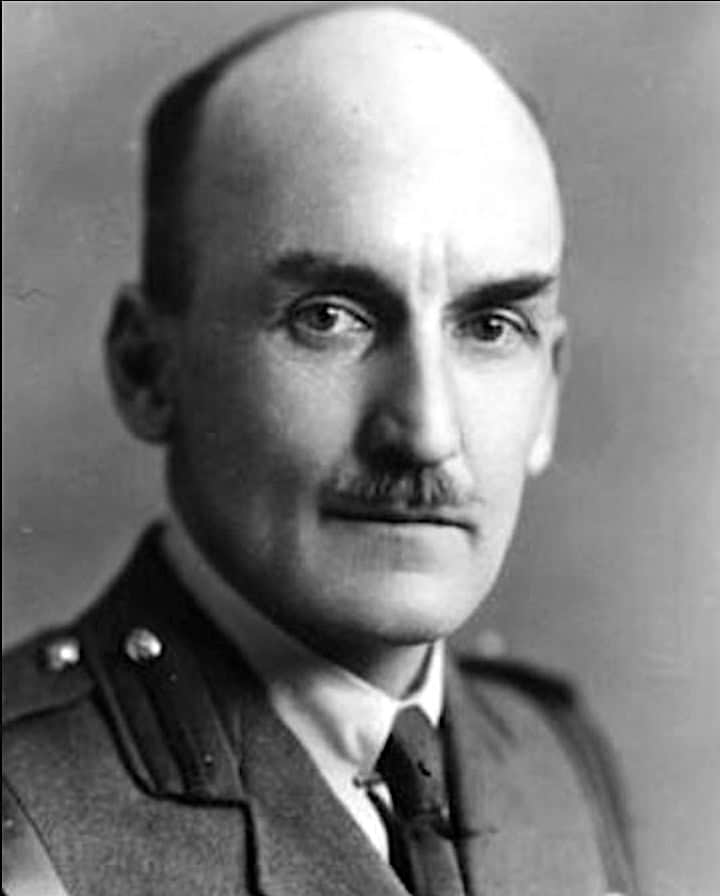
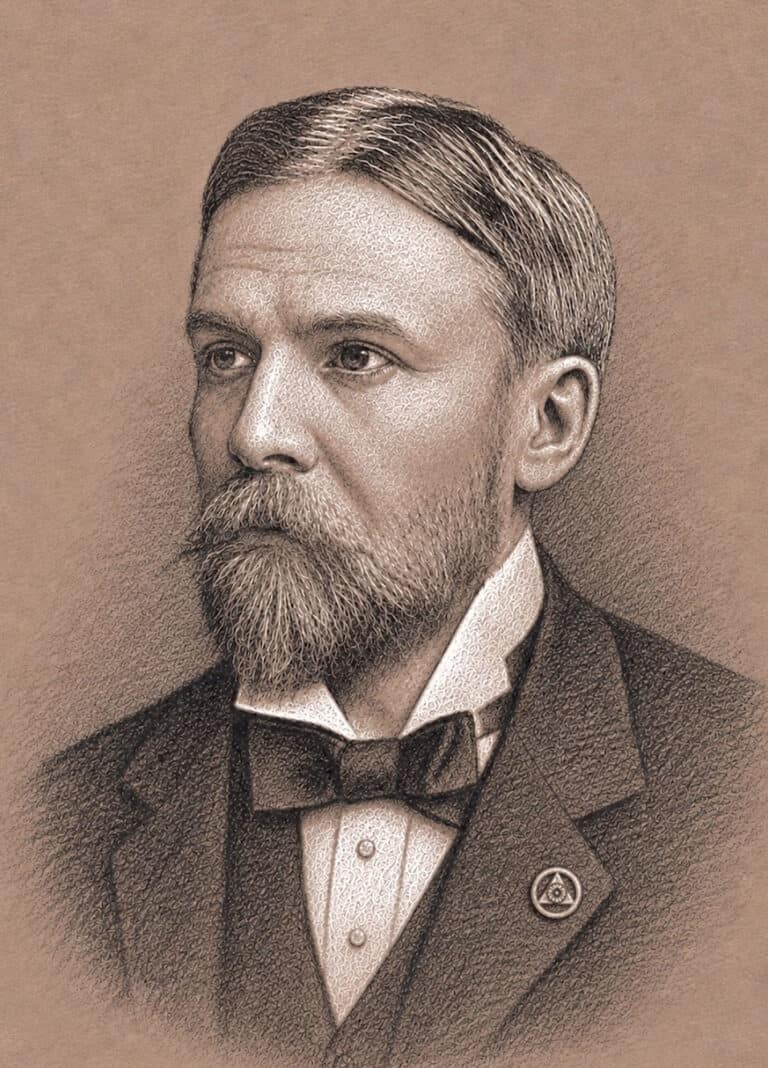
John Frederick Charles Fuller
The 1976 Yogi Publication Society edition placed Fuller’s study within a catalog that had long included works on Hermeticism, Western esotericism, Christian mysticism, alchemy, Yoga, occult philosophy, and comparative religion. Fuller’s own preface makes the scope clear: he is searching for a concealed doctrine that he believes may provide a key to the rest of Qabalistic symbolism.
The book is less of a conventional history of Jewish mysticism than an attempt to reconstruct a concealed metaphysical system. Fuller interprets the Tree of Life, the Sephiroth, Tetragrammaton, Adam Qadmon, Satan, the serpent, sexual polarity, the Fall, and the Messiah as different expressions of a single cosmic process. Creation is a movement from unity into multiplicity. Multiplicity produces opposition and conflict. The apparent opposition of good and evil becomes necessary to experience and transformation. Humanity occupies a decisive position because consciousness is the arena in which divided forces can be reunited. Redemption, in Fuller’s interpretation, includes the restoration of the divided Divine through humanity. By the final chapters, the Qabalah has become for Fuller a theory of mystical consciousness in which the initiate attempts to transcend ordinary three-dimensional perception and experience a state where opposites cease to appear contradictory.
Fuller also treats symbolism itself as fundamental to mystical knowledge. Human reason cannot directly comprehend the infinite, so religious and occult systems construct symbols that allow the finite mind to approach what lies beyond it. The Tree of Life is perhaps the greatest example in the book: it is simultaneously a map of creation, consciousness, polarity, spiritual descent, spiritual ascent, and the structure of the Divine Man. Fuller repeatedly compares Qabalistic symbolism with Egyptian religion, Greek philosophy, Christianity, Hindu philosophy, Hermetic symbolism, alchemy, magic, and modern science because he believes these traditions preserve different symbolic expressions of related mysteries. This comparative method is one of the defining features of The Secret Wisdom of the Qabalah and explains why Fuller begins with the Jewish tradition but continually moves beyond its boundaries.
“The Beings who live Below, say that God is on High; while the Angels in Heaven, say that God is on Earth.”-ZOHAR
What Does Fuller Mean by the “Secret Wisdom” of the Qabalah?
Fuller begins with a deceptively simple problem: existence is mysterious. Human beings know that they exist, but the ultimate source and nature of existence remain beyond ordinary reason. Whether that mystery is called God, Reality, Nature, the Unknowable, or Zero does not solve the problem. Changing the word changes the symbol, not the mystery represented by it. Human intellectual life is symbolic. Thoughts, theological doctrines, scientific models, myths, mathematical concepts, and religious images are finite representations constructed around something that cannot be completely contained within them.
This distinction between the symbol and what it represents is fundamental to everything that follows. Fuller argues that symbols can lose their effectiveness as human consciousness and knowledge change. A cosmological image capable of awakening religious wonder in one civilization may become unbelievable to another. The underlying mystery has not necessarily changed; the intellectual language through which people approach it has. Fuller even extends the argument to science. The replacement of an older material conception of indivisible atoms by newer descriptions involving waves does not eliminate mystery. It changes the conceptual symbols through which the physical universe is understood.
For Fuller, a successful symbolic system establishes equilibrium between the finite human intelligence and the mystery beyond it. When the symbols remain convincing, they provide meaning, orientation, and what he repeatedly calls wonder. When they cease to function, the equilibrium collapses. Fuller connects this breakdown with social and spiritual disintegration. His introduction is an argument about civilization as well as Qabalah: societies require symbols capable of connecting ordinary life with realities or ideals greater than individual existence.
Why Was Mystical Knowledge Kept Secret?
This leads Fuller directly to the traditional secrecy surrounding esoteric teaching. He argues that ancient initiatory systems did not necessarily conceal knowledge simply to create privileged priesthoods. Their secrecy reflected the belief that knowledge capable of transforming one person could destabilize another person who was intellectually or psychologically unprepared for it. Fuller compares transcendental knowledge with advanced mathematics: something may be perfectly intelligible to a trained mathematician while remaining effectively incomprehensible to most people. The fact that knowledge exists does not mean every person can understand it in the same manner.
He applies this principle to religious initiation. Sacred traditions used allegory, myth, number, ritual, and symbolism to disclose different levels of meaning according to the capacity of the student. Fuller interprets the distinction between an outward teaching and an inward teaching as central to ancient religion and associates it with Jewish mysticism, Christianity, Egyptian initiation, Greek philosophy, and other currents of Western esotericism. The Torah itself can be approached as a narrative, law, symbolic text, or concealed mystical teaching depending upon the reader.
Fuller considers this distinction important to the Qabalah because Qabalah means “reception”: something received or transmitted. It was traditionally understood as an inherited body of secret knowledge. Fuller describes this knowledge as dispersed through the Torah, Talmud, Mishnah, Midrashim, Zohar, and numerous other writings. Its subjects include God, creation, the destiny of the universe, humanity, good and evil, souls, angels, demons, numbers, letters, complementary forces, and the relationship between spiritual and material existence.
What Is the Qabalah According to Fuller?
Fuller divides the Qabalah broadly into theoretical and practical branches. The theoretical side includes symbolic, dogmatic, and speculative teachings, while the practical side enters the territory traditionally associated with magic. His own attention is directed primarily toward the speculative or metaphysical Qabalah because he believes it contains a philosophy of the evolution, involution, and devolution of the universe.
The outward narratives of scripture are not the final object of interpretation. Fuller repeatedly uses the image of clothing: the visible story is the garment covering a deeper body, while beneath the body is the soul. The initiate attempts to penetrate progressively through these coverings toward the mystery concealed within them. The Zohar becomes important because Fuller regards it as the great storehouse of Qabalistic symbolism, even while acknowledging the uncertainty surrounding its authorship and historical development.
Where Did Qabalistic Ideas Come From?
The Winged Wand of Egypt
Fuller does not portray the Qabalah as an intellectually isolated Jewish creation. He describes it as an extraordinarily absorptive tradition that incorporated ideas and symbols encountered across centuries. He finds parallels or influences from Egypt, Babylonia, Chaldea, Greek philosophy, Hinduism, the Vedas, Upanishads, Bhagavad Gita, Vedanta, and Tantra. He even characterizes the Qabalist provocatively as an “inveterate plagiarist,” meaning that Qabalistic tradition continually absorbs external ideas and reorganizes them within its own symbolic framework.
For Fuller this capacity is a strength as much as a historical complication. The Qabalah becomes a universal symbolic machine capable of translating different religious and philosophical systems into corresponding patterns. Egyptian, Greek, Jewish, Christian, and Indian symbols can be placed beside one another because Fuller believes they repeatedly express relationships between active and passive forces, unity and multiplicity, masculine and feminine, descent and ascent. His comparisons with Indian religion also make the book a natural companion within the later YPS catalog to works devoted to Yogi philosophy and authors such as Swami Vivekananda, though Fuller develops his own interpretation and vocabulary.
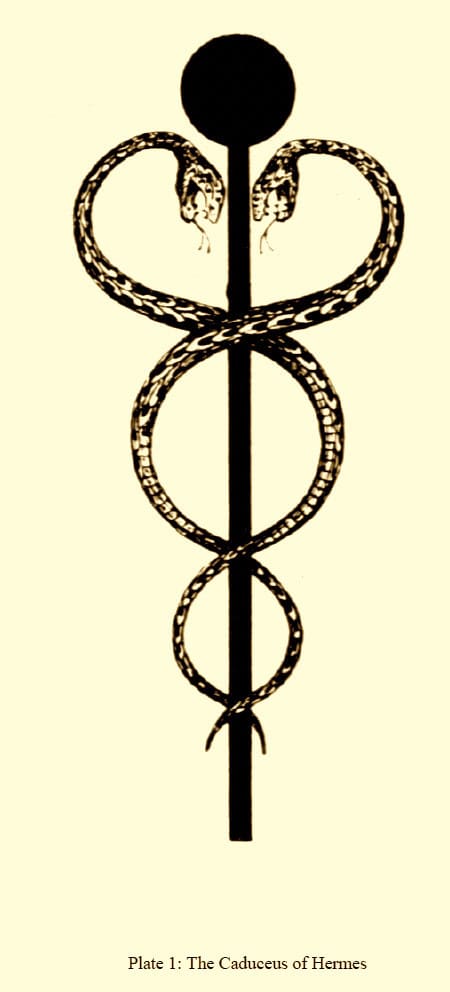
This is why symbols such as the Egyptian Winged Wand and the Greek Caduceus become important to his discussion. Fuller sees their bilateral symmetry and central axis as expressions of the same principle of equilibrium that appears in the Qabalistic Tree of Life. The Caduceus also brings the book into the symbolic world associated with Hermes Trismegistus and Hermeticism, traditions that repeatedly use correspondences between higher and lower orders of existence.
The Caduceus of Hermes
Why Is Equilibrium So Important?
Equilibrium is one of the governing concepts of the entire book. Fuller understands manifestation as the interaction of complementary forces. Absolute unity cannot produce a differentiated universe without polarity, because manifestation requires distinction. Positive and negative, active and passive, masculine and feminine, attraction and repulsion, severity and mercy are complementary pairs whose relationships generate and maintain existence.
The Caduceus illustrates this through two serpents winding around a central staff. Neither serpent alone represents the whole. Their opposed movements become ordered through the axis around which they are balanced. The Winged Wand presents a comparable structure: a central line, paired serpents, paired wings, and a solar form above them. Fuller reads these ancient symbols as representations of forces reconciled around a center.
The same architecture will reappear in the Tree of Life. The right and left sides express contrasting forces while the central pillar establishes their reconciliation. Equilibrium does not mean inactivity. It is the condition created when forces that could produce destructive opposition are brought into a higher relationship.
The Divine Man and the Qabalistic Structure of Reality
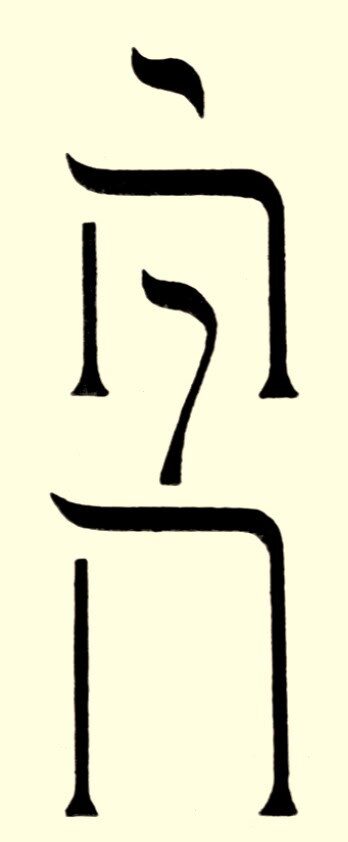
The Divine Man
Fuller develops this principle through the idea of Adam Qadmon, the Primordial or Divine Man. The human form becomes a symbolic model of cosmic structure. Humanity is not simply another object created inside the universe; the structure of the human being mirrors the structure of manifestation itself. The macrocosm and microcosm correspond, a principle that also appears throughout Hermeticism and later works of occult philosophy.
One of Fuller’s most striking diagrams reduces the Divine Man to Hebrew letters arranged vertically. The image is deliberately abstract because Fuller is not describing an anatomical person. He is showing how the Divine Name can be understood anthropomorphically, with the letters themselves forming the symbolic structure of primordial humanity.
This relationship between God, humanity, letters, numbers, and cosmic structure is central to Fuller’s treatment of Qabalah. Hebrew letters are not merely marks used to record speech. In the symbolic system he describes, letters possess numerical values and can represent forces, relationships, and stages of manifestation. Language itself becomes cosmological. Creation can be imagined as articulation: the ineffable becoming expressible through number, letter, name, form, and eventually matter.
What Is the Tree of Life?
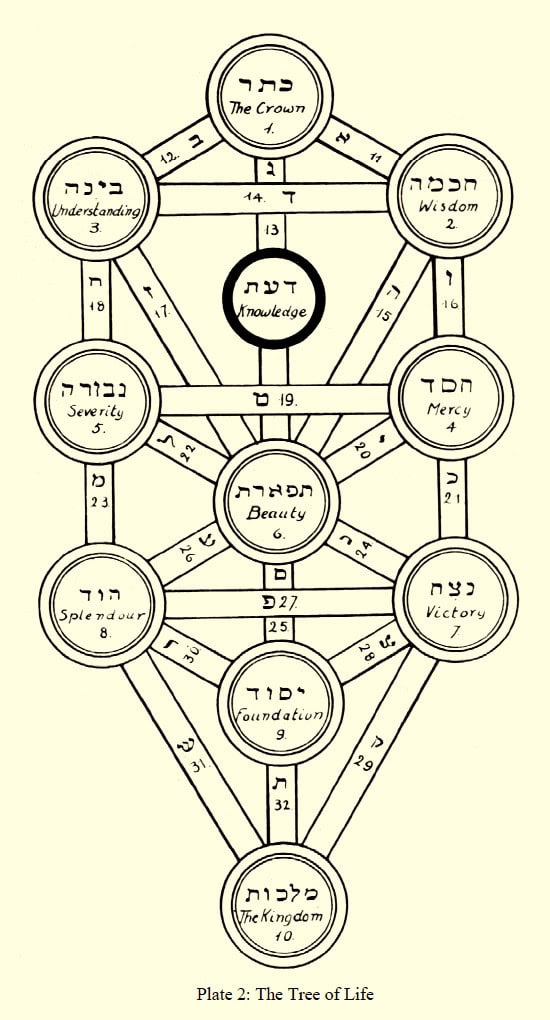
The Tree of Life is the central map through which Fuller organizes Qabalistic cosmology. It consists of ten Sephiroth connected through twenty-two paths corresponding to the letters of the Hebrew alphabet. The Sephiroth represent stages or principles through which the unknowable source becomes progressively manifest. They are differentiated expressions within a single process of emanation.
The Tree of Life
At the summit stands Kether, the Crown. Beneath it are Chokmah, Wisdom, and Binah, Understanding. The subsequent Sephiroth include Chesed, Mercy; Geburah, Severity; Tiphereth, Beauty; Netzach, Victory; Hod, Splendour; Yesod, Foundation; and Malkuth, the Kingdom. Fuller’s Tree also displays Daath, Knowledge, in a distinctive position associated with the abyss separating the supernal realm from the lower structure.
The arrangement is more important than any Sephirah considered separately. Kether represents the highest point at which the unknowable begins to become symbolically conceivable. Chokmah and Binah introduce polarity. The process continues downward through increasingly differentiated relationships until it reaches Malkuth, the Kingdom, associated with material manifestation.
Creation is represented as a descent. What is unified at the summit becomes increasingly divided as it moves downward. The mystical path reverses the direction: consciousness begins in the divided world of ordinary experience and attempts to ascend toward unity. This use of the Tree as both a map of the cosmos and a map of consciousness became one of the most influential structures in later Qabalah and Western occultism.
What Are the Three Pillars of the Tree of Life?
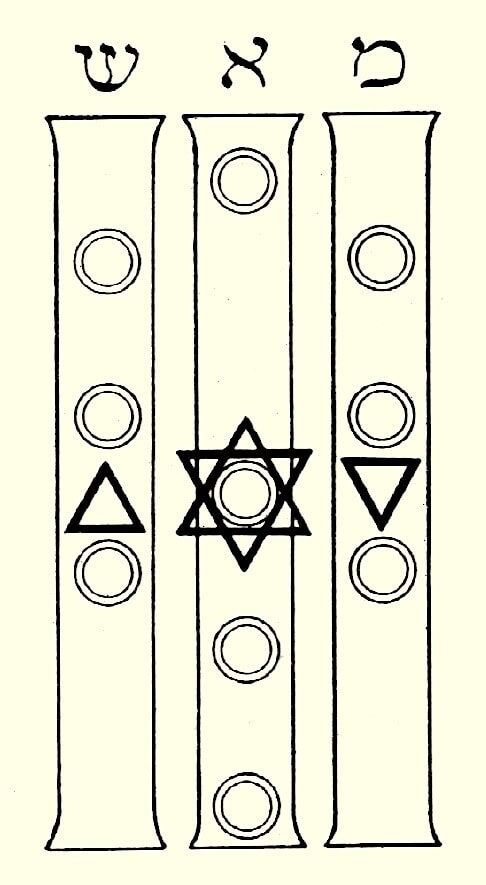
The Three Pillars of the Tree of Life
Fuller emphasizes that the Sephiroth are arranged upon three pillars. The right and left pillars embody opposed tendencies, while the central pillar represents their equilibrium. His diagram simplifies the Tree so that this underlying architecture becomes unmistakable.
The two outer pillars can be understood as complementary principles of expansion and restriction, mercy and severity, force and form. Neither can simply be abolished because manifestation requires both. Unrestrained expansion would be as destructive as absolute restriction. The middle pillar is the path through which these extremes are reconciled.
This gives the Tree both a cosmological and psychological meaning. It describes how the universe is structured, but it also describes the work demanded of the initiate. Spiritual development requires the balancing of opposites through a center capable of containing both. This search for a balanced center provides one of the strongest points of comparison between Fuller’s Qabalistic interpretation and other currents of mystical and occult thought represented in the Yogi Publication Society catalog.
How Does Creation Emerge from the Infinite?
Behind the Sephiroth stands a reality that cannot itself be adequately described. Fuller approaches it through the Qabalistic conceptions associated with nothingness and infinity. The highest source cannot simply be another being among beings because any defined being already possesses limitation. The primal source must precede definition.
Creation is pictured as a process of emanation. The unknowable becomes progressively knowable through stages of limitation and differentiation. The Sephiroth make possible the transition from absolute unity toward the plurality of the manifested universe. Fuller repeatedly returns to paradox here. If the ultimate source is truly infinite, nothing can exist outside it. Evil, matter, limitation, and humanity must in some sense arise within the totality instead of constituting independent realities standing against it. This problem drives the next major part of his argument.
What Is the Qabalistic Chalice?
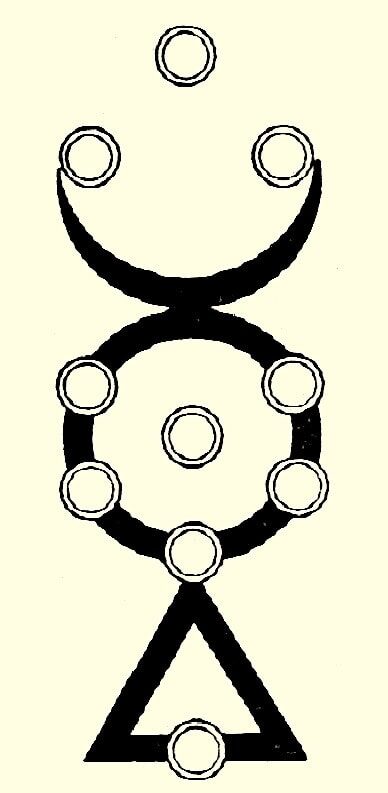
The Qabalalistic Chalise
The Qabalistic Chalice is Fuller’s compact symbolic representation of the Tree as a vessel. Its circular forms reproduce the Sephirotic structure while the surrounding shapes suggest a cup capable of receiving and containing the descending divine influence.
The image reinforces one of the book’s recurring ideas: manifestation involves reception. The very word Qabalah is connected by Fuller with receiving tradition, while the metaphysical system itself describes lower forms receiving emanations from higher ones. The chalice becomes an appropriate symbol for the receptive side of creation.
It also introduces the sexual symbolism that becomes increasingly important later in the book. Creation requires an active and receptive relationship. Fuller repeatedly interprets masculine and feminine as symbolic descriptions of complementary cosmic principles as well as biological categories.
Why Do Good and Evil Exist?
The problem of good and evil is where Fuller’s interpretation becomes most unconventional. If God is the source of everything, where can evil originate? An absolutely independent evil would imply a power existing outside God and would compromise divine unity. Fuller attempts to understand evil as a condition produced through differentiation and activity.
As manifestation descends farther from unity, forces become increasingly separated and oppositional. Harmony becomes discord. From the standpoint of the manifested world, these divisions appear as good and evil. From the standpoint of the original unity, both belong to a single process.
This does not mean Fuller simply declares destructive behavior good. His argument is metaphysical. Good and evil describe relationships within a divided field of existence. The mystical objective is to reach a level of consciousness at which their common origin can be perceived.
What Is Satan in Fuller’s Qabalistic Interpretation?
Satan becomes inseparable from this process. Fuller traces the evolution of the satanic principle through the descent of divine force into progressively denser levels of manifestation. In the material world, the higher order is reversed. Harmony becomes discord and divine activity appears as demonic opposition.
Sammael, the serpent, and Satan are given a paradoxical function. The adversary participates in the cosmic process that makes transformation possible. Fuller describes a succession of falls extending through different worlds until the spiritual force appears in its demonic counterpart in the material realm. Assiah, the world of matter, becomes a reversed image or shadow of Yetzirah.
The serpent can be both destructive and regenerative. Death releases life from form. Temptation produces the conditions through which knowledge becomes possible. Opposition creates the struggle necessary for transformation. Fuller is constructing a system in which the adversary cannot finally exist outside the Divine because nothing can.
What Does the Brazen Serpent Represent?
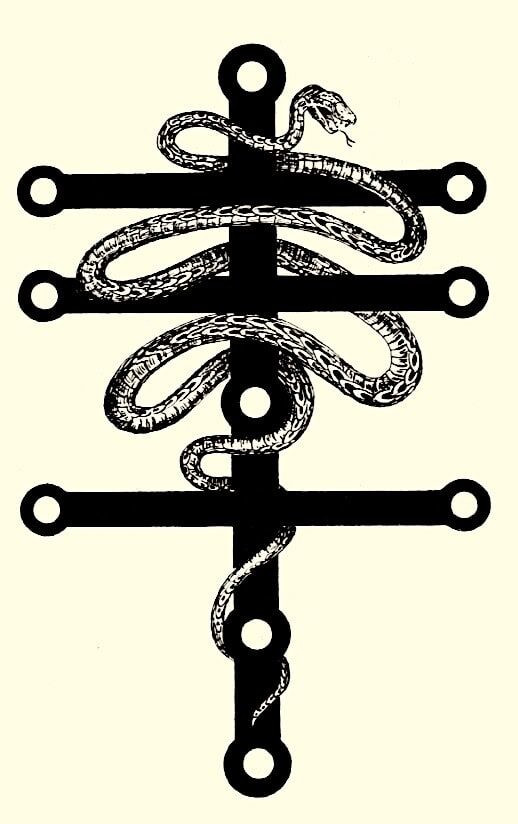
The Brazen Serpent
The serpent symbolism culminates in one of the book’s most memorable illustrations, the Brazen Serpent. A serpent winds around a structure corresponding to the Tree, visually joining the imagery of the serpent with the Sephirotic pattern.
The serpent is not treated as a simple emblem of evil. It can represent descent, temptation, generation, death, wisdom, transformation, and return depending upon its orientation and position. This ambiguity is crucial. The same force that appears destructive at one level can participate in redemption when redirected.
Fuller compares this with the serpent that consumes its own tail. Activity consumes activity. Division is overcome through the consequences of division itself. Evil contains the conditions through which evil can eventually be transcended.
The serpent also gives Fuller another bridge between Qabalistic symbolism and the imagery of Hermes Trismegistus, alchemy, and other branches of Western esoteric symbolism in which serpents can represent wisdom, transformation, generation, cyclicality, and occult power.
What Is the Mystery of Sex?
Fuller treats sexuality as one of the clearest physical representations of a much larger metaphysical law. Manifestation proceeds through polarity. Masculine and feminine symbolize active and passive, projective and receptive, positive and negative principles. Creation occurs through their interaction.
The sexual symbolism of Qabalah is not incidental. Fuller reads divine names, the Sephiroth, Adam and Eve, and the structure of the Tree through relationships of separation and reunion. The division of primordial humanity into male and female becomes another version of the cosmic movement from unity into duality.
This is also why sexual reunion can become a symbol of mystical reunion. Physical generation produces a child through the joining of separated sexes; spiritual generation is imagined through the joining of divided principles within humanity and Divinity. Fuller carries this analogy directly into his interpretation of messianic redemption.
What Does Fuller Mean by the Fall of Tetragrammaton?
Chapter IV radically reinterprets the Fall. Fuller shifts attention away from the conventional question of humanity falling away from God and asks whether manifestation itself can be understood as a divine fall. Tetragrammaton, YHVH, becomes the Divine expressed within the world of differentiation. The descent from unknowable unity toward form is itself a kind of fall.
This descent is required by manifestation. The infinite must become finite, the undifferentiated differentiated, and unity multiplicity if a universe is to appear. Fuller describes successive stages of descent and reversal through the Qabalistic worlds. The Fall is bound to creation itself.
Adam Qadmon represents primordial humanity before the full fragmentation of material consciousness. The later creation of Eve symbolizes differentiation within that primordial unity. What had existed together becomes divided into complementary forms.
Why Is the Fall of Adam Necessary?
Fuller gives the Genesis story an especially provocative interpretation. Eve’s temptation of Adam is not merely the beginning of human corruption. Without the knowledge of good and evil, their reconciliation would be impossible. The Fall initiates the process through which divided consciousness can eventually transcend division.
The fruit of the Tree of Knowledge becomes connected with generative power, and the serpent becomes an agent within a larger process whose meaning cannot be reduced to moral wickedness. Fuller explicitly describes the biblical Fall as a first step toward the redemption of Tetragrammaton because without differentiation, good and evil could never be brought back into harmony.
This inversion is central to the entire book. The Fall contains redemption in potential. Division creates the possibility of conscious reunion. The serpent who appears to destroy Eden also sets in motion the experience through which humanity may eventually understand the unity hidden behind opposites.
What Is the Redemption of Tetragrammaton?
Fuller’s fifth chapter contains the central doctrine he believes the Qabalah conceals. Redemption is normally imagined as God saving fallen humanity. Fuller reverses the relationship. Humanity becomes the instrument through which the fallen Divine is restored.
His reasoning follows from the cosmology established earlier. If Divinity descends into manifestation, then the divided universe contains the Divine in a fragmented condition. Humanity, possessing consciousness and containing the same active and passive principles, becomes capable of consciously reversing the descent.
Fuller describes a symbolic double marriage. The active principle in humanity unites with the passive principle in Divinity, while the passive principle in humanity unites with the active principle in Divinity. From this union emerges the Child or Messiah, representing the integration of humanity in God and God in humanity.
This leads to Fuller’s most striking formulation: humanity becomes the instrument of the redemption of God. The purpose of mystical transformation is not simply escape from the world or personal salvation. The initiate participates in a cosmic process through which the fragmentation produced by creation is healed.
What Is the Messianic Act?
The Messianic Act is the conscious reversal of the Fall. The movement downward from unity into multiplicity must be answered by a movement upward from multiplicity toward unity. Yet the lower world cannot simply be ignored. Its experiences must be assimilated.
Fuller interprets the Tree of Knowledge accordingly. Humanity must encounter the divided world of good and evil before it can transcend that distinction. The fruits of the opposing branches must be experienced and “digested” before the central path can be climbed. At the summit, the apparent absolute distinction between good and evil disappears within a more comprehensive unity.
Redemption is integration instead of avoidance. The fragmented elements of existence are brought into a new relationship. What descended through division ascends through reconciliation.
Where Does Mystical Power Come From?
Having established the cosmology, Fuller turns in Chapter VI to its practical implications. The essence of the Qabalah is no longer merely knowledge of an elaborate diagram. It is the transformation of consciousness through the relationships represented by that diagram.
Mystical power comes from establishing a different relationship between consciousness and the forces ordinarily experienced as opposites. The initiate attempts to cease identifying exclusively with one pole of a duality and instead discover the center from which both poles can be perceived. Equilibrium becomes a psychological and mystical operation.
Fuller now brings modern science back into the argument he began in the introduction. Scientific discoveries have dissolved many of the apparently solid categories through which earlier generations understood matter, space, energy, and causation. To Fuller, this does not eliminate mysticism. It makes the older mechanistic worldview less secure and opens conceptual room for realities that cannot be pictured through ordinary sensory experience.
This emphasis on the transformation of consciousness also helps explain why Fuller’s work could sit comfortably within the later YPS catalog. The Society had spent decades publishing systems that approached consciousness through very different vocabularies, including Yogi Ramacharaka, William Walker Atkinson, Theron Q. Dumont, Swami Panchadasi, and Swami Bhakta Vishita. Those books belong to a different period and should not be confused with Fuller’s own argument, but their presence helps explain the publishing setting into which the 1976 edition entered.
What Is the “Laboratory of Satan”?
Fuller calls the manifested world a kind of laboratory in which opposition, suffering, temptation, limitation, and mortality provide the conditions for transformation. Satan again becomes a paradoxical figure. The adversarial world tests consciousness because without resistance there can be no meaningful mastery.
The mystical ordeal involves confronting the forces that produce division and learning to integrate what ordinary consciousness experiences as incompatible. The Tree of Life is transformed from a diagram of the universe into a map of this ordeal.
The danger is imbalance. Identification with either pole can trap consciousness within duality. The central path demands the capacity to experience opposites without being completely possessed by either.
What Does Fuller Mean by the Fourth Dimension?
The idea of the fourth dimension provides Fuller with a modern analogy for mystical consciousness. A being confined to a lower-dimensional world could not adequately imagine a higher-dimensional object. It might encounter only sections or projections of something whose complete form remained beyond its perceptual capacity.
Fuller applies this analogy to ordinary human consciousness. Human beings experience reality through a limited framework and then assume that this framework describes reality as it exists in itself. Mystical experience may represent a temporary transcendence of that limitation.
From a higher-dimensional standpoint, contradictions belonging to the lower dimension could appear reconciled. Things that seem separated might be understood as parts of one structure. Beginning and end, inside and outside, subject and object, good and evil may cease to possess the absolute separateness attributed to them by ordinary consciousness. The fourth dimension is an analogy for illumination.
What Is the “Anatomy of Illuminism”?
The final chapter attempts to describe the condition toward which the entire book has been moving. Illuminism is the transformation of consciousness in which the ordinary divisions governing perception are transcended. Fuller associates historical religious and revolutionary movements with attempts to break existing forms, but he distinguishes outward revolution from the inward revolution of mystical consciousness.
The illuminated state cannot be adequately described in ordinary language because language itself depends upon distinctions. Subject and predicate, this and that, before and after, cause and effect all belong to the differentiated structure of thought. Mystical consciousness attempts to apprehend a unity prior to these divisions.
This brings Fuller back to the problem with which he opened the book. Human beings live through symbols because the ultimate mystery cannot be directly captured by reason. The Qabalah provides an extraordinarily elaborate symbolic structure, but even the Tree of Life is not Reality itself. It is a map. The initiate must eventually pass beyond the symbolic system used to reach the threshold of the experience it represents.
What Is the Mystic Way?
The Mystic Way is the return from multiplicity toward unity. The initiate begins in Malkuth, the world of manifested experience, and symbolically ascends the Tree. Each stage represents a transformation of consciousness and a progressive reconciliation of divisions.
The process is not simply the acquisition of more intellectual information. Fuller has spent an entire book using extraordinarily complicated symbols only to arrive at the conclusion that intellectual symbols eventually have to be transcended. The Tree teaches the mind how to move beyond the limitations of the mind. The culmination of the path is not possession of a final secret formula. It is an experience in which the distinctions that made the question necessary have disappeared.
The Central Idea of The Secret Wisdom of the Qabalah
Fuller’s entire interpretation can be reduced to one great movement: unity becomes multiplicity so that multiplicity can consciously return to unity. The unknowable source emanates the Sephiroth; the Divine becomes differentiated; polarity appears; the worlds descend toward matter; primordial humanity divides; good and evil emerge as opposites; the serpent introduces knowledge and death; consciousness experiences separation; and humanity acquires the possibility of reversing the process.
The Tree of Life maps both movements. Read downward, it is a diagram of creation and the Fall. Read upward, it is a diagram of redemption and illumination. The right and left pillars express division into complementary forces. The middle pillar expresses their reconciliation. The serpent represents the force moving through differentiation. Adam Qadmon represents the Divine reflected in human form. Tetragrammaton represents Divinity within manifestation. The Messiah represents restored integration.
The unusual feature of Fuller’s interpretation is that humanity does not merely wait to be rescued from this condition. Humanity has a function within it. Because human consciousness stands within the manifested universe while possessing the capacity to conceive unity, the human being becomes a bridge between divided creation and its source. Fuller expresses this in the startling proposition that man becomes “the implement of the redemption of God.”
The Secret Wisdom of the Qabalah is much more than a book about Hebrew letters, occult correspondences, or the ten Sephiroth. Fuller uses those subjects to construct a much larger theory of existence. Creation is differentiation. Evil is bound to disequilibrium and divided activity. The Fall is a necessary descent into multiplicity. Knowledge makes conscious reconciliation possible. Redemption reintegrates what has been divided. Mystical illumination is the experiential realization of the unity that symbolism can indicate but never completely express.
This also explains the importance of the book’s illustrations. The Caduceus of Hermes, Winged Wand of Egypt, Divine Man, Tree of Life, Three Pillars, Qabalistic Chalice, and Brazen Serpent are not seven unrelated occult pictures. Fuller uses them as variations on the same structural idea. Again and again there is an axis, opposing forces, descent, polarity, intersection, and reconciliation. The imagery makes visible the pattern his prose attempts to uncover: beneath the diversity of religious and occult symbolism lies a recurring architecture of unity dividing into opposites and opposites returning through equilibrium to unity.
The title The Secret Wisdom of the Qabalah describes Fuller’s purpose precisely. He is not trying to reveal every secret of Qabalistic literature. He is searching for the organizing principle beneath its symbols, the hidden idea that might explain why the Tree of Life, Tetragrammaton, Adam, Eve, Satan, the serpent, the Messiah, sex, death, and mystical illumination can all belong to a single system. Whether every historical or Qabalistic interpretation he proposes is accepted or not, Fuller openly acknowledges the speculative character of his investigation. His objective is to identify the idea he believes lies behind the symbols and to show that the apparent oppositions of existence may be understood as stages within a larger process of division, experience, reconciliation, and return.
The book also occupies an interesting position in the history of the Yogi Publication Society. Its 1976 appearance came many decades after the early Chicago period associated with Herbert A. Parkyn, the Chicago School of Psychology, and the early New Thought network from which the original publishing enterprise developed. By the time Fuller’s work was issued, the YPS catalog encompassed a wide range of esoteric traditions extending far beyond its early publications. The presence of Fuller’s Qabalistic study alongside works connected with the Three Initiates and The Kybalion illustrates the deep interest in Hermetic material carried under the Yogi Publication Society name.
John Frederick Charles Fuller Biography
Major-General John Frederick Charles Fuller (1878–1966), known as J. F. C. Fuller, was a British Army officer, military strategist, historian, and author. He is considered one of the main architects of modern armored warfare. In addition to his military career, Fuller had a lasting interest in Western esotericism, Hermetic philosophy, ceremonial magic, and Qabalistic mysticism. He wrote several important works exploring the philosophical roots of the Western mystery tradition.
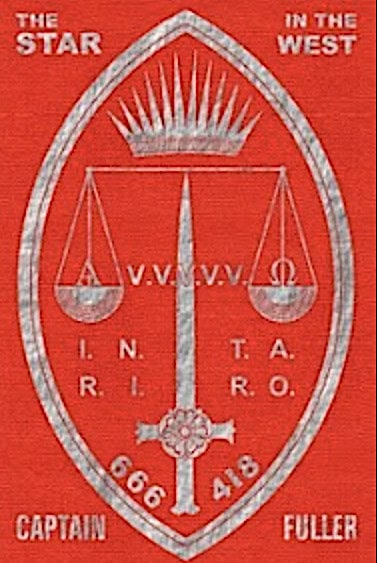
The Star in the West; A Critical Essay on the Works of Aleister Crowley by Fuller
Fuller graduated from the Royal Military College at Sandhurst and served in different parts of the British Empire. He became internationally known during the First World War for his new ideas about using tanks and mechanized warfare. His writings changed twentieth-century military thinking and influenced leaders worldwide. While foreign armies often adopted his ideas faster than Britain did, Fuller is now seen as one of the leading military theorists of the modern era.
Alongside his military work, Fuller also studied the occult. In 1907, he joined Aleister Crowley‘s magical order, the A∴A∴, and became one of Crowley’s first and most important associates. During this time, he wrote The Star in the West (1907), which was the first major study of Crowley’s philosophy and magical system. This book helped introduce Crowley’s ideas to more people. As Fuller’s military career grew, he slowly distanced himself from Crowley, realizing that being closely linked to such a controversial figure could hurt his professional future. Even after they parted ways, Fuller kept his interest in mysticism and continued to study Hermeticism, Qabalah, comparative religion, and esoteric philosophy on his own.
Fuller’s most important work on the occult is The Secret Wisdom of the Qabalah (1937). In this book, he examines Jewish mystical philosophy within the wider Western esoteric tradition. Instead of seeing the Qabalah only as ceremonial magic, Fuller presents it as a universal philosophy for spiritual growth. He focuses on the symbolism of the Tree of Life, the connection between people and the Divine, and the repeated theme of sacred trinities in different religious and philosophical traditions. By comparing Jewish mysticism, Hermetic philosophy, Christianity, and Eastern religions, Fuller aimed to show the common ground shared by many spiritual traditions.
Throughout his writings, Fuller combined the analytical discipline of a professional. In his writings, Fuller brought together the analytical skills of a soldier with a deep interest in metaphysics, symbolism, and the hidden forces behind human consciousness and society. His rare ability to connect military science, philosophy, and esoteric ideas made him a unique thinker of the twentieth century. He is remembered for changing modern warfare and for his lasting impact on the study of Western mysticism.
Related Research Articles
From Suggestion to the Seven Hermetic Principles: Herbert A. Parkyn and the Psychological Roots of The Kybalion
An examination of the roots of The Kybalion’s Seven Hermetic Principles and their parallels with Herbert A. Parkyn’s system of Suggestive Therapeutics.
The Sacred Geometry of the Yogi Publication Society Logo
This article examines the Yogi Publication Society logo and its sacred geometry meaning, comparing it with Hindu, Hermetic, Rosicrucian, Masonic, and Theosophical traditions to show the intention behind the publishing network.
The Science of Psychic Healing: A Bridge Between Yogi Philosophy and the Law of Suggestion
This article explores the book The Science of Psychic Healing and its close parallels with Herbert A. Parkyn's teachings and examines its role in connecting Eastern philosophy with the science of mind.