Telepathy is the claimed communication of thoughts, ideas, emotions, images, or other mental impressions from one mind to another without the ordinary physical means of speech, writing, gesture, or the recognized senses. It occupied an important place in the literature surrounding the Yogi Publication Society because it stood at the meeting point of Yogi philosophy, psychical research, suggestion, clairvoyance, concentration, thought force, and the occult conception of mind as something capable of acting beyond the limits of the physical brain. YPS books did not present telepathy as an isolated marvel. They placed it within systems that attempted to explain how thought could be projected, received, concentrated, resisted, and consciously directed. This made telepathy closely connected with the mental training taught under such names as Yogi Ramacharaka, William Walker Atkinson, Theron Q. Dumont, Swami Panchadasi, and Swami Bhakta Vishita, while its history within the YPS circle reaches back to the investigations of Herbert A. Parkyn and the psychical subjects surrounding his Chicago School of Psychology.
What does telepathy mean?
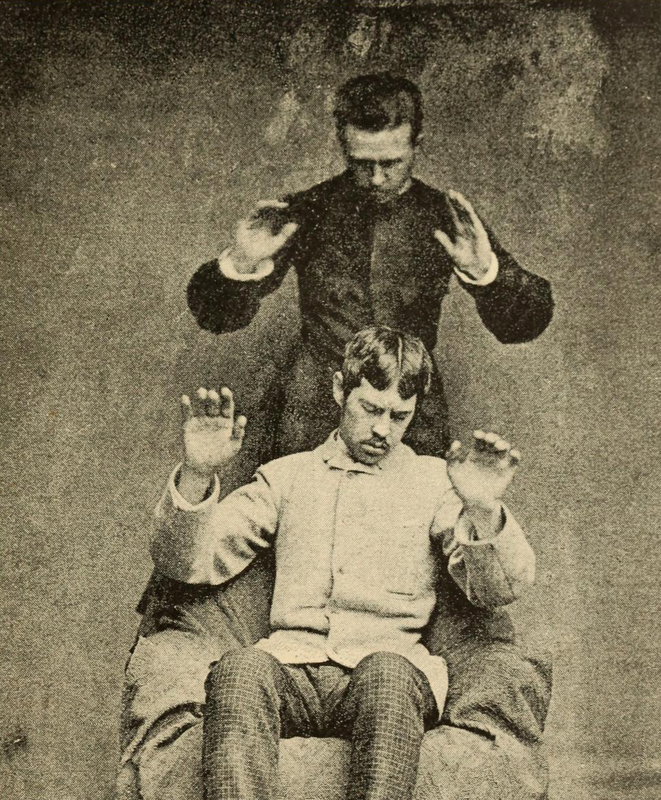
The word telepathy was formed from Greek roots commonly rendered as “distant feeling” or “feeling at a distance.” In psychical research it came to designate the supposed direct transmission of mental impressions between individuals without an ordinary sensory channel. One person was commonly described as the agent or sender and the other as the percipient or receiver. The transmitted content might be a word, number, image, sensation, emotion, command, mental picture, or awareness of an event affecting the sender. In the occult literature associated with the YPS, the concept could be extended still further. Thought itself was treated as an active force or vibration capable of passing outward from the thinker and affecting another mind under suitable conditions.
This definition is important because telepathy was not limited to deliberate experiments in which one person attempted to guess what another was thinking. Writers also applied the idea to spontaneous experiences in which someone suddenly thought intensely of a distant person, experienced an unexplained emotion corresponding with that person’s condition, or received a vivid mental impression later believed to correspond with an event occurring elsewhere. The experimental and spontaneous forms were treated as different manifestations of the same proposed capacity of mind to communicate beyond ordinary sensory contact.
How was telepathy believed to work?
There was no single explanation accepted by every writer. Psychical researchers could treat telepathy as a problem requiring experimental investigation without committing themselves to an occult theory of its mechanism. Writers within Western esotericism, Theosophy, and Hindu philosophy were more willing to propose models in which mind extended beyond the physical nervous system. In such systems, the brain could be compared to an instrument through which consciousness operated, while thought itself could produce movements, waves, vibrations, or forms in a subtler medium.
The YPS literature frequently used the language of thought vibrations and mental currents. A concentrated thought was represented as possessing greater force than a weak or wandering one, while a receptive mind was thought to be more responsive to an incoming impression. This created a two-sided model of telepathy. Successful transmission depended on the strength and definiteness of the projected thought and on the ability of the receiver to become sufficiently receptive to recognize it. Concentration, attention, visualization, mental quiet, and control of distracting thoughts could all be presented as means of improving these conditions.
What is the difference between telepathy and clairvoyance?
Telepathy and clairvoyance were closely related in occult and psychical literature, but they described different claimed processes. Telepathy concerns communication or impression passing from one mind to another. Clairvoyance concerns the claimed perception of something that is not accessible through ordinary physical sight. If a person receives a mental image deliberately projected by another person, the experience would normally be classified as telepathic. If the person claims to perceive a distant room, object, or event without receiving the information from another mind, the experience would more properly fall under clairvoyance.
The distinction becomes difficult when a distant event involves another person. A percipient who suddenly sees an image of a distant friend in danger might be described as clairvoyant if the event itself was supposedly perceived, or telepathic if the friend’s intense mental state was believed to have transmitted the impression. Early psychical literature repeatedly encountered this problem. The same experience could be interpreted through more than one theory, which is one reason telepathy and clairvoyance so often appeared together in books devoted to psychic phenomena.
Is telepathy the same as mind reading?
Telepathy and mind reading overlap, but the terms were not always used in exactly the same way. Mind reading could refer to the direct perception of another person’s thoughts, yet it was also used for demonstrations that might depend upon subtle muscular movements, unconscious physical signals, expectation, suggestion, or highly developed observation. A performer who found a hidden object while maintaining physical contact with a person who knew its location might call the feat mind reading even when unconscious muscular guidance offered another explanation.
Telepathy, in its stricter psychical sense, excluded those ordinary channels. The central claim was that information had passed between minds without sensory or physical communication. This distinction was significant in the environment surrounding Parkyn, where hypnosis, suggestion, mind reading, mental influence, and psychical phenomena were being investigated alongside one another. Determining whether an effect resulted from suggestion, unconscious signaling, observation, or a genuinely anomalous form of mental communication was part of the problem these investigators faced.
What is thought transference?
Thought transference was one of the most common expressions used for telepathy. The phrase describes the supposed passage of a thought or mental impression from one person to another. Experiments might involve numbers, playing cards, geometric figures, words, names, colors, or simple drawings. The sender concentrated on the selected object while the receiver attempted to quiet the mind and record whatever impression arose.
The term also reveals how telepathy was understood within much of the YPS literature. Thought was not treated only as silent speech occurring privately inside the head. It could be described as producing an influence beyond the thinker. This concept linked telepathy with the extensive YPS literature on concentration, mental influence, personal magnetism, thought force, and suggestion.
What role does concentration play in telepathy?
Concentration was treated as one of the central conditions for deliberate telepathic work. The sender was instructed to hold a clear and definite mental image instead of allowing attention to wander. A vague thought was assumed to produce a vague impression, while sustained concentration was supposed to give the thought greater force and direction. Visualization could serve the same purpose. Instead of merely repeating the name of an object, the sender might construct a vivid mental picture and hold it steadily before the mind.
The receiver faced a different problem. Excessive effort could fill consciousness with self-generated thoughts and make it difficult to distinguish a possible incoming impression from imagination. Receptivity was often described as a state of quiet attention in which impressions could enter consciousness without being immediately altered by deliberate reasoning. This balance between concentrated projection and receptive attention became a recurring feature of telepathic instruction.
What is the difference between deliberate and spontaneous telepathy?
Deliberate telepathy
Deliberate telepathy involves an intentional attempt to send or receive a mental impression. One person concentrates upon a predetermined image, word, object, number, or command while another attempts to receive it. Such exercises were attractive to writers interested in psychic development because they could be repeated and compared. They also offered a way of training concentration and receptivity even when the larger explanation of the results remained disputed.
Spontaneous telepathy
Spontaneous telepathy refers to experiences that occur without a planned experiment. A person may suddenly think of a distant relative immediately before receiving news from that person, experience an unexplained feeling of danger corresponding with an accident elsewhere, or awaken with an unusually vivid impression connected with someone emotionally close to them. Psychical researchers collected large numbers of such reports because dramatic spontaneous cases often seemed to involve intense emotional states. Occult writers sometimes proposed that powerful emotion produced an unusually forceful mental transmission.
Why were emotional events important in theories of telepathy?
Accounts of spontaneous telepathy often involved death, accidents, illness, danger, or severe emotional distress. One explanation offered in psychical and occult literature was that an intense mental state might generate an impression powerful enough to reach another person. Close emotional relationships were also thought to create favorable conditions for reception. Reports involving relatives, spouses, close friends, or people with strong personal attachments were accordingly given considerable attention.
Such experiences could overlap with apparitions, dreams, visions, and clairvoyance. A person might awaken at the moment of a distant relative’s death, dream of an accident as it occurred, or experience a vivid image of someone who was physically far away. Whether such an experience was classified as telepathy, clairvoyance, or an apparition depended upon the interpretation given to the perceived information.
Can telepathy occur during dreams?
Dreams occupied an important place in early discussions of telepathy because sleep appeared to remove some of the ordinary activity of the conscious mind. If waking thought interfered with the reception of subtle impressions, the sleeping mind could be imagined as more receptive. Reports of dreams corresponding with distant events were accordingly examined by psychical researchers and occult writers.
The difficulty was separating an unusual correspondence from the enormous number of ordinary dreams people experience and forget. A dream remembered only after news of an event arrived could also be unconsciously altered by later knowledge. Careful investigators sought written records, independent witnesses, dates, and other evidence showing that the dream had been described before the confirming information became known. The same evidential problem affected spontaneous telepathy generally.
How is telepathy related to suggestion?
Telepathy and suggestion concern the influence of one mind upon another, but they address different questions. Suggestion concerns how an idea presented to the mind can influence thought, feeling, bodily condition, or behavior. The suggestion may be delivered through speech, writing, gesture, expectation, environmental cues, or self-directed mental activity. Telepathy proposes something more specific, that a mental impression can pass between people without those recognized channels.
The distinction was highly important in experiments involving hypnosis and psychic phenomena. A subject might seem to receive information mentally when subtle verbal cues, expectations, previous instructions, or unconscious signals were actually responsible. Anyone investigating telepathy had to consider suggestion as an alternative explanation. At the same time, occult writers sometimes proposed that telepathy itself could serve as a vehicle for suggestion, allowing a strongly projected thought to influence another person at a distance.
How does telepathy connect with Herbert A. Parkyn’s work?
Herbert A. Parkyn developed his system in an environment where hypnosis, suggestion, mind reading, thought transference, psychic phenomena, and unusual mental states were being actively investigated. His Chicago School of Psychology trained students in the laws governing suggestion and the operation of the voluntary and involuntary mind. His Special Mail Course in Hypnotism and Suggestive Therapeutics extended this training through concentration, mental control, suggestion, and related subjects.
Telepathy also appeared directly within the psychical investigations surrounding Parkyn. His 1898 writings under the name Astra explored telepathy in connection with psychical research, distant mental impressions, dreams, visions, rapport, unusual states of consciousness, and accounts of information apparently transmitted across distance. This is important to the later history of the Yogi Publication Society. Several years before the YPS began publishing its better-known books on thought force, psychic development, mind reading, and occult powers, telepathy was already part of the field being explored within Parkyn’s circle.
What were the agent and percipient in telepathy experiments?
Early psychical researchers commonly called the person from whom the mental impression originated the agent and the person who supposedly received it the percipient. This vocabulary allowed investigators to describe experiments without assuming in advance how the transfer occurred. The agent might concentrate on a picture while the percipient attempted to reproduce it, or the agent might experience an unexpected event while a distant percipient independently reported a corresponding impression.
The agent-percipient model became important because it separated two functions that occult literature would later describe in terms of projection and receptivity. The agent required concentration and a definite mental image. The percipient required sensitivity to the incoming impression. YPS teachings about thought projection and mental receptivity developed the same two-sided problem through the language of thought force and mental vibrations.
What is rapport and how does it relate to telepathy?
Rapport describes a condition of unusual psychological connection or responsiveness between two people. The term had a long history in mesmerism and hypnosis before becoming associated with psychical investigation. A hypnotized subject might display exceptional responsiveness to the operator, leading investigators to ask whether the established relationship could also facilitate thought transference.
In occult interpretations, rapport could be extended beyond hypnosis. Emotional closeness, repeated mental contact, shared concentration, or deliberate attunement might be thought to create a connection between two minds. Telepathy between relatives and close friends was sometimes explained in this way. The concept helped bridge older mesmeric ideas and later theories of mental vibration.
Is telepathy connected with personal magnetism?
The literature of personal magnetism frequently taught that thought, will, attention, confidence, and concentrated intention affect other people. Not every form of personal magnetism was presented as telepathy. Facial expression, voice, posture, expectation, behavior, and suggestion could all influence another person through ordinary means. Some writers, however, proposed an additional mental component operating without visible communication.
This is one reason telepathy fits closely beside the teachings published under Theron Q. Dumont. The Dumont system placed sustained attention, will, concentration, mental projection, personal influence, and control of thought at the center of mental development. Telepathy represented one possible extension of the same central question that occupied much of this literature, whether concentrated thought could exert an effect beyond the mind in which it originated.
What did Yogi philosophy teach about thought transmission?
The books issued under Yogi Ramacharaka presented thought as more than an internal psychological event. Within this literature, thought could be described through the language of vibrations, waves, currents, and mental atmospheres. Concentrated thoughts were said to travel outward, while other minds could become receptive to them. Such ideas placed telepathy within a larger account of mind, prana, concentration, psychic development, and the hidden capacities of consciousness.
The YPS presentation of Yogi philosophy also stressed control over attention and thought. The ability to concentrate was valuable whether the goal was ordinary mental development, self-mastery, meditation, or the investigation of psychic faculties. Telepathy was one application of a much larger doctrine in which an undisciplined mind scattered its energies while a trained mind could direct them.
Swami Vivekananda had already helped introduce American audiences to Indian teachings about concentration, mind, and extraordinary mental powers before the appearance of the YPS. The YPS entered an American environment in which Yoga and psychical research were already being compared, debated, and combined with Western theories of mental development.
What is the relationship between telepathy and thought vibrations?
Thought vibration became one of the most recognizable explanations of telepathy in New Thought and occult literature. The analogy was drawn from physical phenomena such as sound, light, electricity, magnetism, and wireless transmission. If invisible waves could carry sound or electrical signals through space, writers asked whether thought might also produce vibrations capable of transmission and reception.
This language became prominent within the literature associated with William Walker Atkinson and New Thought. The analogy gave readers a conceptual model for distant mental influence at a time when invisible physical forces and wireless communication were transforming popular ideas about what could pass through space. It did not establish a scientific mechanism for telepathy, but it provided one of the main explanatory frameworks used by early twentieth-century occult and mental-science writers.
How did Swami Panchadasi and Swami Bhakta Vishita approach telepathy?
The books published under Swami Panchadasi and Swami Bhakta Vishita placed telepathy among a series of psychic faculties that included mind reading, clairvoyance, crystal gazing, psychic influence, astral perception, and psychometry. These works were instructional as well as explanatory. They attempted to classify psychic phenomena and describe exercises through which readers could investigate concentration, receptivity, visualization, and extrasensory perception.
This organization is characteristic of the YPS catalog. Telepathy was rarely isolated from other mental and psychic subjects. It belonged to a graded field of abilities in which ordinary concentration and observation stood near experiments in thought transference, while clairvoyance, psychometry, and astral perception extended the model beyond direct mind-to-mind communication.
How is telepathy different from psychometry?
Psychometry is the claimed ability to obtain information about a person, place, or event through contact with an object associated with it. Telepathy involves supposed communication between minds. If a person holds a letter and receives an impression directly from its distant writer, a telepathic explanation might be proposed. If the impression is believed to arise from information somehow retained by the physical letter itself, the experience would be classified as psychometry.
Occult literature sometimes blurred the distinction because both phenomena were explained through subtle impressions and vibrations. The difference concerns the proposed source of the information. Telepathy points to another mind. Psychometry points to an object or the impressions believed to be associated with it.
What role did J. C. F. Grumbine play in the study of telepathy and psychic development?
J. C. F. Grumbine belonged to the same American metaphysical and psychical environment in which telepathy, clairvoyance, psychometry, mediumship, concentration, and psychic development were being organized into teachable systems. His work is valuable for understanding the intellectual setting surrounding Parkyn and the early YPS because it shows that psychic abilities were not treated only as spontaneous curiosities. They were increasingly classified, explained, and presented as capacities that might be studied through systematic exercises.
This instructional approach paralleled the development of correspondence courses, schools of psychology, occult lessons, and later YPS books. Telepathy became something that could be placed into a lesson sequence alongside concentration, receptivity, visualization, psychometry, and clairvoyance.
What did Theosophy contribute to ideas about telepathy?
Theosophy provided an elaborate occult framework for mental communication. Human beings were described as possessing subtler principles and vehicles beyond the physical body, while thoughts could be represented as forces or forms acting upon subtler planes. Telepathy could accordingly be interpreted as communication occurring through levels of consciousness not dependent upon the physical senses.
This framework overlapped with YPS discussions of the astral world, thought forms, mental vibrations, and psychic perception. It also helped connect Indian religious and philosophical terminology with Western occultism, producing a vocabulary that appeared throughout late nineteenth- and early twentieth-century metaphysical literature.
How does telepathy fit within Western esotericism?
Within Western esotericism, telepathy could be interpreted through older ideas concerning correspondences, invisible sympathies, spiritual influence, imagination, will, and the relationship between mind and the unseen world. The terminology changed as mesmerism, psychical research, psychology, and theories of vibration entered the discussion, yet the underlying question had a much older history. Could consciousness act at a distance, and could one human being receive an influence that had not reached the ordinary senses?
The YPS catalog brought several of these traditions together. Hermeticism, Qabalah, Rosicrucian teachings, Yoga, New Thought, psychical research, and mental science all appeared within its publishing world. Telepathy was one subject through which their different conceptions of mind could meet.
How is telepathy related to Hermeticism and The Kybalion?
Classical writings attributed to Hermes Trismegistus do not teach modern experimental telepathy in the form developed by nineteenth-century psychical research. Hermeticism, however, supplied concepts concerning mind, correspondence, invisible causation, and the relationship between different levels of existence that later occult writers could apply to psychic phenomena.
The connection became more explicit in The Kybalion by the Three Initiates. Its Principle of Mentalism declares mind fundamental to the universe, while its discussions of vibration, polarity, cause and effect, and mental transmutation provide a system in which mental influence is given a central position. Telepathy is not the central subject of The Kybalion, yet the book belongs to the same YPS intellectual environment in which thought was repeatedly treated as active, transmissible, and capable of directed influence.
Does Qabalah have a direct teaching of telepathy?
Qabalah does not simply correspond to the modern psychical-research category of telepathy. Qabalistic traditions developed complex teachings concerning levels of existence, divine emanation, the soul, symbolic correspondences, and hidden relationships within creation. Later occult Qabalism incorporated these concepts into systems of ceremonial and mental training that also addressed will, imagination, concentration, and subtle influence.
Within the YPS catalog, Qabalistic material belonged beside Hermetic, Rosicrucian, psychic, and mental-science works. Its relevance to telepathy lies less in a direct ancient doctrine of experimental thought transference than in the metaphysical structure through which later occultists interpreted invisible communication and mental action.
What is the relationship between telepathy and Rosicrucian teachings?
Rosicrucian literature often treated the disciplined development of the human mind as part of a larger path of occult training. Concentration, will, imagination, secrecy, symbolic knowledge, and mastery of unseen forces could all enter this program. Later Rosicrucian and occult systems readily incorporated telepathy and thought transmission into this conception of hidden human capacities.
The YPS interest in Rosicrucianism helps explain why telepathy could be presented as more than an isolated psychic trick. Mental communication could be interpreted as evidence that consciousness participated in laws extending beyond ordinary physical perception. Training the mind was then part of investigating those laws.
Is telepathy connected with Christian mysticism?
Christian mysticism traditionally described spiritual experiences such as visions, interior communication, divine inspiration, discernment, and unusual awareness, but these should not automatically be classified as telepathy. Modern occult writers sometimes interpreted older mystical experiences through the newer language of psychic perception and thought transference, while Christian mystics themselves could understand similar experiences through a theological framework.
The distinction matters because the YPS published and circulated works drawn from multiple religious and occult traditions. Similar descriptions of extraordinary knowledge could receive very different explanations depending upon whether the writer approached them through Christian mysticism, Yoga, psychical research, Theosophy, or mental science.
Can telepathy be used to influence another person?
Occult and New Thought literature often moved from the reception of thoughts to the possibility of deliberately projecting them. If one mind could receive an image or idea from another, writers reasoned that concentrated thought might also affect another person’s mood, attention, decision, or behavior. This produced teachings described as mental influence, mental suggestion, thought projection, or distant influence.
This subject also raised ethical questions. Systems of mental training frequently warned against attempting to dominate another person’s will. The ability to control one’s own thought was treated as more valuable than attempts to manipulate others. Telepathy could accordingly be presented both as a psychic faculty and as a test of mental discipline and ethical self-control.
Can a person resist telepathic influence?
Writers who accepted telepathic influence commonly taught that a trained and self-controlled mind was less vulnerable to unwanted mental impressions. Fear, passivity, indecision, and uncontrolled imagination were sometimes represented as conditions that increased receptivity, while concentration, confidence, self-possession, and deliberate thought were presented as forms of mental defense.
This idea closely connected telepathy with the YPS literature on personal mastery. The same exercises used to strengthen concentration and will were presented as ways of controlling what entered consciousness. Whether an impression originated from another person, suggestion, social pressure, or one’s own uncontrolled imagination, the prescribed response was often similar. The individual was to develop the ability to recognize, examine, accept, or reject ideas consciously.
Is telepathy connected with Karma and reincarnation?
Telepathy is a different doctrine from Karma and reincarnation, yet occult systems could connect them through theories of relationships continuing across multiple lives. Strong attachments between individuals were sometimes proposed as one reason certain people seemed unusually sensitive to one another’s thoughts or emotional states. A karmic relationship could thus be offered as an explanation for exceptional rapport.
Telepathy itself does not require reincarnation, and a reported telepathic experience does not establish a karmic connection. The association belongs to the larger metaphysical systems in which psychic faculties, repeated embodiment, spiritual development, and the continuity of consciousness were treated as parts of one account of human existence.
Does telepathy prove that the mind exists independently of the brain?
This was one of the most important questions raised by telepathy. If information could genuinely pass from one mind to another without any sensory or physical means, it would challenge a strictly local conception of mental activity. For psychical researchers interested in survival after death, telepathy was important because it offered a possible demonstration that mind might possess capacities not adequately explained by ordinary sensory processes.
At the same time, telepathy alone would not establish survival after death. Communication between two living minds and the continued existence of consciousness after bodily death are separate claims. The connection came from the larger attempt to determine whether consciousness possessed functions that could operate outside familiar physical channels.
How did telepathy fit into the Yogi Publication Society catalog?
The Yogi Publication Society approached telepathy through several overlapping systems. The Yogi books treated thought as force and explored concentration, psychic development, mental vibrations, and the hidden capacities of mind. Works under Swami Panchadasi and Swami Bhakta Vishita placed thought transference beside clairvoyance, psychometry, mind reading, crystal gazing, and astral perception. The Theron Q. Dumont books concentrated on will, concentration, mental projection, personality, and personal influence. The Three Initiates placed mental power within a Hermetic philosophical structure in The Kybalion.
These were not identical teachings under interchangeable names. Each approached mind from a different direction. Their appearance within the same publishing network, however, made telepathy part of a recognizable YPS field concerned with the powers of thought, the training of attention, the relationship between conscious and subconscious processes, psychic perception, and the possibility that mind could operate beyond ordinary sensory boundaries.
Why was telepathy important to psychical research?
Telepathy offered psychical researchers a phenomenon that could at least be approached experimentally. Unlike many religious or metaphysical claims, thought-transference experiments could be repeated under controlled conditions. Investigators could attempt to prevent sensory cues, record guesses, compare successes with failures, and examine whether results exceeded chance expectation.
The field remained controversial because experiments could be affected by poor controls, unconscious signaling, selective reporting, statistical problems, fraud, and the human tendency to remember striking coincidences while forgetting failures. Those difficulties made experimental design central to the subject. Telepathy became one of the major testing grounds for the question of whether unusual mental phenomena could be investigated by methods resembling those used in other fields of inquiry.
Why was telepathy so important to the early YPS worldview?
Telepathy addressed one of the central questions running through the intellectual world from which the YPS developed. Is thought confined to the thinker, or can it act beyond the physical boundaries of the individual? That question connected psychical research with Parkyn’s investigations of mind and suggestion, the mental-force teachings associated with New Thought, the concentration exercises of the Yogi books, the psychic instruction of Panchadasi and Bhakta Vishita, and the mental philosophy presented through Dumont and the Three Initiates.
The subject also linked ordinary mental training with claims of extraordinary mental capacity. Concentration could improve memory and attention, but the same faculty was also presented as necessary for thought projection. Receptivity could describe an ordinary psychological condition, but it could also become the proposed basis of telepathic reception. Suggestion demonstrated that ideas could alter thought and behavior through recognizable channels, while telepathy asked whether a similar influence might occur without those channels.
What is the larger meaning of telepathy within the Yogi Publication Society?
Within the YPS publishing program, telepathy formed part of a sustained investigation into the nature and power of mind. The subject connected Yogi philosophy with psychical research, New Thought with mental science, and Western esotericism with the new psychological language of concentration, suggestion, subconscious activity, and thought transmission. It also stood beside clairvoyance and psychometry as one of the principal psychic faculties examined in the literature surrounding the society.
Its importance to YPS history reaches back before the society itself. Parkyn’s early work had already brought suggestion, hypnosis, mind reading, unusual mental states, and psychical investigation into the same educational environment, while his 1898 Astra writings dealt directly with telepathy and distant mental impressions. When the Yogi Publication Society later issued books describing thought vibrations, mental currents, psychic receptivity, mind reading, and the deliberate projection of thought, telepathy became part of a line of investigation already present within the intellectual network from which the publishing house developed.