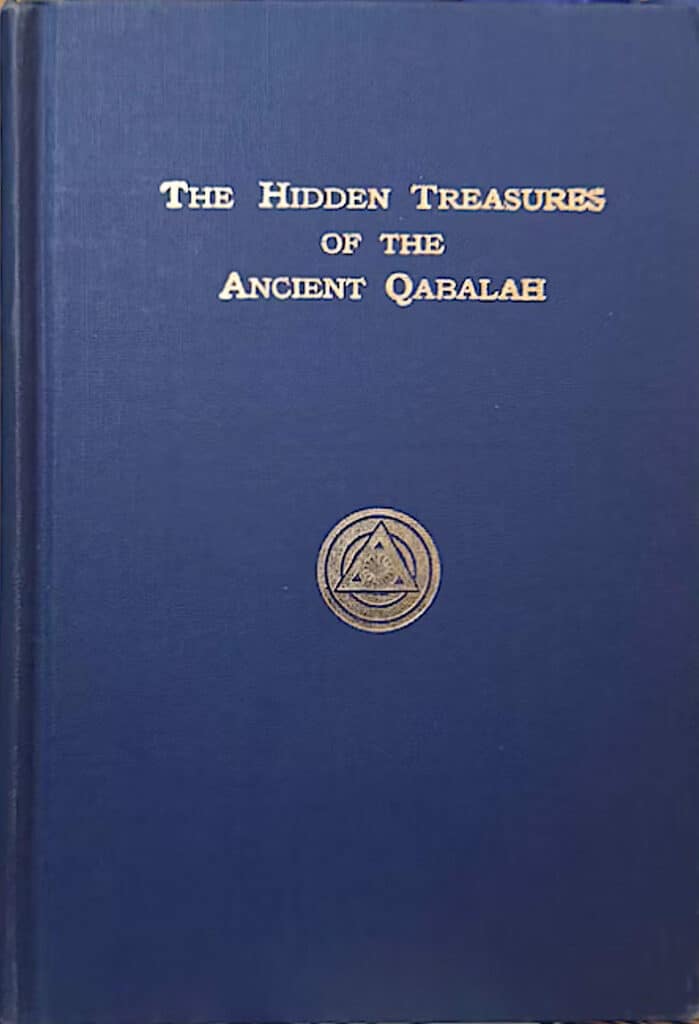
The Hidden Treasures of the Ancient Qabalah is a 1918 work by Elias Gewurz published by the Yogi Publication Society as the first volume of a projected series, with the subtitle The Transmutation of Passion into Power. Gewurz presents the Qabalah as the secret doctrine of the Jews, transmitted through generations of teachers and disciples and preserved most fully in the Zohar.
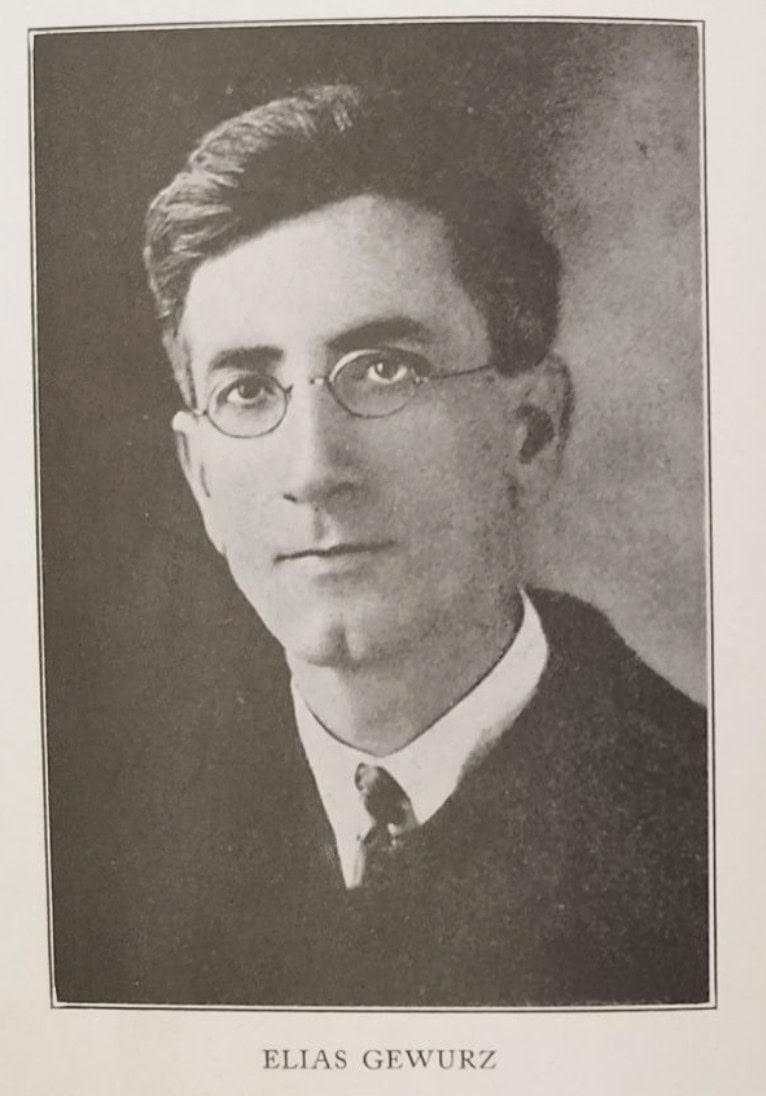
Elias Gewurz
Yet the book is far more than an introduction to Jewish mystical literature. Its central subject is spiritual transformation. Gewurz interprets Qabalistic teaching through alchemy, reincarnation, karma, Yoga, Christian scripture, Theosophy, occult initiation, the Masters, masculine and feminine principles, spiritual love, regeneration, and the liberation of the soul. The unusual character of the book becomes clear almost immediately. Gewurz explicitly compares the four paths of Yogi philosophy with Western alchemy and argues that both describe the same process of transforming the human being. Raja Yoga purifies the lower nature, Karma Yoga redirects energy into sacrificial work, Gnani Yoga refines the mind, and Bhakti Yoga unites the soul with God through love and devotion. He then identifies the human body and mind as the alchemical vessel in which this transformation occurs. This direct union of Qabalah, Yoga, alchemy, Hermetic teaching, Theosophy, and Christian mystical language made the book an unusually close fit with the publishing program YPS had been developing through Yogi Ramacharaka, The Kybalion, and its other works of Western esotericism.
What Is the Qabalah According to Elias Gewurz?
Gewurz opens by defining the Qabalah as the secret doctrine of the Jews, handed down by great teachers to chosen disciples under vows of secrecy. He identifies Moses de Leon with the written transmission of the Zohar during the thirteenth century and describes that work as containing immense stores of occult knowledge that remain difficult for English-speaking students because of its Hebrew and Aramaic language. His purpose is not to produce a scholarly history of Jewish mysticism. He wants to recover what he believes is the living spiritual science concealed within Qabalistic literature. He says that the assemblies of the ancient Jewish Masters were sources from which later occult philosophy developed and goes so far as to declare that modern occultism comes from the same source. Gewurz also states that he devoted the greater part of his life to the study of the Qabalah and that the teachings in his books are founded upon this ancient wisdom. The Qabalah is thus presented as an initiatory tradition containing laws governing the soul, spiritual evolution, divine consciousness, love, karma, and the return of the individual to God.
There is also an important Theosophical background to the book. Gewurz dates his introductory statement from Krotona in Hollywood in May 1915, and the copyright page explains that the substance of Chapters I through VI had been read before the Krotona Lodge of the Theosophical Society during May and June 1915. Chapter VII had been presented there in January, while Chapter VIII had been given before the Krotona Institute during its February–March session. The 1918 YPS book is thus a published form of teachings Gewurz had already delivered within one of the most important American Theosophical communities of the period. This explains much of its vocabulary of karma, reincarnation, Root Races, Masters, higher bodies, planes, evolution, and spiritual initiation, even while Gewurz repeatedly traces the foundation of his teaching to the Qabalah.
What Does Gewurz Mean by the Transmutation of Passion into Power?
The subtitle supplies the organizing principle of the entire volume. Gewurz treats human passion as energy that has descended into attachment, desire, self-interest, and material expression. Spiritual development does not destroy the fundamental life energy behind these forces. It changes their direction and quality. The same power that operates through desire can be drawn upward and converted into spiritual strength. This is why Gewurz turns to the imagery of alchemy. The alchemical furnace becomes the conditions of human life, the metals become elements of human nature, the dross becomes selfish desire and attachment, the gold becomes the spiritual soul, and transmutation becomes the gradual purification of the complete human being. The old alchemical formula of dissolving and coagulating is interpreted as first dissolving the bonds that hold consciousness to passion and material attachment and then redirecting the liberated life-force upward toward the soul.
The vessel in which the operation occurs is man himself. Gewurz specifically says that the physical body is the crucible in which the gold is tried, while his later explanation makes clear that the mental body participates in the same process. Even the cross receives an inward interpretation. The human body becomes the cross upon which the lower nature is crucified while the spiritual nature is liberated. Suffering, limitation, weakness, and difficulty can consequently become parts of the transmuting process. A person who suddenly attempts to reverse years of destructive living cannot expect all parts of his nature to submit immediately. Old habits and affinities continue to exert pressure. Gewurz describes spiritual development as the establishment of new affinities within the human constitution until the direction of life has changed.
Why Does Gewurz Compare Yoga with Alchemy?
One of the most important passages in the book for understanding its place within YPS occurs in the first chapter. Gewurz unexpectedly moves from the Qabalah into a detailed discussion of the four forms of Yoga. Raja Yoga purifies the lower man. Karma Yoga turns human energies toward sacrificial work. Gnani Yoga refines the mental nature through study and exercise. Bhakti Yoga joins the individual to God through love and devotion. Different temperaments initially follow different paths, but Gewurz says all of them eventually converge and that anyone seeking complete liberation must finally master the whole process.
He then makes the comparison explicit. Yoga comes from the East and alchemy from the West, yet he believes both were inspired by higher spiritual helpers and agree in their fundamental principles. Most important is their agreement concerning the vessel of transformation. In both systems, the operation occurs within the human being. The physical and mental bodies must be purified until the spiritual soul can emerge from the limitations imposed upon it. Gewurz invokes the Hermetic saying that to produce gold one must possess gold and explains that the required gold is already present as the spiritual soul. Spiritual transformation is possible because divinity is latent in man from the beginning.
This passage creates an unusually direct bridge between the book and the Hindu philosophy already published by YPS. Readers of the Ramacharaka courses would have immediately recognized Raja Yoga, Gnani Yoga, Karma Yoga, the higher and lower nature, the spiritual soul, evolutionary development, the Masters, and liberation from the lower personality. Gewurz was approaching the same spiritual ascent from a Qabalistic and Western alchemical direction. The connection is stated by Gewurz himself. He tells his reader that Yoga and alchemy agree in their central principles and describes them as Eastern and Western expressions of the same spiritual work.
What Is the Human Being Being Transformed Into?
Gewurz describes human life as a meeting point between descending and ascending nature. The individual contains physical, mental, psychic, and spiritual elements, and the struggle of life takes place inside this composite being. Self-control, in this scheme, is much deeper than suppressing an occasional impulse. Genuine mastery means reorganizing the relationships among the different levels of the human constitution until the spiritual principle becomes dominant. Gewurz describes this in startling language as the making of a new creature, with man beginning to become divine.
Evolution ordinarily accomplishes this slowly. Gewurz says that successive cycles carry humanity forward almost imperceptibly, but a person who consciously enters the spiritual path attempts to accelerate the process. He describes this as stepping away from the general movement of humanity and taking a hand in one’s own making. At the human stage the spiritual soul has acquired the capacity for individual initiative. It can begin its return toward its divine source by consciously mastering tendencies that had previously flowed outward into sensation and desire. The energy is drawn inward and upward until it becomes available to the spirit. The book’s transmutation of passion into power is thus a theory of directed spiritual evolution.
Why Does Spiritual Power Increase Moral Responsibility?
Gewurz repeatedly warns that occult development creates responsibility. Thoughts, words, and actions generate karmic consequences, and the effects become more serious as a person’s spiritual power increases. Someone possessing greater knowledge and power is capable of producing greater effects upon other people and upon the higher planes. For this reason, spiritual advancement must be accompanied by increasing selflessness and sacrifice. The acquisition of occult power without corresponding moral purification is dangerous.
This principle is central to the book because Gewurz does not regard knowledge itself as redemptive. He criticizes seekers who pursue knowledge simply for the possession of knowledge. Intellectual or occult knowledge placed in the hands of an undeveloped personality only gives that personality sharper instruments with which to cause harm. Knowledge must be accompanied by love and right use. This teaching places The Hidden Treasures of the Ancient Qabalah close to other YPS warnings about psychic development. The books issued under Swami Panchadasi and Swami Bhakta Vishita similarly combine instruction concerning hidden powers with warnings about their selfish employment. Gewurz approaches the matter from the moral discipline of initiation. Power is evidence of increased obligation, and the advanced student is expected to become increasingly sacrificial as his capacities develop.
What Are the Feminine Elements in Man?
The second chapter develops one of the book’s most distinctive teachings. Gewurz treats masculine and feminine qualities as spiritual principles existing within the complete human being. Strength and beauty initially appear as different qualities associated with man and woman, yet he regards them as different manifestations of one underlying power. Beauty is described as strength carried to a higher stage of development. The aggressive and outward-moving force associated with the masculine principle becomes transformed into the attractive, receptive, and harmonizing quality associated with the feminine.
Gewurz then internalizes the entire distinction. Spiritual completion requires a reconciliation of masculine and feminine within the mind itself. He describes the developed mind as becoming male-female in one, a condition he calls the dualization of mind. When this has occurred, a new form of consciousness becomes possible. He associates the transformation with the second birth and distinguishes the earthly mind received at the first birth from the heavenly mind awakened through spiritual regeneration. The feminine principle is thus not merely a discussion of relations between biological men and women. It becomes an essential element in the regeneration of consciousness.
The symbolism fits the book’s alchemical framework. Opposing forces must be reconciled within the vessel. Outgoing force and receptive love, strength and beauty, will and attraction eventually cease to work against one another. Their union produces a more complete human being. Gewurz compares this process with the lotus, whose roots lie in mud while its flower rises toward light. Physical desire supplies the original material, yet that material can be transmuted into something spiritually beautiful.
What Is Spiritual Companionship Between Man and Woman?
Gewurz next carries the masculine-feminine teaching into human relationships. Spiritual companionship begins when relationships cease to be governed mainly by possession, gratification, dependency, and ordinary personal attraction. As the disciple develops, Gewurz says that old relationships based upon lower affinities may fall away while new relationships arise through spiritual affinity. Friends are recovered on another level as “friends of the soul.”
The union of spiritually compatible people can strengthen both participants because human beings possess magnetic, electric, sympathetic, mental, psychic, and moral forces that can be elevated to higher levels of expression. Gewurz regards these forces as subject to spiritual will. When two people are joined through genuine spiritual affinity, their combined energies strengthen the operation of that will. He gives special importance to companionship between man and woman because the complementary principles represented by each can assist the development of both.
This gives the preceding chapter a second meaning. The masculine and feminine principles must eventually be reconciled within the individual, while spiritual companionship can aid the same process through relationship. Love becomes a means of transmutation when it ceases to revolve around personal possession and begins to awaken the divine qualities concealed in both people.
How Can Love Become a Means of Knowing God?
The fourth chapter, “The Knowledge of God Obtainable Through Love Pure and Undefiled,” takes the argument still further. Gewurz treats love as a mode of spiritual knowledge. Intellectual study can describe God, but purified love establishes an inward relationship with the divine life. The transformation of ordinary affection into impersonal spiritual love is thus another example of passion becoming power.
This is where the book intersects strongly with Christian mysticism. Gewurz repeatedly employs Biblical language, Christian images of rebirth, the cross, surrender, divine sonship, love, sacrifice, and the Father while interpreting these through Qabalistic, Theosophical, and occult concepts. The result is a spiritual system in which Christian regeneration, Qabalistic illumination, alchemical transmutation, and yogic liberation describe different dimensions of the same ascent.
Love also becomes the safeguard against the misuse of knowledge. Gewurz’s opening argument that knowledge without love can make a person more dangerous is answered by the later chapters. The true initiate must acquire power and love together. Increased consciousness must widen sympathy. If development increases pride, condemnation, domination, or separateness, then the lower personality has appropriated the knowledge.
What Is the Mystery of Time and Space?
Gewurz’s fifth chapter turns from personal transformation to metaphysics. Time and space are described as fundamental conditions through which the human mind interprets existence, yet their true nature remains beyond ordinary thought. Everything we ordinarily conceive appears within categories of past, present, future, location, distance, and extension. Gewurz asks what existed before time, what remains when time ends, where space ends, and what could exist where space does not. His questions are intended to loosen the reader’s assumption that the sensory world’s dimensions exhaust reality.
This chapter fits the book’s larger teaching about levels of consciousness. If ordinary mental consciousness is itself only one stage of human development, its perception of time and space cannot be assumed to describe reality as perceived from higher planes. The spiritual path gradually shifts consciousness beyond the limitations of the personal mind. What appears absolute from below may become relative from above.
This subject also has an interesting place within the later YPS occult literature. Clairvoyance and Occult Powers by Swami Panchadasi similarly treats time as relative when explaining clairvoyance of the past and future, including the possibility that events we call past and future may possess a kind of simultaneous existence from a higher-dimensional standpoint. The two books do not present identical arguments, but both place the ordinary experience of sequential time within a larger occult conception of consciousness.
What Is the Peace That Passeth Understanding?
Gewurz’s “peace that passeth understanding” is an achieved spiritual condition. Ordinary peace depends upon circumstances. Qabalistic peace arises when the center of consciousness has moved away from the personal reactions that circumstances continually disturb. Desire, fear, resentment, ambition, attachment, and judgment produce agitation because the individual remains identified with the personality through which these forces operate. Transmutation gradually removes their power.
Peace is therefore connected with mastery. The person who has redirected the outgoing energies of the lower nature develops an interior center that external conditions cannot easily disturb. This is also why love, sacrifice, spiritual companionship, and self-control have occupied so much of the preceding book. They prepare the conditions in which the higher consciousness can become stable.
The idea closely resembles the interior peace described in Light on the Path, a work that YPS also published and that Gewurz himself explicitly invokes later in the book. He quotes its requirement that before the voice can speak in the presence of the Masters it must lose the power to wound. For Gewurz, peace cannot be separated from harmlessness. A person who remains eager to condemn another person’s weakness has not reached the spiritual condition he is describing.
How Does Gewurz Explain Justice and Mercy?
The chapter on justice and mercy turns the doctrine of karma into an ethical discipline. Gewurz does not deny consequences. Human beings live under law, and thoughts, actions, desires, and relationships create results. Yet the recognition of law must not turn the student into a judge of other people. The developing disciple begins to understand how complex the karmic history behind any human personality may be and therefore becomes less willing to condemn what he sees on the surface.
Gewurz makes this point with unusual force. He imagines a future stage of humanity in which moral and spiritual defects will be treated with the compassion already extended to physical disabilities. Just as civilized people should not mock someone who is blind, deaf, or physically disabled, spiritually developed people will cease responding to vice and wrongdoing with hatred. He imagines future institutions treating criminals and vicious people as sufferers requiring care. His criterion for the student is severe. If another person’s misconduct awakens anything other than love and pity, the observer remains spiritually undeveloped.
Justice describes the operation of law. Mercy describes the consciousness of the spiritually awakened person living under that law. The student recognizes karmic causation without claiming the right to sit in judgment over another soul.
Why Is the Refusal to Judge So Important?
The prohibition against judgment becomes one of the book’s most concrete disciplines. Gewurz eventually gives the reader a morning prayer asking that during the coming day he or she may not become an instrument of judgment against any brother or sister. This is significant because it turns an abstract teaching into a daily mental practice.
For Gewurz, judgment binds the person judging to the same lower field of consciousness he is attempting to transcend. Resentment and repulsion show that the personality remains active. The true self does not operate through these reactions. Spiritual advancement can thus be measured in part by what another person’s weakness awakens within us. The difficult person becomes a test of the student’s own development.
This gives the book’s doctrine of transmutation an intensely psychological dimension. The spiritual path is worked out through repeated reactions, thoughts, habits, attractions, dislikes, and choices. The student watches the inner movement and gradually changes its direction. In this limited sense there is an interesting point of contact with the mental discipline found in suggestion and the training system developed by Herbert A. Parkyn through the Chicago School of Psychology and his Special Mail Course in Hypnotism and Suggestive Therapeutics. Gewurz supplies a Qabalistic and Theosophical explanation of self-mastery, while Parkyn’s earlier system approached the deliberate direction of thought, habit, and conduct through psychology and suggestion. The similarity is worth recognizing without collapsing two distinct systems into one.
What Happens on the Threshold of the Sanctuary?
Chapter VIII brings the book explicitly into the language of occult initiation. Gewurz opens with the statement from Light on the Path that before the soul can stand in the Master’s presence it must be washed in the blood of the heart. He interprets the blood of the heart as the life-essence. To be washed in it means that personal joy, sorrow, preference, and attachment have lost their position as the governing considerations of life. The disciple has discovered a higher allegiance and increasingly organizes life around the will of the divine Lord.
The sanctuary is therefore an interior state before it is a place. Entrance requires surrender of the personality’s competing masters. During ordinary life the individual serves desires, ambitions, fears, social pressures, attachments, and likes and dislikes. The initiatory path gradually reveals these as tyrants because each claims obedience from the personality. Spiritual freedom arrives when their authority is broken.
This teaching also places Gewurz within the stream of occult initiation literature that YPS had already made part of its catalog. The language of Masters, discipleship, hidden sanctuaries, purification, ordeals, and inner illumination occurs throughout the Western esotericism and Theosophical literature YPS published. Gewurz brings these themes directly into his interpretation of Qabalistic development.
Why Does Light on the Path Matter in This Book?
The explicit use of Light on the Path is significant because Gewurz does more than casually quote a familiar occult book. Its teachings become part of his explanation of the Qabalistic path. The requirement that the disciple lose the power to wound is used to explain mercy, nonjudgment, and preparation for contact with the Masters. The teaching concerning being washed in the blood of the heart becomes the foundation for his chapter on entering the sanctuary.
This reveals how freely Gewurz moves between traditions. He begins with Jewish Qabalah, uses Theosophical ideas of karma and reincarnation, compares the process with Hindu Yoga, explains it through Western alchemy, uses Christian language of crucifixion and regeneration, and then employs Light on the Path as an initiatory text. His claim is that these traditions disclose a common spiritual process. The hidden treasure of the Qabalah is therefore not a collection of isolated Jewish symbols. It is an ancient spiritual science that Gewurz believes reappears under different forms throughout the world’s initiatory traditions.
What Is the Eternal Light According to the Qabalah?
Near the end of the book Gewurz returns to the image that has quietly governed the entire volume, divine light. The opening pages had already described the human heart as a medium through which the light of the Holy One must pass. Attachments created through karmic obligations make the medium dense and opaque. As these bonds are broken, the heart becomes transparent enough to transmit the divine light.
The symbolism clarifies the entire process of transmutation. The spiritual student does not manufacture divinity. The light already exists. The work consists in removing the conditions that prevent its manifestation. Desire, selfishness, judgment, attachment, ignorance, and identification with the lower personality obstruct what is already present at the center of the human being. Purification allows the hidden light to become visible.
This idea has a natural relationship with Hermeticism, and the connection is made unmistakable on the book’s opening page. Gewurz places beneath his title an injunction attributed to the “Golden Precepts of Trismegistus,” telling the student to preserve gratitude toward those who have served as channels of light to the perplexed soul. The book therefore invokes Hermes Trismegistus before the main text even begins.
What Does Regeneration Mean in the Qabalah?
Regeneration is the completion of the process described throughout the volume. The old personality has been governed by divided impulses and identification with physical and personal existence. The regenerated person has shifted the center of life toward the spiritual principle. Gewurz’s earlier discussion of the second birth becomes crucial here. The earthly mind belongs to the first birth, while the heavenly mind emerges through spiritual rebirth.
Regeneration also explains why the book repeatedly uses Christian terminology. The second birth, crucifixion, resurrection, surrender, the Father, divine sonship, and the eternal light all become expressions of an occult transformation. The cross is experienced in the body. The crucifixion is the death of lower attachments. Resurrection is the emergence of the spiritual soul. Divine light appears when the human medium becomes transparent. The language is Christian, but Gewurz places it inside a Qabalistic, Theosophical, yogic, and alchemical cosmology.
What Does the Qabalistic Prayer Reveal About the Whole Book?
The volume closes with a Qabalistic prayer, and it is one of the clearest summaries of Gewurz’s actual spiritual priorities. The prayer does not ask for wealth, power, success, occult abilities, or material advantage. It asks for knowledge of God and peace. It asks that the heart become so filled with divine love that the individual can love not only those who return affection but even those who do not yet understand love. It asks the disciple to remember his own former weakness so that compassion will extend to weak people who cause pain as readily as to strong people who bring happiness.
That conclusion matters. After discussing occult knowledge, hidden traditions, alchemy, higher bodies, Masters, evolution, karmic law, spiritual power, Yoga, Qabalah, and initiation, Gewurz ends with love, humility, mercy, endurance, and surrender. The hidden treasure is finally a transformed human consciousness.
How Does the Book Connect Qabalah, Alchemy, Yoga, and Hermeticism?
This is the defining feature of The Hidden Treasures of the Ancient Qabalah. Gewurz does not keep the traditions in separate compartments. The Qabalah supplies the ancient wisdom. Alchemy supplies the symbolism of transformation. Yoga supplies a systematic account of paths by which different parts of human nature can be disciplined. Theosophy supplies much of the modern occult vocabulary of karma, reincarnation, Masters, Root Races, planes, and spiritual evolution. Christianity supplies the language of the cross, rebirth, divine love, surrender, resurrection, and the Father. Hermeticism supplies the Western initiatory and alchemical framework through which the transmutation is understood.
This is also why the invocation of Trismegistus on the title page deserves attention. Gewurz’s book begins under a Hermetic sign and then describes spiritual alchemy as a Western counterpart of Yoga. The saying “to produce gold one must have gold” becomes a statement about the divine element already concealed in man. The material of the Great Work is human nature itself.
How Does The Hidden Treasures of the Ancient Qabalah Compare with The Kybalion?
The relationship to The Kybalion is important because both books were issued by YPS and both present ancient wisdom through a modern synthesis of mental, spiritual, and Hermetic concepts. The Kybalion, published under the name of the Three Initiates, organizes its teaching around Hermetic principles governing mind, correspondence, vibration, polarity, rhythm, causation, and gender. Gewurz approaches transformation through Qabalah, spiritual alchemy, love, karma, and initiation. Yet there are unmistakable conceptual meeting points.
Mental and spiritual transmutation are central to both. Both understand the visible personality as only one level of a larger reality. Both treat opposing qualities as capable of transformation. Both give special importance to masculine and feminine principles. Both teach that the individual can consciously participate in an otherwise lawful process of development. Both use the Hermetic tradition as a key to understanding human transformation. Gewurz’s discussion of the male-female mind is especially noteworthy beside The Kybalion’s Principle of Gender, although the two books develop the idea in different ways.
Gewurz also makes a statement that fits remarkably well beside the Hermetic correspondence emphasized in The Kybalion. He argues for a “perfect analogy” between nature and man and says that understanding this relationship helps the student order his own life according to nature’s laws. His comparison of Eastern Yoga with Western alchemy is built upon the same conviction that apparently different manifestations can reveal one underlying law.
The connection should not be overstated as evidence of common authorship or direct textual dependence. The uploaded book does not establish either claim. What it does establish is that by 1918 YPS was publishing a Qabalistic work that openly combined Hermetic alchemy, Yoga, occult evolution, masculine and feminine principles, correspondence between man and nature, and conscious spiritual transmutation within the same publishing program that had produced The Kybalion ten years earlier.
Why Is the Rosicrucian and Alchemical Element Important?
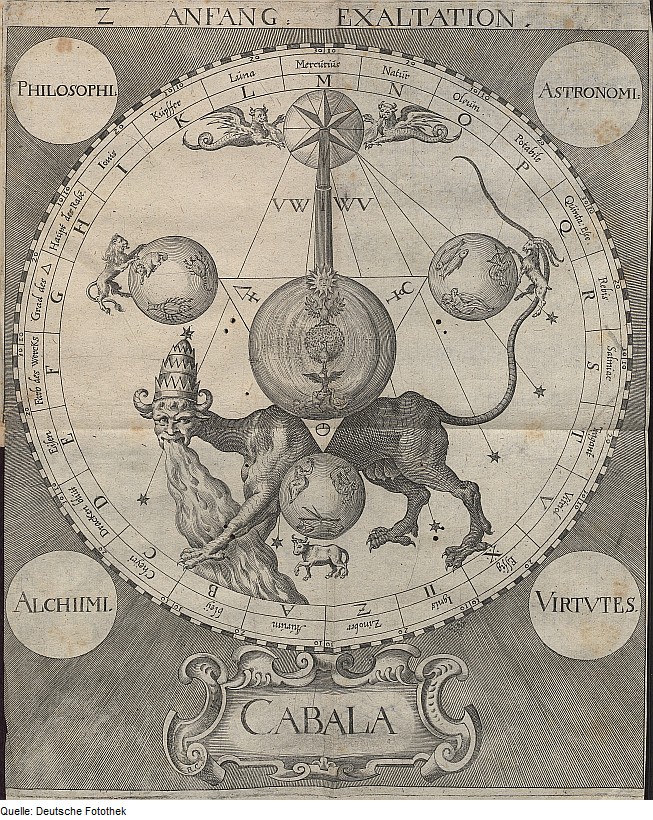
Although Gewurz identifies the Qabalah as the foundation of his teachings, the spiritual alchemy running through the book places it naturally within the Rosicrucian and Hermetic stream of Western occultism. The crucible, metals, gold, furnace, dissolution, coagulation, purification, transmutation, and regeneration all become descriptions of processes occurring within the initiate.
This is spiritual alchemy in its clearest form. The laboratory is the human constitution. The base material is unregenerated human nature. The fire is experience and spiritual discipline. The dross is attachment. The gold is the divine soul. The completed operation is regeneration. Gewurz consequently makes alchemy intelligible as an initiatory psychology. Its chemical language becomes a concealed description of the transformation of consciousness.
Why Was This Book Such a Natural YPS Publication?
By 1918 the Yogi Publication Society had spent fifteen years publishing works that moved freely across Yoga, occultism, mental science, Hermetic philosophy, psychic development, mysticism, reincarnation, healing, concentration, and spiritual evolution. Gewurz’s book brings many of those fields together in a single volume.
The connection to Yogi Ramacharaka is unusually direct because Gewurz himself introduces Raja Yoga, Karma Yoga, Gnani Yoga, and Bhakti Yoga as parallel methods of spiritual development and then compares Yoga with Western alchemy. Readers familiar with the YPS Ramacharaka books did not need a translator to recognize this vocabulary. Gewurz’s spiritual soul, higher and lower natures, karma, reincarnation, evolutionary cycles, Masters, liberation, and multiple levels of human existence belonged to a conceptual world already familiar through YPS.
The book also stood comfortably beside the publisher’s mental and occult works associated with William Walker Atkinson, Theron Q. Dumont, Panchadasi, Bhakta Vishita, and the Three Initiates. Those books approached self-mastery through different identities and subjects, while Gewurz supplied an openly Qabalistic and Theosophical route into the transformation of human consciousness.
What Makes The Hidden Treasures of the Ancient Qabalah Important in the YPS Catalog?
Its importance lies in how clearly it displays the synthesis at the center of the later YPS catalog. A book advertised as ancient Qabalah quickly becomes a discussion of Yoga. A discussion of Yoga becomes an explanation of alchemy. Alchemy becomes a method of interpreting human psychology and spiritual evolution. The spiritual soul becomes the hidden gold. Christian crucifixion becomes the experience of the incarnated soul. Masculine and feminine principles become forces that must be reconciled within consciousness. Karma explains human obligations. Reincarnation explains the long history of the individual. The Masters guide spiritual evolution. Light on the Path supplies rules of initiation. Trismegistus stands at the entrance to the book. Divine love stands at its end.
That combination makes The Hidden Treasures of the Ancient Qabalah an unusually revealing YPS publication. It demonstrates that the Society’s presentation of Eastern and Western traditions as complementary paths was not confined to books written under the Ramacharaka or Hermetic identities. Elias Gewurz independently states the same basic proposition inside the book itself. Yoga and alchemy came from different geographical traditions, he says, yet agree in their fundamental principles because both concern the transformation of man. The body and mind are the vessel, ordinary human nature is the material placed in the furnace, spiritual discipline supplies the transforming work, and the gold sought by the alchemist is already concealed within the human being as the spiritual soul.
What Is the Central Teaching of The Hidden Treasures of the Ancient Qabalah?
The central teaching is contained in its subtitle. Passion can become power. Human beings do not attain spiritual freedom by acquiring information about hidden doctrines while remaining inwardly unchanged. The hidden knowledge must be worked into life. Desire becomes devotion. Personal love expands into spiritual love. Strength matures into beauty. Knowledge becomes wisdom through love. Judgment becomes mercy. Attachment gives way to freedom. The divided masculine and feminine elements become reconciled. The ordinary mind gives way to the heavenly mind. The personality ceases to dominate the soul, and the divine light that was concealed behind it begins to shine through.
For Gewurz, this is the real meaning of Qabalistic wisdom. Its treasures are hidden because their deepest content cannot simply be possessed intellectually. They become known through transformation. The initiate himself becomes the laboratory in which the ancient teaching is demonstrated. The gold sought through spiritual alchemy is the liberated soul, and the final proof of attainment is found in a person whose knowledge has become love, whose power has become service, and whose inner life has become transparent to the eternal light.
Elias Gewurz Biography
Elias Gewurz (1875–1947) was a Polish-American author, lecturer, and active member of the Theosophical Society, whose writings helped introduce Qabalistic philosophy to a wider English-speaking audience. Born on September 11, 1875, in Kraków, Galicia, Poland, he was educated in Vienna, Austria.
By 1908, Gewurz had transferred from the Austrian Section to the American Theosophical Society. During the First World War, while Galicia became a battleground between advancing Russian and German forces, he spent time writing in Las Palmas on Grand Canary Island before emigrating to the United States. Upon his arrival, he settled at the Krotona Theosophical Colony in Hollywood, California, where he delivered several lectures in 1915. Over the following decades he lived in San Francisco, where he worked as Assistant Librarian at the Olympic Club, later returned to Hollywood as a language teacher, and eventually settled in Ventura, California, supporting himself as a writer after becoming a naturalized American citizen.
Gewurz is best known for his influential works on Qabalah, particularly The Hidden Treasures of the Ancient Qabalah and Mysteries of the Qabalah. The Hidden Treasures of the Ancient Qabalah was first published by the Theosophical Book Concern at Krotona in 1915 after originating as a series of lectures delivered before the Krotona Lodge. The book was warmly received within Theosophical circles, with Gewurz donating copies to newly chartered lodges and their libraries. It was highly praised as an accessible introduction to one of the world’s oldest esoteric traditions. In 1918, the Yogi Publication Society issued its own edition.
Gewurz never married and remained devoted to writing, lecturing, and the study of Western esotericism throughout his life. He died in Ventura, California, on November 23, 1947.