The Secret Doctrine of the Rosicrucians written under the pseudonym, Magus Incognito, was originally published by the Advanced Thought Publishing Company and later issued by the Yogi Publication Society. The book presents a complete system of Rosicrucian cosmology, spiritual evolution, consciousness, reincarnation, psychic development, and universal law. It begins with the hidden Rosicrucian tradition and the meaning of its symbols, then builds a large metaphysical system from the Infinite Unmanifest through the World Soul, polarity, the One and the Many, the planes of consciousness, the sevenfold soul, metempsychosis, the aura, and finally the Seven Cosmic Principles. It is one of the clearest examples of how the publishing network brought Rosicrucian teaching, Hermeticism, Western esotericism, Qabalah, alchemy, reincarnation, mental influence, and Eastern philosophy into a single occult framework.
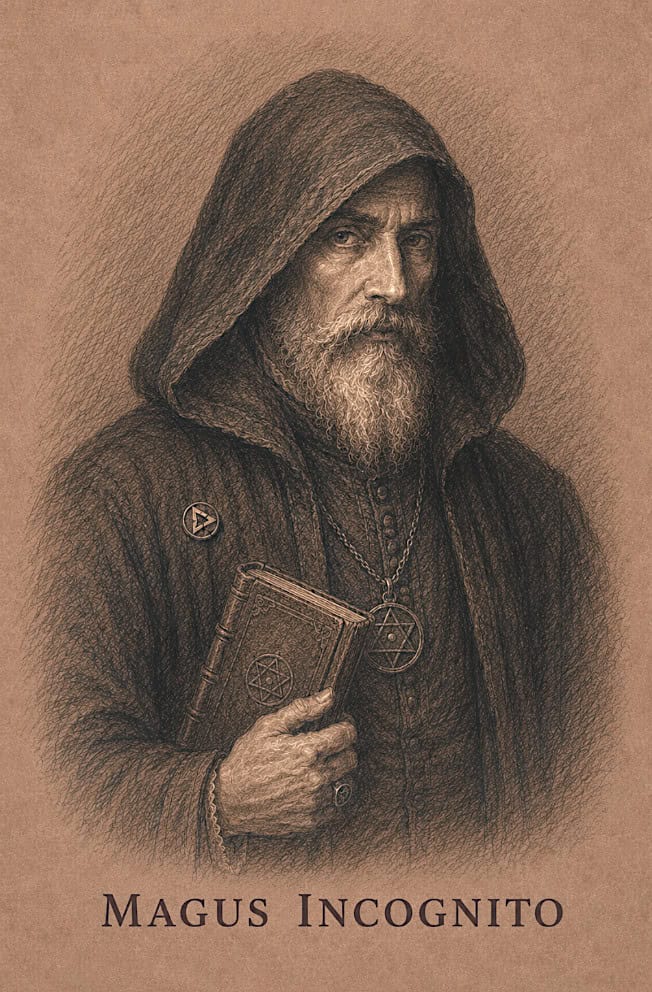
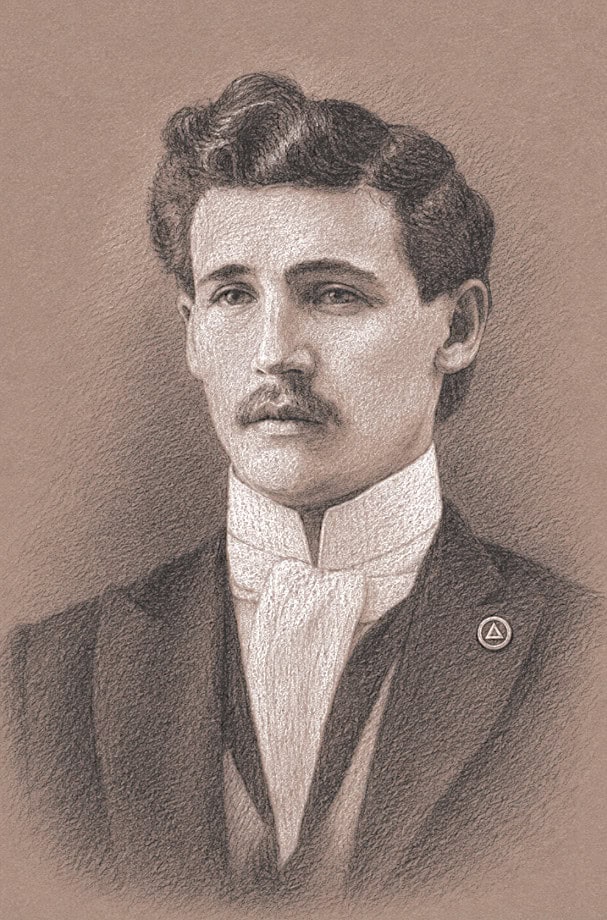
Magus Incognito (Artist depiction)
At the center of the book are the “Seven Aphorisms of Creation,” which the author describes as embodying the fundamental principles of the Rosicrucian Secret Doctrine. The first seven major doctrinal sections progressively move from the Absolute and unmanifested source of existence to the manifestation of the cosmos, life, consciousness, and finally the individual human soul. The later portions of the book then apply this cosmology to reincarnation, human evolution, the aura, and seven universal laws or “Cosmic Principles.”
The central idea running through the entire work is that existence is fundamentally One. The apparent multiplicity of the universe results from this One Reality becoming progressively involved in manifestation. Spirit becomes life, life becomes consciousness, consciousness assumes innumerable forms, and individual beings gradually evolve toward recognition of their underlying spiritual identity. Creation and spiritual evolution are therefore opposite movements of the same process: first the One involves itself in limitation and multiplicity, and then the Many gradually evolve toward conscious realization of the One.
The book overlaps heavily with subjects already familiar from The Kybalion, including Correspondence, Vibration, Rhythm, Polarity, cosmic law, sex or gender as a universal principle, the relationship between the One and the Many, and the existence of different planes of consciousness. It also connected the network surrounding Herbert A. Parkyn, William Walker Atkinson, and the Yogi Publication Society, to a much deeper Rosicrucian background, which will be examined later through figures including R. Swinburne Clymer and Ella Wheeler Wilcox.
What Is The Secret Doctrine of the Rosicrucians About?
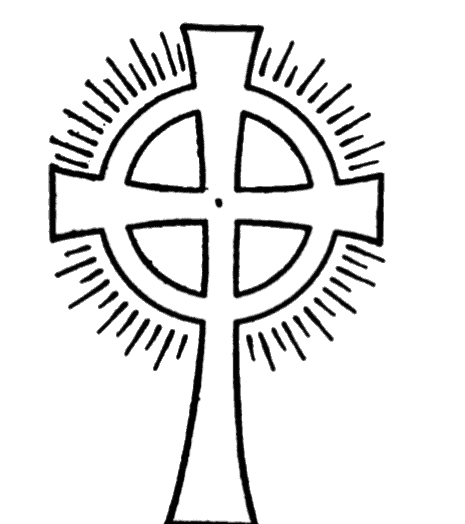
Mystic Symbol of the Rosicrucian Brotherhood
The Secret Doctrine of the Rosicrucians presents what it calls an ancient body of esoteric teaching transmitted through masters, initiates, and hidden schools for many centuries. The system begins before the existence of the visible universe and attempts to explain how manifestation itself begins, how unity becomes diversity, how life appears in matter, how consciousness develops through different levels, how individual souls progress through repeated incarnations, and how universal laws operate throughout the cosmos. The book is constructed as a progression. Each stage depends upon what has already been established, beginning with the Infinite Unmanifest and then moving into the World Soul, polarity, multiplicity, life, consciousness, the soul, reincarnation, cosmic evolution, psychic phenomena, and the Seven Cosmic Principles.
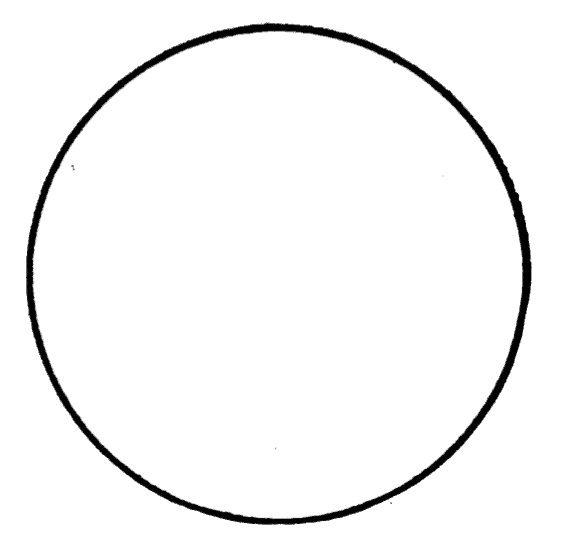
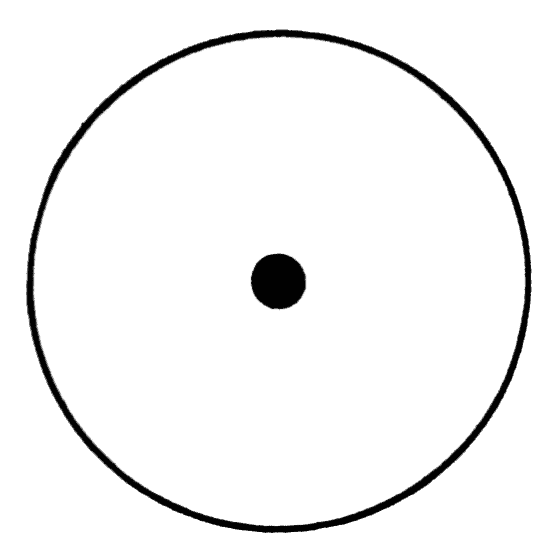
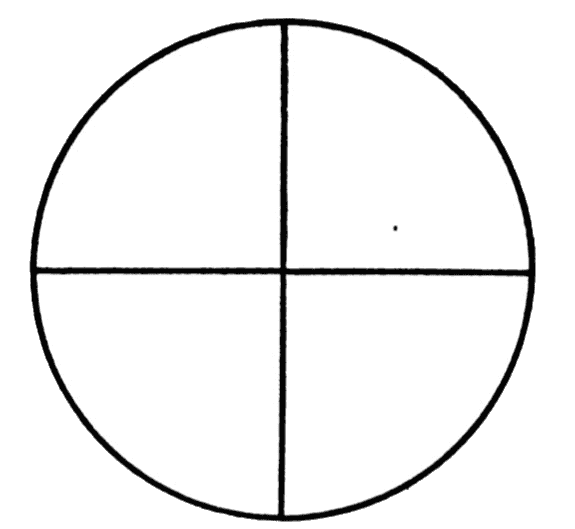
The book also treats sacred geometry as a second language through which the doctrine can be understood. The empty circle, the point within the circle, the Rose Cross, the Cosmic Egg, the Universal Androgyne, the Flame, and other figures are used to represent successive states in cosmic manifestation. The symbols change as the universe changes. An empty circle represents the Infinite before manifestation. A point appearing at the center marks the first expression of the World Soul. A cross and circle represent the appearance of creative polarity. Later images add multiplicity, life, and consciousness. This visual system is one of the reasons the book is important within the YPS catalog. It gathers metaphysics, occult psychology, symbolic religion, and comparative philosophy into one organized sequence.
Who Are the Rosicrucians According to Magus Incognito?
Magus Incognito begins by separating what he calls the true Rosicrucians from public organizations using the Rosicrucian name. He describes the early twentieth-century occult world as filled with groups claiming exclusive descent from an original Rosicrucian order and charging fees for initiation or membership. His own definition is very different. The true Rosicrucians are presented as an unorganized body held together through common knowledge, training, and recognition among initiates. Membership is said to depend upon recommendation by qualified members and advancement in esoteric knowledge, not upon joining a public society through payment.
This definition is important because Magus Incognito describes Rosicrucian influence as something that can operate within other institutions. He states that Rosicrucians may be found in occult organizations, philosophical circles, science, business, professional life, politics, churches, Masonry, labor movements, and other societies. They are described as the “leaven” within these organizations, keeping certain teachings alive while remaining publicly unidentified. The model is one of hidden intellectual transmission through networks. Ideas can pass through a school, magazine, lodge, church, publishing company, or philosophical society without requiring every participant to publicly identify as Rosicrucian. That claim becomes significant later when the book is placed beside the network connected with Parkyn, Atkinson, Advanced Thought Publishing Company, and YPS.
Christian Rosenkreutz and the Brothers of the Rosy Cross
The book places the modern public awareness of Rosicrucianism around the beginning of the seventeenth century, when reports began circulating concerning the mysterious Brothers of the Rosy Cross. Magus Incognito discusses the traditional story of Christian Rosenkreutz, the German monk or nobleman said to have traveled through India, Persia, and Arabia before returning to Europe with a body of secret wisdom acquired from Eastern sages. Rosenkreutz was then said to have founded the original brotherhood, whose existence remained concealed until long after his lifetime. Magus Incognito accepts the story only as a symbolic account containing a disguised version of a deeper historical truth.
The direction of the legend matters. Knowledge travels from the East into Europe. Magus Incognito expresses this with the Rosicrucian maxim “Look to the East, whence comes all Light.” He states that the Secret Doctrine originated through Oriental sources and that elements of the same teaching could still be found in advanced Eastern brotherhoods. He also notes that Theosophy and Western interest in Oriental philosophy had helped bring fragments of the old teaching into public view. This makes the book a natural fit within the same publishing environment that produced large numbers of works on Yogi philosophy and the writings issued under the name Yogi Ramacharaka. Magus Incognito presents Rosicrucianism as part of an East-to-West transmission of esoteric knowledge, not as an isolated European phenomenon.
Where Does the Rosicrucian Secret Doctrine Come From?
“The Alchemical Tree of Life” with 7 ancient levels for self mastery by Wolfgang Killian
The Secret Doctrine is described as a body of wisdom assembled from fragments surviving in many civilizations. Magus Incognito names Egypt, India, Persia, Chaldea, Media, China, Assyria, ancient Greece, and the Hebrew mystical tradition, including the Kabbalah and Zohar. He then places behind all of these a still older source associated with Atlantis. According to the book’s occult history, knowledge preserved in Atlantis was scattered after the destruction of that civilization, and later masters attempted to collect the fragments that survived among different peoples.
The historical claim belongs to the esoteric framework of the book, but the way Magus Incognito uses it is important. Similarities among Indian philosophy, Egyptian mystery traditions, Greek philosophy, Persian teachings, Chaldean lore, and Hebrew Qabalah are treated as evidence that each preserved portions of an older common doctrine. The book presents Pythagoras as one of the major carriers of that current into the Greek world and says his teaching came through Egyptian and Persian instruction. It also connects the same stream with Gautama Buddha and ancient Hebrew esotericism. The result is a universal history of occult knowledge in which religious systems can differ on the surface while preserving related inner principles.
This method explains why the book moves so freely among Eastern philosophy, Greek thought, Qabalah, Christian language, alchemy, modern psychology, and contemporary scientific theories. Magus Incognito treats these traditions as different expressions of one ancient wisdom. That approach closely matches the comparative structure found throughout the Yogi Publication Society catalog, where Indian philosophy, occult science, mental development, comparative religion, and Western esoteric systems appear beside one another.
Why Is Rosicrucian Teaching Kept Secret?
Magus Incognito argues that secrecy exists because esoteric knowledge requires preparation. Some teachings are said to involve forces and methods that could be misunderstood or misused if exposed without training. Other teachings cannot be fully understood until the student has developed the intellectual and spiritual capacity required to receive them. Initiation is presented as a graded process in which access to knowledge corresponds with the development of the student.
The book contrasts the public exchange of knowledge associated with Western science with the traditional Eastern model of guarded instruction. The quoted discussion of the chela describes a student who enters an esoteric school and becomes bound to secrecy concerning what is learned there. It also warns against mistaking unusual occult powers for the purpose of initiation. The manipulation of hidden forces and apparently extraordinary abilities may arise during training, but Magus Incognito presents them as secondary effects of a deeper development of consciousness.
The same principle shapes the book itself. Magus Incognito repeatedly states that some meanings are being disclosed while others remain reserved. Near the end of the opening section he says the volume does not reveal the complete formulas of mental alchemy or spiritual transmutation. Those teachings are said to become available only when the student reaches the proper stage. The saying “When the Pupil is ready, the Master appears” is used to summarize this relationship between preparation and further knowledge.
What Does the Book Mean by Higher Alchemy?
The discussion of alchemy provides one of the first clear examples of the book’s method. Magus Incognito accepts the traditional association between Rosicrucianism and alchemy but argues that the deepest Rosicrucian alchemy concerns mental and spiritual transformation. Physical alchemy and the transmutation of metals become outward correspondences of inner processes. Sulphur, mercury, the Philosopher’s Stone, and other familiar alchemical terms are presented as symbols capable of carrying a second meaning for readers who possess the key.
Correspondence is what makes this possible. “As above, so below” allows a process occurring on one level to represent or reveal a related process on another. A material transformation can express a mental transformation because the same law is believed to operate across different planes. Higher Alchemy thus becomes the transformation of consciousness, character, and spiritual condition.
This idea will become one of the important bridges to The Kybalion. The Kybalion also treats mental transmutation as a form of higher alchemy and also makes Correspondence the law that connects different levels of existence. The detailed textual comparison belongs later in the article, after the Rosicrucian system has been fully established, because the strength of the comparison lies in how many related pieces fit together.
The Seven Aphorisms of Creation
Magus Incognito says the foundation of the system is contained in what he calls the Seven Aphorisms of Creation. These aphorisms describe successive stages in the movement from the unmanifest source toward a fully differentiated universe. Each aphorism introduces a new level of manifestation and is accompanied by symbols designed to represent the same idea visually. The first deals with the Eternal Parent before creation. The second concerns the birth of the World Soul. The third introduces cosmic sexual polarity. Later aphorisms explain how the One becomes the Many, how universal life permeates all forms, and how consciousness develops through successive planes.
The Seven Aphorisms are presented as foundational teachings, not as the complete Rosicrucian doctrine. Magus Incognito says that mastery of these principles prepares the student to receive more advanced instruction. The number seven will continue through the book in the seven planes of consciousness, the sevenfold soul, planetary cycles, racial cycles, and the Seven Cosmic Principles. The repeated sevenfold structure gives the system an internal architecture that becomes more apparent as the later sections unfold.
What Does the Rose Cross Symbol Mean?
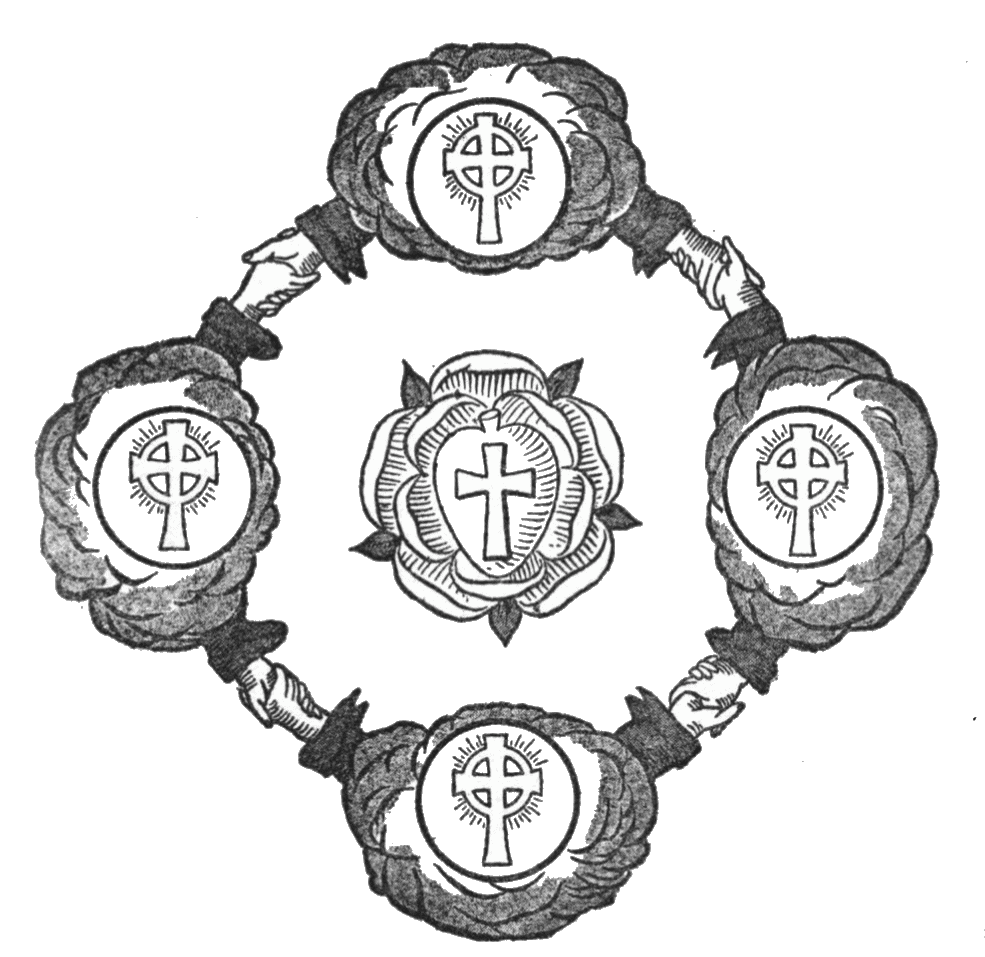
The Symbol of the Rosy Cross (Conventionalized)
The Rose Cross is given several levels of interpretation. Magus Incognito says that when the Rose appears above the Cross, the Rose represents divine attainment reached through the trials and suffering symbolized by the Cross. When the Cross becomes a sword joined to the Rose, the image expresses active spiritual struggle followed by attainment. When the Cross is surmounted by a Crown, the symbol represents mastery gained through the difficulties of mortal existence. The modified phallic form introduces another level associated with the universal male and female principles.
The symbol is thus designed to carry several meanings at the same time. It can refer to spiritual development, sacrifice, mastery, generation, polarity, and the union of complementary forces. Magus Incognito explicitly says that higher interpretations remain reserved from the public discussion, which fits the book’s larger claim that symbols were designed to reveal different levels of meaning according to the preparation of the reader.
Part I closes with another important idea. Magus Incognito says that knowledge without expression in action is like wealth hoarded by a miser and instructs the student to remember the “Law of Use.” This statement becomes important later because The Kybalion ends with a closely related insistence that occult knowledge must be used. The two passages deserve to be compared directly when the article reaches the larger Kybalion section.
The Eternal Parent and the First Aphorism
Symbol of the Infinite Unmanifest
Part II leaves Rosicrucian history and begins the cosmology itself. The First Aphorism describes the Eternal Parent during what the book calls the Sleep of the Cosmic Night. Light does not exist because the Flame of Spirit has not been kindled. Time does not exist because change has not begun. Things do not exist because form has not appeared. Action cannot exist because there are no things capable of acting. The pairs of opposites do not exist because polarity requires manifested things. The Eternal Parent remains causeless, indivisible, changeless, infinite, and alone.
This passage establishes the difference between the Absolute and the manifested universe. The Eternal Parent cannot be defined through any quality appearing later within creation. Spirit does not fully define it because Spirit belongs to manifestation. Matter does not define it. Time, form, polarity, personality, motion as ordinarily understood, and even consciousness in its familiar sense all belong to later stages. The Eternal Parent is the source from which these become possible.
Magus Incognito uses the empty circle as the symbol of this condition. The circle is meant to suggest Infinite Space, although the author admits that any drawn circle is inadequate because a finite line cannot contain infinity. Infinite Space remains the closest available symbol because it can contain every possible manifestation without becoming one of the manifested things contained within it. The book describes the Infinite as a “No-Thing” containing the possibility of all Thingness.
Why Does Infinite Space Represent the Eternal Parent?
The idea of Infinite Space allows Magus Incognito to remove the Absolute from ordinary religious images. Space cannot be pictured as a bounded object because every imagined boundary requires more space beyond it. Space can also be imagined as existing whether a universe is manifested or absent. The book cites an occult catechism asking what remains whether there is a universe or even gods, with the answer given simply as “Space.”
Indian philosophy is brought directly into the explanation through the formula “neti, neti,” or “not this, not that.” The Infinite cannot be defined by attaching finite properties to it. Human thought can recognize the inadequacy of particular descriptions while remaining unable to form a complete positive image of the Absolute. Magus Incognito describes the essence of Being as formless, unconditioned, and beyond the reach of ordinary thought.
This is one of the clearest examples of the book blending Rosicrucian language with Eastern metaphysics. The Eternal Parent is presented as a universal source that cannot be contained inside one religious vocabulary. That same comparative method appears repeatedly throughout the volume.
The Cosmic Night and the Days and Nights of Brahm
Creation has no single beginning in this system. Magus Incognito describes an endless alternation between Cosmic Days and Cosmic Nights. During a Cosmic Day, manifestation unfolds. During a Cosmic Night, the manifested universe is withdrawn into the Infinite Unmanifest. The process repeats through limitless cycles. The book directly compares this with the Indian Days and Nights of Brahm and links the same concept with Buddhism, Brahmanism, and the Kabbalah.
Rhythm governs this cosmic alternation. The universe expands into manifestation and later returns toward unmanifestation in a pattern compared with breathing. The book also brings in Herbert Spencer’s philosophy of universal concentration and diffusion as a modern echo of what Magus Incognito regards as an ancient occult principle.
This establishes Rhythm at the largest imaginable scale. Rhythm is first presented as the law governing the appearance and disappearance of universes. Later it will govern movement on lower planes, including cycles in nature, history, and consciousness. The same law is intended to operate through the whole hierarchy of existence.
Why Is the Eternal Parent Beyond Spirit and Matter?
Magus Incognito makes an important distinction between the Infinite source and Spirit. Spirit itself appears only after manifestation begins, so the Eternal Parent must stand behind both Spirit and Matter. The Flame is used as the traditional symbol of Spirit, yet the book places behind the visible Flame what it calls the “Dark Flame,” the hidden essence from which light and spiritual activity arise. The Dark Flame has no ordinary light or heat because those qualities appear only after manifestation.
The same reasoning is applied to time. Time measures change. If nothing changes, there can be pure duration without time in the ordinary sense. During the Cosmic Night, there are no changing forms or successive states, so time has not yet begun. Time appears with manifestation because manifestation introduces change.
Form follows the same pattern. A thing can be distinguished only because it possesses qualities that separate it from other things. Before manifestation, no such distinctions exist. The Eternal Parent contains the possibility of every form and quality without possessing a finite form of its own.
What Are the Pairs of Opposites?
Polarity appears as soon as manifestation begins. Magus Incognito argues that every manifested quality implies an opposite. Hot and cold, light and darkness, large and small, near and far, hard and soft, and similar pairs are used as examples. A thing becomes knowable through qualities that distinguish it from other things, and each quality occupies one side of a larger opposition.
The Eternal Parent cannot be assigned one pole because that would limit the Infinite to a particular condition. The book also refuses to describe the Absolute as simply containing both poles in the same finite sense. The pairs of opposites belong to manifestation. The Infinite contains the possibility from which polarity can appear while remaining beyond polarity itself.
This becomes a major foundation for later occult psychology. Once states are understood as positions within polar relationships, movement between states becomes possible. Magus Incognito will later extend the same principle from cosmology into mind and consciousness.
The Soul of the World and the Second Aphorism
Symbol of the New-Born World Soul (The Germ within the Egg)
Part III begins the first movement into manifestation. The Second Aphorism says that the Germ within the Cosmic Egg takes form, the Flame is rekindled, time begins, a thing exists, action begins, the pairs of opposites appear, and the World Soul is born. The new Cosmic Day has begun.
The symbol now changes. The empty circle remains, but a black point appears at its center. The circle continues to represent the Infinite Unmanifest. The point represents the first focal center of manifestation. Magus Incognito calls this first manifestation the World Soul, Anima Mundi, World Spirit, Logos, Demiurge, and Universal Will, drawing several philosophical traditions into one concept.
The World Soul contains the potential of the universe that will develop from it, much as a germ within an egg contains the possibilities of the organism that will later emerge. Manifestation begins as a unified center before any complex differentiation has occurred.
What Does the Cosmic Egg Symbolize?
Magus Incognito treats the Cosmic Egg as one of the most widespread symbols of creation. The egg contains life in an invisible and undeveloped form before that life breaks outward into recognizable structure. Its hidden germ grows from within, making the image a natural symbol for a universe developing from an unseen source.
The book compares versions of the Cosmic Egg found in Indian, Greek, Orphic, Syrian, Persian, and Egyptian traditions and even links the ancient symbolism with later Christian Easter imagery. The Brahmanic Golden Egg of Kalahansa is placed beside the Orphic Egg and other ancient forms.
The repetition of the symbol across cultures is interpreted as another survival of the universal Secret Doctrine. Magus Incognito repeatedly uses this kind of comparison to argue that separate religious traditions preserve related fragments of the same ancient metaphysical teaching.
The Logos, Demiurge, and Anima Mundi
The World Soul becomes a meeting place for several philosophical concepts. The Anima Mundi is the living soul of the world. The Logos is the ordering or creative principle through which the universe takes form. The Demiurge is the intermediary creative power between the Absolute and the world of manifestation. Magus Incognito treats these as different names or formulations for the same first manifested principle.
The distinction between the Eternal Parent and the World Soul is central. The World Soul does not possess the absolute status of the Eternal Parent. It exists during the Cosmic Day and disappears when manifestation is withdrawn. The Eternal Parent remains beyond the cycle.
The World Soul also carries an impulse toward manifestation, described through concepts such as Universal Will and the Will-to-Live. Creation is driven by an urge toward expression. The universe begins to unfold because the first manifestation contains within itself the impulse to develop its latent possibilities.
Is the Universe an Idea in the Infinite Mind?
The book makes one of its strongest metaphysical statements when it describes the World Soul as an idea of the Eternal Parent. Magus Incognito rejects the idea that the World Soul has been physically divided from the Infinite or created out of literal nothingness. He compares its existence with an image appearing in a dream or reverie. The manifested cosmos exists as a picture within the Infinite Imagination.
This introduces a distinction between absolute and relative reality. The Eternal Parent alone is unconditioned. The World Soul and everything developing from it possess reality within manifestation. The universe is real at its own level while remaining dependent upon a source that transcends the entire manifested order.
This will become one of the strongest points of comparison with The Kybalion’s doctrine of the Mental Universe. The detailed comparison belongs later, once the Rosicrucian account of the One and the Many has also been developed, because that later material completes the structure needed for a direct comparison.
The Universal Androgyne and the Third Aphorism
Symbol of the Universal Androgyne
Part IV introduces the next stage of manifestation. The Third Aphorism states that the One becomes Two, the Neuter becomes bisexual, male and female evolve as two aspects within one being, and generation begins. Magus Incognito calls this condition the Universal Hermaphrodite or Universal Androgyne.
Male and female are being used as cosmic principles. The doctrine extends the two forces through every plane of existence. Creation requires interaction, and interaction requires differentiated forces capable of acting and reacting upon one another. Masculine and feminine become the names given to these complementary activities of the World Soul.
The book applies this concept far beyond biological reproduction. Electricity, magnetism, chemical affinity, mineral processes, mental influence, and higher spiritual activity are all said to involve some expression of the same dual principle. Physical sex is one manifestation of a universal law.
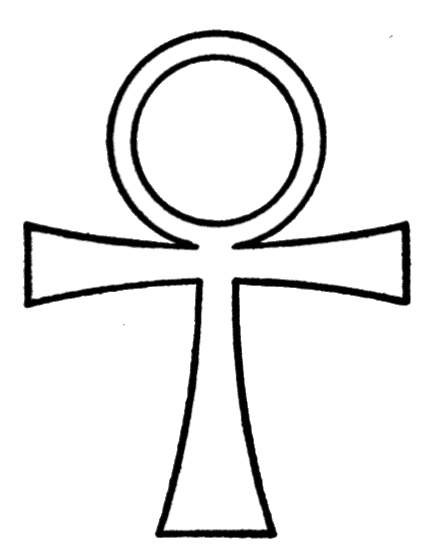
What Do the Circle and Cross Mean?
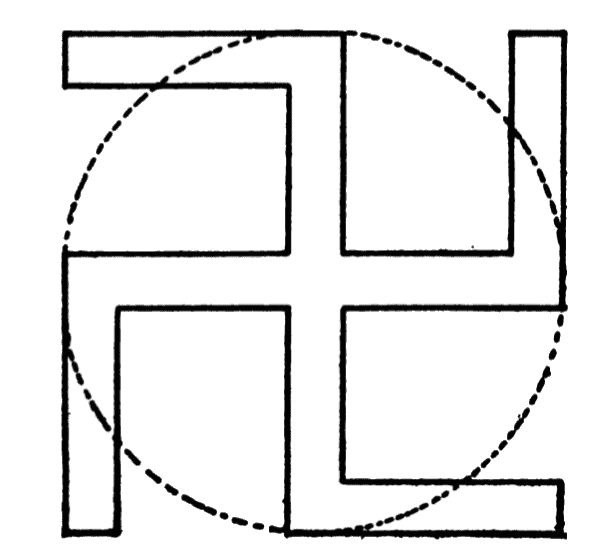
Symbol of the Swastica
The symbolism changes again with the Third Aphorism. The circle is associated with the feminine principle and the cross with the masculine principle. Combining them produces the symbol of the Universal Androgyne. Magus Incognito discusses the cross within the circle, the phallic cross, and the swastika understood as a rotating cross whose movement creates the appearance of a circle.
The Rosy Cross is incorporated into this same symbolism. The circle becomes the Rose and the cross may become the Sword. Their union represents the interaction of complementary universal forces. The book separates this teaching from later forms of phallic worship, which it describes as distorted versions of an older initiatory doctrine.
The symbol can now be read at several levels. Earlier it represented trial, spiritual attainment, and mastery. Here it also represents cosmic generation. The multiple meanings are possible because the book assumes that the same patterns operate at different levels through Correspondence.
How Does the One Become Two?
Symbol of the Phallic Cross
The first three aphorisms now form a clear sequence. The Eternal Parent exists beyond all differentiation. The World Soul appears as the first center of manifestation. The World Soul then develops two complementary poles within itself. These poles are called masculine and feminine, and their interaction makes generation possible.
The important point is that duality remains inside unity. The two principles do not become two independent absolute beings. They remain expressions of one World Soul. Difference enters manifestation without destroying the unity from which it came.
That pattern will continue into the next part of the system. The One will become the Many without ceasing to be One. Individual centers will appear without acquiring absolute separation. The doctrine moves step by step from unity into increasingly complex manifestation.
Universal Sex, Electricity, Magnetism, and Chemical Affinity
Magus Incognito attempts to support the doctrine of universal sex with the scientific language available in his own period. Positive and negative electrical forces are interpreted as masculine and feminine activities. Atomic and chemical processes are described through attraction and generation. Crystallization is treated as another expression of the same universal polarity. Some of the scientific explanations reflect early twentieth-century theories and should be read as part of the intellectual setting in which the book was written.
The point inside the Rosicrucian system is clear. Every creative process requires interaction between differentiated forces. The language of sex is used to describe this relationship at physical, mental, and spiritual levels. Generation becomes one of the fundamental mechanisms of manifestation. This prepares the way for the next major step. Once polarity has appeared and creative interaction has begun, the universe can move from the One and the Two toward the Many.
How Does the One Become the Many?
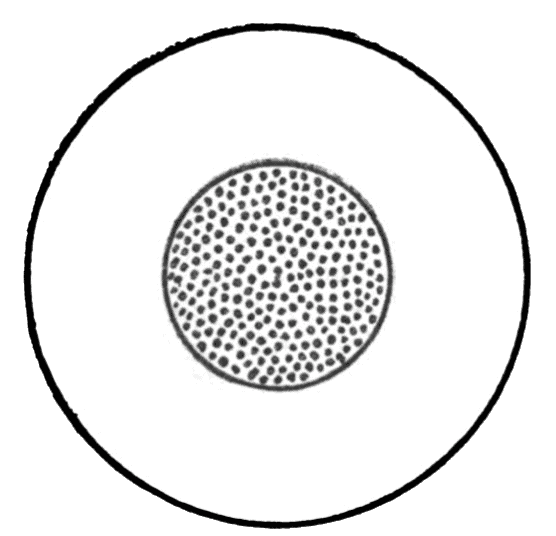
Symbol of the Many in the One
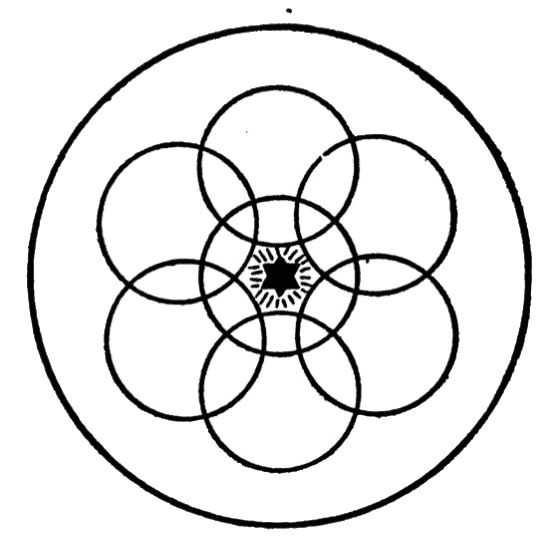
The Fourth Aphorism gives one of the central statements of the Rosicrucian system: “The One becomes Many. The Unity becomes Diversity. The Identical becomes Variety. Yet the Many remains One; the Diversity remains Unity; and the Variety remains Identical.” Magus Incognito uses this aphorism to explain how the single World Soul can manifest through countless individual centers of life without actually dividing itself into separate ultimate realities. The accompanying symbol shows the Infinite Unmanifest as the outer circle, the World Soul as a smaller circle within it, and numerous points inside the World Soul representing individualized centers of life, being, and activity. Each center appears to possess its own existence, yet every one remains an expression within the same universal source.
Magus Incognito develops this idea through a series of simple analogies. Falling raindrops appear separate while belonging to the same body of water. Water placed into different jars assumes different boundaries while remaining the same substance. Bubbles rise individually within the ocean but remain composed of the same substance surrounding them. These examples lead to the distinction between Absolute Being and relative being. Absolute Being is One. Relative existence appears as Many. Individuality exists within manifestation, but complete separation from the universal life is impossible. This is the form of monism taught throughout the work. The Many are genuine centers of expression, experience, and consciousness within the manifested universe, while their deepest being remains rooted in the One.
This also explains why individuality does not disappear from the system. The purpose of cosmic evolution is not presented as the immediate dissolution of every individual center back into indistinguishable unity. Individualization provides the centers through which the World Soul can manifest increasingly complex forms of life and consciousness. Each center becomes a vehicle through which universal potential develops into specific experience. The paradox is maintained throughout the book. The One becomes Many while remaining One, and the Many possess relative individuality while never becoming absolutely separate from their source. The table of contents summarizes the doctrine through the sequence of the ocean and its bubbles, Absolute Being as One, relative being as apparently many, and the final “Paradox of Being.”
Involution and Evolution in the Rosicrucian System
The movement of the World Soul into multiplicity begins what Magus Incognito calls involution, the descent of spirit into increasingly dense forms of matter. The universal principle clothes itself in successive material garments, moving through sub-mineral, mineral, plant, animal, human, superhuman, and god-like forms. Evolution describes the corresponding ascent in which consciousness becomes progressively more capable of expressing the spiritual potential hidden within those forms. The two movements belong to one cosmic process. Involution supplies the conditions through which spirit becomes involved in matter, while evolution is the progressive unfolding of what has been concealed within those conditions.
Magus Incognito uses the image of a spiral stairway to explain this development. Life does not simply travel outward from the One and then retrace an identical route backward. It progresses through stages, gathering experience and developing new capacities as it moves. The mineral, plant, animal, and human kingdoms are levels within an ascending process whose possibilities extend beyond ordinary humanity. Human consciousness occupies a stage on the stairway, with superhuman and god-like states above it. The universe is thus presented as a system of spiritual development in which the simplest manifestations already contain possibilities that will appear openly only at higher levels.
This relationship between involution and evolution is crucial to the book’s conception of the human being. Humanity contains the history of the lower stages through which life has passed and the potential of the higher stages toward which consciousness is moving. The lower forms have not simply been discarded. Their functions remain active within human nature while higher faculties develop above them. This provides the framework for Magus Incognito’s later sevenfold description of the human soul, where elemental, mineral, plant, animal, human, superhuman, and divine aspects are all present within one individual.
The Universal Flame of Life
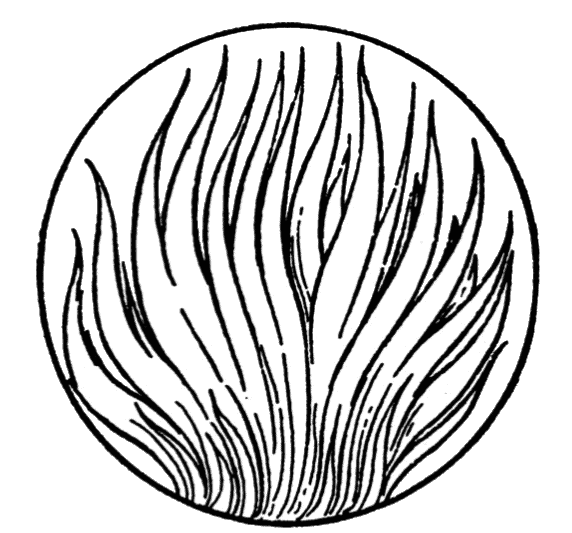
Symbol of the Universal Flame of Life
The Fifth Aphorism turns from multiplicity to life itself. Magus Incognito uses the image of the Universal Flame and its countless sparks to express the relationship between universal life and individual living beings. Life is not treated as a property that suddenly appears when matter reaches a certain degree of biological complexity. It is universal. The cosmos is described as “all-alive,” with life existing in the ether, atoms, chemical elements, minerals, plants, animals, human beings, superhuman beings, and divine forms. The difference between these levels concerns the form and degree through which life expresses itself.
The flame symbolism adds another layer to the One and the Many. Countless sparks can proceed from a flame without exhausting the fire from which they come. Each spark carries the nature of fire while appearing as an individual point of flame. Magus Incognito uses this as an image of individual life within Universal Life. The individual is a localized expression of something extending throughout the universe.
The book strongly rejects the division of nature into living and dead matter. Matter that appears inert is said to contain life operating at a level too elementary to resemble the biological processes normally identified with living organisms. Crystals, metals, atoms, and chemical elements are brought into the living universe. The mineral world is not a dead foundation upon which life later appears. It is an earlier and less developed expression of the same universal life that becomes more recognizable in plants, animals, and humans.
Does Magus Incognito Claim That Metals and Minerals Are Alive?
Magus Incognito attempts to support this doctrine with scientific experiments involving the responses of metals to stimulation. He describes experiments in which metals appeared to register fatigue, recovery after rest, altered responses following repeated stimulation, reactions to heat and cold, and effects compared with poisoning and intoxication. The text even describes metals as entering conditions analogous to sleep, torpor, excitement, weakening, and death. These claims belong to the book’s early twentieth-century attempt to interpret experimental observations through an occult theory of universal life. They are valuable for understanding the argument of Magus Incognito, though they should not be read as statements of current scientific consensus.
The purpose of these examples is to erase a fixed boundary between organic and inorganic nature. If matter can receive an external stimulus and respond to it, Magus Incognito sees evidence of a primitive form of life. Increasing biological complexity allows that universal life to manifest through more elaborate functions, yet the underlying principle is already present in the simplest material forms. The mineral, plant, animal, and human worlds become connected stages instead of separate creations.
This produces a living cosmology. The universe is filled with centers of activity at different degrees of development, and nothing is excluded from the evolutionary process. The mineral is not humanly conscious, but it belongs to the same continuum that can eventually produce human consciousness. Life is universal while the forms through which it operates differ immensely.
What Are the Seven Planes of Consciousness?
Symbol of the Seven Planes of Consciousness
Magus Incognito carries the same reasoning from life into consciousness. If life is universal, consciousness is presented as the inner quality of life. The book states the doctrine in its simplest form as “Everything is Conscious.” Here consciousness does not mean reflective human thought. Magus Incognito defines its lowest expression as awareness, the capacity to receive an impression from a stimulus and respond to it. By using this wide definition, he can attribute consciousness to forms of existence far below the human level.
The seven planes are Elemental Consciousness, Mineral Consciousness, Plant Consciousness, Animal Consciousness, Human Consciousness, the Consciousness of the Demi-Gods, and the Consciousness of the Gods. Each plane contains seven subplanes, each subplane divides again, and the process continues through additional sevenfold divisions. The boundaries are not absolute. Neighboring planes blend into one another, which explains why some forms seem to stand between mineral and plant, plant and animal, or animal and human levels.
The sequence describes consciousness as a continuum stretching from the simplest responsiveness in matter to states of awareness that Magus Incognito regards as divine. Human consciousness sits within this continuum. It has developed beyond animal awareness through self-consciousness but has not reached the highest possibilities of consciousness. This gives the system a direction. Evolution is the progressive awakening of consciousness already latent within universal life.
Elemental Consciousness and the Mind Within Matter
The Elemental Plane is the lowest of the seven planes and concerns consciousness associated with atoms, electrons, etheric activity, and the elementary forces of matter. Magus Incognito interprets attraction, repulsion, combination, and response as evidence of a primitive form of awareness. The language of desire and choice is sometimes applied to atomic behavior because the author sees physical affinities as elementary expressions of tendencies that become recognizable as desire and will on higher planes.
This idea also supplies an explanation for occult manipulation of matter. The book claims that a person who understands elemental consciousness can influence these lower centers through higher mental forces, producing phenomena that appear magical to observers who know only the physical level. “Magic” is thus placed within a hierarchy of consciousness. The occultist is said to work with natural laws and lower forms of awareness that conventional understanding has not recognized.
The doctrine creates a continuous path from matter to mind. Mental activity does not suddenly enter a universe that had previously contained none. Its simplest potential is present from the beginning of manifestation and becomes progressively richer as suitable forms develop. The same universal consciousness that responds faintly at the elemental level eventually becomes instinct, intellect, self-awareness, and cosmic consciousness.
Mineral Consciousness and the Organization of Form
Mineral consciousness represents a higher organization of the elemental forces. Crystallization receives special attention because crystals display definite patterns, structures, affinities, and tendencies toward characteristic forms. Magus Incognito interprets this organization as evidence that consciousness operates within mineral existence. Cohesion and molecular arrangement become expressions of an inner organizing principle.
The mineral plane remains far below anything resembling human thought. Its consciousness is narrow and directed toward the requirements of mineral existence. The distinction is one of degree and function. A mineral possesses the amount and kind of awareness necessary for its place within the universal order.
This approach allows Magus Incognito to describe evolution as continuous. The mineral level organizes elemental forces into stable forms. Those organized forms become the material foundation through which the plant level can express more complex functions. Each plane incorporates the achievements of lower levels while introducing new capacities.
How Does Consciousness Appear in Plants?
Plant Consciousness marks a major expansion in the book’s hierarchy. Plants grow toward light, extend roots toward moisture and nourishment, respond to their environment, protect themselves, reproduce, and alter their behavior according to conditions. Magus Incognito interprets these activities as signs of a genuine mental principle adapted to plant existence. He cites contemporary experiments and observations as evidence that plants exhibit forms of sensation, nutrition-related intelligence, nervous organization, and behavior resembling elementary thought processes.
The transition between plant and animal consciousness is described as gradual. Some organisms occupy a border where classification becomes difficult, which Magus Incognito uses as evidence that the planes blend instead of being separated by rigid boundaries. The same problem appears between other adjacent levels. Nature advances through continuous degrees.
The author even entertains the possibility that altered environmental conditions might call forth latent mental capacities in plants and produce forms approaching lower animal intelligence. The speculation reveals the logic of the system. Higher consciousness is already potential within lower forms, and development occurs as circumstances permit more of that potential to become expressed.
Animal Consciousness and the Development of Mind
Animal Consciousness ranges from the faint awareness of simple organisms to the highly developed intelligence of animals such as dogs, horses, and elephants. Magus Incognito emphasizes sensation, memory, emotion, instinct, learning, adaptation, and increasingly complex mental activity. The animal world provides the long evolutionary development through which consciousness becomes capable of the more complex operations required for human self-awareness.
The highest animal intelligence can approach or exceed the intellectual performance of some humans in limited respects. Intelligence alone is not the dividing line Magus Incognito chooses between animal and human consciousness. The decisive transition occurs when awareness turns inward and recognizes itself. An animal experiences the world. A human being can also become aware of the individual self having the experience.
That distinction is important because it shifts the definition of humanity away from simple reasoning ability. The beginning of the human plane is marked by the appearance of the inward statement “I Am I.” Consciousness has become capable of observing itself.
What Makes Human Consciousness Different?
Symbol of the Three Higher Planes of Consciousness
Human Consciousness begins with self-consciousness. Magus Incognito describes this as the inward mental gaze through which an individual recognizes himself as a separate center of experience. Even people at the lowest level of human development possess some glimmer of this sense of self. The book argues that this feature, more than intellectual sophistication, separates the human plane from the animal plane.
Self-consciousness gives humanity extraordinary possibilities while also creating new forms of suffering. A person can reflect upon the past, imagine the future, judge himself, compare himself with others, experience shame and pride, fear distant possibilities, and deliberately direct mental activity. The same faculty that makes intellectual civilization possible also intensifies anxiety and conflict. Human beings pay what Magus Incognito calls the price of self-consciousness.
Yet self-consciousness also makes mastery possible. Once the mind can observe its own operations, it can begin directing them. Instinctive impulses, emotional states, habits, and thought processes become objects of awareness instead of forces acting entirely without supervision. Human consciousness thus opens the possibility of deliberate mental development.
This part of the system has an obvious relationship with the mental-training literature found throughout the YPS environment, including works on suggestion, mental control, will, concentration, and self-development. The Rosicrucian book embeds these psychological capacities inside a cosmic evolutionary system. Mental mastery becomes one stage in the development of consciousness toward forms above ordinary self-consciousness.
What Is the Consciousness of the Demi-Gods?
The Consciousness of the Demi-Gods is the sixth plane and is characterized by an awakening sense of unity with Universal Life. The self remains conscious of individuality, yet its field of identification expands. Sympathy, justice, kindness, altruism, human brotherhood, and concern for the suffering of others are interpreted as manifestations filtering into ordinary human consciousness from this higher level. As consciousness expands, distinctions of caste, status, and narrow self-interest lose their power because the individual increasingly experiences other beings as related expressions of the same life.
Magus Incognito connects this plane with Cosmic Consciousness. Experiences of mystical unity reported by religious teachers, poets, philosophers, and mystics are treated as temporary openings into a state that will one day become normal for humanity. A person may receive only flashes of it while remaining centered in ordinary human consciousness. Those flashes can still transform character because the individual has directly experienced a relationship with life extending beyond the personal ego.
The book quotes descriptions of mystical consciousness to show that the experience appears across different religious and philosophical traditions. Ralph Waldo Emerson is used in this discussion to express a state in which subject and object, seer and seen, appear within one universal soul. Magus Incognito treats such accounts as descriptions of an actual higher plane of consciousness and not merely poetic language.
Cosmic Consciousness and the Expansion of the Self
Cosmic Consciousness changes the meaning of individuality. Ordinary self-consciousness says “I am this individual.” The higher awareness retains a center of consciousness while recognizing its participation in a universal life. The person feels connected with humanity, nature, and the cosmos in a way that ordinary intellectual belief cannot reproduce.
Knowledge and power are linked in this discussion. Magus Incognito states that an increase in knowing brings an increase in power according to cause and effect. Higher consciousness allows a person to perceive relationships and forces inaccessible to ordinary awareness, and those perceptions are said to produce capacities that can appear extraordinary from the lower level.
This is also where moral development becomes inseparable from psychic development. The mark of higher consciousness is not simply the possession of unusual powers. It is the expansion of identification beyond personal interest. Compassion and human brotherhood become signs of spiritual advancement because they reveal an actual widening of the self’s field of consciousness.
What Is the Consciousness of the Gods?
The seventh plane represents the highest form of manifested consciousness described in the book. Magus Incognito admits that ordinary human language cannot adequately explain it because human concepts are produced within a lower plane. The Consciousness of the Gods is presented as a state in which the veil separating individualized consciousness from the universal source has become exceedingly thin.
Beings functioning normally at this level would view ordinary physical existence from a radically different standpoint. The universe would appear as a vast field of changing forms whose apparent solidity is secondary to the deeper spiritual reality behind them. Magus Incognito compares the manifested universe, from this level, with a moving picture or phantasmagoria whose forms possess relative existence while lacking the absolute reality of the Eternal Parent.
Godhood is thus a stage of consciousness within manifestation and should not be confused with the Infinite Unmanifest. Even the highest gods remain within the manifested cosmos. The Eternal Parent remains beyond the entire hierarchy.
The Sevenfold Soul of Man
Symbol of the Sevenfold Soul
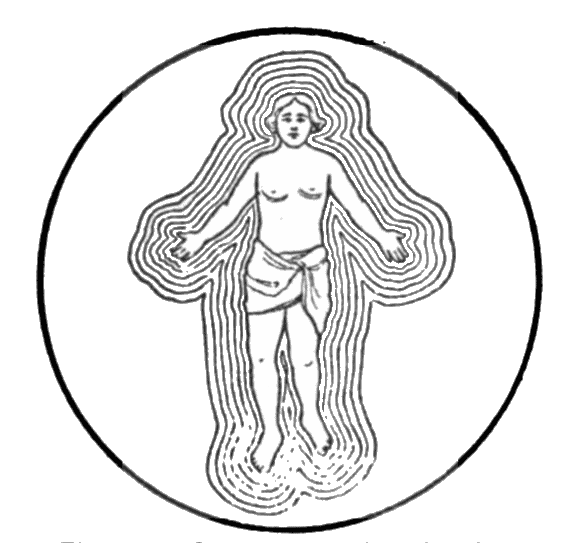
The Seventh Aphorism turns the cosmic hierarchy inward: “The Soul of Man is Sevenfold, yet but One in essence; Man’s Spiritual Unfoldment has as its end the Discovery of Himself beneath the Sevenfold Veil.” The human soul is represented as a figure surrounded by seven outlines or veils, all enclosed within the circle of the Infinite Unmanifest. Each veil corresponds with one of the levels through which universal consciousness has developed.
Magus Incognito does not mean that a person possesses seven completely separate souls. The soul is one in essence and expresses itself through seven functional levels. These are the Elemental Soul, Mineral Soul, Plant Soul, Animal Soul, Human Soul, Soul of the Demi-Gods, and Soul of the Gods. The human being becomes a miniature representation of the whole evolutionary hierarchy. Every level through which life has passed remains represented within human nature, while the higher levels toward which consciousness is developing already exist as latent capacities.
This creates a direct relationship between cosmology and psychology. The same sevenfold progression seen in the universe is repeated within the individual. To know oneself is to uncover these layers and discover the deeper Self concealed by them. The veils conceal because ordinary consciousness identifies with one or another of these functions. They also reveal because each layer expresses something of the underlying spiritual reality.
What Is the Elemental Soul?
The Elemental Soul provides the basic pattern or framework of physical form. Magus Incognito associates it with the etheric double and with what occult literature often calls the astral body or ghost. It supplies the subtle pattern around which the physical organism is constructed and maintained. The visible body is thus treated as an outer material expression of an invisible organizing form.
This doctrine places human embodiment within the same elemental forces active throughout matter. The physical body participates in a lower plane of universal existence even while serving as the vehicle for higher forms of consciousness. The elemental level does not disappear when human consciousness develops. It remains active beneath conscious awareness, maintaining structure and providing the pattern of bodily form.
The concept also gives Magus Incognito a framework for occult phenomena involving apparitions and the persistence of subtle forms. The so-called ghost can be interpreted through the survival or appearance of this subtler vehicle instead of being treated as the physical body itself.
The Mineral and Plant Souls Within the Human Body
The Mineral Soul governs the chemical processes of the body. Digestion, chemical transformation, assimilation at the material level, and the complex laboratory of bodily chemistry are placed under this aspect. The minerals composing the body retain their place within the universal hierarchy, but they have been incorporated into a higher organism and now serve a more complex center of life.
The Plant Soul governs growth, nutrition, cellular development, repair, and the vegetative processes shared with plant life. Human beings continue to grow, assimilate nourishment, reproduce cells, and repair tissue through processes that do not require conscious intellectual direction. These functions express the plant level within human organization.
Magus Incognito uses these levels to show that human beings contain the evolutionary past within themselves. Mineral and plant consciousness have not vanished. They operate automatically beneath ordinary awareness, supporting the higher functions that have developed above them.
The Animal Soul and Human Passion
The Animal Soul governs the functions inherited from animal existence. Appetite, physical desire, sexual impulse, instinctive emotion, self-preservation, aggression, and many automatic reactions belong to this level. Magus Incognito does not treat the Animal Soul as an evil foreign force inserted into humanity. It is a legitimate stage of nature and remains necessary for physical existence.
The problem arises when higher human faculties become servants of the lower animal impulses. Intellect can vastly increase the ability of desire to obtain what it wants. A person can use reasoning, planning, language, and social power to satisfy impulses that animals pursue through simpler instinct. The possession of intellect alone is thus no guarantee of spiritual advancement.
Spiritual development requires mastery and integration. Magus Incognito later summarizes the relationship by saying that the wise person uses the lower levels without allowing the lower levels to use him. The lower nature remains part of the individual, but its functions must come under the direction of a more developed center of consciousness.
The Human Soul and the Struggle Between Higher and Lower Nature
The Human Soul is associated with intellect, reasoning, deliberate thought, self-consciousness, and the ability to direct mental activity. It occupies a difficult position because it stands between the animal nature below and the awakening spiritual nature above. Magus Incognito describes human existence as a field of trials produced by these competing attractions. The lower nature seeks to use the newly developed intellect in the service of appetite and personal desire. The higher nature draws the individual toward unity, moral awareness, and a consciousness of relationship with Universal Life.
This gives the familiar religious struggle between higher and lower impulses a psychological and evolutionary explanation. Magus Incognito rejects the need to interpret the conflict as an external devil tempting the individual while a guardian angel pulls in the opposite direction. The forces belong to different levels within the person. The Ego is passing through a transitional stage in which both are active.
The Human Soul becomes the arena in which conscious choice acquires immense importance. Self-awareness permits the individual to recognize impulses, evaluate them, and decide which level of nature will direct action. Spiritual development is the gradual establishment of conscious mastery over lower functions while becoming increasingly receptive to higher ones.
The Soul of the Demi-Gods Within Man
The sixth aspect of the soul corresponds with altruistic emotion, spiritual intuition, universal sympathy, and Cosmic Consciousness. Magus Incognito treats every genuine movement toward human brotherhood, compassion, justice, and identification with others as evidence that this higher level is already active within humanity. Its appearance may be intermittent, but the capacity exists within the structure of the soul.
This gives moral development a metaphysical basis. Compassion arises because consciousness begins to perceive the unity concealed beneath apparent separateness. As that perception becomes stronger, suffering experienced by another person ceases to appear wholly external. The individual feels what Magus Incognito calls the urge of Unity.
The higher level also explains mystical experiences that temporarily exceed ordinary self-consciousness. These moments are interpreted as openings through which the individual experiences a level already present within the deeper Self. Spiritual evolution makes these experiences more stable until what once appeared as a rare flash becomes a normal mode of consciousness.
The Soul of the Gods and the Hidden Potential of Humanity
The Soul of the Gods is the seventh and highest aspect of the sevenfold human soul. Magus Incognito says that it remains latent in most people, appears in occasional flashes in a few, and is destined to become a normal plane of functioning at a far higher stage of spiritual evolution. He also states that beings already exist for whom this consciousness is normal.
The doctrine makes Godhood a latent possibility within the human being. This does not mean that the individual becomes the Infinite Unmanifest. Godhood remains a manifested state. The distinction between the Eternal Parent and every level of manifestation is preserved even at the summit of spiritual evolution.
The sevenfold soul thus contains an extraordinary span of existence. Elemental forces, mineral chemistry, plant growth, animal instinct, human intellect, cosmic consciousness, and divine consciousness all meet within one evolving center. Magus Incognito summarizes the lesson by saying that every person contains the potentiality of Godhood along with all the lower stages through which manifestation has passed. The task of the wise person is to master the lower while opening consciousness toward the higher.
What Does “Know Thyself” Mean in This Rosicrucian System?
Self-knowledge takes on a much larger meaning once the soul is understood as sevenfold. Knowing oneself cannot be limited to studying personality, habits, memories, or ordinary thought. The familiar conscious personality represents only one level within a much larger being. The real work is the discovery of the Self beneath the seven veils.
Each veil can become an object of awareness. Physical processes can be observed. Instinct and desire can be recognized. Thoughts can be watched and directed. The sense of personal identity can itself be examined. Spiritual intuition can be cultivated. As consciousness ceases to identify exclusively with each layer, the individual moves toward recognition of the deeper center that expresses itself through all of them.
This provides an esoteric interpretation of self-mastery. The goal is not the destruction of the lower faculties. Each belongs to the evolutionary structure and serves a legitimate function. Mastery means placing each faculty in its proper relationship to the whole.
Metempsychosis, Reincarnation, and the Evolution of the Soul
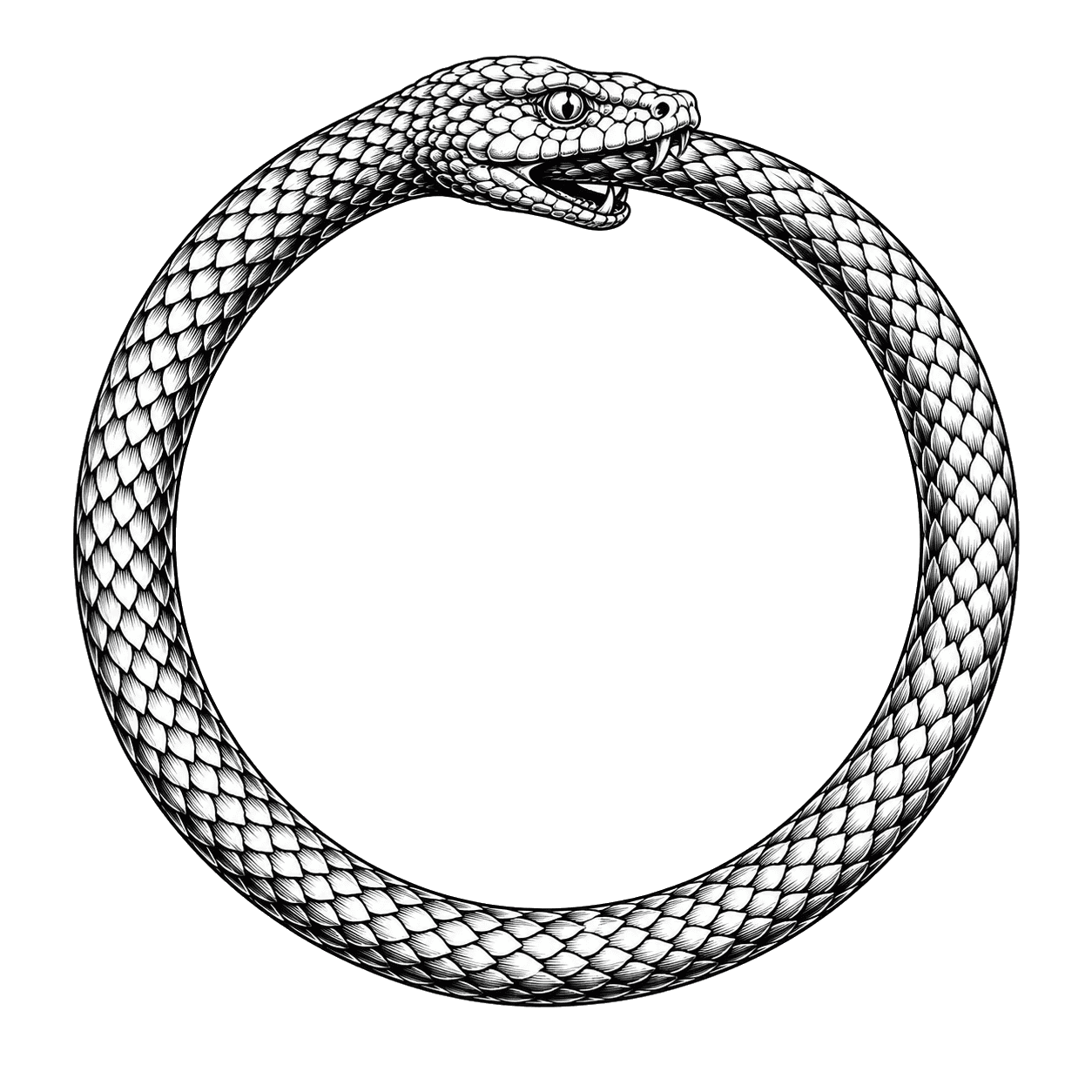
The Ouroboros, the universal symbol for eternity, cyclic renewal, and the unity of all things.
Magus Incognito treats metempsychosis, reincarnation, and transmigration of souls as different names for the doctrine that individual consciousness survives physical death and later enters another physical body. The book describes this teaching as one of the oldest religious ideas known to humanity and places versions of it within Egyptian, Chaldean, Persian, Hindu, Greek, Druidic, Hebrew esoteric, and early Christian traditions. Pythagoras, Plato, and numerous later philosophers are cited as evidence for its long intellectual history.
Reincarnation is tied directly to evolution. Racial development alone cannot account for the spiritual progress Magus Incognito wants to explain because each physical generation dies. The reincarnating soul provides continuity. It returns repeatedly, carrying the results of previous experience and acquiring further development through each embodiment. Evolution thus operates both through the biological and cultural history of humanity and through the individual history of the soul.
The image used is one of spirit gradually freeing itself from the limitations of matter. Matter supplies the conditions through which experience can occur, while the soul presses toward fuller expression. Each life becomes one period of education in a much longer development.
Why Does the Book Say People Cannot Usually Remember Past Lives?
The absence of ordinary past-life memory is not treated as evidence against reincarnation. Magus Incognito distinguishes between memories accessible to everyday consciousness and memories held at deeper levels of mind. Experiences from earlier incarnations may remain outside the normal field of awareness while still influencing character, ability, attraction, fear, and intuition.
The book appeals to sudden impressions of familiarity, unexplained affinities, childhood abilities, infant prodigies, and reported recollections of previous lives as signs that deeper memory can sometimes enter ordinary consciousness. Magus Incognito places more weight on what he calls an inward conviction of having lived before than on formal philosophical argument.
This emphasis on hidden memory places reincarnation within the book’s larger psychology of layered consciousness. Ordinary waking awareness represents only a limited field. Material outside that field can still shape the individual. Past-life memory becomes one class of information believed to exist within the deeper self.
What Happens Immediately After Death?
Death separates the soul from the physical organism but does not end individual consciousness. Magus Incognito describes a period of “soul sleep” following physical death. The duration differs according to the spiritual development of the individual. Less developed souls tend toward a more rapid return to embodiment, while more developed souls may spend much longer in the conditions between earthly lives.
During soul sleep, the lower sheaths associated with physical existence are gradually discarded. The soul awakens on the Astral Plane clothed in the level corresponding with its highest genuine development. Death does not automatically raise everyone to the same spiritual state. Each individual enters conditions suited to what has actually been developed during life.
This makes death part of the same evolutionary law operating during incarnation. The individual cannot acquire a higher spiritual state simply by losing the physical body. Consciousness carries its own level with it.
What Is the Astral Plane?
The Astral Plane is described as containing countless subplanes and divisions distinguished by differences in vibration instead of physical distance. Souls are drawn naturally to the level corresponding with their spiritual condition. Magus Incognito calls this an operation of the Law of Attraction. Each soul finds itself among conditions and beings compatible with its own development.
Movement between these levels follows a specific rule. A soul may descend temporarily to a lower level but cannot enter a higher plane for which it has not developed the necessary vibratory condition. Magus Incognito describes vibration as functioning like an astral barrier. Communication between souls at different levels is possible only when the more developed descends toward the less developed.
The environment of the Astral Plane is also responsive to thought. Beliefs, expectations, and mental imagery impress themselves upon astral substance, so souls can experience surroundings corresponding with deeply held religious or cultural conceptions. The book suggests that paradisal landscapes and other traditional afterlife images can acquire temporary objective appearance through this process. Each soul becomes, to some degree, a creator of its own environment through thought forms.
What Does the Soul Do Between Earthly Lives?
The Rosy Cross
The interval between incarnations is a period of assimilation and development. The soul reviews and absorbs the meaning of its previous earthly experience. Mistakes become clearer, confusing events can be understood from a different perspective, and the lasting results of experience become incorporated into character. Magus Incognito describes this as a process in which the soul takes stock of itself and prepares for another embodiment.
The Astral Plane is thus not simply a waiting room between lives. Spiritual development can continue there. The soul occupies conditions corresponding with its highest genuine level and has opportunities to develop those qualities before another incarnation. Earthly life and astral life perform complementary functions within the cycle. Physical existence supplies concentrated action, resistance, relationships, choices, and experience in matter. Astral existence allows the results of that experience to be assimilated before another period of physical action begins.
What Determines Rebirth?
The Law of Attraction governs the movement toward another incarnation. A soul carrying unresolved desires, ambitions, attachments, duties, aspirations, or longings remains connected with earthly experience. These forces draw it toward circumstances in which they can find expression. Rebirth is presented as the natural result of the soul’s own internal condition.
Magus Incognito makes an important distinction concerning desire. The motive for rebirth does not have to be selfish or morally low. Noble aspiration can also bind a soul to earthly activity. A desire to serve humanity, complete a work, fulfill a duty, help others, or express love still contains an impulse toward earthly action. The book states that even highly unselfish souls may return because they feel compelled to accomplish something for humanity.
The decisive factor is attraction. Desire seeks expression, and a desire connected with earthly conditions pulls consciousness toward another earthly life. When all such attraction has been exhausted, the soul is no longer compelled toward terrestrial rebirth and can continue its development on higher planes.
Reincarnation and the Yogi Publication Society
The treatment of reincarnation places The Secret Doctrine of the Rosicrucians directly alongside one of the major subjects developed throughout the Yogi Publication Society catalog. Books issued under Yogi Ramacharaka presented reincarnation, karma, astral existence, spiritual evolution, and the higher constitution of humanity through the language of Yogi philosophy and Hindu philosophy. Magus Incognito presents many of the same subjects as components of a claimed Rosicrucian Secret Doctrine and explicitly argues that the teachings belong to an ancient current preserved across both Eastern and Western traditions.
That is one reason the pseudonym Magus Incognito is significant. The name gives the work a Western initiatory identity suited to Rosicrucian teaching, while the doctrine itself repeatedly crosses the boundaries between East and West. The reader encounters reincarnation, astral planes, sevenfold spiritual development, vibration, Cosmic Consciousness, the World Soul, Qabalistic material, Greek philosophy, Christian esotericism, and Rosicrucian symbolism within one system. The different authorial identities found in the Advanced Thought and YPS publishing program allowed related subjects to be presented through distinct religious and occult voices.
The Rosicrucian System and the Mental-Science World Around YPS
The sections on human consciousness connect to the teachings on suggestion by Herbert A. Parkyn at his Chicago School of Psychology. While the book places self-consciousness, control of mental states, hidden levels of mind, mental influence, action and reaction, and the deliberate mastery of lower impulses within an occult evolutionary cosmology, it still resembles Parkyn’s teachings.
The Secret Doctrine of the Rosicrucians gives these ideas a cosmic scale. Self-mastery becomes one stage in an evolutionary process extending from elemental responsiveness through animal instinct and human self-consciousness toward Cosmic Consciousness and Godhood. The human mind stands midway within a living universe whose deepest movement is the progressive awakening of consciousness.
The Soul’s Progress Through the Seven-Planet Chain
The Rosicrucian system extends the development of the individual soul far beyond a sequence of incarnations on Earth. Magus Incognito describes human evolution as occurring through a chain of seven planets connected by subtle forces and traversed by successive waves of life. A soul does not simply complete one earthly life and proceed permanently to another world. It passes through repeated incarnations and larger evolutionary rounds, participating in different stages of life on the planetary chain before returning at a higher level of development. The movement is represented as a spiral because the soul can appear to return to similar conditions while reaching them at a different stage of consciousness. The same pattern that governs individual development is applied to races, civilizations, planets, and the total history of humanity.
The number seven organizes this entire scheme. The book describes seven rounds around the planetary chain, seven races associated with each round, seven sub-races within each race, and further subdivisions continuing the same numerical pattern. Humanity is said to be in its fourth planetary round and predominantly in the fifth race of that round. These ideas closely resemble the evolutionary cosmologies circulating through late nineteenth- and early twentieth-century occultism and Theosophy. They are presented here as elements of the Rosicrucian Secret Doctrine and joined with the book’s earlier ideas about involution, evolution, reincarnation, and the progressive awakening of consciousness.
Magus Incognito’s purpose is to describe an immense school of spiritual development in which one physical lifetime represents only a small segment. Souls gain experience through repeated embodiment, civilizations provide different environments for development, and planetary rounds create still larger stages. Evolution proceeds by recurrence with advancement, which explains the repeated use of the spiral. A circle brings the traveler back to the same point. A spiral returns to a corresponding point at another level. This distinction becomes important again when the book reaches its Principle of Cycles and explicitly calls the conversion of a circle into a rising spiral one of the higher forms of Mental Alchemy.
Lemuria, Atlantis, and the Races of Humanity
The racial history described by Magus Incognito belongs to the occult cosmology of its period and should be read as such, not as modern anthropology or geology. The book places different stages of humanity in successive great races separated by enormous geological catastrophes. Lemuria is associated with an earlier race, Atlantis with the fourth, and the civilizations of recorded history with later stages. Each great racial period is said to reach a point of development, experience destruction through natural upheaval, and leave survivors through whom portions of knowledge and culture pass into later ages. The book then connects Egyptian, Persian, Chaldean, Greek, Roman, and other civilizations with this long spiritual chronology.
Atlantis serves a second function beyond its place in the racial scheme. It also supplies Magus Incognito with an explanation for similarities among ancient esoteric traditions. The original Secret Doctrine is presented as having been scattered through survivors and later reconstructed from fragments preserved in Egypt, India, Persia, Chaldea, Greece, and Hebrew esotericism. The history of humanity and the history of occult knowledge become parts of the same narrative. Civilizations rise and fall, yet the doctrine survives because fragments are carried onward by initiates and mystery schools.
The important theme is recurrence without exact repetition. Civilizations follow cycles of ascent, achievement, decline, and destruction. Knowledge can disappear from public culture while remaining preserved in smaller initiatory circles. The same pattern applies to individuals, races, nations, and worlds. Magus Incognito repeatedly treats history as a manifestation of universal law, which prepares the way for his later distinction between Rhythm and Cycles.
What Is the Human Aura?
The aura is described as the psychic atmosphere surrounding an individual. Magus Incognito defines it as an emanation from the soul that is invisible to ordinary sight yet perceptible through clairvoyant vision. He compares it with rays proceeding from the sun or fragrance extending from a flower and describes it as a form of energy possessing a degree of subtle substantiality. The aura becomes important because it is supposed to make inner states externally perceptible. Thought, emotion, vitality, character, and spiritual development leave corresponding impressions in the psychic atmosphere surrounding the person.
Auric colors provide a visual language for these conditions. Reds are associated with physical vitality, passion, force, anger, and related states depending upon their shade. Yellow corresponds with intellectual activity. Blue and violet are associated with religious, devotional, and spiritual feeling. Greens can indicate several different qualities depending upon tone and combination. Dark or clouded colors correspond with less desirable conditions, while lighter and clearer colors are associated with more developed states. White is connected with Spirit. The aura is constantly changing because thought and emotion are constantly changing.
This doctrine places clairvoyance within a system of psychological interpretation. A clairvoyant who can see the aura is said to perceive character and temporary mental states through color. The aura is thus presented as a bridge between inner consciousness and psychic observation, and this connects directly with the YPS literature issued under names such as Swami Panchadasi and Swami Bhakta Vishita, where clairvoyance, psychic perception, astral phenomena, and mental influence were major subjects.
Can Auric Colors Affect the Mind?
The relationship between color and consciousness runs in both directions. A mental or emotional state is said to produce a corresponding auric color, while deliberate concentration upon a color can generate a related mental or emotional state. Magus Incognito states that concentration on red can stimulate vitality, vigor, courage, and passionate energy. Blue is associated with spiritual and religious feeling. Yellow is used to stimulate intellectual activity or refresh a tired mind. The doctrine is based upon action and reaction. The mental state produces the color, and the corresponding color can act back upon the mind.
The same idea is extended into healing. Blues, violet, and lavender are assigned cooling and soothing effects. Green is associated with rest and invigoration. Yellow and orange stimulate intellectual activity. Bright reds stimulate body and mind. The colors may be physically present in a person’s surroundings or visualized mentally by someone performing a treatment. These claims belong to the occult therapeutic system being presented and are not modern medical recommendations, yet historically they are valuable because they show how easily the book moves between psychic philosophy, mental influence, visualization, and healing.
This language brings the work unusually close to the mental-science world surrounding Herbert A. Parkyn, suggestion, and the Chicago School of Psychology. The explanatory systems differ, yet both are interested in how an idea, image, expectation, or directed mental state can affect emotion and bodily experience. In The Secret Doctrine of the Rosicrucians, this relationship is embedded within the larger occult theory of vibration, aura, and consciousness.
The Protective Aura and Mental Influence
Magus Incognito also gives instructions for creating what he calls a Protective Aura. The student forms a mental image of being completely surrounded by pure white light and strengthens the image through an act of will. The resulting psychic atmosphere is said to protect against adverse mental influence, psychic attack, malicious mental magnetism, black magic, and what the book calls psychic vampirism. The white light may be used defensively, while its use for attack or personal gain is explicitly rejected.
The book immediately connects this teaching with personal magnetism, magnetic influence, and personal atmosphere. This is a significant point within the YPS catalog. Personal magnetism was already a major subject in works associated with William Walker Atkinson, Theron Q. Dumont, Yogi Ramacharaka, and other identities within the same publishing world. The Rosicrucian work absorbs that vocabulary into a system involving aura and psychic radiation. Mental influence can be produced outwardly, while another individual can develop resistance by establishing and maintaining a stronger mental and psychic condition.
The repeated combination of visualization and will is also important. A mental picture is formed, attention is concentrated upon it, will sustains it, and the resulting state is expected to affect the individual’s psychic condition. This same basic relationship among imagery, attention, mental state, and will appears across much of the mental-science and occult literature surrounding the YPS environment, even when the theoretical explanation changes.
What Are the Seven Cosmic Principles?
The closing section of The Secret Doctrine of the Rosicrucians condenses the laws operating throughout its entire cosmology into seven Cosmic Principles. They are Correspondence, Law and Order, Vibration, Rhythm, Cycles, Polarity, and Sex. Magus Incognito says these laws operate throughout the cosmos and extend into its smallest activities. The importance of this final arrangement becomes immediately apparent when it is placed beside the seven Hermetic principles of The Kybalion, published in 1908 under the name Three Initiates. The two lists are not identical, yet five categories correspond directly by name or concept, and the remaining principles can be mapped closely through the way each book develops its system.
The Rosicrucian sequence is Correspondence, Law and Order, Vibration, Rhythm, Cycles, Polarity, and Sex. The Kybalion gives Mentalism, Correspondence, Vibration, Polarity, Rhythm, Cause and Effect, and Gender. The relationship becomes much stronger once the actual explanations are compared. Law and Order includes causation. Sex is the Rosicrucian equivalent of the universal masculine and feminine principle that The Kybalion names Gender. Cycles develops a form of rhythmic recurrence that The Kybalion absorbs largely within Rhythm. Mentalism is not named as one of Magus Incognito’s final seven, yet his earlier cosmology describes the manifested universe as an idea or picture within the Infinite Imagination of the Eternal Parent. The conceptual overlap therefore extends beyond the titles of the principles.
Correspondence and “As Above, So Below”
The first Rosicrucian Cosmic Principle is Correspondence. Magus Incognito identifies it with the Hermetic formula “As above, so below; as below, so above” and with the maxim “From One know All.” The same laws are believed to manifest at different levels, allowing the student to reason from known phenomena toward unknown planes. What can be observed in matter may provide an analogy for mind, and what operates in lower forms of life can reveal laws functioning at higher levels.
The Kybalion uses virtually the same formulation. Its second Hermetic Principle states that there is correspondence among the laws and phenomena of the different planes of Being and Life and quotes the same “As above, so below” aphorism. It later explains that the planes share laws and characteristics because all proceed from one source. In both books, Correspondence is more than a statement that everything is connected. It is an epistemological method. The student can study what is accessible and use analogy to penetrate what lies beyond direct experience.
This is one of the strongest direct parallels between the two books because the terminology, maxim, and function all coincide. Both identify the doctrine as ancient and Hermetic. Both use it to connect physical, mental, and spiritual planes. Both treat it as a method for investigating the unknown. Magus Incognito openly calls the maxim Hermetic, placing his claimed Rosicrucian system in direct relationship with Hermeticism at the very point where the final seven principles begin.
Law and Order Compared with Cause and Effect
Magus Incognito’s second Cosmic Principle is Law and Order. The universe is governed by law, nothing happens through absolute chance, and every event arises from causes and conditions. What people call chance reflects ignorance of the causal chain. The book distinguishes this from fatalism. A predetermined supernatural decree is not required. Human will itself can enter the sequence of antecedent causes and alter what follows. The principle is summarized as the teaching that nothing happens by chance and that events occur through Law, Order, and Causation.
The connection with The Kybalion’s Principle of Cause and Effect is direct. The difference lies chiefly in the label. The Rosicrucian work places causation inside the wider category of Law and Order, while The Kybalion gives Cause and Effect its own position among the seven principles. In both systems, freedom is compatible with universal law because the developed individual can introduce deliberate causes instead of remaining entirely subject to forces originating elsewhere.
That relationship between will and causation also connects the cosmology with mental training. The student gains greater control by discovering what forces are acting upon thought and behavior and by deliberately initiating new causes. Law does not disappear when mastery increases. Mastery means understanding the law well enough to operate within it consciously.
Vibration as the Scale of Manifestation
The third Rosicrucian Cosmic Principle states that everything in the manifested cosmos exists in vibration. Magus Incognito applies the concept to matter, light, heat, magnetism, electricity, mind, and spiritual states. Differences between planes and forms are explained in large measure through differences in the rate and character of vibration. Matter that appears motionless contains continual movement at levels invisible to ordinary senses. The book uses the familiar image of a rapidly rotating object moving through increasing frequencies of sound, heat, and other effects as its rate changes.
The Kybalion makes Vibration its third principle as well and develops the same basic continuum from matter through energy and mind toward spiritual states. Its summary formulation is that nothing rests, everything moves, and everything vibrates. The concept allows forms that appear radically different to be understood as degrees within one scale of manifestation.
The parallel becomes stronger because both books connect vibration with mental mastery. Mental states have their own vibratory conditions, and changing the condition changes the state. This makes vibration one of the mechanisms underlying mental transmutation. The language of raising or changing vibration becomes a way of describing the deliberate alteration of consciousness.
Rhythm and the Swing of the Pendulum
Magus Incognito’s fourth Cosmic Principle is Rhythm. Movement alternates between opposing tendencies and expresses itself through recurring patterns. The book finds rhythm in atomic vibration, planetary movement, tides, day and night, sleeping and waking, work and rest, involution and evolution, civilizations, fashions, history, and emotional states. The pendulum provides the main image. Movement toward one extreme is followed by movement back toward the other.
This is another close match with The Kybalion, which also makes Rhythm one of its seven principles and uses the pendulum as its governing image. In both systems, the psychological application becomes as important as the cosmic one. Emotional states can swing between extremes, and the student seeks a form of mastery that prevents consciousness from being carried helplessly by the movement.
The Rosicrucian text states that advanced students are taught to apply the Principle of Rhythm to the control of emotional states. The Kybalion develops this method under the name Neutralization, where the Hermetist seeks to avoid being swept fully into the backward swing. The shared doctrine is thus cosmic and psychological at once. The same rhythm governing tides and planets appears in human emotion and behavior.
Why Does Magus Incognito Separate Rhythm and Cycles?
The Principle of Cycles receives its own place in the Rosicrucian seven, while The Kybalion incorporates much of the same material into Rhythm. Magus Incognito says that everything proceeds in circles, yet pure repetition would leave evolution trapped. The key is the spiral. A cycle can return to a corresponding position while the center itself advances, creating a spiral instead of a closed circle. The soul can pass repeatedly through analogous experiences while moving upward in development.
This is where the earlier planetary rounds, reincarnation, races, and civilizations connect with the Cosmic Principles. Cycles operate within a larger direction of evolution. Magus Incognito calls the conversion of the circle into a spiral one of the higher forms of Mental Alchemy. Through will, the individual can transform mere repetition into advancement.
This principle explains why history can repeat itself without being literally identical. It also explains why reincarnation does not mean endlessly reliving the same existence. Repetition creates another opportunity at a different point in development. The spiral becomes the book’s answer to the tension between recurrence and progress.
Polarity and Mental Alchemy
The sixth Rosicrucian Cosmic Principle is Polarity. Every manifested phenomenon has opposing poles, and the two poles belong to a larger unity. Magus Incognito uses the magnet as the simplest illustration. Positive and negative poles appear opposed, yet they belong to one magnetic system. The same pattern appears in high and low, light and darkness, before and after, heat and cold, and countless other oppositions.
The psychological importance of this teaching lies in Mental Alchemy. If apparently opposite mental conditions occupy different positions within one underlying range, consciousness can move along that range. Fear and courage, discouragement and confidence, hatred and love, or weakness and strength can be interpreted as polar states whose degree can change. The Kybalion develops precisely this application of Polarity and makes movement along the mental scale one of the main mechanisms of Mental Transmutation.
Both systems link Polarity with self-mastery. The student learns that a mental condition does not have to be accepted as an immovable thing. It can be recognized as a position and deliberately shifted. This is where occult cosmology becomes a method of mental discipline.
Sex and Gender as Universal Creative Principles
Magus Incognito’s seventh Cosmic Principle is Sex. The term refers to a universal creative duality expressed through masculine and feminine forces on physical, mental, and spiritual planes. The book explicitly connects the principle with mental influence, suggestion, hypnotism, and higher spiritual activity. The universal male and female principles first introduced through the Universal Androgyne return here as one of the laws governing manifestation.
The Kybalion calls its seventh principle Gender and defines it through the same universal masculine and feminine duality operating on all planes. It treats biological sex as one manifestation of a much wider generative principle. Mental Gender then applies the doctrine directly to consciousness, identifying active or projective and receptive or generative phases of mind.
The relationship becomes especially interesting when The Kybalion connects Mental Gender with contemporary dual-mind psychology. Its discussion refers to theories distinguishing objective and subjective, conscious and subconscious, voluntary and involuntary, or active and passive phases of mind. That places a universal occult doctrine beside the same psychological territory that had been central to Parkyn’s teaching for years. The historical meaning of that overlap deserves attention because The Secret Doctrine of the Rosicrucians later explicitly identifies Sex as the principle underlying suggestion and hypnotism. The Rosicrucian framework is absorbing psychological influence into a universal doctrine of complementary mental forces.
How Close Is The Secret Doctrine of the Rosicrucians to The Kybalion?
The relationship between the two books is extremely close. The Kybalion appeared in 1908 under the pseudonym Three Initiates and organized its Hermetic philosophy around seven principles. The Secret Doctrine of the Rosicrucians appeared a decade later under another anonymous occult identity and also organized its Rosicrucian teaching around seven Cosmic Principles. The categories correspond directly. Correspondence is Correspondence. Vibration is Vibration. Rhythm is Rhythm. Polarity is Polarity. Sex corresponds with Gender. Law and Order is Cause and Effect. Cycles is Rhythm.
The remaining Kybalion principle, Mentalism, is not absent from the Rosicrucian cosmology. Earlier in The Secret Doctrine, manifestation was described as an idea or picture within the Infinite Imagination of the Eternal Parent. The Kybalion states its doctrine more directly as “THE ALL is MIND; The Universe is Mental.” Both distinguish the absolute source from the shifting forms of the manifested universe and then explain manifestation through a mental or idealistic model. The terminology differs, but the structural role is closely related.
The similarities continue through the doctrines surrounding the principles. Both works describe an unknowable infinite source. Both distinguish absolute reality from the relative reality of manifestation. Both describe the One expressing itself through the Many. Both organize reality into planes. Both use Correspondence to link those planes. Both treat Vibration as a means of explaining differences among conditions and levels. Both use Polarity to explain apparently opposed states. Both make Rhythm universal and illustrate it through the pendulum. Both teach universal causation. Both extend masculine and feminine creative principles beyond biological reproduction. Both connect these cosmic laws with mental mastery. Both use the language of Mental Alchemy. Both insist that occult knowledge must be applied in action.
This is a substantial doctrinal relationship and shows that The Secret Doctrine of the Rosicrucians presents a Rosicrucian formulation of a system identical to the Hermetic system already published by the same interconnected publishing network.
The One and the Many Compared with “The ALL in All”
One of the strongest comparisons appears outside the final lists of principles. The Secret Doctrine says the One becomes Many while remaining One. Individual centers are compared with reflections of one sun, drops of water, and bubbles within an ocean. Multiplicity exists inside unity. The apparent individual is real at the level of manifestation while remaining inseparable from the universal source.
The Kybalion devotes an entire chapter to “The ALL in All” and develops a closely related relationship between universal Mind and individual manifestations. The universe and all its beings exist within THE ALL while THE ALL also expresses itself throughout them. The changing universe possesses relative reality for those living within it, even though its reality is subordinate to the absolute reality of THE ALL. The Kybalion warns readers against allowing the doctrine of relative unreality to paralyze ordinary life. People must continue to act within the manifested world while understanding its deeper nature.
The parallel is important because it joins cosmology with the doctrine of mental action. In both works, recognizing unity does not abolish individuality or action. The student is expected to function intelligently within manifestation while understanding the source beneath it.
Mental Alchemy in Both Books
The phrase Mental Alchemy provides another direct bridge. Magus Incognito explains that the true work of Rosicrucian alchemy concerns mental and spiritual transmutation and later applies Polarity, Rhythm, Cycles, will, and consciousness to the transformation of the individual. The Kybalion likewise defines Mental Transmutation as the art of changing mental states and treats Hermetic philosophy as a system for understanding the laws that make such change possible.
The same cluster of ideas surrounds both teachings. A mental state is governed by law. It possesses vibration. It lies somewhere along a polarity. It is affected by rhythm. It produces effects and arises from causes. Through awareness and will, the individual can begin altering these conditions. The goal is increasing self-government.
The agreement becomes even more striking at the level of the “Law of Use.” The Secret Doctrine closes its opening presentation of Rosicrucianism with the teaching that possession of knowledge without its manifestation in action resembles a miser hoarding precious metal. The Kybalion also closes by insisting that knowledge must become application and that possession of occult principles has little value unless they are used. The similarity is conceptual, structural, and rhetorical. Both books introduce hidden wisdom, explain universal laws, teach mental transmutation, and return to action as the test of knowledge.
The Sevenfold Man and the Earlier Yogi Ramacharaka System
The relationship with the wider YPS catalog becomes even clearer when Magus Incognito’s sevenfold human being is placed beside the earlier Yogi Ramacharaka course. The 1903 course presents man as a sevenfold creature consisting of Physical Body, Astral Body, Prana or Vital Force, Instinctive Mind, Intellect, Spiritual Mind, and Spirit. It states that the spirit contains all potentialities, that higher principles unfold as humanity develops, and that human beings can manifest on increasingly elevated planes.
Magus Incognito uses different names and a different Rosicrucian framework, but once again the individual contains seven levels extending from the physical and elemental through instinct, intellect, spiritual consciousness, and divine potential. Both systems connect the sevenfold human constitution with spiritual evolution and higher planes. The earlier Yogi course also covered aura and auric colors, thought influence, clairvoyance, telepathy, personal magnetism, psychic protection, the Astral World, survival after death, and spiritual evolution. Those subjects reappear together inside The Secret Doctrine of the Rosicrucians.
This is important for understanding the publication history. The later book did not introduce YPS readers to an entirely new set of ideas simply because they were now labeled Rosicrucian. Much of the conceptual territory had already appeared under Yogi identities. The change of pseudonym and tradition changed the voice and claimed lineage while allowing closely related teachings to be reorganized through a Western esoteric system.
R. Swinburne Clymer and the Rosicrucian Current Around Parkyn
Reuben Swinburne Clymer
R. Swinburne Clymer provides an important connection because Rosicrucianism was already represented within Parkyn’s network years before The Secret Doctrine of the Rosicrucians appeared. Clymer was associated with the Fraternitas Rosae Crucis since 1899, and developed an extensive publishing career centered on Rosicrucianism and the teachings of Paschal Beverly Randolph. He later became one of the principal American Rosicrucian leaders of the twentieth century.
More importantly for this research, Clymer was a graduate of the Chicago School and a longtime collaborator with Parkyn. This provides a direct historical bridge between a recognized Rosicrucian figure and Parkyn’s intellectual circle. It does not require a speculative claim that Parkyn belonged to Clymer’s organization. The significant fact is that Rosicrucian teaching was already represented by a major Rosicrucian author inside Parkyn’s publishing network.
Clymer also matters because his Rosicrucian work belongs to the years surrounding the creation of the YPS intellectual system. His writing and publishing activity shows that Rosicrucian concepts were active in the same American occult environment before The Secret Doctrine of the Rosicrucians was published. This makes it difficult to treat Rosicrucianism as a late addition disconnected from the earlier Parkyn and YPS world. It was already well established among people working within the network.
Ella Wheeler Wilcox Provides Another Rosicrucian Connection
Ella Wheeler Wilcox
Ella Wheeler Wilcox also provides a close connection to Rosicrucianism. Wilcox joined the network when she was brought into New Thought magazine as an editor in 1902. Then between 1904 and 1909, she became involved with the Rosicrucian Research Society alongside Harvey Spencer Lewis, Frater Elbert Hubbard and Isaac K. Funk, president of Funk & Wagnalls Publishing Company. (Funk was a regular contributor to Parkyn’s Suggestion magazine and Hubbard was a close associate as well).
The group held monthly meetings in New York City and operated as the New York Institute for Psychical Research. When the organization received its official Rosicrucian charter in 1915, Wilcox was appointed to its first Supreme Council. She served as a Supreme Council officer until her death in 1919, the same year The Secret Doctrine of the Rosicrucians was published.
The organization’s name would later be changed to the Ancient Mystical Order of the Rosy Cross (AMORC). Her poetry would continue to circulate in Rosicrucian publications, including Rosicrucian Digest, and one of her poems became associated with Rosicrucian funeral observances.
Parkyn and the Order of the White Rose
The Order of the White Rose
Lastly and most importantly, Parkyn himself was directly connected to Rosicrucianism. He was a member of J. C. F. Grumbine’s Order of the White Rose, a Rosicrucian order devoted to esoteric and spiritual development. That membership is important because it places Parkyn personally inside a Rosicrucian organization during the same period in which he was developing his work in suggestion, psychic research, mental science, and the network that later fed into the Yogi Publication Society.
It means the Rosicrucian current surrounding the later YPS material was not only present through outside authors and parallel occult movements. Parkyn himself had direct involvement with a Rosicrucian order.
What Does The Secret Doctrine of the Rosicrucians Reveal About The Kybalion?
The Secret Doctrine of the Rosicrucians makes The Kybalion easier to place within the occult literature surrounding YPS. If The Kybalion is read alone, its seven principles can appear as a self-contained Hermetic system introduced by the mysterious Three Initiates in 1908. The later Magus Incognito book shows how much of the book is actually Rosicrucian doctrine.
The Secret Doctrine is expansive, cosmological, evolutionary, and heavily concerned with reincarnation, aura, planetary rounds, races, and Rosicrucian symbolism. The Kybalion strips the system down into a compact set of principles and concentrates much more heavily on mental mastery. Yet the structural kinship is difficult to miss.
Why Is Magus Incognito an Important YPS Pseudonym?
The pseudonym Magus Incognito performs a function similar to other identities associated with the YPS publishing world. It gives the teaching an authoritative voice suited to its subject. Yogi Ramacharaka speaks from an Indian and Yogi setting. Swami Panchadasi and Swami Bhakta Vishita speak within occult and psychic frameworks. Theron Q. Dumont presents mental force and personal development through another identity. The Three Initiates present Hermetic philosophy collectively. Magus Incognito appears as an anonymous Western adept revealing a Rosicrucian Secret Doctrine.
The identity matters because the pseudonym tells the reader how to interpret the material before the argument begins. “Magus” signals initiation and occult mastery. “Incognito” signals concealed identity and hidden authority. This perfectly matches a book whose opening pages insist that genuine Rosicrucians do not publicly advertise themselves and that true esoteric instruction is transmitted quietly from qualified teacher to qualified student.
Why Does The Secret Doctrine of the Rosicrucians Matter to YPS History?
The book matters because it gathers into one volume an unusually large portion of the intellectual world represented across the Yogi Publication Society catalog. Reincarnation, the astral world, sevenfold man, aura, clairvoyance, personal magnetism, mental influence, spiritual evolution, planes of consciousness, universal law, Mental Alchemy, Hermetic Correspondence, Vibration, Rhythm, Polarity, causation, and universal creative duality all appear within a single claimed Rosicrucian system.
Many of these subjects had already been presented through Yogi Ramacharaka and other YPS identities. The 1903 Yogi course alone contains seven principles of man, the astral body, vital force, instinctive mind, intellect, spiritual mind, spirit, aura, thought influence, clairvoyance, telepathy, personal magnetism, psychic protection, the astral world, survival after death, and spiritual evolution. The Secret Doctrine gives much of that territory a Western Rosicrucian framework and joins it directly with the principles found in The Kybalion.
For the history of the publisher, the value of the book lies in this convergence. It reveals how easily subjects that might be cataloged separately as Hindu, Hermetic, Rosicrucian, psychological, psychic, or New Thought could be understood within one esoteric philosophy. The language and authority changed according to the pseudonym and tradition. The underlying questions remained closely connected.
What Is the Central Teaching of The Secret Doctrine of the Rosicrucians?
The central teaching of The Secret Doctrine of the Rosicrucians is that all manifested existence proceeds from one infinite source and develops through universal laws toward increasingly complete expressions of life and consciousness. The One manifests as the Many without losing its unity. Life exists throughout nature. Consciousness develops through successive levels. The individual human being contains within himself the results of lower stages and the potential for higher ones. Reincarnation gives the soul repeated opportunities for development, while larger cycles carry souls, races, civilizations, and worlds through ascending spirals of experience.
The Seven Cosmic Principles describe the laws governing this process. Correspondence links the planes. Law and Order makes the universe causal and intelligible. Vibration explains changing conditions and levels. Rhythm governs alternating movement. Cycles turn recurrence into patterns of return and advancement. Polarity organizes manifestation through complementary opposites and gives Mental Alchemy a method of changing states. Sex supplies the universal generative relationship through which new forms and mental conditions are produced. The principles are meant to be used, not simply memorized.
The human goal is conscious participation in this process. The student learns to observe lower impulses without becoming their servant, develop the faculties of self-consciousness, recognize unity beneath separation, cultivate higher states, direct thought and will, and transform knowledge into action. The path moves from unconscious participation in universal law toward conscious cooperation with it.
That is what gives The Secret Doctrine of the Rosicrucians its importance within the history of YPS. It is a Rosicrucian synthesis of ideas that had already circulated through Parkyn’s mental-science network, the Yogi Ramacharaka teachings, the psychic and occult literature surrounding the same circle, and The Kybalion.