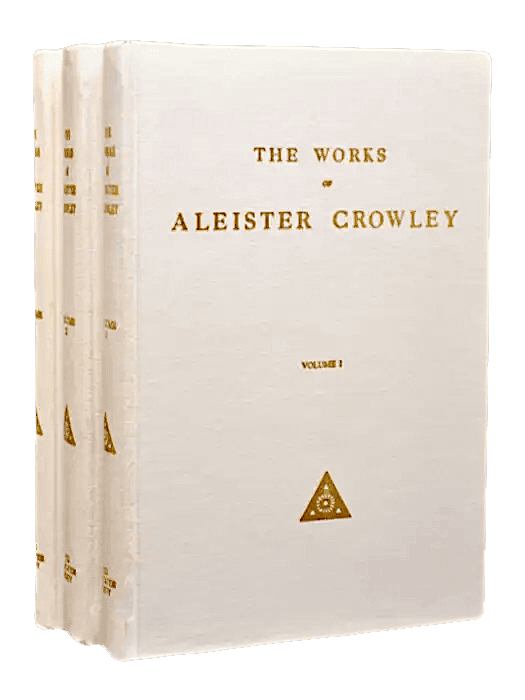
The 1974 edition of Collected Works of Aleister Crowley, Volumes I, II, III, reprinted in Des Plaines, Illinois, by the Yogi Publication Society, preserves the authorized collection originally issued in 1905 as The Works of Aleister Crowley by the Society for the Propagation of Religious Truth.
Volume I gathers Crowley’s early poetry, philosophical verse, dramatic works, religious experiments, and mystical writings, including Aceldama, The Tale of Archais, Songs of the Spirit, The Poem, Jephthah, Mysteries, Jezebel and Other Tragic Poems, An Appeal to the American Republic, The Fatal Force, The Mother’s Tragedy, The Temple of the Holy Ghost, Carmen Saeculare, and Tannhäuser. The editor’s 1905 preface describes the authorized collection as containing Crowley’s important writings and immediately calls attention to two features that dominate the volume: his extensive references to classical mythology and his frequent use of Qabalistic literature. The result is an unusually revealing record of Crowley before the religious and magical system associated with his later career had reached its mature form.
Volume I is valuable because it allows the reader to watch Crowley’s religious thought develop through his earliest literary work. The book itself identifies these poems as belonging to the “first period” of his life, characterized by “spiritual and mystic enthusiasm.” Christianity remains everywhere in the language and symbolism, yet Crowley repeatedly tests Christian ideas against mysticism, Buddhism, classical mythology, Qabalah, Hermeticism, Rosicrucian symbolism, and other currents of Western esotericism. God, Satan, Christ, sin, death, initiation, love, lust, sacrifice, the soul, divine union, and spiritual knowledge return again and again, sometimes reverently and sometimes through deliberate blasphemy or inversion. Crowley is already asking the question that drives much of the volume: what must happen to the individual personality before direct knowledge of spiritual reality becomes possible?
Volume II has clear shift toward exploring philosophy and mysticism. Along with new poetry and plays, Crowley includes essays exploring the mysteries of consciousness, various religions, mysticism, and Eastern philosophy. Works like Science and Buddhism show his effort to connect spiritual experience with logical thinking, while other writings reveal his growing interest in ceremonial magic, meditation, and ancient secret traditions. Read Vol.2 online
In Volume III, Crowley’s unique vision of hidden knowledge becomes clear. The collection includes more ambitious poetry, mystical stories, and philosophical essays that hint at the themes he would later develop in The Equinox and his mature Thelemic works. Initiation, the symbolic mysteries of the ancient world, spiritual freedom, and the search for higher awareness now take center stage, culminating in essays that introduce the religious and magical system he would soon reveal. Real Vol. 3 online
The Works of Aleister Crowley Vol. 1-3
What Is the Collected Works of Aleister Crowley, Volume I About?
At its center, Volume I records a young writer attempting to understand religious experience for himself. Crowley had been raised within a strict Christian environment, and the inherited vocabulary of Christianity still supplies much of his imagery, even when he is attacking the theology attached to it. His poems continually return to the conflict between conventional religion and personal spiritual experience. Heaven and hell, God and Satan, purity and degradation, spirit and flesh, love and death are placed beside one another until their ordinary meanings begin to break down. Crowley is fascinated by opposites and by the possibility that apparently contrary forces may conceal a deeper unity.
This search gives the volume a distinctly initiatory character. Spiritual knowledge is frequently portrayed as something reached through ordeal. The seeker passes through fear, doubt, desire, suffering, isolation, contradiction, and the apparent destruction of the self. Death often functions on more than one level: physical death, the death of certainty, the death of religious convention, and the dissolution of the individual personality before a larger spiritual reality. The recurring language of gates, temples, mountains, crosses, roses, journeys, invocations, altars, and sanctuaries gives these experiences the structure of initiation.
Aceldama and the Search for God
Aceldama, first published in 1898 and subtitled A Place to Bury Strangers In: A Philosophical Poem, establishes many of the ideas that continue through the collection. Crowley introduces it with the image of himself standing at the hollow center of a dark sphere, attempting to penetrate its circumference and “find out God.” He then describes the poem as having arisen from an intense spiritual crisis on December 7, when he felt himself engaged in a struggle between God and Satan. His account ends with an uncertainty that defines much of the work that follows: God had conquered, he says, but he remained unsure which of the two combatants had actually been God.
That uncertainty becomes the philosophical engine of Aceldama. Crowley moves from the religious certainties of childhood toward confrontation with infinity and nothingness. He remembers trying to imagine what lay outside the universe and discovering no supporting structure beyond it: “Nothing, Nothing, Nothing, Nothing.” Terror gives way to a different perception in which apparent contradictions begin to merge. Nothing becomes everything, darkness becomes light, and multiplicity appears capable of resolving itself into unity. At the “moveless point” where power, light, life, and motion are concentrated, he encounters God and imagines his individual life being absorbed into the divine.
The price of this union is destruction of the isolated self. Crowley treats selfishness and attachment as chains binding the soul, drawing upon Christian and Buddhist imagery while searching for a method of liberation. The spiritual seeker must pass through suffering, humiliation, desire, and psychological extremes. Aceldama can be disturbing because Crowley deliberately carries this principle toward grotesque images of degradation. Yet these excesses reveal an idea that becomes central to the collection: spiritual transformation demands the destruction of false boundaries within the personality.
Songs of the Spirit and the Language of Mysticism
Songs of the Spirit develops the same search through shorter poems that range across religion, philosophy, nature, love, death, and mystical experience. Titles such as “The Quest,” “The Alchemist,” “The Initiation,” “Power,” “Astrology,” and “The Philosopher’s Progress” show how thoroughly spiritual and occult ideas had entered Crowley’s poetic vocabulary. He uses the natural world as a field of correspondences in which night, stars, colors, mountains, storms, flowers, fire, and darkness can reveal states of consciousness.
“The Philosopher’s Progress” is especially important for understanding the Hermetic current within the collection. Crowley places the famous Hermetic formula associated with Hermes Trismegistus at the head of the poem: “That which is above, is like that which is below; and that which is below, is like that which is above.” The poem then explores correspondences between apparent opposites—height and depth, death and sleep, lust and love, angels and devils. The Hermetic principle becomes a poetic method. The visible and invisible worlds reflect one another, while forces that appear opposed may occupy corresponding positions within a single order.
This idea of correspondence appears throughout the volume and helps explain Crowley’s attraction to Qabalistic systems. Religious symbols cease to belong exclusively to one faith. Christian, Jewish, classical, Egyptian, and occult images can be placed within a symbolic structure and compared according to the spiritual ideas they express. The Table of Correspondences included at the end of the volume makes this method explicit and points toward the systematic occult classifications for which Crowley would later become known.
Why Are Opposites So Important in Crowley’s Early Writings?
The unicursal hexagram-and-flower sigil of Thelema is a six-pointed star that can be drawn in a single continuous line rather than two overlapping triangles.
Crowley repeatedly organizes experience into pairs: God and Satan, spirit and matter, purity and sin, male and female, love and lust, life and death, light and darkness, heaven and hell. He then searches for the point at which those oppositions cease to be absolute. The method can appear theological in one poem, erotic in another, philosophical in another, and Qabalistic elsewhere, yet the underlying problem remains remarkably consistent.
For Crowley, ordinary consciousness divides reality. It calls one experience sacred and another profane, one force good and another evil, one state spiritual and another material. Mystical consciousness appears when these rigid divisions begin to collapse. This explains why his early work can move rapidly from prayer to blasphemy or from Christian imagery to pagan symbolism. He is testing whether spiritual truth can survive the destruction of the categories through which conventional religion defines it.
Jephthah and the Problem of Sacrifice
Jephthah turns to the biblical story of the Israelite leader whose vow results in the sacrifice of his daughter. Crowley treats the material dramatically, using the story to examine devotion, obligation, divine command, suffering, and the terrible consequences that can follow absolute religious commitment. Sacrifice is one of the volume’s recurring ideas because it gives dramatic form to the destruction of personal attachment. What must a person surrender in pursuit of God, truth, duty, or spiritual attainment?
The question becomes increasingly uncomfortable as Crowley presses it. Sacrifice may be heroic, tragic, irrational, or spiritually transformative depending upon the level from which it is viewed. The tension reflects his wider struggle with inherited religion. He remains fascinated by the intensity of biblical faith while refusing to accept its moral framework without examination.
Mysteries and the Development of the Initiatory Theme
The large group of writings gathered under Mysteries expands Crowley’s treatment of love, death, sexuality, religion, despair, and spiritual transformation. The titles themselves suggest a movement through psychological and symbolic states: “The Five Kisses,” “The Flight,” “The Ultimate Voyage,” “The Dreaming Death,” “De Profundis,” “Man’s Hope,” “Perdurabo,” “The Rape of Death,” and “A Vision Upon Ushba.” Crowley treats human experience as a sequence of ordeals capable of producing insight.
The word “mysteries” is significant. In ancient religious usage, mysteries were truths entered through initiation, ceremony, or direct experience. Crowley’s poems repeatedly treat knowledge in this sense. Spiritual truth cannot be reduced to intellectual belief. The seeker has to pass through the experience represented by the symbol. Love, suffering, sexual desire, solitude, terror, beauty, death, and ecstasy become possible doors into states of consciousness that ordinary religious instruction cannot provide.
The Temple of the Holy Ghost
The Temple of the Holy Ghost is one of the most important sections of Volume I because its structure turns Crowley’s spiritual development into the architecture of a temple. Its divisions move from “The Court of the Profane” through “The Gate of the Sanctuary” and “The Holy Place” to “The Holy of Holies.” The arrangement gives the poems the form of progressive initiation: the reader begins outside the sacred center and moves inward through successive degrees of spiritual experience.
The individual titles make the esoteric character unmistakable. “The Nameless Quest,” “The Two Minds,” “The Two Wisdoms,” “The Two Loves,” “The Law of Change,” “Synthesis,” “The Neophyte,” “The Name,” “The Evocation,” “The Rose and the Cross,” “The Palace of the World,” “The Mountain Christ,” “The Rosicrucian,” “The Athanor,” and “The Chant to Be Said or Sung Unto Our Lady Isis” place Christian language beside Rosicrucian, Qabalistic, Egyptian, magical, and alchemical symbolism.
What Does the Temple Represent?
Rosicrucian illustration of the classical four elements (earth, water, air, fire) centered about the seven planetary metals (lead, tin, copper, iron, gold, mercury, silver) in a hexagrammic layout, circumscribed by the Cosmos
The temple can be read as a map of consciousness. The outer court corresponds to ordinary life and its conflicts; the sanctuary marks entry into disciplined spiritual searching; the holy place represents deeper initiation; and the Holy of Holies represents approach to the hidden center. This is one of the clearest places in Volume I where Crowley begins organizing mystical experience according to an initiatory structure.
“The Rosicrucian,” “The Rose and the Cross,” and “The Athanor” are especially revealing. The rose and cross belong to the symbolic vocabulary of Rosicrucianism, while the athanor is the furnace traditionally associated with alchemical work. In spiritual alchemy, the transformation of substances becomes an image for transformation of the practitioner. Crowley’s placement of these symbols inside the progressive architecture of The Temple of the Holy Ghost shows how readily he was combining poetry with esoteric systems of initiation.
Isis, the Rose, the Cross, and the Holy Ghost
The religious language of The Temple of the Holy Ghost is deliberately mixed. Christ appears beside Isis. Christian sanctuaries stand beside Rosicrucian symbolism. Alchemical language appears within poetry concerned with love, consciousness, and spiritual transformation. Crowley treats these traditions as symbolic languages capable of describing related experiences.
This comparative use of religion is one of the features the editor singled out in the 1905 preface. Crowley’s revolt against his religious upbringing led him into the study of the beliefs of many peoples, widening the gulf between his outlook and orthodox Christianity. Volume I captures that process while it is still underway. The reader encounters a Crowley who has left religious orthodoxy behind but is still constructing the symbolic language through which he will express his own spiritual ideas.
What Role Does Qabalah Play in Volume I?
Qabalah supplies Crowley with a framework for interpreting relationships between spiritual concepts. The editor explicitly warns readers in the preface that Crowley makes frequent allusions to Qabalistic writers and provides notes to explain some of them. These references are not incidental decoration. Qabalistic ideas allow Crowley to organize divine attributes, states of consciousness, colors, symbols, numbers, gods, and spiritual levels within a connected system.
At several points the editorial notes identify Qabalistic meanings behind Crowley’s imagery. References to Binah, for example, connect understanding, the Great Sea, color symbolism, and spiritual states. This method points toward a defining characteristic of Crowley’s later occult writing: the construction of networks of correspondence through which apparently unrelated symbols can be understood as expressions of the same underlying principle.
The Table of Correspondences at the end of Volume I reinforces this approach. Its presence after the poetry and drama encourages the reader to see the literary imagery as part of an organized symbolic system. Poetry, religion, mythology, Qabalah, astrology, alchemy, and ceremonial symbolism begin to occupy a shared intellectual space.
The Rose and Cross and Rosicrucian Symbolism
Rosicrucian Rose and Cross
The appearance of “The Rose and the Cross” and “The Rosicrucian” marks Crowley’s direct engagement with Rosicrucian symbolism. The rose and cross bring together several of the volume’s recurring concerns: sacrifice and regeneration, suffering and illumination, sexuality and spirituality, death and rebirth, secrecy and revelation. Crowley can use the Christian associations of the cross while simultaneously placing it inside an esoteric symbolic tradition.
This is characteristic of his treatment of inherited symbols. He rarely leaves them confined to their conventional theological meanings. A Christian image can acquire Qabalistic, magical, erotic, or mystical associations; a pagan deity can appear inside a poem structured around Christian ideas; an alchemical image can describe psychological transformation. The symbols become movable parts within a system of correspondences.
The Athanor and Spiritual Alchemy
“The Athanor” introduces one of the central symbols of alchemy. The athanor is the furnace in which the alchemical work proceeds under controlled heat. Within an esoteric interpretation of alchemy, it readily becomes an image of sustained inner transformation. The human being becomes the vessel in which conflicting forces are subjected to the conditions necessary for change.
That image fits Crowley’s early spiritual philosophy remarkably well. Aceldama had already portrayed the self as something that must be subjected to extreme conditions before transformation can occur. Throughout Volume I, suffering, desire, contradiction, and religious crisis function like heat within a furnace. The Temple of the Holy Ghost gives this process a ceremonial architecture; “The Athanor” gives it an alchemical image.
Carmen Saeculare and Spiritual Revolt
Carmen Saeculare continues Crowley’s fascination with exile, revolt, and transformation. Its sections—“The Exile,” “Carmen Saeculare,” “In the Hour Before Revolt,” and the epilogue—place spiritual conflict in the language of rebellion. Revolt is an important idea throughout the collection because Crowley’s search for religious truth is inseparable from his rejection of inherited authority.
The revolt is intellectual, moral, religious, and personal. Crowley’s early work continually asks whether a person can discover truth while remaining obedient to systems of belief received from family, church, or society. His answer throughout the volume moves toward individual experience as the decisive authority. That tendency would become much more explicit in his later religious writings, but Volume I already contains its foundations.
Tannhäuser: Love, Sin, and Redemption
Tannhäuser, the long dramatic work closing the main body of Volume I, draws upon the medieval legend of the poet who enters the Venusberg and becomes associated with forbidden sensual experience before seeking reconciliation with the Christian world. The story gives Crowley an ideal framework for themes that have occupied him throughout the book: sacred and profane love, desire, sin, religious judgment, spiritual experience, and the conflict between institutional morality and personal knowledge.
Crowley’s Tannhäuser inhabits several worlds at once. Venusberg represents sensual and forbidden experience, while the Christian world defines that experience through the language of sin. The drama repeatedly asks whether those categories are sufficient to describe what the protagonist has experienced. Love itself becomes a mystery capable of crossing the boundaries established by religious convention.
The placement of Tannhäuser at the end of the collection is significant. Many of the earlier poems present Crowley’s religious conflict as personal meditation. Tannhäuser gives that conflict dramatic form. The struggle between sensuality and spirituality, pagan and Christian worlds, condemnation and redemption becomes a story enacted by characters. The same oppositions that Crowley has spent the volume examining philosophically now become human relationships and choices.
Christianity and Crowley’s Religious Revolt
Christian mysticism remains one of the strongest currents running through Volume I even when Crowley is attacking Christian orthodoxy. Christ, the cross, sacrifice, resurrection, the Holy Ghost, prayer, sin, salvation, saints, biblical figures, churches, and sacred places fill the collection. His rebellion against Christianity is expressed through Christian language because Christianity provided the religious universe from which he began.
This makes the volume more complex than a simple rejection of religion. Crowley clearly rejects many conventional doctrines and moral judgments, yet he remains intensely interested in direct encounter with the divine. His quarrel is often with authority, dogma, inherited categories, and the separation of spiritual life from personal experience. The mystical impulse survives the collapse of orthodoxy.
Death, Love, and the Destruction of the Self
Few ideas occur more frequently in Volume I than death and love. Crowley repeatedly joins them. Love can annihilate the boundaries of the self; death can become entry into another condition; sexual union can provide imagery for mystical union; spiritual surrender can resemble both death and erotic absorption. Night becomes a mother, death a gateway, and loss a form of transformation.
This explains the intensity of the volume’s erotic and sometimes deliberately offensive imagery. Crowley is searching for experiences powerful enough to break ordinary consciousness. Desire, fear, shame, ecstasy, grief, and physical passion interest him because they can overwhelm the stable identity through which a person normally experiences the world. The mystical objective is repeatedly associated with getting beyond that isolated self.
How Does Volume I Anticipate Crowley’s Later Occult Work?
Volume I predates the works for which Crowley later became most famous, yet many elements of his mature thought are already present. The book contains:
extensive Qabalistic symbolism and commentary;
the Hermetic doctrine of correspondence;
Rosicrucian and alchemical imagery;
Egyptian religious symbolism, including Isis;
initiation as a progressive spiritual process;
the reconciliation or transcendence of opposites;
direct experience as a source of religious knowledge;
the use of multiple religious traditions within a single symbolic system;
spiritual transformation through ordeal;
tables of occult correspondences;
a sustained challenge to conventional religious morality.
These elements make the collection an important record of Crowley in transition. The elaborate magical and religious systems associated with his later career have not yet taken their familiar form, but many of their intellectual ingredients are visible. He is learning to treat religion, mythology, Qabalah, poetry, symbolism, and personal experience as parts of one field of investigation.
The direct invocation of Hermes Trismegistus in “The Philosopher’s Progress” deserves special attention because it connects Crowley’s early poetry to the long history of Hermeticism. The formula “that which is above is like that which is below” provides a concise statement of correspondence between different levels of reality. Crowley immediately translates that principle into poetic oppositions and parallels.
For readers of Yogi Publication Society literature, this aspect of the collection has an obvious historical interest. The publisher that reprinted Crowley’s work in 1974 had previously issued The Kybalion under the name Three Initiates, another work built around teachings attributed to Hermes Trismegistus and the Hermetic tradition. Crowley’s treatment is his own and belongs to a different body of writing, but the YPS catalogue brought both works into the same publishing history.
Why Is This Volume Important?
Collected Works of Aleister Crowley, Volume I is most useful as a record of Crowley before the mature system of his later career. The reader encounters a young writer obsessed with the central questions of mystical religion: What is God? What survives when inherited belief collapses? Can good and evil be understood as absolute categories? What is the relationship between love and death? Can suffering transform consciousness? What does initiation demand from the individual? Can different religions preserve fragments of the same spiritual truth?
His answers are rarely stable. That instability is part of the historical value of the collection. Crowley moves through Christianity, Buddhism, Qabalah, Hermetic symbolism, classical mythology, Rosicrucian imagery, alchemy, Egyptian religion, erotic mysticism, and philosophical skepticism while trying to construct a language capable of expressing direct spiritual experience. The poetry can be extravagant, provocative, obscure, and intentionally offensive, qualities the original editor openly acknowledged. Yet beneath the changing forms lies a remarkably persistent search for unity behind contradiction.
The 1974 Yogi Publication Society reprint preserves that early stage of Crowley’s development in the form authorized in 1905. Read as a historical document, Volume I shows many of the ideas later associated with Aleister Crowley already taking shape: initiation, correspondences, Qabalah, mystical union, symbolic transformation, the reconciliation of opposites, and the pursuit of religious knowledge through personal experience. It is less a systematic occult manual than a record of spiritual experimentation expressed through poetry and drama, and it captures Crowley at the point where his revolt against inherited religion was becoming a search for an esoteric system of his own.
Aleister Crowley Biography
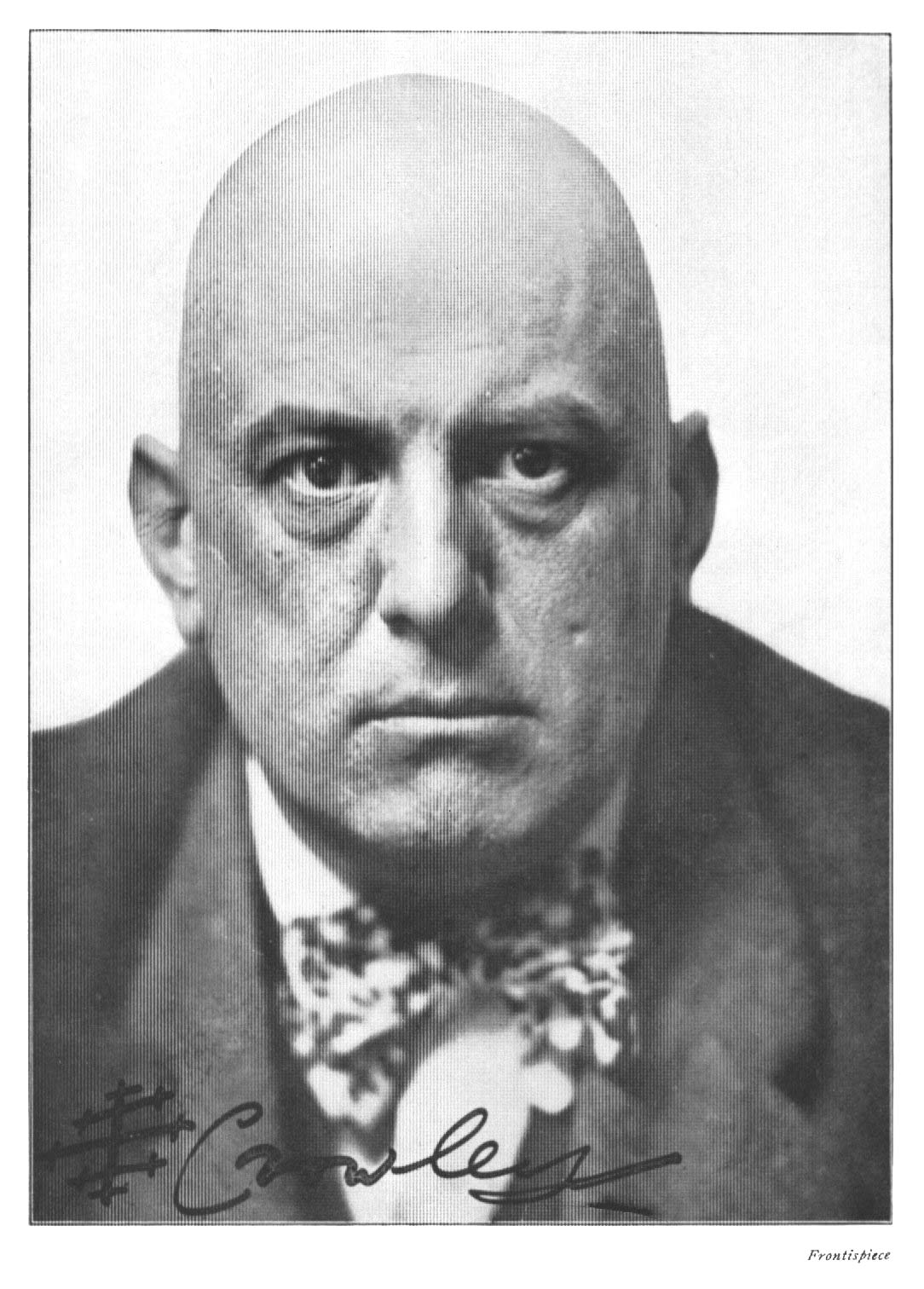
Aleister Crowley was dubbed “the wickedest man in the world.” 1913
Aleister Crowley (1875–1947) was an English occultist, ceremonial magician, poet, novelist, mountaineer, and the founder of the religious philosophy called Thelema. He became one of the most influential and controversial figures in modern Western esotericism. Crowley turned away from the strict evangelical Christianity of his Plymouth Brethren upbringing and spent his life exploring mysticism, ceremonial magic, comparative religion, Eastern philosophy, and ancient traditions. The press often called him “the wickedest man in the world,” but his writings had a major impact on twentieth-century occultism and still influence modern magical, esoteric, and alternative spiritual movements.
Crowley was born Edward Alexander Crowley in Royal Leamington Spa to a wealthy brewing family. He went to Trinity College, Cambridge, where he became interested in poetry, mountaineering, philosophy, and the occult. In 1898, he joined the Hermetic Order of the Golden Dawn, the leading magical society in Britain at the time, and studied ceremonial magic, Qabalah, alchemy, astrology, and ritual with leaders like Samuel Liddell MacGregor Mathers. After conflicts within the Order, Crowley spent years traveling through Europe, North Africa, India, China, Mexico, and Ceylon. He combined mountaineering with deep studies of yoga, meditation, and Eastern religions.
The most important event in Crowley’s career happened in Cairo in 1904, when he said he received a revelation from a spiritual being named Aiwass. Over three days, he dictated The Book of the Law, which became the foundation of Thelema. This philosophy is known for the statements, “Do what thou wilt shall be the whole of the Law” and “Love is the law, love under will.” Crowley explained that these ideas were not about doing whatever one wants, but about finding and following one’s unique “True Will,” or highest purpose in life.
A key part of Crowley’s teaching was the idea of “Magick,” which he spelled this way to set it apart from stage magic. He described Magick as “the Science and Art of causing Change to occur in conformity with Will.” For Crowley, Magick was a disciplined system that brought together ritual, meditation, symbolism, suggestion, and spiritual growth. He drew from Hermeticism, Qabalah, alchemy, Gnosticism, yoga, Tantra, and ancient mystery traditions, aiming to blend Eastern and Western esoteric teachings into one system.
Throughout his life, Crowley was involved in several occult groups, most notably becoming the leader of the Ordo Templi Orientis (O.T.O.), where he changed its teachings to focus on Thelema. In 1920, he founded the Abbey of Thelema in Cefalù, Sicily, as a place for spiritual and magical practice. The Abbey attracted widespread public attention and controversy, and after one resident died, the Italian government, led by Benito Mussolini, expelled Crowley from Italy in 1923.
Crowley was a very productive writer, publishing many books, essays, poetry collections, novels, plays, translations, and guides on ceremonial magick, yoga, Qabalah, mysticism, psychology, and comparative religion. Some of his most important works include The Book of the Law, Magick in Theory and Practice, The Book of Thoth, The Vision and the Voice, and the magazine The Equinox.
Besides his work in the occult, Crowley was a skilled mountaineer who took part in early expeditions to K2 in 1902 and Kangchenjunga in 1905, helping to start Himalayan climbing.
Crowley died in relative obscurity in 1947, but his influence grew immensely after his death. His ideas helped shape modern ceremonial magic, Wicca, contemporary occultism, and many alternative spiritual movements. His focus on personal spiritual freedom, symbolic psychology, and disciplined self-realization appealed to the counterculture of the 1960s and later. Crowley has become a lasting cultural figure, appearing on the cover of Sgt. Pepper’s Lonely Hearts Club Band and inspiring artists, writers, musicians, and many students of Western esotericism.
Related Research Articles
From Suggestion to the Seven Hermetic Principles: Herbert A. Parkyn and the Psychological Roots of The Kybalion
An examination of the roots of The Kybalion’s Seven Hermetic Principles and their parallels with Herbert A. Parkyn’s system of Suggestive Therapeutics.
Herbert A. Parkyn’s Foundation in Eastern Philosophy
This article examines Dr. Herbert A. Parkyn's early study of Eastern philosophy and the network of individuals and ideas that helped lay the foundation for the Yogi Publication Society and its publishing program.
The Sacred Geometry of the Yogi Publication Society Logo
This article examines the Yogi Publication Society logo and its sacred geometry meaning, comparing it with Hindu, Hermetic, Rosicrucian, Masonic, and Theosophical traditions to show the intention behind the publishing network.

![Collected Works of Aleister Crowley [Three volumes]](https://yogipublicationsocietyhistory.org/wp-content/uploads/2026/07/Aleister-Crowley-678x1024.jpg)