Aleister Crowley (1875–1947) was an English occultist, ceremonial magician, poet, novelist, mountaineer, and the founder of the religious philosophy called Thelema. He became one of the most influential and controversial figures in modern Western esotericism. Crowley turned away from the strict evangelical Christianity of his Plymouth Brethren upbringing and spent his life exploring mysticism, ceremonial magic, comparative religion, Eastern philosophy, and ancient traditions. The press often called him “the wickedest man in the world,” but his writings had a major impact on twentieth-century occultism and still influence modern magical, esoteric, and alternative spiritual movements.

Crowley was born Edward Alexander Crowley in Royal Leamington Spa to a wealthy brewing family. He went to Trinity College, Cambridge, where he became interested in poetry, mountaineering, philosophy, and the occult. In 1898, he joined the Hermetic Order of the Golden Dawn, the leading magical society in Britain at the time, and studied ceremonial magic, Qabalah, alchemy, astrology, and ritual with leaders like Samuel Liddell MacGregor Mathers. After conflicts within the Order, Crowley spent years traveling through Europe, North Africa, India, China, Mexico, and Ceylon. He combined mountaineering with deep studies of yoga, meditation, and Eastern religions.
The most important event in Crowley’s career happened in Cairo in 1904, when he said he received a revelation from a spiritual being named Aiwass. Over three days, he dictated The Book of the Law, which became the foundation of Thelema. This philosophy is known for the statements, “Do what thou wilt shall be the whole of the Law” and “Love is the law, love under will.” Crowley explained that these ideas were not about doing whatever one wants, but about finding and following one’s unique “True Will,” or highest purpose in life.
A key part of Crowley’s teaching was the idea of “Magick,” which he spelled this way to set it apart from stage magic. He described Magick as “the Science and Art of causing Change to occur in conformity with Will.” For Crowley, Magick was a disciplined system that brought together ritual, meditation, symbolism, suggestion, and spiritual growth. He drew from Hermeticism, Qabalah, alchemy, Gnosticism, yoga, Tantra, and ancient mystery traditions, aiming to blend Eastern and Western esoteric teachings into one system.
Throughout his life, Crowley was involved in several occult groups, most notably becoming the leader of the Ordo Templi Orientis (O.T.O.), where he changed its teachings to focus on Thelema. In 1920, he founded the Abbey of Thelema in Cefalù, Sicily, as a place for spiritual and magical practice. The Abbey attracted widespread public attention and controversy, and after one resident died, the Italian government, led by Benito Mussolini, expelled Crowley from Italy in 1923.
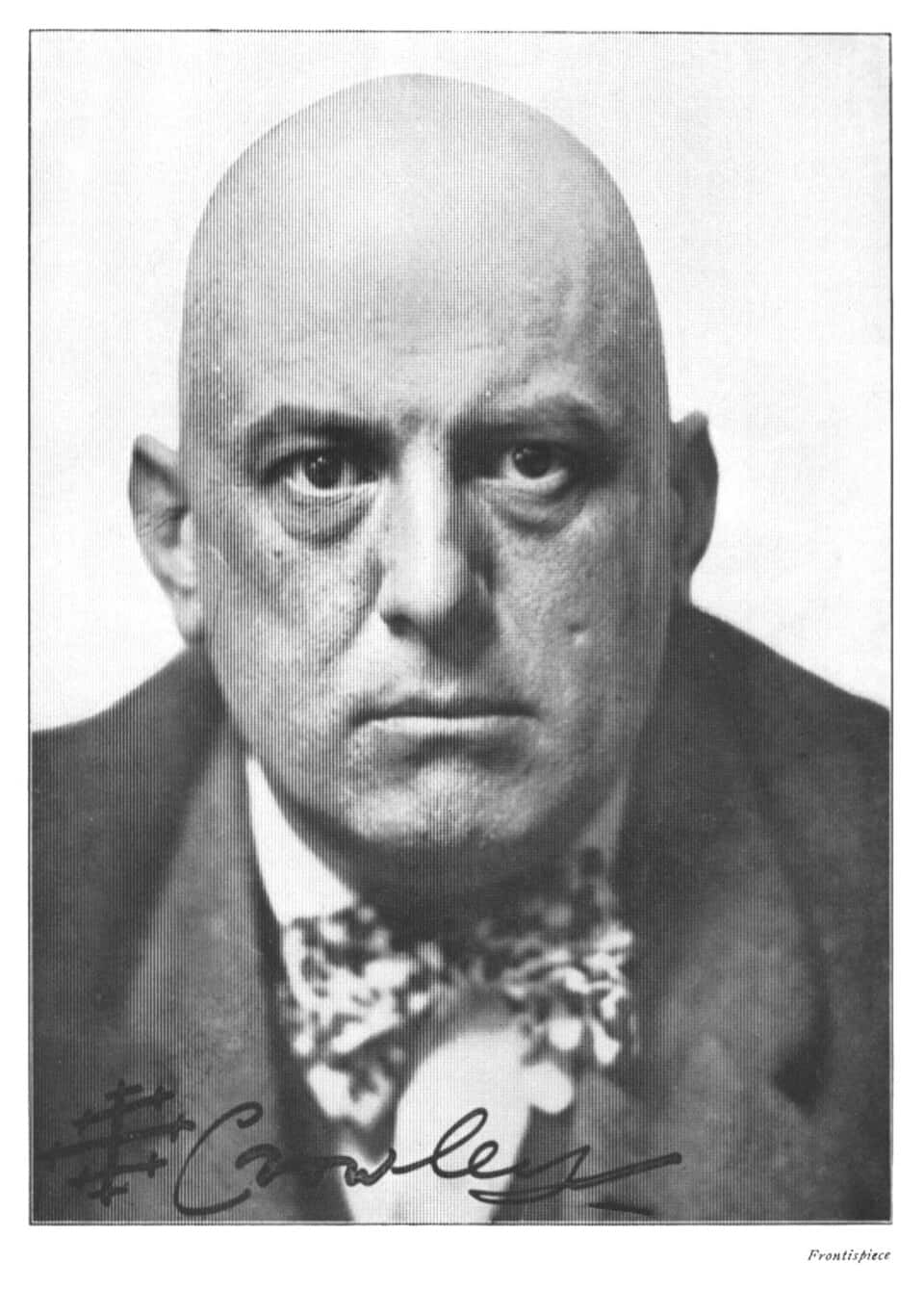
Crowley was a very productive writer, publishing many books, essays, poetry collections, novels, plays, translations, and guides on ceremonial magick, yoga, Qabalah, mysticism, psychology, and comparative religion. Some of his most important works include The Book of the Law, Magick in Theory and Practice, The Book of Thoth, The Vision and the Voice, and the magazine The Equinox.
Besides his work in the occult, Crowley was a skilled mountaineer who took part in early expeditions to K2 in 1902 and Kangchenjunga in 1905, helping to start Himalayan climbing. Crowley died in relative obscurity in 1947, but his influence grew immensely after his death. His ideas helped shape modern ceremonial magic, Wicca, contemporary occultism, and many alternative spiritual movements. His focus on personal spiritual freedom, symbolic psychology, and disciplined self-realization appealed to the counterculture of the 1960s and later. Crowley has become a lasting cultural figure, appearing on the cover of Sgt. Pepper’s Lonely Hearts Club Band and inspiring artists, writers, musicians, and many students of Western esotericism.