
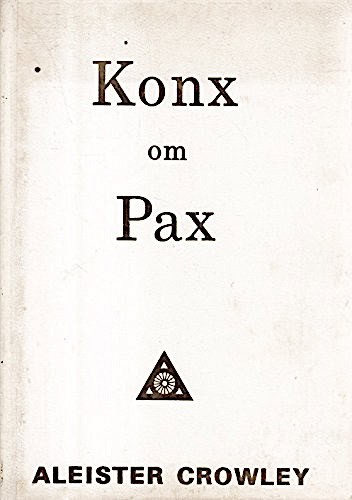
Konx Om Pax
About This Publication
Konx Om Pax: Essays in Light, by Aleister Crowley, was originally published in 1907 by the Society for the Propagation of Religious Truth, with only five hundred copies originally printed on handmade paper, with each copy individually numbered and signed. It was later published by the Yogi Publication Society in 1970. Crowley wrote it as he moved beyond his Hermetic Order of the Golden Dawn training and began forming ideas that would later become Thelema.

The books contains four principal works, “The Wake World,” “Ali Sloper,” “Thien Tao,” and “The Stone of Abiegnus,” preceded by a “Dedication and Counter-Dedication with a Note on Obscurity.”
Although these pieces differ dramatically in form, they develop a connected esoteric argument. Crowley moves among Qabalah, ceremonial initiation, Rosicrucianism, mysticism, Taoism, Yoga, alchemical symbolism, and the attainment of higher states of consciousness. Fairy tale, satire, philosophical dialogue, poetry, religious symbolism, and occult allegory become different ways of describing the same movement. Ordinary consciousness divides experience into opposites. Initiatory training brings those opposites into equilibrium. Mystical attainment carries consciousness beyond the division itself.
This is the meaning Crowley assigns to the title. He explicitly defines “Konx Om Pax” as “Light in Extension” and associates its LVX with the “Brethren of the Rosy Cross.”
What Does Konx Om Pax Mean?
Crowley begins by explaining the central idea before any of the four principal works appear. His “Note on Obscurity” presents two symbolic paths. On the Path of Evil, the Neophyte encounters Samael, the Prince of Darkness. On the Path of Good, he encounters Metatron, the angel of the Divine Presence. Darkness and overwhelming light can both prevent the unprepared initiate from passing farther. The important problem is already established. The initiate cannot reach the goal simply by choosing one member of a pair of opposites.
Crowley describes the light of the book as something beyond ordinary reasoning. It is neither reason nor irrationality. He calls it an LVX that first masters reason and then transcends it. His explanation becomes explicitly Rosicrucian when he writes that KONX is “the LVX of the Brethren of the Rosy Cross” and that it “transcends all the possible pairs of opposites” (p. viii).
This idea supplies the philosophical structure of the entire volume. Good and evil, truth and falsehood, light and darkness, virtue and vice, motion and rest are divisions created within ordinary consciousness. Crowley does not propose simply reversing conventional values. He argues that the student must comprehend both sides and reach a position from which their apparent contradiction disappears.
His image of two fighting elephants makes the point. The successful person does not champion either elephant. He captures and rides both, like the charioteer of the Tarot controlling the black and white sphinxes. The initiate learns equilibrium before transcendence.
Crowley also insists that mystical attainment cannot be reached by abandoning thought before mastering it. “Nor avails it, O man, to transcend the reason by ignoring it” (p. x). Reason must first be pushed to its limit. Only after its limitations have been discovered through experience can consciousness pass beyond them.
The dedication then reveals the initiatory purpose of the book. Crowley addresses those outside the Order, initiates who lack the current password, and even those who have resigned or been expelled, describing the volume as a revelation of arcana from the “Adytum of God-nourished Silence” (p. xi). The book is being presented as an outward disclosure of material ordinarily associated with an inner initiatory system.
“The Wake World” and the Qabalistic Journey of the Soul
“The Wake World” begins on page 1 and is subtitled “A Tale for Babes and Sucklings,” followed by the deliberately contradictory qualification that it contains explanatory Hebrew and Latin notes “for the use of the Wise and Prudent.”
The narrator is a young woman named Lola. She explains that the people around her call her Lola Daydream, yet when she is awake she knows that she is dreaming. The truly important figure is her “Fairy Prince,” whom the marginal notation identifies with Adonai. He is Lola’s divine lover and the object of her journey. When she finally unites with him, the dream ends.
Crowley has therefore taken an advanced occult doctrine and disguised it as a children’s fairy tale. Lola represents the aspirant. Her Fairy Prince represents the divine or higher presence sought through initiation. The world that ordinary people regard as waking existence becomes the dream, while union with the higher consciousness becomes awakening.
The opening establishes the goal directly. Lola describes the Prince as someone who sees through her completely and says that when they kiss, “I wake up quite” and “there is no dream any more” (p. 1).
Her journey is simultaneously a love story and an ascent through an occult cosmology. Crowley fills the apparently innocent narrative with Qabalistic names, Hebrew terms, magical correspondences, Tarot imagery, divine names, numerical references, and initiatory symbolism. Lola progresses through successive conditions as she approaches her Prince. The reader can follow the surface fairy tale while the initiated reader follows another narrative encoded underneath it.
This helps explain Crowley’s unusual opening declaration about obscurity. The meaning is intentionally layered. The same passage can operate as story, Qabalistic diagram, initiatory instruction, and description of consciousness.
The Holy Guardian Angel and Mystical Union
The relationship between Lola and her Prince supplies the emotional center of “The Wake World.” The objective of initiation is represented as union. The divine is not merely something the student studies. It must become an immediate experience.
On page 5 the symbolism becomes unmistakable. Lola addresses “Mine Angel” and asks for “this grace of union,” followed by a request for “conversation and communion.” The same passage invokes L.V.X., I.N.R.I., T.A.R.O., crucifixion, death, resurrection, sacrament, and the ring of amethyst.
Crowley is combining Christian mystical imagery with Qabalistic and ceremonial symbolism. Crucifixion and resurrection become stages of transformation. Sacrament becomes a means of union. The Angel is the higher object of the aspirant’s devotion. The fairy-tale marriage is the completion of an initiatory process.
The method is important to understanding the rest of Konx Om Pax. Different religious languages can describe the same inner movement. Christian resurrection, Qabalistic ascent, magical initiation, mystical marriage, and yogic attainment can occupy the same system without Crowley treating them as mutually exclusive religions.
“Ali Sloper, or The Forty Liars”
The second major work changes tone completely. “Ali Sloper, or The Forty Liars” begins on page 25 and turns occult initiation into a grotesque comic performance. Crowley parodies the personalities, quarrels, pretensions, rituals, and internal politics surrounding the ceremonial magical world with which he had been involved.
The piece contains transparent caricatures of figures associated with the Hermetic Order of the Golden Dawn. “The Mysterious Mathers” appears in a performance called “The Family Vault,” while “The Yonly Yeats” unmistakably plays upon W. B. Yeats. The supposed occult adepts are transformed into performers in an absurd theatrical company.
The comedy has a serious purpose. Crowley is attacking the confusion of membership, rank, ritual office, personality, and institutional authority with actual spiritual attainment. An initiate can possess titles and ceremonial knowledge while remaining trapped in ordinary habits of thought.
The philosophical argument from the introduction then returns.
Truth, Falsehood and the Pairs of Opposites
A discussion between Bones and Bowley develops the question of truth and lying. Bowley argues that genuine attainment requires conquering “the Illusion of the Pairs of Opposites.” Truth and falsehood belong to the same class of apparent oppositions as white and black or good and evil (p. 45).
The conversation immediately becomes Qabalistic. The speakers discuss Kether and the Tree, asking what truth would look like when viewed from the highest Sephirah. They then use heat and cold as an example. What appears to ordinary perception as a fundamental opposition can be understood at another level as different degrees of motion.
Crowley then explicitly connects the Qabalistic argument with Yoga. Bones asks how much more completely the opposites disappear “when we observe the matter from the point of view of Samadhi” (p. 45).
That sentence is one of the most useful passages in the volume for understanding its religious synthesis. Qabalistic ascent to Kether and yogic Samadhi are being used to explain the same problem. The apparent contradictions of ordinary consciousness disappear when consciousness reaches another state.
“Ali Sloper” is therefore doing considerably more than mocking an occult organization. Crowley is distinguishing the outward apparatus of occultism from the transformation the apparatus is supposed to produce.
“Thien Tao, or The Synagogue of Satan”
“Thien Tao” begins on page 53 and carries the argument into a fictionalized Eastern setting. Here Crowley uses Taoist language to examine society, education, government, morality, habit, and the deliberate cultivation of equilibrium.
The central proposal is extraordinary. People become psychologically unbalanced because they become fixed in one mode of living and thinking. The corrective is deliberate experience of the opposite.
A person obsessed with cleanliness should work where dirt is unavoidable. Someone terrified of infection should be sent into conditions where the fear cannot govern him. A hurried businessman should learn repose. A naturally slow person should experience intense activity. Crowley extends the principle into morality, religion, temperament, and social behavior. The purpose is equilibrium.
The system is an application of the principle announced at the beginning of the book. A person enslaved to one pole of an opposition cannot transcend the opposition. He first has to become capable of both.
Crowley then makes the esoteric objective explicit. After the proposed period of corrective training, each person is to spend a month seeking “the Stone of the Philosophers” (p. 63). The method must again be adapted to the individual. Solitude and fasting may be prescribed for the social and luxurious, repose for the restless, work for the idle, ritual for the rational, and philosophy for the credulous.
The Stone of the Philosophers is functioning here as an alchemy symbol for transformation of the individual. Crowley has converted the old alchemical quest into a program for altering consciousness.
The story later reports the startling results of this program. People forced beyond their accustomed limitations discover abilities that their former habits had prevented them from developing. The social order itself is overturned by the experiment.
The Tao of the title is thus connected with balance and freedom from fixed extremes. The “Synagogue of Satan” is intentionally provocative language for a school that attacks conventional assumptions by forcing people to experience what their habits have excluded.
“The Stone of Abiegnus”
The final and longest portion, “The Stone of Abiegnus,” begins on page 69. Its title brings the Rosicrucian and alchemical symbolism that has appeared throughout the volume into the foreground.
Abiegnus belongs to the symbolic geography of Rosicrucian initiation. The Stone is simultaneously the Philosophers’ Stone and the transformed condition sought by the initiate. Crowley develops the subject through a mixture of narrative, dialogue, poetry, philosophy, religious argument, humor, and mystical symbolism.
The central problem remains knowledge. What can human beings know through reason, science, religion, philosophy, and direct mystical experience? Crowley repeatedly attacks intellectual certainty. Scientific investigation can disclose facts, yet facts do not exhaust reality. Religious dogma can preserve symbols while failing to produce the experience represented by them. Philosophical argument can expose contradictions while creating new conceptual prisons of its own.
At one point he addresses the Buddha and asks whether there can be any fixed point for the universe. The passage moves between appearance and reality, growth and decay, truth and falsehood. The result returns the reader to the book’s opening problem. Every fixed intellectual formulation generates its opposite. The Stone cannot simply be another proposition added to the collection.
The Philosophers’ Stone as Spiritual Attainment
The Stone in Konx Om Pax should be understood alongside the other names Crowley gives the goal throughout the book. It corresponds with Lola reaching the Fairy Prince, the Qabalist approaching Kether, the yogi entering Samadhi, the Rosicrucian attaining LVX, and the alchemist obtaining the Philosophers’ Stone.
The languages differ because they come from different traditions. The underlying pattern is consistent.
This also explains why Crowley can move so rapidly among Christianity, Buddhism, Islam, Qabalah, Taoism, Rosicrucian symbolism, ceremonial magic, alchemy, and Yoga. He is looking for the transformative experience represented within each system.
The book’s title gathers these strands into one formula. KONX is LVX. LVX is Light. The light expands beyond the ordinary division of experience into opposing categories.
Why Are So Many Religious Traditions Combined in the Book?
One of the most noticeable characteristics of Konx Om Pax is the density of its religious references. Even before “The Wake World” begins, Crowley places material from the Qur’an, Hebrew mystical literature, Christian scripture, Enochian material, and an African proverb beside one another.
This continues throughout the book. Hebrew divine names stand beside Christian formulas. Tarot symbolism appears beside Qabalistic Sephiroth. Buddha and Samadhi appear within discussions framed by Western ceremonial magic. Taoism becomes a means of discussing equilibrium. Alchemical transformation becomes psychological and mystical transformation.
Crowley is constructing a comparative esoteric system in which religious traditions preserve different symbolic expressions of states of consciousness and stages of initiation. This places Konx Om Pax firmly within the late nineteenth- and early twentieth-century current of Western esotericism that attempted to interpret Eastern and Western religious systems through a common occult framework.
.

The first 1907 edition became almost as well known for its cover as for what was inside. Crowley designed the detailed geometric cover himself, filling it with a maze of lines and letters. Later stories say he came up with parts of the design while using hashish and wanted the geometry to be more than just decoration. The cover was meant to show the book’s main ideas, acting as a visual symbol or charm that showed the hidden links between light, consciousness, and sacred geometry. This mix of art and occult symbols matched the book, where every style was used to teach spiritual lessons.
Aleister Crowley Biography
Aleister Crowley (1875–1947) was an English occultist, ceremonial magician, poet, novelist, mountaineer, and the founder of the religious philosophy called Thelema. He became one of the most influential and controversial figures in modern Western esotericism. Crowley turned away from the strict evangelical Christianity of his Plymouth Brethren upbringing and spent his life exploring mysticism, ceremonial magic, comparative religion, Eastern philosophy, and ancient traditions. The press often called him “the wickedest man in the world,” but his writings had a major impact on twentieth-century occultism and still influence modern magical, esoteric, and alternative spiritual movements.
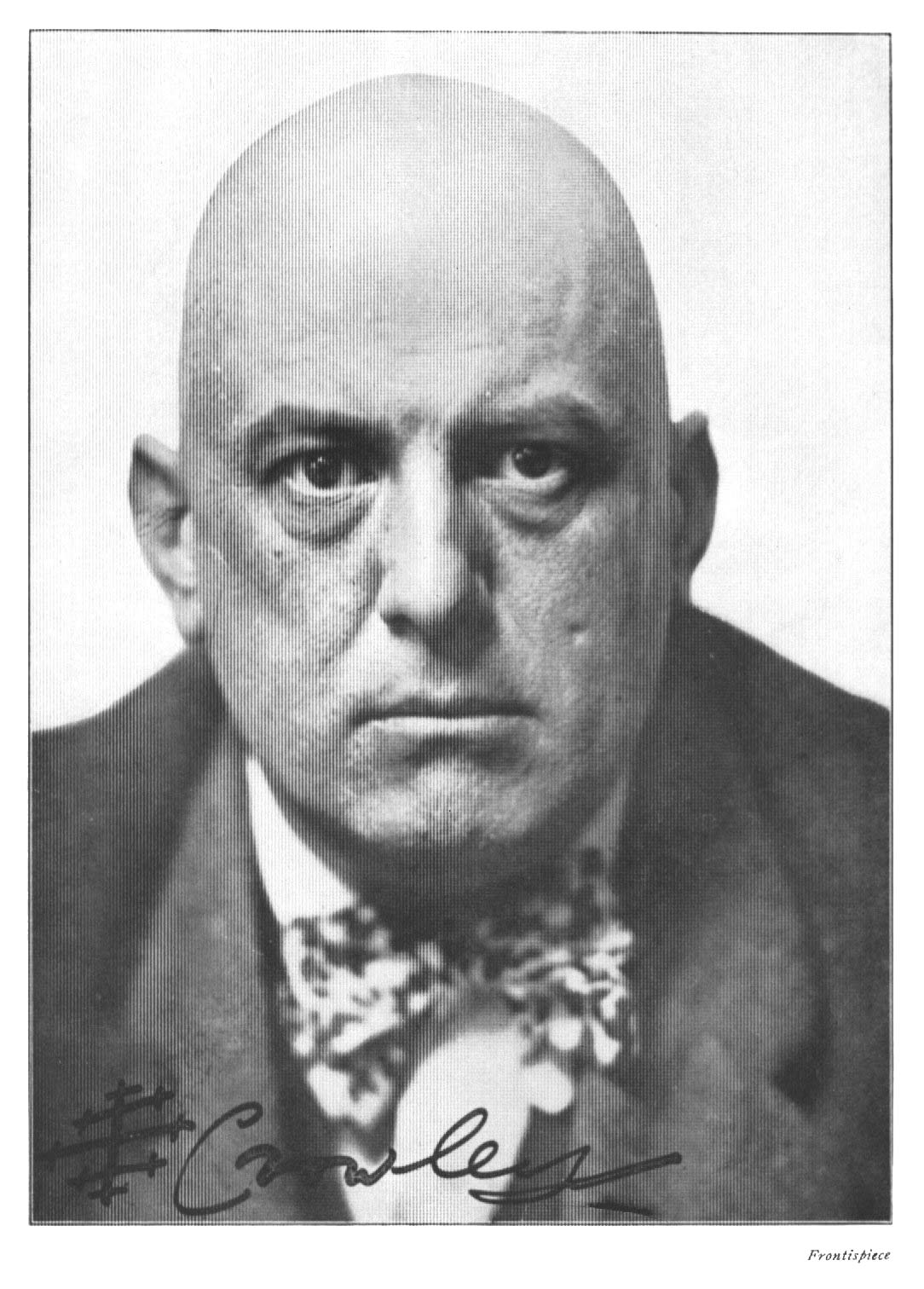
Crowley was born Edward Alexander Crowley in Royal Leamington Spa to a wealthy brewing family. He went to Trinity College, Cambridge, where he became interested in poetry, mountaineering, philosophy, and the occult. In 1898, he joined the Hermetic Order of the Golden Dawn, the leading magical society in Britain at the time, and studied ceremonial magic, Qabalah, alchemy, astrology, and ritual with leaders like Samuel Liddell MacGregor Mathers. After conflicts within the Order, Crowley spent years traveling through Europe, North Africa, India, China, Mexico, and Ceylon. He combined mountaineering with deep studies of yoga, meditation, and Eastern religions.
The most important event in Crowley’s career happened in Cairo in 1904, when he said he received a revelation from a spiritual being named Aiwass. Over three days, he dictated The Book of the Law, which became the foundation of Thelema. This philosophy is known for the statements, “Do what thou wilt shall be the whole of the Law” and “Love is the law, love under will.” Crowley explained that these ideas were not about doing whatever one wants, but about finding and following one’s unique “True Will,” or highest purpose in life.
A key part of Crowley’s teaching was the idea of “Magick,” which he spelled this way to set it apart from stage magic. He described Magick as “the Science and Art of causing Change to occur in conformity with Will.” For Crowley, Magick was a disciplined system that brought together ritual, meditation, symbolism, suggestion, and spiritual growth. He drew from Hermeticism, Qabalah, alchemy, Gnosticism, yoga, Tantra, and ancient mystery traditions, aiming to blend Eastern and Western esoteric teachings into one system.

Throughout his life, Crowley was involved in several occult groups, most notably becoming the leader of the Ordo Templi Orientis (O.T.O.), where he changed its teachings to focus on Thelema. In 1920, he founded the Abbey of Thelema in Cefalù, Sicily, as a place for spiritual and magical practice. The Abbey attracted widespread public attention and controversy, and after one resident died, the Italian government, led by Benito Mussolini, expelled Crowley from Italy in 1923.
Crowley was a very productive writer, publishing many books, essays, poetry collections, novels, plays, translations, and guides on ceremonial magick, yoga, Qabalah, mysticism, psychology, and comparative religion. Some of his most important works include The Book of the Law, Magick in Theory and Practice, The Book of Thoth, The Vision and the Voice, and the magazine The Equinox.
Besides his work in the occult, Crowley was a skilled mountaineer who took part in early expeditions to K2 in 1902 and Kangchenjunga in 1905, helping to start Himalayan climbing.
Crowley died in relative obscurity in 1947, but his influence grew immensely after his death. His ideas helped shape modern ceremonial magic, Wicca, contemporary occultism, and many alternative spiritual movements. His focus on personal spiritual freedom, symbolic psychology, and disciplined self-realization appealed to the counterculture of the 1960s and later. Crowley has become a lasting cultural figure, appearing on the cover of Sgt. Pepper’s Lonely Hearts Club Band and inspiring artists, writers, musicians, and many students of Western esotericism.