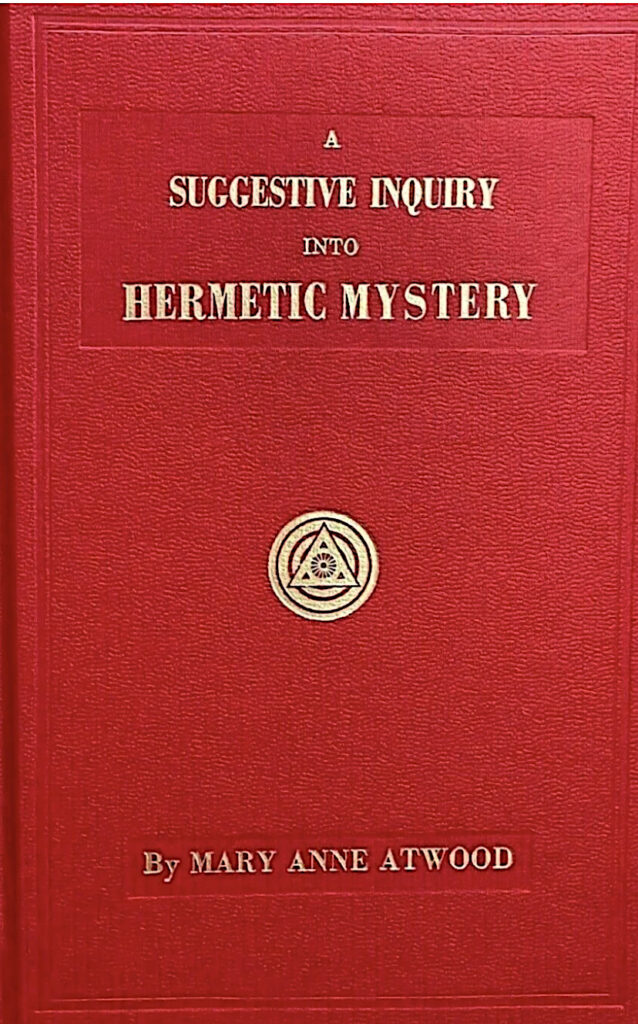
A Suggestive Inquiry into the Hermetic Mystery, also published under the expanded title A Suggestive Inquiry into the Hermetic Mystery and Alchemy, is the major work of English Hermetic writer Mary Anne Atwood, who wrote it under her maiden name Mary Anne South. The book was originally published anonymously in London by Trelawney Saunders in 1850, withdrawn almost immediately, and reissued in 1918 with an introduction by Walter Leslie Wilmshurst. It was later republished by the Yogi Publication Society in 1976.
Mary Anne Atwood
Atwood’s subject is Hermeticism, but her understanding of alchemy reaches far beyond the ordinary idea of attempting to manufacture gold. The real Hermetic experiment takes place within human nature. The alchemical laboratory is man, the hidden agent is the vital or universal spirit operating within him, and the Great Work is a process through which that spirit is separated, purified, concentrated, and brought into conscious activity.
Atwood brings together Hermes Trismegistus, Neoplatonism, the Qabalah, the ancient Mysteries, Rosicrucian traditions, Christian mysticism, alchemy, animal magnetism, and Mesmerism in an attempt to recover what she believed was a single ancient experimental science of spiritual regeneration. The book itself describes its purpose as an attempt to recover the “Ancient Experiment of Nature.”
What Is A Suggestive Inquiry into the Hermetic Mystery About?
Atwood begins from the proposition that the great philosophical traditions of antiquity possessed an experimental knowledge of human nature that had been lost. She does not present Hermetic philosophy merely as a collection of doctrines inherited from the past. For her, the ancient philosophers were describing something that could actually be experienced. Modern philosophy and science study phenomena through the senses and external observation, while the older Wisdom tradition sought knowledge of causes by transforming the person doing the investigation. Atwood describes this as the disciplining and conversion of the rational faculty until it reaches an “Intuition of Universal Truth in its own conscious Identity or Self-knowledge.” She traces this conception through Zoroastrian teaching, the Jewish Cabal, Egyptian mysteries, Orphism, Pythagoras, Plato, and the Alexandrian philosophers.
This distinction establishes the argument of the entire book. Ordinary consciousness is not, in Atwood’s view, an adequate instrument for discovering the deepest laws of nature. Human beings normally perceive effects while remaining ignorant of their causes. The ancient initiatory systems existed to alter that condition. Their object was to turn consciousness inward, away from dependence upon sensory appearances, until the hidden causal principle could be discovered within human nature itself. Man is presented as a microcosm, an epitome of the universe containing within himself a latent faculty capable of perceiving the hidden forms and causes behind manifested existence.
This is where Atwood locates alchemy. Its obscure language of metals, furnaces, vessels, fire, mercury, sulfur, dissolution, purification, conjunction, fermentation, and transmutation is treated as the deliberately veiled language of an interior science. The Philosopher’s Stone is connected with the perfection of the human subject, and the transformation of base matter into gold corresponds at its highest level to a regeneration of life and consciousness. Atwood does not simply dismiss metallic alchemy as nonsense or reduce every alchemical statement to a modern psychological metaphor. She takes the alchemists’ claims seriously. Her argument is that their physical language conceals a deeper operation involving the forces of nature and the constitution of man.
The History and Philosophy of Alchemy
The first part of the book provides the foundation for the more difficult material that follows. Atwood surveys the history of alchemy and the writings attributed to or associated with many of its major representatives. She follows the tradition through ancient Hermetic sources and later Arabic and European alchemists, examining the recurring testimony that a genuine secret art existed behind the bewildering language of alchemical literature.
A central problem is secrecy. If the alchemists possessed a coherent science, why did they write in riddles? Atwood argues that concealment was intentional. The adepts repeatedly warn that their Mercury is not common mercury, their gold is not simply ordinary gold, their fire is not ordinary fire, and their vessel cannot be understood merely as laboratory glassware. The contradictions between alchemical writers begin to look different once their terminology is understood as a system of concealment.
The historical survey also places the Rosicrucian tradition within this transmission. Atwood describes philosophers gathering together for protection and carrying their work into the Rosicrucian fraternity after fraud, persecution, and public misunderstanding had made open discussion of alchemy increasingly difficult. The Rosicrucian material is not an isolated diversion. It belongs to her argument that the Hermetic science survived through concealed schools, symbolic literature, and carefully restricted transmission.
What Is the True Subject of Alchemy?
The second part moves from historical evidence into Atwood’s explanation of what the Hermetic Art is actually supposed to accomplish. The contents themselves announce the change. Atwood calls this “A More Esoteric Consideration of the Hermetic Art and its Mysteries,” beginning with the “True Subject of the Hermetic Art and its Concealed Root.” She promises to identify the alchemical laboratory and the vessel in which the adepts sublimated the Universal Spirit of Nature and concentrated its Light.
The decisive point is that the true laboratory is associated with living human nature. The Universal Spirit is already present, but in ordinary life it remains bound to sensory consciousness and dispersed through natural activity. The Hermetic process seeks to arrest that activity, turn the vital principle back upon itself, separate it from ordinary sensory impressions, and bring what is normally hidden into conscious manifestation.
Alchemy thus becomes a science of concentration and regeneration. Its language of dissolution and coagulation describes stages in which the ordinary constitution is loosened so that a more fundamental principle can be isolated and strengthened. Purification removes what prevents that principle from acting freely. Conjunction reunites what has been separated in a new and perfected state. Gold signifies the completed condition because gold, within traditional alchemical symbolism, represents permanence, perfection, and incorruptibility.
The importance of the Philosopher’s Stone follows from this interpretation. The Stone is not presented simply as a mysterious chemical substance awaiting discovery in a laboratory. It represents the perfected agent through which transformation becomes possible. Atwood repeatedly moves between spiritual, vital, and material language because her Hermetic philosophy does not impose the modern division between mind and matter upon the old texts. The same causal power manifests through different levels of nature.
The Ancient Mysteries and the Regeneration of Man
Atwood then connects alchemy with initiation. The ancient Mysteries were designed, in her reconstruction, to bring the candidate through controlled alterations of consciousness. The Lesser and Greater Mysteries become stages in an experimental process whose goal was direct knowledge of the spiritual ground of existence.
The ordinary personality is an obstacle because consciousness has become attached to sensory impressions, desires, imagination, and what Atwood calls the Selfhood. Initiatory discipline begins by weakening this domination. The vital spirit can then be separated from the confused impressions ordinarily acting upon it and made capable of another kind of perception.
This gives an unusually literal meaning to spiritual regeneration. Regeneration is not merely becoming morally better or adopting a new belief. It is a transformation in the condition of the person. Atwood treats the ancient language of death and rebirth, descent and ascent, darkness and illumination as descriptions of successive stages in the alteration of consciousness.
The connection also explains her repeated use of Light. Hermetic Light is not ordinary illumination. It signifies the manifestation of the causal principle when the obstacles preventing its perception have been removed. The alchemical quest for hidden Light and the initiatory quest for divine illumination become two vocabularies describing the same operation.
Why Does Atwood Connect Alchemy With Mesmerism?
One of the most striking features of the book, and one that makes its later appearance in the YPS catalog far more interesting, is Atwood’s extensive treatment of animal magnetism and Mesmerism. She believed nineteenth-century magnetic experiments had accidentally rediscovered the entrance to the same field explored systematically by the ancient initiates.
Atwood accepts the familiar magnetic phenomena of her period, including induced sleep, altered sensitivity, unusual perception, apparent communication of thought, and changes in bodily condition. But she argues that contemporary Mesmerists had stopped at the beginning of the discovery. They could produce phenomena without understanding the causal force producing them. She asks what Mesmerism has discovered concerning self-knowledge, perfection of life, or the cause of its own effects.
Her comparison with initiation is explicit. According to Atwood, ancient theurgists did not remain satisfied with the first phenomena of altered consciousness. They sought to separate the “Vital Spirit” from the sensory and imaginative impressions that normally obscure it. Once purified and strengthened, this interior faculty became the instrument through which higher knowledge could be obtained.
Near the end of the work she becomes even clearer about the importance of this connection, calling Mesmerism the neglected “Door-keeper” that had first introduced her and her circle to the vestibule of ancient science. That statement is important for understanding Atwood. Her interpretation of alchemy did not arise solely from reading old books. Mesmeric experimentation helped provide the conceptual bridge through which she believed the obscure statements of the alchemists could be understood.
The Laws and Conditions of the Hermetic Experiment
The later sections turn toward the conditions under which the Great Work can be undertaken. Atwood stresses that knowledge alone is insufficient. The state of the operator is part of the experiment. Motivation, discipline, reason, faith, self-command, and moral disposition influence the result because the operator is also the subject upon which the Art operates.
This explains the traditional warnings against greed. Someone seeking only metallic gold has misunderstood the nature of Hermetic gold before beginning. Atwood states that avarice and ambition cannot discover the “true Form of Gold.” The language is simultaneously moral and technical. An uncontrolled desire prevents the inward condition necessary for the experiment.
The same principle explains the secrecy surrounding the Art. Hermetic concealment is presented as protection against misuse and misunderstanding. The alchemists’ obscurity becomes part of a system intended to prevent an unprepared reader from mechanically reproducing operations whose consequences he does not understand.
The work reaches its fullest expression when Atwood joins the alchemical process to the Christian doctrine of regeneration. The Fall represents the loss of an original condition in which divine life operated freely through humanity. The Great Work seeks its restoration. Atwood can accordingly identify the language of the Philosopher’s Stone with Biblical symbolism, writing of the restoration of the original divine principle within man and locating the Stone or tincture within this process.
Why Was the Book Suppressed After Its Original Publication?
The unusual history of A Suggestive Inquiry is almost inseparable from its reputation. Mary Anne South wrote the work while her father, Thomas South, was conducting his own long investigation of Hermetic philosophy. It appeared anonymously in 1850. According to Walter Leslie Wilmshurst’s detailed account prepared for the 1918 edition, Thomas South had financed its publication without first reading the completed manuscript. After seeing what his daughter had revealed, he became convinced that the book disclosed too much of the Hermetic mystery. The remaining copies were recalled, and most were burned along with the manuscript of Thomas South’s own unfinished Hermetic poem. Only a small number escaped destruction.
Mary Anne South later married the Rev. Alban Thomas Atwood and became known as Mary Anne Atwood. She did not publish another major book. Surviving copies of the Suggestive Inquiry became scarce, while Atwood herself continued studying the Western mystical tradition for decades. The work finally returned to print in 1918, eight years after her death, in an edition containing Wilmshurst’s substantial introduction and material concerning Atwood herself.
There is a further detail that helps explain why the 1918 edition can legitimately be treated as more than an unauthorized resurrection of the discarded 1850 text. Atwood eventually revised a copy of the work herself, and the revisions were used when preparing the later edition. Wilmshurst reports that another copy had also been corrected by her friend Walter Moseley and that the two sets of corrections were collated for the reissue.
Why Did A Suggestive Inquiry Fit the Yogi Publication Society?
The Yogi Publication Society’s decision to republish Atwood in 1976 makes considerable sense when the book is placed beside the older YPS catalog. YPS had never confined itself to books about Indian Yoga. From its early years it published works spanning Yogi philosophy, Western occultism, psychic phenomena, mental development, Qabalah, Rosicrucian thought, Hermetic philosophy, and related systems. The Atwood volume belongs firmly to the Western Hermetic side of that program.
The most obvious connection is The Kybalion. That work presents itself as a study of the Hermetic philosophy of ancient Egypt and Greece and places Hermes Trismegistus at the head of its tradition. Atwood begins from the same Hermetic ancestry but approaches it through historical alchemy, Neoplatonism, the Mysteries, Qabalah, Christian theosophy, and the literature of the adepts. Her title page even places a passage from the Asclepius of Hermes Trismegistus directly beneath the statement of the book’s purpose.
There is an equally strong connection with YPS books dealing with psychic development and the hidden forces of the human organism. Atwood’s Universal Spirit, vital principle, altered states, magnetic agency, concentration of hidden force, unusual perception, and her attempt to explain Mesmerism as the outer edge of an older science place the work in territory that YPS had explored from several directions. The vocabulary differs from later YPS books, but the underlying question is familiar. What powers lie latent within human beings, and can those powers be consciously developed?
This makes the 1976 republication more than the addition of an old alchemical curiosity. Atwood supplies a nineteenth-century Western Hermetic counterpart to subjects that YPS had presented through Yoga, psychic science, mental philosophy, and Hermetic literature.
An Important Connection Between Atwood, Mesmerism, and the Origins of the YPS Tradition
There is a deeper historical connection that deserves attention on the Yogi Publication Society History site. It should be identified as a comparison arising from the sources, not as evidence that Atwood directly influenced Herbert A. Parkyn.
Atwood’s route into the Hermetic mystery began through Mesmerism. She and her father experimented with magnetic and psychophysical phenomena, and she eventually interpreted those phenomena as fragments of an ancient science. Her mature argument is that Mesmerists had discovered real effects but had failed to identify the deeper principle behind them. She wanted investigation to move beyond magnetic sleep and its phenomena toward the causal agency operating through human beings.
That history creates an unusual parallel with Herbert A. Parkyn and the Chicago School of Psychology. Parkyn likewise began within the nineteenth-century world of hypnotism and magnetic or suggestive phenomena but moved away from treating hypnotic sleep as the central fact. His work increasingly concentrated on suggestion, auto-suggestion, mental states, involuntary processes, and the forces that could be reached without the older theatrical conception of hypnosis. That intellectual environment later fed directly into the network from which YPS arose.
The two systems are not identical and there is no evidence in the material examined here that Parkyn borrowed his system from Atwood. What is historically striking is the direction of movement. Atwood begins with Mesmeric phenomena and asks what hidden causal principle lies behind them. Parkyn’s research begins with hypnotic phenomena and isolates suggestion as the operative principle. The later YPS literature then expands into mental force, psychic development, Yoga, Hermetic philosophy, and hidden laws of mind and nature. Seen across that chronology, the 1976 Atwood edition reaches back to an earlier Western attempt to make almost exactly that kind of transition from phenomena to underlying law.
Atwood’s Connection Between Eastern and Western Esotericism
Another connection makes the YPS republication even more fitting. Atwood was not simply opposed to Eastern philosophy. According to Wilmshurst’s account, she became interested in the early Theosophical Society and even gave much of the remarkable philosophical library inherited from her father to A. P. Sinnett. She later became dissatisfied with the direction taken by the Society, but her objection was not based upon an absolute division between Eastern and Western wisdom. Wilmshurst records her view that Vedanta and the Hermetic doctrine, when properly understood, were “similar, not divergent, in doctrine.”
That statement has unusual relevance to YPS. The original Society became a publishing meeting point between Indian philosophical language and Western occult traditions. Its catalog could contain Yogi Ramacharaka alongside The Kybalion, Qabalistic works, Rosicrucian material, psychic research, mental science, and Christian mystical literature because these subjects were being presented as different approaches to hidden laws of consciousness and nature. Atwood had already reached a comparable conclusion from the Western Hermetic side. For her, Vedanta and Hermeticism did not have to be rival systems.
There is an additional bridge in the YPS catalog itself. Edward Carpenter’s A Visit to a Gnani, another work later associated with YPS, records an Indian teacher explaining alchemical transformation through consciousness. Carpenter writes that to make quicksilver solid is “to fix thought,” while the transformation of base copper into gold represents the transformation of man through a divine principle. That is remarkably close in structure to the spiritual interpretation of alchemical transmutation developed at great length by Atwood. The resemblance does not establish literary dependence. It does show why a publisher interested in both Yoga and Western alchemy could regard the two bodies of literature as complementary.
Why the 1976 YPS Edition Matters
The 1976 republication of A Suggestive Inquiry into the Hermetic Mystery represents the later Yogi Publication Society preserving one of the major nineteenth-century attempts to recover the philosophical meaning of alchemy. The choice also reflects something fundamental about the YPS catalog. Its subject was never simply Yoga in the narrow modern sense. It repeatedly crossed the supposed boundary between Eastern and Western esoteric traditions in search of common teachings concerning mind, consciousness, hidden forces, spiritual development, and the relationship between the individual and universal life.
Atwood’s book fits that program unusually well. It begins with Hermes Trismegistus, travels through Greek philosophy, Qabalah, the Mysteries, Rosicrucianism, Christian theosophy, alchemy, and Mesmerism, and arrives at the idea that the great secret sought throughout these traditions is hidden within human nature itself. Its laboratory is the human microcosm. Its raw material is the latent life within it. Its experiment is the awakening and purification of that life. Its gold is the perfected state produced by the Great Work.
That makes A Suggestive Inquiry into the Hermetic Mystery more than a history of alchemy. It is Atwood’s attempt to reconstruct alchemy as an experimental philosophy of human transformation and to recover the common science she believed lay behind the language of the Hermetic philosophers and ancient initiatory schools. Its appearance under the Yogi Publication Society imprint in 1976 was a natural extension of the Society’s long interest in Hermetic philosophy, occult psychology, psychic development, ancient wisdom traditions, and the hidden capacities of the human mind.
Mary Anne Atwood Biography
Mary Anne Atwood (1817–1910) was one of the most influential figures in the nineteenth-century revival of Hermetic philosophy and spiritual alchemy. Born Mary Anne South in Dieppe, France, she was raised in Gosport, Hampshire, where she spent her childhood immersed in her father Thomas South’s extensive library of classical, philosophical, and esoteric works. Although she received no formal education, she was privately trained in Latin, Greek, classical literature, and philosophy, developing an intellectual foundation that was unusual for a woman of her era. Under her father’s guidance she became his closest collaborator, sharing his fascination with spirituality, mysticism, mesmerism, and the hidden traditions of antiquity.
Together, father and daughter explored the growing nineteenth-century interest in magnetism, psychical phenomena, and the ancient wisdom traditions. Their first major publication appeared in 1846 under the pseudonym Thuos Mathos, an anagram of Thomas South. Entitled Early Magnetism in its Higher Relations to Humanity as Veiled in the Poets and the Prophets, the book examined the spiritual dimensions of magnetism and its connections to mythology, religion, and prophecy. Its favorable reception encouraged them to undertake a far more ambitious project: a comprehensive investigation into the true meaning of alchemy.
At a time when most people regarded alchemy as a failed attempt to transform base metals into gold, Atwood argued that the great alchemical writings concealed an entirely different purpose. In her view, the alchemists were not primarily concerned with physical substances but with the transformation of human consciousness. The symbols of furnaces, metals, tinctures, and the Philosopher’s Stone represented stages in the purification and regeneration of the soul. Drawing upon Hermetic, Platonic, Christian mystical, and Kabbalistic traditions, she presented alchemy as a spiritual science whose ultimate goal was the restoration of humanity’s original divine nature.
These ideas reached their fullest expression in her landmark work, A Suggestive Inquiry into the Hermetic Mystery, published anonymously in 1850. The book was intended to appear alongside a companion work by her father entitled The Enigma of Alchemy. However, shortly after publication, Thomas South finally read his daughter’s manuscript in its entirety and became convinced that it revealed secrets that had traditionally been hidden beneath allegory and symbolism. Fearing that such knowledge might be dangerous in the wrong hands, father and daughter withdrew the book from circulation, purchased as many remaining copies as possible, and destroyed them. They also burned Thomas South’s unpublished manuscript. Only a handful of copies survived, turning the work into one of the great rarities of occult literature.
The destruction of the book marked a turning point in Atwood’s life. In 1859 she married the Reverend Alban Thomas Atwood, vicar of Leake near Thirsk in Yorkshire, and settled at Knayton Lodge. The marriage was reportedly a happy one, and although her husband shared an interest in science and psychical research, he did not participate in her alchemical studies. The couple had no children. After her husband’s death in 1883, Atwood remained in Yorkshire, living a largely secluded life devoted to reading, correspondence, gardening, and continued reflection on spiritual subjects.
Despite her withdrawal from public authorship, she remained connected to important figures within the late Victorian occult revival. She corresponded with members of the Theosophical movement and maintained friendships with Arthur Edward Waite, Charles Carleton Massey, A. P. Sinnett, Walter Moseley, and the artist and occultist Isabelle de Steiger. Through these relationships her ideas continued to circulate privately among influential esoteric circles. She also helped introduce important mystical works to English readers, including Karl von Eckartshausen’s The Cloud Upon the Sanctuary.
Throughout her life Atwood maintained that alchemy was neither primitive chemistry nor mere symbolism. She believed it preserved an authentic spiritual tradition concerned with the regeneration of the soul and humanity’s reunion with the divine source. The famous Hermetic principle “As above, so below” was, for her, a statement of the correspondence between the inner life of the individual and the greater universe. The Philosopher’s Stone represented spiritual perfection, while the stages of alchemical transformation symbolized the soul’s journey from fragmentation and ignorance toward unity, wisdom, and enlightenment.
Near the end of her life, Atwood reluctantly allowed a small number of trusted friends access to copies of her suppressed work and made minor revisions to the text. After her death, Isabelle de Steiger arranged for A Suggestive Inquiry into the Hermetic Mystery to be republished in 1918, nearly seventy years after its original appearance. The new edition included an extensive introduction by the Freemason and mystic Walter Leslie Wilmshurst, who regarded Atwood as one of the most remarkable interpreters of the Hermetic tradition. He believed that the spiritual disillusionment following the First World War had created a climate in which her ideas could finally be appreciated.
The republication transformed Atwood’s reputation. What had once been an obscure and nearly lost work became recognized as one of the foundational texts of modern spiritual alchemy. Historians of esotericism have since identified A Suggestive Inquiry as one of the key works responsible for shifting the interpretation of alchemy away from laboratory experiments and toward a spiritual and psychological understanding. Her ideas influenced members of the Hermetic Order of the Golden Dawn, Theosophists, Rosicrucians, the Alchemical Society, and later twentieth-century occult thinkers. Through her writings, alchemy was reimagined not as the search for material gold, but as a path of inner transformation leading toward wisdom, self-knowledge, and union with the divine.
Mary Anne Atwood died peacefully at Knayton Lodge on April 13, 1910, at the age of ninety-two. Her final reported words, “I cannot find my centre of gravity,” have often been interpreted as a fitting reflection of a life devoted to exploring the relationship between the soul, consciousness, and the unseen realities that lie beyond the material world. She was buried beside her husband at Leake Church in Yorkshire.